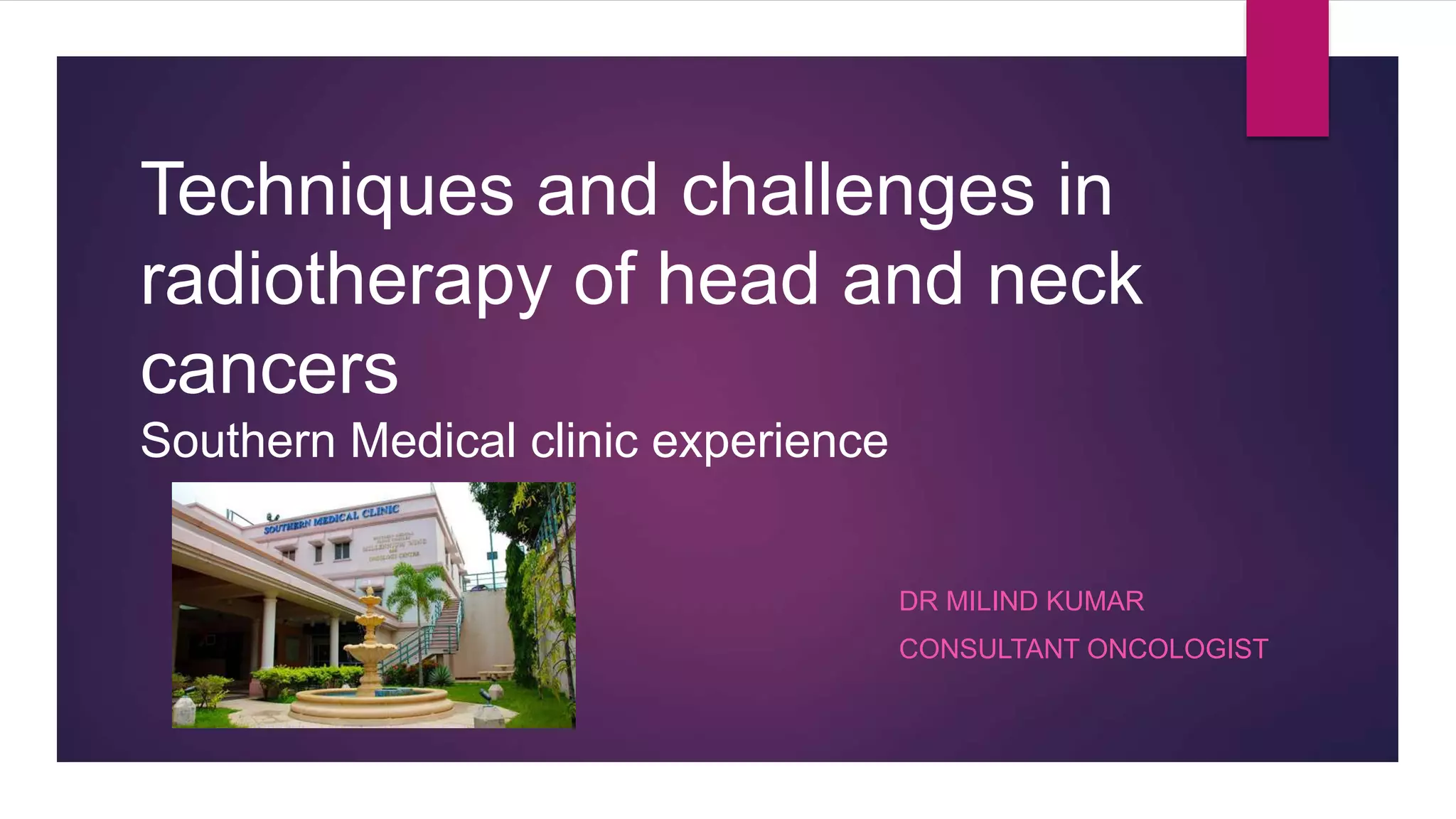
Techniques and challenges in
radiotherapy of head and neck
cancers
Southern Medical clinic experience
DR MILIND KUMAR
CONSULTANT ONCOLOGIST
Scope of presentation
 Overview of head and neck cancer & Radiotherapy
role
 Contouring & radiation planning guidelines followed
at SMOC
 SMOC experience (Rapidarc in Head and neck
patients)
Management of head and neck cancers
 Early stage (Stage I Stage II)—(Single modality)
Surgery or radiotherapy alone usually suffice
 Advanced stage(Stage III Stage IV)– (Multimodal)
Surgery followed by post op RT or concurrent chemoradiation
Radiotherapy vs surgery
 Multiple sessions –70Gy/35#/7 weeks vs one OT session
 Acute side effects—skin reactions, mucositis, pain, fungal infection
 Late side effects– loss of taste, xerostomia, dental caries, skin fibrosis.
 Organ preservation—speech, swallowing
 Weight loss during RT
Radiotherapy rationale
 Ionizing radiation– free radicals damage DNA of tumor
 While dividing tumor cells undergo apoptosis and cell death
 Differential effect on normal tissues and they are less rapidly dividing as
compared to malignant tissues.
 Radiotherapy want to focus on GTV-Gross tumor volume
 CTV-Clinical target volume for subclinical disease
 PTV-CTV + margin to account for daily set up errors and intra-fraction motion
Chemotherapy in head and neck cancers
 It is usually used in combination with radiotherapy (sequential or
concurrent).
 It has a role in organ / voice preservation (in laryngeal / hypopharyngeal
cancers) and in oropharyngeal cancers.
 In select patients chemotherapy can be used for palliating symptoms.
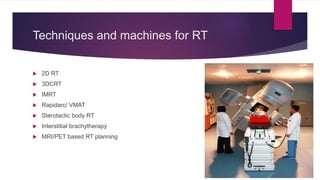
Techniques and machines for RT
 2D RT
 3DCRT
 IMRT
 Rapidarc/ VMAT
 Sterotactic body RT
 Interstitial brachytherapy
 MRI/PET based RT planning
Radiotherapy work flow
 Initial diagnosis---tissue diagnosis ---Surgical evaluation—MDT discussion
 Oncology consult—Diagnosis, investigations, staging and manangement planning
 Radiation Simulation- CT with immobilization mask
 Dosimetry—Identification and contouring organ at Risk
 Radiation oncologist—Identification and contouring GTV/CTV
 Dosimetry and Physicist—Planning, approval with RO, Quality assurance (patient specific
checks)
 Treatment delivery –Radiation therapists
 Image guided verification of treatment delivery (CBCT/KV/MV image correction)
 Weekly reviews with RO (Weight/ FBC/ local exam/ analgesia)
 Daily reviews with oncology nurse, dietitian, Counsellor as need arises.
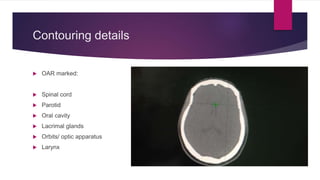
Contouring details
 OAR marked:
 Spinal cord
 Parotid
 Oral cavity
 Lacrimal glands
 Orbits/ optic apparatus
 Larynx
Contouring notes
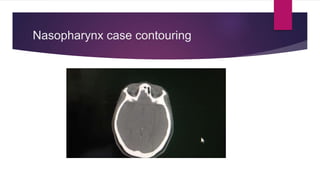
Nasopharynx case contouring
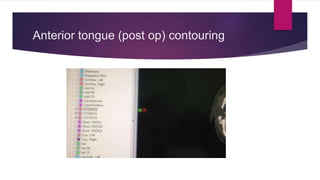
Anterior tongue (post op) contouring
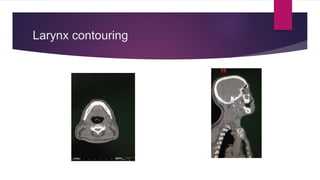
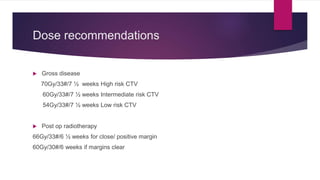
Larynx contouring
Dose recommendations
 Gross disease
70Gy/33#/7 ½ weeks High risk CTV
60Gy/33#/7 ½ weeks Intermediate risk CTV
54Gy/33#/7 ½ weeks Low risk CTV
 Post op radiotherapy
66Gy/33#/6 ½ weeks for close/ positive margin
60Gy/30#/6 weeks if margins clear
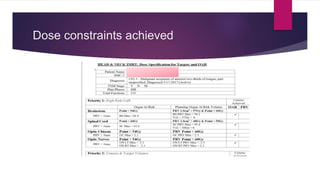
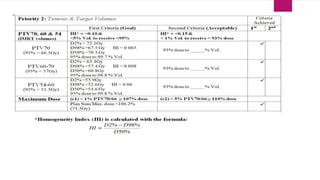
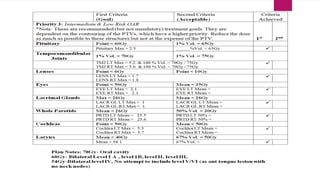
Dose constraints achieved
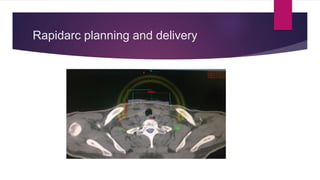
Rapidarc planning and delivery
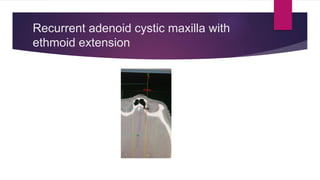
Recurrent adenoid cystic maxilla with
ethmoid extension
Image guidance-Treatment delivery
 CBCT-Weekly CBCT
CBCT on demand if weight loss >10%, if mask is loose/ not fitting well
 Kv-Kv imaging Daily done for matching.
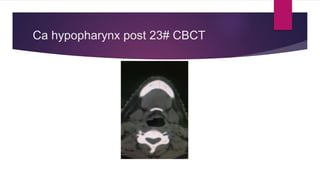
 Adaptive RT planning—In case of significant weight loss –CBCT –correlated with
planning CT scan and enables to re-CT sim and re-plan.
Ca hypopharynx post 23# CBCT
Radiation toxicities -Management
 Radiation induced skin reactions-Saline dressings, do not bandage, povidone –
iodine, flamazine
 Radiation induced mucositis- anbesol, magic mouthwash, soda bicarb gargles
 Analgesia- Tramacet, liquid morphine
 Weight loss- High protein diet sheet, daily monitoring by oncology nurses
SMOC experience
 32 patients of head and neck cancers/ radiation
 Nov 2015- Aug 2017 experience after commissioning of Rapidarc ix
 All patients received VMAT –RA
 Post op 60Gy-66Gy/30-33#
 Radical 70Gy/35#/7 or 70Gy/33#/7 ½ weeks with SIB technique
60Gy/30# 60Gy/33#
54Gy/33#
SMOC experience
 32 patients of head and neck cancers/ radiation
 Nov 2015- Aug 2017 experience after commissioning of Rapidarc ix
 All patients received VMAT –RA
 Post op 60Gy-66Gy/30-33#
 Radical 70Gy/35#/7 or 70Gy/33#/7 ½ weeks with SIB technique
60Gy/30# 60Gy/33#
54Gy/33#
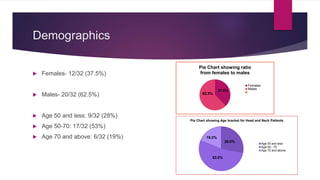
Demographics
 Females- 12/32 (37.5%)
 Males- 20/32 (62.5%)
 Age 50 and less: 9/32 (28%)
 Age 50-70: 17/32 (53%)
 Age 70 and above: 6/32 (19%)
Pie Chart showing ratio
from females to males
Females
Males
37.5%
62.5%
Pie Chart showing Age bracket for Head and Neck Patients
Age 50 and less
Age 50 - 70
Age 70 and above
28.0%
19.0%
53.0%
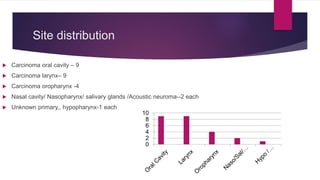
Site distribution
 Carcinoma oral cavity – 9
 Carcinoma larynx– 9
 Carcinoma oropharynx -4
 Nasal cavity/ Nasopharynx/ salivary glands /Acoustic neuroma--2 each
 Unknown primary,, hypopharynx-1 each
0
2
4
6
8
10
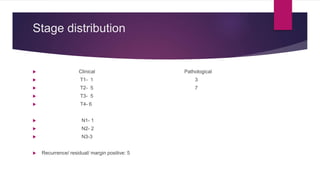
Stage distribution
 Clinical Pathological
 T1- 1 3
 T2- 5 7
 T3- 5
 T4- 6
 N1- 1
 N2- 2
 N3-3
 Recurrence/ residual/ margin positive: 5
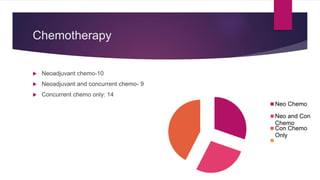
Chemotherapy
 Neoadjuvant chemo-10
 Neoadjuvant and concurrent chemo- 9
 Concurrent chemo only: 14
Neo Chemo
Neo and Con
Chemo
Con Chemo
Only
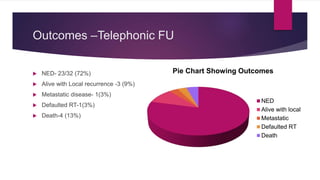
Outcomes –Telephonic FU
 NED- 23/32 (72%)
 Alive with Local recurrence -3 (9%)
 Metastatic disease- 1(3%)
 Defaulted RT-1(3%)
 Death-4 (13%)
Pie Chart Showing Outcomes
NED
Alive with local
Metastatic
Defaulted RT
Death
Our challenges
 Timely diagnosis
 Timely referral to higher centre and institution of appropriate treatment
 PEG insertion pre-RT
 Dental prophylaxis
 Weight loss-CBCT-Adaptive RT.
 Social issues-compliance
 Financial constraints—SMARA charity supportive.
Thank you
Teachers/ patients/ Team @ SMC

Head and neck radiotherapy experience

  • 1.
    Techniques and challengesin radiotherapy of head and neck cancers Southern Medical clinic experience DR MILIND KUMAR CONSULTANT ONCOLOGIST
  • 2.
    Scope of presentation Overview of head and neck cancer & Radiotherapy role  Contouring & radiation planning guidelines followed at SMOC  SMOC experience (Rapidarc in Head and neck patients)
  • 3.
    Management of headand neck cancers  Early stage (Stage I Stage II)—(Single modality) Surgery or radiotherapy alone usually suffice  Advanced stage(Stage III Stage IV)– (Multimodal) Surgery followed by post op RT or concurrent chemoradiation
  • 4.
    Radiotherapy vs surgery Multiple sessions –70Gy/35#/7 weeks vs one OT session  Acute side effects—skin reactions, mucositis, pain, fungal infection  Late side effects– loss of taste, xerostomia, dental caries, skin fibrosis.  Organ preservation—speech, swallowing  Weight loss during RT
  • 5.
    Radiotherapy rationale  Ionizingradiation– free radicals damage DNA of tumor  While dividing tumor cells undergo apoptosis and cell death  Differential effect on normal tissues and they are less rapidly dividing as compared to malignant tissues.  Radiotherapy want to focus on GTV-Gross tumor volume  CTV-Clinical target volume for subclinical disease  PTV-CTV + margin to account for daily set up errors and intra-fraction motion
  • 6.
    Chemotherapy in headand neck cancers  It is usually used in combination with radiotherapy (sequential or concurrent).  It has a role in organ / voice preservation (in laryngeal / hypopharyngeal cancers) and in oropharyngeal cancers.  In select patients chemotherapy can be used for palliating symptoms.
  • 7.
    Techniques and machinesfor RT  2D RT  3DCRT  IMRT  Rapidarc/ VMAT  Sterotactic body RT  Interstitial brachytherapy  MRI/PET based RT planning
  • 8.
    Radiotherapy work flow Initial diagnosis---tissue diagnosis ---Surgical evaluation—MDT discussion  Oncology consult—Diagnosis, investigations, staging and manangement planning  Radiation Simulation- CT with immobilization mask  Dosimetry—Identification and contouring organ at Risk  Radiation oncologist—Identification and contouring GTV/CTV  Dosimetry and Physicist—Planning, approval with RO, Quality assurance (patient specific checks)  Treatment delivery –Radiation therapists  Image guided verification of treatment delivery (CBCT/KV/MV image correction)  Weekly reviews with RO (Weight/ FBC/ local exam/ analgesia)  Daily reviews with oncology nurse, dietitian, Counsellor as need arises.
  • 9.
    Contouring details  OARmarked:  Spinal cord  Parotid  Oral cavity  Lacrimal glands  Orbits/ optic apparatus  Larynx
  • 10.
  • 11.
  • 12.
    Anterior tongue (postop) contouring
  • 13.
  • 14.
    Dose recommendations  Grossdisease 70Gy/33#/7 ½ weeks High risk CTV 60Gy/33#/7 ½ weeks Intermediate risk CTV 54Gy/33#/7 ½ weeks Low risk CTV  Post op radiotherapy 66Gy/33#/6 ½ weeks for close/ positive margin 60Gy/30#/6 weeks if margins clear
  • 15.
  • 18.
  • 19.
    Recurrent adenoid cysticmaxilla with ethmoid extension
  • 20.
    Image guidance-Treatment delivery CBCT-Weekly CBCT CBCT on demand if weight loss >10%, if mask is loose/ not fitting well  Kv-Kv imaging Daily done for matching.  Adaptive RT planning—In case of significant weight loss –CBCT –correlated with planning CT scan and enables to re-CT sim and re-plan.
  • 21.
  • 22.
    Radiation toxicities -Management Radiation induced skin reactions-Saline dressings, do not bandage, povidone – iodine, flamazine  Radiation induced mucositis- anbesol, magic mouthwash, soda bicarb gargles  Analgesia- Tramacet, liquid morphine  Weight loss- High protein diet sheet, daily monitoring by oncology nurses
  • 23.
    SMOC experience  32patients of head and neck cancers/ radiation  Nov 2015- Aug 2017 experience after commissioning of Rapidarc ix  All patients received VMAT –RA  Post op 60Gy-66Gy/30-33#  Radical 70Gy/35#/7 or 70Gy/33#/7 ½ weeks with SIB technique 60Gy/30# 60Gy/33# 54Gy/33#
  • 24.
    SMOC experience  32patients of head and neck cancers/ radiation  Nov 2015- Aug 2017 experience after commissioning of Rapidarc ix  All patients received VMAT –RA  Post op 60Gy-66Gy/30-33#  Radical 70Gy/35#/7 or 70Gy/33#/7 ½ weeks with SIB technique 60Gy/30# 60Gy/33# 54Gy/33#
  • 25.
    Demographics  Females- 12/32(37.5%)  Males- 20/32 (62.5%)  Age 50 and less: 9/32 (28%)  Age 50-70: 17/32 (53%)  Age 70 and above: 6/32 (19%) Pie Chart showing ratio from females to males Females Males 37.5% 62.5% Pie Chart showing Age bracket for Head and Neck Patients Age 50 and less Age 50 - 70 Age 70 and above 28.0% 19.0% 53.0%
  • 26.
    Site distribution  Carcinomaoral cavity – 9  Carcinoma larynx– 9  Carcinoma oropharynx -4  Nasal cavity/ Nasopharynx/ salivary glands /Acoustic neuroma--2 each  Unknown primary,, hypopharynx-1 each 0 2 4 6 8 10
  • 27.
    Stage distribution  ClinicalPathological  T1- 1 3  T2- 5 7  T3- 5  T4- 6  N1- 1  N2- 2  N3-3  Recurrence/ residual/ margin positive: 5
  • 28.
    Chemotherapy  Neoadjuvant chemo-10 Neoadjuvant and concurrent chemo- 9  Concurrent chemo only: 14 Neo Chemo Neo and Con Chemo Con Chemo Only
  • 29.
    Outcomes –Telephonic FU NED- 23/32 (72%)  Alive with Local recurrence -3 (9%)  Metastatic disease- 1(3%)  Defaulted RT-1(3%)  Death-4 (13%) Pie Chart Showing Outcomes NED Alive with local Metastatic Defaulted RT Death
  • 30.
    Our challenges  Timelydiagnosis  Timely referral to higher centre and institution of appropriate treatment  PEG insertion pre-RT  Dental prophylaxis  Weight loss-CBCT-Adaptive RT.  Social issues-compliance  Financial constraints—SMARA charity supportive.
  • 31.