Starting out with DIBH
Will Snyder, MS
Cartersville Medical Center
Cartersville, GA
April 16, 2021
Disclosures
• No disclosures to report
Cartersville Medical Center
• Located in Cartersville, GA
• Treating ~20 patients daily
• 3 therapists, 1 dosimetrist, 1 physicist
• 1 True Beam equipped with AlignRT camera system
• 1 GE Optima CT Simulator equipped with GateCT camera system
Overview
SECTION I: DIBH workflow (simulation, setup, treatment)
SECTION II: Our experience with DIBH using AlignRT Advance
SECTION III: Staff and patient benefits of SGRT
Section I: DIBH Workflow
Patient Education
• Prior to getting patient on the sim table, explain what is going to
happen.
• Urge patient to remain calm and do their best.
• Reassure patient that they will receive proper treatment regardless of
whether or not they can perform breath hold.
Section I: DIBH Workflow
Patient Coaching – Quick Tips
Coach the patient on what you’re looking for out of their breath hold:
1. Breathe in slowly through your nose
2. Fill your CHEST; not your BELLY
3. Don’t arch your back
Section I: DIBH Workflow
Patient Selection Criteria
CMC Patient Criteria list
1. Able to comfortably perform multiple 20-25 second breath holds.
2. Each breath hold is reproducible (GateCT, RPM, laser incident on skin)
3. Chest rise of at least 5 mm (not required but ideal).
Section I: DIBH Workflow
Once you’ve coached the patient, have them perform 3-4 practice breath
holds while you evaluate.
Section I: DIBH Workflow
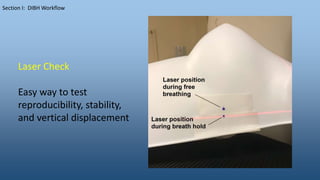
Laser Check
Easy way to test
reproducibility, stability,
and vertical displacement
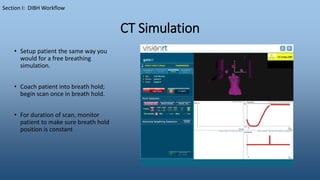
CT Simulation
• Setup patient the same way you
would for a free breathing
simulation.
• Coach patient into breath hold;
begin scan once in breath hold.
• For duration of scan, monitor
patient to make sure breath hold
position is constant
Section I: DIBH Workflow
CT Simulation (continued)
Once breath hold scan is completed. Keep patient in position and perform free
breathing scan.
GENERAL TIPS FOR SIMULATION:
• Be critical when monitoring patient
• Limit scan range to only what is necessary for planning
• If patient is really struggling during simulation, they may have trouble during treatment
Section I: DIBH Workflow
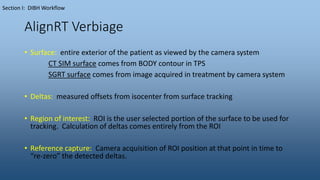
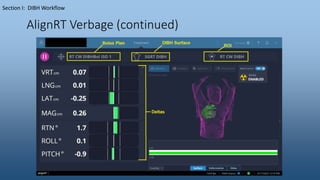
AlignRT Verbiage
• Surface: entire exterior of the patient as viewed by the camera system
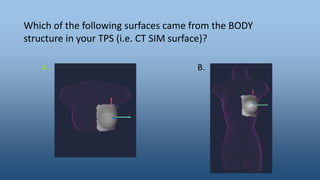
CT SIM surface comes from BODY contour in TPS
SGRT surface comes from image acquired in treatment by camera system
• Deltas: measured offsets from isocenter from surface tracking
• Region of interest: ROI is the user selected portion of the surface to be used for
tracking. Calculation of deltas comes entirely from the ROI
• Reference capture: Camera acquisition of ROI position at that point in time to
“re-zero” the detected deltas.
Section I: DIBH Workflow
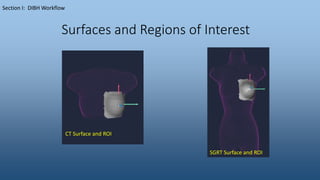
Surfaces and Regions of Interest
Section I: DIBH Workflow
CT Surface and ROI
SGRT Surface and ROI
AlignRT Verbage (continued)
Section I: DIBH Workflow
Treatment Preparation
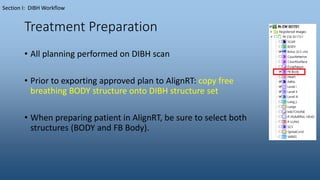
• All planning performed on DIBH scan
• Prior to exporting approved plan to AlignRT: copy free
breathing BODY structure onto DIBH structure set
• When preparing patient in AlignRT, be sure to select both
structures (BODY and FB Body).
Section I: DIBH Workflow
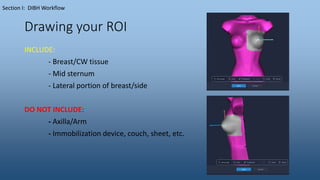
Drawing your ROI
Section I: DIBH Workflow
INCLUDE:
- Breast/CW tissue
- Mid sternum
- Lateral portion of breast/side
DO NOT INCLUDE:
- Axilla/Arm
- Immobilization device, couch, sheet, etc.
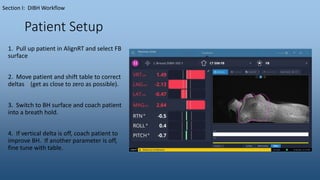
Patient Setup
1. Pull up patient in AlignRT and select FB
surface
2. Move patient and shift table to correct
deltas (get as close to zero as possible).
3. Switch to BH surface and coach patient
into a breath hold.
4. If vertical delta is off, coach patient to
improve BH. If another parameter is off,
fine tune with table.
Section I: DIBH Workflow
Patient Alignment and Treatment Delivery
• Acquire imaging with patient in BH
• Once shift is ready to be applied:
1. Coach patient into BH
2. Shift Table
3. Take reference capture “this and future sessions”
4. Tell patient to breath
• Switch to FB surface and take a reference capture “this and future sessions”
Section I: DIBH Workflow
Treatment Delivery with bolus
• If no bolus is needed, you are ready to coach your patient into BH and begin
treatment
• If bolus needed, perform the following with 2 therapists
1. Go into room
2. Coach patient into BH
3. Therapist 1: place bolus while patient in BH
4. Therapist 2: once bolus placed, take reference “this session only”
• Treat patient in BH using the reference taken with bolus
Section I: DIBH Workflow
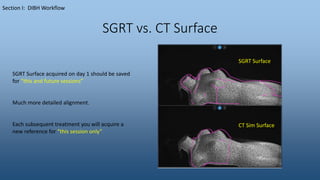
SGRT vs. CT Surface
Section I: DIBH Workflow
SGRT Surface acquired on day 1 should be saved
for “this and future sessions”
Much more detailed alignment.
Each subsequent treatment you will acquire a
new reference for “this session only”
SGRT Surface
CT Sim Surface
Section II: Helpful tips and lessons learned at
Cartersville
Make sure all staff is comfortable with system
SGRT is a therapy tool: make sure everybody is comfortable
• Performing DIBH simulation
• Importing DICOM and preparing ROI
• Initial patient alignment and reference capture
• Daily treatment
• Patient Coaching
Section II: Lessons Learned
Consistency when coaching breath holds
At simulation:
1. Breathe in slowly through your nose
2. Fill chest, NOT belly
3. Don’t arch your back
At Treatment:
1. “When you’re ready, perform a breath hold”
2. “You can breathe”
Section II: Lessons Learned
Simplicity is key!
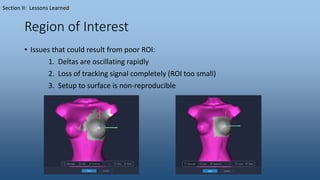
Region of Interest
• Issues that could result from poor ROI:
1. Deltas are oscillating rapidly
2. Loss of tracking signal completely (ROI too small)
3. Setup to surface is non-reproducible
Section II: Lessons Learned
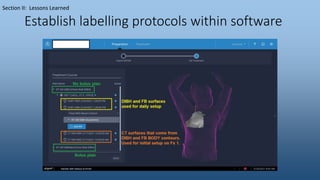
Establish labelling protocols within software
Section II: Lessons Learned
Summary of Lessons Learned:
• Make sure everybody can do each role involved in DIBH
• Use consistent phrasing when coaching patient to breath hold
• ROI can make or break a smooth treatment
• Labelling protocols for your surfaces
Section II: Lessons Learned
Section III: Staff and patient benefits of SGRT
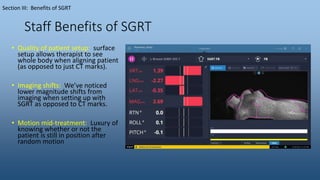
Staff Benefits of SGRT
• Quality of patient setup: surface
setup allows therapist to see
whole body when aligning patient
(as opposed to just CT marks).
• Imaging shifts: We’ve noticed
lower magnitude shifts from
imaging when setting up with
SGRT as opposed to CT marks.
• Motion mid-treatment: Luxury of
knowing whether or not the
patient is still in position after
random motion
Section III: Benefits of SGRT
Patient Benefits of SGRT
• Tattoo-less setup: we have stopped tattooing patients at CT sim as
we perform all initial alignments using SGRT.
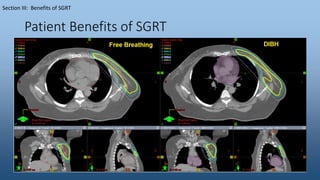
• Dosimetric benefit of DIBH: heart and lung sparing for DIBH patients
• Intrafraction Motion Monitoring: Using AlignRT for intrafraction
motion monitoring on SRS/SRT and SBRT patients.
Section III: Benefits of SGRT
Patient Benefits of SGRT
Section III: Benefits of SGRT
Thank you
Questions
Which structure(s) do you need to import into AlignRT
when preparing for a DIBH treatment?
A. Free Breathing BODY
B. DIBH BODY
C. DIBH BODY and Free Breathing BODY
D. DIBH BODY and Breast contour
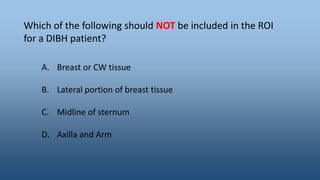
Which of the following should NOT be included in the ROI
for a DIBH patient?
A. Breast or CW tissue
B. Lateral portion of breast tissue
C. Midline of sternum
D. Axilla and Arm
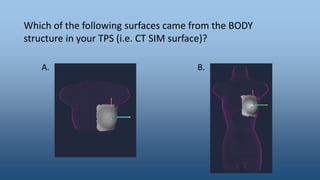
Which of the following surfaces came from the BODY
structure in your TPS (i.e. CT SIM surface)?
A. B.
What is the proper technique for a good breath hold?
A. Fill your chest
B. Fill your belly
C. Arch your back
Which of the following are we looking for in a good DIBH
candidate?
A. Ability to hold breath for 20-25 seconds
B. Reproducibility of chest position during breath hold
C. Stability of lung filling throughout breath hold
D. All of the above
Answers
Which structure(s) do you need to import into AlignRT
when preparing for a DIBH treatment?
A. Free Breathing BODY
B. DIBH BODY
C. DIBH BODY and Free Breathing BODY
D. DIBH BODY and Breast contour
Which of the following should NOT be included in the ROI
for a DIBH patient?
A. Breast or CW tissue
B. Lateral portion of breast tissue
C. Midline of sternum
D. Axilla and Arm
Which of the following surfaces came from the BODY
structure in your TPS (i.e. CT SIM surface)?
A. B.
What is the proper technique for a good breath hold?
A. Fill your chest
B. Fill your belly
C. Arch your back
Which of the following are we looking for in a good DIBH
candidate?
A. Ability to hold breath for 20-25 seconds
B. Reproducibility of chest position during breath hold
C. Stability of lung filling throughout breath hold
D. All of the above

Starting out with DIBH

  • 1.
    Starting out withDIBH Will Snyder, MS Cartersville Medical Center Cartersville, GA April 16, 2021
  • 2.
  • 3.
    Cartersville Medical Center •Located in Cartersville, GA • Treating ~20 patients daily • 3 therapists, 1 dosimetrist, 1 physicist • 1 True Beam equipped with AlignRT camera system • 1 GE Optima CT Simulator equipped with GateCT camera system
  • 4.
    Overview SECTION I: DIBHworkflow (simulation, setup, treatment) SECTION II: Our experience with DIBH using AlignRT Advance SECTION III: Staff and patient benefits of SGRT
  • 5.
  • 6.
    Patient Education • Priorto getting patient on the sim table, explain what is going to happen. • Urge patient to remain calm and do their best. • Reassure patient that they will receive proper treatment regardless of whether or not they can perform breath hold. Section I: DIBH Workflow
  • 7.
    Patient Coaching –Quick Tips Coach the patient on what you’re looking for out of their breath hold: 1. Breathe in slowly through your nose 2. Fill your CHEST; not your BELLY 3. Don’t arch your back Section I: DIBH Workflow
  • 8.
    Patient Selection Criteria CMCPatient Criteria list 1. Able to comfortably perform multiple 20-25 second breath holds. 2. Each breath hold is reproducible (GateCT, RPM, laser incident on skin) 3. Chest rise of at least 5 mm (not required but ideal). Section I: DIBH Workflow Once you’ve coached the patient, have them perform 3-4 practice breath holds while you evaluate.
  • 9.
    Section I: DIBHWorkflow Laser Check Easy way to test reproducibility, stability, and vertical displacement
  • 10.
    CT Simulation • Setuppatient the same way you would for a free breathing simulation. • Coach patient into breath hold; begin scan once in breath hold. • For duration of scan, monitor patient to make sure breath hold position is constant Section I: DIBH Workflow
  • 11.
    CT Simulation (continued) Oncebreath hold scan is completed. Keep patient in position and perform free breathing scan. GENERAL TIPS FOR SIMULATION: • Be critical when monitoring patient • Limit scan range to only what is necessary for planning • If patient is really struggling during simulation, they may have trouble during treatment Section I: DIBH Workflow
  • 12.
    AlignRT Verbiage • Surface:entire exterior of the patient as viewed by the camera system CT SIM surface comes from BODY contour in TPS SGRT surface comes from image acquired in treatment by camera system • Deltas: measured offsets from isocenter from surface tracking • Region of interest: ROI is the user selected portion of the surface to be used for tracking. Calculation of deltas comes entirely from the ROI • Reference capture: Camera acquisition of ROI position at that point in time to “re-zero” the detected deltas. Section I: DIBH Workflow
  • 13.
    Surfaces and Regionsof Interest Section I: DIBH Workflow CT Surface and ROI SGRT Surface and ROI
  • 14.
  • 15.
    Treatment Preparation • Allplanning performed on DIBH scan • Prior to exporting approved plan to AlignRT: copy free breathing BODY structure onto DIBH structure set • When preparing patient in AlignRT, be sure to select both structures (BODY and FB Body). Section I: DIBH Workflow
  • 16.
    Drawing your ROI SectionI: DIBH Workflow INCLUDE: - Breast/CW tissue - Mid sternum - Lateral portion of breast/side DO NOT INCLUDE: - Axilla/Arm - Immobilization device, couch, sheet, etc.
  • 17.
    Patient Setup 1. Pullup patient in AlignRT and select FB surface 2. Move patient and shift table to correct deltas (get as close to zero as possible). 3. Switch to BH surface and coach patient into a breath hold. 4. If vertical delta is off, coach patient to improve BH. If another parameter is off, fine tune with table. Section I: DIBH Workflow
  • 18.
    Patient Alignment andTreatment Delivery • Acquire imaging with patient in BH • Once shift is ready to be applied: 1. Coach patient into BH 2. Shift Table 3. Take reference capture “this and future sessions” 4. Tell patient to breath • Switch to FB surface and take a reference capture “this and future sessions” Section I: DIBH Workflow
  • 19.
    Treatment Delivery withbolus • If no bolus is needed, you are ready to coach your patient into BH and begin treatment • If bolus needed, perform the following with 2 therapists 1. Go into room 2. Coach patient into BH 3. Therapist 1: place bolus while patient in BH 4. Therapist 2: once bolus placed, take reference “this session only” • Treat patient in BH using the reference taken with bolus Section I: DIBH Workflow
  • 20.
    SGRT vs. CTSurface Section I: DIBH Workflow SGRT Surface acquired on day 1 should be saved for “this and future sessions” Much more detailed alignment. Each subsequent treatment you will acquire a new reference for “this session only” SGRT Surface CT Sim Surface
  • 21.
    Section II: Helpfultips and lessons learned at Cartersville
  • 22.
    Make sure allstaff is comfortable with system SGRT is a therapy tool: make sure everybody is comfortable • Performing DIBH simulation • Importing DICOM and preparing ROI • Initial patient alignment and reference capture • Daily treatment • Patient Coaching Section II: Lessons Learned
  • 23.
    Consistency when coachingbreath holds At simulation: 1. Breathe in slowly through your nose 2. Fill chest, NOT belly 3. Don’t arch your back At Treatment: 1. “When you’re ready, perform a breath hold” 2. “You can breathe” Section II: Lessons Learned Simplicity is key!
  • 24.
    Region of Interest •Issues that could result from poor ROI: 1. Deltas are oscillating rapidly 2. Loss of tracking signal completely (ROI too small) 3. Setup to surface is non-reproducible Section II: Lessons Learned
  • 25.
    Establish labelling protocolswithin software Section II: Lessons Learned
  • 26.
    Summary of LessonsLearned: • Make sure everybody can do each role involved in DIBH • Use consistent phrasing when coaching patient to breath hold • ROI can make or break a smooth treatment • Labelling protocols for your surfaces Section II: Lessons Learned
  • 27.
    Section III: Staffand patient benefits of SGRT
  • 28.
    Staff Benefits ofSGRT • Quality of patient setup: surface setup allows therapist to see whole body when aligning patient (as opposed to just CT marks). • Imaging shifts: We’ve noticed lower magnitude shifts from imaging when setting up with SGRT as opposed to CT marks. • Motion mid-treatment: Luxury of knowing whether or not the patient is still in position after random motion Section III: Benefits of SGRT
  • 29.
    Patient Benefits ofSGRT • Tattoo-less setup: we have stopped tattooing patients at CT sim as we perform all initial alignments using SGRT. • Dosimetric benefit of DIBH: heart and lung sparing for DIBH patients • Intrafraction Motion Monitoring: Using AlignRT for intrafraction motion monitoring on SRS/SRT and SBRT patients. Section III: Benefits of SGRT
  • 30.
    Patient Benefits ofSGRT Section III: Benefits of SGRT
  • 31.
  • 32.
  • 33.
    Which structure(s) doyou need to import into AlignRT when preparing for a DIBH treatment? A. Free Breathing BODY B. DIBH BODY C. DIBH BODY and Free Breathing BODY D. DIBH BODY and Breast contour
  • 34.
    Which of thefollowing should NOT be included in the ROI for a DIBH patient? A. Breast or CW tissue B. Lateral portion of breast tissue C. Midline of sternum D. Axilla and Arm
  • 35.
    Which of thefollowing surfaces came from the BODY structure in your TPS (i.e. CT SIM surface)? A. B.
  • 36.
    What is theproper technique for a good breath hold? A. Fill your chest B. Fill your belly C. Arch your back
  • 37.
    Which of thefollowing are we looking for in a good DIBH candidate? A. Ability to hold breath for 20-25 seconds B. Reproducibility of chest position during breath hold C. Stability of lung filling throughout breath hold D. All of the above
  • 38.
  • 39.
    Which structure(s) doyou need to import into AlignRT when preparing for a DIBH treatment? A. Free Breathing BODY B. DIBH BODY C. DIBH BODY and Free Breathing BODY D. DIBH BODY and Breast contour
  • 40.
    Which of thefollowing should NOT be included in the ROI for a DIBH patient? A. Breast or CW tissue B. Lateral portion of breast tissue C. Midline of sternum D. Axilla and Arm
  • 41.
    Which of thefollowing surfaces came from the BODY structure in your TPS (i.e. CT SIM surface)? A. B.
  • 42.
    What is theproper technique for a good breath hold? A. Fill your chest B. Fill your belly C. Arch your back
  • 43.
    Which of thefollowing are we looking for in a good DIBH candidate? A. Ability to hold breath for 20-25 seconds B. Reproducibility of chest position during breath hold C. Stability of lung filling throughout breath hold D. All of the above

Editor's Notes

  • #4 45 miles NW of Atlanta Been physicist at CMC since June 2019 Stereotactic program: Mainly lung/spine SBRT, occasional intracranial SRS/SRT  using AlignRT for motion monitoring DIBH program has been active for 4-5 Purpose: go over our DIBH workflow: share initial experience, present lessons learned, give some tips that can be used in your own clinical workflow
  • #5 Spend most time going over workflow; used framework of VisionRT workflow We’ve learned a lot during initial experience Other ways SGRT has benefited out clinic; general setup, stereotactic
  • #7 1. Just like any sim, explain to the patient how the procedure is gonna go. DIFFERENT HERE: you don’t know whether or not they will be treated FB or BH Holding your breath does not come naturally (to most). It can be a stressful thing for some patients, remind them to remain calm and do their best! Before you know if they are a candidate, avoid harping too much on dosimetry (heart sparing, lung sparing, etc.). Have seen a patient get upset when they couldn’t perform BH; afraid their heart wouldn’t be spared.
  • #8 After patient education, once they’re in position on the sim table, teach them how to perform their breath hold. We’ve found these three tips to be very helpful: In through the nose slows the inhale down (less chance of patient jerking body) Filling the chest is likely to increase heart – CW distance. Arching your back will displace patient from immobilization, changing their body position making reproducibility less likely We’ve found these to be practical and easy to grasp. (Generally only bring up #3 if it’s noticed to be an issue). Find whatever verbiage works for you: the most important thing is that
  • #9 Once you’ve coached the patient on their BH, have them perform a couple for practice while you evaluate. We are looking for 3 main things: Our standard is a 20 second breath hold without getting fatigued. We’ll need them to perform BH for multiple imaging and treatment fields, so we need to know they can comfortably do several in a row. Reproducibility can be checked in a few ways. Laser check on skin is a very easy way to check this We’d like to see a decent sized vertical displacement during breath hold (signify more space between heart – CW), but not absolutely necessary. Cannot tell until you look at scan (heart sometimes moves with diaphragm) You will find out what criteria works for your workflow. Maybe you can get away with shorter BH. However, you don’t want your treatment to take forever, and you don’t want your patient to be miserable throughout. Select a criteria, see how it works, adjust, repeat.

  • #10 We have the GateCT system (which we use for monitoring during scan), but have found this to be just as effective and easy for the initial patient analysis. Draw dot on patient’s side at coronal laser incidence Coach patient into breath hold. As chest rises, laser incidence moves posteriorly Once stable, draw another dot at coronal laser incidence (BH dot) After BH complete, FB dot should return to laser Very simple, quick and dirty way to check 3 things: Reproducibility (laser returns to the same spot) Stability (not letting air out slowly during BH) Vertical movement of chest (distance between dots)
  • #11 Image to the right shows GateCT interface. Perform scan once BH appears stable. Cosely monitor that patient is not slowly letting air our throughout the scan. Other than GateCT: RPM, bellows belt, ABC, or other 4DCT technologies can likely be applied here. You are really just trying to make sure that the BH is reproducible and stable throughout duration of scan.
  • #12 I’d recommend performing DIBH scan first. If patient has any trouble and needs to get up from table for some reason, it’s almost certain to happen during DIBH scan. If you’ve already done your FB scan then they’ll have to be manually registered (added step). Once DIBH scan is successfully completed, have the patient relax and breathe normal for a quick FB scan. This is the most important BH the patient will perform throughout the course of treatment, make sure it’s a good one. When you go to setup on day 1, it will go very smoothly if simulation is done properly . This BH is likely going to be on the longer side (relative to Tx days). Save them a few seconds by not over scanning If you notice patient is really struggling during simulation, give them a rest and ask how they’re feeling. Make sure they will be able to reproduce this every day for several weeks. Spent A LOT of time going over simulation, it is critical to having success in your daily setup.
  • #13 Prior to getting into the Tx workflow, we’ll go over some terminology utilized in the AlignRT system for when they come up during this next section. SURFACE: Two types of surfaces: CT SIM-Body contour in TPS; SGRT – reconstructed from images acquired in treatment by the camera system DELTAS: Deltas show measured offsets from the current patient position to the treatment position (isocenter coming from plan file). ROI: User selected region of interest. Portion of surface to be used for surface tracking and calculation of deltas. Portions of surface outside the ROI DO NOT affect deltas. Reference Capture: Camera will acquire a new surface and transpose the ROI onto the current patient position, re-setting the deltas to zero. (after imaging, when you’re in your treatment position)
  • #16 Won’t go over planning procedure. One thing: You will need to copy your FB body structure into your planning structure set (DIBH set). This will be used for alignment When importing the patient into AlignRT, make sure both the BODY and FB Body are selected.
  • #19 Why acquire a FB reference?
  • #20 Bolus must be placed during BH. Will require some coordination between Therapist 1 and 2
  • #24 We made the point that everybody should be comfortable with these procedures. However, make sure that you have consistency
  • #29 Video mode is GREAT for setup. Compare this view to setting up to CT marks, it’s far superior. Related to this  imaging shifts have gone down. Representative of higher quality setups. If patient coughs, you don’t have to re-image