Radial neck fracture
Dr. Ashiqur Rahman
Resident Orthopedics
Dhaka Medical college Hospital
Introduction
 In adults a displaced fracture of the radial neck may need open
reduction.
 if so, a pre-contoured locking plate can be applied, carefully placed to
avoid the articular surface during rotation.
 If undisplaced, non-operative management can produce acceptable
results despite a relatively high rate of non-union. Most are
asymptomatic.
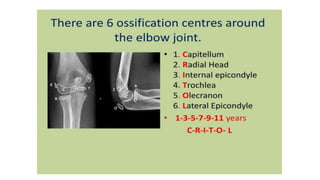
 In children with radial neck # usually are 04 to 14 years old.
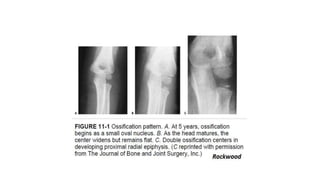
 Primarily because, ossification of the radial head usually
does not begin before 5 years of age.
 The normal anatomical angulation of the radial neck in children has
been erroneously diagnosed as a buckle fracture in this area.
 In AP Radiograph lateral angulation varies from 0-15°
 And in lateral radiograph 10° anterior to 5° posterior.
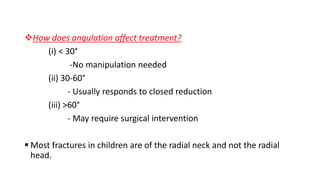
How does angulation affect treatment?
(i) < 30°
-No manipulation needed
(ii) 30-60°
- Usually responds to closed reduction
(iii) >60°
- May require surgical intervention
 Most fractures in children are of the radial neck and not the radial
head.
Clinical feature:
- Palpation over the radial head and neck is painful.
- Passive forearm pronation and supination is painful.
- A young child may primarily complains wrist pain and the
pressure over the proximal radius may accentuate the referred
wrist pain.
- Wrist pain is secondary to radial shortening and distal radio
ulnar dysfunction.
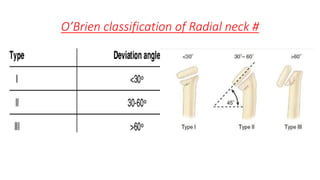
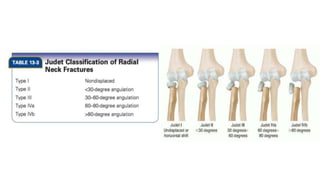
O’Brien classification of Radial neck #
Treatment option of Radial neck #
1. Immobilization with no manipulation.
2. Manipulative closed reduction
3. Percutaneous pin reduction
4. Intramedullary pin reduction
5. Open reduction with or without internal fixation
6. Excision of radial head. Or a small head fragment.
Non operative methods:
- Younger children angulation less than 20 to 30 degrees.
- A collar and cuff or a simple posterior long cast is enough.
Manipulative closed reduction:
- Angulation up to 40 to 45 degrees.
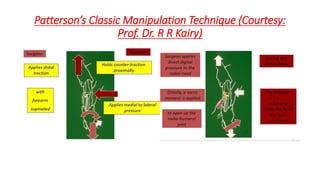
Patterson’s Classic Manipulation Technique (Courtesy:
Prof. Dr. R R Kairy)
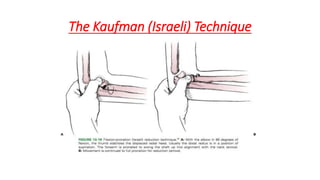
The Kaufman (Israeli) Technique
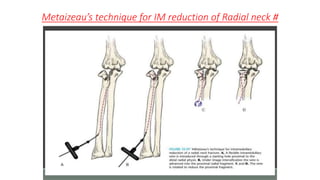
Metaizeau’s technique for IM reduction of Radial neck #
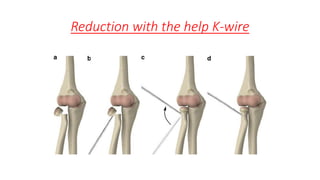
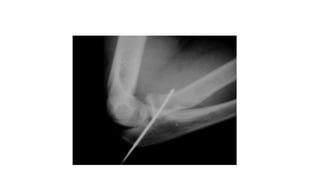
Reduction with the help K-wire
Complication:
1. Loss of motion
2. Radial head overgrowth
3. Non union
4. Avascular necrosis.

Radial neck fracture

  • 1.
    Radial neck fracture Dr.Ashiqur Rahman Resident Orthopedics Dhaka Medical college Hospital
  • 2.
    Introduction  In adultsa displaced fracture of the radial neck may need open reduction.  if so, a pre-contoured locking plate can be applied, carefully placed to avoid the articular surface during rotation.  If undisplaced, non-operative management can produce acceptable results despite a relatively high rate of non-union. Most are asymptomatic.
  • 3.
     In childrenwith radial neck # usually are 04 to 14 years old.  Primarily because, ossification of the radial head usually does not begin before 5 years of age.
  • 8.
     The normalanatomical angulation of the radial neck in children has been erroneously diagnosed as a buckle fracture in this area.  In AP Radiograph lateral angulation varies from 0-15°  And in lateral radiograph 10° anterior to 5° posterior.
  • 9.
    How does angulationaffect treatment? (i) < 30° -No manipulation needed (ii) 30-60° - Usually responds to closed reduction (iii) >60° - May require surgical intervention  Most fractures in children are of the radial neck and not the radial head.
  • 10.
    Clinical feature: - Palpationover the radial head and neck is painful. - Passive forearm pronation and supination is painful. - A young child may primarily complains wrist pain and the pressure over the proximal radius may accentuate the referred wrist pain. - Wrist pain is secondary to radial shortening and distal radio ulnar dysfunction.
  • 11.
  • 13.
    Treatment option ofRadial neck # 1. Immobilization with no manipulation. 2. Manipulative closed reduction 3. Percutaneous pin reduction 4. Intramedullary pin reduction 5. Open reduction with or without internal fixation 6. Excision of radial head. Or a small head fragment.
  • 14.
    Non operative methods: -Younger children angulation less than 20 to 30 degrees. - A collar and cuff or a simple posterior long cast is enough. Manipulative closed reduction: - Angulation up to 40 to 45 degrees.
  • 15.
    Patterson’s Classic ManipulationTechnique (Courtesy: Prof. Dr. R R Kairy)
  • 16.
  • 17.
    Metaizeau’s technique forIM reduction of Radial neck #
  • 18.
    Reduction with thehelp K-wire
  • 20.
    Complication: 1. Loss ofmotion 2. Radial head overgrowth 3. Non union 4. Avascular necrosis.