Supra-condylar fracture
• Supracondylar humeral fracture are the most common pediatric
fractures.
• Accounting for 3% of all children’s fractures.
• The most common age of injury is 5 to 7 years.
• Almost all (98%) are extension type injuries, which is usually caused
by fall on the outstretched hand.
• Flexion type fractures, almost rarer, are most difficult to reduce.
• Flexion type have worse outcomes, and are associated ulnar nerve
injury.
• Approximately, 5 – 10% of child have an associated ipsilateral distal
radial fracture.
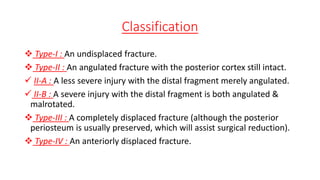
Classification
 Type-I : An undisplaced fracture.
 Type-II : An angulated fracture with the posterior cortex still intact.
 II-A : A less severe injury with the distal fragment merely angulated.
 II-B : A severe injury with the distal fragment is both angulated &
malrotated.
 Type-III : A completely displaced fracture (although the posterior
periosteum is usually preserved, which will assist surgical reduction).
 Type-IV : An anteriorly displaced fracture.
Clinical features
• The child is in pain & the elbow is swollen.
• With a posteriorly displaced fracture the S-deformity in the elbow.
• It is essential to feel the pulse distally & check capillary return.
• Passive extension of the flexor muscles should be pain-free otherwise
there may be concern regarding ischemia.
• The wrist & hand should be examined for evidence of nerve injury.
X-ray
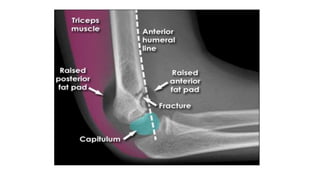
1. Fad pad sign :
 In undisplaced fracture the ‘fad pad’ or ‘sail’ sign should raise
suspicion.
 This is a triangular lucency in front of & behind the distal humerus
like the sail of a yacht, due to the fad pad being pushed by fluid such
as a hematoma.
2. Anterior humeral line:
 A line drawn along the anterior cortex of the humerus should cross
the middle of the capitellum.
 If the line is anterior to the capitellum, a type-II # is suspected.
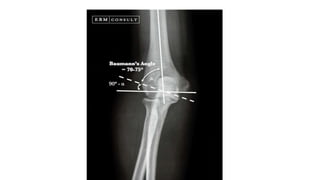
3. Baumen’s angle :
 In AP X-ray of the elbow a line drawn along the long axis of the
humeral shaft & a line through the coronal axis of the capitellar
physis.
 Normally the angle is less than 80 degrees.
 If the distal fragment is tilted varus, the increased angle is readily
detected.
Treatment
• If there is even suspicion of a fracture, the elbow us gently splinted in
30 degrees of flexion to prevent movement and possible
neurovascular injury during X-ray examination.
1. Type-I : Undisplaced fracture
 The elbow is immobilized in 90° & neutral rotation.
 A light weight splint or a cast is applied & the arm is supported in a
sling.
 It is essential to obtain an X-ray 5-7 days later to check that there
has been no displacement.
 The splint is retained for 3 weeks and supervised movements is
then allowed.
2. Type-IIA : Posteriorly angulated fracture – Mild
 If the posterior cortex are in continuity, the fracture can be reduced
under GA.
 Closed reduction & casting may be used in patients with IIA
injuries.(Camb.)
 Closed reduction & percutaneous pinning with 02 to 03 lateral pins
has become the main form of Rx for type IIB.(Camb.)
 We prefer to pin most of the type-II # because of concerns about the
ability to maintain reduction in a splint or cast.
3. Type-IIB &III:
 These are usually associated with severe swelling, are difficult to
reduce & are often unstable.
 Moreover, there is considerable risk of neurovascular injury or
circulatory compromise due to swelling.
 The fracture should be reduced under GA as soon as possible by the
following manoeuvre :
Extension type injury
• Pt. in supine position, traction for 2-3 minutes in length of the arm
with counter traction above the elbow.
• Correction of any sideway tilt or shift and rotation (in comparison
with the arm)
• Gradual flexion of the elbow to 120°, and pronation of the forearm to
lock posterior & medial soft tissue hinge, while maintaining traction &
exerting finger pressure on the olecranon to correct the posterior tilt.
• Then feel pulse & check the capillary return; if the distal circulation is
suspect, immediate relax the amount of elbow flexion until it
improves.
• Confirm the Anteroposterior reduction by the image intensification,
aiming the beam through the forearm & rotating the humerus from
medial to lateral column reduction. Confirm lateral reduction to
obtain a lateral view of the elbow.(Camb.)
• Maintain reduction while performing closed percutaneous pinning
with image intensification to verify that the lateral 02 pins engage the
both fracture fragments.(Camb.)
• The pin should be divergent & not cross at fracture site.(Camb.)
• If a medial pin used, make a 1cm incision over the medial epicondyle.
• Spread the soft tissues so that the medial epicondyle can be seen &
ensure the ulnar nerve is protected.
• Alternatively, a small soft tissue drill sleeve is used.
• A back slab is applied & the arm is held in a collar & cuff sling.
• The circulation should be checked repeatedly during the first 24
hours.
• An X-ray is obtained after 3-5 days to confirm that the # has not
slipped.
• The splint is retained for 3 – 4 weeks, after which movements are
begun.
• Check X-ray must be obtained on removal of the splint & wires to
ensure adequate position has been maintained.
Flexion type injury
• For a rarer, flexion type injury, flexing the elbow will further displace
the fragment because of the disruption of the posterior periosteal
hinge.
• The # is reduced by pulling on the forearm with the elbow semi-
flexed, applying thumb pressure over the front of the distal fragment
& then extending the elbow fully.
• Percutaneous smooth pin are used if unstable.
• In this case elbow is need to be pinned in extension.
• A posterior slab is applied if unstable.
Complications
Early :
• Vascular injury
• Nerve injury
Late :
• Malunion
• Elbow stiffness
• Heterotopic ossification

Supra condylar fracture

  • 1.
  • 2.
    • Supracondylar humeralfracture are the most common pediatric fractures. • Accounting for 3% of all children’s fractures. • The most common age of injury is 5 to 7 years. • Almost all (98%) are extension type injuries, which is usually caused by fall on the outstretched hand. • Flexion type fractures, almost rarer, are most difficult to reduce. • Flexion type have worse outcomes, and are associated ulnar nerve injury.
  • 3.
    • Approximately, 5– 10% of child have an associated ipsilateral distal radial fracture.
  • 4.
    Classification  Type-I :An undisplaced fracture.  Type-II : An angulated fracture with the posterior cortex still intact.  II-A : A less severe injury with the distal fragment merely angulated.  II-B : A severe injury with the distal fragment is both angulated & malrotated.  Type-III : A completely displaced fracture (although the posterior periosteum is usually preserved, which will assist surgical reduction).  Type-IV : An anteriorly displaced fracture.
  • 5.
    Clinical features • Thechild is in pain & the elbow is swollen. • With a posteriorly displaced fracture the S-deformity in the elbow. • It is essential to feel the pulse distally & check capillary return. • Passive extension of the flexor muscles should be pain-free otherwise there may be concern regarding ischemia. • The wrist & hand should be examined for evidence of nerve injury.
  • 6.
    X-ray 1. Fad padsign :  In undisplaced fracture the ‘fad pad’ or ‘sail’ sign should raise suspicion.  This is a triangular lucency in front of & behind the distal humerus like the sail of a yacht, due to the fad pad being pushed by fluid such as a hematoma. 2. Anterior humeral line:  A line drawn along the anterior cortex of the humerus should cross the middle of the capitellum.  If the line is anterior to the capitellum, a type-II # is suspected.
  • 8.
    3. Baumen’s angle:  In AP X-ray of the elbow a line drawn along the long axis of the humeral shaft & a line through the coronal axis of the capitellar physis.  Normally the angle is less than 80 degrees.  If the distal fragment is tilted varus, the increased angle is readily detected.
  • 10.
    Treatment • If thereis even suspicion of a fracture, the elbow us gently splinted in 30 degrees of flexion to prevent movement and possible neurovascular injury during X-ray examination.
  • 11.
    1. Type-I :Undisplaced fracture  The elbow is immobilized in 90° & neutral rotation.  A light weight splint or a cast is applied & the arm is supported in a sling.  It is essential to obtain an X-ray 5-7 days later to check that there has been no displacement.  The splint is retained for 3 weeks and supervised movements is then allowed.
  • 12.
    2. Type-IIA :Posteriorly angulated fracture – Mild  If the posterior cortex are in continuity, the fracture can be reduced under GA.  Closed reduction & casting may be used in patients with IIA injuries.(Camb.)  Closed reduction & percutaneous pinning with 02 to 03 lateral pins has become the main form of Rx for type IIB.(Camb.)  We prefer to pin most of the type-II # because of concerns about the ability to maintain reduction in a splint or cast.
  • 13.
    3. Type-IIB &III: These are usually associated with severe swelling, are difficult to reduce & are often unstable.  Moreover, there is considerable risk of neurovascular injury or circulatory compromise due to swelling.  The fracture should be reduced under GA as soon as possible by the following manoeuvre :
  • 14.
    Extension type injury •Pt. in supine position, traction for 2-3 minutes in length of the arm with counter traction above the elbow. • Correction of any sideway tilt or shift and rotation (in comparison with the arm) • Gradual flexion of the elbow to 120°, and pronation of the forearm to lock posterior & medial soft tissue hinge, while maintaining traction & exerting finger pressure on the olecranon to correct the posterior tilt. • Then feel pulse & check the capillary return; if the distal circulation is suspect, immediate relax the amount of elbow flexion until it improves.
  • 15.
    • Confirm theAnteroposterior reduction by the image intensification, aiming the beam through the forearm & rotating the humerus from medial to lateral column reduction. Confirm lateral reduction to obtain a lateral view of the elbow.(Camb.) • Maintain reduction while performing closed percutaneous pinning with image intensification to verify that the lateral 02 pins engage the both fracture fragments.(Camb.) • The pin should be divergent & not cross at fracture site.(Camb.)
  • 16.
    • If amedial pin used, make a 1cm incision over the medial epicondyle. • Spread the soft tissues so that the medial epicondyle can be seen & ensure the ulnar nerve is protected. • Alternatively, a small soft tissue drill sleeve is used.
  • 17.
    • A backslab is applied & the arm is held in a collar & cuff sling. • The circulation should be checked repeatedly during the first 24 hours. • An X-ray is obtained after 3-5 days to confirm that the # has not slipped. • The splint is retained for 3 – 4 weeks, after which movements are begun. • Check X-ray must be obtained on removal of the splint & wires to ensure adequate position has been maintained.
  • 18.
    Flexion type injury •For a rarer, flexion type injury, flexing the elbow will further displace the fragment because of the disruption of the posterior periosteal hinge. • The # is reduced by pulling on the forearm with the elbow semi- flexed, applying thumb pressure over the front of the distal fragment & then extending the elbow fully. • Percutaneous smooth pin are used if unstable. • In this case elbow is need to be pinned in extension. • A posterior slab is applied if unstable.
  • 19.
    Complications Early : • Vascularinjury • Nerve injury Late : • Malunion • Elbow stiffness • Heterotopic ossification