PEDIATRIC RADIAL HEAD
DISLOCATION
By
Objectives
 Radiological Anatomy of the elbow
 Differentiate congenital vs traumatic (proper diagnosis)
 If traumatic isolated or Monteggia
 Debate in management
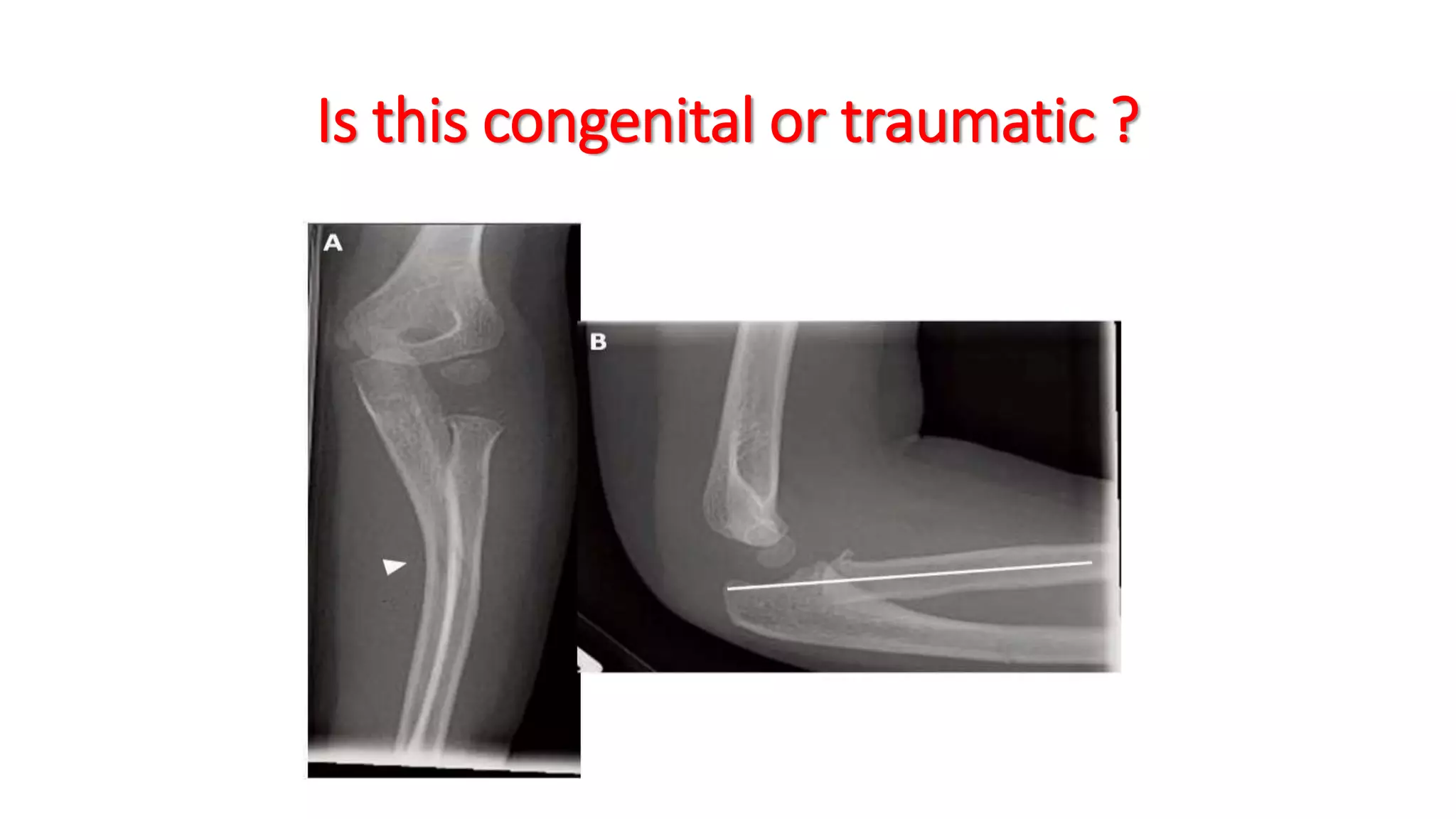
Is this congenital or traumatic ?
• Assessment of these radiographs depends on evaluating the
anatomic relationships of the ossification centers of the
elbow including
The position of the radial head relative to the capitellum
Anterior humeral line relative to the capitellum
Baumann’s angle
Interpretation of pediatric elbow radiographs is complicated by
the cartilaginous components of the elbow that are radiolucent.
Radio-capitullar line
(AP)
Anterior humeral &
Radio-capitullar lines
(Lat)
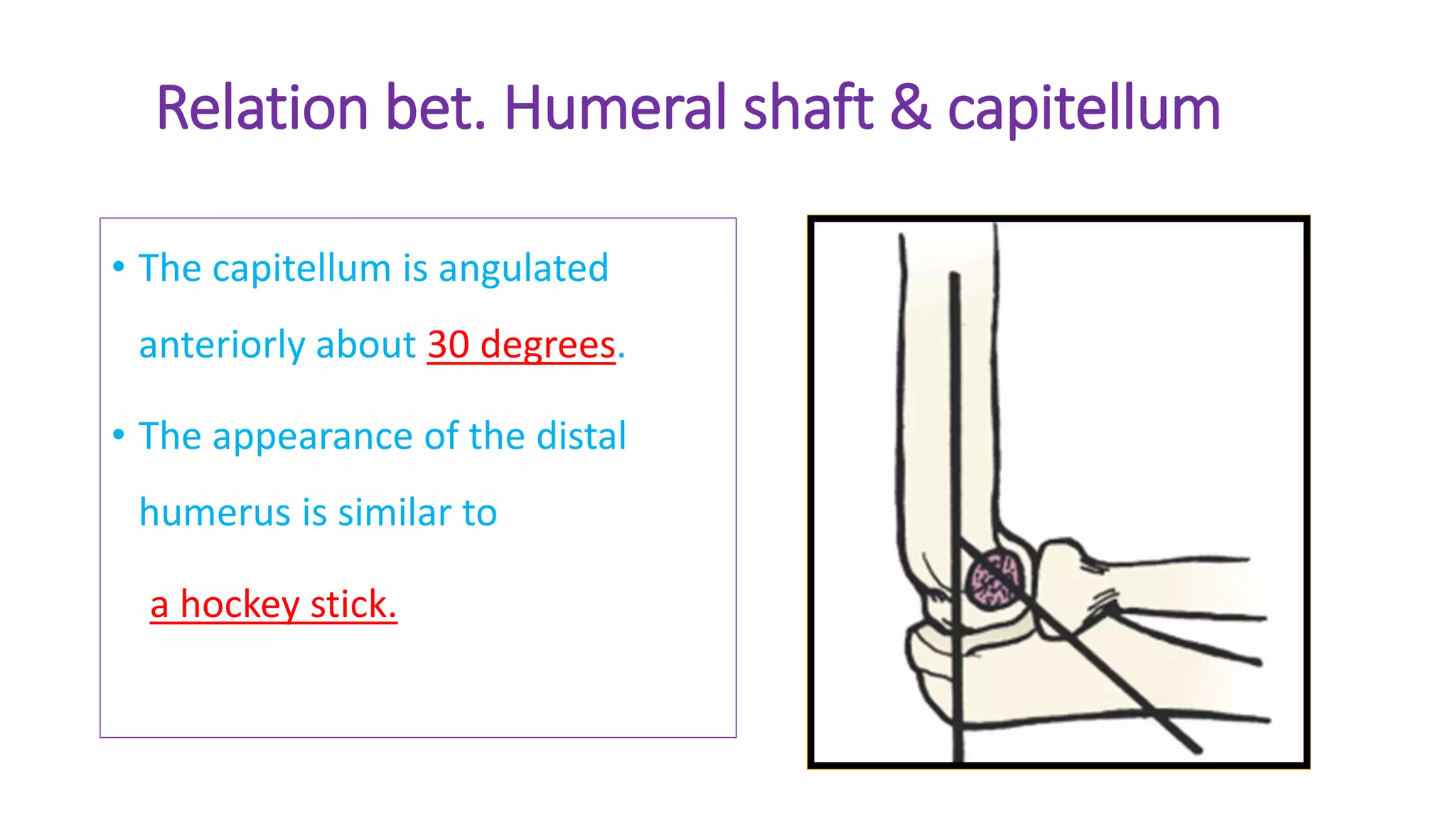
Relation bet. Humeral shaft & capitellum
• The capitellum is angulated
anteriorly about 30 degrees.
• The appearance of the distal
humerus is similar to
a hockey stick.
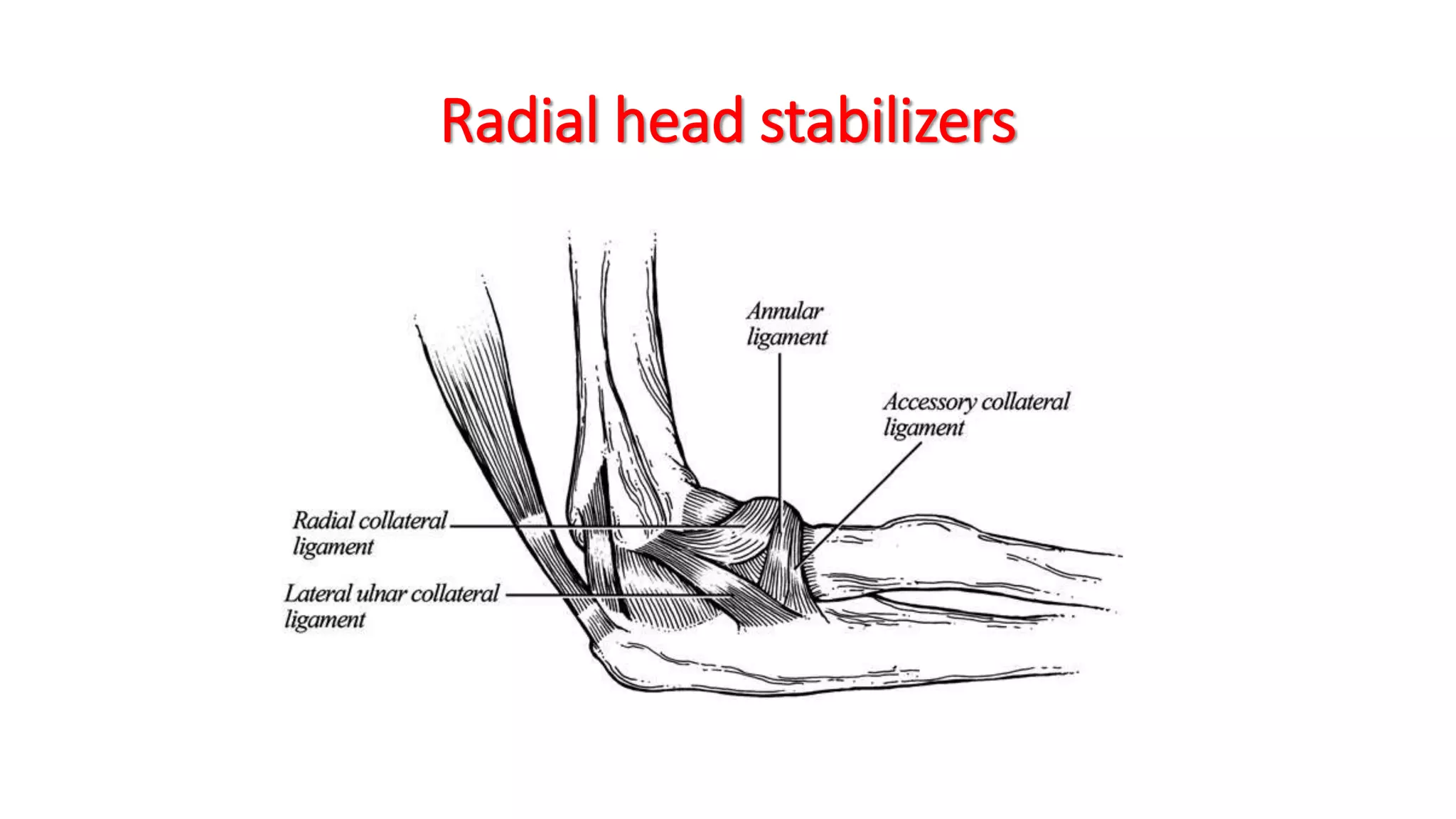
Radial head stabilizers
Causes
Congenital
• Rare but it is the
most common cong.
anomaly of elbow
• Isolated or syndromic
in more than of 50%
Traumatic
Mostly as a part of monteggia
Rarely as isolated
Developmental
Inadequate length of the
radius & multiple hereditary
osteochondromatosis (MHE)
Congenital VS traumatic
 Bilateral involvement in 60%
 Hypoplastic capitellum
 Lack of history of trauma
 Dome shaped radial head
 Other congenital anomalies
 Posterior is the most common
Radiographic diagnostic criteria as described
by McFarland
 Shortening of the ulna or overlength of
the radius
 Hypoplasia of the capitellum
 Grooving of the distal radius
 Prominent ulnar epicondyle
 Partially defective trochlea
 Dome-shaped radial head with a long
narrow neck
Additional criteria that favour a congenital dislocation are
described by Mardam-Bey & Ger (1979)
 Bilateral involvement
 Other congenital anomalies
 Familial occurrence
 Dislocation seen at birth
 No history of trauma
 Ulnar bowing
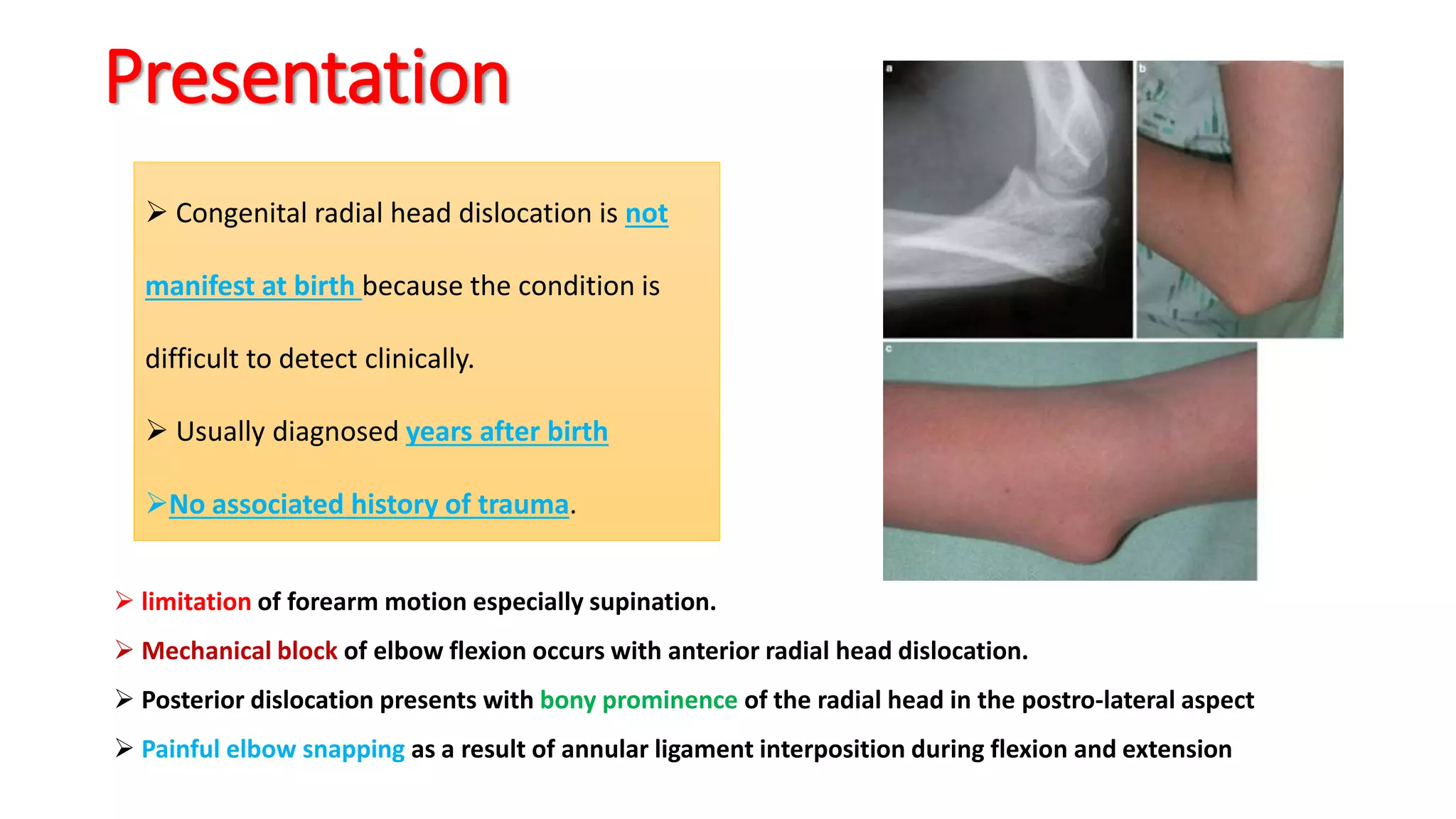
Presentation
 Congenital radial head dislocation is not
manifest at birth because the condition is
difficult to detect clinically.
 Usually diagnosed years after birth
No associated history of trauma.
 limitation of forearm motion especially supination.
 Mechanical block of elbow flexion occurs with anterior radial head dislocation.
 Posterior dislocation presents with bony prominence of the radial head in the postro-lateral aspect
 Painful elbow snapping as a result of annular ligament interposition during flexion and extension
Isolated congenital vs syndromic
• 60% of all cases, seen in conjunction
with various syndromes e.g
Nail patella syndrome
Silver’s syndrome
Ehlers-Danlos syndrome
congenital radioulnar synostosis
mental retardation
Other associated anomalies include
 Skeletal dysplasia
 Craniosynostosis
 Synostosis of the tibia and fibula
 Scoliosis.
Nursemaid's elbow (Pulled elbow)
• Untreated traumatic dislocation of the radial head during childhood
may present with radiographic and clinical manifestations that are
similar to those of congenital radial head dislocation.
• The differentiation can be difficult.
Radiographic criteria that may support its congenital nature include:
 Short radius relative to the ulna
 Bilateral involvement
 The presence of other musculoskeletal anomalies
Let‘s to answer this ?
Is this congenital or traumatic ?
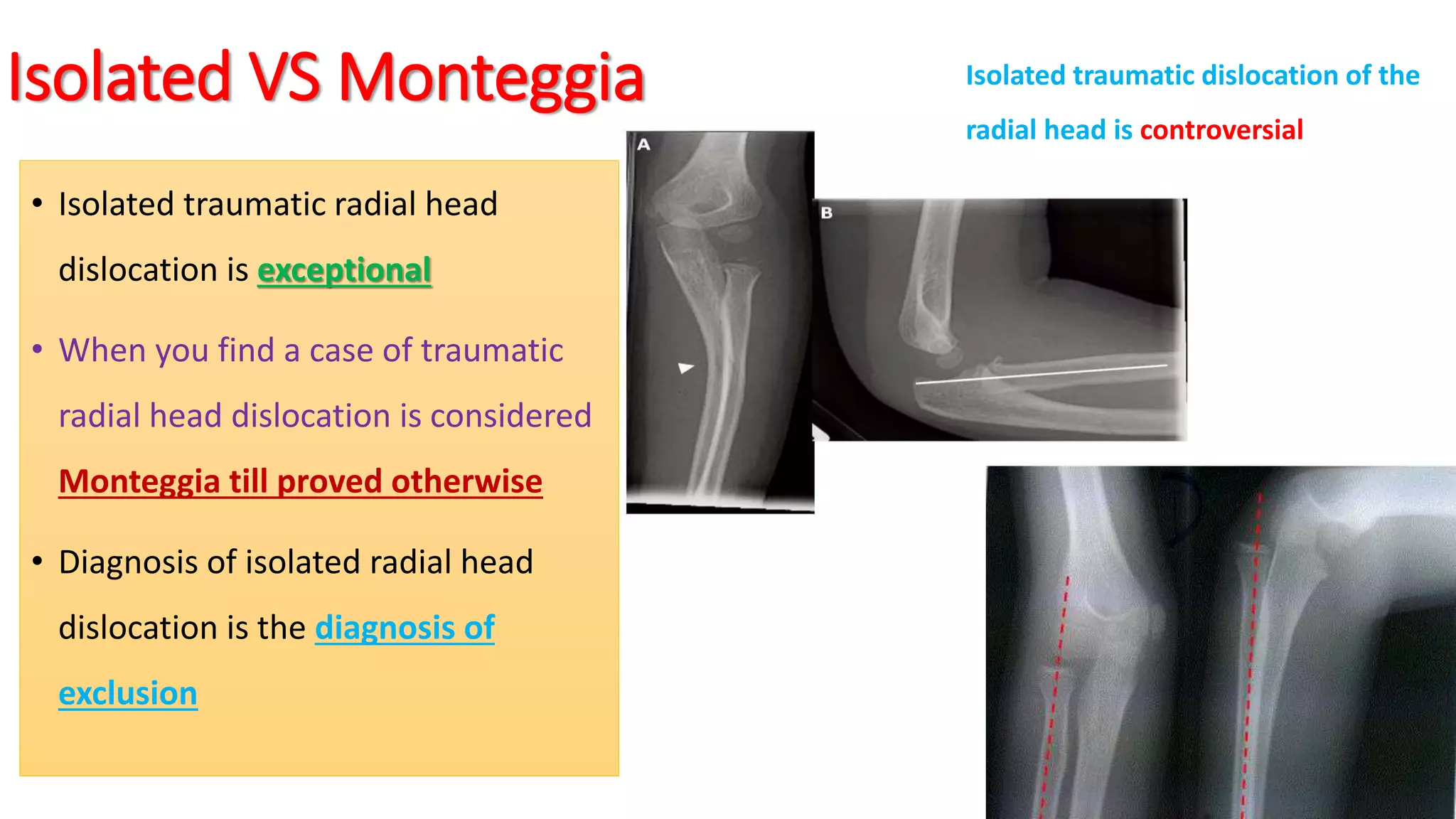
Isolated VS Monteggia
• Isolated traumatic radial head
dislocation is exceptional
• When you find a case of traumatic
radial head dislocation is considered
Monteggia till proved otherwise
• Diagnosis of isolated radial head
dislocation is the diagnosis of
exclusion
Isolated traumatic dislocation of the
radial head is controversial
Isolated traumatic dislocation
• The mechanism is not well known
 Two opposing theories are described.
Forced hyper-pronation forearm on
elbow in extension with or without
varus has been described
The other is hyperforced elbow extension
on full supination of the forearm with or
without tear of the biceps
Treatment of congenital radial head dislocation
SURGERY
• Various surgical treatment possibilities
have been discussed in literature:
 Resection
 Rotation & shortening osteotomy
 Reconstruction of the annular ligament
 Ulnar osteotomy ± annular reco.
 Ilizarov assisted reduction
Conservative
The elbow is not so forgiving when
operated upon
DO NOT TOUCH ASYMPTOMATIC PATIENT
Indications of surgery
• Symptomatic patient :
 Pain
 Painful snapping
 Functional impairment (ROM)
 Cosmetic reasons.
Treatment of traumatic radial head dislocation
Conservative
DO NOT TOUCH ASYMPTOMATIC PATIENT
Acute
Closed reduction ± pinning
If failed
Open reduction with annular repair or
reco. ± pinning
Chronic
Surgery
Open reduction +
Annular lig. Reco.
Ulnar osteotomy
Annular ligament reconstruction
Using
 Central or lateral slip of
triceps fascia
 Forearm fascia
 Fascia lata
 Palmaris longus tendon.
Theoretically this fascial slip acts both as a dynamic
and static stabilizer and prevents radial head
subluxation.
Modified Bell Tawse technique
Actually reconstruction alone is insufficient to maintain the reduction.
Possible complications
 Osteolytic changes
 Avascular necrosis
Narrowing and growth disturbance of the radial neck
 Heterotopic ossification
 Radio-ulnar synostosis
 Restricted pronation and supination
Missed Monteggia fracture in children:
Is annular ligament reconstruction always required?
• CONCLUSION:
Distraction-angulation osteotomy of the ulna suffices in
most cases of missed monteggia fracture and the need
for annular ligament reconstruction is based on
intraoperative findings of radial head instability
Indian journal of orthopedic IJO 2009
Ulnar osteotomy with or without ligament
reconstruction
 Floating osteotomy without fixation or stabilized by graft
 Corrective diaphyseal osteotomy
 Proximal bending osteotomy
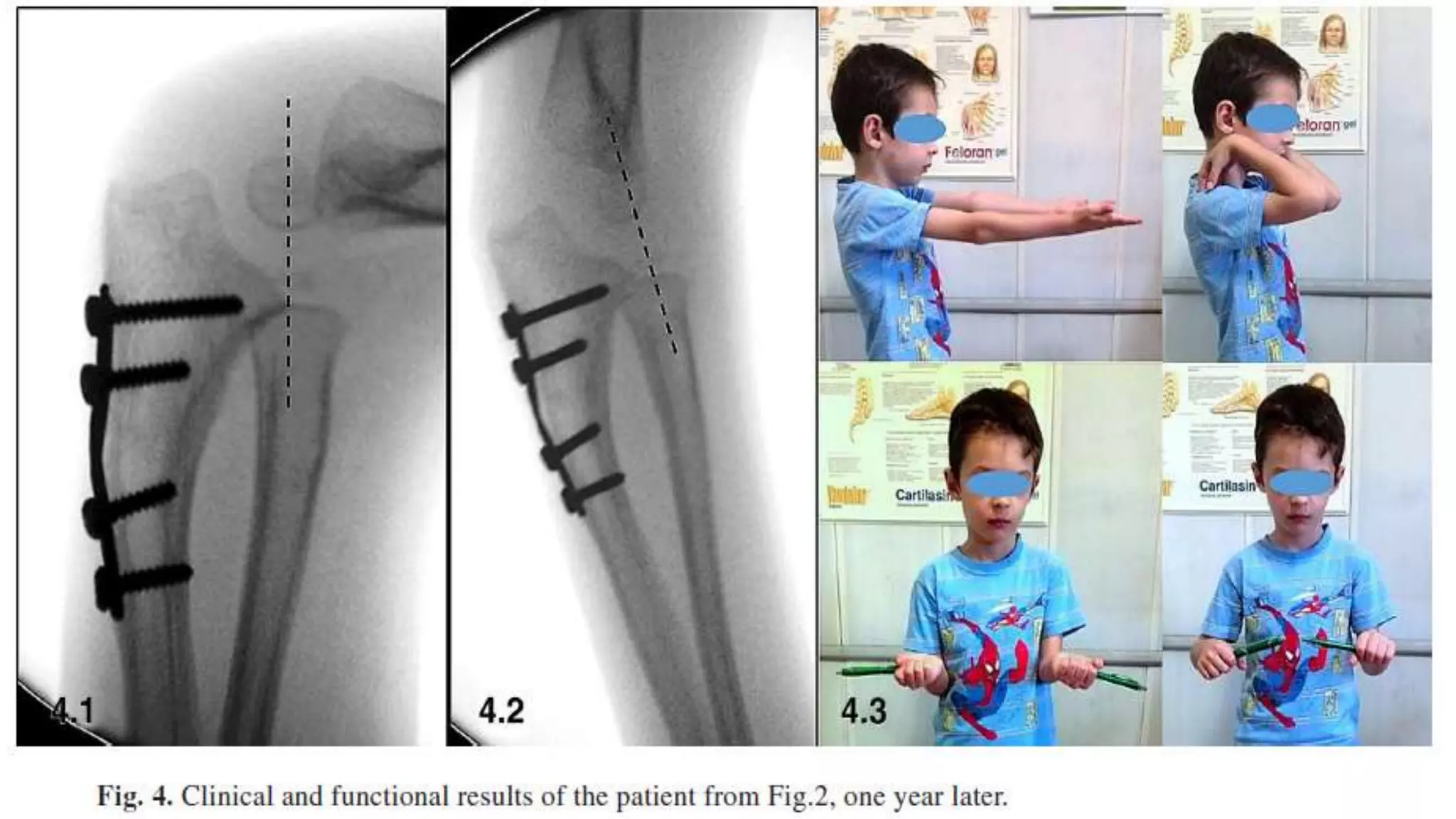
 Angulation and elongation osteotomy ( most popular nowadays)
 Gradual lengthening and angulation of the ulna using an external fixator.
Angulation elongation osteotomy
Angulation-Elongation
osteotomy
What a result
They concluded their work into this table
What about trans-capitullar K- wire
(much debate)
Old thinking
In procedures involving reconstruction around the radial head, it is mandatory to
stabilize the radial head by a trans-capitellar K wire to prevent redislocation
What about
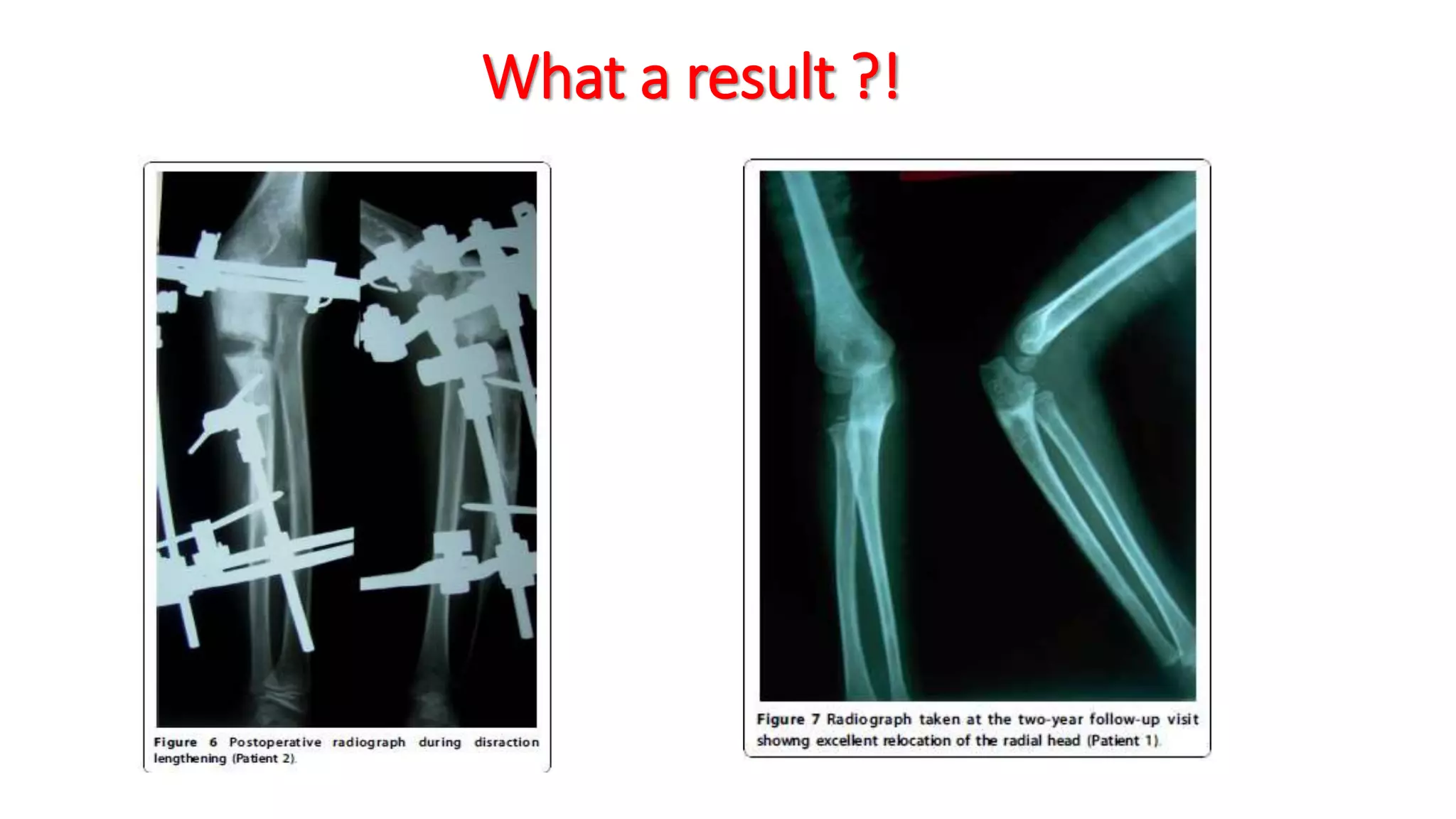
Ilizarov
How to plan your frame
What a result ?!
Take home message
Identify radial head dislocation
Differentiate congenital from traumatic
Differentiate isolated traumatic from monteggia
Specify treatment method of each case individually
Pediatric Radial head dislocation

Pediatric Radial head dislocation

  • 2.
  • 3.
    Objectives  Radiological Anatomyof the elbow  Differentiate congenital vs traumatic (proper diagnosis)  If traumatic isolated or Monteggia  Debate in management
  • 4.
    Is this congenitalor traumatic ?
  • 5.
    • Assessment ofthese radiographs depends on evaluating the anatomic relationships of the ossification centers of the elbow including The position of the radial head relative to the capitellum Anterior humeral line relative to the capitellum Baumann’s angle Interpretation of pediatric elbow radiographs is complicated by the cartilaginous components of the elbow that are radiolucent.
  • 6.
    Radio-capitullar line (AP) Anterior humeral& Radio-capitullar lines (Lat)
  • 8.
    Relation bet. Humeralshaft & capitellum • The capitellum is angulated anteriorly about 30 degrees. • The appearance of the distal humerus is similar to a hockey stick.
  • 9.
  • 11.
    Causes Congenital • Rare butit is the most common cong. anomaly of elbow • Isolated or syndromic in more than of 50% Traumatic Mostly as a part of monteggia Rarely as isolated Developmental Inadequate length of the radius & multiple hereditary osteochondromatosis (MHE)
  • 12.
    Congenital VS traumatic Bilateral involvement in 60%  Hypoplastic capitellum  Lack of history of trauma  Dome shaped radial head  Other congenital anomalies  Posterior is the most common
  • 13.
    Radiographic diagnostic criteriaas described by McFarland  Shortening of the ulna or overlength of the radius  Hypoplasia of the capitellum  Grooving of the distal radius  Prominent ulnar epicondyle  Partially defective trochlea  Dome-shaped radial head with a long narrow neck
  • 14.
    Additional criteria thatfavour a congenital dislocation are described by Mardam-Bey & Ger (1979)  Bilateral involvement  Other congenital anomalies  Familial occurrence  Dislocation seen at birth  No history of trauma  Ulnar bowing
  • 15.
    Presentation  Congenital radialhead dislocation is not manifest at birth because the condition is difficult to detect clinically.  Usually diagnosed years after birth No associated history of trauma.  limitation of forearm motion especially supination.  Mechanical block of elbow flexion occurs with anterior radial head dislocation.  Posterior dislocation presents with bony prominence of the radial head in the postro-lateral aspect  Painful elbow snapping as a result of annular ligament interposition during flexion and extension
  • 16.
    Isolated congenital vssyndromic • 60% of all cases, seen in conjunction with various syndromes e.g Nail patella syndrome Silver’s syndrome Ehlers-Danlos syndrome congenital radioulnar synostosis mental retardation Other associated anomalies include  Skeletal dysplasia  Craniosynostosis  Synostosis of the tibia and fibula  Scoliosis.
  • 17.
    Nursemaid's elbow (Pulledelbow) • Untreated traumatic dislocation of the radial head during childhood may present with radiographic and clinical manifestations that are similar to those of congenital radial head dislocation. • The differentiation can be difficult. Radiographic criteria that may support its congenital nature include:  Short radius relative to the ulna  Bilateral involvement  The presence of other musculoskeletal anomalies
  • 18.
    Let‘s to answerthis ? Is this congenital or traumatic ?
  • 19.
    Isolated VS Monteggia •Isolated traumatic radial head dislocation is exceptional • When you find a case of traumatic radial head dislocation is considered Monteggia till proved otherwise • Diagnosis of isolated radial head dislocation is the diagnosis of exclusion Isolated traumatic dislocation of the radial head is controversial
  • 21.
    Isolated traumatic dislocation •The mechanism is not well known  Two opposing theories are described. Forced hyper-pronation forearm on elbow in extension with or without varus has been described The other is hyperforced elbow extension on full supination of the forearm with or without tear of the biceps
  • 22.
    Treatment of congenitalradial head dislocation SURGERY • Various surgical treatment possibilities have been discussed in literature:  Resection  Rotation & shortening osteotomy  Reconstruction of the annular ligament  Ulnar osteotomy ± annular reco.  Ilizarov assisted reduction Conservative The elbow is not so forgiving when operated upon DO NOT TOUCH ASYMPTOMATIC PATIENT
  • 24.
    Indications of surgery •Symptomatic patient :  Pain  Painful snapping  Functional impairment (ROM)  Cosmetic reasons.
  • 25.
    Treatment of traumaticradial head dislocation Conservative DO NOT TOUCH ASYMPTOMATIC PATIENT Acute Closed reduction ± pinning If failed Open reduction with annular repair or reco. ± pinning Chronic Surgery Open reduction + Annular lig. Reco. Ulnar osteotomy
  • 26.
    Annular ligament reconstruction Using Central or lateral slip of triceps fascia  Forearm fascia  Fascia lata  Palmaris longus tendon. Theoretically this fascial slip acts both as a dynamic and static stabilizer and prevents radial head subluxation. Modified Bell Tawse technique
  • 27.
    Actually reconstruction aloneis insufficient to maintain the reduction. Possible complications  Osteolytic changes  Avascular necrosis Narrowing and growth disturbance of the radial neck  Heterotopic ossification  Radio-ulnar synostosis  Restricted pronation and supination
  • 28.
    Missed Monteggia fracturein children: Is annular ligament reconstruction always required? • CONCLUSION: Distraction-angulation osteotomy of the ulna suffices in most cases of missed monteggia fracture and the need for annular ligament reconstruction is based on intraoperative findings of radial head instability Indian journal of orthopedic IJO 2009
  • 30.
    Ulnar osteotomy withor without ligament reconstruction  Floating osteotomy without fixation or stabilized by graft  Corrective diaphyseal osteotomy  Proximal bending osteotomy  Angulation and elongation osteotomy ( most popular nowadays)  Gradual lengthening and angulation of the ulna using an external fixator.
  • 31.
  • 32.
  • 37.
    They concluded theirwork into this table
  • 38.
    What about trans-capitullarK- wire (much debate) Old thinking In procedures involving reconstruction around the radial head, it is mandatory to stabilize the radial head by a trans-capitellar K wire to prevent redislocation
  • 39.
  • 41.
    How to planyour frame
  • 42.
  • 43.
    Take home message Identifyradial head dislocation Differentiate congenital from traumatic Differentiate isolated traumatic from monteggia Specify treatment method of each case individually

Editor's Notes

  • #4 DE radius, proximal femur
  • #23 Anatomical neck, 4 part #