1
Jens Martensson
An introspection…
•‘While waiting for the bus,
David idly kicked an old tin
can.’
2
Jens Martensson
What if….
•‘While waiting for the bus,
David viciously kicked an
old tin can.’
3
Jens Martensson
Michael Alexander Kirkwood
Halliday
•(often M.A.K. Halliday; 13 April 1925 –
15 April 2018) was an English-born
linguist who developed the
internationally influential systemic
functional linguistics (SFL) model of
language.
5
Jens Martensson
FUNCTIONALIST STYLISTICS
•is concerned with the relationship
between the FORMS OF LANGUAGE
as a system and the CONTEXT OR
SITUATION OF ITS PRODUCTION, as
well as the social, cultural and political
factors that impact upon its construction
and reception.
6
Jens Martensson
Historical perspectives..
•functionalist approaches are
fundamentally concerned with the ways
in which the formal properties of
language are used PRAGMATICALLY.
(Halliday 1994, Halliday and Hasan 1976)
7
Jens Martensson
FUNCTION
•is considered to be "a
fundamental property
of language itself".
8
Jens Martensson
FOR FUNCTIONALISTS
•the context of a language
event is as important as the
formal features of which it is
comprised.
9
Jens Martensson
Eggins (2004)
a text’s pivotal nature is
the ‘meeting point of
contextual and linguistic
expression’.
10
Jens Martensson
ON POINT…
•Building on Malinowski’s (1923) work on
the importance of situational context in
language and society’ (1950), Halliday
(1971) has often been credited with
developing the key concepts of
functionalist stylistics
11
Jens Martensson
According to Collins Cobuild
Advanced Dictionary (2009)
•Semiotics is the academic
study of the relationship of
language and others signs to
their meanings.
12
Jens Martensson
HALLIDAY’S TRANSITIVITY SYSTEM
•is a system that develops old
conception about transitivity,
so whether a verb takes or
does not take a direct object
is not a prime consideration.
13
Jens Martensson
COMPONENTS OF
TRANSITIVITY PROCESS
•the process itself,
•participants in the process,
•Circumstances associated
with the process.
14
Jens Martensson
SIX PROCESSES
•material, mental,
relational, behavioral,
verbal, and existential.
15
Jens Martensson
Material processes
•ARE PROCESSES OF
‘DOING’. They express the
notion that some entity ‘does’
something –which may be done
‘to’ some other entity.
16
Jens Martensson
Participants Role
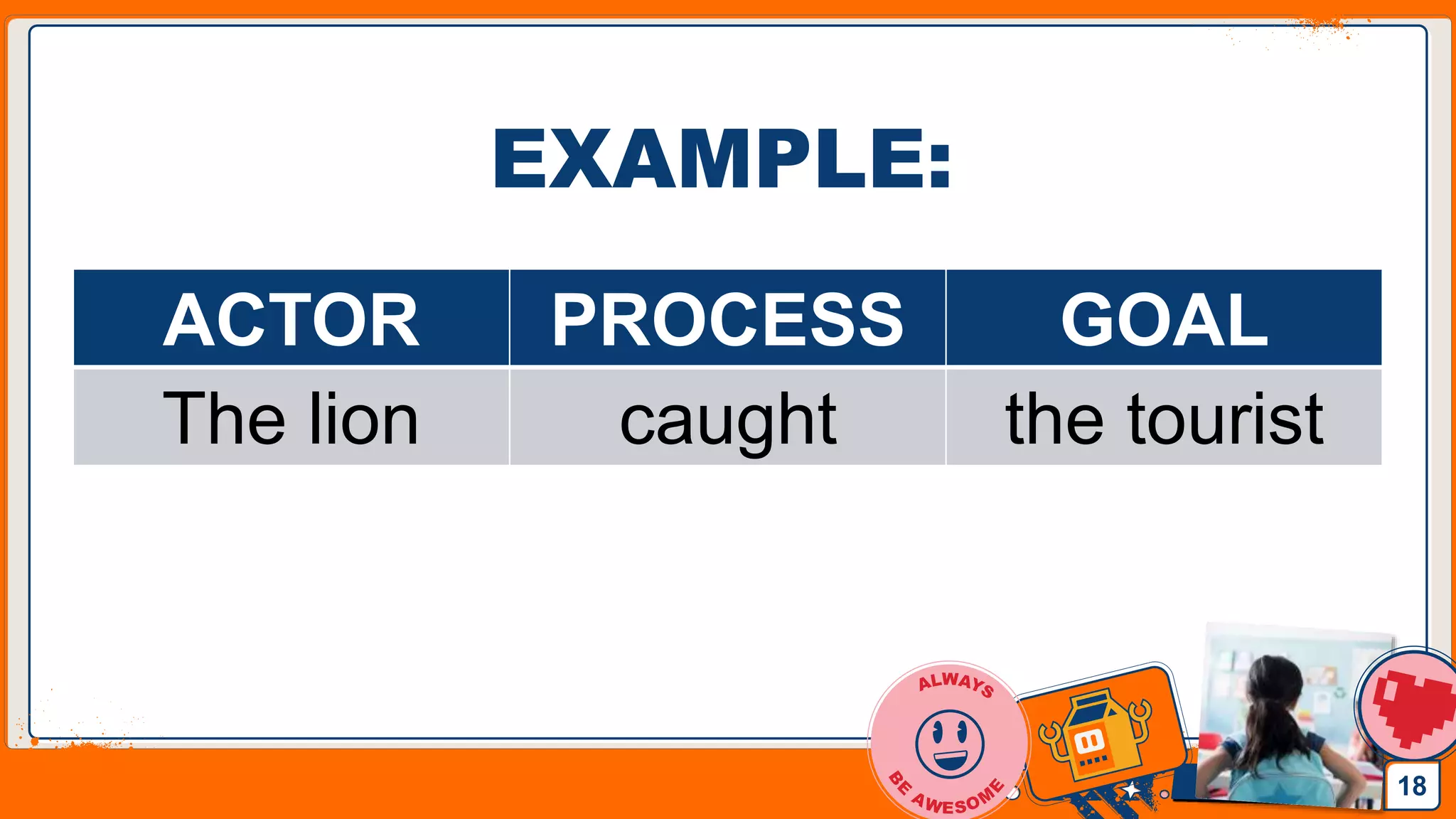
•In the material processes,
there are two participants
role, namely: actor and
goal, for example:
17
Jens Martensson
EXAMPLE:
18
ACTOR PROCESS GOAL
The lion caught the tourist
Jens Martensson
Mental processes
•Processes of
SENSING.
19
Jens Martensson
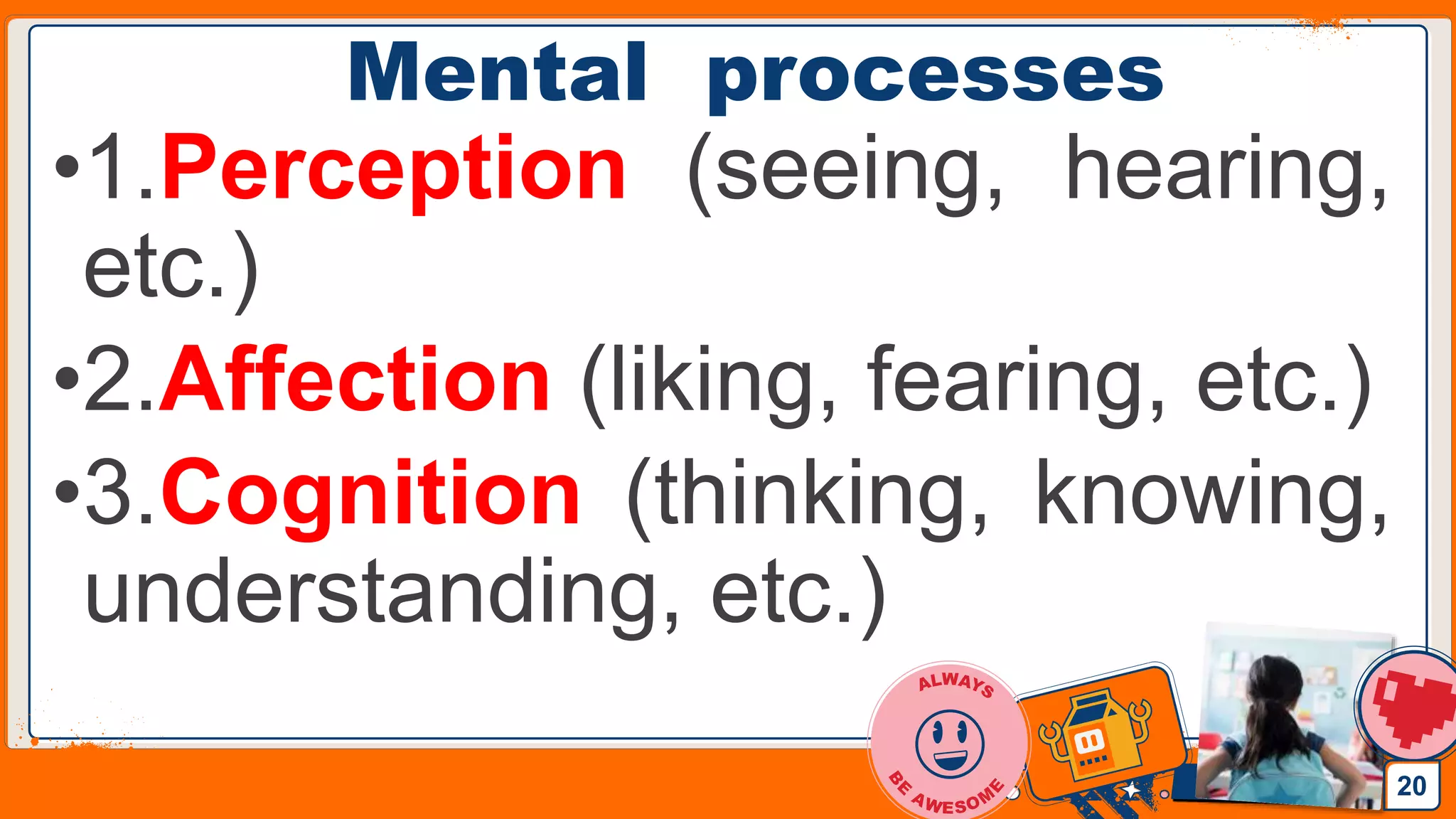
Mental processes
•1.Perception (seeing, hearing,
etc.)
•2.Affection (liking, fearing, etc.)
•3.Cognition (thinking, knowing,
understanding, etc.)
20
Jens Martensson
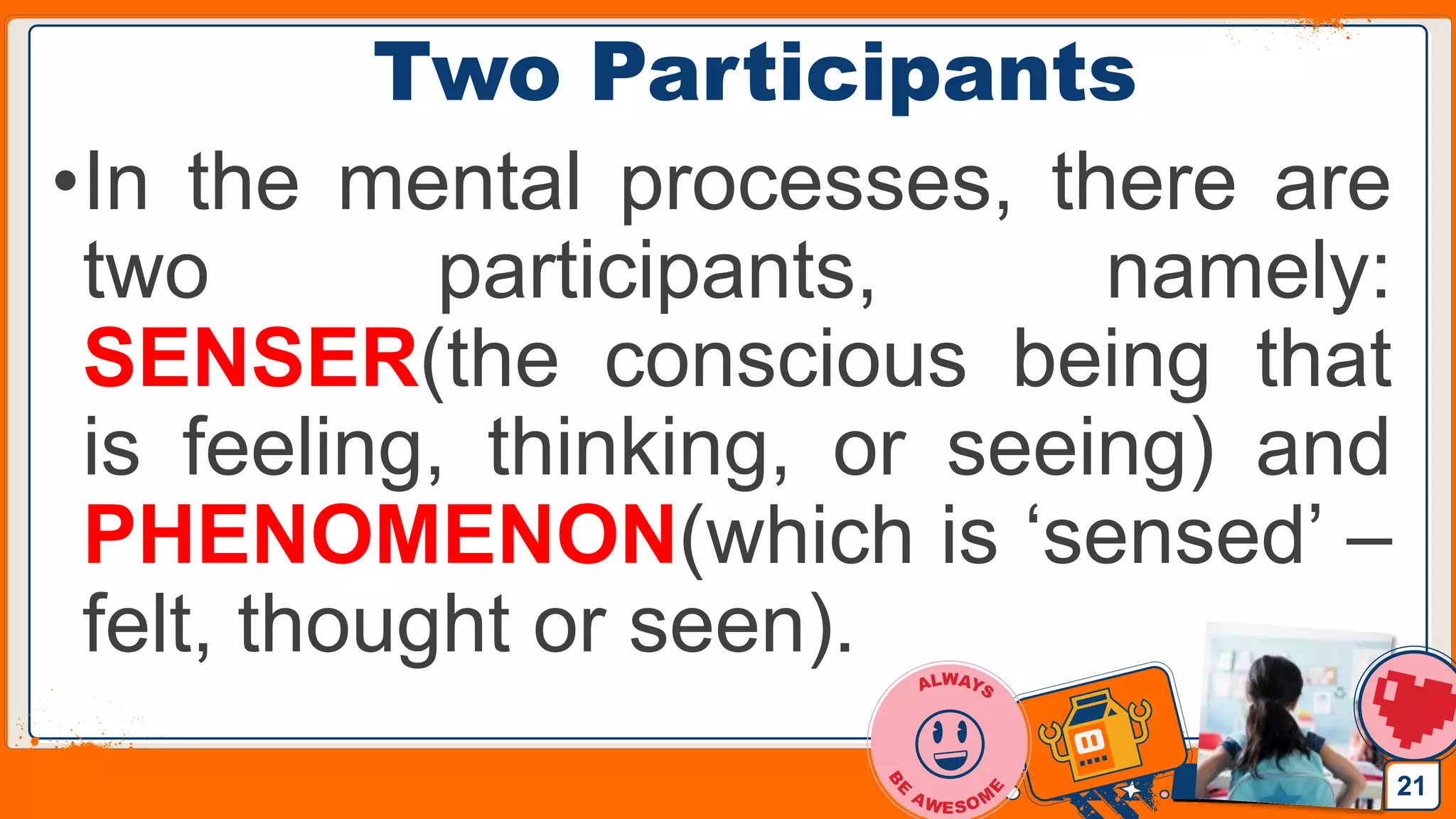
Two Participants
•In the mental processes, there are
two participants, namely:
SENSER(the conscious being that
is feeling, thinking, or seeing) and
PHENOMENON(which is ‘sensed’ –
felt, thought or seen).
21
Jens Martensson
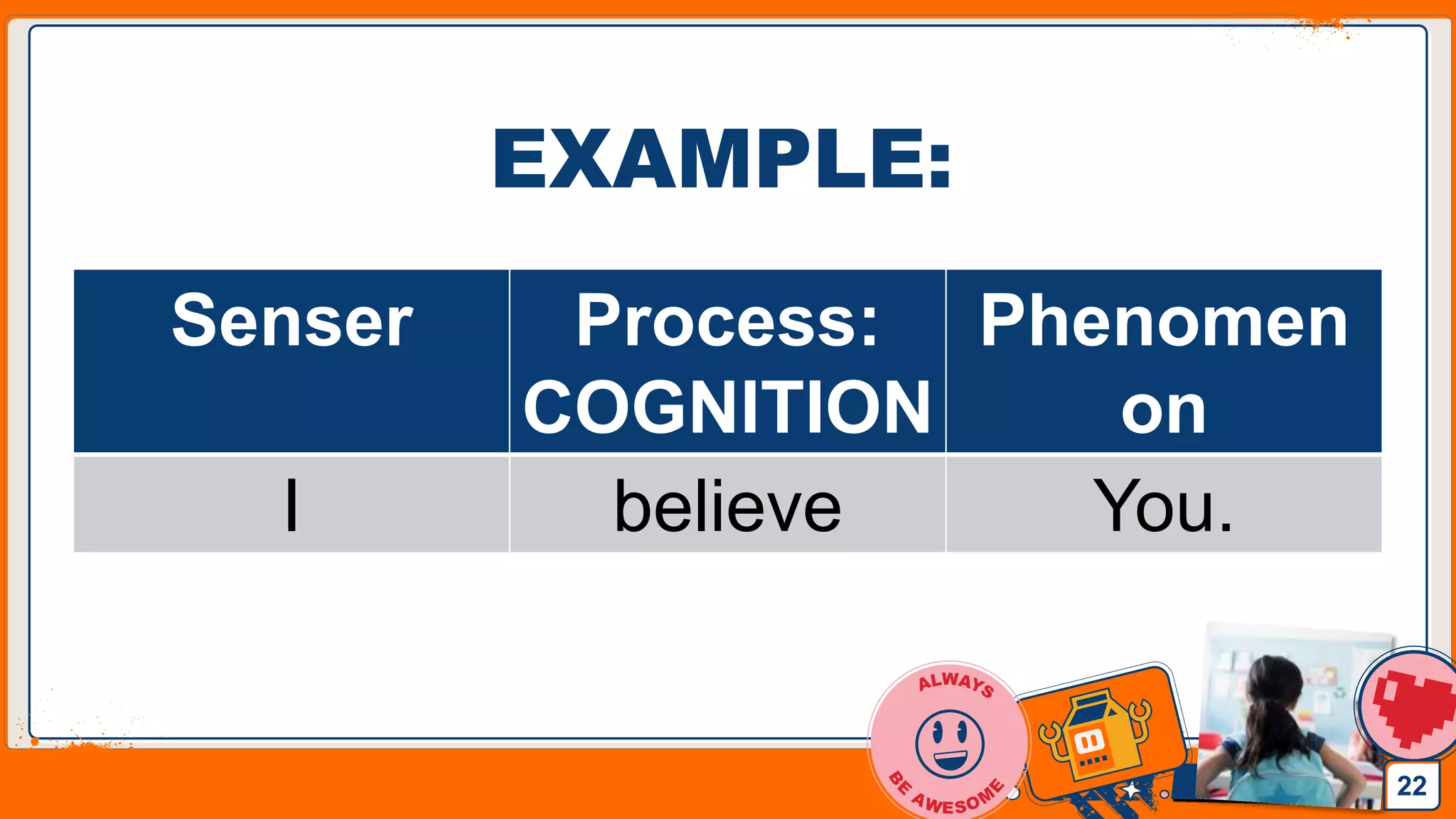
EXAMPLE:
22
Senser Process:
COGNITION
Phenomen
on
I believe You.
Jens Martensson
Relational processes
•Processes of BEING.
23
Jens Martensson
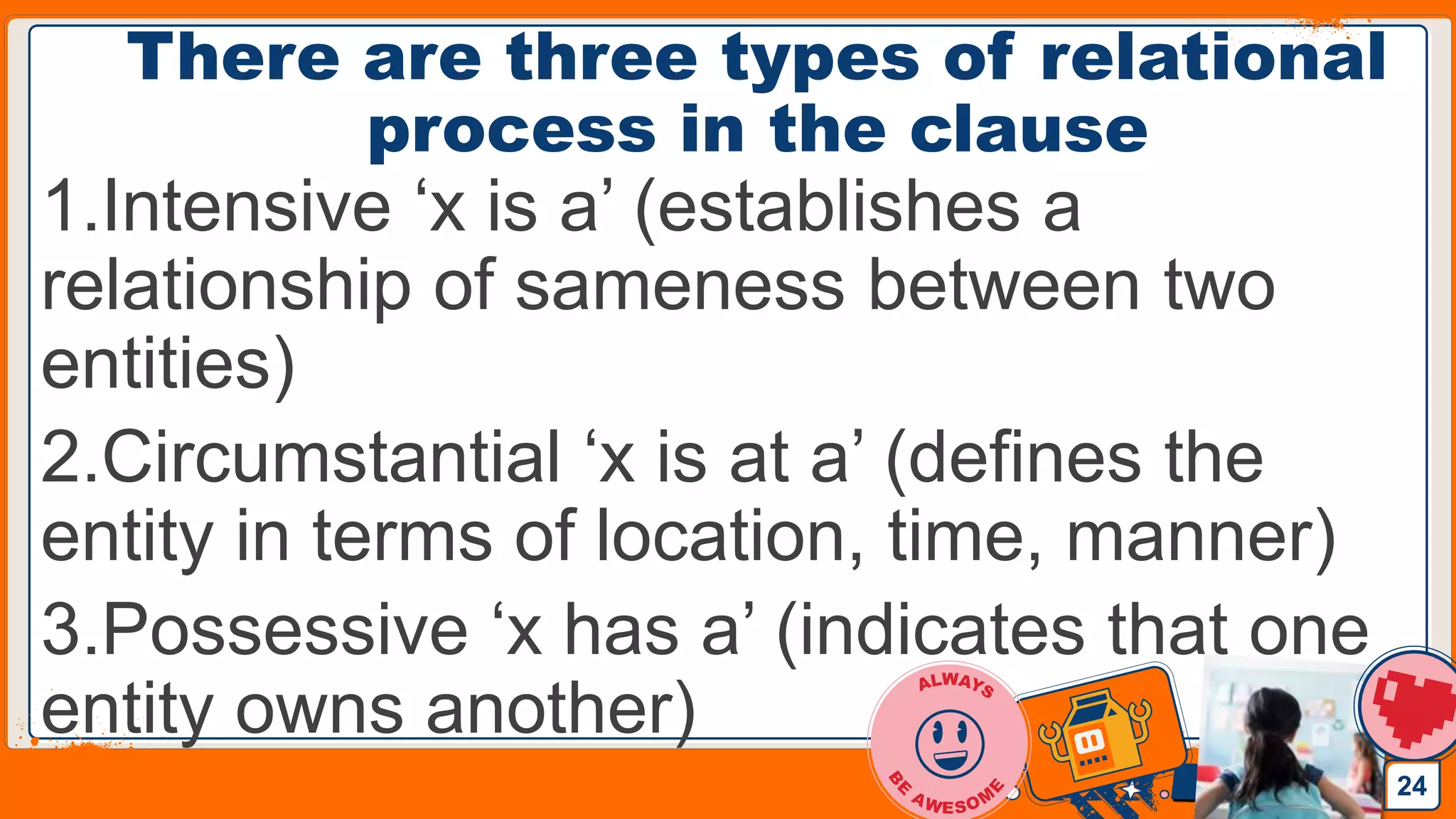
There are three types of relational
process in the clause
1.Intensive ‘x is a’ (establishes a
relationship of sameness between two
entities)
2.Circumstantial ‘x is at a’ (defines the
entity in terms of location, time, manner)
3.Possessive ‘x has a’ (indicates that one
entity owns another)
24
Jens Martensson
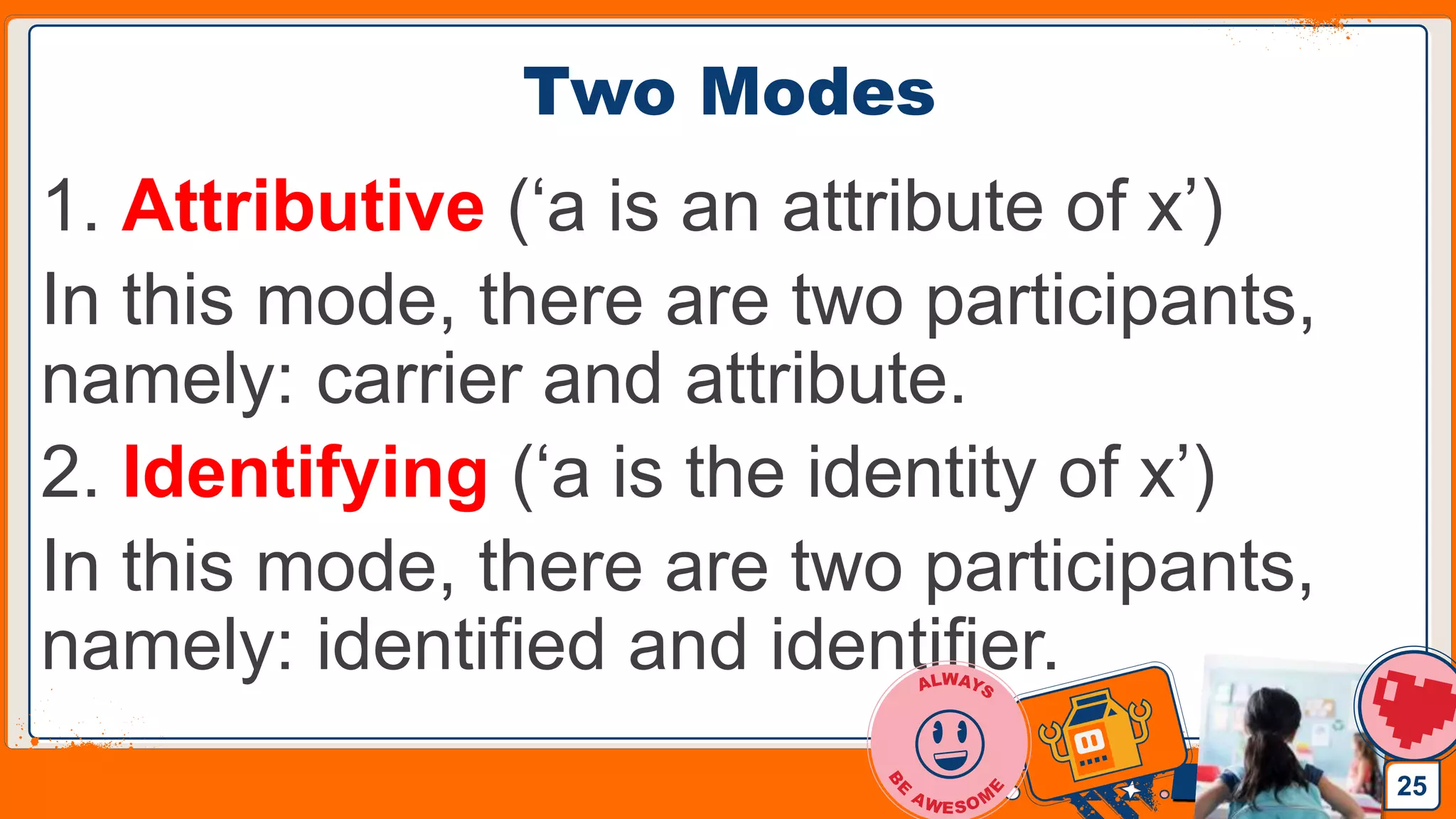
Two Modes
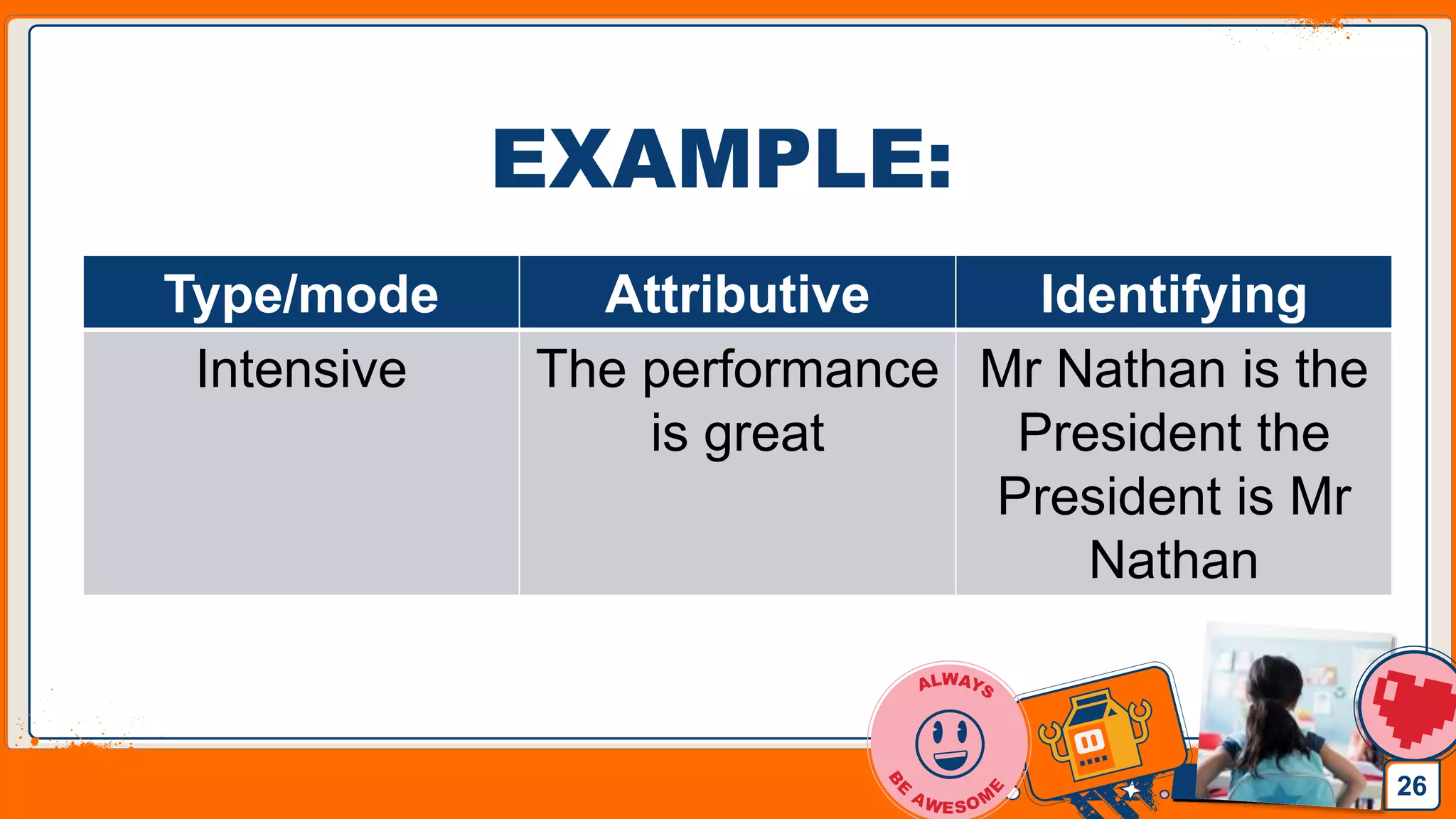
1. Attributive (‘a is an attribute of x’)
In this mode, there are two participants,
namely: carrier and attribute.
2. Identifying (‘a is the identity of x’)
In this mode, there are two participants,
namely: identified and identifier.
25
Jens Martensson
EXAMPLE:
26
Type/mode Attributive Identifying
Intensive The performance
is great
Mr Nathan is the
President the
President is Mr
Nathan
Jens Martensson
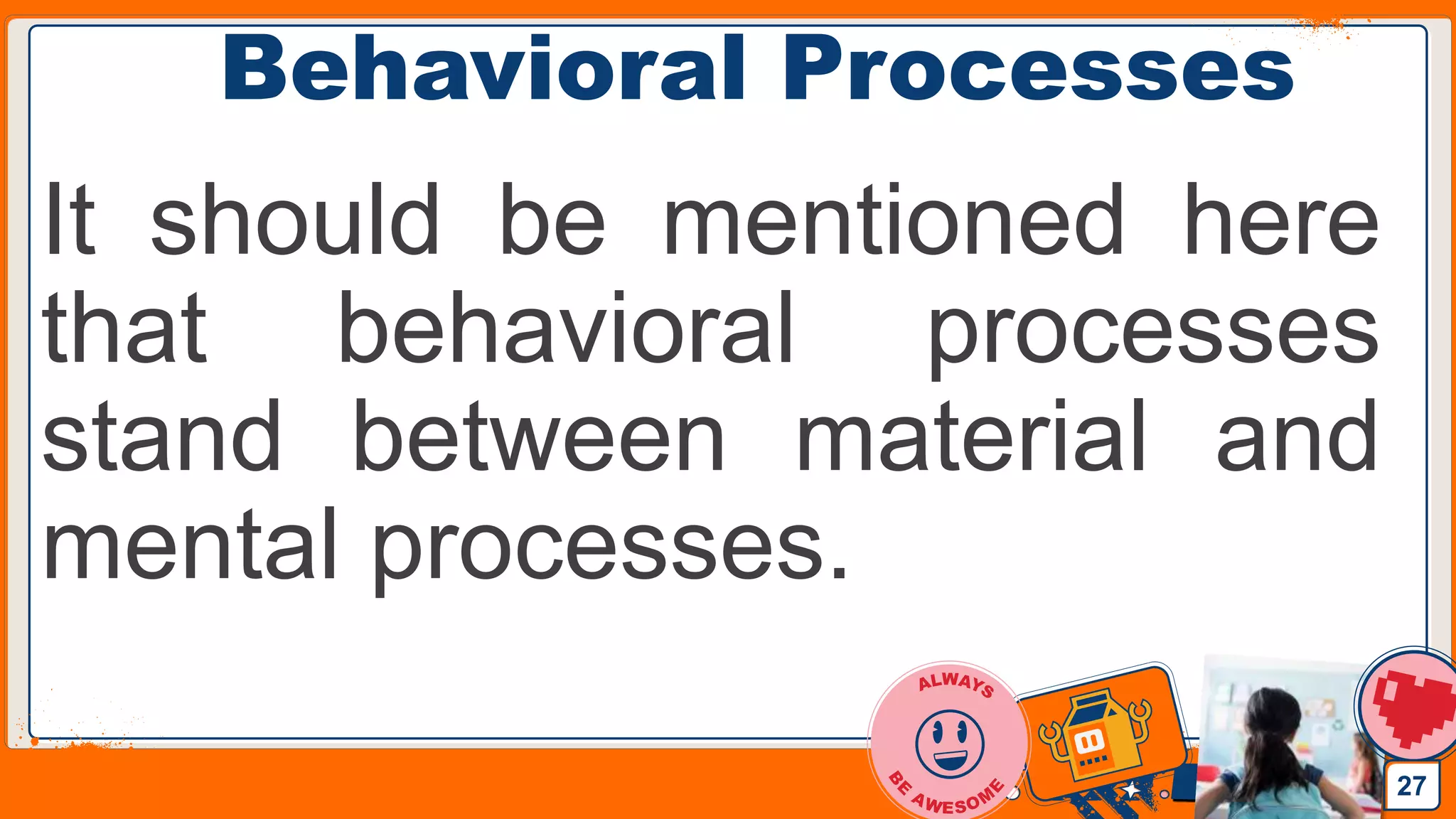
Behavioral Processes
It should be mentioned here
that behavioral processes
stand between material and
mental processes.
27
Jens Martensson
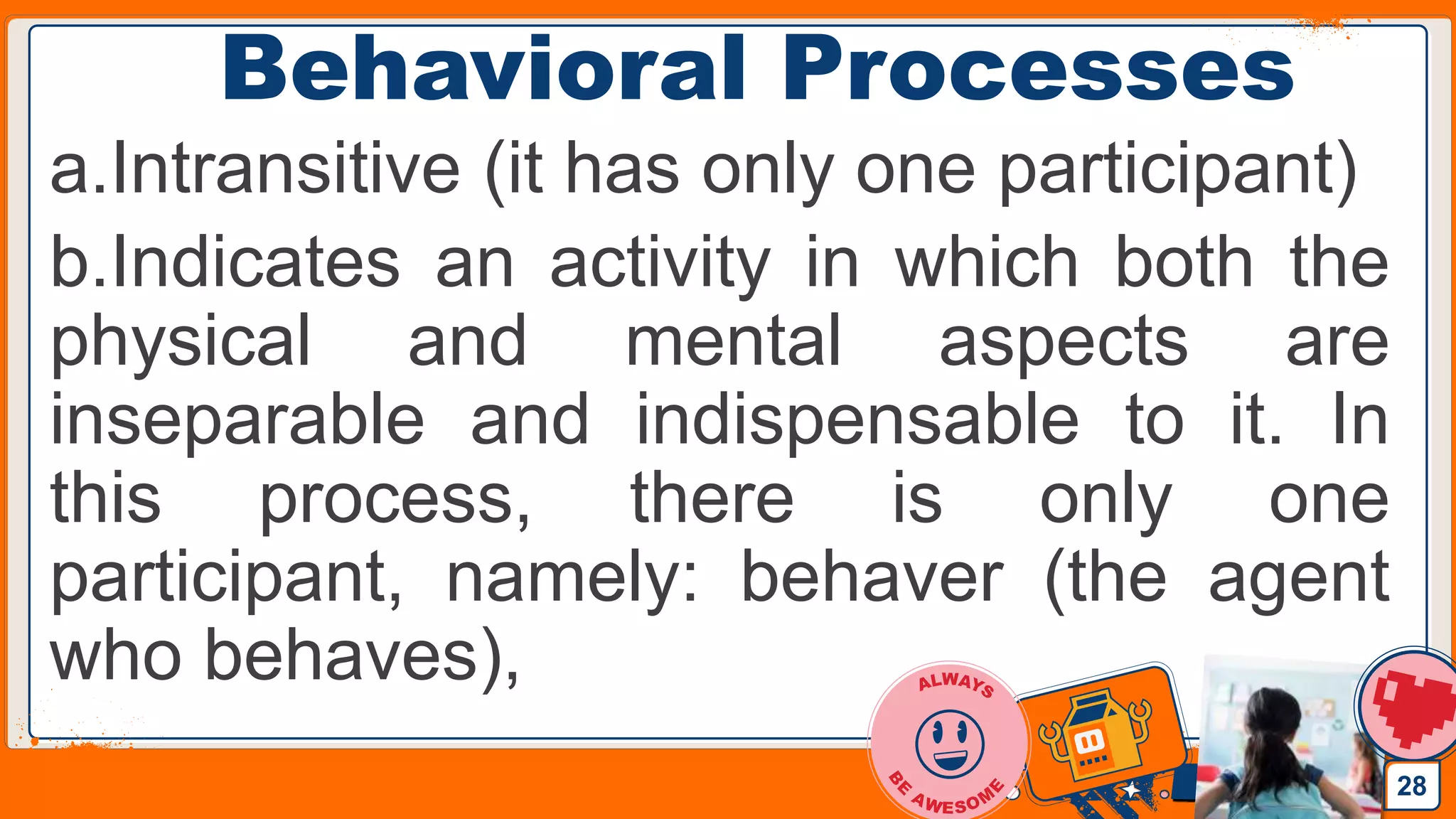
Behavioral Processes
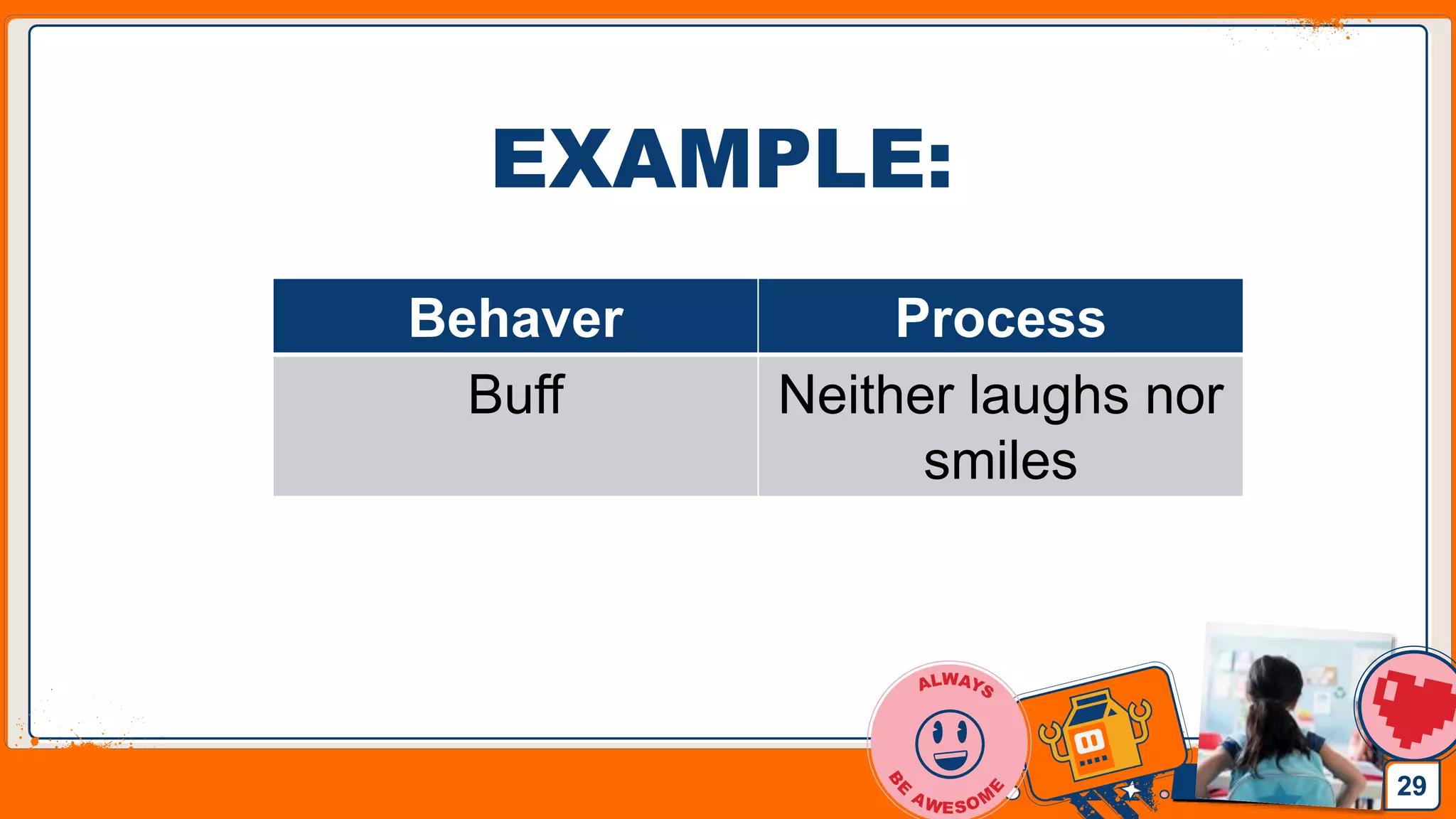
a.Intransitive (it has only one participant)
b.Indicates an activity in which both the
physical and mental aspects are
inseparable and indispensable to it. In
this process, there is only one
participant, namely: behaver (the agent
who behaves),
28
Jens Martensson
EXAMPLE:
29
Behaver Process
Buff Neither laughs nor
smiles
Jens Martensson
Verbal Processes
Processes of
saying.
30
Jens Martensson
Participants
1. Sayer (participant who speaks),
2. Receiver (the one to whom the
verbalization is addressed),
3. Verbiage (a name for the
verbalization itself).
31
Jens Martensson
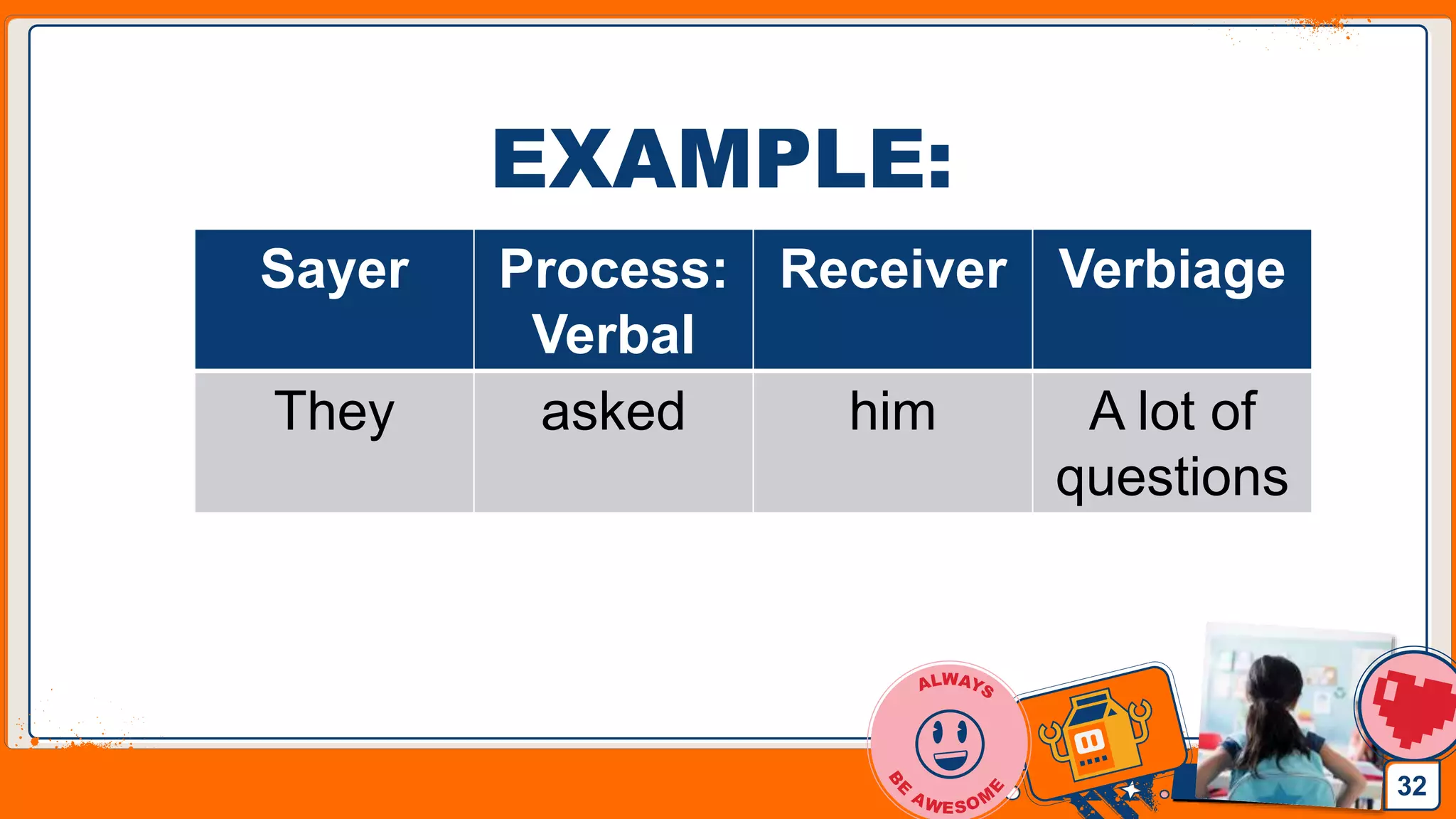
EXAMPLE:
32
Sayer Process:
Verbal
Receiver Verbiage
They asked him A lot of
questions
Jens Martensson
Participants
There is however one other type of
verbal process, in which the sayer is
in sense acting verbally on another
direct participant, with verbs such
as: insult, praise, slander, abuse,
and flatter. This other participant will
be referred to as the target.
33
Jens Martensson
EXAMPLE:
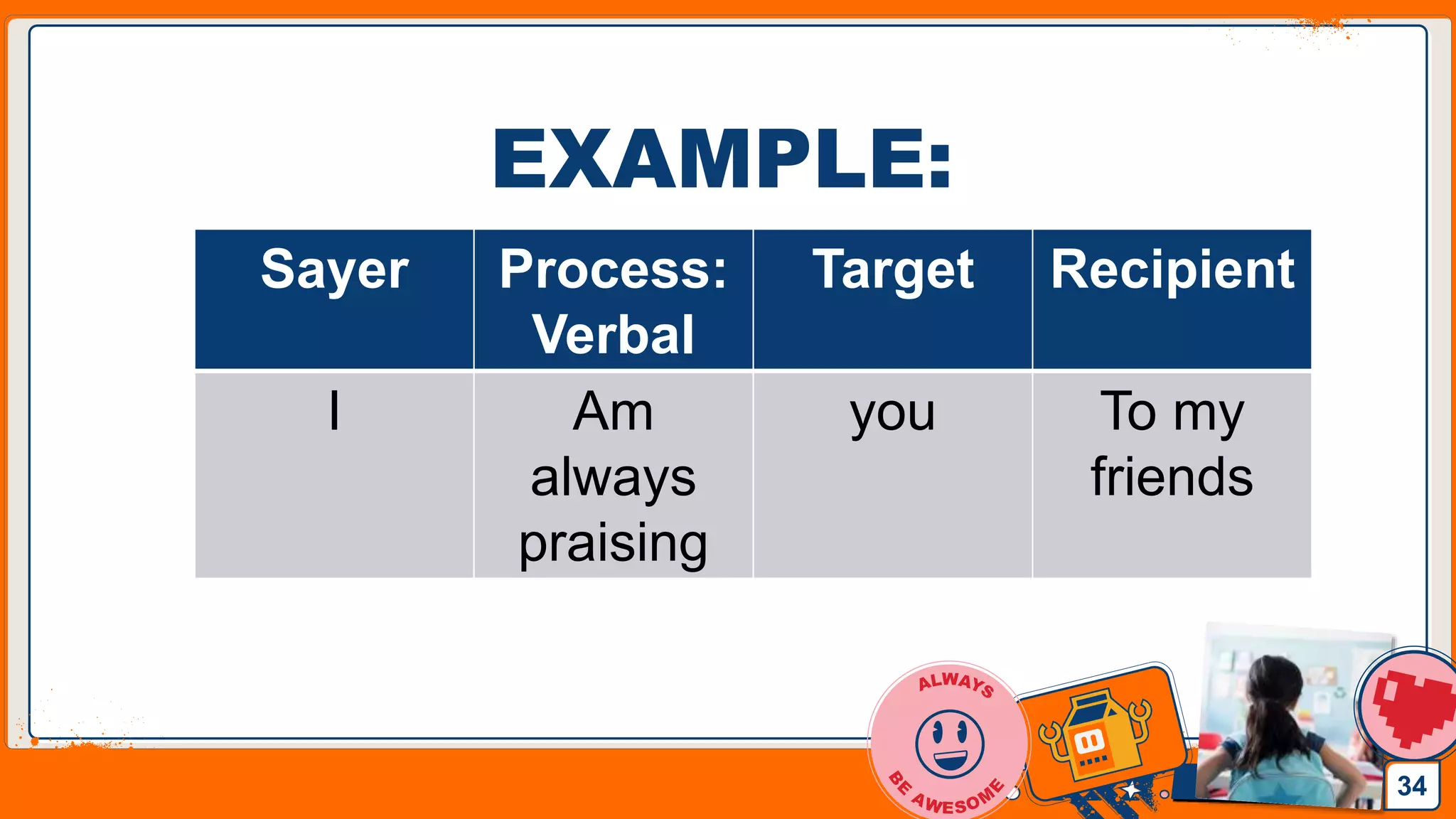
34
Sayer Process:
Verbal
Target Recipient
I Am
always
praising
you To my
friends
Jens Martensson
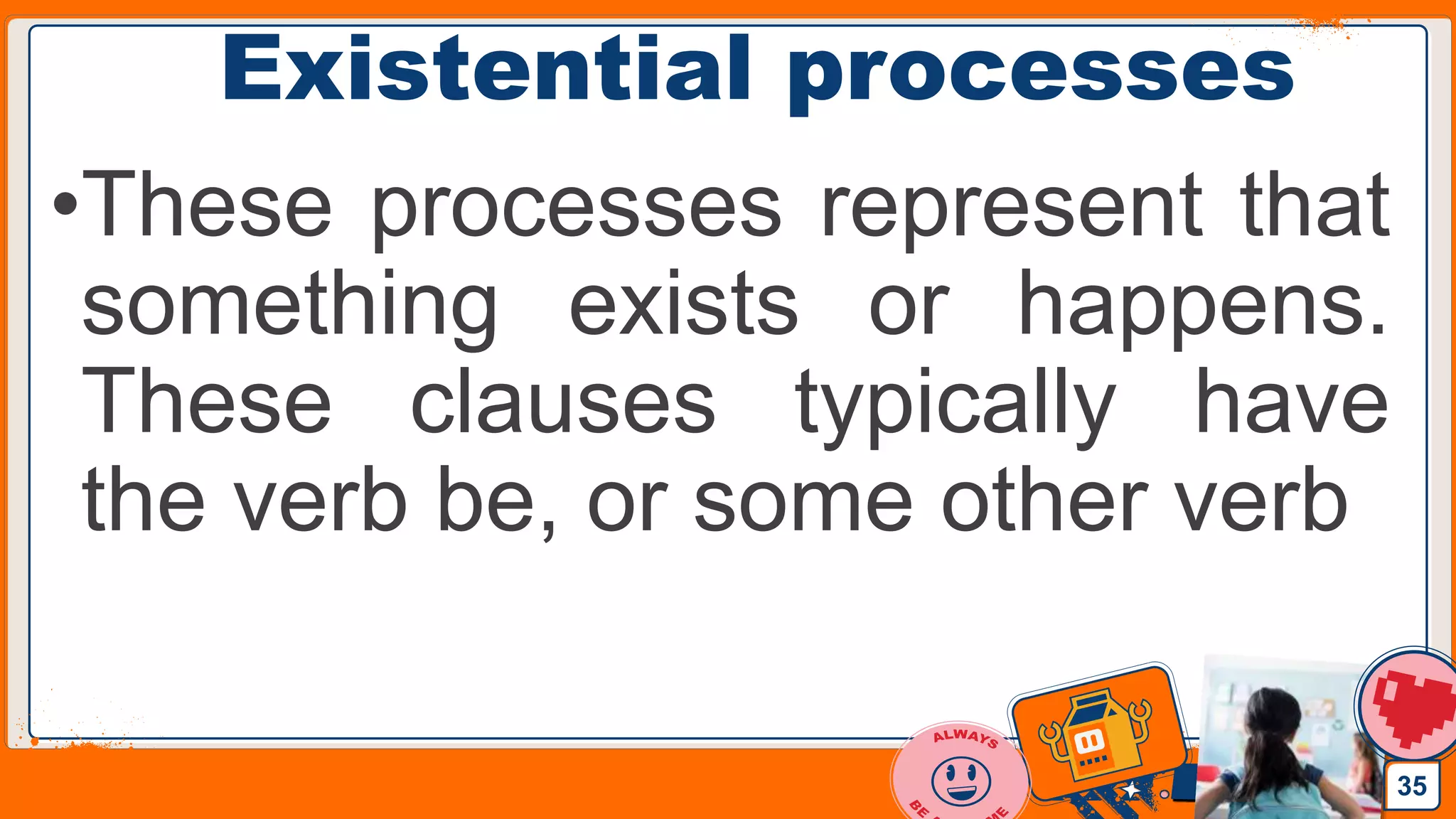
Existential processes
•These processes represent that
something exists or happens.
These clauses typically have
the verb be, or some other verb
35
Jens Martensson
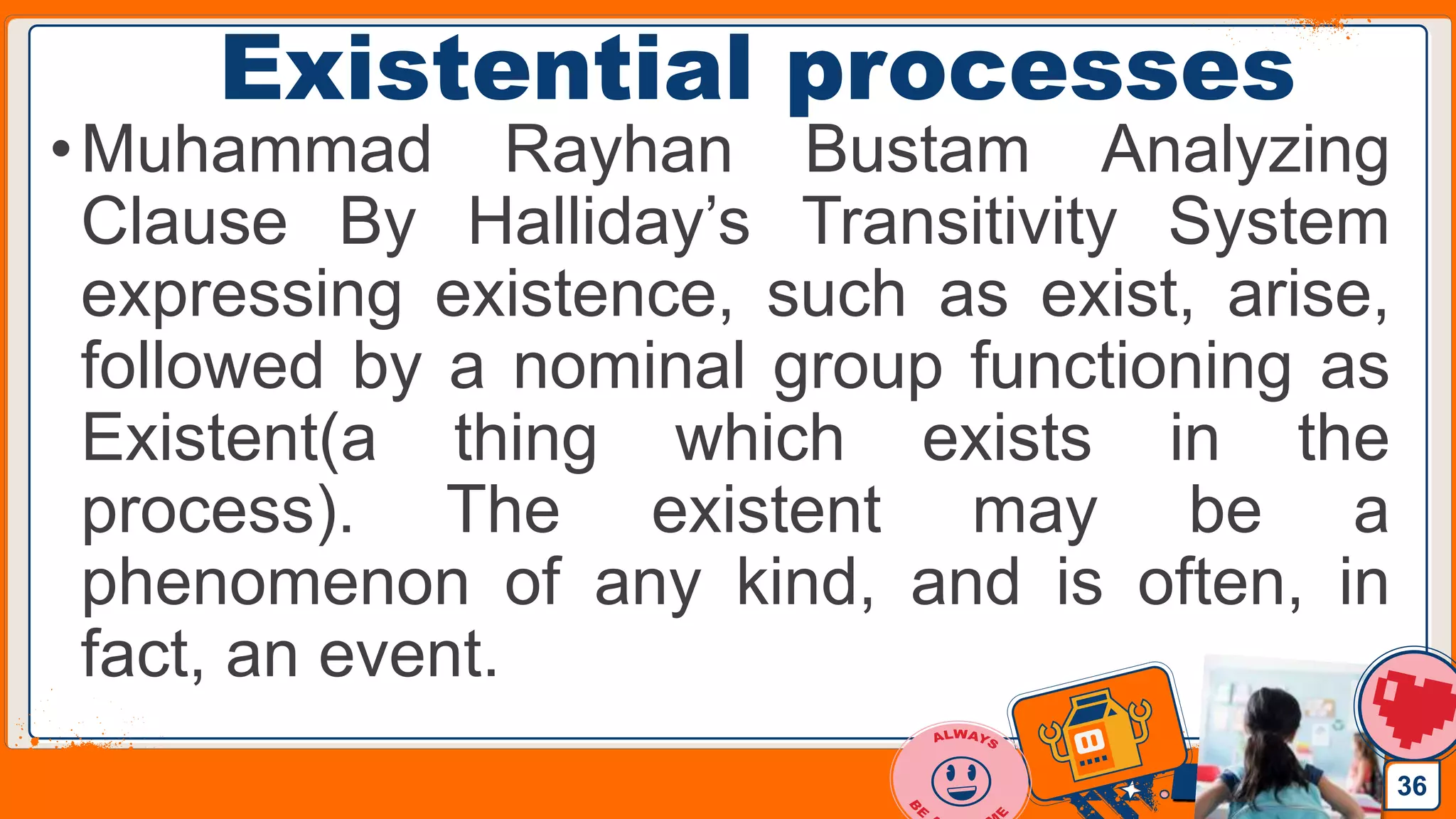
Existential processes
•Muhammad Rayhan Bustam Analyzing
Clause By Halliday’s Transitivity System
expressing existence, such as exist, arise,
followed by a nominal group functioning as
Existent(a thing which exists in the
process). The existent may be a
phenomenon of any kind, and is often, in
fact, an event.
36
Jens Martensson
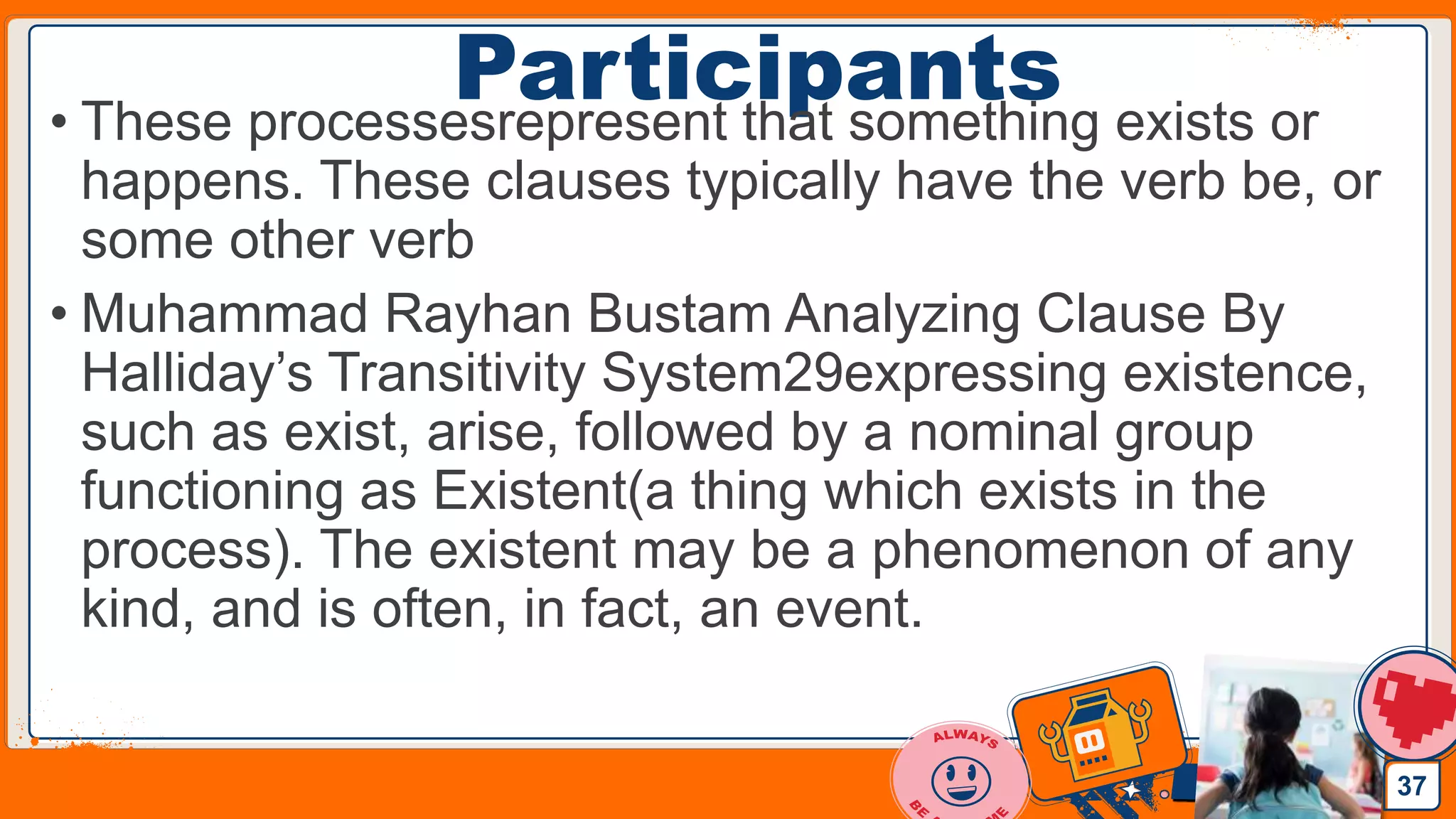
Participants• These processesrepresent that something exists or
happens. These clauses typically have the verb be, or
some other verb
• Muhammad Rayhan Bustam Analyzing Clause By
Halliday’s Transitivity System29expressing existence,
such as exist, arise, followed by a nominal group
functioning as Existent(a thing which exists in the
process). The existent may be a phenomenon of any
kind, and is often, in fact, an event.
37
Jens Martensson
TRIPARTITE FUNCTIONS OF
LANGUAGE
•a. Ideational
•b. Interpersonal
•c. Textual
38
Jens Martensson
IDEATIONAL
•to express ideas and
experience (clause as
representation)
39
Jens Martensson
IDEATIONAL
•The use of language
to express content
and to communicate
information.
40
Jens Martensson
HALLIDAY (1994)
•‘language enables human
beings to build a mental
picture of reality, to make
sense of what goes on
around them and inside
them.’
41
Jens Martensson
TWO MAIN SYSTEMS
•The ideational function
involves two main
systems, namely:
TRANSITIVITY AND
ERGATIVITY.
42
Jens Martensson
AS CLAUSE OF REPRESENTATION
•Transitivity is a more
complex stylistic model
in the context of this
metafunction.
43
Jens Martensson
TRANSITIVITY SYSTEM
•construes the world of
experience into a
manageable set of
PROCESS TYPES.
44
Jens Martensson
IDEATIONAL FUNCTION
•concerned with
building and
maintaining a theory
of experience.
45
Jens Martensson
TWO IDEATIONAL FUNCTIONS
•EXPERIENTIAL
•LOGICAL
46
Jens Martensson
EXPERIENTIAL FUNCTION
•refers to the grammatical
choices that enable speakers
to make meanings about the
world around us and inside
us
47
Jens Martensson
ON POINT…
“Grammar is not merely
annotating experience; it
is CONSTRUING
EXPERIENCE.”
48
Jens Martensson
LOGICAL FUNCTION
Systems which set up
logical–semantic
relationships between
one clausal unit and
another
49
Jens Martensson
INTERPERSONAL
•to mediate in the
establishment of social
relationships (clause as
exchange)
50
Jens Martensson
INTERPERSONAL
•The use of language to
signify discourse.
51
Jens Martensson
This TENET…
•"the interpersonal
encounters are
essential to our
survival"
52
Jens Martensson
This TENET…
•a speaker not only talks
about something, but is
always talking to and
with others.
53
Jens Martensson
INTERPERSONAL FUNCTIONS
•Mood,
•Modality, and
•Polarity
54
Jens Martensson
MODALITY(SIMPSON 1993)
•refers to a ‘speaker’s
attitude towards, or
opinion about, the truth of
a proposition expressed by
a sentence.
55
Jens Martensson
CATEGORIES OF MODALITY
•level of obligation or duty in a statement
(‘deontic’ modality),
•its truth-value (‘epistemic’ modality),
•level of desire (‘boulomaic’ modality)
•the degree of perception (‘perception’
modality).
(Uspensky, 1973)
56
Jens Martensson
TEXTUAL
•to provide the formal
properties of
language (clause as
message)
57
Jens Martensson
TWO TEXTUAL STRUCTURES
•thematic structure
(theme and rheme) and
Information structure
(NEW and GIVEN).
58
Jens Martensson
Cohesion (Halliday and Hasan
1976)
•refers to the way in which
sentences are related or
linked together in order to
make sense.
59
Jens Martensson
Cohesion (Halliday and Hasan
1976)
•internal
organisation’
60
Jens Martensson
COHESIVE DEVICES
•conjunction,
•ellipsis,
•substitution
•reference,
•reader’s ability to make the necessary
linkages between the two (or more)
elements.
61
Jens Martensson
Halliday argues…
•‘It is the demands posed by the
service of these functions which
have moulded the shape of
language and fixed the course
of its evolution’.
62
Jens Martensson
Sample text..
• There are four things a young child ought to learn
about fishing his first time out. First, hooks are sharp.
Demonstrate this by lightly pressing the point against
the fleshy part of his thumb. Second, a pole is held in
a certain way (usually at the end in two hands, one
above the other). Third, noise frightens the fish away.
Fourth, the fisherman must be patient. Perhaps the
best way to teach patience is to be patient yourself,
since his attitude will depend to a considerable extent
on how you behave.
63Schwartz, How to Fly a Kite, Catch a Fish, Grow a Flower1
Jens Martensson
On focus…
•hooks are sharp,
•noise frightens the fish
away.
•since
64Schwartz, How to Fly a Kite, Catch a Fish, Grow a Flower1
Jens Martensson
On focus…
•ought to;
•must be;
•Perhaps
(merely a suggestion)
65
Jens Martensson
Through the numerals
•first, second, third and
fourth
66
Jens Martensson
The point is…
•It is the MESHING OF THESE
METAFUNCTIONS IN THE
LEXICOGRAMMAR OF THE
CLAUSE that realizes the meaning
of the text as an act of
communication between the writer
and his readers
67
Jens Martensson
The idea…
•The capacity for functionalist
stylistics to see through the text to
the underlying ideas that shape its
construction allows us to engage
with language in ways that go
beyond the words on the page.
68

Functional Stylistics jayron-bermejo