Philosophical Dictionary 2ndEdition Mario Bunge
download
https://ebookbell.com/product/philosophical-dictionary-2nd-
edition-mario-bunge-57081310
Explore and download more ebooks at ebookbell.com
2.
Here are somerecommended products that we believe you will be
interested in. You can click the link to download.
A Philosophical Dictionary From The French Of M De Voltaire Voltaire
https://ebookbell.com/product/a-philosophical-dictionary-from-the-
french-of-m-de-voltaire-voltaire-2546276
A Pocket Philosophical Dictionary Oxford Worlds Classics 1st Edition
Voltaire
https://ebookbell.com/product/a-pocket-philosophical-dictionary-
oxford-worlds-classics-1st-edition-voltaire-52165594
Quiddities An Intermittently Philosophical Dictionary W V Quine W V
Quine
https://ebookbell.com/product/quiddities-an-intermittently-
philosophical-dictionary-w-v-quine-w-v-quine-57161560
Words Of Wisdom A Philosophical Dictionary For The Perennial Tradition
1st Edition Carlson
https://ebookbell.com/product/words-of-wisdom-a-philosophical-
dictionary-for-the-perennial-tradition-1st-edition-carlson-5289552
3.
A Dictionary OfPhilosophical Logic Roy T Cook
https://ebookbell.com/product/a-dictionary-of-philosophical-logic-roy-
t-cook-51974938
A Dictionary Of Philosophical Logic Cook Roy T
https://ebookbell.com/product/a-dictionary-of-philosophical-logic-
cook-roy-t-9970304
A Dictionary Of Philosophical Terms And Names 30 Sandro Borzoni
https://ebookbell.com/product/a-dictionary-of-philosophical-terms-and-
names-30-sandro-borzoni-46494720
Dictionary Of Untranslatables A Philosophical Lexicon Course Book
Barbara Cassin Editor Emily Apter Editor Jacques Lezra Editor Michael
Wood Editor
https://ebookbell.com/product/dictionary-of-untranslatables-a-
philosophical-lexicon-course-book-barbara-cassin-editor-emily-apter-
editor-jacques-lezra-editor-michael-wood-editor-51950076
Dictionary Of Untranslatables A Philosophical Lexicon Barbara Cassin
https://ebookbell.com/product/dictionary-of-untranslatables-a-
philosophical-lexicon-barbara-cassin-23877444
Other books byMario Bunge
Causality and Modem Science
Finding Philosophy in Social Science
Foundations ofBiophilosophy
Foundations ofPhysics
The Mind-Body Problem
Philosophy in Crisis
Philosophy ofPhysics
Philosophy ofPsychology
Philosophy ofScience, 2 volumes
Social Science Under Debate
Treatise on Basic Philosophy, 8 volumes
FOitEWOitD
This is alexicon of modern philosophical concepts, problems, principles, and theories.
It is limited to modern Western philosophy. Far from being neutral, it adopts a humanist
and scientistic standpoint. But then, the competition too is biased in its choice of
terms, authors, and analyses-only, covertly so in most cases.
Three warnings are in order. First, theentries are uneven in length: whereas most
are short, a few are minipapers on important topics that, in my opinion, have not been
handled correctly in the literature. Second, some entries contain technical matter that
the nonspecialist may skip or leave for later. Third, I have eschewed solemnity, because
it belongs in mummified, not in living, philosophy; and somberness is best left to hell
mongers. Philosophy should lighten, not burden; and enlighten, not obscure.
The choice of philosophical terms has been dictated by usage, usefulness, and en
during value rather than trendiness. Fashions are, by definition, local and short-lived.
This is why such traditional terms as 'thing', 'change', 'test', 'truth', and 'good'occur
here, whereas 'abduction', 'anomalous monism', 'logical atomism', 'prehension',
'rigid designator', 'strict implication', and other archaisms or short-lived curios do not.
The reader interested in further ideas or different approaches should consult
longer dictionaries or my Treatise on Basic Philosophy (8 volumes, Dordrecht-Boston:
Reidel/Kluwer, 1974-89). My Philosophy in Crisis: The Needfor Reconstruction, and
Scientific Realism: Selected Essays ofMario Bunge, edited by Martin Mahner, both
published by Prometheus Books in 2001, should also be helpful.
This is the second, revised, and considerably enlarged version of the edition first
published in 1999.
I am very grateful to Martin Mahner for his numerous constructive criticisms, as
well as to Mary A. Read for her intelligent copyediting.
I dedicate this book to Marta, my beloved wife of over four decades.
Mario Bunge
Department of Philosophy
McGill University
Montreal
5
12.
6 Conventions
ix =See entry X
Ant = Antonym
Syn = Synonym
LHS = left-hand side
RHS = right-hand side
w.r.t. = with respect to
=ctr = Identical by definition
iff = if and only if
,p = not-p
p v q =p or q
p & q = p and q
CONVENTIONS
p ⇒ q = ifp, then q
p <=> q =p if and only if q
p, q I- r =p and q jointly entail r. Syn :.
{x E Al Px} = the set of objects in set A
that possess property P
a E S individual a belongs to set S
0 the empty set
N = the set of natural numbers: 0, 1, 2, ...
IR = the set of real numbers, such as 1, ½,
✓2, n, and e
f' A ➔ B the function f maps the set A
(domain) into the set B (codornain)
13.
A
A = ATraditional formalization of the logical principle of iidentity: Every object is
identical to itself. Equivalent formulation: For all x, x = x, or Ix (x = x). This princi
ple has often been misunderstood as denying the possibility of change. Actually it
states only that, in the respect that is being considered, every object remains identical
to itself. Moreover, the principle is necessary to state that a given thing undergoes cer
tain changes. For instance, "personal identity" does not mean that persons do not
change, but that they continue to be the same in some important respects throughout
their changes. The principle is also useful in some mathematical proofs: if one reaches
a conclusion of the form "A i' A," one knows that at least one of the premises is false,
and must thus be altered or dropped.
ABOUT Xis about Y = Xrefers to Y = Xconcerns Y = Xdeals with Y = Xrelates to
Y. A key semantic concept. Examples: logic is about the form of arguments; histori
ography is about the past. iReference. Sometimes confused with iintentionality, a
psychological concept.
ABSOLUTE/ RELATIVEA fact that happens relative to all reference frames, or a propo
sition that holds regardless of context, can be said to be absolute. Ant irelative. For
example, a light beam striking a retina is an absolute fact. By contrast, the value of the
wavelength is relative to a frame of reference; and the color sensation it causes is rel
ative to (depends on) the subject's state and her surrounding. Mathematical truths are
relative, in that they exist and hold only within definite contexts rather than across con
texts. (For example, the equality "12 + 1 = 1" holds in clock arithmetic, not in num
ber theory.) By contrast, many factual statements are absolutely true because they ad
equately represent absolute facts. Examples: "This is a book," "Water is composed of
oxygen and hydrogen." Objective properties that are invariant with respect to changes
in reference frame may be said to be absolute. Examples: electric charge, number of
components, chemical composition, and social structure. Likewise objective patterns
(1laws1) that are the same in all reference frames may be said to be absolute. 'Ab
solute', like 'relative', is an adjective, for it represents a property. When ireified, it be
comes 'the Absolute', a favorite with mystics, theologians, and traditional meta
physicians. Nobody knows for sure what this expression means. The expression
'absolute truth'is sometimes intended to mean total (by contrast to partial) truth, as in
the statement that the progress of science consists in going from relative to absolute
truths. This usage is confusing. iPartial truth.
7
14.
8 Absolutism
ABSOLUTISM Theview that existence, knowledge, or morals are independent of the
knower-actor as well as of circumstances. Ant irelativism.
ABSTRACT a Semantics A construct or symbol is semantically abstract if it does not
refer to anything definite. All the constructs of logic and abstract algebra are seman
tically abstract. The more abstract constructs are the more general. Hence they are the
more portable from one discipline to another. Empiricists and vulgar materialists (e.g.,
nominalists) refuse to admit them, just as subjective idealists mistrust, despise, or even
reject everything iconcrete. b Epistemology A construct or symbol is epistemologi
cally abstract if it does not evoke any perceptions. Examples: the highest-level con
cepts of mathematics and theoreticalscience, such as those of function, infinity, energy,
gene, evolution, ecological niche, and risk.
ABSTRACTION The operation of rendering something iabstract. The dual of iinter
pretation. Example: one of the possible interpretations of the abstract algebraic formula
"a O b," where a and b designate nondescript individuals, and O stands for an unspeci
fied associative operation, is the arithmetic formula "a + b," where a and b designate
numbers and + stands for ordinary addition. Abstraction is a gate to generalization.
ABSURD Nonsensical or false. According to Schopenhauer, Kierkegaard, Sartre, and
other writers, the world, or at least human life, is absurd, hence it cannot be accounted
for in rational terms. Therefore these writers cannot help us understand reality, let alone
cope with it in an effective manner. Moreover, their thesis is itself absurd, because ab
surdity can be predicated only of symbols or ideas, never of concrete items such as the
world. Nor should 'absurd' be used as a noun, as in 'the absurd', because it designates
a property, not an entity.
ABUSE The cheapest, most common, and most persuasive form of_icriticism. Thus,
secular humanists are routinely accused of ignoring the spiritual dimension of human
life, and materialists of being crass, narrow-minded, and dogmatic.
ACADEMIC Apiece of intellectual work of very limited interest, and that is more likely
to advance its author's career than human knowledge. When a significant number of
scholars engage in work of this kind, one faces an academic iindustry.
ACCIDENT Unforeseen crossing of initially independent lines, as in meeting without
premeditation a long-lost friend. Individual accidents exhibit no patterns, hence are un
predictable. Biological and social evolution are littered with accidents, whence they
cannot be understood exclusively in terms of patterns (laws). By contrast, large col
lections of accidents of the same kind, such as automobile crashes and unintentional
fires, exhibit definite statistical patterns. Thus what is accidental on one ilevel may
become lawful on the next. This is why insurance companies make money insuring
against such accidents. By the same token they refuse to compensate for the accidents
called Acts of God.iChance.
ACCIDENTAL a Event An i accident. b Property An unimportant property: one whose
15.
9
Adaptationism
absence would notessentially alter the thing concerned. Example: someone's skin
color or having a beard. Ant iessential.
ACCOUNT iDescription or iexplanation of some ifacts.
ACTION a General (ontological) concept What one thing does to another. Possible for
malization: The action that thing x exerts on thing y equals the set-theoretic difference
between the history of y in the presence of x, and the history of y in the absence of x.
b Human action is whatever humans do. Syn ipraxis. The ultimate source of social life.
Some human actions are deliberate: they are preceded by the design of a iplan. There
are several sources or triggers: habit, coercion, passion, compassion, interest, reason,
and combinations of two or more of the preceding. Exclusive focus on any of these
gives rise to a one-sided theory of action, such as ibehaviorism, iemotivism, and ira
tional-choice theory. Action theory= ipraxiology.
ACTIVE/ PASSIVE iAgent/ patient.
ACTUAL a Ontology Real, as opposed to both potential and virtual. b Mathematics An
actual infinity is an infinite set as determined by some predicate, such as the set of
points inside a circle. Dual: potential infinity, constructed step by step according to a
rule such as a recursive definition. Example: Peano's axiomatic definition of the con
cept of natural number.
ACTUALISM The ontological view that all possibility is unreal or subjective, hence all
dispositions are imaginary, and all possibility statements are metaphysical or arbitrary.
Ant ipossibilism. Actualism is falsified by any theory in factual science or technol
ogy, for any such theory refers not only to actuals but also to possibles-such as pos
sible antennas and the fields they would emit. This is made clear by the istate-space
representation, where all the possible (lawful) states of things of a kind are represented.
It is even more obvious in the case of probabilistic factual theories, such as quantum
mechanics and genetics. In short, all factual knowledge is about possibles as well as
actuals. This explains why imodal logic is useless in science. Caution: 'actualism' is
also a misnomer for activism, the pragmatist thesis that everything revolves around ac
tion.
ACTUALITY Reality, concrete iexistence. The dual of ipossibility.
ACTUALIZATION Transformation of ipossibility into iactuality. Example: the occur
rence of any possible change, such as motion and a firm's reorganization. A key con
cept in Aristotle's philosophy.
ADAPTATIONISM The exaggeration of the role of adaptation in evolution, based on the
assumption that natural selection "chooses" among alternative "designs" on the basis
of how well they function. A tenet of pop evolutionary biology, ievolutionary epis
temology, ievolutionary psychology, and evolutionary medicine. Even diseases as dis
abling as depression would ultimately be good for us. Adaptationism is an exaggera-
16.
1 O Adaptationism
tionof the truism that well-adapted organisms can outreproduce ill-adapted ones. And
it overlooks the occurrence of plenty of biologically neutral items, such as "junk" DNA
(nearly 99 percent of our genome), and traits, such as eye color and ear shape.
ADDITION a Logic The principle of addition states that any proposition p entails a
propositionp v q, where q need not bear any relation top. This principle is both gen
erous and treacherous. It is generous because it allows for the deduction of infinitely
many propositions from any given proposition. This ensures that even the humblest of
assumptions entails infinitely many possible consequences. But the principle is treach
erous because it allows for the intrusion of total strangers into any formally valid ar
gument. For example, letp be a theorem in some mathematical theory, and q = "God
is vindictive." Sincep entailsp or q, it is correctly concluded that, if God is not vin
dictive, thenp. (This by virtue of the logical truths:p v q =p v-,-,q =-,-,q vp = -,q
⇒p.) Thus the appearance is created that theology has mathematical consequences.
The previous argument must then be regarded as being logically valid but semantically
fallacious, for mixing disjoint iuniverses of discourse. The only way to avoid this fal
lacy is to impose the condition that the two propositions share at least one predicate.
This ensures that both are icoreferential. iRelevance logic was introduced to avoid
the intrusion of irrelevancies in a discourse. But it fails to do so because it keeps the
addition principle. By contrast, iaxiomatization blocks trespassers. b Mathematics
The addition, logical sum, or union of two sets is the set comprised of all the elements
in both sets. Symbol: u. 'Addition' takes on different meanings for other mathemati
cal objects, such as numbers, functions, and operators. c Science and Ontology Con
crete things may add up in at least two different ways: juxtaposition and combination.
Thejuxtaposition, aggregation, or physical addition of two or more things of the same
kind results in another thing of the same kind. The combination of two or more things
of any kindresultsin a third thingwith some new (Iemergent) properties, that is, prop
erties not possessed by its components or precursors.
AD HOC HYPOTHESIS A hypothesis devised either to "cover" a narrow range of data
or to save another hypothesis from adverse evidence. Ad hoc hypotheses of the first
kind have a very restricted explanatory or predictive power, for they are tied to a small
and fixed body of data. The distinction between ordinary and ad hoc hypotheses par
allels that between two sorts of marksmanship. The honest marksman puts up a target
and then shoots. The dishonest one shoots first and then draws concentric circles
around the bullet's hole. Ad hoc hypotheses of the second kind, i.e., those aiming at
protecting other hypotheses, are in tum of two sorts: in good and in bad faith. A bona
fide ad hoc hypothesis is independently testable, a malafide one is not. A classical ex
ample of a bona fide ad hoc hypothesis is William Harvey's conjecture of the existence
of capillaries bridging the arteries to the veins visible to the naked eye. The capillar
ies were eventually seen through the microscope. A classical example of a mala fide
ad hoc hypothesis is Sigmund Freud's repression hypothesis, designed to protect the
Oedipus complex and other fantasies. For example, if a man does not ostensibly hate
his father, he has only repressed his hatred. And if this particular dream does not have
an overt sexual content, it must have a covert ("latent") one.
17.
Agency 11
AD HOMINEMaArgument Defense or attack of a doctrine on the strength of the pres
tige or discredit of its proponents. Examples: tu quoque (you too) and "X-ism is right
(wrong) because it is held by the great (miserable) Y." Ad hominem arguments are fal
lacious because there is no necessary connection between a person's views and his
character. They are usually resorted to when no genuine arguments come to mind.
However, they may induce us to watch out for hidden presuppositions or agendas. Be
sides, they can be effective silencers. b Explanation Account of a person's views in
terms of his background or interests. Example: "The ambiguity of Kant's ethics is due
to his being a subject of the Prussian state, and yet in sympathy with the Enlightenment
and the French Revolution." By contrast to arguments ad hominem, ad hominem tex
planations may have some merit.
AESTHETICISM The opinion that beauty is the overriding value. Not a popular view
among those who have to work for a living, or who devote themselves to the search
for truth.
AESTHETICS a Philosophical The philosophy of art. It pivots around the general con
cepts of work of art, representational / abstract, style, and beautiful / ugly. The status
of this field is uncertain because there are no known objective standards, hence
transpersonal and cross-cultural ones, for evaluating works of art-particularly in our
time, when even a capricious collage and an arbitrary sequence of noises will pass for
works of art if suitably marketed. As a consequence, although there are plenty of aes
thetic opinions, definitions, and classifications, there seem to be no testable aesthetic
hypotheses, let alone hypothetico-deductive systems (theories). Still, the analysis and
interrelation of aesthetic concepts is a legitimate endeavor, that may be called 'ana
lytical aesthetics'. b Scientific The experimental psychology of art appreciation.
AFTERLIFE Life after life-an oxymoron. Belief in afterlife is common to most reli
gions, which have exploited it in return for meek behavior and resignation in the face
of injustice. The worst deal: pay now, enjoy later (maybe). Only an idealist philoso
phy of mind can be compatible with belief in the afterlife. However, most contempo
rary idealist philosophies are nonreligious.
AGATHONISM The ethicalcomponent of tsystemism. Accordingto it we must seek the
good for self and others. Maximal postulate: "Enjoy life and help live an enjoyable
life." This principle combines selfishness with altruism. Agathonism posits further that
rights and duties come in pairs; that actions must be morally justified; and that moral
principles should be evaluated by their consequences. Agathonism combines features
of both Kantianism and utilitarianism. tPrinciplism in 1'bioethics is very close to
agathonism.
AGENCY Human taction. Often opposed to (social) structure, while actually the latter is
both an outcome of previous agencyand a constraint upon it. Indeed, we are all born into
a preexisting society that has a definite (but changing) structure, and which we may alter
to some extent or other through our social behavior. For example, even the mere addi
tion or withdrawal of a single person makes a difference to the structure of a family.
18.
12 Agent /Patient
AGENT/ PATIENT The relata of the iaction relation. If x acts upon y, then x is called
the agent and y the patient. However, the patient may react back on the agent that ini
tiated the process. In this case both entities iinteract, and the agent/patient distinction
evaporates except for practical purposes.
AGNOSIA Ignorance. The initial state of exploration and research. According to radi
cal iskepticism, ignorance is also the final stage of inquiry.
AGNOSTICISM a Epistemology Denial of the possibility of knowing facts as they re
ally are, or even whether there are facts outside the knower. A version of iskepticism.
Sextus Empiricus, Francisco Sanches, Hume, Kant, Mill, and Spencer were episte
mological agnostics. b Philosophy of religion Suspension of all religious belief. A re
ligious agnostic is likely to be a shame-faced atheist afraid that he might be wrong, ac
cused of dogmatism, or discriminated against. Agnosticism is part of radical (or
systematic) iskepticism. It is usually defended on the strength of either or all of the
following views: (1) ianything is possible; (2) the hypothesis of the existence of the
supernatural can be neither proved nor disproved by empirical means, precisely be
cause thesupernatural is inaccessible tothesenses; (3) good scientists must never make
categorical statements: the most they can responsibly state is that the hypothesis in
question is either extremely plausible or implausible; (4) agnosticism makes no dif
ference to scientific research, whereas atheism narrows its range. Let us examine
these views. The first view is wrong, for possibilities are constrained by ilaws. The
second view holds only on the empiricist assumption that experience is the sole source
of knowledge. But iempiricism is too narrow a philosophical framework for a science
that studies radio waves, genes, hominids, nations, anomie, political discontent, infla
tion, and other unobservables. Science also predicts the impossibility of certain things
and processes, such as human immortality and reincarnation (since brain death is ac
companied by the cessation of mental processes). As for the ban on categorical state
ments, it is actually ignored in science. For example, biologists reject the possibility
of reversingany long evolutionary line, because of (a) the randomness of genetic mu
tations; and (b) the second law of thermodynamics, that excludes the recurrence of ex
actly the same environmental conditions prevailing in the past. Extreme caution is in
dicated only in matters of detail, such as the nth decimal figure of the value of a
parameter. And the fourth plea for agnosticism, though the most subtle of all, holds no
water either. Indeed, consider the following test cases: cosmology, evolution, and the
soul. The agnostic mustadmit the possibility that the universe was created and may be
destroyed by divine fiat. But this admission subjects science to theology. As for evo
lution, the agnostic must be prepared to admit that any gap in the paleontological
record may be a practical joke of the Creator. Consequently he will be tempted to give
up further search for fossils of the same stage, or else to give up any attempt to explain
their disappearance. Finally, an agnostic will not regard research on the ghostly as a
waste of time, which it is if icognitive neuroscience is taken seriously. iAtheism has
none of these flaws.
AGONISM The worldview according to which conflict is what keeps the world going.
Held by Heraclitus, Hobbes, Hegel, and Marx. iDialectics, iHobbesianism. Agonism
19.
Algorithm 13
is onlypartially true, because fcooperation, whether deliberate or not, is just as per
vasive as conflict.
AKRASIA Weakness of will: doing what one knows not to be the best. Some philoso
phers are puzzled by such behavior, which they regard as irrational. However, there are
often good reasons for not doing the best, from compassion and fear of consequences
to prudence. In general, there is seldom a single reason for taking action, and futility
maximization is not always practically or morally advisable.
ALCHEMY, EPISTEMIC The attempt to transmute ignorance into knowledge with the
help of symbols. Because of the latter, the illusions of knowledge and perhaps even ex
actness are created. A few academic industries and many scholarly reputations have
been built in this manner. Example 1: Assign (subjective) fprobabilities to possibili
ties of unknown outcomes or to untested hunches, and set in motion the machinery of
the calculus of probability. fProbabilistic philosophy (in particular ontology),
fBayesianism, frational-choice theories. Example 2: Attribute (subjective) futilities
to the outcomes of any action. Example 3: Equate anything you like with finforma
tion, and put the statistical theory of information to use. All three are examples of
fpseudoexactness.
ALETHIC Having to do with truth. fLogic in the strict sense, unlike fmodel theory, is
alethically neutral, because logical validity concerns form, not content nor, a fortiori,
truth. So much so, that none of the axioms in any logical theory contains a truth con
cept. Truth and falsity occur only in the heuristics of logic, such as the soundness re
quirement, that true premises should not entail false conclusions. Those concepts also
occur in the didactics of logic, particularly in the use of the ftruth table as a fdeci
sion procedure.
ALGEBRA The study of algebraic systems, such as Boolean algebras, lattices, groups,
and vector spaces. In tum, an algebraic system may be defined as a set together with
one or more operations among members of the set, and some laws governing these op
erations. Algebra has applications in logic, mathematics, science, anc.l iexact philos
ophy.
ALGORITHM Foolproof("mechanical") computational procedure, such as long division
and the method for extracting square roots. This intuitive concept is exactified by those
of icomputability and fTuring machine. Algorithms are precise and effective rules for
operating on symbols to solve well-posed problems of a restricted kind with the help
of a body of knowledge. Since only direct problems can be well posed, in general no
algorithms to solvefinverse problems are possible. The concept is central to mathe
matics, computer science, knowledge engineering (in particular artificial intelligence),
cognitive psychology, and the philosophy of mind. It also occurs in two quaint ideas.
One is the rather popular thesis that all mental processes are algorithmic, whence com
puters can think whatever humans can. This view is false because most mental
processes are noncomputational: think, e.g., of emotion, perception, identification,
comparison, problem detection, guess, convention, evaluation, and invention. fCom-
20.
•
•
•
-
u
i · la]1 -
l r 1 • a
r ht. h_........
•
- n
· n
. '
la
u , • . n o · -·AL �.Al n
ul
•
l
•
·-ri _1 it 1 .. • · • t• • ti ,,.l(;:3. ............ L-.. •
th .__.•- _ -- -·- r
rule. -n
nonal
id
• •
•
•
-
-
-
-
-
I in . 111g ce i I1f .
• •
l llt •
r I l '
-
hol s
l
I
-
..
•
..
I
•
,.
'
I
l
•
- • •
t
It ' OU I ,.
u . . n
it . n •
•
....... l 1 '"'
1 n •
t '-'1·
-',..:]
. • th t i
l
I
0
'
• •
•
•
lf •
•
n -
te
in l....i,;,l' i
_f
rrriul
[
ur l
m th
• un-
h m
• •
l
•
1-
go
21.
Analogy 15
ism, selfishness.Utilitarians hold that altruism is nothing but enlightened selfishness.
This only holds for reciprocal altruism or quid pro quo (you scratch my back and I
scratch yours). Normal people engage in both spontaneous and calculated altruism.
Every moral code worth its name includes altruistic norms. And no social system is vi
able without a modicum of altruism.
AMBIGUITY, LEXICAL A isign is said to be ambiguous if it designates or denotes more
than one object. Example: 'ring' (wedding ring, telephone ring, algebraic ring, etc.).
In natural languages ambiguities are tolerable, nay unavoidable, but they are inexcus
able in scientific texts. And yet they often do occur in the latter. Examples: the terms
'information', 'species', 'genome', 'genotype', and 'phenotyope'in contemporary bi
ology.
AMORAL Independent of morality. Not to be confused with "immoral," or contrary to
received morality. Examples: mathematics and basic science are amoral. By contrast,
technology and ethics are morally committed because of their power to affect life. A
classical problem is whether the social studies are morally committed. This problem
evaporates upon distinguishing ibasic social science, such as sociology, from iso
cial technology, such as normative macroeconomics. Indeed, only the latter is intent
on altering society, and is therefore in agreement or in violation with some moral
norms. Still, a good case may be made for the thesis that morality is relevant to all
human activities. In particular, the search for truth involves honesty, and that of effi
ciency requires concern for others.
AMORALISM The collection of doctrines that denies the legitimacy of moral norms
and, in general, value judgments. Examples: ethical iemotivism and inihilism. Ant
imoralism.
ANALOGY Similarity in some respect.Analogycan be substantial, formal, or both. Two
objects are substantially analogous to each other iff they are composed of the same
"stuff." Example: all social systems are substantially analogous in being composed of
people. Two objects areformally analogous iff there is a correspondence between ei
ther their parts or their properties. Examples: the sets of integers and of even integers;
human and ion migration. Two particularly important cases are when the objects con
cerned are either sets or systems. Analogy between sets comes in different strengths.
The weakest obtains when there is an injective mapping from one set into the other, that
is, when every element of a set has a partner in the other. The strongest is isomorphism,
which obtains when every element and every operation in one of the sets is mirrored
in the other. Being the strongest, isomorphism is the less common. (Incidentally, the
rather popular claim that true knowledge is isomorphic to the real world is mistaken,
if only because the real world is not a set.) Two concrete isystems can be analogous
in any of five ways: with respect to composition, environment, structure, function, or
history. Thus all social systems are composition-wise analogous, in that they are com
posed of people; all rural communities are environment-wise analogous in that they are
embedded in agricultural settings; all schools are structurally analogous in that they are
held together by the learning bond; all states are functionally analogous in that they
22.
16 Analogy
maintain security;and all banks are historically analogous in that they are generated
by trade. The concept of functional analogy is unimportant in biology. For example,
not much can be made out of the fact that the wings of bats and birds are functionally
analogous. By contrast, the concept of historical analogy is particularly important in
biology, where it is called homology. Example: the forelimbs of terrestrial animals are
historically analogous to the flippers of aquatic animals in having common ancestors.
Analogies can be shallow or deep. If the former, they may mislead. If deep, they sug
gest pattern (law). Currently fashionable examples of superficialmisleadinganalogies:
genetics-linguistics, mind-computer, cultural transmission-genome.
ANALYSIS Breaking down a whole into its components and their mutual relations. Ant
isynthesis. Analysis can be conceptual, empirical, or both. Conceptual analysis distin
guishes without dismantling, whereas empirical analysis consists in separating the com
ponents of a concrete whole. A prism analyzes white light into waves of different fre
quencies; Fourieranalysis does the sameconceptually. Critical thinkingstarts by analyzing
ideas and procedures, and culminates in such syntheses as classifications, theories, ex
perimental designs, and plans. Analysis may have any of the following results: dissolu
tion of ill-conceived problems; clear restatement of ill-posed problems; disclosure of
presuppositions; elucidation; definition; deduction; proof of consistency or inconsistency;
proof of compatibility or incompatibility with some body of knowledge; reduction; bridge
building-and more. Analysis is a mark of conceptual irationality. Accordingly, the
family of philosophies may be split into analytic or rationalist, and antianalytic or irra
tionalist. Not surprisingly, whereas there is little variety in the antianalytic camp, the an
alytic camp is characterized by diversity. The various analytic schools can be ordered in
several ways, among them according to depth. The shallowest of them all is ordinary-lan
guage philosophy, which employs only common sense and shuns the entire traditional
problematics of philosophy.Next comes iexact philosophy, which may or may not tackle
important problems, but at least it handles them with the help of logical and mathemati
cal tools. The deepest philosophies combine potent analytic tools with scientific and
technological knowledge to tackle interesting and often tough philosophical problems.
However, thereis no deep analysis outside some itheory (hypothetico-deductive system).
ANALYSIS OF VARIANCE Analysis of the variance (scatter around the average) of a trait
in a population. Standard abbreviation: ANOVA. Widely believed to point to causal
factors-as when it is stated that heredity "explains" 80 percent of the variance in the
IQ of a human population, the remaining 20 percent being due to (caused by) random
environmental factors. This belief is wrong, because a variance (or "variability") need
not result from any variation of a property over time or space, such as an acceleration
or a density gradient. Therefore, no statistical analysis of an array of observational data
can establish icausation. Two traits can be associated (e.g., statistically correlated)
more or less strongly, but no trait, such as the possession of a certain gene, can cause
another trait. Only iexperiment can establish causation, by checking the effect of ac
tual changes (variations) in the values of the independent variable(s) upon the depen
dent one. For example, genetic manipulation may eventually cause changes in some
mental abilities. Until that happens, and until we understand what 'intelligence' means,
we should abstain from stating that good genes cause intelligence. iNature / nurture.
23.
Anarchism 17
ANALYTIC PHILOSOPHYa Broad sense The philosophical approach that seeks clarity
through conceptual ianalysis. It is an approach, not a doctrine. iOrdinary-language
philosophy. b Narrow sense The examination ofthe usage of ordinary-language words
and locutions, as well as of some philosophical problems in the light of popular wis
dom. Syn ilinguistic philosophy, Oxford philosophy, Wittgensteinian philosophy.
ANALYTIC/ SYNTHETIC DIVIDE The traditional view that every proposition is either an
alytic in the narrow sense (i.e., logically true and uninformative) or synthetic (i.e., em
pirical and informative). A cornerstone of both ilogical positivism and Wittgenstein's
philosophy. This view is false because the strictly mathematical propositions, such as
"There are infinitely many prime numbers," belong neither in logic nor in factual sci
ence. The correct dichotomy isiformal/ factual.
ANALYTICITY This word designates several concepts, among them Kant's vague notion,
and that of a tautology. a Kant's notion According to Kant, a proposition is analytic if
its predicate is included in its subject. (Presupposition: all predicates are unary,like "is
young.")Taken literally, this definition is absurd. Consider the proposition "God is om
nipotent," which may be symbolized as "Og." There is no way the subject g can be in
cluded in the predicate 0. The best we can do is to reanalyze the given proposition as
"If g is godlike, then g is omnipotent." The hypothesis that omnipotence is one of the
attributes of the divinity amounts to the assertion that the predicate "omnipotent" is a
member of the iintension of the predicate "is godlike," along with "ubiquitous,"
"omniscient," "all-merciful," and the like. This is the closest we can get to Kant's no
tion of analyticity. It involves the notion of set membership, not that of inclusion, and
it uses a semantic tool, namely the present author's theory of iintension. Hence it is
unrelated to the logical notion of an analytic proposition. It is just a historicai curios
ity. This is why it is standard fare in history of philosophy courses. b Logic An ana
lytic proposition is the same as a itautology: a composite formula that is true regard
less of the meanings and truth values of its (atomic) constituents. Example: "p or not-p"
in classical logic. The analytic propositions are included in the class of formal or a pri
ori itruths, that is, propositions which are true not because they match facts but by
virtue of their icoherence with other propositions in the same body of knowledge. In
the case of tautologies this coherence is assured by the mutual equivalence of all tau
tologies. Warning 1: Different logical theories may have different but partially over
lapping sets of tautologies. Warning 2: Tautologies are not meaningless: they just do
not have any specific meanings: they do not "say" anything spc�ial about anything in
particular.
ANARCHISM a Epistemology Radical iskepticism: the opinion that all beliefs are equiv
alent, in that none of them has more legitimate claims to truth or efficiency than its rivals.
Syn: irelativism. Thus, creationism would be just as legitimate as evolutionary biology,
and faith healing just as good as medicine. Epistemological anarchists preach tolerance
to anything but rigorous standards: it thus condones intellectual sloth, imposture, and ir
responsibility. b Political philosophy The doctrine and movement that seeks to abolish the
state. Leftist anarchism promotes an egalitarian federation of cooperatives. Right-wing an
archism advocates the reduction of the state to the law-enforcement agencies.
24.
18 And
AND Ordinary-languagedesignation of the conjunction, as in the predicate "general&
deep," and in the proposition "Molecular biology is general& molecular biology is
deep." Relation to idisjunction: -, (-, p& -, q) = p v q . Standard symbols: A and&.
The ontic counterpart of disjunction is ijuxtaposition.
ANIMAL RIGHTS The doctrine that all animals have the right to life. Strictly speaking,
animals have no rights, since they have neither moral qualms that they could debate
rationally, nor duties other than those that we impose on some of them, such as pack
mules and watchdogs. The so-called animal rights are actually obligations we impose
uponourselves to ease the unnecessary suffering of animals and enhance their welfare.
We do this out of empathy, to check our own cruelty, and to assuage our conscience
or else to increase the quality and quantity of animal activities or products. Philoso
phers can help nonhuman animals in two ways. One is by incorporating into moral phi
losophy the duty to treat animals in a humane way. (This injunction has already had a
positive impact on applied ethology.) The other is by criticizing animal experimenta
tion of the trial-and-error kind, that is, without a clue as to what type of stimuli might
produce interesting responses-with the accompanying waste of life.
ANIMISM The doctrine that all things, or all things of some kind, are animated, i.e., in
habited by immaterial ispirits, which would rule them. Example: The metaphor that
the soul governs the body, just as the pilot steers the boat (Plato). Syn: ipanpsy
chism.
ANNIHILATION The conversion of something into nothing. An impossible event ac
cording to the laws of conservation of energy and momentum. What often does hap
pen is a qualitative transformation whereby some properties submerge. Example: the
so-called annihilation of an electron pair consists in its conversion into a photon; in this
process, mass and charge disappear but the total energy, total charge (nil), and total spin
(one) are conserved.
ANOMALY A fact or idea that is out of the ordinary, that contradicts an accepted gen
eralization, or that falls under no known law. Initially, discrepancies from received
views are accounted for by patching up the received view with iad hoc hypotheses.
Should thesepile up or turn out not to be independently corroborated, the view in ques
tion is replaced with a more comprehensive one that "covers" (accounts for) the anom
aly in question. Thus, the discovery of anomalies is an important motivator for theory
change. But, contrary to popular belief, a scientific irevolution takes much more than
the discovery of a few anomalies.
ANTECEDENT/ CONSEQUENT In a conditional proposition "If p then q" (or "p ⇒ q"
for short), p is called the antecedent and q the consequent. Warning: The consequent
q is not the consequence of p, unless p is independently asserted. iModus ponens.
ANTECEDENT KNOWLEDGE Body of knowledge available at the time of the start of a
research project. Some such knowledge is necessary to pose any new problem. iBack
ground knowledge.
25.
Antinomy 19
ANTHROPIC HYPOTHESISThe hypothesis that the universe was designed so that even
tually it would possess all the necessary and sufficient conditions for the emergence
of human life. Wrong logic: all that follows from the fact that humans emerged at the
place and time they did, and not somewhere else at a different time, or not at all, is that
it was possible, not necessary, for our species to appear there and then.
ANTHROPOCENTRIC View regarding human beings as either the creators, centers, or
beneficiaries of the world. Examples: Judaism, Christianity, Islam, subjective tideal
ism, ontological tconstructivism and tphenomenalism, the tanthropic hypothesis.
ANTHROPOLOGY a Scientific The most basic and comprehensive of all the sciences of
man. It studies social systems of all kinds and sizes, at all times, and in all respects:
environmental, biological, economic, political, and cultural. It is one of the tbiosocial
(or socionatural) sciences. It is so far lacking in theoretical sophistication--iargely in
reaction to the anthropological speculations of philosophers. b Philosophical The
branch of tontology that deals with human beings in generalrather than with any par
ticular human group. Because of its apriorism, it has been in decline since the birth of
scientific anthropology at the end of the nineteenth century. It remains to be seen
whether a philosophical anthropology consistent with scientific anthropology is viable.
ANTHROPOMORPHIC Metaphor that assigns human features to nonhuman objects. Ex
amples: imagining personal gods, identifying computers with brains, and attributing
goals to firms.
ANTI-INTELLECTUALISM Rejection or subordination of the intellect, and the con
comitant overrating of passion, feeling, intuition, or action. Examples: mysticism, vi
talism, emotivism, intuitionism, romanticism, pragmatism, existentialism, postmod
ernism, back-to-nature movement, New Age, and vulgar red-neckism.
Anti-intellectualism implies tantiphilosophy, but the converse is false. Ant tintellec
tualism.
ANTINOMIANISM a Theology and ethics Belief in the existence of chosen people
above moral bonds. Practiced by all tyrants and some intellectuals. b Philosophy of bi
ology Disbelief in the existence of biological laws. Falsified by the existence of ge
netic, embryological, physiological, and other laws. c Philosophy of social science
Disbelief in the existence of historical laws. Falsified by the exi�tcnce of such laws as:
"All social systems deteriorate unless overhauled from time to time," "No institution
discharges exactly the tasks it was originally set up to do," and "The diffusion curve
of any cultural novelty is roughly sigmoid."
ANTINOMY A pair of mutually contradictory hypotheses, each of which is confirmed
by a different body of knowledge. Example: "Space is infinitely divisible" and "Space
is not infinitely divisible." Kant regarded this particular antinomy as insoluble. But the
hypothesis of space (and time) quantization is inconsistent with all contemporary
physical theories. Indeed, in all of these the space-time manifold is assumed to be con
tinuous. tScientism denies the existence of insoluble antinomies.
26.
20 Antiphilosophy
ANTIPHILOSOPHY Thecollection of views that, like irrationalism and radical skepti
cism, deny the possibility or desirability of rational discussion or of knowledge, or that
regard philosophizing as a waste of time or as an affliction resulting from language
mistakes, hence as curable with a dose of linguistic analysis. ilinguistic philosophy.
ANTIREALISM The opposite of irealism. The denial of objective reality, or the mis
taking of fiction for fact. Characteristic of isubjective idealism as well as of schizo
phrenics.
ANTISCIENCE The belief system openly hostile to science. Examples: alternative med
icine, "humanistic" (armchair) psychology and sociology, phenomenology, and exis
tentialism.
ANTITHESIS The negation of a thesis, as in "Irrationalism is the antithesis of rational
ism." If two propositions are mutually antithetical, and one of them is true, then its an
tithesis is false. Akey term in Hegelian and Marxist idialectics, where theses and an
titheses are ireified and said to interpenetrate and combine into syntheses-a prime
example of muddled thinking.
ANY An arbitrary item. To be distinguished from "all," as in the logical truth: What
holds for any holds for all (If Fx, then /x Fx).
ANYTHING GOES Believe and do whatever you want. The slogan of iepistemological
anarchism.
ANYTHING IS POSSIBLE This view is often associated with the scientific attitude. Ac
tually scientists hold that certain entities, properties, or events are impossible for vio
lating certain deeply entrenched scientific laws. For example, any scientist will deny
that there can be light, chemical reactions, or life inside a compact rock. Likewise, a
physiological psychologist will deny the possibility of telepathy or psychokinesis; an
anthropologist will deny the possibility that a tribe of gatherer-hunters can design, let
alone build, a nuclear reactor; and an economist will deny the possibility of industri
alizationwithout natural resources and skilled labor. In each of these cases certain nec
essary conditions for the existence of some object are not met. The philosophical
principle of the universality of the fundamental laws of physics reinforces the case
against the view that anything is possible. Indeed, according to the former, it is im
possible that in some region of the universe theforce of gravity be different from what
it is in the known part of the universe, or that a body could reverse its direction of mo
tion without first stopping, or that it could overtake light in the void. The case is fur
ther reinforced by the ontological principle of ilawfulness. Indeed, according to the
latter there can be no lawless events, such as miracles: there can only be events that
satisfy unknown laws, and even so provided the latter do not violate any of the rea
sonably well-confirmed law-statements.
APODEICTIC Doubtless. Logically necessary (tautologous). iNecessity a Logic.
27.
Approximation 21
APORIA Conceptualdifficulty, perplexity, dilemma, blind alley. In particular, unsolved
contradiction between theses that at first sight are equally plausible. Examples: Zeno's
paradoxes of motion, Epimenides' Liar paradox, and such dilemmas as atomism v.
plenism, individualism v. holism, rationalism v. empiricism, and deontologism v. util
itarianism. iAntinomy. The radical skeptic takes pleasure in aporias because they
seem to make his point. Others see them as challenges, since they can only be solved
by further inquiry.
APPEARANCE Fact as perceived or imagined by some animal. Syn iphenomenon. In
other words: x is an appearance to y =ctry perceives or imagines x. Examples: stellar
constellations appear to be systems but are not such; hypocrites appear to be what they
are not. Appearances, unlike objective facts, are context-dependent. Hence "appears"
is a quaternary relation: In circumstance w, factx appears to animaly as z. In the philo
sophical tradition appearance is the opposite of reality. This is mistaken, for an ap
pearance is a process occurring in the nervous system of some animal, hence it is just
as much of a fact as an external event. Appearances constitute just facts of a special
kind: they occur, so to speak, in the subject/object (or inquirer-external thing) interface.
What is true is that, unlike external facts, appearances do not occur by themselves, in
dependently of cognitive subjects. Whereas in business and politics appearance is
everything, in science it only raises the problem of its explanation. The philosophical
school that holds that only appearances exist or can be known is iphenomenalism.
iThing in itself.
APPLIED PHILOSOPHY The motley collectionof applications of philosophical ideas to
some of the strategy, policy, and decision problems raised by science, technology, and
social practice. Examples: environmental and business ethics, legal and political phi
losophy, bioethics, and the philosophy of education.
APPREHEND Grasp, understand. The word is misleading, because it suggests Plato's
ready-made realm of ideas rather than either learning or fresh construction.
APPROACH Way of looking at things or handling them. Manner in which a problem
(cognitive, practical, or moral) is tackled. Examples: commonsensical or scientific,
down-to-earth or philosophical, sectoral or systemic, prudential or moral, medical or
legal. In general, an approach Ql. may be construed as a body B of background knowl
edge together with a set P of problems (problematics), a set A of aims, and a set M of
methods (methodics): Ql. = < B, P, A, M>. Unlike a iparadigm, an approach is not com
mitted to any particular hypotheses other than those in B.
APPROACH, PHILOSOPHICAL a Ordinary knowledge Resignation. b Philosophy A
philosophical approach is general (rather than limited to a few cases), universal (cross
cultural), radical (rather than superficial), global (rather nonsectoral), and critical
(nondogmatic).
APPROXIMATION An approximately true proposition is one that is closer to the itruth
than to falsity. For example, the statement that the Earth is spherical is approximately
28.
22 Approximation
true, andthe statement that it is ellipsoidal is an even better approximation to the truth.
Another example: 3 is a first approximation to the value of 1t, 3.1 a second-order ap
proximation, 3.14 a third-order one, and so on. Approximation theory is the branch of
mathematics that studies methods of successive approximations to solve problems that,
like most nonlinear differential equations, lack closed-form (exact) solutions. In par
ticular, interpolation methods, series expansions, and the calculus of perturbations
allow for successive approximations. Likewise, ever more refined experimental tech
niques yield increasingly true values of imagnitudes. The pervasiveness of approxi
mation techniques in applied mathematics, science, and technology underlines the im
portance of the concept of ipartial truth-a concept overlooked by most philosophers.
A PRIORI/ A POSTERIORI A priori= prior to or independent of experience. A posteri
ori = following or dependent upon experience. The mathematical and theological
propositions are a priori. A priori ideas are of two kinds: formal (or propositions of rea
son) and factual (ordinary guesses or scientific hypotheses). Ordinary knowledge,
science, and technology blend a priori ideas (hypotheses) with a posteriori ones (data).
APRIORISM The view that the world can be known by either intuition or pure reason,
without observation and experiment. Radical iintuitionism and radical irationalism
are aprioristic. Thjs is why neither of them has inspired any scientific discoveries or
technological designs.
ARBITRARY a Logic and mathematics An arbitrary member of a set, or argument of a
function, is an unspecified one. Example: the individual variable x in "x is young," and
the predicate variable F in "America is F." b Praxiology and politology A capricious
decision or action: one that does not abide by any generally recognized rule.
ARGENTINE ROOM Atest of creative intelligence.Aperson is locked up in a room dur
ing twenty-four hours, without access to any documents or computers, and is asked to
come up with a couple of new nontrivial problems in a field of her choice. The answer
is examined by a panel of peers. If they rule that the problem is indeed novel and in
teresting, the subject is declared to possess an original brain rather than either an im
itative or an algorithmic (machinelike) one. Whereas some people will pass this test,
no computers will, because they all work to rule, and problem-invention is not subject
to rules (or ialgorithms). This test is to be compared with both the iTuring and the
iChinese room tests, neither of which sets the task of corning up with new problems.
ARGUMENT a Ordinary language Dispute, debate, controversy. b Logic Reasoning (valid
or invalid) from premises to conclusion. The only valid arguments are deductive. Logi
cal validity depends exclusively on form. Thus "All melons are virtuous; this is a melon;
hence this melon is virtuous" is formally valid. Regardless of their validity, arguments
can be fruitful or barren. If invalid yet fruitful, they may be called seductive. Example:
a statistical inference of sample to population. Nondeductive arguments depend on their
content. Hencethe project of building inductive or analogical logics is wrongheaded. The
study of nondeductive arguments belongs in cognitive psychology and epistemology, not
logic. Analogical and inductive arguments, however fruitful, are logically invalid.
29.
Artificial Intelligence 23
ARGUMENT,FOR THE SAKE OF A proposition is asserted for the sake of argument if
the goal is to find out the truth value of its logical consequences.
ARISTOTELIAN In accordance with Aristotle's teachings. Example: Thomism revived
and reformed Aristotelianism.
ARROW OF TIME The mistaken idea that time "flows" from past to future. It is often
held that irreversible processes, such as heat transfer, the mixing of liquids, aging, and
the expansion of the universe, exhibit or even define the arrow of time. This is an un
fortunate metaphor, for the "arrow" or directionality in question is inherent in irre
versible processes, not in time. If time had an arrow it would be represented, like a
force, by a vector; but as a matter of fact the time variable is a scalar. And if time
flowed, it would have to move at the speed of one second per second-a meaningless
expression. What is true is that the time interval between any two events e and e', rel
ative to the same reference frame!, changes sign when the events are traded. That is,
T(e,e',f) = -T(e',e,f). However, this is not a law but a convention useful to distinguish
"before" from "after." iTime.
ART a Aesthetics The transmutation of feelings, images, and ideas into words, figures,
sounds, or bodily movements. Artists are expected to give pleasures, to self or others,
other than the so-called pleasures of the flesh. The object of iaesthetics. b Episte
mology Some products of scientific and technological research are more than valid,
true, or efficient: they are also regarded as beautiful (or ugly), and elegant (or clumsy).
Moreover, it is generally agreed that scientific research is an art rather than a science.
However, there is no consensus on the meanings of these terms. Hence all arguments
about aesthetic qualities are inconclusive. iAesthetics, ibeauty.
ARTIFACT Man-made object. Examples: Symbols, machines, industrial processes, for
mal organizations, social movements. Unlike natural entities, artifacts obey irules in
addition to ilaws.
ARTIFICIAL / NATURAL Artificial = man-made, natural = nonartificial. Obvious ex
amples: computers and stars respectively. Subjectivists, in particular constructivists,
tacitly reject this dichotomy: they deny the existence of autonomous nature. But they
do not even attempt to explain why, if this is so, the natural sciences do not contain any
of the typical notions of social science or technology, such as those of price, policy, and
automation. What is true is that all typically human traits and activities are at least
partly artificial, for they are invented or learned. Examples: ideation, speech, tool de
sign, computation, romantic love, moral norms, social conventions. Human nature is
thus largely artificial. Therefore, with reference to humans, the concepts of state of na
ture (prior to society) and natural law are only philosophical fantasies. And "natural
deduction" is a misnomer, because logic is so unnatural that it did not even exist
twenty-five centuries ago.
ARTIFICIAL INTELLIGENCE (Al) The branch of engineering devoted to the design of in
formation processors and robots. Two versions: weak and strong. WeakAI assumes that
30.
24 Artificial Intelligence
suchmachines can only mimic some mental processes, namely those that are subject
to explicit computation rules (Ialgorithm). Strong AI holds that some digital comput
ers have or can be made to acquire a mind. This belief is mistaken if only because there
are plenty of nonalgorithmic (non-rule-directed) cognitive processes, such as concept
formation, guessing, and criticism-not to speak of feelings and emotions. Besides,
programmed machines are not expected to have initiative, in particular to do things that
have not been programmed, such as having original ideas and rebelling. !Cognitive
science.
ARTIFICIAL LIFE (AL) There are currently two research projects: weak and strong AL.
The goal of the weak (or classical, or wet) AL project is to synthesize cells out of their
abiotic components, starting by assembling organelles and making intensive use of bio
chemistry. This is a scientific project. The strong (or dry) AL project is the attempt to
mimic some life processes on computers, instead of studying them in vivo. The basic
assumption of strong AL is that life is solely characterized by organization: that car
bon, water, and things do not matter any more than chemical reactions. This is a pro
ject of information technologists.
AS IF Pretense or fiction, as in "Mainstream economic theory assumes that individu
als behave as if they maximized their expected utilities." The trademark of 1'fiction
ism.
ASEITY Uncaused, self-caused. Said of God by religionists, and of the universe by nat
uralists.
ASSERTION To assert a proposition is to state it and affirm that it is true. That is, an
assertion is actualy the conjunction of two propositions: p and p is true. The distinc
tion between stating a proposition and asserting it (as true) helps to understand why a
proposition is neither true nor false before being put to the test. Stating a proposition
carries no truth commitment. By contrast, asserting it can be legitimately made only
either on the strength of proof or strong evidence, or for the sake of argument.
ASSOCIATION a Ontology Objects of all kinds can associate, spontaneously or artifi
cially, to form objects of the same or different kinds. Symbols, concepts, atoms, cells,
parts of machines, persons, social systems, and the like, associate to form either ag
gregates or systems. The resulting object may or may not have 1'emergent properties.
If it has any, it qualifies as a tsystem. b Mathematics Any two given attributes of a
given object are either mutually independent or associated in some way. If the latter,
they are associated with some strength or other. Functionaldependence is the strongest.
Statistical correlation, a far weaker association, ranges between weak and strong, and
it is measured by a number comprised betwen -1 and +1. A strong statistical correla
tion suggests a functional dependence masked by noise (random fluctuation) of some
kind.
ASSOCIATIONISM The eighteenth- and nineteenth-centuries psychological school that
held that all mental processes consist in the association of elementary ideas, whence
31.
Atom 25
psychology wouldbe a sort of mental chemistry.Behaviorism confirmed this view
with regard to simple stimuli,but it failed to account for the emergence of radically
new ideas,whether simple or complex,that do not result from putting together two or
more simple ideas.For instance,the concepts of chance,mass,electromagnetic field,
DNA,and anomie were not arrived at by combining previously known notions. Yet,
associationism is back in fashion among the philosophers of mind and evolutionary
psychologists who hold that our basic ideas are innate.
ASSOCIATIVITY Property of the combination of symbols and constructs of some kinds.
Examples: word concatenation,number addition,and physical juxtaposition. A set S
together with a binary associative operation EB is called a semigroup.It is defined by
the associative law: For all x, y, and z in S, x EB (y EB z) = (x EB y) EB z. Semigroups are
useful in iexact philosophy because they are qualitative and occur in nearly all do
mains.Examples: the definitions of ilanguage and of the ipart-whole relation.
ASSUMPTION i Premise, i hypothesis, posit. Assumptions need not be known to be
true: they can be posited for the sake of argument,that is,to find out their logical con
sequences and thus evaluate them.
ATHEISM Disbelief in deities.Not to be confused with iagnosticism,which is merely
suspension of belief in the supernatural. Atheism cannot be proved except indirectly.
However,it does not call for proof.Indeed,the iburden of proof of the existence of
any X rests on those who claim that X exists. However,the refutation of any particu
lar version of deism or theism constitutes an indirect partial proof of atheism.Indirect
because,in ordinary logic,refuting a propositionp amounts to proving not-p. And the
refutation is partial because it concerns only a particular kind of deism or theism at a
time.Thus a refutation of the tenets of any of the Christian religions does not refute
those of Hinduism or conversely. The refutation of any belief in deities of a certain kind
may proceed in two ways: empirically and rationally. The former consists in pointing
to (a) the lack of positive evidence for religion; and (b) the abundanceof evidence con
trary to the predictions of religionists-e.g.,that lightning will strike the blasphemer.
The rational method consists in noting contradictions among religious dogmas. For ex
ample,if God is both omnipotent and good,why does he tolerate congenital diseases
and war? If God is both omnipotent and omniscient,why has he created species con
demned to extinction? Atheism is supported by modern science and technology in sev
eral ways.Indeed,modern science and technology involve no supernatural entities,and
deny the possibility of miracles. Consequently scientific research,which is largely the
search for objective pattern,is hindered by deism and theism. Examples of research on
problems actively discouraged by organized religion: nature and origins of life,mind,
and religion.
ATOM a LogicAtomic formula= formula that contains no logicalfunctors ("not," "or,"
"and," "if ...then "). Example: "O is a number." b Semantics Unit of meaning.iCon
cept,iproposition.Example: "object." c Ontology Unit of being,or indivisible thing.
Example: ielementary particles such as electrons.
32.
26 Atomism
ATOMISM Anyview that objects of some kind are either indivisible or aggregates or
combinations of indivisibles (individuals, atoms). The ontology underlying radical iin
dividualism. Ancient Greek and Indian atomism was perhaps the earliest naturalist and
nonanthropomorphic worldview. It was also the most comprehensive and rational
one, for it purported to understand everything concrete, whether physical, chemical,
biological, or social, without invoking any supernatural and therefore unintelligible
forces. Admittedly, ancient atomism was qualitative and totally speculative. It be
came quantitative and testable only after the work of Dalton, Avogadro, and Canniz
zaro in chemistry, and Boltzmann in physics. But it was not until the beginning of the
twentieth century that the atomic hypothesis was experimentally confirmed and in
corporated into full-fledged theories. iOuantum mechanics. However, this was some
what of a Pyrrhic victory, for atoms proved to be divisible after all. Still, according to
modem physics there are indivisible material things, such as quarks, electrons, and
photons. Even so, the current view of the basic bricks of the universe is different from
that of ancient atomism. Indeed, according to quantum physics the elementary "parti
cles" are not pellets but rather fuzzy entities. Moreover, they interact mainly through
fields, which are not corpuscular. So, without fields atoms would neither exist nor com
bine. As well, there is no total vacuum: even in places where there are neither "parti
cles" nor field quanta, there is a fluctuating electromagnetic field that can act on any
incoming piece of matter. "Empty" space is thus never totally empty, and it has phys
ical properties such as polarization. iPlenism, defended by Aristotle and Descartes,
has thusbeen vindicated by modem physics as much as atomism.Atomism spilled over
into other sciences. For example, biologists found that the cell is the atom or unit of
life. The associationist psychologists, from Berkeley to Mill to Wundt, were atomists
in positing that all mental processes are combinations of simple sensations or ideas. For
a time there was even talk of mental chemistry. Atomism has been somewhat more suc
cessful in social studies. For example, Adam Smith modeled the economy as the ag
gregate of producers and consumers acting independently from one another. All con
temporary irational-choice theories are atomistic. Indeed, they all claim to explain
social facts in a bottom-up fashion, i.e., starting from individual valuations, decisions,
and actions. Finally, atomism is strong in moral philosophy. Witness Kantianism, util
itarianism, contractarianism, and libertarianism: all of them start from the fiction of the
totally free or autonomous individuai. There are, then, physical, biological, and social
atoms, but none of these is isolated. Every single entity except for the universe as a
whole is a component of some isystem. The free electron or photon, the isolated cell,
and the isolated person are idealizations, iideal types, or fictions. Still, the connections
among things are not always as strong as assumed by iholism. If they were, the cos
mos could not be analyzed and science would be impossible, for we would have to
know the whole in order to know every single part of it-as Pascal realized. Though
very potent, atomism is limited. For example, not even iquantum mechanics can dis
pense with macro-objects when describing micro-objects. Indeed, any well-posed
problem in quantum mechanics involves a description of the boundary conditions
which constitute an idealized representation of the macrophysical environment of the
thing of interest. The importance of the environment is, if anything, even more obvi
ous in social matters. For example, an individual's actions are unintelligible except
when placed in the physical environment and the social systems he is a part of. What
33.
Axiom 27
holds forsocial science holds, a fortiori, for moral philosophy. In this field atomism
is radically false, for every moral problem arises from our living in society and being
able to engage in either prosocial or antisocial behavior. But, since there is some truth
to atomism, as well as to holism, we need a sort of synthesis of the two whereby both
are transformed. This synthesis is 1'systemism.
ATTRIBUTE a Ordinary language Synonym of property. b Philosophy Predicate, i.e.,
function from individuals of some kind to propositions, as in Hot: Bodies ➔ All the
propositions containing "hot." The generalization to higher-order attributes is imme
diate: iPredicate.
AUTHORITARIANISM Submission to authority, hence proscription of criticism and
protest in epistemic, educational, moral, economic, or political matters. A component
of all undemocratic ideologies and political regimes, as well as of traditional teaching
methods. It also occurs in iintuitionism and in school philosophies.
AUTHORITY Legitimate power. Two kinds of power are of interest with reference to
scholarly communities: intellectual and moral. A person exerts intellectual authority
in a research team or a field of study if his or her intellectual superiority in the matter
is acknowledged in the group, regardless of any legal or moral authority. And anyone
acting with unselfish motives and consistent integrity enjoys moral authority. The two
kinds of authority are mutually independent: eminent researchers may be morally
slack, whereas moral role-models may be intellectually mediocre. Scientific commu
nities are classless, but they have a status structure in that their leaders are freely rec
ognized as the most intelligent, insightful, or productive of the group: their authority
derives entirely from their "nose" for good problems and originality, and their ability
to attract coworkers and train students.
AUTONOMY/ HETERONOMY a Ontology and scienceAutonomous = independent, self
determined, self-governing. Heteronomous = dependent, other-determined, other-gov
erned. A system is the more autonomous, the more stable against external distur
bances. Such stability or homeostasis is achieved through self-regulation mechanisms.
b Praxiology and ethics The injunction to behave as autonomous beings is laudable but
not fully viable because no one is totally self-sufficient and free from social burdens.
Real human beings are partially autonomous in some respects and partially het
eronomous in others. Not even autocrats can do everything they would like to, and not
even slaves are totally deprived of initiative.
AXIOLOGY i Value theory.
AXIOM Explicit assumption. In a theory, initial and therefore unprovable hypothesis.
Syn ipostulate. In ancient philosophy and ordinary language, "axiomatic" amounts to
"self-evident." The contemporary concept of an axiom does not involve the idea that
it is a self-evident or intuitive proposition. In fact, the axioms (postulates) of most sci
entific theories are highly counterintuitive. Nor is it required that they be true. Thus,
the axioms of an abstract (uninterpreted) mathematical theory are neither true nor false,
34.
28 Axiom
and thoseof a factual theory may be partially true or even just plausible. Axioms are
not provable but they are justifiable by their consequences. iAxiomatics.
AXIOMATICS Any reasonably clear itheory can be axiomatized, that is, organized in
the axiom-definition-theorem format. Since axiomatization concerns not content but
architecture or organization, it can be carried out in all fields of inquiry, from mathe
matics and factual science to philosophy. The main points of axiomatics are rigor and
systemicity. Rigor, because it requires exhibiting the underlying logic as well as pre
suppositions, and distinguishing defined from undefinable, and deduced from as
sumed. And systemicity (hence avoidance of irrelevancy) because all the predicates are
required to be icoreferential, and because all the statements "hang together" by virtue
of the implication relation. Contrary to widespread opinion, axiomatization does not
bring rigidity. On the contrary, by exhibiting the assumptions explicitly and orderly, ax
iomatics facilitates correction and deepening. Moreover, in principle any given ax
iomatization can be replaced with a more precise or a deeper one. It is often stated that
iGodel's incompleteness theorem dashed Hilbert's optimism concerning the scope of
axiomatics. Actually all the theorem did was to prove thatthere can be no perfect (com
plete) axiomatic system. It did not prove that more inclusive systems are impossible.
Example of an axiomatic system: the socioeconomics of the arms race. Axiom 1: The
sum of civilian and military investments is constant. Axiom 2: The rate of technolog
ical innovation is an increasing function of investment in R&D. Axiom 3: Commer
cial competitiveness is an increasing function of technological innovation. Axiom 4:
The standard of living is an increasing function of civilian investment. Some conse
quences follow. Theorem 1: The greater the military expenditures, the smaller the civil
ian ones (from Axiom 1). Theorem 2: As civilian investment decreases relative to mil
itary investment, the rate of technological innovation declines (from Axiom 2 and
Theorem 1). Theorem 3: Commercial competitiveness declines with increasing mili
tary expenditures (from Axiom 3 and Theorem 2). Theorem 4: The standard of living
declines with increasing military expenditures (from Axioms 1 and 4).
35.
B
B TEST Atest of the worth of a philosophy. According to it, a good philosophy is (a)
clear and internally consistent; (b) compatible with the bulk of the knowledge of its
time; (c) helpful in identifying new interesting philosophical problems; (d) instrumen
tal in evaluating philosophical ideas; (d) helpful in clarifying and systematizing key
philosophical concepts; (e) instrumental in advancing research both in and out of phi
losophy; (f) capable of participating competently, and sometimes constructively, in
some of the scientific, moral, or political controversies of its day; (g) helpful in identi
fying bunk; and (h) characterized by a low word-to-thought ratio. Aristotle would have
passed the B test with flying colors in his time. By contrast, Hume's empiricism,
Hegel's idealism, Nietzsche's vitalism, Bergson's intuitionism, Husserl's phenomenol
ogy, and Heidegger's existentialism flunk the B test.
BABBLE Platitudinous, enigmatic, or incoherent talk. Examples: psychobabble (pop
psychoiogy), sociobabble (pop sociology), iexistentialism, and much contemporary
literary "theory," in particular deconstructionism. iGobbledygook.
BACKGROUND OF A RESEARCH FIELD The body of knowledge used, and taken for
granted until new notice, in an inquiry. iAntecedent knowledge. Some philosophers,
such as Bacon, Descartes, and Husserl, recommended that nothing be presupposed
when initiating an inquiry. But this is impossible, because every inquiry is triggered
by some problem, which is discovered in the pertinent background knowledge. More
over, problems cannot even be stated, let alone examined, in a knowledge vacuum:
there are no absolute beginnings in research. A correct methodological maxim is not
to ignore the background knowledge but to reexamine and repair some of its compo
nents whenever they look defective. Another is to keep an iopen mind-never an
empty one.
BACONIAN In accordance with Francis Bacon's epistemology. This was iempiricist,
in particular iinductivist. Consequently, it cannot account for nonobservational con
cepts and generalizations, such as those occurring in dynamics and history.
BAROQUE PHILOSOPHY Rhetorical (empty and convoluted) form of philosophizing
that specializes in iminiproblems and ipseudoproblems.
BASIC a Logic Basic concept: undefined (or primitive) concept in a given context.
Basic assumption: unproved premise (iaxiom, postulate) in a given context. What is
29
36.
30 Basic
basic inone context may be derived in an alternative one. b Epistemology Sense
datum, description of perceived item, or protocol statement. Only empiricists, in par
ticular logical positivists, regard such statements as basic, or constitutive of the "em
pirical basis of science." Working scientists check data, and they value general and
deep hypotheses as much as, or even more so than, well-confirmed but narrow or shal
low theories. c Ontology Elementary (indivisible) thing or constituent of things. Ex
amples: electrons, quarks, and photons. Warning 1: Whether things of a given kind are
actually basic, or only undivided until now, is for empirical research to determine.
Warning 2: "Basic" is not the same as "simple." Indeed, basic things, such as electrons,
have a rather complex behavior, whence they are described by extremely complex the
ories such as relativistic iquantum mechanics.
BASIS Premises of an argument or evidence in support of a hypothesis. Syn ground.
BAYESIANISM School that upholds the subjective interpretation of iprobability as
credence or degree of certainty. Syn personalism.The gist of Bayesianism is the in
terpretation of the arguments occurring in the probability functions as propositions and,
in particular, hypotheses and data, and of the probabilities themselves as credences (de
grees of credibility or certainty). This interpretation is untenable because (a) the math
ematical formalism does not contain variables interpretable as persons; (b) the concept
of credibility is neither mathematical nor methodological, but psychological; (c) even
assuming that they are meaningful, the prior probability P(h) of a hypothesis and its
posterior probability P(hle) are unknowable; and (d) no list of hypotheses compatible
with a given body of data can be exhaustive and mutually exclusive, so that the sum
takenover all of them equalsunity-asrequired by the definition of a probability func
tion. iAcademic industry, ialchemy, epistemic, iBayes's theorem, iprobability
paradoxes b, iprobability, subjective.
BAYES'S THEOREM The theorem that relates the conditional probabilities P(AIB) and
P(BIA). In mainstream probability theory and statistics, the arguments A and B denote
either arbitrary sets or facts (states or events). The interpretation of A and B as propo
sitions (in particular hypotheses and data) is fraught with paradox. iBayesianism,
probability paradoxes.
BEAUTY What everyone seeks and enjoys but nobody seems to know. Axiological ab
solutists regard beauty as objective and cross-cultural, whereas subjectivists declare it
to lie in the eyes of the beholder, hence relative to subject and culture. Presumably, this
question can be settled only by anthropology and experimental iaesthetics.
BECOMING Change, process. The central concept in any processual ontology, just as
that of being, is pivotal to any static ontology. iProcessualism. However, becoming
and being are not mutually exclusive, for to be imaterial is to be able to change.
BEGGING THE QUESTION Fallacy consisting in assuming what is to be proved. Ex
amples: Bodies cannot think because they are physical things; markets cannot lie be
cause they are always in or near equilibrium. Syn ipetitio principii.
37.
Biconditional 31
BEHAVIORISM Thepsychological school that studies only overt behavior. Syn S-R
(stimulus-response) psychology. Two varieties: methodological and ontological. The
former does not deny the occurrence of mental processes but decrees that they are not
scientifically studiable. By contrast, ontological behaviorism denies the reality of the
mental. Obviously, the second entails the first. What makes behaviorism philosophically
interesting is that it was inspired by empiricism. However, the empty-organism and
mindless approach to psychology is now all but dead. Its main legacies are experimental
rigor, behavior therapy, and distrust of empty talk about the soul. Its contemporary suc
cessor is ifunctionalism.
BEING a Individual existent, as in "human being." Syn ientity. b iExistence, as in
"There are stones" (factual existence) and "There exist irrational numbers" (formal ex
istence).
BELIEF A state of mind, or mental process, consisting in giving assent to a proposition
or a set of propositions. These are accepted for being regarded as true, practical, or
moral. Thus, the concept of belief is a ternary predicate: x believes yon ground z [au
thority, evidence, etc.]. In everyday matters belief is often independent of truth. In
mathematics, science, technology, and philosophy proper, one believes only what can
be proved either conclusively or plausibly, or what entails true propositions. In other
domains, particularly religion and politics, most people believe uncritically what they
have been taught: they rarely bother to find out whether it is true or efficient. Belief is
thus a psychological category, not a semantic or epistemological one. However, this
is not to belittle the importance of justifiable (well-grounded) belief in all fields of
knowledge and action. For example, researchers believe that it is worthwhile to redo
certain observations or to put certain hunches to the test; and citizens will mobilize only
if they believe that their interests are at stake, or are made to believe certain slogans.
iJustification.
BELIEF SYSTEM The collection of beliefs held at a given time by an individual or
shared by the members of a social group. Such beliefs are more or less strongly held,
some of them change over time, and they constitute a system-though not necessar
ily a consistent one.
BENEVOLENCE Disposition to do good. Ant malevolence. Benevolence can be sponta
neous or calculated (rational). Either is necessary for coexistence.
BEPC SKETCH The view that society is a supersystem composed of four coupled sub
systems: the biological (B), economic (E), political (P), and cultural (C). A isys
temist alternative to both iindividualism and iholism. A practical consequence of it
is that authentic and sustainable social development is at once biological, economic,
political, and cultural.
BICONDITIONAL A proposition of the form "If p then q and conversely." That is, p <=>
q =dr (p ⇒ q) & (q ⇒p). Standard abbreviations: p =q, p iff q. A biconditional is true
iff both constituents are either trne or false in the same degree.
38.
32 Big Bang
BIGBANG The hypothesis of the start of the expansion of the universe. Not to be con
fused with the beginning of the universe, much less with its divine creation. Physics
makes no room for an absolute and unique beginning, since any value of the time vari
able is arbitrary: the laws of physics are not dated.
BIG QUESTIONS Important and long-lasting questions, some of which are asked by
philosophers, scientists, and religionists, who treat them differently and seldom answer
in the same way. Examples: What is time, and does it exist by itself? What is chance,
and is it any different from ignorance of the real causes? Did the universe have an ori
gin, and will it have an end, or is it eternal? How did life originate: by divine fiat or
from prebiotic matter, and if so how? What is mind: immaterial stuff or brain process?
Does God exist or is it a fiction? Some of these questions constitute the partial over
lap between science and religion. iDouble-truth doctrine.
BIOETHICS The branch of iethics that investigates the moral problems raised by med
icine, biotechnology, social medicine, and normative demography. Sample of prob
lematics: whether a person begins at birth or at conception; the moral legitimacy of the
death penalty, assisted suicide, and human cloning; and the right to patent genes. The
bulk of current bioethics focuses on problems concerning individuals, such as surro
gate motherhood and the right to decline medical treatment. It neglects the problem
atics of social medicine and public-health policies, such as restrictions on reproduc
tive freedom, universal health care, the disease-poverty connection, the insufficient
funding of public-health care, and the private appropriation of biological knowledge.
Some bioethical problems belong also in ienvironmental ethics,inomoethics, or
itechnoethics. Examples: the status of the right to reproduce in an overpopulated
world; the risks of letting loose genetically engineered organisms; and the duty to pro
tect the environment. Bioethics is one of the most active fields of contemporary phi
losophy, and the battleground among all the major moral philosophies. However,
among caregivers and public health-care managers, a consensus is emerging around
iprinciplism.
BIOLOGISM The program of reducing all the social sciences to biology, in particular
genetics and evolutionary biology. The gist of human sociobiology. The program can
not be carried through because (a) one and the same group of people can organize it
self into different social systems; (b) the laws of nature constrain but do not entail so
cial conventions; and (c) social change need not have biological motivations. Still,
sociobiology has had the merit of reminding social scientists that people are not just
bundles of intentions, values, and norms: that they have biological needs and drives,
and are subject to evolution. iEvolutionary psychology.
BIOLOGY a Science The scientific study of living beings present and past. Like all fac
tual sciences, biology is at once theoretical and empirical. Since the inception of evo
lutionary ideas, biology has been a historical science along with cosmology, geology,
and historiography. iEvolution. b Philosophy of The philosophical investigation of
problems raised by biological research, such as those of the peculiarities of organisms,
the nature of biospecies, the scope of teleology, the structure of evolutionary theory,
39.
Bond or Link33
the possibility of reducing biology to physics and chemistry, the prospects of iartifi
cial life, and the relations between ethics and biology.
BIOSOCIAL SCIENCES Sciences that study the links between biological and social fea
tures. Examples: anthropology, social psychology, human geography, demography,
biosociology (as different from sociobiology). The very existence of such hybrids fal
sifies the Kantian and ihermeneutic dogma of the dichotomy between the natural and
the social sciences.
BIVALENCE The principle that every proposition is either true or false. Not to be con
fused with the law of iexcluded middle. The latter is not a law in intuitionistic logic,
which abides by bivalence. Obviously, bivalence does not hold in imany-valued log
ics. Moreover, classical logic is consistent with any number of theories that admit more
than two truth values, as well as with those that admit propositions with no truth
value. iTruth-gap theory, ipartial truth-value.
BLACK BOX Input-output ischema: imodel or itheory of a thing that focuses on what
it does, while disregarding its "works" or mechanism. Syn ifunctional or iphenom
enological model or theory. Examples: classical thermodynamics, behaviorist learn
ing theory, computationist psychology, and descriptive sociology. Black boxes are nec
essary but insufficient, for they do not supply iexplanations proper. iMechanism.
BLACK-BOXISM The philosophical prescription that the innards (stuff and structure) of
things should not be exposed, much less conjectured. Syn idescriptionism, ifunc
tionalism. Philosophical underpinning: ipositivism, iphenomenalism.
BLAME A central concept in legal theory and practice, deontological ethics, religion,
and politics. It is peripheral in humanist ethics, which emphasizes personal responsi
bility and rehabilitation rather than guilt and punishment. Apportioning blame is a fa
vorite occupation of the bad losers and the self-righteous.
BODY a Science and ontology Macrophysical thing endowed with mass. Examples:
grains ot sands, planets, cells, and forests. ildealism conceives of concrete things as
embodiments of ideas, and places the human body under the mind. iMaterialism re
gards mental functions as processes in the brain. Since the latter is part of the body, the
mental turns out to be bodily. Thus the idealist (and theological) contrast between body
and mind disappears. iMind-body problem. b Epistemology and semantics A body of
knowledge is a set of more or less closely related ideas, intermediate between a ran
dom collection and a system. Examples: the background knowledge of a discipline, the
legal corpus of a society.
BOND or LINK Two things are bonded, linked, or coupled, if there is a relation between
them that makes a difference to them. Examples: physical force, chemical bond, friend
ship, business relation. Relations may then be divided into bonding and nonbonding.
The spatiotemporal relations are nonbonding. However, they may render bonds possi
ble or impossible. Examples: proximity, betweenness, and temporal succession.
40.
34 Boolean Algebra
BOOLEANALGEBRA An iabstract mathematical system described by the correspond
ing abstract theory. The systemfl= <S, u, n, ', 0, l> is a Boolean algebra if Sis a set,
u (union or join) and n (intersection or meet) are binary operations in S,' is a unary
operation in S,and 0 and l are distinct members of S,such that each operation is as
sociative and commutative, and distributes over the other, and, for all a in S,a u 0 =
a, a n 1 = a, a u a' = 1, a n a' = 0. Boolean algebras are of interest to philosophy on
several counts: (a) they are abstract, hence they can be interpreted in an unlimited num
ber of ways: i.e., they have any number of imodels; (b) the propositional calculus is
a model (example) of a Boolean algebra; and (c) iftis a theorem in the theory of
Boolean algebras, then its dual too is a theorem, where the dual oftis obtained by ex
changing u for n, and 0 for 1-which constitutes a i metatheorem.
BOTTOM-UP/ TOP-DOWN Two research strategies used to tackle multilevel systems.
A bottom-up or synthetic study moves upward from the lower-level components, at
tempting to assemble a system from them, and a macroprocess from lower-level
processes. Its dual is the top-down or analytic study, that decomposes a system or a
process into its lower-level components. The two strategies are mutually complemen
tary rather than mutually exclusive. For example, the proper study of memory, per
ception, imagery, and other mental processes is conducted on both the macro- or phe
nomenological level, and its lower-level components. Thus, the study of memory
leads to inquiring into its neural mechanisms, which in turn poses the problem of find
ing the molecules that facilitate and those that inhibit the consolidation of memories.
Again, the study of social cohesion and disintegration leads to inquiries into individ
ual actions, which are in turn stimulated or constrained by institutions.
BOUDON-COLEMAN DIAGRAM Diagram linking macro- to microprocesses, and thus
contribute to explaining both. Example:
Macro-level Raise in employment rate➔ Stock-market fall
t i
Micro-level Fear of inflation➔ Shareholders' panic
BRAIN The control center of behavior and the organ of the mind. The human brain is
likely to be the most complex and intriguing thing in the world. It is investigated by
neuroscience and cognitive psychology, but ignored by behaviorists, psychoanalysts,
and traditional philosophers of mind.
BRAIN/ MIND An unnecessary hybrid in the same bag as "leg/ walk." A more rea
sonable expression would be "the minding brain."
BREADTH/ DEPTH Breadth (or icoverage) and idepth are usually regarded as being
inversely related. However, depth is oftenattained only through icross-disciplinarity.
And one of the merits of a philosophical approach is that it combines previously dis
connected items.
BREAKTHROUGH A radically new discovery or invention. Examples: the inventions of
41.
Business Ethics 35
themicroscope, the atomic hypothesis, and mathematical proof. An epistemic irevo
lution, such as the seventeenth-century Scientific Revolution, is a bundle (system) of
epistemic breakthroughs in a number of research fields-never in all.
BURDEN OF PROOF Whoever proffers a conjecture, norm, or method has the moral
obligation to justify it. For example, whoever advances a nonbiological account of the
mental, or a biological account of the social, has the duty to exhibit evidence for it. By
contrast, scientists and technologists are in no obligation to check the wild fantasies
of pseudoscientists: they have enough work of their own. Likewise, detectives have no
obligation to disproof claims to alien abduction; biomedical researchers do not have
the duty to check every alleged case of faith healing; and engineers do not have the
duty to examine every new design of a perpetual motion machine. Syn ionusprobandi.
BUSINESS ETHICS Ethics applied to business transactions. Example of problems: Is
honesty always good business, as Ben Franklin claimed? Is the market a school of
morality, as the free-marketeers maintain? Is it moral to market whatever can sell, re
gardless of its noxious effects? Is it right to patent genes, by contrast to GMOs (ge
netically modified organisms)? Is it moral to market GMOs without a license based on
tests? Is it morallyjustified to privatize such public services asjails and the water sup
ply? Is it moral to lend money to oppressive and corrupt governments? In general,
which are the moral limits to the market forces, and who is to set them?
42.
C
CALCULUS a Inlogic, a theory of deductive reasoning, such as the propositional and
the predicate calculi. b In mathematics, a theory involving one or more ialgorithms,
such as the infinitesimal (differential and integral) calculus.
CARDINAL/ORDINAL Cardinality of a set= numerosity of its membership. Cardinalmag
nitude (or "scale"): one with numerical values. Examples: length, age, population. Ordi
nal magnitude: one whose degrees can be ordered as to more or less, but not assigned nu
merical values.Examples: awareness, subjective utility,plausibility,aesthetic satisfaction.
CARTESIAN PRODUCT The cartesian product of two sets equals the set whose mem
bers are the ordered pairs of members of the given sets: A x B = {<a,b> I aEA & bE B}.
IfAand B are intervals of the real line,A x B can be visualized as the rectangle of base
Aand height B. Clearly,Ax B -:t- Bx A. The cartesian product of n sets is the set whose
members are the iordered n -tuples of members of the given sets. The main interest
of the cartesian product to philosophy is that it occurs in the standard definition of the
concepts of irelation and ifunction, which in tum occur in the definition of plenty of
philosophical concepts, such as those of ipredicate, iextension, and ireference.
CASUISTRY a Ordinary language Sophistry. b Ethics The opinion that there are no uni
versal moral norms, hence every case must be judged on its own merits. Syn case-based
moral reasoning.
CATEGORICAL IMPERATIVE Kant's principle that all rules of conduct should be uni
versalizable, i.e., applicable to everyone. Contrary to popular belief, and Kant's own,
this is not a moral maxim but a imetaethical principle, hence a metarule. The princi
ple is a pillar of ihumanism and democraticpolitical philosophy.To reject it is to con
done the practice of having one morality for the rulers and another for the ruled. But
Kant'sclaim,that the principle is a priori and rational,is false. If it were, it would have
been formulated at least three millennia earlier, when rational thinking emerged.
CATEGORIZATION The grouping of items into icategories or kinds, such as "alive,"
"food," "friendly," and "abstract," regardless of the peculiarities of the individual
members. A basic mode of cognition of higher animals.
CATEGORY a Philosophy An extremely broad concept. Examples: construct, abstract,
change, existence, kind, generality, law, matter, meaning,mental,social,space, system,
36
43.
Causalism 37
thing, time.b Mathematics A construct consisting of objects and arrows (mappings)
between them satisfying certain axioms. For example, sets and functions constitute a
category. Other examples arise in specific branches of mathematics. Category theory
provides an alternative and deeper foundation for mathematics than does set theory.
CATEGORY MISTAKE Presentation of an object of a certain kind as belonging to another.
Examples: confusing free will with predictability; speaking of "collective memory"
and "the meaning of an action"; conflating constructs (such as propositions) with lin
guistic expressions (such as sentences); and confusing objective patterns with their
conceptualizations (law statements).
CAUSA CESSANTE, CESSAT EFFECTUS If the cause ceases, so does its effect. A cen
tral maxim of the Aristotelian theory of change. It holds only for chemical reactions:
they cease when the supply of reagents stops. But it fails in most other cases, in par
ticular for the motion of bodies and photons, since they keep moving until stopped by
something else, without anything pushing them. ilnertia.
CAUSAL ANALYSIS Analysis of two or more events to find out whether they are
causally related. Two main types: qualitative and functional. If the events are given
only global descriptions, such as "the patient responded favorably to the treatment,"
one starts by setting up a itwo-by-two experimental or statistical design such as
CE CE
CE CE
where C and E name the events in question, whereas C and E stand for the nonoccur
rence of C andE respectively. C will be said to be a cause ofE if the entries in the main
diagonal are occupied whereas the remaining entries are empty. A statistical analysis
will yield a numerical value for the C-E correlation. If this value is high, a causal re
lation is likely to obtain, but must still be established by wiggling C and E in a con
trolled (experimental) fashion. The ideal case is that where C and E are not coarse di
chotomic (yes-no) variables, but numerical variables related by a function of the form
y =f(x). In this case, the events will be changes (increments or decrements) in x and
y. These changes will be approximately related by �y = f'(x)· �. wheref'(x) is the
value of the slope of the graph offat x. Note that this is a factual (or empirical) inter
pretation of the mathematical formula in question. And the relation will be causal if the
formula (as interpreted) is empirically corroborated. The so-called counterfactual
analysis of causation, favored by the iplurality of worlds metaphysicians, is utterly dif
ferent from the above standard analyses in science. Indeed, it is roughly the following:
If C had not occurred, E would not have occurred either. This is just the translation, to
the subjunctive mode, of the indicative CE that occurs in the two-by-two matrix
above. Moreover, it does not help the causal analysis of functional relations.
CAUSALISM The ontological thesis according to which icausation is the only mode
of becoming. Falsified by radioactivity, the spontaneous discharge of neurons, and
iself-assembly. iDeterminism.
44.
38 Causation
CAUSATION. Anievent (change of state) c is said to be the cause of another event e
if and only if c is sufficient for that of e. Example: the Earth's spinning is the cause of
the alternation of days and nights. If on the other hand c can happen without the oc
currence of e-i.e., if c is necessary but not sufficient for e- then c is said to be a
cause of e. Example: HIV infection is a cause of AIDS. A necessary but insufficient
cause is called a contributory cause. Most if not all social events have multiple con
tributory causes. Another important distinction is that between linear and nonlinear
causal relations. A linear causal relation is one where the size of the effect is com
mensurate to that of the cause. Example: the flow of water that moves an alternator,
which in turn generates electricity. In a nonlinear causal relation, the size of the effect
is many times that of the cause. Example: giving an order to fire a gun or an employee.
The first is a case of energy transfer, the second one of triggering. The causal relation
(or nexus)holds exclusively between events. Hence, to say that a thing causes another,
or that it causes a process (as when the brain is said to cause the mind), involves mis
using the word 'cause'. Empiricists have always mistrusted the concept of causation
because the causal relation is imperceptible. In fact, at best a cause and its effect can
be perceived, but their relation must be guessed. This is why empiricists have proposed
replacing causation with constant conjunction (Hume) or with function (Mach). But
constant conjunction or concomitance can occur without causation. And a functional
relation, being purely mathematical, has no ontological commitment; besides, most
functions can be inverted, which is not the case with most causal relations; furthermore,
if the independent variable in a functional relation is time, a causal interpretation of it
is out of the question, because instants are not events.Although causal relations are im
perceptible, they can be checked experimentally by wiggling the cause. For example,
the hypothesis that electric currents generate magnetic fields is confirmed by varying
the current intensity and measuring the intensity of the magnetic field. Caution: only
events or processes �an be causally related. Hence it is just as mistaken to assert that
the brain causes the mind as it is to say that the legs cause the walking. The correct
statement of the psychoneural identity thesis is that all mental processes are brain
processes, and that some of them can cause other processes in the brain or in another
part of the body, as when a sudden emotion stops a train of thought.
CAUSE / EFFECT The terms of the causal relation. iCausation.
CAVE, PLATO'S Plato claimed that the inquiring subject is like a prisoner chained in a
cave, who can only see the flitting and ambiguous shadows cast by the things outside.
A metaphor intended to convey the idea that our knowledge of the external world, un
like that of ideas, is necessarily superficial and uncertain. This idea has been falsified
by modern science and technology. For example, we know the chemistry of the fire in
Plato's cave, as well as the optics of the light it gives out.
CERTAINTY Certainty is the state of mind or mental process that involves no wavering.
It is a desirable state as long as it is not regarded as final. Ant idoubt. Like doubt, cer
tainty is a psychological category, not an epistemological one: all certainty is certainty
of someone about something. In fact, an inquirer may be certain about a falsity and un
certain about a truth. Moreover, certainty comes in degrees. However, the attempt to
45.
Chance 39
equate degreeof certainty with iprobability is misguided, because changes in certainty
are not known to be chance events: most of them result from learning. iUncertainty.
CESM MODEL The isketch of a isystem as the ordered quadruple 'M = < Composi
tion, Environment, Structure, Mechanism(s)>. Example: a manufacturing plant is
composed of workers, engineers, and managers; its environment is a market; it is held
together by contracts and relations of communication and command; and its mecha
nisms are those of manufacturing, trading, borrowing, and marketing. If the mechanism
of a system is either unknown or ignorable, the mechanismic CESM sketch reduces to
a itunctional CES sketch.
CETERIS PAR/BUS Other things being equal, or the other variables being ignored or
held constant. A common simplifying condition or assumption in all disciplines, from
mathematics to medicine. Examples: the concepts of partial derivative and ofisolation
in some respect (e.g., thermal). However, it is often wrongly held that the ceteris
paribus condition is typical of the social sciences.
CHAIN (OR LADDER) OF BEING The Neoplatonic worldview that ranked all beings, real
or imaginary, in a hierarchy from higher to lower. Contemporary secular version: the
ilevel structure of reality, or ordering of levels of organization. Unlike the chain of
being, whose order relations are those of closeness to God and domination (or subor
dination), the collection of levels of organization is ordered by the relation "emerges
from" or "evolves from." Besides, it does not include immaterial objects such as souls
and supernatural entities.
CHANCE There are essentially two concepts of chance: the traditional or epistemologi
cal one, and the ontological or modem one. a Epistemological Chance= unpredictable,
unanticipated, or uncertain. Examples: the accidental collision of two cars, and the ac
cidental stumbling on a fact of a previously unknown kind. Presumably, an omniscient
being would not need this concept. Mechanism has no use for it either. Recall Laplace's
thesis: If we knew all the causes, and all the antecedent conditions, we would be able
to predict the entire future. Hence the epistemological concept of chance is but a name
for ignorance. b Ontological. Chance event= event belonging to a random sequence,
i.e., one every member of which has a definite iprobability. Examples: radioactive
decay, random shuffling of a pack of cards, random choice of a number, random mat
ing of insects. Ontological chance is objective: random events have definite ipropen
sities independent of the knowing subject. These objective propensities have nothing
to do with uncertainty, which is a state of mind. We may be uncertain about an objec
tive probability value, but the latter is a property of real states or changes of state
(events). Moreover, these are objective properties of individuals, not of collectives. For
example, an atom in an excited state has a definite probability of emitting a photon
within the next second. Consequently, different atoms of the same kind, all in the same
excited state, will decay at different times. By virtue of the probability law those times
will not be scattered wildly but will fit a pattern. Thus ontological chance, far from being
the same as indeterminacy, is a type of lawfulness or determination. In other words,
there are laws of chance. Related but different concept: iaccident.
46.
40 Change
CHANGE Anyalteration or variation in one or more properties of a thing. The pecu
liarity of imaterial objects. Quantitative change = change in the value of one or
more properties. Examples: motion, accretion, population increase. Qualitative change
= the iemergence or submergence of one or more properties of a thing. Examples:
"creation" and "annihilation" of electron pairs; transmutation of atomic nuclei; chem
ical combinations and dissociations; birth and death of organisms; structural changes
in social systems. Evolutionary change= the emergence of a whole new kind (species)
or of things. Examples: formation of new biospecies and of new institutions. Onto
logical principle: Every change causes some other change(s).
CHAOS a Traditional or nontechnical concept: Chaotic= lawless. Example: The things
in a municipal garbage dump are scattered chaotically. b Contemporary or technical
concept: Chaotic= fitting a pattern represented by a nonlinear finite difference of dif
ferential equation of a certain type. Best-known example: the logistic equation Xn =
k.xn(l - Xn). As the value of the parameter (or "knob variable") k takes certain values,
the solution Xn changes abruptly. Since these processes are perfectly lawful, the word
'chaotic' is inappropriate. Moreover, it is misleading, for it has suggested to many a
nonmathematical author that any apparently disorderly process, such as political tur
bulence, must fit chaos theory.
CHARLACANISM The literary genre introduced by the French psychoanalyst Jacques
Lacan, who admitted that psychoanalysis is not a science but ''l'art du bavardage."
CHEMISTRY The science of molecular composition and transformation. A chemical
system or reactor is a system where chemical reactions occur. If all of these cease, for
example, as a result of either very low or very high temperatures, the system becomes
a physical system. The logical relation between chemistry and physics is still a matter
of controversy. The majority view is that chemistry has been converted into a chapter
of physicsand, more particularly, of iquantum mechanics. However, a detailed analy
sis of present-day quantum chemistry shows that the very statement of a problem in
this field presupposes such supraphysical concepts as chemical reaction, and the
macrochemical theory of chemical kinetics.
CHICKEN-AND-EGG PROBLEM A problem of the same kind as "What was first, the
chicken or the egg?" Earlier thought to be insoluble riddles, these problems are now
seen in the light of evolution. For example, the egg I just had for breakfast came from
a hen that came from a different egg, that was laid by a somewhat different hen, and
so on-all the way back to a dinosaur's egg. Chicken-and-egg problems must not be
confused with problems such as "What came first, matter or space-time, nature or nur
ture, player or rule of the game, social stratification or the state?" These other prob
lems are caused by a false tacit assumption, namely, that one of the disjuncts had to
precede the other, while actually both come together.
CHINESE ROOM ARGUMENT John Searle's thought-experiment suggesting, by analogy,
that computers only perform mindless symbol-processings, so that they do not under
stand what they do. Simplified version: A person who knows no Chinese is locked in
47.
Clarity, Semantic 41
aroom and given two stacks of cards written in Chinese, along with instructions in
English. These specify that every card in the first stack containing a Chinese charac
ter with a certain shape is to be exchanged for a card in the second stack containing
another designated ideogram, also recognizable by its shape. The mindless execution
of this task amounts to a mechanical computation. The operator has performed it
without understanding the ideograms. However, this argument cuts no ice with the
eliminative materialist, who would argue that this is exactly how brains proceed,
namely, as programmed computers. An experienced teacher would argue that a stan
dard school examination involving nonalgorithrnic operations is a more adequate test
of understanding. iArgentine room.
CHOICE Key concept in ethics, psychology, and social science. It occurs, for instance,
in the philosophico-scientific problem of whether choice is completely free, partly free,
or totally determined by the past and by external circumstances. iFree will, irational
choice theory.
CHOICE, AXIOM OF Given any family Fof nonempty sets, there exists a function/that
"chooses" one representalive of each member of F-i.e., that assigns to each member
A of Fa unique elementf(A) of F. This axiom of standard set theory is one of the most
hotly debated axioms of contemporary mathematics. Mathematical intuitionists reject
it because it is not constructive, i.e., it does not define the choice function but only
states its existence. ilntuitionism, a mathematical, iset theory.
CHUTZPAH, PHILOSOPHICAL Cheek, nerve. The one commodity that has never been
in short supply in the philosophical community. Few philosophers have been known
to refrain from pontificating on subjects about which they did not have the dimmest
idea. Examples: Kant's, Engels's, and Wittgenstein's pronouncements on mathemat
ics; Hegel's on chemistry and biology; Bergson's on relativity theory; and Heidegger's
on ontology and technology.
CIRCLE, VICIOUS/VIRTUOUS a Logic Vicious circle: repetition of the defined concept
in the defining clause, or of the conclusion among the premises. Example: "People can
speak because they are endowed with a language acquisition device" (N. Chomsky).
Virtuous circle: process of successive approximations, whereby a finding is used to im
prove on it. Example: the validity of mathematics consists in its abidance by logic,
which in turn is tested and challenged by mathematics. bOntology Feedback loop. iCy
bernetics. Example of material vicious circle: poverty breeds ignorance, which in tum
fosters poverty. Example of material virtuous circle: good wages increase productiv
ity, which in tum makes wage raises possible.
CLARITY, SEMANTIC Having a precise imeaning, being minimally vague or fuzzy. For
an idea to be clear it suffices that it be well defined, either explicitly or by means of a
set of postulates. Clarity is the very fust requirement of rational discourse and a nec
essary condition for civilized and fruitful dialogue. Some ideas, such as those of holy
trinity, absolute, dialectical contradiction, transcendence, id, and iDasein, are intrin
sically unclear (obscure). Others are initially somewhat unclear but are gradually elu-
48.
42 Clarity, Semantic
cidatedth.rough exemplification, analysis, or itheorification. This has been the case
with the ideas of set, function, energy, evolution, and uncounted others.
CLASS Collection (in particular set) defined by a (simple or complex) predicate. Syn
kind, type, sort.Algebra of classes: the branch of logic that handles sets as wholes (in
dividuals), and investigates their union, intersection, and complement.
CLASSIFICATION Exhaustive partition of a collection into mutually disjoint subsets
(species), and grouping of the latter into higher-rankclasses (taxa) such as genera. Two
logical relations are involved in a classification: those of membership (E) of an indi
vidual in a class, and of inclusion (<:: ) of a class in a higher-rank class. Hence every
classification is a imodel (example) of set theory. iTaxonomy.
CLOSURE A set of well-formed formulas is syntactically closed (or closed under de
duction) if every member of the set is either an assumption or a logical consequence
of one or more assumptions. A set of well-formed formulas is semantically closed if
all of them are icoreferential. The only way to achieve at once syntactical and se
mantical closure is to use the iaxiomaticmethod, including at least one isemantic as
sumption per primitive (undefined) concept, so as to prevent the smuggling in of in
terlopers.
CODE a Applied mathematics A one-to-one correspondence between any two sets, at
least one of which is composed of artificial signs, such as numerals, letters, words, or
figures. Examples: the Morse code, traffic lights, and the semantic assumptions in a
theory. The mathematical structure of codes is studied by coding theory, a chapter of
iinformation theory. b Philosophy iSemantics is interested in the codes constituting
the isemantic assumptions enabling one to interpret ("read") a mathematical for
malism in factual terms, such as "Let 'p' and 'q' represent the price and quantity of a
good respectively." The occurrence of an explicit code in a text is a mark of its iex
actness. Its absence condones or even encourages arbitrary iinterpretations, such as
those of dreams, tea leaves at the bottom of a cup, and social facts. The so-called ge
netic code is a correspondence between nucleic acids and proteins. This correspon
dence is not a code proper because it does not involve signs, and because it is many
to-one rather than one-to-one. Hence, knowledge of the structure of a protein is
insufficient to infer the structure of the RNA molecule involved in its synthesis: th.is
is an iinverse problem with multiple possible solutions.
COEXTENSIVE Two ipredicates are strictly coextensive if their iextensions coincide,
and partially coextensive if they overlap only in part. Example of the former: "body"
and "massive." Example of the latter: "artificial" and "made."
COG/TO, ERGO SUMI think, therefore I am. A principle of Descartes's, who took it to
be self-evident. It has been interpreted and reinterpreted to death over nearly four cen
turies. Sometimes it is believed to encapsulate the idealist doctrine that ideas precede
existence. However, taken literally it asserts, on the contrary, that existence is neces
sary for (hence precedes) thinking. Indeed, in the conditional "C ⇒ S," C is sufficient
49.
Collection 43
for S,and S necessary for C. A more plausible interpretation is that Descartes starts his
inquiry by doubting everything except that he is thinking at the moment.
COGNITION Process leading to iknowledge. Perception, exploration, imagination,
reasoning, criticism, and testing are cog�tive processes. Cognition is studied by cog
nitive ipsychology, and cognitive neuroscience, whereas knowledge is studied pri
marily by iepistemology and knowledge engineering.
COGNITIVE NEUROSCIENCE The merger of neuroscience and ipsychology: the study
of the brain processes that we feel introspectively as mental. Examples: the location
and identification of the neural processes triggered by a luminous signal or a word; the
search for the place and mechanism of the binding of 'the various features of vision
(shape, color, movement, and texture); the neurophysiological study of intention and
volition in the prefrontal cortex; the study or control of schizophrenic or paranoiac
episodes as brain processes. The underlying philosophy of mind is centered on the ma
terialist hypothesis that mental processes are brain processes. iMind-body prob
lem,icognitive science.
COGNITIVE SCIENCE The alliance of cognitive ipsychology, ilinguistics, and iArti
ficial Intelligence. This alliance is based on the hypotheses that all mental processes
are cognitive; that these are immaterial (substrate-free); and moreover that they are
computational, whence they can be "instantiated" in either brains or computers.
Clearly, this dualistic and mechanistic philosophy of mind is at variance with that un
derlying icognitive neuroscience. iArtificial intelligence.
COGNITIVISM The family of axiological and ethical doctrines that assert the relevance
of knowledge to value judgments and moral norms. Ant iemotivism, iintuitionism.
COHERENCE iConsistency.
COHERENCE THEORY OF TRUTH The thesis (rather than theory) that a proposition is
true, without further ado, just in case it coheres (is iconsistent) with every other
proposition in the body of knowledge under consideration. Obviously, this holds only
for formal truths. Factual itruth is more demanding. A body of knowledge concern
ing facts of some kind is expected not only to be coherent (internally consistent), but
also to match the facts it refers to. That is, in factual science and technology coherence
is necessary but insufficient.
COINTENSIVE Two predicates are cointensive if their iintensions (or senses or con
notations) coincide totally or in part. Examples: "mass" and "weight," "book" and
"booklet," "dependent" and "linearly dependent," "supernaturalist" and "religious."
COLLECTION A group of objects, gathered either arbitrarily or because they have some
property in common. A collection with fixed membership is a iset in the mathemati
cal sense of the word. For example, humankind is a collection with variable member
ship, whereas the collection of all humans alive at a given time is a set.
50.
44 Collectivism
COLLECTIVISM Theontological andepistemological thesis, found in thephilosophy of so
cial studies, thatsocialwholesalways precede andconditiontheir individualconstituents.
Syn iholism. Collectivism is trueinsofar as every individual is born into a preexisting so
ciety and can never free himself entirely from it.But it is false in denying that individual
actions, sometimes against the prevailing current, arewhatkeep oralter social wholes.Ant
iindividualism. iSystemism is the alternative to both collectivism and individualism.
COMBINATORIAL An association of items that does not alter their nature and satisfies the
laws of combinatorics.For instance, n items can be ordered linearly inn!= 1.2 ...n dif
ferent ways (permutations); and the number of sets of r different items deriving from a
total of n individuals is the binomial coefficient. Combinatorial associations are excep
tional because, when two or more items come together, they are likely to constitute a
isystem with iemergent properties. Examples: the meaningless letters d, g, o associ
ate into the meaningful words 'dog' and 'god'; and two hydrogen atoms combine into
a hydrogen molecule with properties of its own, such as a dissociationenergy and a band
(as opposite to a line) spectrum.
COMMANDMENT ilmperative. Example: "Thou shalt be precise."
COMMITMENT, ONTOLOGICAL W.v.0.Quine's thesis that the occurrence of the i"ex
istential" quantifier :l in logic shows that this science, far from being ontologically
neutral, is committed to the existence of things of some kind. But this interpretation
of :l is mistaken, since it is best read as "for some." An affirmation of existence,
whether conceptual or material, calls for the use of the iexistence predicate.
COMMON GOOD The good or wealth shared by everyone or nearly everyone in a so
ciety. Examples: security, peace, clean air, universal health care, public parks, muse
ums.The unavoidable, but in principle soluble, conflicts between public and private
interests are studied by moral philosophers and social scientists and technologists, and
are managed by statesmen, judges, and government bureaucrats.
COMMON SENSE Faculty or judgment lying between wild speculation on the one
hand and well-grounded assertion and educated guess on the other. Common sense,
which involves both ordinary knowledge and rationality, is a point of departure: sci
ence, technology, and philosophy start where common sense proves insufficient. Re
course to common sense is double-edged: it can discourage serious research as well as
nonsense. For example, linguistic philosophy-a commonsense philosophy-has
served both as an antidote to idealist extravagances, and as a deterrent toexact and sci
entific philosophizing.iAnalytic philosophy, iantiphilosophy.
COMMONSENSE REALISM Naive or uncritical irealism. Effective against both wild
fantasy and radical skepticism, but insufficient to cope with the unobservables that are
peculiar to science and technology.
COMMUNICATION The transmission of a cognitively meaningful signal or message,
that is, one involvingsomeknowledge, as is the case with data, conjectures, questions,
51.
Comparative Method 45
instructions,and commands. When two or more thingscommunicate,either in one way
only or reciprocally, they constitute a communication system. More precisely, a com
munication system may be characterized as a concrete (material) system composed of
animals of the same or different species, as well as nonliving things, in some (natural
or social) environment, and whose structure includes signals of one or more kinds
visual,acoustic, electromagnetic, chemical, etc. The propagation of suchsignals is typ
ically subject to distortions due to uncontrolled (often random) changes in the com
munication channel. Communication engineers, ethologists, sociolinguists, linguists,
and others study, design, maintain, or repair communication systems, such as TV net
works, the Internet, and linguistic communities. The latter are the units of study of the
sociolinguist. !linguistics d.
COMMUNISM Thekindof ,egalitarianism that advocates a classless society through the
socialization of the means of production by violent means. Communism has been prac
ticed in all primitive societies. Modern or Soviet communism succeeded in decreasing
income inequalities and raising the cultural level. Ultimately it failed because it betrayed
the original ideal: it was a dictatorship that destroyed social bonds, invaded the private
sphere, and discouraged individual initiative; it confused socialization with state own
ership, and imposed an obsolete philosophy as part ofintellectualcensorship.!Marxism.
COMMUNITARIANISM Moral and social philosophy that stresses solidarity, community
efforts, and social values. Ant !individualism. According to it (a) values and norms are
somehow exuded by communities, hence they can be neither grounded nor disputed;
(b) all values and norms are local, none is universal; (c) different cultures (societies),
in particular their value systems, are equivalent and mutually "incommensurable"; (d)
the individual is thoroughly shaped by his community (or collectivity, or society), to
which he owes allegiance; (e) the community as a whole must care for the individual
in a paternalistic fashion. A component of 1holism, cultural ,relativism, and ,na
tionalism. From a sociological viewpoint, communitarianism is a natural product of
either small, isolated, and stagnant rural communities, or oppressed ethnic minorities.
An obvious flaw of this doctrine is that it underplays individual differences, interests,
aspirations, and even rights. Because it punishes dissent, communitarianism is basi
cally conservative when not reactionary. Its merits are that (a) contrary to !individu
alism, it reminds us that we all have some duties, and it emphasizes certain social val
ues, chief among them social cohesion and solidarity; and (b) it calls for a vision of the
good society, i.e., the community capable of attaining or preserving the 1common good
from individual greed. 1Agathonism is expected to combine the positive aspects of
communitarianism and individualism.
COMPARATIVE JUDGMENTA description of the outcome of a ,comparison. Examples:
"A is larger than B," "Whereas A is smooth, B is rugged," "Bread loaves are incom
parable with symphonies." As regards precision, comparative statements are comprised
between qualitative and quantitative statements.
COMPARATIVE METHOD No such thing: there are no general rules for drawing !Com
parisons. The reason is that different comparisons are elicited by different questions
52.
46 Comparative Method
orhypotheses. For example, two biospecies may be compared with respect to either
common ancestors or adaptedness, and two artifacts as to either efficiency or cost.
COMPARISON a Broad sense Search for similarities and differences between two or
more objects. A basic cognitive operation. If conscious, a comparison may result ei
ther in a icomparative judgment or in a denialthat the objects under consideration are
comparable in a given respect, such as usefulness or beauty. b Narrow sense Check
ing whether a icomparison relation holds between two objects.
COMPARISONRELATION Areflexive, antisymmetric, and transitive relation. A relation,
such as� ands, as in "Big events are less frequent than small ones," and "The human
species is included in the primate genus."
COMPATIBILITY Two or more propositions are mutually compatible if neither denies
any of the other(s). Compatibility does not require that all the propositions in question
be true. This condition is too strong because, before inquiring into the truth of a set of
propositions, it is advisable to check whether they are mutually compatible. Ant in
compatibility. The concept of incompatibility may be adopted as the single primitive
(undefined) logical operation (Sheffer's stroke). iConsistency.
COMPETITION A pervasive mode of interaction, mostly unwirting, found on all levels.
Examples: competition between twochemicalreactions for a reagent; among plants for
nutrients or sunshine; and among siblings for parental attention and affection. Com
petition in some respects is compatible with cooperation in others, as in the cases of
communities of apes and scientists. Individualists exalt competition, holists exagger
ate cooperation, and systemists admit both modes of interaction. iCooperation.
COMPLEMENT The complement of a set S relative to its universe of discourse U is the
set of all the elements of U that are not in S. Symbols: U, U S. Syn set-theoretic dif
ference. Example: physical fields constitute the complement of the collection of bod
ies in the collection of all material things: F = M B, whence M = B u F.
COMPLEMENTARITY, PRINCIPLE OF Niels Bohr's hypothesis that every thing, prop
erty, and concept has a dual or complement; and that, the more precise or better known
one of them, the fuzzier or less well known its "complement." A failed generalization
of iHeisenberg's inequalities. Genuine examples: position and momentum, angle and
angular momentum of a iquanton. Spurious examples proposed by Bohr himself: en
ergy and time, truth and depth, psychology and physiology.
COMPLETENESS A itheory is complete if every formula of it is either a postulate or
a valid logical consequence of its postulates. Hence a complete theory cannot be en
riched without introducing a contradiction in it. First-order predicate logic and a few
simple mathematical theories have proved to be complete. By contrast, anytheory con
taining a fragment of number theory is necessarily incomplete. iGodel's incomplete
ness theorem.
53.
Computationism 47
COMPLEXITY Acomplex object is one with two or more components. Ant isimplic
ity. Conceptual examples: all of the defined concepts, all propositions, all theories, and
all methods are complex to some extent or other. Factual examples: atoms, molecules,
cells, social systems. However, complexity on one ilevel of organization may coex
ist with simplicity on another, as exemplified by the laws of gases vis a vis their mol
ecular constituents. Since every isystem can be analyzed into its composition, envi
ronment, structure, and mechanism (iCESM), four kinds of complexity must be
distinguished. These are compositional (number and types of components); environ
mental (number, types, and intensities of links with items in the environment); struc
tural (number, types, and intensities of bonds among the components); and mechanis
mic (types of process that makes the system "tick").
COMPOSITION a System The collection of parts of a system. Since a system may have
parts on several levels (e.g., atoms, molecules, cells, organs, persons, etc.), it is nec
essary to indicate the level at which the composition is being thought of. Examples:
composition at the atomic level, at the level of the person (in the case of a social sys
tem), at the level of the firm (in the case of an economic system). The definition of the
concept of composition CL(s) of a system s at level Lis straightforward: it is the in
tersection of C(s) with L, i.e., CL(s) = C(s) n L, i.e., the collection of Ls that are parts
of s. b Fallacy The ontological fallacy consisting in attributing to a whole (collection
or system) all the properties of its parts. Example: "That species lives on termites."
This fallacy originates in the denial of iemergence. Radical ireductionism involves
the fallacy of composition. Ontological iindividualists, particularly in the social sci
ences, are particularly prone to that fallacy.
COMPUTATION a Broad sense Processing information in accordance with a fixed set
of rules (ialgorithms). iComputationism. b Strict sense Finding the value of a func
tion for one or more values of its argument(s). A function/is said to be computable if
there exists a rule (or instruction, or algorithm) to obtain its valuefix) for any value of
x. Computability (in this narrow technical sense) is the exception rather than the rule,
if only because it is restricted to recursive functions, which are defined on the set of
natural numbers. Hence, it does not cover the overwhelming majority of functions nor,
a fortiori, the most important numerical functions that occur in science and technol
ogy, namely the real-valued and complex-valued functions. For example, not even the
trigonometric functions, such as the sine function, are computable in the strict techni
cal sense, although every calculus student is expected to be able to find any value of
them to any desired approximation. A fortiori, computability theory cannot handle
functions involving the imaginary unit i = ✓-l, such as, e.g., f = (exp inl2Y = exp (i2
rc/2) = exp (-n/2) ::::.208.
COMPUTATIONISM The thesis that the imind is a collection of computer programs.
Equivalently: the thesis that all mental operations arecomputations in accordance with
ialgorithms. This thesis underpins the uncritical enthusiasm for iartificial intelli
gence. By the same token, it has impoverished psychology and misguided the philos
ophy of mind. Indeed, it has led to neglecting such nonalgorithmic processes as those
of posing new problems and forming new concepts, hypotheses, and rules (such as al-
54.
48 Computationism
gorithms). Besides,it has reinforced the idealist myth that the mental is stuff-neutral,
so that it can be studied in isolation from both neuroscience and social psychology. Fi
nally, computationism has artificially cut the links between intelligence and emo
tion-despite the well-known fact that the corresponding organs are anatomically
linked, and that learning requires motivation.
COMPUTER Symbol-processing imachine. An artifact that can be operated, in partic
ular programmed, to undergo processes whose inputs and outputs are surrogates of
ideas.There are two main genera of computers: analogical and digital. The former con
sist of continuous physical (e.g., hydrodynamic or electromagnetic) processes, and
consequently are slow. By contrast, digital computers operate on a small number of
symbols, such as the numerals O and 1. Digital computers are so fast that they can ac
complish in a second the analogs of mental operations that would take thousands of
people thousands of years to perform. On the other hand, because computers run on
iprograms, they have neither initiative nor creativity.
COMPUTER MODEL A computer model of a thing or process is a iprogram that mim
ics or simulates the original object in some respects, in such a way that its behavior
under certain stimuli can be found out.
COMPUTER MODEL OF THE BRAIN The view that human bratns are computers or very
similar to them. This analogy is biologically untenable because of the radically dif
ferent kinds of stuff (hence processes) that brains and computers are made of. In par
ticular, the hardware/software distinctionmakes no sense with reference to brains. Ob
viously, the analogy holds up to a point for algorithmic ("mechanical") operations: if
fed a suitable program, a computer will carry out operations that only brains could per
form in the past. But the parallel breaks down for all the other mental operations, in
particular for the invention of theories and the design of algorithms. Besides, com
puters operate with symbols, such as numerals, not with concepts, such as numbers.
And they are devoid of initiative, creativity, and judgment. Last, but not least, com
puters do not feel emotions, not even enthusiasm when working well, or sadness when
attacked by a "virus." Still, given any process, whether physical, chemical, biological,
or social, some of its features can be simulated on a computer-provided something
is known about them, and this knowledge is combined with an algorithm.
COMPUTER PROGRAM A sequence of instructions for the automatic and sequential
transformation of symbols by a icomputer. The concept of a computer program is cen
tral in the psychological theories and philosophies of mind that postulate that the
mind is a set of computer programs. iComputationism, imind-body problem.
COMPUTER WORSHIP The wild overrating of the ability of computers. Computer wor
ship is evident in strong i artificial intelligence, iartificial life, and icomputationism.
It also occurs in daily life, when the verdicts of computers are regarded as unappealable.
CONCEIT, PHILOSOPHER'S The belief that philosophers are competent to make pro
nouncements about the nature of things without using any scientific or technological
Revel. xii. 12.
Woto the Inhabitants of the Earth, and of the Sea; for the Devil is
come down unto you, having great Wrath; because he knoweth,
that he hath but a short time.
HE Text is Like the Cloudy and Fiery Pillar, vouchsafed
unto Israel, in the Wilderness of old; there is a very dark
side of it in the Intimation, that, The Devil is come down
having great Wrath; but it has also a bright side, when it
assures us, that, He has but a short time; Unto the
Contemplation of both, I do this Day Invite you.
We have in our Hands a Letter from our Ascended Lord in Heaven,
to Advise us of his being still alive, and of his Purpose e're long, to
give us a Visit, wherein we shall see our Living Redeemer, stand at
the latter day upon the Earth. 'Tis the last Advice that we have had
from Heaven, for now sixteen Hundred years; and the scope of it, is,
to represent how the Lord Jesus Christ having begun to set up his
Kingdom in the World, by the preaching of the Gospel, he would
from time to time utterly break to pieces all Powers that should
make Head against it, until, The Kingdoms of this World are become
the Kingdomes of our Lord, and of his [3] Christ, and he shall Reign
for ever and ever. 'Tis a Commentary on what had been written by
Daniel, about, The fourth Monarchy; with some Touches upon, The
Fifth; wherein, The greatness of the Kingdom under the whole
Heaven, shall be given to the people of the Saints of the most High:
And altho' it have, as 'tis expressed by one of the Ancients, Tot
Sacramenta quot verba, a Mystery in every Syllable, yet it is not
altogether to be neglected with such a Despair, as that, I cannot
read, for the Book is sealed. It is a Revelation, and a singular, and
notable Blessing is pronounced upon them that humbly study it.
The Divine Oracles, have with a most admirable Artifice and
Carefulness, drawn, as the very pious Beverley, has laboriously
Evinced, an exact Line of Time, from the first Sabbath at the Creation
of the World, unto the great Sabbatism at the Restitution of all
Things. In that famous Line of Time, from the Decree for the
57.
Restoring of Jerusalem,after the Babylonish Captivity, there seem to
remain a matter of Two Thousand and Three Hundred Years, unto
that New Jerusalem, whereto the Church is to be advanced, when
the Mystical Babylon shall be fallen. At the Resurrection of our Lord,
there were seventeen or eighteen Hundred of those Years, yet upon
the Line, to run unto, The rest which remains for the People of God;
and this Remnant in the Line of Time, is here in our Apocalypse,
variously Embossed, Adorned, and Signalized with such
Distinguishing Events, if we mind them, will help us escape that
Censure, Can ye not Discern the Signs of the Times?
The Apostle John, for the View of these Things, had laid before him,
as I conceive, a Book, with leaves, or folds; which Volumn was
written both on the Backside, and on the Inside, and Roll'd up in a
Cylindriacal Form, under seven Labels, fastned with so many Seals.
The first Seal being opened, and the first Label removed, under the
first Label the Apostle saw what he saw, of a first Rider Pourtray'd,
and so on, till the last Seal was broken up; each of the Sculptures
being enlarged with agreeable Visions and Voices, to illustrate it. The
Book being now Unrolled, there were Trumpets, with wonderful
Concomitants, Exhibited successively on the Expanding Backside of
it. Whereupon the Book was Eaten, as it were to be Hidden, from
Interpretations; till afterwards, in the Inside of it, the Kingdom of
Anti-christ came to be Exposed. Thus, the Judgments of God on the
Roman Empire, first unto the Downfal of Paganism, and then, unto
the Downfal of Popery, which is but Revived Paganism, are in these
Displayes, with Lively Colours and Features made sensible unto us.
[4] Accordingly, in the Twelfth Chapter of this Book, we have an
August Preface, to the Description of that Horrid Kingdom, which our
Lord Christ refused, but Antichrist accepted, from the Devils Hands;
a Kingdom, which for Twelve Hundred and Sixty Years together, was
to be a continual oppression upon the People of God, and opposition
unto his Interests; until the Arrival of that Illustrious Day, wherein,
The Kingdom shall be the Lords, and he shall be Governour among
the Nations. The Chapter is (as an Excellent Person calls it) an
Extravasated Account of the Circumstances, which befell the
58.
Primitive Church, duringthe first Four or Five Hundred Years of
Christianity: It shows us the Face of the Church, first in Rome
Heathenish, and then in Rome Converted, before the Man of Sin was
yet come to Mans Estate. Our Text contains the Acclamations made
upon the most Glorious Revolution that ever yet happened upon the
Roman Empire; namely, That wherein the Travailing Church brought
forth a Christian Emperour. This was a most Eminent Victory over
the Devil, and Resemblance of the State, wherein the World, ere
long shall see, The Kingdom of our God, and the Power of his Christ.
It is here noted,
First, As a matter of Triumph. 'Tis said, Rejoyce, ye Heavens, and ye
that dwell in them. The Saints in both Worlds, took the Comfort of
this Revolution; the Devout Ones that had outlived the late
Persecutions, were filled with Transporting Joys, when they saw the
Christian become the Imperial Religion, and when they saw Good
Men come to give Law unto the rest of Mankind; the Deceased Ones
also, whose Blood had been Sacrificed in the Ten Persecutions,
doubtless made the Light Regions to ring with Hallelujahs unto God,
when there were brought unto them, the Tidings of the Advances
now given to the Christian Religion, for which they had suffered
Martyrdom.
Secondly, As a matter of Horror. 'Tis said, Wo to the Inhabiters of
the Earth and of the Sea. The Earth still means the False Church, the
Sea means the Wide World, in Prophetical Phrasæology. There was
yet left a vast party of Men, that were Enemies to the Christian
Religion, in the power of it; a vast party left for the Devil to work
upon: Unto these is a Wo denounced; and why so? 'Tis added, For
the Devil is come down unto you, having great Wrath, because he
knows, that he has but a short time. These were, it seems, to have
some desperate and peculiar Attempts of the Devil made upon them.
In the mean time, we may entertain this for our Doctrine.
Great Wo proceeds from the Great Wrath, with which [5] the Devil,
towards the end of his Time, will make a Descent upon a miserable
World.
59.
I have nowPublished a most awful and solemn Warning for our
selves at this day; which has four Propositions, comprehended in it.
Proposition I. That there is a Devil, is a thing Doubted by none but
such as are under the Influence of the Devil. For any to deny the
Being of a Devil must be from an Ignorance or Profaneness, worse
than Diabolical. A Devil. What is that? We have a Definition of the
Monster, in Eph. 6. 12. A Spiritual Wickedness, that is, A wicked
Spirit. A Devil is a Fallen Angel, an Angel Fallen from the Fear and
Love of God, and from all Celestial Glories; but Fallen to all manner
of Wretchedness and Cursedness. He was once in that Order of
Heavenly Creatures, which God in the Beginning made Ministering
Spirits, for his own peculiar Service and Honour, in the management
of the Universe; but we may now write that Epitaph upon him, How
art thou fallen from Heaven! thou hast said in thine Heart, I will
Exalt my Throne above the Stars of God; but thou art brought down
to Hell! A Devil is a Spiritual and Rational Substance, by his Apostacy
from God, inclined to all that is Vicious, and for that Apostacy
confined unto the Atmosphere of this Earth, in Chains, under
Darkness, unto the Judgment of the Great Day. This is a Devil; and
the Experience of Mankind as well as the Testimony of Scripture,
does abundantly prove the Existence of such a Devil.[78]
About this Devil, there are many things, whereof we may reasonably
and profitably be Inquisitive; such things, I mean, as are in our
Bibles Reveal'd unto us; according to which if we do not speak on so
dark a Subject, but according to our own uncertain, and perhaps
humoursome Conjectures, There is no Light in us. I will carry you
with me, but unto one Paragraph of the Bible, to be informed of
three Things, relating to the Devil; 'tis the Story of the Gadaren
Energumen, in the fifth Chapter of Mark.
First, then, 'Tis to be granted; the Devils are so many, that some
Thousands, can sometimes at once apply themselves to vex one
Child of Man. It is said, in Mark 5. 15. He that was Possessed with
the Devil, had the Legion. Dreadful to be spoken! A Legion consisted
of Twelve Thousand Five Hundred People: And we see that in one
60.
Man or two,so many Devils can be spared for a Garrison. As the
Prophet cryed out, Multitudes, Multitudes, in the Valley of Decision!
So I say, There are multitudes, multitudes, in the valley of
Destruction, where the Devils are! When [6] we speak of, The Devil,
'tis, A name of Multitude; it means not One Individual Devil, so
Potent and Scient, as perhaps a Manichee would imagine; but it
means a Kind, which a Multitude belongs unto. Alas, the Devils, they
swarm about us, like the Frogs of Egypt, in the most Retired of our
Chambers. Are we at our Boards? There will be Devils to Tempt us
unto Sensuality: Are we in our Beds? There will be Devils to Tempt
us unto Carnality; Are we in our Shops? There will be Devils to
Tempt us unto Dishonesty. Yea, Tho' we get into the Church of God,
there will be Devils to Haunt us in the very Temple it self, and there
tempt us to manifold Misbehaviours. I am verily perswaded, That
there are very few Humane Affairs whereinto some Devils are not
Insinuated; There is not so much as a Journey intended, but Satan
will have an hand in hindering or furthering of it.
Secondly, 'Tis to be supposed, That there is a sort of Arbitrary, even
Military Government, among the Devils. This is intimated, when in
Mar. 5. 9. The unclean Spirit said, My Name is Legion: they are
under such a Discipline as Legions use to be. Hence we read about,
The Prince of the power of the Air: Our Air has a power? or an Army
of Devils in the High Places of it; and these Devils have a Prince over
them, who is King over the Children of Pride. 'Tis probable, That the
Devil, who was the Ringleader of that mutinous and rebellious Crew,
which first shook off the Authority of God, is now the General of
those Hellish Armies;[79] Our Lord, that Conquered him, has told us
the Name of him; 'tis Belzebub; 'tis he that is the Devil, and the rest
are his Angels, or his Souldiers. Think on vast Regiments of cruel
and bloody French Dragoons, with an Intendant over them,
overrunning a pillaged Neighbourhood, and you will think a little,
what the Constitution among the Devils is.
Thirdly, 'tis to be supposed, that some Devils are more peculiarly
Commission'd, and perhaps Qualify'd, for some Countries, while
61.
others are forothers. This is intimated when in Mar. 5. 10. The
Devils besought our Lord much, that he would not send them away
out of the Countrey. Why was that? But in all probability, because
these Devils were more able to do the works of the Devil, in such a
Countrey, than in another. It is not likely that every Devil does know
every Language; or that every Devil can do every Mischief.[80] 'Tis
possible, that the Experience, or, if I may call it so, the Education of
all Devils is not alike, and that there may be some difference in their
Abilities. If one might make an Inference from what the Devils do, to
what they are, One cannot [7] forbear dreaming, that there are
degrees of Devils. Who can allow, that such Trifling Dæmons, as that
of Mascon,[81] or those that once infested our New berry, are of so
much Grandeur, as those Dæmons, whose Games are mighty
Kingdoms? Yea, 'tis certain, that all Devils do not make a like Figure
in the Invisible World. Nor does it look agreeably, That the Dæmons,
which were the Familiars of such a Man as the old Apollonius, differ
not from those baser Goblins that chuse to Nest in the filthy and
loathsom Rags of a beastly Sorceress. Accordingly, why may not
some Devils be more accomplished for what is to be done in such
and such places, when others must be detach'd for other Territories?
Each Devil, as he sees his advantage, cries out, Let me be in this
Countrey, rather than another. But Enough, if not too much, of these
things.[82]
Proposition II. There is a Devilish Wrath against Mankind, with which
the Devil is for God's sake Inspired. The Devil is himself broiling
under the intollerable and interminable Wrath of God; and a fiery
Wrath at God, is, that which the Devil is for that cause Enflamed.
Methinks I see the posture of the Devils in Isa. 8. 21. They fret
themselves, and Curse their God, and look upward. The first and
chief Wrath of the Devil, is at the Almighty God himself; he knows,
The God that made him, will not have mercy on him, and the God
that formed him, will shew him no favour; and so he can have no
Kindness for that God, who has no Mercy, nor Favour for him. Hence
'tis, that he cannot bear the Name of God should be acknowledged
62.
in the World:Every Acknowledgement paid unto God, is a fresh drop
of the burning Brimstone falling upon the Devil; he does make his
Insolent, tho' Impotent Batteries, even upon the Throne of God
himself: and foolishly affects to have himself exalted unto that
Glorious High Throne, by all people, as he sometimes is, by
Execrable Witches. This horrible Dragon does not only with his Tayl
strike at the Stars of God, but at the God himself, who made the
Stars, being desirous to outshine them all. God and the Devil are
sworn Enemies to each other; the Terms between them, are those,
in Zech. 11. 18. My Soul loathed them, and their Soul also abhorred
me. And from this Furious wrath, or Displeasure and Prejudice at
God, proceeds the Devils wrath at us, the poor Children of Men. Our
doing the Service of God, is one thing that exposes us to the wrath
of the Devil. We are the High Priests of the World; when all
Creatures are called upon, Praise ye the Lord, they bring to us those
demanded Praises of God, saying, do you offer them for us. Hence
'tis, that the Devil has a Quarrel with [8] us, as he had with the
High-Priest in the Vision of Old. Our bearing the Image of God is
another thing that brings the wrath of the Devil upon us. As a Tyger,
thro' his Hatred at man will tear the very Picture of him, if it come in
his way; such a Tyger the Devil is; because God said of old, Let us
make Man in our Image, the Devil is ever saying, Let us pull this
man to pieces. But the envious Pride of the Devil, is one thing more
that gives an Edge unto his Furious Wrath against us. The Apostle
has given us an hint, as if Pride had been the Condemnation of the
Devil. 'Tis not unlikely, that the Devil's Affectation to be above that
Condition which he might learn that Mankind was to be preferr'd
unto, might be the occcasion of his taking up Arms against the
Immortal King. However, the Devil now sees Man lying in the Bosom
of God, but himself damned in the bottom of Hell; and this enrages
him exceedingly; O, says he, I cannot bear it, that man should not
be as miserable as my self.
Proposition III. The Devil, in the prosecution, and the execution of
his wrath upon them, often gets a Liberty to make a Descent upon
the Children of men. When the Devil does hurt unto us, he comes
63.
down unto us;for the Rendezvouze of the Infernal Troops, is indeed
in the supernal parts of our Air.[83] But as 'tis said, A sparrow of the
Air does not fall down without the will of God; so I may say, Not a
Devil in the Air, can come down without the leave of God. Of this we
have a famous Instance in that Arabian Prince, of whom the Devil
was not able so much as to Touch any thing, till the most high God
gave him a permission, to go down.[84] The Devil stands with all the
Instruments of death, aiming at us, and begging of the Lord, as that
King ask'd for the Hood-wink'd Syrians of old, Shall I smite 'em, shall
I smite 'em? He cannot strike a blow, till the Lord say, Go down and
smite, but sometimes he does obtain from the high possessor of
Heaven and Earth, a License for the doing of it. The Devil sometimes
does make most rueful Havock among us; but still we may say to
him, as our Lord said unto a great Servant of his, Thou couldst have
no power against me, except it were given thee from above.[85] The
Devil is called in 1 Pet. 5. 8. Your Adversary. This is a Law-term; and
it notes An Adversary at Law. The Devil cannot come at us, except in
some sence according to Law; but sometimes he does procure sad
things to be inflicted, according to the Law of the eternal King upon
us. The Devil first goes up as an Accuser against us. He is therefore
styled The Accuser; and it is on this account, that his proper Name
does belong unto him. There is a Court somewhere kept; a Court of
Spirits, where the Devil enters all sorts of Complaints [9] against us
all; he charges us with manifold sins against the Lord our God:
There he loads us with heavy Imputations of Hypocrysie, Iniquity,
Disobedience; whereupon he urges, Lord, let 'em now have the
death, which is their wages, paid unto 'em! If our Advocate in the
Heavens do not now take off his Libel; the Devil, then, with a
Concession of God, comes down, as a destroyer upon us. Having
first been an Attorney, to bespeak that the Judgments of Heaven
may be ordered for us, he then also pleads, that he may be the
Executioner of those Judgments; and the God of Heaven sometimes
after a sort, signs a Warrant, for this destroying Angel, to do what
has been desired to be done for the destroying of men. But such a
permission from God, for the Devil to come down, and break in upon
64.
mankind, oftentimes mustbe accompany'd with a Commission from
some wretches of mankind it self. Every man is, as 'tis hinted in Gen.
4. 9. His brother's keeper. We are to keep one another from the
Inroads of the Devil, by mutual and cordial Wishes of prosperity to
one another. When ungodly people give their Consents in witchcrafts
diabolically performed, for the Devil to annoy their Neighbours, he
finds a breach made in the Hedge about us, whereat he Rushes in
upon us, with grievous molestations. Yea, when the impious people,
that never saw the Devil, do but utter their Curses against their
Neighbours, those are so many watch words, whereby the Mastives
of Hell are animated presently to fall upon us. Tis thus, that the
Devil gets leave to worry us.
Proposition IV. Most horrible woes come to be inflicted upon
Mankind, when the Devil does in great wrath, make a descent upon
them. The Devil is a Do-Evil, and wholly set upon mischief. When
our Lord once was going to Muzzel him, that he might not mischief
others, he cry'd out, Art thou come to torment me? He is, it seems,
himself Tormented, if he be but Restrained from the tormenting of
Men. If upon the sounding of the Three last Apocalyptical Angels, it
was an outcry made in Heaven, Wo, wo, wo, to the inhabitants of
the Earth by reason of the voice of the Trumpet. I am sure, a
descent made by the Angel of death, would give cause for the like
Exclamation: Wo to the world, by reason of the wrath of the Devil!
what a woful plight, mankind would by the descent of the Devil be
brought into, may be gathered from the woful pains, and wounds,
and hideous desolations which the Devil brings upon them, with
whom he has with a bodily Possession made a Seisure. You may
both in Sacred and Profane History, read many a direful Account of
the woes, which they that are possessed by the Devil, do undergo:
And from thence conclude, What [10] must the Children of Men
hope from such a Devil! Moreover, the Tyrannical Ceremonies,
whereto the Devil uses to subjugate such Woful Nations or Orders of
Men, as are more Entirely under his Dominion, do declare what
woful Work the Devil would make where he comes. The very
Devotions of those forlorn Pagans, to whom the Devil is a Leader,
65.
are most bloodyPenances; and what Woes indeed must we expect
from such a Devil of a Moloch, as relishes no Sacrifices like those of
Humane Heart-blood, and unto whom there is no Musick like the
bitter, dying, doleful Groans, ejaculated by the Roasting Children of
Men.
Furthermore, the servile, abject, needy circumstances wherein the
Devil keeps the Slaves, that are under his more sensible Vassalage,
do suggest unto us, how woful the Devil would render all our Lives.
We that live in a Province, which affords unto us all that may be
necessary or comfortable for us, found the Province fill'd with vast
Herds of Salvages, that never saw so much as a Knife, or a Nail, or a
Board, or a Grain of Salt, in all their Days. No better would the Devil
have the World provided for. Nor should we, or any else, have one
convenient thing about us, but be as indigent as usually our most
Ragged Witches are; if the Devil's Malice were not overruled by a
compassionate God, who preserves Man and Beast. Hence 'tis, that
the Devil, even like a Dragon, keeping a Guard upon such Fruits as
would refresh a languishing World, has hindred Mankind for many
Ages, from hitting upon those useful Inventions, which yet were so
obvious and facil, that it is every bodies wonder, they were no
sooner hit upon. The bemisted World, must jog on for thousands of
Years, without the knowledg of the Loadstone, till a Neapolitan
stumbled upon it, about three hundred years ago. Nor must the
World be blest with such a matchless Engine of Learning and Vertue,
as that of Printing, till about the middle of the Fifteenth Century. Nor
could One Old Man, all over the Face of the whole Earth, have the
benefit of such a Little, tho' most needful thing, as a pair of
Spectacles, till a Dutch-Man, a little while ago accommodated us.[86]
Indeed, as the Devil does begrutch us all manner of Good, so he
does annoy us with all manner of Wo, as often as he finds himself
capable of doing it. But shall we mention some of the special woes
with which the Devil does usually infest the World! Briefly then;
Plagues are some of those woes with which the Devil troubles us. It
is said of the Israelites, in 1 Cor. 10. 10. They were destroyed of the
66.
destroyer. That is,they had the Plague among them. 'Tis the
Destroyer, or the Devil, that scatters Plagues about the World.
Pestilential and Contagious Diseases, 'tis the Devil who does
oftentimes invade us with them. 'Tis no uneasy thing for the Devil to
impreg[11]nate the Air about us, with such Malignant Salts, as
meeting with the Salt of our Microcosm, shall immediately cast us
into that Fermentation and Putrefaction, which will utterly dissolve
all the Vital Tyes within us; Ev'n as an Aqua-Fortis, made with a
conjunction of Nitre and Vitriol, Corrodes what it Seizes upon. And
when the Devil has raised those Arsenical Fumes, which become
Venemous Quivers full of Terrible Arrows, how easily can he shoot
the deleterious Miasms into those Juices or Bowels of Mens Bodies,
which will soon Enflame them with a Mortal Fire! Hence come such
Plagues, as that Beesom of Destruction, which within our memory
swept away such a Throng of People from one English City in one
Visitation;[87] And hence those Infectious Fevers, which are but so
many Disguised Plagues among us, causing Epidemical Desolations.
Again, Wars are also some of those Woes, with which the Devil
causes our Trouble. It is said in Rev. 12. 17. The Dragon was Wrath
and he went to make War; and there is in truth scarce any War, but
what is of the Dragon's kindling.[88] The Devil is that Vulcan, out of
whose Forge come the instruments of our Wars, and it is he that
finds us Employments for those Instruments. We read concerning
Dæmoniacks, or People in whom the Devil was, that they would cut
and wound themselves; and so, when the Devil is in Men, he puts
'em upon dealing in that barbarous fashion with one another. Wars
do often furnish him with some Thousands of Souls in one Morning
from one Acre of Ground; and for the sake of such Thyestæan
Banquets, he will push us upon as many Wars as he can.
Once more, why may not Storms be reckoned among those Woes,
with which the Devil does disturb us? It is not improbable that
Natural Storms on the World are often of the Devils raising. We are
told in Job 1. 11, 12, 19. that the Devil made a Storm, which
hurricano'd the House of Job, upon the Heads of them that were
Feasting in it. Paracelsus could have informed the Devil, if he had
67.
not been informed,as besure he was before, That if much
Aluminious matter, with Salt Petre not throughly prepared, be mixed,
they will send up a cloud of Smoke, which will come down in Rain.
But undoubtedly the Devil understands as well the way to make a
Tempest as to turn the Winds at the Solicitation of a Laplander;[89]
whence perhaps it is, that Thunders are observed oftner to break
upon Churches than upon any other Buildings; and besides many a
Man, yea many a Ship, yea, many a Town has miscarried, when the
Devil has been permitted from above to make an horrible Tempest.
[90] However that the Devil has raised many Metaphorical Storms
upon the Church, is a thing, than which there is nothing more
notorious. It was said unto Believers in Rev. 2. 10. The Devil shall
cast some of [12] you into Prison. The Devil was he that at first set
Cain upon Abel to butcher him, as the Apostle seems to suggest, for
his Faith in God, as a Rewarder. And in how many Persecutions, as
well as Heresies has the Devil been ever since Engaging all the
Children of Cain! That Serpent the Devil has acted his cursed Seed in
unwearied endeavours to have them, Of whom the World is not
worthy, treated as those who are not worthy to live in the World. By
the impulse of the Devil, 'tis that first the old Heathens, and then the
mad Arians were pricking Briars to the true Servants of God; and
that the Papists that came after them, have out done them all for
Slaughters, upon those that have been accounted as the Sheep for
the Slaughters. The late French Persecution is perhaps the horriblest
that ever was in the World:[91] And as the Devil of Mascon seems
before to have meant it in his out-cries upon the Miseries preparing
for the poor Hugonots! Thus it has been all acted by a singlar Fury
of the old Dragon inspiring of his Emissaries.
But in reality, Spiritual Woes are the principal Woes among all those
that the Devil would have us undone withal. Sins are the worst of
Woes, and the Devil seeks nothing so much as to plunge us into
Sins. When men do commit a Crime for which they are to be
Indicted, they are usually mov'd by the Instigation of the Devil. The
Devil will put ill men upon being worse. Was it not he that said in 1
68.
King. 22. 22.I will go forth, and be a lying Spirit in the Mouth of all
the Prophets? Even so the Devil becomes an Unclean Spirit, a
Drinking Spirit, a Swearing Spirit, a Worldly Spirit, a Passionate
Spirit, a Revengeful Spirit, and the like in the Hearts of those that
are already too much of such a Spirit; and thus they become
improv'd in Sinfulness. Yea, the Devil will put good men upon doing
ill. Thus we read in 1 Chron. 21. 1. Satan provoked David to number
Israel. And so the Devil provokes men that are Eminent in Holiness
unto such things as may become eminently Pernicious; he provokes
them especially unto Pride, and unto many unsuitable Emulations.
There are likewise most lamentable Impressions which the Devil
makes upon the Souls of Men by way of punishment upon them for
their Sins. 'Tis thus when an Offended God puts the Souls of Men
over into the Hands of that Officer who has the power of Death, that
is, the Devil. It is the woful Misery of Unbelievers in 2 Cor. 4. 4. The
god of this World has blinded their minds. And thus it may be said of
those woful Wretches whom the Devil is a God unto, the Devil so
muffles them that they cannot see the things of their peace. And the
Devil so hardens them, that nothing will awaken their cares about
their Souls: How come so many to be Seared in their Sins? 'Tis the
Devil that with a red hot Iron fetcht from his Hell [13] does cauterise
them. Thus 'tis, till perhaps at last they come to have a Wounded
Conscience in them, and the Devil has often a share in their
Torturing and confounded Anguishes. The Devil who Terrified Cain,
and Saul, and Judas into Desperation, still becomes a King of Terrors
to many Sinners, and frights them from laying hold on the Mercy of
God in the Lord Jesus Christ. In these regards, Wo unto us, when
the Devil comes down upon us.[92]
Proposition V. Toward the End of his Time the Descent of the Devil in
Wrath upon the World will produce more woful Effects, than what
have been in former Ages. The dying Dragon, will bite more cruelly
and sting more bloodily than ever he did before: The Death-pangs of
the Devil will make him to be more of a Devil than ever he was; and
the Furnace of this Nebuchadnezzar will be heated seven times
hotter, just before its putting out.
69.
We are inthe first place to apprehend, that there is a time fixed and
stated by God for the Devil to enjoy a dominion over our sinful and
therefore woful World. The Devil once exclaimed in Mat. 8. 29.
Jesus, thou Son of God, art thou come hither to Torment us before
our Time? It is plain, that until the second coming of our Lord the
Devil must have a time of plagueing the World, which he was afraid
would have Expired at his first. The Devil is by the wrath of God the
Prince of this World; and the time of his Reign is to continue until
the time when our Lord himself shall take to himself his great Power
and Reign. Then 'tis that the Devil shall hear the Son of God
swearing with loud Thunders against him, Thy time shall now be no
more! Then shall the Devil with his Angels receive their doom, which
will be, depart into the everlasting Fire prepared for you.
We are also to apprehend, that in the mean time, the Devil can give
a shrewd guess, when he draws near to the End of his Time. When
he saw Christianity enthron'd among the Romans, it is here said, in
our Rev. 12. 12. He knows he hath but a short time. And how does
he know it? Why Reason will make the Devil to know that God won't
suffer him to have the Everlasting Dominion; and that when God has
once begun to rescue the World out of his hands, he'll go through
with it, until the Captives of the mighty shall be taken away and the
prey of the terrible shall be delivered. But the Devil will have
Scripture also, to make him know, that when his Antichristian Vicar,
the seven-headed Beast on the seven-hilled City,[93] shall have spent
his determined years, he with his Vicar must unavoidably go down
into the bottomless Pit. It is not improbable, that the Devil often
hears the Scripture expounded in our Congregations; yea that we
never assemble without a Satan among us. As there are some
Divines, who do with more uncertainty conjecture, from a certain
place in the Epistle to the Ephesians, That the Angels do sometimes
come into our Churches, to gain some advantage from our Ministry.
But be sure our Demonstrable Interpretations may give Repeated
Notices to the Devil, That his time is almost out; and what the
Preacher says unto the Young Man, Know thou, that God will bring
70.
thee into Judgment!That may our Sermons tell unto the Old Wretch,
Know thou, that the time of thy Judgment is at hand.
But we must now, likewise, apprehend, that in such a time, the woes
of the World will be heightened, beyond what they were at any time
yet from the foundation of the World. Hence 'tis, that the Apostle
has forewarned us, in 2 Tim. 3. 1. this know, that [14] in the last
days, perillous times shall come. Truly, when the Devil knows, that
he is got into his Last days, he will make perillous times for us; the
times will grow more full of Devils, and therefore more full of Perils,
than ever they were before. Of this, if we would know, what cause is
to be assigned; It is not only, because the Devil grows more able,
and more eager to vex the World; but also, and chiefly, because the
World is more worthy to be vexed by the Devil, than ever heretofore.
The Sins of Men in this Generation, will be more mighty Sins, than
those of the former Ages; men will be more Accurate and Exquisite
and Refined in the arts of Sinning, than they use to be. And besides,
their own sins, the sins of all the former Ages will also lie upon the
sinners of this generation. Do we ask why the mischievous powers of
darkness are to prevail more in our days, than they did in those that
are past and gone! 'Tis because that men by sinning over again the
sins of the former days, have a Fellowship with all those unfruitful
works of darkness. As 'twas said in Matth. 23. 36. All these things
shall come upon this generation; so the men of the last Generation,
will find themselves involved in the guilt of all that went before
them. Of Sinners 'tis said, They heap up Wrath; and the sinners of
the Last Generations do not only add unto the heap of sin that has
been pileing up ever since the Fall of man, but they Interest
themselves in every sin of that enormous heap. There has been a
Cry of all former ages going up to God, That the Devil may come
down! and the sinners of the Last Generations, do sharpen and
louden that cry, till the thing do come to pass, as Destructively as
Irremediably. From whence it follows, that the Thrice Holy God, with
his Holy Angels, will now after a sort more abandon the World, than
in the former ages. The roaring Impieties of the old World, at last
gave mankind such a distast in the Heart of the Just God, that he
71.
came to say,It Repents me that I have made such a Creature! And
however, it may be but a witty Fancy, in a late Learned Writer, that
the Earth before the Flood was nearer to the Sun, than it is at this
Day; and that Gods Hurling down the Earth to a further distance
from the Sun, were the cause of that Flood;[94] yet we may fitly
enough say, that men perished by a Rejection from the God of
Heaven. Thus the enhanc'd Impieties of this our World, will
Exasperate the Displeasure of God, at such a rate, as that he will
more cast us off, than heretofore; until at last, he do with a more
than ordinary Indignation say, Go Devils; do you take them, and
make them beyond all former measures miserable!
If Lastly, We are inquisitive after Instances of those aggravated
woes, with which the Devil will towards the End of his Time assault
us; let it be remembered, That all the Extremities which were
foretold by the Trumpets and Vials in the Apocalyptick Schemes of
these things, to come upon the World, were the woes to come from
the wrath of the Devil, upon the shortning of his Time. The
horrendous desolations that have come upon mankind, by the
Irruptions of the old Barbarians upon the Roman World, and then of
the Saracens, and since, of the Turks, were such woes as men had
never seen before. The Infandous Blindness and Vileness which then
came upon mankind, and the Monstrous Croisadoes which
thereupon carried the Roman World by Millions together unto the
Shambles; were also such woes as had never yet had a Parallel. And
yet these were some of the things here intended, when it was said,
Wo! For the Devil is come down in great Wrath, having but a short
time.
But besides all these things, and besides the increase of Plagues and
Wars, and Storms, and Internal Maladies now in our days, there are
especially two most extraordinary Woes, one would fear, will in these
days become very ordinary. One Woe that may be look'd for is, A
frequent Repition of Earth-quakes, and this perhaps by the energy of
the Devil in the Earth. The Devil will be clap't up, as a Prisoner in or
near the Bowels of the earth, when once that Conflagration shall be
72.
dispatched, which willmake, The New Earth wherein shall dwell
Righteousness; and that Conflagration will doubtless be much
promoted by the Subterraneous Fires, which are a cause of the
Earthquakes in our Dayes. Accordingly, we read, Great Earthquakes
in divers places, enumerated among the Tokens of the Time
approaching, when the Devil shall have no longer Time. I suspect,
That we shall now be visited with more Usual [15] and yet more
Fatal Earthquakes than were our Ancestors; in asmuch as the Fires
that are shortly to Burn unto the Lowest Hell, and set on Fire the
Foundations of the Mountaions, will now get more Head than they
use to do; and it is not impossible, that the Devil, who is ere long to
be punished in those Fires, may aforehand augment his Desert of it,
by having an hand in using some of those Fires, for our Detriment.
Learned Men have made no scruple to charge the Devil with it; Deo
permittente, Terræ motus causat. The Devil surely, was a party in
the Earthquake,[95] whereby the Vengeance of God, in one black
Night sunk Twelve considerable Cities of Asia, in the Reign of
Tiberious.[96] But there will be more such Catastrophe's in our
Dayes; Italy has lately been Shaking, till its Earthquakes have
brought Ruines at once upon more than thirty Towns; but it will
within a little while, shake again, and shake till the Fire of God have
made an Entire Etna of it. And behold, This very Morning, when I
was intending to utter among you such Things as these, we are cast
into an Heartquake by Tidings of an Earthquake that has lately
happened at Jamaica: an horrible Earthquake, whereby the Tyrus of
the English America, was at once pull'd into the Jaws of the Gaping
and Groaning Earth, and many Hundreds of the Inhabitants buried
alive.[97] The Lord sanctifie so dismal a Dispensation of his
Providence, unto all the American Plantations! But be assured, my
Neighbours, the Earthquakes are not over yet! We have not yet seen
the last. And then, Another Wo that may be Look'd for is, The Devils
being now let Loose in preternatural Operations more than formerly;
and perhaps in Possessions and Obsessions that shall be very
marvellous. You are not Ignorant, That just before our Lords First
Coming, there were most observable Outrages committed by the
73.
Devil upon theChildren of Men: And I am suspicious, That there will
again be an unusual Range of the Devil among us, a little before the
Second Coming of our Lord, which will be, to give the last stroke, in
Destroying the works of the Devil. The Evening Wolves will be much
abroad, when we are near the Evening of the World. The Devil is
going to be Dislodged of the Air, where his present Quarters are;
God will with flashes of hot Lightning upon him, cause him to fall as
Lightning from his Ancient Habitations: And the Raised Saints will
there have a New Heaven, which We expect according to the
Promise of God. Now a little before this thing, you be like to see the
Devil more sensibly and visibly Busy upon Earth perhaps, than ever
he was before. You shall oftner hear about Apparitions of the Devil,
and about poor people strangely Bewitched, Possessed and
Obsessed, by Infernal Fiends. When our Lord is going to set up His
Kingdom, in the most sensible and visible manner, that ever was,
and in a manner answering the Transfiguration in the Mount, it is a
Thousand to One, but the Devil will in sundry parts of the world,
assay the like for Himself, with a most Apish Imitation: and Men, at
least in some Corners of the World, and perhaps in such as God may
have some special Designs upon, will to their Cost, be more
Familiarized with the World of Spirits, than they had been formerly.
So that, in fine, if just before the End, when the times of the Jews
were to be finished, a man then ran about every where, crying, Wo
to the Nation! Wo to the City! Wo to the Temple! Wo! Wo! Wo! Much
more may the descent of the Devil, just before his End, when also
the times of the Gentiles will be finished, cause us to cry out, Wo!
Wo! Wo! because of the black things that threaten us!
But it is now Time to make our Improvement of what has been said.
And, first, we shall entertain our selves with a few Corollaries,
deduced from what has been thus asserted.
Corollary I. What cause have we to bless God, for our preservation
from the Devils wrath, in this which may too reasonably be called
the Devils World! While we are in this present evil world, We are
continually surrounded with swarms of those Devils, who make this
74.
present world, becomeso evil. What a wonder of Mercy is it, that no
Devil could ever yet make a prey of us![98] We can set our foot no
where but we shall tread in the midst of most Hellish Rattle-Snakes;
and one of those Rattle-Snakes once thro' the mouth of a Man, on
whom he had Seized, hissed out such a Truth as this, If God would
let me loose upon you, I should find enough in the Best of you all, to
make you all mine.[99] What shall I say? The Wilderness thro' which
we are passing to the Pro-[16]mised Land, is all over fill'd with Fiery
flying serpents. But, blessed be God; None of them have hitherto so
fastned upon us, as to confound us utterly! All our way to Heaven,
lies by the Dens of Lions, and the Mounts of Leopards; there are
incredible Droves of Devils in our way. But have we safely got on our
way thus far? O let us be thankful to our Eternal preserver for it. It is
said in Psal. 76. 10. Surely the wrath of Man shall praise thee, and
the Remainder of wrath shalt thou restrain; But surely it becomes to
praise God, in that we have yet sustain'd no more Damage by the
wrath of the Devil, and in that he has restrain'd that Overwhelming
wrath. We are poor, Travellers in a World, which is as well the Devils
Field, as the Devils Gaol;[100] a World in every Nook whereof the
Devil is encamped with Bands of Robbers, to pester all that have
their Face looking Zion-ward: And are we all this while preserved
from the undoing Snares of the Devil? it is, Thou, O keeper of Israel,
that hast hitherto been our Keeper! And therefore, Bless the Lord, O
my soul, Bless his Holy Name, who has redeemed thy Life from the
Destroyer!
Corollary II. We may see the rise of those multiply'd, magnify'd, and
Singularly-stinged Afflictions, with which aged, or dying Saints
frequently have their Death Prefaced, and their Age embittered.
When the Saints of God are going to leave the World, it is usually a
more Stormy World with them, than ever it was; and they find more
Vanity, and more Vexation in the world than ever they did before. It
is true, That many are the afflictions of the Righteous; but a little
before they bid adieu to all those many Afflictions, they often have
greater, harder, Sorer, Loads thereof laid upon them, than they had
75.
yet endured. Itis true, That thro' much Tribulation we must enter
into the Kingdom of God; but a little before our Entrance thereinto,
our Tribulation may have some sharper accents of Sorrow, than ever
were yet upon it. And what is the cause of this? It is indeed the
Faithfulness of our God unto us, that we should find the Earth more
full of Thorns and Briars than ever, just before he fetches us from
Earth to Heaven; that so we may go away the more willingly, the
more easily, and with less Convulsion, at his calling for us. O there
are ugly Ties, by which we are fastned unto this world; but God will
by Thorns and Briars tear those Ties asunder. But, is not the Hand of
Joab here? Sure, There is the wrath of the Devil also in it. A little
before we step into Heaven, the Devil thinks with himself, My time to
abuse that Saint is now but short; what Mischief I am to do that
Saint, must be done quickly, if at all; he'l shortly be out of my Reach
for ever. And for this cause he will now fly upon us with the Fiercest
Efforts and Furies of his Wrath. It was allowed unto the Serpent, in
Gen. 2. 15. To Bruise the Heel. Why, at the Heel, or at the Close, of
our Lives, the Serpent will be nibbling, more than ever in our Lives
before: and it is Because now he has but a short time. He knows,
That we shall very shortly be, Where the wicked cease from
Troubling, and where the Weary are at Rest; wherefore that Wicked
one will now Trouble us, more than ever he did, and we shall have
so much Disrest, as will make us more weary than ever we were, of
things here below.
Corollary III. What a Reasonable Thing then is it, that they whose
Time is but short, should make as great Use of their Time, as ever
they can! I pray, let us learn some good, even from the wicked One
himself. It has been advised, Be wise as Serpents: why, there is a
piece of Wisdom, whereto that old Serpent, the Devil himself, may
be our Moniter. When the Devil perceives his Time is but short, it
puts him upon Great Wrath. But how should it be with us, when we
perceive that our Time is but short? why, it should put us upon Great
Work. The motive which makes the Devil to be more full of wrath;
should make us more full of warmth, more full of watch, and more
full of All Diligence to make our Vocation, and Election sure. Our
76.
Pace in ourJourney Heaven-ward, must be Quickened, if our space
for that Journey be shortned, even as Israel went further the two
last years of their Journey Canaan-ward, than they did in 38 years
before. The Apostle brings this, as a spur to the Devotions of
Christians, in 1 Cor. 7. 29. This I say, Brethren, the time is short.
Even so, I say this; some things I lay before you, which I do only
think, or guess, but here is a thing which I venture to say with all
the [33] freedom imaginable. You have now a Time to Get good,
even a Time to make sure of Grace and Glory, and every good thing,
by true Repentance: But, This I say, the time is but short. You have
now Time to Do good, even to serve out your generation, as by the
Will, so for the Praise of God; but, This I say, the time is but short.
And what I say thus to All People, I say to Old People, with a
peculiar Vehemency: Sirs, It cannot be long before your Time is out;
there are but a few sands left in the glass of your Time: And it is of
all things the saddest, for a man to say, My time is done, but my
work undone! O then, To work as fast as you can; and of Soul-work,
and Church-work, dispatch as much as ever you can. Say to all
Hindrances, as the gracious Jeremiah Burroughs[101] would
sometimes to Visitants: You'll excuse me if I ask you to be short with
me, for my work is great, and my time is but short. Methinks every
time we hear a Clock, or see a Watch, we have an admonition given
us, that our Time is upon the wing, and it will all be gone within a
little while. I remember I have read of a famous man, who having a
Clock-watch long lying by him, out of Kilture in his Trunk, it
unaccountably struck Eleven just before he died. Why, there are
many of you, for whom I am to do that office this day: I am to tell
you You are come to your Eleventh hour; there is no more than a
twelfth part at most, of your life yet behind. But if we neglect our
business, till our short Time shall be reduced into none, then, woe to
us, for the great wrath of God will send us down from whence there
is no Redemption.
Corollary IV.
77.
How welcome shoulda Death in the Lord be unto them that belong
not unto the Devil, but unto the Lord! While we are sojourning in
this World, we are in what may upon too many accounts be called
The Devils Country: We are where the Devil may come upon us in
great wrath continually. The day when God shall take us out of this
World, will be, The day when the Lord will deliver us from the hand
of all our Enemies, and from the hand of Satan. In such a day, why
should not our song be that of the Psalmist, Blessed be my Rock,
and let the God of my Salvation be exalted! While we are here, we
are in the valley of the shadow of death; and what is it that makes it
so? 'Tis because the wild Beasts of Hell are lurking on every side of
us, and every minute ready to salley forth upon us. But our Death
will fetch us out of that Valley, and carry us where we shall be for
ever with the Lord. We are now under the daily Buffetings of the
Devil, and he does molest us with such Fiery Darts, as cause us even
to cry out, I am weary of my Life. Yea, but are we as willing to die,
as, weary of Life? Our Death will then soon set us where we cannot
be reach'd by the Fist of Wickedness; and where the Perfect cannot
be shotten at. It is said in Rev. 14. 13. Blessed are the [34] Dead
which die in the Lord, they rest from their labours. But we may say,
Blessed are the Dead in the Lord, inasmuch as they rest from the
Devils! Our dying will be but our taking wing: When attended with a
Convoy of winged Angels, we shall be convey'd into that Heaven,
from whence the Devil having been thrown he shall never more
come thither after us. What if God should now say to us, as to
Moses, Go up and die! As long as we go up, when we die, let us
receive the Message with a joyful Soul; we shall soon be there,
where the Devil can't come down upon us. If the God of our Life
should now send that Order to us, which he gave to Hezekiah, Set
thy house in order, for thou shalt die, and not live; we need not be
cast into such deadly Agonies thereupon, as Hezekiah was: We are
but going to that House, the Golden Doors whereof, cannot be
entred by the Devil that here did use to persecute us. Methinks I see
the Departed Spirit of a Believer, triumphantly carried thro' the Devils
Territories, in such a stately and Fiery Chariot, as the Spiritualizing
Body of Elias had; methink I see the Devil, with whole Flocks of
78.
Harpies, grinning atthis Child of God, but unable to fasten any of
their griping Talons upon him: And then, upon the utmost edge of
our Atmosphœre, methinks I overhear the holy Soul, with a most
heavenly Gallantry, deriding the defeated Fiend, and saying, Ah!
Satan! Return to thy Dungeons again; I am going where thou canst
not come for ever! O 'tis a brave thing so to die! and especially so to
die, in our time. For, tho' when we call to mind, That the Devils time
is now but short, it may almost make us wish to live unto the end of
it; and to say with the Psalmist, Because the Lord will shortly appear
in his Glory to build up Zion. O my God! Take me not away in the
midst of my days. Yet when we bear in mind, that the Devils Wrath
is now most great, it would make one willing to be out of the way.
Inasmuch as now is the time for the doing of those things in the
prospect whereof Balaam long ago cry'd out Who shall live when
such things are done! We should not be inordinatly loth to die at
such a time. In a word, the Times are so bad, that we may well
count it, as good a time to die in, as ever we saw.
Corollary V.
Good News for the Israel of God, and particularly for his New-English
Israel. If the Devils Time were above a thousand years ago,
pronounced short, what may we suppose it now in our Time? Surely
we are not a thousand years distant from those happy thousand
years of rest and peace, and [which is better] Holiness reserved for
the People of God in the latter days; and if we are not a thousand
years yet short of that Golden Age, there is cause to think, that we
are not an hundred. That the blessed Thousand years are not yet
begun, is abundantly clear [35] from this, We do not see the Devil
bound; No, the Devil was never more let loose than in our Days; and
it is very much that any should imagine otherwise: But the same
thing that proves the Thousand Years of prosperity for the Church of
God, under the whole Heaven, to be not yet begun, does also prove,
that it is not very far off; and that is the prodigious wrath with which
the Devil does in our days Persecute, yea, desolate the World. Let us
cast our Eyes almost where we will, and we shall see the Devils
domineering at such a rate as may justly fill us with astonishment; it
79.
is questionable whetherIniquity ever were so rampant, or whether
Calamity were ever so pungent, as in this Lamentable time; We may
truly say, 'Tis the Hour and the Power of Darkness. But, tho' the
wrath be so great, the time is but short: when we are perplexed with
the wrath of the Devil, the Word of our God at the same time unto
us, is that in Rom. 16. 20. The God of Peace shall bruise Satan
under your feet Shortly. Shortly, didst thou say, dearest Lord! O
gladsome word! Amen, Even so, come Lord! Lord Jesus, come
quickly! We shall never be rid of this troublesome Devil, till thou do
come to Chain him up!
But because the people of God, would willingly be told whereabouts
we are, with reference to the wrath and the time of the Devil, you
shall give me leave humbly to set before you a few Conjectures.
The first Conjecture.
The Devils Eldest Son seems to be towards the End of his last Half-
time; and if it be so, the Devils Whole-time, cannot but be very near
its End. It is a very scandalous thing that any Protestant, should be
at a loss where to find the Anti-Christ. But, we have a sufficient
assurance, that the Duration of Anti-Christ, is to be but for a Time,
and for Times, and for Half a time; that is for Twelve Hundred and
Sixty Years. And indeed, those Twelve Hundred and Sixty Years,
were the very Spott of Time left for the Devil, and meant when 'tis
here said, He has but a short time. Now, I should have an easie time
of it, if I were never put upon an Harder Task, than to produce what
might render it extreamly probable, that Anti-christ entred his last
Half-time, or the last Hundred and Fourscore years of his Reign, at
or soon after the celebrated Reformation which began at the year
1517 in the former Century.[102] Indeed, it is very agreeable to see
how Antichrist then lost Half of his Empire; and how that half which
then became Reformed, have been upon many accounts little more
than Half-reformed. But by this computation, we must needs be
within a very few years of such a Mortification to befal the See of
Rome, as that Antichrist, who has lately been planting (what proves
80.
no more lastingthan) a Tabernacle in the Glorious Holy Mountain
between the Seas, must quickly, Come to his End and none shall
help him. [36] So then, within a very little while, we shall see the
Devil stript of the grand, yea, the last, Vehicle, wherein he will be
capable to abuse our World. The Fires, with which, That Beast is to
be consumed, will so singe the Wings of the Devil too, that he shall
no more set the Affairs of this world on Fire. Yea, they shall both go
into the same Fire, to be tormented for ever and ever.
The Second Conjecture.
That which is, perhaps, the greatest Effect of the Devils Wrath,
seems to be in a manner at an end: and this would make one hope
that the Devils time cannot be far from its end. It is in Persecution,
that the wrath of the Devil uses to break forth, with its greatest fury.
Now there want not probabilities, that the last Persecution intended
for the Church of God, before the Advent of our Lord, has been upon
it. When we see the second Woe passing away, we have a fair signal
given unto us, That the last slaughter of our Lord's Witnesses is
over; and then what Quickly follows? The next thing is, The
Kingdoms of this World, are become the Kingdoms of Our Lord, and
of His Christ: and then down goes the Kingdom of the Devil, so that
he cannot any more come down upon us. Now, the Irrecoverable
and Irretrievable Humiliations that have lately befallen the Turkish
Power, are but so many Declarations of the second Woe passing
away.[103] And the dealings of God with the European parts of the
world, at this day do further strengthen this our expectation. We do
see, at this hour a great Earth-quake all Europe over: and we shall
see, that this great Earth-quake, and these great Commotions, will
but contribute unto the advancement of our Lords hitherto
depressed Interests. 'Tis also to be remark'd that, a disposition to
recognize the Empire of God over the Conscience of man, does now
prevail more in the world than formerly; and God from on High more
touches the Hearts of Princes and Rulers with an averseness to
Persecution. 'Tis particularly the unspeakable happiness of the
81.
English Nation, tobe under the Influences of that excellent Queen,
who could say, In as much as a man cannot make himself believe
what he will, why should we Persecute men for not believing as we
do! I wish I could see all good men of one mind; but in the mean
time I pray, let them however love one another.[104] Words worthy
to be written in Letters of Gold! and by us the more to be
considered, because to one of Ours did that royal Person express
Her self so excellently, so obligingly. When the late King James
published his Declaration for Liberty of Conscience, a worthy Divine
in the Church of England, then studying the Revelation, saw cause
upon Revelational Grounds, to declare himself in such words as
these, Whatsoever others may intend or design by this Liberty of
Conscience, I cannot believe, that it will ever be recalled in England,
as long as the World stands. And you know how miraculously [37]
the Earth-quake[105] which then immediately came upon the
Kingdom, has established that Liberty! But that which exceeds all the
tendencies this way, is, the dispensation of God at this Day, towards
the blessed Vaudois. Those renowned Waldenses, which were a sort
of Root unto all Protestant Churches, were never dissipated, by all
the Persecutions of many Ages, till within these few years, the
French King and the Duke of Savoy leagued for their dissipation.[106]
But just Three years and a half after the scattering of that holy
people, to the surprise of all the World, Spirit of life from God is
come into them; and having with a thousand Miracles repossessed
themselves of their antient Seats, their hot Persecutor is become
their great Protector. Whereupon the reflection of the worthy
person, that writes the story is, The Churches of Piemont, being the
Root of the Protestant Churches, they have been the first
established; the Churches of other places, being but the Branches,
shall be established in due time, God will deliver them speedily, He
has already delivered the Mother, and He will not long leave the
Daughter behind: He will finish what he has gloriously begun!
The Third Conjecture.
82.
There is littleroom for hope, that the great wrath of the Devil, will
not prove the present ruine of our poor New-England in particular. I
believe, there never was a poor Plantation, more pursued by the
wrath of the Devil, than our poor New-England; and that which
makes our condition very much the more deplorable is, that the
wrath of the great God Himself, at the same time also presses hard
upon us. It was a rousing alarm to the Devil, when a great Company
of English Protestants and Puritans, came to erect Evangelical
Churches, in a corner of the World, where he had reign'd without
any controul for many Ages; and it is a vexing Eye-sore to the Devil,
that our Lord Christ should be known, and own'd and preached in
this howling Wilderness. Wherefor he has left no Stone unturned,
that so he might undermine his Plantation, and force us out of our
Country.
First, The Indian Powawes, used all their Sorceries to molest the first
Planters here;[107] but God said unto them, Touch them not! Then,
Seducing Spirits came to root in this Vineyard, but God so rated
them off, that they have not prevail'd much farther than the Edges
of our Land.[108] After this, we have had a continual blast upon
some of our principal Grain, annually diminishing a vast part of our
ordinary Food. Herewithal, wasting Sicknesses, especially Burning
and Mortal Agues, have Shot the Arrows of Death in at our
Windows. Next, we have had many Adversaries of our own
Language, who have been perpetually assaying to deprive us of
those English Liberties, in the encouragement whereof these
Territories have been settled.[109] As if this had not been [38]
enough; The Tawnies among whom we came, have watered our Soil
with the Blood of many Hundreds of our Inhabitants. Desolating
Fires also have many times laid the chief Treasure of the whole
Province in Ashes. As for Losses by Sea, they have been multiply'd
upon us: and particularly in the present French War, the whole
English Nation have observ'd that no part of the Nation has
proportionably had so many Vessels taken, as our poor New-
England. Besides all which, now at last the Devils are (if I may so
83.
speak) in Personcome down upon us with such a Wrath, as is justly
much, and will quickly be more, the Astonishment of the World. Alas,
I may sigh over this Wilderness, as Moses did over his, in Psal. 90. 7.
9. We are consumed by thine Anger, and by thy Wrath we are
troubled: All our days are passed away in thy Wrath. And I may add
this unto it, The Wrath of the Devil too has been troubling and
spending of us, all our days.
But what will become of this poor New-England after all? Shall we
sink, expire, perish, before the short time of the Devil shall be
finished?[110] I must confess, That when I consider the lamentable
Unfruitfulness of men, among us, under as powerful and perspicuous
Dispensations of the Gospel, as are in the World; and when I
consider the declining state of the Power of Godliness in our
Churches, with the most horrible Indisposition that perhaps ever
was, to recover out of this declension; I cannot but Fear lest it
comes to this, and lest an Asiatic Removal of Candlesticks come
upon us. But upon some other Accounts, I would fain hope
otherwise; and I will give you therefore the opportunity to try what
Inferences may be drawn from these probable Prognostications.
I say, First, That surely, America's Fate must at the long run include
New-Englands in it. What was the design of our God, in bringing
over so many Europeans hither of late Years? Of what use or state
will America be, when the Kingdom of God shall come? If it must all
be the Devils propriety, while the saved Nations of the other
Hæmisphere shall be Walking in the Light of the New Jerusalem, Our
New-England has then, 'tis likely, done all that it was erected for. But
if God have a purpose to make here a seat for any of those glorious
things which are spoken of thee, O thou City of God; then even
thou, O New-England, art within a very little while of better days
than ever yet have dawn'd upon thee.
I say, Secondly, That tho' there be very Threatning Symptoms on
America, yet there are some hopeful ones. I confess, when one
thinks upon the crying Barbarities with which the most of those
Europeans that have Peopled this New world, became the Masters of
84.
it; it looksbut Ominously. When one also thinks how much the way
of living in many parts of America, is utterly inconsistent with the
very Essentials of Christianity; yea, how much Injury and Violence is
there[39]in done to Humanity it self; it is enough to damp the Hopes
of the most Sanguine Complexion. And the Frown of Heaven which
has hitherto been upon Attempts of better Gospellizing the
Plantations, considered, will but increase the Damp. Nevertheless,
on the other side, what shall be said of all the Promises, That our
Lord Jesus Christ shall have the uttermost parts of the Earth for his
Possession? and of all the Prophecies, That All the ends of the Earth
shall remember and turn unto the Lord? Or does it look agreeably,
That such a rich quarter of the World, equal in some regards to all
the rest, should never be out of the Devils hands, from the first
Inhabitation unto the last Dissolution of it? No sure; why may not
the last be the first? and the Sun of Righteousness come to shine
brightest, in Climates which it rose latest upon!
I say, Thirdly, That as it fares with Old England, so it will be most
likely to fare with New-England. For which cause, by the way, there
may be more of the Divine Favour in the present Circumstances of
our dependence on England, than we are well aware of. This is very
sure, if matters go ill with our Mother, her poor American Daughter
here, must feel it; nor could our former Happy Settlement have
hindred our sympathy in that Unhappiness. But if matters go Well in
the Three Kingdoms; as long as God shall bless the English Nation,
with Rulers that shall encourage Piety, Honesty, Industry, in their
Subjects, and that shall cast a Benign Aspect upon the Interests of
our Glorious Gospel, Abroad as well as at Home; so long, New-
England will at least keep its head above water: and so much the
more, for our comfortable Settlement in such a Form as we are now
cast into. Unless there should be any singular, destroying, Topical
Plagues, whereby an offended God should at last make us Rise; But,
Alas, O Lord, what other Hive hast thou provided for us!
I say, Fourthly, That the Elder England will certainly and speedily be
Visited with the ancient loving kindness of God. When one sees, how
strangely the Curse of our Joshua, has fallen upon the Persons and
85.
Houses of themthat have attempted the Rebuilding of the Old
Romish Jericho, which has there been so far demolished, they
cannot but say, That the Reformation there, shall not only be
maintained, but also pursued, proceeded, perfected; and that God
will shortly there have a New Jerusalem. Or, Let a Man in his
thoughts run over but the series of amazing Providences towards the
English Nation for the last Thirty Years: Let him reflect, how many
Plots for the ruine of the Nation have been strangely discovered?
yea, how very unaccountably those very Persons, yea, I may also
say, and those very Methods which were intended for the tools of
that ruine, have become the instruments or occasions of
Deliverances? A man cannot but say upon these Reflec[40]tions, as
the Wife of Manoah once prudently expressed her self, If the Lord
were pleased to have Destroyed us, He would not have shew'd us all
these things. Indeed, It is not unlikely, that the Enemies of the
English Nation, may yet provoke such a Shake unto it, as may
perhaps exceed any that has hitherto been undergone: the Lord
prevent the Machinations of his Adversaries! But that shake will
usher in the most glorious Times that ever arose upon the English
Horizon. As for the French Cloud which hangs over England, tho' it
be like to Rain showers of Blood upon a Nation, where the Blood of
the Blessed Jesus has been too much treated as an Unholy Thing;
yet I believe God will shortly scatter it: and my belief is grounded
upon a bottom that will bear it. If that overgrown French
Leviathan[111] should accomplish any thing like a Conquest of
England, what could there be to hinder him from the Universal
Empire of the West? But the Visions of the Western World, in the
Views both of Daniel and of John, do assure us, that whatever
Monarch, shall while the Papacy continues go to swallow up the Ten
Kings which received their Power upon the Fall of the Western
Empire, he must miscarry in the Attempt. The French Phaetons
Epitaph seems written in that, Sure Word of Prophecy.
[Since the making of this Conjecture, there are arriv'd unto us, the
News of a Victory obtain'd by the English over the French, which
further confirms our Conjecture; and causes us to sing, Pharaohs
86.
Welcome to ourwebsite – the perfect destination for book lovers and
knowledge seekers. We believe that every book holds a new world,
offering opportunities for learning, discovery, and personal growth.
That’s why we are dedicated to bringing you a diverse collection of
books, ranging from classic literature and specialized publications to
self-development guides and children's books.
More than just a book-buying platform, we strive to be a bridge
connecting you with timeless cultural and intellectual values. With an
elegant, user-friendly interface and a smart search system, you can
quickly find the books that best suit your interests. Additionally,
our special promotions and home delivery services help you save time
and fully enjoy the joy of reading.
Join us on a journey of knowledge exploration, passion nurturing, and
personal growth every day!
ebookbell.com




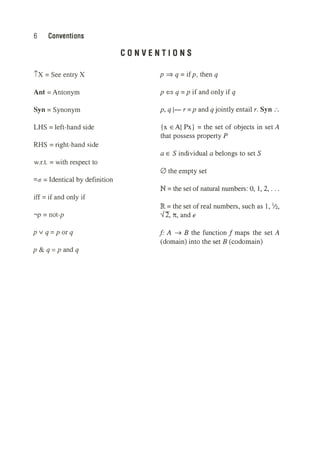
![•
•
•
-
u
i · la] 1 -
l r 1 • a
r ht. h_........
•
- n
· n
. '
la
u , • . n o · -·AL �.Al n
ul
•
l
•
·-ri _1 it 1 .. • · • t• • ti ,,.l(;:3. ............ L-.. •
th .__.•- _ -- -·- r
rule. -n
nonal
id
• •
•
•
-
-
-
-
-
I in . 111g ce i I1f .
• •
l llt •
r I l '
-
hol s
l
I
-
..
•
..
I
•
,.
'
I
l
•
- • •
t
It ' OU I ,.
u . . n
it . n •
•
....... l 1 '"'
1 n •
t '-'1·
-',..:]
. • th t i
l
I
0
'
• •
•
•
lf •
•
n -
te
in l....i,;,l' i
_f
rrriul
[
ur l
m th
• un-
h m
• •
l
•
1-
go](https://image.slidesharecdn.com/28540655-250514154126-b25d5305/85/Philosophical-Dictionary-2nd-Edition-Mario-Bunge-20-320.jpg)

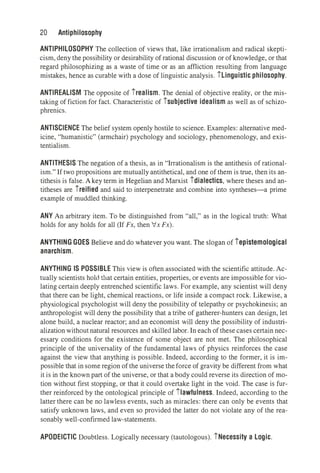
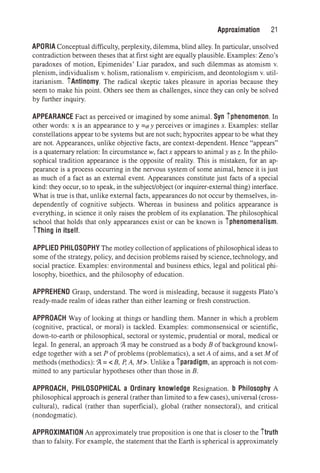
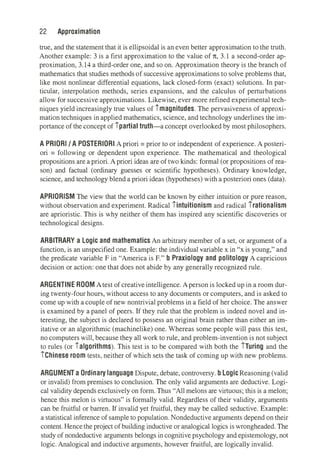
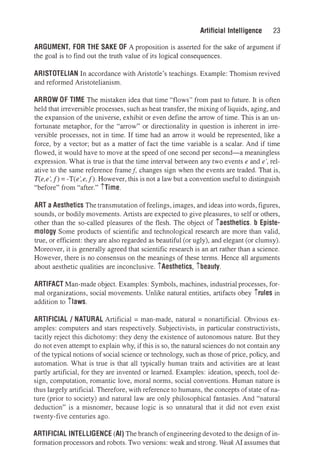



![Biconditional 31
BEHAVIORISM The psychological school that studies only overt behavior. Syn S-R
(stimulus-response) psychology. Two varieties: methodological and ontological. The
former does not deny the occurrence of mental processes but decrees that they are not
scientifically studiable. By contrast, ontological behaviorism denies the reality of the
mental. Obviously, the second entails the first. What makes behaviorism philosophically
interesting is that it was inspired by empiricism. However, the empty-organism and
mindless approach to psychology is now all but dead. Its main legacies are experimental
rigor, behavior therapy, and distrust of empty talk about the soul. Its contemporary suc
cessor is ifunctionalism.
BEING a Individual existent, as in "human being." Syn ientity. b iExistence, as in
"There are stones" (factual existence) and "There exist irrational numbers" (formal ex
istence).
BELIEF A state of mind, or mental process, consisting in giving assent to a proposition
or a set of propositions. These are accepted for being regarded as true, practical, or
moral. Thus, the concept of belief is a ternary predicate: x believes yon ground z [au
thority, evidence, etc.]. In everyday matters belief is often independent of truth. In
mathematics, science, technology, and philosophy proper, one believes only what can
be proved either conclusively or plausibly, or what entails true propositions. In other
domains, particularly religion and politics, most people believe uncritically what they
have been taught: they rarely bother to find out whether it is true or efficient. Belief is
thus a psychological category, not a semantic or epistemological one. However, this
is not to belittle the importance of justifiable (well-grounded) belief in all fields of
knowledge and action. For example, researchers believe that it is worthwhile to redo
certain observations or to put certain hunches to the test; and citizens will mobilize only
if they believe that their interests are at stake, or are made to believe certain slogans.
iJustification.
BELIEF SYSTEM The collection of beliefs held at a given time by an individual or
shared by the members of a social group. Such beliefs are more or less strongly held,
some of them change over time, and they constitute a system-though not necessar
ily a consistent one.
BENEVOLENCE Disposition to do good. Ant malevolence. Benevolence can be sponta
neous or calculated (rational). Either is necessary for coexistence.
BEPC SKETCH The view that society is a supersystem composed of four coupled sub
systems: the biological (B), economic (E), political (P), and cultural (C). A isys
temist alternative to both iindividualism and iholism. A practical consequence of it
is that authentic and sustainable social development is at once biological, economic,
political, and cultural.
BICONDITIONAL A proposition of the form "If p then q and conversely." That is, p <=>
q =dr (p ⇒ q) & (q ⇒p). Standard abbreviations: p =q, p iff q. A biconditional is true
iff both constituents are either trne or false in the same degree.](https://image.slidesharecdn.com/28540655-250514154126-b25d5305/85/Philosophical-Dictionary-2nd-Edition-Mario-Bunge-37-320.jpg)










![Revel. xii. 12.
Wo to the Inhabitants of the Earth, and of the Sea; for the Devil is
come down unto you, having great Wrath; because he knoweth,
that he hath but a short time.
HE Text is Like the Cloudy and Fiery Pillar, vouchsafed
unto Israel, in the Wilderness of old; there is a very dark
side of it in the Intimation, that, The Devil is come down
having great Wrath; but it has also a bright side, when it
assures us, that, He has but a short time; Unto the
Contemplation of both, I do this Day Invite you.
We have in our Hands a Letter from our Ascended Lord in Heaven,
to Advise us of his being still alive, and of his Purpose e're long, to
give us a Visit, wherein we shall see our Living Redeemer, stand at
the latter day upon the Earth. 'Tis the last Advice that we have had
from Heaven, for now sixteen Hundred years; and the scope of it, is,
to represent how the Lord Jesus Christ having begun to set up his
Kingdom in the World, by the preaching of the Gospel, he would
from time to time utterly break to pieces all Powers that should
make Head against it, until, The Kingdoms of this World are become
the Kingdomes of our Lord, and of his [3] Christ, and he shall Reign
for ever and ever. 'Tis a Commentary on what had been written by
Daniel, about, The fourth Monarchy; with some Touches upon, The
Fifth; wherein, The greatness of the Kingdom under the whole
Heaven, shall be given to the people of the Saints of the most High:
And altho' it have, as 'tis expressed by one of the Ancients, Tot
Sacramenta quot verba, a Mystery in every Syllable, yet it is not
altogether to be neglected with such a Despair, as that, I cannot
read, for the Book is sealed. It is a Revelation, and a singular, and
notable Blessing is pronounced upon them that humbly study it.
The Divine Oracles, have with a most admirable Artifice and
Carefulness, drawn, as the very pious Beverley, has laboriously
Evinced, an exact Line of Time, from the first Sabbath at the Creation
of the World, unto the great Sabbatism at the Restitution of all
Things. In that famous Line of Time, from the Decree for the](https://image.slidesharecdn.com/28540655-250514154126-b25d5305/85/Philosophical-Dictionary-2nd-Edition-Mario-Bunge-56-320.jpg)
![Restoring of Jerusalem, after the Babylonish Captivity, there seem to
remain a matter of Two Thousand and Three Hundred Years, unto
that New Jerusalem, whereto the Church is to be advanced, when
the Mystical Babylon shall be fallen. At the Resurrection of our Lord,
there were seventeen or eighteen Hundred of those Years, yet upon
the Line, to run unto, The rest which remains for the People of God;
and this Remnant in the Line of Time, is here in our Apocalypse,
variously Embossed, Adorned, and Signalized with such
Distinguishing Events, if we mind them, will help us escape that
Censure, Can ye not Discern the Signs of the Times?
The Apostle John, for the View of these Things, had laid before him,
as I conceive, a Book, with leaves, or folds; which Volumn was
written both on the Backside, and on the Inside, and Roll'd up in a
Cylindriacal Form, under seven Labels, fastned with so many Seals.
The first Seal being opened, and the first Label removed, under the
first Label the Apostle saw what he saw, of a first Rider Pourtray'd,
and so on, till the last Seal was broken up; each of the Sculptures
being enlarged with agreeable Visions and Voices, to illustrate it. The
Book being now Unrolled, there were Trumpets, with wonderful
Concomitants, Exhibited successively on the Expanding Backside of
it. Whereupon the Book was Eaten, as it were to be Hidden, from
Interpretations; till afterwards, in the Inside of it, the Kingdom of
Anti-christ came to be Exposed. Thus, the Judgments of God on the
Roman Empire, first unto the Downfal of Paganism, and then, unto
the Downfal of Popery, which is but Revived Paganism, are in these
Displayes, with Lively Colours and Features made sensible unto us.
[4] Accordingly, in the Twelfth Chapter of this Book, we have an
August Preface, to the Description of that Horrid Kingdom, which our
Lord Christ refused, but Antichrist accepted, from the Devils Hands;
a Kingdom, which for Twelve Hundred and Sixty Years together, was
to be a continual oppression upon the People of God, and opposition
unto his Interests; until the Arrival of that Illustrious Day, wherein,
The Kingdom shall be the Lords, and he shall be Governour among
the Nations. The Chapter is (as an Excellent Person calls it) an
Extravasated Account of the Circumstances, which befell the](https://image.slidesharecdn.com/28540655-250514154126-b25d5305/85/Philosophical-Dictionary-2nd-Edition-Mario-Bunge-57-320.jpg)
![Primitive Church, during the first Four or Five Hundred Years of
Christianity: It shows us the Face of the Church, first in Rome
Heathenish, and then in Rome Converted, before the Man of Sin was
yet come to Mans Estate. Our Text contains the Acclamations made
upon the most Glorious Revolution that ever yet happened upon the
Roman Empire; namely, That wherein the Travailing Church brought
forth a Christian Emperour. This was a most Eminent Victory over
the Devil, and Resemblance of the State, wherein the World, ere
long shall see, The Kingdom of our God, and the Power of his Christ.
It is here noted,
First, As a matter of Triumph. 'Tis said, Rejoyce, ye Heavens, and ye
that dwell in them. The Saints in both Worlds, took the Comfort of
this Revolution; the Devout Ones that had outlived the late
Persecutions, were filled with Transporting Joys, when they saw the
Christian become the Imperial Religion, and when they saw Good
Men come to give Law unto the rest of Mankind; the Deceased Ones
also, whose Blood had been Sacrificed in the Ten Persecutions,
doubtless made the Light Regions to ring with Hallelujahs unto God,
when there were brought unto them, the Tidings of the Advances
now given to the Christian Religion, for which they had suffered
Martyrdom.
Secondly, As a matter of Horror. 'Tis said, Wo to the Inhabiters of
the Earth and of the Sea. The Earth still means the False Church, the
Sea means the Wide World, in Prophetical Phrasæology. There was
yet left a vast party of Men, that were Enemies to the Christian
Religion, in the power of it; a vast party left for the Devil to work
upon: Unto these is a Wo denounced; and why so? 'Tis added, For
the Devil is come down unto you, having great Wrath, because he
knows, that he has but a short time. These were, it seems, to have
some desperate and peculiar Attempts of the Devil made upon them.
In the mean time, we may entertain this for our Doctrine.
Great Wo proceeds from the Great Wrath, with which [5] the Devil,
towards the end of his Time, will make a Descent upon a miserable
World.](https://image.slidesharecdn.com/28540655-250514154126-b25d5305/85/Philosophical-Dictionary-2nd-Edition-Mario-Bunge-58-320.jpg)
![I have now Published a most awful and solemn Warning for our
selves at this day; which has four Propositions, comprehended in it.
Proposition I. That there is a Devil, is a thing Doubted by none but
such as are under the Influence of the Devil. For any to deny the
Being of a Devil must be from an Ignorance or Profaneness, worse
than Diabolical. A Devil. What is that? We have a Definition of the
Monster, in Eph. 6. 12. A Spiritual Wickedness, that is, A wicked
Spirit. A Devil is a Fallen Angel, an Angel Fallen from the Fear and
Love of God, and from all Celestial Glories; but Fallen to all manner
of Wretchedness and Cursedness. He was once in that Order of
Heavenly Creatures, which God in the Beginning made Ministering
Spirits, for his own peculiar Service and Honour, in the management
of the Universe; but we may now write that Epitaph upon him, How
art thou fallen from Heaven! thou hast said in thine Heart, I will
Exalt my Throne above the Stars of God; but thou art brought down
to Hell! A Devil is a Spiritual and Rational Substance, by his Apostacy
from God, inclined to all that is Vicious, and for that Apostacy
confined unto the Atmosphere of this Earth, in Chains, under
Darkness, unto the Judgment of the Great Day. This is a Devil; and
the Experience of Mankind as well as the Testimony of Scripture,
does abundantly prove the Existence of such a Devil.[78]
About this Devil, there are many things, whereof we may reasonably
and profitably be Inquisitive; such things, I mean, as are in our
Bibles Reveal'd unto us; according to which if we do not speak on so
dark a Subject, but according to our own uncertain, and perhaps
humoursome Conjectures, There is no Light in us. I will carry you
with me, but unto one Paragraph of the Bible, to be informed of
three Things, relating to the Devil; 'tis the Story of the Gadaren
Energumen, in the fifth Chapter of Mark.
First, then, 'Tis to be granted; the Devils are so many, that some
Thousands, can sometimes at once apply themselves to vex one
Child of Man. It is said, in Mark 5. 15. He that was Possessed with
the Devil, had the Legion. Dreadful to be spoken! A Legion consisted
of Twelve Thousand Five Hundred People: And we see that in one](https://image.slidesharecdn.com/28540655-250514154126-b25d5305/85/Philosophical-Dictionary-2nd-Edition-Mario-Bunge-59-320.jpg)
![Man or two, so many Devils can be spared for a Garrison. As the
Prophet cryed out, Multitudes, Multitudes, in the Valley of Decision!
So I say, There are multitudes, multitudes, in the valley of
Destruction, where the Devils are! When [6] we speak of, The Devil,
'tis, A name of Multitude; it means not One Individual Devil, so
Potent and Scient, as perhaps a Manichee would imagine; but it
means a Kind, which a Multitude belongs unto. Alas, the Devils, they
swarm about us, like the Frogs of Egypt, in the most Retired of our
Chambers. Are we at our Boards? There will be Devils to Tempt us
unto Sensuality: Are we in our Beds? There will be Devils to Tempt
us unto Carnality; Are we in our Shops? There will be Devils to
Tempt us unto Dishonesty. Yea, Tho' we get into the Church of God,
there will be Devils to Haunt us in the very Temple it self, and there
tempt us to manifold Misbehaviours. I am verily perswaded, That
there are very few Humane Affairs whereinto some Devils are not
Insinuated; There is not so much as a Journey intended, but Satan
will have an hand in hindering or furthering of it.
Secondly, 'Tis to be supposed, That there is a sort of Arbitrary, even
Military Government, among the Devils. This is intimated, when in
Mar. 5. 9. The unclean Spirit said, My Name is Legion: they are
under such a Discipline as Legions use to be. Hence we read about,
The Prince of the power of the Air: Our Air has a power? or an Army
of Devils in the High Places of it; and these Devils have a Prince over
them, who is King over the Children of Pride. 'Tis probable, That the
Devil, who was the Ringleader of that mutinous and rebellious Crew,
which first shook off the Authority of God, is now the General of
those Hellish Armies;[79] Our Lord, that Conquered him, has told us
the Name of him; 'tis Belzebub; 'tis he that is the Devil, and the rest
are his Angels, or his Souldiers. Think on vast Regiments of cruel
and bloody French Dragoons, with an Intendant over them,
overrunning a pillaged Neighbourhood, and you will think a little,
what the Constitution among the Devils is.
Thirdly, 'tis to be supposed, that some Devils are more peculiarly
Commission'd, and perhaps Qualify'd, for some Countries, while](https://image.slidesharecdn.com/28540655-250514154126-b25d5305/85/Philosophical-Dictionary-2nd-Edition-Mario-Bunge-60-320.jpg)
![others are for others. This is intimated when in Mar. 5. 10. The
Devils besought our Lord much, that he would not send them away
out of the Countrey. Why was that? But in all probability, because
these Devils were more able to do the works of the Devil, in such a
Countrey, than in another. It is not likely that every Devil does know
every Language; or that every Devil can do every Mischief.[80] 'Tis
possible, that the Experience, or, if I may call it so, the Education of
all Devils is not alike, and that there may be some difference in their
Abilities. If one might make an Inference from what the Devils do, to
what they are, One cannot [7] forbear dreaming, that there are
degrees of Devils. Who can allow, that such Trifling Dæmons, as that
of Mascon,[81] or those that once infested our New berry, are of so
much Grandeur, as those Dæmons, whose Games are mighty
Kingdoms? Yea, 'tis certain, that all Devils do not make a like Figure
in the Invisible World. Nor does it look agreeably, That the Dæmons,
which were the Familiars of such a Man as the old Apollonius, differ
not from those baser Goblins that chuse to Nest in the filthy and
loathsom Rags of a beastly Sorceress. Accordingly, why may not
some Devils be more accomplished for what is to be done in such
and such places, when others must be detach'd for other Territories?
Each Devil, as he sees his advantage, cries out, Let me be in this
Countrey, rather than another. But Enough, if not too much, of these
things.[82]
Proposition II. There is a Devilish Wrath against Mankind, with which
the Devil is for God's sake Inspired. The Devil is himself broiling
under the intollerable and interminable Wrath of God; and a fiery
Wrath at God, is, that which the Devil is for that cause Enflamed.
Methinks I see the posture of the Devils in Isa. 8. 21. They fret
themselves, and Curse their God, and look upward. The first and
chief Wrath of the Devil, is at the Almighty God himself; he knows,
The God that made him, will not have mercy on him, and the God
that formed him, will shew him no favour; and so he can have no
Kindness for that God, who has no Mercy, nor Favour for him. Hence
'tis, that he cannot bear the Name of God should be acknowledged](https://image.slidesharecdn.com/28540655-250514154126-b25d5305/85/Philosophical-Dictionary-2nd-Edition-Mario-Bunge-61-320.jpg)
![in the World: Every Acknowledgement paid unto God, is a fresh drop
of the burning Brimstone falling upon the Devil; he does make his
Insolent, tho' Impotent Batteries, even upon the Throne of God
himself: and foolishly affects to have himself exalted unto that
Glorious High Throne, by all people, as he sometimes is, by
Execrable Witches. This horrible Dragon does not only with his Tayl
strike at the Stars of God, but at the God himself, who made the
Stars, being desirous to outshine them all. God and the Devil are
sworn Enemies to each other; the Terms between them, are those,
in Zech. 11. 18. My Soul loathed them, and their Soul also abhorred
me. And from this Furious wrath, or Displeasure and Prejudice at
God, proceeds the Devils wrath at us, the poor Children of Men. Our
doing the Service of God, is one thing that exposes us to the wrath
of the Devil. We are the High Priests of the World; when all
Creatures are called upon, Praise ye the Lord, they bring to us those
demanded Praises of God, saying, do you offer them for us. Hence
'tis, that the Devil has a Quarrel with [8] us, as he had with the
High-Priest in the Vision of Old. Our bearing the Image of God is
another thing that brings the wrath of the Devil upon us. As a Tyger,
thro' his Hatred at man will tear the very Picture of him, if it come in
his way; such a Tyger the Devil is; because God said of old, Let us
make Man in our Image, the Devil is ever saying, Let us pull this
man to pieces. But the envious Pride of the Devil, is one thing more
that gives an Edge unto his Furious Wrath against us. The Apostle
has given us an hint, as if Pride had been the Condemnation of the
Devil. 'Tis not unlikely, that the Devil's Affectation to be above that
Condition which he might learn that Mankind was to be preferr'd
unto, might be the occcasion of his taking up Arms against the
Immortal King. However, the Devil now sees Man lying in the Bosom
of God, but himself damned in the bottom of Hell; and this enrages
him exceedingly; O, says he, I cannot bear it, that man should not
be as miserable as my self.
Proposition III. The Devil, in the prosecution, and the execution of
his wrath upon them, often gets a Liberty to make a Descent upon
the Children of men. When the Devil does hurt unto us, he comes](https://image.slidesharecdn.com/28540655-250514154126-b25d5305/85/Philosophical-Dictionary-2nd-Edition-Mario-Bunge-62-320.jpg)
![down unto us; for the Rendezvouze of the Infernal Troops, is indeed
in the supernal parts of our Air.[83] But as 'tis said, A sparrow of the
Air does not fall down without the will of God; so I may say, Not a
Devil in the Air, can come down without the leave of God. Of this we
have a famous Instance in that Arabian Prince, of whom the Devil
was not able so much as to Touch any thing, till the most high God
gave him a permission, to go down.[84] The Devil stands with all the
Instruments of death, aiming at us, and begging of the Lord, as that
King ask'd for the Hood-wink'd Syrians of old, Shall I smite 'em, shall
I smite 'em? He cannot strike a blow, till the Lord say, Go down and
smite, but sometimes he does obtain from the high possessor of
Heaven and Earth, a License for the doing of it. The Devil sometimes
does make most rueful Havock among us; but still we may say to
him, as our Lord said unto a great Servant of his, Thou couldst have
no power against me, except it were given thee from above.[85] The
Devil is called in 1 Pet. 5. 8. Your Adversary. This is a Law-term; and
it notes An Adversary at Law. The Devil cannot come at us, except in
some sence according to Law; but sometimes he does procure sad
things to be inflicted, according to the Law of the eternal King upon
us. The Devil first goes up as an Accuser against us. He is therefore
styled The Accuser; and it is on this account, that his proper Name
does belong unto him. There is a Court somewhere kept; a Court of
Spirits, where the Devil enters all sorts of Complaints [9] against us
all; he charges us with manifold sins against the Lord our God:
There he loads us with heavy Imputations of Hypocrysie, Iniquity,
Disobedience; whereupon he urges, Lord, let 'em now have the
death, which is their wages, paid unto 'em! If our Advocate in the
Heavens do not now take off his Libel; the Devil, then, with a
Concession of God, comes down, as a destroyer upon us. Having
first been an Attorney, to bespeak that the Judgments of Heaven
may be ordered for us, he then also pleads, that he may be the
Executioner of those Judgments; and the God of Heaven sometimes
after a sort, signs a Warrant, for this destroying Angel, to do what
has been desired to be done for the destroying of men. But such a
permission from God, for the Devil to come down, and break in upon](https://image.slidesharecdn.com/28540655-250514154126-b25d5305/85/Philosophical-Dictionary-2nd-Edition-Mario-Bunge-63-320.jpg)
![mankind, oftentimes must be accompany'd with a Commission from
some wretches of mankind it self. Every man is, as 'tis hinted in Gen.
4. 9. His brother's keeper. We are to keep one another from the
Inroads of the Devil, by mutual and cordial Wishes of prosperity to
one another. When ungodly people give their Consents in witchcrafts
diabolically performed, for the Devil to annoy their Neighbours, he
finds a breach made in the Hedge about us, whereat he Rushes in
upon us, with grievous molestations. Yea, when the impious people,
that never saw the Devil, do but utter their Curses against their
Neighbours, those are so many watch words, whereby the Mastives
of Hell are animated presently to fall upon us. Tis thus, that the
Devil gets leave to worry us.
Proposition IV. Most horrible woes come to be inflicted upon
Mankind, when the Devil does in great wrath, make a descent upon
them. The Devil is a Do-Evil, and wholly set upon mischief. When
our Lord once was going to Muzzel him, that he might not mischief
others, he cry'd out, Art thou come to torment me? He is, it seems,
himself Tormented, if he be but Restrained from the tormenting of
Men. If upon the sounding of the Three last Apocalyptical Angels, it
was an outcry made in Heaven, Wo, wo, wo, to the inhabitants of
the Earth by reason of the voice of the Trumpet. I am sure, a
descent made by the Angel of death, would give cause for the like
Exclamation: Wo to the world, by reason of the wrath of the Devil!
what a woful plight, mankind would by the descent of the Devil be
brought into, may be gathered from the woful pains, and wounds,
and hideous desolations which the Devil brings upon them, with
whom he has with a bodily Possession made a Seisure. You may
both in Sacred and Profane History, read many a direful Account of
the woes, which they that are possessed by the Devil, do undergo:
And from thence conclude, What [10] must the Children of Men
hope from such a Devil! Moreover, the Tyrannical Ceremonies,
whereto the Devil uses to subjugate such Woful Nations or Orders of
Men, as are more Entirely under his Dominion, do declare what
woful Work the Devil would make where he comes. The very
Devotions of those forlorn Pagans, to whom the Devil is a Leader,](https://image.slidesharecdn.com/28540655-250514154126-b25d5305/85/Philosophical-Dictionary-2nd-Edition-Mario-Bunge-64-320.jpg)
![are most bloody Penances; and what Woes indeed must we expect
from such a Devil of a Moloch, as relishes no Sacrifices like those of
Humane Heart-blood, and unto whom there is no Musick like the
bitter, dying, doleful Groans, ejaculated by the Roasting Children of
Men.
Furthermore, the servile, abject, needy circumstances wherein the
Devil keeps the Slaves, that are under his more sensible Vassalage,
do suggest unto us, how woful the Devil would render all our Lives.
We that live in a Province, which affords unto us all that may be
necessary or comfortable for us, found the Province fill'd with vast
Herds of Salvages, that never saw so much as a Knife, or a Nail, or a
Board, or a Grain of Salt, in all their Days. No better would the Devil
have the World provided for. Nor should we, or any else, have one
convenient thing about us, but be as indigent as usually our most
Ragged Witches are; if the Devil's Malice were not overruled by a
compassionate God, who preserves Man and Beast. Hence 'tis, that
the Devil, even like a Dragon, keeping a Guard upon such Fruits as
would refresh a languishing World, has hindred Mankind for many
Ages, from hitting upon those useful Inventions, which yet were so
obvious and facil, that it is every bodies wonder, they were no
sooner hit upon. The bemisted World, must jog on for thousands of
Years, without the knowledg of the Loadstone, till a Neapolitan
stumbled upon it, about three hundred years ago. Nor must the
World be blest with such a matchless Engine of Learning and Vertue,
as that of Printing, till about the middle of the Fifteenth Century. Nor
could One Old Man, all over the Face of the whole Earth, have the
benefit of such a Little, tho' most needful thing, as a pair of
Spectacles, till a Dutch-Man, a little while ago accommodated us.[86]
Indeed, as the Devil does begrutch us all manner of Good, so he
does annoy us with all manner of Wo, as often as he finds himself
capable of doing it. But shall we mention some of the special woes
with which the Devil does usually infest the World! Briefly then;
Plagues are some of those woes with which the Devil troubles us. It
is said of the Israelites, in 1 Cor. 10. 10. They were destroyed of the](https://image.slidesharecdn.com/28540655-250514154126-b25d5305/85/Philosophical-Dictionary-2nd-Edition-Mario-Bunge-65-320.jpg)
![destroyer. That is, they had the Plague among them. 'Tis the
Destroyer, or the Devil, that scatters Plagues about the World.
Pestilential and Contagious Diseases, 'tis the Devil who does
oftentimes invade us with them. 'Tis no uneasy thing for the Devil to
impreg[11]nate the Air about us, with such Malignant Salts, as
meeting with the Salt of our Microcosm, shall immediately cast us
into that Fermentation and Putrefaction, which will utterly dissolve
all the Vital Tyes within us; Ev'n as an Aqua-Fortis, made with a
conjunction of Nitre and Vitriol, Corrodes what it Seizes upon. And
when the Devil has raised those Arsenical Fumes, which become
Venemous Quivers full of Terrible Arrows, how easily can he shoot
the deleterious Miasms into those Juices or Bowels of Mens Bodies,
which will soon Enflame them with a Mortal Fire! Hence come such
Plagues, as that Beesom of Destruction, which within our memory
swept away such a Throng of People from one English City in one
Visitation;[87] And hence those Infectious Fevers, which are but so
many Disguised Plagues among us, causing Epidemical Desolations.
Again, Wars are also some of those Woes, with which the Devil
causes our Trouble. It is said in Rev. 12. 17. The Dragon was Wrath
and he went to make War; and there is in truth scarce any War, but
what is of the Dragon's kindling.[88] The Devil is that Vulcan, out of
whose Forge come the instruments of our Wars, and it is he that
finds us Employments for those Instruments. We read concerning
Dæmoniacks, or People in whom the Devil was, that they would cut
and wound themselves; and so, when the Devil is in Men, he puts
'em upon dealing in that barbarous fashion with one another. Wars
do often furnish him with some Thousands of Souls in one Morning
from one Acre of Ground; and for the sake of such Thyestæan
Banquets, he will push us upon as many Wars as he can.
Once more, why may not Storms be reckoned among those Woes,
with which the Devil does disturb us? It is not improbable that
Natural Storms on the World are often of the Devils raising. We are
told in Job 1. 11, 12, 19. that the Devil made a Storm, which
hurricano'd the House of Job, upon the Heads of them that were
Feasting in it. Paracelsus could have informed the Devil, if he had](https://image.slidesharecdn.com/28540655-250514154126-b25d5305/85/Philosophical-Dictionary-2nd-Edition-Mario-Bunge-66-320.jpg)
![not been informed, as besure he was before, That if much
Aluminious matter, with Salt Petre not throughly prepared, be mixed,
they will send up a cloud of Smoke, which will come down in Rain.
But undoubtedly the Devil understands as well the way to make a
Tempest as to turn the Winds at the Solicitation of a Laplander;[89]
whence perhaps it is, that Thunders are observed oftner to break
upon Churches than upon any other Buildings; and besides many a
Man, yea many a Ship, yea, many a Town has miscarried, when the
Devil has been permitted from above to make an horrible Tempest.
[90] However that the Devil has raised many Metaphorical Storms
upon the Church, is a thing, than which there is nothing more
notorious. It was said unto Believers in Rev. 2. 10. The Devil shall
cast some of [12] you into Prison. The Devil was he that at first set
Cain upon Abel to butcher him, as the Apostle seems to suggest, for
his Faith in God, as a Rewarder. And in how many Persecutions, as
well as Heresies has the Devil been ever since Engaging all the
Children of Cain! That Serpent the Devil has acted his cursed Seed in
unwearied endeavours to have them, Of whom the World is not
worthy, treated as those who are not worthy to live in the World. By
the impulse of the Devil, 'tis that first the old Heathens, and then the
mad Arians were pricking Briars to the true Servants of God; and
that the Papists that came after them, have out done them all for
Slaughters, upon those that have been accounted as the Sheep for
the Slaughters. The late French Persecution is perhaps the horriblest
that ever was in the World:[91] And as the Devil of Mascon seems
before to have meant it in his out-cries upon the Miseries preparing
for the poor Hugonots! Thus it has been all acted by a singlar Fury
of the old Dragon inspiring of his Emissaries.
But in reality, Spiritual Woes are the principal Woes among all those
that the Devil would have us undone withal. Sins are the worst of
Woes, and the Devil seeks nothing so much as to plunge us into
Sins. When men do commit a Crime for which they are to be
Indicted, they are usually mov'd by the Instigation of the Devil. The
Devil will put ill men upon being worse. Was it not he that said in 1](https://image.slidesharecdn.com/28540655-250514154126-b25d5305/85/Philosophical-Dictionary-2nd-Edition-Mario-Bunge-67-320.jpg)
![King. 22. 22. I will go forth, and be a lying Spirit in the Mouth of all
the Prophets? Even so the Devil becomes an Unclean Spirit, a
Drinking Spirit, a Swearing Spirit, a Worldly Spirit, a Passionate
Spirit, a Revengeful Spirit, and the like in the Hearts of those that
are already too much of such a Spirit; and thus they become
improv'd in Sinfulness. Yea, the Devil will put good men upon doing
ill. Thus we read in 1 Chron. 21. 1. Satan provoked David to number
Israel. And so the Devil provokes men that are Eminent in Holiness
unto such things as may become eminently Pernicious; he provokes
them especially unto Pride, and unto many unsuitable Emulations.
There are likewise most lamentable Impressions which the Devil
makes upon the Souls of Men by way of punishment upon them for
their Sins. 'Tis thus when an Offended God puts the Souls of Men
over into the Hands of that Officer who has the power of Death, that
is, the Devil. It is the woful Misery of Unbelievers in 2 Cor. 4. 4. The
god of this World has blinded their minds. And thus it may be said of
those woful Wretches whom the Devil is a God unto, the Devil so
muffles them that they cannot see the things of their peace. And the
Devil so hardens them, that nothing will awaken their cares about
their Souls: How come so many to be Seared in their Sins? 'Tis the
Devil that with a red hot Iron fetcht from his Hell [13] does cauterise
them. Thus 'tis, till perhaps at last they come to have a Wounded
Conscience in them, and the Devil has often a share in their
Torturing and confounded Anguishes. The Devil who Terrified Cain,
and Saul, and Judas into Desperation, still becomes a King of Terrors
to many Sinners, and frights them from laying hold on the Mercy of
God in the Lord Jesus Christ. In these regards, Wo unto us, when
the Devil comes down upon us.[92]
Proposition V. Toward the End of his Time the Descent of the Devil in
Wrath upon the World will produce more woful Effects, than what
have been in former Ages. The dying Dragon, will bite more cruelly
and sting more bloodily than ever he did before: The Death-pangs of
the Devil will make him to be more of a Devil than ever he was; and
the Furnace of this Nebuchadnezzar will be heated seven times
hotter, just before its putting out.](https://image.slidesharecdn.com/28540655-250514154126-b25d5305/85/Philosophical-Dictionary-2nd-Edition-Mario-Bunge-68-320.jpg)
![We are in the first place to apprehend, that there is a time fixed and
stated by God for the Devil to enjoy a dominion over our sinful and
therefore woful World. The Devil once exclaimed in Mat. 8. 29.
Jesus, thou Son of God, art thou come hither to Torment us before
our Time? It is plain, that until the second coming of our Lord the
Devil must have a time of plagueing the World, which he was afraid
would have Expired at his first. The Devil is by the wrath of God the
Prince of this World; and the time of his Reign is to continue until
the time when our Lord himself shall take to himself his great Power
and Reign. Then 'tis that the Devil shall hear the Son of God
swearing with loud Thunders against him, Thy time shall now be no
more! Then shall the Devil with his Angels receive their doom, which
will be, depart into the everlasting Fire prepared for you.
We are also to apprehend, that in the mean time, the Devil can give
a shrewd guess, when he draws near to the End of his Time. When
he saw Christianity enthron'd among the Romans, it is here said, in
our Rev. 12. 12. He knows he hath but a short time. And how does
he know it? Why Reason will make the Devil to know that God won't
suffer him to have the Everlasting Dominion; and that when God has
once begun to rescue the World out of his hands, he'll go through
with it, until the Captives of the mighty shall be taken away and the
prey of the terrible shall be delivered. But the Devil will have
Scripture also, to make him know, that when his Antichristian Vicar,
the seven-headed Beast on the seven-hilled City,[93] shall have spent
his determined years, he with his Vicar must unavoidably go down
into the bottomless Pit. It is not improbable, that the Devil often
hears the Scripture expounded in our Congregations; yea that we
never assemble without a Satan among us. As there are some
Divines, who do with more uncertainty conjecture, from a certain
place in the Epistle to the Ephesians, That the Angels do sometimes
come into our Churches, to gain some advantage from our Ministry.
But be sure our Demonstrable Interpretations may give Repeated
Notices to the Devil, That his time is almost out; and what the
Preacher says unto the Young Man, Know thou, that God will bring](https://image.slidesharecdn.com/28540655-250514154126-b25d5305/85/Philosophical-Dictionary-2nd-Edition-Mario-Bunge-69-320.jpg)
![thee into Judgment! That may our Sermons tell unto the Old Wretch,
Know thou, that the time of thy Judgment is at hand.
But we must now, likewise, apprehend, that in such a time, the woes
of the World will be heightened, beyond what they were at any time
yet from the foundation of the World. Hence 'tis, that the Apostle
has forewarned us, in 2 Tim. 3. 1. this know, that [14] in the last
days, perillous times shall come. Truly, when the Devil knows, that
he is got into his Last days, he will make perillous times for us; the
times will grow more full of Devils, and therefore more full of Perils,
than ever they were before. Of this, if we would know, what cause is
to be assigned; It is not only, because the Devil grows more able,
and more eager to vex the World; but also, and chiefly, because the
World is more worthy to be vexed by the Devil, than ever heretofore.
The Sins of Men in this Generation, will be more mighty Sins, than
those of the former Ages; men will be more Accurate and Exquisite
and Refined in the arts of Sinning, than they use to be. And besides,
their own sins, the sins of all the former Ages will also lie upon the
sinners of this generation. Do we ask why the mischievous powers of
darkness are to prevail more in our days, than they did in those that
are past and gone! 'Tis because that men by sinning over again the
sins of the former days, have a Fellowship with all those unfruitful
works of darkness. As 'twas said in Matth. 23. 36. All these things
shall come upon this generation; so the men of the last Generation,
will find themselves involved in the guilt of all that went before
them. Of Sinners 'tis said, They heap up Wrath; and the sinners of
the Last Generations do not only add unto the heap of sin that has
been pileing up ever since the Fall of man, but they Interest
themselves in every sin of that enormous heap. There has been a
Cry of all former ages going up to God, That the Devil may come
down! and the sinners of the Last Generations, do sharpen and
louden that cry, till the thing do come to pass, as Destructively as
Irremediably. From whence it follows, that the Thrice Holy God, with
his Holy Angels, will now after a sort more abandon the World, than
in the former ages. The roaring Impieties of the old World, at last
gave mankind such a distast in the Heart of the Just God, that he](https://image.slidesharecdn.com/28540655-250514154126-b25d5305/85/Philosophical-Dictionary-2nd-Edition-Mario-Bunge-70-320.jpg)
![came to say, It Repents me that I have made such a Creature! And
however, it may be but a witty Fancy, in a late Learned Writer, that
the Earth before the Flood was nearer to the Sun, than it is at this
Day; and that Gods Hurling down the Earth to a further distance
from the Sun, were the cause of that Flood;[94] yet we may fitly
enough say, that men perished by a Rejection from the God of
Heaven. Thus the enhanc'd Impieties of this our World, will
Exasperate the Displeasure of God, at such a rate, as that he will
more cast us off, than heretofore; until at last, he do with a more
than ordinary Indignation say, Go Devils; do you take them, and
make them beyond all former measures miserable!
If Lastly, We are inquisitive after Instances of those aggravated
woes, with which the Devil will towards the End of his Time assault
us; let it be remembered, That all the Extremities which were
foretold by the Trumpets and Vials in the Apocalyptick Schemes of
these things, to come upon the World, were the woes to come from
the wrath of the Devil, upon the shortning of his Time. The
horrendous desolations that have come upon mankind, by the
Irruptions of the old Barbarians upon the Roman World, and then of
the Saracens, and since, of the Turks, were such woes as men had
never seen before. The Infandous Blindness and Vileness which then
came upon mankind, and the Monstrous Croisadoes which
thereupon carried the Roman World by Millions together unto the
Shambles; were also such woes as had never yet had a Parallel. And
yet these were some of the things here intended, when it was said,
Wo! For the Devil is come down in great Wrath, having but a short
time.
But besides all these things, and besides the increase of Plagues and
Wars, and Storms, and Internal Maladies now in our days, there are
especially two most extraordinary Woes, one would fear, will in these
days become very ordinary. One Woe that may be look'd for is, A
frequent Repition of Earth-quakes, and this perhaps by the energy of
the Devil in the Earth. The Devil will be clap't up, as a Prisoner in or
near the Bowels of the earth, when once that Conflagration shall be](https://image.slidesharecdn.com/28540655-250514154126-b25d5305/85/Philosophical-Dictionary-2nd-Edition-Mario-Bunge-71-320.jpg)
![dispatched, which will make, The New Earth wherein shall dwell
Righteousness; and that Conflagration will doubtless be much
promoted by the Subterraneous Fires, which are a cause of the
Earthquakes in our Dayes. Accordingly, we read, Great Earthquakes
in divers places, enumerated among the Tokens of the Time
approaching, when the Devil shall have no longer Time. I suspect,
That we shall now be visited with more Usual [15] and yet more
Fatal Earthquakes than were our Ancestors; in asmuch as the Fires
that are shortly to Burn unto the Lowest Hell, and set on Fire the
Foundations of the Mountaions, will now get more Head than they
use to do; and it is not impossible, that the Devil, who is ere long to
be punished in those Fires, may aforehand augment his Desert of it,
by having an hand in using some of those Fires, for our Detriment.
Learned Men have made no scruple to charge the Devil with it; Deo
permittente, Terræ motus causat. The Devil surely, was a party in
the Earthquake,[95] whereby the Vengeance of God, in one black
Night sunk Twelve considerable Cities of Asia, in the Reign of
Tiberious.[96] But there will be more such Catastrophe's in our
Dayes; Italy has lately been Shaking, till its Earthquakes have
brought Ruines at once upon more than thirty Towns; but it will
within a little while, shake again, and shake till the Fire of God have
made an Entire Etna of it. And behold, This very Morning, when I
was intending to utter among you such Things as these, we are cast
into an Heartquake by Tidings of an Earthquake that has lately
happened at Jamaica: an horrible Earthquake, whereby the Tyrus of
the English America, was at once pull'd into the Jaws of the Gaping
and Groaning Earth, and many Hundreds of the Inhabitants buried
alive.[97] The Lord sanctifie so dismal a Dispensation of his
Providence, unto all the American Plantations! But be assured, my
Neighbours, the Earthquakes are not over yet! We have not yet seen
the last. And then, Another Wo that may be Look'd for is, The Devils
being now let Loose in preternatural Operations more than formerly;
and perhaps in Possessions and Obsessions that shall be very
marvellous. You are not Ignorant, That just before our Lords First
Coming, there were most observable Outrages committed by the](https://image.slidesharecdn.com/28540655-250514154126-b25d5305/85/Philosophical-Dictionary-2nd-Edition-Mario-Bunge-72-320.jpg)

![present world, become so evil. What a wonder of Mercy is it, that no
Devil could ever yet make a prey of us![98] We can set our foot no
where but we shall tread in the midst of most Hellish Rattle-Snakes;
and one of those Rattle-Snakes once thro' the mouth of a Man, on
whom he had Seized, hissed out such a Truth as this, If God would
let me loose upon you, I should find enough in the Best of you all, to
make you all mine.[99] What shall I say? The Wilderness thro' which
we are passing to the Pro-[16]mised Land, is all over fill'd with Fiery
flying serpents. But, blessed be God; None of them have hitherto so
fastned upon us, as to confound us utterly! All our way to Heaven,
lies by the Dens of Lions, and the Mounts of Leopards; there are
incredible Droves of Devils in our way. But have we safely got on our
way thus far? O let us be thankful to our Eternal preserver for it. It is
said in Psal. 76. 10. Surely the wrath of Man shall praise thee, and
the Remainder of wrath shalt thou restrain; But surely it becomes to
praise God, in that we have yet sustain'd no more Damage by the
wrath of the Devil, and in that he has restrain'd that Overwhelming
wrath. We are poor, Travellers in a World, which is as well the Devils
Field, as the Devils Gaol;[100] a World in every Nook whereof the
Devil is encamped with Bands of Robbers, to pester all that have
their Face looking Zion-ward: And are we all this while preserved
from the undoing Snares of the Devil? it is, Thou, O keeper of Israel,
that hast hitherto been our Keeper! And therefore, Bless the Lord, O
my soul, Bless his Holy Name, who has redeemed thy Life from the
Destroyer!
Corollary II. We may see the rise of those multiply'd, magnify'd, and
Singularly-stinged Afflictions, with which aged, or dying Saints
frequently have their Death Prefaced, and their Age embittered.
When the Saints of God are going to leave the World, it is usually a
more Stormy World with them, than ever it was; and they find more
Vanity, and more Vexation in the world than ever they did before. It
is true, That many are the afflictions of the Righteous; but a little
before they bid adieu to all those many Afflictions, they often have
greater, harder, Sorer, Loads thereof laid upon them, than they had](https://image.slidesharecdn.com/28540655-250514154126-b25d5305/85/Philosophical-Dictionary-2nd-Edition-Mario-Bunge-74-320.jpg)
![Pace in our Journey Heaven-ward, must be Quickened, if our space
for that Journey be shortned, even as Israel went further the two
last years of their Journey Canaan-ward, than they did in 38 years
before. The Apostle brings this, as a spur to the Devotions of
Christians, in 1 Cor. 7. 29. This I say, Brethren, the time is short.
Even so, I say this; some things I lay before you, which I do only
think, or guess, but here is a thing which I venture to say with all
the [33] freedom imaginable. You have now a Time to Get good,
even a Time to make sure of Grace and Glory, and every good thing,
by true Repentance: But, This I say, the time is but short. You have
now Time to Do good, even to serve out your generation, as by the
Will, so for the Praise of God; but, This I say, the time is but short.
And what I say thus to All People, I say to Old People, with a
peculiar Vehemency: Sirs, It cannot be long before your Time is out;
there are but a few sands left in the glass of your Time: And it is of
all things the saddest, for a man to say, My time is done, but my
work undone! O then, To work as fast as you can; and of Soul-work,
and Church-work, dispatch as much as ever you can. Say to all
Hindrances, as the gracious Jeremiah Burroughs[101] would
sometimes to Visitants: You'll excuse me if I ask you to be short with
me, for my work is great, and my time is but short. Methinks every
time we hear a Clock, or see a Watch, we have an admonition given
us, that our Time is upon the wing, and it will all be gone within a
little while. I remember I have read of a famous man, who having a
Clock-watch long lying by him, out of Kilture in his Trunk, it
unaccountably struck Eleven just before he died. Why, there are
many of you, for whom I am to do that office this day: I am to tell
you You are come to your Eleventh hour; there is no more than a
twelfth part at most, of your life yet behind. But if we neglect our
business, till our short Time shall be reduced into none, then, woe to
us, for the great wrath of God will send us down from whence there
is no Redemption.
Corollary IV.](https://image.slidesharecdn.com/28540655-250514154126-b25d5305/85/Philosophical-Dictionary-2nd-Edition-Mario-Bunge-76-320.jpg)
![How welcome should a Death in the Lord be unto them that belong
not unto the Devil, but unto the Lord! While we are sojourning in
this World, we are in what may upon too many accounts be called
The Devils Country: We are where the Devil may come upon us in
great wrath continually. The day when God shall take us out of this
World, will be, The day when the Lord will deliver us from the hand
of all our Enemies, and from the hand of Satan. In such a day, why
should not our song be that of the Psalmist, Blessed be my Rock,
and let the God of my Salvation be exalted! While we are here, we
are in the valley of the shadow of death; and what is it that makes it
so? 'Tis because the wild Beasts of Hell are lurking on every side of
us, and every minute ready to salley forth upon us. But our Death
will fetch us out of that Valley, and carry us where we shall be for
ever with the Lord. We are now under the daily Buffetings of the
Devil, and he does molest us with such Fiery Darts, as cause us even
to cry out, I am weary of my Life. Yea, but are we as willing to die,
as, weary of Life? Our Death will then soon set us where we cannot
be reach'd by the Fist of Wickedness; and where the Perfect cannot
be shotten at. It is said in Rev. 14. 13. Blessed are the [34] Dead
which die in the Lord, they rest from their labours. But we may say,
Blessed are the Dead in the Lord, inasmuch as they rest from the
Devils! Our dying will be but our taking wing: When attended with a
Convoy of winged Angels, we shall be convey'd into that Heaven,
from whence the Devil having been thrown he shall never more
come thither after us. What if God should now say to us, as to
Moses, Go up and die! As long as we go up, when we die, let us
receive the Message with a joyful Soul; we shall soon be there,
where the Devil can't come down upon us. If the God of our Life
should now send that Order to us, which he gave to Hezekiah, Set
thy house in order, for thou shalt die, and not live; we need not be
cast into such deadly Agonies thereupon, as Hezekiah was: We are
but going to that House, the Golden Doors whereof, cannot be
entred by the Devil that here did use to persecute us. Methinks I see
the Departed Spirit of a Believer, triumphantly carried thro' the Devils
Territories, in such a stately and Fiery Chariot, as the Spiritualizing
Body of Elias had; methink I see the Devil, with whole Flocks of](https://image.slidesharecdn.com/28540655-250514154126-b25d5305/85/Philosophical-Dictionary-2nd-Edition-Mario-Bunge-77-320.jpg)
![Harpies, grinning at this Child of God, but unable to fasten any of
their griping Talons upon him: And then, upon the utmost edge of
our Atmosphœre, methinks I overhear the holy Soul, with a most
heavenly Gallantry, deriding the defeated Fiend, and saying, Ah!
Satan! Return to thy Dungeons again; I am going where thou canst
not come for ever! O 'tis a brave thing so to die! and especially so to
die, in our time. For, tho' when we call to mind, That the Devils time
is now but short, it may almost make us wish to live unto the end of
it; and to say with the Psalmist, Because the Lord will shortly appear
in his Glory to build up Zion. O my God! Take me not away in the
midst of my days. Yet when we bear in mind, that the Devils Wrath
is now most great, it would make one willing to be out of the way.
Inasmuch as now is the time for the doing of those things in the
prospect whereof Balaam long ago cry'd out Who shall live when
such things are done! We should not be inordinatly loth to die at
such a time. In a word, the Times are so bad, that we may well
count it, as good a time to die in, as ever we saw.
Corollary V.
Good News for the Israel of God, and particularly for his New-English
Israel. If the Devils Time were above a thousand years ago,
pronounced short, what may we suppose it now in our Time? Surely
we are not a thousand years distant from those happy thousand
years of rest and peace, and [which is better] Holiness reserved for
the People of God in the latter days; and if we are not a thousand
years yet short of that Golden Age, there is cause to think, that we
are not an hundred. That the blessed Thousand years are not yet
begun, is abundantly clear [35] from this, We do not see the Devil
bound; No, the Devil was never more let loose than in our Days; and
it is very much that any should imagine otherwise: But the same
thing that proves the Thousand Years of prosperity for the Church of
God, under the whole Heaven, to be not yet begun, does also prove,
that it is not very far off; and that is the prodigious wrath with which
the Devil does in our days Persecute, yea, desolate the World. Let us
cast our Eyes almost where we will, and we shall see the Devils
domineering at such a rate as may justly fill us with astonishment; it](https://image.slidesharecdn.com/28540655-250514154126-b25d5305/85/Philosophical-Dictionary-2nd-Edition-Mario-Bunge-78-320.jpg)
![is questionable whether Iniquity ever were so rampant, or whether
Calamity were ever so pungent, as in this Lamentable time; We may
truly say, 'Tis the Hour and the Power of Darkness. But, tho' the
wrath be so great, the time is but short: when we are perplexed with
the wrath of the Devil, the Word of our God at the same time unto
us, is that in Rom. 16. 20. The God of Peace shall bruise Satan
under your feet Shortly. Shortly, didst thou say, dearest Lord! O
gladsome word! Amen, Even so, come Lord! Lord Jesus, come
quickly! We shall never be rid of this troublesome Devil, till thou do
come to Chain him up!
But because the people of God, would willingly be told whereabouts
we are, with reference to the wrath and the time of the Devil, you
shall give me leave humbly to set before you a few Conjectures.
The first Conjecture.
The Devils Eldest Son seems to be towards the End of his last Half-
time; and if it be so, the Devils Whole-time, cannot but be very near
its End. It is a very scandalous thing that any Protestant, should be
at a loss where to find the Anti-Christ. But, we have a sufficient
assurance, that the Duration of Anti-Christ, is to be but for a Time,
and for Times, and for Half a time; that is for Twelve Hundred and
Sixty Years. And indeed, those Twelve Hundred and Sixty Years,
were the very Spott of Time left for the Devil, and meant when 'tis
here said, He has but a short time. Now, I should have an easie time
of it, if I were never put upon an Harder Task, than to produce what
might render it extreamly probable, that Anti-christ entred his last
Half-time, or the last Hundred and Fourscore years of his Reign, at
or soon after the celebrated Reformation which began at the year
1517 in the former Century.[102] Indeed, it is very agreeable to see
how Antichrist then lost Half of his Empire; and how that half which
then became Reformed, have been upon many accounts little more
than Half-reformed. But by this computation, we must needs be
within a very few years of such a Mortification to befal the See of
Rome, as that Antichrist, who has lately been planting (what proves](https://image.slidesharecdn.com/28540655-250514154126-b25d5305/85/Philosophical-Dictionary-2nd-Edition-Mario-Bunge-79-320.jpg)
![no more lasting than) a Tabernacle in the Glorious Holy Mountain
between the Seas, must quickly, Come to his End and none shall
help him. [36] So then, within a very little while, we shall see the
Devil stript of the grand, yea, the last, Vehicle, wherein he will be
capable to abuse our World. The Fires, with which, That Beast is to
be consumed, will so singe the Wings of the Devil too, that he shall
no more set the Affairs of this world on Fire. Yea, they shall both go
into the same Fire, to be tormented for ever and ever.
The Second Conjecture.
That which is, perhaps, the greatest Effect of the Devils Wrath,
seems to be in a manner at an end: and this would make one hope
that the Devils time cannot be far from its end. It is in Persecution,
that the wrath of the Devil uses to break forth, with its greatest fury.
Now there want not probabilities, that the last Persecution intended
for the Church of God, before the Advent of our Lord, has been upon
it. When we see the second Woe passing away, we have a fair signal
given unto us, That the last slaughter of our Lord's Witnesses is
over; and then what Quickly follows? The next thing is, The
Kingdoms of this World, are become the Kingdoms of Our Lord, and
of His Christ: and then down goes the Kingdom of the Devil, so that
he cannot any more come down upon us. Now, the Irrecoverable
and Irretrievable Humiliations that have lately befallen the Turkish
Power, are but so many Declarations of the second Woe passing
away.[103] And the dealings of God with the European parts of the
world, at this day do further strengthen this our expectation. We do
see, at this hour a great Earth-quake all Europe over: and we shall
see, that this great Earth-quake, and these great Commotions, will
but contribute unto the advancement of our Lords hitherto
depressed Interests. 'Tis also to be remark'd that, a disposition to
recognize the Empire of God over the Conscience of man, does now
prevail more in the world than formerly; and God from on High more
touches the Hearts of Princes and Rulers with an averseness to
Persecution. 'Tis particularly the unspeakable happiness of the](https://image.slidesharecdn.com/28540655-250514154126-b25d5305/85/Philosophical-Dictionary-2nd-Edition-Mario-Bunge-80-320.jpg)
![English Nation, to be under the Influences of that excellent Queen,
who could say, In as much as a man cannot make himself believe
what he will, why should we Persecute men for not believing as we
do! I wish I could see all good men of one mind; but in the mean
time I pray, let them however love one another.[104] Words worthy
to be written in Letters of Gold! and by us the more to be
considered, because to one of Ours did that royal Person express
Her self so excellently, so obligingly. When the late King James
published his Declaration for Liberty of Conscience, a worthy Divine
in the Church of England, then studying the Revelation, saw cause
upon Revelational Grounds, to declare himself in such words as
these, Whatsoever others may intend or design by this Liberty of
Conscience, I cannot believe, that it will ever be recalled in England,
as long as the World stands. And you know how miraculously [37]
the Earth-quake[105] which then immediately came upon the
Kingdom, has established that Liberty! But that which exceeds all the
tendencies this way, is, the dispensation of God at this Day, towards
the blessed Vaudois. Those renowned Waldenses, which were a sort
of Root unto all Protestant Churches, were never dissipated, by all
the Persecutions of many Ages, till within these few years, the
French King and the Duke of Savoy leagued for their dissipation.[106]
But just Three years and a half after the scattering of that holy
people, to the surprise of all the World, Spirit of life from God is
come into them; and having with a thousand Miracles repossessed
themselves of their antient Seats, their hot Persecutor is become
their great Protector. Whereupon the reflection of the worthy
person, that writes the story is, The Churches of Piemont, being the
Root of the Protestant Churches, they have been the first
established; the Churches of other places, being but the Branches,
shall be established in due time, God will deliver them speedily, He
has already delivered the Mother, and He will not long leave the
Daughter behind: He will finish what he has gloriously begun!
The Third Conjecture.](https://image.slidesharecdn.com/28540655-250514154126-b25d5305/85/Philosophical-Dictionary-2nd-Edition-Mario-Bunge-81-320.jpg)
![There is little room for hope, that the great wrath of the Devil, will
not prove the present ruine of our poor New-England in particular. I
believe, there never was a poor Plantation, more pursued by the
wrath of the Devil, than our poor New-England; and that which
makes our condition very much the more deplorable is, that the
wrath of the great God Himself, at the same time also presses hard
upon us. It was a rousing alarm to the Devil, when a great Company
of English Protestants and Puritans, came to erect Evangelical
Churches, in a corner of the World, where he had reign'd without
any controul for many Ages; and it is a vexing Eye-sore to the Devil,
that our Lord Christ should be known, and own'd and preached in
this howling Wilderness. Wherefor he has left no Stone unturned,
that so he might undermine his Plantation, and force us out of our
Country.
First, The Indian Powawes, used all their Sorceries to molest the first
Planters here;[107] but God said unto them, Touch them not! Then,
Seducing Spirits came to root in this Vineyard, but God so rated
them off, that they have not prevail'd much farther than the Edges
of our Land.[108] After this, we have had a continual blast upon
some of our principal Grain, annually diminishing a vast part of our
ordinary Food. Herewithal, wasting Sicknesses, especially Burning
and Mortal Agues, have Shot the Arrows of Death in at our
Windows. Next, we have had many Adversaries of our own
Language, who have been perpetually assaying to deprive us of
those English Liberties, in the encouragement whereof these
Territories have been settled.[109] As if this had not been [38]
enough; The Tawnies among whom we came, have watered our Soil
with the Blood of many Hundreds of our Inhabitants. Desolating
Fires also have many times laid the chief Treasure of the whole
Province in Ashes. As for Losses by Sea, they have been multiply'd
upon us: and particularly in the present French War, the whole
English Nation have observ'd that no part of the Nation has
proportionably had so many Vessels taken, as our poor New-
England. Besides all which, now at last the Devils are (if I may so](https://image.slidesharecdn.com/28540655-250514154126-b25d5305/85/Philosophical-Dictionary-2nd-Edition-Mario-Bunge-82-320.jpg)
![speak) in Person come down upon us with such a Wrath, as is justly
much, and will quickly be more, the Astonishment of the World. Alas,
I may sigh over this Wilderness, as Moses did over his, in Psal. 90. 7.
9. We are consumed by thine Anger, and by thy Wrath we are
troubled: All our days are passed away in thy Wrath. And I may add
this unto it, The Wrath of the Devil too has been troubling and
spending of us, all our days.
But what will become of this poor New-England after all? Shall we
sink, expire, perish, before the short time of the Devil shall be
finished?[110] I must confess, That when I consider the lamentable
Unfruitfulness of men, among us, under as powerful and perspicuous
Dispensations of the Gospel, as are in the World; and when I
consider the declining state of the Power of Godliness in our
Churches, with the most horrible Indisposition that perhaps ever
was, to recover out of this declension; I cannot but Fear lest it
comes to this, and lest an Asiatic Removal of Candlesticks come
upon us. But upon some other Accounts, I would fain hope
otherwise; and I will give you therefore the opportunity to try what
Inferences may be drawn from these probable Prognostications.
I say, First, That surely, America's Fate must at the long run include
New-Englands in it. What was the design of our God, in bringing
over so many Europeans hither of late Years? Of what use or state
will America be, when the Kingdom of God shall come? If it must all
be the Devils propriety, while the saved Nations of the other
Hæmisphere shall be Walking in the Light of the New Jerusalem, Our
New-England has then, 'tis likely, done all that it was erected for. But
if God have a purpose to make here a seat for any of those glorious
things which are spoken of thee, O thou City of God; then even
thou, O New-England, art within a very little while of better days
than ever yet have dawn'd upon thee.
I say, Secondly, That tho' there be very Threatning Symptoms on
America, yet there are some hopeful ones. I confess, when one
thinks upon the crying Barbarities with which the most of those
Europeans that have Peopled this New world, became the Masters of](https://image.slidesharecdn.com/28540655-250514154126-b25d5305/85/Philosophical-Dictionary-2nd-Edition-Mario-Bunge-83-320.jpg)
![it; it looks but Ominously. When one also thinks how much the way
of living in many parts of America, is utterly inconsistent with the
very Essentials of Christianity; yea, how much Injury and Violence is
there[39]in done to Humanity it self; it is enough to damp the Hopes
of the most Sanguine Complexion. And the Frown of Heaven which
has hitherto been upon Attempts of better Gospellizing the
Plantations, considered, will but increase the Damp. Nevertheless,
on the other side, what shall be said of all the Promises, That our
Lord Jesus Christ shall have the uttermost parts of the Earth for his
Possession? and of all the Prophecies, That All the ends of the Earth
shall remember and turn unto the Lord? Or does it look agreeably,
That such a rich quarter of the World, equal in some regards to all
the rest, should never be out of the Devils hands, from the first
Inhabitation unto the last Dissolution of it? No sure; why may not
the last be the first? and the Sun of Righteousness come to shine
brightest, in Climates which it rose latest upon!
I say, Thirdly, That as it fares with Old England, so it will be most
likely to fare with New-England. For which cause, by the way, there
may be more of the Divine Favour in the present Circumstances of
our dependence on England, than we are well aware of. This is very
sure, if matters go ill with our Mother, her poor American Daughter
here, must feel it; nor could our former Happy Settlement have
hindred our sympathy in that Unhappiness. But if matters go Well in
the Three Kingdoms; as long as God shall bless the English Nation,
with Rulers that shall encourage Piety, Honesty, Industry, in their
Subjects, and that shall cast a Benign Aspect upon the Interests of
our Glorious Gospel, Abroad as well as at Home; so long, New-
England will at least keep its head above water: and so much the
more, for our comfortable Settlement in such a Form as we are now
cast into. Unless there should be any singular, destroying, Topical
Plagues, whereby an offended God should at last make us Rise; But,
Alas, O Lord, what other Hive hast thou provided for us!
I say, Fourthly, That the Elder England will certainly and speedily be
Visited with the ancient loving kindness of God. When one sees, how
strangely the Curse of our Joshua, has fallen upon the Persons and](https://image.slidesharecdn.com/28540655-250514154126-b25d5305/85/Philosophical-Dictionary-2nd-Edition-Mario-Bunge-84-320.jpg)
![Houses of them that have attempted the Rebuilding of the Old
Romish Jericho, which has there been so far demolished, they
cannot but say, That the Reformation there, shall not only be
maintained, but also pursued, proceeded, perfected; and that God
will shortly there have a New Jerusalem. Or, Let a Man in his
thoughts run over but the series of amazing Providences towards the
English Nation for the last Thirty Years: Let him reflect, how many
Plots for the ruine of the Nation have been strangely discovered?
yea, how very unaccountably those very Persons, yea, I may also
say, and those very Methods which were intended for the tools of
that ruine, have become the instruments or occasions of
Deliverances? A man cannot but say upon these Reflec[40]tions, as
the Wife of Manoah once prudently expressed her self, If the Lord
were pleased to have Destroyed us, He would not have shew'd us all
these things. Indeed, It is not unlikely, that the Enemies of the
English Nation, may yet provoke such a Shake unto it, as may
perhaps exceed any that has hitherto been undergone: the Lord
prevent the Machinations of his Adversaries! But that shake will
usher in the most glorious Times that ever arose upon the English
Horizon. As for the French Cloud which hangs over England, tho' it
be like to Rain showers of Blood upon a Nation, where the Blood of
the Blessed Jesus has been too much treated as an Unholy Thing;
yet I believe God will shortly scatter it: and my belief is grounded
upon a bottom that will bear it. If that overgrown French
Leviathan[111] should accomplish any thing like a Conquest of
England, what could there be to hinder him from the Universal
Empire of the West? But the Visions of the Western World, in the
Views both of Daniel and of John, do assure us, that whatever
Monarch, shall while the Papacy continues go to swallow up the Ten
Kings which received their Power upon the Fall of the Western
Empire, he must miscarry in the Attempt. The French Phaetons
Epitaph seems written in that, Sure Word of Prophecy.
[Since the making of this Conjecture, there are arriv'd unto us, the
News of a Victory obtain'd by the English over the French, which
further confirms our Conjecture; and causes us to sing, Pharaohs](https://image.slidesharecdn.com/28540655-250514154126-b25d5305/85/Philosophical-Dictionary-2nd-Edition-Mario-Bunge-85-320.jpg)