Ali Asghar Jatoi
20 BS/ENG/011
Semantics
11/8/2021 jatoiasghar06@gmail.com 1
Presentation Topic
THE APPLICATION OF SEMANTIC
FIELD THEORY TO ENGLISH
VOCBULARY LEARNING
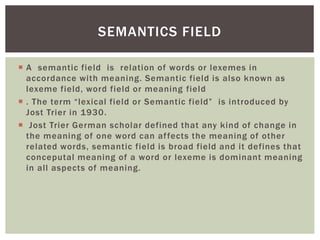
 A semantic field is relation of words or lexemes in
accordance with meaning. Semantic field is also known as
lexeme field, word field or meaning field
 . The term “lexical field or Semantic field” is introduced by
Jost Trier in 1930.
 Jost Trier German scholar defined that any kind of change in
the meaning of one word can affects the meaning of other
related words, semantic field is broad field and it defines that
conceputal meaning of a word or lexeme is dominant meaning
in all aspects of meaning.
SEMANTICS FIELD
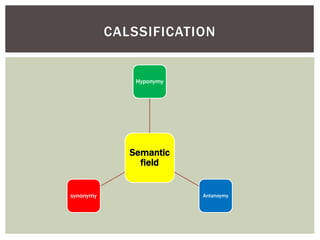
Semantic
field
Hyponymy
Antanoymy
synonymy
CALSSIFICATION
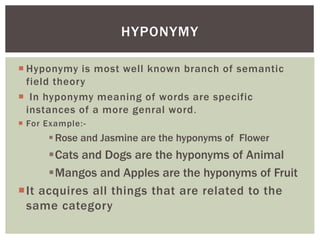
 Hyponymy is most well known branch of semantic
field theory
 In hyponymy meaning of words are specific
instances of a more genral word.
 For Example:-
Rose and Jasmine are the hyponyms of Flower
Cats and Dogs are the hyponyms of Animal
Mangos and Apples are the hyponyms of Fruit
It acquires all things that are related to the
same category
HYPONYMY
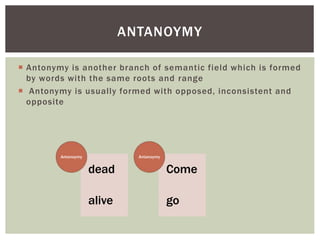
 Antonymy is another branch of semantic field which is formed
by words with the same roots and range
 Antonymy is usually formed with opposed, inconsistent and
opposite
ANTANOYMY
dead
alive
Antanoymy
Come
go
Antanoymy
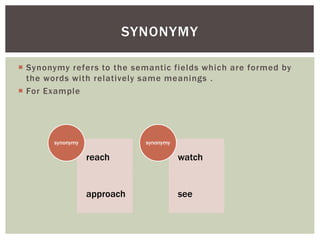
 Synonymy refers to the semantic fields which are formed by
the words with relatively same meanings .
 For Example
SYNONYMY
reach
approach
synonymy
watch
see
synonymy
 This paper studies English vocabulary learning based on
semantic field theory
 In introduction, the paper presents the significance of the
study and the theoretical review of semantic field
 The efficiency of vocabulary learning greatly determines the
success of language learning
 The size of one’s vocabulary directly affects the development
of his/her linguistic competence.
CONCLUSION
 The Application of Semantic Field Theory to English
Vocabulary Learning (Chunming Gao
School of Foreign Languages, Changchun University of Science
and Technology, China Bin Xu Kanrin Japanese School, Japan.)
REFERENCE
THANK YOU
ANY QUESTION...??

Semantic presentation

  • 1.
    Ali Asghar Jatoi 20BS/ENG/011 Semantics 11/8/2021 jatoiasghar06@gmail.com 1
  • 2.
    Presentation Topic THE APPLICATIONOF SEMANTIC FIELD THEORY TO ENGLISH VOCBULARY LEARNING
  • 3.
     A semanticfield is relation of words or lexemes in accordance with meaning. Semantic field is also known as lexeme field, word field or meaning field  . The term “lexical field or Semantic field” is introduced by Jost Trier in 1930.  Jost Trier German scholar defined that any kind of change in the meaning of one word can affects the meaning of other related words, semantic field is broad field and it defines that conceputal meaning of a word or lexeme is dominant meaning in all aspects of meaning. SEMANTICS FIELD
  • 4.
  • 5.
     Hyponymy ismost well known branch of semantic field theory  In hyponymy meaning of words are specific instances of a more genral word.  For Example:- Rose and Jasmine are the hyponyms of Flower Cats and Dogs are the hyponyms of Animal Mangos and Apples are the hyponyms of Fruit It acquires all things that are related to the same category HYPONYMY
  • 6.
     Antonymy isanother branch of semantic field which is formed by words with the same roots and range  Antonymy is usually formed with opposed, inconsistent and opposite ANTANOYMY dead alive Antanoymy Come go Antanoymy
  • 7.
     Synonymy refersto the semantic fields which are formed by the words with relatively same meanings .  For Example SYNONYMY reach approach synonymy watch see synonymy
  • 8.
     This paperstudies English vocabulary learning based on semantic field theory  In introduction, the paper presents the significance of the study and the theoretical review of semantic field  The efficiency of vocabulary learning greatly determines the success of language learning  The size of one’s vocabulary directly affects the development of his/her linguistic competence. CONCLUSION
  • 9.
     The Applicationof Semantic Field Theory to English Vocabulary Learning (Chunming Gao School of Foreign Languages, Changchun University of Science and Technology, China Bin Xu Kanrin Japanese School, Japan.) REFERENCE
  • 10.