RABINDRANATH
TAGORE
Viswakavi (World Poet)
Rabindranath was born on May 9,
1861 in Bengal.
His father Maharihi Devendranath
Tagore was a rich man and an
aristocrat and his mother was
Sarada Devi. Rabindranath
Tagore was not sent to any
school.
He was educated at home by a
tutor. Rabindranath was not
happy, getting educated within the
four walls. He was a curious and
creative child.
Though he was educated at home, he
studied many subjects and there was a
method in his studies.
He would get up early. After physical
education he would study Mathematics,
History, Geography, Bengali and Sanskrit.
In the afternoon, he learnt drawing, English
and play games.
On Sundays he would learn music and
conduct experiments in science. Reading
plays was of special interest to him.
He was happy to read plays of Kalidas
and Shakespeare. He had a special
interest in Bengali, which was his mother-
tongue.
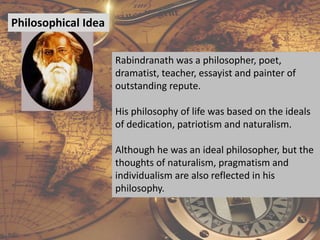
Philosophical Idea
Rabindranath was a philosopher, poet,
dramatist, teacher, essayist and painter of
outstanding repute.
His philosophy of life was based on the ideals
of dedication, patriotism and naturalism.
Although he was an ideal philosopher, but the
thoughts of naturalism, pragmatism and
individualism are also reflected in his
philosophy.
Idealist:
Tagore believes that man should realize the
"ultimate truth" which will liberate him from the
worldly bondage. Experience according to him is
within the world of illusion
Humanist:
Tagore said nature and man are created by
supreme power. There is a strong link between
man and nature. So man should act naturally to
feel the presence of superpower within him.
Naturalist:
Tagore said nature is the great teacher which is not
hostile to man. Nature is kind, generous and
benevolent like mother. In his view, "Education
diverted from nature has brought untold harm to
young children." Man should develop his relation
with the nature as his fellowmen.
Rabindranath Tagore was primarily an
educationist rather than a political
thinker.
He put emphasis on 'naturalism' for
framing educational model.
In education, freedom is the basic
guiding force for inculcating interest
within a student who will derive
inspiration from nature to pursue any
branch of knowledge he likes.
The establishment of Shantiniketan
fulfilled the desired goal of Tagore in
the educational front.
Educational Idea
Unity of West and East:
Tagore's education marked a novel blending of the ideas of
the East and West. The spiritualism of Indian philosophy
and progressive outlook of the western people were
blended together to give rise to an educational philosophy
which marked its distinction in comparison to other
educationists of India.
Natural growth in natural circumstance:
Tagore envisaged that nature is the best teacher to
the pupil. Nature will provide the student with
necessary situation to earn knowledge. No pressure
should be exerted upon the student to learn
anything.
Goodbye to book-centered education:
the first time in the arena of education, Tagore
established a new mile-stone. With boldness and
firmness, he rejected a book-centered education for
students. To him it is not just to confine the mind of
boys and girls to text-books only. It will kill the natural
instincts of a student and make him bookish.
Freedom to learner:
Tagore had championed the cause of freedom. The
same he wanted to implement in the field of
education. With that object he had opened
Shantiniketan, Sri Niketan and Brahmachari Ashram.
Accordingly, he gave free choice to students to
develop their interest in any field they like.
Teaching - practical and real:
According to Tagore, teaching should be practical and
real but not artificial and theoretical. As a naturalist
out and out, Tagore laid emphasis on the practicality
of education. That will definitely increase the creative
skill within a learner.
That creativity will bring perfection in the learning
process and the student will be a master in his own
field but not a slave to mere theoretical knowledge
which one delves deep.
Palace of fine arts (dance, drama, music, poetry etc.:
Tagore attached great importance to the fine arts in
his educational curriculum. To him, game, dance,
music, drama, painting etc. should form a part of
educational process. Students should take active part
in these finer aspects of human life for these are very
essential to enrich soul.
Education for rural reconstruction:
Tagore was aware about the rural poverty of our
country. So, he wanted to eradicate it through
education. The practical training imparted in different
crafts to the students will make them skilled artisans
in their field.
AIMS OF EDUCATION
A PRESENTATION BY
FAUMEDHA A T
KSTC

Rabindranath tagore

  • 1.
  • 2.
    Viswakavi (World Poet) Rabindranathwas born on May 9, 1861 in Bengal. His father Maharihi Devendranath Tagore was a rich man and an aristocrat and his mother was Sarada Devi. Rabindranath Tagore was not sent to any school. He was educated at home by a tutor. Rabindranath was not happy, getting educated within the four walls. He was a curious and creative child.
  • 3.
    Though he waseducated at home, he studied many subjects and there was a method in his studies. He would get up early. After physical education he would study Mathematics, History, Geography, Bengali and Sanskrit. In the afternoon, he learnt drawing, English and play games. On Sundays he would learn music and conduct experiments in science. Reading plays was of special interest to him. He was happy to read plays of Kalidas and Shakespeare. He had a special interest in Bengali, which was his mother- tongue.
  • 4.
    Philosophical Idea Rabindranath wasa philosopher, poet, dramatist, teacher, essayist and painter of outstanding repute. His philosophy of life was based on the ideals of dedication, patriotism and naturalism. Although he was an ideal philosopher, but the thoughts of naturalism, pragmatism and individualism are also reflected in his philosophy.
  • 5.
    Idealist: Tagore believes thatman should realize the "ultimate truth" which will liberate him from the worldly bondage. Experience according to him is within the world of illusion
  • 6.
    Humanist: Tagore said natureand man are created by supreme power. There is a strong link between man and nature. So man should act naturally to feel the presence of superpower within him.
  • 7.
    Naturalist: Tagore said natureis the great teacher which is not hostile to man. Nature is kind, generous and benevolent like mother. In his view, "Education diverted from nature has brought untold harm to young children." Man should develop his relation with the nature as his fellowmen.
  • 8.
    Rabindranath Tagore wasprimarily an educationist rather than a political thinker. He put emphasis on 'naturalism' for framing educational model. In education, freedom is the basic guiding force for inculcating interest within a student who will derive inspiration from nature to pursue any branch of knowledge he likes. The establishment of Shantiniketan fulfilled the desired goal of Tagore in the educational front. Educational Idea
  • 9.
    Unity of Westand East: Tagore's education marked a novel blending of the ideas of the East and West. The spiritualism of Indian philosophy and progressive outlook of the western people were blended together to give rise to an educational philosophy which marked its distinction in comparison to other educationists of India.
  • 10.
    Natural growth innatural circumstance: Tagore envisaged that nature is the best teacher to the pupil. Nature will provide the student with necessary situation to earn knowledge. No pressure should be exerted upon the student to learn anything.
  • 11.
    Goodbye to book-centerededucation: the first time in the arena of education, Tagore established a new mile-stone. With boldness and firmness, he rejected a book-centered education for students. To him it is not just to confine the mind of boys and girls to text-books only. It will kill the natural instincts of a student and make him bookish.
  • 12.
    Freedom to learner: Tagorehad championed the cause of freedom. The same he wanted to implement in the field of education. With that object he had opened Shantiniketan, Sri Niketan and Brahmachari Ashram. Accordingly, he gave free choice to students to develop their interest in any field they like.
  • 13.
    Teaching - practicaland real: According to Tagore, teaching should be practical and real but not artificial and theoretical. As a naturalist out and out, Tagore laid emphasis on the practicality of education. That will definitely increase the creative skill within a learner. That creativity will bring perfection in the learning process and the student will be a master in his own field but not a slave to mere theoretical knowledge which one delves deep.
  • 14.
    Palace of finearts (dance, drama, music, poetry etc.: Tagore attached great importance to the fine arts in his educational curriculum. To him, game, dance, music, drama, painting etc. should form a part of educational process. Students should take active part in these finer aspects of human life for these are very essential to enrich soul.
  • 15.
    Education for ruralreconstruction: Tagore was aware about the rural poverty of our country. So, he wanted to eradicate it through education. The practical training imparted in different crafts to the students will make them skilled artisans in their field.
  • 16.
  • 17.