‘‘The regular type of school is a
manufactory and is a mere method
of discipline specially
designed for grinding out
uniform results”
Rabindranath Tagore
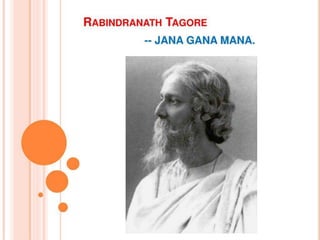
Rabindrana
th
Tagore was
great poet
of India.
His name is
written as
Rabindranath
Thakur
in Indian
languages.
a philosopher
and an artist.
well known
for composing
music.
1913, he won
the Nobel
Prize in
Literature.
He was
popularly
known as
"kabiguru".
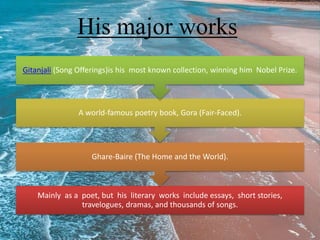
His major works
Mainly as a poet, but his literary works include essays, short stories,
travelogues, dramas, and thousands of songs.
Ghare-Baire (The Home and the World).
A world-famous poetry book, Gora (Fair-Faced).
Gitanjali (Song Offerings)is his most known collection, winning him Nobel Prize.
He wrote
many non-
fiction books.
on variety of
subject like
Indian
History,
Linguistics,
Spirituality,
etc.
His
travelogues,
essay, lectures
and letters
are complied
in several
volumes.
He wrote
Sadhana
which
includes ideal
way of
spiritual
uplifment.
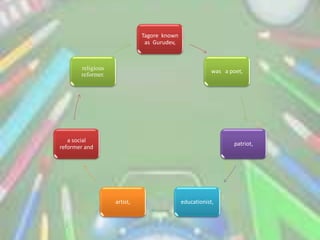
Tagore known
as Gurudev,
was a poet,
patriot,
educationist,
artist,
a social
reformer and
religious
reformer.
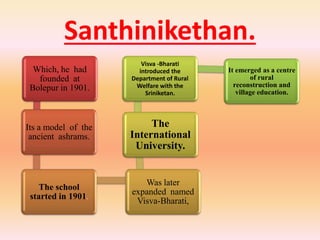
Santhinikethan.
Which, he had
founded at
Bolepur in 1901.
Its a model of the
ancient ashrams.
The school
started in 1901.
Was later
expanded named
Visva-Bharati,
The
International
University.
Visva -Bharati
introduced the
Department of Rural
Welfare with the
Sriniketan.
It emerged as a centre
of rural
reconstruction and
village education.
Tagore’s Philosophy
 Philosophy of
Humanism.
Synthesis of Culture.
 True culture.
 Tagore a Universalist
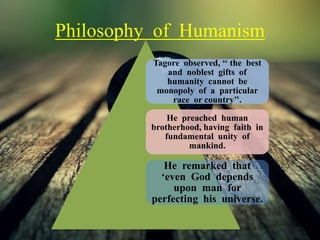
Philosophy of Humanism
Tagore observed, ‘‘ the best
and noblest gifts of
humanity cannot be
monopoly of a particular
race or country’’.
He preached human
brotherhood, having faith in
fundamental unity of
mankind.
He remarked that
‘even God depends
upon man for
perfecting his universe.
Synthesis of Culture.
Before we are in a
position to stand
in comparison with
the other cultures
of the world.
Try to cooperate with
them, we must bare
our own culture on a
synthesis of all the
different cultures we
have’’
True culture
Culture bring
fulfillment from
the depths the self
to the faculties
and aptitudes of a
man as a whole.
Man spontaneously
attain an all round
fulfillment and the
pursuit of knowledge
for its own sake and
the enthusiasm for
unselfish action
become natural.
It sets greater
store by natural
courtesy than
mechanical
observance of
custom and
convention.
A cultured man
will rather injure
than humiliate
himself.
To be envious of
others success is
to humiliate
himself.
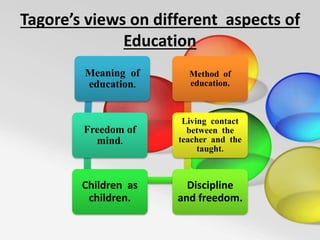
Tagore’s views on different aspects of
Education
Meaning of
education.
Freedom of
mind.
Children as
children.
Discipline
and freedom.
Living contact
between the
teacher and the
taught.
Method of
education.
Tagore’s views on different aspects of
Education.
Creative self expression through
physical, mental ,aesthetic and moral
development.
Education as a vehicle for appreciating
the richest aspect of cultures, while
maintaining one’s own cultural specificity.
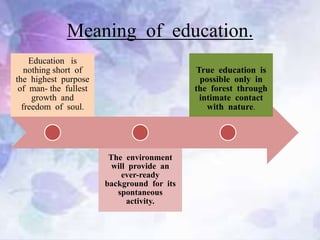
Meaning of education.
Education is
nothing short of
the highest purpose
of man- the fullest
growth and
freedom of soul.
The environment
will provide an
ever-ready
background for its
spontaneous
activity.
True education is
possible only in
the forest through
intimate contact
with nature.
Freedom of mind.
The objective of
education is the
freedom of
mind, which can
only be achieved
through the path
of education.
Children as children.
It is a mistake to judge Children by the
standards of grown-ups.
Adults ignore the natural gifts of children
and insist that children must learn
through the same process as they do.
Children’s subconscious mind is more
active than conscious intelligence.
Discipline and freedom
Living ideals cannot
be set in to
clockwork
arrangement.
Tagore wrote, ’’I
never said to them;
Don’t’ do this, or
don’t do that I
never punish them ‘’.
An ideal School
An ideal school is an ashram.
Tagore observed ‘’ To give spiritual culture
to our boys was my principal objective in
starting my school at Bolepur ‘’
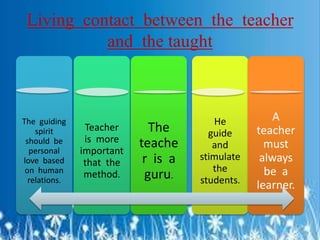
Living contact between the teacher
and the taught
The guiding
spirit
should be
personal
love based
on human
relations.
Teacher
is more
important
that the
method.
The
teache
r is a
guru.
He
guide
and
stimulate
the
students.
A
teacher
must
always
be a
learner.
He remarked, ‘‘ A teacher can never
truly teach unless he is still learning
himself. A lamp can never light
another lamp unless it continues to
burn in its own flame’’.
Method of education
Use of methods
like debates,
discussions,
heuristic,
method activity
method ,etc .
We were
taught in our
language that
our mind
quickened.
Learning
should, as far
as possible
follow the
process of
eating.
We must admit
that the English
language cannot
lose its seat of
honor in our
universities.
Santhinikethan [Abode of peace]
and Viswabharathi
He started a small
school at
Santhinikethan in
1901.
Later this school was
developed in to a
university and rural
reconstruction centre
known as Viswa
bharathi.
He dedicated forty
years of his life to his
educational institution
at Santhinikethen.
Students were encouraged to create their
own publications.
Put out several illustrated magazines.
Encouraged to follow their ideas in
painting and drawing
to draw inspiration from the many
visiting artists and writres.
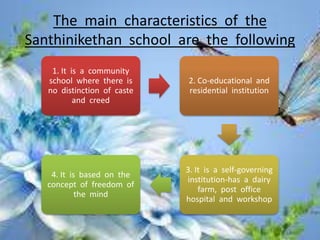
The main characteristics of the
Santhinikethan school are the following
1. It is a community
school where there is
no distinction of caste
and creed
2. Co-educational and
residential institution
3. It is a self-governing
institution-has a dairy
farm, post office
hospital and workshop
4. It is based on the
concept of freedom of
the mind
Mother toungue is
the medium of
instruction
It is situated in
natural surroundings
and it provides for
manual lab our.
There is a well-
equipped library.
Viswabharati
Viswabh
arati as
a
learning
centre ,
Where
conflicting
interest are
minimized,
where
individuals work
together in
common pursuit
of truth.
Artists in all
part of the
world have
created
forms of
beauty.
Scientists
discovered
the secrets
of the
universe,
Philosoph
ers
solved
the
problems
of
existence,
Saints
made the
truth of
the world
organic in
their own
lives.
spiritual
Not
merely
for some
particular
race to
which
they
belong.
For all
mankind.
Various institutions, which have developed
at Viswabharati, are following.
5. Vineyard Bhavan [teacher’s college]
4. Vidhya Bhavan [college undergraduate and PG studies and research]
3. Sikh Bhavan [higher secondary]
2. Path Bhavan [school section -matriculation examination]
1 .Sisu Bhavan [nursery school]
11.CheenaBhavan [school of languages-Chinese, Tibetan etc]
10. SilpaSadana [college of industrial training]
9. Siksa Satra [rural high school]
8. Sriniketan [department of rural reconstruction]
7. Sangit Bhavan [college of music and dance]
6. Kala Bhavan [college of fine arts and crafts]
5. Vinaya Bhavan [teacher’s college]
Educational Contributions of Tagore
Nature walks and excursions were a part of the
curriculum and students were encouraged to
follow the life cycles of insects, birds and plants.
His of education placed equal importance on the
aesthetic development of the senses along with
the intellectual.
To him music, literature,
art, dance and drama were
very important aspects of
daily school life.
First to support and bring
together different forms of
Indian dance.
He helped revive folk
dances.
introduced dance forms
from other parts of India,
such as Manipuri, Kathak
and Kathakali.
They were encouraged to read out their own writings in
special literary evenings.
Believed in presenting difficult levels of literature.
Follow their ideas in painting and drawing and to draw
inspiration from the many visiting artists and writers
Tagore had envisioned is at Visva-Bharati, a learning
centre where conflicting interests are minimized.
Individuals work together in a common pursuit of
truth and realise 'that artists in all parts of the world
have created forms of beauty.
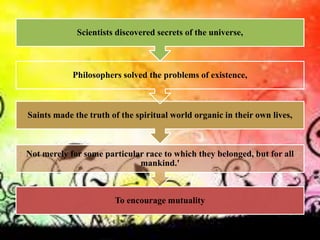
To encourage mutuality
Not merely for some particular race to which they belonged, but for all
mankind.'
Saints made the truth of the spiritual world organic in their own lives,
Philosophers solved the problems of existence,
Scientists discovered secrets of the universe,
The Constitution designated Visva-Bharati as
an Indian, Eastern and Global cultural centre
whose goals were to:
Study the mind of Man
in its realisation of
different aspects of
truth from diverse
points of view.
Bring into more intimate
relation with one
another through patient
study and research, the
different cultures of the
East on the basis of their
underlying unity.
3. Approach the West from the standpoint of such a unity of
the life and thought of Asia
4. Seek to realise in a common fellowship of study the
meeting of East and West and thus ultimately strengthen the
fundamental conditions of world peace through the free
communication of ideas between the two hemispheres.
5. And with such Ideals in view to
provide at Shantiniketan a centre of
culture where research into the study of
the religion, literature, history, science
and art of Hindu, Buddhist, Jain,
Zoroastrian, Islamic, Sikh, Christian and
other civilizations may be pursued along
with the culture of the West.
simplicity of externals which is necessary for true spiritual
realization, in amity.
Good-fellowship and co-operation between the
thinkers and scholars of both Eastern and Western
countries,
Free from all antagonisms of race,
Nationality, creed or caste and in the name of the One Supreme
Being who is Shantam , Shivam &Advaitham.
In terms of curriculum
Tagore advocated a
different methodology
of teaching.
Studying national
cultures for the wars
won and cultural
dominance imposed.
Tagore is acknowledged
as a living icon of the
type of mutuality and
creative exchange that
he advocated.
Vishwa Bharathy.
In 1901 Tagore set up a school Shanthenikethan.
Gradually over the years, it developed into Vishwa
Bharathy- an international university.
teacher and students live together in a spirit of perfect
comeradeship with the motto ‘‘ where the whole world
forms its one single nest .’’
Evaluation Of Tagore’s Philosophy
In the words of H.B.Mulherji
‘‘ Tagore was the greatest prophet of educational
renaissance in modern India. He waged ceaseless
battle to uphold the highest educational ideal
before the country and conducted educational
experiments at his own institution, which made
them living symbols of what an ideal should be.’’
tagore.pptx

tagore.pptx

  • 3.
    ‘‘The regular typeof school is a manufactory and is a mere method of discipline specially designed for grinding out uniform results” Rabindranath Tagore
  • 4.
    Rabindrana th Tagore was great poet ofIndia. His name is written as Rabindranath Thakur in Indian languages. a philosopher and an artist. well known for composing music. 1913, he won the Nobel Prize in Literature. He was popularly known as "kabiguru".
  • 5.
    His major works Mainlyas a poet, but his literary works include essays, short stories, travelogues, dramas, and thousands of songs. Ghare-Baire (The Home and the World). A world-famous poetry book, Gora (Fair-Faced). Gitanjali (Song Offerings)is his most known collection, winning him Nobel Prize.
  • 6.
    He wrote many non- fictionbooks. on variety of subject like Indian History, Linguistics, Spirituality, etc. His travelogues, essay, lectures and letters are complied in several volumes. He wrote Sadhana which includes ideal way of spiritual uplifment.
  • 7.
    Tagore known as Gurudev, wasa poet, patriot, educationist, artist, a social reformer and religious reformer.
  • 8.
    Santhinikethan. Which, he had foundedat Bolepur in 1901. Its a model of the ancient ashrams. The school started in 1901. Was later expanded named Visva-Bharati, The International University. Visva -Bharati introduced the Department of Rural Welfare with the Sriniketan. It emerged as a centre of rural reconstruction and village education.
  • 9.
    Tagore’s Philosophy  Philosophyof Humanism. Synthesis of Culture.  True culture.  Tagore a Universalist
  • 10.
    Philosophy of Humanism Tagoreobserved, ‘‘ the best and noblest gifts of humanity cannot be monopoly of a particular race or country’’. He preached human brotherhood, having faith in fundamental unity of mankind. He remarked that ‘even God depends upon man for perfecting his universe.
  • 11.
    Synthesis of Culture. Beforewe are in a position to stand in comparison with the other cultures of the world. Try to cooperate with them, we must bare our own culture on a synthesis of all the different cultures we have’’
  • 12.
    True culture Culture bring fulfillmentfrom the depths the self to the faculties and aptitudes of a man as a whole. Man spontaneously attain an all round fulfillment and the pursuit of knowledge for its own sake and the enthusiasm for unselfish action become natural.
  • 13.
    It sets greater storeby natural courtesy than mechanical observance of custom and convention. A cultured man will rather injure than humiliate himself. To be envious of others success is to humiliate himself.
  • 14.
    Tagore’s views ondifferent aspects of Education Meaning of education. Freedom of mind. Children as children. Discipline and freedom. Living contact between the teacher and the taught. Method of education.
  • 15.
    Tagore’s views ondifferent aspects of Education. Creative self expression through physical, mental ,aesthetic and moral development. Education as a vehicle for appreciating the richest aspect of cultures, while maintaining one’s own cultural specificity.
  • 16.
    Meaning of education. Educationis nothing short of the highest purpose of man- the fullest growth and freedom of soul. The environment will provide an ever-ready background for its spontaneous activity. True education is possible only in the forest through intimate contact with nature.
  • 17.
    Freedom of mind. Theobjective of education is the freedom of mind, which can only be achieved through the path of education.
  • 18.
    Children as children. Itis a mistake to judge Children by the standards of grown-ups. Adults ignore the natural gifts of children and insist that children must learn through the same process as they do. Children’s subconscious mind is more active than conscious intelligence.
  • 19.
    Discipline and freedom Livingideals cannot be set in to clockwork arrangement. Tagore wrote, ’’I never said to them; Don’t’ do this, or don’t do that I never punish them ‘’.
  • 20.
    An ideal School Anideal school is an ashram. Tagore observed ‘’ To give spiritual culture to our boys was my principal objective in starting my school at Bolepur ‘’
  • 21.
    Living contact betweenthe teacher and the taught The guiding spirit should be personal love based on human relations. Teacher is more important that the method. The teache r is a guru. He guide and stimulate the students. A teacher must always be a learner.
  • 22.
    He remarked, ‘‘A teacher can never truly teach unless he is still learning himself. A lamp can never light another lamp unless it continues to burn in its own flame’’.
  • 23.
    Method of education Useof methods like debates, discussions, heuristic, method activity method ,etc . We were taught in our language that our mind quickened. Learning should, as far as possible follow the process of eating. We must admit that the English language cannot lose its seat of honor in our universities.
  • 24.
    Santhinikethan [Abode ofpeace] and Viswabharathi He started a small school at Santhinikethan in 1901. Later this school was developed in to a university and rural reconstruction centre known as Viswa bharathi. He dedicated forty years of his life to his educational institution at Santhinikethen.
  • 25.
    Students were encouragedto create their own publications. Put out several illustrated magazines. Encouraged to follow their ideas in painting and drawing to draw inspiration from the many visiting artists and writres.
  • 26.
    The main characteristicsof the Santhinikethan school are the following 1. It is a community school where there is no distinction of caste and creed 2. Co-educational and residential institution 3. It is a self-governing institution-has a dairy farm, post office hospital and workshop 4. It is based on the concept of freedom of the mind
  • 27.
    Mother toungue is themedium of instruction It is situated in natural surroundings and it provides for manual lab our. There is a well- equipped library.
  • 28.
    Viswabharati Viswabh arati as a learning centre , Where conflicting interestare minimized, where individuals work together in common pursuit of truth. Artists in all part of the world have created forms of beauty. Scientists discovered the secrets of the universe,
  • 29.
    Philosoph ers solved the problems of existence, Saints made the truth of theworld organic in their own lives. spiritual Not merely for some particular race to which they belong. For all mankind.
  • 30.
    Various institutions, whichhave developed at Viswabharati, are following. 5. Vineyard Bhavan [teacher’s college] 4. Vidhya Bhavan [college undergraduate and PG studies and research] 3. Sikh Bhavan [higher secondary] 2. Path Bhavan [school section -matriculation examination] 1 .Sisu Bhavan [nursery school]
  • 31.
    11.CheenaBhavan [school oflanguages-Chinese, Tibetan etc] 10. SilpaSadana [college of industrial training] 9. Siksa Satra [rural high school] 8. Sriniketan [department of rural reconstruction] 7. Sangit Bhavan [college of music and dance] 6. Kala Bhavan [college of fine arts and crafts] 5. Vinaya Bhavan [teacher’s college]
  • 32.
    Educational Contributions ofTagore Nature walks and excursions were a part of the curriculum and students were encouraged to follow the life cycles of insects, birds and plants. His of education placed equal importance on the aesthetic development of the senses along with the intellectual.
  • 33.
    To him music,literature, art, dance and drama were very important aspects of daily school life. First to support and bring together different forms of Indian dance. He helped revive folk dances. introduced dance forms from other parts of India, such as Manipuri, Kathak and Kathakali.
  • 34.
    They were encouragedto read out their own writings in special literary evenings. Believed in presenting difficult levels of literature. Follow their ideas in painting and drawing and to draw inspiration from the many visiting artists and writers
  • 35.
    Tagore had envisionedis at Visva-Bharati, a learning centre where conflicting interests are minimized. Individuals work together in a common pursuit of truth and realise 'that artists in all parts of the world have created forms of beauty.
  • 36.
    To encourage mutuality Notmerely for some particular race to which they belonged, but for all mankind.' Saints made the truth of the spiritual world organic in their own lives, Philosophers solved the problems of existence, Scientists discovered secrets of the universe,
  • 37.
    The Constitution designatedVisva-Bharati as an Indian, Eastern and Global cultural centre whose goals were to: Study the mind of Man in its realisation of different aspects of truth from diverse points of view. Bring into more intimate relation with one another through patient study and research, the different cultures of the East on the basis of their underlying unity.
  • 38.
    3. Approach theWest from the standpoint of such a unity of the life and thought of Asia 4. Seek to realise in a common fellowship of study the meeting of East and West and thus ultimately strengthen the fundamental conditions of world peace through the free communication of ideas between the two hemispheres.
  • 39.
    5. And withsuch Ideals in view to provide at Shantiniketan a centre of culture where research into the study of the religion, literature, history, science and art of Hindu, Buddhist, Jain, Zoroastrian, Islamic, Sikh, Christian and other civilizations may be pursued along with the culture of the West.
  • 40.
    simplicity of externalswhich is necessary for true spiritual realization, in amity. Good-fellowship and co-operation between the thinkers and scholars of both Eastern and Western countries, Free from all antagonisms of race, Nationality, creed or caste and in the name of the One Supreme Being who is Shantam , Shivam &Advaitham.
  • 41.
    In terms ofcurriculum Tagore advocated a different methodology of teaching. Studying national cultures for the wars won and cultural dominance imposed. Tagore is acknowledged as a living icon of the type of mutuality and creative exchange that he advocated.
  • 42.
    Vishwa Bharathy. In 1901Tagore set up a school Shanthenikethan. Gradually over the years, it developed into Vishwa Bharathy- an international university. teacher and students live together in a spirit of perfect comeradeship with the motto ‘‘ where the whole world forms its one single nest .’’
  • 43.
    Evaluation Of Tagore’sPhilosophy In the words of H.B.Mulherji ‘‘ Tagore was the greatest prophet of educational renaissance in modern India. He waged ceaseless battle to uphold the highest educational ideal before the country and conducted educational experiments at his own institution, which made them living symbols of what an ideal should be.’’