"Agricultural intensification, value chain 
development and human capacity 
strengthening: How can we build these 
Together" 
Kindu Mekonnen 
ILRI, Addis Ababa, 21 July 2014
Contents of the presentation 
1. Concepts/ definitions 
2. Global challenges 
3. Why IVCCD? 
4. Achieving IVCCD 
4.1. Partnership 
4.2. Understanding systems 
4.3. R4D intervention options 
4.4. Documentation and scaling best bet options 
4.5. Communication 
5. Lessons from earlier project initiatives
1. Concepts/ definitions 
Intensification: 
• producing more units of output per units of all inputs and 
through new combinations of inputs and related innovations. 
Value chain: 
• a network of different functions or stages from production to 
consumption, including all supplementary support services. 
Capacity development: 
• A locally driven process of transformational learning that leads to 
actions, which support changes in institutional capacity areas to 
advance development goals.
2. Global challenges 
• Population increase 
(World: 8.3- 10.9 billon 
and SSA –2 billon 
people in 2050) 
• Climate change 
• Resources scarcity 
• Energy demand High youth population at a small village in Wolaita, 
Southern Ethiopia
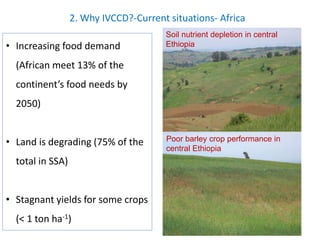
2. Why IVCCD?-Current situations- Africa 
• Increasing food demand 
(African meet 13% of the 
continent’s food needs by 
2050) 
• Land is degrading (75% of the 
total in SSA) 
• Stagnant yields for some crops 
(< 1 ton ha-1) 
Soil nutrient depletion in central 
Ethiopia 
Poor barley crop performance in 
central Ethiopia
• Feed scarcity (Average deficit 
in 2009 in Ethiopia= 45.64 
million t DM yr-1) 
• Competing uses of resources 
(grazing land, crop residues) 
• Farm-to-market links are 
weak 
• High rates of hunger and 
malnutrition
4. Achieving IVCCD-Linkage and integration 
Outputs Inputs 
Agricultural Intensification) 
Value chain development (crop 
and livestock enterprises) Capacity 
development 
Inputs 
Production 
Storage 
Processing 
Marketing 
Indirect: 
Food 
Nutrition 
Income 
Direct: 
Land 
Water 
Labour 
Chemicals, OM 
Biodiversity 
Financial capital 
Knowledge 
Infrastructure 
Technology 
Market 
Policy, Institutions
4.1. Partnership 
Potential partners: 
• Research orgs 
• Higher learning 
Institutions 
• Extension 
• NGOs 
• Framers 
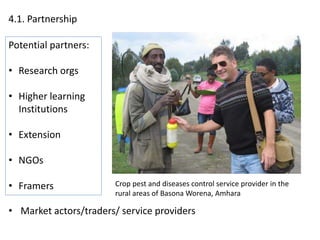
Crop pest and diseases control service provider in the 
rural areas of BasonaWorena, Amhara 
• Market actors/traders/ service providers
Scale of partnership: Local, regional, national and global level with 
d/t roles and responsibilities 
Examples of successful partnership: ILRI-UNEP-WU CC adaptation 
Kabe watershed project 
UNEP – Overall oversight of the projects and linking to donors 
ILRI- Provide technical support and link UNEP and Wollo University 
WU- Lead the implementation of the project at the landscape scales 
in collaboration with ILRI, SARC and extension + capacity building 
SARC (ARARI) - action research 
WoreiluWereda Office of Agriculture - community Mobilization
Land-care with mass mobilization in Kabe watershed, Amhara
4.2. Understanding systems 
• Constraints, farm typologies and opportunities in relation to 
Scale: 
• Farm level 
• Landscape 
• Watershed 
A woman farmer showing how bacterial wilt disease has 
become serious at her farm in Lemo, SNNPR 
IVCCD
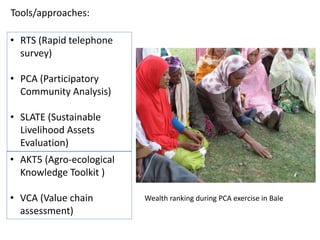
Tools/approaches: 
• RTS (Rapid telephone 
survey) 
• PCA (Participatory 
Community Analysis) 
• SLATE (Sustainable 
Livelihood Assets 
Evaluation) 
• AKT5 (Agro-ecological 
Knowledge Toolkit ) 
• VCA (Value chain 
assessment) 
Wealth ranking during PCA exercise in Bale
Examples of diagnostic results that required IVCCD interventions: 
Example 1. Africa RISING sites 
Priority crop related constraints: 
• Shortage of quality improved seeds 
• Weeds, diseases and insects and storage pests 
• Lack of improved farm tools 
• Inadequate soil and water management practices 
• Poor storage facilities 
• High input and low output prices
Priority livestock related constraints: 
• Feed shortage (quality and quantity) 
• Poor vet services and vaccines 
• Labour consuming milk processing 
• Decline of grazing lands 
• Diseases, internal and external parasites 
• Price fluctuation for live animals 
• Shortage of water during the dry periods
Example 2. SLP project sites in east Africa 
30 
25 
20 
15 
10 
5 
0 
Kobo Nekemte Kakamega 
soil fertility decline 
high inputs/low outputs price 
and inputs unavailability 
lack of information/services 
problem of weeds, pests and 
diseases 
rainfall/drought problem 
Occurrence in 8 villages 
Main constraints of crop production in 3 east African countries
30 
25 
20 
15 
10 
5 
0 
Kobo Nekemte Kakamega 
lack of services and 
trainings 
high cost of cbs/ other 
inputs 
feed shortage 
diseases and parasites 
Occurrence in 8 villages 
Main constraints of livestock production in 3 east African countries
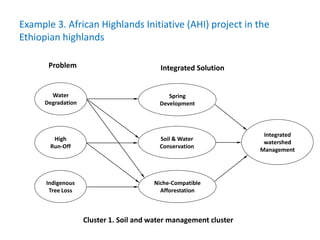
Example 3. African Highlands Initiative (AHI) project in the 
Ethiopian highlands 
Water 
Degradation 
High 
Run-Off 
Indigenous 
Tree Loss 
Spring 
Development 
Soil & Water 
Conservation 
Niche-Compatible 
Afforestation 
Integrated 
watershed 
Management 
Problem Integrated Solution 
Cluster 1. Soil and water management cluster
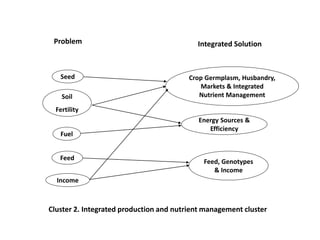
Problem Integrated Solution 
Seed Crop Germplasm, Husbandry, 
Soil 
Fertility 
Fuel 
Feed 
Markets & Integrated 
Nutrient Management 
Energy Sources & 
Efficiency 
Income 
Feed, Genotypes 
& Income 
Cluster 2. Integrated production and nutrient management cluster
4.3. R4D intervention options 
Time frame: 
• Short-term- entry 
points 
• Mid-term 
• Long-term
20 
Upstream 
Upstream 
Midstream 
Downstream 
Targets/social groups: 
• Gender 
• Wealth 
• Sex 
• Watershed/Landscape 
positions 
• Collective action (SWC) 
• Trans boundary issues 
(forests, water, grazing land)
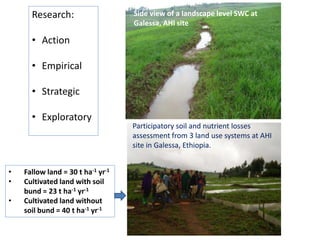
Research: 
• Action 
• Empirical 
• Strategic 
• Exploratory 
Side view of a landscape level SWC at 
Galessa, AHI site 
Participatory soil and nutrient losses 
assessment from 3 land use systems at AHI 
site in Galessa, Ethiopia. 
• Fallow land = 30 t ha-1 yr-1 
• Cultivated land with soil 
bund = 23 t ha-1 yr-1 
• Cultivated land without 
soil bund = 40 t ha-1 yr-1
Locations: 
• Farm- Action research 
• FTC- Empirical research 
• Research and University plots - Empirical research 
• School and church compounds- Empirical research 
• Communal land- Action research
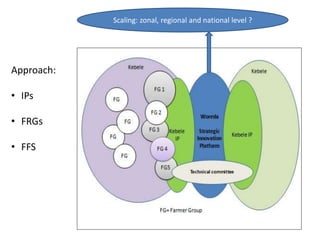
Approach: 
• IPs 
• FRGs 
• FFS 
Scaling: zonal, regional and national level ?
• Tree FRG in 
Wolmera, Holetta 
and Dendi – Ginchi, 
Central Ethiopia 
• Gully rehabilitation 
FRG- Galessa, 
Central Ethiopia
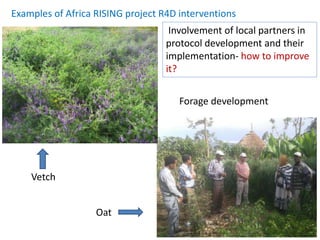
Examples of Africa RISING project R4D interventions 
Forage development 
Vetch 
Oat 
Involvement of local partners in 
protocol development and their 
implementation- how to improve 
it?
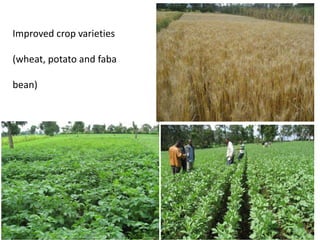
Improved crop varieties 
(wheat, potato and faba 
bean)
Examples of integrated and intensified crop production from AHI 
project in the highlands of Ethiopia 
Potato varieties 
Storage- DLS 
Maket 
Food security
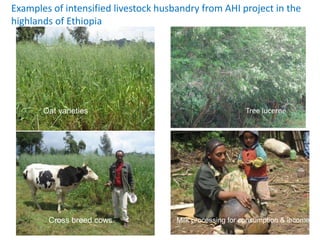
Examples of intensified livestock husbandry from AHI project in the 
highlands of Ethiopia 
Oat varieties 
Tree lucerne 
Cross breed cows Milk processing for consumption & income
29 
Examples of water related 
interventions in ILRI-UNEPWU project 
at Kabe watershed, Amhara (digital 
stories)
Examples of Africa RISING capacity development approaches 
• Trainings 
• Cross-site visits 
• Field days 
• Workshops/ 
learning events 
• Student attachment 
Farmers research groups identification at Jewe, Africa RISING 
kebele in Lemo, SNNPR 
• Gap assessment and filling of local partner institutions
Examples of Africa RISING value chain development approach 
• Selection of cross cutting VC enterprises across AR sites- (crop-wheat, 
fababean and potato) and (livestock- dairy cattle, beef 
cattle and sheep) 
• Mapping of VC actors and service providers 
• Rapid assessment of VC actors and service providers 
• Sampling and interviewing of selected actors and service 
providers 
• Develop VC interventions (7 crop and livestock related 
interventions)
4.4. Documentation and scaling best bet options 
Documentation: 
• Processes 
• lessons 
Scaling: 
• Site level 
• Project level-on 
line 
• Out scaling (horizontal scaling up) 
• Up scaling (vertical scaling up) 
Strengthen 
through training 
• Within or beyond 
Africa RISING sites? 
• Scaling strategies 
• Targets
4.5. Communication 
• How to pack and make available information to various end 
users – from farmers to policy makers? 
Some Tools: 
• Posters 
• Brochures 
• Briefs 
• Digital stories 
• Videos 
• Publications 
Access: 
• Online 
• Knowledge center 
• Local language- farmers
5. Lessons from earlier project initiatives and Africa RISING project 
• Identification of the categories of farmers that have common 
interest/s - to target their needs, contributions and decisions. 
• Reflection/feed backing/evaluation at different levels of the 
research-to improve approaches and actions. 
• Farming communities and local admin express their commitments 
when R&D partners work with them on priority issues. 
• Interventions that give immediate benefits to the farming 
communities (e.g. improved crop varieties) – NRM agenda.
• Linking the high value produces to the market – benefit 
communities - encourage them to participate in d/t R&D 
initiatives. 
• Project exist strategies – sustainability of R&D efforts. 
• Documentation of processes and lessons – share experiences to 
practitioners 
• Integration challenges – capacity of supporting institutions 
• Data sharing/data base issues – staff turnover dynamism
Thank you for listening!!

Agricultural intensification, value chain development and human capacity strengthening: How can we build these together

  • 1.
    "Agricultural intensification, valuechain development and human capacity strengthening: How can we build these Together" Kindu Mekonnen ILRI, Addis Ababa, 21 July 2014
  • 2.
    Contents of thepresentation 1. Concepts/ definitions 2. Global challenges 3. Why IVCCD? 4. Achieving IVCCD 4.1. Partnership 4.2. Understanding systems 4.3. R4D intervention options 4.4. Documentation and scaling best bet options 4.5. Communication 5. Lessons from earlier project initiatives
  • 3.
    1. Concepts/ definitions Intensification: • producing more units of output per units of all inputs and through new combinations of inputs and related innovations. Value chain: • a network of different functions or stages from production to consumption, including all supplementary support services. Capacity development: • A locally driven process of transformational learning that leads to actions, which support changes in institutional capacity areas to advance development goals.
  • 4.
    2. Global challenges • Population increase (World: 8.3- 10.9 billon and SSA –2 billon people in 2050) • Climate change • Resources scarcity • Energy demand High youth population at a small village in Wolaita, Southern Ethiopia
  • 5.
    2. Why IVCCD?-Currentsituations- Africa • Increasing food demand (African meet 13% of the continent’s food needs by 2050) • Land is degrading (75% of the total in SSA) • Stagnant yields for some crops (< 1 ton ha-1) Soil nutrient depletion in central Ethiopia Poor barley crop performance in central Ethiopia
  • 6.
    • Feed scarcity(Average deficit in 2009 in Ethiopia= 45.64 million t DM yr-1) • Competing uses of resources (grazing land, crop residues) • Farm-to-market links are weak • High rates of hunger and malnutrition
  • 7.
    4. Achieving IVCCD-Linkageand integration Outputs Inputs Agricultural Intensification) Value chain development (crop and livestock enterprises) Capacity development Inputs Production Storage Processing Marketing Indirect: Food Nutrition Income Direct: Land Water Labour Chemicals, OM Biodiversity Financial capital Knowledge Infrastructure Technology Market Policy, Institutions
  • 8.
    4.1. Partnership Potentialpartners: • Research orgs • Higher learning Institutions • Extension • NGOs • Framers Crop pest and diseases control service provider in the rural areas of BasonaWorena, Amhara • Market actors/traders/ service providers
  • 9.
    Scale of partnership:Local, regional, national and global level with d/t roles and responsibilities Examples of successful partnership: ILRI-UNEP-WU CC adaptation Kabe watershed project UNEP – Overall oversight of the projects and linking to donors ILRI- Provide technical support and link UNEP and Wollo University WU- Lead the implementation of the project at the landscape scales in collaboration with ILRI, SARC and extension + capacity building SARC (ARARI) - action research WoreiluWereda Office of Agriculture - community Mobilization
  • 10.
    Land-care with massmobilization in Kabe watershed, Amhara
  • 11.
    4.2. Understanding systems • Constraints, farm typologies and opportunities in relation to Scale: • Farm level • Landscape • Watershed A woman farmer showing how bacterial wilt disease has become serious at her farm in Lemo, SNNPR IVCCD
  • 12.
    Tools/approaches: • RTS(Rapid telephone survey) • PCA (Participatory Community Analysis) • SLATE (Sustainable Livelihood Assets Evaluation) • AKT5 (Agro-ecological Knowledge Toolkit ) • VCA (Value chain assessment) Wealth ranking during PCA exercise in Bale
  • 13.
    Examples of diagnosticresults that required IVCCD interventions: Example 1. Africa RISING sites Priority crop related constraints: • Shortage of quality improved seeds • Weeds, diseases and insects and storage pests • Lack of improved farm tools • Inadequate soil and water management practices • Poor storage facilities • High input and low output prices
  • 14.
    Priority livestock relatedconstraints: • Feed shortage (quality and quantity) • Poor vet services and vaccines • Labour consuming milk processing • Decline of grazing lands • Diseases, internal and external parasites • Price fluctuation for live animals • Shortage of water during the dry periods
  • 15.
    Example 2. SLPproject sites in east Africa 30 25 20 15 10 5 0 Kobo Nekemte Kakamega soil fertility decline high inputs/low outputs price and inputs unavailability lack of information/services problem of weeds, pests and diseases rainfall/drought problem Occurrence in 8 villages Main constraints of crop production in 3 east African countries
  • 16.
    30 25 20 15 10 5 0 Kobo Nekemte Kakamega lack of services and trainings high cost of cbs/ other inputs feed shortage diseases and parasites Occurrence in 8 villages Main constraints of livestock production in 3 east African countries
  • 17.
    Example 3. AfricanHighlands Initiative (AHI) project in the Ethiopian highlands Water Degradation High Run-Off Indigenous Tree Loss Spring Development Soil & Water Conservation Niche-Compatible Afforestation Integrated watershed Management Problem Integrated Solution Cluster 1. Soil and water management cluster
  • 18.
    Problem Integrated Solution Seed Crop Germplasm, Husbandry, Soil Fertility Fuel Feed Markets & Integrated Nutrient Management Energy Sources & Efficiency Income Feed, Genotypes & Income Cluster 2. Integrated production and nutrient management cluster
  • 19.
    4.3. R4D interventionoptions Time frame: • Short-term- entry points • Mid-term • Long-term
  • 20.
    20 Upstream Upstream Midstream Downstream Targets/social groups: • Gender • Wealth • Sex • Watershed/Landscape positions • Collective action (SWC) • Trans boundary issues (forests, water, grazing land)
  • 21.
    Research: • Action • Empirical • Strategic • Exploratory Side view of a landscape level SWC at Galessa, AHI site Participatory soil and nutrient losses assessment from 3 land use systems at AHI site in Galessa, Ethiopia. • Fallow land = 30 t ha-1 yr-1 • Cultivated land with soil bund = 23 t ha-1 yr-1 • Cultivated land without soil bund = 40 t ha-1 yr-1
  • 22.
    Locations: • Farm-Action research • FTC- Empirical research • Research and University plots - Empirical research • School and church compounds- Empirical research • Communal land- Action research
  • 23.
    Approach: • IPs • FRGs • FFS Scaling: zonal, regional and national level ?
  • 24.
    • Tree FRGin Wolmera, Holetta and Dendi – Ginchi, Central Ethiopia • Gully rehabilitation FRG- Galessa, Central Ethiopia
  • 25.
    Examples of AfricaRISING project R4D interventions Forage development Vetch Oat Involvement of local partners in protocol development and their implementation- how to improve it?
  • 26.
    Improved crop varieties (wheat, potato and faba bean)
  • 27.
    Examples of integratedand intensified crop production from AHI project in the highlands of Ethiopia Potato varieties Storage- DLS Maket Food security
  • 28.
    Examples of intensifiedlivestock husbandry from AHI project in the highlands of Ethiopia Oat varieties Tree lucerne Cross breed cows Milk processing for consumption & income
  • 29.
    29 Examples ofwater related interventions in ILRI-UNEPWU project at Kabe watershed, Amhara (digital stories)
  • 30.
    Examples of AfricaRISING capacity development approaches • Trainings • Cross-site visits • Field days • Workshops/ learning events • Student attachment Farmers research groups identification at Jewe, Africa RISING kebele in Lemo, SNNPR • Gap assessment and filling of local partner institutions
  • 31.
    Examples of AfricaRISING value chain development approach • Selection of cross cutting VC enterprises across AR sites- (crop-wheat, fababean and potato) and (livestock- dairy cattle, beef cattle and sheep) • Mapping of VC actors and service providers • Rapid assessment of VC actors and service providers • Sampling and interviewing of selected actors and service providers • Develop VC interventions (7 crop and livestock related interventions)
  • 32.
    4.4. Documentation andscaling best bet options Documentation: • Processes • lessons Scaling: • Site level • Project level-on line • Out scaling (horizontal scaling up) • Up scaling (vertical scaling up) Strengthen through training • Within or beyond Africa RISING sites? • Scaling strategies • Targets
  • 33.
    4.5. Communication •How to pack and make available information to various end users – from farmers to policy makers? Some Tools: • Posters • Brochures • Briefs • Digital stories • Videos • Publications Access: • Online • Knowledge center • Local language- farmers
  • 34.
    5. Lessons fromearlier project initiatives and Africa RISING project • Identification of the categories of farmers that have common interest/s - to target their needs, contributions and decisions. • Reflection/feed backing/evaluation at different levels of the research-to improve approaches and actions. • Farming communities and local admin express their commitments when R&D partners work with them on priority issues. • Interventions that give immediate benefits to the farming communities (e.g. improved crop varieties) – NRM agenda.
  • 35.
    • Linking thehigh value produces to the market – benefit communities - encourage them to participate in d/t R&D initiatives. • Project exist strategies – sustainability of R&D efforts. • Documentation of processes and lessons – share experiences to practitioners • Integration challenges – capacity of supporting institutions • Data sharing/data base issues – staff turnover dynamism
  • 36.
    Thank you forlistening!!