JL Sem2_2013/2014
TMS2033 Differential Equations
Quiz1 (2.5%)
Semester 2 2013/2014
Monday 17th
March 2014
All the best 
1. Consider the differential equation )(yf
dt
dy

a. What is the type of the differential equation above called?
Since f is a function of the unknown variable only, then this differential equation is
said to be autonomous.
b. Given ),1()( 2
yyyf  find the equilibrium solutions for the differential equation.
For equilibrium solution, dy/dt = 0. Hence, we need to solve for y in .0)1( 2
 yy
Therefore, .1010 2
 yyory
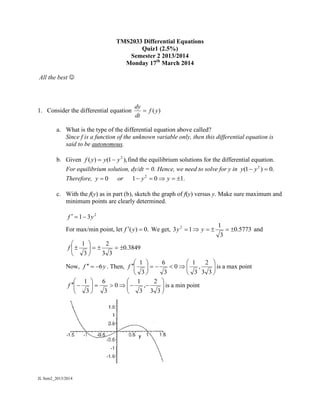
c. With the f(y) as in part (b), sketch the graph of f(y) versus y. Make sure maximum and
minimum points are clearly determined.
2
31 yf 
For max/min point, let .0)(  yf We get, 5773.0
3
1
13 2
 yy and
3849.0
33
2
3
1






f
Now, yf 6 . Then, 












33
2
,
3
1
0
3
6
3
1
f is a max point













33
2
,
3
1
0
3
6
3
1
f is a min point
JL Sem2_2013/2014
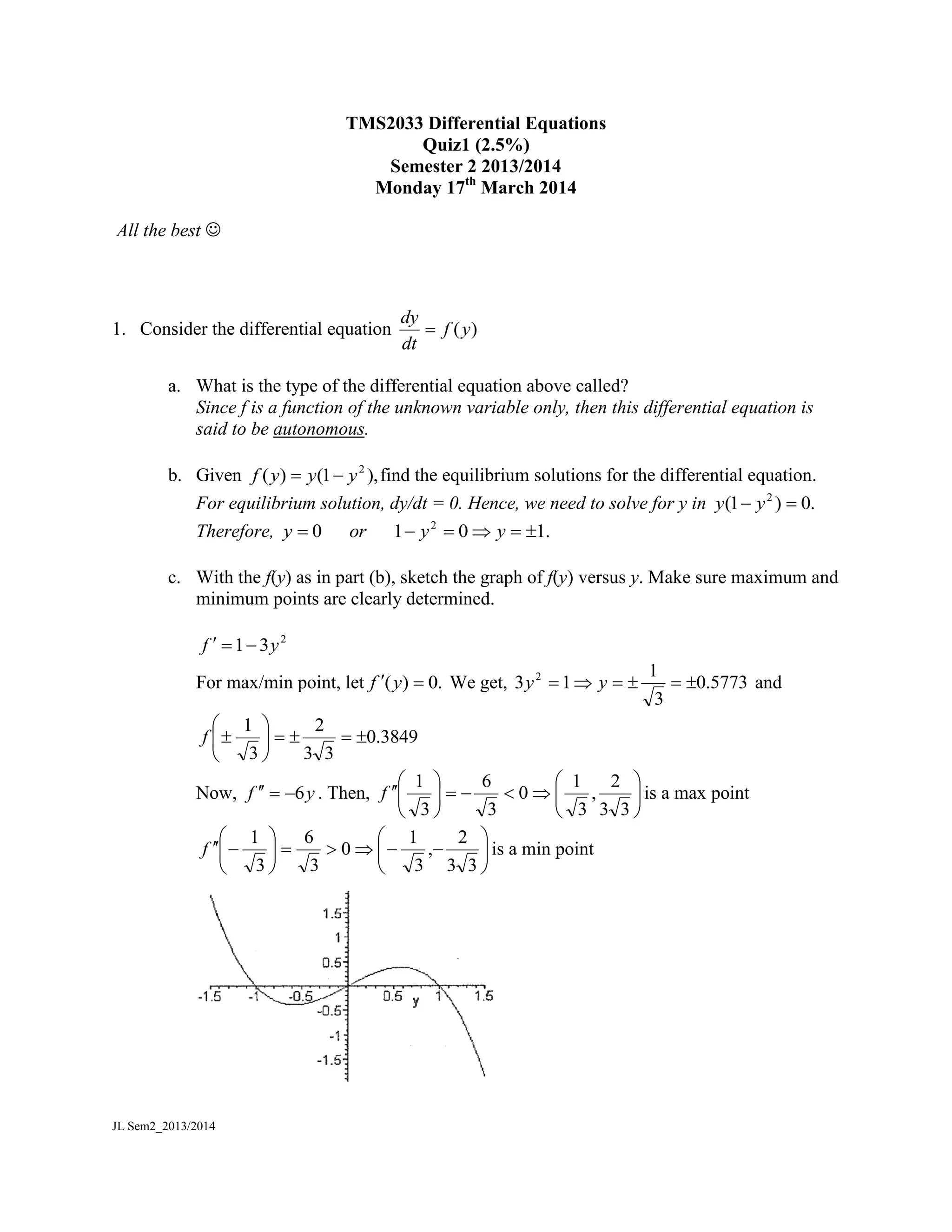
d. Draw the phase line and classify the equilibrium solutions obtained in part (b).
y
dt
dy
yfyfor  00)(,1, increasing
y
dt
dy
yfyfor  00)(,01, decreasing
y
dt
dy
yfyfor  00)(,10, increasing
y
dt
dy
yfyfor  00)(,1, decreasing
Therefore, the equilibrium point at 0y is unstable and the equilibrium point at
1y are stable.
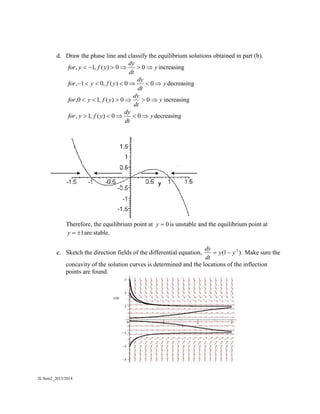
e. Sketch the direction fields of the differential equation, ).1( 2
yy
dt
dy
 Make sure the
concavity of the solution curves is determined and the locations of the inflection
points are found.
JL Sem2_2013/2014
For concavity of the solution curves, we need to determine 22
dtyd . We have,
)()()()(2
2
yfyf
dt
dy
yfyf
dt
d
dt
dy
dt
d
dt
yd

Inflection points occur when 22
dtyd = 0. This means when f = 0. From part (c), we
obtained that f = 0 when
3
1
y . Hence, for concavity:
,1y 0f and f > 0  02
2
dt
yd
concave down
3
1
1  y , 0f and f < 0  02
2
dt
yd
concave up
0,0
3
1
 fy and f < 0  02
2
dt
yd
concave down
3
1
0  y , 0f and f > 0  02
2
dt
yd
concave up
0,1
3
1
 fy and f > 0  02
2
dt
yd
concave down
,1y 0f and f < 0  02
2
dt
yd
concave up
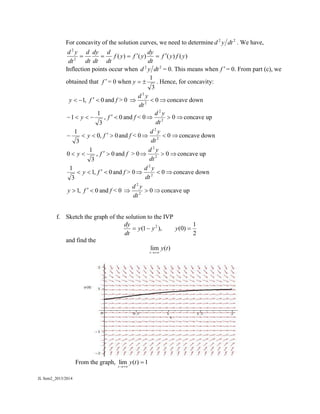
f. Sketch the graph of the solution to the IVP
2
1
)0(),1( 2
 yyy
dt
dy
and find the
lim ( )
t
y t

From the graph, 1)(lim 

ty
t

Quiz1 sol

  • 1.
    JL Sem2_2013/2014 TMS2033 DifferentialEquations Quiz1 (2.5%) Semester 2 2013/2014 Monday 17th March 2014 All the best  1. Consider the differential equation )(yf dt dy  a. What is the type of the differential equation above called? Since f is a function of the unknown variable only, then this differential equation is said to be autonomous. b. Given ),1()( 2 yyyf  find the equilibrium solutions for the differential equation. For equilibrium solution, dy/dt = 0. Hence, we need to solve for y in .0)1( 2  yy Therefore, .1010 2  yyory c. With the f(y) as in part (b), sketch the graph of f(y) versus y. Make sure maximum and minimum points are clearly determined. 2 31 yf  For max/min point, let .0)(  yf We get, 5773.0 3 1 13 2  yy and 3849.0 33 2 3 1       f Now, yf 6 . Then,              33 2 , 3 1 0 3 6 3 1 f is a max point              33 2 , 3 1 0 3 6 3 1 f is a min point
  • 2.
    JL Sem2_2013/2014 d. Drawthe phase line and classify the equilibrium solutions obtained in part (b). y dt dy yfyfor  00)(,1, increasing y dt dy yfyfor  00)(,01, decreasing y dt dy yfyfor  00)(,10, increasing y dt dy yfyfor  00)(,1, decreasing Therefore, the equilibrium point at 0y is unstable and the equilibrium point at 1y are stable. e. Sketch the direction fields of the differential equation, ).1( 2 yy dt dy  Make sure the concavity of the solution curves is determined and the locations of the inflection points are found.
  • 3.
    JL Sem2_2013/2014 For concavityof the solution curves, we need to determine 22 dtyd . We have, )()()()(2 2 yfyf dt dy yfyf dt d dt dy dt d dt yd  Inflection points occur when 22 dtyd = 0. This means when f = 0. From part (c), we obtained that f = 0 when 3 1 y . Hence, for concavity: ,1y 0f and f > 0  02 2 dt yd concave down 3 1 1  y , 0f and f < 0  02 2 dt yd concave up 0,0 3 1  fy and f < 0  02 2 dt yd concave down 3 1 0  y , 0f and f > 0  02 2 dt yd concave up 0,1 3 1  fy and f > 0  02 2 dt yd concave down ,1y 0f and f < 0  02 2 dt yd concave up f. Sketch the graph of the solution to the IVP 2 1 )0(),1( 2  yyy dt dy and find the lim ( ) t y t  From the graph, 1)(lim   ty t