
Presentation “Algorithm” 
Group Members: 
Abdul Basit Ali (Sp 13-BCS-045) 
Ahsan Shahzad (Sp 13-BCS-037)
It is one of the fastest sorting techniques available. 
Like binary search, this method uses a recursive, divide 
and conquer strategy 
The basic idea is to separate a list of items into two 
parts, surrounding a distinguished item called the pivot. 
At the end of the process, one part will contain items 
smaller than the pivot and the other part will contain items 
larger than the pivot. 
The performance of the whole Quicksort algorithm 
depends on how well the pivot is taken.
1. Let us take the middle element as pivot. 
2. Then we arrange the array such that all elements 
greater then 8 is on right side and others on left 
side.(This is the first subdivision producing two 
sub list). 
3. Now, each sub list is subdivided in exactly the 
same manner. This process continues until all sub 
lists are in order. The list is then sorted. This is 
a recursive process.
We choose the value as pivot.(Preferably middle element). 
As in binary search, the index of this value is found by 
(first+last)/2 
where first and last are the indices of the initial and 
final items in the list. 
We then identify a left_arrow and right_arrow on the 
far left and far right, respectively.(left_arrow and 
right_arrow initially represent the lowest and highest 
indices of the vector items). 
It looks like:
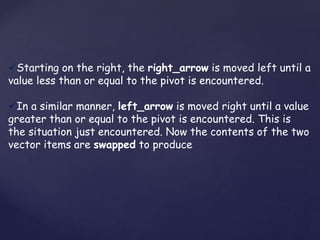
Starting on the right, the right_arrow is moved left until a 
value less than or equal to the pivot is encountered. 
In a similar manner, left_arrow is moved right until a value 
greater than or equal to the pivot is encountered. This is 
the situation just encountered. Now the contents of the two 
vector items are swapped to produce
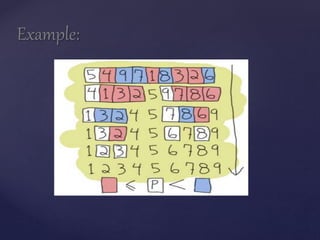
Example:
Since each element ultimately ends up in the correct position, the algorithm 
correctly sorts. But how long does it take?.On this basis it is divided into 
following three cases. 
1. Best Case 
2. Worst Case 
3. Average Case 
Best Case for QuickSort 
The best case for divide-and-conquer algorithms comes when we split the input as evenly 
as possible. Thus in the best case, each sub problem is of size n/2. The partition step on 
each sub problem is linear in its size. the total efficiency(time taken) in the best case is 
O(nlog2n). 
Worst Case for Quicksort 
Suppose instead our pivot element splits the array as unequally as possible. Thus instead 
of n/2 elements in the smaller half, we get zero, meaning that the pivot element is the 
biggest or smallest element in the array. 
The Average Case for Quicksort 
Suppose we pick the pivot element at random in an array of n keys Half the time, the pivot 
element will be from the centre half of the sorted array. Whenever the pivot element is 
from positions n/4 to 3n/4, the larger remaining sub-array contains at most 3n/4 
elements.
Heap Sort
Heap Sort: 
 Heaps are based on the notion of complete 
tree. 
 A Binary Tree has the Heap Property if, 
* It is empty 
* The key in the root is larger 
than that in either and both 
sub trees have the Heap property.
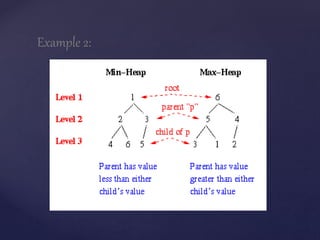
Types Of Heap: 
 Min Heap :- 
If the value at the node N, is less than or equal to 
the value at each of the children of N, then Heap is 
called a MIN-HEAP. 
In General, a Heap represents a table of N 
elements or records satisfying the following 
property; 
Nj  Ni for i  j  n & i = [j/2]
 Max Heap:- 
If the value at the node N, is greater than or equal 
to the value at each of the children of N, then Heap 
is called a MAX-HEAP. 
In General, a Heap represents a table of N 
elements or records satisfying the following 
property; 
Nj  Ni for i  j  n & i = [j/2]
Two main steps for heap Sort are: 
 Creation of Heap 
 Processing of Heap
Creation of the Heap: 
To put the largest element on the top 
In each step size of the Heap increase. 
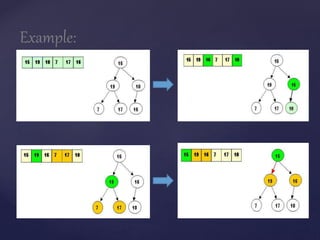
 Put the elements in heap as they occur in sequential order 
i.e. parent then left child and than right child. 
 Each time (of inserting a new node/child) compare it with 
its Parent Node; 
Is? Child Node (Left child or Right child) is less 
than or equal or greater than or equal to that of parent 
node…. 
If it is greater than its successor than interchange 
them.
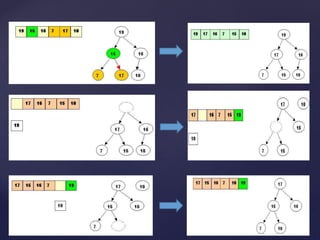
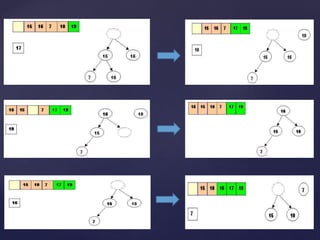
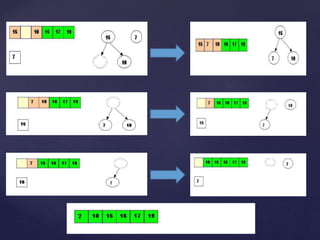
Processing of the Heap: 
The last element of last level should be replaced by 
Top element of the list. 
In this process the largest element will be at last 
place 
List will be sorted out in increasing order from Root 
to Leaf. 
After replacing the Top element Creation of the 
Heap takes place. 
In each step size of Heap decreased.
Example:
Example 2:
TIME COMPLEXITY : 
Time complexity of heap sort in 
• Worst case O(n log n) 
• Average case O(n log n) 
• Best case O(n log n)

Quick and Heap Sort with examples

  • 1.
    Presentation “Algorithm” GroupMembers: Abdul Basit Ali (Sp 13-BCS-045) Ahsan Shahzad (Sp 13-BCS-037)
  • 2.
    It is oneof the fastest sorting techniques available. Like binary search, this method uses a recursive, divide and conquer strategy The basic idea is to separate a list of items into two parts, surrounding a distinguished item called the pivot. At the end of the process, one part will contain items smaller than the pivot and the other part will contain items larger than the pivot. The performance of the whole Quicksort algorithm depends on how well the pivot is taken.
  • 3.
    1. Let ustake the middle element as pivot. 2. Then we arrange the array such that all elements greater then 8 is on right side and others on left side.(This is the first subdivision producing two sub list). 3. Now, each sub list is subdivided in exactly the same manner. This process continues until all sub lists are in order. The list is then sorted. This is a recursive process.
  • 4.
    We choose thevalue as pivot.(Preferably middle element). As in binary search, the index of this value is found by (first+last)/2 where first and last are the indices of the initial and final items in the list. We then identify a left_arrow and right_arrow on the far left and far right, respectively.(left_arrow and right_arrow initially represent the lowest and highest indices of the vector items). It looks like:
  • 5.
    Starting on theright, the right_arrow is moved left until a value less than or equal to the pivot is encountered. In a similar manner, left_arrow is moved right until a value greater than or equal to the pivot is encountered. This is the situation just encountered. Now the contents of the two vector items are swapped to produce
  • 6.
  • 7.
    Since each elementultimately ends up in the correct position, the algorithm correctly sorts. But how long does it take?.On this basis it is divided into following three cases. 1. Best Case 2. Worst Case 3. Average Case Best Case for QuickSort The best case for divide-and-conquer algorithms comes when we split the input as evenly as possible. Thus in the best case, each sub problem is of size n/2. The partition step on each sub problem is linear in its size. the total efficiency(time taken) in the best case is O(nlog2n). Worst Case for Quicksort Suppose instead our pivot element splits the array as unequally as possible. Thus instead of n/2 elements in the smaller half, we get zero, meaning that the pivot element is the biggest or smallest element in the array. The Average Case for Quicksort Suppose we pick the pivot element at random in an array of n keys Half the time, the pivot element will be from the centre half of the sorted array. Whenever the pivot element is from positions n/4 to 3n/4, the larger remaining sub-array contains at most 3n/4 elements.
  • 8.
  • 9.
    Heap Sort: Heaps are based on the notion of complete tree.  A Binary Tree has the Heap Property if, * It is empty * The key in the root is larger than that in either and both sub trees have the Heap property.
  • 10.
    Types Of Heap:  Min Heap :- If the value at the node N, is less than or equal to the value at each of the children of N, then Heap is called a MIN-HEAP. In General, a Heap represents a table of N elements or records satisfying the following property; Nj  Ni for i  j  n & i = [j/2]
  • 11.
     Max Heap:- If the value at the node N, is greater than or equal to the value at each of the children of N, then Heap is called a MAX-HEAP. In General, a Heap represents a table of N elements or records satisfying the following property; Nj  Ni for i  j  n & i = [j/2]
  • 12.
    Two main stepsfor heap Sort are:  Creation of Heap  Processing of Heap
  • 13.
    Creation of theHeap: To put the largest element on the top In each step size of the Heap increase.  Put the elements in heap as they occur in sequential order i.e. parent then left child and than right child.  Each time (of inserting a new node/child) compare it with its Parent Node; Is? Child Node (Left child or Right child) is less than or equal or greater than or equal to that of parent node…. If it is greater than its successor than interchange them.
  • 14.
    Processing of theHeap: The last element of last level should be replaced by Top element of the list. In this process the largest element will be at last place List will be sorted out in increasing order from Root to Leaf. After replacing the Top element Creation of the Heap takes place. In each step size of Heap decreased.
  • 15.
  • 19.
  • 20.
    TIME COMPLEXITY : Time complexity of heap sort in • Worst case O(n log n) • Average case O(n log n) • Best case O(n log n)