HEAP
Data Structure And Algorithm
Mohamed Fawzy
AGENDA
 Introduction
 Heap Types
 Why Heap ?
 Time Complexity
 How to use it ?
 Applications on Heap
 Reference
 Questions
INTRODUCTION
 Heapsort : A sorting algorithm that works by first
organizing the data to be sorted into a special type
of binary tree called a heap.
 Heap: is an array object that we can view in special
form of complete binary tree e.g A[]
HEAP TYPES
 Max-Heap-root node has the largest value: A max
full complete binary tree where is root the largest
value for example A[Parent(i)] >= A[i]
 Min-Heap root node has the smallest value : A Min
full complete binary tree where is root the smallest
value for example A[Parent(i)] <= A[i]
HEAP TYPES (CONT)
 Parent(i)
return [i/2]
 Left(i)
Return 2i
 Right(i)
Return 2i+1
WHY HEAP ?
 Heap sort Algorithm has the best possible worst
case running time, and it doesn't need extra
storage. That makes it good for situations where
you have a very large array. Which used in Heap
Data structure .
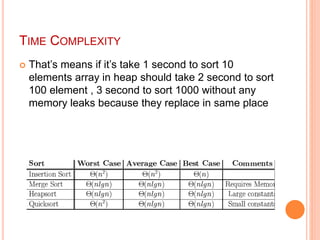
 heapsort’s running time is O(n log n)
TIME COMPLEXITY
 That’s means if it’s take 1 second to sort 10
elements array in heap should take 2 second to sort
100 element , 3 second to sort 1000 without any
memory leaks because they replace in same place
HOW TO USE IT ?
 Let’s determine first how heap work
1. Remove the topmost item (the largest) and replace
it with the rightmost leaf. The topmost item is stored
in an array.
2. Re-establish the heap.
3. Repeat steps 1 and 2 until there are no more items
left in the heap.
HOW TO USE IT ? (CONT)
 The below image describe how it’s working to sort
max-heap data structure
HOW TO USE IT ? (CONT)
 Operations :
1- creation of an empty heap if not exist
2- insertion of a new element into heap if exist and
not full (overflow)
3- deletion of the largest(smallest) element from the
heap if exist and not empty (underflow)
HOW TO USE IT ? INSERTION INTO A MAX
HEAP
void insert_max_heap(int item, int *n)
{
int i;
if (HEAP_FULL(*n)) {
printf(“the heap is full.n”);
exit(1);
}
i = ++(*n);
while ((i!=1)&&(item.key>heap[i/2].key))
{
heap[i] = heap[i/2];
i /= 2;
}
heap[i]= item;
}
APPLICATIONS ON HEAP
 See an illustration first
 Array interpreted as a binary tree
1 2 3 4 5 6 7 8 9 10
26 5 77 1 61 11 59 15 48 19
26[1]
5[2] 77[3]
1[4] 61[5] 11[6] 59[7]
15[8] 48[9] 19[10]
APPLICATIONS ON HEAP
 Adjust it to a Max-Heap
77[1]
61[2] 59[3]
48[4] 19[5] 11[6] 26[7]
15[8] 1[9] 5[10]
REFERENCE
 Introduction to algorithms 3rd edition (Heapsort chapter)
 http://bigocheatsheet.com/
 http://cs.anu.edu.au/~Alistair.Rendell/Teaching/apac_comp3600/module2/bina
ry_heaps.xhtml
 http://www.eecs.wsu.edu/~cook/aa/lectures/l3.pdf
 http://www.iti.fh-flensburg.de/lang/algorithmen/sortieren/heap/heapen.htm
 http://www.slideshare.net/abdulwaqar/heap-sort-16149461
 Data structure and algorithms coursera (Princeton university )
 http://community.topcoder.com/tc?module=Static&d1=tutorials&d2=sorting
QUESTIONS
Any Questions ?

Heapsort using Heap

  • 1.
    HEAP Data Structure AndAlgorithm Mohamed Fawzy
  • 2.
    AGENDA  Introduction  HeapTypes  Why Heap ?  Time Complexity  How to use it ?  Applications on Heap  Reference  Questions
  • 3.
    INTRODUCTION  Heapsort :A sorting algorithm that works by first organizing the data to be sorted into a special type of binary tree called a heap.  Heap: is an array object that we can view in special form of complete binary tree e.g A[]
  • 4.
    HEAP TYPES  Max-Heap-rootnode has the largest value: A max full complete binary tree where is root the largest value for example A[Parent(i)] >= A[i]  Min-Heap root node has the smallest value : A Min full complete binary tree where is root the smallest value for example A[Parent(i)] <= A[i]
  • 5.
    HEAP TYPES (CONT) Parent(i) return [i/2]  Left(i) Return 2i  Right(i) Return 2i+1
  • 6.
    WHY HEAP ? Heap sort Algorithm has the best possible worst case running time, and it doesn't need extra storage. That makes it good for situations where you have a very large array. Which used in Heap Data structure .  heapsort’s running time is O(n log n)
  • 7.
    TIME COMPLEXITY  That’smeans if it’s take 1 second to sort 10 elements array in heap should take 2 second to sort 100 element , 3 second to sort 1000 without any memory leaks because they replace in same place
  • 8.
    HOW TO USEIT ?  Let’s determine first how heap work 1. Remove the topmost item (the largest) and replace it with the rightmost leaf. The topmost item is stored in an array. 2. Re-establish the heap. 3. Repeat steps 1 and 2 until there are no more items left in the heap.
  • 9.
    HOW TO USEIT ? (CONT)  The below image describe how it’s working to sort max-heap data structure
  • 10.
    HOW TO USEIT ? (CONT)  Operations : 1- creation of an empty heap if not exist 2- insertion of a new element into heap if exist and not full (overflow) 3- deletion of the largest(smallest) element from the heap if exist and not empty (underflow)
  • 11.
    HOW TO USEIT ? INSERTION INTO A MAX HEAP void insert_max_heap(int item, int *n) { int i; if (HEAP_FULL(*n)) { printf(“the heap is full.n”); exit(1); } i = ++(*n); while ((i!=1)&&(item.key>heap[i/2].key)) { heap[i] = heap[i/2]; i /= 2; } heap[i]= item; }
  • 12.
    APPLICATIONS ON HEAP See an illustration first  Array interpreted as a binary tree 1 2 3 4 5 6 7 8 9 10 26 5 77 1 61 11 59 15 48 19 26[1] 5[2] 77[3] 1[4] 61[5] 11[6] 59[7] 15[8] 48[9] 19[10]
  • 13.
    APPLICATIONS ON HEAP Adjust it to a Max-Heap 77[1] 61[2] 59[3] 48[4] 19[5] 11[6] 26[7] 15[8] 1[9] 5[10]
  • 14.
    REFERENCE  Introduction toalgorithms 3rd edition (Heapsort chapter)  http://bigocheatsheet.com/  http://cs.anu.edu.au/~Alistair.Rendell/Teaching/apac_comp3600/module2/bina ry_heaps.xhtml  http://www.eecs.wsu.edu/~cook/aa/lectures/l3.pdf  http://www.iti.fh-flensburg.de/lang/algorithmen/sortieren/heap/heapen.htm  http://www.slideshare.net/abdulwaqar/heap-sort-16149461  Data structure and algorithms coursera (Princeton university )  http://community.topcoder.com/tc?module=Static&d1=tutorials&d2=sorting
  • 15.