Research Methods in
Management
Methods of data collection
• Types
– Primary
• Observation
• Interview
• Questionnaires
• Schedules
• Warranty cards
• Distributor audit
• Pantry audits
• Consumer panels
• Using mechanical devices
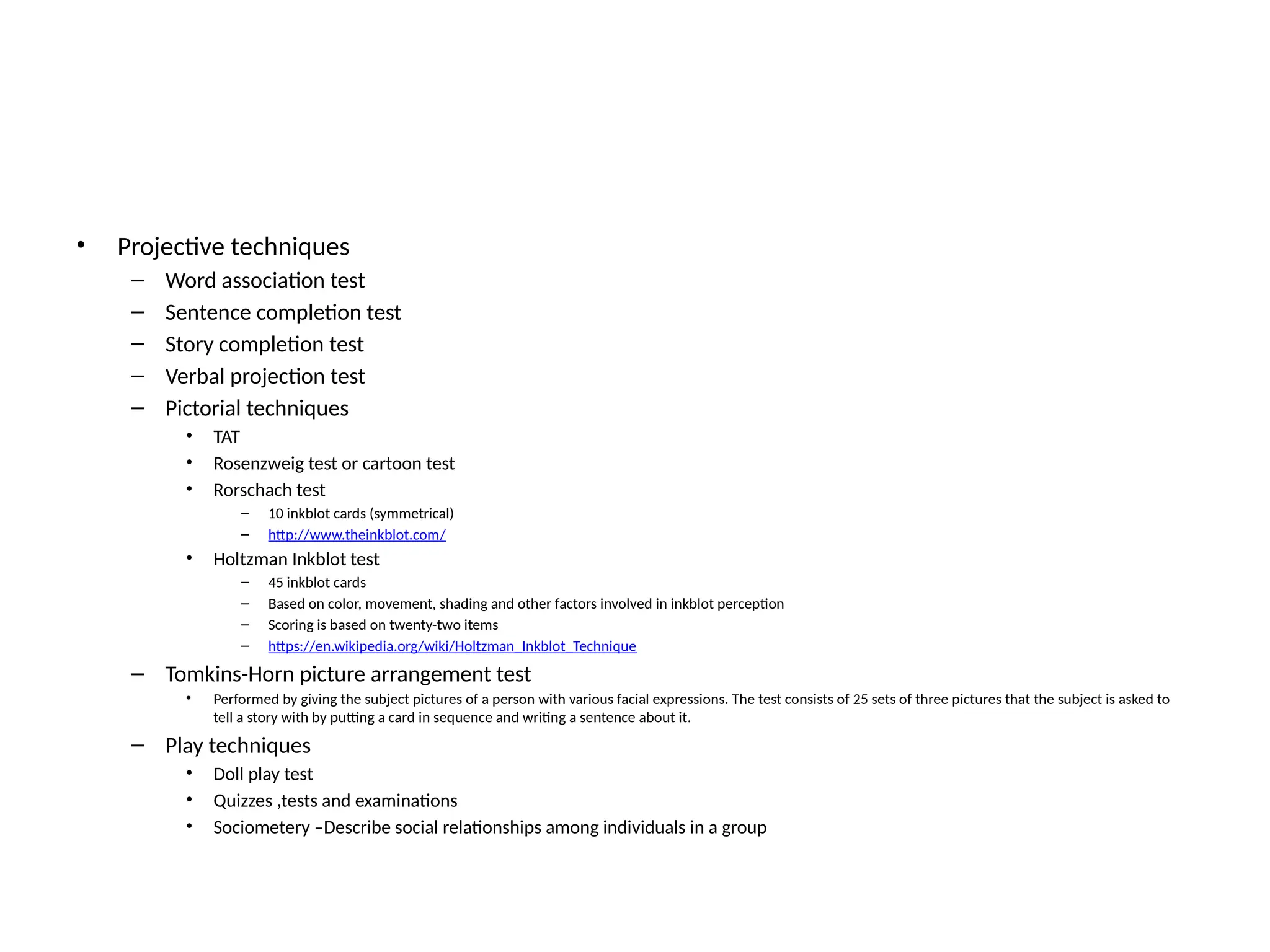
• Projective techniques
• Depth interviews
• Content analysis
– Secondary
Observation
• Structured
– Careful definitions of units to be observed, the
styles of recording the observed information,
statndardized conditions of observation and
selection of pertinent data of observation.
Suitable for descriptive studies
• Non structured
• Observation taking place without the above mentioned
characteristics thought in advance. Suitable for exploratory
studies
• Participant observation
• Non - Participant observation
• Disguised observation
• Controlled observation
• Uncontrolled observation
Interview method
• Personal interview
– Structured interview
– Unstructured interview
– Focused interview
– Clinical interview
• Broad underlying feelings or motivations or with the course
of individual's life experience
– Non directive interview
• Encourage respondents to talk
• Telephonic interview
Questionnaires ,Schedules & Other methods
• Questionnaires
• Schedules
• Warranty cards
• Distributor or store audits
– Performed by salesmen at regular intervals
• Pantry audits
• Estimate consumption of the basket of goods at the consumer
level
• Investigator collects types of inventories, quantities and the
price of the commodities consumed.
• Consumer panels
– Extension of pantry approach
– Set of consumers are arranged to come to an
understanding to maintain detailed daily records of
their consumption and the same is available to
investigators on demand
Types
• Transitory
– Before and after basis
• Continuing
• Mechanical devices
– Eye camera
– Pupilometric camera
– Psychogalvanometer
– Motion picture camera
– Audiometer
• Projective techniques
– Word association test
– Sentence completion test
– Story completion test
– Verbal projection test
– Pictorial techniques
• TAT
• Rosenzweig test or cartoon test
• Rorschach test
– 10 inkblot cards (symmetrical)
– http://www.theinkblot.com/
• Holtzman Inkblot test
– 45 inkblot cards
– Based on color, movement, shading and other factors involved in inkblot perception
– Scoring is based on twenty-two items
– https://en.wikipedia.org/wiki/Holtzman_Inkblot_Technique
– Tomkins-Horn picture arrangement test
• Performed by giving the subject pictures of a person with various facial expressions. The test consists of 25 sets of three pictures that the subject is asked to
tell a story with by putting a card in sequence and writing a sentence about it.
– Play techniques
• Doll play test
• Quizzes ,tests and examinations
• Sociometery –Describe social relationships among individuals in a group
• Depth interview
• Content analysis
Questionnaire Design
Attitude Measurement
• Attitude – an expression of favour or disfavour
toward a person, place, thing or event
• Attitude can be formed from a person’s past
and present
• Attitude is also measurable and changeable as
well as influencing the person’s behaviour.
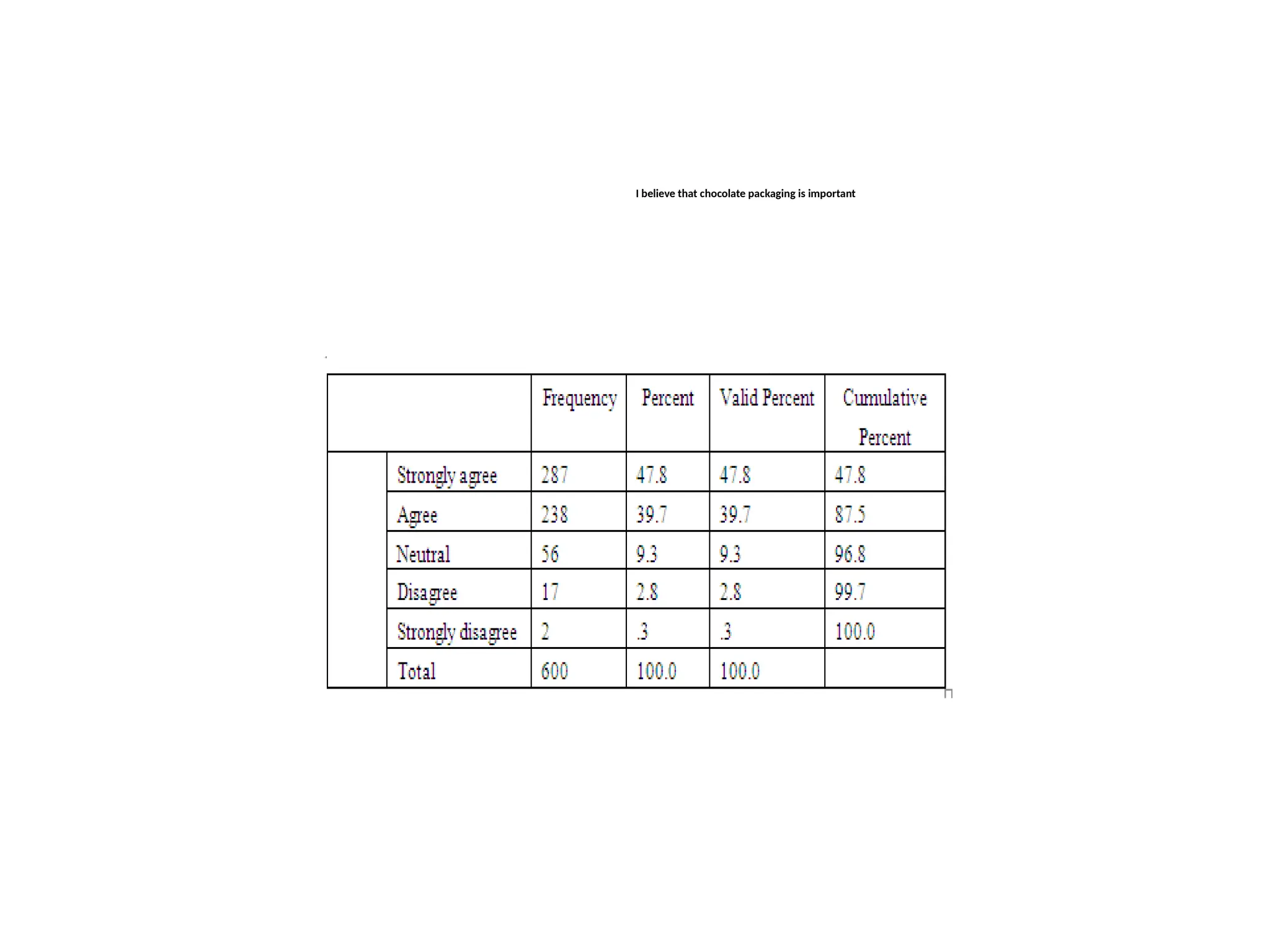
I believe that chocolate packaging is important
Methods of Measuring Attitudes
• Rating
– Likert Scale – carefully constructed attitudinal
measure which asks people for their agreement
with a statement
– Example: Please rate each of the following, on a
scale from 1 to 10, with 1 being least important
and 10 being most important…
• Sorting
– Asks respondents to sort items/names into groups
• Multiple Choice Questions (MCQ)
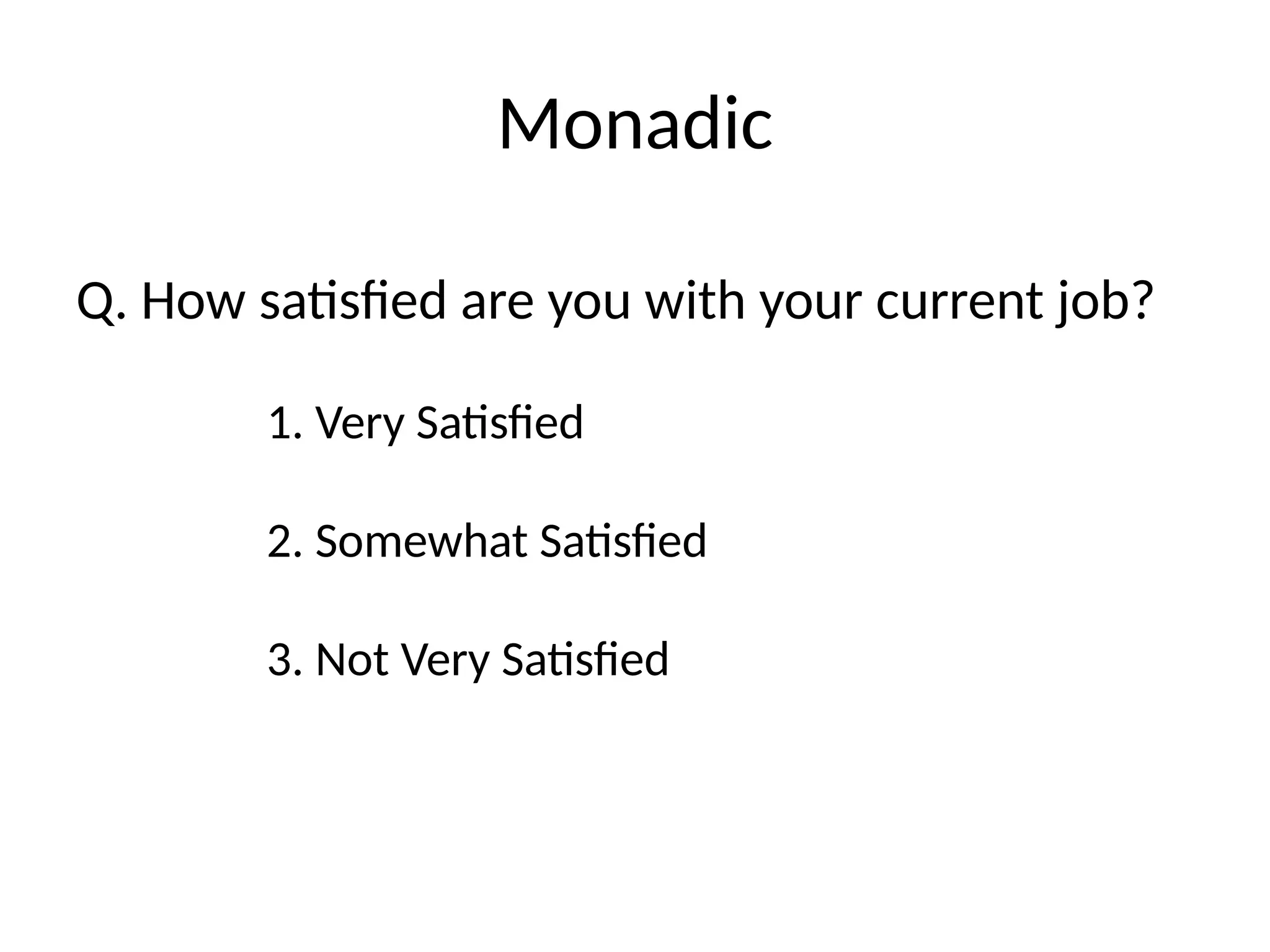
Monadic
Q. How satisfied are you with your current job?
1. Very Satisfied
2. Somewhat Satisfied
3. Not Very Satisfied
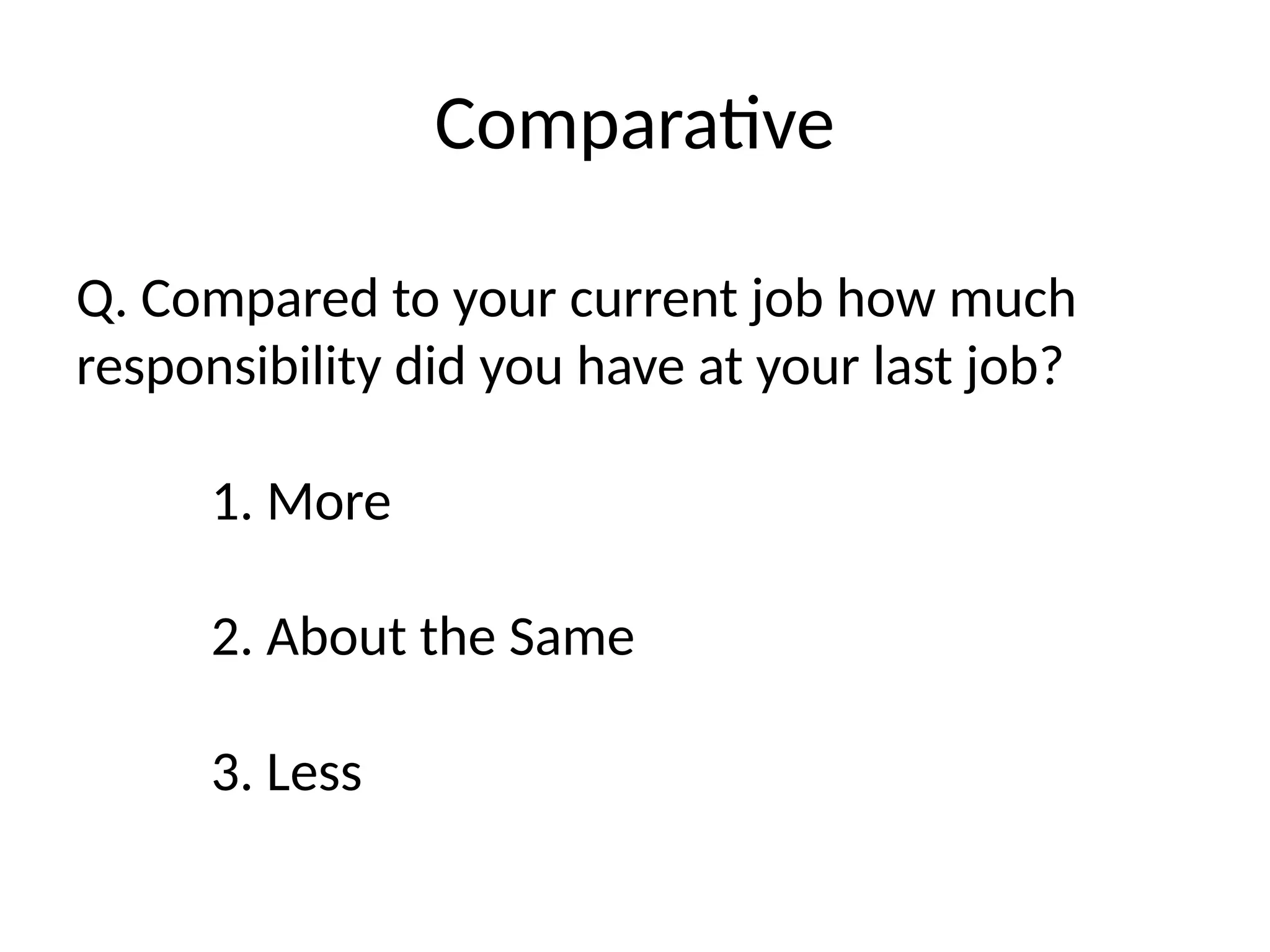
Comparative
Q. Compared to your current job how much
responsibility did you have at your last job?
1. More
2. About the Same
3. Less
Unbalanced
Q. How satisfied are you with your current cable
service?
1. Very Satisfied
2. Somewhat Satisfied
3. Somewhat unsatisfied
Balanced
Q. How satisfied are you with your current cable
service?
1. Very Satisfied
2. Somewhat Satisfied
3. Somewhat unsatisfied
4. Very unsatisfied
Forced Choice
• Does not allow the respondent to offer no
opinion, which is different than a neutral
opinion
Unforced Choice
• Allows respondents to opt out of providing an
opinion.
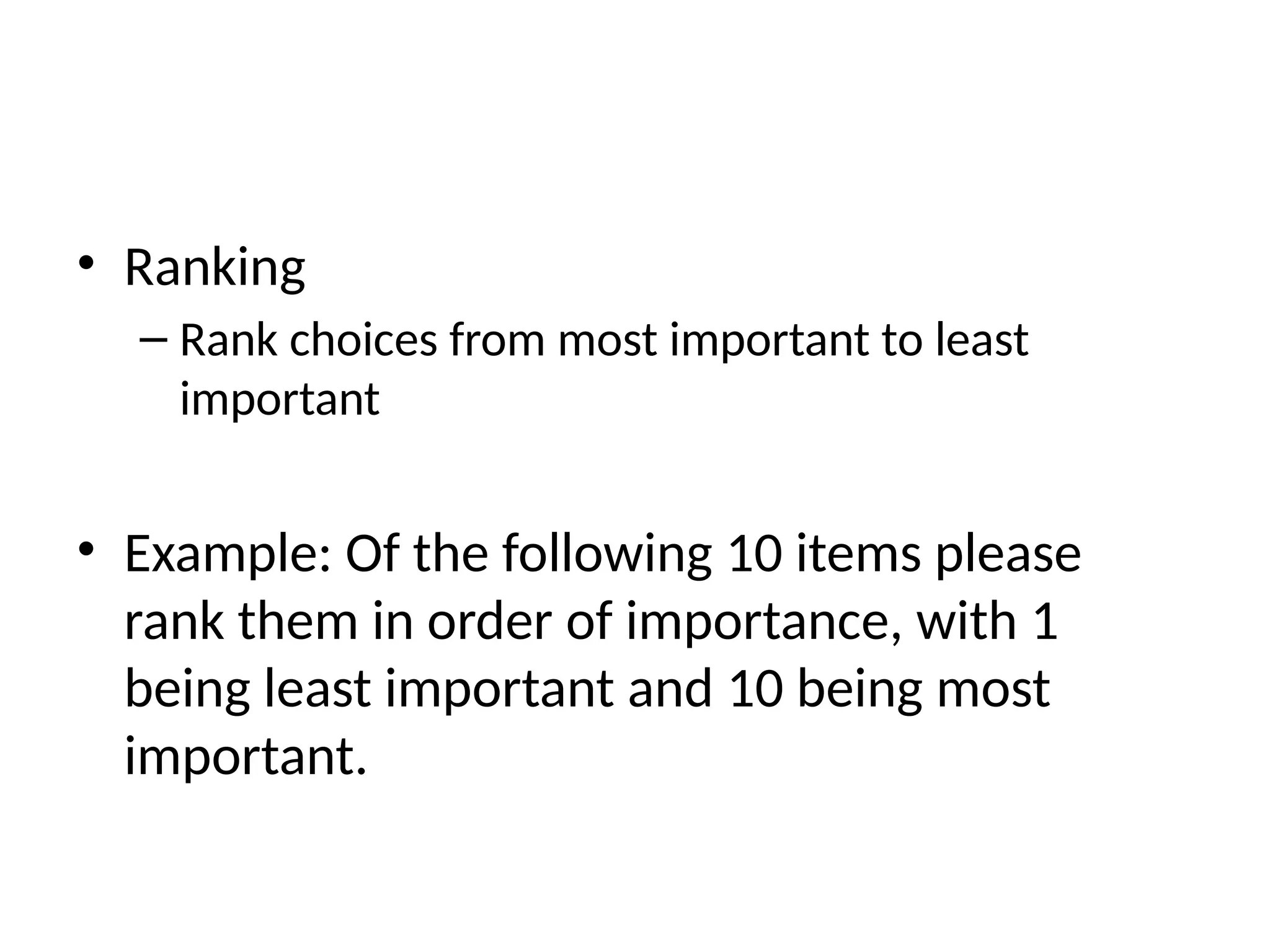
• Ranking
– Rank choices from most important to least
important
• Example: Of the following 10 items please
rank them in order of importance, with 1
being least important and 10 being most
important.
Questionnaire
• A set of questions designed to generate the
data necessary for accomplishing a research
project's objectives
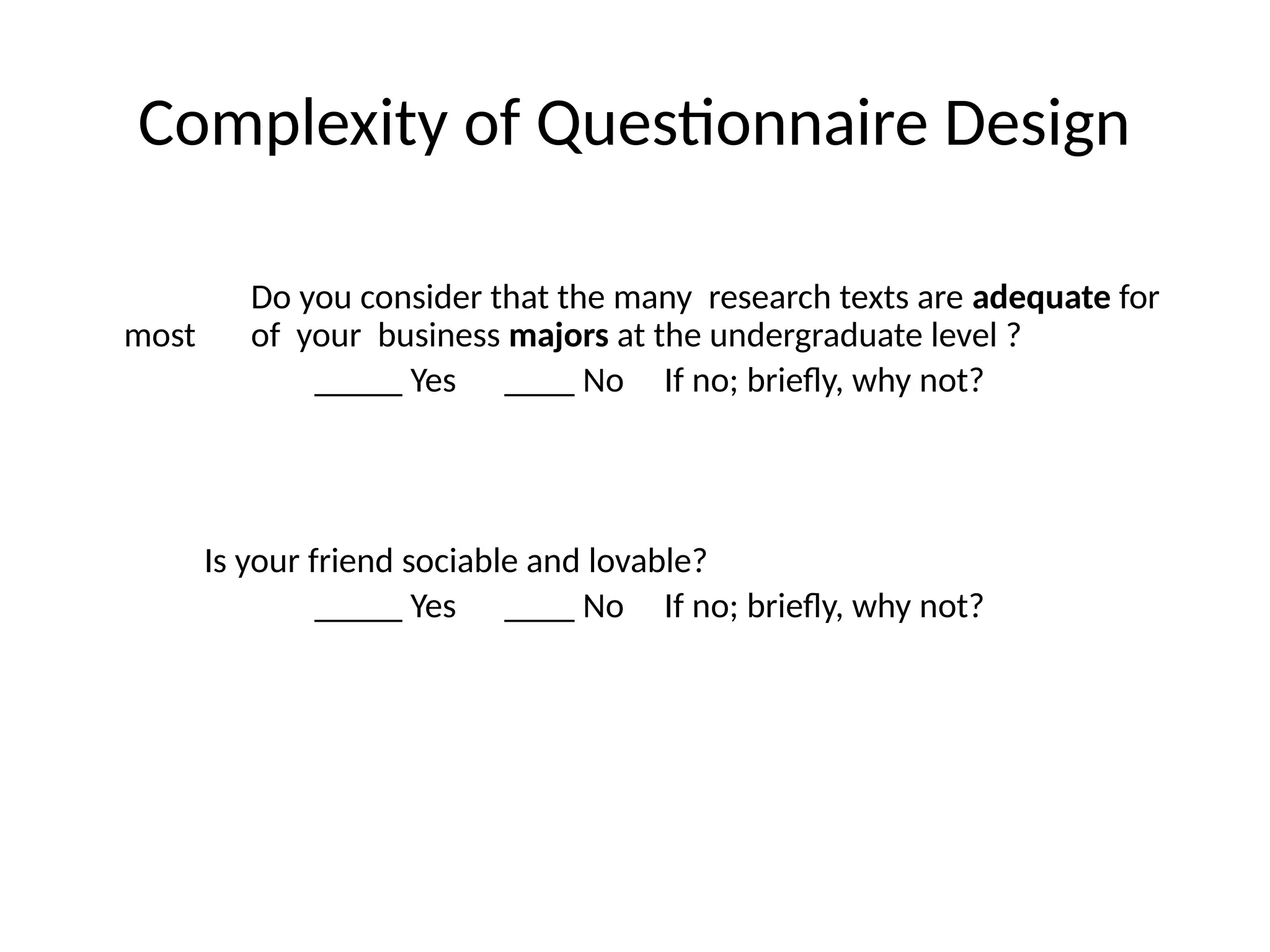
Complexity of Questionnaire Design
Do you consider that the many research texts are adequate for
most of your business majors at the undergraduate level ?
_____ Yes ____ No If no; briefly, why not?
Is your friend sociable and lovable?
_____ Yes ____ No If no; briefly, why not?
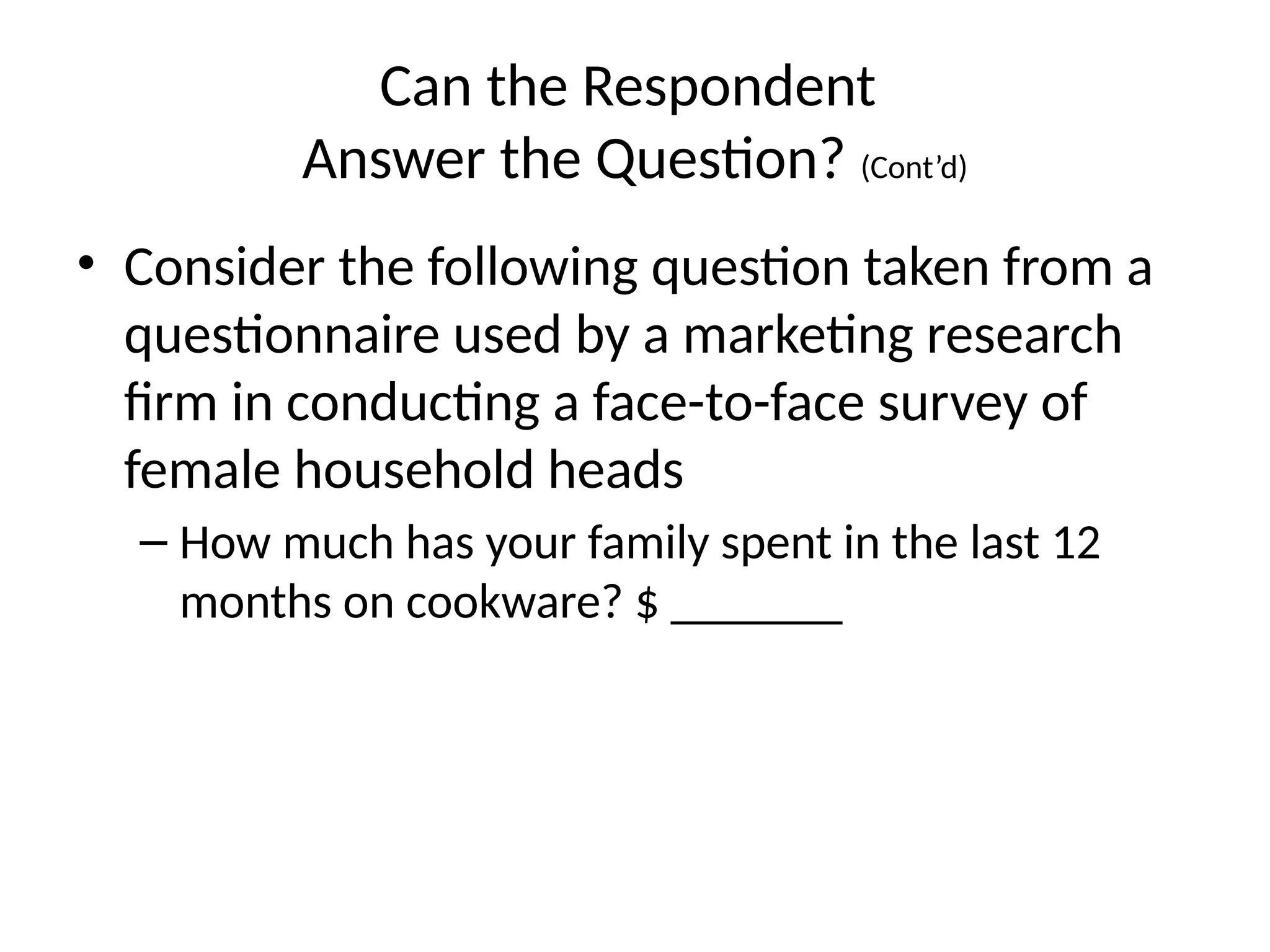
Can the Respondent
Answer the Question? (Cont’d)
• Consider the following question taken from a
questionnaire used by a marketing research
firm in conducting a face-to-face survey of
female household heads
– How much has your family spent in the last 12
months on cookware? $ _______
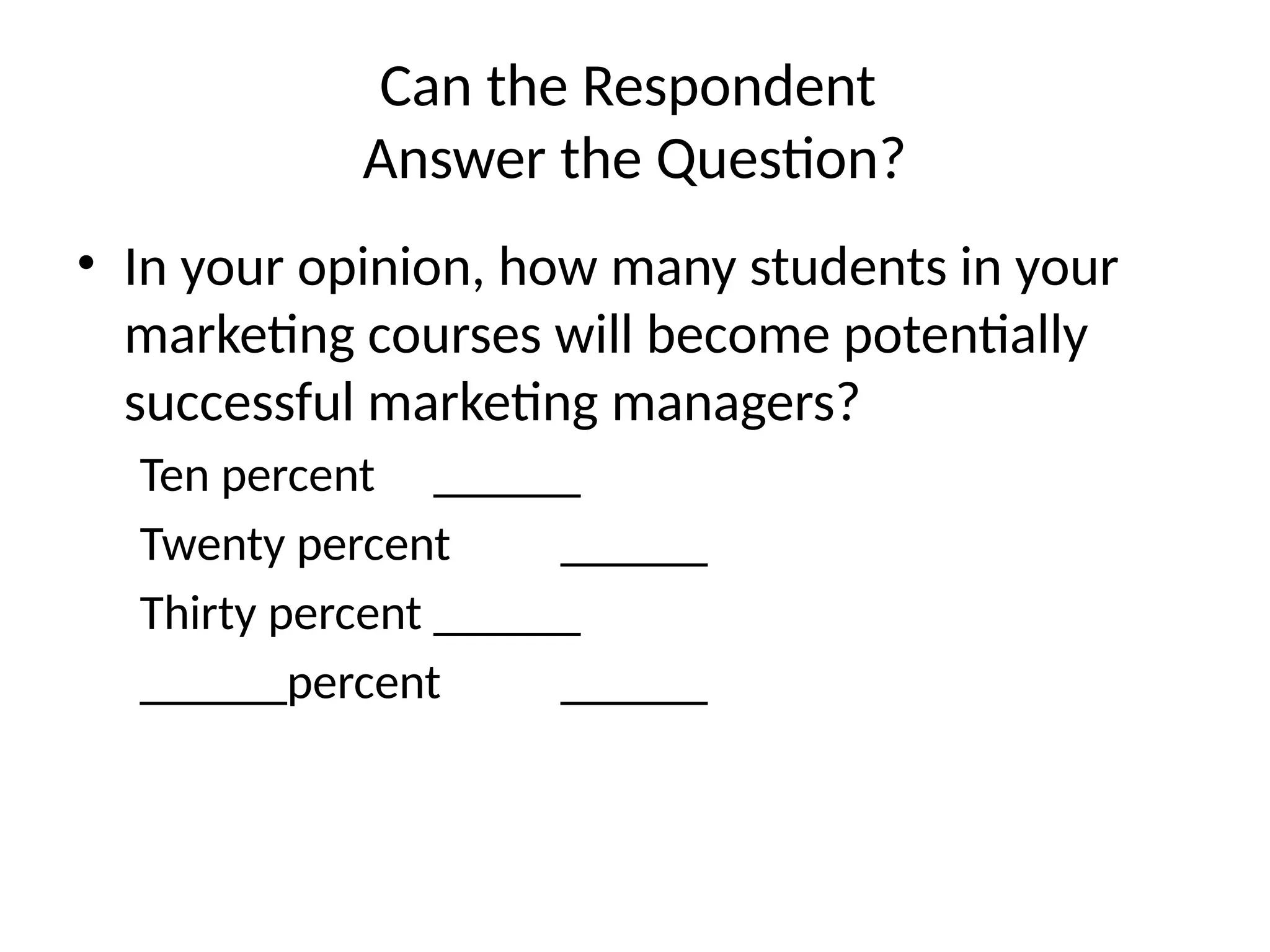
Can the Respondent
Answer the Question?
• In your opinion, how many students in your
marketing courses will become potentially
successful marketing managers?
Ten percent ______
Twenty percent ______
Thirty percent ______
______percent ______
• Questionnaire quality and design criteria
– What should be asked?
– How should questions be phrased?
– In what sequence the questions be arranged?
– What questionnaire layout will best serve the research
objectives?
– How should the questionnaire be pretested?
– Does the questionnaire need to be revised?
Questionnaire General Format
• Self-administered (by mail or
personal contact)
• In person (face-to-face)
• Telephone interviews
Question Form
• Nonstructured questions
– Open-ended
• Structured questions
– Fixed-response
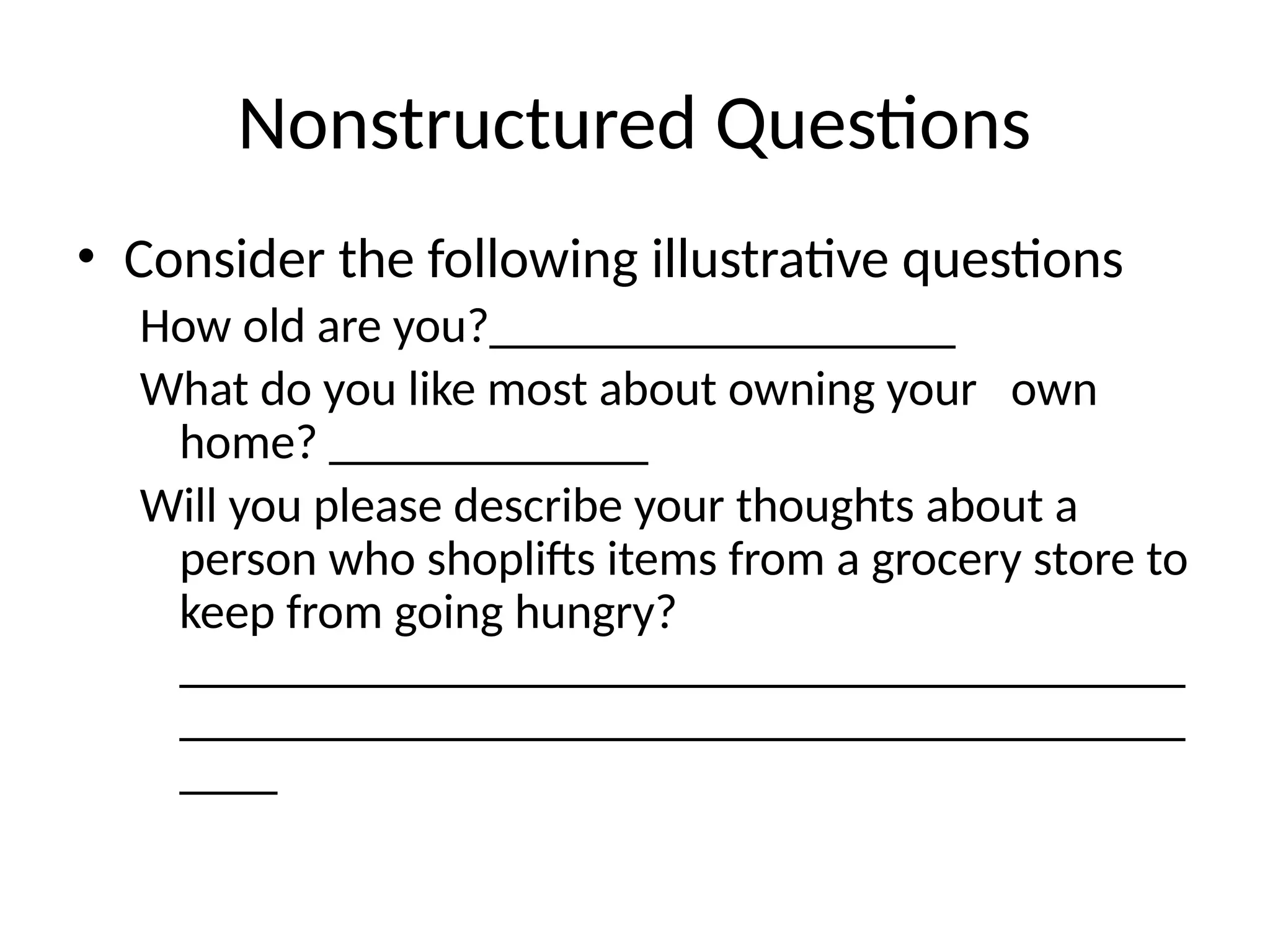
Nonstructured Questions
• Consider the following illustrative questions
How old are you?___________________
What do you like most about owning your own
home? _____________
Will you please describe your thoughts about a
person who shoplifts items from a grocery store to
keep from going hungry?
_________________________________________
_________________________________________
____
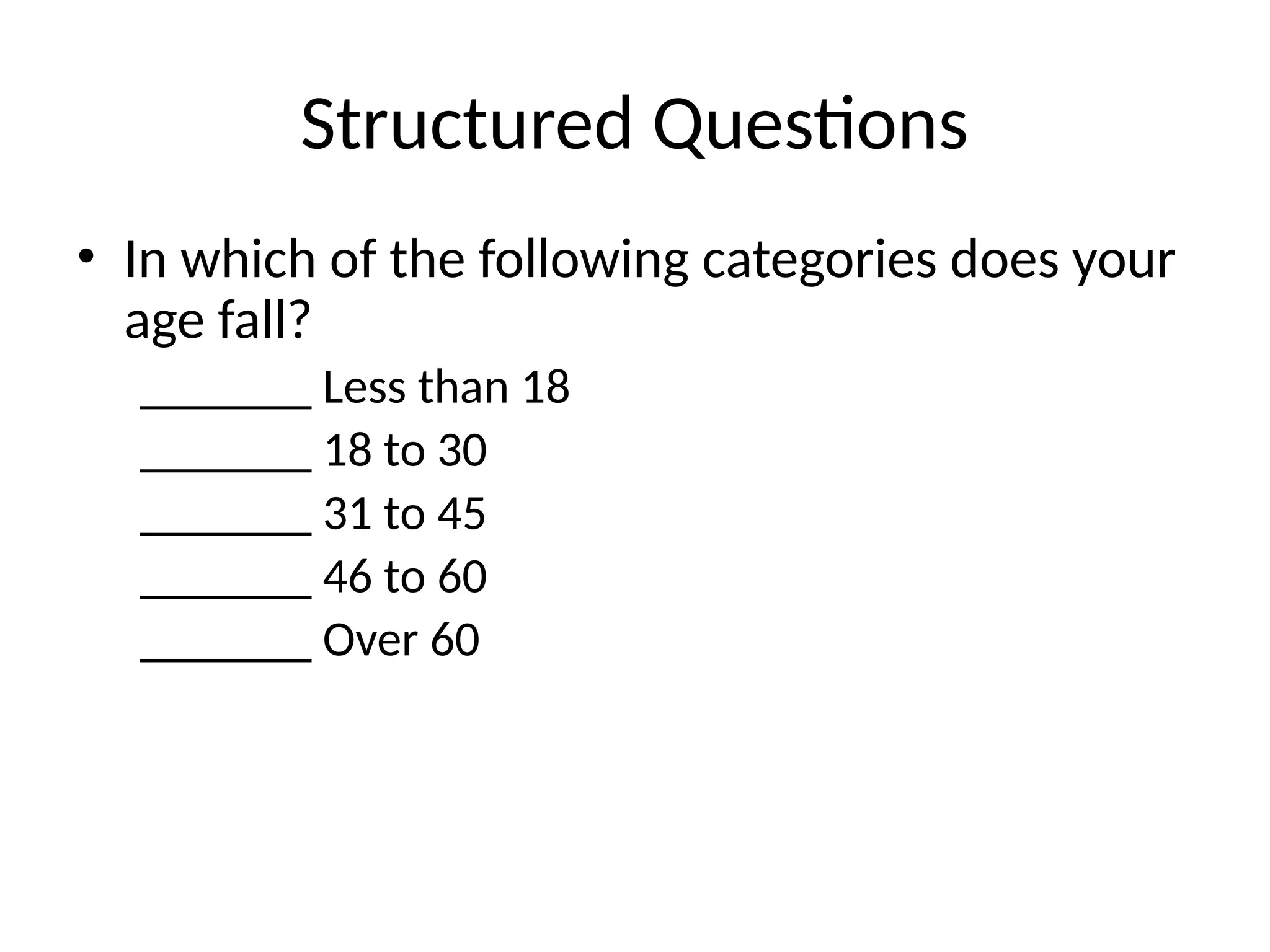
Structured Questions
• In which of the following categories does your
age fall?
_______ Less than 18
_______ 18 to 30
_______ 31 to 45
_______ 46 to 60
_______ Over 60
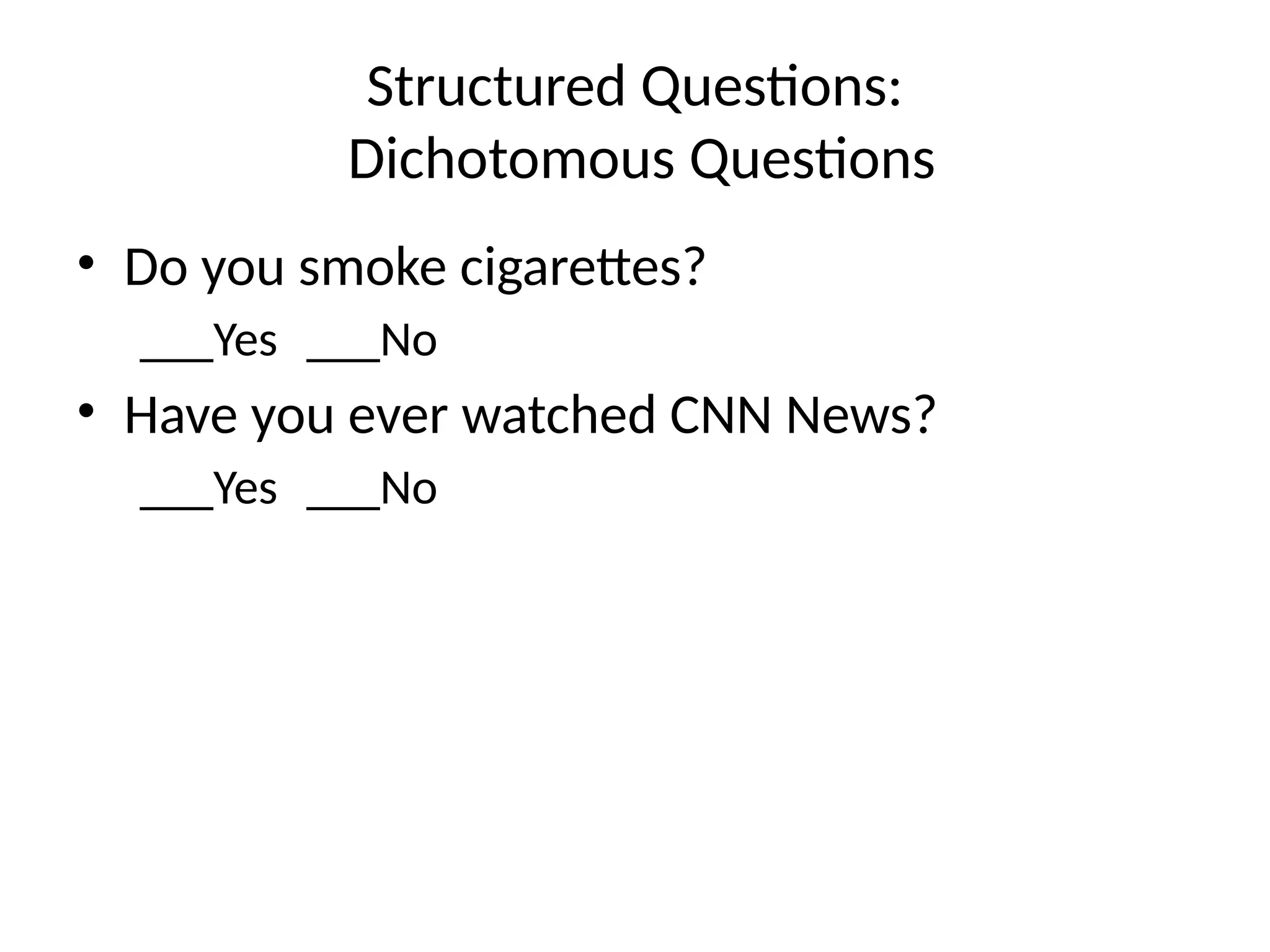
Structured Questions:
Dichotomous Questions
• Do you smoke cigarettes?
___Yes ___No
• Have you ever watched CNN News?
___Yes ___No
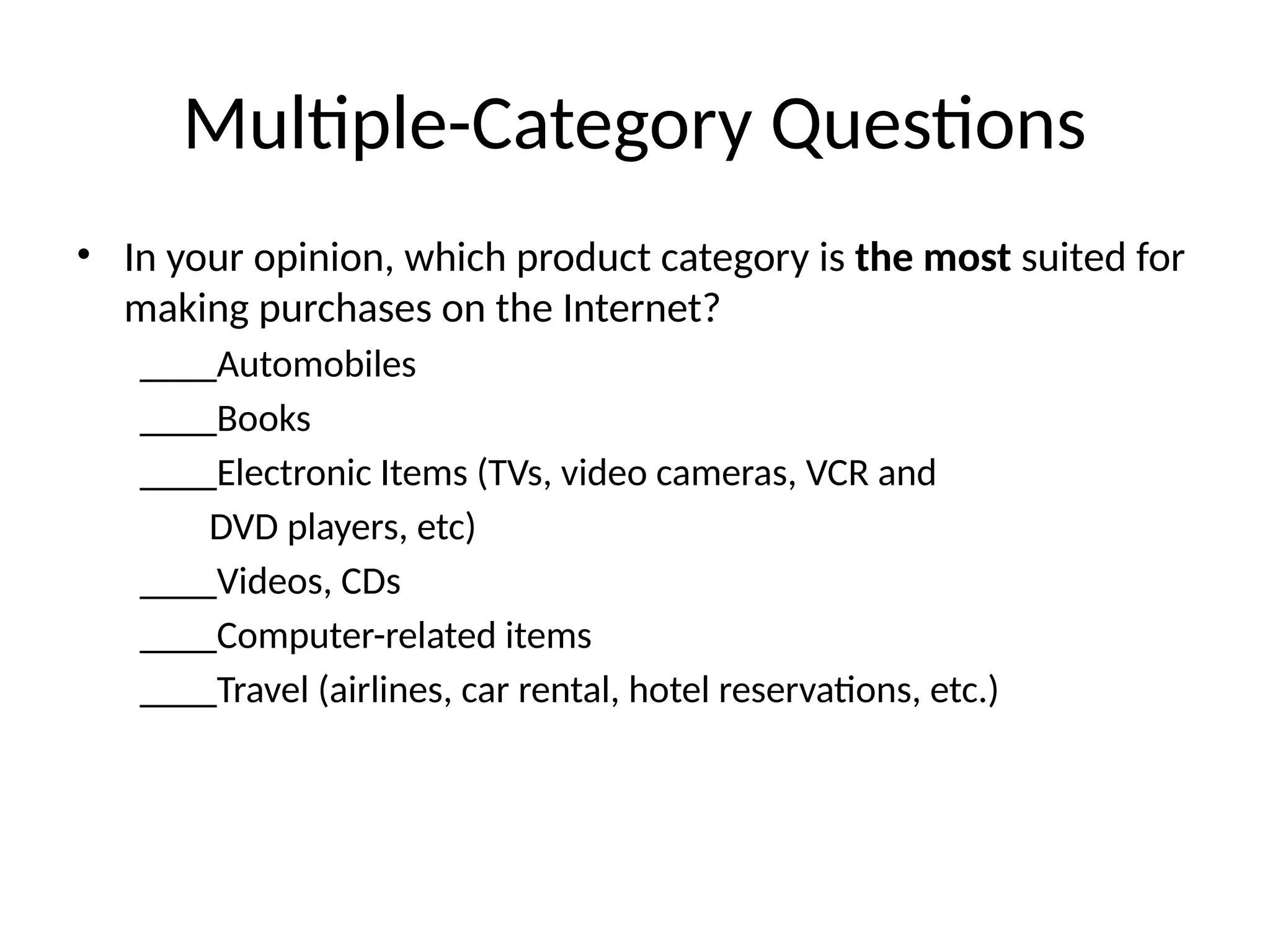
Multiple-Category Questions
• In your opinion, which product category is the most suited for
making purchases on the Internet?
____Automobiles
____Books
____Electronic Items (TVs, video cameras, VCR and
DVD players, etc)
____Videos, CDs
____Computer-related items
____Travel (airlines, car rental, hotel reservations, etc.)
Multiple-Category Questions (Cont’d)
• What do you like about Bank of America’s
online banking service?
____24 hour service
____Transaction privacy
____No need to travel – do it from home
____Paying bills online– no need to mail bills
____Other ____(please specify)
Response Category Sequence
• Approximately how many international
telephone calls do you make per week?
______ 0 to 1 call
______ 2 to 3 calls
______ 4 to 5 calls
______ 6 to 7 calls
______ More than 7 calls
• The response categories in this question
follow a natural sequence
Response Category Content
• Response choices should be
– Collectively exhaustive
• taken together
– Mutually exclusive
• not overlap
Response Category
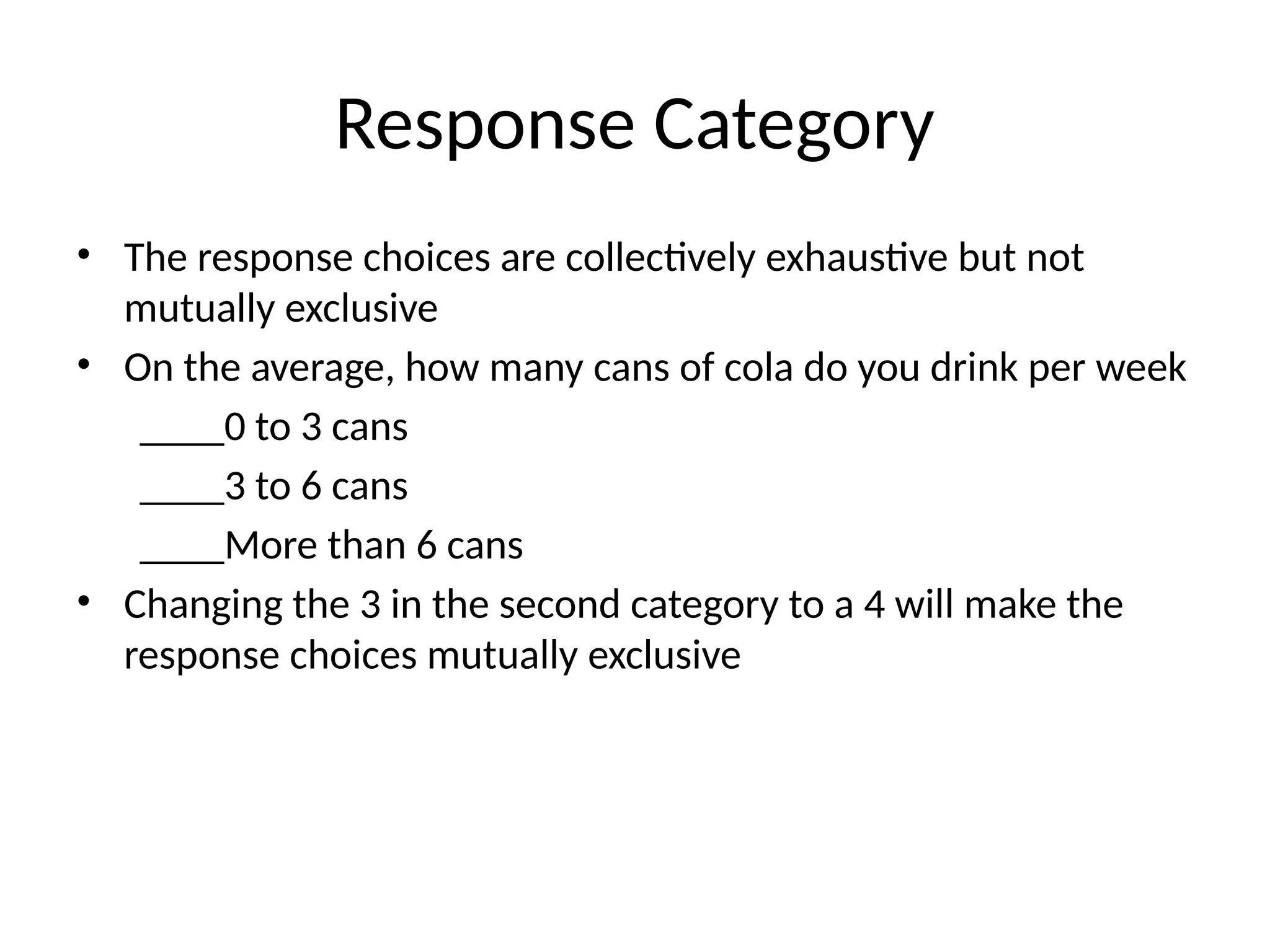
• The response choices are collectively exhaustive but not
mutually exclusive
• On the average, how many cans of cola do you drink per week
____0 to 3 cans
____3 to 6 cans
____More than 6 cans
• Changing the 3 in the second category to a 4 will make the
response choices mutually exclusive
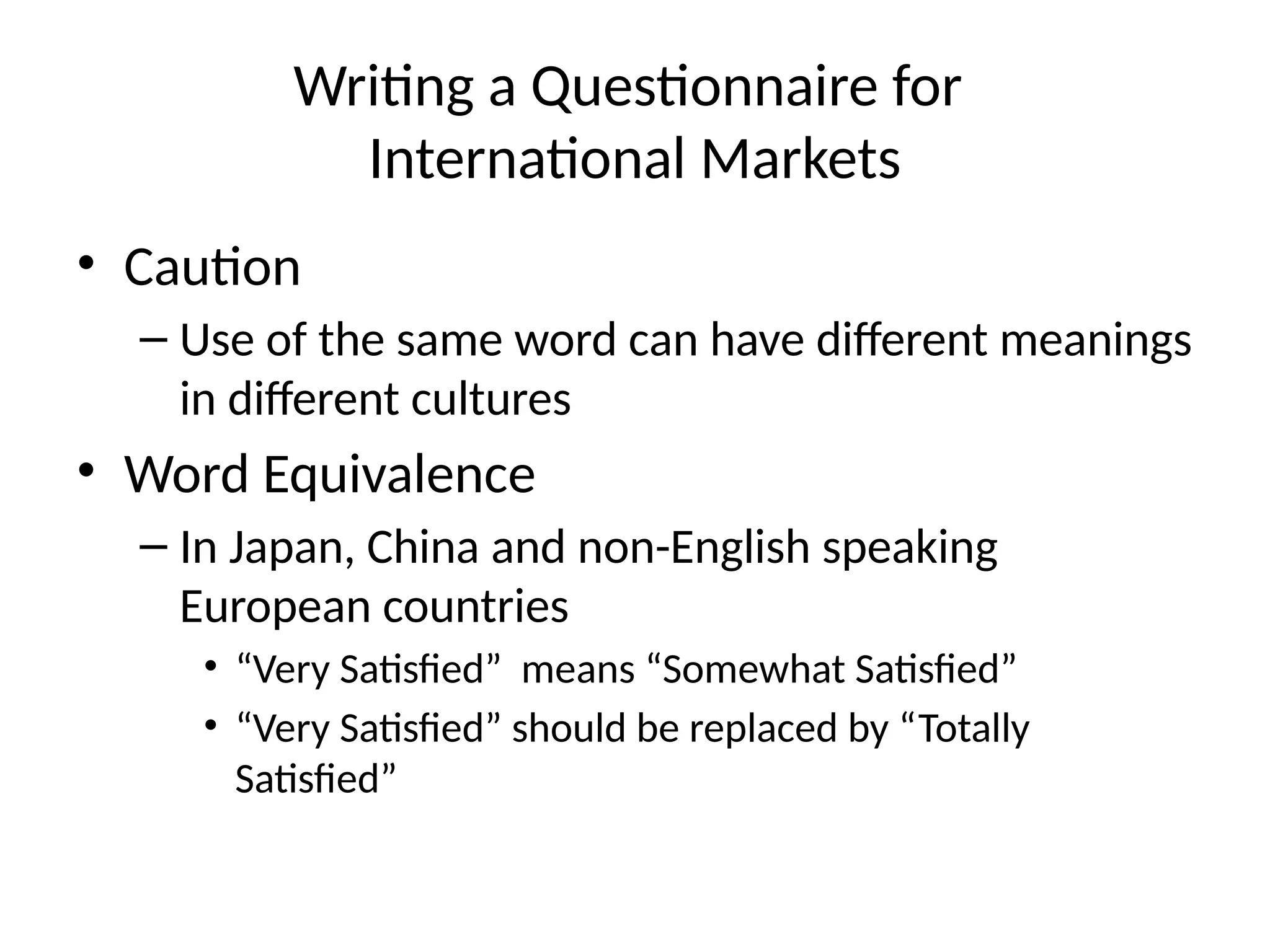
Writing a Questionnaire for
International Markets
• Caution
– Use of the same word can have different meanings
in different cultures
• Word Equivalence
– In Japan, China and non-English speaking
European countries
• “Very Satisfied” means “Somewhat Satisfied”
• “Very Satisfied” should be replaced by “Totally
Satisfied”
Will the Respondent
Answer the Question?
• Questions about personal financial matters or
sexual behavior are examples of sensitive
questions
• Words used in the questions should not be
ambiguous to the respondents
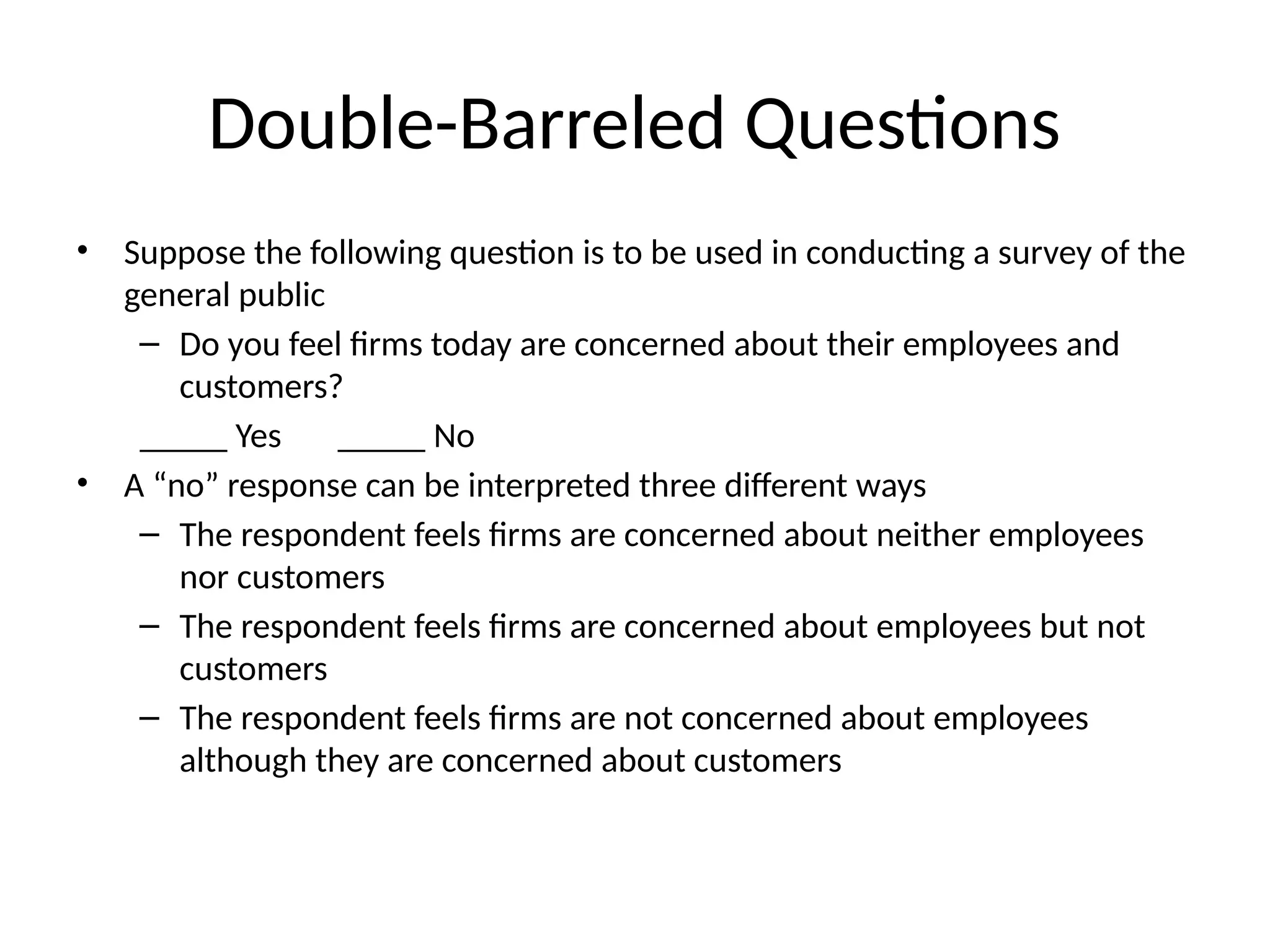
Double-Barreled Questions
• Suppose the following question is to be used in conducting a survey of the
general public
– Do you feel firms today are concerned about their employees and
customers?
_____ Yes _____ No
• A “no” response can be interpreted three different ways
– The respondent feels firms are concerned about neither employees
nor customers
– The respondent feels firms are concerned about employees but not
customers
– The respondent feels firms are not concerned about employees
although they are concerned about customers
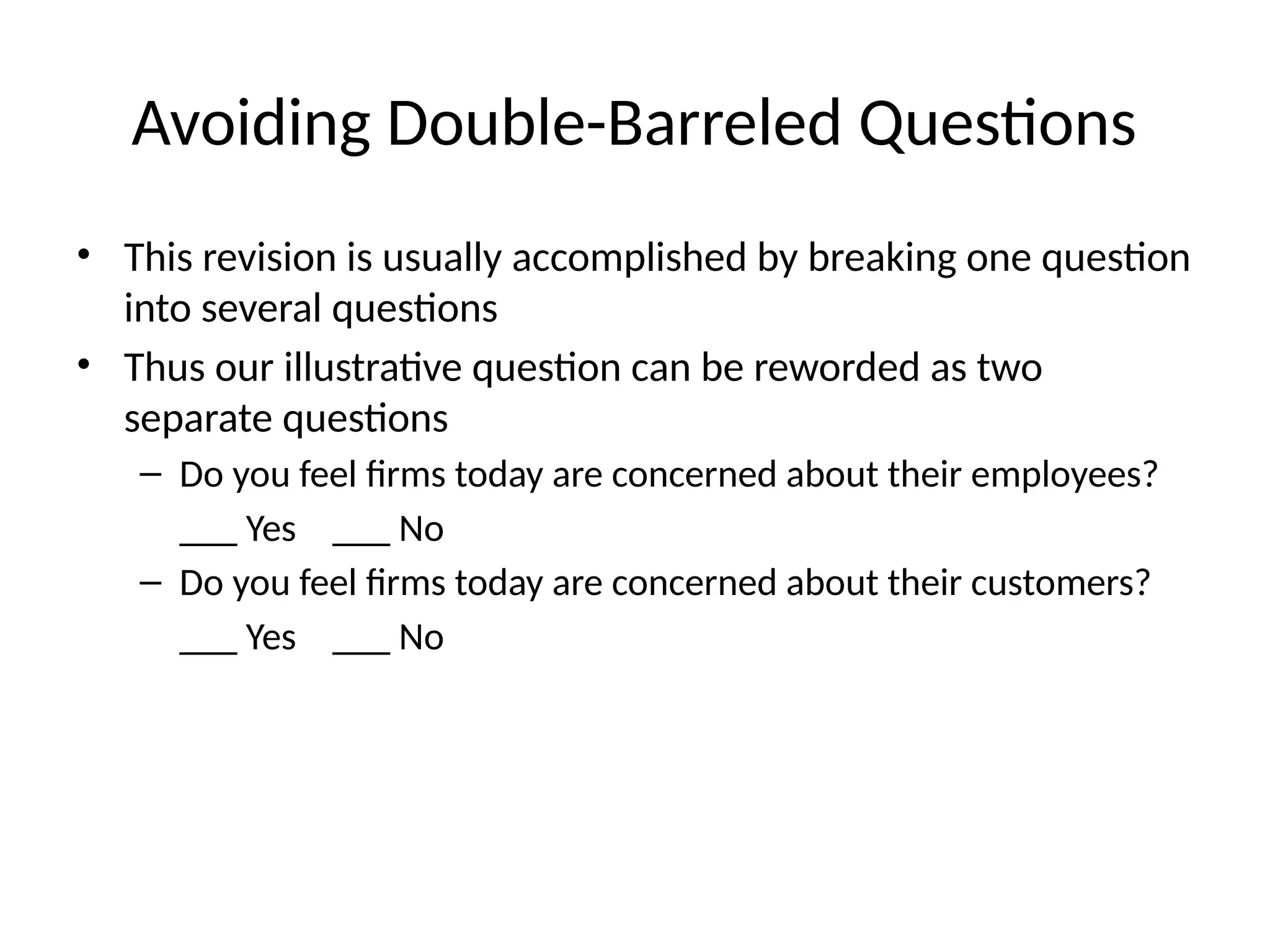
Avoiding Double-Barreled Questions
• This revision is usually accomplished by breaking one question
into several questions
• Thus our illustrative question can be reworded as two
separate questions
– Do you feel firms today are concerned about their employees?
___ Yes ___ No
– Do you feel firms today are concerned about their customers?
___ Yes ___ No
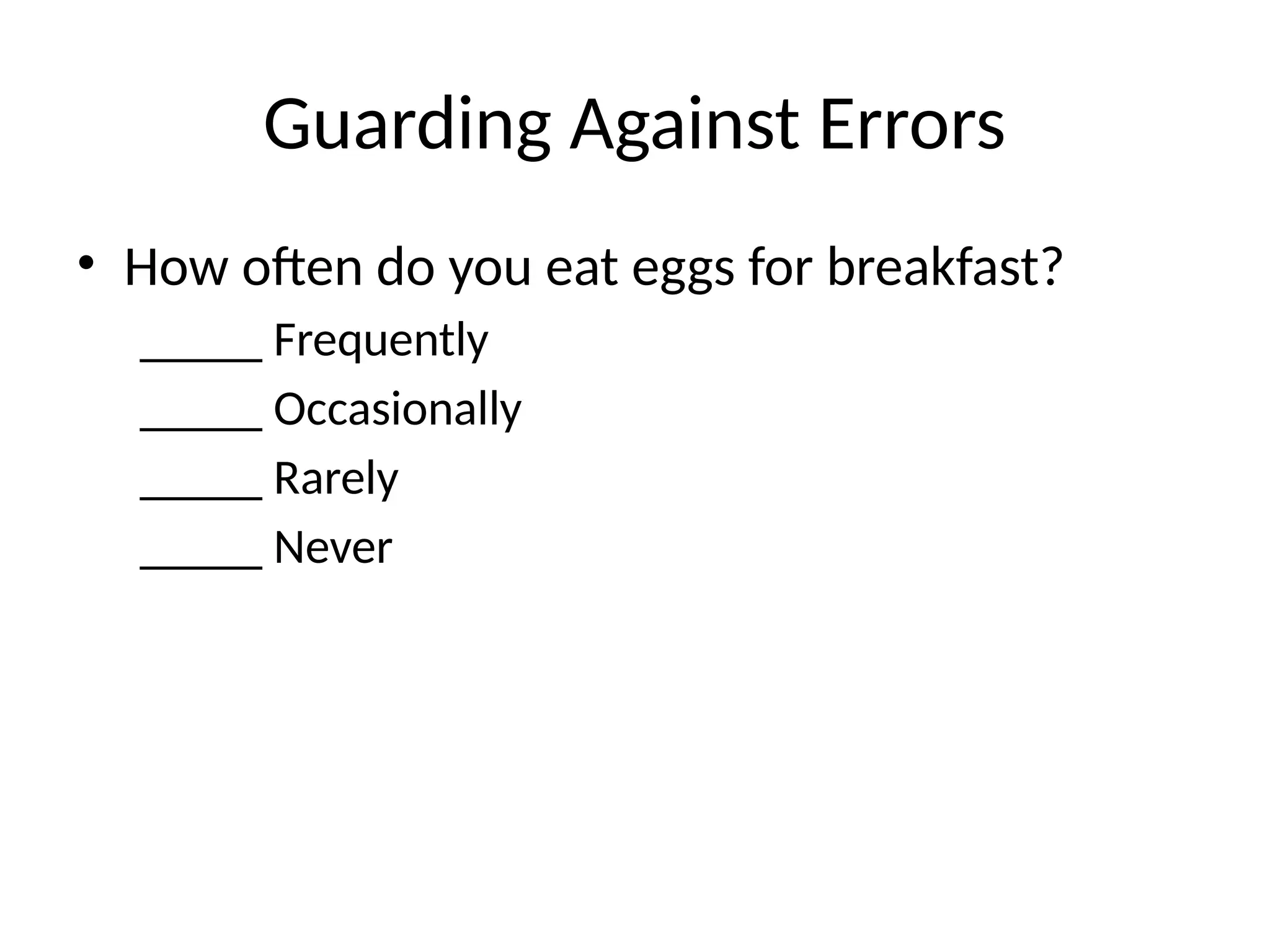
Guarding Against Errors
• How often do you eat eggs for breakfast?
_____ Frequently
_____ Occasionally
_____ Rarely
_____ Never
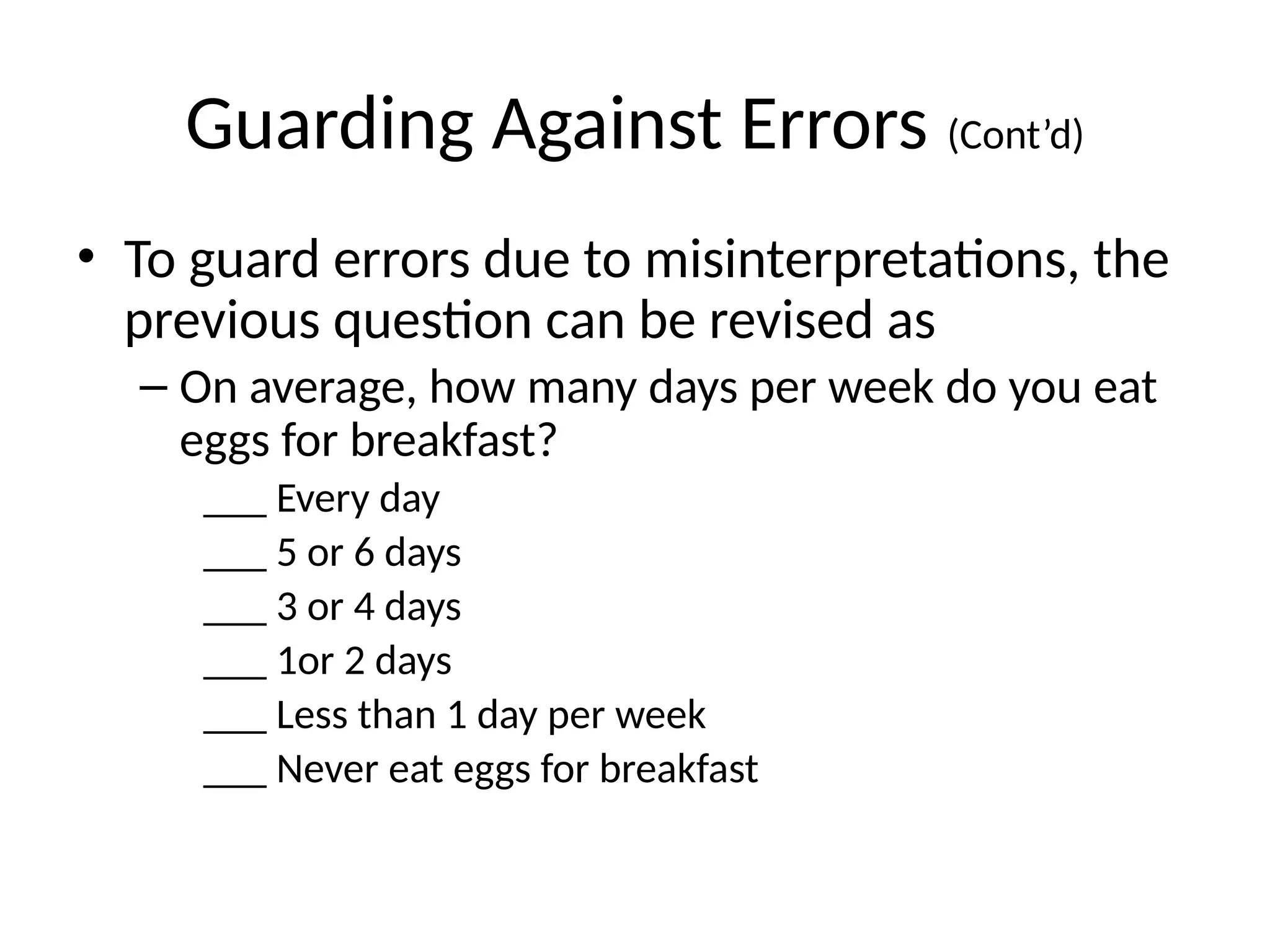
Guarding Against Errors (Cont’d)
• To guard errors due to misinterpretations, the
previous question can be revised as
– On average, how many days per week do you eat
eggs for breakfast?
___ Every day
___ 5 or 6 days
___ 3 or 4 days
___ 1or 2 days
___ Less than 1 day per week
___ Never eat eggs for breakfast
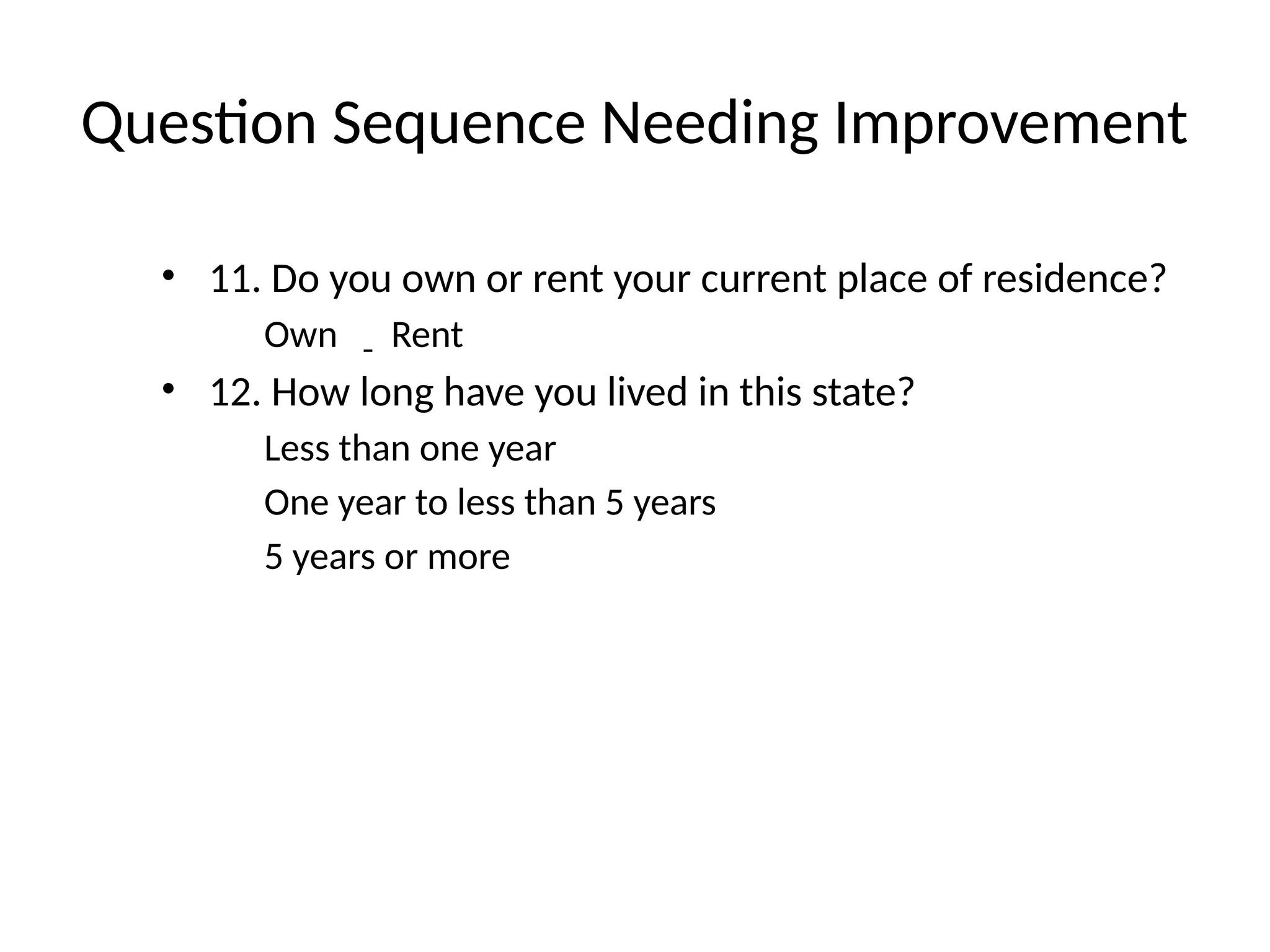
Question Sequence Needing Improvement
• 11. Do you own or rent your current place of residence?
Own Rent
• 12. How long have you lived in this state?
Less than one year
One year to less than 5 years
5 years or more
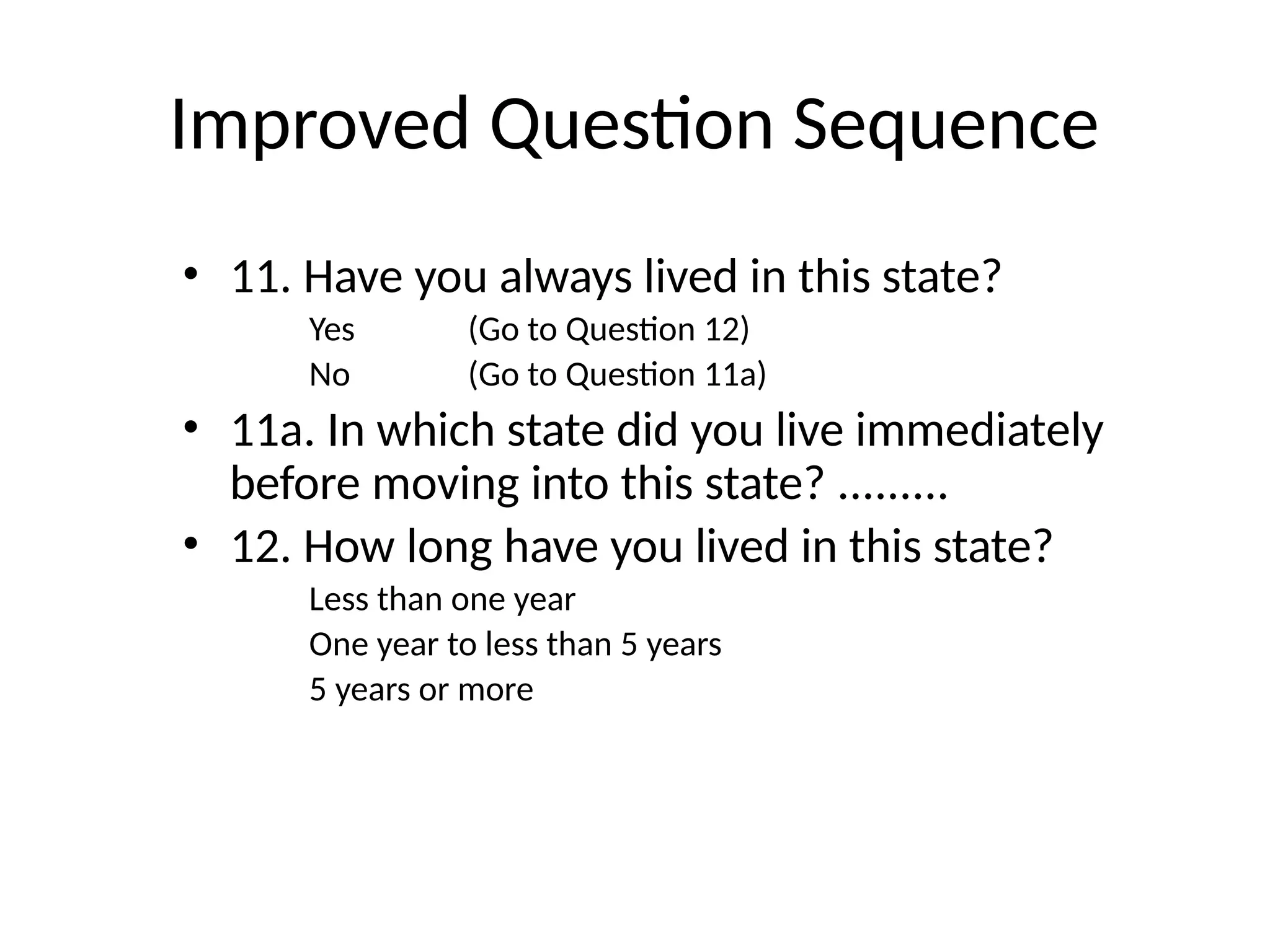
Improved Question Sequence
• 11. Have you always lived in this state?
Yes (Go to Question 12)
No (Go to Question 11a)
• 11a. In which state did you live immediately
before moving into this state? .........
• 12. How long have you lived in this state?
Less than one year
One year to less than 5 years
5 years or more
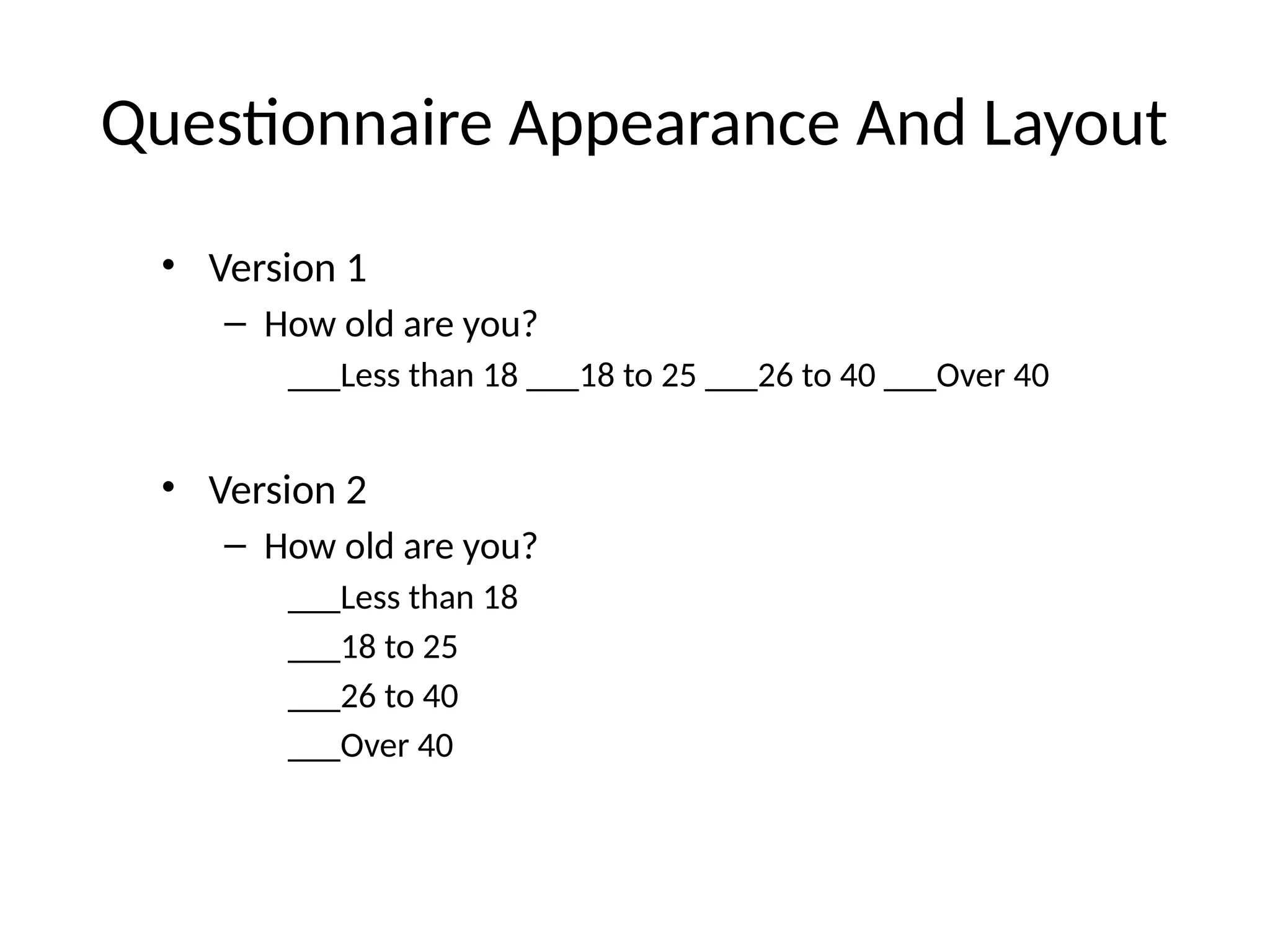
Questionnaire Appearance And Layout
• Version 1
– How old are you?
___Less than 18 ___18 to 25 ___26 to 40 ___Over 40
• Version 2
– How old are you?
___Less than 18
___18 to 25
___26 to 40
___Over 40
Guidelines for good questionnaire design
• Avoid complexity: Use simple conversational
language
• Avoid leading and loaded questions (question
that suggests a socially desirable answer or is it
emotionally charged)
• Avoid ambiguity :Be specific as possible
• Avoid double barreled items
• Avoid burdensome questions that may tax
respondent's memory
Data Analysis & Interpretation
Data preparation process
• Preparing preliminary plan of data analysis
• Questionnaire checking
• Editing
• Coding
• Transcribing
• Data cleaning
• Statistically adjusting the data
• Selecting a data analysis strategy
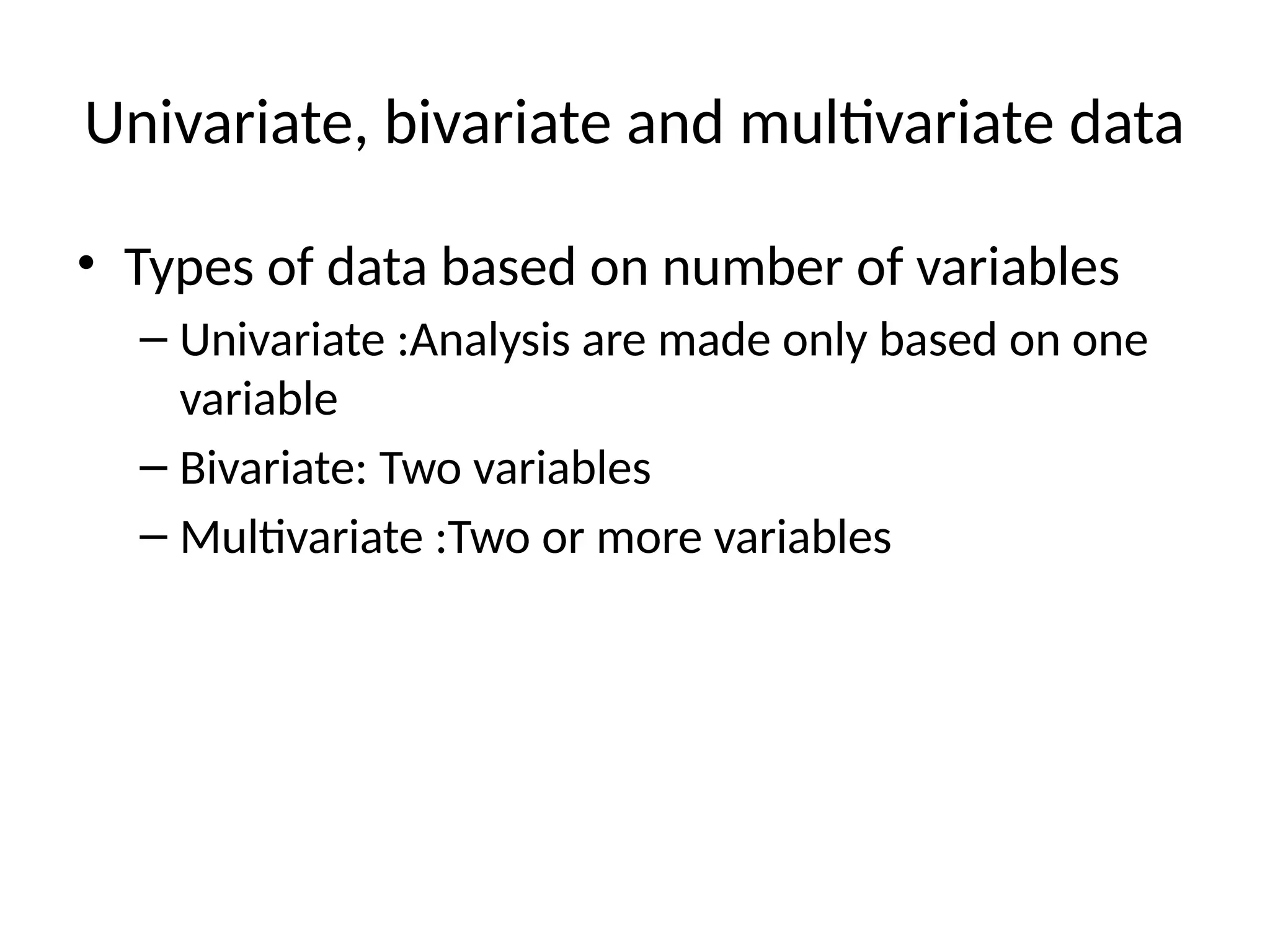
Univariate, bivariate and multivariate data
• Types of data based on number of variables
– Univariate :Analysis are made only based on one
variable
– Bivariate: Two variables
– Multivariate :Two or more variables
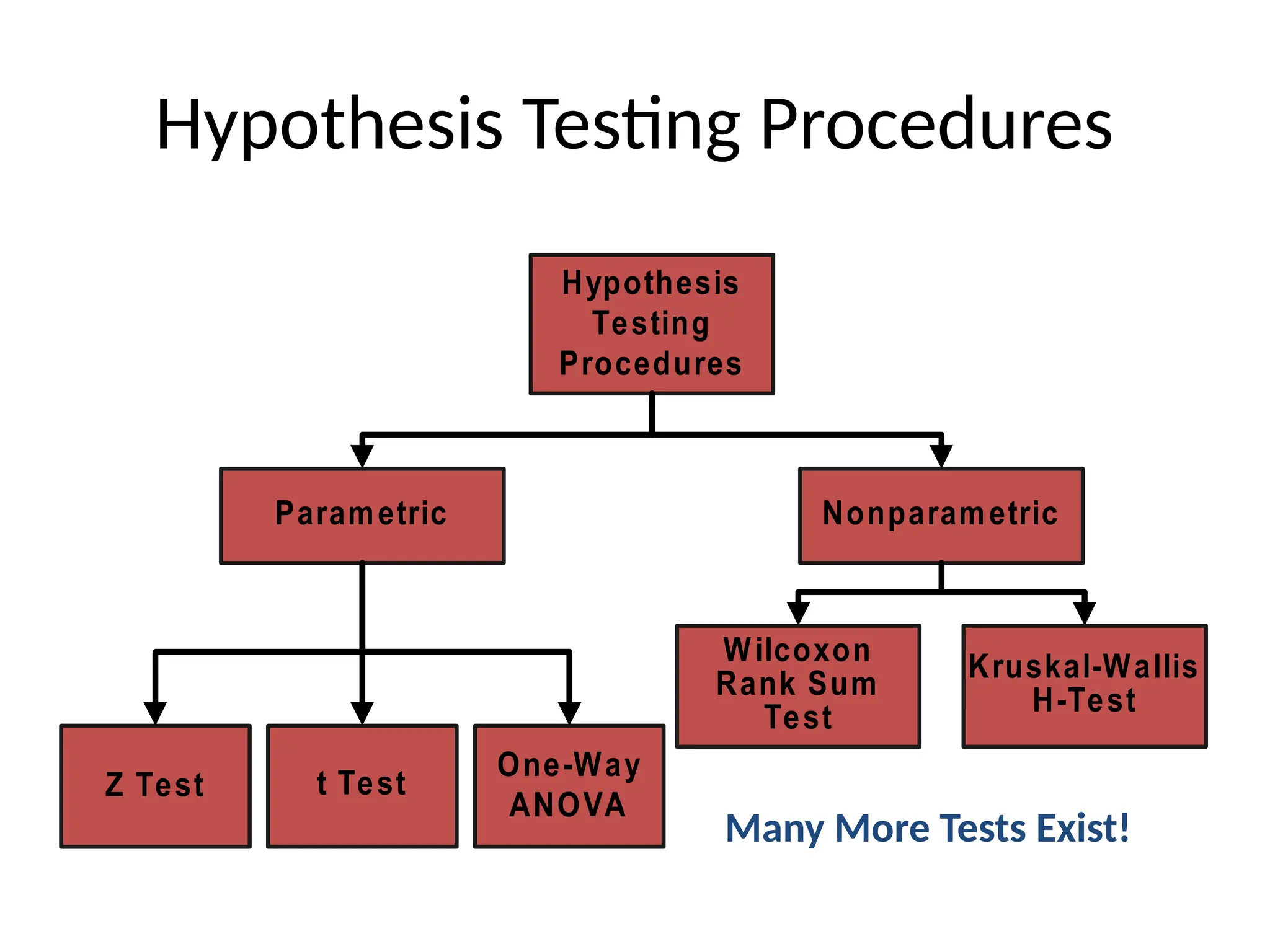
Hypothesis Testing Procedures
Hypothesis
Testing
Procedures
Nonparametric
Parametric
Z Test
Kruskal-Wallis
H-Test
Wilcoxon
Rank Sum
Test
t Test
One-Way
ANOVA
Many More Tests Exist!
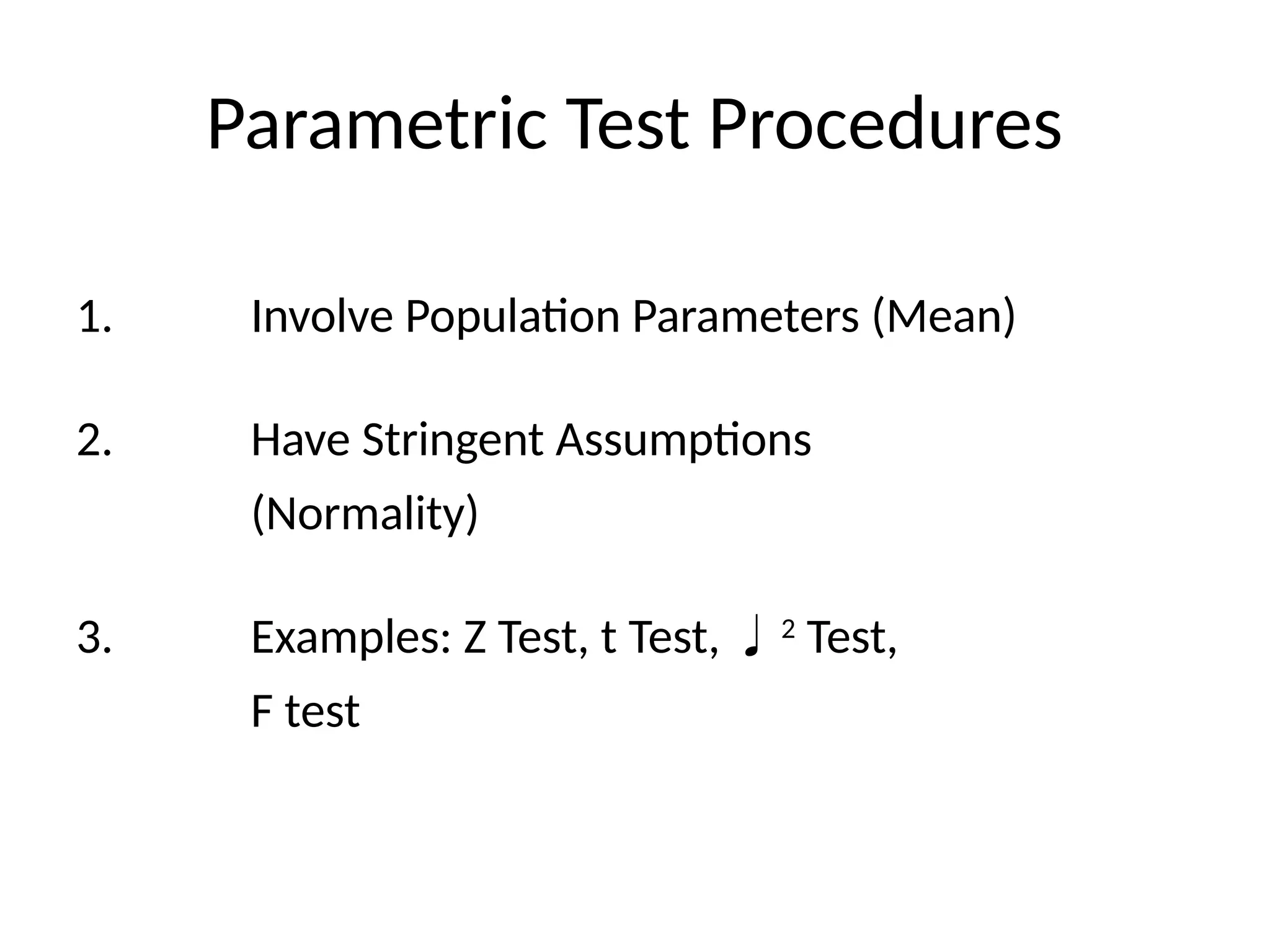
Parametric Test Procedures
1. Involve Population Parameters (Mean)
2. Have Stringent Assumptions
(Normality)
3. Examples: Z Test, t Test, 2
Test,
F test
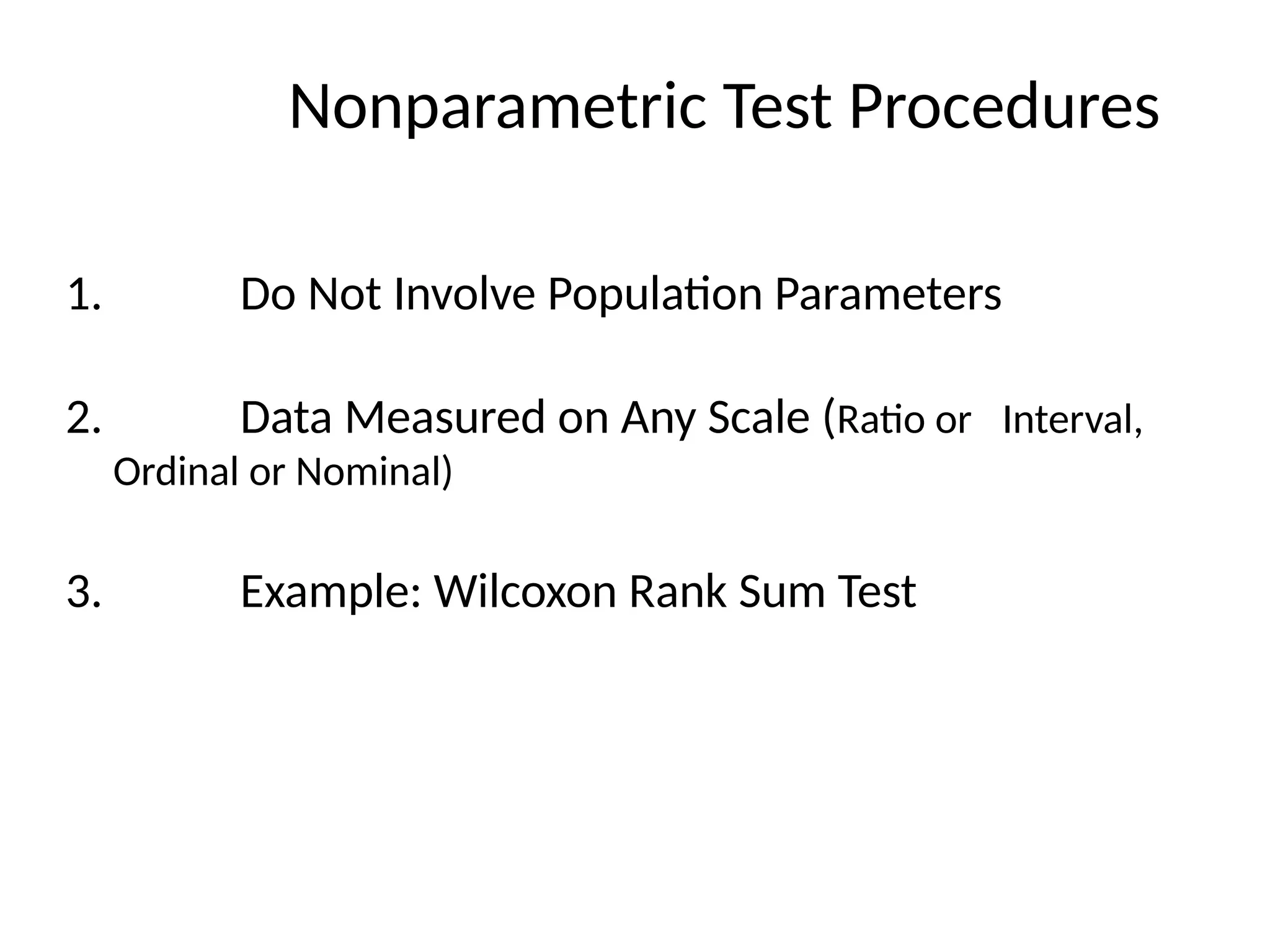
Nonparametric Test Procedures
1. Do Not Involve Population Parameters
2. Data Measured on Any Scale (Ratio or Interval,
Ordinal or Nominal)
3. Example: Wilcoxon Rank Sum Test
Advantages of Nonparametric Tests
1. Used With All Scales
2. Easier to Compute
3. Make Fewer Assumptions
4. Need Not Involve
Population Parameters
5. Results May Be as Exact
as Parametric Procedures
Disadvantages of Nonparametric Tests
1. May Waste Information
Parametric model more efficient
if data Permit
2. Difficult to Compute by
hand for Large Samples
3. Tables Not Widely Available
Hypothesis testing
• What u normally do
– If calculated value is less than the table value-
hypothesis accepted
– If calculated value is more than the table value-
hypothesis rejected
• How you do in SPSS?
– If the p value is > .05 – The result is insignificant
– If the p value is < .05 – The result is significant
Chi square tests
• Chi-square is a statistical test commonly used to
compare observed data with data we would expect
to obtain according to a specific hypothesis.
• The chi-square test is always testing what scientists
call the null hypothesis, which states that there is
no significant difference between the expected and
observed result.
• We want to compare our observed data to what we
expect to see. Due to chance? Due to association?
Assumptions:
• Independent observations
• A sample size of at least 10
• Random sampling
• All observations must be used
• For the test to be accurate, the expected frequency
should be at least 5
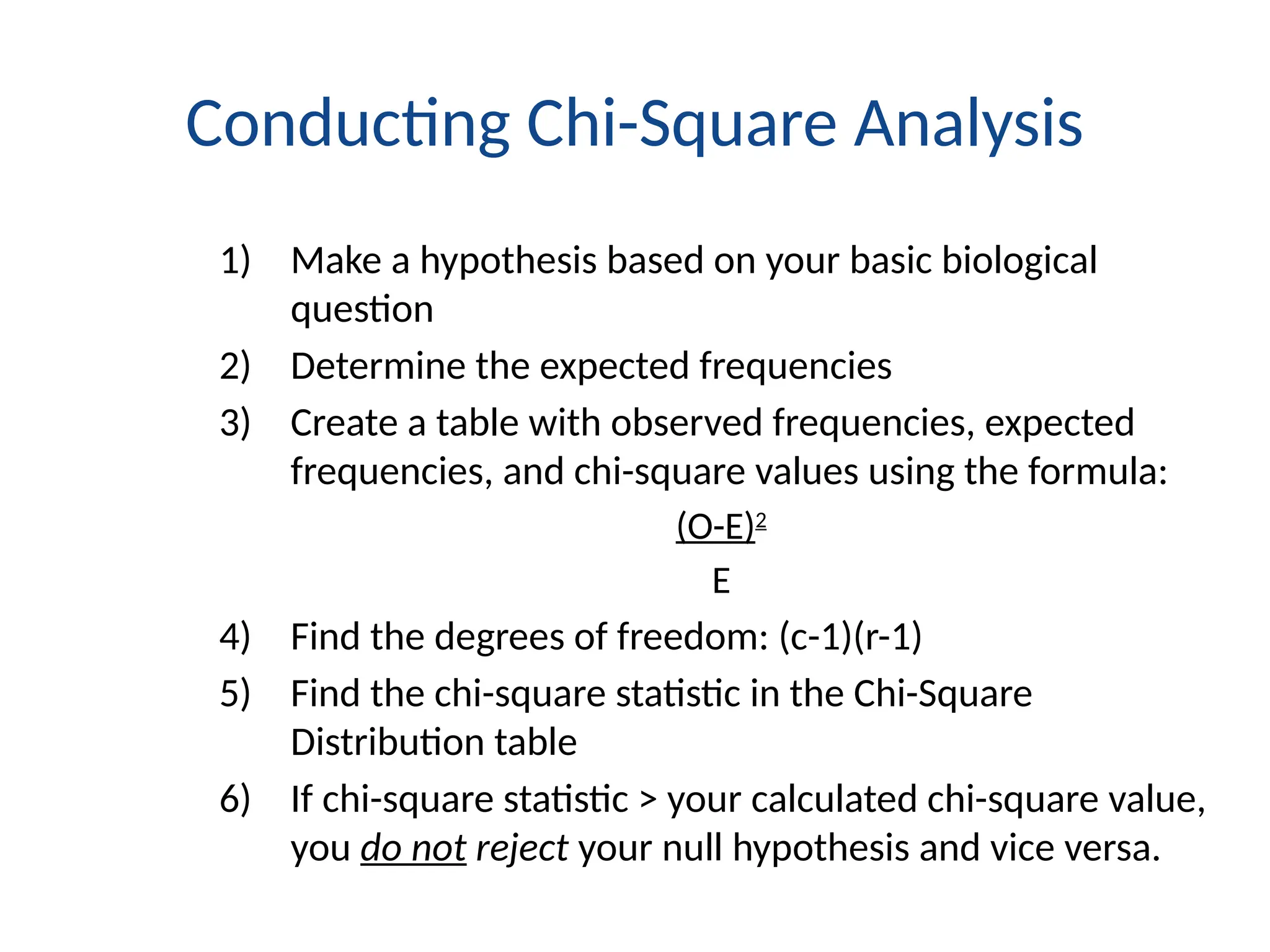
Conducting Chi-Square Analysis
1) Make a hypothesis based on your basic biological
question
2) Determine the expected frequencies
3) Create a table with observed frequencies, expected
frequencies, and chi-square values using the formula:
(O-E)2
E
4) Find the degrees of freedom: (c-1)(r-1)
5) Find the chi-square statistic in the Chi-Square
Distribution table
6) If chi-square statistic > your calculated chi-square value,
you do not reject your null hypothesis and vice versa.
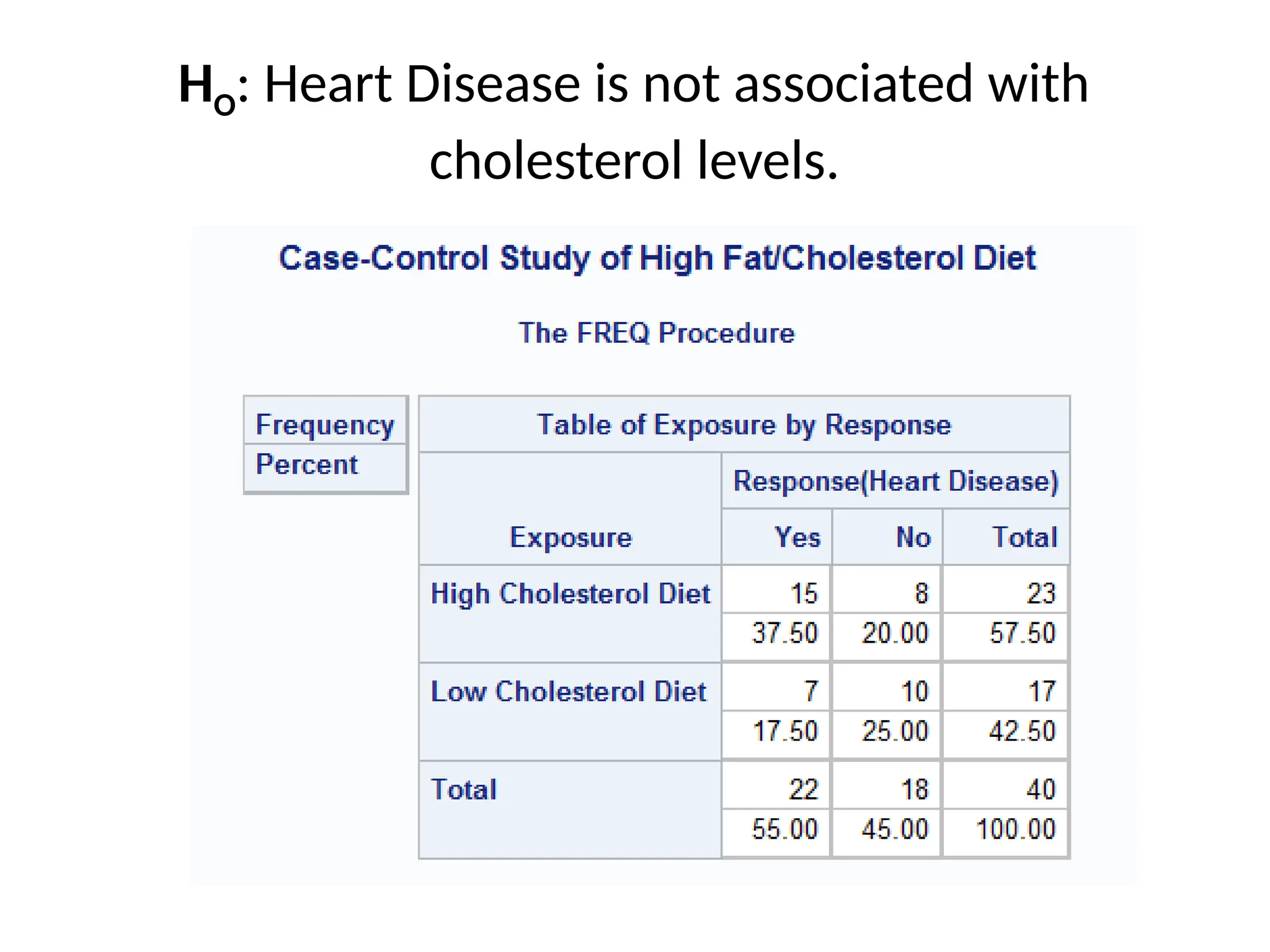
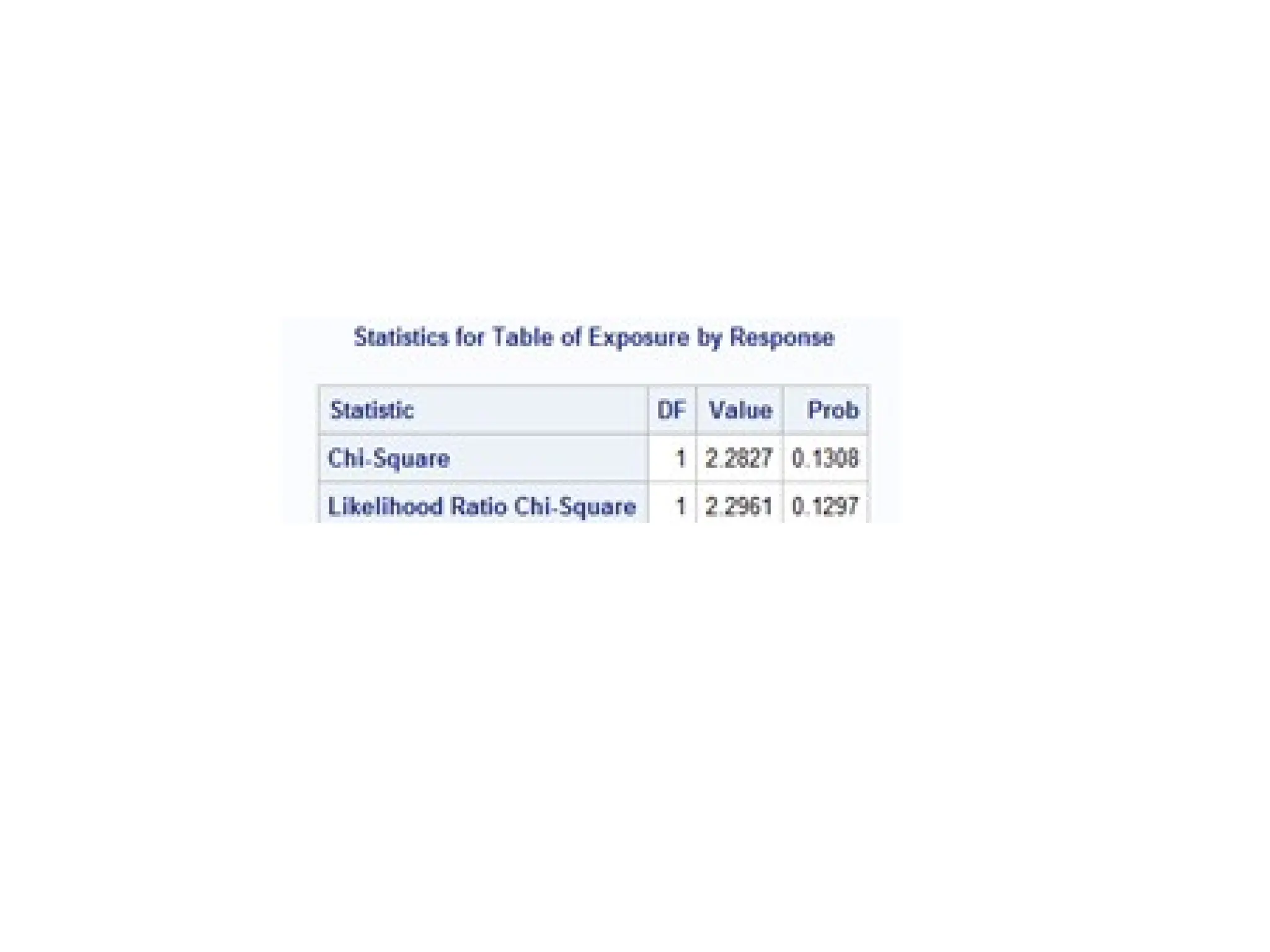
HO: Heart Disease is not associated with
cholesterol levels.
REPORT PREPARATION AND
PRESENTATION
Report Format
• Title page
– With names & Reg. Nos. of team members
• Table of contents
• Executive summary
– Major findings
– Conclusions
– Recommendations
• Research problem
– Review of literature
– Formulation of hypothesis/es
– Research Methodology
• Type of research design
• Nature of data collected
• Scaling techniques used
• Questionnaire development and pretesting details
• Sampling design
– Target population
– Sampling frame
– Sampling technique
– Sample size
• Fieldwork details
• Data Analysis
– Hypothesis/es testing
• Results and discussions
• Limitations
• Conclusions and recommendations
• References
• Exhibits
• Questionnaires and forms

Research Methodology__________________________________

  • 1.
  • 2.
    Methods of datacollection • Types – Primary • Observation • Interview • Questionnaires • Schedules • Warranty cards • Distributor audit • Pantry audits • Consumer panels • Using mechanical devices • Projective techniques • Depth interviews • Content analysis – Secondary
  • 3.
    Observation • Structured – Carefuldefinitions of units to be observed, the styles of recording the observed information, statndardized conditions of observation and selection of pertinent data of observation. Suitable for descriptive studies • Non structured • Observation taking place without the above mentioned characteristics thought in advance. Suitable for exploratory studies
  • 4.
    • Participant observation •Non - Participant observation • Disguised observation • Controlled observation • Uncontrolled observation
  • 5.
    Interview method • Personalinterview – Structured interview – Unstructured interview – Focused interview – Clinical interview • Broad underlying feelings or motivations or with the course of individual's life experience – Non directive interview • Encourage respondents to talk • Telephonic interview
  • 6.
    Questionnaires ,Schedules &Other methods • Questionnaires • Schedules • Warranty cards • Distributor or store audits – Performed by salesmen at regular intervals • Pantry audits • Estimate consumption of the basket of goods at the consumer level • Investigator collects types of inventories, quantities and the price of the commodities consumed.
  • 7.
    • Consumer panels –Extension of pantry approach – Set of consumers are arranged to come to an understanding to maintain detailed daily records of their consumption and the same is available to investigators on demand Types • Transitory – Before and after basis • Continuing
  • 8.
    • Mechanical devices –Eye camera – Pupilometric camera – Psychogalvanometer – Motion picture camera – Audiometer
  • 9.
    • Projective techniques –Word association test – Sentence completion test – Story completion test – Verbal projection test – Pictorial techniques • TAT • Rosenzweig test or cartoon test • Rorschach test – 10 inkblot cards (symmetrical) – http://www.theinkblot.com/ • Holtzman Inkblot test – 45 inkblot cards – Based on color, movement, shading and other factors involved in inkblot perception – Scoring is based on twenty-two items – https://en.wikipedia.org/wiki/Holtzman_Inkblot_Technique – Tomkins-Horn picture arrangement test • Performed by giving the subject pictures of a person with various facial expressions. The test consists of 25 sets of three pictures that the subject is asked to tell a story with by putting a card in sequence and writing a sentence about it. – Play techniques • Doll play test • Quizzes ,tests and examinations • Sociometery –Describe social relationships among individuals in a group
  • 10.
    • Depth interview •Content analysis
  • 11.
  • 12.
    Attitude Measurement • Attitude– an expression of favour or disfavour toward a person, place, thing or event • Attitude can be formed from a person’s past and present • Attitude is also measurable and changeable as well as influencing the person’s behaviour.
  • 13.
    I believe thatchocolate packaging is important
  • 14.
    Methods of MeasuringAttitudes • Rating – Likert Scale – carefully constructed attitudinal measure which asks people for their agreement with a statement – Example: Please rate each of the following, on a scale from 1 to 10, with 1 being least important and 10 being most important…
  • 15.
    • Sorting – Asksrespondents to sort items/names into groups • Multiple Choice Questions (MCQ)
  • 16.
    Monadic Q. How satisfiedare you with your current job? 1. Very Satisfied 2. Somewhat Satisfied 3. Not Very Satisfied
  • 17.
    Comparative Q. Compared toyour current job how much responsibility did you have at your last job? 1. More 2. About the Same 3. Less
  • 18.
    Unbalanced Q. How satisfiedare you with your current cable service? 1. Very Satisfied 2. Somewhat Satisfied 3. Somewhat unsatisfied
  • 19.
    Balanced Q. How satisfiedare you with your current cable service? 1. Very Satisfied 2. Somewhat Satisfied 3. Somewhat unsatisfied 4. Very unsatisfied
  • 20.
    Forced Choice • Doesnot allow the respondent to offer no opinion, which is different than a neutral opinion
  • 21.
    Unforced Choice • Allowsrespondents to opt out of providing an opinion.
  • 22.
    • Ranking – Rankchoices from most important to least important • Example: Of the following 10 items please rank them in order of importance, with 1 being least important and 10 being most important.
  • 23.
    Questionnaire • A setof questions designed to generate the data necessary for accomplishing a research project's objectives
  • 24.
    Complexity of QuestionnaireDesign Do you consider that the many research texts are adequate for most of your business majors at the undergraduate level ? _____ Yes ____ No If no; briefly, why not? Is your friend sociable and lovable? _____ Yes ____ No If no; briefly, why not?
  • 25.
    Can the Respondent Answerthe Question? (Cont’d) • Consider the following question taken from a questionnaire used by a marketing research firm in conducting a face-to-face survey of female household heads – How much has your family spent in the last 12 months on cookware? $ _______
  • 26.
    Can the Respondent Answerthe Question? • In your opinion, how many students in your marketing courses will become potentially successful marketing managers? Ten percent ______ Twenty percent ______ Thirty percent ______ ______percent ______
  • 27.
    • Questionnaire qualityand design criteria – What should be asked? – How should questions be phrased? – In what sequence the questions be arranged? – What questionnaire layout will best serve the research objectives? – How should the questionnaire be pretested? – Does the questionnaire need to be revised?
  • 28.
    Questionnaire General Format •Self-administered (by mail or personal contact) • In person (face-to-face) • Telephone interviews
  • 29.
    Question Form • Nonstructuredquestions – Open-ended • Structured questions – Fixed-response
  • 30.
    Nonstructured Questions • Considerthe following illustrative questions How old are you?___________________ What do you like most about owning your own home? _____________ Will you please describe your thoughts about a person who shoplifts items from a grocery store to keep from going hungry? _________________________________________ _________________________________________ ____
  • 31.
    Structured Questions • Inwhich of the following categories does your age fall? _______ Less than 18 _______ 18 to 30 _______ 31 to 45 _______ 46 to 60 _______ Over 60
  • 32.
    Structured Questions: Dichotomous Questions •Do you smoke cigarettes? ___Yes ___No • Have you ever watched CNN News? ___Yes ___No
  • 33.
    Multiple-Category Questions • Inyour opinion, which product category is the most suited for making purchases on the Internet? ____Automobiles ____Books ____Electronic Items (TVs, video cameras, VCR and DVD players, etc) ____Videos, CDs ____Computer-related items ____Travel (airlines, car rental, hotel reservations, etc.)
  • 34.
    Multiple-Category Questions (Cont’d) •What do you like about Bank of America’s online banking service? ____24 hour service ____Transaction privacy ____No need to travel – do it from home ____Paying bills online– no need to mail bills ____Other ____(please specify)
  • 35.
    Response Category Sequence •Approximately how many international telephone calls do you make per week? ______ 0 to 1 call ______ 2 to 3 calls ______ 4 to 5 calls ______ 6 to 7 calls ______ More than 7 calls • The response categories in this question follow a natural sequence
  • 36.
    Response Category Content •Response choices should be – Collectively exhaustive • taken together – Mutually exclusive • not overlap
  • 37.
    Response Category • Theresponse choices are collectively exhaustive but not mutually exclusive • On the average, how many cans of cola do you drink per week ____0 to 3 cans ____3 to 6 cans ____More than 6 cans • Changing the 3 in the second category to a 4 will make the response choices mutually exclusive
  • 38.
    Writing a Questionnairefor International Markets • Caution – Use of the same word can have different meanings in different cultures • Word Equivalence – In Japan, China and non-English speaking European countries • “Very Satisfied” means “Somewhat Satisfied” • “Very Satisfied” should be replaced by “Totally Satisfied”
  • 39.
    Will the Respondent Answerthe Question? • Questions about personal financial matters or sexual behavior are examples of sensitive questions • Words used in the questions should not be ambiguous to the respondents
  • 40.
    Double-Barreled Questions • Supposethe following question is to be used in conducting a survey of the general public – Do you feel firms today are concerned about their employees and customers? _____ Yes _____ No • A “no” response can be interpreted three different ways – The respondent feels firms are concerned about neither employees nor customers – The respondent feels firms are concerned about employees but not customers – The respondent feels firms are not concerned about employees although they are concerned about customers
  • 41.
    Avoiding Double-Barreled Questions •This revision is usually accomplished by breaking one question into several questions • Thus our illustrative question can be reworded as two separate questions – Do you feel firms today are concerned about their employees? ___ Yes ___ No – Do you feel firms today are concerned about their customers? ___ Yes ___ No
  • 42.
    Guarding Against Errors •How often do you eat eggs for breakfast? _____ Frequently _____ Occasionally _____ Rarely _____ Never
  • 43.
    Guarding Against Errors(Cont’d) • To guard errors due to misinterpretations, the previous question can be revised as – On average, how many days per week do you eat eggs for breakfast? ___ Every day ___ 5 or 6 days ___ 3 or 4 days ___ 1or 2 days ___ Less than 1 day per week ___ Never eat eggs for breakfast
  • 44.
    Question Sequence NeedingImprovement • 11. Do you own or rent your current place of residence? Own Rent • 12. How long have you lived in this state? Less than one year One year to less than 5 years 5 years or more
  • 45.
    Improved Question Sequence •11. Have you always lived in this state? Yes (Go to Question 12) No (Go to Question 11a) • 11a. In which state did you live immediately before moving into this state? ......... • 12. How long have you lived in this state? Less than one year One year to less than 5 years 5 years or more
  • 46.
    Questionnaire Appearance AndLayout • Version 1 – How old are you? ___Less than 18 ___18 to 25 ___26 to 40 ___Over 40 • Version 2 – How old are you? ___Less than 18 ___18 to 25 ___26 to 40 ___Over 40
  • 47.
    Guidelines for goodquestionnaire design • Avoid complexity: Use simple conversational language • Avoid leading and loaded questions (question that suggests a socially desirable answer or is it emotionally charged) • Avoid ambiguity :Be specific as possible • Avoid double barreled items • Avoid burdensome questions that may tax respondent's memory
  • 48.
    Data Analysis &Interpretation
  • 49.
    Data preparation process •Preparing preliminary plan of data analysis • Questionnaire checking • Editing • Coding • Transcribing • Data cleaning • Statistically adjusting the data • Selecting a data analysis strategy
  • 50.
    Univariate, bivariate andmultivariate data • Types of data based on number of variables – Univariate :Analysis are made only based on one variable – Bivariate: Two variables – Multivariate :Two or more variables
  • 51.
    Hypothesis Testing Procedures Hypothesis Testing Procedures Nonparametric Parametric ZTest Kruskal-Wallis H-Test Wilcoxon Rank Sum Test t Test One-Way ANOVA Many More Tests Exist!
  • 52.
    Parametric Test Procedures 1.Involve Population Parameters (Mean) 2. Have Stringent Assumptions (Normality) 3. Examples: Z Test, t Test, 2 Test, F test
  • 53.
    Nonparametric Test Procedures 1.Do Not Involve Population Parameters 2. Data Measured on Any Scale (Ratio or Interval, Ordinal or Nominal) 3. Example: Wilcoxon Rank Sum Test
  • 54.
    Advantages of NonparametricTests 1. Used With All Scales 2. Easier to Compute 3. Make Fewer Assumptions 4. Need Not Involve Population Parameters 5. Results May Be as Exact as Parametric Procedures
  • 55.
    Disadvantages of NonparametricTests 1. May Waste Information Parametric model more efficient if data Permit 2. Difficult to Compute by hand for Large Samples 3. Tables Not Widely Available
  • 56.
    Hypothesis testing • Whatu normally do – If calculated value is less than the table value- hypothesis accepted – If calculated value is more than the table value- hypothesis rejected • How you do in SPSS? – If the p value is > .05 – The result is insignificant – If the p value is < .05 – The result is significant
  • 57.
    Chi square tests •Chi-square is a statistical test commonly used to compare observed data with data we would expect to obtain according to a specific hypothesis. • The chi-square test is always testing what scientists call the null hypothesis, which states that there is no significant difference between the expected and observed result. • We want to compare our observed data to what we expect to see. Due to chance? Due to association?
  • 58.
    Assumptions: • Independent observations •A sample size of at least 10 • Random sampling • All observations must be used • For the test to be accurate, the expected frequency should be at least 5
  • 59.
    Conducting Chi-Square Analysis 1)Make a hypothesis based on your basic biological question 2) Determine the expected frequencies 3) Create a table with observed frequencies, expected frequencies, and chi-square values using the formula: (O-E)2 E 4) Find the degrees of freedom: (c-1)(r-1) 5) Find the chi-square statistic in the Chi-Square Distribution table 6) If chi-square statistic > your calculated chi-square value, you do not reject your null hypothesis and vice versa.
  • 60.
    HO: Heart Diseaseis not associated with cholesterol levels.
  • 62.
  • 63.
    Report Format • Titlepage – With names & Reg. Nos. of team members • Table of contents • Executive summary – Major findings – Conclusions – Recommendations
  • 64.
    • Research problem –Review of literature – Formulation of hypothesis/es – Research Methodology • Type of research design • Nature of data collected • Scaling techniques used • Questionnaire development and pretesting details • Sampling design – Target population – Sampling frame – Sampling technique – Sample size • Fieldwork details
  • 65.
    • Data Analysis –Hypothesis/es testing • Results and discussions • Limitations • Conclusions and recommendations • References • Exhibits • Questionnaires and forms

Editor's Notes

  • #16 There is no reference.