SDLC stands for System Development Life Cycle
We need to recognize that a candidate system
has a life cycle, just like a living system or a new
product System analysis and design are keyed
to the system life cycle We separate and
sequence these activities for learning purpose,
but in real life they overlap enter highly enter
related. System analysis gives a system
development project meaning and direction.
Recognize of need: -
One must know what the problem is before it can be
solved. The basis of candidate system is recognition of
need for improving the system. Suppose we need to
launch any product it can be done by two steps are:
• Preliminary survey: - it means before launching the company members must do a survey of that
product.
• Initial investigation: - it means investigation done before any product is launched.
Feasibility study: -
It is a carried out to select the best system that meets performance requirements. This entails
identification description and evolution of candidate system and selection of the best system for the job.
There are 3 types of Feasibility study are: -
• Economic Feasibility: - It uses cost/benefit analysis to determine whether the benefit outweigh the
cost of solving the problem.
• Technical Feasibility: - it assesses whether the current technology and available resources can be
used to solve the problem.
• Operational/behavioral Feasibility: - Behavioral feasibility people are inherently resistant to
change, and computers have been known to
facilitate change.
Analysis: -
Analysis is a detailed study of the various operations
performed by a system and their relationship within
and outside of the system. One aspect of analysis is
defining the boundaries of the system and determining
whether or not a candidate system should consider
other related systems.
Design: -
The most creative and challenging phase of the system
life cycle is system design. Design is a multistep process
that focuses on four distinct attributes of a program.
Verification
Validation
Specification
Elicitation
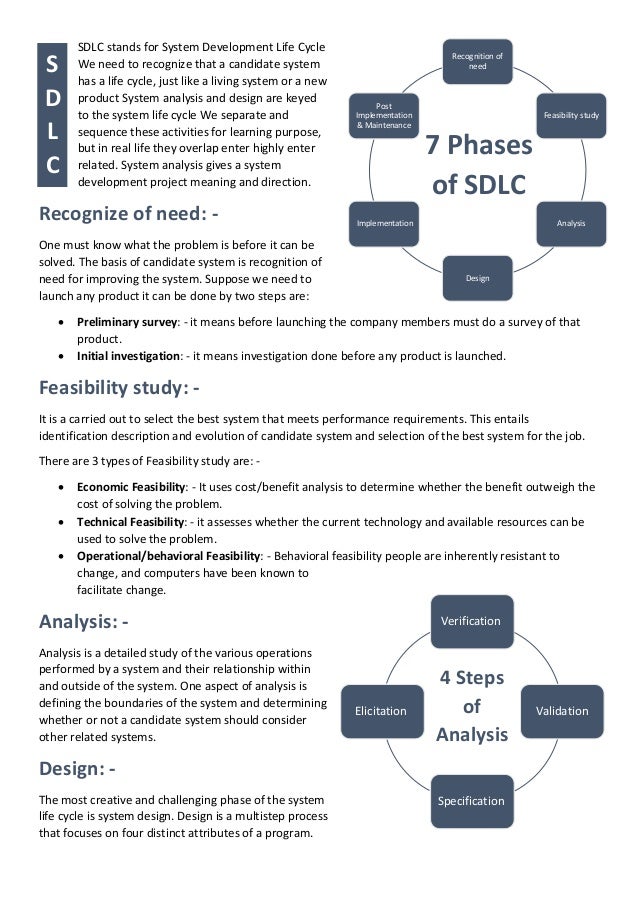
Recognition of
need
Feasibility study
Analysis
Design
Implementation
Post
Implementation
& Maintenance
7 Phases
of SDLC
4 Steps
of
Analysis
S
D
L
C
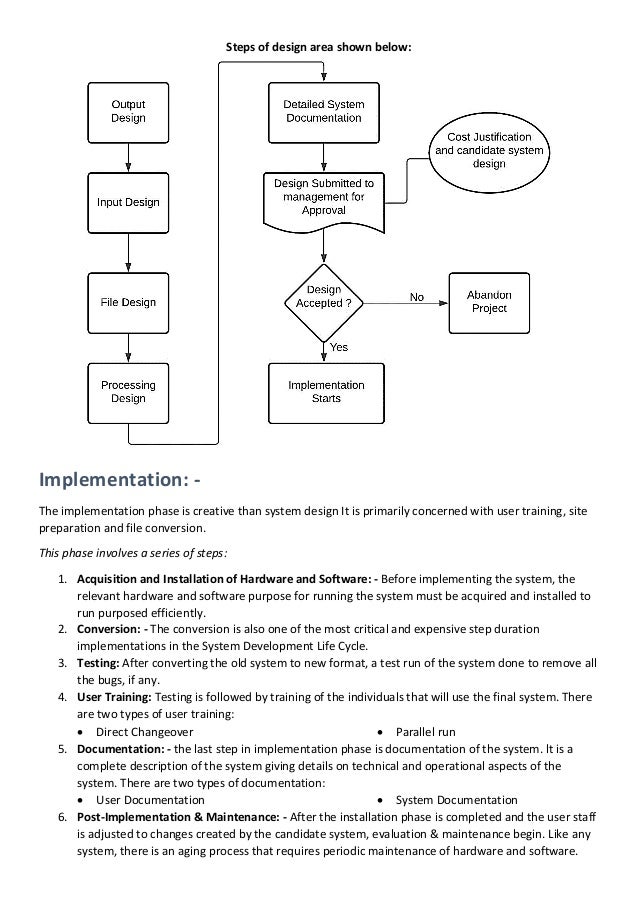
Steps of design area shown below:
Implementation: -
The implementation phase is creative than system design It is primarily concerned with user training, site
preparation and file conversion.
This phase involves a series of steps:
1. Acquisition and Installation of Hardware and Software: - Before implementing the system, the
relevant hardware and software purpose for running the system must be acquired and installed to
run purposed efficiently.
2. Conversion: - The conversion is also one of the most critical and expensive step duration
implementations in the System Development Life Cycle.
3. Testing: After converting the old system to new format, a test run of the system done to remove all
the bugs, if any.
4. User Training: Testing is followed by training of the individuals that will use the final system. There
are two types of user training:
• Direct Changeover • Parallel run
5. Documentation: - the last step in implementation phase is documentation of the system. lt is a
complete description of the system giving details on technical and operational aspects of the
system. There are two types of documentation:
• User Documentation • System Documentation
6. Post-Implementation & Maintenance: - After the installation phase is completed and the user staff
is adjusted to changes created by the candidate system, evaluation & maintenance begin. Like any
system, there is an aging process that requires periodic maintenance of hardware and software.

System Development Life Cycle (Notes)

  • 1.
    SDLC stands forSystem Development Life Cycle We need to recognize that a candidate system has a life cycle, just like a living system or a new product System analysis and design are keyed to the system life cycle We separate and sequence these activities for learning purpose, but in real life they overlap enter highly enter related. System analysis gives a system development project meaning and direction. Recognize of need: - One must know what the problem is before it can be solved. The basis of candidate system is recognition of need for improving the system. Suppose we need to launch any product it can be done by two steps are: • Preliminary survey: - it means before launching the company members must do a survey of that product. • Initial investigation: - it means investigation done before any product is launched. Feasibility study: - It is a carried out to select the best system that meets performance requirements. This entails identification description and evolution of candidate system and selection of the best system for the job. There are 3 types of Feasibility study are: - • Economic Feasibility: - It uses cost/benefit analysis to determine whether the benefit outweigh the cost of solving the problem. • Technical Feasibility: - it assesses whether the current technology and available resources can be used to solve the problem. • Operational/behavioral Feasibility: - Behavioral feasibility people are inherently resistant to change, and computers have been known to facilitate change. Analysis: - Analysis is a detailed study of the various operations performed by a system and their relationship within and outside of the system. One aspect of analysis is defining the boundaries of the system and determining whether or not a candidate system should consider other related systems. Design: - The most creative and challenging phase of the system life cycle is system design. Design is a multistep process that focuses on four distinct attributes of a program. Verification Validation Specification Elicitation Recognition of need Feasibility study Analysis Design Implementation Post Implementation & Maintenance 7 Phases of SDLC 4 Steps of Analysis S D L C
  • 2.
    Steps of designarea shown below: Implementation: - The implementation phase is creative than system design It is primarily concerned with user training, site preparation and file conversion. This phase involves a series of steps: 1. Acquisition and Installation of Hardware and Software: - Before implementing the system, the relevant hardware and software purpose for running the system must be acquired and installed to run purposed efficiently. 2. Conversion: - The conversion is also one of the most critical and expensive step duration implementations in the System Development Life Cycle. 3. Testing: After converting the old system to new format, a test run of the system done to remove all the bugs, if any. 4. User Training: Testing is followed by training of the individuals that will use the final system. There are two types of user training: • Direct Changeover • Parallel run 5. Documentation: - the last step in implementation phase is documentation of the system. lt is a complete description of the system giving details on technical and operational aspects of the system. There are two types of documentation: • User Documentation • System Documentation 6. Post-Implementation & Maintenance: - After the installation phase is completed and the user staff is adjusted to changes created by the candidate system, evaluation & maintenance begin. Like any system, there is an aging process that requires periodic maintenance of hardware and software.