QUESTION 7
Olivia Desanges
WHAT IS CONTINUITY AND WHY IS IT
IMPORTANT?
 Continuity is the maintenance of continuous action
over time, and is important as it would then make
sense to the audience and with no continuity then
there would be confusion and make the film look
unprofessional
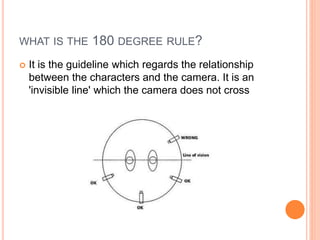
WHAT IS THE 180 DEGREE RULE?
 It is the guideline which regards the relationship
between the characters and the camera. It is an
'invisible line' which the camera does not cross
OUR PRELIM USING THE 180 DEGREE RULE
We filmed the character using a low angle shot and
then the camera remained on this side of the
line/character when the character is walking out. In
our opening sequence, again, we used the 180
degree rule with a different shot to make it more
unique and interesting
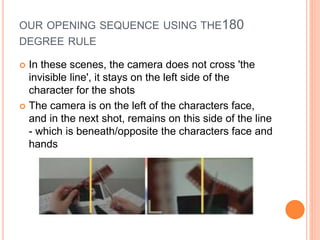
OUR OPENING SEQUENCE USING THE180
DEGREE RULE
 In these scenes, the camera does not cross 'the
invisible line', it stays on the left side of the
character for the shots
 The camera is on the left of the characters face,
and in the next shot, remains on this side of the line
- which is beneath/opposite the characters face and
hands
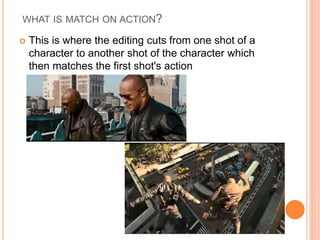
WHAT IS MATCH ON ACTION?
 This is where the editing cuts from one shot of a
character to another shot of the character which
then matches the first shot's action
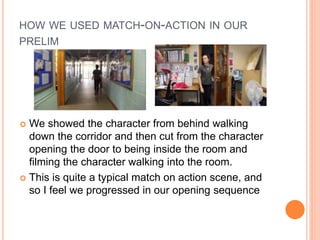
HOW WE USED MATCH-ON-ACTION IN OUR
PRELIM
 We showed the character from behind walking
down the corridor and then cut from the character
opening the door to being inside the room and
filming the character walking into the room.
 This is quite a typical match on action scene, and
so I feel we progressed in our opening sequence
HOW WE USED MATCH ON ACTION IN OUR
OPENING SEQUENCE
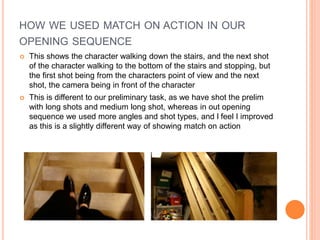
 This shows the character walking down the stairs, and the next shot
of the character walking to the bottom of the stairs and stopping, but
the first shot being from the characters point of view and the next
shot, the camera being in front of the character
 This is different to our preliminary task, as we have shot the prelim
with long shots and medium long shot, whereas in out opening
sequence we used more angles and shot types, and I feel I improved
as this is a slightly different way of showing match on action
WHAT IS SHOT REVERSE SHOT?
 This is when one character is shown looking at one
character and then the other character is shown
looking back at the first character
SHOT REVERSE SHOT FROM OUR PRELIM
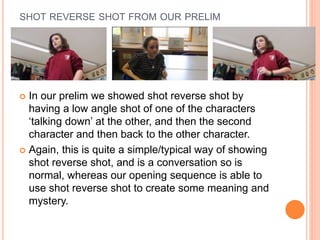
 In our prelim we showed shot reverse shot by
having a low angle shot of one of the characters
‘talking down’ at the other, and then the second
character and then back to the other character.
 Again, this is quite a simple/typical way of showing
shot reverse shot, and is a conversation so is
normal, whereas our opening sequence is able to
use shot reverse shot to create some meaning and
mystery.
SHOT REVERSE SHOT IN OUR OPENING
SEQUENCE
 Here, we used shot reverse shot in a photo shoot rather than a
conversation, which is again different to our preliminary task, and I
feel I improved in this area as it is not too typical - shot of a
character, then the photographer and then back to the first character
yet is seen in a different way
 Due to different things happening, such as the shot being a medium
long shot, then a medium shot of the photographer and then a big
close up of the characters face, it allows the shot reverse shot to add
to the mystery and psychology behind our film
HOW HAVE I DEVELOPED WITHIN
CINEMATOGRAPHY, SHOTS, ANGLES ETC
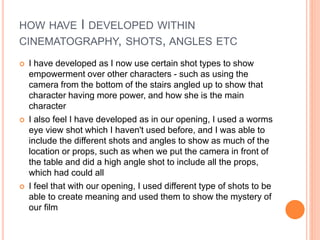
 I have developed as I now use certain shot types to show
empowerment over other characters - such as using the
camera from the bottom of the stairs angled up to show that
character having more power, and how she is the main
character
 I also feel I have developed as in our opening, I used a worms
eye view shot which I haven't used before, and I was able to
include the different shots and angles to show as much of the
location or props, such as when we put the camera in front of
the table and did a high angle shot to include all the props,
which had could all
 I feel that with our opening, I used different type of shots to be
able to create meaning and used them to show the mystery of
our film
IMAGES OF HOW I HAVE IMPROVED
Using a worms eye view to show a
different perspective of the object,
and also linking this to our titles –
so emphasising this
Using a high angle shot to show
the audience what else is in the
frame – the other props and it’s
looking down at the character so
cannot see what is being written
but then this creates mystery
Our low angle shot showed this
character being the dominant one,
yet in our opening sequence we used
the high and low angle shots and
worms eye shot to show props
creating meaning
HOW I IMPROVED WITHIN EDITING
 Within the editing, in our prelim, no editing was used
other than cutting between speech, however no colour
editing or other transitions or music was used. So I feel I
improved by using certain editing techniques and which
helped towards creating mystery and tension. We
changed the colouring of certain frames and the way
one frame led to another, such as the end frame
finishing with a flash to lead on to the titles, so with the
colours we chose, it meant suspense and mystery
created – adding to our sub genre of our opening.
 Also, in our prelim, where we were cutting from one
frame to another, it was very jumpy and was not a clean
transaction between scenes – in a few, some start and
ends of sentences were cut off due to editing a clip too
short
IMAGES ON HOW I HAVE IMPROVED
I have improved by making the scene black and white which allowed
more meaning to be created, whereas in our prelim it was very simple
with not much editing on at all. I have also improved with the black and
white titles being similar to the black and white colouring we used for the
one scene.
HOW HAVE I IMPROVED WITHIN THE MISE-EN-
SCENE
 I feel I have improved by making sure that the lighting we used, and
the props all have something to do with our film – in our prelim, we
were located in the textiles classroom with the textiles machinery and
boards, which wasn’t as apparent to our actual film, whereas the
other locations we used for our film, and what the locations included
were apparent. For example, we used a basement which had
Christmas decorations in the corner which showed the audience how
the room wasn’t used much etc. There were more props in our film
such as what is used for developing photos, which were important for
creating the character and showing the audience who that character
is.
 Also, lighting was effective as we made the scenes darker, more
black and white than normal in our film to portray the mystery of our
thriller, whereas in our prelim we didn’t change the lighting, we kept it
the same, so we didn’t think too much about the mise-en-scene, yet
in our film we thought much more about it.
IMAGES ON HOW I IMPROVED
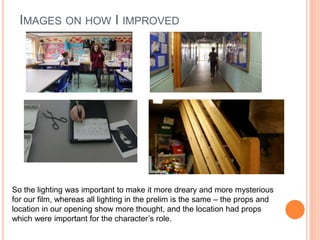
So the lighting was important to make it more dreary and more mysterious
for our film, whereas all lighting in the prelim is the same – the props and
location in our opening show more thought, and the location had props
which were important for the character’s role.
HOW HAVE I DEVELOPED WITH TITLES
 In the titles I have been able to use different fonts and size to create
a meaning – such as using the typewriter to make it slightly slower
and more dramatic.
 I have used colours as well to portray certain feelings – such as
using white lettering on a black background which makes it seem like
more of a darker thriller, more mysterious etc.
 The transitions into the title I have also developed on too – we used
a flash from the photographers camera to go into the titles so it links
well, is meaningful and fits the theme well
 Our titling linked well with some of the scenes which were black and
white and which were darker. So I feel I developed by linking the
titles well with other parts of the film, and to the film as a whole, such
as when we filmed the character cutting up the negative photos.
IMAGES ON HOW I IMPROVED
I developed, as similar to the film SE7EN, it is white writing on dark,
and black scenes and it links well to the film – SE7EN links to the
seven sins the character uses to kill people, and negatives links to the
photographer, and the scene where we filmed the negative cuttings.
So, I developed by thinking more about what the film title represents
and what the look and colouring of the title represents.
CONCLUSION
 I feel I have improved over the process as I have thought much more
carefully on what makes a thriller a thriller, and how this adds to our
own chosen sun-genre – how do we make our thriller a mystery
thriller. I have thought and compared our film to real films and
thought about what we don’t have that real films do – for example,
music – there are normally times of silence in real opening films to
add to tension and create that suspense right from the start; there’s
normally little if no dialogue and more shot types to emphasise the
thriller genre. For example, in Se7en, there were a range of shot
types used to show everything going on, however no dialogue was
involved, only music which created emotion. So I feel I have
improved by using features of real film in our film to fulfil the genre.
 I have also learnt about the different features of film and how they
have a huge impact on the film itself. The emotion created by sound,
the ways the colouring and titles portray a certain type of genre, how
jump-cuts can also create a certain type of emotion, and how shot
types and different angles show a character in a certain type of way –
dominant, a victim, powerful, the main character etc.
CONCLUSION
 I have also learnt how facial features help portray
certain characteristics of, such as our character
keeping a straight face to show little emotion and
not knowing about what’s going to happen etc, so
by thinking in detail about the small things it allows
the build up of character and it adds to the film
fitting the genre well, and I have learnt about this in
detail over the process.

Question 7

  • 1.
  • 2.
    WHAT IS CONTINUITYAND WHY IS IT IMPORTANT?  Continuity is the maintenance of continuous action over time, and is important as it would then make sense to the audience and with no continuity then there would be confusion and make the film look unprofessional
  • 3.
    WHAT IS THE180 DEGREE RULE?  It is the guideline which regards the relationship between the characters and the camera. It is an 'invisible line' which the camera does not cross
  • 4.
    OUR PRELIM USINGTHE 180 DEGREE RULE We filmed the character using a low angle shot and then the camera remained on this side of the line/character when the character is walking out. In our opening sequence, again, we used the 180 degree rule with a different shot to make it more unique and interesting
  • 5.
    OUR OPENING SEQUENCEUSING THE180 DEGREE RULE  In these scenes, the camera does not cross 'the invisible line', it stays on the left side of the character for the shots  The camera is on the left of the characters face, and in the next shot, remains on this side of the line - which is beneath/opposite the characters face and hands
  • 6.
    WHAT IS MATCHON ACTION?  This is where the editing cuts from one shot of a character to another shot of the character which then matches the first shot's action
  • 7.
    HOW WE USEDMATCH-ON-ACTION IN OUR PRELIM  We showed the character from behind walking down the corridor and then cut from the character opening the door to being inside the room and filming the character walking into the room.  This is quite a typical match on action scene, and so I feel we progressed in our opening sequence
  • 8.
    HOW WE USEDMATCH ON ACTION IN OUR OPENING SEQUENCE  This shows the character walking down the stairs, and the next shot of the character walking to the bottom of the stairs and stopping, but the first shot being from the characters point of view and the next shot, the camera being in front of the character  This is different to our preliminary task, as we have shot the prelim with long shots and medium long shot, whereas in out opening sequence we used more angles and shot types, and I feel I improved as this is a slightly different way of showing match on action
  • 9.
    WHAT IS SHOTREVERSE SHOT?  This is when one character is shown looking at one character and then the other character is shown looking back at the first character
  • 10.
    SHOT REVERSE SHOTFROM OUR PRELIM  In our prelim we showed shot reverse shot by having a low angle shot of one of the characters ‘talking down’ at the other, and then the second character and then back to the other character.  Again, this is quite a simple/typical way of showing shot reverse shot, and is a conversation so is normal, whereas our opening sequence is able to use shot reverse shot to create some meaning and mystery.
  • 11.
    SHOT REVERSE SHOTIN OUR OPENING SEQUENCE  Here, we used shot reverse shot in a photo shoot rather than a conversation, which is again different to our preliminary task, and I feel I improved in this area as it is not too typical - shot of a character, then the photographer and then back to the first character yet is seen in a different way  Due to different things happening, such as the shot being a medium long shot, then a medium shot of the photographer and then a big close up of the characters face, it allows the shot reverse shot to add to the mystery and psychology behind our film
  • 12.
    HOW HAVE IDEVELOPED WITHIN CINEMATOGRAPHY, SHOTS, ANGLES ETC  I have developed as I now use certain shot types to show empowerment over other characters - such as using the camera from the bottom of the stairs angled up to show that character having more power, and how she is the main character  I also feel I have developed as in our opening, I used a worms eye view shot which I haven't used before, and I was able to include the different shots and angles to show as much of the location or props, such as when we put the camera in front of the table and did a high angle shot to include all the props, which had could all  I feel that with our opening, I used different type of shots to be able to create meaning and used them to show the mystery of our film
  • 13.
    IMAGES OF HOWI HAVE IMPROVED Using a worms eye view to show a different perspective of the object, and also linking this to our titles – so emphasising this Using a high angle shot to show the audience what else is in the frame – the other props and it’s looking down at the character so cannot see what is being written but then this creates mystery Our low angle shot showed this character being the dominant one, yet in our opening sequence we used the high and low angle shots and worms eye shot to show props creating meaning
  • 14.
    HOW I IMPROVEDWITHIN EDITING  Within the editing, in our prelim, no editing was used other than cutting between speech, however no colour editing or other transitions or music was used. So I feel I improved by using certain editing techniques and which helped towards creating mystery and tension. We changed the colouring of certain frames and the way one frame led to another, such as the end frame finishing with a flash to lead on to the titles, so with the colours we chose, it meant suspense and mystery created – adding to our sub genre of our opening.  Also, in our prelim, where we were cutting from one frame to another, it was very jumpy and was not a clean transaction between scenes – in a few, some start and ends of sentences were cut off due to editing a clip too short
  • 15.
    IMAGES ON HOWI HAVE IMPROVED I have improved by making the scene black and white which allowed more meaning to be created, whereas in our prelim it was very simple with not much editing on at all. I have also improved with the black and white titles being similar to the black and white colouring we used for the one scene.
  • 16.
    HOW HAVE IIMPROVED WITHIN THE MISE-EN- SCENE  I feel I have improved by making sure that the lighting we used, and the props all have something to do with our film – in our prelim, we were located in the textiles classroom with the textiles machinery and boards, which wasn’t as apparent to our actual film, whereas the other locations we used for our film, and what the locations included were apparent. For example, we used a basement which had Christmas decorations in the corner which showed the audience how the room wasn’t used much etc. There were more props in our film such as what is used for developing photos, which were important for creating the character and showing the audience who that character is.  Also, lighting was effective as we made the scenes darker, more black and white than normal in our film to portray the mystery of our thriller, whereas in our prelim we didn’t change the lighting, we kept it the same, so we didn’t think too much about the mise-en-scene, yet in our film we thought much more about it.
  • 17.
    IMAGES ON HOWI IMPROVED So the lighting was important to make it more dreary and more mysterious for our film, whereas all lighting in the prelim is the same – the props and location in our opening show more thought, and the location had props which were important for the character’s role.
  • 18.
    HOW HAVE IDEVELOPED WITH TITLES  In the titles I have been able to use different fonts and size to create a meaning – such as using the typewriter to make it slightly slower and more dramatic.  I have used colours as well to portray certain feelings – such as using white lettering on a black background which makes it seem like more of a darker thriller, more mysterious etc.  The transitions into the title I have also developed on too – we used a flash from the photographers camera to go into the titles so it links well, is meaningful and fits the theme well  Our titling linked well with some of the scenes which were black and white and which were darker. So I feel I developed by linking the titles well with other parts of the film, and to the film as a whole, such as when we filmed the character cutting up the negative photos.
  • 19.
    IMAGES ON HOWI IMPROVED I developed, as similar to the film SE7EN, it is white writing on dark, and black scenes and it links well to the film – SE7EN links to the seven sins the character uses to kill people, and negatives links to the photographer, and the scene where we filmed the negative cuttings. So, I developed by thinking more about what the film title represents and what the look and colouring of the title represents.
  • 20.
    CONCLUSION  I feelI have improved over the process as I have thought much more carefully on what makes a thriller a thriller, and how this adds to our own chosen sun-genre – how do we make our thriller a mystery thriller. I have thought and compared our film to real films and thought about what we don’t have that real films do – for example, music – there are normally times of silence in real opening films to add to tension and create that suspense right from the start; there’s normally little if no dialogue and more shot types to emphasise the thriller genre. For example, in Se7en, there were a range of shot types used to show everything going on, however no dialogue was involved, only music which created emotion. So I feel I have improved by using features of real film in our film to fulfil the genre.  I have also learnt about the different features of film and how they have a huge impact on the film itself. The emotion created by sound, the ways the colouring and titles portray a certain type of genre, how jump-cuts can also create a certain type of emotion, and how shot types and different angles show a character in a certain type of way – dominant, a victim, powerful, the main character etc.
  • 21.
    CONCLUSION  I havealso learnt how facial features help portray certain characteristics of, such as our character keeping a straight face to show little emotion and not knowing about what’s going to happen etc, so by thinking in detail about the small things it allows the build up of character and it adds to the film fitting the genre well, and I have learnt about this in detail over the process.