Quantum Tunneling Sensors
SK2901 – Quantum Materials and Devices
Jaskaran Singh Malhotra
Aniruddha Paul
Contents
• Wave nature of Matter
• Quantum Tunneling (QT)
• Applications of Tunneling
• Force based QT sensors and applications
• Biomolecule sensing using QT
Wave Nature of matter
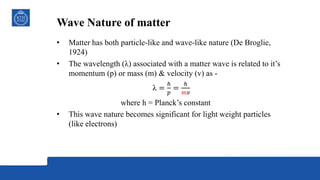
• Matter has both particle-like and wave-like nature (De Broglie,
1924)
• The wavelength (λ) associated with a matter wave is related to it’s
momentum (p) or mass (m) & velocity (v) as -
λ =
ℎ
𝑝
=
ℎ
𝑚𝑣
where h = Planck’s constant
• This wave nature becomes significant for light weight particles
(like electrons)
Wave nature of matter
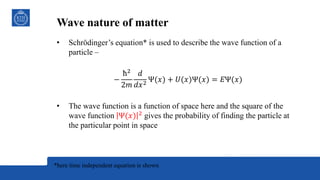
• Schrödinger’s equation* is used to describe the wave function of a
particle –
−
ħ2
2𝑚
𝑑
𝑑𝑥2 Ψ(𝑥) + 𝑈(𝑥)Ψ(𝑥) = 𝐸Ψ(𝑥)
• The wave function is a function of space here and the square of the
wave function Ψ(𝑥) 2
gives the probability of finding the particle at
the particular point in space
*here time independent equation is shown
Quantum Tunelling
• When there’s an energy barrier (V>E)
in a region of space, the particle
cannot cross the barrier (Classical
mechanics)
• But as a consequence of wave nature,
the solutions for the Schrödinger’s
equation for a particle in such a
situation gives a decaying wave
function
• Thus, there is a probability that a
particle will tunnel through the barrier.
source : https://www.testandmeasurementtips.com/quantum-
tunneling-and-tunnel-diodes/
a
V
Quantum Tunelling
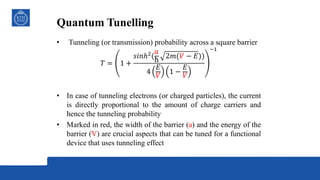
• Tunneling (or transmission) probability across a square barrier
𝑇 = 1 +
𝑠𝑖𝑛ℎ2
(
𝑎
ħ
2𝑚(𝑉 − 𝐸))
4
𝐸
𝑉 1 −
𝐸
𝑉
−1
• In case of tunneling electrons (or charged particles), the current
is directly proportional to the amount of charge carriers and
hence the tunneling probability
• Marked in red, the width of the barrier (a) and the energy of the
barrier (V) are crucial aspects that can be tuned for a functional
device that uses tunneling effect
Use of tunneling phenomena
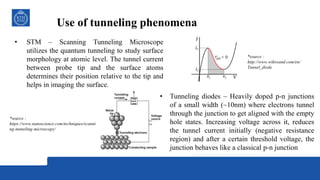
• STM – Scanning Tunneling Microscope
utilizes the quantum tunneling to study surface
morphology at atomic level. The tunnel current
between probe tip and the surface atoms
determines their position relative to the tip and
helps in imaging the surface.
• Tunneling diodes – Heavily doped p-n junctions
of a small width (~10nm) where electrons tunnel
through the junction to get aligned with the empty
hole states. Increasing voltage across it, reduces
the tunnel current initially (negative resistance
region) and after a certain threshold voltage, the
junction behaves like a classical p-n junction
*source :
https://www.nanoscience.com/techniques/scanni
ng-tunneling-microscopy/
*source :
http://www.wikiwand.com/en/
Tunnel_diode
Quantum Tunneling Sensors
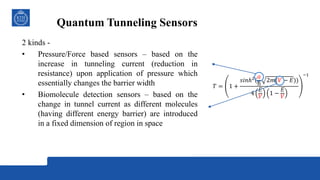
2 kinds -
• Pressure/Force based sensors – based on the
increase in tunneling current (reduction in
resistance) upon application of pressure which
essentially changes the barrier width
• Biomolecule detection sensors – based on the
change in tunnel current as different molecules
(having different energy barrier) are introduced
in a fixed dimension of region in space
𝑇 = 1 +
𝑠𝑖𝑛ℎ2
(
𝑎
ħ
2𝑚(𝑉 − 𝐸))
4
𝐸
𝑉
1 −
𝐸
𝑉
−1
Touch/pressure sensors
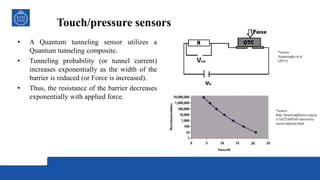
• A Quantum tunneling sensor utilizes a
Quantum tunneling composite.
• Tunneling probability (or tunnel current)
increases exponentially as the width of the
barrier is reduced (or Force is increased).
• Thus, the resistance of the barrier decreases
exponentially with applied force.
*source :
Amarsinghe et al
(2013)
*source :
http://practicalphysics.org/qt
c-%E2%80%93-discovery-
novel-material.html
Quantum Tunneling Composites (QTCs)
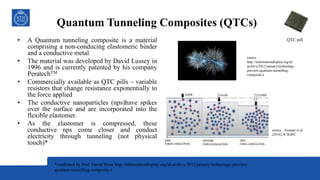
• A Quantum tunneling composite is a material
comprising a non-conducing elastomeric binder
and a conductive metal
• The material was developed by David Lussey in
1996 and is currently patented by his company
PeratechTM
• Commercially available as QTC pills – variable
resistors that change resistance exponentially to
the force applied
• The conductive nanoparticles (nps)have spikes
over the surface and are incorporated into the
flexible elastomer.
• As the elastomer is compressed, these
conductive nps come closer and conduct
electricity through tunneling (not physical
touch)*
source :
http://informationdisplay.org/id-
archive/2012/january/technology-
preview-quantum-tunnelling-
composite-t
source : Azsman et al
(2016), ICSGRC
*confirmed by Prof. David Bloor http://informationdisplay.org/id-archive/2012/january/technology-preview-
quantum-tunnelling-composite-t
QTC pill
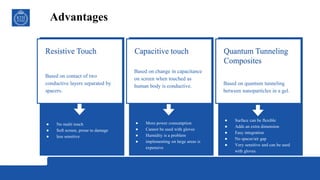
Advantages
Quantum Tunneling
Composites
● Surface can be flexible
● Adds an extra dimension
● Easy integration
● No spacer/air gap
● Very sensitive and can be used
with gloves.
Based on quantum tunneling
between nanoparticles in a gel.
Capacitive touch
● More power consumption
● Cannot be used with gloves
● Humidity is a problem
● implementing on large areas is
expensive
Based on change in capacitance
on screen when touched as
human body is conductive.
Resistive Touch
● No multi touch
● Soft screen, prone to damage
● less sensitive
Based on contact of two
conductive layers separated by
spacers.
Applications
● Touch screen- apple patent (2017), qtc whiteboards, sensors for automotive
screens
● Force sensor- Traffic monitoring, accelerometers, concrete composites*.
*B. Han, B. Han, X. Yu, “Effects of content level and particle size of nickel powder on the piezoresistivity of cement-based
composites/sensors,” Smart Mater. Struct., vol. 19, pp. 065012, Apr. 2010.
https://www.peratech.com
Applications
http://informationdisplay.org/id-archive/2012/january/technology-preview-
quantum-tunnelling-composite-t
● Smart skin- Tactile sensors,
haptics for robotics/prosthetics
● Smart clothes- flexible pressure
sensors, implemented in controls
for ipads, sports monitoring,
impact assessment in physical
sports, pressure distribution in
walking and physiotherapy.
*] R. S. Dahiya and M. Valle, “Tactile sensing for robotic applications,” Sensors Focus Tactile Force Stress Sensors, pp. 289–304,
2008
**A. D. Lantada, “Quantum tunnelling composites: Characterisation and modelling to promote their applications as sensors,” Sensors
and Actuators A: Physical, vol. 164, no. 1–2, pp. 46–57, Nov. 2010..
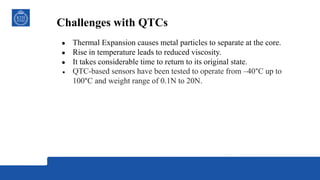
Challenges with QTCs
● Thermal Expansion causes metal particles to separate at the core.
● Rise in temperature leads to reduced viscosity.
● It takes considerable time to return to its original state.
● QTC-based sensors have been tested to operate from ‒40°C up to
100°C and weight range of 0.1N to 20N.
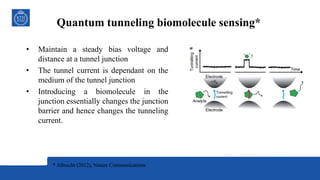
Quantum tunneling biomolecule sensing*
• Maintain a steady bias voltage and
distance at a tunnel junction
• The tunnel current is dependant on the
medium of the tunnel junction
• Introducing a biomolecule in the
junction essentially changes the junction
barrier and hence changes the tunneling
current.
* Albrecht (2012), Nature Communications
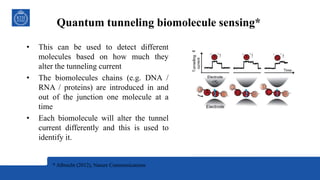
Quantum tunneling biomolecule sensing*
• This can be used to detect different
molecules based on how much they
alter the tunneling current
• The biomolecules chains (e.g. DNA /
RNA / proteins) are introduced in and
out of the junction one molecule at a
time
• Each biomolecule will alter the tunnel
current differently and this is used to
identify it.
* Albrecht (2012), Nature Communications
Thank you for your attention

Quantum Tunneling Sensors

  • 1.
    Quantum Tunneling Sensors SK2901– Quantum Materials and Devices Jaskaran Singh Malhotra Aniruddha Paul
  • 2.
    Contents • Wave natureof Matter • Quantum Tunneling (QT) • Applications of Tunneling • Force based QT sensors and applications • Biomolecule sensing using QT
  • 3.
    Wave Nature ofmatter • Matter has both particle-like and wave-like nature (De Broglie, 1924) • The wavelength (λ) associated with a matter wave is related to it’s momentum (p) or mass (m) & velocity (v) as - λ = ℎ 𝑝 = ℎ 𝑚𝑣 where h = Planck’s constant • This wave nature becomes significant for light weight particles (like electrons)
  • 4.
    Wave nature ofmatter • Schrödinger’s equation* is used to describe the wave function of a particle – − ħ2 2𝑚 𝑑 𝑑𝑥2 Ψ(𝑥) + 𝑈(𝑥)Ψ(𝑥) = 𝐸Ψ(𝑥) • The wave function is a function of space here and the square of the wave function Ψ(𝑥) 2 gives the probability of finding the particle at the particular point in space *here time independent equation is shown
  • 5.
    Quantum Tunelling • Whenthere’s an energy barrier (V>E) in a region of space, the particle cannot cross the barrier (Classical mechanics) • But as a consequence of wave nature, the solutions for the Schrödinger’s equation for a particle in such a situation gives a decaying wave function • Thus, there is a probability that a particle will tunnel through the barrier. source : https://www.testandmeasurementtips.com/quantum- tunneling-and-tunnel-diodes/ a V
  • 6.
    Quantum Tunelling • Tunneling(or transmission) probability across a square barrier 𝑇 = 1 + 𝑠𝑖𝑛ℎ2 ( 𝑎 ħ 2𝑚(𝑉 − 𝐸)) 4 𝐸 𝑉 1 − 𝐸 𝑉 −1 • In case of tunneling electrons (or charged particles), the current is directly proportional to the amount of charge carriers and hence the tunneling probability • Marked in red, the width of the barrier (a) and the energy of the barrier (V) are crucial aspects that can be tuned for a functional device that uses tunneling effect
  • 7.
    Use of tunnelingphenomena • STM – Scanning Tunneling Microscope utilizes the quantum tunneling to study surface morphology at atomic level. The tunnel current between probe tip and the surface atoms determines their position relative to the tip and helps in imaging the surface. • Tunneling diodes – Heavily doped p-n junctions of a small width (~10nm) where electrons tunnel through the junction to get aligned with the empty hole states. Increasing voltage across it, reduces the tunnel current initially (negative resistance region) and after a certain threshold voltage, the junction behaves like a classical p-n junction *source : https://www.nanoscience.com/techniques/scanni ng-tunneling-microscopy/ *source : http://www.wikiwand.com/en/ Tunnel_diode
  • 8.
    Quantum Tunneling Sensors 2kinds - • Pressure/Force based sensors – based on the increase in tunneling current (reduction in resistance) upon application of pressure which essentially changes the barrier width • Biomolecule detection sensors – based on the change in tunnel current as different molecules (having different energy barrier) are introduced in a fixed dimension of region in space 𝑇 = 1 + 𝑠𝑖𝑛ℎ2 ( 𝑎 ħ 2𝑚(𝑉 − 𝐸)) 4 𝐸 𝑉 1 − 𝐸 𝑉 −1
  • 9.
    Touch/pressure sensors • AQuantum tunneling sensor utilizes a Quantum tunneling composite. • Tunneling probability (or tunnel current) increases exponentially as the width of the barrier is reduced (or Force is increased). • Thus, the resistance of the barrier decreases exponentially with applied force. *source : Amarsinghe et al (2013) *source : http://practicalphysics.org/qt c-%E2%80%93-discovery- novel-material.html
  • 10.
    Quantum Tunneling Composites(QTCs) • A Quantum tunneling composite is a material comprising a non-conducing elastomeric binder and a conductive metal • The material was developed by David Lussey in 1996 and is currently patented by his company PeratechTM • Commercially available as QTC pills – variable resistors that change resistance exponentially to the force applied • The conductive nanoparticles (nps)have spikes over the surface and are incorporated into the flexible elastomer. • As the elastomer is compressed, these conductive nps come closer and conduct electricity through tunneling (not physical touch)* source : http://informationdisplay.org/id- archive/2012/january/technology- preview-quantum-tunnelling- composite-t source : Azsman et al (2016), ICSGRC *confirmed by Prof. David Bloor http://informationdisplay.org/id-archive/2012/january/technology-preview- quantum-tunnelling-composite-t QTC pill
  • 11.
    Advantages Quantum Tunneling Composites ● Surfacecan be flexible ● Adds an extra dimension ● Easy integration ● No spacer/air gap ● Very sensitive and can be used with gloves. Based on quantum tunneling between nanoparticles in a gel. Capacitive touch ● More power consumption ● Cannot be used with gloves ● Humidity is a problem ● implementing on large areas is expensive Based on change in capacitance on screen when touched as human body is conductive. Resistive Touch ● No multi touch ● Soft screen, prone to damage ● less sensitive Based on contact of two conductive layers separated by spacers.
  • 12.
    Applications ● Touch screen-apple patent (2017), qtc whiteboards, sensors for automotive screens ● Force sensor- Traffic monitoring, accelerometers, concrete composites*. *B. Han, B. Han, X. Yu, “Effects of content level and particle size of nickel powder on the piezoresistivity of cement-based composites/sensors,” Smart Mater. Struct., vol. 19, pp. 065012, Apr. 2010. https://www.peratech.com
  • 13.
    Applications http://informationdisplay.org/id-archive/2012/january/technology-preview- quantum-tunnelling-composite-t ● Smart skin-Tactile sensors, haptics for robotics/prosthetics ● Smart clothes- flexible pressure sensors, implemented in controls for ipads, sports monitoring, impact assessment in physical sports, pressure distribution in walking and physiotherapy. *] R. S. Dahiya and M. Valle, “Tactile sensing for robotic applications,” Sensors Focus Tactile Force Stress Sensors, pp. 289–304, 2008 **A. D. Lantada, “Quantum tunnelling composites: Characterisation and modelling to promote their applications as sensors,” Sensors and Actuators A: Physical, vol. 164, no. 1–2, pp. 46–57, Nov. 2010..
  • 14.
    Challenges with QTCs ●Thermal Expansion causes metal particles to separate at the core. ● Rise in temperature leads to reduced viscosity. ● It takes considerable time to return to its original state. ● QTC-based sensors have been tested to operate from ‒40°C up to 100°C and weight range of 0.1N to 20N.
  • 15.
    Quantum tunneling biomoleculesensing* • Maintain a steady bias voltage and distance at a tunnel junction • The tunnel current is dependant on the medium of the tunnel junction • Introducing a biomolecule in the junction essentially changes the junction barrier and hence changes the tunneling current. * Albrecht (2012), Nature Communications
  • 16.
    Quantum tunneling biomoleculesensing* • This can be used to detect different molecules based on how much they alter the tunneling current • The biomolecules chains (e.g. DNA / RNA / proteins) are introduced in and out of the junction one molecule at a time • Each biomolecule will alter the tunnel current differently and this is used to identify it. * Albrecht (2012), Nature Communications
  • 17.
    Thank you foryour attention