arXiv:quant-ph/0608140v1
18
Aug
2006
F. J. Dyson
ADVANCED
QUANTUM MECHANICS
Second Edition
ADVANCED QUANTUM MECHANICS
Lecture notes by Professor F. J. Dyson for a course in Relativistic Quantum Mechanics
given at Cornell University in the Fall of 1951.
Second Edition
The first edition of these notes was written by Professor Dyson. The second edition was prepared by
Michael J. Moravcsik; he is responsible for the changes made in the process of re-editing.
Generally used notation:
A∗
: complex conjugate transposed (Hermitian conjugate)
A+
: complex conjugate (not transposed)
A : A∗
β = A∗
γ4 = adjoint
A−1
= inverse
AT
= transposed
I = identity matrix or operator
i
Table of Contents
Introduction 1
Subject Matter . . . . . . . . . . . . . . . . . . . . . . . . . . . . . . . . . . . . . . . . . . . . . . 1
Detailed Program . . . . . . . . . . . . . . . . . . . . . . . . . . . . . . . . . . . . . . . . . . . . . 2
One Particle Theories . . . . . . . . . . . . . . . . . . . . . . . . . . . . . . . . . . . . . . . . . . 2
The Dirac Theory 4
The Form of the Dirac Equation . . . . . . . . . . . . . . . . . . . . . . . . . . . . . . . . . . . . 4
Lorentz Invariance of the Dirac Equation . . . . . . . . . . . . . . . . . . . . . . . . . . . . . . . 6
To Find the S . . . . . . . . . . . . . . . . . . . . . . . . . . . . . . . . . . . . . . . . . . . . . . . 7
The Covariant Notation . . . . . . . . . . . . . . . . . . . . . . . . . . . . . . . . . . . . . . . . . 8
Conservation Laws – Existence of Spin . . . . . . . . . . . . . . . . . . . . . . . . . . . . . . . . . 9
Elementary Solutions . . . . . . . . . . . . . . . . . . . . . . . . . . . . . . . . . . . . . . . . . . . 10
The Hole Theory . . . . . . . . . . . . . . . . . . . . . . . . . . . . . . . . . . . . . . . . . . . . . 11
Positron States – charge conjugation . . . . . . . . . . . . . . . . . . . . . . . . . . . . . . . . . . 11
Electromagnetic Properties of the Electron . . . . . . . . . . . . . . . . . . . . . . . . . . . . . . 12
The Hydrogen Atom . . . . . . . . . . . . . . . . . . . . . . . . . . . . . . . . . . . . . . . . . . . 13
Solution of the radial equation . . . . . . . . . . . . . . . . . . . . . . . . . . . . . . . . . . . . . 14
Behavior of an Electron in non-relativistic approximation . . . . . . . . . . . . . . . . . . . . . . 17
Summary of Matrices in the Dirac Theory in our notation . . . . . . . . . . . . . . . . . . . . . . 20
Summary of Matrices in the Dirac Theory in the Feynman notation . . . . . . . . . . . . . . . . 21
Scattering Problems and Born Approximation 22
General Discussion . . . . . . . . . . . . . . . . . . . . . . . . . . . . . . . . . . . . . . . . . . . . 22
Projection Operators . . . . . . . . . . . . . . . . . . . . . . . . . . . . . . . . . . . . . . . . . . . 23
Calculation of Spurs . . . . . . . . . . . . . . . . . . . . . . . . . . . . . . . . . . . . . . . . . . . 24
Scattering of two electrons in Born Approximation – The Møller Formula . . . . . . . . . . . . . 27
Relation of Cross Sections to Transition Amplitudes . . . . . . . . . . . . . . . . . . . . . . . . . 29
Results for Møller Scattering . . . . . . . . . . . . . . . . . . . . . . . . . . . . . . . . . . . . . . 30
Note on the Treatment of Exchange Effects . . . . . . . . . . . . . . . . . . . . . . . . . . . . . . 31
Relativistic Treatment of Several Particles . . . . . . . . . . . . . . . . . . . . . . . . . . . . . . . 31
Field Theory 32
Classical Relativistic Field Theory . . . . . . . . . . . . . . . . . . . . . . . . . . . . . . . . . . . 32
Quantum Relativistic Field Theory . . . . . . . . . . . . . . . . . . . . . . . . . . . . . . . . . . . 34
The Feynman Method of Quantization . . . . . . . . . . . . . . . . . . . . . . . . . . . . . . . . . 35
The Schwinger Action Principle . . . . . . . . . . . . . . . . . . . . . . . . . . . . . . . . . . . . . 36
A. The Field Equations . . . . . . . . . . . . . . . . . . . . . . . . . . . . . . . . . . . . . . 37
B. The Schrödinger Equation for the State-function . . . . . . . . . . . . . . . . . . . . . . . 37
C. Operator Form of the Schwinger Principle . . . . . . . . . . . . . . . . . . . . . . . . . . 38
D. Canonical Commutation Laws . . . . . . . . . . . . . . . . . . . . . . . . . . . . . . . . . 39
E. The Heisenberg Equation of Motion for the Operators . . . . . . . . . . . . . . . . . . . 39
F. General Covariant Commutation Laws . . . . . . . . . . . . . . . . . . . . . . . . . . . . 39
G. Anticommuting Fields . . . . . . . . . . . . . . . . . . . . . . . . . . . . . . . . . . . . . 40
ii
Examples of Quantized Field Theories 41
I. The Maxwell Field . . . . . . . . . . . . . . . . . . . . . . . . . . . . . . . . . . . . . . . . . . . 41
Momentum Representations . . . . . . . . . . . . . . . . . . . . . . . . . . . . . . . . . . . . 42
Fourier Analysis of Operators . . . . . . . . . . . . . . . . . . . . . . . . . . . . . . . . . . . 43
Emission and Absorption Operators . . . . . . . . . . . . . . . . . . . . . . . . . . . . . . . 44
Gauge Invariance of the Theory . . . . . . . . . . . . . . . . . . . . . . . . . . . . . . . . . . 45
The Vacuum State . . . . . . . . . . . . . . . . . . . . . . . . . . . . . . . . . . . . . . . . . 45
The Gupta-Bleuler Method . . . . . . . . . . . . . . . . . . . . . . . . . . . . . . . . . . . . 47
Example: Spontaneous Emission of Radiation . . . . . . . . . . . . . . . . . . . . . . . . . . 47
The Hamiltonian Operator . . . . . . . . . . . . . . . . . . . . . . . . . . . . . . . . . . . . 49
Fluctuations of the Fields . . . . . . . . . . . . . . . . . . . . . . . . . . . . . . . . . . . . . 50
The Lamb Shift – Fluctuation of Position of Electron . . . . . . . . . . . . . . . . . . . . . . 51
Ia. Theory of Line Shift and Line Width . . . . . . . . . . . . . . . . . . . . . . . . . . . . . . . . 52
The Interaction Representation . . . . . . . . . . . . . . . . . . . . . . . . . . . . . . . . . . 53
Application of Interaction Representation to Line Shift and Line Width . . . . . . . . . . . 54
Calculation of Line Shift – Non-Relativistic Theory . . . . . . . . . . . . . . . . . . . . . . . 57
The Idea of Mass Renormalization . . . . . . . . . . . . . . . . . . . . . . . . . . . . . . . . 57
II. Field Theory of the Dirac Electron – Without Interaction . . . . . . . . . . . . . . . . . . . . 59
Covariant Commutation Rules . . . . . . . . . . . . . . . . . . . . . . . . . . . . . . . . . . 60
Momentum Representations . . . . . . . . . . . . . . . . . . . . . . . . . . . . . . . . . . . . 61
Fourier Analysis of Operators . . . . . . . . . . . . . . . . . . . . . . . . . . . . . . . . . . . 62
Emission and Absorption Operators . . . . . . . . . . . . . . . . . . . . . . . . . . . . . . . 62
Charge Symmetrical Representation . . . . . . . . . . . . . . . . . . . . . . . . . . . . . . . 63
The Hamiltonian . . . . . . . . . . . . . . . . . . . . . . . . . . . . . . . . . . . . . . . . . . 64
Failure of Theory with Commuting Fields . . . . . . . . . . . . . . . . . . . . . . . . . . . . 64
The Exclusion Principle . . . . . . . . . . . . . . . . . . . . . . . . . . . . . . . . . . . . . . 65
The Vacuum State . . . . . . . . . . . . . . . . . . . . . . . . . . . . . . . . . . . . . . . . . 65
III. Field Theory of Dirac Electron in External Field . . . . . . . . . . . . . . . . . . . . . . . . . 66
Covariant Commutation Rules . . . . . . . . . . . . . . . . . . . . . . . . . . . . . . . . . . 66
The Hamiltonian . . . . . . . . . . . . . . . . . . . . . . . . . . . . . . . . . . . . . . . . . . 68
Antisymmetry of the States . . . . . . . . . . . . . . . . . . . . . . . . . . . . . . . . . . . . 69
Polarization of the Vacuum . . . . . . . . . . . . . . . . . . . . . . . . . . . . . . . . . . . . 70
Calculation of Momentum Integrals . . . . . . . . . . . . . . . . . . . . . . . . . . . . . . . . 73
Physical Meaning of the Vacuum Polarization . . . . . . . . . . . . . . . . . . . . . . . . . . 75
Slowly Varying Weak Fields. The Uehling Effect. . . . . . . . . . . . . . . . . . . . . . . . . 78
IV. Field Theory Of Dirac And Maxwell Fields In Interaction . . . . . . . . . . . . . . . . . . . . 78
The Complete Relativistic Quantum Electrodynamics . . . . . . . . . . . . . . . . . . . . . 78
Free Interaction Representation . . . . . . . . . . . . . . . . . . . . . . . . . . . . . . . . . . 80
Free Particle Scattering Problems 81
A. Møller Scattering of Two Electrons . . . . . . . . . . . . . . . . . . . . . . . . . . . . . . . . . 81
Properties of the DF Function . . . . . . . . . . . . . . . . . . . . . . . . . . . . . . . . . . 82
The Møller Formula – Conclusion . . . . . . . . . . . . . . . . . . . . . . . . . . . . . . . . . 83
Electron-Positron Scattering . . . . . . . . . . . . . . . . . . . . . . . . . . . . . . . . . . . . 84
B. Scattering of a Photon by an Electron – The Compton Effect – The Klein-Nishina Formula. . 84
Calculation of Cross Section . . . . . . . . . . . . . . . . . . . . . . . . . . . . . . . . . . . . 86
Sum Over Spins . . . . . . . . . . . . . . . . . . . . . . . . . . . . . . . . . . . . . . . . . . . 87
C. Two-Quantum Pair Annihilation . . . . . . . . . . . . . . . . . . . . . . . . . . . . . . . . . . 90
D. Bremsstrahlung and Pair Creation in the Coulomb Field of an Atom . . . . . . . . . . . . . . 92
iii
General Theory of Free Particle Scattering 94
Reduction of an Operator to Normal Form . . . . . . . . . . . . . . . . . . . . . . . . . . . . . . 96
Feynman Graphs . . . . . . . . . . . . . . . . . . . . . . . . . . . . . . . . . . . . . . . . . . . . . 98
Feynman Rules of Calculation . . . . . . . . . . . . . . . . . . . . . . . . . . . . . . . . . . . . . . 100
The Self-Energy of the Electron . . . . . . . . . . . . . . . . . . . . . . . . . . . . . . . . . . . . . 102
Second-Order Radiative Corrections to Scattering . . . . . . . . . . . . . . . . . . . . . . . . . . . 104
Treatment of Low-Frequency Photons – The Infra-Red Catastrophe. . . . . . . . . . . . . . . . . 116
Scattering By A Static Potential 118
A. The Magnetic Moment of the Electron . . . . . . . . . . . . . . . . . . . . . . . . . . . . . . . 121
B. Relativistic Calculation of the Lamb Shift . . . . . . . . . . . . . . . . . . . . . . . . . . . . . 123
Covariant Part of the Calculation . . . . . . . . . . . . . . . . . . . . . . . . . . . . . . . . . 124
Discussion of the Nature of the Φ-Representation . . . . . . . . . . . . . . . . . . . . . . . . 126
Concluding Non-Covariant Part of the Calculation . . . . . . . . . . . . . . . . . . . . . . . 127
Accuracy of the Lamb Shift Calculation . . . . . . . . . . . . . . . . . . . . . . . . . . . . . 130
Typist’s Afterword 132
Notes 134
References 138
Index 140
iv
Lecture Course 491 — Advanced Quantum Theory
F. J. Dyson — Fall Semester 1951
Introduction
Books
W. Pauli, “Die Allgemeinen Principien der Wellenmechanik”; Handbuch der Physik, 2 ed., Vol. 24,
Part 1; Edwards reprint, Ann Arbor 1947. (In German) [1]
W. Heitler, Quantum Theory of Radiation, 2nd Edition, Oxford. 3rd edition just published. [2]
G. Wentzel, Introduction to the Quantum Theory of Wave-Fields, Interscience, N.Y. 1949 [3]
I shall not expect you to have read any of these, but I shall refer to them as we go along. The later part
of the course will be new stuff, taken from papers of Feynman and Schwinger mainly. [4], [5], [6], [7], [8]
Subject Matter
You have had a complete course in non-relativistic quantum theory. I assume this known. All the general
principles of the NR theory are valid and true under all circumstances, in particular also when the system
happens to be relativistic. What you have learned is therefore still good.
You have had a course in classical mechanics and electrodynamics including special relativity. You know
what is meant by a system being relativistic; the equations of motion are formally invariant under Lorentz
transformations. General relativity we shall not touch.
This course will be concerned with the development of a Lorentz–invariant Quantum theory. That is not
a general dynamical method like the NR quantum theory, applicable to all systems. We cannot yet devise
a general method of that kind, and it is probably impossible. Instead we have to find out what are the
possible systems, the particular equations of motion, which can be handled by the NR quantum dynamics
and which are at the same time Lorentz–invariant.
In the NR theory it was found that almost any classical system could be handled, i.e.quantized. Now
on the contrary we find there are very few possibilities for a relativistic quantized system. This is a most
important fact. It means that starting only from the principles of relativity and quantization, it is mathe-
matically possible only for very special types of objects to exist. So one can predict mathematically some
important things about the real world. The most striking examples of this are:
(i) Dirac from a study of the electron predicted the positron, which was later discovered [9].
(ii) Yukawa from a study of nuclear forces predicted the meson, which was later discovered [10].
These two examples are special cases of the general principle, which is the basic success of the relativistic
quantum theory, that A Relativistic Quantum Theory of a Finite Number of Particles is Impossible. A RQ
theory necessarily contains these features: an indefinite number of particles of one or more types, particles
of each type being identical and indistinguishable from each other, possibility of creation and annihilation
of particles. Thus the two principles of relativity and quantum theory when combined lead to a world built
up out of various types of elementary particles, and so make us feel quite confident that we are on the right
way to an understanding of the real world. In addition, various detailed properties of the observed particles
1
INTRODUCTION 2
are necessary consequences of the general theory. These are for example:
(i) Magnetic moment of Electron (Dirac) [9].
(ii) Relation between spin and statistics (Pauli) [11].
Detailed Program
We shall not develop straightaway a correct theory including many particles. Instead we follow the historical
development. We try to make a relativistic quantum theory of one particle, find out how far we can go
and where we get into trouble. Then we shall see how to change the theory and get over the trouble by
introducing many particles. Incidentally, the one–particle theories are quite useful, being correct to a good
approximation in many situations where creation of new particles does not occur, and where something
better than a NR approximation is needed. An example is the Dirac theory of the H atom.1
The NR theory gave levels correctly but no fine-structure. (Accuracy of one part in 10,000). The Dirac
one-particle theory gives all the main features of the fine-structure correctly, number of components and
separations good to 10% but not better. (Accuracy one part in 100,000).
The Dirac many-particle theory gives the fine-structure separations (Lamb experiment) correctly to
about one part in 10,000. (Overall accuracy 1 in 108
.)
Probably to get accuracy better than 1 in 108
even the DMP theory is not enough and one will need
to take all kinds of meson effects into account which are not yet treated properly. Experiments are so far
only good to about 1 in 108
.
In this course I will go through the one-particle theories first in detail. Then I will talk about their
breaking down. At that point I will make a fresh start and discuss how one can make a relativistic quantum
theory in general, using the new methods of Feynman and Schwinger. From this we shall be led to the
many-particle theories. I will talk about the general features of these theories. Then I will take the special
example of quantum electrodynamics and get as far as I can with it before the end of the course.
One-Particle Theories
Take the simplest case, one particle with no forces. Then the NR wave-mechanics tells you to take the
equation E =
1
2m
p2
of classical mechanics, and write
E → i~
∂
∂t
px → −i~
∂
∂x
(1)
to get the wave-equation2
i~
∂
∂t
ψ = −
~2
2m

∂2
∂x2
+
∂2
∂y2
+
∂2
∂z2

ψ = −
~2
2m
∇2
ψ (2)
satisfied by the wave-function ψ.
To give a physical meaning to ψ, we state that ρ = ψ∗
ψ is the probability of finding the particle at the
point x y z at time t. And the probability is conserved because3
∂ρ
∂t
+ ∇ ·~
 = 0 (3)
where
~
 =
~
2mi
(ψ∗
∇ψ − ψ∇ψ∗
) (4)
where ψ∗
is the complex conjugate of ψ.
Now do this relativistically. We have classically
E2
= m2
c4
+ c2
p2
(5)
INTRODUCTION 3
which gives the wave equation
1
c2
∂2
∂t2
ψ = ∇2
ψ −
m2
c2
~2
ψ (6)
This is an historic equation, the Klein-Gordon equation. Schrödinger already in 1926 tried to make a RQ
theory out of it. But he failed, and many other people too, until Pauli and Weisskopf gave the many-particle
theory in 1934 [12]. Why?
Because in order to interpret the wave-function as a probability we must have a continuity equation.
This can only be got out of the wave-equation if we take ~
 as before, and
ρ =
i~
2mc2

ψ∗ ∂ψ
∂t
−
∂ψ∗
∂t
ψ

(7)
But now since the equation is 2nd
order, ψ and
∂ψ
∂t
are arbitrary. Hence ρ need not be positive. We have
Negative Probabilities. This defeated all attempts to make a sensible one-particle theory.
The theory can be carried through quite easily, if we make ψ describe an assembly of particles of
both positive and negative charge, and ρ is the net charge density at any point. This is what Pauli and
Weisskopf did, and the theory you get is correct for π-mesons, the mesons which are made in the synchrotron
downstairs. I will talk about it later.
The Dirac Theory
The Form of the Dirac Equation
Historically before the RQ theory came the one-particle theory of Dirac. This was so successful in dealing
with the electron, that it was for many years the only respectable RQ theory in existence. And its difficulties
are a lot less immediate than the difficulties of the one-particle KG theory.
Dirac said, suppose the particle can exist in several distinct states with the same momentum (different
orientations of spin.) Then the wave-function ψ satisfying (6) must have several components; it is not a
scalar but a set of numbers each giving the prob. amplitude to find the particle at a given place and in a
given substate. So we write for ψ a column matrix
ψ =






ψ1
ψ2
·
·
·






for the components ψα ; α = 1, 2, . . .
Dirac assumed that the probability density at any point is still given by
ρ =
X
α
ψ∗
αψα (8)
which we write
ρ = ψ∗
ψ
as in the NR theory. Here ψ∗
is a row matrix
[ψ∗
1, ψ∗
2, . . . ]
We must have (3) still satisfied. So ψ must satisfy a wave-equation of First Order in t. But since the
equations are relativistic, the equation has to be also of 1st
order in x y z. Thus the most general possible
wave-equation is
1
c
∂ψ
∂t
+
3
X
1
αk ∂ψ
∂xk
+ i
mc
~
β ψ = 0 (9)
where x1 x2 x3 are written for x y z and α1
α2
α3
β are square matrices whose elements are numbers. The
conjugate of (9) gives
1
c
∂ψ∗
∂t
+
3
X
1
∂ψ∗
∂xk
αk∗
− i
mc
~
ψ∗
β∗
= 0 (10)
where αk∗
and β∗
are Hermitian conjugates.
Now to get (3) out of (8), (9) and (10) we must have αk∗
= αk
, β∗
= β so αk
and β are Hermitian; and
jk = c ψ∗
αk
ψ

(11)
4
THE DIRAC THEORY 5
Next what more do we want from equation (9)? Two things. (A) it must be consistent with the 2nd
order equation (6) we started from; (B) the whole theory must be Lorentz invariant.
First consider (A). If (9) is consistent with (6) it must be possible to get exactly (6) by multiplying (9)
by the operator
1
c
∂
∂t
−
3
X
1
αℓ ∂
∂xℓ
− i
mc
~
β (12)
chosen so that the terms with mixed derivatives
∂
∂t
∂
∂xk
and
∂
∂t
cancel. This gives
1
c2
∂2
ψ
∂t2
=
X X
k6=ℓ
1
2
αk
αℓ
+ αℓ
αk
 ∂2
ψ
∂xk ∂xℓ
+
X
k
α2
k
∂2
ψ
∂x2
k
−
m2
c2
~2
β2
ψ + i
mc
~
X
k
αk
β + βαk
 ∂ψ
∂xk
This agrees with (6) if and only if
αk
αℓ
+ αℓ
αk
= 0 k 6= ℓ
αk
β + β αk
= 0 (13)
αk 2
= β2
= I, (identity matrix)
Thus we could not possibly factorize the 2nd
order equation into two first-order operators involving ordinary
numbers. But we can do it with matrices.
Consider the Pauli spin matrices
σ1 =

0 1
1 0

σ2 =

0 −i
i 0

σ3 =

1 0
0 −1

(14)
you are familiar with. They satisfy
σkσℓ + σℓσk = 2δℓk
But we cannot make 4 matrices of this type all anti-commuting. They must be at least 4 × 4.
One possible set of αk
and β is
αk
=

0 σk
σk 0

β =
1 0
0 1 0
0 −1 0
0 −1

(15)
In particular
α1
=




0 0 0 1
0 0 1 0
0 1 0 0
1 0 0 0



 α2
=




0 0 0 −i
0 0 i 0
0 −i 0 0
i 0 0 0



 α3
=




0 0 1 0
0 0 0 −1
1 0 0 0
0 −1 0 0




These are hermitian as required. Of course if αk
and β are any set satisfying (13) then Sαk
S−1
and
SβS−1
are another set, where S is any unitary matrix SS∗
= 1. And conversely it can be proved that
every possible 4 × 4 matrices αk
and β are of this form with some such matrix S. We do not prove this here.
The Dirac equation is thus a set of 4 simultaneous linear partial differential4
equations in the four
functions ψα.
THE DIRAC THEORY 6
Lorentz Invariance of the Dirac Equation
What does this mean? Consider a general Lorentz transformation: If x′
µ are the new coordinates:
x′
µ =
3
X
ν=0
aµνxν (xo = ct) (16)
In the new coordinate system the wave-function will be ψ′
. Clearly we do not expect that ψ′
= ψ. Example:
in the Maxwell theory which is relativistic, the magnetic field H is no longer a pure magnetic field in a
moving system. Instead it transforms like a tensor. So we have to find some transformation law for the ψ
which will leave invariant the physical consequences of the equations.
We need in fact two things: (i) the interpretation of ψ∗
ψ as a probability density must be preserved,
(ii) the validity of the Dirac equation must be preserved in the new system.
First consider (i). The quantity which can be directly observed and must be invariant is the quantity
(ψ∗
ψ) × V
where V is a volume. Now in going to a new Lorentz system with relative velocity v the volume V changes
by Fitzgerald contraction to the value
V ′
= V
r
1 −
v2
c2
Therefore
(ψ∗′
ψ′
) =
ψ∗
ψ
r
1 −
v2
c2
(17)
and so (ψ∗
ψ) = ρ transforms like an energy, i.e.like the fourth component of a vector. This shows incidentally
that ψ′
6= ψ. Since ρ and ~
 are related by the equation of continuity, the space-components of the 4-vector
are
(S1, S2, S3) = ψ∗
αk
ψ =
1
c
jk (18)
So we require that the 4 quantities
(S1, S2, S3, S0) = ψ∗
αk
ψ, ψ∗
ψ

(19)
transform like a 4-vector. This will be enough to preserve the interpretation of the theory.
Assume that
ψ′
= Sψ (20)
where S is a linear operator. Then
ψ′∗
= ψ∗
S∗
(21)
So we require
ψ∗′
αk
ψ′
= ψ∗
S∗
αk
Sψ =
3
X
ν=0
akν ψ∗
αν
ψ (22)
ψ∗′
ψ′
= ψ∗
S∗
Sψ =
3
X
ν=0
a0νψ∗
αν
ψ
writing α0
= I.
THE DIRAC THEORY 7
Thus we need
S∗
αµ
S =
3
X
ν=0
aµναν
, µ = 0, 1, 2, 3 (23)
Next consider (ii). The Dirac equation for ψ′
is
3
X
0
αν ∂
∂x′
ν
ψ′
+ i
mc
~
βψ′
= 0 (24)
Now the original Dirac equation for ψ expressed in terms of the new coordinates is
3
X
µ=0
3
X
ν=0
αµ ∂
∂x′
ν
aνµS−1
ψ′
+ i
mc
~
βS−1
ψ′
= 0 (25)
The sets of equations (24) and (25) have to be equivalent, not identical. Thus (25) must be the same as
(24) multiplied by βS−1
β. The condition for this is
βS−1
βαν
=
3
X
0
αλ
aνλS−1
(26)
But (23) and (26) are identical if
βS−1
β = S∗
which means S∗
βS = β (27)
Thus β transforms like a scalar, αν
like a 4-vector when multiplied by S∗
S.
To find the S
Given two coordinate transformations in succession, with matrices already found, the combined transfor-
mation will correspond to the product of these matrices. Hence we have to consider only 3 simple types of
transformation.
1) Pure rotations
x′
0 = x0 x′
3 = x3
x′
1 = x1 cos θ + x2 sin θ
x′
2 = −x1 sin θ + x2 cos θ
2) Pure Lorentz transformations
x′
1 = x1 x′
2 = x2
x′
3 = x3 cosh θ + x0 sinh θ
x′
0 = x3 sinh θ + x0 cosh θ
3) Pure reflections
x′
1 = −x1 x′
2 = −x2 x′
3 = −x3 x′
0 = x0
Case 1 Then
S = cos 1
2 θ + iσ3 sin 1
2 θ (28)
THE DIRAC THEORY 8
Here
σ3 =

σ3 0
0 σ3

commutes with α3 and β.
σ3α1 = iα2, σ3α2 = −iα1
S∗
= cos 1
2 θ − iσ3 sin 1
2 θ
Then
S∗
βS = β
S∗
α0
S = α0
S∗
α3
S = α3
as required.
S∗
α1
S = cos θ α1
+ sin θ α2
S∗
α2
S = − sin θ α1
+ cos θ α2
Case 2
S = S∗
= cosh 1
2 θ + α3 sinh 1
2 θ (29)
Here
S∗
βS = β
S∗
α1
S = α1
S∗
α2
S = α2
S∗
α3
S = cosh θ α3
+ sinh θ α0
S∗
α0
S = sinh θ α3
+ cos θ α0
Case 3
S = S∗
= β (30)
Note that in all cases S is ambiguous by a factor ±1. So in case 1 a rotation though 360◦
gives S = −1.
Problem 1 Find the S corresponding to a general infinitesimal coordinate transformation. Compare and
show that it agrees with the exact solutions given here.
The ψα’s transforming with these S-transformations are called spinors. They are a direct extension of the
non-relativistic 2-component spin-functions. Mathematical theory of spinors is not very useful. In fact we
find always in practice, calculations can be done most easily if one avoids any explicit representation of the
spinors. Use only formal algebra and commutation relations of the matrices.
The covariant notation
In order to avoid distinction between covariant and contravariant vectors (which we have also unjustifiably
ignored in the previous discussion) it is useful to use the imaginary 4th
coordinate
x4 = ix0 = ict (31)
In this coordinate system the four matrices5
γ1, 2, 3, 4 = −iβα1, 2, 3
, β

i.e. (32)
THE DIRAC THEORY 9
γ1 =

0 0 −i
−i 0
0 i
i 0 0

; γ2 =

0 0 −1
1 0
0 1
−1 0 0

; γ3 =

0 −i 0
0 i
i 0
0 −i 0

; γ4 =
1 0
0 1 0
0 −1 0
0 −1

are a 4-vector. They are all Hermitian and satisfy
γµγν + γνγµ = 2δµν (33)
The Dirac equation and its conjugate may now be written
4
X
1
γµ
∂ψ
∂xµ
+
mc
~
ψ = 0
4
X
1
∂ψ
∂xµ
γµ −
mc
~
ψ = 0 (34)
with
ψ = ψ∗
β and (35)
sµ = i ψ γµ ψ

=

1
c
~
, iρ

(36)
These notations are much the most convenient for calculations.
Conservation Laws. Existence of Spin.
The Hamiltonian in this theory is6
i~
∂ψ
∂t
= Hψ (37)
H = −i~c
3
X
1
αk ∂
∂xk
+ mc2
β = −i~c α · ∇ + mc2
β (38)
This commutes with the momentum p = −i~∇. So the momentum p is a constant of motion.
However the angular momentum operator
L = r × p = −i~r × ∇ (39)
is not a constant. For
[H, L] = −~2
c α × ∇ (40)
But
[H, σ] = −i~c ∇ · [α, σ] where σ = (σ1, σ2, σ3)
while 
α1
, σ1

= 0,

α1
, σ2

= 2iα3
,

α1
, σ3

= −2iα2
, etc.
So
[H, σ3] = 2~c α1
∇2 − α2
∇1

and thus
[H, σ] = 2~c α × ∇ (41)
Thus
L + 1
2 ~σ = ~J (42)
THE DIRAC THEORY 10
is a constant, the total angular momentum, because by (40), (41) and (42)
[H, J] = 0
L is the orbital a. m. and 1
2 ~σ the spin a. m. This agrees with the N. R. theory. But in that theory the
spin and L of a free particle were separately constant. This is no longer the case.
When a central force potential V (r) is added to H, the operator J still is constant.
Elementary Solutions
For a particle with a particular momentum p and energy E, the wave function will be
ψ(x, t) = u exp

i
p · x
~
− i
Et
~

(43)
where u is a constant spinor. The Dirac equation then becomes an equation for u only
Eu = c α · p + mc2
β

u (44)
We write now
p+ = p1 + ip2 p− = p1 − ip2 (45)
Then (44) written out in full becomes
E − mc2

u1 = c (p3u3 + p−u4)
E − mc2

u2 = c (p+u3 − p3u4)
(46)
E + mc2

u3 = c (p3u1 + p−u2)
E + mc2

u4 = c (p+u1 − p3u2)
These 4 equations determine u3 and u4 given u1 and u2, or vice-versa. And either u1 and u2, or u3 and u4,
can be chosen arbitrarily provided that7
E2
= m2
c4
+ c2
p2
(47)
Thus given p and E = +
p
m2c4 + c2p2, there are two independent solutions of (46); these are, in non-
normalized form: 






1
0
c p3
E + mc2
c p+
E + mc2














0
1
c p−
E + mc2
−c p3
E + mc2







(48)
This gives the two spin-states of an electron with given momentum, as required physically.
But there are also solutions with E = −
p
m2c4 + c2p2. In fact again two independent solutions, making
4 altogether. These are the famous negative energy states. Why cannot we simply agree to ignore these
states, say they are physically absent? Because when fields are present the theory gives transitions from
positive to negative states. e.g.H atom should decay to negative state in 10−10
secs. or less.
Certainly negative energy particles are not allowed physically. They can for example never be stopped
by matter at rest, with every collision they move faster and faster. So Dirac was driven to
THE DIRAC THEORY 11
The Hole Theory
All negative-energy states are normally filled by one electron each. Because of the exclusion principle
transitions of ordinary electrons to these states are forbidden. If sometimes a negative energy state of
momentum −p energy −E is empty, this appears as a particle of momentum p energy +E, and the opposite
charge to an electron, i.e. an ordinary positron.
Thus we are led at once to a many-particle theory in order to get sensible results. With spin-0 particles,
to get positive probabilities. With spin-1
2 particles, to get positive energies.
The Dirac theory in its one-particle form cannot describe properly the interaction between several
particles. But so long as we are talking only about free particles, we can describe them with one-particle
wave-functions.
Positron States
So which wave-function will describe a positron with momentum p and energy E? Clearly the wave function
should be of the form
φ(x, t) = v exp

i
p · x
~
− i
Et
~

(49)
as always in quantum mechanics. But the negative-energy electron whose absence is the positron has a
wave-function
ψ(x, t) = u exp

−i
p · x
~
+ i
Et
~

(50)
since it has a momentum −p energy −E.
Thus we must take
φ = Cψ+
, i.e. v = Cu+
(51)
where ψ+
is ψ with complex conjugate elements but not transposed, and C is a suitable constant matrix;
ψ+
(x, t) = u+
exp

i
p · x
~
− i
Et
~

We know that u is a solution of
Eu = c α · p − mc2
β

u (52)
We want the theory to make no distinction between electrons and positrons, and so v must also satisfy the
Dirac equation
Ev = c α · p + mc2
β

v
ECu+
= c α · p + mc2
β

Cu+
(53)
But from (52) we have for u+
the equation
Eu+
= c α+
· p − mc2
β+

u+
(54)
In order that (53) and (54) be identical we should have
Cαk+
= αk
C, Cβ+
= −βC (55)
Now in fact
α1+
= α1
α3+
= α3
α2+
= −α2
β+
= β
Therefore a suitable C will be
C = −iβα2
= γ2 =

0 0 −1
1 0
0 1
−1 0 0

(56)
THE DIRAC THEORY 12
The relation between ψ and φ is symmetrical because
C2
= I Hence ψ = Cφ+
(57)
The φ is called the charge-conjugate wave-function corresponding to the negative-energy electron ψ. Clearly
φ∗
φ = Cψ+
∗
Cψ+

= ψT
C∗
Cψ+
= ψ∗
(C∗
C)
T
ψ = ψ∗
ψ (58)
And
φ∗
αk
φ = ψT
C∗
αk
Cψ+
= ψ∗
CαkT
Cψ = ψ∗
αk
ψ (59)
Thus the probability and flow densities are the same for a positron as for the conjugate negative electron.
For many purposes it is easier to represent positrons directly by the ψ wave-function, e.g. in computing
cross-sections for pair creation and so forth as we shall do later. But if you actually want to see the positron,
e.g. in describing the details of a positronium experiment, it is necessary to use the φ wave-function to
represent e.g. the way the spin is pointing.
This is all we shall say about free electrons and positrons.
Electromagnetic Properties of the Electron
Given an external (c-number) electromagnetic field defined by the potentials
Aµ µ = 1, 2, 3, 4 A4 = iΦ
given functions of space and time. Then the motion of a particle in the field is found by substituting in the
free-particle Lagrangian
E + e Φ for E
p +
e
c
A for p (60)
where (−e) is the electron charge. We write the momentum-energy 4-vector
p = (p1, p2, p3, p4 = iE/c) (61)
Then we have to substitute simply
pµ +
e
c
Aµ for pµ (62)
Now in the quantum theory
pµ → −i~
∂
∂xµ
(63)
Therefore the Dirac equation with fields is
4
X
1
γµ

∂
∂xµ
+
ie
~c
Aµ

ψ +
mc
~
ψ = 0 (64)
4
X
1

∂
∂xµ
−
ie
~c
Aµ

ψ γµ −
mc
~
ψ = 0 (65)
In the non-covariant notations this is
i~
∂ψ
∂t
=

−e Φ +
3
X
1

−i~c
∂
∂xk
+ eAk

αk
+ mc2
β
#
ψ (66)
THE DIRAC THEORY 13
since by (57), we have ψγµ = ψ∗
βγµ = (Cφ+
)
T
βγµ = φT
CT
βγµ; the wave function φ = Cψ+
of a positron
satisfies by (65)
X 
∂
∂xµ
−
ie
~c
Aµ

γT
µ βCφ −
mc
~
βCφ = 0 (67)
Multiplying by Cβ this gives
X 
∂
∂xµ
−
ie
~c
Aµ

γµφ +
mc
~
φ = 0 (68)
This is exactly the Dirac equation for a particle of positive charge (+e). We have used
CβγT
µ βC = −γµ, (69)
which follows from (15), (32), and (55).
The Hydrogen Atom
This is the one problem which it is possible to treat very accurately using the one-electron Dirac theory.
The problem is to find the eigenstates of the equation
Eψ = Hψ
H = −i~c α · ∇ + mc2
β −
e2
r
(70)
As in the NR theory, we have as quantum numbers in addition to E itself the quantities
jz = −i [r × ∇]3 + 1
2 σ3 (71)
j(j + 1) = J2
=

−i (r × ∇) + 1
2 σ
2
(72)
where jz and j are now half-odd integers by the ordinary theory of angular momenta. These quantum
numbers are not enough to fix the state, because each value of j may correspond to two NR states with
ℓ = j ± 1
2 . Therefore we need an additional operator which commutes with H, which will distinguish
between states with σ parallel or antiparallel to J. The obvious choice is
Q = σ · J
But [H, σ] is non-zero and rather complicated. So it is better to try
Q = βσ · J (73)
which is the same in the NR limit.
Then we have
[H, Q] = [H, βσ · J] = [H, βσ] · J + βσ · [H, J]
But [H, J] = 0; furthermore, since
αk
βσℓ = βσℓαk
k 6= ℓ and αk
βσk = −βσkαk
we get
[H, βσ] = −i~c {(α · ∇) βσ − βσ (α · ∇)} = −2i~c
3
X
k=1
αk
σk β ∇k
Therefore
[H, βσ] · J = −2~c
3
X
k=1
αk
σk β ∇k (r × ∇)k − i~c (α · ∇) β = −i~c (α · ∇) β =

H, 1
2 β
THE DIRAC THEORY 14
because
∇ · r × ∇ = 0 and αk
σk =

0 1
1 0

for all k’s.
Hence the quantity which commutes with H and is a constant of the motion is
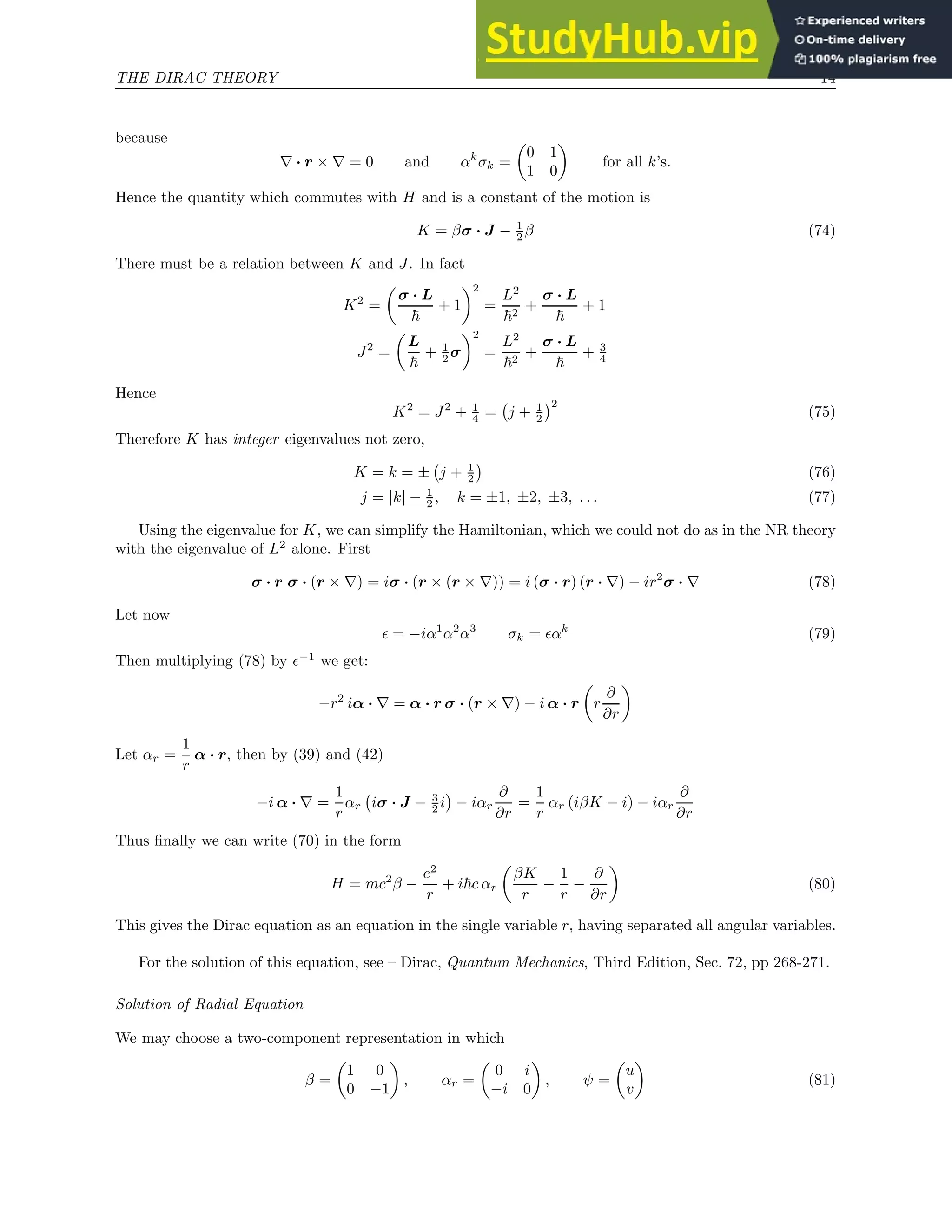
K = βσ · J − 1
2 β (74)
There must be a relation between K and J. In fact
K2
=

σ · L
~
+ 1
2
=
L2
~2
+
σ · L
~
+ 1
J2
=

L
~
+ 1
2 σ
2
=
L2
~2
+
σ · L
~
+ 3
4
Hence
K2
= J2
+ 1
4 = j + 1
2
2
(75)
Therefore K has integer eigenvalues not zero,
K = k = ± j + 1
2

(76)
j = |k| − 1
2 , k = ±1, ±2, ±3, . . . (77)
Using the eigenvalue for K, we can simplify the Hamiltonian, which we could not do as in the NR theory
with the eigenvalue of L2
alone. First
σ · r σ · (r × ∇) = iσ · (r × (r × ∇)) = i (σ · r) (r · ∇) − ir2
σ · ∇ (78)
Let now
ǫ = −iα1
α2
α3
σk = ǫαk
(79)
Then multiplying (78) by ǫ−1
we get:
−r2
iα · ∇ = α · r σ · (r × ∇) − i α · r

r
∂
∂r

Let αr =
1
r
α · r, then by (39) and (42)
−i α · ∇ =
1
r
αr iσ · J − 3
2 i

− iαr
∂
∂r
=
1
r
αr (iβK − i) − iαr
∂
∂r
Thus finally we can write (70) in the form
H = mc2
β −
e2
r
+ i~c αr

βK
r
−
1
r
−
∂
∂r

(80)
This gives the Dirac equation as an equation in the single variable r, having separated all angular variables.
For the solution of this equation, see – Dirac, Quantum Mechanics, Third Edition, Sec. 72, pp 268-271.
Solution of Radial Equation
We may choose a two-component representation in which
β =

1 0
0 −1

, αr =

0 i
−i 0

, ψ =

u
v

(81)
THE DIRAC THEORY 15
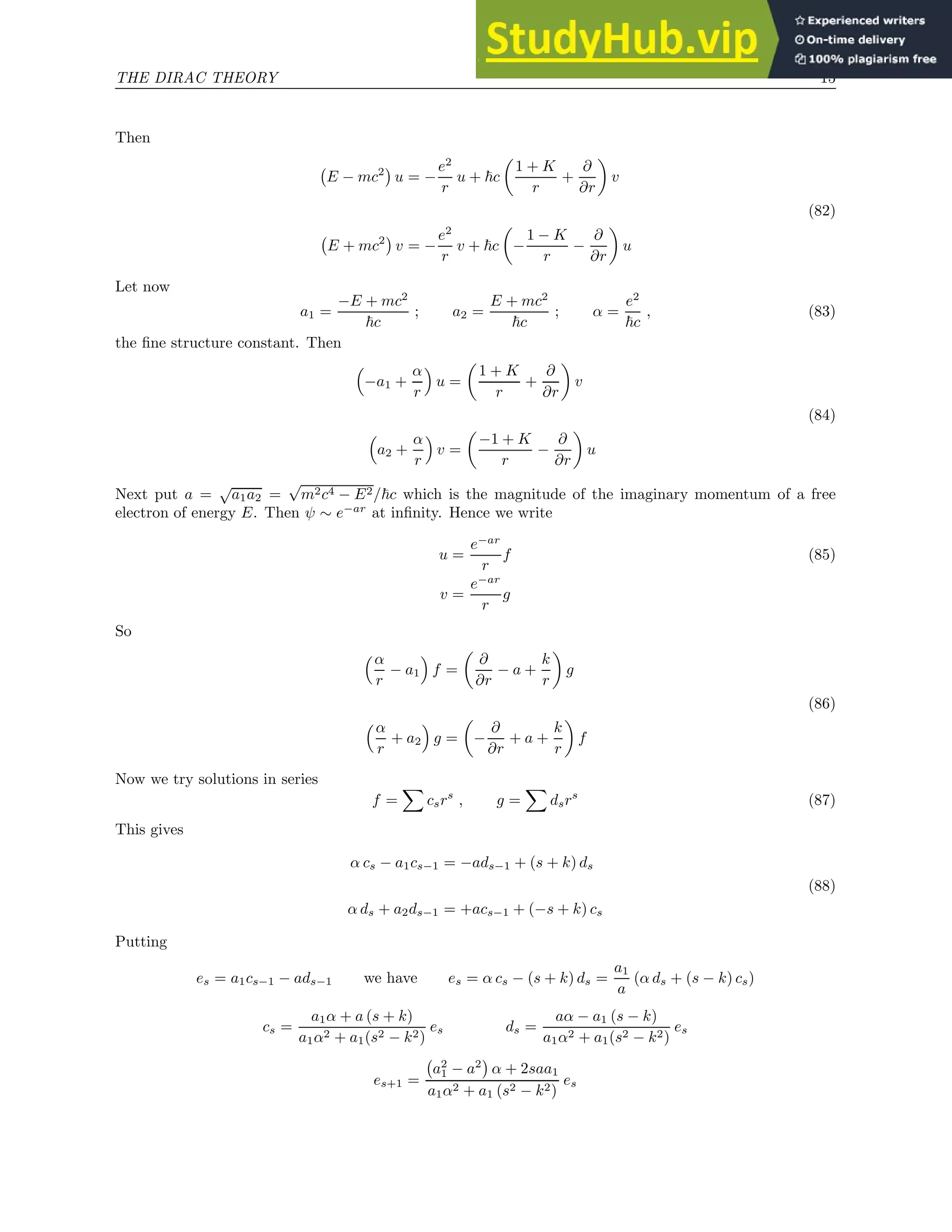
Then
E − mc2

u = −
e2
r
u + ~c

1 + K
r
+
∂
∂r

v
(82)
E + mc2

v = −
e2
r
v + ~c

−
1 − K
r
−
∂
∂r

u
Let now
a1 =
−E + mc2
~c
; a2 =
E + mc2
~c
; α =
e2
~c
, (83)
the fine structure constant. Then

−a1 +
α
r

u =

1 + K
r
+
∂
∂r

v
(84)

a2 +
α
r

v =

−1 + K
r
−
∂
∂r

u
Next put a =
√
a1a2 =
√
m2c4 − E2/~c which is the magnitude of the imaginary momentum of a free
electron of energy E. Then ψ ∼ e−ar
at infinity. Hence we write
u =
e−ar
r
f (85)
v =
e−ar
r
g
So
α
r
− a1

f =

∂
∂r
− a +
k
r

g
(86)
α
r
+ a2

g =

−
∂
∂r
+ a +
k
r

f
Now we try solutions in series
f =
X
csrs
, g =
X
dsrs
(87)
This gives
α cs − a1cs−1 = −ads−1 + (s + k) ds
(88)
α ds + a2ds−1 = +acs−1 + (−s + k) cs
Putting
es = a1cs−1 − ads−1 we have es = α cs − (s + k) ds =
a1
a
(α ds + (s − k) cs)
cs =
a1α + a (s + k)
a1α2 + a1(s2 − k2)
es ds =
aα − a1 (s − k)
a1α2 + a1(s2 − k2)
es
es+1 =
a2
1 − a2

α + 2saa1
a1α2 + a1 (s2 − k2)
es
THE DIRAC THEORY 16
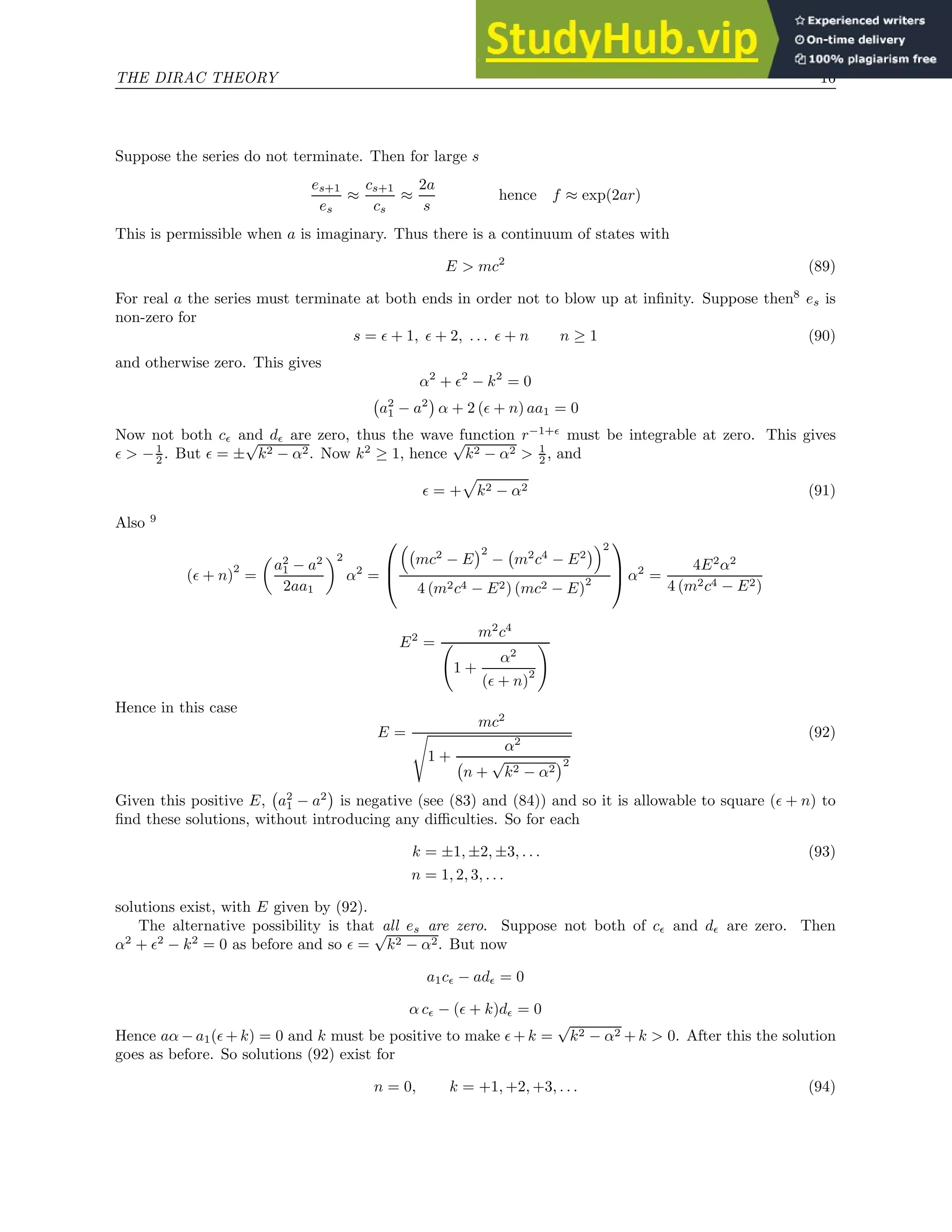
Suppose the series do not terminate. Then for large s
es+1
es
≈
cs+1
cs
≈
2a
s
hence f ≈ exp(2ar)
This is permissible when a is imaginary. Thus there is a continuum of states with
E  mc2
(89)
For real a the series must terminate at both ends in order not to blow up at infinity. Suppose then8
es is
non-zero for
s = ǫ + 1, ǫ + 2, . . . ǫ + n n ≥ 1 (90)
and otherwise zero. This gives
α2
+ ǫ2
− k2
= 0
a2
1 − a2

α + 2 (ǫ + n) aa1 = 0
Now not both cǫ and dǫ are zero, thus the wave function r−1+ǫ
must be integrable at zero. This gives
ǫ  −1
2 . But ǫ = ±
√
k2 − α2. Now k2
≥ 1, hence
√
k2 − α2  1
2 , and
ǫ = +
p
k2 − α2 (91)
Also 9
(ǫ + n)
2
=

a2
1 − a2
2aa1
2
α2
=




mc2
− E
2
− m2
c4
− E2
2
4 (m2c4 − E2) (mc2 − E)
2


 α2
=
4E2
α2
4 (m2c4 − E2)
E2
=
m2
c4
1 +
α2
(ǫ + n)
2
!
Hence in this case
E =
mc2
s
1 +
α2
n +
√
k2 − α2
2
(92)
Given this positive E, a2
1 − a2

is negative (see (83) and (84)) and so it is allowable to square (ǫ + n) to
find these solutions, without introducing any difficulties. So for each
k = ±1, ±2, ±3, . . . (93)
n = 1, 2, 3, . . .
solutions exist, with E given by (92).
The alternative possibility is that all es are zero. Suppose not both of cǫ and dǫ are zero. Then
α2
+ ǫ2
− k2
= 0 as before and so ǫ =
√
k2 − α2. But now
a1cǫ − adǫ = 0
α cǫ − (ǫ + k)dǫ = 0
Hence aα − a1(ǫ + k) = 0 and k must be positive to make ǫ + k =
√
k2 − α2 + k  0. After this the solution
goes as before. So solutions (92) exist for
n = 0, k = +1, +2, +3, . . . (94)
THE DIRAC THEORY 17
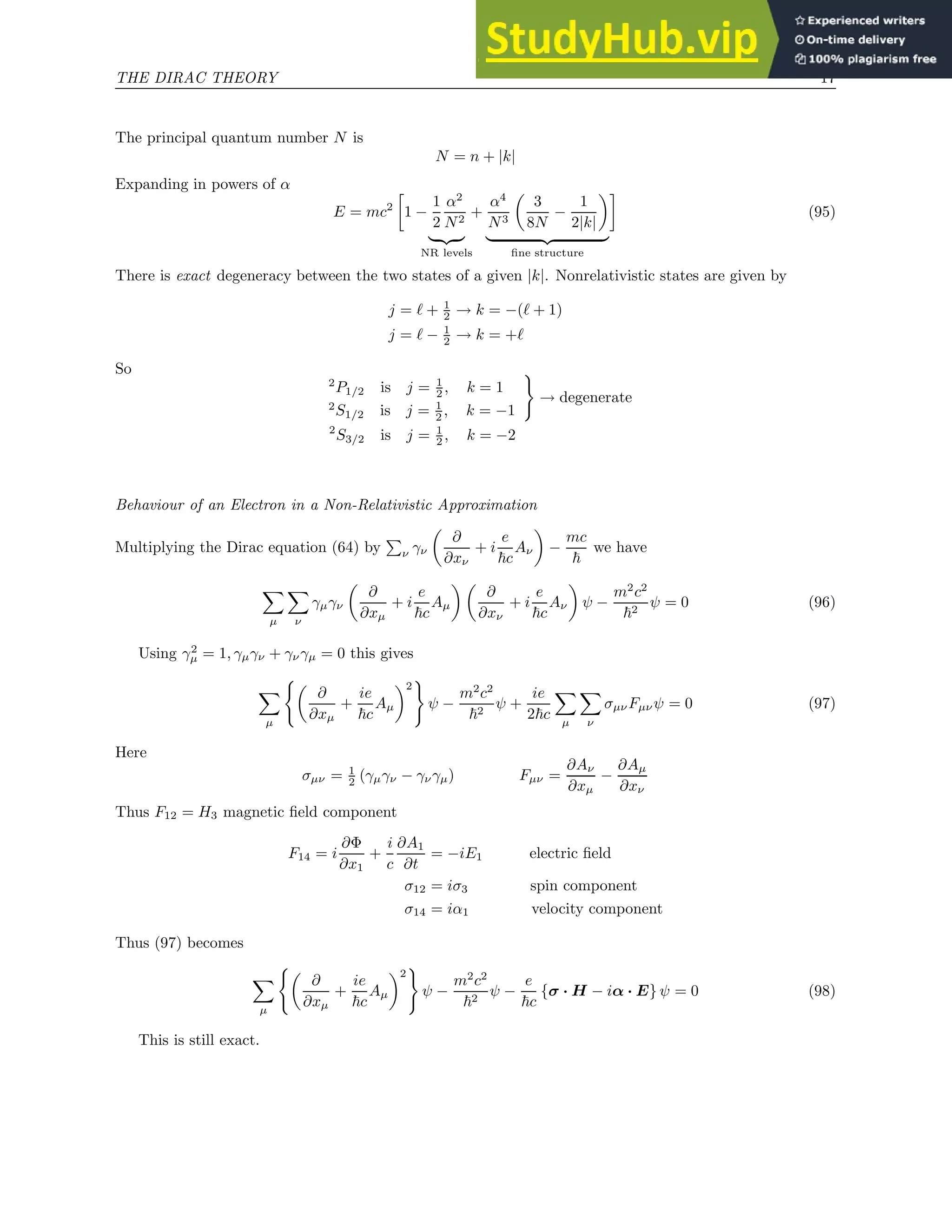
The principal quantum number N is
N = n + |k|
Expanding in powers of α
E = mc2

1 −
1
2
α2
N2
+
α4
N3

3
8N
−
1
2|k|

(95)
| {z }
NR levels
| {z }
fine structure
There is exact degeneracy between the two states of a given |k|. Nonrelativistic states are given by
j = ℓ + 1
2 → k = −(ℓ + 1)
j = ℓ − 1
2 → k = +ℓ
So
2
P1/2 is j = 1
2 , k = 1
2
S1/2 is j = 1
2 , k = −1
)
→ degenerate
2
S3/2 is j = 1
2 , k = −2
Behaviour of an Electron in a Non-Relativistic Approximation
Multiplying the Dirac equation (64) by
P
ν γν

∂
∂xν
+ i
e
~c
Aν

−
mc
~
we have
X
µ
X
ν
γµγν

∂
∂xµ
+ i
e
~c
Aµ
 
∂
∂xν
+ i
e
~c
Aν

ψ −
m2
c2
~2
ψ = 0 (96)
Using γ2
µ = 1, γµγν + γνγµ = 0 this gives
X
µ
(
∂
∂xµ
+
ie
~c
Aµ
2
)
ψ −
m2
c2
~2
ψ +
ie
2~c
X
µ
X
ν
σµνFµνψ = 0 (97)
Here
σµν = 1
2 (γµγν − γνγµ) Fµν =
∂Aν
∂xµ
−
∂Aµ
∂xν
Thus F12 = H3 magnetic field component
F14 = i
∂Φ
∂x1
+
i
c
∂A1
∂t
= −iE1 electric field
σ12 = iσ3 spin component
σ14 = iα1 velocity component
Thus (97) becomes
X
µ
(
∂
∂xµ
+
ie
~c
Aµ
2
)
ψ −
m2
c2
~2
ψ −
e
~c
{σ · H − iα · E} ψ = 0 (98)
This is still exact.
THE DIRAC THEORY 18
Now in the NR approximation
i~
∂
∂t
= mc2
+ O(1)
(
∂
∂x4
+
ie
~c
A4
2
)
−
m2
c2
~2
=
1
~2c2
(
−i~
∂
∂t
− eΦ
2
− m2
c4
)
=
1
~2c2

−i~
∂
∂t
− eΦ − mc2
 
−i~
∂
∂t
− eΦ + mc2

=
1
~2c2

−2mc2
+ O(1)

−i~
∂
∂t
− eΦ + mc2

Hence

−i~
∂
∂t
− eΦ + mc2

ψ −
h2
2m
3
X
k=1
(
∂
∂xk
+
ie
~c
Ak
2
)
ψ +
e~
2mc
[σ · H − iα · E] ψ + O

1
mc2

= 0
The NR approximation means dropping the terms O 1/mc2

. Thus the NR Schrödinger equation is
i~
∂ψ
∂t
=
(
mc2
− eΦ −
h2
2m
3
X
k=1

∂
∂xk
+
ie
~c
Ak
2
+
e~
2mc
(σ · H − iα · E)
)
ψ (99)
The term α · E is really relativistic, and should be dropped or treated more exactly. Then we have exactly
the equation of motion of a NR particle with a spin magnetic moment equal to
M = −
e~
2mc
σ (100)
This is one of the greatest triumphs of Dirac, that he got this magnetic moment right out of his general
assumptions without any arbitrariness.
It is confirmed by measurements to about one part in 1000. Note that the most recent experiments
show a definite discrepancy, and agree with the value
M = −
e~
2mc
σ

1 +
e2
2π~c

(101)
calculated by Schwinger using the complete many-particle theory.
Problem 2 Calculate energy values and wave functions of a Dirac particle moving in a homogeneous infinite
magnetic field. Can be done exactly. See F. Sauter, Zeitschrift für Physik 69 (1931) 742.
Solution
Take the field B in the z direction.
A1 = −1
2 By , A2 = 1
2 Bx
The second-order Dirac equation (98) gives for a stationary state of energy ±E

E2
~2c2
−
m2
c2
~2

ψ +

∂
∂x
−
1
2
ieB
~c
y
2
ψ +

∂
∂y
+
1
2
ieB
~c
x
2
ψ +
∂2
∂z2
ψ −
eB
~c
σzψ = 0
Taking a representation with σz diagonal, this splits at once into two states with σz = ±1. Also
Lz = −i~

x
∂
∂y
− y
∂
∂x
THE DIRAC THEORY 19
is a constant of the motion, say Lz = ℓ~ where ℓ is an integer. And −i~
∂
∂z
= pz. Let λ = |eB~c|. Then

E2
− m2
c4
− c2
p2
z ± (ℓz ± 1) λ ψ = ~2
c2

1
4
λ2
r2
~4c4
−

∂2
∂x2
+
∂2
∂y2

ψ
This is an eigenvalue problem with eigenvalues of a two-dimensional harmonic oscillator.
Thus
E2
= m2
c4
+ c2
p2
z + λ {n ± (ℓz ± 1)}
where ℓz = 0, ±1, ±2, . . ., ±(n − 1).
So the eigenvalues are
E =
p
m2c4 + c2p2
z + M|eB~c| with M = 0, 1, 2, . . .
The lowest state has energy exactly mc2
.
THE DIRAC THEORY 20
Summary of Matrices in the Dirac Theory in our notation
αk
αℓ
+ αℓ
αk
= 2δkℓI αk
β + βαk
= 0 β2
= I σkσℓ + σℓσk = 2δkℓI
γk = −iβαk
αk
= iβγk γ4 = β γµγν + γνγµ = 2δµνI (γk)
∗
= γk
αk
γℓ − γℓαk
= 2iδℓkβ γ5 = γ1γ2γ3γ4 γµγ5 + γ5γµ = 0 αk
γ5 − γ5αk
= 0 γ2
5 = I
We use the following representation:
σ1 =

0 1
1 0

σ2 =

0 −i
i 0

σ3 =

1 0
0 −1

αk
=

O σk
σk O

i.e. α1
=




0 0 0 1
0 0 1 0
0 1 0 0
1 0 0 0



 α2
=




0 0 0 −i
0 0 i 0
0 −i 0 0
i 0 0 0



 α3
=




0 0 1 0
0 0 0 −1
1 0 0 0
0 −1 0 0




β =

I O
O −I

i.e. β = γ4 =




1 0 0 0
0 1 0 0
0 0 −1 0
0 0 0 −1



 γ5 =

O −I
−I O

=




0 0 −1 0
0 0 0 −1
−1 0 0 0
0 −1 0 0




γk =

O −iσk
iσk O

i.e. γ1 =




0 0 0 −i
0 0 −i 0
0 i 0 0
i 0 0 0



 γ2 =




0 0 0 −1
0 0 1 0
0 1 0 0
−1 0 0 0



 γ3 =




0 0 −i 0
0 0 0 i
i 0 0 0
0 −i 0 0




σk = ǫαk
αk
= ǫσk η = iǫβ ǫ = −iα1
α2
α3
ǫ2
= η2
= I γ5 = −ǫ
σk = ηγk γk = ησk ǫ = −iηβ η = −α1
α2
α3
ǫ =

O I
I O

=




0 0 1 0
0 0 0 1
1 0 0 0
0 1 0 0



 η =

O −iI
iI O

=




0 0 −i 0
0 0 0 −i
i 0 0 0
0 i 0 0




αk
σℓ + σℓαk
= 2δℓkǫ γkσℓ + σℓγk = 2δℓkη βσk − σkβ = 0
σkσℓ = αkαℓ = γkγℓ = iσm k, ℓ, m = (1, 2, 3) cyclicly permuted
αk
ǫ − ǫαk
= γµǫ + ǫγµ = σkǫ − ǫσk = 0
αk
η + ηαk
= γkη − ηγk = σkη − ησk = βη + ηβ = 0
αkσℓ = iαm
σkγℓ = iγm
γkαℓ = βσm



k, ℓ, m = (1, 2, 3) cyclicly permuted
Comparison with the Dirac notation: ρ1 = ǫ ρ2 = η ρ3 = β.
Latin indices: 1, 2, 3. Greek indices: 1, 2, 3, 4.
THE DIRAC THEORY 21
Summary of Matrices in the Dirac Theory in the Feynman notation
αk
αℓ
+ αℓ
αk
= 2δkℓI αk
β + βαk
= 0 g00 = +1 gkk = −1 gµν = 0, µ 6= ν
σkσℓ + σℓσk = 2δkℓI β2
= I
γk = βαk
αk
= βγk γ0 = β γµγν + γνγµ = 2gµνI (γk)
∗
= −γk
αk
γℓ − γℓαk
= −2δℓkβ γ5 = iγ0γ1γ2γ3 γµγ5 + γ5γµ = 0 αk
γ5 − γ5αk
= 0 γ2
5 = −I
Representation:
σ1 =

0 1
1 0

σ2 =

0 −i
i 0

σ3 =

1 0
0 −1

αk
=

O σk
σk O

i.e. α1
=




0 0 0 1
0 0 1 0
0 1 0 0
1 0 0 0



 α2
=




0 0 0 −i
0 0 i 0
0 −i 0 0
i 0 0 0



 α3
=




0 0 1 0
0 0 0 −1
1 0 0 0
0 −1 0 0




β =

I O
O −I

i.e. β = γ0 =




1 0 0 0
0 1 0 0
0 0 −1 0
0 0 0 −1




γk =

O σk
−σk O

i.e. γ1 =




0 0 0 1
0 0 1 0
0 −1 0 0
−1 0 0 0



 γ2 =




0 0 0 −i
0 0 i 0
0 −i 0 0
i 0 0 0



 γ3 =




0 0 1 0
0 0 0 −1
−1 0 0 0
0 1 0 0




ρ1 =

O I
I O

=




0 0 1 0
0 0 0 1
1 0 0 0
0 1 0 0



 = γ5 ρ2 =

O −iI
iI O

=




0 0 −i 0
0 0 0 −i
i 0 0 0
0 i 0 0




σk = ρ1αk
αk
= ρ1σk ρ2 = iρ1β ρ1 = −iα1
α2
α3
ρ2
1 = ρ2
2 = I
σk = −iρ2γk γk = iρ2σk ρ1 = −iρ2β ρ2 = −α1
α2
α3
β
αk
σℓ + σℓαk
= 2δℓkρ1 γkσℓ + σℓγk = −2δℓkρ2 βσk − σkβ = 0
σkσℓ = αkαℓ = −γkγℓ = iσm k, ℓ, m = (1, 2, 3) cyclicly permuted
αk
ρ1 − ρ1αk
= γµρ1 + ρ1γµ = σkρ1 − ρ1σk = 0
αk
ρ2 + ρ2αk
= γkρ2 − ρ2γk = σkρ2 − ρ2σk = βρ2 + ρ2β = 0
αkσℓ = iαm
σkγℓ = iγm
γkαℓ = iβσm



k, ℓ, m = (1, 2, 3) cyclicly permuted
Latin indices: 1, 2, 3. Greek indices: 0, 1, 2, 3.
Scattering Problems and Born Approximation
General Discussion
The problem of scattering of a Dirac particle by a potential can be treated exactly by finding the continuum
solutions of the Dirac equation. This is a complicated business even for the simplest case of a Coulomb
force. It was done by Mott, Proc. Roy. Soc. A135 (1932) 429.
For most purposes in relativistic problems, and always when the scattering is produced by complicated
effects involving radiation theory, one uses the Born approximation. That is, we treat the scattering only
to 1st
order in the interaction, or only to some definite order in which we are interested.
The formula for scattering from an initial state A to a final state B lying in a continuum of states is,
transition probability per unit time,
w =
2π
~
ρE |VBA|2
(102)
This you ought to know. ρE = density of final states per unit energy interval. VBA is the matrix element
of the potential V for the transition. Here V may be anything, and may be itself a second-order or higher
order effect obtained by using higher-order perturbation theory.
The difficulties in real calculations usually come from the factors 2 and π and the correct normalization
of states. Always I shall normalize the continuum states not in the usual way (one particle per unit volume)
which is non-invariant, but instead
One particle per volume
mc2
|E|
(103)
where |E| is the energy of the particles. Then under a Lorentz transformation the volume of a fixed region
transforms like 1/|E| and so the definition stays invariant.
Thus a continuum state given by the spinor ψ = u exp {(ip · x − iEt)/~} is normalized so that
u∗
u =
|E|
mc2
(104)
Now if we multiply the Dirac equation for a free particle, (44), by u on the left, we get Eu∗
βu = cu∗
βα ·
pu + mc2
u∗
u; its complex conjugate is Eu∗
βu = −cu∗
βα · pu + mc2
u∗
u since βα is anti-Hermitian; then
by adding we get
E uu = mc2
u∗
u (105)
Therefore the normalization becomes
uu = +1 for electron states
= −1 for positron states

= ǫ; This is the definition of ǫ. (106)
With this normalization the density of states in momentum space is one per volume h3
of phase space, that
is to say
ρ =
1
h3
mc2
|E|
dp1dp2dp3 (107)
per volume dp1dp2dp3 of momentum space, for each direction of spin and each sign of charge. Now we have
again an invariant differential
dp1dp2dp3
|E|
(108)
22
SCATTERING PROBLEMS AND BORN APPROXIMATION 23
Projection Operators
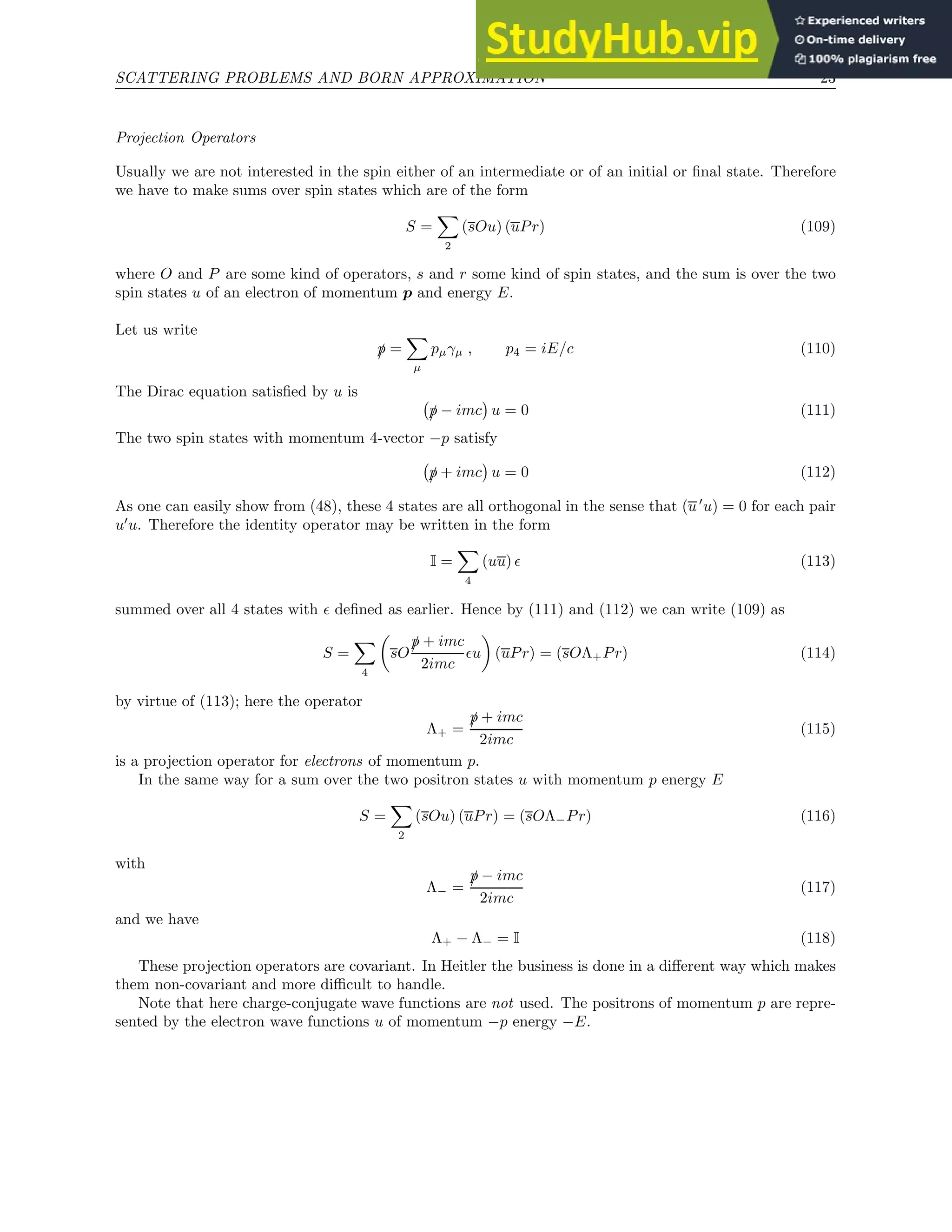
Usually we are not interested in the spin either of an intermediate or of an initial or final state. Therefore
we have to make sums over spin states which are of the form
S =
X
2
(sOu) (uPr) (109)
where O and P are some kind of operators, s and r some kind of spin states, and the sum is over the two
spin states u of an electron of momentum p and energy E.
Let us write
/
p =
X
µ
pµγµ , p4 = iE/c (110)
The Dirac equation satisfied by u is
/
p − imc

u = 0 (111)
The two spin states with momentum 4-vector −p satisfy
/
p + imc

u = 0 (112)
As one can easily show from (48), these 4 states are all orthogonal in the sense that (u′
u) = 0 for each pair
u′
u. Therefore the identity operator may be written in the form
I =
X
4
(uu) ǫ (113)
summed over all 4 states with ǫ defined as earlier. Hence by (111) and (112) we can write (109) as
S =
X
4

sO
/
p + imc
2imc
ǫu

(uPr) = (sOΛ+Pr) (114)
by virtue of (113); here the operator
Λ+ =
/
p + imc
2imc
(115)
is a projection operator for electrons of momentum p.
In the same way for a sum over the two positron states u with momentum p energy E
S =
X
2
(sOu) (uPr) = (sOΛ−Pr) (116)
with
Λ− =
/
p − imc
2imc
(117)
and we have
Λ+ − Λ− = I (118)
These projection operators are covariant. In Heitler the business is done in a different way which makes
them non-covariant and more difficult to handle.
Note that here charge-conjugate wave functions are not used. The positrons of momentum p are repre-
sented by the electron wave functions u of momentum −p energy −E.
SCATTERING PROBLEMS AND BORN APPROXIMATION 24
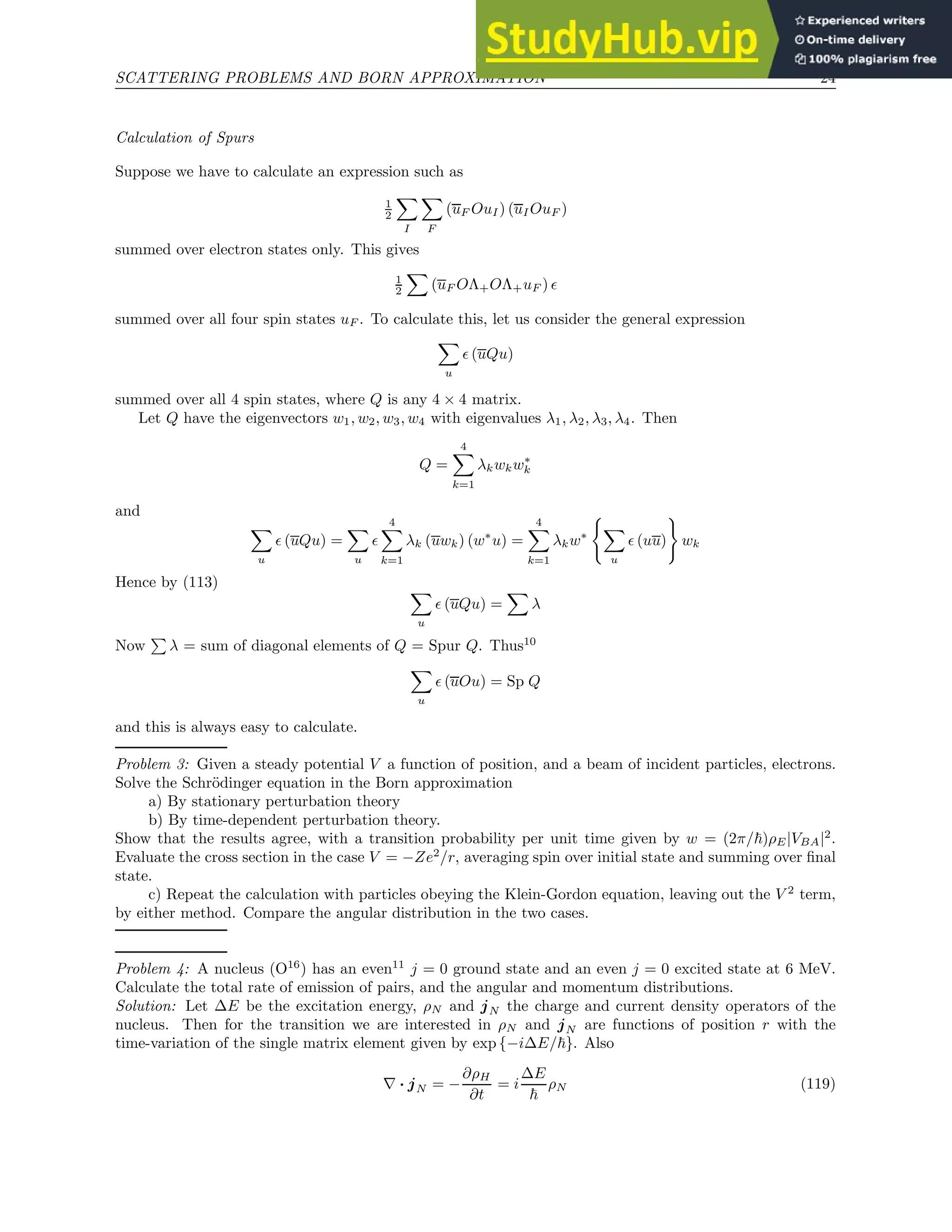
Calculation of Spurs
Suppose we have to calculate an expression such as
1
2
X
I
X
F
(uF OuI) (uIOuF )
summed over electron states only. This gives
1
2
X
(uF OΛ+OΛ+uF ) ǫ
summed over all four spin states uF . To calculate this, let us consider the general expression
X
u
ǫ (uQu)
summed over all 4 spin states, where Q is any 4 × 4 matrix.
Let Q have the eigenvectors w1, w2, w3, w4 with eigenvalues λ1, λ2, λ3, λ4. Then
Q =
4
X
k=1
λkwkw∗
k
and
X
u
ǫ (uQu) =
X
u
ǫ
4
X
k=1
λk (uwk) (w∗
u) =
4
X
k=1
λkw∗
(
X
u
ǫ (uu)
)
wk
Hence by (113) X
u
ǫ (uQu) =
X
λ
Now
P
λ = sum of diagonal elements of Q = Spur Q. Thus10
X
u
ǫ (uOu) = Sp Q
and this is always easy to calculate.
Problem 3: Given a steady potential V a function of position, and a beam of incident particles, electrons.
Solve the Schrödinger equation in the Born approximation
a) By stationary perturbation theory
b) By time-dependent perturbation theory.
Show that the results agree, with a transition probability per unit time given by w = (2π/~)ρE|VBA|2
.
Evaluate the cross section in the case V = −Ze2
/r, averaging spin over initial state and summing over final
state.
c) Repeat the calculation with particles obeying the Klein-Gordon equation, leaving out the V 2
term,
by either method. Compare the angular distribution in the two cases.
Problem 4: A nucleus (O16
) has an even11
j = 0 ground state and an even j = 0 excited state at 6 MeV.
Calculate the total rate of emission of pairs, and the angular and momentum distributions.
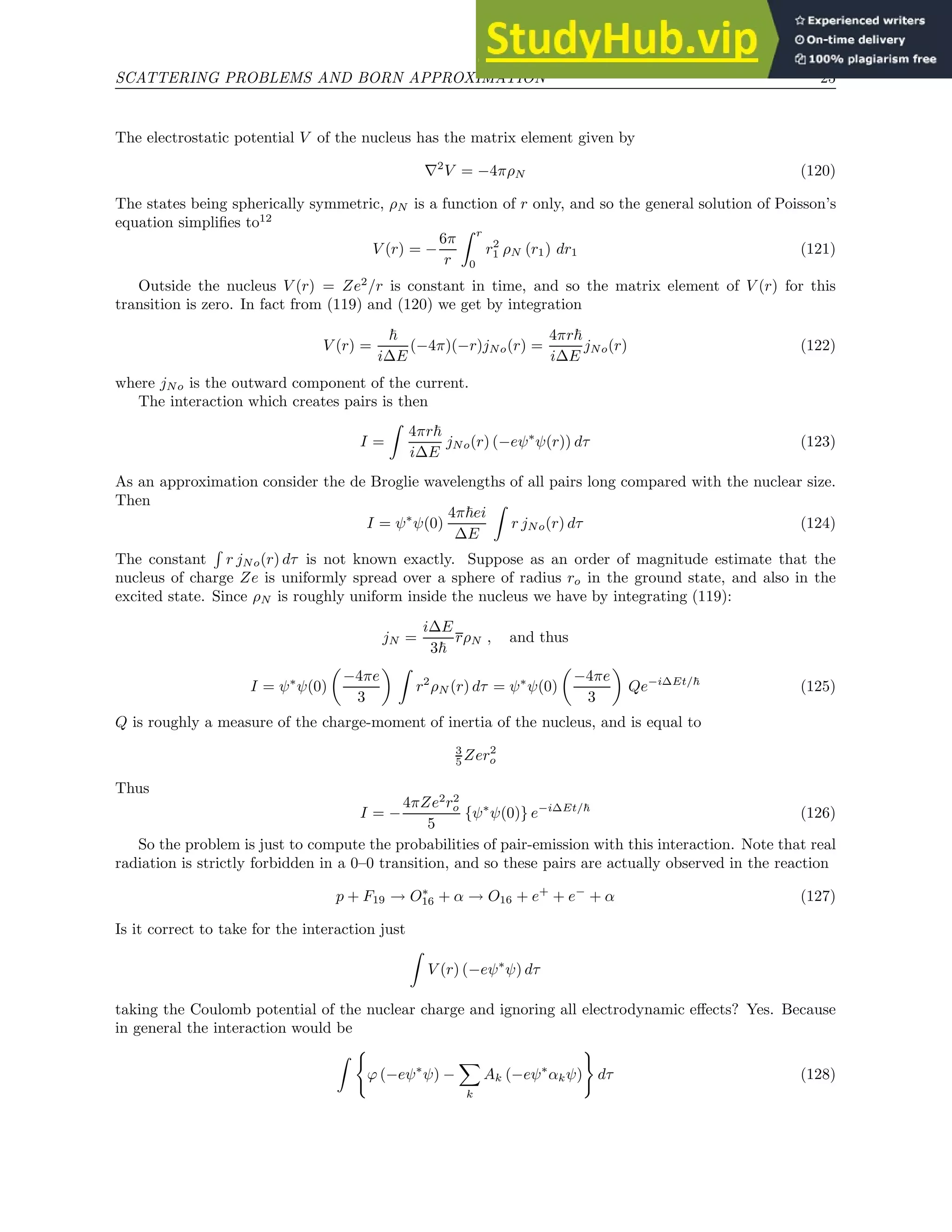
Solution: Let ∆E be the excitation energy, ρN and jN the charge and current density operators of the
nucleus. Then for the transition we are interested in ρN and jN are functions of position r with the
time-variation of the single matrix element given by exp {−i∆E/~}. Also
∇ · jN = −
∂ρH
∂t
= i
∆E
~
ρN (119)
SCATTERING PROBLEMS AND BORN APPROXIMATION 25
The electrostatic potential V of the nucleus has the matrix element given by
∇2
V = −4πρN (120)
The states being spherically symmetric, ρN is a function of r only, and so the general solution of Poisson’s
equation simplifies to12
V (r) = −
6π
r
Z r
0
r2
1 ρN (r1) dr1 (121)
Outside the nucleus V (r) = Ze2
/r is constant in time, and so the matrix element of V (r) for this
transition is zero. In fact from (119) and (120) we get by integration
V (r) =
~
i∆E
(−4π)(−r)jNo(r) =
4πr~
i∆E
jNo(r) (122)
where jNo is the outward component of the current.
The interaction which creates pairs is then
I =
Z
4πr~
i∆E
jNo(r) (−eψ∗
ψ(r)) dτ (123)
As an approximation consider the de Broglie wavelengths of all pairs long compared with the nuclear size.
Then
I = ψ∗
ψ(0)
4π~ei
∆E
Z
r jNo(r) dτ (124)
The constant
R
r jNo(r) dτ is not known exactly. Suppose as an order of magnitude estimate that the
nucleus of charge Ze is uniformly spread over a sphere of radius ro in the ground state, and also in the
excited state. Since ρN is roughly uniform inside the nucleus we have by integrating (119):
jN =
i∆E
3~
rρN , and thus
I = ψ∗
ψ(0)

−4πe
3
 Z
r2
ρN (r) dτ = ψ∗
ψ(0)

−4πe
3

Qe−i∆Et/~
(125)
Q is roughly a measure of the charge-moment of inertia of the nucleus, and is equal to
3
5 Zer2
o
Thus
I = −
4πZe2
r2
o
5
{ψ∗
ψ(0)} e−i∆Et/~
(126)
So the problem is just to compute the probabilities of pair-emission with this interaction. Note that real
radiation is strictly forbidden in a 0–0 transition, and so these pairs are actually observed in the reaction
p + F19 → O∗
16 + α → O16 + e+
+ e−
+ α (127)
Is it correct to take for the interaction just
Z
V (r) (−eψ∗
ψ) dτ
taking the Coulomb potential of the nuclear charge and ignoring all electrodynamic effects? Yes. Because
in general the interaction would be
Z (
ϕ (−eψ∗
ψ) −
X
k
Ak (−eψ∗
αkψ)
)
dτ (128)
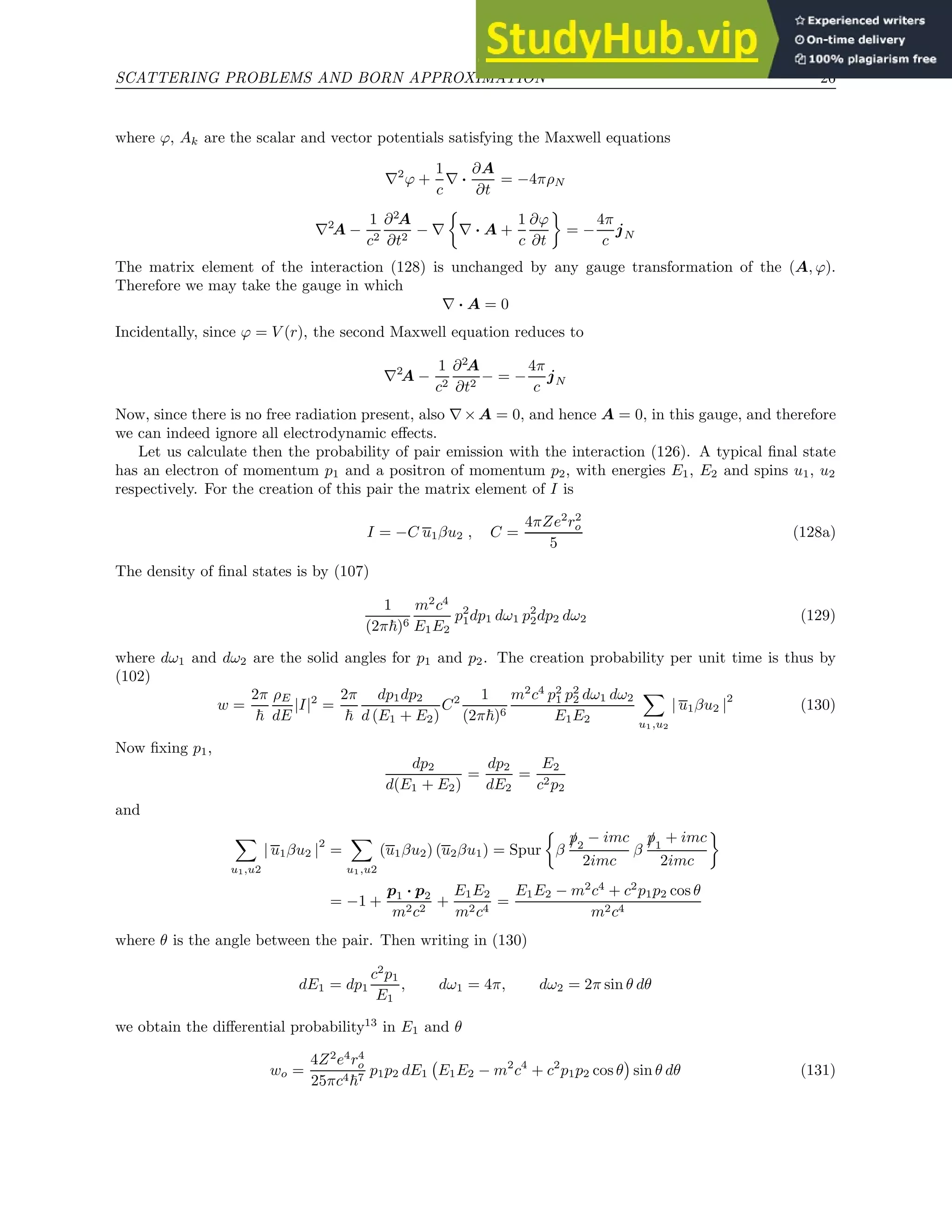
SCATTERING PROBLEMS AND BORN APPROXIMATION 26
where ϕ, Ak are the scalar and vector potentials satisfying the Maxwell equations
∇2
ϕ +
1
c
∇ ·
∂A
∂t
= −4πρN
∇2
A −
1
c2
∂2
A
∂t2
− ∇

∇ · A +
1
c
∂ϕ
∂t

= −
4π
c
jN
The matrix element of the interaction (128) is unchanged by any gauge transformation of the (A, ϕ).
Therefore we may take the gauge in which
∇ · A = 0
Incidentally, since ϕ = V (r), the second Maxwell equation reduces to
∇2
A −
1
c2
∂2
A
∂t2
− = −
4π
c
jN
Now, since there is no free radiation present, also ∇×A = 0, and hence A = 0, in this gauge, and therefore
we can indeed ignore all electrodynamic effects.
Let us calculate then the probability of pair emission with the interaction (126). A typical final state
has an electron of momentum p1 and a positron of momentum p2, with energies E1, E2 and spins u1, u2
respectively. For the creation of this pair the matrix element of I is
I = −C u1βu2 , C =
4πZe2
r2
o
5
(128a)
The density of final states is by (107)
1
(2π~)6
m2
c4
E1E2
p2
1dp1 dω1 p2
2dp2 dω2 (129)
where dω1 and dω2 are the solid angles for p1 and p2. The creation probability per unit time is thus by
(102)
w =
2π
~
ρE
dE
|I|2
=
2π
~
dp1dp2
d (E1 + E2)
C2 1
(2π~)6
m2
c4
p2
1 p2
2 dω1 dω2
E1E2
X
u1,u2
| u1βu2 |
2
(130)
Now fixing p1,
dp2
d(E1 + E2)
=
dp2
dE2
=
E2
c2p2
and
X
u1,u2
| u1βu2 |
2
=
X
u1,u2
(u1βu2) (u2βu1) = Spur

β
/
p2
− imc
2imc
β
/
p1
+ imc
2imc

= −1 +
p1 · p2
m2c2
+
E1E2
m2c4
=
E1E2 − m2
c4
+ c2
p1p2 cos θ
m2c4
where θ is the angle between the pair. Then writing in (130)
dE1 = dp1
c2
p1
E1
, dω1 = 4π, dω2 = 2π sin θ dθ
we obtain the differential probability13
in E1 and θ
wo =
4Z2
e4
r4
o
25πc4~7
p1p2 dE1 E1E2 − m2
c4
+ c2
p1p2 cos θ

sin θ dθ (131)
SCATTERING PROBLEMS AND BORN APPROXIMATION 27
Since
∆E = 6 MeV = 12 mc2
we can to a good approximation treat all particles as extreme relativistic. Thus
wo =
4Z2
e4
r4
o
25πc6~7
E2
1 E2
2 dE1 (1 + cos θ) sin θ dθ (132)
So the pairs have an angular distribution concentrated in the same hemisphere, and predominantly equal
energies. Then, since
Z π
0
(1 + cos θ) sin θ dθ = 2, and
Z ∆E
0
E2
1 E2
2 dE1 =
Z ∆E
0
E2
1 (E1 + ∆E)2
dE1 =
1
15
(∆E)5
the total creation probability per unit time is
wT =
4Z2
e4
r4
o
25π~7c6
1
15
(∆E)5
(133)
Numerically
Ze2
~c
≈
1
17
and
∆Ero
~c
≈
1
10
since ro = 4 × 10⁻¹³
cm
Hence the lifetime will be
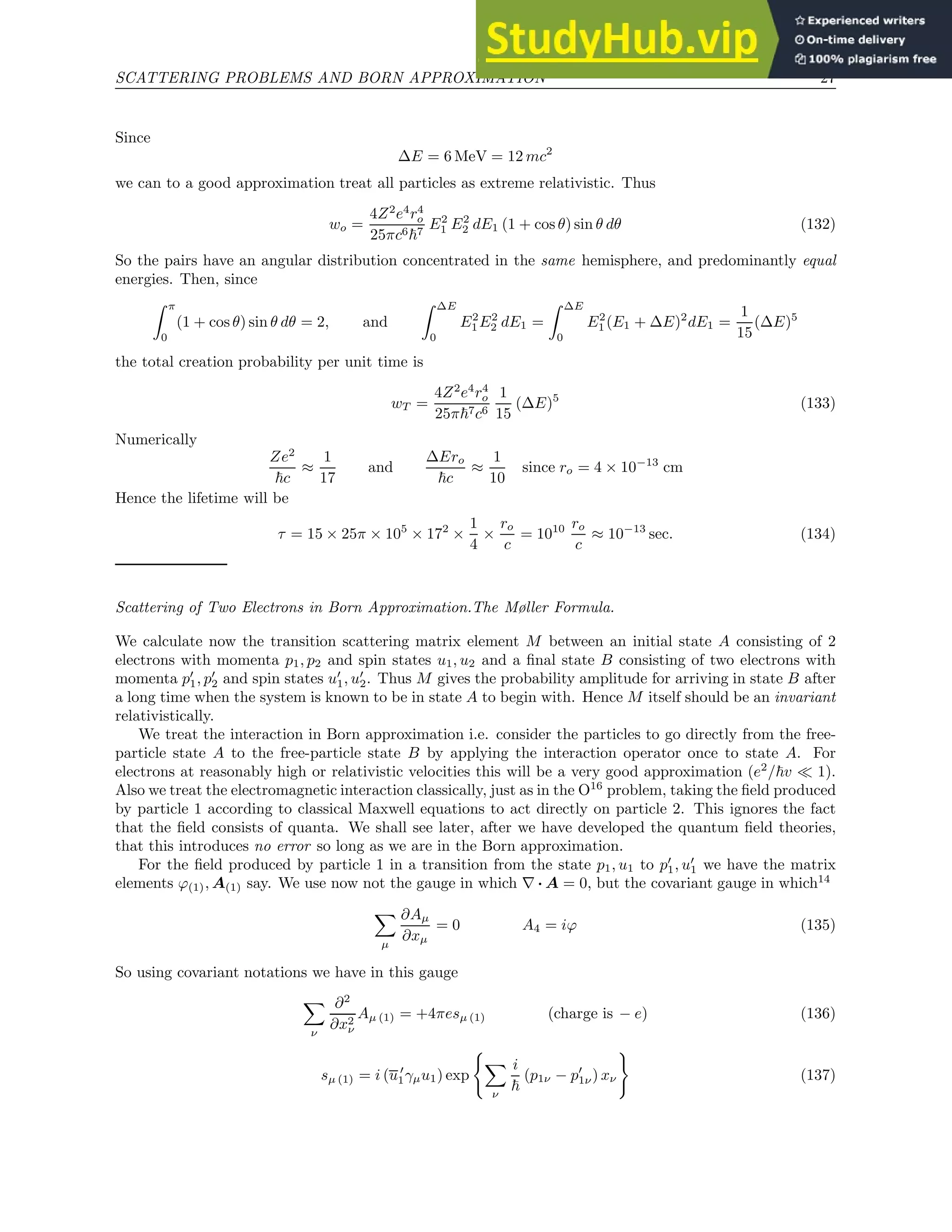
τ = 15 × 25π × 105
× 172
×
1
4
×
ro
c
= 1010 ro
c
≈ 10−13
sec. (134)
Scattering of Two Electrons in Born Approximation.The Møller Formula.
We calculate now the transition scattering matrix element M between an initial state A consisting of 2
electrons with momenta p1, p2 and spin states u1, u2 and a final state B consisting of two electrons with
momenta p′
1, p′
2 and spin states u′
1, u′
2. Thus M gives the probability amplitude for arriving in state B after
a long time when the system is known to be in state A to begin with. Hence M itself should be an invariant
relativistically.
We treat the interaction in Born approximation i.e. consider the particles to go directly from the free-
particle state A to the free-particle state B by applying the interaction operator once to state A. For
electrons at reasonably high or relativistic velocities this will be a very good approximation (e2
/~v ≪ 1).
Also we treat the electromagnetic interaction classically, just as in the O16
problem, taking the field produced
by particle 1 according to classical Maxwell equations to act directly on particle 2. This ignores the fact
that the field consists of quanta. We shall see later, after we have developed the quantum field theories,
that this introduces no error so long as we are in the Born approximation.
For the field produced by particle 1 in a transition from the state p1, u1 to p′
1, u′
1 we have the matrix
elements ϕ(1), A(1) say. We use now not the gauge in which ∇ · A = 0, but the covariant gauge in which14
X
µ
∂Aµ
∂xµ
= 0 A4 = iϕ (135)
So using covariant notations we have in this gauge
X
ν
∂2
∂x2
ν
Aµ (1) = +4πesµ (1) (charge is − e) (136)
sµ (1) = i (u′
1γµu1) exp
(
X
ν
i
~
(p1ν − p′
1ν) xν
)
(137)
SCATTERING PROBLEMS AND BORN APPROXIMATION 28
whence
Aµ (1) = −4πie~2




(u′
1γµu1) exp

P
ν
i
~
(p1ν − p′
1ν) xν

P
λ (p1λ − p′
1λ)
2



 (138)
where X
ν
(p1ν − p′
1ν)
2
= |p1 − p′
1|
2
−
1
c2
(E1 − E′
1)
2
(139)
The effect of the field (138) on particle 2 is given by the interaction term in the Dirac equation for
particle 2
−eϕ + eα · A = ieβ
X
µ
γµAµ (140)
This gives for particle 2 for the transition from state p2, u2 to p′
2, u′
2 a transition matrix element
Z
dτ ψ′∗
2 ieβ
X
µ
γµAµ (1)
!
ψ2 (141)
a 3-dimensional integral over space at the time t say. For the total transition matrix element M by first
order perturbation method
M = −
i
~
Z ∞
−∞
dt
Z
dτ ψ
′
2 ie
X
µ
γµAµ (1)
!
ψ2 = −
i
~c
Z
d4
x ψ
′
2 ie
X
µ
γµAµ (1)
!
ψ2 (142)
where the 4-fold integral is dx1 dx2 dx3 dx0, x0 = ct. Putting in the values of Aµ (1), ψ′
2 and ψ2, we get
M = −
4πe2
~i
c
X
µ
(u′
2γµu2) (u′
1γµu1)
1
P
ν (p1ν − p′
1ν)
2
Z
d4
x exp
(
X
λ
i
~
(p1λ − p′
1λ + p2λ − p′
2λ) xλ
)
= −
4πe2
~i
c
X
µ, ν
(u′
2γµu2) (u′
1γµu1)
(p1ν − p′
1ν)
2 (2π~)4
δ 4
(p1 + p2 − p′
1 − p′
2) (143)
where δ 4
(x) =
Q4
k=1 δ(xk).
There is also the exchange process in which the particle p1, u1 goes to p′
2, u′
2 and vice-versa. This gives a
contribution to M with a minus sign since the wave function ought to be taken antisymmetric between the
two particles. Hence the final result is
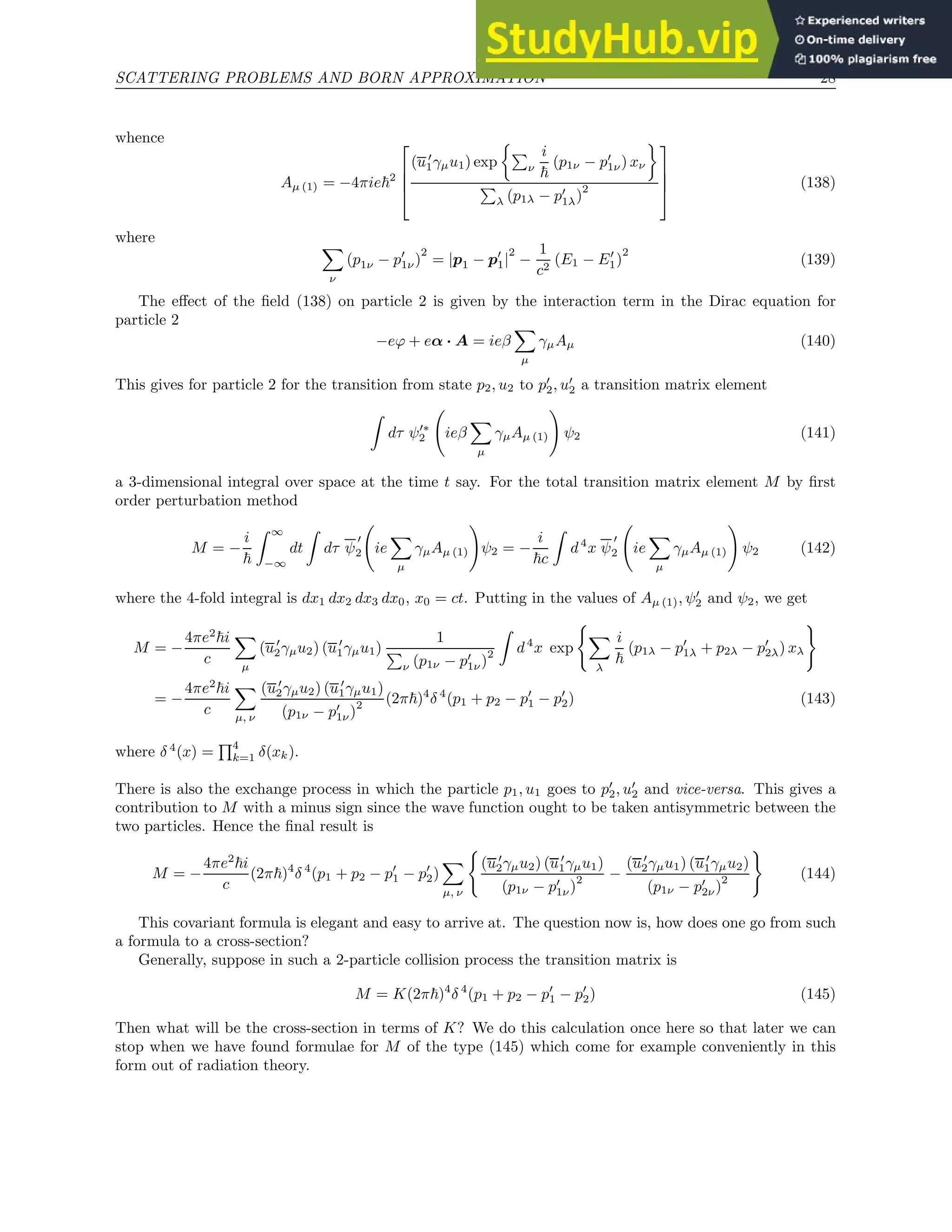
M = −
4πe2
~i
c
(2π~)4
δ 4
(p1 + p2 − p′
1 − p′
2)
X
µ, ν
(
(u′
2γµu2) (u′
1γµu1)
(p1ν − p′
1ν)
2 −
(u′
2γµu1) (u′
1γµu2)
(p1ν − p′
2ν)
2
)
(144)
This covariant formula is elegant and easy to arrive at. The question now is, how does one go from such
a formula to a cross-section?
Generally, suppose in such a 2-particle collision process the transition matrix is
M = K(2π~)4
δ 4
(p1 + p2 − p′
1 − p′
2) (145)
Then what will be the cross-section in terms of K? We do this calculation once here so that later we can
stop when we have found formulae for M of the type (145) which come for example conveniently in this
form out of radiation theory.
SCATTERING PROBLEMS AND BORN APPROXIMATION 29
Relation of Cross-sections to Transition Amplitudes
Let w be the transition probability per unit volume and per unit time. This is related to the transition
probability for a single final state, which is
ws = c|K|2
(2π~)4
δ 4
(p1 + p2 − p′
1 − p′
2) (146)
since in |M|2
one of the two (2π~)4
δ 4
(p1 + p2 − p′
1 − p′
2) /c factors represents merely the volume of space-
time in which the interaction can occur. The number of final states is by (107)
1
(2π~)6
mc2
|E′
1|
mc2
|E′
2|
dp′
11 dp′
12 dp′
13 dp′
21 dp′
22 dp′
23 (147)
Multiplying (146) by (147) gives the total transition probability
w = |K|2 1
(2π~)2
m2
c4
E′
1E′
2
c δ 4
(p1 + p2 − p′
1 − p′
2) dp′
11 dp′
12 dp′
13 dp′
21 dp′
22 dp′
23 (148)
As δ(ax) =
1
a
δ(x), we have
δ 4
(p1 + p2 − p′
1 − p′
2) = δ 3
(p1 + p2 − p′
1 − p′
2) c δ(E1 + E2 − E′
1 − E′
2)
and the integration over dp2 gives then by the momentum conservation
w = |K|2 c2
(2π~)2
m2
c4
E′
1E′
2
δ(E1 + E2 − E′
1 − E′
2) dp′
11 dp′
12 dp′
13 (148a)
Furthermore,
if f(a) = 0, we have f(x) = f(a) + f′
(a)(x − a) = f′
(a)(x − a)
and thus
δ(f(x)) = δ{f′
(a)(x − a)} =
δ(x − a)
f′(a)
Applying this to (148a) with f(x) = f(p′
13) = E1 + E2 − E′
1 − E′
2 and a = (p′
13)c = the value of p′
13 giving
momentum and energy conservation, we get
δ(E1 + E2 − E′
1 − E′
2) =
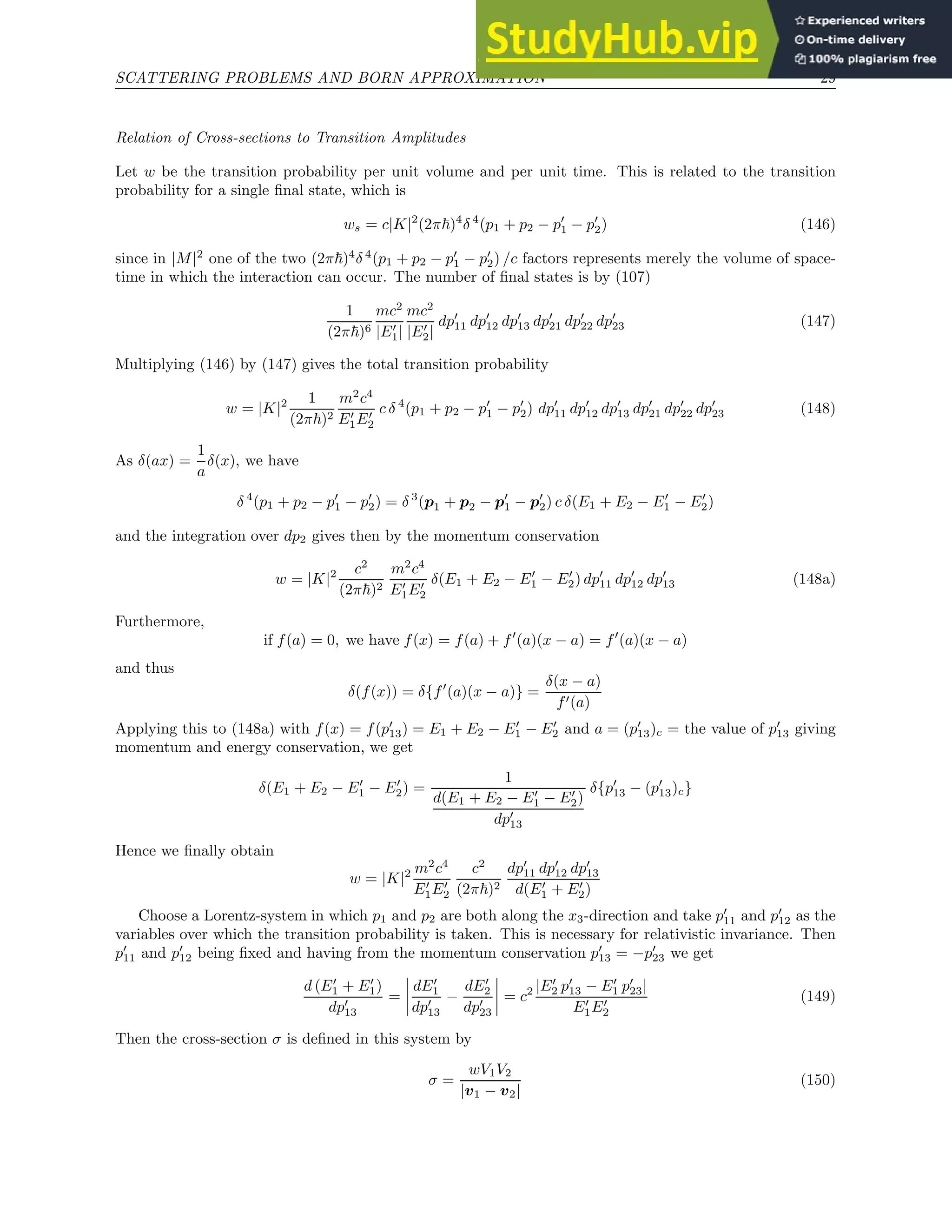
1
d(E1 + E2 − E′
1 − E′
2)
dp′
13
δ{p′
13 − (p′
13)c}
Hence we finally obtain
w = |K|2 m2
c4
E′
1E′
2
c2
(2π~)2
dp′
11 dp′
12 dp′
13
d(E′
1 + E′
2)
Choose a Lorentz-system in which p1 and p2 are both along the x3-direction and take p′
11 and p′
12 as the
variables over which the transition probability is taken. This is necessary for relativistic invariance. Then
p′
11 and p′
12 being fixed and having from the momentum conservation p′
13 = −p′
23 we get
d (E′
1 + E′
1)
dp′
13
=
dE′
1
dp′
13
−
dE′
2
dp′
23
= c2 |E′
2 p′
13 − E′
1 p′
23|
E′
1E′
2
(149)
Then the cross-section σ is defined in this system by
σ =
wV1V2
|v1 − v2|
(150)
SCATTERING PROBLEMS AND BORN APPROXIMATION 30
where V1 is the normalization volume for particle 1, and v1 its velocity. In fact by (103)
V1 =
mc2
E1
V2 =
mc2
E2
(v1 − v2) =
c2
p1
E1
−
c2
p2
E2
(151)
Hence the cross-section becomes
σ =
w mc2
2
c2 |p1E2 − p2E1|
= |K|2 mc2
4
c2 |E2p13 − E1p23| |E′
2 p′
13 − E′
1 p′
23|
1
(2π~)
2 dp′
11 dp′
12 (152)
It is worth noting that the factor p1E2 − p2E1 is invariant under Lorentz transformations leaving the x1
and x2 components unchanged (e.g.boosts parallel to the x3 axis.)15
To prove this, we have to show that
p13E2 − p23E1 = p̃13Ẽ2 − p̃23Ẽ1 (where ˜ denotes the quantities after the Lorentz transformation) because
we have chosen a Lorentz system in which the direction of the momentum vector is the x3 axis. Then
Ẽ = E cosh θ − cp sinh θ
p̃ = p cosh θ −
E
c
sinh θ
Since E2
= p2
c2
+ m2
c4
, we can write
E = mc2
cosh φ pc = mc2
sinh φ, which makes
Ẽ = mc2
cosh(φ − θ) p̃c = mc2
sinh(φ − θ) and thus
Ẽ2p̃13 − Ẽ1p̃23 = m2
c3
{cosh (φ2 − θ) sinh (φ1 − θ) − cosh (φ1 − θ) sinh (φ2 − θ)}
= m2
c3
sinh (φ1 − φ2)
independently of θ. Hence we see that σ is invariant under Lorentz transformations parallel to the x3 axis.
Results for Møller Scattering
One electron initially at rest, the other initially with energy E = γmc2
;
γ =
1
p
1 − (v/c)2
scattering angle = θ in the lab system
= θ∗
in the center-of-mass system
Then the differential cross-section is (Mott and Massey, Theory of Atomic Collisions, 2nd
ed., p. 368)
2πσ(θ) dθ = 4π

e2
mv2
2 
γ + 1
γ2

dx
(
4
(1 − x2)2
−
3
1 − x2
+

γ − 1
2γ
2 
1 +
4
1 − x2
)
(153)
with
x = cos θ∗
=
2 − (γ + 3) sin2
θ
2 + (γ − 1) sin2
θ
Without spin you get simply
4π

e2
mv2
2 
γ + 1
γ2

dx

4
(1 − x2)2
−
3
1 − x2

Effect of spin is a measurable increase of scattering over the Mott formula. Effect of exchange is roughly
the
3
1 − x2
term. Positron-electron scattering is very similar. Only the exchange effect is different because
of annihilation possibility.
SCATTERING PROBLEMS AND BORN APPROXIMATION 31
Note on the Treatment of Exchange Effects
The correctly normalized initial and final states in this problem are
1
√
2
{ψ1(1)ψ2(2) − ψ1(2)ψ2(1)}
(154)
1
√
2
{ψ′
1(1)ψ′
2(2) − ψ′
1(2)ψ′
2(1)}
where ψ2(1) means the particle 2 in the state 1, and so on. With these states the matrix element M is
exactly as we have calculated it including the exchange term.
The number of possible final states is only one half of the number of states of two distinguishable
particles. But this does not bring a factor 1
2 into the differential cross-section, because the density of
antisymmetrical states, in which one of the two particles has a momentum in a particular range dp1 dp2 dp3
is exactly the same as the density of states of 2 distinguishable particles in which the particle labelled 1 lies
in the given range. Hence the general rule: the differential cross-section does not have a factor 1
2 , the total
cross section does because each final state may only be counted once in integrating over the angles.
Relativistic Treatment of Several Particles
The Møller treatment of the interaction of two electrons succeeds because the field of particle 1 is calculated
for all time without taking any account of the effect of particle 2 on particle 1. How can one do a better
calculation taking such reactions into account? Clearly we must construct an equation of motion which
follows the motions of both particles continuously in time and keeps them in step with each other. So we
must have a Dirac equation for 2 electrons, taking exact account of their interaction by including in the
equation the behaviour of the Maxwell field too.
This kind of 2-particle Dirac equation is no longer relativistically invariant, if we give each particle a
separate position in space but all the same time. To avoid this Dirac constructed the many-time theory
in which each electron has its own private time coordinate, and satisfies its private Dirac equation. This
theory is all right in principle. But it becomes hopelessly complicated when pairs are created and you have
equations with new time-coordinates suddenly appearing and disappearing. In fact the whole program of
quantizing the electron theory as a theory of discrete particles each with its private time becomes nonsense
when you are dealing with an infinite “sea” or an indefinite number of particles. So we have come to the
end of what we can do with the relativistic quantum theory of particles.
Where did the theory go wrong? Obviously a lot of the troubles of arose from the fact that a particle
was always described by an operator r representing its position at the time t, t being a number and not an
operator. This made the interpretation of the formalism essentially non-relativistic even when the equations
were formally invariant. In equations like the K. G. and the Dirac equation, the space and time coordinates
appear symmetrically. Thus we are led to the following new view-point.
Relativistic quantum theory is the study of quantities ψ which are functions of four coordinates x1, x2,
x3, x0, all the coordinates being c-numbers and only the expressions containing ψ being operators describing
the dynamical system.
The dynamical system is specified by the quantity ψ existing at all points of space-time, and so consists
of a system of fields. Relativistic quantum theory is necessarily a field theory.
The process of reinterpreting a one-particle wave-function like the Dirac ψ as a quantized field operator
is called Second Quantization.
Field Theory
Before we can begin on the program of constructing our quantum theory of fields, we must make some
remarks about Classical Field Theory.
Classical Relativistic Field Theory
We take a field with components (vector, spinor etc.) labeled by a suffix α. Let
φα
µ =
∂φα
∂xµ
(155)
The theory is fully described by an invariant function of position called the Lagrangian Density,
L = L φα
(x), φα
µ(x)

, (156)
a function of φα
and its first derivatives at the point x. The behaviour of the field is fixed by the Action
Principle. If Ω is any finite or infinite region of space-time, then
I(Ω) =
1
c
Z
Ω
L d4
x (157)
is stationary for the physically possible fields φα
. Thus the variation ϕα
→ φα
+ δφα
produces no change
in I to first order in δφα
, if δφα
is an arbitrary variation equal to zero on the boundary of Ω.
It is always assumed that L is at most quadratic in the φα
µ and is in various other respects a well-behaved
function.
Let Σ be the boundary of Ω, and dσ an element of 3–dimensional volume on Σ, nµ the outward unit
vector normal to dσ, and
dσµ = nµdσ,
X
µ
n2
µ = −1 µ = 1, 2, 3, 4 x0 = ct
dσµ = (dx2 dx3 dx0, dx1 dx3 dx0, dx1 dx2 dx0, −i dx1 dx2 dx3)
(158)
Then
c δI(Ω) =
Z
Ω
X
α
∂L
∂φα
δφα
+
X
µ
∂L
∂φα
µ
δφα
µ
!
d4
x
=
Z
Ω
X
α
(
∂L
∂φα
−
X
µ
∂
∂xµ

∂L
∂φα
µ
)
δφα
d4
x +
Z
Σ
X
α,µ
nµ
∂L
∂φα
µ
δφα
dσ (159)
So the principle of action gives the field equations
∂L
∂φα
−
X
µ
∂
∂xµ

∂L
∂φα
µ

= 0 (160)
32
FIELD THEORY 33
defining the motion of the fields.
The quantity
πα =
1
c
X
µ
nµ
∂L
∂φα
µ
(161)
is the momentum conjugate to φα
, defined at x and with respect to the surface Σ.
A more general type of variation is made by varying not only the φα
but also the boundary of Ω, each
point xµ being moved to the position (xµ + δxµ) where δxµ is either constant or may vary over the surface.
Writing N φα
for the new φα
and Oφα
for the old one, we have
δφα
(x) = N φα
(x + δx) − Oφα
(x)
Oφα
(x + δx) = Oφα
(x) +
X
µ
δxµ Oφα
µ(x)
∆φα
(x) = N φα
(x) − Oφα
(x) (162)
Therefore under the joint variation
c δI(Ω) =
Z
ΩN
L N φα
(x), N φα
µ(x)

d 4
x −
Z
ΩO
L Oφα
(x), Oφα
µ(x)

d 4
x
=
Z
ΩN
−
Z
ΩO

L N φα
(x), N φα
µ(x)

d 4
x −
Z
ΩO

L N φα
(x), N φα
µ(x)

− L Oφα
(x), Oφα
µ(x)

d 4
x
=
Z
Σ
X
α,µ
nµδxµ L N φα
(x), N φα
µ(x)

dσ + c
Z
Σ
X
α
πα(x)∆φα
(x) dσ
the latter being true by (159) if we assume (160).
Now since by (162)
δφα
(x) = N φα
(x) +
X
µ
δxµ N φα
µ(x) − Oφα
(x) = ∆φα
+
X
µ
δxµ N φα
µ(x)
hence we get finally
δI(Ω) =
Z
Ω
X
α,µ

παδφα
+

1
c
nµL − φα
µπα

δxµ

dσ (163)
with all the new quantities on the RHS.
In the case which is physically of importance, the actual motion is fixed uniquely by specifying the
values of the φα
everywhere on two space-time surfaces σ2 and σ1 which are the past and future boundaries
of the volume Ω. A space-like surface is one on which every two points are outside each other’s light-cones,
so that the fields can be fixed independently at every point.
Special case of non-relativistic theory, both σ1 and σ2 are just space at the time t1 and t2, and δxµ is ic
times a displacement of the time by δt1 and δt2. Then we may write nµ = (0, 0, 0, i), πα = ∂L /∂φ̇α
, and
then for the Hamiltonian
H =
Z
dτ
X
α
παφ̇α
− L
!
(164)
and thus
δI(Ω) =
Z
dτ
X
α
{(παδφα
) (t1) − (παδφα
) (t2)} − {H(t1) δt1 − H(t2) δt2} (165)
The essential feature of this classical theory is that the Action Principle is stated only for variations
vanishing on the boundary of Ω. From this one can deduce as in (163) and (165) the effect on I(Ω) of
variations not vanishing on the boundary. This is possible because each state of motion is defined by fixing
as many field quantities as can be fixed independently, (e.g. all the fields on two space-like surfaces or all
FIELD THEORY 34
the fields and their time-derivatives on one surface) and then the whole past and future of the motion is
determined by the field equations.
Field equations can be written in the Hamiltonian form
φ̇α
=
∂H
∂πα
, π̇α = −
∂H
∂φα
Examples:
1. Klein-Gordon Field, real
LK = −1
2 c2
(
X
µ

∂ψ
∂xµ
2
+ µ2
ψ2
)
(166)
2. Klein-Gordon Field, complex
L ′
K = −c2
(
X
µ

∂ψ
∂xµ
∂ψ∗
∂xµ

+ µ2
ψψ∗
)
(167)
where we consider ψ and ψ∗
independent one-component fields.
3. Maxwell Field, four component Aµ, Fermi form,
LM = −1
4
X
µ,ν

∂Aν
∂xµ
−
∂Aµ
∂xν
2
− 1
2
X
µ

∂Aµ
∂xµ
2
(168)
4. Dirac Field
LD = −~c ψ
X
λ
γλ
∂
∂xλ
+ µ
!
ψ µ =
mc
~
(169)
5. Dirac Field interacting with Maxwell Field
LQ = LD + LM −
X
λ
ieAλψγλψ (170)
here Q stands for quantum electrodynamics.
Problem 5. Work out these examples: find the field equations, the momentum conjugate to each component
of the field, and the Hamiltonian function, (the momenta and Hamiltonian defined for the case of a flat
space σ only). Verify that the Hamiltonian gives a correct canonical representation of the field equations
as Hamiltonian equations of motion.
Quantum Relativistic Field Theory
The classical relativistic field theories were usually quantized by using the Hamiltonian form of the field
equations and bringing in the commutation relations between coordinates and momenta taken from non-
relativistic quantum mechanics. For this approach see Wentzel’s book. It is a very bad method, it is
complicated; and it is not at all obvious or even easy to prove that the theory so made is relativistic,
because the whole Hamiltonian approach is non-covariant.
Just recently we learnt a much better way of doing it, which I shall now expound in these lectures. It
is due to Feynman and Schwinger.16
FIELD THEORY 35
References: R. P. Feynman, Rev. Mod. Phys. 20 (1948) 367
Phys. Rev. 80 (1950) 440
J. Schwinger, Phys. Rev. 82 (1951) 914
It is relativistic all the way, and it is much simpler than the old methods. It is based directly on the Action
Principle form of the classical theory which I have just given you, not the Hamiltonian form.
In the quantum theory the φα
are operators defined at each point of space-time as before. They satisfy
the same field equations as before, and this is ensured if we assume that the Action Principle
δI(Ω) = 0
I(Ω) =
1
c
Z
Ω
L φα
, φα
µ

d4
x (171)
holds for all variations δφα
of the operators vanishing on the boundaries of Ω.
In the quantum theory, because of complementarity relations, it is not possible to give numerical values
to all field operators throughout a physical motion. In fact the state of motion is specified by giving
numerical values to the φα
on one space-like surface. The future of the state of motion cannot then be
determined from the field equations, which are in general second-order differential equations. Therefore the
action principle (171) which was enough for the classical theory is no longer enough. We must make some
additional statement about the behaviour of δI for variations δφα
which are not zero on the boundaries of
Ω.
A state of motion is specified by specifying a space-time surface σ and a set of numerical values φ′ α
for
the eigenvalue which the operators φα
on σ have in this state. The state is denoted by the Dirac ket vector
|φ′ α
, σi. This is a special kind of state in which the φα
on σ have eigenvalues: the general state is a linear
combination of |φ′ α
, σi with various values of φ′ α
. The physically observable quantities are expressions
such as the matrix element
φ′ α
1 , σ1 φβ
(x) φ′ α
2 , σ2 (172)
of the field operator φβ
(x) between the two states specified by φ′ α
1 on σ1 and by φ′ α
2 on σ2. In particular,
the transition probability amplitude between the two states is
hφ′ α
1 , σ1 φ′ α
2 , σ2i (173)
The squared modulus of this gives the probability of finding the values φ′ α
1 for the fields on σ1, in the
motion which is defined by the fields being given the definite values φ′ α
2 on σ2.
The Feynman Method of Quantization
The Feynman method of quantizing the theory consists in writing down an explicit formula for the transition
amplitude (173). Namely
hφ′ α
1 , σ1 φ′ α
2 , σ2i = N
X
H
exp

i
~
IH(Ω)

(174)
Here H represents a History of the fields between σ2 and σ1, i.e. any set of classical functions φα
(x) which
are defined in the region Ω between σ2 and σ1 and which take the values φ′ α
1 on σ1 and φ′ α
2 on σ2. IH (Ω)
is the value of I(Ω) calculated with these particular functions. The sum
P
H is taken over all possible
histories, a continuously infinite sum whose exact mathematical definition is not easy to formulate. N is
a normalization factor independent of the particular states considered, chosen so as to make the sum of
the squares of the amplitudes from a given state to all other states equal to 1. This formula is derived by
Feynman from very general considerations, applying a Huyghens principle to the solution of wave-mechanics
just as it is done in wave-optics. By this one formula the whole theory is quantized and the answer to any
FIELD THEORY 36
physical problem in principle given. The method applies not only to field theory but to ordinary NR
quantum theory too. We do not try to derive or justify the Feynman formula here. We just show that it
gives the same results as the usual QM. For a discussion of the difficulties in defining the sum
P
H, and a
method of doing it in simple cases, see C. Morette, Phys. Rev. 81 (1951) 848.
From formula (174) we derive at once the most general Correspondence Principle giving us back the
classical theory in the limit as ~ → 0. For suppose ~ → 0 then the exponential factor in (174) becomes an
extremely rapidly oscillating function of H for all histories H except that one for which I(Ω) is stationary.
Therefore in the limit the sum
P
H reduces to the contribution from the classical motion leading from φ′ α
2
on σ2 to φ′ α
1 on σ1, all other contributions interfering destructively. The classical motion is defined by
the condition that17
its δI(Ω) = 0 for all small variations of the φα
between σ2 and σ1. This passage to
the classical theory is precisely analogous to the passage from wave-optics to geometrical optics when the
wave-length of light is allowed to tend to zero. The WKB approximation is gotten by taking ~ small but
not quite zero.
To establish a connection between the Feynman method and the ordinary method of quantization,
Feynman has to define what he means by an operator in his formulation. This he does as follows: Let x be
any space-time point inside Ω. Let O(x) be any field operator defined at x, for example φβ
(x) or φβ
µ(x).
Then O(x) is given a meaning by defining its matrix element between the states |φ′ α
2 , σ2i and |φ′ α
1 , σ1i,
where σ2 and σ1 are any two surfaces to the past and future of x. This matrix element is
hφ′ α
1 , σ1 O(x) φ′ α
2 , σ2i = N
X
H
OH(x) exp

i
~
IH(Ω)

(175)
The number OH is just the value which the expression O takes when the φα
are given the values which they
have in the history H. It is easily verified that the definitions (174) and (175) are physically reasonable
and give the right formal properties of transition amplitudes and operator matrix elements.
The Feynman method has one fatal drawback: we cannot use it until we have some way of calculating
or at least using the sums over histories, and so far nobody has suggested a practical way of doing this.
But Schwinger has shown how to derive from the Feynman method an Action Principle formulation of the
theory which avoids this difficulty.
The Schwinger Action Principle
Let the sets of eigenvalues φ′ α
1 and φ′ α
2 in (174) be held fixed. Let the numbers φα
H(x) be varied so that
φα
H(x) is replaced by φα
H(x) + δφα
(x) where δφα
(x) is an arbitrary infinitesimal c-number quantity. Let the
surfaces σ1 and σ2 be varied so that the point xµ moves to xµ +δxµ. And let the function L also be varied
so that it is replaced by L + δL where δL is any expression involving the φα
and φα
µ. Under this triple
variation (174) gives
δ hφ′ α
1 , σ1 φ′ α
2 , σ2i = N
X
H

i
~
δIH(Ω) exp

i
~
IH (Ω)

(176)
Using (175) this may be written
δ hφ′ α
1 , σ1 φ′ α
2 , σ2i =
i
~
hφ′ α
1 , σ1 δI(Ω) φ′ α
2 , σ2i . (177)
Here δI(Ω) is the operator obtained by making the three variations on the operator I(Ω). Formally δI(Ω)
is the same as the variation obtained in the classical theory,
δI(Ω) =
1
c
Z
Ω
(
δL +
X
α,µ

∂L
∂φα
−
∂
∂xµ
∂L
∂φα
µ

δφα
)
d4
x
+
Z
σ1
−
Z
σ2
 X
α,µ

παδφα
+

1
c
nµL − φα
µπα

δxµ

dσ (178)
FIELD THEORY 37
Only now everything on the RHS of (178) is an operator.
Now what is the meaning of this triple variation as applied to the left side of (174)? Since the φα
H(x)
are only variables of summation, the change from φα
H(x) to φα
H(x) + δφα
(x) only affects the left side in
changing the boundary values which φα
H (x) must take on σ1 and σ2. Thus instead of φα
H (x) = φα′′
1 (x) on
σ1 we now have the new summation variable
φα
H (x) + δφα
= φα′′
1 (x) + δφα
on σ1
Therefore the change in φα
H is equivalent simply to changing
φα′′
1 to φα′′
1 + δφα
on σ1
φα′
2 to φα′
2 + δφα
on σ2.
The change in L and in the position of σ produces a change in the left side of (174), by virtue of the
change in the operators φα
on σ1 and σ2 resulting from the variations δL and δxµ in consequence of the
field equations.
Hence the net result of the triple variation on the left side of (174) is to give the change in the matrix
element hφα′′
1 , σ1 φα′
2 , σ2i if the φα′′
1 and φα′
2 are left fixed, the operators φα
(x) on σ1 and σ2 being modified
in consequence of the variations δL and δxµ according to the field equations, and in addition φα
(x) on σ1
and σ2 being changed to φα
(x) − δφα
(x).
Schwinger takes equation (177) as the fundamental principle for setting up the quantum theory. Thus
he gets rid of the unpleasant
P
H. Out of this action principle come very simply all the main features of a
quantum field theory, A – G below.
A. The Field Equations
If we take the special case of a variation δφα
which vanishes on the boundary of Ω and δL = δxµ = 0,
then hφα′
1 , σ1 φα′
2 , σ2i depends only on the operators φα
on σ1 and σ2 and is unaffected by the variation.
Therefore for all such variations
δI(Ω) = 0 (171)
∂L
∂φα
−
X
µ
∂
∂xµ
∂L
∂φα
µ
= 0 (179)
That is to say, the classical action principle and the classical field equations are valid for the quantum field
operators.
We see that (177) is exactly the kind of generalization we want of the old variation principle (171). It
includes the information, necessary for a quantum theory, concerning the effect on I(Ω) of variations not
vanishing at the boundary of Ω.
B. The Schrödinger Equation for the State-function
Specialize σ1 and σ2 to be the whole space at the times t1 and t2. Then
hφ′ α
1 , σ1 φ′ α
2 , σ2i = hφ′ α
1 , t1 φ′ α
2 , t2i = Ψ (φ′ α
1 , t1)
is a Schrödinger wave-function giving the probability amplitude for finding the system in the state φ′ α
1 at
the time t1, given the initial conditions φ′ α
2 at t2. The development of Ψ (φ′ α
1 , t1) with time t1 is thus a
description of the development of the state of the system with time in the Schrödinger representation.
Take in (177) a variation in which δφα
= δL = 0, the surface σ1 being just moved through the
displacement δt in the time direction. Then using (165) and (164)
δΨ (φ′ α
1 , t1) = −
i
~
hφ′ α
1 , t1 H (t1) φ′ α
2 , t2i δt1
FIELD THEORY 38
or
i~
d
dt
hφ′ α
1 , t1 φ′ α
2 , t2i = hφ′ α
1 , t1 H (t1) φ′ α
2 , t2i (180)
This is the ordinary Schrödinger equation in Dirac’s notation. It shows that the Schwinger action principle
contains enough information for predicting the future behaviour of a system given initially in a known
quantum state.
C. Operator Form of the Schwinger Principle
Feynman defined operators by giving the formula (175) for their matrix elements between states specified
on two different surfaces. The initial state had to be specified in the past, the final state in the future, the
operator referring to some particular time which is taken as present.
The usual and generally more useful way of defining operators is to specify their matrix elements between
states defined on the same surface. Thus we are interested in a matrix element
hφ′ α
, σ O φ′′ α
, σi (181)
where φ′ α
and φ′′ α
are given sets of eigenvalues and σ is a surface which may be past, present or future in
relation to the field-points to which O refers.
Suppose that a reference surface σo is chosen in the remote past. Let the φα
, σ and L be varied in such
a way that everything on σo remains fixed. For such a variation, (178) gives if we assume that (179) holds
δI(Ω) =
1
c
Z
Ω
δL d4
x +
Z
σ
X
α,µ

παδφα
+

1
c
nµL − φα
µπα

δxµ

dσ (182)
where Ω is the region bounded by σo and σ. Let us now first calculate the variation of (181) arising from
the change in the meaning of the states |φ′ α
, σi and |φ′′ α
, σi. The operator O itself is at this point fixed
and not affected by the variations in φα
, σ and L . Then
hφ′ α
, σ O φ′′ α
, σi =
X
φ′
o
X
φ′′
o
hφ′ α
, σ φ′ α
o , σoi hφ′ α
o , σo O φ′′ α
o , σoi hφ′′ α
o , σo φ′′ α
, σi (183)
therefore, denoting
hφ′ α
, σ O φ′′ α
, σi = hσ′
O σ′′
i etc., we have
δ hσ′
O σ′′
i =
X
′
X
′′
(δ hσ′
σ′
oi) hσ′
o O σ′′
o i hσ′′
o σ′′
i +
X
′
X
′′
hσ′
σ′
oi hσ′
o O σ′′
o i (δ hσ′′
o σ′′
i)
because |φ′ α
o i and |φ′′ α
o i are not changed by the variation, and neither is O. Therefore, using (177) we have
δ hσ′
O σ′′
i =
X
′
X
′′
i
~
hσ′
δIσ−σo O σ′′
i +
X
′
X
′′
i
~
hσ′
O δIσo−σ σ′′
i
where the subscript σ − σo refers to the surface integrals in (178). Since δIσ−σo = −δIσo−σ, we get finally
δ hφ′ α
, σ O φ′′ α
, σi =
i
~
hφ′ α
, σ [ δI(Ω), O ] φ′′ α
, σi (184)
where [ P, R ] = PR − RP. This applies for the case when O is fixed and the states vary.
Now we want to calculate the variation of hφ′ α
, σ O φ′′ α
, σi for the case when the states are fixed, and
O = O (φα
(σ)) changes. This, however, will be the same as for the previous case, except with the opposite
sign, because the variation of the matrix element18
hφ′ α
, σ O φ′′ α
, σi (185)
if both the states and O change simultaneously is zero. Therefore, if we use a representation in which matrix
elements of O are defined between states not subject to variation we get19
i~ δO(σ) = [ δI(Ω), O(σ) ] (186)
This is the Schwinger action principle in operator form. It is related to (177) exactly as the Heisenberg
representation is to the Schrödinger representation in elementary quantum mechanics.
FIELD THEORY 39
D. The Canonical Commutation Laws
Taking for σ the space at time t, for O(σ) the operator φα
(r, t) at the space-point r, and δxµ = δL = 0
we have by (182) and (186) for an arbitrary variation δφα
−i~ δφα
(r, t) =
X
β
Z
[ πβ(r′
, t) δφβ
(r′
, t), φα
(r, t) ] d3
r′
(187)
because dσ = −nµ dσµ = −i(−i dx′
1dx′
2dx′
3) = −d3
r′
by (158); the unit vector in the increasing time
direction is i, and this is the outward direction since we choose σo in the past. Hence for every r, r′
[ φα
(r, t), πβ(r′
, t) ] = i~ δαβ δ3
(r − r′
) (188)
Also since the φα
(r) on σ are assumed independent variables,
[ φα
(r, t), φβ
(r′
, t) ] = 0 (189)
So this method gives automatically the correct canonical commutation laws for the fields. There is no need
to prove that the commutation rules are consistent with the field equations, as was necessary in the older
methods.
E. The Heisenberg Equation of Motion for the Operators
Suppose that σ is a flat surface at time t, and that a variation is made by moving the surface through the
small time δt as in B above. But now let O(t) = O(σ) be an operator built up out of the field-operators
φα
on σ. Then by (165) and (186) the change in O(t) produced by the variation is given by
i~ δO(t) = [ − H(t) δt, O(t) ]
That is to say, O(t) satisfies the Heisenberg equation of motion
i~
dO(t)
dt
= [ O(t), H(t) ] (190)
where H(t) is the total Hamiltonian operator.
F. General Covariant Commutation Laws
From (186) we derive at once the general covariant form of the commutation laws discovered by Peierls in
1950 [13]. This covariant form is not easy to reach in the Hamiltonian formalism.
Let two field points z and y be given, and two operators R(z) and Q(y) depending on the field quantities
φα
at z and y. Let a reference surface σo be fixed, past of both z and y. Suppose the quantity,
δR(L ) = ǫ δ4
(x − z) R(z) (191)
is added to the Lagrangian density L (x), where ǫ is an infinitesimal c-number This will make at most
a certain infinitesimal change ǫ δRφα
(x) in the solutions φα
(x) of the field equations. Supposing the new
φα
(x) to be identical with the old one on σo then δRφα
(x) is different from zero only in the future light-cone
of z.
Similarly adding
δQ(L ) = ǫ δ4
(x − y) Q(y) (192)
to L (x) produces at most a change ǫ δQφα
(x) in the φα
(x). Let ǫ δRQ(y) be the change in Q(y) produced
by the addition (191), while ǫ δQR(z) be the change in R(z) produced by (192). Suppose y lies on a surface
FIELD THEORY 40
σ lying in the future of z. Then we take Q(y) for O(σ) in (186), and δL given by (191). The δI(Ω) given
by (182) reduces then simply to
δI(Ω) =
1
c
ǫ R(z)
It is assumed that there is no intrinsic change δφα
of φα
or δxµ of σ apart from the change whose effect is
already included in the δL term. Thus (186) gives
[ R(z), Q(y) ] = i~c δRQ(y) (y0  z0)
[ R(z), Q(y) ] = −i~c δQR(z) (z0  y0) (193)
When y and z are separated by a space-like interval, the commutator is zero, because the disturbance R(z)
propagates with a velocity at most c and therefore can affect things only in the future lightcone of z; this
means δRQ(y) = 0 in this case.
Peierls’ formula, valid for any pair of field operators, is
[ R(z), Q(y) ] = i~c {δRQ(y) − δQR(z)} (194)
This is a useful formula for calculating commutators in a covariant way.
G. Anticommuting Fields
There is one type of field theory which can be constructed easily by Schwinger’s action principle, but which
does not come out of Feynman’s picture. Suppose a classical field theory in which a group of field operators
ψα
always occurs in the Lagrangian in bilinear combinations like ψβ
ψα
with the group of field operators
ψ. Examples, the Dirac LD and the quantum electrodynamics LQ.
Then instead of taking every φα
on a given surface σ to commute as in (189), we may take every pair
of ψα
to anticommute, thus20
{ ψα
(r, t), ψβ
(r′
, t) } = 0 { P, R } = PR + RP (195)
The bilinear combination will still commute, like the φα
’s did before. The ψα
commute as before with
any field quantities on σ other than the ψ and ψ. Schwinger then assumes (177) to hold precisely as before,
except that in calculating δI(Ω) according to (178), the variation δψα
anticommutes with all operators ψα
and ψβ
. In these theories it turns out that the momentum πα conjugate to ψα
is just a linear combination
of ψ, because the Lagrangian is only linear in the derivatives of ψ. With the anticommuting fields the field
equations (179) are deduced as before, also the Schrödinger equation (180), the commutation rules being
given by (186) and (187). But now in order to make (187) valid, since δψβ
anticommutes with the ψ and
π operators,21
the canonical commutation law must be written
{ ψα
(r, t), πβ(r′
, t) } = −i~ δαβ δ3
(r − r′
) (196)
The general commutation rule (194) is still valid provided that Q and R are also expressions bilinear in the
ψ and ψ.
The interpretation of the operators, and the justification for the Schwinger principle, in the case of
anticommuting fields, is not clear. But it is clear that the Schwinger principle in this case gives a consistent
and simple formulation of a relativistic quantum field theory. And we may as well take advantage of the
method, even if we do not quite understand its conceptual basis. The resulting theory is mathematically
unambiguous, and gives results in agreement with experiment; that should be good enough.
Examples of Quantized Field Theories
I. The Maxwell Field
Lagrangian
LM = −1
4
X
µ,ν

∂Aν
∂xµ
−
∂Aµ
∂xν
2
− 1
2
X
µ

∂Aµ
∂xµ
2
(168)
Field equations
X
µ
∂2
∂x2
µ
Aλ = 2
Aλ = 0 (197)
Commutation rules for the Aλ: To find these we uses the Peierls method. Take two points y and z
with z0  y0. Let Q(y) = Aλ(y), R(z) = Aµ(z). Note: in this section x, y, z, k etc. are meant to
have components 1, 2, 3 and 0, while in xµ, yµ, zµ, kµ, etc. we mean µ = 1, 2, 3 and 4. When δQ(L ) =
ǫ δ4
(x − y)Aλ(y) is added to LM , the field equation for Aµ becomes
2
Aµ + δλµ ǫ δ4
(x − y) = 0 (198)
This equation is satisfied by Aµ + δQAµ(z) (by definition), and hence also by δQAµ(z) because of (197).
Therefore δQAµ(z) is defined by the conditions
2
(δQAµ(z)) = −δλµ δ4
(z − y)
δQAµ(z) = 0 for z0  y0. (199)
That is to say, δQAµ(z) is a c-number and is the retarded potential created by a point source acting
instantaneously at the space-time point y.
δQAµ(z) = δλµDR(z − y)
2
DR(z − y) = −δ4
(z − y) (200)
If x is any 4-vector, using
δ(x2
− a2
) =
1
2a
{δ(x − a) + δ(x + a)} , a  0
we get
DR(x) =
1
2π
Θ(x) δ(x2
) =
1
4π|r|
δ(x0 − |r|) (201)
Here
|r| =
q
x2
1 + x2
2 + x2
3; xo = ct; x2
= r2
− x2
o Θ(x) =
(
+1 for x  0
0 for x  0
In the same way
δRAλ(y) = δλµDA(z − y) = δλµDR(y − z) (202)
41
EXAMPLES OF QUANTIZED FIELD THEORIES 42
where DA is the advanced potential of the same source,
DA(x) =
1
4π|r|
δ(x0 + |r|)
Hence we have the the commutation rule (194)
[ Aµ(z), Aλ(y) ] = i~c δλµ [DA(z − y) − DR(z − y)]
= i~c δλµD(z − y) (definition of D) (203)
This invariant D-function satisfies by (200)
2
D(x) = −δ4
(x) − (−δ4
(x)) = 0 (204)
as it must. Also
D(x) =
1
4π|r|
[δ(x0 + |r|) − δ(x0 − |r|)]
= −
1
2π
ǫ(x) δ(x2
) ǫ(x) = sign(x0) (205)
Momentum Representations
We have
δ4
(x) =
1
(2π)4
Z
exp(ik · x) d4
k (206)
where the integral is fourfold, over dk1 dk2 dk3 dk4. Therefore
DR(x) =
1
(2π)4
Z
+
exp(ik · x)
1
k2
d4
k (207)
where k2
= |k|2
− k2
0. The integration with respect to k1 k2 k3 is an ordinary real integral. That with
respect to k0 is a contour integral going along the real axis and above the two poles at k0 = ±|k|.
x x
For detailed calculations, see the Appendix below. This gives the correct behaviour of DR being zero for
x0  0. Similarly
DA(x) =
1
(2π)4
Z
−
exp(ik · x)
1
k2
d4
k (208)
with a contour going below both the poles. Therefore
D(x) =
1
(2π)4
Z
s
exp(ik · x)
1
k2
d4
k (209)
with a contour s as shown.
x x
s
EXAMPLES OF QUANTIZED FIELD THEORIES 43
Evaluating the residues we have
D(x) = −
i
(2π)3
Z
exp(ik · x) δ(k2
) ǫ(k) d4
k (210)
this being now an ordinary real integral.
x x x
y
x x x
Appendix
Let us verify, e.g. (207). For x0  0, we have to take the top path shown,
otherwise the integrand blows up; this gives obviously 0.
For x0  0, we have to take the bottom path; then
DR(x) =
1
(2π)4
Z
+
eik·x
e−ik0x0
k2
− k2
0
d3
k dk0
where k and x are 3 dimensional vectors.
Now because of the clockwise direction
Z
+
e−ik0x0
k2
− k2
0
dk0 = −
Z
+
e−ik0x0
(k0 − |k|)(k0 + |k|)
dk0
= 2πi(Residue at k0 = |k| + Residue at k0 = −|k|) = 2πi

e−i|k|x0
2|k|
−
e+i|k|x0
2|k|

Hence
DR(x) =
i
(2π)3
Z
1
2|k|
eik·x
n
ei|k|x0
− e−i|k|x0
o
d3
k
=
i
(2π)3
2π
ZZ
1
2|k|
ei|k||x| cos θ
n
ei|k|x0
− e−i|k|x0
o
|k|2
d|k| sin θ dθ
= −
i
(2π)2
Z ∞
0
1
2|k|
1
i|k||x|
n
ei|k|x0
− e−i|k|x0
o
|k|2

ei|k||x|α
α=+1
α=−1

d|k|
= −
1
4π2
1
2|x|
Z ∞
0
n
ei|k|(x0+|x|)
− ei|k|(x0−|x|)
− e−i|k|(x0−|x|)
+ e−i|k|(x0+|x|)
o
d|k|
= −
1
4π|x|
1
2π
Z +∞
−∞
n
ei|k|(x0+|x|)
− ei|k|(x0−|x|)
o
d|k|
= −
1
4π|x|
δ(x0 − |x|) for x0  0.
Fourier Analysis of Operators
Let us analyze the potential Aµ into Fourier components
Aµ(x) = B
Z
d3
k |k|−1/2
{akµ exp(ik · x) + ãkµ exp(−ik · x)} (211)
where the factor |k|−1/2
appears only as a matter of convenience; the actual Fourier coefficients are then
|k|−1/2
akµ and |k|−1/2
ãkµ. The integration is over all 4-vectors (k) with k0 = +|k|. B is a normalization
factor to be determined later. The akµ and ãkµ are operators independent of x.
Since A1, A2, A3 and A0 are Hermitian,
ãkµ = a∗
kµ = Hermitian conjugate of akµ, µ = 1, 2, 3, 0 and therefore
ãk4 = −a∗
k4 = −Hermitian conjugate of ak4 (212)
EXAMPLES OF QUANTIZED FIELD THEORIES 44
Computing the commutator [ Aµ(z), Aλ(y) ] from (211) and comparing the result with (203) in the
momentum representation (210), we have first, since the result is a function of (z − y) only22
[ akµ, ak′λ ] = 0
[ ãkµ, ãk′λ ] = 0 (213)
[ akµ, ãk′λ ] = δ3
(k − k′
) δµλ
And the two results for the commutator agree then precisely if we take
B =
r
~c
16π3
(214)
Emission and Absorption Operators
The operators Aµ(x) obey the Heisenberg equations of motion for operators (190)
i~
∂Aµ
∂t
= [ Aµ, H ] (190a)
Therefore the operator akµ exp(ik · x) has matrix elements between an initial state of energy E1 and a final
state of energy E2, only if
i~(−ick0) = E1 − E2 = ~c|k| (215)
because by (211) and (190a) we have
ψ1 i~(−ick0)akµ ψ2 = ψ1 ~c|k| akµ ψ2 = ψ1 [ aµk, H ] ψ2 = (E1 − E2)ψ1 aµk ψ2 (216)
Now ~c|k| is a constant energy, characteristic of the frequency ω = ck characteristic of the particular Fourier
components of the field. The operator akµ can only operate so as to reduce the energy of a system by a
lump of energy of this size. In the same way, ãkµ will only operate when
E1 − E2 = −~c|k|
to increase the energy by the same amount.
This is the fundamental property of the quantized field operators, that they change the energy of a
system not continuously but in jumps. This shows that our formalism includes correctly the experimentally
known quantum behaviour of radiation.
We call akµ the absorption operator for the field oscillator with propagation vector k and polarization
direction µ. Likewise ãkµ the emission operator.
We have thus 4 directions of polarization for a photon of given momentum. There are not all observed
in electromagnetic radiation. Free radiation can only consist of transverse waves, and has only 2 possible
polarizations. This is because the physically allowable states Ψ are restricted by a supplementary condition
X
µ
∂A
(+)
µ
∂xµ
Ψ = 0 (217)
where A
(+)
µ is the positive frequency part of Aµ, i.e. the part containing the absorption operators. In the
classical theory we have
X
µ
∂Aµ
∂xµ
= 0
the condition imposed in order to simplify the Maxwell equations to the simple form 2
Aµ = 0. In the
quantum theory it was usual to take
X
µ
∂Aµ
∂xµ
Ψ = 0
EXAMPLES OF QUANTIZED FIELD THEORIES 45
but this means that photons of a certain kind cannot be emitted in a physical state which is physically
difficult to understand and brings mathematical inconsistencies into the theory. So we assume only (216)
which only says these photons are not present and cannot be absorbed from a physical state, which makes
good sense. Also in the classical limit
P
µ ∂Aµ/∂xµ is a real quantity, and so
P
µ ∂Aµ/∂xµ = 0 follows
correctly from (216) alone.
The method of using (216) as supplementary condition is due to Gupta and Bleuler23
;
S. N. Gupta, Proc. Roy. Soc. A 63 (1950) 681.
K. Bleuler, Helv. Phys. Acta 23 (1950) 567.
The older treatment is unnecessary and difficult, so we will not bother about it.
By (211), (216) is equivalent to assuming
X
µ
(kµakµ) Ψ = 0 (216a)
for each momentum vector k of a photon.
As a result of this work of Gupta and Bleuler, the supplementary conditions do not come into the prac-
tical use of the theory at all. We use the theory and get correct results, forgetting about the supplementary
conditions.
Gauge-Invariance of the Theory
The theory is gauge-invariant. That is to say, adding a gradient24
Λµ = ∂Λ/∂xµ to the potentials does not
change the fields by anything which is physically observable. Therefore all states which differ only by such
an addition to the potentials are physically identical.
If Ψ is any state then
Ψ′
=

1 + λ
X
µ
kµãkµ

Ψ
is a state obtained from Ψ by emitting a pseudo-photon with potentials proportional to ∂Λ/∂xµ. Hence Ψ′
should be indistinguishable from Ψ.
Now if Ψ2 is any state whatever satisfying the supplementary condition (216a) the matrix element
(Ψ′∗
, Ψ1) =

Ψ∗

1 + λ
X
µ
k∗
µ ã∗
kµ

, Ψ2

=

Ψ∗
,

1 + λ
X
µ
kµ a∗
kµ

Ψ2

= (Ψ∗
, Ψ2) (216b)
Hence the matrix elements of Ψ′
and Ψ to any physical state Ψ2 whatever are equal, and so the results
of the theory are all independent of whether the state Ψ is represented by the vector Ψ or by Ψ′
. This is
enough to show that the theory is properly gauge-invariant, in spite of the fact that states are specified by
the potentials which are not themselves gauge-invariant.
The Vacuum State
The vacuum state is by definition the state of lowest energy, so that all absorption operators operating on
it give zero:
akµΨo = 0 (217a)
and therefore by (212)
(akµΨo)∗
= (Ψ∗
oa∗
kµ) = ±(Ψ∗
oãkµ) = 0 (217b)
Given any operator Q, we are interested in the “vacuum expectation value” of Q defined as
hQio = (Ψ∗
o, QΨo) (218)
EXAMPLES OF QUANTIZED FIELD THEORIES 46
Then we have at once
hakµak′λio = 0 by (217a) (219a)
hãkµãk′λio = 0 by (217b) (219b)
hãkµak′λio = 0 by (217a,b) (219c)
And by the commutation laws (213) and (219c) we have
hakµãk′λio = h [ akµ, ãk′λ ] io = δ3
(k − k′
) δµλ (220)
The vacuum expectation value hAµ(z) Aλ(y)io is thus just the part of the commutator [ Aµ(z), Aλ(y)]
which contains positive frequencies exp{ik · (z − y)} with k0  0, as one can see using (211), (219) and
(220). Thus25
hAµ(z) Aλ(y)io = i~c δµλ D+
(z − y) (221)
D+
(x) = −
i
(2π)3
Z
k00
exp(ik · x) δ(k2
) Θ(k) d4
k (222)
We write
D(x) = D+
(x) + D−
(x) (223)
D+
= 1
2

D − iD(1)

D−
= 1
2

D + iD(1)

(224)
The even function D(1)
is then defined by
hAµ(z) Aλ(y) + Aλ(y) Aµ(z)io = ~c δµλ D(1)
(z − y) (225)
D(1)
(x) =
1
(2π)3
Z
exp(ik · x) δ(k2
) d4
k (226)
It is then not hard to prove (see the Appendix below) that
D(1)
(x) =
1
2π2x2
(227)
The functions D and D(1)
are the two independent solutions of 2
D = 0, one odd and the other even.
Then we define the function
D(x) = −1
2 ǫ(x) D(x) = 1
2 (DR(x) + DA(x)) =
1
4π
δ(x2
)
=
1
(2π)4
Z
exp(ik · x)
1
k2
d4
k (228)
the last being a real principal value integral: This is the even solution of the point-source equation
2
D(x) = −δ4
(x) (229)
Appendix
D(1)
(x) =
1
(2π)3
Z
eik·x
δ(k2
) d4
k
= −
1
(2π)2
Z +1
−1
dµ
Z ∞
−∞
dk0
Z ∞
0
d|k|ei|k||x|µ
e−ik0x0
{δ(k0 − |k|) + δ(k0 + |k|)}|k|2
2|k|
=
1
(2π)2
Z ∞
0
d|k|
1
i|k||x|
n
ei|k||x|
− e−i|k||x|
o 1
2|k|
n
e−i|k|x0
+ ei|k|x0
o
|k|2
=
1
2π2
1
|x|
Z ∞
0
sin(|k||x|) cos(|k|x0) d|k| =
1
2π2
1
2|x|
Z ∞
0
d|k| {sin((|x| + x0)|k|) + sin((|x| − x0)|k|)}
EXAMPLES OF QUANTIZED FIELD THEORIES 47
Taking the integral in the Abelian sense
lim
ǫ→0
Z ∞
0
e−ǫx
sin ax dx = lim
ǫ→0
a
ǫ2 + a2
=
1
a
hence in our case26
D(1)
(x) =
1
2π2
1
2|x|

1
|x| + x0
+
1
|x| − x0

=
1
2π2x2
.
The Gupta-Bleuler Method
There is one difficulty in the preceding theory. We assume according to (220)
hakµa∗
k′λio = ± δ3
(k − k′
) δµλ (220a)
Here the plus sign holds for µ = 1, 2, 3; the minus sign for µ = 4. Now if the operators akµ, a∗
kµ are
represented in the usual way by matrices, as it is done in the elementary theory of the harmonic oscillator
(see Wentzel p. 33, Eq. (6.16)), the vacuum expectation values of a product (akµ a∗
kµ) will always be positive,
i.e. the plus sign should hold in (220a) for µ = 4 also. In fact (akµ a∗
kµ) will have a positive expectation
value in any state whatever, if the photon oscillators are treated as ordinary elementary oscillators.
Therefore we must distinguish between the scalar product (Ψ∗
1, Ψ2) as we have defined it by our covariant
theory, and the scalar product (Ψ∗
1, Ψ2)E which one would calculate using the explicit matrix representation
of the operators. The product (Ψ∗
1, Ψ2)E has no physical significance, because the matrix representations of
the ak4 refer to states with photons polarized purely in the time dimension, which cannot occur physically.
However, it is convenient also to be able to use the matrix representations in practice.
To use the matrix representations, we have only to define an operator η by the condition
ηΦ = (−1)Φ (220b)
where Φ is any state in which there is a definite number N of photons polarized in the 4-direction. Then
the physical scalar product is given in terms of the explicit matrix representations by
(Ψ∗
1, Ψ2) = (Ψ∗
1, ηΨ2)E (220c)
The definition (220c), introduced by Gupta, makes the matrix representations consistent with all the re-
quirements of the covariant theory, in particular also it gives (220) correctly. The physical scalar product
is thus an indefinite metric regarded from the point of view of the matrix representations. However, we
have seen in (216b) that for any physical states the scalar product (Ψ∗
1, Ψ2) is equal to (Ψ∗
1T , Ψ1T ) where
Ψ1T is a state involving transverse photons only, and hence is positive. Thus for physical states the metric
is definite and this is all that we require of it.
Example: Spontaneous Emission of Radiation
This is a purely quantum-mechanical effect. A classical treatment, considering the reaction of the atom to
a classical applied Maxwell field, gives a correct account of the absorption of radiation and of stimulated
emission, but fails to give the spontaneous emission.
Let an atom have 2 states, the ground state 1 and an excited state 2 with energy ~cq. For the transition
2 → 1 let the charge-current density of the atom have the unintegrated matrix elements
jµA(x) = jµA(r, t) at the point x = (r, t)
The interaction with the Maxwell field has matrix element27
I = −
1
c
Z X
µ
jµA(r, t) hAµ(r, t)iemit d3
r (230)
EXAMPLES OF QUANTIZED FIELD THEORIES 48
for making a transition with emission of a photon. The total emission probability per unit time is obtained
using time dependent perturbation theory:28
w =
1
T
X
|a1(T )|2
=
1
T
X
photon
states
1
i~
Z 
−
1
c
Z X
µ
jµA(r, t) hAµ(r, t)iemit d3
r

dt
2
=
1
Tc4~2
ZZ X
λ,µ
j∗
λA(x′
) jµA(x) hA∗
λ(x′
)Aµ(x)io d4
x d4
x′
(231)
the integral being over all space for a long time T , the sum over the physical photon states only. It is not
correct to take in (231) the photon states to be the 4 states with polarization in the directions µ = 1, 2, 3, 4,
because these are not physical states.
Using a sum-rule to sum over the states
w =
1
Tc4~2
ZZ X
λ,µ
j∗
λA(x′
) jµA(x) hA∗
λ(x′
)Aµ(x)io d4
x d4
x′
Write j̃λA(x′
) for the matrix element29
of jλA(x′
) in the reverse transition 1 → 2. Then
j∗
λA(x′
) = ηλ j̃λA(x′
), A∗
λ(x′
) = ηλAλ(x′
)
with ηλ = +1, λ = 1, 2, 3; η4 = −1.
Hence
w =
1
Tc4~2
ZZ 4
X
λ, µ=1
j∗
λA(x′
) jµA(x) hA∗
λ(x′
)Aµ(x)io d4
x d4
x′
=
~c
(2π)3
Z
d4
k δ(k2
)Θ(k0)
4
X
µ=1
jµA(k)j̃µA(k)
1
Tc4~2
cT
Z
0
cT
Z
0
dx0 dx′
0 exp {i(x − x0)(q − ko)}
=
1
(2π)2~c2
4
X
µ=1
Z
d3
k δ(|k|2
− q2
)jµA(k)j̃µA(k) (232)
since
1
cT
cT
Z
0
cT
Z
0
dx0 dx′
0 exp {i(x − x0)(q − ko)} = cT
sin2 cT
2 (q − k0)
cT
2 (q − k0)
2 → πδ(q − k0) if cT → ∞
where30
jµA(k) =
Z
jµA(r) e−ik·r
d3
r j̃µA(k) =
Z
j̃µA(r) eik·r
d3
r
By the charge conservation law
X
µ
kµjµA(k) = 0
X
µ
kµj̃µA(k) = 0
and so
X
µ
jµA(k)j̃µA(k) =
1
q2
qj4A qj̃4A +
3
X
i
|jiA(k)|2
= −
1
q2
3
X
i,ℓ=1

kijiA(k) kℓj̃ℓA(k) +
3
X
i
|jiA(k)|2
= −
1
q2
|k|2
|jA|2
cos2
θ + |jA|2
= |jA|2
(1 − cos2
θ) = |j1A|2
+ |j2A|2
(232a)
EXAMPLES OF QUANTIZED FIELD THEORIES 49
where 1 and 2 are the two directions of transverse polarization. This shows how the third and fourth
polarization directions do not appear in real emission problems. The same result would be obtained if we
used the indefinite metric explicitly, i.e.take the sum in (231) over the 4 polarization states µ = 1, 2, 3, 4,
with the µ = 4 given a minus sign arising from the η in (220c). But it is always simpler to work directly
with the covariant formalism, than to bother with the non-physical photon states and then have to use η
to get the right answers.
Finally, the emission probability in direction of polarization 1 and in direction of propagation given by
the solid angle dΩ is, using (232), (232a), and δ(|k|2
− q2
) =
1
2q
δ(|k| − q) for q  0
w =
q dΩ
8π2~c2
|j1A(x)|
2
(233)
For dipole radiation by a one-electron atom with coordinates (x, y, z)
j1 = eẋ = iecqx k · r ≪ 1
and
w =
e2
q3
dΩ
8π2~
|hxi12|
2
(234)
This checks with Bethe’s Handbuch article.31
The example shows how covariant methods will work, even for problems of this elementary sort for
which they are not particularly suited. The covariant method avoids the necessity of having to think about
the normalization of the photon states, the factors of 2 and π etc. being given automatically when one uses
(221).
The Hamiltonian Operator
From the equation
i~
∂Aµ
∂t
= [ Aµ, H ]
we find
[ akµ, H ] = ~c|k|akµ
[ ãkµ, H ] = −~c|k|ãkµ
Using the commutation rules (213) we can find an operator H which satisfies all these conditions simulta-
neously. Namely
H =
Z
d3
k ~c|k|
4
X
1
ãkλakλ (234a)
This operator is in fact unique apart from an arbitrary additive constant. To fix the constant we require32
hHio = 0 which leads to the result (234a) precisely, as one can see at once from (219). Hence (234a) is the
Hamiltonian of this theory, which is very simple in this momentum representation.
To derive H from the Lagrangian is also possible but much more tedious. From (234a) we see that
Nkλ = ãkλakλ (not summed)
is an operator just representing the number of quanta in the frequency k and polarization λ. It follows at
once from the commutation rules (213), from the singular δ-function factor which comes from the continuous
spectrum, Nkλ being in fact the number of quanta per unit frequency range, that
R
Nkλd3
k integrated over
any region of momentum-space has the integer eigenvalues 0, 1, 2, . . . . This is so, because the state with
EXAMPLES OF QUANTIZED FIELD THEORIES 50
ni particles with momentum ki is Ψ =
Qℓ
i=1(ãkiλ)ni
Ψo. Then taking
R
Ω
Nkλd3
k over Ω including the
momenta k1, k2, . . . , kj we get
Z
Ω
Nkλd3
k Ψ =
Z
Ω
ãkλakλ
ℓ
Y
i=1
(ãkiλ)ni
Ψo d3
k
=
Z
Ω
ãkλ
( ℓ
X
i=1
ni
ℓ
Y
i=1
ã
(ni−1)
kiλ [ akλ, ãkiλ ] +
ℓ
Y
i=1
(akiλ)ni
akλ
)
Ψo d3
k by (213) and (217a)
=
Z
Ω
ãkλ
ℓ
X
i=1
ni
ℓ
Y
i=1
ã
(ni−1)
ki λ δ3
(k − ki)Ψo d3
k =
j
X
i=1
ni
ℓ
Y
i=1
(ãkiλ)
ni
Ψo =
j
X
i=1
niΨ
Fluctuations of the Fields
Since the electromagnetic fields E and H are quantum-mechanical variables, they do not have well-
determined values in any state in which energy and momentum are well-defined, for example the vacuum
state. A state of the fields can be specified either by fixing the values of E and H or by specifying the
numbers of quanta present with various momenta and energies. The two descriptions are complementary
and are both possible only in the classical limit of large numbers of quanta and very strong fields.
An educational discussion of these questions, considering in detail the example of a cavity resonator with
one mode of oscillation, has been given by L. P. Smith, Phys. Rev. 69 (1946) 195. This is worth reading.
Essential is the fact that you cannot fix the time-dependence of the field (phase) with a fixed number of
quanta (energy).
We consider a more general problem. What is the mean-square fluctuation in the vacuum state of a
field-quantity? We define
E1(V T ) =
1
V T
Z
V T
E1(x) dτ dt
H1(V T ) =
1
V T
Z
V T
H1(x) dτ dt (235)
averaged over some finite space-volume V and also over a time T . Let V (k) =
R
V e−ik·r
dτ. Then since
H = ∇ × A, we have
D
{H1(V T )}
2
E
o
=
1
V 2T 2
ZZ
dτ dτ′
dt dt′

∂
∂x2
A3 −
∂
∂x3
A2
 
∂
∂x′
2
A′
3 −
∂
∂x′
3
A′
2

o
=
1
V 2T 2
~c
2
ZZ
dτ dτ′
dt dt′

∂
∂x2
∂
∂x′
2
+
∂
∂x3
∂
∂x′
3

D(1)
(x − x′
) using (225)
=
1
V 2T 2
~c
16π3
ZZ
dτ dτ′
dt dt′

∂
∂x2
∂
∂x′
2
+
∂
∂x3
∂
∂x′
3
 Z
d4
k eik·(x−x′
)
δ(k2
) using (226)
=
~c
16π3V 2T 2
Z T
0
Z T
0
Z
d3
k
|k|
(k2
2 + k2
3) |V (k)|2
ei|k|x0
e−i|k|x′
0 dt dt′
=
~c
16π3V 2T 2
Z
d3
k
|k|
(k2
2 + k2
3) |V (k)|2 4 sin2
(1
2 c|kT )
c2|k|2
D
{E1(V T )}
2
E
o
=
1
V 2T 2
~c
2
ZZ
dτ dτ′
dt dt′

−
∂
∂x4
∂
∂x′
4
−
∂
∂x1
∂
∂x′
1

D(1)
(x − x′
)
=
~c
16π3V 2T 2
Z
d3
k
|k|
(|k|2
− k2
1) |V (k)|2 4 sin2
(1
2 c|kT )
c2|k|2
=
D
{H1(V T )}2
E
o
(236)
EXAMPLES OF QUANTIZED FIELD THEORIES 51
Taking for V any finite volume and T a finite time, this mean-square fluctuation is finite. Example: a
sphere of radius R gives
V (K) =
4π
|k|3
(sin R|k| − R|k| cos R|k|) (237)
But if either R or T tends to zero, the fluctuations tend to ∞ and in the limit actually diverge.33
That
is to say, only measurements of field-quantities averaged both in space and in time can have any physical
reality.
Fluctuation of Position of an Electron in a Quantized Electromagnetic Field. The Lamb Shift.
Consider an electron represented by an extended spherical charge of radius R, lying in a stationary state
in the potential φ(r) of a hydrogen atom. It has a certain wave-function ψ(r). We consider everything
non-relativistically except for the quantized radiation field with which the electron interacts. The effect of
this fluctuating field is to produce a rapid fluctuation in position of the electron. In fact we have for rapid
fluctuations
mr̈ = −eE
Thus a fluctuating component of E with frequency c|K| produces the same fluctuation in r with amplitude
multiplied by a factor
e
m
1
c2|K|2
. The slow fluctuations of E cannot be followed by the electron if the
frequency is less than the atomic frequency cKH. Hence we find from (236), making T → 0
r2
1 o
=
e2
m2
~c
16π3V 2
Z ∞
KH
d3
K
|K|
(K2
2 + K2
3 ) |V (K)|2 1
c4|K|4
because lim
x→0
sin2
x
x2
= 1. The integral now converges at ∞, because of the finite size of the electron. Since
R is very small we may approximate (237) by
V (K) =
(
4
3 πR3
= V for |K|R  1
0 for |K|R  1
Then, since (K2
2 + K2
3 ) = |K|2
(1 − cos2
θ) and
R π
0 sin2
θ sin θ dθ = 4
3 , we have34
r2
1 o
=
e2
~
6m2c3π2
Z 1/R
KH
d|K|
|K|
=
e2
~
6m2c3π2
log

1
RKH

(238)
This fluctuation in position produces a change in the effective potential acting on the electron. Thus
hV (r + δr)i = V (r) + hδr · ∇V (r)io + 1
2 (δr)2
o
∂2
V
∂r2
+ . . .
= V (r) + 1
2 r2
1 o
∇2
V
because hδr · ∇V (r)io = 0, being odd. Now in a hydrogen atom, ∇2
V = e2
δ3
(r) (Heaviside units!) Hence
the change in the energy of the electron due to the fluctuations is35
(ao = Bohr radius)
∆E =
Z
ψ∗
δV ψ dτ = 1
2 r2
1 o
e2
|ψ(0)|2
=



e4
~
12π2m2c3
log

1
RKH

1
πn3a3
o
for s-states
0 for all others
(239)
EXAMPLES OF QUANTIZED FIELD THEORIES 52
because for the hydrogen atom36
(ρ = r
√
−8mrEn/~)
ψnℓm(r, θ, ϕ) = −
1
√
2π
eimϕ

(2ℓ + 1)(ℓ − |m|)!
2(ℓ + |m|)!
1/2
P
|m|
ℓ (cos θ)

2
nao
3
(n − ℓ − 1)!
2n[(n + ℓ)!]3
#1/2
e−ρ/2
ρℓ
L2ℓ+1
n+ℓ (ρ)
and
ψn00(0, θ, ϕ) =
1
√
2π
√
2
2



−

2
nao
3
(n − 1)!
2n(n!)3
#1/2




−
(n!)2
(n − 1)!

=
1
π1/2a
3/2
o n3/2
There will also be a (much bigger) addition to kinetic energy, arising from the fluctuations. We ignore
this on the grounds that it will be the same for all atomic states and so will not give any relativistic
displacement. Of course this is not a good argument.
Hence we find the first approximation to the Lamb shift; the 2s state is shifted relative to the 2p states
by
∆E = +
e4
~
96π3m2c3a3
o
log
1
RKH
Now37
ao =
4π~2
me2
=
1
α
~
mc
(Bohr radius)
Ry =
e4
m
32π2~4
(Rydberg energy unit)
KH =
Ry
4~c
We take R = (~/mc), the electron Compton wave-length since it is at this frequency that the NR treatment
becomes completely wrong. Then
RKH =
Ry
4mc2
=
1
8
α2
∆E = +
α3
3π
log(8 × 1372
) Ry (240)
Actually
α3
3π
Ry = 136 Mc in frequency units. This gives an effect of the right sign and order of magnitude.
Method due to Welton [14].
The size of the log is wrong because the low-frequency cut-off was badly done. We find ∆E ∼ 1600 Mc
instead of the correct value of 1060 Mc. But physically the origin of the shift is correctly described in this
way.
Ia. Theory of Line Shift and Line Width
To make a better treatment of the effect of the radiation interaction on energy-levels, we must try to solve
more exactly the equation of motion for the system atom plus radiation field. The effect of the field is shown
not only in a shift of energy levels, but also in a finite width of the levels due to real radiation. Roughly, if
the state has a life-time T for decay by radiation, the width Γ of the level, or the mean variation in energy
of the emitted photons, is given by the uncertainty principle Γ ≈ ~/T . The line-shift and line-width are
effects of the same kind and cannot be correctly treated except in combination.
So we make a theory now which treats the atom non-relativistically, but takes account properly of the
radiation interaction. This means, we repeat the calculation of spontaneous emission by an atom, but
now including the reaction of the radiation on the atom instead of taking the atom as given by a fixed
charge-current oscillator.
For this sort of calculation it is always convenient to work in a special representation called the Inter-
action Representation.
EXAMPLES OF QUANTIZED FIELD THEORIES 53
The Interaction Representation
In the Schrödinger representation the wave-function Ψ satisfies the equation of motion
i~
∂
∂t
Ψ = HΨ (241)
where H is the Hamiltonian. In the case of an atom interacting with the radiation field, we have
H = HA + HM + HS
I (242)
where HA is the Hamiltonian operator for the atom, and HM that for the Maxwell field without interaction.
HM is given by (234a), and in quantum electrodynamics according to (170)
HS
I = −
1
c
Z X
µ
jS
µ (r)AS
µ (r)d3
r (243)
because jS
µ (r) = ie ψγµψ, and in this case H =
P
µ πµAµ − L = −L because πµ = ∂L /∂ ˙
Aµ, and LI
does not contain ˙
Aµ. All the operators in (242), (243) are time-independent38
, Schrödinger representation
operators, and so are the given the label S.
Now we choose a new wave function Φ(t) which is given in terms of Ψ by
Ψ(t) = exp

−
i
~
(HA + HM ) t

Φ(t) (244)
This Φ(t) will be a constant for any state representing the atom and the Maxwell field without interaction.
Thus the time-variation of Φ(t) in an actual state describes just the effect of the interaction in perturbing
the atomic states. From (241) and (244), the time-variation of Φ is given by the Schrödinger equation
i~
∂Φ
∂t
= HI (t)Φ (245)
with
HI(t) = exp

i
~
(HA + HM )t

HS
I exp

−
i
~
(HA + HM )t

(246)
Thus
HI = −
1
c
Z X
µ
jµ(r, t)Aµ(r, t)d3
r (247)
with
jµ(r, t) = exp

i
~
HAt

jS
µ (r) exp

−
i
~
HAt

(248)
Aµ(r, t) = exp

i
~
HM t

AS
µ(r) exp

−
i
~
HM t

(249)
These operators jµ(r, t) and Aµ(r, t) have precisely the time-dependence of the field-operators in the Heisen-
berg representation, for the two systems, atom and radiation field, taken separately without interaction.
Thus in the Interaction Representation the time-dependence of the Schrödinger wave-function is split into
two parts, the operators taking the time-dependence of the non-interaction systems, the wave-function
taking a time-dependence showing the effects of the interaction only. The operators Aµ(r, t) satisfy the
wave-equation 2
Aµ = 0 and the covariant commutation laws (203), because we see from (249) that
∂Aµ(r, t)
∂t
= i~ [ HM , Aµ(r, t) ]
i. e., the time variation of Aµ(r, t) is the same as that of Aµ(x) in the Heisenberg representation without
interaction (see (190a)), which in turn leads to the field equations (197). Matrix elements of IR operators
given by (246), (248) or (249) between IR wave-functions given by (244) are of course the same as the
matrix elements which would be obtained in any other representation.
EXAMPLES OF QUANTIZED FIELD THEORIES 54
The Application of the Interaction Representation to the Theory of Line-Shift and Line-Width
Consider the solution of Eq. (245) in which the atom is given initially in a stationary unperturbed state
O with energy Eo, the Maxwell field being in the vacuum state, with no photons present. Let Φo be the
interaction representation wave-function representing the atom in state O and the Maxwell field in the
vacuum state, without interaction. Φo is independent of time.
The initial condition Φ(t) = Φo at time t = to is a physically unreal one. It would mean putting the
atom into existence at time 0 without any radiation field being excited at this time. This we cannot do
physically. In fact the initial condition for an atom in an excited state will depend on how it got into
the excited state. This cannot be formulated in a simple way: one needs a complicated model in order to
describe the initial excitation of the atom.
We are interested in calculating the variation with time of (Φ∗
oΦ(t)), the probability amplitude for finding
the atom still in the unperturbed state Φo at time t. By (245) we have
d
dt
(Φ∗
oΦ(t)) = −
i
~
(Φ∗
oHI(t)Φ(t)) (250)
Suppose we take the physically unreal initial condition
Φ(t) = Φo at t = to
Then (250) will give
d
dt
(Φ∗
oΦ(t))t=to
= 0 (251)
from the HI given by (247) has zero expectation value in the Maxwell field vacuum, since Aµ(r, t) also has
a zero expectation value in vacuum as one can see from (211) and (217). Thus (Φ∗
oΦ(t)) is momentarily
stationary at t = to. This is however not interesting since the conditions at t = to are entirely unphysical.
The physically meaningful quantity is the value of (250) at a time t a long time after to. Then the atom
will have “settled down” to a quasi-stationary state of radiative decay, and we may expect that the value
we find for (250) is independent of the particular initial condition chosen and will be correct for an atom
which has been excited by any reasonable method to the state Φo.
We make the calculation so as to include effects of the radiation HI up to second order. This means we
include effects of emitting and absorbing one photon only. In fact we know physically that effects from two
or more photons are very small, so the approximation is a good one.
Suppose that (t − to) is long compared with all the atomic frequencies. Then a solution of (245), valid
to first order in HI, is
Φ1(t) =

1 −
i
~
Z t
−∞
HI(t′
) dt′

a(t) Φo (252)
+ terms involving other atomic states Φn with two or more photons present.
Here a(t) = (Φ∗
oΦ(t)) is a slowly varying amplitude, constant to first order in HI, representing the slow
decay of the atom. Note that our treatment is not only a perturbation theory correct to second order in
HI, but it also must account exactly for the big effects produced by the radiative decay over long periods
of time. Therefore we do not put a(t) = 1 in (252) although this would be correct to first order in HI.
If we put a(t) = 1 in (252) we should have just the solution of the radiation emission problem, neglecting
all effects of radiation reaction on the atom, which we obtained before from Eg. (230).
The value of
d
dt
a(t) =
d
dt
(Φ∗
oΦ(t)) is obtained correct to second order in HI, and including the radiative
reaction effects, by substituting (252) into (250).
Hence we have
1
a(t)
d
dt
a(t) = −
1
~
Z t
−∞
dt′
{Φ∗
oHI(t)HI (t′
)Φo} (253)
EXAMPLES OF QUANTIZED FIELD THEORIES 55
Using (247), (221) this gives39
1
a
da
dt
= −
i
~c
Z t
−∞
dt′
ZZ
d3
r d3
r′
D+
(r − r′
, t − t′
)
X
µ
hjµ(r, t)jµ(r′
, t′
)ioo
= −
1
(2π)3~c
Z
d3
k
2|k|
Z t
−∞
dt′
ZZ
d3
r d3
r′
exp {ik · (r − r′
) − ic|k|(t − t′
)}
X
µ
hjµ(r, t)jµ(r′
, t′
)ioo
(254)
Let the atomic states be labelled by n, the state n having energy En. Let
jk
µ(n, m) (255)
be the matrix element of the operator Z
jS
µ (r)e−ik·r
d3
r (256)
in the transition m → n. Then using a matrix product to evaluate hjµ(r, t)jµ(r′
, t′
)ioo,
1
a
da
dt
= −
1
16π3~c
Z
d3
k
|k|
Z t
−∞
dt′
X
n
exp

i
~
(t − t′
) (Eo − En − ~c|k|)
 X
µ
|jk
µ(n, 0)|2
(257)
where we made use of (248).
As before, the sum extends only over the two transverse polarizations µ, the other two cancelling each other
exactly. Now we have to calculate
Z 0
−∞
eiax
dx = πδ(a) +
1
ia
= 2πδ+(a) (258)
this being the definition of the δ+ function. Thus
1
a
da
dt
= −
1
8π2c
Z
d3
k
|k|
X
n,µ
|jk
µ(n, 0)|2
δ+ (En − E0 + ~c|k|) (259)
We write
1
a
da
dt
= −
1
2
Γ −
i
~
∆E (260)
Then ∆E and Γ are real constants given by
∆E = −
~
16π3c
Z
d3
k
|k|
X
n,µ
|jk
µ(n, 0)|2
En − E0 + ~c|k|
(261)
Γ =
1
8π2c
Z
d3
k
|k|
X
n,µ
|jk
µ(n, 0)|2
δ (En − E0 + ~c|k|) (262)
These are independent of t. Therefore the amplitude of the state Φo in the wave-function Φ(t) is given for
all t ≫ to by
a(t) = (Φ∗
oΦ(t)) = exp

−
i
~
∆E (t − to) −
1
2
Γ (t − to)

(263)
The state Φo, as a result of the perturbation by the radiation field, has its energy shifted by ∆E, and
decays exponentially like
|a(t)|2
= e−Γ (t−to)
(263/a)
EXAMPLES OF QUANTIZED FIELD THEORIES 56
Comparing (232) and (262), we see that Γ is exactly the total probability per unit time of radiation from the
state o to all other states n, calculated neglecting radiation reaction. This gives the physical interpretation
for the decay law (263/a). When the denominators in (261) have zeroes, the integration over |k| is to be
taken as a Cauchy principal value. The energy shift ∆E is exactly what would be obtained from elementary
second-order perturbation theory, if the difficulties arising from vanishing denominators were just ignored.
We calculate now the spectrum of radiation emitted in the transition from the level o to the level n,
including effects of the level shifts ∆Eo and ∆En and the widths Γo and Γn. Let bnk be the amplitude at
time t, of the state in which the atom is in state n and the photon is present with propagation vector k.
The equation of motion for bnk, including effects of radiation out of the state n, is
dbnk
dt
=

−
1
2
Γn −
i
~
∆En

bnk − Q exp

i
~
(En − Eo + ~c|k|) t

a(t) (264)
with a(t) given by (263).40
Here the last term represents the effects of transitions o → n, and Q is the
space part of a matrix element of HS
I which is independent of t and varies only slowly with k so that we
can regard Q as a constant for all values of k within the line-width. The exponential is the time part of the
matrix element, the exponent being proportional to the energy difference between the atom in state n plus
the photon, and the atom in the zero state. The solution of (264) is, taking for convenience to = 0,
bnk = A {exp(−βt) − exp(−γt)} (265)
using the initial condition bnk = 0 at t = 0. Here
β =
1
2
Γo +
i
~
(Eo + ∆Eo − En − ~c|k|)
γ =
1
2
Γn +
i
~
∆En (266)
and A = Q/(β − γ).
The probability that the atom leaves the state n by a second radiative transition at time t, so that a
quantum k remains, is
Γn|bnk(t)|2
The quantum k remains from the first transition o → n. After the atom makes the second transition to a
continuum of possible states, the final states will no longer be coherent, and so the quanta left behind at
different times t will not interfere with each other. The total probability for the emission of a quantum of
frequency k in the first transition is thus
P(k) = Γn|Q|2 1
|β − γ|2
Z ∞
0
|e−βt
− e−γt
|2
dt (267)
Now
1
|β − γ|2
Z ∞
0
|e−βt
− e−γt
|2
dt =
1
(β − γ)(β∗ − γ∗)

1
β + β∗
+
1
γ + γ∗
−
1
β + γ∗
−
1
β∗ + γ

=
1
β − γ

1
(γ + γ∗)(β∗ + γ)
−
1
(β + β∗)(β + γ∗)

=
β + β∗
+ γ + γ∗
(β + β∗)(γ + γ∗)(β + γ∗)(γ + β∗)
=
1
2
Re (β + γ)
Re (β) Re (γ) |β + γ∗|2
(268)
Hence
P(k) = |Q|2 Γo + Γn
Γo
~2
(Eo + ∆Eo − En − ∆En − ~c|k|)2
+ 1
4 ~2(Γo + Γn)2
(269)
This formula for P(k) gives the natural shape of a spectral line. The maximum intensity occurs at
~c|k| = (Eo + ∆Eo) − (En + ∆En) (270)
EXAMPLES OF QUANTIZED FIELD THEORIES 57
i.e. at the difference between the energies of the two levels including the radiative level shifts. The width
at half-maximum is
~(Γo + Γn) (271)
just the sum of the two widths of the levels given by their reciprocal life-times.
These formulae (270) and (271) are important in interpreting the modern radio-frequency spectroscopic
experiments with their very accurate measurements of line shapes and positions.
Calculation of Line-Shift, Non-Relativistic Theory
In all atomic systems, the line widths are finite and easily calculated from the known transition amplitudes.
For this, non-relativistic theory is accurate enough for all purposes. The line-shift (261) is much more
difficult, and non-relativistic theory is not accurate enough to handle it properly. Still we shall calculate
(261) using the NR theory, to see what it gives. It turns out to give quite a lot that is interesting.
First, in a NR calculation we use the dipole approximation which we also used to derive (234). Supposing
a one-electron atom, the electron having mass m and charge −e, we put
jk
1 (n0) = −
e
m
(p1)n0 = −
e
m
Z
ψ∗
n

−i~
∂
∂x

ψ0 d3
r

(272)
The line shift (261) becomes
∆E = −
e2
~
16π3m2c
Z
d3
k
|k|
X
n
|(p1)n0|
2
+ |(p2)n0|
2
En − Eo + ~c|k|
and integrating over the direction of k, (compare with (238)),
∆E = −
e2
~
6π2m2c
Z ∞
0
|k| d|k|
X
n
|pn0|
2
En − Eo + ~c|k|
(273)
The integral over |k| is now obviously divergent, even before summing over n. Therefore the line-shift is
infinite. When a complete relativistic theory with positrons is used, the divergence becomes only logarithmic
instead of linear, but it still definitely diverges. This was for many years a disaster which destroyed all faith
in the theory, and no way of avoiding the difficulty was found until 1947.
The Idea of Mass Renormalization
The line shift (273) is also infinite for a free electron of momentum p. In this case p is a diagonal operator
and the sum over n reduces to the term n = 0. Therefore
∆EF = −
1
6π2
e2
m2c2
Z ∞
0
d|k|

p2
(274)
The effect of the radiation interaction is just to give a free electron an additional energy proportional to its
kinetic energy (p2
/2m). If the integral in (274) is cut off at an upper limit K ∼ (mc/~) in order to allow
for the fact that the theory anyway is wrong in the relativistic region; then
∆EF ≈ −
1
6π2
e2
~c
p2
m
is a small correction to the kinetic energy, which would be produced by an increase in the rest-mass of the
electron from m to (m + δm),
δm =
1
3π2
e2
c2
Z ∞
0
d|k| (275)
EXAMPLES OF QUANTIZED FIELD THEORIES 58
We must now take into account that the observed rest-mass of any electron, bound or free, is not m
but m + δm. Therefore in (273) a part
−
1
6π2
e2
c2
Z ∞
0
d|k|

p2
oo
(276)
expresses only the effect of the mass-change δm on the kinetic energy of the bound electron; this part
is already included in the kinetic energy of the electron, when the observed mass (m + δm) is taken for
the mass in the formula (p2
/2m). Therefore the part (276) has to be subtracted from (273), to give the
observable line-shift. The subtraction just cancels out the error that was made in identifying the mass m
of a “bare” electron without electromagnetic interaction with the observed electronic mass.
The idea of this mass-renormalization is that, although the “bare” mass m appears in the original
description of the atom without radiation field, all the final results of the theory should depend only on the
physically observable m + δm. The idea is originally due to Kramers [16], developed by Bethe (Phys. Rev.
72 (1947) 339.)
Subtracting (276) from (273) gives the physically observable line-shift
∆E =
e2
6π2m2c2
Z ∞
0
d|k |
X
n
(En − Eo) |pno|
2
En − Eo + ~c|k|
(277)
The divergence at high |k| is now only logarithmic. Taking an upper limit cut-off for the integral at the
point
~c|k| = K
where K is an energy on the order of magnitude of mc2
, we have
∆E =
e2
6π2m2c3~
X
n
(En − Eo) |pno|
2
log
K
En − Eo
(278)
remembering that the integration over |k| in (277) is to be taken as a Cauchy principal value when (En −E0)
is negative.
From this formula (278) the line-shift for hydrogen states can be calculated numerically, as was done by
Bethe, Brown and Stehn (Phys. Rev. 77 (1950) 370.)
Since the log in (278) will be quite large (∼ 7) for states n which are in the non-relativistic range, it is
convenient to write
X
n
(En − Eo) |pno|
2
log |En − Eo| =
(
X
n
(En − Eo) |pno|
2
)
log (E − Eo)av (279)
this being the definition of (E − Eo)av. Then (E − Eo)av is a non-relativistic energy. Exact calculation
gives for the 2s state in hydrogen
(E − Eo)av = 16.6 Ry (280)
Thus the important transitions are to states which although non-relativistic are continuum states with very
high excitation. This is surprising.
Note that in (278) the terms are all positive if Eo is the ground state. For higher states there will
be both positive and negative contributions. In particular, we shall see that for a Coulomb potential the
positive and negative terms cancel almost exactly, for all except s states41
. The cancellation is more or less
accidental and seems to have no deeper meaning.
Now using a sum rule X
n
(En − Eo) |pno|
2
= h p · [ H, p ] ioo (281)
where H is the Hamiltonian for the atom42
H =
1
2m
p2
+ V V = −
1
4π
e2
r
, [ H, p ] = i~(∇V ) (282)
EXAMPLES OF QUANTIZED FIELD THEORIES 59
h p · [ H, p ] ioo = ~2
Z
ψ∗
o∇ · (ψo∇V ) dτ (283)
=
~2
2
Z
ψ∗
o∇ · (ψo∇V ) dτ +
Z
ψo∇ · (ψ∗
o∇V ) dτ

=
~2
2

2
Z
ψ∗
oψo∇2
V dτ +
Z
∇ (ψ∗
oψo) · ∇V dτ

=
~2
2
Z
ψ∗
oψo∇2
V dτ = 1
2 e2
~2
|ψo(0)|2
where we used Green’s vector theorem, the fact that h p · [ H, p ] ioo is real, and the result that ∇2
V =
e2
δ3
(r) in Heaviside units.
Hence43
∆E =
e4
~
12π2m2c3
|ψo(0)|2
log
K
(E − Eo)av
=
e4
~
12π2m2c3
log
K
(E − Eo)av
×
(
1/(πn3
a3
o) for s states
0 for others
(284)
Compare this with (239). It differs only in having the log(K/(E − Eo)av) replacing log(1/RKH). The low
frequency photons have now been treated properly instead of being estimated. Only the high-frequency
end is still inaccurate because of the vagueness of the cut-off K. Taking K = mc2
, (284) gives for the Lamb
shift 2s − 2p the value 1040 Megacycles. Remarkably close to the experimental value of 1062.
The success of this calculation of the line shift shows that the correct treatment of the interaction
between an electron and the Maxwell field, with the help of the idea of mass renormalization, will give
sensible results in agreement with experiment. This calculation could be done non-relativistically because
the line shift is mainly a low-frequency and non-relativistic effect.
There are other effects of the radiation interaction, especially the anomalous increase in the observed
magnetic moment of the electron by a factor

1 +
α
2π

over the value given by the Dirac theory, which are
essentially relativistic in character. For studying these effects, and for calculating the Lamb shift accurately
without an arbitrary cut-off, we need to use a complete relativistic quantum electrodynamics, in which both
electrons and the Maxwell field are handled relativistically.
Therefore we must go back to where we left off the theory of the Dirac electron on page 31, and start to
construct a relativistic field theory of electrons and positrons, similar to the quantized Maxwell field theory.
II. Field Theory of the Dirac Electron, Without Interaction
We apply to the Dirac equation the method of field quantization for anti-commuting fields. The reason
why we must do this, and not use commuting fields, we will see later. Write
µ = (mc/~), m = electron mass
Lagrangian
Lo = −~c ψ
X
λ
γλ
∂
∂xλ
+ µ
!
ψ (285)
Note the factor ~ here. This means that the theory has no classical limit in the sense of the Correspondence
Principle. In the classical limit, only charges and currents composed of many particles have any meaning;
the ψ field disappears entirely from view. The ~ has to be put into (285) to make the dimensions right,
since ψψ

has dimensions (1/Volume) just as in the 1-particle Dirac theory of which this is an extension.
EXAMPLES OF QUANTIZED FIELD THEORIES 60
Field equations
X
λ
γλ
∂ψ
∂xλ
+ µψ = 0
X
λ
∂ψ
∂xλ
γλ − µψ = 0 (286)
The charge-conjugate field φ can be defined by
φ = Cψ+
according to (51), and it also satisfies
X
λ
γλ
∂
∂xλ
+ µ
!
φ = 0 (287)
Covariant Commutation Rules
We proceed as for the Maxwell field. Take two points z and y with z0  y0. Let
Q(y) = ψ(y) u
R(z) = v ψ(z) or ψ(z) v (288)
Here u and v are spinor operators, not depending on y or z and anticommuting with all the ψ and ψ
operators in our equations, as we assumed at the beginning of this section. For example take u = ψ(w)
where w is a point far away outside the light-cones of both y and z. We make a change in the Lagrangian
by
δQL = ǫδ4
(x − y) ψ(y) u (289)
The factor u must be put in to make δQL a bilinear expression, which is necessary for the Peierls method
to be applicable. In fact only bilinear expressions have a physically observable meaning, and it is never
meaningful under any circumstances to add together a term linear and a term bilinear in the field operators.
The changed field equations for ψ and ψ are
For ψ : No change
For ψ :
X
λ
γλ
∂
∂xλ
+ µ
!
ψ −
ǫ
~c
δ4
(x − y) u = 0 (290)
Thus δQψ(z) = 0 and ǫδQψ(z) satisfies (290). (Compare with (198).)
Hence δQψ(z) is defined by the conditions
X
λ
γλ
∂
∂xλ
+ µ
!
δQψ(z) =
1
~c
δ4
(z − y) u
δQψ(z) = 0 for z0  y0
(291)
From (291), δQψ(z) is a c-number spinor. We write
δQψ(z) = −
1
~c
SR(z − y) u (292)
Then SR(x) is a c-number Dirac matrix function of x, satisfying
X
λ
γλ
∂
∂xλ
+ µ
!
SR(x) = −δ4
(x)
SR(x) = 0 for x0  0
(293)
EXAMPLES OF QUANTIZED FIELD THEORIES 61
and the 4 × 4 unit matrix I is understood on the right of (293).
If we have R = ψ(z) v then δψ = 0, as before. If R = v ψ(z) then
δRψ(y) = −
1
~c
v SA(z − y)
δRψ(y) = 0 (294)
where SA(x) is the Dirac matrix satisfying
X
λ
γλ
∂
∂xλ
+ µ
!
SA(x) = −δ4
(x)
SA(x) = 0 for x0  0 (295)
Finally, if we had chosen Q = u ψ(y) we should have had δQψ(z) = 0 in the same way.
Hence using the Peierls commutation law (194) with (292) and (294) we find
[ v ψ(z) , u ψ(y) ] = [ ψ(z) v , ψ(y) u ] = 0
[ v ψ(z) , ψ(y) u ] = −iv [SA(z − y) − SR(z − y)] u (296)
These hold for every choice of u and v if we now choose u and v anti-commuting with all the ψ and ψ
operators. Therefore writing
S(x) = SA(x) − SR(x) (297)
we can write down the commutation rules for the operator components:
{ψα(z), ψβ(y)} =

ψα(z), ψβ(y) = 0 (298)

ψα(z), ψβ(y) = −iSαβ(z − y) (299)
The invariant S−function satisfies by (293) and (295)
X
λ
γλ
∂
∂xλ
+ µ
!
S(x) = 0 (300)
There are no simple formulae for the S-functions like (261) and (265) for the D-functions, in coordinate
space. However in momentum representations the S-functions are equally simple.
Momentum Representations
Write
SR(x) =
X
λ
γλ
∂
∂xλ
− µ
!
∆R(x), SA(x) =
X
λ
γλ
∂
∂xλ
− µ
!
∆A(x)
S(x) =
X
λ
γλ
∂
∂xλ
− µ
!
∆(x) (301)
Then we have
2
− µ2

∆R(x) = 2
− µ2

∆A(x) = −δ4
(x)
2
− µ2

∆(x) = 0 ∆(x) = (∆A − ∆R) (x) (302)
with the boundary conditions as before. And the ∆-functions are exact analogues of the D-functions, the
D-functions being the special case µ = 0. Instead of (207) we have by making the formal substitution
k2
→ k2
+ µ2
∆R(x) =
1
(2π)4
Z
+
eik·x 1
k2 + µ2
d4
k (303)
EXAMPLES OF QUANTIZED FIELD THEORIES 62
where the contour in the k0-plane goes above the two poles at k0 = ±
p
|k|2 + µ2. Similarly for (208). And
instead of (210)
∆(x) = −
i
(2π)3
Z
eik·x
δ(k2
+ µ2
) ǫ(k) d4
k (304)
Hence using (301) and the notation (110)
S(x) =
1
(2π)3
Z
eik·x
(/
k + iµ)δ(k2
+ µ2
) ǫ(k) d4
k (305)
Note the projection operator Λ+ appearing here, as defined by (115) with the momentum p = ~k. Thus
the S-function distinguishes automatically between the electron states k0 = +
p
|k|2 + µ2 and the positron
states k0 = −
p
|k|2 + µ2
Fourier Analysis of Operators
We analyze ψα into Fourier components, written in a quite general form:
ψα(x) = Q
Z
d3
k

µ2
|k|2 + µ2
1/4
(
X
u+
uαeik·x
bku +
X
u−
uαe−ik·x
bku
)
(306)
where, as in (211), the factor µ2
/(|k|2
+ µ2
)
1/4
only makes the notation simpler. The integration is over
all 4-vectors k with k0 = +
p
|k|2 + µ2. For each k, the sum
P
u+ is over the two spin-states u satisfying,
by (111), the equation
(/
k − iµ) u = 0 (307)
and the sum
P
u− is over the two spin-states u satisfying by (112)
(/
k + iµ) u = 0 (308)
the normalization being given by (106) and (113). The bku are operators independent of x and α, whose
properties are to be determined.
Taking the adjoint to (306) we have
ψα(x) = Q
Z
d3
k

µ2
|k|2 + µ2
1/4
(
X
u+
b∗
kuuαe−ik·x
+
X
u−
b∗
kuuαeik·x
)
(309)
Here the b∗
ku are ordinary Hermitian conjugates of bku.
Computing the anti-commutators (298), (299) from (306) and (309), and comparing the results with
the momentum integral (305), using (115) and the properties of Λ+ we have
{ bku, bk′v} = { b∗
ku, b∗
k′v} = 0 (310)
{ bku, b∗
k′v} = δ3
(k − k′
) δuv (311)
and we find that the constant Q in (306) and (309) is given by44
Q = (2π)−3/2
(312)
Emission and Absorption Operators
Let
Ek = ~c
p
|k|2 + µ2 (313)
EXAMPLES OF QUANTIZED FIELD THEORIES 63
be the energy of an electron or a positron with momentum ~k. We apply the same argument which led to
(215) for the Maxwell field. From this it follows that
bku for electron states u
b∗
ku for positron states u
have matrix elements only for transitions from an initial state of energy E1 to a final state of energy E2,
where
E1 − E2 = Ek (314)
And
bku for positron states u
b∗
ku for electron states u
have matrix elements which are non-zero only when
E2 − E1 = Ek (315)
Thus we see as before that the field has the properties we require of a quantized field. It can carry energy
only in discrete lumps of magnitude Ek for each frequency k. And the energy can be carried by two kinds of
excitation, which we have called electrons and positrons anticipating the later results of the theory. We see
already that these two excitation states have particle properties, and that there are two kinds of particles.
The absorption operators are
bku for electrons
b∗
ku for positrons
the emission operators are
bku for positrons
b∗
ku for electrons
Charge-Symmetrical Representation
We use the charge-conjugate field φ defined by (51), in order to put the whole theory into a form where there
is complete symmetry between electrons and positrons. This symmetry is known as the charge-symmetry
of the theory.
Let k be given, and a spinor u satisfying (308), representing a positron state. We represent the positron
state alternatively by the charge conjugate spinor
v = Cu+
(316)
which will satisfy (307) as u does for electron states. We denote by
bC
kv = b∗
ku
the absorption operator for the positron state v. Then instead of (306), (309) we may write the pair of
equations
ψα(x) = Q
Z
d3
k

µ2
|k|2 + µ2
1/4
(
X
u+
uαeik·x
bku +
X
v+

Cv+
α
e−ik·x
b∗C
kv
)
(317)
φα(x) = Q
Z
d3
k

µ2
|k|2 + µ2
1/4
(
X
v+
vαeik·x
bC
kv +
X
u+

Cu+
α
e−ik·x
b∗
ku
)
(318)
EXAMPLES OF QUANTIZED FIELD THEORIES 64
The ψ and φ fields are thus entirely symmetrical between positrons and electrons; φ could be taken as the
starting-point and ψ derived from it, just as easily as vice versa.
The commutation rules (311) become
{ bku, b∗
k′u′ } = δ3
(k − k′
) δuu′

bC
kv, b∗C
k′v′ = δ3
(k − k′
) δvv′ (318a)

bC
kv′ , b∗
ku = 0, etc.
These are also symmetrical between electron and positron.
The Hamiltonian
The Hamiltonian H has commutation rules with the emission and absorption operators as for the Maxwell
field. These rules come straight from the Heisenberg equations of motion for ψ and φ. For any electron
state u or positron v
[ bku, H ] = Ekbku [ bC
kv, H ] = EkbC
kv
[ b∗
ku, H ] = −Ekb∗
ku [ b∗C
kv , H ] = −Ekb∗C
kv
(319)
Hence the Hamiltonian of the theory is
H =
Z
d3
k Ek
(
X
u+
b∗
kubku +
X
v+
b∗C
kv bC
kv
)
(320)
as one can verify at once by substituting into (319).
The additive constant is again chosen so that hHio, the expectation value of H in the vacuum state, is zero.
This eliminates a possible arbitrary additive constant from H.
In (317), (318) and (320) there is complete symmetry between electrons and positrons. The theory could
just have well been built up from the positron as the fundamental particle, instead of from the electron.
But for practical calculations we shall generally not use (317), (318), (320). It is generally easier to work
with the unsymmetrical form of the theory, with the fields ψ and ψ.
Failure of Theory with Commuting Fields
Suppose we had taken the theory up to this point, only assuming ψ and ψ to be ordinary commuting
fields. Then u and v would be taken to be quantities commuting with all ψ and ψ, in the relations (296).
Thus (298) and (299) would still be true only with commutators everywhere instead of anticommutators.
Likewise (310) and (311). However in this symmetric representation, instead of (318a) we should have
[ bku, b∗
k′u′ ] = δ3
(k − k′
) δuu′
[ bC
kv, b∗C
k′v′ ] = −δ3
(k − k′
) δvv′
(321)
And then the Hamiltonian instead of being given by (320) would have to be
H =
Z
d3
k Ek
(
X
u+
b∗
kubku −
X
v+
b∗C
kv bC
kv
)
(322)
So positrons would actually be particles of negative energy, like the negative energy electrons of the one-
electron theory. This is physically inadmissible.
Thus the use of anticommuting fields is the only thing which gives us a proper positive energy for the
positrons. This is reasonable, because the intuitive Dirac hole theory can only work by virtue of the Pauli
exclusion principle, and the exclusion principle is a feature of anticommuting fields.
EXAMPLES OF QUANTIZED FIELD THEORIES 65
The Exclusion Principle
Take any creation operator b∗
ku. As a special case of (310) we have identically
b∗
kub∗
ku = 0 (323)
Given any state Ψ, the result of creating two electrons with frequency k and spin u in that state is
b∗
kub∗
kuΨ = 0. Thus there are no states in which two electrons have the same momentum and spin. So we
have the Pauli exclusion principle valid for both electrons and positrons. Also, an electron and a positron
do not exclude each other.
It is a very great success of the general field theory, that it has given us the Pauli principle automatically,
not by special hypothesis as in the old particle theory of electrons.45
The most general state of the fields is described by specifying for each electron and positron state the
number of particles occupying it. This number in each case can take just the two values 0 and 1.
The Vacuum State
The vacuum state Ψo is defined by
bkuΨo = 0 and thus Ψ∗
o b∗
ku = 0 for electron states u
b∗
kuΨo = 0 and thus Ψ∗
o bku = 0 for positron states u (323a)
So the vacuum expectation value of products of emission and absorption operators are given by (311). We
find using (323a)
hbkubk′vio = hb∗
kub∗
k′vio = 0
hbkub∗
k′vio = Θu δ3
(k − k′
) δuv (324)
hb∗
kubk′vio = (1 − Θu) δ3
(k − k′
) δuv
where
Θu =
(
= 1 for electron states u,
= 0 for positron states.
Hence by (306) and (309) the expectation value ψα(z)ψβ(y) o
is just the part of the anti-commutator
{ψα(z), ψβ(y)} which contains positive frequencies exp[ik · (z − y)], with ko  0. Thus, similarly to (221)
ψα(z)ψβ(y) o
= −iS+
αβ(z − y) (325)
S+
(x) =
1
(2π)3
Z
eik·x
(/
k + iµ) δ(k2
+ µ2
) Θ(k) d4
k (326)
where
Θ(x) =
(
= +1 for x0  0
= 0 for x0  0
writing as before
S+
= 1
2

S − iS(1)

S−
= 1
2

S + iS(1)

(327)
ψβ(y)ψα(z) o
= −iS−
αβ(z − y) (328)
[ ψα(z), ψβ(y) ] o
= −S
(1)
αβ (z − y) (329)
S(1)
(x) =
i
(2π)3
Z
eik·x
(/
k + iµ) δ(k2
+ µ2
) d4
k (330)
EXAMPLES OF QUANTIZED FIELD THEORIES 66
S−
(x) = −
1
(2π)3
Z
eik·x
(/
k + iµ) δ(k2
+ µ2
) Θ(−k) d4
k (330a)
These results for the Dirac theory without electromagnetic interaction will be used a lot when we come
to the complete quantum electrodynamics with both Dirac and Maxwell fields quantized. Meanwhile, we
should say a little about the theory of quantized Dirac particles in a given c-number Maxwell field.
III. Field Theory of Dirac Electron in External Field
Lagrangian
L = LD − ieψ /
A
e
ψ (331)
Field equations (
X
λ
γλ

∂
∂xλ
+
ie
~c
Ae
λ

+ µ
)
ψ = 0 (332)
X
λ

∂ψ
∂xλ
−
ie
~c
Ae
λψ

γλ − µψ = 0 (333)
These equations are still linear, the Ae
µ being given functions of position. This makes the theory still simple.
Covariant Commutation Rules
Because of the linearity, a change v ψ(z) in L makes no difference to the field equation for ψ(y). Therefore
for every two space-time points y and z we still have, as in (298),
{ψα(z), ψβ(y)} = {ψα(z), ψβ(y)} = 0 (334)
Beyond this point not much can be done with the theory for general time-dependent potentials Ae
µ.
In practice when we have time-dependent Ae
µ we always use perturbation theory starting from free field
formalism, assuming the Ae
µ to be small, or else use special tricks for particular problems.
The important practical cases in which the Ae
µ are not small are always those in which the Ae
µ are
time-independent in a particular Lorentz system. Examples: electrons bound in atoms by static Coulomb
forces, electrons moving in constant macroscopic electric and magnetic fields.
So we assume Ae
µ = Ae
µ(r) time-independent. We also assume the Ae
µ to be physically well-behaved so
that the stationary eigenvalue equation
Enψn =



−eΦ +
3
X
j=1

−i~c
∂
∂xj
+ eAe
j

αj
+ mc2
β



ψn (335)
regarded as an equation for the c-number Dirac wave-function ψn(r) has a complete set of eigenfunctions
ψn with eigenvalues En; the spectrum may be either discrete or continuous or mixed. Equation (335) is
derived from (332) by substituting into it the particular function
ψ = ψn(r) exp

−i
En
~
t

(336)
We assume further the potentials to be such that the eigenfunctions ψn separate clearly into two classes,
the ψn+ with positive En and the ψn− with negative En. This is again true for all physically occurring
potentials, though it would fail for the Coulomb field of a point nucleus with charge Z  137.
The time-independent potentials make the problem essentially non-covariant, and so we shall use the
non-covariant notations in developing the theory. We write the equations as if all the levels n are discrete,
thus
P
n means a sum over discrete levels plus an integral over continuous levels suitably normalized. We
are now chiefly interested in discrete levels, and so we need not bother to write the formulae for normalizing
EXAMPLES OF QUANTIZED FIELD THEORIES 67
the continuous levels explicitly. This makes the picture apparently simpler than the free-particle theory,
where the normalization of continuous levels was done at every stage accurately; the simplicity is only
apparent, because we shall just be ignoring the complications arising from continuous levels.
The general solution of the field equations (332) is
ψ(r, t) =
X
n
bnψn(r) exp

−i
En
~
t

(337)
where the bn are operators independent of r and t, and En can be both positive and negative.
By (334) we have
{bm, bn} = 0 {b∗
m, b∗
n} = 0
where b∗
m is the Hermitian conjugate of bm. We take the ψn normalized so that
Z
ψ∗
m(r) ψn(r) d3
r = δnm (338)
i.e.in the usual non-covariant way. Note especially in (339) that we are treating all levels as if they were
discrete; this can be done for example by enclosing our whole system in a finite box.
We want still to find the continuous rules between ψ and ψ∗
, or between bn and b∗
m.46
Suppose we add
to the Lagrangian (331)
δL (r, t) = ǫδ(t − to) ψ∗
(r, to) ψn(r) u (339)
where u is an operator anticommuting with ψ and ψ∗
as in (288). This produces a change in the field
equation for ψ which now becomes
(
X
λ
γλ

∂
∂xλ
+
ie
~c
Ae
λ

+ µ
)
ψ =
ǫ
~c
δ(t − to)βψn(r)u (340)
So the change δψ produced in ψ by the addition of δL satisfies (341) with the initial condition δψ(r, t) = 0
for t  to. (Compare with (198) and (290).) Now the solution of (341) will obviously be of the form
δψ = a(t)ψn(r) (341)
where a(t) is a function of t only, because the right side of the linear equation also has this form. Substituting
(342) into (341) and using (335) we have

i~
∂
∂t
− En

a(t) = −ǫδ(t − to)u (342)
and hence
δψ =
iǫ
~
Θ(t − to)ψn(r) exp

−i
En
~
(t − to)

u (343)
as we can verify using
d
dt
Θ(t − to) = δ(t − to)
Integrating (340) over space-time gives by (339)
c
ZZ
δL (r, t) d3
r dt = ǫ c b∗
n exp

i
En
~
to

u (344)
For t  to, (343) is the change produced in ψ(r, t) by adding (344) to the action integral. Hence by the
Peierls commutation rule, using (193), (343) and (344),
[ b∗
nu, ψ(r, t) ] = −ψn(r) exp

−i
En
~
t
EXAMPLES OF QUANTIZED FIELD THEORIES 68
and therefore
{b∗
n, ψ(r, t)} = ψn(r) exp

−i
En
~
t

(345)
because by assumption the u’s anticommute with the ψ’s. The time to no longer appears in (345), checking
the consistency of the method.
Multiplying (345) by ψ∗
n(r′
) exp{−iEnt′
/~} and summing over n, we have47
{ψα(r, t), ψ∗
β(r′
, t′
)} =
X
n
ψnα(r)ψ∗
nβ(r′
) exp

−i
En
~
(t − t′
)

(346)
This is the general commutation rule which reduces to (299) in the special case of free particles.
Multiplying (345) by ψ∗
m(r) and integrating over r, we have
{bm, b∗
n} = δnm (347)
which is identical to (311) in the case of free particles when normalizations are properly treated.
The Hamiltonian
As before, the bn+ are absorption operators for electrons and the b∗
n− absorption operators for positrons,
only the electrons and positrons being defined by the bound wave-functions. The vacuum state Ψo is given
by
bn+Ψ0 = 0 b∗
n−Ψ0 = 0 (348)
And the total Hamiltonian of the system, in order to give the correct commutators with the bn and the b∗
n
and also to have zero expectation value in the vacuum, is
H =
X
n+
Enb∗
nbn −
X
n−
Enbnb∗
n (349)
=
X
n+
Enb∗
nbn +
X
n−
|En|bnb∗
n (350)
From this Hamiltonian it is clear that the system is just a superposition of non-interacting particle-states.
In each particle-state independently there is a number of particles given by
Nn = b∗
nbn for electron states
Nn = bnb∗
n for positron states
From the commutation rules (338) and (347)
N2
n = Nn (351)
so each Nn has just the two eigenvalues 0, 1. This describes exactly the physical situation in a many-electron
atom where each atomic level may be full or empty independent of the others.
If each N is represented by the (2 × 2) diagonal matrix
Nn =

0 0
0 1

(352)
then we have
bn+ =

0 1
0 0

b∗
n− =

0 0
1 0

bn− =

0 0
1 0

b∗
n− =

0 1
0 0

(353)
EXAMPLES OF QUANTIZED FIELD THEORIES 69
This gives an explicit matrix representation for the operators. Each of the states n has its own two-valued
row and column index. Thus for an atom with M levels altogether the operators would be represented by
(2M
× 2M
) matrices.
Once having got the Hamiltonian (350) and the stationary states ψn the theory of many-electron systems
is completely straightforward. We see that the levels of the hydrogen atom given by the one-electron Dirac
theory are still exactly valid in this many-electron theory. Only now the Hamiltonian (350) having positive
eigenvalues, the negative energy states give us no disasters. The positrons appear with positive energy, so
that all the results of the Dirac theory are given to us simply and automatically.
Antisymmetry of the States
We know that in elementary quantum theory of many-electron systems we have to represent the system
wave-functions by determinants of one-particle wave-functions, so as to make the system wave-functions
always antisymmetric in the particle coordinates. We shall no longer need to make any such arbitrary
choice of wave-functions in the field theory, all the results of the antisymmetry being given automatically
by the theory.
For example, consider an atom with 2 electrons in states ψ1 and ψ2, all other states being empty. Then
the state of the system is given by
Ψ = b∗
1b∗
2Ψo (354)
where Ψo is the vacuum state. In (354) there is no arbitrariness; an interchange of the indices 1 and 2 will
only change Ψ into −Ψ which means no physical change. Now consider a 2-particle interaction operator
V = 1
2
ZZ
d3
r1 d3
r2 {ψ∗
(r1)ψ(r1)} V (r1 − r2) {ψ∗
(r2)ψ(r2)} (355)
For example, V may be the Coulomb potential between two electrons, which is not included in the La-
grangian (331). The 1
2 is put in so as to count each pair of points r1, r2 only once. We calculate the matrix
element of V for a transition from Ψ to a state
Ψ′
= b∗
3b∗
4Ψo
where the 2 electrons are in two other states ψ3 and ψ4. This matrix element is
M = (Ψ∗
o, b4b3V b∗
1b∗
2Ψo) (356)
Expanding V by (337) into a sum of products of bn and b∗
n, a contribution to (356) will come only from
the 4 terms in V proportional to b1b2b∗
3b∗
4. Using the anticommutation rules, we have
(Ψ′∗
, b1b2V b∗
3b∗
4Ψ) = −1
(Ψ′∗
, b1b2V b∗
4b∗
3Ψ) = 1, etc., (357)
Hence adding up the 4 terms
M =
ZZ
d3
r1 d3
r2 V (r1 − r2) {{ψ∗
3(r1)ψ1(r1)}{ψ∗
4(r2)ψ2(r2)}
− {ψ∗
3(r1)ψ2(r1)}{ψ∗
4(r2)ψ2(r2)}}
(358)
This is exactly the result, direct minus exchange interaction, which would be given by using antisymmetrized
wave-functions.
The field theory thus gives the full force of the Fermi statistics for electrons. And we could have shown
in the same way that it gives the Bose statistics for photons.
EXAMPLES OF QUANTIZED FIELD THEORIES 70
Polarization of the Vacuum
Because of the possibility of exciting the vacuum by creating a positron-electron pair, the vacuum behaves
like a dielectric, just as a solid has dielectric properties in virtue of the possibility of its atoms being excited
to excited states by Maxwell radiation. This effect does not depend on the quantizing of the Maxwell field,
so we calculate it using classical fields.
Like a real solid dielectric, the vacuum is both non-linear and dispersive, i.e. the dielectric constant
depends on the field intensity and on the frequency. And for sufficiently high frequencies and field intensities
it has a complex dielectric constant, meaning it can absorb energy from the Maxwell field by real creation
of pairs.
We calculate the dielectric constant only in the linear region, i.e.assuming weak fields. The critical field
for this problem is
Ec =
m2
c3
e~
≈ 1016 Volts
cm
(from eE ·
~
mc
≈ mc2
) (359)
and in fact the linear theory is good enough for almost all problems. The important case where it is
not good enough is the propagation of photons through the intense Coulomb field round a heavy nucleus
like lead. Then the non-linearity produces a scattering of photons which is small but has been detected
experimentally by Wilson. [15]
We calculate the dispersive effects exactly, i.e. with no restriction on the frequency. Since the treatment
is linear, the imposed Maxwell field may be supposed to be given by the potentials of a plane wave whose
amplitude increases slowly with time
Ae
µ(x) = eµ exp{iq · x + δoxo} (360)
Here e and q are given vectors, δo is a small positive number. This exponentially increasing amplitude
is put in so that the potential Ae
µ effectively acts only for a finite time before any given time at which
observations may be made. This enables us to fix the initial conditions of the problem unambiguously. At
the end of the calculation we shall go to the limit δo = 0.
The vacuum polarization is the effect of the fluctuations of the quantized electron-positron field on a
given Maxwell field. The Lamb shift is the effect of the fluctuations of the quantized Maxwell field on a given
electron. The two effects are just opposites of each other, the roles of the two fields being interchanged.
Thus we can treat the vacuum polarization now conveniently with the theory of the quantized electron field
alone. The treatment will be relativistic and so more correct than the treatment given for the Lamb shift.
Later, to have a complete theory of both effects, we shall quantize both fields together and consider the
reaction of each on the other.
Historically the electron self-energy (Lamb shift) and the vacuum polarization were the two problems
on which the theory broke down because of divergences. Schwinger showed that the vacuum polarization
could be calculated and was finite, if one used the same kind of renormalization idea that made the Lamb
shift also finite.
The electron field operator ψH in the field (360) satisfies (332). Here ψH is the operator in the Heisenberg
representation. Now a solution of (332) correct to first order in Ae
µ is
ψH(x) = ψ(x) +
ie
~c
Z
dx′
SR(x − x′
) /
A
e
(x′
)ψ(x′
) (361)
Here SR is given by (293), (301), and (303), and ψ(x) is a solution of the free-field equation (286). In fact
ψ(x) is the field operator of the interaction representation, when the effects of Aµ are represented in the
wave-function instead of in the operators. Using the retarded potential in (361) means that the unperturbed
states are specified in the past, as the initial states upon which Ae
µ later produces effects. Thus the vacuum
state defined by (323a) is the state in which initially no electrons or positrons are present. This is the state
which we wish to study, and we call it Ψo.
Using the interaction representation operators ψ(x), Ψo is the vacuum state and remains so for all time;
the physical state is initially Ψo but does not remain Ψo. Using the Heisenberg operators ψH(x), Ψo is the
EXAMPLES OF QUANTIZED FIELD THEORIES 71
physical state for all time; it is initially the vacuum state but does not remain so. In the remote past as
x0 → −∞, because SR is a retarded potential ψH(x) and ψ(x) become identical.
The expression (361) is useful because we know how to calculate matrix elements of ψ(x) from the state
Ψo, whereas the matrix elements of ψH do not have any simple form. We also need the adjoint equation
ψH(x) = ψ(x) +
ie
~c
Z
dx′
ψ(x′
) /
A
e
(x′
)SA(x′
− x) (362)
where SA(x) is given by (295).
The total current operator to first order in Aµ is
jµH(x) = −iec ψH(x)γµψH (x)
= jµ(x) +
e2
~
Z
d4
x′

ψ(x)γµSR(x − x′
) /
A
e
(x′
)ψ(x′
) + ψ(x′
) /
A
e
(x′
)SA(x′
− x)γµψ(x) (363)
Here
jµ(x) = −iec ψ(x)γµψ(x) (364)
is the current operator of the interaction representation. The vacuum expectation value
(Ψ∗
o jµ(x) Ψo) = hjµ(x)io
= −iec
DX
α,β
ψβ(x)(γµ)βαψα(x)
E
o
= −iec
X
α,β
(γµ)βα ψβ(x)ψα(x) o
(365)
is given by (328)
hjµ(x)io = −ec Spur

γµS−
(0)
=
ec
(2π)3
Z
d3
k δ(k2
+ µ2
) Θ(−k) Spur{γµ [/
k − iµ]}
=
4ec
(2π)3
Z
d3
k δ(k2
+ µ2
) Θ(−k) kµ (366)
This is a highly divergent integral and is mathematically meaningless. This is one of the difficulties of the
theory about which one can argue for a long time.
However there is no doubt that correct physical results are obtained by putting hjµ(x)io = 0 simply.
There are two good reasons for doing this.
(1) Physical. hjµ(x)io, being the expectation value of the charge-current in the vacuum in the absence
of all external fields, is known to be zero experimentally. Therefore if we calculated hjµ(x)io and found
it were not zero we should simply define the current operator to be jµ − hjµio. With this definition the
expectation value would become zero automatically.
(2) Mathematical. hjµ(x)io as we have calculated it is a vector, each component of which is a number
quite independent of the coordinate system. There does not exist such a vector invariant under Lorentz
transformations, except for this zero vector. Therefore hjµ(x)io = 0 is the only assumption we can make
which would keep the theory invariant.
This is a simple example of a method which has often to be used in quantum electrodynamics. When
a calculation leads to a divergent integral or a mathematically indeterminate expression, we use physical
arguments or arguments of Lorentz invariance to find a definite value for the quantity we are unable to
calculate. This is the reason for the great success of the covariant formulation of electrodynamics introduced
by Schwinger.
So using this principle we have by (328)
hjµH (x)io = −
ie2
~
Z
d4
x′
Spur{ /
A
e
(x′
)S−
(x′
− x)γµSR(x − x′
) + /
A
e
(x′
)SA(x′
− x)γµS−
(x − x′
)} (367)
EXAMPLES OF QUANTIZED FIELD THEORIES 72
We use the momentum representation (303) for SR. But instead of taking the contour along the real axis
for k0 we can use a path of integration running along a straight line parallel to the real axis a distance δo
above it. That gives the momentum representation
e−δ0
SR(x) =
i
(2π)4
Z
eik·x /
k + i/
δ + iµ
(k + iδ)2 + µ2
d4
k (368)
where δ0 is any positive real number, δ is the vector with components (0, 0, 0, δ0) and the integral is along
the real axis. The poles of (368) in the k0 plane are displaced away from the real axis and so the integrand
is free from singularities on the path of integration. Similarly
e+δ0
SA(x) =
i
(2π)4
Z
eik·x /
k − i/
δ + iµ
(k − iδ)2 + µ2
d4
k (369)
When using (368) and (369) we shall usually make δ0 → 0 after carrying out the integrations, so that the
convergence factors e±δ0x0
will tend to 1 for every finite x.
Thus the momentum representation of (367) will be
hjµH (x)io = −
e2
~
1
(2π)7
Z
d4
x′
ZZ
d4
k1 d4
k2 exp{iq · x′
+ i(k1 − k2) · (x′
− x) + δ0x0}×
×

Spur{/
e(/
k1 + iµ)γµ(/
k2 + i/
δ + iµ)}
δ(k2
1 + µ2
) Θ(−k1)
(k2 + iδ)2 + µ2
+ Spur{/
e(/
k1 − i/
δ + iµ)γµ(/
k2 + iµ)}
δ(k2
2 + µ2
) Θ(−k2)
(k1 − iδ)2 + µ2

The integration of x′
is immediate and gives (2π)4
δ4
(k1 − k2 + q). Hence
hjµH(x)io = −
e2
(2π)3~
eiq·x+δ0x0
×
×
Z
d4
k

Spur{/
e(/
k + iµ)γµ(/
k + /
q + i/
δ + iµ)}
δ(k2
+ µ2
) Θ(−k)
(k + q + iδ)2 + µ2
+ Spur{/
e(/
k − i/
δ + iµ)γµ(/
k + /
q + iµ)}
δ{(k + q)2
+ µ2
} Θ(−k − q)
(k − iδ)2 + µ2

(370)
Now consider the function48
Fν(k) = Spur{/
e(/
k + iµ)γν(/
k + /
q + i/
δ + iµ)}
1
(k2 + µ2)[(k + q + iδ)2 + µ2]
(371)
This has poles at 4 points in the k0 plane
k0 = ±
p
|k|2 + µ2 k0 = −q0 − iδ0 ±
p
|k + q|2 + µ2 (372)
The integral in the expression (370) is just the sum of the residues at the two points49
k0 = −
p
|k|2 + µ2 k0 = −q0 − iδ0 −
p
|k + q|2 + µ2 (373)
x
x x
x
1
2
3
4
1
3
2
4
EXAMPLES OF QUANTIZED FIELD THEORIES 73
Hence
hjνH(x)io =
ie2
(2π)4~
eiq·x+δ0x0
Z
C
Fν(k) dk (374)
where
R
C means a contour integral in the k0 plane drawn as shown in the diagram, going from −∞ to +∞
below the two poles (373) and above the other two poles, and including the upper semicircle of the k0 plane
at infinity. So long as δ0  0 the poles are always clearly separated from each other. Now the calculation
really starts, with the evaluation of this integral (374). This will be typical of all the calculations which
have to be done in quantum electrodynamics using the modern methods.
Calculation of Momentum Integrals
Write Jν =
R
C
Fν(k) dk. Then Jν is a vector function of the variables µ (the mass of the electron) and
Q = q + iδ (375)
Jν is certainly an analytic function of µ if δ  0, and it is an analytic function of Q if µ is large enough so
that the poles (373) always lie to the left of the imaginary axis and the other two poles (372) to the right.
Therefore we can calculate Jν for large values of µ and δ = 0 so that Q = q.
To simplify (371) we take δ = 0 and use Feynman’s formula (Phys. Rev. 76 (1949) 785)
1
ab
=
Z 1
0
dz
1
[az + b(1 − z)]2
(376)
which we can get at once simply from the definite integral of the RHS.50
Hence
Jν =
Z 1
0
dz
Z
C
dk Spur{/
e(/
k + iµ)γν(/
k + /
q + iµ)}
1
{k2 + µ2 + z(2k · q + q2)}2
=
Z 1
0
dz
Z
C
dk Spur{/
e(/
k − z/
q + iµ)γν(/
k + (1 − z)/
q + iµ)}
1
{k2 + µ2 + (z − z2)q2}2
(377)
In the last step a shift of origin was made in the k–integration replacing k by (k − zq). Again in (377)
the poles in the k0–plane for every z are well separated by the imaginary axis, provided that µ is large.
Evaluating the spur and dropping terms are odd in k, and using (33),51
Spur γν = 0, Spur γµγν = 4δµν,
we get
Jν = 4
Z 1
0
dz
Z
C
dk
eν(−k2
− µ2
+ (z − z2
)q2
) + 2(e · k) kν − 2(z − z2
)(e · q) qν
{k2 + µ2 + (z − z2)q2}2
(378)
the odd terms going out because we can now take the k0–integration straight up the imaginary axis from
−i∞ to i∞ if we like. For the same reasons of symmetry we may replace
e · k kν by 1
4 k2
eν because e · k kν =
X
λ
eλkλkν → eνkνkν → 1
4 eνk2
in the numerator, and obtain finally
Jν = 4
Z 1
0
dz
Z
C
dk
eν{−1
2 k2
− µ2
+ (z − z2
)q2
} − 2(z − z2
)(e · q) qν
{k2 + µ2 + (z − z2)q2}2
(379)
This integral is still badly divergent. So we again use a physical argument to give a definite value to the
most divergent part of it. The current operator both in interaction and in Heisenberg representation must
satisfy
X
ν
∂jν(x)
∂xν
= 0 (380)
EXAMPLES OF QUANTIZED FIELD THEORIES 74
identically. Therefore (374) gives (since we now take δ = 0)
X
ν
qνJν = 0 (381)
which gives the relation
Z 1
0
dz
Z
C
dk
−1
2 k2
− µ2
− (z − z2
)q2
{k2 + µ2 + (z − z2)q2}2
≡ 0 (382)
This equation (382) is a guiding equation telling us that a certain divergent expression appearing in (379)
is to be given the value zero in order to make physical sense. We are left with
Jν = 8(q2
eν − e · q qν)
Z 1
0
dz (z − z2
)
Z
C
dk
{k2 + µ2 + (z − z2)q2}2
(383)
For any positive Λ the integral
IΛ =
Z
C
dk
(k2 + Λ)3
(384)
is convergent and can be evaluated by integrating for k0 up the imaginary axis from −i∞ to +i∞. This
gives (see the Appendix below)
IΛ = i
ZZZZ
dk1dk2dk3dk0
(k2
1 + k2
2 + k2
3 + k2
0 + Λ)3
= 2π2
i
Z ∞
0
k3
dk
(k2 + Λ)3
= π2
i
Z ∞
0
x dx
(x + Λ)3
=
π2
i
2Λ
(385)
Hence integrating with respect to Λ
Z
C
dk

1
(k2 + Λ)2
−
1
(k2 + µ2)2

= π2
i log

µ2
Λ

(386)
this integral being also convergent. However
Z
C
dk
(k2 + µ2)2
is logarithmically divergent for large k. Its value is
2iπ2
log

kmax
µ

= 2iπ2
R (387)
where R is the logarithmic factor and is independent of q.
Using (386) and (387) in (383), with Λ = µ2
+ (z − z2
)q2
, we get
Jν = 8π2
i(q2
eν − e · q qν)

1
3 R −
Z 1
0
dz (z − z2
) log

1 +
(z − z2
)q2
µ2

(388)
This is the analytic formula for Jν valid for large µ in which case the logarithm is real. We make the analytic
continuation to small values of µ by writing (q + iδ) for q in (388), treating δ0 as small and positive. Then
q2
becomes q2
− 2iδq0 and the logarithm becomes
log 1 +
(z − z2
)q2
µ2
+







0 for
(z − z2
)q2
µ2
 −1
−iπ ǫ(q0) for
(z − z2
)q2
µ2
 −1
EXAMPLES OF QUANTIZED FIELD THEORIES 75
Writing now z for 4(z − z2
) and using (374), we go to the limit δ0 = 0 and find52
hjνH (x)io = −
e2
2π2~
q2
eν − e · q qν

eiq·x
×
×
(
1
3 R −
1
8
Z 1
0
z dz
√
1 − z
log 1 +
zq2
4µ2
+
iπ
8
ǫ(q0)
Z −4µ2
/q2
0
z dz
√
1 − z
) (389)
the last term being zero except when
q2
 −4µ2
(390)
Now the external potential Ae
ν(x) is associated with a classical external charge-current density
jνE(x) = −c
X
λ
∂
∂xλ
FλνE(x)
= −c
X
λ

∂2
∂x2
λ
Ae
ν(x) −
∂2
∂xν∂xλ
Ae
λ(x)

= c

q2
eν − e · q qν eiq·x
(391)
Hence (389) gives the final result, with α =
1
137
=
e2
4π~c
, (Heaviside units)
hjνH(x)io = −αjνE(x)
(
2
3π
R −
1
4π
Z 1
0
z dz
√
1 − z
log 1 +
zq2
4µ2
+
i
4
ǫ(q0)
Z −4µ2
/q2
0
z dz
√
1 − z
)
(392)
Appendix
The four dimensional volume element is (see (385)) dξ1dξ2dξ3dξ4 = 2π2
r3
dr in four dimensional polar
coordinates. To show this, we denote the surface of a p dimensional unit sphere by ω. Then the surface of a
p dimensional sphere of radius R is Rp−1
ω, and hence the volume element in polar coordinates is ωRp−1
dR.
To calculate the value of ω, we compute the p dimensional Laplace integral in Cartesian and polar
coordinates. We have
J =
ZZ
. . .
Z
exp
(
−
p
X
i=1
ξ2
i
)
dξ1dξ2 . . . dξp =
√
π
p
On the other hand
J = ω
Z ∞
0
e−ρ2
ρp−1
dρ = ω
Γ(p/2)
2
and thus by comparison
ω =
2πp/2
Γ(p/2)
For p = 4, we have Γ(2) = 1, ω = 2π2
. For p = 3, we have Γ(3
2 ) =
√
π
2
, ω =
2π3/2
√
π/2
= 4π, etc.
Physical Meaning of the Vacuum Polarization
We now discuss the various physical effects arising from the calculation of
hjνH (x)io
1) The result is completely gauge-invariant. This may be seen at once from (391): for if a gradient
∂Λ/∂xν is added to Ae
ν, there is no change in jνE.
EXAMPLES OF QUANTIZED FIELD THEORIES 76
2) If the relation (382) had not been used in order to simplify (379), we should have had an addition to
hjνH(x)io of the form K′
eν = KAe
ν(x) (see (360)) where K is an indeterminate numerical factor containing
the divergent integral standing on the left of (382). That is to say, an induced current proportional to the
inducing potential. This would have destroyed the gauge-invariance of the result if K 6= 0. Therefore we
can also use the physical requirement that the results must be gauge-invariant in order to give the value
zero to the indeterminate K.
3) The energy density of the vacuum arising from the polarization by the potentials Ae
ν(x) is
d(x) = −
1
2c
X
ν
Ae
ν(x) hjνE(x)io (393)
Thus the term KAe
ν(x) would give an energy density
−
K
2c
X
ν
Ae
ν(x)Ae
ν(x) (394)
associated with the electromagnetic potentials. This would give to the photon a finite rest-mass, and for
this reason K is often referred to as the “self-energy of the photon”. There is a lot of discussion in the
literature of this photon self-energy. But since physical arguments lead us definitely to give K the value
zero, we have no choice but to say that the photon self-energy also is zero. This is of course the result that
any consistent theory of electrodynamics must give.
4) The logarithmic divergence R is a real divergence and cannot be given the value 0 from physical
arguments. However, it gives only an induced charge exactly proportional to the inducing external charge.
It is never possible experimentally to separate the external charge from the proportional induced charge.
Therefore in all measurements of the external charge, the measured charge will be not jνE(x) but
jνR(x) =

1 −
2α
3π
R

jνE(x) (395)
jνR here meaning “renormalized charge”. Thus the effect of the term R in (392) is only change the unit
in which the external charge is measured. We write the results in terms of the observed external charge
jνR instead of the unobservable jνE, this change of units being called “charge renormalization”. Note
the similarity between charge and mass renormalization. In both cases a divergent effect is recognized
as producing no observable phenomenon, because it only changes the value of one of the fundamental
constants, in the one case the electron mass m and in the other the unit of charge e. Since m and e are
things which are observed directly, the divergent effects disappear completely when the results are written
in terms of the observed m and e. Thus (392) becomes
hjνH(x)io = αjνR(x)
(
1
4π
Z 1
0
z dz
√
1 − z
log 1 +
zq2
4µ2
−
i
4
ǫ(q0)
Z −4µ2
/q2
0
z dz
√
1 − z
)
(396)
Everything here is now finite and observable.
5) When Ae
ν(x) is the potential of a pure radiation field without sources, jνR = 0 and so there is no
polarization. Thus for every photon or freely travelling wave, the vacuum behaves like a true vacuum; there
are no dielectric effects of any kind. This agrees with the common-sense idea of the vacuum. The result is
however only true so long as the polarization can be treated as linear; if non-linear effects were included
then two beams of light crossing the same region would produce a polarization current, giving rise to a
“scattering of light by light”. The light-by-light scattering has been calculated, it is not zero but is much
too small to be observable.
6) The induced current (396) consists of two components, the first in phase with the potential Ae
ν(x)
and the second out of phase by π/2. Speaking of the vacuum as a circuit being driven by the potential
Ae
ν(x), the first is an inductive effect, the second a resistive one. So only the second term gives an absorption
of energy by the vacuum from the driving potentials.
EXAMPLES OF QUANTIZED FIELD THEORIES 77
We study the energy balance, remembering that the classical potentials Ae
ν(x) must always be real
quantities like
Ae
ν(x) = eν cos(q · x) (397)
and we take without loss of generality q0 positive. Then (396) gives, taking e · q = 0,
hjνH(x)io = eν {A cos(q · x) + B sin(q · x)} (398)
where A and B are real and
B = 1
4 αcq2
Z −4µ2
/q2
0
z dz
√
1 − z
(399)
The energy supplied by the potentials to the vacuum per unit volume and per unit time is
E = −
1
c
X
ν
hjνH(x)io
∂Ae
ν(x)
∂t
= −q0
X
ν
e2
ν

A sin(q · x) cos(q · x) + B sin2
(q · x)

(400)
From (400) one sees that the in-phase current gives no net absorption of energy, while the out-of-phase
current gives a mean energy supply per unit time
E = −1
2 q0e2
B = −
αce2
q2
q0
8
Z −4µ2
/q2
0
z dz
√
1 − z
(401)
If q does not satisfy (390), i.e.if
q0 
p
4µ2 + |q|2 (402)
then B = 0 and E = 0, there is not enough energy in the vibrations of the field to create a real positron-
electron pair whose rest-mass alone requires 2mc2
, given that the field supplies in the interaction a momen-
tum ~k together with the energy ~cq0.
However if (390) is satisfied, then there is enough energy for creation of real pairs, each real pair carrying
energy ~cq0. Since q is time-like and e · q = 0, e is space-like and (e2
)  0. This can be seen as follows:
e · q = 0 = e · q − e0q0
Since q is timelike, we can use a Lorentz transformation which makes q = 0; then, of course, q0 6= 0. But
then we must have e0 = 0, which means that e is spacelike. Therefore E  0, verifying that the potentials
can never extract energy from the vacuum. And we have the probability per unit volume and per unit time
that the potential (397) will create a real pair
w =
E
~cq0
= −
α(e2
)(q2
)
8~
Z −4µ2
/q2
0
z dz
√
1 − z
(403)
The result could of course have been found more easily by elementary methods. The thing I want to stress
here is that the elementary real pair-creation processes are necessarily tied up with the less elementary
vacuum-polarization effect given by the A term in (398), and the A term will exist whether or not real pair
production is possible. The situation is quite the same as the tying up of the elementary line-width effect
in atomic spectra with the less elementary line-shifts; we discussed these effects in detail earlier. Therefore
we have quite as much reason to take seriously the vacuum-polarization effect given by the in-phase current
in (396), as we have to take seriously the Lamb shift itself. Because physicists were unwilling to take these
two effects seriously, physics was held up for quite a number of years.
EXAMPLES OF QUANTIZED FIELD THEORIES 78
Vacuum Polarization For Slowly Varying Weak Fields. The Uehling Effect.
Let now the external potential Ae
ν(x) be not only weak but also slowly varying in both space and time, i.e.
let it be a superposition of Fourier components (360) with
|q2
| ≪ µ2
(404)
Then by (390) the second term in (396) is zero53
and the logarithm may be expanded in terms of (q2
/µ2
).
Keeping only the term of order q2
hjνH(x)io = α
q2
16πµ2
jνR(x)
Z 1
0
z2
dz
√
1 − z
=
αq2
15πµ2
jνR(x)
But in each Fourier component of jνR(x), operating with the D’Alembertian 2
gives a factor (−q2
). Hence
the result, independent of the Fourier decomposition, valid for slowly varying fields
hjνH (x)io = −
α
15πµ2

2
jνR(x) (405)
Consider the effect of (405) in the case of the hydrogen atom. The proton54
is represented by the static
charge-density ρP(r), and this induces a charge in the vacuum whose density is
ρIN(r) = −
α
15πµ2
∇2
ρP(r) (406)
The electrostatic potential of the proton is thus V (r) + VIN(r), where
∇2
V (r) = −ρP(r)
∇2
VIN(r) = −ρIN(r) =
α
15πµ2
∇2
ρP(r)
and hence
VIN(r) = +
α
15πµ2
ρP(r) (407)
Thus for a point proton, the potential added to the Coulomb potential by vacuum-polarization is
VIN(r) = +
αe
15πµ2
δ3
(r) (408)
And the change in the energy of a state of the hydrogen atom with wave-function ψ(r) is
∆EP = −
αe2
15πµ2
|ψ(0)|2
= −1
5

e4
~
12π2m2c3
|ψ(0)|2

(409)
This is just the same as the formula for the Lamb shift, (284), with (−1/5) instead of the logarithm. Thus
it is a factor 40 smaller than the Lamb shift, and in the opposite direction, −27 megacycles in the total of
1062. Still the experiments are good enough to show that the effect is there all right.
The result (409) was calculated many years ago by Uehling [17] using old-fashioned methods.
IV. Field Theory Of Dirac And Maxwell Fields In Interaction
The Complete Relativistic Quantum Electrodynamics
We now take the combined system of Dirac and Maxwell fields in interaction, and make out of it a relativistic
quantum theory using the methods we have already developed. This will then be the complete theory
of quantum electrodynamics, applicable to all problems in which electrons, positrons and photons are
EXAMPLES OF QUANTIZED FIELD THEORIES 79
concerned. We also include in the theory a classical Maxwell field, which acts on the electrons and positrons
and represents the effects of external charges such as protons which may happen to be present.
Lagrangian
L = LD + LM − ieψ /
Aψ − ieψ /
A
e
ψ (410)
Here we use Aν(x) for the Maxwell potential operators and Ae
ν(x) for the potentials of the classical external
field.
Field equations (
X
λ
γλ

∂
∂xλ
+
ie
~c
(Aλ + Ae
λ)

+ µ
)
ψ = 0 (411)
X
λ

∂
∂xλ
−
ie
~c
(Aλ + Ae
λ)

ψγλ − µψ = 0 (412)
2
Aν = ieψγνψ (413)
(See (384).)55
These equations are non-linear. And so there is no possibility of finding the general commutation rules
of the field operators in closed form. We cannot find any solutions of the field equations, except for the
solutions which are obtained as formal power series expansions in the coefficient e which multiplies the non-
linear interaction terms. It is thus a basic limitation of the theory, that it is in its nature a perturbation
theory stating from the non-interacting fields as an unperturbed system. Even to write down the general
commutation laws of the fields, it is necessary to use a perturbation theory of this kind.
Since the perturbation theory treatment is forced on us from the beginning, it is convenient not to set
up the theory in the Heisenberg representation but to use the interaction representation. The IR is just
designed for a perturbation theory in which the radiation interaction is treated as small. In the IR the
commutation rules can be obtained simply in closed form, and so the theory can be set up with a minimum
of trouble.
There are two different interaction representations which we can use. The first may be called the Bound
Interaction Representation. It is exactly the representation we used in discussing the radiation from an atom
in the non-relativistic theory. We take all field operators to have the time-dependence of the Heisenberg
operators in the theory of the free Maxwell field and the electron field interacting with external potential,
only the interaction between the two fields being omitted. Thus the field equations in the BIR are (332),
(333), and
2
Aν = 0 (414)
The wave-function Φ(t) in the BIR satisfies the Schrödinger equation
i~
∂Φ
∂t
= HR(t)Φ (415)
HR(t) = ie
Z
ψ(r, t) /
A(r, t)ψ(r, t)d3
r (416)
This HR(t) is just the difference between the Hamiltonians of the theories with and without the radiation
interaction. Because no derivatives of field operators occur in HR, the difference is just minus the difference
between the corresponding Lagrangians, and so has the simple form given by (416). (Compare with (243).)
Using the BIR we can discuss the radiation of light by an atom, as it was done before, but now treating
the atom relativistically. In fact this representation must be used, as soon as we wish to calculate effects
accurately enough to require exact Dirac wave-functions for the unperturbed atomic states. However, the
BIR is not convenient to use, because the commutation rules for the electron field are given by (346) and
are still too complicated for all but the simplest problems. Therefore we shall use the BIR only when we
are compelled to, and then usually only in the final stages of a problem. Generally we can do the main part
of the work, with the major calculations, in the second type of interaction representation.
EXAMPLES OF QUANTIZED FIELD THEORIES 80
Free Interaction Representation
Here we take all field operators ψ, ψ and Aµ to satisfy the free field equations (286) and (414). The
commutation rules are then also given by the free-field formulae (203) and (298), (299). The wave-function
satisfies the Schrödinger equation
i~
∂Φ
∂t
= {He
(t) + HR(t)} Φ (417)
He
(t) = ie
Z
ψ(r, t) /
A
e
(r, t)ψ(r, t)d3
r (418)
with HR formally again given by (416). But here HR is not the same operator as in (415) because of the
time-dependence of the ψ and ψ in the two cases.
This FIR is the interaction representation normally used in quantum electrodynamics, and will be called
henceforth the Interaction Representation or IR simply. It is very well suited to relativistic calculations
because it makes the field-commutators and expectation values invariant functions. Thus the calculations
can be explicitly and formally invariant, even when the potentials Ae
ν are given in a special Lorentz frame
as in the hydrogen atom.
It was Schwinger and Feynman who first discovered the importance of making calculations formally
invariant when using a relativistic theory. They made this discovery in completely different ways, charac-
teristically. Feynman simply found that the calculations become much easier and simpler when done in a
way which did not conceal the invariance of the theory. This is still true, in fact the main reason why we
can tackle now more difficult problems than we could 10 years ago is just that the calculations with the new
methods are so much shorter. But the greater and essential advantage of the covariant calculations, pointed
out by Schwinger, is that they enable the separation of finite observable effects from infinite renormalization
terms to be made in a clear and unambiguous way. We had an example of this in the treatment we gave
of vacuum polarization, where the covariant type of calculation was used. The divergent term (382) could
be separated clearly from (379), because of the way in which (379) depends formally on the vectors eν and
qν. If the calculation had been done in a non-covariant way we could not have used (381) as we did.
So now we shall apply the covariant methods, working in the IR, to solve a number of the standard
problems of electrodynamics, in increasing order of difficulty.
Free Particle Scattering Problems
In this extensive class of problems we are interested in calculating the over-all transition matrix element M
between an initial state A and a final state B, A and B being specified by assigning the spins and momenta
of the free particles which are present in these states. The scattering process is supposed to occur as follows:
The free particles which are specified by state A in the remote past, converge and interact, and other free
particles emerge or are created in the interaction and finally constitute the state B in the remote future.
We wish to calculate the matrix element M for this process, without studying the equations of motion or
investigating the behavior of the system at intermediate times while the interaction is in progress.
The unperturbed states A and B are supposed to be states of free particles without interaction and are
therefore represented by constant state-vectors ΦA and ΦB in the interaction representation. The actual
initial and final states in a scattering problem will consist of particles each having a self-field with which
it continues to interact even in the remote future and past, hence ΦA and ΦB do not accurately represent
the initial and final states. However, so long as we are using perturbation theory and not including the
higher order effects arising form the self-fields of the particles, it is consistent to use constant ΦA and
ΦB representing bare particles without radiation interaction. Even when self-field effects are considered, it
turns out that the bare-particle ΦA and ΦB can still be used, although in this case some careful justification
for it is needed.
The matrix element M is
M = (Φ∗
BUΦA) (419)
Here UΦA is the state which is obtained at t = +∞ by solving the equation of motion (417) with the initial
condition Φ = ΦA at t = −∞. U can easily be written down as a perturbation expansion in the operators
He
and HR,
U = 1 +

−
i
~
 Z ∞
−∞
dt1 {He
(t1) + HR(t1)}
+

−
i
~
2 Z ∞
−∞
dt1
Z ∞
−∞
dt2 {He
(t1) + HR(t1)} {He
(t2) + HR(t2)} + . . .
(420)
=
∞
X
n=0

−
i
~
n
1
n!
Z ∞
−∞
dt1 . . .
Z ∞
−∞
dtn P {{He
(t1) + HR(t1)} . . . {He
(tn) + HR(tn)}} (421)
Here the P signifies a chronological product, the factors in it being multiplied not in the order in which
they are written but in the order of the times t1, t2, . . . , tn, the factors with later times standing to the left
of those with earlier times. This accounts for the factor 1/n! after we change all the limits to cover the
whole range from −∞ to +∞. The operator U is generally referred to as “the S-matrix”.
Before discussing the general analysis of the series expansion (421), we shall use it to solve some standard
problems.
A. Møller Scattering of Two Electrons
We have in the initial state A two electrons in states (p1u1)(p2u2) and in the final state B two electrons
(p′
1u′
1)(p′
2u′
2). The electron (p1u1) is given by the one-particle wave-function
u1eip1·x
(422)
81
FREE PARTICLE SCATTERING PROBLEMS 82
normalized by (u1u1) = 1. With the wave function normalized in this way, (422) is just the matrix element
of the operator ψ(x) between the vacuum state and the state containing electron 1. We can see this from
ψ(x) =
X
p,u
bpuueip·x
where {bpu, b∗
p′u′ } = δpp′ δuu′ . Then (Φ∗
o, ψ(x)Φpu) = (Φ∗
o, bpuΦpu)ueip·x
= (Φ∗
o, Φo)ueip·x
= ueip·x
.
Thus we consider the states 1, 2 and 1′
, 2′
as if they were discrete states, the ψ operator being given by
the expansion (337). It would also be possible to use the continuous-state expansion (306) for ψ, but then
the normalization of the initial and final states would have to be considered afresh. Since we fixed the
normalization (472) when we previously derived the Møller formula (144), we shall now stick to it.
We shall calculate in the Born approximation as before, thus keeping only the term n = 2 in (421) which
gives the matrix element M proportional to e2
. In this problem the external potential Ae
is zero. The term
n = 2 in (421) is
U2 =
+e2
2~2c2
ZZ
dx1 dx2 P

ψ(x1) /
A(x1)ψ(x1), ψ(x2) /
A(x2)ψ(x2) (423)
the integration going over all space-time. To obtain the matrix element M = (Φ∗
BU2ΦA) we only have to
replace according to (377)
ψ(xi) = u1eip1·xi
b1 + u2eip2·xi
b2 + u′
eip′
1·xi
b′
1 + u′
2eip′
2·xi
b′
2 by u1eip1·xi
b1 + u2eip2·xi
b2 (424)
and
ψ(xi) = u1e−ip1·xi
b∗
1 + u2e−ip2·xi
b∗
2 + u′
1e−ip′
1·xi
b∗′
1 + u′
2e−ip′
2·xi
b∗′
2 by u′
1e−ip′
1·xi
b∗′
1 + u′
2e−ip′
2·xi
b∗′
2
because we only absorb 1 and 2 and only create 1′
and 2′
. Then we want to pick out the coefficient of
(b∗′
1 b1)(b∗′
2 b2) (425)
in the resulting expansion. There are no photons in the initial and final states and so the vacuum expectation
value is taken for the Maxwell potential operators. We thus find, taking account of the fact that the b and
b anticommute with each other as in the derivation of (358), the result
M =
X
µ,λ
e2
~2c2
ZZ
dx1 dx2 {exp [i(p1 − p′
1) · x1 + i(p2 − p′
2) · x2] (u′
1γλu1)(u′
2γµu2)
− exp [i(p1 − p′
2 · x1 + i(p2 − p′
1) · x2] (u′
2γλu1)(u′
1γµu2)} hP{Aλ(x1), Aµ(x2)}io
(426)
The expectation-value of the chronological product brings in an important new function,
hP{Aλ(x1), Aµ(x2)}io = 1
2 ~c δλµ DF (x1 − x2) (427)
where F stands for Feynman. Also called by Stueckelberg Dc
, c for causality. [18]
Properties of the DF Function
Since
P{Aλ(x1), Aµ(x2)} = 1
2 {Aλ(x1), Aµ(x2)} + 1
2 ǫ(x1 − x2)[ Aλ(x1), Aµ(x2) ] (428)
we have by (203) and (205)
DF (x) = D(1)
(x) + iǫ(x)D(x) =
1
2π2

1
x2
− iπδ(x2
)

= D(1)
(x) − i {DA(x) + DR(x)}
= D(1)
(x) − 2iD(x) (429)
FREE PARTICLE SCATTERING PROBLEMS 83
according to (228). Obviously DF is an even function. It has the property that asymptotically as x0 → ∞
in the future, DF = 2iD+
contains only positive frequencies, while as x0 → −∞ in the past, DF = −2iD−
contains only negative frequencies. See Fierz, Helv. Phys. Acta 23 (1950) 731 for a full discussion.
Thus DF is the potential arising from a point source disturbance at the origin, when all the potential
travelling out in the future represents particles created, and all the potential travelling in from56
the past
represents particles to be absorbed, all particles having positive energy. It is thus the potential which
maintains the correct causal time-sequence of events, and in this way it was discovered by Stueckelberg.
But the definition (427) is easier to understand and use.
The momentum representation of DF is
DF (x) =
−2i
(2π)4
Z
F
eik·x d4
k
k2
(430)
The contour of integration here is along the real axis, below the pole at k0 = −|k| and above the pole at
k0 = +|k|, in the k0 plane:
x x
We can see this using (429), (207), (208), and comparing (210), (226) and (209) one also knows that
x x
C
with
(430) is always known as a “Feynman integral”. We can also write
DF (x) =
−2i
(2π)4
Z
eik·x d4
k
k2 − iǫ
(431)
Here the integration is along the real axis for all four components of k. ǫ is a small positive real number
and the limit ǫ → 0 is supposed to be taken in (431) after the integration is done. Before going to the limit,
the ǫ term just shifts the poles off the real axis, the pole |k| going done and the pole −|k| going up, and so
the integral is well-defined and non-singular.
The Møller Formula, conclusion
Using (427) and (431) in (426), the integrations over x1 and x2 can be done at once, giving a δ-function
involving k, and the k integration can then also be done immediately. The result is
M2 =
X
λ
−ie2
~c
(2π)4
δ4
(p1 + p2 − p′
1 − p′
2)

(u′
1γλu1)(u′
2γλu2)
(p1 − p′
1)2 − iǫ
−
(u′
2γλu1)(u′
1γλu2)
(p1 − p′
2)2 − iǫ

(432)
Now p1 and p′
1 are both electron momentum 4-vectors and hence (p1 − p′
1) is a space-like vector and its
square cannot be zero. Hence we can go directly to the limit by putting ǫ = 0 in (432). This gives us the
Møller formula (144) allowing for a difference in units in p and e.
It is clear that the formula comes very directly out of (423), once we know the momentum expansion
(431) of the DF function. And we shall find that things are equally simple in other free-particle scattering
problems.
FREE PARTICLE SCATTERING PROBLEMS 84
Electron-Positron Scattering
Exactly the same formula (432) also gives the matrix element of scattering of an electron by a positron.
We must assume that the electron is initially in state 1 given by
u1eip1·x
(433)
and finally in state 1′
by
u′
1eip′
1·x
(434)
But now the initial state of the positron is given by the wave-function
u′
2e−ip′
2·x
(435)
and the final state by
u2e−ip2·x
(436)
using the negative-energy electron wave-functions and not the charge-conjugate functions to represent the
positron. The correctness of (435) and (436) is clear since b2 is the emission operator and b′
2 the absorption
operator for this positron.
The second term in (432) now represents not an ordinary exchange effect but a special short-range
scattering due to a virtual annihilation of the positron and electron. This term has been observed experi-
mentally by measuring the fine-structure constant of positronium. (M. Deutsch and E. Dulit, Phys. Rev.
84 (1951) 601, (Nov. 1, 1951).)
B. Scattering of a Photon by an Electron. The Compton Effect. Klein-Nishina Formula.
Again we use the same operator U2 given by (423). We only have to calculate its matrix element M2
between an initial state A and a final state B, where A consists of an electron with wave-function
ueip·x
(437)
and a photon with potentials given by
Aµ = eµeik·x
(438)
and B consists of the electron in state
u′
eip′
·x
(439)
and the photon with potentials
Aµ = e′
µeik′
·x
(440)
The operator Aλ(x1) appearing in (423) contains both photon emission and absorption components
according to (211), and so does Aµ(x2). Hence the matrix element M2 is a sum of contributions; we can
either take eλeik·x1
from Aλ(x1) and57
e′
µeik′
·x2
from Aµ(x2) or vice versa. Likewise the electron can be
absorbed by ψ(x2) or emitted again by ψ(x1), or vice versa. Thus altogether we find for M2, after taking
into account that the whole expression is symmetrical in x1 and x2,
M2 =
e2
~2c2
X
λ,µ,α,β
ZZ
dx1 dx2
n
exp(ip · x2 − ip′
· x1) (u′
1γλ)α ǫ(x1 − x2)P

ψα(x1), ψβ(x2) o
(γµu)β
o
×

eλe′
µ exp(ik · x1 − ik′
· x2) + eµe′
λ exp(ik · x2 − ik′
· x1)
(441)
Note that with anticommuting fields the expression ǫ(x1 − x2)P

ψα(x1), ψβ(x2) is a relativistic invariant
whereas the P-product by itself is not. Thus in analogy with (427) we write
ǫ(x1 − x2)P

ψα(x1), ψβ(x2) o
= −1
2 SF αβ(x1 − x2) (442)
FREE PARTICLE SCATTERING PROBLEMS 85
where SF is a new invariant function. Since
ǫ(x2 − x1)P

ψα(x1), ψβ(x2) = 1
2 [ ψα(x1), ψβ(x2) ] + 1
2 ǫ(x2 − x1)

ψα(x1), ψβ(x2) (443)
we have by (299) and (329)
SF (x) = S(1)
+ iǫ(x)S(x) (444)
in exact analogy to (429). We write also
SF (x) =
X
λ

γλ
∂
∂xλ
− µ

∆F (x) (445)
and we find from (444) the momentum representations
∆F (x) =
−2i
(2π)4
Z
eik·x d4
k
k2 + µ2 − iǫ
(446)
SF (x) =
2
(2π)4
Z
eik·x

/
k + iµ
k2 + µ2 − iǫ

d4
k (447)
We can also write (447) conveniently as
SF (x) =
2
(2π)4
Z
F
eik·x 1
/
k − iµ
d4
k (448)
Here the Dirac matrix in the denominator means that we have to multiply above and below by (/
k + iµ) in
order to evaluate the integral. Thus (448) is not a real simplification of (447), only it saves writing. The
Feynman integration in (448) is defined as a contour integral exactly as in (430).
Now substituting from (448) into (441), just like for (432)
M2 =
−e2
~2c2
(2π)4
δ 4
(p + k − p′
− k′
) u′

/
e
1
/
p − /
k
′
− iµ
/
e′
+ /
e′ 1
/
p + /
k − iµ
/
e
#
u (449)
Again the denominators (p − k)2
+ µ2
can never vanish so the ǫ can be put equal to zero in (447). In fact
if the electron is initially at rest
(p − k′
)2
+ µ2
= (p2
+ µ2
) + k′ 2
− 2p · k′
= 2p0k′
0 = 2µk′
0
and similarly
(p + k)2
+ µ2
= −2µk0 (450)
because k′ 2
= 0 and p2
= −µ2
; p = 0 because the electron is at rest.
M2 =
−e2
2~2c2µ
(2π)4
δ 4
(p + k − p′
− k′
) u′

1
k′
0
/
e(/
p − /
k
′
+ iµ)/
e′
−
1
k0
/
e′
(/
p + /
k + iµ)/
e

u (451)
Now we can simplify (451) further. Since the photon is not polarized in time, e4 = e′
4 = 0; since the electron
is at rest, p = 0. Hence e · p = 0, and thus /
e/
p = −/
p/
e + 2I e · p = −/
p/
e, i.e. /
p and /
e anticommute. This plus
the fact that u is a spin state of momentum ~p, i.e.
(/
p − iµ)u = 0 (452)
mean that the term /
p + iµ in (451) can be omitted. Thus we get
M2 =
e2
2~2c2µ
(2π)4
δ 4
(p + k − p′
− k′
) u′

/
e
/
k
′
k′
0
/
e′
+ /
e′ /
k
k0
/
e
#
u (453)
FREE PARTICLE SCATTERING PROBLEMS 86
Calculation of the Cross-Section
We write as in (145)
M2 = K(2π)4
δ 4
(p + k − p′
− k′
) (454)
Then the scattering probability per unit volume and per unit time for the single final state is as before
wδ = c|K|2
(2π)4
δ 4
(p + k − p′
− k′
) (455)
The number of final states for the electron is
1
(2π)3

mc2
E′

dp′
1 dp′
2 dp′
3 (456)
The photon with potentials (440), when e′
µ is a space-like vector having (e′
µ)2
= 1 is normalized to one
particle per volume ~c/2k′
0. This can be seen at once, comparing (440) with (211) and (214), and taking
into account the difference of (2π)3
between the continuous and discrete normalizations. Hence the number
of final states for the photon is
1
(2π)3

~c
2k′
0

dk′
1 dk′
2 dk′
3 (457)
The total transition probability is thus
w = c|K|2 1
(2π)2

mc2
E′
~c
2k′
0

dk′
1 dk′
2 dk′
3
d(p′
0 + k′
0)
(458)
We write this as a probability for scattering the photon with frequency k′
0 into a unit solid angle dΩ. Then
using momentum conservation, we have
dp′
0
dk′
0
=
p′
1 dp′
1 + . . .
p′
0 dk′
0
= −
p′
1 dk′
1 + . . .
p′
0 dk′
0
= −
p′
1k′
1 + · · · + p′
3k′
3
p′
0k′
0
dk′
0
d(p′
0 + k′
0)
=
p′
0k′
0
−(p′ · k′)
=
p′
0k′
0
−p · k
=
p′
0k′
0
p0k0
(459)
Hence finally
w = c|K|2 1
(2π)2
~c
2k0
k′2
0 dΩ (460)
The differential cross-section for scattering the photon of frequency k0 into solid angle dΩ is then
σ =
wV1V2
c
where V1 is according to (149) the electron normalization volume
mc2
E
= 1 and V2 is the photon volume,
V2 =
~c
2k0
. Thus
σ =

~c
4πk0
2
|K|2
k′2
0 dΩ (461)
K =
e2
2~2c2µ
u′

/
e
/
k
′
k′
0
/
e′
+ /
e′ /
k
k0
/
e
#
u (462)
This gives the cross-section for a known electron spin in the initial and final states.
FREE PARTICLE SCATTERING PROBLEMS 87
Sum over Spins
Experimentally we do not observe the electron spins. Hence we observe only the cross-section σ obtained
by averaging σ over the two spin states u and summing over the two spin states u′
. The summing and
averaging we do by the method of projection operators according to (109), (114).
Here are some rules for spurs and dagger operators:
ξ is a Dirac matrix in general.
1) Spur ξ(1)
ξ(2)
. . . ξ(2k−1)

= 0, i.e.the spur of an odd number of factors is 0.
2) Spur ξ(1)
ξ(2)
. . . ξ(2k)

= Spur

P ξ(1)
ξ(2)
. . . ξ(2k)

where P is any cyclic permutation.
This is clear, because any cyclic permutation consists of steps of the form

ξ(1)
ξ(2)
. . . ξ(s)

ξ(m)
→ ξ(m)

ξ(1)
ξ(2)
. . . ξ(s)

and for two square matrices58
A, B
Spur AB =
X
i,j
aijbji = Spur BA
3) Spur ξ(1)
ξ(2)
. . . ξ(2k−1)
ξ(2k)

= Spur ξ(2k)
ξ(2k−1)
. . . ξ(2)
ξ(1)

To show this, it is enough to assume that all ξ(i)
are different; by the commutation rules of the γ’s we can
always reduce the product to this form. Then, since each inversion (of neighbors) brings in a minus sign,
and since there are an even number of inversions, we get our rule immediately.
4) /
a/
b = −/
b/
a + 2 I (a · b)
In particular
/
e/
e = I (e · e) /
e/
k = −/
k/
e /
e′
/
k
′
= −/
k
′
/
e′
5) By 2), one can cyclically permute a product of dagger operators without changing its spur.
Now we can proceed to evaluate the sum over spins. We have
1
2
X
u
X
u′
|K|2
= −
e4
8~4c4µ2
X
u
X
u′
(
u′
/
e
/
k
′
k′
0
/
e′
+ /
e′ /
k
k0
/
e
!
u
) (
u /
e
/
k
k0
/
e′
+ /
e′ /
k
′
k′
0
/
e
!
u′
)
=
e4
32~4c4µ4
Spur
(
(/
p + iµ) /
e
/
k
k0
/
e′
+ /
e′ /
k
′
k′
0
/
e
!
(/
p′
+ iµ) /
e
/
k
′
k′
0
/
e′
+ /
e′ /
k
k0
/
e
!)
(463)
Now
/
k
k0
= iβ +
k1γ1 + k2γ2 + k3γ3
k0
= iβ + γk , say.
Similarly
/
k
′
k′
0
= iβ + γk′ .
Since /
p anticommutes with /
e, /
e′
, γk and γk′ , (compare with remark after (451)) we may write (463) in the
form
e4
32~4c4µ4
Spur
(
/
e
/
k
k0
/
e′
+ /
e′ /
k
′
k′
0
/
e
!
(iµ − /
p) + 4µ(e · e′
)
)
(/
p′
+ iµ)
(
/
e
/
k
′
k′
0
/
e′
+ /
e′ /
k
k0
/
e
)#
FREE PARTICLE SCATTERING PROBLEMS 88
because, using 4), and again compare with remark after (451),59
/
p/
e
/
k
k0
/
e′
= −/
e/
p
/
k
k0
/
e′
= +/
e
/
k
k0
/
p/
e′
− 2/
e
k · p
k0
/
e′
= −/
e
/
k
k0
/
e′
/
p + 2µ/
e/
e′
and similarly60
/
p/
e′ /
k
′
k′
0
/
e = −/
e′ /
k
′
k′
0
/
e/
p + 2µ/
e′
/
e
so adding the terms gives
− /
e
/
k
k0
/
e′
+ /
e′ /
k
′
k′
0
/
e
!
/
p + 2µ{/
e, /
e′
} = − /
e
/
k
k0
/
e′
+ /
e′ /
k
′
k′
0
/
e
!
/
p + 4µ(e · e′
)
Now since /
k/
k = /
k
′
/
k
′
= /
p/
p + µ2
= 0 (for the photons because they are on the lightcone, for the electron
because p2
= −µ2
), we get for |K|2
e4
32~4c4µ4
Spur

4µ(e · e′
)(/
p′
+ iµ)(/
e
/
k
′
k′
0
/
e′
+ /
e′ /
k
k0
/
e) + (/
e
/
k
′
k′
0
/
e′
/
e
/
k
k0
/
e′
+ /
e′ /
k
k0
/
e/
e′ /
k
′
k′
0
/
e)(iµ − /
p)(/
k − /
k
′
)
#
(464)
because
(iµ − /
p)(/
p′
+ iµ) = iµ(/
p′
− /
p) − µ2
− /
p/
p′
= iµ(/
k − /
k
′
) − µ2
− /
p(/
p − /
k
′
+ /
k) = (iµ − /
p)(/
k − /
k
′
)
We consider the second part of (464) first:
Spur

/
e
/
k
′
k′
0
/
e′
/
e
/
k
k0
/
e′
n
−/
p(/
k − /
k
′
) − (/
k − /
k
′
)/
p
o
#
= 2p0(k0 − k′
0) Spur

/
e/
e′ /
k
′
k′
0
/
k
k0
/
e/
e′
#
= 2µ(k0 − k′
0) Spur

−2(e · e′
)
/
k
′
k′
0
/
e′ /
k
k0
/
e
!
−
/
k
′
k′
0
/
k
k0
#
= −8µ
k0 − k′
0
k0k′
0
(k · k′
) + 4µ(e · e′
) Spur

−/
k/
e
/
k
′
k′
0
/
e′
+ /
k
′
/
e′ /
k
k0
/
e
#
since
Sp
h
/
e/
e′
/
k
′
/
k/
e/
e′
i
= Sp
h
/
e/
e′
/
e/
e′
/
k
′
/
k
i
= Sp
h
−/
e/
e/
e′
/
e′
/
k
′
/
k + 2 I /
e/
e′
/
k
′
/
k(e · e′
)
i
= Sp
h
−/
k
′
/
k − 2(e · e′
)/
k
′
/
e′
/
k/
e
i
Hence altogether (464) becomes
e4
32~4c4µ4
(
−8µ
k0 − k′
0
k0k′
0
(k · k′
) + 4µ(e · e′
) Spur

(/
p − /
k
′
)/
e
/
k
′
k′
0
/
e′
+ (/
p + /
k)/
e′ /
k
k0
/
e
#)
But /
k/
e/
k = /
k
′
/
e′
/
k
′
= 0 and
(p′
− p)2
= (k − k′
)2
= k2
+ k′2
− 2k · k′
= −2k · k′
(p′
− p)2
= p′2
+ p2
− 2p′
· p = 2µ2
+ 2µp′
0 = 2µ2
+ 2µ(−µ + k0 − k′
0) = 2µ(k0 − k′
0)
Hence k · k′
= −µ(k0 − k′
0) and then
Sp

(/
p − /
k
′
)/
e
/
k
′
k′
0
/
e′
+ (/
p + /
k)/
e′ /
k
k0
/
e
#
= Sp

/
p/
e
/
k
′
k′
0
/
e′
− /
k
′
/
e′ /
k
′
k′
0
/
e + /
p/
e′ /
k
k0
/
e + /
k/
e
/
k
k0
/
e′
#
= Sp

/
p/
e
/
k
′
k′
0
/
e′
+ /
e
/
k
k0
/
e′
/
p
#
= Sp

/
p/
e
/
k
′
k′
0
/
e′
+ /
p/
e
/
k
k0
/
e′
#
FREE PARTICLE SCATTERING PROBLEMS 89
and so (464) is
e4
8~4c4µ4

2µ2
(k0 − k′
0)2
k0k′
0
+ 2µ(e · e′
) Spur

/
p/
eiβ/
e′

=
e4
4~4c4µ2

(k0 − k′
0)2
k0k′
0
+ 4(e · e′
)2

(465)
Hence by (461) the cross-section averaged over electron spins is
σ =
e4
k′2
0 dΩ
64π2~2c2µ2k2
0

(k0 − k′
0)2
k0k′
0
+ 4(e · e′
)2

The classical electron radius is
ro =
e2
4πmc2
=
e2
4π~cµ
Hence
σ = 1
4 r2
o dΩ

k′
0
k0
2 
(k0 − k′
0)2
k0k′
0
+ 4 cos2
φ

(466)
where φ is the angle between the polarizations of the incident quantum k0 and the emitted quantum k′
0.
This is the famous Klein-Nishina formula.
To put σ explicitly as a function of the scattering angle θ, we must use the equations61
k · k′
= −µ(k0 − k′
0)
k · k′
= |k||k′
| cos θ − k0k′
0 = k0k′
0(cos θ − 1)
k0k′
0(1 − cos θ) = µ(k0 − k′
0)
k0
k′
0
= 1 + (1 − cos θ)
k0
µ
Put
ǫ =
k0
µ
=

Photon energy
mc2

Then
σ = 1
4 r2
o dΩ

(1 − cos θ)2
ǫ2
1 + ǫ(1 − cos θ)
+ 4 cos2
φ

[1 + ǫ(1 − cos θ)]
2 (467)
Thus for large ǫ the scattered photons are mainly unpolarized and concentrated in the forward direction.
For small ǫ (non-relativistic problem) we have simply62
σ = r2
o cos2
φ dΩ (468)
the classical result. Summing over the two polarizations of the photon k′
and averaging over all polarizations
of k, this gives the cross-section for all polarizations
σ = 1
2 r2
o(1 + cos2
θ) dΩ (469)
We get this by evaluating 1
2
P
e
P
e′ (e · e′
)2
. First we have to sum over the two polarization directions of
photon k′
. This summation for three directions would give
X
(e · e′
)2
= e2
= 1
Hence for the two directions perpendicular to k′
we can write
X
e′
(e · e′
)2
= 1 − (e · k̂
′
)2
FREE PARTICLE SCATTERING PROBLEMS 90
Now we perform the other summation over the two polarization directions of photon k, using the same
argument. This gives
X
e
X
e′
(e · e′
)2
=
X
e
h
1 − (e · k̂
′
)2
i
= 2 −
h
k̂
′ 2
− (k̂ · k̂
′
)2
i
= 1 + cos2
θ
This with the averaging factor of 1
2 gives (469).
The total cross-section then is
σ = 8
3 πr2
o (470)
This non-relativistic scattering given by (468) – (470) is called Thomson scattering.63
C. Two Quantum Pair Annihilation
Consider a process by which an electron in the state (p, u) and a positron associated with the wave-function
(439) are both annihilated, with the emission of two photons given by the potentials (438) and (440). The
positron momentum-energy 4-vector is then (−~p′
) so we write p+ = −p′
. The positron spinor in the
charge-conjugate representation is v = Cu′ +
.
This annihilation process will again be effected by the operator U2 given by (423). And the matrix
element for the transition is exactly as before given by an expression identical with (449) except that k is
now replaced by −k, namely
M2 = −
e2
(2π)4
~2c2
δ 4
(p + p+ − k − k′
) u′
(
/
e
1
/
p − /
k
′
− iµ
/
e′
+ /
e′ 1
/
p − /
k − iµ
/
e
)
u
= K(2π)4
δ 4
(p + p+ − k − k′
)
(471)
We consider the probability for this process for an electron and positron both at rest. The result will
then apply to the decay of a positronium atom, where the velocities are only of the order of αc and can be
treated as zero to a good approximation.
Then
p = p+ = (0, 0, 0, iµ)
k0 = k′
0 = µ
(472)
As in (453) we have
K =
e2
2~2c2µ2
u′
(/
e/
k
′
/
e′
+ /
e′
/
k/
e)u (473)
The decay probability per unit volume per unit time into a solid angle dΩ for one of the photons is
w = c|K|2 1
(2π)2

~c
2µ
2
dk1dk2dk3
d(k0 + k′
0)
(because k0 = µ here) in analogy to (458). But now d(k0 + k′
0) = 2dk′
0 and so
w = c|K|2 1
(2π)2
1
8
~2
c2
dΩ (474)
For parallel polarizations, e = e′
, and
(/
e/
k
′
/
e′
+ /
e′
/
k/
e) = −(/
k
′
+ /
k) = −2iµβ
But β has zero matrix element between the spin-states u and u′
, which are positive and negative-frequency
states both of zero momentum. Hence for parallel polarizations
w = 0 (475)
FREE PARTICLE SCATTERING PROBLEMS 91
For perpendicular polarizations, take coordinate axes 1 along e, 2 along e′
, and 3 along k. Then
(/
e/
k
′
/
e′
+ /
e′
/
k/
e) = µ{γ1(−γ3 + iβ)γ2 + γ2(γ3 + iβ)γ1} = 2µγ1γ2γ3 (476)
Hence for perpendicular polarizations64
u[/
e/
k
′
/
e′
+ /
e′
/
k/
e]u = 2µvT
Cγ4γ1γ2γ3u = −2µivT
γ4σ2u
= 2µvT




0 −1 0 0
1 0 0 0
0 0 0 1
0 0 −1 0



 u
=
(
0 when spins u and v are parallel
2µ
√
2 when spins u and v are antiparallel
We get this latter result by observing that for antiparallel spins the initial wave function is
ψ =
1
√
2

1
0
 
0
1

−
1
√
2

0
1
 
1
0

(neglecting the “small components”) and therefore
vT

0 −1
1 0

u =
1
√
2
(0 1)

0 −1
1 0
 
1
0

−
1
√
2
(1 0)

0 −1
1 0
 
0
1

=
1
√
2

(1 0)

1
0

− (0 − 1)

0
1

=
2
√
2
=
√
2
This is one place where charge-conjugate spinors are useful and necessary!
Summarizing, we find for electron and positron with spins parallel, in triplet state, the 2-photon decay
is forbidden. This selection rule is in fact an exact one for positronium in the ground state 1s triplet. Only
3-photon decay can occur and this makes the lifetime ∼ 1100 times longer. For electron and positron in
singlet state, the 2-photon decay occurs with the photons always polarized perpendicularly to each other.
The probability for the decay, integrating (474) over a solid angle 2π since the photons are indistinguishable,
is
w =
~2
c3
16π
2|K|2
=
2e4
~2cµ28π
= 4πcr2
o (477)
Formula (477) is for electron and positron normalized to one particle per unit volume. If the density of the
electron probability relative to the position of the positron is ρ, then the mean annihilation life-time will
be65
(the “classical electron radius” ro = e2
/(4πmc2
) in Heaviside units)
τ =
1
4πcr2
oρ
(478)
For the positronium 1s singlet state
ρ =
1
8πa3
o
ao = Bohr radius = 1372
ro
τ = 2 × 1374
×
ao
c
= 2 × 1375
×
~
mc2
≈ 1.2 × 10⁻¹⁰
sec. (479)
For slowly-moving electrons and positrons with relative velocity v, the annihilation cross-section accord-
ing to (477) will be
4πr2
o
 c
v

singlet state, (480)
proportional to
1
v
just like neutron cross-sections at low (thermal) energies.
FREE PARTICLE SCATTERING PROBLEMS 92
D. Bremsstrahlung and Pair Creation in the Coulomb Field of an Atom
We consider these two important processes together. Given an external potential Ae
µ representing the
Coulomb field, the processes are:
Bremsstrahlung
Electron (pu) → Electron (p′
u′
) + Photon (k′
e′
)
Pair-creation
Photon (k′
e′
) → Electron (pu) + Positron (p′
+u′
)
We treat not only the photon (ke) but also the potential Ae
in Born approximation. This is valid so long
as
Potential energy × time of transit ≪ ~
or
Ze2
4πr
×
r
v
≪ ~
or
Ze2
4π~v
=
Z
137
c
v
≪ 1 (481)
The treatment will only be good for relativistic velocities v ∼ c, and for lighter atoms Z ≪ 137. In fact for
heavy atoms (Z = 82 for lead) and v ∼ c the error from the Born approximation is about 10%.
The processes arise in the Born approximation just from the term linear in Aµ and linear in Ae
µ in (421).
This term is
U1 =
e2
~2c2
ZZ
dx1 dx2 P

ψ(x1) /
A(x1)ψ(x1), ψ(x2) /
A
e
(x2)ψ(x2) (482)
The factor 1
2 in (423) is now missing, otherwise everything is the same as before. We suppose Ae
µ(x2) is a
superposition of Fourier components
Ae
µ(x2) =
1
(2π)4
Z
dk f(k) eµeik·x2
(483)
where f(k) is a known function of k. For a static Coulomb field all the vectors k appearing in (483) have
zero 4th
component, and eµ is the constant vector (0, 0, 0, i). We calculate the matrix element M1 for
bremsstrahlung or pair creation with Ae
µ given by the pure Fourier component (438) ; the results are then
to be afterwards superposed to give the actual potential according to (483).
For bremsstrahlung the formula for M1 is (449), identically the same as for the Compton effect, or
integrating over the frequency k
M1 = −
e2
~2c2
f(p′
+ k′
− p) u′
(
/
e
1
/
p − /
k
′
− iµ
/
e′
+ /
e′ 1
/
p′
+ /
k
′
− iµ
/
e
)
u (484)
The factor 2 difference between (482) and (423) is just compensated by the fact that the photon k′
e′
can be
emitted by two operators Aµ in (423) and by only one in (482). The bremsstrahlung cross section is then
calculated by squaring (484) and integrating over k′
and p′
with appropriate normalization factors. For the
details see Heitler’s book §17.66
For pair creation the same formula (449) gives the matrix element M1, allowing for the fact that the
roles of the particles are now changed around so that electron (pu) instead of (p′
u′
) is created etc. Thus
M1 = −
e2
(2π)4
)
~2c2
δ 4
(k + k′
− p − p+) u
(
/
e
1
/
k
′
− /
p+
− iµ
/
e′
+ /
e′ 1
/
k − /
p+
− iµ
/
e
)
u′
(485)
FREE PARTICLE SCATTERING PROBLEMS 93
and integrating over the components of the potential
M1 = −
e2
~2c2
f(p + p+ − k′
) u
(
/
e
1
/
k
′
− /
p+
− iµ
/
e′
+ /
e′ 1
/
p − /
k
′
− iµ
/
e
)
u′
(486)
For the cross-section calculation see again Heitler, §20.67
General Theory of Free Particle Scattering
We have shown how (421) leads to matrix elements for standard scattering processes, from which cross-
sections can be calculated. In each case we used only the term n = 2 in (421), which happened to be
the lowest term giving a contribution to these processes. The higher terms n = 4, 6, . . . will also give
contributions to the matrix elements for these processes, contributions which are collectively called “radia-
tive corrections”. It turns out that the results without radiative corrections agree with the experimental
scattering cross-sections in all cases. The experiments are never accurate to better than a few percent,
and the radiative corrections are always smaller than the lowest-order terms by at least one power of
(e2
/4π~c) = (1/137). Thus the study of the radiative corrections for scattering processes will not lead to
any directly observable effects.
Nevertheless we shall work out a method of calculating the high-order terms of (421). This method turns
out to be simplest and easiest to explain when we are discussing scattering problems. Incidentally we shall
see what the radiative corrections to scattering look like, and we shall learn something about the nature
of radiative corrections in general. Finally at the end we shall be able to use the method of calculation in
order to find the radiative corrections to the motion of an electron in a hydrogen atom, which is the case in
which these small effects can be accurately observed, but where the pure scattering theory is not directly
applicable.
To avoid unnecessary complications we suppose there is no external field Ae
. Problems in which there
is an external field, so long as it can be treated in the Born approximation, can always be simply related to
problems without external field, just as the bremsstrahlung matrix element (484) is related to the Compton
effect (449). When there is no external field the matrix element for any scattering process is
M = (Φ∗
BSΦA) (487)
S =
∞
X
n=0
 e
~c
n 1
n!
Z
. . .
Z
dx1 . . . dxnP

ψ /
Aψ(x1), . . . , ψ /
Aψ(xn) (488)
The operators in (488) are field-operators of the interaction representation, the integrations over the points
x1, . . . xn extend over all space-time, and the initial and final states A and B are entirely arbitrary.
We wish to calculate the matrix element M of S for a particular scattering process, in which the states A
and B are specified by enumerating the particles present in the two states. We must now take properly into
account the fact that the particles in states A and B, although well separated and no longer interacting with
one another, are real particles interacting with their self-fields and with the vacuum-fluctuations of the fields
in their neighborhood. Thus A and B are really time-dependent states in the interaction representation
and will not be given by time-independent vectors ΦA and ΦB, except in the lowest-order approximation.
(See page 81.) Let ΨB(t) be the actual time-dependent state-vector of the state B in the IR. We are not
interested in the dependence of ΦB(t) on t. In an actual scattering experiment the particles in state B are
observed in counters or photographic plates or cloud-chambers and the time of their arrival is not measured
precisely. Therefore it is convenient to use for B not the state-function ΨB(t) but a state-function ΦB
which is by definition the state-function describing a set of bare particles without radiation interaction,
the bare particles having the same momenta and spins as the real particles in the state B. In the IR the
state-function ΦB is time-independent. The question is only, what is the connection between ΨB(t) and
ΦB?
94
GENERAL THEORY OF FREE PARTICLE SCATTERING 95
Suppose tB to be a time so long in the future after the scattering process is over, that from tB to +∞
the state B consists of separated outward-traveling particles. Then the relation between ΨB(t) and ΦB is
simple. We imagine a fictitious world in which the charge e occurring in the radiation interaction decreases
infinitely slowly (adiabatically) from its actual value at time tB to zero at time (+∞). In the fictitious
world, the state ΨB(tB) at time tB will grow into the bare-particle state ΦB at time +∞. Thus
ΦB = Ω2(tB)ΨB(tB) (489)
where68
Ω2(tB) =
∞
X
n=0
 e
~c
n 1
n!
Z ∞
tB
. . .
Z ∞
tB
dx1 . . . dxn P

ψ /
Aψ(x1), . . . , ψ /
Aψ(xn) gB(t1) . . . gB(tn) (490)
and gB(t) is a function decreasing adiabatically from the value 1 at t = tB to zero at t = ∞. Similarly,
when tA is a time so far in the past that the state A consists of separated converging particles from t = −∞
to t = tA we have
ΨA(tA) = Ω1(tA)ΦA (491)
Ω1(tA) =
∞
X
n=0
 e
~c
n 1
n!
Z tA
−∞
. . .
Z tA
−∞
dx1 . . . dxn P

ψ /
Aψ(x1), . . . , ψ /
Aψ(xn) gA(t1) . . . gA(tn) (492)
where gA(t) is a function increasing adiabatically from t = −∞ to t = tA.
The scattering matrix element between states A and B is given exactly by
M = Ψ∗
B(tB)StB
tA
ΨA(tA)

(493)
StB
tA
=
∞
X
n=0
 e
~c
n 1
n!
Z tB
tA
. . .
Z tB
tA
P

ψ /
Aψ(x1), . . . , ψ /
Aψ(xn) dx1 . . . dxn (494)
Of course (493) is independent of the times tA and tB. When tA and tB are chosen so far in the past that
(489) and (491) are satisfied, then (493) may be written in the form (487), where now
S = Ω2(tB)StB
tA
Ω1(tA)
=
∞
X
n=0
 e
~c
n 1
n!
Z ∞
−∞
. . .
Z ∞
−∞
dx1 . . . dxn P

ψ /
Aψ(x1), . . . , ψ /
Aψ(xn) g(t1) . . . g(tn)
(495)
and g(t) is a function increasing adiabatically from 0 to 1 for −∞  t  tA, equal to 1 for tA ≤ t ≤ tB,
and decreasing adiabatically from 1 to 0 for tA  t  ∞. Thus we come to the important conclusion that
formula (487) for the matrix element is correct, using the bare particle state-functions ΦA and ΦB, provided
that formula (488) for S is interpreted by putting in the slowly varying cut-off function g(ti) to make the
integrals converge at ti = ±∞. The cut-off functions are to be put in as they appear in (495), and then S
is defined as the limit to which (495) tends as the rate of variation of g(t) is made infinitely slow.
The main practical effect of this limiting process in the definition of S is to justify us in throwing away
all terms in the integrals which oscillate finitely at ti = ±∞. There are however certain cases in which the
integral (488) is in a more serious way ambiguous due to bad convergence at ti = ±∞. In these cases the
cut-off functions have to be kept explicitly until a late stage of the calculations before going to the limit
g(t) = 1. In all cases, if the limiting process is done in this way, the matrix element M is obtained correctly
and unambiguously.
The use of bare-particle wave-functions ΦA and ΦB in (487) is thus justified. This makes the calculation
of M in principle simple. It is only necessary to pick out from (488) the terms which contain the right
combination of elementary emission and absorption operators to annihilate the particles in A and to create
those in B. We shall next describe a general method of systematically picking out those terms, which is
due originally to Feynman. It was first explained in published form by G. CẆick, Phys. Rev. 80 (1950)
268. Feynman and Wick have applied the method only to chronologically ordered products such as appear
in (488). However the method applies in the same way to all products whether chronological or not, and
we shall describe it in full generality.
GENERAL THEORY OF FREE PARTICLE SCATTERING 96
The Reduction of an Operator to Normal Form
Given any operator O which is a product of field operators, for example
O = ψ(x1) /
A(x1)ψ(x1)ψ(x2) /
A(x2)ψ(x2) (496)
we want to pick out the matrix element of O for a transition between states A and B in which there is a
known distribution of bare particles. For example A may be a state with only one electron in state 1, and
B a state with one electron in state 2. Then we wish to pick out from (496) terms in which there appear
the operators b1 and b∗
2. In order to pick out all such terms systematically, we make a complete analysis of
O into a sum of terms On, each On being a sum of products of emission and absorption operators in which
all emission operators stand to the left of all absorption operators.69
. Any operator in which the emission
and absorption operators are arranged in this special way is called “Normal”70
[19]. The On will be called
the “Normal constituents” of O. Once O has been analyzed in this way, then we find the matrix element
simply by taking the coefficient of b∗
2b1 in the expansion
P
On. No other term in the expansion can give
any contribution to the matrix element. In O itself there might appear a term such as
b∗
2b3b∗
3b1 (497)
which would give a contribution to the matrix element, since the operator b∗
3 could create a particle in
an intermediate state 3 which the operator b3 would then annihilate. The expansion of O into normal
constituents eliminates all terms such as (497) and replaces them by sums of normal products with numerical
coefficients. Thus using the anticommutation rule for b3 and b∗
3, (497) becomes replaced by
Ab∗
2b1 − b∗
2b∗
3b3b1 (498)
where A is a numerical coefficient. The second term in (498) gives no contribution to the matrix element.
It is clear that by using the commutation rules of the operators in this way, every O can be written as
a sum of normal products, and that the analysis leads to a unique expansion of O. But we do not need
to go through the tedious algebra of using the commutation rules, instead we can write down the normal
constituents On directly by following simple rules.
First, we define the notation N(Q), where Q is any product of emission and absorption operators,
to be the product obtained by simply rearranging the factors of Q in a normal order, irrespective of the
commutation rules, with a factor (−1) if the rearrangement involves an odd permutation of the electron-
positron operators. Similarly if Q is any sum of products, N(Q) is defined by rearranging factors in each
term of the sum in the same way. Thus we have for example (see (211))
N(Aλ(x)Aµ(y)) = A+
λ (x)A+
µ (y) + A−
λ (x)A−
µ (y) + A−
λ (x)A+
µ (y) + A+
µ (y)A+
λ (x) (499)
where A+
µ (x) is the positive-frequency part of Aµ(x), i.e. the part containing absorption operators. Observe
that the order of factors in the first two products in (499) is immaterial, only the third and fourth products
have their order fixed by the condition of being normal. Similarly (see (306) and (309))
N ψα(x)ψβ(y)

= ψ +
α (x)ψ
+
β (y) + ψ −
α (x)ψ
−
β (y) + ψ −
α (x)ψ
+
β (y) − ψ
−
β (y)ψ +
α (x) (500)
With this notation, every product of two field operators can immediately be written as a sum of normal
constituents. Using the commutation rules (213) and the vacuum expectation values given by (219), (220),
Aλ(x)Aµ(y) = hAλ(x)Aµ(y)io + N(Aλ(x)Aµ(y)) (501)
Similarly, using (310), (311), (324),
ψα(x)ψβ(y) = ψα(x)ψβ(y) o
+ N ψα(x)ψβ(y)

(502)
And in fact for any two field operators P, Q we have
PQ = hPQio + N(PQ) (503)
GENERAL THEORY OF FREE PARTICLE SCATTERING 97
provided P and Q are both linear in emission and absorption operators. The proof of (503) has in effect
been done by proving (501) and (502), because these include all of the possible products of two boson or two
fermion operators, and (503) is trivial for the product of one boson and one fermion operator, because they
commute. Equations (501) – (503) are operator identities, and hold whether or not the physical problem
is directly concerned with the vacuum state of the fields. In fact we could if we wished define the “vacuum
expectation values” as the functions appearing in (501) – (503) and so avoid speaking about the vacuum
state at all.
Next we shall state the generalization of the rule (503) to any product O of field operators, for example
the O given by (496). We define a “factor pairing” of O by picking out from O a certain even number
of factors, either all or none or any intermediate number, and associating them together in pairs. For the
product PQ there are only two factor-pairings, either we choose the pair PQ together or we choose no pairs
at all. To each factor-pairing n corresponds to a normal constituent On obtained as follows: For each pair
of factors PQ which is paired in n, On contains the numerical factor hPQio, the order of P and Q being
maintained as it was in O. The unpaired factors R1R2 . . . Rm in O appear in On rearranged in normal
form. Thus the complete form of On is
On = ± hPQio hP′
Q′
io . . . N(R1, R2, . . . Rm) (504)
the sign in front being + or − according to the even or odd character of the permutation of the electron-
positron operators from the order in which they are written in O to the order in which they are written in
(504). With this definition of (504) of On, we have the following theorem:
Every operator product O is identically equal to the sum of the On obtained from all its factor-pairings.
This theorem gives the decomposition of O into its normal constituents. Equations (501) – (503) are just
special cases of it. Clearly non-zero On are only obtained when each pair of factors is either a ψ and a ψ
operator or two Aµ operators. We shall therefore suppose that the factor-pairings are always restricted in
this way.
The proof of the theorem is very simple, by induction on m, the number of factors in O. The theorem
is true when m = 1 or 2, so we need only prove it true for m assuming it true for m − 2. Let then O′
be a
product of (m − 2) factors. First we show that the theorem is true for
O = (PQ ± QP)O′
(505)
where P and Q are field operators and the plus sign appears only if P and Q are both electron-positron
operators. In fact, the normal constituents of PQO′
and of (±QPO′
) will be identical, so long as P and Q
are not paired together. Therefore the sum of the normal constituents of O reduces to
X
On = {hPQio ± hQPio}
X
O′
n (506)
But
P
O′
n = O′
, and
hPQio ± hQPio = (PQ ± QP) (507)
this being a number and not an operator. Therefore (506) gives
P
On = 0, and the theorem is proved for
O given by (505). Next let O be any product of m factors. Then by using the commutation relations we
can write
O = N(O) + Σ (508)
where Σ is a sum of terms of the form (505). The theorem is true for each term (505) and so is true for Σ.
The theorem is trivially true for N(O), because hPQio = 0 for every pair of factors P, Q in the order in
which they occur in N(O), and so all normal constituents (504) of N(O) are zero except the constituent
N(O) itself. Therefore the theorem holds for every O given by (508), and this completes the proof.
GENERAL THEORY OF FREE PARTICLE SCATTERING 98
Feynman Graphs
We use a method of Feynman to enumerate the possible factor-pairings of O. Each pairing is pictured in
a diagram or graph G. G consists of a certain number of vertices with lines joining them. The vertices
represent simply the different field-points at which the factors of O operate. Thus for O given by (496)
each G has the two vertices x1, x2. The lines in G are either dotted, representing photon operators, or
undotted, representing electron-positron operators. The rules for drawing these lines are the following:
1) For each factor-pair ψ(x)ψ(y), an undotted line is drawn in G running from x to y, the direction
being marked by an arrow in the line.
2) For each unpaired factor ψ(x), an undotted line is drawn running from x out of the diagram, the
other end of the line being free and not being a vertex of G.
3) For each unpaired factor ψ(y), an undotted line is drawn running into y, the other end of the line
being free.
4) For each factor-pair Aµ(x)Aν (y), a dotted line joins x and y.
5) For unpaired factor Aµ(x), a dotted line is drawn with one end of x and the other end free.
6) Every undotted line has a definite direction marked by an arrow. A dotted line has no direction
and no arrow.
In general, we must allow factor-pairings in which two operators at the same field-point are paired
together. This will give a line in G with both ends at the same point. However in the case of operators
such as (496) or more generally (488), a pair of factors taken from the same point will always give rise to a
factor
hjµ(x)io = −iec ψ(x)γµψ(x) o
(509)
in the corresponding normal constituents (504). We saw in the discussion following (366) that the vacuum
expectation value (509) is zero, the operators being IR operators. Therefore factor-pairings in which two
factors at the same field-point are paired, in the analysis of quantum-electrodynamical operators such as
(488), always give zero contributions. So we may add to our list of rules for the construction of G:
7) Lines joining a point to itself are forbidden.
The possible factor pairings of (496) are then represented by the following G’s:
x1
x2
G1
x1
x2
G2
x1
x2
G3
x1
x2
G4
GENERAL THEORY OF FREE PARTICLE SCATTERING 99
x1
x2
x1
x2
x1
x2 x2
G5 G6 G7 G8
x1
Corresponding to these G’s there will be just 8 normal constituents of O, which we call O1 . . . O8. These
normal constituents are, in their respective order:
O1 = ±N

ψ(x1) /
A(x1)ψ(x1)ψ(x2) /
A(x2)ψ(x2)
O2 = ± ψ(x1)ψ(x2) o
N

/
A(x1)ψ(x1)ψ(x2) /
A(x2)
O3 = ± ψ(x2)ψ(x1) o
N

ψ(x1) /
A(x1) /
A(x2)ψ(x2)
O4 = ± /
A(x1) /
A(x2) o
N

ψ(x1)ψ(x1)ψ(x2)ψ(x2)
O5 = ± ψ(x1)ψ(x2) o
/
A(x1) /
A(x2) o
N

ψ(x2)ψ(x1)
O6 = ± ψ(x2)ψ(x1) o
/
A(x1) /
A(x2) o
N

ψ(x1)ψ(x2)
O7 = ± ψ(x1)ψ(x2) o
ψ(x2)ψ(x1) o
N

/
A(x1) /
A(x2)
O8 = ± ψ(x1)ψ(x2) o
ψ(x2)ψ(x1) o
/
A(x1) /
A(x2) o
This type of process to which Oi gives matrix elements can be seen at once by looking at the external lines
of Gi, i.e. the lines which have one end free. Thus, for Møller scattering only G4 contributes. For Compton
scattering only G2 and G3. And for a transition from a one-electron atom to a one-electron state, which
requires an operator of the form b∗
2b1, and G5 and G6 will contribute.
A ψ operator not only annihilates electrons but also creates positrons. And a ψ not only creates electrons
but annihilates positrons. Thus an undotted external line with the arrow pointing in represents either an
electron in the initial state or a positron in the final state. And an undotted external line with the arrow
pointing out represents either an outgoing electron or an incoming positron. Dotted external lines likewise
represent a photon either in the initial or the final state, because Aµ can both annihilate and create a
photon. Thus G4 will give not only electron-electron scattering, but also electron-positron scattering. G2
and G3 give not only the Compton effect, but also two-quantum annihilation of a positron-electron pair,
and also the inverse process of pair-creation by the collision of two photons.
We have introduced the Feynman graphs simply as a convenient pictorial way of visualizing the analysis
of an operator into its normal constituents. The graphs are just diagrams drawn on the paper. But
according to Feynman71
, “Space-time Approach to Quantum Electrodynamics”, Phys. Rev. 76 (1949)
769, the graphs are more than this. He regards the graphs as a picture of an actual process which is
occurring physically in space-time. Thus G2 represents an electron and a photon coming together and
interacting at the space-time point x1, where the photon is absorbed; then the electron propagates through
space-time along the line x1x2, until at x2 it emits a photon, and the electron and photon then travel out
along the outgoing lines at x2. According to Feynman an internal undotted line running from x1 to x2
represents an electron propagating from x1 to x2 if the time x2 is later than the time x1, and represents
a positron propagating from x2 to x1 if the time x2 is earlier. In this sense a positron can be regarded as
precisely equivalent to an electron which happens to propagate itself backwards instead of forwards in time.
The space-time picture of Feynman is a perfectly consistent and reasonable one. It gives a correct
account of everything that happens, including pair creation and annihilation and all the other phenomena
GENERAL THEORY OF FREE PARTICLE SCATTERING 100
connected with positrons. It is in fact equivalent mathematically to the field-theory treatment we follow in
this course.
The disadvantage of the Feynman theory is that it is constructed as a particle theory. The fact that there
are many particles, indistinguishable from each other and obeying quantum statistics, has to be put into
the theory as a special assumption. And the equations of motion of the particles become quite complicated
when interactions between several particles, not to mention vacuum-polarization effects, are included. Thus
the logical basis of the Feynman theory is much less simple than that of the field theory, where everything
follows from general principles once the form of the Lagrangian is chosen.
In this course we follow the pedestrian route of logical development, starting from the general principles
of quantizations applied to covariant field equations, and deriving from these principles first the existence
of particles and later the results of the Feynman theory. Feynman by the use of imagination and intuition
was able to build a correct theory and get the right answers to problems much quicker than we can. It is
safer and better for us to use the Feynman space-time pictures not as the basis for our calculations but
only as a help in visualizing the formulae which we derive rigorously from the field-theory. In this way we
have the advantages of the Feynman theory, its concreteness and its simplification of calculations, without
its logical disadvantages.
Feynman Rules of Calculation
The Feynman rules of calculation arise when we analyze into normal constituents a chronologically ordered
operator such as (488). In this case the vacuum expectation values in (504) are always taken for pairs of
operators which are already chronologically ordered. Hence the numerical factors in (504) are all either
hP(Aλ(x), Aµ(y))io = 1
2 ~c DF (x − y) δλµ (510)
or
ǫ(x − y) P ψα(x), ψβ(y)

o
= −1
2 SF αβ(x − y) (511)
using (427) and (442). The factor ǫ is put into (511) so that the ± sign still characterizes the permutation
of electron-positron operators in going from the order as written in (504) to the order as written in O. For
the same reason, we shall follow Wick and generally use for chronological products the notation
T (R1R2 . . . Rn) = ±P(R1R2 . . . Rn) (512)
where the sign is plus or minus according to the even or odd character of the permutation of electron-
positron operators involved in going from the written order to the chronological order in (512). Hence in
particular we have
T (Aλ(x), Aµ(y)} = P{Aλ(x), Aµ(y))
T ψα(x), ψβ(y)

= ǫ(x − y) P ψα(x), ψβ(y)
 (513)
and for every set of field operators R1R2 . . . Rn the quantity (512) is a relativistic invariant although the
P-product by itself is not. In (488) itself the P-product may be written as a T -product, the sign in (512)
in this case always being plus.
The rules for writing down the normal constituents of (488) are therefore extremely simple. We are
generally only interested in those normal constituents which give matrix elements for some specified type
of scattering process. Then the rules are
1) Draw all the graphs which have the right set of external lines corresponding to the particles absorbed
and emitted in the process considered. Each graph G will have the same external lines, but the number
of vertices and of internal lines will vary from graph to graph. We shall always calculate only up to some
definite order N in the series (488), and so we draw only graphs with not more than N vertices. The total
number of such graphs is finite. Each vertex in each graph must have precisely 3 lines ending at it, one
GENERAL THEORY OF FREE PARTICLE SCATTERING 101
incoming electron line, one outgoing electron line, and one photon line.
2) To each graph G with n vertices corresponds one normal constituent SG of S.
3) Choosing a particular G, write down the nth
term Sn of the series (488) and pair off the factors of Sn
as indicated by G. Replace each factor-pair Aλ(x)Aµ(y) by (510), and replace each factor-pair ψα(x)ψβ(y)
by (511). Apply an N-ordering to the remaining unpaired factors of Sn, and multiply the whole expression
by (±1) following the rule given for equation (504). The result of applying these operations to Sn is the
normal constituent SG.
If we wish to calculate the matrix element for the scattering process, then we have only to add one more
rule to the three already given.
4) In each SG, substitute for the unpaired operators the wave-functions of the absorbed and emitted
particles, for example writing (437) for ψ(x) when an electron (p, u) is absorbed, and writing (438) for
Aµ(x) when a photon (k, e) is absorbed. These substitutions may sometimes be made in more than one
way (for example in the Compton effect when the absorbed and emitted photon may be assigned in two
ways to the two unpaired photon operators.) In such cases the substitutions are to be made in all possible
ways, and the results added together, taking account of Fermi statistics by putting in a minus sign when
two electron or positron wave-functions are interchanged.
The rules (1)–(4) constitute the Feynman rules for calculating the matrix elements of all processes in
electrodynamics. According to Feynman they have an intermediate concrete interpretation. Thus (510) is
the probability amplitude for a photon emitted at x with polarization λ to propagate itself and arrive at y
with polarization µ, plus the amplitude for a photon having been emitted at y to arrive at x. And (511)
is the amplitude for an electron emitted at y to arrive at x, plus the amplitude for a positron emitted at
x to arrive at y, with the assigned spins α and β. In this way the matrix element is just the probability
amplitude for the succession of events, interactions and propagations, that are depicted in the vertices and
lines of G. The total probability amplitude for a process is just the sum of the amplitudes derived by from
the various graphs G which contribute to the process.
The Feynman rules of calculation take their most practical form when we use the momentum represen-
tations (430) and (448) for the DF and SF functions, carry out the integrations over the points x1 . . . xn,
and so obtain the matrix elements as integrals of rational functions in momentum-space. In this way for
example the simple matrix elements (432) and (449) were obtained.
In the momentum space integral for SG, there will appear
(1) A factor
1
k2
corresponding to each internal photon line of G, (514)
(2) A factor
1
/
k − iµ
corresponding to each internal electron line of G, (515)
(3) A factor (2π)4
δ 4
(k1 + k2 + k3) (516)
corresponding to each internal photon line of G at which the 3 lines associated with
momenta (k1, k2, k3) meet. This factor arises from the integration over the space-time
position of the vertex.
In addition to these factors there will be numerical factors and Dirac matrices γα arising from the
particular form of Sn. In practice it is easiest not to write down the SG directly in momentum space, but
to use the rules (1) – (4) to obtain formulae in configuration space with the right numerical constants, and
then transform to momentum space by (430) and (448).
We shall now show how these general methods work by calculating in detail the historic problem,
the second-order radiative correction to the scattering of an electron by a weak external potential. This
GENERAL THEORY OF FREE PARTICLE SCATTERING 102
problem has been first satisfactorily treated by Schwinger,72
Phys. Rev. 76 (1949) 790. Schwinger’s paper
is outstandingly difficult to read, and I hope you will find my treatment at least slightly easier. But the
problem is in its nature complicated and cannot be done without some fairly heavy mathematics. Once
the calculations are done for this problem of scattering, it turns out that the results can be used without
much further trouble for the relativistic calculation of the Lamb shift too. The scattering and Lamb shift
problems are very closely related: in both cases one is calculating the second-order radiative corrections to
the motion of an electron, only in one case the electron is in a high continuum state so that the external
field can be treated as weak, in the other case the electron is in a discrete state and the potential must be
treated as strong.
The Self-Energy of the Electron
Before we can study the effect of radiation interaction on an electron scattered by an external potential, we
must first consider the effect of the radiation interaction on a single free electron in the absence of external
potentials. Let the free electron be given initially in the state (pu). The effect of the radiation interaction
acting alone is given by the scattering matrix (488). If the initial state is ΦA, then the final state, reached
after the radiation interaction has been acting for an infinitely long time, will be SΦA. Now S has matrix
elements only for transitions which conserve momentum and energy. Starting from a one-electron state, it
is impossible to make a transition to a many-particle state, for example by emitting one or more photons,
while conserving momentum and energy. Therefore the only non-zero matrix elements of S from the state
ΦA will be given by (487), where ΦB is also a one-electron state. In ΦB let the electron have the momentum
and spin (p′
u′
).
We consider radiative effects only up to the second order. The term of order 1 in (488) gives transitions
only with emission an absorption of photons, and hence gives no contribution to the transition ΦA → ΦB.
Therefore we may write simply
S = 1 + U2 (517)
with U2 given by (423). We have to calculate the matrix element M2 of U2 between the states (pu) and
(p′
u′
).
To write down M3 we use the Feynman rules. The factor-pairings of U2 are represented in the 8 graphs
on pp 98-99. Of these only G5 and G6 contribute to M2, and they contribute equally since the integral
(423) is symmetrical in the variables x1 and x2. The normal constituent of U2 arising from G5 and G6 is,
using (510) and (511)73
U2N =
X
λ,µ
e2
~2c2
ZZ
dx1 dx2 N ψ(x1)γλ T ψ(x1), ψ(x2)

o
γµψ(x2)

hT (Aλ(x1), Aµ(x2))io
= −
e2
4~c
X
λ
ZZ
dx1 dx2 N ψ(x1)γλSF (x1 − x2)γλψ(x2)

DF (x2 − x1)
(518)
To obtain M2 from (518) we substitute for ψ(x2) and ψ(x1) the wave-functions of the initial and final states,
and use the momentum integrals (430), (448). Then the integration over x1 and x2 can be carried out and
we find
M2 =
X
λ
ie2
~c
Z
F
Z
F
dk1 dk2

u′
γλ
1
/
k1 − iµ
γλu

1
k2
2
δ(k1 − k2 − p′
) δ(k2 − k1 + p)
=
X
λ
ie2
~c
δ(p − p′
)
Z
F
dk

u′
γλ
1
/
k + /
p − iµ
γλu

1
k2
(519)
We consider the Dirac operator
Σ(p) =
X
λ
Z
F
dk

γλ
1
/
k + /
p − iµ
γλ

1
k2
(520)
GENERAL THEORY OF FREE PARTICLE SCATTERING 103
appearing in (519). Since (p, u) are the momentum and spin of a real electron, we may use the relations
p2
+ µ2
= 0, (/
p − iµ)u = 0 (521)
when we evaluate Σ(p) in (519). So using (376), (585) and following the same method that was used in
evaluating (377)74
Σ(p) =
Z
F
dk
X
λ
γλ(/
k + /
p + iµ)γλ
k2(k2 + 2p · k)
=
Z
F
dk
4iµ − 2/
k − 2/
p
k2(k2 + 2p · k)
= 2
Z 1
0
dz
Z
F
dK
iµ − /
k
[k2 + 2zp · k]2
= 2
Z 1
0
Z
F
dk
(iµ − /
k + z/
p)
[k2 − z2p2]2
= 2
Z 1
0
dz
Z
F
dk
iµ(1 + z)
[k2 + z2µ2]2
(522)
where we changed the origin of the k integration by the replacement k → k − zp and we eliminated the odd
terms. Using (386) and introducing the logarithmic divergence R again according to (387),
Σ(p) = 2
Z 1
0
dz iµ(1 + z){2iπ2
(R − log z)} = −π2
µ [6R + 5] = −6π2
µR′
(523)
Thus Σ(p) is a logarithmically divergent constant, depending only on the electron mass and independent
of the state of the electron. The difference 5/6 between R and R′
is of course not significant. Substituting
(523) into (519) gives the value of M2
M2 = −6π2
i
e2
µ
~c
R′
δ(p − p′
) (u′
u) (524)
Thus U2 does not give any transitions between different one-electron states. It has only the diagonal matrix
elements given by (524) .
Now (524) has precisely the correct relativistic form to be identified with a pure self-energy effect.
Suppose that in consequence of the radiation interaction the mass of a real electron is
m = mo + δm (525)
where mo is the mass of the bare electron without interaction and δm is the electromagnetic contribution
to the mass. The mass-change δm would be represented by a term
LS = −δm c2
ψψ (526)
in the Lagrangian density (410). This would produce an interaction energy
HS(t) = δmc2
Z
ψ(r, t)ψ(r, t) d3
r (527)
in the Schrödinger equation (415), and finally a contribution
US = −i
δmc
~
Z
ψψ(x) dx (528)
in the scattering matrix (421) or (488).
The matrix element of (528) between the states (pu) and (p′
u′
) is
MS = −i
δmc
~
(2π)4
δ(p − p′
) (u′
u) (529)
GENERAL THEORY OF FREE PARTICLE SCATTERING 104
This is identical with (524) if we identify the self-mass δm by the equation
δm =
3
8π2
e2
m
~c
R′
=
3α
2π
R′
m (530)
For all one-electron matrix elements, U2 is identical with US. That is to say, the whole effect of the radiation
interaction upon a free electron is to change its mass by the amount (530). This is a most satisfactory
conclusion. It means that an electron with its self-field still has the correct relationship between momentum
and energy for a relativistic particle, only the value of the rest-mass being changed by the self-field. It was
always one of the central difficulties of the classical electron theory, that a classical extended electron did
not have the right relativistic behavior.
The self-mass δm is an unobservable quantity. The observed mass of an electron is m, and neither mo
nor δm can be measured separately. Thus it is unsatisfactory that δm appears in the scattering matrix S
which is supposed to represent the results of experiments.
The reason why δm still appears explicitly is just that we have not used the observed mass m in defining
the initial and final states of the system. We defined these states as states of a free electron with the bare
mass mo. Wherever we used the letter m for the electron mass in the theory up to this point, in fact it was
an inconsistency of notation and we meant by m the mass of a bare electron.
It is much better not to change the notation, but to keep the notation and change the interpretation, so
that m everywhere in the theory is now intended to mean the mass of a real electron. In particular, we set
up the interaction representation operators with the real electron mass m, and the initial and final states of
scattering problems are defined as free particles with the correct mass m. With this changed interpretation,
the whole of the theory up to this point is correct, except that in LD which appears in the Lagrangian (410)
of quantum electrodynamics, and in the field equations (411), (412) satisfied by the Heisenberg operators,
the bare mass mo must be used instead of m. We prefer to keep the observed mass m in LD, and correct
for it by writing instead of (410)75
L = LD + LM − ieψ /
Aψ − ieψ /
A
e
ψ − LS (531)
with LS given by (526). The radiation interaction becomes then
HR(t) − HS(t) = HI
(t) (532)
with HR given by (416) and HS by (527). After making the changes (537) and (532), the whole theory
becomes consistent with the interpretation that m is everywhere the observed electron mass.
In particular, one result of (532) is that for one-electron states the scattering operator S becomes
S = 1 + U2 − US (533)
instead of (517), keeping only terms of order e2
. The matrix elements of (U2 − US) for one-electron states
are all zero. Thus, if we use the correct mass m in defining the states of an electron, there are no longer
any observable effects of the radiation interaction on the motion of a free electron. This shows that the
mass-renormalization, the procedure of inserting the term (−LS) in (531), is consistent and is likely to give
sensible results.
Second-Order Radiative Corrections to Scattering
Let an electron be scattered from the initial state (pu) to the final state (p′
u′
) by the external potential
Ae
µ(x) =
1
(2π)4
Z
eiq·x
eµ(q) dq (534)
At the same time the electron is interacting with the quantized Maxwell field with the interaction (532),
since we suppose the initial and final states to be defined with the observed mass of a free electron. The
GENERAL THEORY OF FREE PARTICLE SCATTERING 105
scattering matrix element M is then given by (419), with U given by (421) after replacing each HR by HI
according to (532).
We treat Ae
µ in the linear Born approximation. Thus we keep only terms of order 0 and 1 in Ae
µ. The
terms of order 0 give the effects of the radiation interaction alone; as we have seen, these effects are zero
for an initial state consisting of a single electron.
The scattering matrix is thus given effectively by the terms of order 1 in Ae
µ taken from (421), namely
U =
∞
X
n=0

−i
~
n
1
n!
Z
. . .
Z
dt dt1 . . . dtn P

He
(t), HI
(t1), . . . , HI
(tn) (535)
We shall calculate radiative effects only up to the second order in the radiation interaction. Since δm is
itself of second order, this means that we go to second order in HR and to first order in HS. Thus
U = U0 + U1 + U2 + U′
2 (536)
U0 =
e
~c
Z
dx ψ /
A
e
ψ(x) (537)
U1 =
e2
~2c2
ZZ
dx dx1P

ψ /
A
e
ψ(x), ψ /
Aψ(x1) (538)
U2 =
e3
2~3c3
ZZZ
dx dx1 dx2 P

ψ /
A
e
ψ(x), ψ /
Aψ(x1), ψ /
Aψ(x2) (539)
U′
2 =
ie δm
~2
ZZ
dx dx1 P

ψ /
A
e
ψ(x), ψψ(x1) (540)
The matrix element we wish to calculate is then correspondingly
M = M0 + M1 + M2 + M′
2 (541)
The wave-functions of initial and final states are
ueip·x
u′
eip′
·x
(542)
Then by (534) we have
M0 =
e
~c
(u′
/
eu) (543)
where q is the constant vector
q = p′
− p (544)
and
eµ = eµ(q) (545)
The operator U1 gives transitions from a one-electron state only to states consisting of an electron and
a photon. This is just the bremsstrahlung process, scattering of the electron with real photon emission,
and the matrix element for it is given by (484). In any scattering experiment, this process will of course
go on at the same time as the scattering without radiation. Experimentally, the scattering with photon
emission will only be separable from the radiationless scattering if the emitted photon has an energy greater
than some limit ∆E, roughly equal to the energy resolution with which the energy of the electron can be
measured. The scattering with emission of soft quanta (low frequency, k′
small) will always be included
in the radiationless scattering cross-section. Therefore we shall be interested in the value of M1 for a final
state consisting of the electron (p′
u′
) and a photon with potentials (440), in the case where k′
is so small
as to be negligible in comparison with p, p′
and q. In this case (484) gives
M1 =
e2
~2c2

p · e′
p · k′
−
p′
· e′
p′ · k′

(u′
/
eu) =
e
~c

p · e′
p · k′
−
p′
· e′
p′ · k′

M0 (546)
GENERAL THEORY OF FREE PARTICLE SCATTERING 106
where we used (521) and rule (4) on page 87.
We now come to the calculation of M2, the matrix element of (539) between the states (542). This is the
main part of the problem. To do it we use the Feynman rules. There are just 9 graphs giving contributions
to M2, namely
x1
x2
G1
x x1
x2
G2
x
G3
x1
x2
x
G4
x1
x2
x
x
G5
x1 x2
and {G6, G7, G8, G9} obtained by interchanging the labels (x1, x2) in {G1, G2, G3, G4}, respectively. We
can see this in the following way: The process we are interested in calls for one external photon line and
two external electron lines. Hence /
A
e
(x), one ψ and one ψ must be unpaired. Therefore the two /
A’s are
always coupled. The free electron lines can be ψ0, ψ1; ψ1, ψ0; ψ1, ψ1; ψ1, ψ2 and four more cases obtained
by the substitution 1 ↔ 2. In each case, the rest is uniquely determined by the rules. The ninth case is the
one with external electron lines ψ0, ψ0.
The effect of {G6, G7, G8, G9} is only to double the contribution from {G1, G2, G3, G4}, since (539) is
symmetrical in the variables x1 and x2. Also G5 will give only a numerical phase factor multiplying M0,
the phase factor being the same for all final states; it is in fact precisely the phase-shift between the initial
and final states due to the self-energy of the vacuum. Similar phase shift factors would also multiply the
contributions of G1, G2, etc., coming from disconnected graphs in higher order contributions. In this sense
therefore, we can consider G5 to be really the contribution of U0 with one of the many possible disconnected
additions. A numerical phase factor of this kind, the same for all final states, is entirely unobservable and
without physical meaning, since it can be cancelled by changing the phase of all wave-functions by the same
amount. Hence we can always ignore graphs such as G5 having a disconnected part without external lines.
There remain to be considered only {G1, G2, G3, G4}.
Using the Feynman rules, the contribution of G1 to M2 is (with the factor 2 from G6)
M21 = −
e3
~3c3
ZZZ
dx dx1 dx2
X
µ
Spur

/
A
e
(x) T {ψ(x), ψ(x1)} o
γµ T {ψ(x1), ψ(x)} o
×
× ψ(x2) T {Aµ(x1), /
A(x2)} o
ψ(x2)
(547)
where the spur appears because of the contraction according to rule 3, and the minus sign comes from the
change in order of ψ and ψ factors between (539) and (547). By (510) and (511)
M21 = −
e3
8~2c2
ZZZ
dx dx1 dx2
X
µ
Spur

/
A
e
(x)SF (x − x1)γµSF (x1 − x) DF (x1 − x2)ψ(x2)γµψ(x2)
Hence, using the momentum integrals (430), (448), (534), (542) and carrying out the integration over
GENERAL THEORY OF FREE PARTICLE SCATTERING 107
(x, x1, x2),
M21 =
ie3
(2π)4~2c2
ZZZZ
dk1 dk2 dk3 dq
X
µ
Spur

/
e(q)
1
/
k1 − iµ
γµ
1
/
k2 − iµ

1
k2
3
(u′
γµu) ×
× δ(q + k1 − k2) δ(−k1 + k2 + k3) δ(−k3 − p′
+ p)
=
ie3
(2π)4~2c2
Z
F
dk
X
µ
Spur

/
e
1
/
k − iµ
γµ
1
/
k + /
q − iµ

1
q2
(u′
γµu)
=
ie3
(2π)4~2c2
X
µ
1
q2
(u′
γµu) Jµ
(548)
with q given by (544) and76
Jµ =
Z
F
Fµ(k) dk (549)
the function Fµ(k) being identical with (371) for δ = 0. Note that (549) is a Feynman integral, which is
precisely the same thing as the contour integral (374) with the contour drawn in the diagram. The effect
of the ǫ in (431) is just equivalent to the contour C. Hence77
using (388) for Jµ,
M21 = −
e3
2π2~2c2
(u′
/
eu)

1
3 R −
Z 1
0
(z − z2
) log

1 + (z − z2
)
q2
µ2

dz

(550)
where we have also dropped the term qµ in(388), since
(u′
/
qu) = {u′
(/
p′
− iµ)u} − {u′
(/
p − iµ)u} = 0 (551)
Writing α =
e2
4π~c
, (550) becomes
M21 = αM0

−
2
3π
R +
2
π
Z 1
0
(z − z2
) log

1 + (z − z2
)
q2
µ2

dz

(552)
This is just the scattering which is produced by the charge-current density induced in the vacuum by the
potential Ae
µ according to (392). As before, the term in R is unobservable since it can never be separated
experimentally from the simple scattering M0 to which it is proportional. The observed external potential,
measured in any way whatever, will not be Ae
µ but Ae
µ(1 − 2α
3π R), which we may call the “renormalized
external potential”. Hence in terms of the observed Ae
µ the total contribution from G1 will be
M21 =
2α
π
M0
Z 1
0
(z − z2
) log

1 + (z − z2
)
q2
µ2

dz (553)
The integral will be in general complex as before. But for small q it will be real, and neglecting terms of
order higher than q2
, we have
M21 =
2α
π
q2
µ2
M0
Z 1
0
(z − z2
)2
dz =
α
15π
M0
q2
µ2
(554)
GENERAL THEORY OF FREE PARTICLE SCATTERING 108
Next we consider the contribution to M2 from G2. This is
M22 =
e3
8~2c2
ZZZ
dx dx1 dx2
X
λ
ψ(x) /
A
e
(x)SF (x − x2)γλSF (x2 − x1)γλψ(x1)DF (x1 − x2) (555)
= −
ie3
(2π)4~2c2
ZZZZ
dk1 dk2 dk3 dq
X
λ

u′
/
e(q)
1
/
k1 − iµ
γλ
1
/
k2 − iµ
γλu

1
k2
3
×
× δ(k1 + q − p′
) δ(k2 − k1 − k3) δ(k3 + p − k2) (556)
= −
ie3
(2π)4~2c2
X
λ
Z
F
dk

u′
/
e
1
/
p − iµ
γλ
1
/
k + /
p − iµ
γλu

1
k2
(557)
= −
ie3
(2π)4~2c2

u′
/
e
1
/
p − iµ
Σ(p) u

(558)
with Σ(p) given by(520).
Before discussing Σ(p) we must look at the factor
1
/
p − iµ
which appears in (558). This factor is
/
p + iµ
p2 + µ2
(559)
But since p is the momentum vector of a real electron, p2
+ µ2
= 0 and the factor (559) is singular.
This means that the integrals over x1 and x2 are really divergent and not merely finitely oscillating at
t = ±∞, and the transformation into momentum integrals is not allowable. Eq. (558) as it stands is
strictly meaningless.
This is the place where we have to take explicitly into our calculations the slowly-varying cut-off functions
g(ti) appearing in (495), which are put in for the purpose of defining unambiguously the initial and final
states of the problem. So we write instead of (555)
M22 =
e3
8~2c2
ZZZ
dx dx1 dx2
X
λ
ψ(x) /
A
e
(x)SF (x−x2)γλSF (x2 −x1)γλψ(x1)DF (x1 −x2)g(t1)g(t2) (560)
Here the g(t1)g(t2) factors are attached to the radiation interaction operating at x1 and x2. It is supposed
that the time T over which g(t) varies appreciably is long compared with the duration of the scattering
process. Let the Fourier integral representation of g(t) be
g(t) =
Z ∞
−∞
G(ǫ0)e−iǫ0ct
dǫ0
=
Z ∞
−∞
G(ǫ0)eiǫ·x
dǫ0
(561)
where ǫ0 is a real variable and ǫ is the vector
ǫ = (0, 0, 0, ǫ0) (562)
We have the normalization
g(0) =
Z ∞
−∞
G(ǫ0) dǫ0 = 1 (563)
and we suppose that G(ǫ0) is “almost” a δ-function, that is to say a function which is large only for values
of ǫ0 in a range of about (cT )−1
on either side of zero. Substituting (561) into (560), we obtain instead of
(558) the corrected formula
M22 = −
ie3
(2π)4~2c2
ZZ
G(ǫ0) G(ǫ′
0) dǫ0 dǫ′
0
(
u /
e(q − ǫ − ǫ′
)
1
/
p + /
ǫ + /
ǫ′
− iµ
Σ(p + ǫ) u
)
(564)
GENERAL THEORY OF FREE PARTICLE SCATTERING 109
In (564) the inadmissible factor (559) is replaced by something finite and mathematically well-defined. There
will be a singularity in the integration of (564) over ǫ0, but this is an ordinary pole and the integration over
ǫ0 will give a well-determined result when taken as a Feynman integral. We have as T → ∞ and ǫ0 and
ǫ′
0 → 0
1
/
p + /
ǫ + /
ǫ′
− iµ
=
/
p + /
ǫ + /
ǫ′
+ iµ
2p · (ǫ + ǫ′) + (ǫ + ǫ′)2
∼ −
/
p + iµ
2p0(ǫ0 + ǫ′
0)
(565)
Hence when evaluating Σ(p + ǫ) we need retain only terms of order zero and one in ǫ0; the terms of order
two and higher are negligible, because even when multiplied by (565) they tend to zero as T → ∞.
Keeping only terms of order zero and one in ǫ, Σ(p + ǫ) becomes
Σ(p + ǫ) = Σ(p) −
X
α
ǫαIα(p) (566)
Iα(p) =
Z
F
dk
X
λ

γλ
1
/
k + /
p − iµ
γα
1
/
k + /
p − iµ
γλ

1
k2
(567)
Here we have used the identity
1
A + B
=
1
A
−
1
A
B
1
A
+
1
A
B
1
A
B
1
A
− . . . (568)
which is valid for any two operators A and B, commuting or not, if the series on the RHS converges in some
sense. This can be seen at once by multiplying through by A + B; then the condition becomes (B/A)
n
→ 0
in some sense.
In (564) we may use the conditions (521), and these give for Σ(p) the constant value (523). The integral
Iα(p) is like Σ(p) logarithmically divergent for large k, and it is also logarithmically divergent for small
k, which Σ(p) is not. We shall not attempt to evaluate Iα(p) mathematically. From general principles of
covariance we can say what is its form as a function of p. For general p not satisfying (521), Iα(p) is a Dirac
matrix transforming like a vector under Lorentz transformations, and therefore must be of the form
Iα(p) = F1(p2
)γα + F2(p2
)(/
p − iµ)γα + F3(p2
)γα(/
p − iµ) + F4(p2
)(/
p − iµ)γα(/
p − iµ) (569)
where F1, . . . , F4 are functions of the scalar p2
. Hence using (521) and (523), we see that in (564) we may
put
Σ(p + ǫ) = −6π2
µR′
− I1/
ǫ − I2(/
p − iµ)/
ǫ (570)
where I1 and I2 are new absolute constants, and in particular
I1 = F1(−µ2
) (571)
But in (564) the term
1
/
p + /
ǫ + /
ǫ′
− iµ
!
(/
p − iµ)/
ǫ = /
ǫ −
1
(/
p + /
ǫ + /
ǫ′
− iµ)
(/
ǫ + /
ǫ′
)/
ǫ
is of order ǫ and tends to zero as T → 0. This term may be dropped, and then (564) becomes78
M22 = −
ie3
(2π)4~2c2
ZZ
G(ǫ0) G(ǫ′
0) dǫ0 dǫ′
0 ×
(
u /
e(q − ǫ − ǫ′
)
1
/
p + /
ǫ + /
ǫ′
− iµ
(−6π2
µR′
− I1/
ǫ) u
) (572)
Note that if Iα(p) given by (567) were to be evaluated assuming that p2
+ µ2
= 0 and /
p − iµ = 0 operating
both to the left and to the right, instead of only to the right as in (521), the result obtained would be just
Iα(p) = I1γα (573)
GENERAL THEORY OF FREE PARTICLE SCATTERING 110
This is a convenient definition of I1 for future reference.
Now it is clear that the term R′
in M22 represents some kind of effect of the electron self-energy, which
ought not to be observable. We may expect that this term will be cancelled by the term M′
2 arising from
the self-energy correction HS in (532). This is all the more plausible, because the graph G2 on page 106
contains as a part the graph G5 on page 99 which represents the self-energy of a free electron. We now turn
to the calculation of M′
2.
M′
2 is the sum of two contributions arising from the two graphs shown below.
x1
G2
x
G3
x1
x
'
'
From G′
2 the contribution is (compare with (528))
M′
22 = −
ie δm
2~2
ZZ
dx dx1 ψ(x) /
A
e
SF (x − x1) ψ(x1) (574)
Like (555) this integral does not oscillate but diverges at t1 = ±∞. Therefore we must take explicitly
into account the cut-off factor multiplying the radiation interaction. At time t1 the radiation interaction
HR(t1) will carry the cut-off factor g(t1). But the self-energy δm at time t1 is an effect of second order
in HR, and therefore becomes multiplied by [g(t1)]
2
if g(t1) varies slowly enough. In the definition of the
scattering matrix element (487), the cut-off factors g(t) were introduced in order to represent the initial
and final states by simple bare-particle wave-functions in an unambiguous way. We now require that the
bare-particles’ wave-functions should always have the same mass m as a real electron. This is achieved if we
add the term (−HS) to the radiation interaction appearing in (495), each HS(ti) being multiplied by the
cut-off factor [g(ti)]2
so long as we are dealing only with second order terms in δm. If we were calculating
effects to fourth order in e, then the fourth order part of δm should be multiplied by [g(ti)]
4
, and so on.
The effect of the cut-off factors is therefore to replace (574) by
M′
22 = −
ie δm
2~2
ZZ
dx dx1 ψ(x) /
A
e
SF (x − x1) ψ(x1) [g(t1)]
2
(575)
Using (561) and performing the integrations as before, this becomes
M′
22 = −
ie δm
2~2
ZZ
G(ǫ0)G(ǫ′
0) dǫ0 dǫ′
0
(
u′
/
e(q − ǫ − ǫ′
)
1
/
p + /
ǫ + /
ǫ′
− iµ
!
u
)
(576)
In virtue of (530), this term does precisely cancel the term in R′
in (572), as was to be expected.
To simplify the term in I1 in (572), we may replace /
ǫ by 1
2 (/
ǫ + /
ǫ′
) since the integrand is otherwise
symmetrical between ǫ and ǫ′
. And using (521) we may replace this in turn by 1
2 (/
p + /
ǫ + /
ǫ′
− iµ). This
cancels the denominator of (572) precisely. After the denominator is cancelled, the expression is non-
singular and we may go to the limit T → ∞, using (563) to perform the integration over ǫ0 and ǫ′
0. Since
it is assumed that the external potential is of a limited duration not tending to infinity with T , the factor
/
e(q − ǫ − ǫ′
) is a continuous function of ǫ + ǫ′
and tends to /
e(q) as T → ∞.79
Hence in the limit T → ∞
we have
M22 + M′
22 =
ie3
(2π)4~2c2
1
2
I1 (u′
/
ǫu) =
iα
(2π)3
I1 Mo (577)
GENERAL THEORY OF FREE PARTICLE SCATTERING 111
The graphs G3 and G′
3 give an exactly equal contribution. Hence
M22 + M23 + M′
22 + M′
23 =
iα
4π3
I1 Mo (578)
It turns out that I1 is pure imaginary, and the factor multiplying Mo in (578) is real and negative.
What is the physical interpretation of the divergent term (578)? It is just a divergent constant multiple of
Mo, like the charge-renormalization term in (552). So one is tempted at first to call it an additional charge-
renormalization effect. But this cannot be right, because the whole charge-renormalization was calculated
in (392) and the result agreed with (552). In fact (578) has a much more elementary interpretation. When
the electron arrives at the point x of the external potential where it undergoes scattering, there will be a
certain probability P that it will have previously emitted and not yet reabsorbed a photon, as pictured in
the Feynman graph G4. There will be a probability (1 − P) that it will arrive at x not accompanied by a
photon, as pictured in G2 or G3.
Consider then the contribution MNP to the matrix element M, produced by scattering processes in
which the electron arrives at x with no photon present. In the zero-order approximation MNP = Mo
simply. But in the second-order approximation we must take account of the reduced probability that the
electron comes to x without a photon present; this is done by multiplying the wave-function of the electron
in both initial and final states by the factor
(1 − P)1/2
(579)
Therefore in second-order approximation
MNP = (1 − P)Mo (580)
Since in second order
MNP = Mo + M22 + M′
22 + M23 + M′
23, (581)
the result (578) agrees with (580) provided that we identify P with
P = −
iα
4π3
I1 (582)
The factor (579) represents a renormalization of the amplitude of the wave-function, and for this reason
(578) is usually called a “wave-function renormalization” effect. But this does not mean that the term
(578) is to be removed by a process analogous to mass or charge renormalization. No difficulties arise if we
simply retain (578) as it stands. Finally it will cancel out against a term (+PMo) which comes from G4.
The contribution from G4 to M is, with a factor 2 to allow for G9, using the Feynman rules,
M24 =
e3
8~2c2
ZZ
dx dx1 dx2
X
λ
ψ(x)γλSF (x1 − x) /
A
e
(x)SF (x − x2)γλψ(x2)DF (x2 − x1)
= −
ie3
(2π)4~2c2
(u′
Λ(p, p′
)u)
(583)
where
Λ(p, p′
) =
Z
F
dk
X
λ

γλ
1
/
k + /
p′
− iµ
/
e
1
/
k + /
p − iµ
γλ

1
k2
(584)
There is no singular factor in (584) such as we had in (558). To perform the sum over λ in (584), we use
GENERAL THEORY OF FREE PARTICLE SCATTERING 112
the table
X
λ
γλγλ = 4
X
λ
γλ/
aγλ = −2/
a
X
λ
γλ/
a/
bγλ = 4(a · b)
X
λ
γλ/
a/
b/
cγλ = −2/
c/
b/
a
(585)
valid for any vectors a, b, c. These formulae can be deduced from the following recursive formula:
Denote /
q(n)
= /
q1/
q2
. . . /
qn
where qi are arbitrary vectors, and χn =
P
λ γλ/
q(n)
γλ, χo = 4. Then we have
χn+1 =
X
λ
γλ/
q(n)/
qn+1
γλ =
X
λ
X
µ
γλ/
q(n)
γµγλ(qn+1)µ =
X
λ
X
µ
γλ/
q(n)
[2δλµ − γλγµ] (qn+1)µ
= 2/
qn+1/
q(n)
− χn/
qn+1
which then gives (585) for n = 1, 2, 3. Thus
Λ(p, p′
) = −2
Z
F
dk
(/
k + /
p)/
e(/
k + /
p′
) − 2iµ(2e · k + e · p + e · p′
) − µ2
/
e
k2 [k2 + 2k · p′] [k2 + 2k · p]
(586)
In (583) we may use the relations
p2
+ µ2
= p′2
+ µ2
= 0 (/
p − iµ)u = 0 u′
(/
p′
− iµ) = 0 (587)
We also assume that the external potential satisfies the Lorentz condition
X
λ
∂Ae
µ
∂xµ
= 0 so that e · q = 0 (588)
To evaluate (586) we use the 3-variable generalization of (376)
1
abc
= 2
Z 1
0
dx
Z 1
0
x dy
1
[a(1 − x) + bxy + cx(1 − y)]
3 (589)
which one can verify at once by direct integration. We write
py = py + p′
(1 − y)
p2
y = [−(p′
− p)y + p′
]2
= q2
y2
− (2p′2
− 2p · p′
)y − µ2
= q2
y2
− (p′2
− 2p · p′
+ p2
) − µ2
= −µ2
− (y − y2
)q2
(590)
Then changing the origin of the k-integration by the substitution k → k − xpy (586) and (589) give
Λ(p, p′
) = −4
ZZ
x dx dy
Z
F
dk
(/
k − x/
py
+ /
p)/
e(/
k − x/
py
+ /
p′
) − 2iµe · (2k − 2xpy + p + p′
) − µ2
/
e

k2 − x2p2
y
3 (591)
In (591) we may drop terms which are odd in k. Also using (587) and (588) we may put
e · p = e · p′
= e · py = iµ/
e + 1
2 /
e/
q (592)
GENERAL THEORY OF FREE PARTICLE SCATTERING 113
(/
p − x/
py
)/
e(/
p′
− x/
py
) =

(1 − x)iµ − (1 − xy)/
q /
e

(1 − x)iµ + (1 − x + xy)/
q
= −(1 − x)2
µ2
/
e + (1 − x)iµ/
e/
q(2 − x) + (1 − xy)(1 − x + xy)q2
/
e
(593)
Collecting terms from (592), (593), we have
Λ(p, p′
) = −4
ZZ
x dx dy
Z
F
dk
/
k/
e/
k + (1 − xy)(1 − x + xy)q2
/
e − (x − x2
)iµ/
e/
q + (2 − 2x − x2
)µ2
/
e
[k2 + x2 (µ2 + (y − y2) q2)]3 (594)
Now we saw earlier that the integral (567), evaluated using the conditions p2
+ µ2
= 0, /
p − iµ = 0, has
the value (573). Comparing (567) with (584), this implies that
Λ(p, p) = Λ(p′
, p′
) = I1 /
e (595)
when the conditions (587) with p′
= p are assumed to hold. Thus (I1/
e) is just the value of (594) for p′
= p.
Adding together (583) and (578), this gives
M2T = M24 + M22 + M′
22 + M23 + M′
23 = −
ie3
(2π)4~2c2
(u′
Λc(p, p′
)u) (596)
Λc(p, p′
) = Λ(p, p′
) − 1
2 {Λ(p, p) + Λ(p′
, p′
)}
= −4
ZZ
x dx dy
(Z
F
dk

/
k/
e/
k + (2 − 2x − x2
)µ2
/
e
 1
[k2 + x2 (µ2 + (y − y2) q2)]3 −
1
[k2 + x2µ2]3
!
+

(1 − xy)(1 − x + xy)q2
/
e − (x − x2
)iµ/
e/
q

Z
F
dk
1
[k2 + x2 (µ2 + (y − y2) q2)]
3
)
(597)
The k-integrals in (597) are now convergent. Thus the effect of the “wave-function renormalization” term
(578) is just to cancel out the part of M24 which is independent of q and divergent at high frequencies.
To evaluate (597) we use (385) and (386). First, in the term /
k/
e/
k we may replace kµkν by 1
4 δµνk2
because
of the symmetry of the integral in k-space. So we may write, using (585)
/
k/
e/
k =
X
α
1
4 k2
γα/
eγα = −1
2 k2
/
e (598)
Then by (385) and (386)
Z
F
dk k2
(
1
[k2 + Λ]
3 −
1
[k2 + Λ′]
3
)
=
=
Z
F
dk k2
(
1
[k2 + Λ]2 −
1
[k2 + Λ′]2 −
Λ
[k2 + Λ]3 +
Λ′
[k2 + Λ′]3
)
= π2
i log
Λ′
Λ
(599)
and (597) becomes
Λc(p, p′
) = 2π2
i
ZZ
x dx dy

−/
e log

1 + (y − y2
)
q2
µ2

+
{x − 1 + 2(y − y2
)(1 − x − x2
)}q2
/
e + (x − x2
)iµ/
e/
q
x2(µ2 + (y − y2) q2
)
Integrating the logarithmic term by parts with respect to y,
Λc(p, p′
) = −2π2
i
Z 1
0
Z 1
0
dx dy
1
x [µ2 + (y − y2) q2]

(1 − x)(1 − 2y + 2y2
) + x2
y

q2
/
e − (x − x2
)iµ/
e/
q
(600)
GENERAL THEORY OF FREE PARTICLE SCATTERING 114
When q2
 −4µ2
, the external potential is able to create real pairs, and the denominator in (600) has
poles in the range of the y-integration. In this case the Feynman rule of adding a term (−iǫ) to µ2
, where ǫ
is an infinitesimal positive real number, will give an unambiguous determination of the integral. Just as in
the case of the vacuum polarization formula (389), the integral will split into a real part and an imaginary
part describing the effects of the real pairs created. We shall not discuss these effects of real pairs since
they are not practically important. So we assume q2
 −4µ2
.
In (600) there are no longer any divergences arising from large k. But (584) has a logarithmic divergence
at small k which appears in (600) as a divergence in the x-integration arising from the factor (1/x). This
last remaining divergence must now be examined in detail. It is the famous “Infra-Red Catastrophe”.
To discover the physical meaning of the x-divergence, we consider what would be the effect on our
calculations if the Maxwell field were somehow modified so that all field oscillations with wave-numbers
satisfying
|k| ≥ r (601)
were present as usual, while all oscillations not satisfying (601) were simply absent or incapable of being
excited. We suppose r to be a constant small compared with m, p, p′
and q. Thus photons will exist only
if their energies exceed
∆E = ~cr (602)
In the modified Maxwell theory the DF function will still be given by the integral (431), the k1, k2, k3
integrations being limited by (601), and the k0 integration being taken as usual along the whole real axis
from −∞ to +∞. Let Λr
(p, p′
) and Λr
c(p, p′
) be the integrals which replace Λ(p, p′
) and Λc(p, p′
) when the
Maxwell field is modified. We calculate the differences (Λ − Λr
) and (Λc − Λr
c), considering these integrals
only in the limit of small r, neglecting all terms which tend to zero with r. This means that we may neglect
terms containing either k or x as a factor in the numerator of integrals such as (591) or (594).
In (583) there is just one factor DF . Thus Λr
(p, p′
) is obtained from (584) simply by restricting the
k1, k2, k3 integration by (601). We can now follow the reduction of (584) to the form (594), except that
we do not shift the origin of the k-integration through (xpy) since this would disturb the condition (601).
Dropping terms in the numerator having k or x as a factor, this gives the result
Λ(p, p′
) − Λr
(p, p′
) = −4
ZZ
x dx dy (q2
+ 2µ2
)/
e
Z
F
dk
[k2 + 2xk · py]3 (603)
Hence by (597)
Λc(p, p′
) − Λr
c(p, p′
) =
= −4
ZZ
x dx dy /
e
Z
F
dk
(
q2
+ 2µ2
[k2 + 2xk · py]
3 −
µ2
[k2 + 2xk · p]
3 −
µ2
[k2 + 2xk · p′]
3
)
(604)
The integral (604), with the integration extended over the whole k-space, would give, using (385), (587),
and the substitutions k → k − xpy, k → k − xp, k → xp′
, respectively in the three integrals,
−2πi
ZZ
dx dy
(1 − 2y + 2y2
) q2
x(µ2 + (y − y2) q2)
/
e (605)
which is just the divergent part of (600). But the integration in (604) actually extends over k not satisfying
(601). Therefore subtracting (604) from (600) and using (605), we find for Λr
c(p, p′
) the final result
Λr
c(p, p′
) = −2π2
i
Z 1
0
dy
1
µ2 + (y − y2) q2

(−1 + 5
2 y − 2y2
) q2
/
e − 1
2 iµ/
e/
q
− 4
ZZ
x dx dy /
e
Z
F
dk
(
q2
+ 2µ2
[k2 + 2xk · py]
3 −
µ2
[k2 + 2xk · p]
3 −
µ2
[k2 + 2xk · p′]
3
) (606)
GENERAL THEORY OF FREE PARTICLE SCATTERING 115
This integral is completely convergent for every finite r, the k-integration being restricted to k satisfying
(601). The formula (606) is exact except for terms which tend to zero with r.
To evaluate the k integral in (606) for general p and p′
is possible but tedious. So we shall do it only in
the case of non-relativistic velocities, when
|p| ≪ µ, |p′
| ≪ µ, |q| ≪ µ (607)
where |p| means
p
p2
1 + p2
x + p2
3, the magnitude of the space-like part of the 4-vector p. In addition to (607)
we still assume r small compared to q, p, p′
.
We consider the integral
K =
Z 1
0
Z 1
0
x dx dy
Z
F
dk
1
[k2 + 2xk · py]
3 (608)
integrated over k satisfying (601), and evaluate it including terms of order |p|2
, q2
, |p′
|2
, but neglecting
higher terms. Integrating over k0 only, we have for any positive b
Z
F
dk0
1
[k2 + 2ak0 + b]
= i
Z ∞
−∞
dk0
[|k|2 + k2
0 + 2iak0 + b]
= iπ
1
p
|k|2 + a2 + b
(609)
Differentiating (609) twice with respect to b,
Z
F
dk0
[k2 + 2ak0 + b]
3 =
3iπ
8

|k|2
+ a2
+ b
−5/2
(610)
Hence80
K =
ZZ
x dx dy
3iπ
8
Z
|k|r
d3
k

|k + xpy|2
+ x2
µ2
+ (y − y2
) q2
 −5/2
=
ZZ
x dx dy
3iπ
8
Z
|k|r
d3
k
n
|k|2
+ x2
µ2
−5/2
− 5
2 2xk · py + x2
|py|2
+ x2
(y − y2
) q2

×
|k|2
+ x2
µ2
−7/2
+ 35
8 4x2
(k · py)2
|k|2
+ x2
µ2
−9/2
o
=
ZZ
x dx dy
3iπ2
2
Z ∞
r
k2
dk
n
k2
+ x2
µ2
−5/2
− 5
2 x2
|py|2
+ (y − y2
) q2

k2
+ x2
µ2
−7/2
+35
6 x2
k2
|py|2
k2
+ x2
µ2
−9/2
o
(611)
We can now carry out the integrations over x and y, using
Z 1
0
|py|2
dy = p · p′
+ 1
3 q2
(612)
This gives
K =
3iπ2
2
Z ∞
r
k2
dk

1
3µ2

1
k3
−
1
(k2 + µ2)3/2

−
p · p′
+ 1
2 q2
3µ4

1
k3
−
1
(k2 + µ2)3/2
−
1
2µ2(k2 + µ2)5/2

+ 1
6 k2

p · p′
+ 1
3 q2
 2
µ4

1
k5
−
1
(k2 + µ2)5/2
−
5
µ2
1
(k2 + µ2)7/2

(613)
The k-integration is now elementary, and after dropping terms which tend to zero with r we have
K =
3iπ2
2µ2

1
3

log
µ
2r
+ 1

−
p · p′
+ 1
2 q2
µ2

1
3 log
µ
2r
+ 1
6

+ 1
6
p · p′
+ 1
3 q2
µ2

2 log
µ
2r
+ 5
3
 (614)
GENERAL THEORY OF FREE PARTICLE SCATTERING 116
Putting p = p′
, q = 0 in (614), we find
K0 =
Z 1
0
Z 1
0
x dx dy
Z
F
dk
1
[k2 + 2xk · p]3
=
3iπ2
2µ2

1
3

log
µ
2r
+ 1

+ 1
9
|p|2
µ2

(615)
Substituting (614) and (615) into (606) and dropping terms of higher order than |p|2
, |p′
|2
and q2
,
Λr
c(p, p′
) = −2π2
i

− 5
12
q2
µ2
/
e − 1
2
i
µ
/
e/
q

− 4/
e
3iπ2
2µ2
n
1
3 q2

log
µ
2r
+ 1

− 1
18 q2

2 log
µ
2r
+ 5
3
o
= −4
3 π2
i
q2
µ2
/
e
n
log
µ
2r
+ 11
24
o
−
π2
µ
/
e/
q
(616)
Using (596) and adding the contribution (554) from G1, we find for the second-order terms in (541) the
value
M2 + M′
2 = −
α
3π
n
log
µ
2r
+ 11
24 − 1
5
o q2
µ2
M0 +
α
4π
ie
mc2
u′
/
e/
qu

(617)
The Treatment of Low-Frequency Photons. The Infra-Red Catastrophe.
The second-order correction (617) to the scattering matrix element M0 has been made convergent by only
taking into account the effects of photons with energy greater than ∆E according to (603). When ∆E → 0
the correction diverges logarithmically, and this divergence must now be interpreted.
In the approximation where |p|2
and |p′
|2
are small compared with µ2
, (546) gives
M1 =
e
~cµ|k′
|
(q · e′
)M0 (618)
The total probability that an electron is scattered between the initial and final states (542), with the
emission of a photon with potentials (440), summed over all photons with frequencies lying in the range81
r1  |k′
|  r2 (619)
is therefore
WR(r1, r2) =
Z
d3
k′
X
e′
1
(2π)3

~c
2|k′
|

|M1|2
=
e2
16π3~cµ2
|M0|2
Z
d3
k′ 1
|k′
|3
X
e′
|q · e′
|2
=
α
πµ2
|M0|2
Z r2
r1
dk′
k′
2
3 q2
=
2α
3π

log
r2
r1

q2
µ2
|M0|2
(620)
In (620) it is assumed that both r2 and r1 are frequencies small compared with |q|.
On the other hand, the probability that an electron is scattered between the states (542) without
emitting a photon is given by
WN = |M0 + M2 + M′
2|2
= |M0|2
+ M∗
0 (M2 + M′
2) + (M2 + M′
2)
∗
M0
(621)
neglecting terms of fourth order in the radiation interaction. If we consider in (621) the contribution only
from virtual photons with frequencies in the range (619), then by (617) we have
M2 + M′
2 = −
α
3π

log
r2
r1

q2
µ2
|M0|2
WN (r1, r2) = |M0|2
−
2α
3π

log
r2
r1

q2
µ2
|M0|2
(622)
GENERAL THEORY OF FREE PARTICLE SCATTERING 117
So the contributions to (617) from low-frequency virtual photons serve only to compensate exactly the
probability for scattering with emission of low-frequency real photons. The non-radiative probability is
decreased by the effects of low-frequency virtual photons, so that the total scattering probability, radiative
plus non-radiative, is essentially independent of the presence of very low-frequency photons. The total
scattering probability is thus a finite quantity free from any infra-red divergence.
To describe correctly the radiative corrections to scattering it is essential to specify the critical energy
∆E below which real photons will not be detected. Ideally we suppose that in each scattering event a
photon of energy greater than ∆E is detected with 100% efficiency, a photon of energy less than ∆E with
zero efficiency. Then the total observed probability for non-radiative scattering is given by (621), with
M2 + M′
2 given by (617) and
log
µ
2r
= log

mc2
2∆E

(623)
This probability (621) will include the scatterings in which a photon is emitted with energy below the limit
of detection. The formula (617) is valid so long as
r ≪ |p|, |p′
|, |q| ≪ µ (624)
The probability for radiative scattering (i.e. scattering with emission of a detectable photon) is given by
(546).
It can be proved that this removal of the infra-red divergence by taking into account the existence of
unobservable photons is quite general, and works equally well when q is not small. Only then the evaluation
of (608) is considerably more unpleasant. Also, the same argument removes all infra-red divergences, also
when higher-order radiative corrections are considered, in which case we are concerned with the effects of
the emission of two or more soft photons during the scattering process. For a general discussion of this
question see Bloch and Nordsieck, Phys. Rev. 52 (1937) 54.
Scattering By A Static Potential. Comparison With Experimental Results.
Consider the scattering of an electron by a time-independent electrostatic potential
V (r) =
1
(2π)3
Z
d3
q V (q) eiq·r
(625)
Then (543) gives the matrix element for scattering without radiative corrections (compare (625) and (534))
M0 = 2πi
e
~c
(u′∗
u)V (q) δ(q0) (626)
Non-radiative scattering occurs only between states for which
q0 = 0, |p| = |p′
| (627)
The cross-section for scattering between the states (542), per element of solid angle dΩ in the direction of
p′
, is without radiative corrections
σ0 =
 em
2π~2
2
|u′∗
u|2
|V (q)|2
dΩ (628)
This follows immediately from (626) using (627), using the prescription derived on page 29, when we treated
the Møller scattering the first time. The procedure is as follows:82
wS =
c|M0|2
2π δ(q0)
= 2π
e2
~2c
|u′∗
u|2
|V (q)|2
δ(q0)
ρ dE =
mc2
E
d3
p
(2π)3
E dE = ~2
c2
p dp d3
p = p2
dp dΩ
ρ =
mc2
E
p2
(2π)3
dp
dE
dΩ =
mp
~2(2π)3
dΩ δ(q0) = ~c δ(E)
w =
2πe2
~2c
~c
mp
~2(2π)3
dΩ |u′∗
u|2
|V (q)|2
=
e2
mp
(2π)2~3
dΩ |u′∗
u|2
|V (q)|2
σ =
wV
v
V =
mc2
E
v =
c2
~p
E
σ =
e2
mp
(2π)2~3
mc2
E
E
c2~p
dΩ |u′∗
u|2
|V (q)|2
=
 em
2π~2
2
dΩ |u′∗
u|2
|V (q)|2
Summing over the final spin states, and averaging over the initial spin states, we have
1
2
X
u
X
u′
|u′∗
u|2
= 1
2
1
(2iµ)2
Spur

(/
p + iµ)γ4(/
p′
+ iµ)γ4
=
1
2µ2

µ2
+ p0p′
0 + p · p′
=
1
2µ2

2p2
0 − 1
2 |q|2
(629)
=
p2
o
µ2

1 − 1
4
|p|2
− 2p · p′
+ |p′
|2
p2
0

=
p2
o
µ2

1 − β2
sin2 θ
2

118
SCATTERING BY A STATIC POTENTIAL 119
where θ is the angle between p and p′
, and
β =
|p|
p0
=
v
c
(630)
where v is the velocity of the incident electron. Hence the cross-section for an unpolarized electron beam
is
σ0 =

eE
2π~2c2
2 
1 − β2
sin2 θ
2

|V (q)|2
dΩ (631)
where E is the energy of the incident electron.
The second-order radiative correction to M0 is given by (617), which in this case becomes
M2 + M′
2 = −
α
3π
n
log
µ
2r
+ 11
24 − 1
5
o q2
µ2
M0 −
α
2
e
~cµ
(u′∗
/
qu)V (q) δ(q0) (632)
This gives a second order correction to the cross-section σ0 according to (621). The total non-radiative
cross-section, for scattering without the emission of a photon of energy greater than ∆E, becomes
σN = σ0 + σ2N
=
 em
2π~2
2
|V (q)|2
dΩ

1 −
α
3π

log
µ
2r
+ 11
24 − 1
5
 q2
µ2

(u′∗
u) +
iα
4πµ
(u′∗
/
qu)
2 (633)
Summing and averaging over the spin-states
1
2
X
u
X
u′
(u′∗
/
qu)(u∗
u′
) =
1
2(2iµ)2
Spur

(/
p + iµ)γ4(/
p′
+ iµ)γ4/
q
= −
1
8µ2
Spur

iµ /
pγ4γ4/
q + γ4/
p′
γ4/
q

= −
1
8µ2
Spur

iµ(/
p/
p′
− /
p/
p − /
p′
/
p′
+ /
p′
/
p)
= −
1
8µ2
Spur

iµ(/
p′
− /
p)(/
p′
− /
p) =
i
2µ
q2
(634)
Hence for an unpolarized electron beam the non-radiative cross-section is
σN =

1 −
2α
3π

log
µ
2r
+ 11
24 − 1
5
 q2
µ2

σ0 −
 em
2π~2
2
|V (q)|2
dΩ
α
4π
q2
µ2
(635)
Since we are working only to order q2
in the radiative corrections, the second term in (635) may be replaced
by
−
α
4π
q2
µ2
σ0 (636)
and then we find
σN =

1 −
2α
3π

log
mc2
2∆E
+ 5
6 − 1
5

q2
µ2

σ0 (637)
Formulae (628) and (631) are exact for electrons of any energy; while (632) and (637) are valid only for
slow electrons, terms of order higher than αq2
being neglected.
To remove the dependence of (637) on r we must consider the cross-section for scattering with emission
of a photon of frequency greater than r. Since the electron is now considered to be slow, the maximum
possible energy of the photon is
~ckmax = E − mc2
≈
~2
2m
|p|2
(638)
and therefore for all possible photons the momentum ~|k′
| will be very small compared with the electron
momentum ~|p|.83
Thus the recoil of the electron, arising from the momentum carried off by the photon,
SCATTERING BY A STATIC POTENTIAL 120
can always be neglected. The matrix element and probability for radiative scattering will be given by (618)
and (620), even when the photon takes away a large fraction of the kinetic energy of the electron.
We imagine a scattering experiment in which only the direction of the emerging electron is measured
and not its energy. Then the radiative cross-section σR will measure the total probability of scattering the
electron into a solid angle dΩ with emission of a photon having any frequency between the lower limit r
and the upper limit kmax given by (638). The observed cross-section will be
σT = σN + σR (639)
with the same low-frequency cut-off r in both σN and σR. Thus σT gives the cross-section for scattering into
a given solid angle dΩ with or without photon emission. Being directly observed, σT must be divergence-free
and independent of r.
In the radiative scattering process we may take the final momentum of the electron to be λ~p′
where
0  λ  1 and p′
satisfies (627). Instead of (627) the conservation of energy now gives by (638)
~|p|2
(1 − λ2
) = 2mc|k′
| (640)
According to (620), the probability for scattering the electron into a state λ~p′
, with emission of a photon
in any direction with frequency in the range (k′
, k′
+ dk′
) is
wR(k′
) =
2α
3π
dk′
k′
|p − λp′
|2
µ2
|M0|2
(641)
This corresponds to a differential cross-section
σR(k′
) =
2α
3π
dk′
k′
|p − λp′
|2
µ2
λ

eE
2π~2c2
2
|V (p − λp′
)|2
dΩ (642)
for scattering into the solid angle dΩ, neglecting now the term in β which appeared in (631) since (642) is
itself of order αβ2
and higher terms are neglected. The factor λ comes in from
pfinal
p′
. According to (640)
dk′
k′
= −
2λ dλ
1 − λ2
(643)
Hence the radiative cross-section integrated over the quantum frequency is
σR =
2α
3π
Z λm
0
2λ2
dλ
1 − λ2
|p − λp′
|2
µ2

eE
2π~2c2
2
|V (p − λp′
)|2
dΩ (644)
where by (640) and (638)
λm =
r
1 −
r
kmax
=
r
1 −
∆E
T
(645)
T is the initial kinetic energy of the electron given by (638).
Now we can combine (637) and (644) to give by (639) and (629)
σT =

1 −
2α
3π

log
mc2
2T
+ 5
6 − 1
5

4β2
sin2 θ
2

σ0
+
2α
3π
 e
2π~c
2
dΩ ×
Z 1
0
2λ dλ
1 − λ2

λ |p − λp′
|2
|V (p − λp′
)|2
− |p − p′
|2
|V (p − p′
)|2
(646)
Here we used the following trick: the integral over λ blows up at λ = 1. Therefore we subtract from the
numerator its value at λ = 1, which makes the integral behave decently and permits us to change the upper
limit from λm to 1, for small ∆E’s. We also have to add then the integrand with the numerator having
λ = 1; this gives then a logarithmic term which combines with (637) to give the first part of (646).
SCATTERING BY A STATIC POTENTIAL 121
Formula (646) gives a result of the form
σT =

1 −
8α
3π
β2
sin2 θ
2

log
mc2
2T
+ f(θ)

σ0 (647)
where for low velocities f(θ) is independent of T and of order 1 compared to the logarithm. For any special
potential f(θ) can be calculated.
From (647) we see that the observable radiative correction is not of order α but of order
α
v
c
2
log
 c
v

(648)
which is much smaller if v is not relativistic. Thus the correction cannot be observed at all in a non-
relativistic scattering experiment. In the relativistic region the effect is actually of order α as indicated by
(647), but the correct formula is then enormously more complicated.
The exact formulae in both non-relativistic and relativistic cases have been published by J. Schwinger,
Phys. Rev. 76 (1949) 790.
An experimental test in the relativistic range is just on the limits of the possible. See Lyman, Hanson
and Scott, Phys. Rev. 84 (1951) 626. Scattering of 15 MeV electrons by nuclei were measured with very
good energy-resolution, ∆E/E being 1 - 3 %. In this case it was only the non-radiative cross-section σN
that was observed, and so the radiative correction given by the relativistic form of (637) becomes quite
large. In fact the radiative correction in σN in the relativistic range becomes of the order
α

log
∆E
E
 
log
E
mc2

(649)
according to Schwinger, Phys. Rev. 76, 813, Eq. (2.105) (with misprint K for k, in my notation µ.) In
the conditions of the experiment of Lyman-Hanson-Scott (649) becomes of the order 5% and was clearly
observed, the experimental errors being ∼ 2%. However, (649) arises mainly from the low-energy virtual
photons, with energies going down to ∆E. What is observed is just the decrease in the non-radiative
cross-section due to the competition of radiative scattering with energy-loss in the range [∆E, E]. Thus
the measurement of (649) by LHS is actually only a very inaccurate measurement of the cross-section for
bremsstrahlung, which could be observed much more accurately by observing the photons which are really
emitted.
The theoretically interesting part of the radiative corrections is the part which is not just the effect
of real bremsstrahlung. This part is given by the terms in σN which are of order 1 compared with the
log(∆E/E) appearing in (649). For example, we would have to observe with sufficient accuracy to see the
terms (5
6 − 1
5 ) in (637) if we wished to verify the theoretical radiative corrections at low velocities. In the
relativistic range the “genuine” radiative corrections are of order
α log

E
mc2

(650)
instead of (649), i.e. about 2% in the LHS experiment. To detect such effects is already possible, but to
observe them accurately in a scattering experiment seems not very hopeful.
This is all we can say at present about radiative corrections to scattering by an electrostatic potential.
A. The Magnetic Moment of the Electron
The scattering by an electrostatic potential, the two terms in (617) were lumped together. Both gave
contributions of the same order of magnitude, α(q2
/µ2
) in the cross section. What then is the meaning of
the special form of the second term in (617)? This term has no infra-red divergence and therefore should
be particularly simple to interpret experimentally.
SCATTERING BY A STATIC POTENTIAL 122
Consider scattering of a slow electron by a slowly-varying84
magnetic field. The potentials (534) can
then be taken to be a pure vector potential, so that
e4(q) = 0 (651)
The matrix elements of γ1, γ2, γ3 between positive energy electron states are of the order (v/c). Hence M0
given by (543) is of order (v/c). The first term in (617) is thus of the order α(v/c)3
while the second is of
order α(v/c). Therefore the second term in (617) is the main term in considering magnetic effects, and the
first term can be ignored. The meaning of the second term must be a change in the magnetic properties of
a non-relativistic electron.
As we saw in discussing the Dirac equation, (Eq’s (99) and (100)), an electron by virtue of its charge
(−e) behaves in non-relativistic approximation as if it had a magnetic moment
M = −
e~
2mc
(652)
This moment has an energy of interaction with an external Maxwell field (E, H) given by
HM = −M(σ · H − iα · E) (653)
the term which appears in the non-relativistic Schrödinger equation (100).
Now suppose that the electron possesses an additional magnetic moment δM which does not arise from
its charge. Such an additional moment is called “anomalous”. To give the electron an anomalous moment,
we only need to add arbitrarily a term proportional to (653) to the Hamiltonian. Comparing (654) with
(97) and (98), we see that (653) is a relativistic invariant and can be written
HM = 1
2 iM
X
µ
X
ν
σµνFµν (654)
Hence an anomalous magnetic moment δM will be given to the electron if the term
LM = −1
2 iδM
X
µ
X
ν
σµνFµν (655)
is added to the Lagrangian. This refers still to the one-electron Dirac equation. In the theory of the
quantized Dirac field, the corresponding addition to the Lagrangian density (410) is
LM = −1
2 iδMψ
X
µ
X
ν
σµνψFe
µν (656)
where it is supposed that the anomalous moment is interacting with the external Maxwell field. The
addition (656) to the Lagrangian85
gives a relativistically invariant description of an anomalous moment.
Consider the effect of (656) on the scattering of an electron by the potentials (534). Treating the
scattering in Born approximation and using (420), the contribution of (656) to the scattering matrix element
is
UM =
X
µ,ν
δM
2~c
Z
ψ(x)σµν ψ(x)Fe
µν (x) dx (657)
the integral being over all space-time. Using (542) for the initial and final electron wave-functions, and
defining q, e by (544) and (545), this matrix element becomes
UM = i
δM
2~c
X
µ,ν
(u′
σµνu)(qµeν − qνeµ) = i
δM
2~c

u′
(/
q/
e − /
e/
q)u

(658)
where we used γkγℓ = iσm, k, ℓ, m = (1, 2, 3) cyclically permuted. Since we have also assumed (588) we
may write simply
UM = −i
δM
~c
(u′
/
e/
qu) (659)
SCATTERING BY A STATIC POTENTIAL 123
Now comparing the matrix element (659) with (617), we see that the magnetic effect of the second-order
radiative correction to scattering is exactly described by saying that the electron has an anomalous magnetic
moment δM given by
δM = −
α
4π
e~
mc
= +
α
2π
M (660)
This is the famous Schwinger correction to the electron magnetic moment, which we have now calculated.
Not only for scattering but for all phenomena in the non-relativistic range, the magnetic part of the second-
order radiative correction to the motion of an electron is equivalent simply to the anomalous magnetic
moment (660).
This anomalous moment has been extremely accurately confirmed experimentally by86
Kusch, Prodell
and Koenig (Phys. Rev. 83 (1951) 687) who find
δM
M
= 0.001145 ± 0.000013
The calculated value including a fourth-order α2
correction found by Karplus and Kroll (Phys. Rev. 77
(1950) 536) is
δM
M
=
α
2π
− 2.973

α2
π2

= 0.0011454
B. Relativistic Calculation of the Lamb Shift
To make a correct relativistic calculation of the Lamb shift we have to repeat the treatment of line-shifts
and line-widths which we gave earlier, only now using the relativistic theory for the atom. So we should
set up the equation of motion of atom plus radiation field in the Bound Interaction Representation. The
equation of motion is then given by (245), (247), only with the jµ operator now describing the system of a
relativistic atom. The solution of (245) can then be found as in the non-relativistic case, using the known
wave-functions of the stationary states of the atom. In this way the Lamb shift was actually calculated
by Lamb and Kroll87
, Phys. Rev. 75 (1949) 388. However, in their calculations Lamb and Kroll had
troubles with the subtraction of the divergent mass-renormalization effect. Because the calculation was all
in terms of the atomic wave-functions, it was not possible to keep using relativistically invariant notations
all the way through. Hence the mass term could not be clearly separated from the remaining finite terms
by its dependence on the particle momentum p, as it was separated for example in Eq. (566) during the
calculation of radiative corrections to scattering. The final result of Lamb and Kroll was uncertain because
of this difficulty in the mass separation. They obtained the correct answer 1052 Mc but only by making
use of the experimentally measured value α/2π of the electron anomalous magnetic moment.88
Learning from the calculation of the radiative corrections to scattering, we see that to make a clear
separation of the mass renormalization from observable effects, we must arrange the calculations so that
the separation is done for a particle of momentum p in a variable Lorentz system. Then by varying the
Lorentz system we can vary p and identify the mass term unambiguously as the expression which has the
correct dependence on p. To work in a variable Lorentz system, we must work in a representation which
is independent of the Lorentz system, so that the calculations are formally invariant. The only convenient
invariant representation is the Free Interaction Representation.
Hence our program is to set up the equation of motion first in the Free Interaction Representation, then
carry through a relativistically invariant calculation to identify and cancel the divergent renormalization
effects unambiguously. After this we must transform to the Bound Interaction Representation for the final
calculation of the line-shift. This two-stage calculation is absolutely necessary in order to get the right
answers. It was Schwinger’s invention.
In the FIR the equation of motion is
i~
∂Ψ
∂t
= He
(t) + HI
(t)

Ψ (661)
SCATTERING BY A STATIC POTENTIAL 124
with HI
given by (532) including the mass-renormalization term HS. The first stage in the solution of
(661) is to write
Ψ(t) = Ω1Φ(t) (662)
where Ω1(t) is defined as in (492), only with eψ /
Aψ replaced by [eψ /
Aψ + i δm c2
ψψ], and the function gA(t)
is as before supposed to tend to the limiting form gA(t) → 1 at the end of the calculation. The operator
Ω1(t) satisfies
i~
∂ Ω1(t)
∂t
= HI
(t) Ω1(t) (663)
for any value of t not in the remote past, so that we may take gA(t) = 1. Hence the equation of motion for
Φ(t) derived from (661) is just
i~
∂Φ
∂t
= HT (t)Φ (664)
HT (t) = (Ω1(t))
−1
He
(t) Ω1(t) (665)
The covariant part of the calculation, which is done in the FIR, is just the evaluation of this transformed
Hamiltonian HT (t).
Covariant Part of the Calculation
Let us write
HF (t) = Ω2(t) He
(t) Ω1(t) (666)
with Ω2 given by (490). Then
HT (t) = (Ω2(t)Ω1(t))
−1
HF (t) = S−1
HF (t) (667)
where S, given by (495), is the scattering matrix defined in the absence of the external potential Ae
µ. We
shall now restrict our attention to systems in which only one electron is actually present. We saw by Eq.
(533) that S applied to a one-electron state is equivalent to the unit operator, i. e.g. S produces no real
scattering or shift of phase in one-particle states. Therefore in discussing the hydrogen atom we may simply
omit the S−1
in (667) and write
HT (t) = HF (t) (668)
Now HF (t) is just the term involving He
(t) in the series expansion (421). In fact we have, by direct
multiplication of the series for Ω1 and Ω2,
HF (t) =
∞
X
n=0

−i
~
n
1
n!
Z
. . .
Z
dt1 dt2 . . . dtn P

He
(t), HI
(t1), . . . , HI
(tn) (669)
the damping functions g(ti) being always understood when they are not written explicitly. Now (667) is
directly related to the operator U given by (535), namely
U = −
i
~
Z ∞
−∞
HF (t) dt (670)
We write
HT (t) = He
(t) + HT 1(t) + HT 2(t) (671)
expanding HT in powers of the radiation interaction just as U was expanded in (536)–(540). But the matrix
elements of U2 + U1
2

referring to one-electron transition have already been calculated and are given by
(617) assuming non-relativistic velocities for the electron. This enables us to write down immediately a
SCATTERING BY A STATIC POTENTIAL 125
formula for the operator HT 2, valid for one-electron transitions at non-relativistic velocities. In (617) each
factor qλ may be replaced by (−i∂/∂xλ) operating on the potentials (534). Then (617) becomes
U2 + U′
2 =
1
µ2
α
3π
n
log
µ
2r
+ 11
24 − 1
5
o  e
~c
 Z
ψ(2 /
A)ψ(x) dx
+
α
4π
e
mc2
Z
ψ
X
λ
∂ /
A
∂xλ
γλψ(x) dx
(672)
And using (670) and (668) we deduce
HT 2 =
ie
µ2
α
3π
n
log
µ
2r
+ 11
24 − 1
5
o Z
ψ(2 /
A)ψ(x) d3
x
+
α
4π
ie~
mc
Z
ψ
X
λ
∂ /
A
∂xλ
γλψ(x) d3
x
(673)
Specializing now to the case of a time-independent electrostatic potential given by
A4 = iϕ(r), V = −eϕ, (674)
He
(t) =
Z
V (r)(ψ∗
ψ) d3
r, (675)
we find89
HT 2 =
α
3πµ2
n
log
µ
2r
+ 11
24 − 1
5
o Z
(∇2
V )(ψ∗
ψ)d3
r
−
iα
4πµ
Z
ψ∗
γ4(α · ∇V )ψ d3
r
(676)
The calculation of HT 2, which is the main part of the Lamb shift calculation, can thus be taken over directly
from the scattering calculation. In particular, the elimination of divergent renormalization effects does not
have to be considered afresh. Once (676) has been derived, everything is finite and we are permitted to
carry out the rest of the calculation in a non-covariant way. Note however that the low-energy photon
frequency cut-off r still appears in (676). We expect that this dependence on r will finally disappear when
the effects of HT 1 are considered, the same cut-off being used in both HT 1 and HT 2.
We next turn to the evaluation of HT 1, which is related to U1 in the same way as HT 2 to (U2 + U1
2 ).
According to (484) the matrix element of U1 for a one-electron transition between the states (542), with
emission of the photon (440), is 90
M1 = −
e2
~2c2
u′
(
/
e
1
/
p − /
k
′
− iµ
/
e′
+ /
e′ 1
/
p′
+ /
k
′
− iµ
/
e
)
u (676a)
where now
eµ = eµ(p′
+ k′
− p) (677)
is given by the Fourier expansion (534). Note that we cannot yet use the simple form (546) for M1, because
we do not know that k′
≪ p, q for the photons which will be important in this problem. Using the Dirac
equation satisfied by u and u′
, we may write without approximations using (587) and rule 4 on page 87,
M1 = −
e2
2~2c2
u′
(
/
e/
k
′
/
e′
− 2(p · e′
)/
e
p · k′
+
/
e′
/
k
′
/
e + 2(p′
· e′
)/
e
p′ · k′
)
u (677a)
Since p and p′
are assumed non-relativistic we may write
p · k′
= p′
· k′
= −µk′
0
SCATTERING BY A STATIC POTENTIAL 126
and then
M1 =
e2
2~2c2µk′
0
u′
n
2 ((p′
− p) · e′
) /
e + /
e′
/
k
′
/
e + /
e/
k
′
/
e′
o
u (678)
Now because we shall be considering only an electrostatic potential (674), /
e is a multiple of γ4 simply. Then
if k′
3 is the space-like part of the vector k′
, we have
/
e′
/
k
′
3 /
e + /
e/
k
′
3 /
e′
= /
e
n
/
e′
/
k
′
3 + /
k
′
3 /
e′
o
= 0
Therefore
/
e′
/
k
′
3 /
e + /
e/
k
′
3 /
e′
= ik′
0 /
e′
(2γ4/
e) (679)
Now this term (679) is small compared to the other term in (678), because /
e′
involves the matrices γ1, γ2, γ3
while /
e involves γ4, and the matrix elements of γ1, γ2, γ3 for non-relativistic transitions are small, of the
order of (v/c). The term (679) in fact describes magnetic radiation, whereas the other term in (678) gives
electric. The electric term gives an effect of the order of the Lamb shift. Hence in our approximation we
may neglect the magnetic term and write
M1 =
e2
~2c2µk′
0
((p′
− p) · e′
) (u′
/
eu) (680)
which is the same result as we should have obtained from (546).
Let ZA(x) be the Hertzian vector corresponding to the radiation field potentials Aλ(x), defined by
Aλ(x) =
d
dt
Zλ(x) (681)
Then the matrix element of Zλ(x) for emitting the photon with potentials (440) is
Zλ(x) =
1
ick′
0
e′
λe−ik′
·x
(682)
Compare with (422)91
.
Thus the operator U1 which has the matrix element (680) may be written92
U1 =
e2
~2cµ
Z
dx ψ(Z · ∂) /
A
e
ψ(x) (683)
Using (670) and specializing by means of (674), this gives
HT 1 =
e
~µ
Z
ψ∗
(Z · ∂V )ψ d3
r (684)
This completes the evaluation of HT .
Discussion and the Nature of the Φ-Representation
To understand the effect of the transformation (662), we observe that if Ψ(t) is the state of one real electron
in the absence of an external field, then Φ(t) will be independent of t and will represent one “bare” electron
with the same momentum as the real electron. In an actual hydrogen atom, we may consider the state
Ψ(t) to a very good approximation as a superposition of states of a single real free electron; then Φ(t) is
a superposition of states of a single bare electron with the same distribution of momenta. Thus by the
transformation from Ψ to Φ we have eliminated the radiation field surrounding the electron, all remaining
effects of this radiation field being contained in the operator HT .
It is essential at this point to make sure that in the Φ representation the field-operators are still free-
particle operators, with the correct equations of motion for operators in the FIR. Thus the transformation
SCATTERING BY A STATIC POTENTIAL 127
(662) is only a transformation from one set of variables to another within the FIR, and does not take us
out of the FIR. This point was never explained properly by Schwinger in his papers, although he no doubt
understood it himself.
Let then Q(x) be a field-operator of the Ψ representation. Being a FIR operator, Q(x) satisfies
i~
dQ
dt
= [Q, H0] (685)
where H0 is the Hamiltonian of the Dirac and Maxwell fields without interaction. In the Φ representation
the corresponding field-operator is
Q′
(x) = (Ω1(t))
−1
Q(x) Ω1(t) (686)
Now Ω1(t) is given by (492) where we now take the limit gA = 1. The operators appearing in (492) are all
FIR operators satisfying equations of motion of the form (685). When the integrations in (492) are carried
out, the integrated terms will still have the same time variation given by (685), except for those terms
which correspond to transitions in which energy is conserved. The energy-conserving matrix elements will
have an explicit linear dependence on t after integration, which is not in accordance with (685). Therefore
we conclude that the equation of motion
i~
dΩ1
dt
= [Ω1, H0] (687)
is valid for all matrix elements of Ω1 which are not diagonal in the FIR. The same equation of motion
is satisfied by (Ω1(t))
−1
with the same condition. Now we have seen that Ω1(t) has no matrix elements
diagonal in H0 which give transitions either from or into one-particle states. Hence (687) holds for all
matrix elements in which either initial or final state is a one-particle state.
Combining (687) and the corresponding equation for (Ω1)
−1
with (685) and (686), we have
i~
dQ′
dt
= [Q′
, H0] (688)
This equation (688) is valid for all matrix elements between one-particle states. Thus we can conclude that
so long as we confine attention to a one-electron system, (688) is satisfied by all field operators of the Φ
representation, and so the Φ representation is still within the FIR.
When we consider systems containing more than one particle, then Ω1(t) will have an explicit dependence
on time in addition to (687). Then the Φ representation would no longer belong to the FIR. And this is
physically reasonable, because in many-electron systems it is not in general possible to transform away the
radiation interaction completely, the radiation interaction by itself giving rise to real effects such as Møller
scattering which we should not wish to transform away.
Concluding Non-Covariant Part of the Calculation
Having established that the Φ-representation in which (664) holds is the FIR, we now proceed at once to
transform to the BIR in which we shall finish the calculation of the Lamb shift. To transform to the BIR,
we write
Φ(t) = eiH0t/~
e−i{H0+He
}t/~
Φ′
(t) (689)
The new wave-function Φ′
(t) thus satisfies
i~
∂Φ′
∂t
= {HT 1(t) + HT 2(t)} Φ′
(690)
where HT 1 and HT 2 are given by (684) and (676), only now the ψ∗
and ψ operators have the time-variation
of the Dirac field in the external potential V .
SCATTERING BY A STATIC POTENTIAL 128
To solve (690) we may now use precisely the method that we used for solving (245) in the non-relativistic
treatment. There are only two differences, (i) we have now the extra term HT 2, and (ii) the form of HT 1
is different form (247).
Since we are working only to second order in the radiation interaction and HT 2 is already of that order,
HT 2 is to be treated only as a first-order perturbation. Then HT 2 will have no effect on the line-width Γ,
and will contribute to the line-shift ∆E just the expectation-value of (676) in the state ψ0 of the atom,
namely
∆E2 =
α
3πµ2
n
log
µ
2r
+ 11
24 − 1
5
o Z
(∇2
V )|ψ0|2
d3
r −
iα
4πµ
Z
ψ∗
0γ4(α · ∇V )ψ0 d3
r (691)
The effect of the change from (247) to (684) is that the matrix element jk
µ(n m) given by (256) now
becomes everywhere replaced by
Jk
µ(n m) =
ie
~µ|k|
Z
ψ∗
n
∂V
∂xµ
e−ik·r
ψm d3
r (692)
We see this by comparing (247) and (684), noting that
j(r, t) ↔
ec
~µ
ψ∗
ψ∇V
Z
dt
or Z
jS
(r) e−ik·r
d3
r ↔
iec
~µ|k|c
Z
ψ∗
ψ ∇V e−ik·r
d3
r
In the previous calculation we used a non-relativistic dipole approximation for jµ which gave according to
(272)
jk
µ(n m) = +
ie~
m
Z
ψ∗
n
∂ψ
∂xµ
d3
r (693)
We shall again use a dipole approximation and drop the exponential factor in (692). Then taking for the
atom the non-relativistic Hamiltonian
H =
p2
2m
+ V (694)
the difference between (692) and (693) becomes
Jk
µ(n m) − jk
µ(n m) =
ie
~µ|k|
Z
ψ∗
n
∂ψ
∂xµ
d3
r

(Em − En − hc|k|) (695)
where we used [ p2
, pµ ] = 0 and
R
pµψ∗
n p2
ψm d3
r = −
R
ψ∗
n pµp2
ψm d3
r. This difference vanishes for
transitions in which energy is conserved. Hence the value of Γ given by (262) is unaffected by the change
from j to J. The value Γ calculated previously is still valid in the relativistic theory, except for very small
effects from magnetic radiation which we have neglected.
Using (695) we have the simple relation between jµ and Jµ,
Jk
µ(n m) = jk
µ(n m)
Em − En
hc|k|
(696)
Using formula (261) with J substituted for j, the contribution from HT 1 to the line-shift becomes instead
of (273)
∆E1 = −
e2
6π2m2~c3
Z ∞
r
dk
k
X
n
(En − E0)2
|pn0|2
En − E0 + hc|k|
(697)
The integral is now convergent at high frequencies and only divergent at low frequencies where the cut-off
r is now required to make it finite. The shift (697) would be zero for a free particle, and so there is no
question of subtracting away a mass-renormalization term as we did from (273); in the relativistic treatment
the mass-subtraction was already done long before this stage of the calculation was reached.
SCATTERING BY A STATIC POTENTIAL 129
Integrating (697) directly over k, and taking r to be small compared with (En − E0), we find
∆E1 = −
e2
6π2m2~c3
X
n
(En − E0)2
|pn0|2
log
|En − E0|
hcr
(698)
This is precisely the non-relativistic line-shift (278) with r substituted for K. Defining (E − E0)av by (279)
and using (281), we have
∆E1 =
α
3πµ2

log
hcr
(E − E0)av
 Z
(∇2
V ) |ψ0|2
d3
r (699)
This combines with (691) to give for the total level shift
∆E =
α
3πµ2

log
mc2
2(E − E0)av
+ 11
24 − 1
5
 Z
(∇2
V ) |ψ0|2
d3
r −
iα
4πµ
Z
ψ∗
0 γ4(α · ∇V )ψ0 d3
r (700)
a result which is completely divergence-free and independent of r.
The second term of (700) represents the effect of the anomalous magnetic moment of the electron on
the energy levels. It therefore gives a spin-dependent shift which modifies slightly the fine-structure which
arises from the Dirac magnetic moment. To evaluate this term we use the Dirac equations (see (38)).
mc2
γ4ψ0 = (E0 − V )ψ0 + i~c(α · ∇)ψ0 (701)
mc2
ψ∗
0 γ4 = ψ∗
0 (E0 − V ) − i~c(∇ψ∗
0 · α) (702)
Using both (701) and (702) in turn in the second term of (700) and adding the results using αi
γ4 +γ4αi
= 0
the terms in (E0 − V ) cancel and we find93
2mc2
Z
ψ∗
0 γ4(α · ∇V )ψ0 d3
r
= −i~c
Z
{(∇ψ∗
0 · α)(α · ∇V )ψ0 + ψ∗
0(α · ∇V )(α · ∇ψ0)} d3
r
= −i~c
Z
{(∇ψ∗
0 · σ)(σ · ∇V )ψ0 + ψ∗
0 (σ · ∇V )(σ · ∇ψ0)} d3
r
= −i~c
Z
{ψ0 [∇ψ∗
0 · ∇V + iσ · (∇ψ∗
0 × ∇V )] + ψ∗
0 [∇ψ0 · ∇V + iσ · (∇ψ0 × ∇V )]} d3
r
= i~c
Z

+(∇2
V )ψ∗
0ψ0 − 2iψ∗
[σ · (∇V × ∇)]ψ0 d3
r
(703)
Here we used αi
= ǫσi (see p. 20), ǫ2
= I, and the formula
(σ · B)(σ · C) = (B · C) + i(σ · B × C)
See Dirac, The Principles of Quantum Mechanics, third edition, p. 263.
Now suppose V is a central potential, a function of r only. Then
∇V × ∇ =
1
r
dV
dr
(r × ∇) =
1
r
dV
dr

i
~
L

(704)
with L, the orbital angular momentum, is given by (39). In this case (700) becomes
∆E =
α
3πµ2

log
mc2
2(E − E0)avg
+ 5
6 − 1
5
 Z
(∇2
V ) |ψ0|2
d3
r
+
α
4πµ2~
Z
ψ∗
0

1
r
dV
dr

(σ · L) ψ0 d3
r
(705)
SCATTERING BY A STATIC POTENTIAL 130
In the non-relativistic theory of the hydrogen atom, the quantum number j given by (72) is related to the
operator (σ · L) by
1
~
(σ · L) =
(
ℓ, j = ℓ + 1
2
−ℓ − 1, j = ℓ − 1
2
(706)
Therefore for the hydrogen atom
∆E =
αe2
3πµ2

log
mc2
2(E − E0)avg
+ 5
6 − 1
5

|ψ0(0)|2
+
αe2
16π2µ2
q
Z
1
r3
|ψ0|2
d3
r (707)
where q is the coefficient (706).
For s-states we have q = 0 and so the shift reduces to (see (284))
∆E =
8α3
3π
1
n3
Ry

log
mc2
2(E − E0)avg
+ 5
6 − 1
5

(708)
for the state with principal quantum number n. For all other states the term in |ψ0(0)|2
is zero, and the
shift depends only on the integral

1
r3

=
Z
1
r3
|ψ0|2
d3
r (709)
The value of (709) is given by Bethe, Handbuch der Physik, Vol. 24/1, p. 286, Eq. (3.26) [20]. It is

1
r3

=
1
ℓ(ℓ + 1
2 )(ℓ + 1)n3a3
o
(710)
where ao is the Bohr radius of the hydrogen atom. Hence the shift for states with ℓ 6= 0 becomes
∆E =
α3
2π
1
n3
Ry
1
(ℓ + 1
2 )(ℓ + 1)
for j = ℓ + 1
2 (711)
∆E = −
α3
2π
1
n3
Ry
1
ℓ(ℓ + 1
2 )
for j = ℓ − 1
2 (712)
For the relative displacement of the 2s and 2p1/2 levels, which in the Dirac theory were degenerate, we have
finally by subtracting (712) from (708)
∆E =
α3
3π
Ry

log
mc2
2(E − E0)avg
+ 5
6 − 1
5 + 1
8

= 1051 Megacycles (713)
Accuracy of the Lamb Shift Calculation
With the relativistic calculation of the Lamb shift which we have done, this course comes to an end. In this
calculation we have met and seen how to overcome all the problems of mass and charge renormalization. We
can say we now have a workable quantum electrodynamics which will give finite and unambiguous values
for all observable quantities.
This calculation of the Lamb shift was of course not exact. The two most important errors were
(i) using non-relativistic wave-functions and the dipole radiation approximation in evaluating the effects
of HT 1;
(ii) neglecting the finite mass of the proton.
To correct these errors, very long calculations have been done. In connection with (i), Baranger [21] has
calculated the effect of using relativistic theory in the treatment of HT 1 and he finds the observed shift
increases by 7 megacycles. The effects of (ii) are being looked at by Salpeter [22] but are not greater than
1 - 2 megacycles at most. In addition we have not considered
SCATTERING BY A STATIC POTENTIAL 131
(iii) effects of fourth order in the radiation interaction. These are being looked at by Kroll and others
[23]; they are certainly less than 1 megacycle. [24]
Therefore the theoretical value of the Lamb shift now stands at 1058 ± 2 megacycles. There is no clear
discrepancy between this and the experimental value 1062 ± 5 though a discrepancy may be found when
the experiments and the theory are further cleaned up.
The End
Typist’s Afterword
Both Kaiser’s admirable Drawing Theories Apart [8] and Schweber’s masterful QED and the Men Who
Made It [7] refer frequently to the famous lectures on quantum electrodynamics given by Freeman Dyson at
Cornell University in 1951. Two generations ago, graduate students (and their professors) wishing to learn
the new techniques of QED passed around copies of Dyson’s Cornell lecture notes, then the best and fullest
treatment available. Textbooks appeared a few years later, e. g. by Jauch  Rohrlich [25] and Schweber
[6], but interest in Dyson’s notes has never fallen to zero. Here is what the noted theorist E. T. Jaynes
wrote in an unpublished article [26] on Dyson’s autobiographical Disturbing the Universe, 1984:
But Dyson’s 1951 Cornell course notes on Quantum Electrodynamics were the original basis of
the teaching I have done since. For a generation of physicists they were the happy medium:
clearer and better motivated than Feynman, and getting to the point faster than Schwinger.
All the textbooks that have appeared since have not made them obsolete. Of course, this is to
be expected since Dyson is probably, to this day, best known among the physicists as the man
who first explained the unity of the Schwinger and Feynman approaches.
As a graduate student in Nicholas Kemmer’s department of theoretical physics (Edinburgh, Scotland) I
had heard vaguely about Dyson’s lectures (either from Kemmer or from my advisor, Peter Higgs) and had
read his classic papers [27], [28] in Schwinger’s collection [4]. It never occurred to me to ask Kemmer for a
copy of Dyson’s lectures which he almost certainly had.
My interest in the legendary notes was revived thirty years later by the Kaiser and Schweber books.
Within a few minutes Google led to scans of the notes [29] at the Dibner Archive (History of Recent
Science  Technology) at MIT, maintained by Karl Hall, a historian at the Central European University
in Budapest, Hungary. He had gotten permission from Dyson to post scanned images of the Cornell notes.
Through the efforts of Hall, Schweber and Babak Ashrafi these were uploaded to the Dibner Archive. To
obtain a paper copy would require downloading almost two hundred images, expensive in time and storage.
Was there a text version? Had anyone had retyped the notes? Hall did not know, nor did further searching
turn anything up. I volunteered to do the job. Hall thought this a worthwhile project, as did Dyson, who
sent me a copy of the second edition, edited by Michael J. Moravcsik. (This copy had originally belonged
to Sam Schweber.) Dyson suggested that the second edition be retyped, not the first. Nearly all of the
differences between the two editions are Moravcsik’s glosses on many calculations; there is essentially no
difference in text, and (modulo typos) all the labeled equations are identical.
Between this typed version and Moravcsik’s second edition there are few differences; all are described in
the added notes. (I have also added references and an index.) About half are corrections of typographical
errors. Missing words or sentences have been restored by comparison with the first edition; very infrequently
a word or phrase has been deleted. A few changes have been made in notation. Intermediate steps in two
calculations have been corrected but change nothing. Some notes point to articles or books. No doubt new
errors have been introduced. Corrections will be welcomed! The young physicists will want familiar terms
and notation, occasionally changed from 1951; the historians want no alterations. It was not easy to find
the middle ground.
I scarcely knew L
A
TEX before beginning this project. My friend (and Princeton ’74 classmate) Robert
Jantzen was enormously helpful, very generous with his time and his extensive knowledge of L
A
TEX. Thanks,
Bob. Thanks, too, to Richard Koch, Gerben Wierda and their colleagues, who have made L
A
TEX so easy on
132
133
a Macintosh. George Grätzer’s textbook Math into L
A
TEX was never far from the keyboard. No one who
types technical material should be ignorant of L
A
TEX.
This project would never have been undertaken without the approval of Prof. Dyson and the efforts
of Profs. Hall, Schweber and Ashrafi, who made the notes accessible. I thank Prof. Hall for his steady
encouragement through the many hours of typing. I thank Prof. Dyson both for friendly assistance and
for allowing his wonderful lectures to become easier to obtain, to be read with pleasure and with profit for
many years to come.
David Derbes
Laboratory Schools
University of Chicago
loki@uchicago.edu
11 July 2006
Notes
1
“is” substituted for “in”
2
Both the first and the second editions use ∆ for the Laplacian differential operator; as there are many
quantities with ∆ in them to denote a change or shift, the use of ∇2
for the Laplacian seems a safer choice.
3
The text symbols “div”, “grad” and “curl” have been replaced throughout by “∇ ·”, “∇”, and “∇×”,
respectively. For example, the equation (3) originally read
∂ρ
∂t
+ div j = 0
4
“differential” replaces “diff.”
5
In the second edition, this equation lacked a label.
6
In the first edition, the coefficient of α · ∇ is +i~c
7
E lacked the exponent 2 in Eq. (47).
8
es lacked a subscript s
9
The quantity

mc2
− E
2
− m2
c4
− E2

lacked an exponent 2.
10
The spur of a matrix A is the sum of its diagonal elements, and denoted Spur A or Sp A. This term
is also, and more commonly, known as the trace of a matrix, denoted Tr A.
11
“ever” was written for “even”
12
This equation differs from the form given in the first edition by a factor of − 6
π , but this form also
seems incorrect; perhaps the correct relation is
V (r) = −4π
Z r
0
1
r2
1
dr1
Z r1
0
r2
2
ρ(r2) dr2
13
In the second edition, the factor “dE1” was missing
14
In the literature, the gauge condition ∇ · A = 0 is now called “Coulomb gauge”; the choice of the
gauge condition ∂µAµ
= 0 (using the Einstein summation convention) is called “Lorentz gauge”. (See also
Eq. (588).) In the first edition, Dyson uses Einstein’s convention; in the second edition, Moravcsik does
not. See also the parenthetical remark following Eq. (234a).
15
Rewritten. In v.1, Dyson writes “The factor p1E2 − p2E1 is invariant for a Lorentz transformation
parallel to the 3 axis.” In v.2, Moravcsik writes “It is worth noting that the factor p1E2 −p2E1 is invariant
under Lorentz transformations leaving the x1 and x2 components unchanged.”
16
These three articles may be found in Schwinger, Selected Papers on Quantum Electrodynamics.
17
Deleted “for”; the original statement read “condition that for its δI(Ω) = 0”
18
Eq. (185) lacked a label in v.2. The discussion beginning at Eq. (182) and continuing to Eq. (186)
is unusually different between the editions. What is here follows Moravcsik’s v.2 with the addition of the
phrase “the matrix element” at Eq. (185).
19
A δ was missing: the equation read i~ O = [ δI(Ω), O(σ) ].
20
The notation originally used for anticommutators was AB + BA = [A, B]+.The more familiar {A, B}
has been used instead.
21
Here, ψ was substituted for the original φ (the variable in Eq. (187)) for clarity.
22
In the last commutator, the operator ãk′λ lacked the tilde.
134
135
23
“Bleuler” was written “Bleuber”.
24
Originally, the phrase read Aµ = ∂Λ/∂xµ; this seemed confusing as the original potential is itself Aµ.
25
Eq. (222) lacked the lower limit k0  0 on the integral.
26
D(1)
(x) was added on the left-hand side for clarity
27
Eq. (230) lacked the sum over µ; cf. Eq. (170).
28
“obtained” was inserted; statement read “per unit time is using . . . ”
29
The subscript A was missing in the term jλA(x′
).
30
The exponential in the first integral lacked i; it had the argument −k · r.
31
Bethe  Salpeter, ref. [20], p. 249, Eq. 59.7
32
There was no subscript “o” on the vacuum expectation value.
33
“if” substuted for “it”; and “gives” added to the previous sentence.
34
The limits on the integral were −1 and +1, and the value of the integral was given as 2
3 .
35
The expression for ao is not here in the original, but it appears before Eq. (240).
36
The expression for ρ is not in the original.
37
ao = 0.529177 × 10⁻⁸
cm; Ry = 13.6056 eV.
38
“time-independent” substituted for “time-dependent”, which describes the Heisenberg representation.
39
Sum over µ inserted.
40
Following “given by (263)”, the second edition has the phrase “with o suffices”. The first edition lacks
this phrase. As the sentence makes more sense without it, it has been deleted.
41
“s states” replaces “x states”.
42
The coefficient of the first integral in Eq. (283) was ~; it has been replaced by ~2
. Also, Eq. (283)
lacked a label in the second edition.
43
Here, the Bohr radius was denoted a; it seemed reasonable to use ao instead.
44
“is” replaces “being”
45
“by” replaces “be”
46
In v.2, the Hermitian conjugate b∗
m lacked the asterisk.
47
The argument of the exp function originally had the factor (t−to); this has been replaced by the factor
(t − t′
).
48
The function Fν(k) was written as a scalar, F(k). This is misleading; the right-hand side is a vector
function, because it is linear in γν. So F(k) was promoted to Fν(k).
49
The phrase “integral in the” was inserted.
50
“definite” replaces “indefinite”
51
In v.2, this reads “Spur
P
µ γµγν = 4”
52
The bottom limit of 0 was added to the last integral sign. Note that the change of variable is easier to
follow by first observing
Z 1
0
dz (z − z2
)f(z − z2
) = 2
Z 1/2
0
dz (z − z2
)f(z − z2
)
because the expression (z − z2
) is symmetric about z = 1
2 .
53
The original read “Then by (390) in (396) the second term is zero”.
54
“proton” replaces “photon”
55
The potentials had a subscript ν and the gamma matrices a subscript λ.
56
“from” replaces a second “in”
57
The factor x2 had a superfluous superscript “′
”.
58
A, B added for clarity
59
The words after “because”, “using 4) . . . (451)” were added.
60
In the second edition, the intermediate calculation was wrong; however, the conclusion was correct. It
was rewritten up to Eq. (464). See the trace theorems Eq. (585) et seq. Also, note the identity
Sp (/
a1/
a2/
a3/
a4) = (a1· a2)(a3· a4) − (a1· a3)(a2· a4) + (a1· a4)(a2· a3)
136
61
The third equation lacked a subscript “0” on the variable k′
0; the fourth equation lacked a superscript
“′
” on the variable k′
0.
62
Eq. (468) lacked a label. The word “simply” was inserted.
63
“Thomson” replaces “Thompson”.
64
The first spinor u lacked a bar; u replaces u.
65
The expression for ro was added.
66
In the 3rd
edition of Heitler’s book, see §25.
67
In the 3rd
edition of Heitler’s book, see §26.
68
The first potential lacked a slash; /
A replaces A.
69
The phrase “in which all emission operators stand to the left of all absorption operators” was lost in
the transition from the first edition to the second.
70
Nowadays called “normal order”, this ordering arises in connection with Wick’s Theorem:
(time ordered operators) = (normal ordered operators) + (all contractions)
the contractions being equal to the propagators SF , DF , and so on.
71
In Schwinger’s QED anthology.
72
In Schwinger’s anthology.
73
Both the time ordering brackets lacked a right bracket. These were added.
74
Unlike Dyson, Moravcsik cited Eq. (585) as well as Eq. (376). In Eq. (585) are Dirac matrix identities
which establish the equality between the first two integrals in Eq. (522). Logically these identities should
have been introduced before Chapter 6, but nothing prevents a reader making use of a “forward” reference.
75
The subscript on the second L was originally “O”. It has been replaced with a subscript “D”.
76
Again, a subscript µ has been appended to the function F(k) to make it a Lorentz vector. See note
31 at Eq. (371).
77
The last curly bracket was missing; it has been added.
78
The times symbol × was inserted.
79
This sentence read formerly “. . . the factor ǫ(q − ǫ − ǫ′
) is a continuous function of (ǫ + ǫ′
) and tends
to /
ǫ(q) . . . ”
80
A sentence, “Here, (k ·py)3 denotes the scalar product of the space-like parts of the vectors k and py.”,
was deleted, because the expression k · py is self-explanatory. In both the first and second editions, scant
attention was paid to three-vectors; sometimes an overhead arrow was used, but these were very few. In
this typed version care has been taken to represent three-vectors with bold type, thus: (Ax, Ay, Az) = A.
81
“in” inserted; the original read “lying the range”
82
In the first line, twice in the fourth line, and in the first appearance in the sixth line, the expression
|u′∗
u| lacked the exponent 2. These have been supplied.
83
The modulus bars around p were absent.
84
“slowly-varying” replaces “slowly-carrying”
85
For “Lagrangian” read here “Lagrangian density”. Field theorists, by an abuse of language, often say
the first and mean the second.
86
The original citation lacked Prodell’s name.
87
In Schwinger’s anthology.
88
The notation “Mc” is outmoded; usually this is written “MHz.”
89
“α” is the fine-structure constant, 1
137.036 ; “α” is the Dirac matrix. Originally “α · ∇” was rendered
as “α · grad”.
90
The equation labeling was faulty. In the second edition, what is here labeled (676a) was a second
(676), and what is here labeled (677a) had no label at all. It might have been all right to leave Eq. (677a)
unlabeled, except that in the first edition, both Eq. (677) and Eq. (677a) are labeled (677)! This is a
compromise.
91
The comparison with Eq. (422) is not obvious. Perhaps Eq. (438) was meant?
92
The integrand was originally written
ψ (Z · grad) /
A
e
ψ(x)
137
Since Zλ is a Lorentz vector, the gradient must likewise be. So “grad” here must be ∂λ, not ∇. One goes
from (682) to (680) by an integration by parts; since there are in (680) apparently the dot product of two
4-vectors, this supports the identification here of grad = ∂λ.
93
In the second to last line, the term iσ · (∇ψ0 × ∇V ) was written with a dot product between the two
gradients, rather than a cross product.
References
[1] Wolfgang Pauli, General Principles of Quantum Mechanics, trans. P. Achuthan and K. Venkatesan,
Springer-Verlag, Berlin, 1980. This is an English translation of “Principien der Quantentheorie I” in
Handbuch der Physik, v. 5, 1958, which is a revised edition of the original 1933 work reprinted by
Edwards in 1947. The 1933 chapter on quantum electrodynamics is reprinted as Chapter X in the
revised English edition.
[2] W. Heitler, The Quantum Theory of Radiation, 3rd
ed., Oxford U. P., Oxford, 1954. Reissued in 1984
by Dover Publications.
[3] G. Wentzel, Introduction to the Quantum Theory of Wave Fields, Interscience, NY, 1949. Reissued in
2003 by Dover Publications as Quantum Theory of Fields.
[4] J. Schwinger, ed., Selected Papers on Quantum Electrodynamics, Dover Publications, New York, 1958.
Many of the most important Feynman, Schwinger and Dyson papers, together with those of other
authors, are gathered in this anthology edited by Schwinger.
[5] Arthur I. Miller, Early Quantum Electrodynamics: a source book, Cambridge U. P., Cambridge UK,
1994. Miller’s book includes a valuable historical essay and English translations of three articles cited
by Dyson: Heisenberg’s on the Dirac theory of the positron (Zeits. f. Phys. 90 (1934) 209), Kramers’s
suggestion of mass renormalization (Nuovo Cim. NS 15 (1938) 108), and the Pauli-Weisskopf discussion
of the relativistic many-particle (scalar) theory (Helv. Phys. Acta 7 (1934) 709).
[6] Silvan S. Schweber, An Introduction to Relativistic Quantum Field Theory, Row, Peterson  Co.,
Evanston, IL, 1961. This magisterial textbook has been reissued by Dover Publications (2005) in
paperback. Contains a very complete set of references to the QED work done from 1926-1960.
[7] Silvan S. Schweber, QED and the Men Who Made It: Dyson, Feynman, Schwinger and Tomonaga,
Princeton U. P., Princeton NJ, 1994. A very readable, technical history of QED.
[8] David Kaiser, Drawing Theories Apart: the dispersion of Feynman diagrams in postwar physics, U of
Chicago Press, Chicago, 2005. The sociology of the transmission of Feynman’s graphical techniques.
[9] P. A. M. Dirac, “The quantum theory of the electron”, Proc. Roy. Soc. A 117 (1928) 610.
[10] H. Yukawa, “On the interaction of elementary particles”, Prog. Theo. Phys. 17 (1935) 48. In Henry
A. Boorse and Lloyd Motz, The World of the Atom, vol. II, Basic Books, Inc., New York, 1966, pp
1419–1422.
[11] W. Pauli, “The Connection Between Spin and Statistics”, Phys. Rev. 58 (1940) 716. In Schwinger,
Selected Papers in Quantum Electrodynamics, pp 372–378.
[12] W. Pauli and V. Weisskopf, “The quantization of the scalar relativistic wave equation”, Helv. Phys.
Acta 7 (1934) 709. In Miller, Early Quantum Electrodynamics, pp 188–205 (English).
[13] R. E. Peierls, “The commutation laws of relativistic field theory”, Proc. Roy. Soc. A 214 (1952) 143.
Note the year of publication is 1952.
138
139
[14] Theodore A. Welton, “Some Observable Effects of the Quantum-Mechanical Fluctuations of the Elec-
tromagnetic Field”, Phys. Rev. 74 (1948) 1157. Ted Welton was a friend and undergraduate classmate
of Feynman’s at MIT. See Schweber, QED and the Men Who Made It, pp 375–378.
[15] R. R. Wilson, “Scattering of 1.33
MeV Gamma Rays by an Electric Field”, Phys. Rev. 90 (1953) 720.
Wilson was at Cornell at the time; also he notes “The measurements here reported were all made
in 1951. Publication has been held up until now in the hope that the Rayleigh scattering could be
calculated more accurately.”
[16] H. A. Kramers, “The interaction between charged particles and the radiation field”, Nuovo Cim. NS
15 (1938) 108. English translation in Miller, Early Quantum Electrodynamics, pp 254–258.
[17] E. A. Uehling, “Polarization Effects in the Positron Theory”, Phys. Rev. 48 (1935) 55.
[18] E. C. G. Stueckelberg, “Une propriété de l’operateur S en mécanique asymptotique”, Helv. Phys. Acta
19 (1946) 242. See also D. Rivier  E. C. G. Stuecklberg (sic), “A convergent expression for the
magnetic moment of the muon”, Phys. Rev. 74 (1948) 218.
[19] F. J. Dyson, “Heisenberg operators in quantum electrodynamics”, Phys. Rev. 82 (1951) 428. Dyson
introduces the term “normal product” on pp 429–430.
[20] Hans A. Bethe  Edwin E. Salpeter, Quantum Mechanics of One- and Two-Electron Atoms, Springer-
Verlag, Berlin, 1957. Reissued by Plenum Publishing Co., New York, 1977, (paperback edition). This
is a revised and updated version of the article Dyson cites, H. A. Bethe, “Quantenmechanik der Ein-
und Zwei-Elektronenprobleme”, Handbuch der Physik, Bd. 24/1, Springer, Berlin, 1933. The relevant
formula for Eq. (710) is to be found in the new work with exactly the same label, (3.26), on p. 17. Note
that Bethe  Salpeter use Hartree’s “atomic units”, so that distances are measured in terms of ao.
[21] M. Baranger, H. A. Bethe  R. P. Feynman, “Relativistic Corrections to the Lamb Shift”, Phys. Rev.
92 (1953) 482.
[22] E. E. Salpeter, “Mass Corrections to the Fine Structure of Hydrogen-Like Atoms”, Phys. Rev. 87
(1952) 328.
[23] M. Baranger, F. J. Dyson  E. E. Salpeter, “Fourth-Order Vacuum Polarization”, Phys. Rev. 88
(1952) 680.
[24] E. E. Salpeter, “The Lamb Shift for Hydrogen and Deuterium”, Phys. Rev. 89 (1953) 93.
[25] J. M. Jauch and F. Rohrlich, The Theory of Photons and Electrons, Addison-Wesley Publishing Co.,
Cambridge, MA, 1955.
[26] E. T. Jaynes, “Disturbing the Memory”, http://bayes.wustl.edu/etj/node2.html; link #18, 1984.
[27] F. J. Dyson, “The Radiation Theories of Tomonaga, Schwinger and Feynman”, Phys. Rev. 75 (1949)
486.
[28] F. J. Dyson, “The S-Matrix in Quantum Electrodynamics”, Phys. Rev. 75 (1949) 1736.
[29] F. J. Dyson, “Advanced Quantum Mechanics”, http://hrst.mit.edu/hrs/renormalization/dyson51-intro
/index.html, 1951.
Index
ao, see Bohr radius
Abelian, 48
action, 32, 33, 36, 37
adiabatic, 97
α, see fine structure constant
amplitude, 4, 29, 35, 36, 52, 55–58, 72, 103
transition, 35
angle, 26, 31, 91, 121
scattering, 30, 91, 92
solid, 26, 50, 88, 93, 120, 122
angular momentum, 9, 13, 132
conservation of, 10
annihilate, 92, 97, 98, 101
annihilation, 1, 30, 86, 92
cross-section, 93
life-time, 93
pair, 92, 101, 102
anticommute, 40, 41, 61, 66, 68, 69, 71, 84, 87,
89, 98
Baranger, Michael, 133
bare mass, 59, 106
Bethe, Hans A., 50, 59, 133
Bleuler, K., 46
Bloch, Felix, 119
Bohr radius, 52, 53, 60, 93, 132
Born approximation, 22, 24, 27, 84, 94, 96, 107,
124
Bose statistics, 71
bound interaction representation, 81, 125, 126
Schwinger invention, 126
bremsstrahlung, 94, 96, 108, 123
Brown, L. M., 59
Cauchy principal value, 57, 59
charge renormalization, 78
charge symmetry, 64
chronological product, 83, 84, 102
classical electron radius, 93
Compton
effect, 86–91, 94, 96, 101, 103
scattering, 101
wavelength, 53
conservation laws, 9
contraction of field operators, 103, 104, 109
Coulomb potential, 22, 25, 59, 68, 71, 80, 94
create, 42, 83, 85, 94, 97, 98, 101
creation, 1, 2, 12, 26, 27, 71
operator, 66
pair, 25, 26, 31, 79, 84, 94, 101, 102, 116
cross-section
annihilation, 93
bremsstrahlung, 94, 123
differential, 122
differential, for Møller scattering, 30
differential, photon, 88
experimental, 96
from amplitudes, 28–30
Klein-Nishina, 91
neutron, 93
non-radiative, 108, 121
pair creation, 12
radiative, 122–123
scattering by a static potential, 120
Thomson scattering, 92
unpolarized electron beam, 121
d’Alembertian operator, 79
Deutsch, Martin, 86
De Broglie wavelength, 25
dielectric constant, 71, 78
Dirac
electron magnetic moment, 60
electron theory, 4, 11, 60, 61, 67
equation, 4–7, 10, 13, 14, 17, 22, 23, 28, 31,
105, 124, 128
conjugate, 9
covariant notation, 8
field quantization, 60
Hamiltonian, 9
Lorentz invariance, 6, 7
positron, 11, 13
second order, 18
with electromagnetic fields, 12
field, 34, 129
interacting with Maxwell field, 34, 80
in external potential, 130
hole theory, 11, 66
140
141
ket, 35
Lagrangian, 40
matrices, 5, 20, 62, 104, 111, 127
Dyson notation, 20
Feynman notation, 21
in denominator, 87
spur theorems, 89, 114
notation, 38
wave function, 18, 68, 81
Dirac, P. A. M., 1, 2, 4, 10, 14, 31, 132
distribution, 24, 98
angular, 24, 27
momentum, 24
Dulit, Everett, 86
Dyson, Freeman J., i, 133
electron
absorption and emission operators, 64
anomalous magnetic moment, 60, 123–125,
131
Schwinger correction, 125
bare, 59, 106, 129
classical radius, 91
Compton wavelength, 53
in electromagnetic field
nonrelativistic treatment, 17
magnetic moment, 2, 18, 124
Dirac prediction, 18
negative energy, 11, 12
states, 10, 22
projection operator, 23
wave function, 23
electron-electron scattering, 27, 30
electron-photon scattering, 86
electron-positron
annihilation, 92–93
creation, 26
field, 72
pair, 79
scattering, 30, 86, 92
symmetry, 65
electrons and positrons
relativistic field theory, 60
Fermi
form of Maxwell Lagrangian, 34
statistics, 71
Feynman
DF , 84–85
SF , 87
∆F , 87
iǫ prescription, 116
contour integral, 85, 87, 109, 111
definition of operators, 38
graph, 100, 101, 113
integration formula, 75
propagator, see Feynman, DF , SF , ∆F
quantization, 35, 36, 40, 98, 102
rules, 102–104, 108, 113
Feynman, Richard P., 1, 2, 34, 82, 133
Fierz, Markus, 85
fine structure constant, 15, 17, 60, 78, 109, 113,
123, 125
Fitzgerald contraction, 6
Fourier
components, 44, 45, 63, 79, 94
expansion, 127
integral, 110
free interaction representation, 81, 125
gauge
condition, 26, 27, 114
invariance, 46, 77
transformation, 26
Gauss integral, see Laplace integral
Green’s theorem, 60
Gupta, S. N., 46, 48
Gupta-Bleuler method, 46, 48–50
Hamiltonian, 33–35, 40, 50, 54
and anomalous magnetic moment, 124
Dirac and Maxwell fields, 129
Dirac field, 65, 66, 70
in external field, 70
field equations, 34
non-relativistic atom, 60, 130
transformed, 126
with and without radiation, 81
Hanson, A. O., 123
Heaviside units, 52, 60, 77
Heitler, Walter, 1, 23, 94, 95
Hermitian, 4, 9, 22, 44
conjugate, 4, 63, 68
Huyghens principle, 36
hydrogen atom, 2, 13–17
energy levels, 17, 70
Hamiltonian, 14
Lamb shift, 52, 126–132
numerical calculation of energies, 59
radial equation, 15–17
radiative corrections to electron motion, 96
vacuum polarization, 79
infra-red divergence, 116, 118–119, 124
142
interaction representation, 81–82, 96, 106
Karplus, Robert, 125
Klein-Gordon equation, 3, 4, 24, 31, 34
Klein-Nishina formula, 91
Koenig, Seymour H., 125
Kramers, Hendrik A., 59
Kroll, Norman M., 125, 133
Kusch, Polykarp, 125
Lagrangian, free-particle, 12
Lagrangian density, 32
Dirac, 34, 61
Dirac-Maxwell, 34
inclusion of anomalous magnetic moment, 124
Klein-Gordon, imaginary, 34
Klein-Gordon, real, 34
Maxwell, 34
quantum electrodynamics, 80
Lamb, Willis E., 125
Lamb shift, 52, 53, 60, 72, 79, 80, 104, 125, 127–
129, 133
experiment, 2, 60
Laplace integral, 77
Lorentz
frame, 81
gauge condition, 114
invariance, 1, 5, 73
system, 6, 29, 68, 125
transformations, 1, 6, 22, 30, 73, 79, 111
Lyman, E. M., 123
Massey, H. S. W., 30
mass renormalization, 58–59
Maxwell
electromagnetic theory, 6, 116
equations, 26, 27, 45
field, 31, 48, 54, 60, 61, 64, 65, 67, 72, 81
classical, 71
external classical, 80, 124
Hamiltonian, 54
Lagrangian, 34
modified, 116
quantized, 60, 72, 107
relativistic treatment, 60
vacuum, 55
potentials, 80, 84
radiation, 71
meson, 1, 2
Møller scattering, 27, 30, 31, 84–86, 101, 120, 129
momentum, 4, 9–12, 15, 23
conservation, 9, 29, 88
distribution, 24
integral, 64, 75, 103
representation, 43, 45, 50, 62, 73, 74, 85, 87
space, 22
Moravcsik, Michael J., i
Morette, Cécile, 36
Mott, Neville F., 22, 30
µ, 34, 60
Nordsieck, Arnold E., 119
normal form, 98–103, 105
Pauli
exclusion principle, 66
matrices, 5
spin  statistics, 2
Pauli, Wolfgang, 1–3
Peierls
formula, 40, 62, 69
method, 42, 61
Peierls, Rudolf E., 40
π meson, 3
Poisson’s equation, 25
positron, 1, 11, 26
absorption and emission operators, 64
and line shift, 58
failure of commuting fields, 66
positive energy, 70
states, 11–12, 22, 23, 63–65
positron-electron pair, 71
positronium, 86, 93
probability, 27, 35
amplitude, 38, 55
transition, 35
and continuity, 3
annihilation, 92
conserved, 2
creation, 27
density, 4, 6, 12
differential, 26
emission, 49, 50, 57
pair creation, 26, 79
pair emission, 26
radiation
per unit time, 57
scattering, 88
infra-red, 119
radiative, 122
reduced, 113
with no emitted photon, 119
with one emitted photon, 118
scattering amplitude, 27
143
transition, 22, 24, 29
radiative, 57
problem
1, 8
2, 18
3, 24
4, 24
5, 34
Prodell, Albert G., 125
projection operator, 23, 63, 89
quantum electrodynamics, 2, 34, 54, 60, 73, 74,
80, 81, 102, 106, 133
Lagrangian, 40
ro, see classical electron radius
radiative corrections
electron motion in hydrogen atom, 96
scattering, 96, 119–125
electron by a weak potential, 104
renormalization
advantages of covariant calculation, 82
and external potential, 109
and vacuum polarization, 72
charge, 78, 113
elimination of divergent effects, 127
mass, 60, 107, 125, 131
mass and charge, 133
wave function, 113, 115
Rydberg energy, 53
S-matrix, 83
Salpeter, Edwin E., 133
Sauter, Fritz, 18
scattering
and Born approximation, 22
Compton, 86–91
light by light, 78
Møller, 27, 84–86
photon, and vacuum polarization, 71
Thomson, 92
Schrödinger
equation, 18, 24, 38, 41, 54, 81, 106, 124
representation, 39, 54
wave function, 54
Schrödinger, Erwin, 3
Schwinger
action principle, 36, 38, 40
operator form, 39
covariant electrodynamics, 73
difficult to read, 104
Schwinger, Julian, 1, 2, 18, 34, 82, 125, 129
Scott, M. B., 123
second quantization, 31
self-energy
and Lamb shift, 72
electron, 72, 105, 112
photon, 77
vacuum, 108
Smith, Lloyd P., 51
spin, existence of, 9
spinors, 8, 93
spur theorems, 89, 114
Stehn, J. R., 59
Stueckelberg, E. C. G., 84, 85
Stueckelberg Dc
, 84
Thomson scattering, 92
trace theorems, see spur theorems
Uehling, E. A., 80
vacuum polarization, 72, 77–80, 82, 116
Schwinger calculation, 72
Weisskopf, Victor, 3
Welton, Theodore A., 53
Wentzel, Gregor, 1, 34, 48
Wick, Gian Carlo, 98, 102
Wilson, Robert R., 71
WKB approximation, 36
Yukawa, Hideki, 1

Advanced Quantum Mechanics

  • 1.
  • 2.
    ADVANCED QUANTUM MECHANICS Lecturenotes by Professor F. J. Dyson for a course in Relativistic Quantum Mechanics given at Cornell University in the Fall of 1951. Second Edition The first edition of these notes was written by Professor Dyson. The second edition was prepared by Michael J. Moravcsik; he is responsible for the changes made in the process of re-editing. Generally used notation: A∗ : complex conjugate transposed (Hermitian conjugate) A+ : complex conjugate (not transposed) A : A∗ β = A∗ γ4 = adjoint A−1 = inverse AT = transposed I = identity matrix or operator i
  • 3.
    Table of Contents Introduction1 Subject Matter . . . . . . . . . . . . . . . . . . . . . . . . . . . . . . . . . . . . . . . . . . . . . . 1 Detailed Program . . . . . . . . . . . . . . . . . . . . . . . . . . . . . . . . . . . . . . . . . . . . . 2 One Particle Theories . . . . . . . . . . . . . . . . . . . . . . . . . . . . . . . . . . . . . . . . . . 2 The Dirac Theory 4 The Form of the Dirac Equation . . . . . . . . . . . . . . . . . . . . . . . . . . . . . . . . . . . . 4 Lorentz Invariance of the Dirac Equation . . . . . . . . . . . . . . . . . . . . . . . . . . . . . . . 6 To Find the S . . . . . . . . . . . . . . . . . . . . . . . . . . . . . . . . . . . . . . . . . . . . . . . 7 The Covariant Notation . . . . . . . . . . . . . . . . . . . . . . . . . . . . . . . . . . . . . . . . . 8 Conservation Laws – Existence of Spin . . . . . . . . . . . . . . . . . . . . . . . . . . . . . . . . . 9 Elementary Solutions . . . . . . . . . . . . . . . . . . . . . . . . . . . . . . . . . . . . . . . . . . . 10 The Hole Theory . . . . . . . . . . . . . . . . . . . . . . . . . . . . . . . . . . . . . . . . . . . . . 11 Positron States – charge conjugation . . . . . . . . . . . . . . . . . . . . . . . . . . . . . . . . . . 11 Electromagnetic Properties of the Electron . . . . . . . . . . . . . . . . . . . . . . . . . . . . . . 12 The Hydrogen Atom . . . . . . . . . . . . . . . . . . . . . . . . . . . . . . . . . . . . . . . . . . . 13 Solution of the radial equation . . . . . . . . . . . . . . . . . . . . . . . . . . . . . . . . . . . . . 14 Behavior of an Electron in non-relativistic approximation . . . . . . . . . . . . . . . . . . . . . . 17 Summary of Matrices in the Dirac Theory in our notation . . . . . . . . . . . . . . . . . . . . . . 20 Summary of Matrices in the Dirac Theory in the Feynman notation . . . . . . . . . . . . . . . . 21 Scattering Problems and Born Approximation 22 General Discussion . . . . . . . . . . . . . . . . . . . . . . . . . . . . . . . . . . . . . . . . . . . . 22 Projection Operators . . . . . . . . . . . . . . . . . . . . . . . . . . . . . . . . . . . . . . . . . . . 23 Calculation of Spurs . . . . . . . . . . . . . . . . . . . . . . . . . . . . . . . . . . . . . . . . . . . 24 Scattering of two electrons in Born Approximation – The Møller Formula . . . . . . . . . . . . . 27 Relation of Cross Sections to Transition Amplitudes . . . . . . . . . . . . . . . . . . . . . . . . . 29 Results for Møller Scattering . . . . . . . . . . . . . . . . . . . . . . . . . . . . . . . . . . . . . . 30 Note on the Treatment of Exchange Effects . . . . . . . . . . . . . . . . . . . . . . . . . . . . . . 31 Relativistic Treatment of Several Particles . . . . . . . . . . . . . . . . . . . . . . . . . . . . . . . 31 Field Theory 32 Classical Relativistic Field Theory . . . . . . . . . . . . . . . . . . . . . . . . . . . . . . . . . . . 32 Quantum Relativistic Field Theory . . . . . . . . . . . . . . . . . . . . . . . . . . . . . . . . . . . 34 The Feynman Method of Quantization . . . . . . . . . . . . . . . . . . . . . . . . . . . . . . . . . 35 The Schwinger Action Principle . . . . . . . . . . . . . . . . . . . . . . . . . . . . . . . . . . . . . 36 A. The Field Equations . . . . . . . . . . . . . . . . . . . . . . . . . . . . . . . . . . . . . . 37 B. The Schrödinger Equation for the State-function . . . . . . . . . . . . . . . . . . . . . . . 37 C. Operator Form of the Schwinger Principle . . . . . . . . . . . . . . . . . . . . . . . . . . 38 D. Canonical Commutation Laws . . . . . . . . . . . . . . . . . . . . . . . . . . . . . . . . . 39 E. The Heisenberg Equation of Motion for the Operators . . . . . . . . . . . . . . . . . . . 39 F. General Covariant Commutation Laws . . . . . . . . . . . . . . . . . . . . . . . . . . . . 39 G. Anticommuting Fields . . . . . . . . . . . . . . . . . . . . . . . . . . . . . . . . . . . . . 40 ii
  • 4.
    Examples of QuantizedField Theories 41 I. The Maxwell Field . . . . . . . . . . . . . . . . . . . . . . . . . . . . . . . . . . . . . . . . . . . 41 Momentum Representations . . . . . . . . . . . . . . . . . . . . . . . . . . . . . . . . . . . . 42 Fourier Analysis of Operators . . . . . . . . . . . . . . . . . . . . . . . . . . . . . . . . . . . 43 Emission and Absorption Operators . . . . . . . . . . . . . . . . . . . . . . . . . . . . . . . 44 Gauge Invariance of the Theory . . . . . . . . . . . . . . . . . . . . . . . . . . . . . . . . . . 45 The Vacuum State . . . . . . . . . . . . . . . . . . . . . . . . . . . . . . . . . . . . . . . . . 45 The Gupta-Bleuler Method . . . . . . . . . . . . . . . . . . . . . . . . . . . . . . . . . . . . 47 Example: Spontaneous Emission of Radiation . . . . . . . . . . . . . . . . . . . . . . . . . . 47 The Hamiltonian Operator . . . . . . . . . . . . . . . . . . . . . . . . . . . . . . . . . . . . 49 Fluctuations of the Fields . . . . . . . . . . . . . . . . . . . . . . . . . . . . . . . . . . . . . 50 The Lamb Shift – Fluctuation of Position of Electron . . . . . . . . . . . . . . . . . . . . . . 51 Ia. Theory of Line Shift and Line Width . . . . . . . . . . . . . . . . . . . . . . . . . . . . . . . . 52 The Interaction Representation . . . . . . . . . . . . . . . . . . . . . . . . . . . . . . . . . . 53 Application of Interaction Representation to Line Shift and Line Width . . . . . . . . . . . 54 Calculation of Line Shift – Non-Relativistic Theory . . . . . . . . . . . . . . . . . . . . . . . 57 The Idea of Mass Renormalization . . . . . . . . . . . . . . . . . . . . . . . . . . . . . . . . 57 II. Field Theory of the Dirac Electron – Without Interaction . . . . . . . . . . . . . . . . . . . . 59 Covariant Commutation Rules . . . . . . . . . . . . . . . . . . . . . . . . . . . . . . . . . . 60 Momentum Representations . . . . . . . . . . . . . . . . . . . . . . . . . . . . . . . . . . . . 61 Fourier Analysis of Operators . . . . . . . . . . . . . . . . . . . . . . . . . . . . . . . . . . . 62 Emission and Absorption Operators . . . . . . . . . . . . . . . . . . . . . . . . . . . . . . . 62 Charge Symmetrical Representation . . . . . . . . . . . . . . . . . . . . . . . . . . . . . . . 63 The Hamiltonian . . . . . . . . . . . . . . . . . . . . . . . . . . . . . . . . . . . . . . . . . . 64 Failure of Theory with Commuting Fields . . . . . . . . . . . . . . . . . . . . . . . . . . . . 64 The Exclusion Principle . . . . . . . . . . . . . . . . . . . . . . . . . . . . . . . . . . . . . . 65 The Vacuum State . . . . . . . . . . . . . . . . . . . . . . . . . . . . . . . . . . . . . . . . . 65 III. Field Theory of Dirac Electron in External Field . . . . . . . . . . . . . . . . . . . . . . . . . 66 Covariant Commutation Rules . . . . . . . . . . . . . . . . . . . . . . . . . . . . . . . . . . 66 The Hamiltonian . . . . . . . . . . . . . . . . . . . . . . . . . . . . . . . . . . . . . . . . . . 68 Antisymmetry of the States . . . . . . . . . . . . . . . . . . . . . . . . . . . . . . . . . . . . 69 Polarization of the Vacuum . . . . . . . . . . . . . . . . . . . . . . . . . . . . . . . . . . . . 70 Calculation of Momentum Integrals . . . . . . . . . . . . . . . . . . . . . . . . . . . . . . . . 73 Physical Meaning of the Vacuum Polarization . . . . . . . . . . . . . . . . . . . . . . . . . . 75 Slowly Varying Weak Fields. The Uehling Effect. . . . . . . . . . . . . . . . . . . . . . . . . 78 IV. Field Theory Of Dirac And Maxwell Fields In Interaction . . . . . . . . . . . . . . . . . . . . 78 The Complete Relativistic Quantum Electrodynamics . . . . . . . . . . . . . . . . . . . . . 78 Free Interaction Representation . . . . . . . . . . . . . . . . . . . . . . . . . . . . . . . . . . 80 Free Particle Scattering Problems 81 A. Møller Scattering of Two Electrons . . . . . . . . . . . . . . . . . . . . . . . . . . . . . . . . . 81 Properties of the DF Function . . . . . . . . . . . . . . . . . . . . . . . . . . . . . . . . . . 82 The Møller Formula – Conclusion . . . . . . . . . . . . . . . . . . . . . . . . . . . . . . . . . 83 Electron-Positron Scattering . . . . . . . . . . . . . . . . . . . . . . . . . . . . . . . . . . . . 84 B. Scattering of a Photon by an Electron – The Compton Effect – The Klein-Nishina Formula. . 84 Calculation of Cross Section . . . . . . . . . . . . . . . . . . . . . . . . . . . . . . . . . . . . 86 Sum Over Spins . . . . . . . . . . . . . . . . . . . . . . . . . . . . . . . . . . . . . . . . . . . 87 C. Two-Quantum Pair Annihilation . . . . . . . . . . . . . . . . . . . . . . . . . . . . . . . . . . 90 D. Bremsstrahlung and Pair Creation in the Coulomb Field of an Atom . . . . . . . . . . . . . . 92 iii
  • 5.
    General Theory ofFree Particle Scattering 94 Reduction of an Operator to Normal Form . . . . . . . . . . . . . . . . . . . . . . . . . . . . . . 96 Feynman Graphs . . . . . . . . . . . . . . . . . . . . . . . . . . . . . . . . . . . . . . . . . . . . . 98 Feynman Rules of Calculation . . . . . . . . . . . . . . . . . . . . . . . . . . . . . . . . . . . . . . 100 The Self-Energy of the Electron . . . . . . . . . . . . . . . . . . . . . . . . . . . . . . . . . . . . . 102 Second-Order Radiative Corrections to Scattering . . . . . . . . . . . . . . . . . . . . . . . . . . . 104 Treatment of Low-Frequency Photons – The Infra-Red Catastrophe. . . . . . . . . . . . . . . . . 116 Scattering By A Static Potential 118 A. The Magnetic Moment of the Electron . . . . . . . . . . . . . . . . . . . . . . . . . . . . . . . 121 B. Relativistic Calculation of the Lamb Shift . . . . . . . . . . . . . . . . . . . . . . . . . . . . . 123 Covariant Part of the Calculation . . . . . . . . . . . . . . . . . . . . . . . . . . . . . . . . . 124 Discussion of the Nature of the Φ-Representation . . . . . . . . . . . . . . . . . . . . . . . . 126 Concluding Non-Covariant Part of the Calculation . . . . . . . . . . . . . . . . . . . . . . . 127 Accuracy of the Lamb Shift Calculation . . . . . . . . . . . . . . . . . . . . . . . . . . . . . 130 Typist’s Afterword 132 Notes 134 References 138 Index 140 iv
  • 6.
    Lecture Course 491— Advanced Quantum Theory F. J. Dyson — Fall Semester 1951
  • 7.
    Introduction Books W. Pauli, “DieAllgemeinen Principien der Wellenmechanik”; Handbuch der Physik, 2 ed., Vol. 24, Part 1; Edwards reprint, Ann Arbor 1947. (In German) [1] W. Heitler, Quantum Theory of Radiation, 2nd Edition, Oxford. 3rd edition just published. [2] G. Wentzel, Introduction to the Quantum Theory of Wave-Fields, Interscience, N.Y. 1949 [3] I shall not expect you to have read any of these, but I shall refer to them as we go along. The later part of the course will be new stuff, taken from papers of Feynman and Schwinger mainly. [4], [5], [6], [7], [8] Subject Matter You have had a complete course in non-relativistic quantum theory. I assume this known. All the general principles of the NR theory are valid and true under all circumstances, in particular also when the system happens to be relativistic. What you have learned is therefore still good. You have had a course in classical mechanics and electrodynamics including special relativity. You know what is meant by a system being relativistic; the equations of motion are formally invariant under Lorentz transformations. General relativity we shall not touch. This course will be concerned with the development of a Lorentz–invariant Quantum theory. That is not a general dynamical method like the NR quantum theory, applicable to all systems. We cannot yet devise a general method of that kind, and it is probably impossible. Instead we have to find out what are the possible systems, the particular equations of motion, which can be handled by the NR quantum dynamics and which are at the same time Lorentz–invariant. In the NR theory it was found that almost any classical system could be handled, i.e.quantized. Now on the contrary we find there are very few possibilities for a relativistic quantized system. This is a most important fact. It means that starting only from the principles of relativity and quantization, it is mathe- matically possible only for very special types of objects to exist. So one can predict mathematically some important things about the real world. The most striking examples of this are: (i) Dirac from a study of the electron predicted the positron, which was later discovered [9]. (ii) Yukawa from a study of nuclear forces predicted the meson, which was later discovered [10]. These two examples are special cases of the general principle, which is the basic success of the relativistic quantum theory, that A Relativistic Quantum Theory of a Finite Number of Particles is Impossible. A RQ theory necessarily contains these features: an indefinite number of particles of one or more types, particles of each type being identical and indistinguishable from each other, possibility of creation and annihilation of particles. Thus the two principles of relativity and quantum theory when combined lead to a world built up out of various types of elementary particles, and so make us feel quite confident that we are on the right way to an understanding of the real world. In addition, various detailed properties of the observed particles 1
  • 8.
    INTRODUCTION 2 are necessaryconsequences of the general theory. These are for example: (i) Magnetic moment of Electron (Dirac) [9]. (ii) Relation between spin and statistics (Pauli) [11]. Detailed Program We shall not develop straightaway a correct theory including many particles. Instead we follow the historical development. We try to make a relativistic quantum theory of one particle, find out how far we can go and where we get into trouble. Then we shall see how to change the theory and get over the trouble by introducing many particles. Incidentally, the one–particle theories are quite useful, being correct to a good approximation in many situations where creation of new particles does not occur, and where something better than a NR approximation is needed. An example is the Dirac theory of the H atom.1 The NR theory gave levels correctly but no fine-structure. (Accuracy of one part in 10,000). The Dirac one-particle theory gives all the main features of the fine-structure correctly, number of components and separations good to 10% but not better. (Accuracy one part in 100,000). The Dirac many-particle theory gives the fine-structure separations (Lamb experiment) correctly to about one part in 10,000. (Overall accuracy 1 in 108 .) Probably to get accuracy better than 1 in 108 even the DMP theory is not enough and one will need to take all kinds of meson effects into account which are not yet treated properly. Experiments are so far only good to about 1 in 108 . In this course I will go through the one-particle theories first in detail. Then I will talk about their breaking down. At that point I will make a fresh start and discuss how one can make a relativistic quantum theory in general, using the new methods of Feynman and Schwinger. From this we shall be led to the many-particle theories. I will talk about the general features of these theories. Then I will take the special example of quantum electrodynamics and get as far as I can with it before the end of the course. One-Particle Theories Take the simplest case, one particle with no forces. Then the NR wave-mechanics tells you to take the equation E = 1 2m p2 of classical mechanics, and write E → i~ ∂ ∂t px → −i~ ∂ ∂x (1) to get the wave-equation2 i~ ∂ ∂t ψ = − ~2 2m ∂2 ∂x2 + ∂2 ∂y2 + ∂2 ∂z2 ψ = − ~2 2m ∇2 ψ (2) satisfied by the wave-function ψ. To give a physical meaning to ψ, we state that ρ = ψ∗ ψ is the probability of finding the particle at the point x y z at time t. And the probability is conserved because3 ∂ρ ∂t + ∇ ·~  = 0 (3) where ~  = ~ 2mi (ψ∗ ∇ψ − ψ∇ψ∗ ) (4) where ψ∗ is the complex conjugate of ψ. Now do this relativistically. We have classically E2 = m2 c4 + c2 p2 (5)
  • 9.
    INTRODUCTION 3 which givesthe wave equation 1 c2 ∂2 ∂t2 ψ = ∇2 ψ − m2 c2 ~2 ψ (6) This is an historic equation, the Klein-Gordon equation. Schrödinger already in 1926 tried to make a RQ theory out of it. But he failed, and many other people too, until Pauli and Weisskopf gave the many-particle theory in 1934 [12]. Why? Because in order to interpret the wave-function as a probability we must have a continuity equation. This can only be got out of the wave-equation if we take ~  as before, and ρ = i~ 2mc2 ψ∗ ∂ψ ∂t − ∂ψ∗ ∂t ψ (7) But now since the equation is 2nd order, ψ and ∂ψ ∂t are arbitrary. Hence ρ need not be positive. We have Negative Probabilities. This defeated all attempts to make a sensible one-particle theory. The theory can be carried through quite easily, if we make ψ describe an assembly of particles of both positive and negative charge, and ρ is the net charge density at any point. This is what Pauli and Weisskopf did, and the theory you get is correct for π-mesons, the mesons which are made in the synchrotron downstairs. I will talk about it later.
  • 10.
    The Dirac Theory TheForm of the Dirac Equation Historically before the RQ theory came the one-particle theory of Dirac. This was so successful in dealing with the electron, that it was for many years the only respectable RQ theory in existence. And its difficulties are a lot less immediate than the difficulties of the one-particle KG theory. Dirac said, suppose the particle can exist in several distinct states with the same momentum (different orientations of spin.) Then the wave-function ψ satisfying (6) must have several components; it is not a scalar but a set of numbers each giving the prob. amplitude to find the particle at a given place and in a given substate. So we write for ψ a column matrix ψ =       ψ1 ψ2 · · ·       for the components ψα ; α = 1, 2, . . . Dirac assumed that the probability density at any point is still given by ρ = X α ψ∗ αψα (8) which we write ρ = ψ∗ ψ as in the NR theory. Here ψ∗ is a row matrix [ψ∗ 1, ψ∗ 2, . . . ] We must have (3) still satisfied. So ψ must satisfy a wave-equation of First Order in t. But since the equations are relativistic, the equation has to be also of 1st order in x y z. Thus the most general possible wave-equation is 1 c ∂ψ ∂t + 3 X 1 αk ∂ψ ∂xk + i mc ~ β ψ = 0 (9) where x1 x2 x3 are written for x y z and α1 α2 α3 β are square matrices whose elements are numbers. The conjugate of (9) gives 1 c ∂ψ∗ ∂t + 3 X 1 ∂ψ∗ ∂xk αk∗ − i mc ~ ψ∗ β∗ = 0 (10) where αk∗ and β∗ are Hermitian conjugates. Now to get (3) out of (8), (9) and (10) we must have αk∗ = αk , β∗ = β so αk and β are Hermitian; and jk = c ψ∗ αk ψ (11) 4
  • 11.
    THE DIRAC THEORY5 Next what more do we want from equation (9)? Two things. (A) it must be consistent with the 2nd order equation (6) we started from; (B) the whole theory must be Lorentz invariant. First consider (A). If (9) is consistent with (6) it must be possible to get exactly (6) by multiplying (9) by the operator 1 c ∂ ∂t − 3 X 1 αℓ ∂ ∂xℓ − i mc ~ β (12) chosen so that the terms with mixed derivatives ∂ ∂t ∂ ∂xk and ∂ ∂t cancel. This gives 1 c2 ∂2 ψ ∂t2 = X X k6=ℓ 1 2 αk αℓ + αℓ αk ∂2 ψ ∂xk ∂xℓ + X k α2 k ∂2 ψ ∂x2 k − m2 c2 ~2 β2 ψ + i mc ~ X k αk β + βαk ∂ψ ∂xk This agrees with (6) if and only if αk αℓ + αℓ αk = 0 k 6= ℓ αk β + β αk = 0 (13) αk 2 = β2 = I, (identity matrix) Thus we could not possibly factorize the 2nd order equation into two first-order operators involving ordinary numbers. But we can do it with matrices. Consider the Pauli spin matrices σ1 = 0 1 1 0 σ2 = 0 −i i 0 σ3 = 1 0 0 −1 (14) you are familiar with. They satisfy σkσℓ + σℓσk = 2δℓk But we cannot make 4 matrices of this type all anti-commuting. They must be at least 4 × 4. One possible set of αk and β is αk = 0 σk σk 0 β = 1 0 0 1 0 0 −1 0 0 −1 (15) In particular α1 =     0 0 0 1 0 0 1 0 0 1 0 0 1 0 0 0     α2 =     0 0 0 −i 0 0 i 0 0 −i 0 0 i 0 0 0     α3 =     0 0 1 0 0 0 0 −1 1 0 0 0 0 −1 0 0     These are hermitian as required. Of course if αk and β are any set satisfying (13) then Sαk S−1 and SβS−1 are another set, where S is any unitary matrix SS∗ = 1. And conversely it can be proved that every possible 4 × 4 matrices αk and β are of this form with some such matrix S. We do not prove this here. The Dirac equation is thus a set of 4 simultaneous linear partial differential4 equations in the four functions ψα.
  • 12.
    THE DIRAC THEORY6 Lorentz Invariance of the Dirac Equation What does this mean? Consider a general Lorentz transformation: If x′ µ are the new coordinates: x′ µ = 3 X ν=0 aµνxν (xo = ct) (16) In the new coordinate system the wave-function will be ψ′ . Clearly we do not expect that ψ′ = ψ. Example: in the Maxwell theory which is relativistic, the magnetic field H is no longer a pure magnetic field in a moving system. Instead it transforms like a tensor. So we have to find some transformation law for the ψ which will leave invariant the physical consequences of the equations. We need in fact two things: (i) the interpretation of ψ∗ ψ as a probability density must be preserved, (ii) the validity of the Dirac equation must be preserved in the new system. First consider (i). The quantity which can be directly observed and must be invariant is the quantity (ψ∗ ψ) × V where V is a volume. Now in going to a new Lorentz system with relative velocity v the volume V changes by Fitzgerald contraction to the value V ′ = V r 1 − v2 c2 Therefore (ψ∗′ ψ′ ) = ψ∗ ψ r 1 − v2 c2 (17) and so (ψ∗ ψ) = ρ transforms like an energy, i.e.like the fourth component of a vector. This shows incidentally that ψ′ 6= ψ. Since ρ and ~  are related by the equation of continuity, the space-components of the 4-vector are (S1, S2, S3) = ψ∗ αk ψ = 1 c jk (18) So we require that the 4 quantities (S1, S2, S3, S0) = ψ∗ αk ψ, ψ∗ ψ (19) transform like a 4-vector. This will be enough to preserve the interpretation of the theory. Assume that ψ′ = Sψ (20) where S is a linear operator. Then ψ′∗ = ψ∗ S∗ (21) So we require ψ∗′ αk ψ′ = ψ∗ S∗ αk Sψ = 3 X ν=0 akν ψ∗ αν ψ (22) ψ∗′ ψ′ = ψ∗ S∗ Sψ = 3 X ν=0 a0νψ∗ αν ψ writing α0 = I.
  • 13.
    THE DIRAC THEORY7 Thus we need S∗ αµ S = 3 X ν=0 aµναν , µ = 0, 1, 2, 3 (23) Next consider (ii). The Dirac equation for ψ′ is 3 X 0 αν ∂ ∂x′ ν ψ′ + i mc ~ βψ′ = 0 (24) Now the original Dirac equation for ψ expressed in terms of the new coordinates is 3 X µ=0 3 X ν=0 αµ ∂ ∂x′ ν aνµS−1 ψ′ + i mc ~ βS−1 ψ′ = 0 (25) The sets of equations (24) and (25) have to be equivalent, not identical. Thus (25) must be the same as (24) multiplied by βS−1 β. The condition for this is βS−1 βαν = 3 X 0 αλ aνλS−1 (26) But (23) and (26) are identical if βS−1 β = S∗ which means S∗ βS = β (27) Thus β transforms like a scalar, αν like a 4-vector when multiplied by S∗ S. To find the S Given two coordinate transformations in succession, with matrices already found, the combined transfor- mation will correspond to the product of these matrices. Hence we have to consider only 3 simple types of transformation. 1) Pure rotations x′ 0 = x0 x′ 3 = x3 x′ 1 = x1 cos θ + x2 sin θ x′ 2 = −x1 sin θ + x2 cos θ 2) Pure Lorentz transformations x′ 1 = x1 x′ 2 = x2 x′ 3 = x3 cosh θ + x0 sinh θ x′ 0 = x3 sinh θ + x0 cosh θ 3) Pure reflections x′ 1 = −x1 x′ 2 = −x2 x′ 3 = −x3 x′ 0 = x0 Case 1 Then S = cos 1 2 θ + iσ3 sin 1 2 θ (28)
  • 14.
    THE DIRAC THEORY8 Here σ3 = σ3 0 0 σ3 commutes with α3 and β. σ3α1 = iα2, σ3α2 = −iα1 S∗ = cos 1 2 θ − iσ3 sin 1 2 θ Then S∗ βS = β S∗ α0 S = α0 S∗ α3 S = α3 as required. S∗ α1 S = cos θ α1 + sin θ α2 S∗ α2 S = − sin θ α1 + cos θ α2 Case 2 S = S∗ = cosh 1 2 θ + α3 sinh 1 2 θ (29) Here S∗ βS = β S∗ α1 S = α1 S∗ α2 S = α2 S∗ α3 S = cosh θ α3 + sinh θ α0 S∗ α0 S = sinh θ α3 + cos θ α0 Case 3 S = S∗ = β (30) Note that in all cases S is ambiguous by a factor ±1. So in case 1 a rotation though 360◦ gives S = −1. Problem 1 Find the S corresponding to a general infinitesimal coordinate transformation. Compare and show that it agrees with the exact solutions given here. The ψα’s transforming with these S-transformations are called spinors. They are a direct extension of the non-relativistic 2-component spin-functions. Mathematical theory of spinors is not very useful. In fact we find always in practice, calculations can be done most easily if one avoids any explicit representation of the spinors. Use only formal algebra and commutation relations of the matrices. The covariant notation In order to avoid distinction between covariant and contravariant vectors (which we have also unjustifiably ignored in the previous discussion) it is useful to use the imaginary 4th coordinate x4 = ix0 = ict (31) In this coordinate system the four matrices5 γ1, 2, 3, 4 = −iβα1, 2, 3 , β i.e. (32)
  • 15.
    THE DIRAC THEORY9 γ1 = 0 0 −i −i 0 0 i i 0 0 ; γ2 = 0 0 −1 1 0 0 1 −1 0 0 ; γ3 = 0 −i 0 0 i i 0 0 −i 0 ; γ4 = 1 0 0 1 0 0 −1 0 0 −1 are a 4-vector. They are all Hermitian and satisfy γµγν + γνγµ = 2δµν (33) The Dirac equation and its conjugate may now be written 4 X 1 γµ ∂ψ ∂xµ + mc ~ ψ = 0 4 X 1 ∂ψ ∂xµ γµ − mc ~ ψ = 0 (34) with ψ = ψ∗ β and (35) sµ = i ψ γµ ψ = 1 c ~ , iρ (36) These notations are much the most convenient for calculations. Conservation Laws. Existence of Spin. The Hamiltonian in this theory is6 i~ ∂ψ ∂t = Hψ (37) H = −i~c 3 X 1 αk ∂ ∂xk + mc2 β = −i~c α · ∇ + mc2 β (38) This commutes with the momentum p = −i~∇. So the momentum p is a constant of motion. However the angular momentum operator L = r × p = −i~r × ∇ (39) is not a constant. For [H, L] = −~2 c α × ∇ (40) But [H, σ] = −i~c ∇ · [α, σ] where σ = (σ1, σ2, σ3) while α1 , σ1 = 0, α1 , σ2 = 2iα3 , α1 , σ3 = −2iα2 , etc. So [H, σ3] = 2~c α1 ∇2 − α2 ∇1 and thus [H, σ] = 2~c α × ∇ (41) Thus L + 1 2 ~σ = ~J (42)
  • 16.
    THE DIRAC THEORY10 is a constant, the total angular momentum, because by (40), (41) and (42) [H, J] = 0 L is the orbital a. m. and 1 2 ~σ the spin a. m. This agrees with the N. R. theory. But in that theory the spin and L of a free particle were separately constant. This is no longer the case. When a central force potential V (r) is added to H, the operator J still is constant. Elementary Solutions For a particle with a particular momentum p and energy E, the wave function will be ψ(x, t) = u exp i p · x ~ − i Et ~ (43) where u is a constant spinor. The Dirac equation then becomes an equation for u only Eu = c α · p + mc2 β u (44) We write now p+ = p1 + ip2 p− = p1 − ip2 (45) Then (44) written out in full becomes E − mc2 u1 = c (p3u3 + p−u4) E − mc2 u2 = c (p+u3 − p3u4) (46) E + mc2 u3 = c (p3u1 + p−u2) E + mc2 u4 = c (p+u1 − p3u2) These 4 equations determine u3 and u4 given u1 and u2, or vice-versa. And either u1 and u2, or u3 and u4, can be chosen arbitrarily provided that7 E2 = m2 c4 + c2 p2 (47) Thus given p and E = + p m2c4 + c2p2, there are two independent solutions of (46); these are, in non- normalized form:        1 0 c p3 E + mc2 c p+ E + mc2               0 1 c p− E + mc2 −c p3 E + mc2        (48) This gives the two spin-states of an electron with given momentum, as required physically. But there are also solutions with E = − p m2c4 + c2p2. In fact again two independent solutions, making 4 altogether. These are the famous negative energy states. Why cannot we simply agree to ignore these states, say they are physically absent? Because when fields are present the theory gives transitions from positive to negative states. e.g.H atom should decay to negative state in 10−10 secs. or less. Certainly negative energy particles are not allowed physically. They can for example never be stopped by matter at rest, with every collision they move faster and faster. So Dirac was driven to
  • 17.
    THE DIRAC THEORY11 The Hole Theory All negative-energy states are normally filled by one electron each. Because of the exclusion principle transitions of ordinary electrons to these states are forbidden. If sometimes a negative energy state of momentum −p energy −E is empty, this appears as a particle of momentum p energy +E, and the opposite charge to an electron, i.e. an ordinary positron. Thus we are led at once to a many-particle theory in order to get sensible results. With spin-0 particles, to get positive probabilities. With spin-1 2 particles, to get positive energies. The Dirac theory in its one-particle form cannot describe properly the interaction between several particles. But so long as we are talking only about free particles, we can describe them with one-particle wave-functions. Positron States So which wave-function will describe a positron with momentum p and energy E? Clearly the wave function should be of the form φ(x, t) = v exp i p · x ~ − i Et ~ (49) as always in quantum mechanics. But the negative-energy electron whose absence is the positron has a wave-function ψ(x, t) = u exp −i p · x ~ + i Et ~ (50) since it has a momentum −p energy −E. Thus we must take φ = Cψ+ , i.e. v = Cu+ (51) where ψ+ is ψ with complex conjugate elements but not transposed, and C is a suitable constant matrix; ψ+ (x, t) = u+ exp i p · x ~ − i Et ~ We know that u is a solution of Eu = c α · p − mc2 β u (52) We want the theory to make no distinction between electrons and positrons, and so v must also satisfy the Dirac equation Ev = c α · p + mc2 β v ECu+ = c α · p + mc2 β Cu+ (53) But from (52) we have for u+ the equation Eu+ = c α+ · p − mc2 β+ u+ (54) In order that (53) and (54) be identical we should have Cαk+ = αk C, Cβ+ = −βC (55) Now in fact α1+ = α1 α3+ = α3 α2+ = −α2 β+ = β Therefore a suitable C will be C = −iβα2 = γ2 = 0 0 −1 1 0 0 1 −1 0 0 (56)
  • 18.
    THE DIRAC THEORY12 The relation between ψ and φ is symmetrical because C2 = I Hence ψ = Cφ+ (57) The φ is called the charge-conjugate wave-function corresponding to the negative-energy electron ψ. Clearly φ∗ φ = Cψ+ ∗ Cψ+ = ψT C∗ Cψ+ = ψ∗ (C∗ C) T ψ = ψ∗ ψ (58) And φ∗ αk φ = ψT C∗ αk Cψ+ = ψ∗ CαkT Cψ = ψ∗ αk ψ (59) Thus the probability and flow densities are the same for a positron as for the conjugate negative electron. For many purposes it is easier to represent positrons directly by the ψ wave-function, e.g. in computing cross-sections for pair creation and so forth as we shall do later. But if you actually want to see the positron, e.g. in describing the details of a positronium experiment, it is necessary to use the φ wave-function to represent e.g. the way the spin is pointing. This is all we shall say about free electrons and positrons. Electromagnetic Properties of the Electron Given an external (c-number) electromagnetic field defined by the potentials Aµ µ = 1, 2, 3, 4 A4 = iΦ given functions of space and time. Then the motion of a particle in the field is found by substituting in the free-particle Lagrangian E + e Φ for E p + e c A for p (60) where (−e) is the electron charge. We write the momentum-energy 4-vector p = (p1, p2, p3, p4 = iE/c) (61) Then we have to substitute simply pµ + e c Aµ for pµ (62) Now in the quantum theory pµ → −i~ ∂ ∂xµ (63) Therefore the Dirac equation with fields is 4 X 1 γµ ∂ ∂xµ + ie ~c Aµ ψ + mc ~ ψ = 0 (64) 4 X 1 ∂ ∂xµ − ie ~c Aµ ψ γµ − mc ~ ψ = 0 (65) In the non-covariant notations this is i~ ∂ψ ∂t = −e Φ + 3 X 1 −i~c ∂ ∂xk + eAk αk + mc2 β # ψ (66)
  • 19.
    THE DIRAC THEORY13 since by (57), we have ψγµ = ψ∗ βγµ = (Cφ+ ) T βγµ = φT CT βγµ; the wave function φ = Cψ+ of a positron satisfies by (65) X ∂ ∂xµ − ie ~c Aµ γT µ βCφ − mc ~ βCφ = 0 (67) Multiplying by Cβ this gives X ∂ ∂xµ − ie ~c Aµ γµφ + mc ~ φ = 0 (68) This is exactly the Dirac equation for a particle of positive charge (+e). We have used CβγT µ βC = −γµ, (69) which follows from (15), (32), and (55). The Hydrogen Atom This is the one problem which it is possible to treat very accurately using the one-electron Dirac theory. The problem is to find the eigenstates of the equation Eψ = Hψ H = −i~c α · ∇ + mc2 β − e2 r (70) As in the NR theory, we have as quantum numbers in addition to E itself the quantities jz = −i [r × ∇]3 + 1 2 σ3 (71) j(j + 1) = J2 = −i (r × ∇) + 1 2 σ 2 (72) where jz and j are now half-odd integers by the ordinary theory of angular momenta. These quantum numbers are not enough to fix the state, because each value of j may correspond to two NR states with ℓ = j ± 1 2 . Therefore we need an additional operator which commutes with H, which will distinguish between states with σ parallel or antiparallel to J. The obvious choice is Q = σ · J But [H, σ] is non-zero and rather complicated. So it is better to try Q = βσ · J (73) which is the same in the NR limit. Then we have [H, Q] = [H, βσ · J] = [H, βσ] · J + βσ · [H, J] But [H, J] = 0; furthermore, since αk βσℓ = βσℓαk k 6= ℓ and αk βσk = −βσkαk we get [H, βσ] = −i~c {(α · ∇) βσ − βσ (α · ∇)} = −2i~c 3 X k=1 αk σk β ∇k Therefore [H, βσ] · J = −2~c 3 X k=1 αk σk β ∇k (r × ∇)k − i~c (α · ∇) β = −i~c (α · ∇) β = H, 1 2 β
  • 20.
    THE DIRAC THEORY14 because ∇ · r × ∇ = 0 and αk σk = 0 1 1 0 for all k’s. Hence the quantity which commutes with H and is a constant of the motion is K = βσ · J − 1 2 β (74) There must be a relation between K and J. In fact K2 = σ · L ~ + 1 2 = L2 ~2 + σ · L ~ + 1 J2 = L ~ + 1 2 σ 2 = L2 ~2 + σ · L ~ + 3 4 Hence K2 = J2 + 1 4 = j + 1 2 2 (75) Therefore K has integer eigenvalues not zero, K = k = ± j + 1 2 (76) j = |k| − 1 2 , k = ±1, ±2, ±3, . . . (77) Using the eigenvalue for K, we can simplify the Hamiltonian, which we could not do as in the NR theory with the eigenvalue of L2 alone. First σ · r σ · (r × ∇) = iσ · (r × (r × ∇)) = i (σ · r) (r · ∇) − ir2 σ · ∇ (78) Let now ǫ = −iα1 α2 α3 σk = ǫαk (79) Then multiplying (78) by ǫ−1 we get: −r2 iα · ∇ = α · r σ · (r × ∇) − i α · r r ∂ ∂r Let αr = 1 r α · r, then by (39) and (42) −i α · ∇ = 1 r αr iσ · J − 3 2 i − iαr ∂ ∂r = 1 r αr (iβK − i) − iαr ∂ ∂r Thus finally we can write (70) in the form H = mc2 β − e2 r + i~c αr βK r − 1 r − ∂ ∂r (80) This gives the Dirac equation as an equation in the single variable r, having separated all angular variables. For the solution of this equation, see – Dirac, Quantum Mechanics, Third Edition, Sec. 72, pp 268-271. Solution of Radial Equation We may choose a two-component representation in which β = 1 0 0 −1 , αr = 0 i −i 0 , ψ = u v (81)
  • 21.
    THE DIRAC THEORY15 Then E − mc2 u = − e2 r u + ~c 1 + K r + ∂ ∂r v (82) E + mc2 v = − e2 r v + ~c − 1 − K r − ∂ ∂r u Let now a1 = −E + mc2 ~c ; a2 = E + mc2 ~c ; α = e2 ~c , (83) the fine structure constant. Then −a1 + α r u = 1 + K r + ∂ ∂r v (84) a2 + α r v = −1 + K r − ∂ ∂r u Next put a = √ a1a2 = √ m2c4 − E2/~c which is the magnitude of the imaginary momentum of a free electron of energy E. Then ψ ∼ e−ar at infinity. Hence we write u = e−ar r f (85) v = e−ar r g So α r − a1 f = ∂ ∂r − a + k r g (86) α r + a2 g = − ∂ ∂r + a + k r f Now we try solutions in series f = X csrs , g = X dsrs (87) This gives α cs − a1cs−1 = −ads−1 + (s + k) ds (88) α ds + a2ds−1 = +acs−1 + (−s + k) cs Putting es = a1cs−1 − ads−1 we have es = α cs − (s + k) ds = a1 a (α ds + (s − k) cs) cs = a1α + a (s + k) a1α2 + a1(s2 − k2) es ds = aα − a1 (s − k) a1α2 + a1(s2 − k2) es es+1 = a2 1 − a2 α + 2saa1 a1α2 + a1 (s2 − k2) es
  • 22.
    THE DIRAC THEORY16 Suppose the series do not terminate. Then for large s es+1 es ≈ cs+1 cs ≈ 2a s hence f ≈ exp(2ar) This is permissible when a is imaginary. Thus there is a continuum of states with E mc2 (89) For real a the series must terminate at both ends in order not to blow up at infinity. Suppose then8 es is non-zero for s = ǫ + 1, ǫ + 2, . . . ǫ + n n ≥ 1 (90) and otherwise zero. This gives α2 + ǫ2 − k2 = 0 a2 1 − a2 α + 2 (ǫ + n) aa1 = 0 Now not both cǫ and dǫ are zero, thus the wave function r−1+ǫ must be integrable at zero. This gives ǫ −1 2 . But ǫ = ± √ k2 − α2. Now k2 ≥ 1, hence √ k2 − α2 1 2 , and ǫ = + p k2 − α2 (91) Also 9 (ǫ + n) 2 = a2 1 − a2 2aa1 2 α2 =    mc2 − E 2 − m2 c4 − E2 2 4 (m2c4 − E2) (mc2 − E) 2    α2 = 4E2 α2 4 (m2c4 − E2) E2 = m2 c4 1 + α2 (ǫ + n) 2 ! Hence in this case E = mc2 s 1 + α2 n + √ k2 − α2 2 (92) Given this positive E, a2 1 − a2 is negative (see (83) and (84)) and so it is allowable to square (ǫ + n) to find these solutions, without introducing any difficulties. So for each k = ±1, ±2, ±3, . . . (93) n = 1, 2, 3, . . . solutions exist, with E given by (92). The alternative possibility is that all es are zero. Suppose not both of cǫ and dǫ are zero. Then α2 + ǫ2 − k2 = 0 as before and so ǫ = √ k2 − α2. But now a1cǫ − adǫ = 0 α cǫ − (ǫ + k)dǫ = 0 Hence aα − a1(ǫ + k) = 0 and k must be positive to make ǫ + k = √ k2 − α2 + k 0. After this the solution goes as before. So solutions (92) exist for n = 0, k = +1, +2, +3, . . . (94)
  • 23.
    THE DIRAC THEORY17 The principal quantum number N is N = n + |k| Expanding in powers of α E = mc2 1 − 1 2 α2 N2 + α4 N3 3 8N − 1 2|k| (95) | {z } NR levels | {z } fine structure There is exact degeneracy between the two states of a given |k|. Nonrelativistic states are given by j = ℓ + 1 2 → k = −(ℓ + 1) j = ℓ − 1 2 → k = +ℓ So 2 P1/2 is j = 1 2 , k = 1 2 S1/2 is j = 1 2 , k = −1 ) → degenerate 2 S3/2 is j = 1 2 , k = −2 Behaviour of an Electron in a Non-Relativistic Approximation Multiplying the Dirac equation (64) by P ν γν ∂ ∂xν + i e ~c Aν − mc ~ we have X µ X ν γµγν ∂ ∂xµ + i e ~c Aµ ∂ ∂xν + i e ~c Aν ψ − m2 c2 ~2 ψ = 0 (96) Using γ2 µ = 1, γµγν + γνγµ = 0 this gives X µ ( ∂ ∂xµ + ie ~c Aµ 2 ) ψ − m2 c2 ~2 ψ + ie 2~c X µ X ν σµνFµνψ = 0 (97) Here σµν = 1 2 (γµγν − γνγµ) Fµν = ∂Aν ∂xµ − ∂Aµ ∂xν Thus F12 = H3 magnetic field component F14 = i ∂Φ ∂x1 + i c ∂A1 ∂t = −iE1 electric field σ12 = iσ3 spin component σ14 = iα1 velocity component Thus (97) becomes X µ ( ∂ ∂xµ + ie ~c Aµ 2 ) ψ − m2 c2 ~2 ψ − e ~c {σ · H − iα · E} ψ = 0 (98) This is still exact.
  • 24.
    THE DIRAC THEORY18 Now in the NR approximation i~ ∂ ∂t = mc2 + O(1) ( ∂ ∂x4 + ie ~c A4 2 ) − m2 c2 ~2 = 1 ~2c2 ( −i~ ∂ ∂t − eΦ 2 − m2 c4 ) = 1 ~2c2 −i~ ∂ ∂t − eΦ − mc2 −i~ ∂ ∂t − eΦ + mc2 = 1 ~2c2 −2mc2 + O(1) −i~ ∂ ∂t − eΦ + mc2 Hence −i~ ∂ ∂t − eΦ + mc2 ψ − h2 2m 3 X k=1 ( ∂ ∂xk + ie ~c Ak 2 ) ψ + e~ 2mc [σ · H − iα · E] ψ + O 1 mc2 = 0 The NR approximation means dropping the terms O 1/mc2 . Thus the NR Schrödinger equation is i~ ∂ψ ∂t = ( mc2 − eΦ − h2 2m 3 X k=1 ∂ ∂xk + ie ~c Ak 2 + e~ 2mc (σ · H − iα · E) ) ψ (99) The term α · E is really relativistic, and should be dropped or treated more exactly. Then we have exactly the equation of motion of a NR particle with a spin magnetic moment equal to M = − e~ 2mc σ (100) This is one of the greatest triumphs of Dirac, that he got this magnetic moment right out of his general assumptions without any arbitrariness. It is confirmed by measurements to about one part in 1000. Note that the most recent experiments show a definite discrepancy, and agree with the value M = − e~ 2mc σ 1 + e2 2π~c (101) calculated by Schwinger using the complete many-particle theory. Problem 2 Calculate energy values and wave functions of a Dirac particle moving in a homogeneous infinite magnetic field. Can be done exactly. See F. Sauter, Zeitschrift für Physik 69 (1931) 742. Solution Take the field B in the z direction. A1 = −1 2 By , A2 = 1 2 Bx The second-order Dirac equation (98) gives for a stationary state of energy ±E E2 ~2c2 − m2 c2 ~2 ψ + ∂ ∂x − 1 2 ieB ~c y 2 ψ + ∂ ∂y + 1 2 ieB ~c x 2 ψ + ∂2 ∂z2 ψ − eB ~c σzψ = 0 Taking a representation with σz diagonal, this splits at once into two states with σz = ±1. Also Lz = −i~ x ∂ ∂y − y ∂ ∂x
  • 25.
    THE DIRAC THEORY19 is a constant of the motion, say Lz = ℓ~ where ℓ is an integer. And −i~ ∂ ∂z = pz. Let λ = |eB~c|. Then E2 − m2 c4 − c2 p2 z ± (ℓz ± 1) λ ψ = ~2 c2 1 4 λ2 r2 ~4c4 − ∂2 ∂x2 + ∂2 ∂y2 ψ This is an eigenvalue problem with eigenvalues of a two-dimensional harmonic oscillator. Thus E2 = m2 c4 + c2 p2 z + λ {n ± (ℓz ± 1)} where ℓz = 0, ±1, ±2, . . ., ±(n − 1). So the eigenvalues are E = p m2c4 + c2p2 z + M|eB~c| with M = 0, 1, 2, . . . The lowest state has energy exactly mc2 .
  • 26.
    THE DIRAC THEORY20 Summary of Matrices in the Dirac Theory in our notation αk αℓ + αℓ αk = 2δkℓI αk β + βαk = 0 β2 = I σkσℓ + σℓσk = 2δkℓI γk = −iβαk αk = iβγk γ4 = β γµγν + γνγµ = 2δµνI (γk) ∗ = γk αk γℓ − γℓαk = 2iδℓkβ γ5 = γ1γ2γ3γ4 γµγ5 + γ5γµ = 0 αk γ5 − γ5αk = 0 γ2 5 = I We use the following representation: σ1 = 0 1 1 0 σ2 = 0 −i i 0 σ3 = 1 0 0 −1 αk = O σk σk O i.e. α1 =     0 0 0 1 0 0 1 0 0 1 0 0 1 0 0 0     α2 =     0 0 0 −i 0 0 i 0 0 −i 0 0 i 0 0 0     α3 =     0 0 1 0 0 0 0 −1 1 0 0 0 0 −1 0 0     β = I O O −I i.e. β = γ4 =     1 0 0 0 0 1 0 0 0 0 −1 0 0 0 0 −1     γ5 = O −I −I O =     0 0 −1 0 0 0 0 −1 −1 0 0 0 0 −1 0 0     γk = O −iσk iσk O i.e. γ1 =     0 0 0 −i 0 0 −i 0 0 i 0 0 i 0 0 0     γ2 =     0 0 0 −1 0 0 1 0 0 1 0 0 −1 0 0 0     γ3 =     0 0 −i 0 0 0 0 i i 0 0 0 0 −i 0 0     σk = ǫαk αk = ǫσk η = iǫβ ǫ = −iα1 α2 α3 ǫ2 = η2 = I γ5 = −ǫ σk = ηγk γk = ησk ǫ = −iηβ η = −α1 α2 α3 ǫ = O I I O =     0 0 1 0 0 0 0 1 1 0 0 0 0 1 0 0     η = O −iI iI O =     0 0 −i 0 0 0 0 −i i 0 0 0 0 i 0 0     αk σℓ + σℓαk = 2δℓkǫ γkσℓ + σℓγk = 2δℓkη βσk − σkβ = 0 σkσℓ = αkαℓ = γkγℓ = iσm k, ℓ, m = (1, 2, 3) cyclicly permuted αk ǫ − ǫαk = γµǫ + ǫγµ = σkǫ − ǫσk = 0 αk η + ηαk = γkη − ηγk = σkη − ησk = βη + ηβ = 0 αkσℓ = iαm σkγℓ = iγm γkαℓ = βσm    k, ℓ, m = (1, 2, 3) cyclicly permuted Comparison with the Dirac notation: ρ1 = ǫ ρ2 = η ρ3 = β. Latin indices: 1, 2, 3. Greek indices: 1, 2, 3, 4.
  • 27.
    THE DIRAC THEORY21 Summary of Matrices in the Dirac Theory in the Feynman notation αk αℓ + αℓ αk = 2δkℓI αk β + βαk = 0 g00 = +1 gkk = −1 gµν = 0, µ 6= ν σkσℓ + σℓσk = 2δkℓI β2 = I γk = βαk αk = βγk γ0 = β γµγν + γνγµ = 2gµνI (γk) ∗ = −γk αk γℓ − γℓαk = −2δℓkβ γ5 = iγ0γ1γ2γ3 γµγ5 + γ5γµ = 0 αk γ5 − γ5αk = 0 γ2 5 = −I Representation: σ1 = 0 1 1 0 σ2 = 0 −i i 0 σ3 = 1 0 0 −1 αk = O σk σk O i.e. α1 =     0 0 0 1 0 0 1 0 0 1 0 0 1 0 0 0     α2 =     0 0 0 −i 0 0 i 0 0 −i 0 0 i 0 0 0     α3 =     0 0 1 0 0 0 0 −1 1 0 0 0 0 −1 0 0     β = I O O −I i.e. β = γ0 =     1 0 0 0 0 1 0 0 0 0 −1 0 0 0 0 −1     γk = O σk −σk O i.e. γ1 =     0 0 0 1 0 0 1 0 0 −1 0 0 −1 0 0 0     γ2 =     0 0 0 −i 0 0 i 0 0 −i 0 0 i 0 0 0     γ3 =     0 0 1 0 0 0 0 −1 −1 0 0 0 0 1 0 0     ρ1 = O I I O =     0 0 1 0 0 0 0 1 1 0 0 0 0 1 0 0     = γ5 ρ2 = O −iI iI O =     0 0 −i 0 0 0 0 −i i 0 0 0 0 i 0 0     σk = ρ1αk αk = ρ1σk ρ2 = iρ1β ρ1 = −iα1 α2 α3 ρ2 1 = ρ2 2 = I σk = −iρ2γk γk = iρ2σk ρ1 = −iρ2β ρ2 = −α1 α2 α3 β αk σℓ + σℓαk = 2δℓkρ1 γkσℓ + σℓγk = −2δℓkρ2 βσk − σkβ = 0 σkσℓ = αkαℓ = −γkγℓ = iσm k, ℓ, m = (1, 2, 3) cyclicly permuted αk ρ1 − ρ1αk = γµρ1 + ρ1γµ = σkρ1 − ρ1σk = 0 αk ρ2 + ρ2αk = γkρ2 − ρ2γk = σkρ2 − ρ2σk = βρ2 + ρ2β = 0 αkσℓ = iαm σkγℓ = iγm γkαℓ = iβσm    k, ℓ, m = (1, 2, 3) cyclicly permuted Latin indices: 1, 2, 3. Greek indices: 0, 1, 2, 3.
  • 28.
    Scattering Problems andBorn Approximation General Discussion The problem of scattering of a Dirac particle by a potential can be treated exactly by finding the continuum solutions of the Dirac equation. This is a complicated business even for the simplest case of a Coulomb force. It was done by Mott, Proc. Roy. Soc. A135 (1932) 429. For most purposes in relativistic problems, and always when the scattering is produced by complicated effects involving radiation theory, one uses the Born approximation. That is, we treat the scattering only to 1st order in the interaction, or only to some definite order in which we are interested. The formula for scattering from an initial state A to a final state B lying in a continuum of states is, transition probability per unit time, w = 2π ~ ρE |VBA|2 (102) This you ought to know. ρE = density of final states per unit energy interval. VBA is the matrix element of the potential V for the transition. Here V may be anything, and may be itself a second-order or higher order effect obtained by using higher-order perturbation theory. The difficulties in real calculations usually come from the factors 2 and π and the correct normalization of states. Always I shall normalize the continuum states not in the usual way (one particle per unit volume) which is non-invariant, but instead One particle per volume mc2 |E| (103) where |E| is the energy of the particles. Then under a Lorentz transformation the volume of a fixed region transforms like 1/|E| and so the definition stays invariant. Thus a continuum state given by the spinor ψ = u exp {(ip · x − iEt)/~} is normalized so that u∗ u = |E| mc2 (104) Now if we multiply the Dirac equation for a free particle, (44), by u on the left, we get Eu∗ βu = cu∗ βα · pu + mc2 u∗ u; its complex conjugate is Eu∗ βu = −cu∗ βα · pu + mc2 u∗ u since βα is anti-Hermitian; then by adding we get E uu = mc2 u∗ u (105) Therefore the normalization becomes uu = +1 for electron states = −1 for positron states = ǫ; This is the definition of ǫ. (106) With this normalization the density of states in momentum space is one per volume h3 of phase space, that is to say ρ = 1 h3 mc2 |E| dp1dp2dp3 (107) per volume dp1dp2dp3 of momentum space, for each direction of spin and each sign of charge. Now we have again an invariant differential dp1dp2dp3 |E| (108) 22
  • 29.
    SCATTERING PROBLEMS ANDBORN APPROXIMATION 23 Projection Operators Usually we are not interested in the spin either of an intermediate or of an initial or final state. Therefore we have to make sums over spin states which are of the form S = X 2 (sOu) (uPr) (109) where O and P are some kind of operators, s and r some kind of spin states, and the sum is over the two spin states u of an electron of momentum p and energy E. Let us write / p = X µ pµγµ , p4 = iE/c (110) The Dirac equation satisfied by u is / p − imc u = 0 (111) The two spin states with momentum 4-vector −p satisfy / p + imc u = 0 (112) As one can easily show from (48), these 4 states are all orthogonal in the sense that (u′ u) = 0 for each pair u′ u. Therefore the identity operator may be written in the form I = X 4 (uu) ǫ (113) summed over all 4 states with ǫ defined as earlier. Hence by (111) and (112) we can write (109) as S = X 4 sO / p + imc 2imc ǫu (uPr) = (sOΛ+Pr) (114) by virtue of (113); here the operator Λ+ = / p + imc 2imc (115) is a projection operator for electrons of momentum p. In the same way for a sum over the two positron states u with momentum p energy E S = X 2 (sOu) (uPr) = (sOΛ−Pr) (116) with Λ− = / p − imc 2imc (117) and we have Λ+ − Λ− = I (118) These projection operators are covariant. In Heitler the business is done in a different way which makes them non-covariant and more difficult to handle. Note that here charge-conjugate wave functions are not used. The positrons of momentum p are repre- sented by the electron wave functions u of momentum −p energy −E.
  • 30.
    SCATTERING PROBLEMS ANDBORN APPROXIMATION 24 Calculation of Spurs Suppose we have to calculate an expression such as 1 2 X I X F (uF OuI) (uIOuF ) summed over electron states only. This gives 1 2 X (uF OΛ+OΛ+uF ) ǫ summed over all four spin states uF . To calculate this, let us consider the general expression X u ǫ (uQu) summed over all 4 spin states, where Q is any 4 × 4 matrix. Let Q have the eigenvectors w1, w2, w3, w4 with eigenvalues λ1, λ2, λ3, λ4. Then Q = 4 X k=1 λkwkw∗ k and X u ǫ (uQu) = X u ǫ 4 X k=1 λk (uwk) (w∗ u) = 4 X k=1 λkw∗ ( X u ǫ (uu) ) wk Hence by (113) X u ǫ (uQu) = X λ Now P λ = sum of diagonal elements of Q = Spur Q. Thus10 X u ǫ (uOu) = Sp Q and this is always easy to calculate. Problem 3: Given a steady potential V a function of position, and a beam of incident particles, electrons. Solve the Schrödinger equation in the Born approximation a) By stationary perturbation theory b) By time-dependent perturbation theory. Show that the results agree, with a transition probability per unit time given by w = (2π/~)ρE|VBA|2 . Evaluate the cross section in the case V = −Ze2 /r, averaging spin over initial state and summing over final state. c) Repeat the calculation with particles obeying the Klein-Gordon equation, leaving out the V 2 term, by either method. Compare the angular distribution in the two cases. Problem 4: A nucleus (O16 ) has an even11 j = 0 ground state and an even j = 0 excited state at 6 MeV. Calculate the total rate of emission of pairs, and the angular and momentum distributions. Solution: Let ∆E be the excitation energy, ρN and jN the charge and current density operators of the nucleus. Then for the transition we are interested in ρN and jN are functions of position r with the time-variation of the single matrix element given by exp {−i∆E/~}. Also ∇ · jN = − ∂ρH ∂t = i ∆E ~ ρN (119)
  • 31.
    SCATTERING PROBLEMS ANDBORN APPROXIMATION 25 The electrostatic potential V of the nucleus has the matrix element given by ∇2 V = −4πρN (120) The states being spherically symmetric, ρN is a function of r only, and so the general solution of Poisson’s equation simplifies to12 V (r) = − 6π r Z r 0 r2 1 ρN (r1) dr1 (121) Outside the nucleus V (r) = Ze2 /r is constant in time, and so the matrix element of V (r) for this transition is zero. In fact from (119) and (120) we get by integration V (r) = ~ i∆E (−4π)(−r)jNo(r) = 4πr~ i∆E jNo(r) (122) where jNo is the outward component of the current. The interaction which creates pairs is then I = Z 4πr~ i∆E jNo(r) (−eψ∗ ψ(r)) dτ (123) As an approximation consider the de Broglie wavelengths of all pairs long compared with the nuclear size. Then I = ψ∗ ψ(0) 4π~ei ∆E Z r jNo(r) dτ (124) The constant R r jNo(r) dτ is not known exactly. Suppose as an order of magnitude estimate that the nucleus of charge Ze is uniformly spread over a sphere of radius ro in the ground state, and also in the excited state. Since ρN is roughly uniform inside the nucleus we have by integrating (119): jN = i∆E 3~ rρN , and thus I = ψ∗ ψ(0) −4πe 3 Z r2 ρN (r) dτ = ψ∗ ψ(0) −4πe 3 Qe−i∆Et/~ (125) Q is roughly a measure of the charge-moment of inertia of the nucleus, and is equal to 3 5 Zer2 o Thus I = − 4πZe2 r2 o 5 {ψ∗ ψ(0)} e−i∆Et/~ (126) So the problem is just to compute the probabilities of pair-emission with this interaction. Note that real radiation is strictly forbidden in a 0–0 transition, and so these pairs are actually observed in the reaction p + F19 → O∗ 16 + α → O16 + e+ + e− + α (127) Is it correct to take for the interaction just Z V (r) (−eψ∗ ψ) dτ taking the Coulomb potential of the nuclear charge and ignoring all electrodynamic effects? Yes. Because in general the interaction would be Z ( ϕ (−eψ∗ ψ) − X k Ak (−eψ∗ αkψ) ) dτ (128)
  • 32.
    SCATTERING PROBLEMS ANDBORN APPROXIMATION 26 where ϕ, Ak are the scalar and vector potentials satisfying the Maxwell equations ∇2 ϕ + 1 c ∇ · ∂A ∂t = −4πρN ∇2 A − 1 c2 ∂2 A ∂t2 − ∇ ∇ · A + 1 c ∂ϕ ∂t = − 4π c jN The matrix element of the interaction (128) is unchanged by any gauge transformation of the (A, ϕ). Therefore we may take the gauge in which ∇ · A = 0 Incidentally, since ϕ = V (r), the second Maxwell equation reduces to ∇2 A − 1 c2 ∂2 A ∂t2 − = − 4π c jN Now, since there is no free radiation present, also ∇×A = 0, and hence A = 0, in this gauge, and therefore we can indeed ignore all electrodynamic effects. Let us calculate then the probability of pair emission with the interaction (126). A typical final state has an electron of momentum p1 and a positron of momentum p2, with energies E1, E2 and spins u1, u2 respectively. For the creation of this pair the matrix element of I is I = −C u1βu2 , C = 4πZe2 r2 o 5 (128a) The density of final states is by (107) 1 (2π~)6 m2 c4 E1E2 p2 1dp1 dω1 p2 2dp2 dω2 (129) where dω1 and dω2 are the solid angles for p1 and p2. The creation probability per unit time is thus by (102) w = 2π ~ ρE dE |I|2 = 2π ~ dp1dp2 d (E1 + E2) C2 1 (2π~)6 m2 c4 p2 1 p2 2 dω1 dω2 E1E2 X u1,u2 | u1βu2 | 2 (130) Now fixing p1, dp2 d(E1 + E2) = dp2 dE2 = E2 c2p2 and X u1,u2 | u1βu2 | 2 = X u1,u2 (u1βu2) (u2βu1) = Spur β / p2 − imc 2imc β / p1 + imc 2imc = −1 + p1 · p2 m2c2 + E1E2 m2c4 = E1E2 − m2 c4 + c2 p1p2 cos θ m2c4 where θ is the angle between the pair. Then writing in (130) dE1 = dp1 c2 p1 E1 , dω1 = 4π, dω2 = 2π sin θ dθ we obtain the differential probability13 in E1 and θ wo = 4Z2 e4 r4 o 25πc4~7 p1p2 dE1 E1E2 − m2 c4 + c2 p1p2 cos θ sin θ dθ (131)
  • 33.
    SCATTERING PROBLEMS ANDBORN APPROXIMATION 27 Since ∆E = 6 MeV = 12 mc2 we can to a good approximation treat all particles as extreme relativistic. Thus wo = 4Z2 e4 r4 o 25πc6~7 E2 1 E2 2 dE1 (1 + cos θ) sin θ dθ (132) So the pairs have an angular distribution concentrated in the same hemisphere, and predominantly equal energies. Then, since Z π 0 (1 + cos θ) sin θ dθ = 2, and Z ∆E 0 E2 1 E2 2 dE1 = Z ∆E 0 E2 1 (E1 + ∆E)2 dE1 = 1 15 (∆E)5 the total creation probability per unit time is wT = 4Z2 e4 r4 o 25π~7c6 1 15 (∆E)5 (133) Numerically Ze2 ~c ≈ 1 17 and ∆Ero ~c ≈ 1 10 since ro = 4 × 10⁻¹³ cm Hence the lifetime will be τ = 15 × 25π × 105 × 172 × 1 4 × ro c = 1010 ro c ≈ 10−13 sec. (134) Scattering of Two Electrons in Born Approximation.The Møller Formula. We calculate now the transition scattering matrix element M between an initial state A consisting of 2 electrons with momenta p1, p2 and spin states u1, u2 and a final state B consisting of two electrons with momenta p′ 1, p′ 2 and spin states u′ 1, u′ 2. Thus M gives the probability amplitude for arriving in state B after a long time when the system is known to be in state A to begin with. Hence M itself should be an invariant relativistically. We treat the interaction in Born approximation i.e. consider the particles to go directly from the free- particle state A to the free-particle state B by applying the interaction operator once to state A. For electrons at reasonably high or relativistic velocities this will be a very good approximation (e2 /~v ≪ 1). Also we treat the electromagnetic interaction classically, just as in the O16 problem, taking the field produced by particle 1 according to classical Maxwell equations to act directly on particle 2. This ignores the fact that the field consists of quanta. We shall see later, after we have developed the quantum field theories, that this introduces no error so long as we are in the Born approximation. For the field produced by particle 1 in a transition from the state p1, u1 to p′ 1, u′ 1 we have the matrix elements ϕ(1), A(1) say. We use now not the gauge in which ∇ · A = 0, but the covariant gauge in which14 X µ ∂Aµ ∂xµ = 0 A4 = iϕ (135) So using covariant notations we have in this gauge X ν ∂2 ∂x2 ν Aµ (1) = +4πesµ (1) (charge is − e) (136) sµ (1) = i (u′ 1γµu1) exp ( X ν i ~ (p1ν − p′ 1ν) xν ) (137)
  • 34.
    SCATTERING PROBLEMS ANDBORN APPROXIMATION 28 whence Aµ (1) = −4πie~2     (u′ 1γµu1) exp P ν i ~ (p1ν − p′ 1ν) xν P λ (p1λ − p′ 1λ) 2     (138) where X ν (p1ν − p′ 1ν) 2 = |p1 − p′ 1| 2 − 1 c2 (E1 − E′ 1) 2 (139) The effect of the field (138) on particle 2 is given by the interaction term in the Dirac equation for particle 2 −eϕ + eα · A = ieβ X µ γµAµ (140) This gives for particle 2 for the transition from state p2, u2 to p′ 2, u′ 2 a transition matrix element Z dτ ψ′∗ 2 ieβ X µ γµAµ (1) ! ψ2 (141) a 3-dimensional integral over space at the time t say. For the total transition matrix element M by first order perturbation method M = − i ~ Z ∞ −∞ dt Z dτ ψ ′ 2 ie X µ γµAµ (1) ! ψ2 = − i ~c Z d4 x ψ ′ 2 ie X µ γµAµ (1) ! ψ2 (142) where the 4-fold integral is dx1 dx2 dx3 dx0, x0 = ct. Putting in the values of Aµ (1), ψ′ 2 and ψ2, we get M = − 4πe2 ~i c X µ (u′ 2γµu2) (u′ 1γµu1) 1 P ν (p1ν − p′ 1ν) 2 Z d4 x exp ( X λ i ~ (p1λ − p′ 1λ + p2λ − p′ 2λ) xλ ) = − 4πe2 ~i c X µ, ν (u′ 2γµu2) (u′ 1γµu1) (p1ν − p′ 1ν) 2 (2π~)4 δ 4 (p1 + p2 − p′ 1 − p′ 2) (143) where δ 4 (x) = Q4 k=1 δ(xk). There is also the exchange process in which the particle p1, u1 goes to p′ 2, u′ 2 and vice-versa. This gives a contribution to M with a minus sign since the wave function ought to be taken antisymmetric between the two particles. Hence the final result is M = − 4πe2 ~i c (2π~)4 δ 4 (p1 + p2 − p′ 1 − p′ 2) X µ, ν ( (u′ 2γµu2) (u′ 1γµu1) (p1ν − p′ 1ν) 2 − (u′ 2γµu1) (u′ 1γµu2) (p1ν − p′ 2ν) 2 ) (144) This covariant formula is elegant and easy to arrive at. The question now is, how does one go from such a formula to a cross-section? Generally, suppose in such a 2-particle collision process the transition matrix is M = K(2π~)4 δ 4 (p1 + p2 − p′ 1 − p′ 2) (145) Then what will be the cross-section in terms of K? We do this calculation once here so that later we can stop when we have found formulae for M of the type (145) which come for example conveniently in this form out of radiation theory.
  • 35.
    SCATTERING PROBLEMS ANDBORN APPROXIMATION 29 Relation of Cross-sections to Transition Amplitudes Let w be the transition probability per unit volume and per unit time. This is related to the transition probability for a single final state, which is ws = c|K|2 (2π~)4 δ 4 (p1 + p2 − p′ 1 − p′ 2) (146) since in |M|2 one of the two (2π~)4 δ 4 (p1 + p2 − p′ 1 − p′ 2) /c factors represents merely the volume of space- time in which the interaction can occur. The number of final states is by (107) 1 (2π~)6 mc2 |E′ 1| mc2 |E′ 2| dp′ 11 dp′ 12 dp′ 13 dp′ 21 dp′ 22 dp′ 23 (147) Multiplying (146) by (147) gives the total transition probability w = |K|2 1 (2π~)2 m2 c4 E′ 1E′ 2 c δ 4 (p1 + p2 − p′ 1 − p′ 2) dp′ 11 dp′ 12 dp′ 13 dp′ 21 dp′ 22 dp′ 23 (148) As δ(ax) = 1 a δ(x), we have δ 4 (p1 + p2 − p′ 1 − p′ 2) = δ 3 (p1 + p2 − p′ 1 − p′ 2) c δ(E1 + E2 − E′ 1 − E′ 2) and the integration over dp2 gives then by the momentum conservation w = |K|2 c2 (2π~)2 m2 c4 E′ 1E′ 2 δ(E1 + E2 − E′ 1 − E′ 2) dp′ 11 dp′ 12 dp′ 13 (148a) Furthermore, if f(a) = 0, we have f(x) = f(a) + f′ (a)(x − a) = f′ (a)(x − a) and thus δ(f(x)) = δ{f′ (a)(x − a)} = δ(x − a) f′(a) Applying this to (148a) with f(x) = f(p′ 13) = E1 + E2 − E′ 1 − E′ 2 and a = (p′ 13)c = the value of p′ 13 giving momentum and energy conservation, we get δ(E1 + E2 − E′ 1 − E′ 2) = 1 d(E1 + E2 − E′ 1 − E′ 2) dp′ 13 δ{p′ 13 − (p′ 13)c} Hence we finally obtain w = |K|2 m2 c4 E′ 1E′ 2 c2 (2π~)2 dp′ 11 dp′ 12 dp′ 13 d(E′ 1 + E′ 2) Choose a Lorentz-system in which p1 and p2 are both along the x3-direction and take p′ 11 and p′ 12 as the variables over which the transition probability is taken. This is necessary for relativistic invariance. Then p′ 11 and p′ 12 being fixed and having from the momentum conservation p′ 13 = −p′ 23 we get d (E′ 1 + E′ 1) dp′ 13 = dE′ 1 dp′ 13 − dE′ 2 dp′ 23 = c2 |E′ 2 p′ 13 − E′ 1 p′ 23| E′ 1E′ 2 (149) Then the cross-section σ is defined in this system by σ = wV1V2 |v1 − v2| (150)
  • 36.
    SCATTERING PROBLEMS ANDBORN APPROXIMATION 30 where V1 is the normalization volume for particle 1, and v1 its velocity. In fact by (103) V1 = mc2 E1 V2 = mc2 E2 (v1 − v2) = c2 p1 E1 − c2 p2 E2 (151) Hence the cross-section becomes σ = w mc2 2 c2 |p1E2 − p2E1| = |K|2 mc2 4 c2 |E2p13 − E1p23| |E′ 2 p′ 13 − E′ 1 p′ 23| 1 (2π~) 2 dp′ 11 dp′ 12 (152) It is worth noting that the factor p1E2 − p2E1 is invariant under Lorentz transformations leaving the x1 and x2 components unchanged (e.g.boosts parallel to the x3 axis.)15 To prove this, we have to show that p13E2 − p23E1 = p̃13Ẽ2 − p̃23Ẽ1 (where ˜ denotes the quantities after the Lorentz transformation) because we have chosen a Lorentz system in which the direction of the momentum vector is the x3 axis. Then Ẽ = E cosh θ − cp sinh θ p̃ = p cosh θ − E c sinh θ Since E2 = p2 c2 + m2 c4 , we can write E = mc2 cosh φ pc = mc2 sinh φ, which makes Ẽ = mc2 cosh(φ − θ) p̃c = mc2 sinh(φ − θ) and thus Ẽ2p̃13 − Ẽ1p̃23 = m2 c3 {cosh (φ2 − θ) sinh (φ1 − θ) − cosh (φ1 − θ) sinh (φ2 − θ)} = m2 c3 sinh (φ1 − φ2) independently of θ. Hence we see that σ is invariant under Lorentz transformations parallel to the x3 axis. Results for Møller Scattering One electron initially at rest, the other initially with energy E = γmc2 ; γ = 1 p 1 − (v/c)2 scattering angle = θ in the lab system = θ∗ in the center-of-mass system Then the differential cross-section is (Mott and Massey, Theory of Atomic Collisions, 2nd ed., p. 368) 2πσ(θ) dθ = 4π e2 mv2 2 γ + 1 γ2 dx ( 4 (1 − x2)2 − 3 1 − x2 + γ − 1 2γ 2 1 + 4 1 − x2 ) (153) with x = cos θ∗ = 2 − (γ + 3) sin2 θ 2 + (γ − 1) sin2 θ Without spin you get simply 4π e2 mv2 2 γ + 1 γ2 dx 4 (1 − x2)2 − 3 1 − x2 Effect of spin is a measurable increase of scattering over the Mott formula. Effect of exchange is roughly the 3 1 − x2 term. Positron-electron scattering is very similar. Only the exchange effect is different because of annihilation possibility.
  • 37.
    SCATTERING PROBLEMS ANDBORN APPROXIMATION 31 Note on the Treatment of Exchange Effects The correctly normalized initial and final states in this problem are 1 √ 2 {ψ1(1)ψ2(2) − ψ1(2)ψ2(1)} (154) 1 √ 2 {ψ′ 1(1)ψ′ 2(2) − ψ′ 1(2)ψ′ 2(1)} where ψ2(1) means the particle 2 in the state 1, and so on. With these states the matrix element M is exactly as we have calculated it including the exchange term. The number of possible final states is only one half of the number of states of two distinguishable particles. But this does not bring a factor 1 2 into the differential cross-section, because the density of antisymmetrical states, in which one of the two particles has a momentum in a particular range dp1 dp2 dp3 is exactly the same as the density of states of 2 distinguishable particles in which the particle labelled 1 lies in the given range. Hence the general rule: the differential cross-section does not have a factor 1 2 , the total cross section does because each final state may only be counted once in integrating over the angles. Relativistic Treatment of Several Particles The Møller treatment of the interaction of two electrons succeeds because the field of particle 1 is calculated for all time without taking any account of the effect of particle 2 on particle 1. How can one do a better calculation taking such reactions into account? Clearly we must construct an equation of motion which follows the motions of both particles continuously in time and keeps them in step with each other. So we must have a Dirac equation for 2 electrons, taking exact account of their interaction by including in the equation the behaviour of the Maxwell field too. This kind of 2-particle Dirac equation is no longer relativistically invariant, if we give each particle a separate position in space but all the same time. To avoid this Dirac constructed the many-time theory in which each electron has its own private time coordinate, and satisfies its private Dirac equation. This theory is all right in principle. But it becomes hopelessly complicated when pairs are created and you have equations with new time-coordinates suddenly appearing and disappearing. In fact the whole program of quantizing the electron theory as a theory of discrete particles each with its private time becomes nonsense when you are dealing with an infinite “sea” or an indefinite number of particles. So we have come to the end of what we can do with the relativistic quantum theory of particles. Where did the theory go wrong? Obviously a lot of the troubles of arose from the fact that a particle was always described by an operator r representing its position at the time t, t being a number and not an operator. This made the interpretation of the formalism essentially non-relativistic even when the equations were formally invariant. In equations like the K. G. and the Dirac equation, the space and time coordinates appear symmetrically. Thus we are led to the following new view-point. Relativistic quantum theory is the study of quantities ψ which are functions of four coordinates x1, x2, x3, x0, all the coordinates being c-numbers and only the expressions containing ψ being operators describing the dynamical system. The dynamical system is specified by the quantity ψ existing at all points of space-time, and so consists of a system of fields. Relativistic quantum theory is necessarily a field theory. The process of reinterpreting a one-particle wave-function like the Dirac ψ as a quantized field operator is called Second Quantization.
  • 38.
    Field Theory Before wecan begin on the program of constructing our quantum theory of fields, we must make some remarks about Classical Field Theory. Classical Relativistic Field Theory We take a field with components (vector, spinor etc.) labeled by a suffix α. Let φα µ = ∂φα ∂xµ (155) The theory is fully described by an invariant function of position called the Lagrangian Density, L = L φα (x), φα µ(x) , (156) a function of φα and its first derivatives at the point x. The behaviour of the field is fixed by the Action Principle. If Ω is any finite or infinite region of space-time, then I(Ω) = 1 c Z Ω L d4 x (157) is stationary for the physically possible fields φα . Thus the variation ϕα → φα + δφα produces no change in I to first order in δφα , if δφα is an arbitrary variation equal to zero on the boundary of Ω. It is always assumed that L is at most quadratic in the φα µ and is in various other respects a well-behaved function. Let Σ be the boundary of Ω, and dσ an element of 3–dimensional volume on Σ, nµ the outward unit vector normal to dσ, and dσµ = nµdσ, X µ n2 µ = −1 µ = 1, 2, 3, 4 x0 = ct dσµ = (dx2 dx3 dx0, dx1 dx3 dx0, dx1 dx2 dx0, −i dx1 dx2 dx3) (158) Then c δI(Ω) = Z Ω X α ∂L ∂φα δφα + X µ ∂L ∂φα µ δφα µ ! d4 x = Z Ω X α ( ∂L ∂φα − X µ ∂ ∂xµ ∂L ∂φα µ ) δφα d4 x + Z Σ X α,µ nµ ∂L ∂φα µ δφα dσ (159) So the principle of action gives the field equations ∂L ∂φα − X µ ∂ ∂xµ ∂L ∂φα µ = 0 (160) 32
  • 39.
    FIELD THEORY 33 definingthe motion of the fields. The quantity πα = 1 c X µ nµ ∂L ∂φα µ (161) is the momentum conjugate to φα , defined at x and with respect to the surface Σ. A more general type of variation is made by varying not only the φα but also the boundary of Ω, each point xµ being moved to the position (xµ + δxµ) where δxµ is either constant or may vary over the surface. Writing N φα for the new φα and Oφα for the old one, we have δφα (x) = N φα (x + δx) − Oφα (x) Oφα (x + δx) = Oφα (x) + X µ δxµ Oφα µ(x) ∆φα (x) = N φα (x) − Oφα (x) (162) Therefore under the joint variation c δI(Ω) = Z ΩN L N φα (x), N φα µ(x) d 4 x − Z ΩO L Oφα (x), Oφα µ(x) d 4 x = Z ΩN − Z ΩO L N φα (x), N φα µ(x) d 4 x − Z ΩO L N φα (x), N φα µ(x) − L Oφα (x), Oφα µ(x) d 4 x = Z Σ X α,µ nµδxµ L N φα (x), N φα µ(x) dσ + c Z Σ X α πα(x)∆φα (x) dσ the latter being true by (159) if we assume (160). Now since by (162) δφα (x) = N φα (x) + X µ δxµ N φα µ(x) − Oφα (x) = ∆φα + X µ δxµ N φα µ(x) hence we get finally δI(Ω) = Z Ω X α,µ παδφα + 1 c nµL − φα µπα δxµ dσ (163) with all the new quantities on the RHS. In the case which is physically of importance, the actual motion is fixed uniquely by specifying the values of the φα everywhere on two space-time surfaces σ2 and σ1 which are the past and future boundaries of the volume Ω. A space-like surface is one on which every two points are outside each other’s light-cones, so that the fields can be fixed independently at every point. Special case of non-relativistic theory, both σ1 and σ2 are just space at the time t1 and t2, and δxµ is ic times a displacement of the time by δt1 and δt2. Then we may write nµ = (0, 0, 0, i), πα = ∂L /∂φ̇α , and then for the Hamiltonian H = Z dτ X α παφ̇α − L ! (164) and thus δI(Ω) = Z dτ X α {(παδφα ) (t1) − (παδφα ) (t2)} − {H(t1) δt1 − H(t2) δt2} (165) The essential feature of this classical theory is that the Action Principle is stated only for variations vanishing on the boundary of Ω. From this one can deduce as in (163) and (165) the effect on I(Ω) of variations not vanishing on the boundary. This is possible because each state of motion is defined by fixing as many field quantities as can be fixed independently, (e.g. all the fields on two space-like surfaces or all
  • 40.
    FIELD THEORY 34 thefields and their time-derivatives on one surface) and then the whole past and future of the motion is determined by the field equations. Field equations can be written in the Hamiltonian form φ̇α = ∂H ∂πα , π̇α = − ∂H ∂φα Examples: 1. Klein-Gordon Field, real LK = −1 2 c2 ( X µ ∂ψ ∂xµ 2 + µ2 ψ2 ) (166) 2. Klein-Gordon Field, complex L ′ K = −c2 ( X µ ∂ψ ∂xµ ∂ψ∗ ∂xµ + µ2 ψψ∗ ) (167) where we consider ψ and ψ∗ independent one-component fields. 3. Maxwell Field, four component Aµ, Fermi form, LM = −1 4 X µ,ν ∂Aν ∂xµ − ∂Aµ ∂xν 2 − 1 2 X µ ∂Aµ ∂xµ 2 (168) 4. Dirac Field LD = −~c ψ X λ γλ ∂ ∂xλ + µ ! ψ µ = mc ~ (169) 5. Dirac Field interacting with Maxwell Field LQ = LD + LM − X λ ieAλψγλψ (170) here Q stands for quantum electrodynamics. Problem 5. Work out these examples: find the field equations, the momentum conjugate to each component of the field, and the Hamiltonian function, (the momenta and Hamiltonian defined for the case of a flat space σ only). Verify that the Hamiltonian gives a correct canonical representation of the field equations as Hamiltonian equations of motion. Quantum Relativistic Field Theory The classical relativistic field theories were usually quantized by using the Hamiltonian form of the field equations and bringing in the commutation relations between coordinates and momenta taken from non- relativistic quantum mechanics. For this approach see Wentzel’s book. It is a very bad method, it is complicated; and it is not at all obvious or even easy to prove that the theory so made is relativistic, because the whole Hamiltonian approach is non-covariant. Just recently we learnt a much better way of doing it, which I shall now expound in these lectures. It is due to Feynman and Schwinger.16
  • 41.
    FIELD THEORY 35 References:R. P. Feynman, Rev. Mod. Phys. 20 (1948) 367 Phys. Rev. 80 (1950) 440 J. Schwinger, Phys. Rev. 82 (1951) 914 It is relativistic all the way, and it is much simpler than the old methods. It is based directly on the Action Principle form of the classical theory which I have just given you, not the Hamiltonian form. In the quantum theory the φα are operators defined at each point of space-time as before. They satisfy the same field equations as before, and this is ensured if we assume that the Action Principle δI(Ω) = 0 I(Ω) = 1 c Z Ω L φα , φα µ d4 x (171) holds for all variations δφα of the operators vanishing on the boundaries of Ω. In the quantum theory, because of complementarity relations, it is not possible to give numerical values to all field operators throughout a physical motion. In fact the state of motion is specified by giving numerical values to the φα on one space-like surface. The future of the state of motion cannot then be determined from the field equations, which are in general second-order differential equations. Therefore the action principle (171) which was enough for the classical theory is no longer enough. We must make some additional statement about the behaviour of δI for variations δφα which are not zero on the boundaries of Ω. A state of motion is specified by specifying a space-time surface σ and a set of numerical values φ′ α for the eigenvalue which the operators φα on σ have in this state. The state is denoted by the Dirac ket vector |φ′ α , σi. This is a special kind of state in which the φα on σ have eigenvalues: the general state is a linear combination of |φ′ α , σi with various values of φ′ α . The physically observable quantities are expressions such as the matrix element φ′ α 1 , σ1 φβ (x) φ′ α 2 , σ2 (172) of the field operator φβ (x) between the two states specified by φ′ α 1 on σ1 and by φ′ α 2 on σ2. In particular, the transition probability amplitude between the two states is hφ′ α 1 , σ1 φ′ α 2 , σ2i (173) The squared modulus of this gives the probability of finding the values φ′ α 1 for the fields on σ1, in the motion which is defined by the fields being given the definite values φ′ α 2 on σ2. The Feynman Method of Quantization The Feynman method of quantizing the theory consists in writing down an explicit formula for the transition amplitude (173). Namely hφ′ α 1 , σ1 φ′ α 2 , σ2i = N X H exp i ~ IH(Ω) (174) Here H represents a History of the fields between σ2 and σ1, i.e. any set of classical functions φα (x) which are defined in the region Ω between σ2 and σ1 and which take the values φ′ α 1 on σ1 and φ′ α 2 on σ2. IH (Ω) is the value of I(Ω) calculated with these particular functions. The sum P H is taken over all possible histories, a continuously infinite sum whose exact mathematical definition is not easy to formulate. N is a normalization factor independent of the particular states considered, chosen so as to make the sum of the squares of the amplitudes from a given state to all other states equal to 1. This formula is derived by Feynman from very general considerations, applying a Huyghens principle to the solution of wave-mechanics just as it is done in wave-optics. By this one formula the whole theory is quantized and the answer to any
  • 42.
    FIELD THEORY 36 physicalproblem in principle given. The method applies not only to field theory but to ordinary NR quantum theory too. We do not try to derive or justify the Feynman formula here. We just show that it gives the same results as the usual QM. For a discussion of the difficulties in defining the sum P H, and a method of doing it in simple cases, see C. Morette, Phys. Rev. 81 (1951) 848. From formula (174) we derive at once the most general Correspondence Principle giving us back the classical theory in the limit as ~ → 0. For suppose ~ → 0 then the exponential factor in (174) becomes an extremely rapidly oscillating function of H for all histories H except that one for which I(Ω) is stationary. Therefore in the limit the sum P H reduces to the contribution from the classical motion leading from φ′ α 2 on σ2 to φ′ α 1 on σ1, all other contributions interfering destructively. The classical motion is defined by the condition that17 its δI(Ω) = 0 for all small variations of the φα between σ2 and σ1. This passage to the classical theory is precisely analogous to the passage from wave-optics to geometrical optics when the wave-length of light is allowed to tend to zero. The WKB approximation is gotten by taking ~ small but not quite zero. To establish a connection between the Feynman method and the ordinary method of quantization, Feynman has to define what he means by an operator in his formulation. This he does as follows: Let x be any space-time point inside Ω. Let O(x) be any field operator defined at x, for example φβ (x) or φβ µ(x). Then O(x) is given a meaning by defining its matrix element between the states |φ′ α 2 , σ2i and |φ′ α 1 , σ1i, where σ2 and σ1 are any two surfaces to the past and future of x. This matrix element is hφ′ α 1 , σ1 O(x) φ′ α 2 , σ2i = N X H OH(x) exp i ~ IH(Ω) (175) The number OH is just the value which the expression O takes when the φα are given the values which they have in the history H. It is easily verified that the definitions (174) and (175) are physically reasonable and give the right formal properties of transition amplitudes and operator matrix elements. The Feynman method has one fatal drawback: we cannot use it until we have some way of calculating or at least using the sums over histories, and so far nobody has suggested a practical way of doing this. But Schwinger has shown how to derive from the Feynman method an Action Principle formulation of the theory which avoids this difficulty. The Schwinger Action Principle Let the sets of eigenvalues φ′ α 1 and φ′ α 2 in (174) be held fixed. Let the numbers φα H(x) be varied so that φα H(x) is replaced by φα H(x) + δφα (x) where δφα (x) is an arbitrary infinitesimal c-number quantity. Let the surfaces σ1 and σ2 be varied so that the point xµ moves to xµ +δxµ. And let the function L also be varied so that it is replaced by L + δL where δL is any expression involving the φα and φα µ. Under this triple variation (174) gives δ hφ′ α 1 , σ1 φ′ α 2 , σ2i = N X H i ~ δIH(Ω) exp i ~ IH (Ω) (176) Using (175) this may be written δ hφ′ α 1 , σ1 φ′ α 2 , σ2i = i ~ hφ′ α 1 , σ1 δI(Ω) φ′ α 2 , σ2i . (177) Here δI(Ω) is the operator obtained by making the three variations on the operator I(Ω). Formally δI(Ω) is the same as the variation obtained in the classical theory, δI(Ω) = 1 c Z Ω ( δL + X α,µ ∂L ∂φα − ∂ ∂xµ ∂L ∂φα µ δφα ) d4 x + Z σ1 − Z σ2 X α,µ παδφα + 1 c nµL − φα µπα δxµ dσ (178)
  • 43.
    FIELD THEORY 37 Onlynow everything on the RHS of (178) is an operator. Now what is the meaning of this triple variation as applied to the left side of (174)? Since the φα H(x) are only variables of summation, the change from φα H(x) to φα H(x) + δφα (x) only affects the left side in changing the boundary values which φα H (x) must take on σ1 and σ2. Thus instead of φα H (x) = φα′′ 1 (x) on σ1 we now have the new summation variable φα H (x) + δφα = φα′′ 1 (x) + δφα on σ1 Therefore the change in φα H is equivalent simply to changing φα′′ 1 to φα′′ 1 + δφα on σ1 φα′ 2 to φα′ 2 + δφα on σ2. The change in L and in the position of σ produces a change in the left side of (174), by virtue of the change in the operators φα on σ1 and σ2 resulting from the variations δL and δxµ in consequence of the field equations. Hence the net result of the triple variation on the left side of (174) is to give the change in the matrix element hφα′′ 1 , σ1 φα′ 2 , σ2i if the φα′′ 1 and φα′ 2 are left fixed, the operators φα (x) on σ1 and σ2 being modified in consequence of the variations δL and δxµ according to the field equations, and in addition φα (x) on σ1 and σ2 being changed to φα (x) − δφα (x). Schwinger takes equation (177) as the fundamental principle for setting up the quantum theory. Thus he gets rid of the unpleasant P H. Out of this action principle come very simply all the main features of a quantum field theory, A – G below. A. The Field Equations If we take the special case of a variation δφα which vanishes on the boundary of Ω and δL = δxµ = 0, then hφα′ 1 , σ1 φα′ 2 , σ2i depends only on the operators φα on σ1 and σ2 and is unaffected by the variation. Therefore for all such variations δI(Ω) = 0 (171) ∂L ∂φα − X µ ∂ ∂xµ ∂L ∂φα µ = 0 (179) That is to say, the classical action principle and the classical field equations are valid for the quantum field operators. We see that (177) is exactly the kind of generalization we want of the old variation principle (171). It includes the information, necessary for a quantum theory, concerning the effect on I(Ω) of variations not vanishing at the boundary of Ω. B. The Schrödinger Equation for the State-function Specialize σ1 and σ2 to be the whole space at the times t1 and t2. Then hφ′ α 1 , σ1 φ′ α 2 , σ2i = hφ′ α 1 , t1 φ′ α 2 , t2i = Ψ (φ′ α 1 , t1) is a Schrödinger wave-function giving the probability amplitude for finding the system in the state φ′ α 1 at the time t1, given the initial conditions φ′ α 2 at t2. The development of Ψ (φ′ α 1 , t1) with time t1 is thus a description of the development of the state of the system with time in the Schrödinger representation. Take in (177) a variation in which δφα = δL = 0, the surface σ1 being just moved through the displacement δt in the time direction. Then using (165) and (164) δΨ (φ′ α 1 , t1) = − i ~ hφ′ α 1 , t1 H (t1) φ′ α 2 , t2i δt1
  • 44.
    FIELD THEORY 38 or i~ d dt hφ′α 1 , t1 φ′ α 2 , t2i = hφ′ α 1 , t1 H (t1) φ′ α 2 , t2i (180) This is the ordinary Schrödinger equation in Dirac’s notation. It shows that the Schwinger action principle contains enough information for predicting the future behaviour of a system given initially in a known quantum state. C. Operator Form of the Schwinger Principle Feynman defined operators by giving the formula (175) for their matrix elements between states specified on two different surfaces. The initial state had to be specified in the past, the final state in the future, the operator referring to some particular time which is taken as present. The usual and generally more useful way of defining operators is to specify their matrix elements between states defined on the same surface. Thus we are interested in a matrix element hφ′ α , σ O φ′′ α , σi (181) where φ′ α and φ′′ α are given sets of eigenvalues and σ is a surface which may be past, present or future in relation to the field-points to which O refers. Suppose that a reference surface σo is chosen in the remote past. Let the φα , σ and L be varied in such a way that everything on σo remains fixed. For such a variation, (178) gives if we assume that (179) holds δI(Ω) = 1 c Z Ω δL d4 x + Z σ X α,µ παδφα + 1 c nµL − φα µπα δxµ dσ (182) where Ω is the region bounded by σo and σ. Let us now first calculate the variation of (181) arising from the change in the meaning of the states |φ′ α , σi and |φ′′ α , σi. The operator O itself is at this point fixed and not affected by the variations in φα , σ and L . Then hφ′ α , σ O φ′′ α , σi = X φ′ o X φ′′ o hφ′ α , σ φ′ α o , σoi hφ′ α o , σo O φ′′ α o , σoi hφ′′ α o , σo φ′′ α , σi (183) therefore, denoting hφ′ α , σ O φ′′ α , σi = hσ′ O σ′′ i etc., we have δ hσ′ O σ′′ i = X ′ X ′′ (δ hσ′ σ′ oi) hσ′ o O σ′′ o i hσ′′ o σ′′ i + X ′ X ′′ hσ′ σ′ oi hσ′ o O σ′′ o i (δ hσ′′ o σ′′ i) because |φ′ α o i and |φ′′ α o i are not changed by the variation, and neither is O. Therefore, using (177) we have δ hσ′ O σ′′ i = X ′ X ′′ i ~ hσ′ δIσ−σo O σ′′ i + X ′ X ′′ i ~ hσ′ O δIσo−σ σ′′ i where the subscript σ − σo refers to the surface integrals in (178). Since δIσ−σo = −δIσo−σ, we get finally δ hφ′ α , σ O φ′′ α , σi = i ~ hφ′ α , σ [ δI(Ω), O ] φ′′ α , σi (184) where [ P, R ] = PR − RP. This applies for the case when O is fixed and the states vary. Now we want to calculate the variation of hφ′ α , σ O φ′′ α , σi for the case when the states are fixed, and O = O (φα (σ)) changes. This, however, will be the same as for the previous case, except with the opposite sign, because the variation of the matrix element18 hφ′ α , σ O φ′′ α , σi (185) if both the states and O change simultaneously is zero. Therefore, if we use a representation in which matrix elements of O are defined between states not subject to variation we get19 i~ δO(σ) = [ δI(Ω), O(σ) ] (186) This is the Schwinger action principle in operator form. It is related to (177) exactly as the Heisenberg representation is to the Schrödinger representation in elementary quantum mechanics.
  • 45.
    FIELD THEORY 39 D.The Canonical Commutation Laws Taking for σ the space at time t, for O(σ) the operator φα (r, t) at the space-point r, and δxµ = δL = 0 we have by (182) and (186) for an arbitrary variation δφα −i~ δφα (r, t) = X β Z [ πβ(r′ , t) δφβ (r′ , t), φα (r, t) ] d3 r′ (187) because dσ = −nµ dσµ = −i(−i dx′ 1dx′ 2dx′ 3) = −d3 r′ by (158); the unit vector in the increasing time direction is i, and this is the outward direction since we choose σo in the past. Hence for every r, r′ [ φα (r, t), πβ(r′ , t) ] = i~ δαβ δ3 (r − r′ ) (188) Also since the φα (r) on σ are assumed independent variables, [ φα (r, t), φβ (r′ , t) ] = 0 (189) So this method gives automatically the correct canonical commutation laws for the fields. There is no need to prove that the commutation rules are consistent with the field equations, as was necessary in the older methods. E. The Heisenberg Equation of Motion for the Operators Suppose that σ is a flat surface at time t, and that a variation is made by moving the surface through the small time δt as in B above. But now let O(t) = O(σ) be an operator built up out of the field-operators φα on σ. Then by (165) and (186) the change in O(t) produced by the variation is given by i~ δO(t) = [ − H(t) δt, O(t) ] That is to say, O(t) satisfies the Heisenberg equation of motion i~ dO(t) dt = [ O(t), H(t) ] (190) where H(t) is the total Hamiltonian operator. F. General Covariant Commutation Laws From (186) we derive at once the general covariant form of the commutation laws discovered by Peierls in 1950 [13]. This covariant form is not easy to reach in the Hamiltonian formalism. Let two field points z and y be given, and two operators R(z) and Q(y) depending on the field quantities φα at z and y. Let a reference surface σo be fixed, past of both z and y. Suppose the quantity, δR(L ) = ǫ δ4 (x − z) R(z) (191) is added to the Lagrangian density L (x), where ǫ is an infinitesimal c-number This will make at most a certain infinitesimal change ǫ δRφα (x) in the solutions φα (x) of the field equations. Supposing the new φα (x) to be identical with the old one on σo then δRφα (x) is different from zero only in the future light-cone of z. Similarly adding δQ(L ) = ǫ δ4 (x − y) Q(y) (192) to L (x) produces at most a change ǫ δQφα (x) in the φα (x). Let ǫ δRQ(y) be the change in Q(y) produced by the addition (191), while ǫ δQR(z) be the change in R(z) produced by (192). Suppose y lies on a surface
  • 46.
    FIELD THEORY 40 σlying in the future of z. Then we take Q(y) for O(σ) in (186), and δL given by (191). The δI(Ω) given by (182) reduces then simply to δI(Ω) = 1 c ǫ R(z) It is assumed that there is no intrinsic change δφα of φα or δxµ of σ apart from the change whose effect is already included in the δL term. Thus (186) gives [ R(z), Q(y) ] = i~c δRQ(y) (y0 z0) [ R(z), Q(y) ] = −i~c δQR(z) (z0 y0) (193) When y and z are separated by a space-like interval, the commutator is zero, because the disturbance R(z) propagates with a velocity at most c and therefore can affect things only in the future lightcone of z; this means δRQ(y) = 0 in this case. Peierls’ formula, valid for any pair of field operators, is [ R(z), Q(y) ] = i~c {δRQ(y) − δQR(z)} (194) This is a useful formula for calculating commutators in a covariant way. G. Anticommuting Fields There is one type of field theory which can be constructed easily by Schwinger’s action principle, but which does not come out of Feynman’s picture. Suppose a classical field theory in which a group of field operators ψα always occurs in the Lagrangian in bilinear combinations like ψβ ψα with the group of field operators ψ. Examples, the Dirac LD and the quantum electrodynamics LQ. Then instead of taking every φα on a given surface σ to commute as in (189), we may take every pair of ψα to anticommute, thus20 { ψα (r, t), ψβ (r′ , t) } = 0 { P, R } = PR + RP (195) The bilinear combination will still commute, like the φα ’s did before. The ψα commute as before with any field quantities on σ other than the ψ and ψ. Schwinger then assumes (177) to hold precisely as before, except that in calculating δI(Ω) according to (178), the variation δψα anticommutes with all operators ψα and ψβ . In these theories it turns out that the momentum πα conjugate to ψα is just a linear combination of ψ, because the Lagrangian is only linear in the derivatives of ψ. With the anticommuting fields the field equations (179) are deduced as before, also the Schrödinger equation (180), the commutation rules being given by (186) and (187). But now in order to make (187) valid, since δψβ anticommutes with the ψ and π operators,21 the canonical commutation law must be written { ψα (r, t), πβ(r′ , t) } = −i~ δαβ δ3 (r − r′ ) (196) The general commutation rule (194) is still valid provided that Q and R are also expressions bilinear in the ψ and ψ. The interpretation of the operators, and the justification for the Schwinger principle, in the case of anticommuting fields, is not clear. But it is clear that the Schwinger principle in this case gives a consistent and simple formulation of a relativistic quantum field theory. And we may as well take advantage of the method, even if we do not quite understand its conceptual basis. The resulting theory is mathematically unambiguous, and gives results in agreement with experiment; that should be good enough.
  • 47.
    Examples of QuantizedField Theories I. The Maxwell Field Lagrangian LM = −1 4 X µ,ν ∂Aν ∂xµ − ∂Aµ ∂xν 2 − 1 2 X µ ∂Aµ ∂xµ 2 (168) Field equations X µ ∂2 ∂x2 µ Aλ = 2 Aλ = 0 (197) Commutation rules for the Aλ: To find these we uses the Peierls method. Take two points y and z with z0 y0. Let Q(y) = Aλ(y), R(z) = Aµ(z). Note: in this section x, y, z, k etc. are meant to have components 1, 2, 3 and 0, while in xµ, yµ, zµ, kµ, etc. we mean µ = 1, 2, 3 and 4. When δQ(L ) = ǫ δ4 (x − y)Aλ(y) is added to LM , the field equation for Aµ becomes 2 Aµ + δλµ ǫ δ4 (x − y) = 0 (198) This equation is satisfied by Aµ + δQAµ(z) (by definition), and hence also by δQAµ(z) because of (197). Therefore δQAµ(z) is defined by the conditions 2 (δQAµ(z)) = −δλµ δ4 (z − y) δQAµ(z) = 0 for z0 y0. (199) That is to say, δQAµ(z) is a c-number and is the retarded potential created by a point source acting instantaneously at the space-time point y. δQAµ(z) = δλµDR(z − y) 2 DR(z − y) = −δ4 (z − y) (200) If x is any 4-vector, using δ(x2 − a2 ) = 1 2a {δ(x − a) + δ(x + a)} , a 0 we get DR(x) = 1 2π Θ(x) δ(x2 ) = 1 4π|r| δ(x0 − |r|) (201) Here |r| = q x2 1 + x2 2 + x2 3; xo = ct; x2 = r2 − x2 o Θ(x) = ( +1 for x 0 0 for x 0 In the same way δRAλ(y) = δλµDA(z − y) = δλµDR(y − z) (202) 41
  • 48.
    EXAMPLES OF QUANTIZEDFIELD THEORIES 42 where DA is the advanced potential of the same source, DA(x) = 1 4π|r| δ(x0 + |r|) Hence we have the the commutation rule (194) [ Aµ(z), Aλ(y) ] = i~c δλµ [DA(z − y) − DR(z − y)] = i~c δλµD(z − y) (definition of D) (203) This invariant D-function satisfies by (200) 2 D(x) = −δ4 (x) − (−δ4 (x)) = 0 (204) as it must. Also D(x) = 1 4π|r| [δ(x0 + |r|) − δ(x0 − |r|)] = − 1 2π ǫ(x) δ(x2 ) ǫ(x) = sign(x0) (205) Momentum Representations We have δ4 (x) = 1 (2π)4 Z exp(ik · x) d4 k (206) where the integral is fourfold, over dk1 dk2 dk3 dk4. Therefore DR(x) = 1 (2π)4 Z + exp(ik · x) 1 k2 d4 k (207) where k2 = |k|2 − k2 0. The integration with respect to k1 k2 k3 is an ordinary real integral. That with respect to k0 is a contour integral going along the real axis and above the two poles at k0 = ±|k|. x x For detailed calculations, see the Appendix below. This gives the correct behaviour of DR being zero for x0 0. Similarly DA(x) = 1 (2π)4 Z − exp(ik · x) 1 k2 d4 k (208) with a contour going below both the poles. Therefore D(x) = 1 (2π)4 Z s exp(ik · x) 1 k2 d4 k (209) with a contour s as shown. x x s
  • 49.
    EXAMPLES OF QUANTIZEDFIELD THEORIES 43 Evaluating the residues we have D(x) = − i (2π)3 Z exp(ik · x) δ(k2 ) ǫ(k) d4 k (210) this being now an ordinary real integral. x x x y x x x Appendix Let us verify, e.g. (207). For x0 0, we have to take the top path shown, otherwise the integrand blows up; this gives obviously 0. For x0 0, we have to take the bottom path; then DR(x) = 1 (2π)4 Z + eik·x e−ik0x0 k2 − k2 0 d3 k dk0 where k and x are 3 dimensional vectors. Now because of the clockwise direction Z + e−ik0x0 k2 − k2 0 dk0 = − Z + e−ik0x0 (k0 − |k|)(k0 + |k|) dk0 = 2πi(Residue at k0 = |k| + Residue at k0 = −|k|) = 2πi e−i|k|x0 2|k| − e+i|k|x0 2|k| Hence DR(x) = i (2π)3 Z 1 2|k| eik·x n ei|k|x0 − e−i|k|x0 o d3 k = i (2π)3 2π ZZ 1 2|k| ei|k||x| cos θ n ei|k|x0 − e−i|k|x0 o |k|2 d|k| sin θ dθ = − i (2π)2 Z ∞ 0 1 2|k| 1 i|k||x| n ei|k|x0 − e−i|k|x0 o |k|2 ei|k||x|α α=+1 α=−1 d|k| = − 1 4π2 1 2|x| Z ∞ 0 n ei|k|(x0+|x|) − ei|k|(x0−|x|) − e−i|k|(x0−|x|) + e−i|k|(x0+|x|) o d|k| = − 1 4π|x| 1 2π Z +∞ −∞ n ei|k|(x0+|x|) − ei|k|(x0−|x|) o d|k| = − 1 4π|x| δ(x0 − |x|) for x0 0. Fourier Analysis of Operators Let us analyze the potential Aµ into Fourier components Aµ(x) = B Z d3 k |k|−1/2 {akµ exp(ik · x) + ãkµ exp(−ik · x)} (211) where the factor |k|−1/2 appears only as a matter of convenience; the actual Fourier coefficients are then |k|−1/2 akµ and |k|−1/2 ãkµ. The integration is over all 4-vectors (k) with k0 = +|k|. B is a normalization factor to be determined later. The akµ and ãkµ are operators independent of x. Since A1, A2, A3 and A0 are Hermitian, ãkµ = a∗ kµ = Hermitian conjugate of akµ, µ = 1, 2, 3, 0 and therefore ãk4 = −a∗ k4 = −Hermitian conjugate of ak4 (212)
  • 50.
    EXAMPLES OF QUANTIZEDFIELD THEORIES 44 Computing the commutator [ Aµ(z), Aλ(y) ] from (211) and comparing the result with (203) in the momentum representation (210), we have first, since the result is a function of (z − y) only22 [ akµ, ak′λ ] = 0 [ ãkµ, ãk′λ ] = 0 (213) [ akµ, ãk′λ ] = δ3 (k − k′ ) δµλ And the two results for the commutator agree then precisely if we take B = r ~c 16π3 (214) Emission and Absorption Operators The operators Aµ(x) obey the Heisenberg equations of motion for operators (190) i~ ∂Aµ ∂t = [ Aµ, H ] (190a) Therefore the operator akµ exp(ik · x) has matrix elements between an initial state of energy E1 and a final state of energy E2, only if i~(−ick0) = E1 − E2 = ~c|k| (215) because by (211) and (190a) we have ψ1 i~(−ick0)akµ ψ2 = ψ1 ~c|k| akµ ψ2 = ψ1 [ aµk, H ] ψ2 = (E1 − E2)ψ1 aµk ψ2 (216) Now ~c|k| is a constant energy, characteristic of the frequency ω = ck characteristic of the particular Fourier components of the field. The operator akµ can only operate so as to reduce the energy of a system by a lump of energy of this size. In the same way, ãkµ will only operate when E1 − E2 = −~c|k| to increase the energy by the same amount. This is the fundamental property of the quantized field operators, that they change the energy of a system not continuously but in jumps. This shows that our formalism includes correctly the experimentally known quantum behaviour of radiation. We call akµ the absorption operator for the field oscillator with propagation vector k and polarization direction µ. Likewise ãkµ the emission operator. We have thus 4 directions of polarization for a photon of given momentum. There are not all observed in electromagnetic radiation. Free radiation can only consist of transverse waves, and has only 2 possible polarizations. This is because the physically allowable states Ψ are restricted by a supplementary condition X µ ∂A (+) µ ∂xµ Ψ = 0 (217) where A (+) µ is the positive frequency part of Aµ, i.e. the part containing the absorption operators. In the classical theory we have X µ ∂Aµ ∂xµ = 0 the condition imposed in order to simplify the Maxwell equations to the simple form 2 Aµ = 0. In the quantum theory it was usual to take X µ ∂Aµ ∂xµ Ψ = 0
  • 51.
    EXAMPLES OF QUANTIZEDFIELD THEORIES 45 but this means that photons of a certain kind cannot be emitted in a physical state which is physically difficult to understand and brings mathematical inconsistencies into the theory. So we assume only (216) which only says these photons are not present and cannot be absorbed from a physical state, which makes good sense. Also in the classical limit P µ ∂Aµ/∂xµ is a real quantity, and so P µ ∂Aµ/∂xµ = 0 follows correctly from (216) alone. The method of using (216) as supplementary condition is due to Gupta and Bleuler23 ; S. N. Gupta, Proc. Roy. Soc. A 63 (1950) 681. K. Bleuler, Helv. Phys. Acta 23 (1950) 567. The older treatment is unnecessary and difficult, so we will not bother about it. By (211), (216) is equivalent to assuming X µ (kµakµ) Ψ = 0 (216a) for each momentum vector k of a photon. As a result of this work of Gupta and Bleuler, the supplementary conditions do not come into the prac- tical use of the theory at all. We use the theory and get correct results, forgetting about the supplementary conditions. Gauge-Invariance of the Theory The theory is gauge-invariant. That is to say, adding a gradient24 Λµ = ∂Λ/∂xµ to the potentials does not change the fields by anything which is physically observable. Therefore all states which differ only by such an addition to the potentials are physically identical. If Ψ is any state then Ψ′ = 1 + λ X µ kµãkµ Ψ is a state obtained from Ψ by emitting a pseudo-photon with potentials proportional to ∂Λ/∂xµ. Hence Ψ′ should be indistinguishable from Ψ. Now if Ψ2 is any state whatever satisfying the supplementary condition (216a) the matrix element (Ψ′∗ , Ψ1) = Ψ∗ 1 + λ X µ k∗ µ ã∗ kµ , Ψ2 = Ψ∗ , 1 + λ X µ kµ a∗ kµ Ψ2 = (Ψ∗ , Ψ2) (216b) Hence the matrix elements of Ψ′ and Ψ to any physical state Ψ2 whatever are equal, and so the results of the theory are all independent of whether the state Ψ is represented by the vector Ψ or by Ψ′ . This is enough to show that the theory is properly gauge-invariant, in spite of the fact that states are specified by the potentials which are not themselves gauge-invariant. The Vacuum State The vacuum state is by definition the state of lowest energy, so that all absorption operators operating on it give zero: akµΨo = 0 (217a) and therefore by (212) (akµΨo)∗ = (Ψ∗ oa∗ kµ) = ±(Ψ∗ oãkµ) = 0 (217b) Given any operator Q, we are interested in the “vacuum expectation value” of Q defined as hQio = (Ψ∗ o, QΨo) (218)
  • 52.
    EXAMPLES OF QUANTIZEDFIELD THEORIES 46 Then we have at once hakµak′λio = 0 by (217a) (219a) hãkµãk′λio = 0 by (217b) (219b) hãkµak′λio = 0 by (217a,b) (219c) And by the commutation laws (213) and (219c) we have hakµãk′λio = h [ akµ, ãk′λ ] io = δ3 (k − k′ ) δµλ (220) The vacuum expectation value hAµ(z) Aλ(y)io is thus just the part of the commutator [ Aµ(z), Aλ(y)] which contains positive frequencies exp{ik · (z − y)} with k0 0, as one can see using (211), (219) and (220). Thus25 hAµ(z) Aλ(y)io = i~c δµλ D+ (z − y) (221) D+ (x) = − i (2π)3 Z k00 exp(ik · x) δ(k2 ) Θ(k) d4 k (222) We write D(x) = D+ (x) + D− (x) (223) D+ = 1 2 D − iD(1) D− = 1 2 D + iD(1) (224) The even function D(1) is then defined by hAµ(z) Aλ(y) + Aλ(y) Aµ(z)io = ~c δµλ D(1) (z − y) (225) D(1) (x) = 1 (2π)3 Z exp(ik · x) δ(k2 ) d4 k (226) It is then not hard to prove (see the Appendix below) that D(1) (x) = 1 2π2x2 (227) The functions D and D(1) are the two independent solutions of 2 D = 0, one odd and the other even. Then we define the function D(x) = −1 2 ǫ(x) D(x) = 1 2 (DR(x) + DA(x)) = 1 4π δ(x2 ) = 1 (2π)4 Z exp(ik · x) 1 k2 d4 k (228) the last being a real principal value integral: This is the even solution of the point-source equation 2 D(x) = −δ4 (x) (229) Appendix D(1) (x) = 1 (2π)3 Z eik·x δ(k2 ) d4 k = − 1 (2π)2 Z +1 −1 dµ Z ∞ −∞ dk0 Z ∞ 0 d|k|ei|k||x|µ e−ik0x0 {δ(k0 − |k|) + δ(k0 + |k|)}|k|2 2|k| = 1 (2π)2 Z ∞ 0 d|k| 1 i|k||x| n ei|k||x| − e−i|k||x| o 1 2|k| n e−i|k|x0 + ei|k|x0 o |k|2 = 1 2π2 1 |x| Z ∞ 0 sin(|k||x|) cos(|k|x0) d|k| = 1 2π2 1 2|x| Z ∞ 0 d|k| {sin((|x| + x0)|k|) + sin((|x| − x0)|k|)}
  • 53.
    EXAMPLES OF QUANTIZEDFIELD THEORIES 47 Taking the integral in the Abelian sense lim ǫ→0 Z ∞ 0 e−ǫx sin ax dx = lim ǫ→0 a ǫ2 + a2 = 1 a hence in our case26 D(1) (x) = 1 2π2 1 2|x| 1 |x| + x0 + 1 |x| − x0 = 1 2π2x2 . The Gupta-Bleuler Method There is one difficulty in the preceding theory. We assume according to (220) hakµa∗ k′λio = ± δ3 (k − k′ ) δµλ (220a) Here the plus sign holds for µ = 1, 2, 3; the minus sign for µ = 4. Now if the operators akµ, a∗ kµ are represented in the usual way by matrices, as it is done in the elementary theory of the harmonic oscillator (see Wentzel p. 33, Eq. (6.16)), the vacuum expectation values of a product (akµ a∗ kµ) will always be positive, i.e. the plus sign should hold in (220a) for µ = 4 also. In fact (akµ a∗ kµ) will have a positive expectation value in any state whatever, if the photon oscillators are treated as ordinary elementary oscillators. Therefore we must distinguish between the scalar product (Ψ∗ 1, Ψ2) as we have defined it by our covariant theory, and the scalar product (Ψ∗ 1, Ψ2)E which one would calculate using the explicit matrix representation of the operators. The product (Ψ∗ 1, Ψ2)E has no physical significance, because the matrix representations of the ak4 refer to states with photons polarized purely in the time dimension, which cannot occur physically. However, it is convenient also to be able to use the matrix representations in practice. To use the matrix representations, we have only to define an operator η by the condition ηΦ = (−1)Φ (220b) where Φ is any state in which there is a definite number N of photons polarized in the 4-direction. Then the physical scalar product is given in terms of the explicit matrix representations by (Ψ∗ 1, Ψ2) = (Ψ∗ 1, ηΨ2)E (220c) The definition (220c), introduced by Gupta, makes the matrix representations consistent with all the re- quirements of the covariant theory, in particular also it gives (220) correctly. The physical scalar product is thus an indefinite metric regarded from the point of view of the matrix representations. However, we have seen in (216b) that for any physical states the scalar product (Ψ∗ 1, Ψ2) is equal to (Ψ∗ 1T , Ψ1T ) where Ψ1T is a state involving transverse photons only, and hence is positive. Thus for physical states the metric is definite and this is all that we require of it. Example: Spontaneous Emission of Radiation This is a purely quantum-mechanical effect. A classical treatment, considering the reaction of the atom to a classical applied Maxwell field, gives a correct account of the absorption of radiation and of stimulated emission, but fails to give the spontaneous emission. Let an atom have 2 states, the ground state 1 and an excited state 2 with energy ~cq. For the transition 2 → 1 let the charge-current density of the atom have the unintegrated matrix elements jµA(x) = jµA(r, t) at the point x = (r, t) The interaction with the Maxwell field has matrix element27 I = − 1 c Z X µ jµA(r, t) hAµ(r, t)iemit d3 r (230)
  • 54.
    EXAMPLES OF QUANTIZEDFIELD THEORIES 48 for making a transition with emission of a photon. The total emission probability per unit time is obtained using time dependent perturbation theory:28 w = 1 T X |a1(T )|2 = 1 T X photon states 1 i~ Z − 1 c Z X µ jµA(r, t) hAµ(r, t)iemit d3 r dt 2 = 1 Tc4~2 ZZ X λ,µ j∗ λA(x′ ) jµA(x) hA∗ λ(x′ )Aµ(x)io d4 x d4 x′ (231) the integral being over all space for a long time T , the sum over the physical photon states only. It is not correct to take in (231) the photon states to be the 4 states with polarization in the directions µ = 1, 2, 3, 4, because these are not physical states. Using a sum-rule to sum over the states w = 1 Tc4~2 ZZ X λ,µ j∗ λA(x′ ) jµA(x) hA∗ λ(x′ )Aµ(x)io d4 x d4 x′ Write j̃λA(x′ ) for the matrix element29 of jλA(x′ ) in the reverse transition 1 → 2. Then j∗ λA(x′ ) = ηλ j̃λA(x′ ), A∗ λ(x′ ) = ηλAλ(x′ ) with ηλ = +1, λ = 1, 2, 3; η4 = −1. Hence w = 1 Tc4~2 ZZ 4 X λ, µ=1 j∗ λA(x′ ) jµA(x) hA∗ λ(x′ )Aµ(x)io d4 x d4 x′ = ~c (2π)3 Z d4 k δ(k2 )Θ(k0) 4 X µ=1 jµA(k)j̃µA(k) 1 Tc4~2 cT Z 0 cT Z 0 dx0 dx′ 0 exp {i(x − x0)(q − ko)} = 1 (2π)2~c2 4 X µ=1 Z d3 k δ(|k|2 − q2 )jµA(k)j̃µA(k) (232) since 1 cT cT Z 0 cT Z 0 dx0 dx′ 0 exp {i(x − x0)(q − ko)} = cT sin2 cT 2 (q − k0) cT 2 (q − k0) 2 → πδ(q − k0) if cT → ∞ where30 jµA(k) = Z jµA(r) e−ik·r d3 r j̃µA(k) = Z j̃µA(r) eik·r d3 r By the charge conservation law X µ kµjµA(k) = 0 X µ kµj̃µA(k) = 0 and so X µ jµA(k)j̃µA(k) = 1 q2 qj4A qj̃4A + 3 X i |jiA(k)|2 = − 1 q2 3 X i,ℓ=1 kijiA(k) kℓj̃ℓA(k) + 3 X i |jiA(k)|2 = − 1 q2 |k|2 |jA|2 cos2 θ + |jA|2 = |jA|2 (1 − cos2 θ) = |j1A|2 + |j2A|2 (232a)
  • 55.
    EXAMPLES OF QUANTIZEDFIELD THEORIES 49 where 1 and 2 are the two directions of transverse polarization. This shows how the third and fourth polarization directions do not appear in real emission problems. The same result would be obtained if we used the indefinite metric explicitly, i.e.take the sum in (231) over the 4 polarization states µ = 1, 2, 3, 4, with the µ = 4 given a minus sign arising from the η in (220c). But it is always simpler to work directly with the covariant formalism, than to bother with the non-physical photon states and then have to use η to get the right answers. Finally, the emission probability in direction of polarization 1 and in direction of propagation given by the solid angle dΩ is, using (232), (232a), and δ(|k|2 − q2 ) = 1 2q δ(|k| − q) for q 0 w = q dΩ 8π2~c2 |j1A(x)| 2 (233) For dipole radiation by a one-electron atom with coordinates (x, y, z) j1 = eẋ = iecqx k · r ≪ 1 and w = e2 q3 dΩ 8π2~ |hxi12| 2 (234) This checks with Bethe’s Handbuch article.31 The example shows how covariant methods will work, even for problems of this elementary sort for which they are not particularly suited. The covariant method avoids the necessity of having to think about the normalization of the photon states, the factors of 2 and π etc. being given automatically when one uses (221). The Hamiltonian Operator From the equation i~ ∂Aµ ∂t = [ Aµ, H ] we find [ akµ, H ] = ~c|k|akµ [ ãkµ, H ] = −~c|k|ãkµ Using the commutation rules (213) we can find an operator H which satisfies all these conditions simulta- neously. Namely H = Z d3 k ~c|k| 4 X 1 ãkλakλ (234a) This operator is in fact unique apart from an arbitrary additive constant. To fix the constant we require32 hHio = 0 which leads to the result (234a) precisely, as one can see at once from (219). Hence (234a) is the Hamiltonian of this theory, which is very simple in this momentum representation. To derive H from the Lagrangian is also possible but much more tedious. From (234a) we see that Nkλ = ãkλakλ (not summed) is an operator just representing the number of quanta in the frequency k and polarization λ. It follows at once from the commutation rules (213), from the singular δ-function factor which comes from the continuous spectrum, Nkλ being in fact the number of quanta per unit frequency range, that R Nkλd3 k integrated over any region of momentum-space has the integer eigenvalues 0, 1, 2, . . . . This is so, because the state with
  • 56.
    EXAMPLES OF QUANTIZEDFIELD THEORIES 50 ni particles with momentum ki is Ψ = Qℓ i=1(ãkiλ)ni Ψo. Then taking R Ω Nkλd3 k over Ω including the momenta k1, k2, . . . , kj we get Z Ω Nkλd3 k Ψ = Z Ω ãkλakλ ℓ Y i=1 (ãkiλ)ni Ψo d3 k = Z Ω ãkλ ( ℓ X i=1 ni ℓ Y i=1 ã (ni−1) kiλ [ akλ, ãkiλ ] + ℓ Y i=1 (akiλ)ni akλ ) Ψo d3 k by (213) and (217a) = Z Ω ãkλ ℓ X i=1 ni ℓ Y i=1 ã (ni−1) ki λ δ3 (k − ki)Ψo d3 k = j X i=1 ni ℓ Y i=1 (ãkiλ) ni Ψo = j X i=1 niΨ Fluctuations of the Fields Since the electromagnetic fields E and H are quantum-mechanical variables, they do not have well- determined values in any state in which energy and momentum are well-defined, for example the vacuum state. A state of the fields can be specified either by fixing the values of E and H or by specifying the numbers of quanta present with various momenta and energies. The two descriptions are complementary and are both possible only in the classical limit of large numbers of quanta and very strong fields. An educational discussion of these questions, considering in detail the example of a cavity resonator with one mode of oscillation, has been given by L. P. Smith, Phys. Rev. 69 (1946) 195. This is worth reading. Essential is the fact that you cannot fix the time-dependence of the field (phase) with a fixed number of quanta (energy). We consider a more general problem. What is the mean-square fluctuation in the vacuum state of a field-quantity? We define E1(V T ) = 1 V T Z V T E1(x) dτ dt H1(V T ) = 1 V T Z V T H1(x) dτ dt (235) averaged over some finite space-volume V and also over a time T . Let V (k) = R V e−ik·r dτ. Then since H = ∇ × A, we have D {H1(V T )} 2 E o = 1 V 2T 2 ZZ dτ dτ′ dt dt′ ∂ ∂x2 A3 − ∂ ∂x3 A2 ∂ ∂x′ 2 A′ 3 − ∂ ∂x′ 3 A′ 2 o = 1 V 2T 2 ~c 2 ZZ dτ dτ′ dt dt′ ∂ ∂x2 ∂ ∂x′ 2 + ∂ ∂x3 ∂ ∂x′ 3 D(1) (x − x′ ) using (225) = 1 V 2T 2 ~c 16π3 ZZ dτ dτ′ dt dt′ ∂ ∂x2 ∂ ∂x′ 2 + ∂ ∂x3 ∂ ∂x′ 3 Z d4 k eik·(x−x′ ) δ(k2 ) using (226) = ~c 16π3V 2T 2 Z T 0 Z T 0 Z d3 k |k| (k2 2 + k2 3) |V (k)|2 ei|k|x0 e−i|k|x′ 0 dt dt′ = ~c 16π3V 2T 2 Z d3 k |k| (k2 2 + k2 3) |V (k)|2 4 sin2 (1 2 c|kT ) c2|k|2 D {E1(V T )} 2 E o = 1 V 2T 2 ~c 2 ZZ dτ dτ′ dt dt′ − ∂ ∂x4 ∂ ∂x′ 4 − ∂ ∂x1 ∂ ∂x′ 1 D(1) (x − x′ ) = ~c 16π3V 2T 2 Z d3 k |k| (|k|2 − k2 1) |V (k)|2 4 sin2 (1 2 c|kT ) c2|k|2 = D {H1(V T )}2 E o (236)
  • 57.
    EXAMPLES OF QUANTIZEDFIELD THEORIES 51 Taking for V any finite volume and T a finite time, this mean-square fluctuation is finite. Example: a sphere of radius R gives V (K) = 4π |k|3 (sin R|k| − R|k| cos R|k|) (237) But if either R or T tends to zero, the fluctuations tend to ∞ and in the limit actually diverge.33 That is to say, only measurements of field-quantities averaged both in space and in time can have any physical reality. Fluctuation of Position of an Electron in a Quantized Electromagnetic Field. The Lamb Shift. Consider an electron represented by an extended spherical charge of radius R, lying in a stationary state in the potential φ(r) of a hydrogen atom. It has a certain wave-function ψ(r). We consider everything non-relativistically except for the quantized radiation field with which the electron interacts. The effect of this fluctuating field is to produce a rapid fluctuation in position of the electron. In fact we have for rapid fluctuations mr̈ = −eE Thus a fluctuating component of E with frequency c|K| produces the same fluctuation in r with amplitude multiplied by a factor e m 1 c2|K|2 . The slow fluctuations of E cannot be followed by the electron if the frequency is less than the atomic frequency cKH. Hence we find from (236), making T → 0 r2 1 o = e2 m2 ~c 16π3V 2 Z ∞ KH d3 K |K| (K2 2 + K2 3 ) |V (K)|2 1 c4|K|4 because lim x→0 sin2 x x2 = 1. The integral now converges at ∞, because of the finite size of the electron. Since R is very small we may approximate (237) by V (K) = ( 4 3 πR3 = V for |K|R 1 0 for |K|R 1 Then, since (K2 2 + K2 3 ) = |K|2 (1 − cos2 θ) and R π 0 sin2 θ sin θ dθ = 4 3 , we have34 r2 1 o = e2 ~ 6m2c3π2 Z 1/R KH d|K| |K| = e2 ~ 6m2c3π2 log 1 RKH (238) This fluctuation in position produces a change in the effective potential acting on the electron. Thus hV (r + δr)i = V (r) + hδr · ∇V (r)io + 1 2 (δr)2 o ∂2 V ∂r2 + . . . = V (r) + 1 2 r2 1 o ∇2 V because hδr · ∇V (r)io = 0, being odd. Now in a hydrogen atom, ∇2 V = e2 δ3 (r) (Heaviside units!) Hence the change in the energy of the electron due to the fluctuations is35 (ao = Bohr radius) ∆E = Z ψ∗ δV ψ dτ = 1 2 r2 1 o e2 |ψ(0)|2 =    e4 ~ 12π2m2c3 log 1 RKH 1 πn3a3 o for s-states 0 for all others (239)
  • 58.
    EXAMPLES OF QUANTIZEDFIELD THEORIES 52 because for the hydrogen atom36 (ρ = r √ −8mrEn/~) ψnℓm(r, θ, ϕ) = − 1 √ 2π eimϕ (2ℓ + 1)(ℓ − |m|)! 2(ℓ + |m|)! 1/2 P |m| ℓ (cos θ) 2 nao 3 (n − ℓ − 1)! 2n[(n + ℓ)!]3 #1/2 e−ρ/2 ρℓ L2ℓ+1 n+ℓ (ρ) and ψn00(0, θ, ϕ) = 1 √ 2π √ 2 2    − 2 nao 3 (n − 1)! 2n(n!)3 #1/2    − (n!)2 (n − 1)! = 1 π1/2a 3/2 o n3/2 There will also be a (much bigger) addition to kinetic energy, arising from the fluctuations. We ignore this on the grounds that it will be the same for all atomic states and so will not give any relativistic displacement. Of course this is not a good argument. Hence we find the first approximation to the Lamb shift; the 2s state is shifted relative to the 2p states by ∆E = + e4 ~ 96π3m2c3a3 o log 1 RKH Now37 ao = 4π~2 me2 = 1 α ~ mc (Bohr radius) Ry = e4 m 32π2~4 (Rydberg energy unit) KH = Ry 4~c We take R = (~/mc), the electron Compton wave-length since it is at this frequency that the NR treatment becomes completely wrong. Then RKH = Ry 4mc2 = 1 8 α2 ∆E = + α3 3π log(8 × 1372 ) Ry (240) Actually α3 3π Ry = 136 Mc in frequency units. This gives an effect of the right sign and order of magnitude. Method due to Welton [14]. The size of the log is wrong because the low-frequency cut-off was badly done. We find ∆E ∼ 1600 Mc instead of the correct value of 1060 Mc. But physically the origin of the shift is correctly described in this way. Ia. Theory of Line Shift and Line Width To make a better treatment of the effect of the radiation interaction on energy-levels, we must try to solve more exactly the equation of motion for the system atom plus radiation field. The effect of the field is shown not only in a shift of energy levels, but also in a finite width of the levels due to real radiation. Roughly, if the state has a life-time T for decay by radiation, the width Γ of the level, or the mean variation in energy of the emitted photons, is given by the uncertainty principle Γ ≈ ~/T . The line-shift and line-width are effects of the same kind and cannot be correctly treated except in combination. So we make a theory now which treats the atom non-relativistically, but takes account properly of the radiation interaction. This means, we repeat the calculation of spontaneous emission by an atom, but now including the reaction of the radiation on the atom instead of taking the atom as given by a fixed charge-current oscillator. For this sort of calculation it is always convenient to work in a special representation called the Inter- action Representation.
  • 59.
    EXAMPLES OF QUANTIZEDFIELD THEORIES 53 The Interaction Representation In the Schrödinger representation the wave-function Ψ satisfies the equation of motion i~ ∂ ∂t Ψ = HΨ (241) where H is the Hamiltonian. In the case of an atom interacting with the radiation field, we have H = HA + HM + HS I (242) where HA is the Hamiltonian operator for the atom, and HM that for the Maxwell field without interaction. HM is given by (234a), and in quantum electrodynamics according to (170) HS I = − 1 c Z X µ jS µ (r)AS µ (r)d3 r (243) because jS µ (r) = ie ψγµψ, and in this case H = P µ πµAµ − L = −L because πµ = ∂L /∂ ˙ Aµ, and LI does not contain ˙ Aµ. All the operators in (242), (243) are time-independent38 , Schrödinger representation operators, and so are the given the label S. Now we choose a new wave function Φ(t) which is given in terms of Ψ by Ψ(t) = exp − i ~ (HA + HM ) t Φ(t) (244) This Φ(t) will be a constant for any state representing the atom and the Maxwell field without interaction. Thus the time-variation of Φ(t) in an actual state describes just the effect of the interaction in perturbing the atomic states. From (241) and (244), the time-variation of Φ is given by the Schrödinger equation i~ ∂Φ ∂t = HI (t)Φ (245) with HI(t) = exp i ~ (HA + HM )t HS I exp − i ~ (HA + HM )t (246) Thus HI = − 1 c Z X µ jµ(r, t)Aµ(r, t)d3 r (247) with jµ(r, t) = exp i ~ HAt jS µ (r) exp − i ~ HAt (248) Aµ(r, t) = exp i ~ HM t AS µ(r) exp − i ~ HM t (249) These operators jµ(r, t) and Aµ(r, t) have precisely the time-dependence of the field-operators in the Heisen- berg representation, for the two systems, atom and radiation field, taken separately without interaction. Thus in the Interaction Representation the time-dependence of the Schrödinger wave-function is split into two parts, the operators taking the time-dependence of the non-interaction systems, the wave-function taking a time-dependence showing the effects of the interaction only. The operators Aµ(r, t) satisfy the wave-equation 2 Aµ = 0 and the covariant commutation laws (203), because we see from (249) that ∂Aµ(r, t) ∂t = i~ [ HM , Aµ(r, t) ] i. e., the time variation of Aµ(r, t) is the same as that of Aµ(x) in the Heisenberg representation without interaction (see (190a)), which in turn leads to the field equations (197). Matrix elements of IR operators given by (246), (248) or (249) between IR wave-functions given by (244) are of course the same as the matrix elements which would be obtained in any other representation.
  • 60.
    EXAMPLES OF QUANTIZEDFIELD THEORIES 54 The Application of the Interaction Representation to the Theory of Line-Shift and Line-Width Consider the solution of Eq. (245) in which the atom is given initially in a stationary unperturbed state O with energy Eo, the Maxwell field being in the vacuum state, with no photons present. Let Φo be the interaction representation wave-function representing the atom in state O and the Maxwell field in the vacuum state, without interaction. Φo is independent of time. The initial condition Φ(t) = Φo at time t = to is a physically unreal one. It would mean putting the atom into existence at time 0 without any radiation field being excited at this time. This we cannot do physically. In fact the initial condition for an atom in an excited state will depend on how it got into the excited state. This cannot be formulated in a simple way: one needs a complicated model in order to describe the initial excitation of the atom. We are interested in calculating the variation with time of (Φ∗ oΦ(t)), the probability amplitude for finding the atom still in the unperturbed state Φo at time t. By (245) we have d dt (Φ∗ oΦ(t)) = − i ~ (Φ∗ oHI(t)Φ(t)) (250) Suppose we take the physically unreal initial condition Φ(t) = Φo at t = to Then (250) will give d dt (Φ∗ oΦ(t))t=to = 0 (251) from the HI given by (247) has zero expectation value in the Maxwell field vacuum, since Aµ(r, t) also has a zero expectation value in vacuum as one can see from (211) and (217). Thus (Φ∗ oΦ(t)) is momentarily stationary at t = to. This is however not interesting since the conditions at t = to are entirely unphysical. The physically meaningful quantity is the value of (250) at a time t a long time after to. Then the atom will have “settled down” to a quasi-stationary state of radiative decay, and we may expect that the value we find for (250) is independent of the particular initial condition chosen and will be correct for an atom which has been excited by any reasonable method to the state Φo. We make the calculation so as to include effects of the radiation HI up to second order. This means we include effects of emitting and absorbing one photon only. In fact we know physically that effects from two or more photons are very small, so the approximation is a good one. Suppose that (t − to) is long compared with all the atomic frequencies. Then a solution of (245), valid to first order in HI, is Φ1(t) = 1 − i ~ Z t −∞ HI(t′ ) dt′ a(t) Φo (252) + terms involving other atomic states Φn with two or more photons present. Here a(t) = (Φ∗ oΦ(t)) is a slowly varying amplitude, constant to first order in HI, representing the slow decay of the atom. Note that our treatment is not only a perturbation theory correct to second order in HI, but it also must account exactly for the big effects produced by the radiative decay over long periods of time. Therefore we do not put a(t) = 1 in (252) although this would be correct to first order in HI. If we put a(t) = 1 in (252) we should have just the solution of the radiation emission problem, neglecting all effects of radiation reaction on the atom, which we obtained before from Eg. (230). The value of d dt a(t) = d dt (Φ∗ oΦ(t)) is obtained correct to second order in HI, and including the radiative reaction effects, by substituting (252) into (250). Hence we have 1 a(t) d dt a(t) = − 1 ~ Z t −∞ dt′ {Φ∗ oHI(t)HI (t′ )Φo} (253)
  • 61.
    EXAMPLES OF QUANTIZEDFIELD THEORIES 55 Using (247), (221) this gives39 1 a da dt = − i ~c Z t −∞ dt′ ZZ d3 r d3 r′ D+ (r − r′ , t − t′ ) X µ hjµ(r, t)jµ(r′ , t′ )ioo = − 1 (2π)3~c Z d3 k 2|k| Z t −∞ dt′ ZZ d3 r d3 r′ exp {ik · (r − r′ ) − ic|k|(t − t′ )} X µ hjµ(r, t)jµ(r′ , t′ )ioo (254) Let the atomic states be labelled by n, the state n having energy En. Let jk µ(n, m) (255) be the matrix element of the operator Z jS µ (r)e−ik·r d3 r (256) in the transition m → n. Then using a matrix product to evaluate hjµ(r, t)jµ(r′ , t′ )ioo, 1 a da dt = − 1 16π3~c Z d3 k |k| Z t −∞ dt′ X n exp i ~ (t − t′ ) (Eo − En − ~c|k|) X µ |jk µ(n, 0)|2 (257) where we made use of (248). As before, the sum extends only over the two transverse polarizations µ, the other two cancelling each other exactly. Now we have to calculate Z 0 −∞ eiax dx = πδ(a) + 1 ia = 2πδ+(a) (258) this being the definition of the δ+ function. Thus 1 a da dt = − 1 8π2c Z d3 k |k| X n,µ |jk µ(n, 0)|2 δ+ (En − E0 + ~c|k|) (259) We write 1 a da dt = − 1 2 Γ − i ~ ∆E (260) Then ∆E and Γ are real constants given by ∆E = − ~ 16π3c Z d3 k |k| X n,µ |jk µ(n, 0)|2 En − E0 + ~c|k| (261) Γ = 1 8π2c Z d3 k |k| X n,µ |jk µ(n, 0)|2 δ (En − E0 + ~c|k|) (262) These are independent of t. Therefore the amplitude of the state Φo in the wave-function Φ(t) is given for all t ≫ to by a(t) = (Φ∗ oΦ(t)) = exp − i ~ ∆E (t − to) − 1 2 Γ (t − to) (263) The state Φo, as a result of the perturbation by the radiation field, has its energy shifted by ∆E, and decays exponentially like |a(t)|2 = e−Γ (t−to) (263/a)
  • 62.
    EXAMPLES OF QUANTIZEDFIELD THEORIES 56 Comparing (232) and (262), we see that Γ is exactly the total probability per unit time of radiation from the state o to all other states n, calculated neglecting radiation reaction. This gives the physical interpretation for the decay law (263/a). When the denominators in (261) have zeroes, the integration over |k| is to be taken as a Cauchy principal value. The energy shift ∆E is exactly what would be obtained from elementary second-order perturbation theory, if the difficulties arising from vanishing denominators were just ignored. We calculate now the spectrum of radiation emitted in the transition from the level o to the level n, including effects of the level shifts ∆Eo and ∆En and the widths Γo and Γn. Let bnk be the amplitude at time t, of the state in which the atom is in state n and the photon is present with propagation vector k. The equation of motion for bnk, including effects of radiation out of the state n, is dbnk dt = − 1 2 Γn − i ~ ∆En bnk − Q exp i ~ (En − Eo + ~c|k|) t a(t) (264) with a(t) given by (263).40 Here the last term represents the effects of transitions o → n, and Q is the space part of a matrix element of HS I which is independent of t and varies only slowly with k so that we can regard Q as a constant for all values of k within the line-width. The exponential is the time part of the matrix element, the exponent being proportional to the energy difference between the atom in state n plus the photon, and the atom in the zero state. The solution of (264) is, taking for convenience to = 0, bnk = A {exp(−βt) − exp(−γt)} (265) using the initial condition bnk = 0 at t = 0. Here β = 1 2 Γo + i ~ (Eo + ∆Eo − En − ~c|k|) γ = 1 2 Γn + i ~ ∆En (266) and A = Q/(β − γ). The probability that the atom leaves the state n by a second radiative transition at time t, so that a quantum k remains, is Γn|bnk(t)|2 The quantum k remains from the first transition o → n. After the atom makes the second transition to a continuum of possible states, the final states will no longer be coherent, and so the quanta left behind at different times t will not interfere with each other. The total probability for the emission of a quantum of frequency k in the first transition is thus P(k) = Γn|Q|2 1 |β − γ|2 Z ∞ 0 |e−βt − e−γt |2 dt (267) Now 1 |β − γ|2 Z ∞ 0 |e−βt − e−γt |2 dt = 1 (β − γ)(β∗ − γ∗) 1 β + β∗ + 1 γ + γ∗ − 1 β + γ∗ − 1 β∗ + γ = 1 β − γ 1 (γ + γ∗)(β∗ + γ) − 1 (β + β∗)(β + γ∗) = β + β∗ + γ + γ∗ (β + β∗)(γ + γ∗)(β + γ∗)(γ + β∗) = 1 2 Re (β + γ) Re (β) Re (γ) |β + γ∗|2 (268) Hence P(k) = |Q|2 Γo + Γn Γo ~2 (Eo + ∆Eo − En − ∆En − ~c|k|)2 + 1 4 ~2(Γo + Γn)2 (269) This formula for P(k) gives the natural shape of a spectral line. The maximum intensity occurs at ~c|k| = (Eo + ∆Eo) − (En + ∆En) (270)
  • 63.
    EXAMPLES OF QUANTIZEDFIELD THEORIES 57 i.e. at the difference between the energies of the two levels including the radiative level shifts. The width at half-maximum is ~(Γo + Γn) (271) just the sum of the two widths of the levels given by their reciprocal life-times. These formulae (270) and (271) are important in interpreting the modern radio-frequency spectroscopic experiments with their very accurate measurements of line shapes and positions. Calculation of Line-Shift, Non-Relativistic Theory In all atomic systems, the line widths are finite and easily calculated from the known transition amplitudes. For this, non-relativistic theory is accurate enough for all purposes. The line-shift (261) is much more difficult, and non-relativistic theory is not accurate enough to handle it properly. Still we shall calculate (261) using the NR theory, to see what it gives. It turns out to give quite a lot that is interesting. First, in a NR calculation we use the dipole approximation which we also used to derive (234). Supposing a one-electron atom, the electron having mass m and charge −e, we put jk 1 (n0) = − e m (p1)n0 = − e m Z ψ∗ n −i~ ∂ ∂x ψ0 d3 r (272) The line shift (261) becomes ∆E = − e2 ~ 16π3m2c Z d3 k |k| X n |(p1)n0| 2 + |(p2)n0| 2 En − Eo + ~c|k| and integrating over the direction of k, (compare with (238)), ∆E = − e2 ~ 6π2m2c Z ∞ 0 |k| d|k| X n |pn0| 2 En − Eo + ~c|k| (273) The integral over |k| is now obviously divergent, even before summing over n. Therefore the line-shift is infinite. When a complete relativistic theory with positrons is used, the divergence becomes only logarithmic instead of linear, but it still definitely diverges. This was for many years a disaster which destroyed all faith in the theory, and no way of avoiding the difficulty was found until 1947. The Idea of Mass Renormalization The line shift (273) is also infinite for a free electron of momentum p. In this case p is a diagonal operator and the sum over n reduces to the term n = 0. Therefore ∆EF = − 1 6π2 e2 m2c2 Z ∞ 0 d|k| p2 (274) The effect of the radiation interaction is just to give a free electron an additional energy proportional to its kinetic energy (p2 /2m). If the integral in (274) is cut off at an upper limit K ∼ (mc/~) in order to allow for the fact that the theory anyway is wrong in the relativistic region; then ∆EF ≈ − 1 6π2 e2 ~c p2 m is a small correction to the kinetic energy, which would be produced by an increase in the rest-mass of the electron from m to (m + δm), δm = 1 3π2 e2 c2 Z ∞ 0 d|k| (275)
  • 64.
    EXAMPLES OF QUANTIZEDFIELD THEORIES 58 We must now take into account that the observed rest-mass of any electron, bound or free, is not m but m + δm. Therefore in (273) a part − 1 6π2 e2 c2 Z ∞ 0 d|k| p2 oo (276) expresses only the effect of the mass-change δm on the kinetic energy of the bound electron; this part is already included in the kinetic energy of the electron, when the observed mass (m + δm) is taken for the mass in the formula (p2 /2m). Therefore the part (276) has to be subtracted from (273), to give the observable line-shift. The subtraction just cancels out the error that was made in identifying the mass m of a “bare” electron without electromagnetic interaction with the observed electronic mass. The idea of this mass-renormalization is that, although the “bare” mass m appears in the original description of the atom without radiation field, all the final results of the theory should depend only on the physically observable m + δm. The idea is originally due to Kramers [16], developed by Bethe (Phys. Rev. 72 (1947) 339.) Subtracting (276) from (273) gives the physically observable line-shift ∆E = e2 6π2m2c2 Z ∞ 0 d|k | X n (En − Eo) |pno| 2 En − Eo + ~c|k| (277) The divergence at high |k| is now only logarithmic. Taking an upper limit cut-off for the integral at the point ~c|k| = K where K is an energy on the order of magnitude of mc2 , we have ∆E = e2 6π2m2c3~ X n (En − Eo) |pno| 2 log K En − Eo (278) remembering that the integration over |k| in (277) is to be taken as a Cauchy principal value when (En −E0) is negative. From this formula (278) the line-shift for hydrogen states can be calculated numerically, as was done by Bethe, Brown and Stehn (Phys. Rev. 77 (1950) 370.) Since the log in (278) will be quite large (∼ 7) for states n which are in the non-relativistic range, it is convenient to write X n (En − Eo) |pno| 2 log |En − Eo| = ( X n (En − Eo) |pno| 2 ) log (E − Eo)av (279) this being the definition of (E − Eo)av. Then (E − Eo)av is a non-relativistic energy. Exact calculation gives for the 2s state in hydrogen (E − Eo)av = 16.6 Ry (280) Thus the important transitions are to states which although non-relativistic are continuum states with very high excitation. This is surprising. Note that in (278) the terms are all positive if Eo is the ground state. For higher states there will be both positive and negative contributions. In particular, we shall see that for a Coulomb potential the positive and negative terms cancel almost exactly, for all except s states41 . The cancellation is more or less accidental and seems to have no deeper meaning. Now using a sum rule X n (En − Eo) |pno| 2 = h p · [ H, p ] ioo (281) where H is the Hamiltonian for the atom42 H = 1 2m p2 + V V = − 1 4π e2 r , [ H, p ] = i~(∇V ) (282)
  • 65.
    EXAMPLES OF QUANTIZEDFIELD THEORIES 59 h p · [ H, p ] ioo = ~2 Z ψ∗ o∇ · (ψo∇V ) dτ (283) = ~2 2 Z ψ∗ o∇ · (ψo∇V ) dτ + Z ψo∇ · (ψ∗ o∇V ) dτ = ~2 2 2 Z ψ∗ oψo∇2 V dτ + Z ∇ (ψ∗ oψo) · ∇V dτ = ~2 2 Z ψ∗ oψo∇2 V dτ = 1 2 e2 ~2 |ψo(0)|2 where we used Green’s vector theorem, the fact that h p · [ H, p ] ioo is real, and the result that ∇2 V = e2 δ3 (r) in Heaviside units. Hence43 ∆E = e4 ~ 12π2m2c3 |ψo(0)|2 log K (E − Eo)av = e4 ~ 12π2m2c3 log K (E − Eo)av × ( 1/(πn3 a3 o) for s states 0 for others (284) Compare this with (239). It differs only in having the log(K/(E − Eo)av) replacing log(1/RKH). The low frequency photons have now been treated properly instead of being estimated. Only the high-frequency end is still inaccurate because of the vagueness of the cut-off K. Taking K = mc2 , (284) gives for the Lamb shift 2s − 2p the value 1040 Megacycles. Remarkably close to the experimental value of 1062. The success of this calculation of the line shift shows that the correct treatment of the interaction between an electron and the Maxwell field, with the help of the idea of mass renormalization, will give sensible results in agreement with experiment. This calculation could be done non-relativistically because the line shift is mainly a low-frequency and non-relativistic effect. There are other effects of the radiation interaction, especially the anomalous increase in the observed magnetic moment of the electron by a factor 1 + α 2π over the value given by the Dirac theory, which are essentially relativistic in character. For studying these effects, and for calculating the Lamb shift accurately without an arbitrary cut-off, we need to use a complete relativistic quantum electrodynamics, in which both electrons and the Maxwell field are handled relativistically. Therefore we must go back to where we left off the theory of the Dirac electron on page 31, and start to construct a relativistic field theory of electrons and positrons, similar to the quantized Maxwell field theory. II. Field Theory of the Dirac Electron, Without Interaction We apply to the Dirac equation the method of field quantization for anti-commuting fields. The reason why we must do this, and not use commuting fields, we will see later. Write µ = (mc/~), m = electron mass Lagrangian Lo = −~c ψ X λ γλ ∂ ∂xλ + µ ! ψ (285) Note the factor ~ here. This means that the theory has no classical limit in the sense of the Correspondence Principle. In the classical limit, only charges and currents composed of many particles have any meaning; the ψ field disappears entirely from view. The ~ has to be put into (285) to make the dimensions right, since ψψ has dimensions (1/Volume) just as in the 1-particle Dirac theory of which this is an extension.
  • 66.
    EXAMPLES OF QUANTIZEDFIELD THEORIES 60 Field equations X λ γλ ∂ψ ∂xλ + µψ = 0 X λ ∂ψ ∂xλ γλ − µψ = 0 (286) The charge-conjugate field φ can be defined by φ = Cψ+ according to (51), and it also satisfies X λ γλ ∂ ∂xλ + µ ! φ = 0 (287) Covariant Commutation Rules We proceed as for the Maxwell field. Take two points z and y with z0 y0. Let Q(y) = ψ(y) u R(z) = v ψ(z) or ψ(z) v (288) Here u and v are spinor operators, not depending on y or z and anticommuting with all the ψ and ψ operators in our equations, as we assumed at the beginning of this section. For example take u = ψ(w) where w is a point far away outside the light-cones of both y and z. We make a change in the Lagrangian by δQL = ǫδ4 (x − y) ψ(y) u (289) The factor u must be put in to make δQL a bilinear expression, which is necessary for the Peierls method to be applicable. In fact only bilinear expressions have a physically observable meaning, and it is never meaningful under any circumstances to add together a term linear and a term bilinear in the field operators. The changed field equations for ψ and ψ are For ψ : No change For ψ : X λ γλ ∂ ∂xλ + µ ! ψ − ǫ ~c δ4 (x − y) u = 0 (290) Thus δQψ(z) = 0 and ǫδQψ(z) satisfies (290). (Compare with (198).) Hence δQψ(z) is defined by the conditions X λ γλ ∂ ∂xλ + µ ! δQψ(z) = 1 ~c δ4 (z − y) u δQψ(z) = 0 for z0 y0 (291) From (291), δQψ(z) is a c-number spinor. We write δQψ(z) = − 1 ~c SR(z − y) u (292) Then SR(x) is a c-number Dirac matrix function of x, satisfying X λ γλ ∂ ∂xλ + µ ! SR(x) = −δ4 (x) SR(x) = 0 for x0 0 (293)
  • 67.
    EXAMPLES OF QUANTIZEDFIELD THEORIES 61 and the 4 × 4 unit matrix I is understood on the right of (293). If we have R = ψ(z) v then δψ = 0, as before. If R = v ψ(z) then δRψ(y) = − 1 ~c v SA(z − y) δRψ(y) = 0 (294) where SA(x) is the Dirac matrix satisfying X λ γλ ∂ ∂xλ + µ ! SA(x) = −δ4 (x) SA(x) = 0 for x0 0 (295) Finally, if we had chosen Q = u ψ(y) we should have had δQψ(z) = 0 in the same way. Hence using the Peierls commutation law (194) with (292) and (294) we find [ v ψ(z) , u ψ(y) ] = [ ψ(z) v , ψ(y) u ] = 0 [ v ψ(z) , ψ(y) u ] = −iv [SA(z − y) − SR(z − y)] u (296) These hold for every choice of u and v if we now choose u and v anti-commuting with all the ψ and ψ operators. Therefore writing S(x) = SA(x) − SR(x) (297) we can write down the commutation rules for the operator components: {ψα(z), ψβ(y)} = ψα(z), ψβ(y) = 0 (298) ψα(z), ψβ(y) = −iSαβ(z − y) (299) The invariant S−function satisfies by (293) and (295) X λ γλ ∂ ∂xλ + µ ! S(x) = 0 (300) There are no simple formulae for the S-functions like (261) and (265) for the D-functions, in coordinate space. However in momentum representations the S-functions are equally simple. Momentum Representations Write SR(x) = X λ γλ ∂ ∂xλ − µ ! ∆R(x), SA(x) = X λ γλ ∂ ∂xλ − µ ! ∆A(x) S(x) = X λ γλ ∂ ∂xλ − µ ! ∆(x) (301) Then we have 2 − µ2 ∆R(x) = 2 − µ2 ∆A(x) = −δ4 (x) 2 − µ2 ∆(x) = 0 ∆(x) = (∆A − ∆R) (x) (302) with the boundary conditions as before. And the ∆-functions are exact analogues of the D-functions, the D-functions being the special case µ = 0. Instead of (207) we have by making the formal substitution k2 → k2 + µ2 ∆R(x) = 1 (2π)4 Z + eik·x 1 k2 + µ2 d4 k (303)
  • 68.
    EXAMPLES OF QUANTIZEDFIELD THEORIES 62 where the contour in the k0-plane goes above the two poles at k0 = ± p |k|2 + µ2. Similarly for (208). And instead of (210) ∆(x) = − i (2π)3 Z eik·x δ(k2 + µ2 ) ǫ(k) d4 k (304) Hence using (301) and the notation (110) S(x) = 1 (2π)3 Z eik·x (/ k + iµ)δ(k2 + µ2 ) ǫ(k) d4 k (305) Note the projection operator Λ+ appearing here, as defined by (115) with the momentum p = ~k. Thus the S-function distinguishes automatically between the electron states k0 = + p |k|2 + µ2 and the positron states k0 = − p |k|2 + µ2 Fourier Analysis of Operators We analyze ψα into Fourier components, written in a quite general form: ψα(x) = Q Z d3 k µ2 |k|2 + µ2 1/4 ( X u+ uαeik·x bku + X u− uαe−ik·x bku ) (306) where, as in (211), the factor µ2 /(|k|2 + µ2 ) 1/4 only makes the notation simpler. The integration is over all 4-vectors k with k0 = + p |k|2 + µ2. For each k, the sum P u+ is over the two spin-states u satisfying, by (111), the equation (/ k − iµ) u = 0 (307) and the sum P u− is over the two spin-states u satisfying by (112) (/ k + iµ) u = 0 (308) the normalization being given by (106) and (113). The bku are operators independent of x and α, whose properties are to be determined. Taking the adjoint to (306) we have ψα(x) = Q Z d3 k µ2 |k|2 + µ2 1/4 ( X u+ b∗ kuuαe−ik·x + X u− b∗ kuuαeik·x ) (309) Here the b∗ ku are ordinary Hermitian conjugates of bku. Computing the anti-commutators (298), (299) from (306) and (309), and comparing the results with the momentum integral (305), using (115) and the properties of Λ+ we have { bku, bk′v} = { b∗ ku, b∗ k′v} = 0 (310) { bku, b∗ k′v} = δ3 (k − k′ ) δuv (311) and we find that the constant Q in (306) and (309) is given by44 Q = (2π)−3/2 (312) Emission and Absorption Operators Let Ek = ~c p |k|2 + µ2 (313)
  • 69.
    EXAMPLES OF QUANTIZEDFIELD THEORIES 63 be the energy of an electron or a positron with momentum ~k. We apply the same argument which led to (215) for the Maxwell field. From this it follows that bku for electron states u b∗ ku for positron states u have matrix elements only for transitions from an initial state of energy E1 to a final state of energy E2, where E1 − E2 = Ek (314) And bku for positron states u b∗ ku for electron states u have matrix elements which are non-zero only when E2 − E1 = Ek (315) Thus we see as before that the field has the properties we require of a quantized field. It can carry energy only in discrete lumps of magnitude Ek for each frequency k. And the energy can be carried by two kinds of excitation, which we have called electrons and positrons anticipating the later results of the theory. We see already that these two excitation states have particle properties, and that there are two kinds of particles. The absorption operators are bku for electrons b∗ ku for positrons the emission operators are bku for positrons b∗ ku for electrons Charge-Symmetrical Representation We use the charge-conjugate field φ defined by (51), in order to put the whole theory into a form where there is complete symmetry between electrons and positrons. This symmetry is known as the charge-symmetry of the theory. Let k be given, and a spinor u satisfying (308), representing a positron state. We represent the positron state alternatively by the charge conjugate spinor v = Cu+ (316) which will satisfy (307) as u does for electron states. We denote by bC kv = b∗ ku the absorption operator for the positron state v. Then instead of (306), (309) we may write the pair of equations ψα(x) = Q Z d3 k µ2 |k|2 + µ2 1/4 ( X u+ uαeik·x bku + X v+ Cv+ α e−ik·x b∗C kv ) (317) φα(x) = Q Z d3 k µ2 |k|2 + µ2 1/4 ( X v+ vαeik·x bC kv + X u+ Cu+ α e−ik·x b∗ ku ) (318)
  • 70.
    EXAMPLES OF QUANTIZEDFIELD THEORIES 64 The ψ and φ fields are thus entirely symmetrical between positrons and electrons; φ could be taken as the starting-point and ψ derived from it, just as easily as vice versa. The commutation rules (311) become { bku, b∗ k′u′ } = δ3 (k − k′ ) δuu′ bC kv, b∗C k′v′ = δ3 (k − k′ ) δvv′ (318a) bC kv′ , b∗ ku = 0, etc. These are also symmetrical between electron and positron. The Hamiltonian The Hamiltonian H has commutation rules with the emission and absorption operators as for the Maxwell field. These rules come straight from the Heisenberg equations of motion for ψ and φ. For any electron state u or positron v [ bku, H ] = Ekbku [ bC kv, H ] = EkbC kv [ b∗ ku, H ] = −Ekb∗ ku [ b∗C kv , H ] = −Ekb∗C kv (319) Hence the Hamiltonian of the theory is H = Z d3 k Ek ( X u+ b∗ kubku + X v+ b∗C kv bC kv ) (320) as one can verify at once by substituting into (319). The additive constant is again chosen so that hHio, the expectation value of H in the vacuum state, is zero. This eliminates a possible arbitrary additive constant from H. In (317), (318) and (320) there is complete symmetry between electrons and positrons. The theory could just have well been built up from the positron as the fundamental particle, instead of from the electron. But for practical calculations we shall generally not use (317), (318), (320). It is generally easier to work with the unsymmetrical form of the theory, with the fields ψ and ψ. Failure of Theory with Commuting Fields Suppose we had taken the theory up to this point, only assuming ψ and ψ to be ordinary commuting fields. Then u and v would be taken to be quantities commuting with all ψ and ψ, in the relations (296). Thus (298) and (299) would still be true only with commutators everywhere instead of anticommutators. Likewise (310) and (311). However in this symmetric representation, instead of (318a) we should have [ bku, b∗ k′u′ ] = δ3 (k − k′ ) δuu′ [ bC kv, b∗C k′v′ ] = −δ3 (k − k′ ) δvv′ (321) And then the Hamiltonian instead of being given by (320) would have to be H = Z d3 k Ek ( X u+ b∗ kubku − X v+ b∗C kv bC kv ) (322) So positrons would actually be particles of negative energy, like the negative energy electrons of the one- electron theory. This is physically inadmissible. Thus the use of anticommuting fields is the only thing which gives us a proper positive energy for the positrons. This is reasonable, because the intuitive Dirac hole theory can only work by virtue of the Pauli exclusion principle, and the exclusion principle is a feature of anticommuting fields.
  • 71.
    EXAMPLES OF QUANTIZEDFIELD THEORIES 65 The Exclusion Principle Take any creation operator b∗ ku. As a special case of (310) we have identically b∗ kub∗ ku = 0 (323) Given any state Ψ, the result of creating two electrons with frequency k and spin u in that state is b∗ kub∗ kuΨ = 0. Thus there are no states in which two electrons have the same momentum and spin. So we have the Pauli exclusion principle valid for both electrons and positrons. Also, an electron and a positron do not exclude each other. It is a very great success of the general field theory, that it has given us the Pauli principle automatically, not by special hypothesis as in the old particle theory of electrons.45 The most general state of the fields is described by specifying for each electron and positron state the number of particles occupying it. This number in each case can take just the two values 0 and 1. The Vacuum State The vacuum state Ψo is defined by bkuΨo = 0 and thus Ψ∗ o b∗ ku = 0 for electron states u b∗ kuΨo = 0 and thus Ψ∗ o bku = 0 for positron states u (323a) So the vacuum expectation value of products of emission and absorption operators are given by (311). We find using (323a) hbkubk′vio = hb∗ kub∗ k′vio = 0 hbkub∗ k′vio = Θu δ3 (k − k′ ) δuv (324) hb∗ kubk′vio = (1 − Θu) δ3 (k − k′ ) δuv where Θu = ( = 1 for electron states u, = 0 for positron states. Hence by (306) and (309) the expectation value ψα(z)ψβ(y) o is just the part of the anti-commutator {ψα(z), ψβ(y)} which contains positive frequencies exp[ik · (z − y)], with ko 0. Thus, similarly to (221) ψα(z)ψβ(y) o = −iS+ αβ(z − y) (325) S+ (x) = 1 (2π)3 Z eik·x (/ k + iµ) δ(k2 + µ2 ) Θ(k) d4 k (326) where Θ(x) = ( = +1 for x0 0 = 0 for x0 0 writing as before S+ = 1 2 S − iS(1) S− = 1 2 S + iS(1) (327) ψβ(y)ψα(z) o = −iS− αβ(z − y) (328) [ ψα(z), ψβ(y) ] o = −S (1) αβ (z − y) (329) S(1) (x) = i (2π)3 Z eik·x (/ k + iµ) δ(k2 + µ2 ) d4 k (330)
  • 72.
    EXAMPLES OF QUANTIZEDFIELD THEORIES 66 S− (x) = − 1 (2π)3 Z eik·x (/ k + iµ) δ(k2 + µ2 ) Θ(−k) d4 k (330a) These results for the Dirac theory without electromagnetic interaction will be used a lot when we come to the complete quantum electrodynamics with both Dirac and Maxwell fields quantized. Meanwhile, we should say a little about the theory of quantized Dirac particles in a given c-number Maxwell field. III. Field Theory of Dirac Electron in External Field Lagrangian L = LD − ieψ / A e ψ (331) Field equations ( X λ γλ ∂ ∂xλ + ie ~c Ae λ + µ ) ψ = 0 (332) X λ ∂ψ ∂xλ − ie ~c Ae λψ γλ − µψ = 0 (333) These equations are still linear, the Ae µ being given functions of position. This makes the theory still simple. Covariant Commutation Rules Because of the linearity, a change v ψ(z) in L makes no difference to the field equation for ψ(y). Therefore for every two space-time points y and z we still have, as in (298), {ψα(z), ψβ(y)} = {ψα(z), ψβ(y)} = 0 (334) Beyond this point not much can be done with the theory for general time-dependent potentials Ae µ. In practice when we have time-dependent Ae µ we always use perturbation theory starting from free field formalism, assuming the Ae µ to be small, or else use special tricks for particular problems. The important practical cases in which the Ae µ are not small are always those in which the Ae µ are time-independent in a particular Lorentz system. Examples: electrons bound in atoms by static Coulomb forces, electrons moving in constant macroscopic electric and magnetic fields. So we assume Ae µ = Ae µ(r) time-independent. We also assume the Ae µ to be physically well-behaved so that the stationary eigenvalue equation Enψn =    −eΦ + 3 X j=1 −i~c ∂ ∂xj + eAe j αj + mc2 β    ψn (335) regarded as an equation for the c-number Dirac wave-function ψn(r) has a complete set of eigenfunctions ψn with eigenvalues En; the spectrum may be either discrete or continuous or mixed. Equation (335) is derived from (332) by substituting into it the particular function ψ = ψn(r) exp −i En ~ t (336) We assume further the potentials to be such that the eigenfunctions ψn separate clearly into two classes, the ψn+ with positive En and the ψn− with negative En. This is again true for all physically occurring potentials, though it would fail for the Coulomb field of a point nucleus with charge Z 137. The time-independent potentials make the problem essentially non-covariant, and so we shall use the non-covariant notations in developing the theory. We write the equations as if all the levels n are discrete, thus P n means a sum over discrete levels plus an integral over continuous levels suitably normalized. We are now chiefly interested in discrete levels, and so we need not bother to write the formulae for normalizing
  • 73.
    EXAMPLES OF QUANTIZEDFIELD THEORIES 67 the continuous levels explicitly. This makes the picture apparently simpler than the free-particle theory, where the normalization of continuous levels was done at every stage accurately; the simplicity is only apparent, because we shall just be ignoring the complications arising from continuous levels. The general solution of the field equations (332) is ψ(r, t) = X n bnψn(r) exp −i En ~ t (337) where the bn are operators independent of r and t, and En can be both positive and negative. By (334) we have {bm, bn} = 0 {b∗ m, b∗ n} = 0 where b∗ m is the Hermitian conjugate of bm. We take the ψn normalized so that Z ψ∗ m(r) ψn(r) d3 r = δnm (338) i.e.in the usual non-covariant way. Note especially in (339) that we are treating all levels as if they were discrete; this can be done for example by enclosing our whole system in a finite box. We want still to find the continuous rules between ψ and ψ∗ , or between bn and b∗ m.46 Suppose we add to the Lagrangian (331) δL (r, t) = ǫδ(t − to) ψ∗ (r, to) ψn(r) u (339) where u is an operator anticommuting with ψ and ψ∗ as in (288). This produces a change in the field equation for ψ which now becomes ( X λ γλ ∂ ∂xλ + ie ~c Ae λ + µ ) ψ = ǫ ~c δ(t − to)βψn(r)u (340) So the change δψ produced in ψ by the addition of δL satisfies (341) with the initial condition δψ(r, t) = 0 for t to. (Compare with (198) and (290).) Now the solution of (341) will obviously be of the form δψ = a(t)ψn(r) (341) where a(t) is a function of t only, because the right side of the linear equation also has this form. Substituting (342) into (341) and using (335) we have i~ ∂ ∂t − En a(t) = −ǫδ(t − to)u (342) and hence δψ = iǫ ~ Θ(t − to)ψn(r) exp −i En ~ (t − to) u (343) as we can verify using d dt Θ(t − to) = δ(t − to) Integrating (340) over space-time gives by (339) c ZZ δL (r, t) d3 r dt = ǫ c b∗ n exp i En ~ to u (344) For t to, (343) is the change produced in ψ(r, t) by adding (344) to the action integral. Hence by the Peierls commutation rule, using (193), (343) and (344), [ b∗ nu, ψ(r, t) ] = −ψn(r) exp −i En ~ t
  • 74.
    EXAMPLES OF QUANTIZEDFIELD THEORIES 68 and therefore {b∗ n, ψ(r, t)} = ψn(r) exp −i En ~ t (345) because by assumption the u’s anticommute with the ψ’s. The time to no longer appears in (345), checking the consistency of the method. Multiplying (345) by ψ∗ n(r′ ) exp{−iEnt′ /~} and summing over n, we have47 {ψα(r, t), ψ∗ β(r′ , t′ )} = X n ψnα(r)ψ∗ nβ(r′ ) exp −i En ~ (t − t′ ) (346) This is the general commutation rule which reduces to (299) in the special case of free particles. Multiplying (345) by ψ∗ m(r) and integrating over r, we have {bm, b∗ n} = δnm (347) which is identical to (311) in the case of free particles when normalizations are properly treated. The Hamiltonian As before, the bn+ are absorption operators for electrons and the b∗ n− absorption operators for positrons, only the electrons and positrons being defined by the bound wave-functions. The vacuum state Ψo is given by bn+Ψ0 = 0 b∗ n−Ψ0 = 0 (348) And the total Hamiltonian of the system, in order to give the correct commutators with the bn and the b∗ n and also to have zero expectation value in the vacuum, is H = X n+ Enb∗ nbn − X n− Enbnb∗ n (349) = X n+ Enb∗ nbn + X n− |En|bnb∗ n (350) From this Hamiltonian it is clear that the system is just a superposition of non-interacting particle-states. In each particle-state independently there is a number of particles given by Nn = b∗ nbn for electron states Nn = bnb∗ n for positron states From the commutation rules (338) and (347) N2 n = Nn (351) so each Nn has just the two eigenvalues 0, 1. This describes exactly the physical situation in a many-electron atom where each atomic level may be full or empty independent of the others. If each N is represented by the (2 × 2) diagonal matrix Nn = 0 0 0 1 (352) then we have bn+ = 0 1 0 0 b∗ n− = 0 0 1 0 bn− = 0 0 1 0 b∗ n− = 0 1 0 0 (353)
  • 75.
    EXAMPLES OF QUANTIZEDFIELD THEORIES 69 This gives an explicit matrix representation for the operators. Each of the states n has its own two-valued row and column index. Thus for an atom with M levels altogether the operators would be represented by (2M × 2M ) matrices. Once having got the Hamiltonian (350) and the stationary states ψn the theory of many-electron systems is completely straightforward. We see that the levels of the hydrogen atom given by the one-electron Dirac theory are still exactly valid in this many-electron theory. Only now the Hamiltonian (350) having positive eigenvalues, the negative energy states give us no disasters. The positrons appear with positive energy, so that all the results of the Dirac theory are given to us simply and automatically. Antisymmetry of the States We know that in elementary quantum theory of many-electron systems we have to represent the system wave-functions by determinants of one-particle wave-functions, so as to make the system wave-functions always antisymmetric in the particle coordinates. We shall no longer need to make any such arbitrary choice of wave-functions in the field theory, all the results of the antisymmetry being given automatically by the theory. For example, consider an atom with 2 electrons in states ψ1 and ψ2, all other states being empty. Then the state of the system is given by Ψ = b∗ 1b∗ 2Ψo (354) where Ψo is the vacuum state. In (354) there is no arbitrariness; an interchange of the indices 1 and 2 will only change Ψ into −Ψ which means no physical change. Now consider a 2-particle interaction operator V = 1 2 ZZ d3 r1 d3 r2 {ψ∗ (r1)ψ(r1)} V (r1 − r2) {ψ∗ (r2)ψ(r2)} (355) For example, V may be the Coulomb potential between two electrons, which is not included in the La- grangian (331). The 1 2 is put in so as to count each pair of points r1, r2 only once. We calculate the matrix element of V for a transition from Ψ to a state Ψ′ = b∗ 3b∗ 4Ψo where the 2 electrons are in two other states ψ3 and ψ4. This matrix element is M = (Ψ∗ o, b4b3V b∗ 1b∗ 2Ψo) (356) Expanding V by (337) into a sum of products of bn and b∗ n, a contribution to (356) will come only from the 4 terms in V proportional to b1b2b∗ 3b∗ 4. Using the anticommutation rules, we have (Ψ′∗ , b1b2V b∗ 3b∗ 4Ψ) = −1 (Ψ′∗ , b1b2V b∗ 4b∗ 3Ψ) = 1, etc., (357) Hence adding up the 4 terms M = ZZ d3 r1 d3 r2 V (r1 − r2) {{ψ∗ 3(r1)ψ1(r1)}{ψ∗ 4(r2)ψ2(r2)} − {ψ∗ 3(r1)ψ2(r1)}{ψ∗ 4(r2)ψ2(r2)}} (358) This is exactly the result, direct minus exchange interaction, which would be given by using antisymmetrized wave-functions. The field theory thus gives the full force of the Fermi statistics for electrons. And we could have shown in the same way that it gives the Bose statistics for photons.
  • 76.
    EXAMPLES OF QUANTIZEDFIELD THEORIES 70 Polarization of the Vacuum Because of the possibility of exciting the vacuum by creating a positron-electron pair, the vacuum behaves like a dielectric, just as a solid has dielectric properties in virtue of the possibility of its atoms being excited to excited states by Maxwell radiation. This effect does not depend on the quantizing of the Maxwell field, so we calculate it using classical fields. Like a real solid dielectric, the vacuum is both non-linear and dispersive, i.e. the dielectric constant depends on the field intensity and on the frequency. And for sufficiently high frequencies and field intensities it has a complex dielectric constant, meaning it can absorb energy from the Maxwell field by real creation of pairs. We calculate the dielectric constant only in the linear region, i.e.assuming weak fields. The critical field for this problem is Ec = m2 c3 e~ ≈ 1016 Volts cm (from eE · ~ mc ≈ mc2 ) (359) and in fact the linear theory is good enough for almost all problems. The important case where it is not good enough is the propagation of photons through the intense Coulomb field round a heavy nucleus like lead. Then the non-linearity produces a scattering of photons which is small but has been detected experimentally by Wilson. [15] We calculate the dispersive effects exactly, i.e. with no restriction on the frequency. Since the treatment is linear, the imposed Maxwell field may be supposed to be given by the potentials of a plane wave whose amplitude increases slowly with time Ae µ(x) = eµ exp{iq · x + δoxo} (360) Here e and q are given vectors, δo is a small positive number. This exponentially increasing amplitude is put in so that the potential Ae µ effectively acts only for a finite time before any given time at which observations may be made. This enables us to fix the initial conditions of the problem unambiguously. At the end of the calculation we shall go to the limit δo = 0. The vacuum polarization is the effect of the fluctuations of the quantized electron-positron field on a given Maxwell field. The Lamb shift is the effect of the fluctuations of the quantized Maxwell field on a given electron. The two effects are just opposites of each other, the roles of the two fields being interchanged. Thus we can treat the vacuum polarization now conveniently with the theory of the quantized electron field alone. The treatment will be relativistic and so more correct than the treatment given for the Lamb shift. Later, to have a complete theory of both effects, we shall quantize both fields together and consider the reaction of each on the other. Historically the electron self-energy (Lamb shift) and the vacuum polarization were the two problems on which the theory broke down because of divergences. Schwinger showed that the vacuum polarization could be calculated and was finite, if one used the same kind of renormalization idea that made the Lamb shift also finite. The electron field operator ψH in the field (360) satisfies (332). Here ψH is the operator in the Heisenberg representation. Now a solution of (332) correct to first order in Ae µ is ψH(x) = ψ(x) + ie ~c Z dx′ SR(x − x′ ) / A e (x′ )ψ(x′ ) (361) Here SR is given by (293), (301), and (303), and ψ(x) is a solution of the free-field equation (286). In fact ψ(x) is the field operator of the interaction representation, when the effects of Aµ are represented in the wave-function instead of in the operators. Using the retarded potential in (361) means that the unperturbed states are specified in the past, as the initial states upon which Ae µ later produces effects. Thus the vacuum state defined by (323a) is the state in which initially no electrons or positrons are present. This is the state which we wish to study, and we call it Ψo. Using the interaction representation operators ψ(x), Ψo is the vacuum state and remains so for all time; the physical state is initially Ψo but does not remain Ψo. Using the Heisenberg operators ψH(x), Ψo is the
  • 77.
    EXAMPLES OF QUANTIZEDFIELD THEORIES 71 physical state for all time; it is initially the vacuum state but does not remain so. In the remote past as x0 → −∞, because SR is a retarded potential ψH(x) and ψ(x) become identical. The expression (361) is useful because we know how to calculate matrix elements of ψ(x) from the state Ψo, whereas the matrix elements of ψH do not have any simple form. We also need the adjoint equation ψH(x) = ψ(x) + ie ~c Z dx′ ψ(x′ ) / A e (x′ )SA(x′ − x) (362) where SA(x) is given by (295). The total current operator to first order in Aµ is jµH(x) = −iec ψH(x)γµψH (x) = jµ(x) + e2 ~ Z d4 x′ ψ(x)γµSR(x − x′ ) / A e (x′ )ψ(x′ ) + ψ(x′ ) / A e (x′ )SA(x′ − x)γµψ(x) (363) Here jµ(x) = −iec ψ(x)γµψ(x) (364) is the current operator of the interaction representation. The vacuum expectation value (Ψ∗ o jµ(x) Ψo) = hjµ(x)io = −iec DX α,β ψβ(x)(γµ)βαψα(x) E o = −iec X α,β (γµ)βα ψβ(x)ψα(x) o (365) is given by (328) hjµ(x)io = −ec Spur γµS− (0) = ec (2π)3 Z d3 k δ(k2 + µ2 ) Θ(−k) Spur{γµ [/ k − iµ]} = 4ec (2π)3 Z d3 k δ(k2 + µ2 ) Θ(−k) kµ (366) This is a highly divergent integral and is mathematically meaningless. This is one of the difficulties of the theory about which one can argue for a long time. However there is no doubt that correct physical results are obtained by putting hjµ(x)io = 0 simply. There are two good reasons for doing this. (1) Physical. hjµ(x)io, being the expectation value of the charge-current in the vacuum in the absence of all external fields, is known to be zero experimentally. Therefore if we calculated hjµ(x)io and found it were not zero we should simply define the current operator to be jµ − hjµio. With this definition the expectation value would become zero automatically. (2) Mathematical. hjµ(x)io as we have calculated it is a vector, each component of which is a number quite independent of the coordinate system. There does not exist such a vector invariant under Lorentz transformations, except for this zero vector. Therefore hjµ(x)io = 0 is the only assumption we can make which would keep the theory invariant. This is a simple example of a method which has often to be used in quantum electrodynamics. When a calculation leads to a divergent integral or a mathematically indeterminate expression, we use physical arguments or arguments of Lorentz invariance to find a definite value for the quantity we are unable to calculate. This is the reason for the great success of the covariant formulation of electrodynamics introduced by Schwinger. So using this principle we have by (328) hjµH (x)io = − ie2 ~ Z d4 x′ Spur{ / A e (x′ )S− (x′ − x)γµSR(x − x′ ) + / A e (x′ )SA(x′ − x)γµS− (x − x′ )} (367)
  • 78.
    EXAMPLES OF QUANTIZEDFIELD THEORIES 72 We use the momentum representation (303) for SR. But instead of taking the contour along the real axis for k0 we can use a path of integration running along a straight line parallel to the real axis a distance δo above it. That gives the momentum representation e−δ0 SR(x) = i (2π)4 Z eik·x / k + i/ δ + iµ (k + iδ)2 + µ2 d4 k (368) where δ0 is any positive real number, δ is the vector with components (0, 0, 0, δ0) and the integral is along the real axis. The poles of (368) in the k0 plane are displaced away from the real axis and so the integrand is free from singularities on the path of integration. Similarly e+δ0 SA(x) = i (2π)4 Z eik·x / k − i/ δ + iµ (k − iδ)2 + µ2 d4 k (369) When using (368) and (369) we shall usually make δ0 → 0 after carrying out the integrations, so that the convergence factors e±δ0x0 will tend to 1 for every finite x. Thus the momentum representation of (367) will be hjµH (x)io = − e2 ~ 1 (2π)7 Z d4 x′ ZZ d4 k1 d4 k2 exp{iq · x′ + i(k1 − k2) · (x′ − x) + δ0x0}× × Spur{/ e(/ k1 + iµ)γµ(/ k2 + i/ δ + iµ)} δ(k2 1 + µ2 ) Θ(−k1) (k2 + iδ)2 + µ2 + Spur{/ e(/ k1 − i/ δ + iµ)γµ(/ k2 + iµ)} δ(k2 2 + µ2 ) Θ(−k2) (k1 − iδ)2 + µ2 The integration of x′ is immediate and gives (2π)4 δ4 (k1 − k2 + q). Hence hjµH(x)io = − e2 (2π)3~ eiq·x+δ0x0 × × Z d4 k Spur{/ e(/ k + iµ)γµ(/ k + / q + i/ δ + iµ)} δ(k2 + µ2 ) Θ(−k) (k + q + iδ)2 + µ2 + Spur{/ e(/ k − i/ δ + iµ)γµ(/ k + / q + iµ)} δ{(k + q)2 + µ2 } Θ(−k − q) (k − iδ)2 + µ2 (370) Now consider the function48 Fν(k) = Spur{/ e(/ k + iµ)γν(/ k + / q + i/ δ + iµ)} 1 (k2 + µ2)[(k + q + iδ)2 + µ2] (371) This has poles at 4 points in the k0 plane k0 = ± p |k|2 + µ2 k0 = −q0 − iδ0 ± p |k + q|2 + µ2 (372) The integral in the expression (370) is just the sum of the residues at the two points49 k0 = − p |k|2 + µ2 k0 = −q0 − iδ0 − p |k + q|2 + µ2 (373) x x x x 1 2 3 4 1 3 2 4
  • 79.
    EXAMPLES OF QUANTIZEDFIELD THEORIES 73 Hence hjνH(x)io = ie2 (2π)4~ eiq·x+δ0x0 Z C Fν(k) dk (374) where R C means a contour integral in the k0 plane drawn as shown in the diagram, going from −∞ to +∞ below the two poles (373) and above the other two poles, and including the upper semicircle of the k0 plane at infinity. So long as δ0 0 the poles are always clearly separated from each other. Now the calculation really starts, with the evaluation of this integral (374). This will be typical of all the calculations which have to be done in quantum electrodynamics using the modern methods. Calculation of Momentum Integrals Write Jν = R C Fν(k) dk. Then Jν is a vector function of the variables µ (the mass of the electron) and Q = q + iδ (375) Jν is certainly an analytic function of µ if δ 0, and it is an analytic function of Q if µ is large enough so that the poles (373) always lie to the left of the imaginary axis and the other two poles (372) to the right. Therefore we can calculate Jν for large values of µ and δ = 0 so that Q = q. To simplify (371) we take δ = 0 and use Feynman’s formula (Phys. Rev. 76 (1949) 785) 1 ab = Z 1 0 dz 1 [az + b(1 − z)]2 (376) which we can get at once simply from the definite integral of the RHS.50 Hence Jν = Z 1 0 dz Z C dk Spur{/ e(/ k + iµ)γν(/ k + / q + iµ)} 1 {k2 + µ2 + z(2k · q + q2)}2 = Z 1 0 dz Z C dk Spur{/ e(/ k − z/ q + iµ)γν(/ k + (1 − z)/ q + iµ)} 1 {k2 + µ2 + (z − z2)q2}2 (377) In the last step a shift of origin was made in the k–integration replacing k by (k − zq). Again in (377) the poles in the k0–plane for every z are well separated by the imaginary axis, provided that µ is large. Evaluating the spur and dropping terms are odd in k, and using (33),51 Spur γν = 0, Spur γµγν = 4δµν, we get Jν = 4 Z 1 0 dz Z C dk eν(−k2 − µ2 + (z − z2 )q2 ) + 2(e · k) kν − 2(z − z2 )(e · q) qν {k2 + µ2 + (z − z2)q2}2 (378) the odd terms going out because we can now take the k0–integration straight up the imaginary axis from −i∞ to i∞ if we like. For the same reasons of symmetry we may replace e · k kν by 1 4 k2 eν because e · k kν = X λ eλkλkν → eνkνkν → 1 4 eνk2 in the numerator, and obtain finally Jν = 4 Z 1 0 dz Z C dk eν{−1 2 k2 − µ2 + (z − z2 )q2 } − 2(z − z2 )(e · q) qν {k2 + µ2 + (z − z2)q2}2 (379) This integral is still badly divergent. So we again use a physical argument to give a definite value to the most divergent part of it. The current operator both in interaction and in Heisenberg representation must satisfy X ν ∂jν(x) ∂xν = 0 (380)
  • 80.
    EXAMPLES OF QUANTIZEDFIELD THEORIES 74 identically. Therefore (374) gives (since we now take δ = 0) X ν qνJν = 0 (381) which gives the relation Z 1 0 dz Z C dk −1 2 k2 − µ2 − (z − z2 )q2 {k2 + µ2 + (z − z2)q2}2 ≡ 0 (382) This equation (382) is a guiding equation telling us that a certain divergent expression appearing in (379) is to be given the value zero in order to make physical sense. We are left with Jν = 8(q2 eν − e · q qν) Z 1 0 dz (z − z2 ) Z C dk {k2 + µ2 + (z − z2)q2}2 (383) For any positive Λ the integral IΛ = Z C dk (k2 + Λ)3 (384) is convergent and can be evaluated by integrating for k0 up the imaginary axis from −i∞ to +i∞. This gives (see the Appendix below) IΛ = i ZZZZ dk1dk2dk3dk0 (k2 1 + k2 2 + k2 3 + k2 0 + Λ)3 = 2π2 i Z ∞ 0 k3 dk (k2 + Λ)3 = π2 i Z ∞ 0 x dx (x + Λ)3 = π2 i 2Λ (385) Hence integrating with respect to Λ Z C dk 1 (k2 + Λ)2 − 1 (k2 + µ2)2 = π2 i log µ2 Λ (386) this integral being also convergent. However Z C dk (k2 + µ2)2 is logarithmically divergent for large k. Its value is 2iπ2 log kmax µ = 2iπ2 R (387) where R is the logarithmic factor and is independent of q. Using (386) and (387) in (383), with Λ = µ2 + (z − z2 )q2 , we get Jν = 8π2 i(q2 eν − e · q qν) 1 3 R − Z 1 0 dz (z − z2 ) log 1 + (z − z2 )q2 µ2 (388) This is the analytic formula for Jν valid for large µ in which case the logarithm is real. We make the analytic continuation to small values of µ by writing (q + iδ) for q in (388), treating δ0 as small and positive. Then q2 becomes q2 − 2iδq0 and the logarithm becomes log 1 + (z − z2 )q2 µ2 +        0 for (z − z2 )q2 µ2 −1 −iπ ǫ(q0) for (z − z2 )q2 µ2 −1
  • 81.
    EXAMPLES OF QUANTIZEDFIELD THEORIES 75 Writing now z for 4(z − z2 ) and using (374), we go to the limit δ0 = 0 and find52 hjνH (x)io = − e2 2π2~ q2 eν − e · q qν eiq·x × × ( 1 3 R − 1 8 Z 1 0 z dz √ 1 − z log 1 + zq2 4µ2 + iπ 8 ǫ(q0) Z −4µ2 /q2 0 z dz √ 1 − z ) (389) the last term being zero except when q2 −4µ2 (390) Now the external potential Ae ν(x) is associated with a classical external charge-current density jνE(x) = −c X λ ∂ ∂xλ FλνE(x) = −c X λ ∂2 ∂x2 λ Ae ν(x) − ∂2 ∂xν∂xλ Ae λ(x) = c q2 eν − e · q qν eiq·x (391) Hence (389) gives the final result, with α = 1 137 = e2 4π~c , (Heaviside units) hjνH(x)io = −αjνE(x) ( 2 3π R − 1 4π Z 1 0 z dz √ 1 − z log 1 + zq2 4µ2 + i 4 ǫ(q0) Z −4µ2 /q2 0 z dz √ 1 − z ) (392) Appendix The four dimensional volume element is (see (385)) dξ1dξ2dξ3dξ4 = 2π2 r3 dr in four dimensional polar coordinates. To show this, we denote the surface of a p dimensional unit sphere by ω. Then the surface of a p dimensional sphere of radius R is Rp−1 ω, and hence the volume element in polar coordinates is ωRp−1 dR. To calculate the value of ω, we compute the p dimensional Laplace integral in Cartesian and polar coordinates. We have J = ZZ . . . Z exp ( − p X i=1 ξ2 i ) dξ1dξ2 . . . dξp = √ π p On the other hand J = ω Z ∞ 0 e−ρ2 ρp−1 dρ = ω Γ(p/2) 2 and thus by comparison ω = 2πp/2 Γ(p/2) For p = 4, we have Γ(2) = 1, ω = 2π2 . For p = 3, we have Γ(3 2 ) = √ π 2 , ω = 2π3/2 √ π/2 = 4π, etc. Physical Meaning of the Vacuum Polarization We now discuss the various physical effects arising from the calculation of hjνH (x)io 1) The result is completely gauge-invariant. This may be seen at once from (391): for if a gradient ∂Λ/∂xν is added to Ae ν, there is no change in jνE.
  • 82.
    EXAMPLES OF QUANTIZEDFIELD THEORIES 76 2) If the relation (382) had not been used in order to simplify (379), we should have had an addition to hjνH(x)io of the form K′ eν = KAe ν(x) (see (360)) where K is an indeterminate numerical factor containing the divergent integral standing on the left of (382). That is to say, an induced current proportional to the inducing potential. This would have destroyed the gauge-invariance of the result if K 6= 0. Therefore we can also use the physical requirement that the results must be gauge-invariant in order to give the value zero to the indeterminate K. 3) The energy density of the vacuum arising from the polarization by the potentials Ae ν(x) is d(x) = − 1 2c X ν Ae ν(x) hjνE(x)io (393) Thus the term KAe ν(x) would give an energy density − K 2c X ν Ae ν(x)Ae ν(x) (394) associated with the electromagnetic potentials. This would give to the photon a finite rest-mass, and for this reason K is often referred to as the “self-energy of the photon”. There is a lot of discussion in the literature of this photon self-energy. But since physical arguments lead us definitely to give K the value zero, we have no choice but to say that the photon self-energy also is zero. This is of course the result that any consistent theory of electrodynamics must give. 4) The logarithmic divergence R is a real divergence and cannot be given the value 0 from physical arguments. However, it gives only an induced charge exactly proportional to the inducing external charge. It is never possible experimentally to separate the external charge from the proportional induced charge. Therefore in all measurements of the external charge, the measured charge will be not jνE(x) but jνR(x) = 1 − 2α 3π R jνE(x) (395) jνR here meaning “renormalized charge”. Thus the effect of the term R in (392) is only change the unit in which the external charge is measured. We write the results in terms of the observed external charge jνR instead of the unobservable jνE, this change of units being called “charge renormalization”. Note the similarity between charge and mass renormalization. In both cases a divergent effect is recognized as producing no observable phenomenon, because it only changes the value of one of the fundamental constants, in the one case the electron mass m and in the other the unit of charge e. Since m and e are things which are observed directly, the divergent effects disappear completely when the results are written in terms of the observed m and e. Thus (392) becomes hjνH(x)io = αjνR(x) ( 1 4π Z 1 0 z dz √ 1 − z log 1 + zq2 4µ2 − i 4 ǫ(q0) Z −4µ2 /q2 0 z dz √ 1 − z ) (396) Everything here is now finite and observable. 5) When Ae ν(x) is the potential of a pure radiation field without sources, jνR = 0 and so there is no polarization. Thus for every photon or freely travelling wave, the vacuum behaves like a true vacuum; there are no dielectric effects of any kind. This agrees with the common-sense idea of the vacuum. The result is however only true so long as the polarization can be treated as linear; if non-linear effects were included then two beams of light crossing the same region would produce a polarization current, giving rise to a “scattering of light by light”. The light-by-light scattering has been calculated, it is not zero but is much too small to be observable. 6) The induced current (396) consists of two components, the first in phase with the potential Ae ν(x) and the second out of phase by π/2. Speaking of the vacuum as a circuit being driven by the potential Ae ν(x), the first is an inductive effect, the second a resistive one. So only the second term gives an absorption of energy by the vacuum from the driving potentials.
  • 83.
    EXAMPLES OF QUANTIZEDFIELD THEORIES 77 We study the energy balance, remembering that the classical potentials Ae ν(x) must always be real quantities like Ae ν(x) = eν cos(q · x) (397) and we take without loss of generality q0 positive. Then (396) gives, taking e · q = 0, hjνH(x)io = eν {A cos(q · x) + B sin(q · x)} (398) where A and B are real and B = 1 4 αcq2 Z −4µ2 /q2 0 z dz √ 1 − z (399) The energy supplied by the potentials to the vacuum per unit volume and per unit time is E = − 1 c X ν hjνH(x)io ∂Ae ν(x) ∂t = −q0 X ν e2 ν A sin(q · x) cos(q · x) + B sin2 (q · x) (400) From (400) one sees that the in-phase current gives no net absorption of energy, while the out-of-phase current gives a mean energy supply per unit time E = −1 2 q0e2 B = − αce2 q2 q0 8 Z −4µ2 /q2 0 z dz √ 1 − z (401) If q does not satisfy (390), i.e.if q0 p 4µ2 + |q|2 (402) then B = 0 and E = 0, there is not enough energy in the vibrations of the field to create a real positron- electron pair whose rest-mass alone requires 2mc2 , given that the field supplies in the interaction a momen- tum ~k together with the energy ~cq0. However if (390) is satisfied, then there is enough energy for creation of real pairs, each real pair carrying energy ~cq0. Since q is time-like and e · q = 0, e is space-like and (e2 ) 0. This can be seen as follows: e · q = 0 = e · q − e0q0 Since q is timelike, we can use a Lorentz transformation which makes q = 0; then, of course, q0 6= 0. But then we must have e0 = 0, which means that e is spacelike. Therefore E 0, verifying that the potentials can never extract energy from the vacuum. And we have the probability per unit volume and per unit time that the potential (397) will create a real pair w = E ~cq0 = − α(e2 )(q2 ) 8~ Z −4µ2 /q2 0 z dz √ 1 − z (403) The result could of course have been found more easily by elementary methods. The thing I want to stress here is that the elementary real pair-creation processes are necessarily tied up with the less elementary vacuum-polarization effect given by the A term in (398), and the A term will exist whether or not real pair production is possible. The situation is quite the same as the tying up of the elementary line-width effect in atomic spectra with the less elementary line-shifts; we discussed these effects in detail earlier. Therefore we have quite as much reason to take seriously the vacuum-polarization effect given by the in-phase current in (396), as we have to take seriously the Lamb shift itself. Because physicists were unwilling to take these two effects seriously, physics was held up for quite a number of years.
  • 84.
    EXAMPLES OF QUANTIZEDFIELD THEORIES 78 Vacuum Polarization For Slowly Varying Weak Fields. The Uehling Effect. Let now the external potential Ae ν(x) be not only weak but also slowly varying in both space and time, i.e. let it be a superposition of Fourier components (360) with |q2 | ≪ µ2 (404) Then by (390) the second term in (396) is zero53 and the logarithm may be expanded in terms of (q2 /µ2 ). Keeping only the term of order q2 hjνH(x)io = α q2 16πµ2 jνR(x) Z 1 0 z2 dz √ 1 − z = αq2 15πµ2 jνR(x) But in each Fourier component of jνR(x), operating with the D’Alembertian 2 gives a factor (−q2 ). Hence the result, independent of the Fourier decomposition, valid for slowly varying fields hjνH (x)io = − α 15πµ2 2 jνR(x) (405) Consider the effect of (405) in the case of the hydrogen atom. The proton54 is represented by the static charge-density ρP(r), and this induces a charge in the vacuum whose density is ρIN(r) = − α 15πµ2 ∇2 ρP(r) (406) The electrostatic potential of the proton is thus V (r) + VIN(r), where ∇2 V (r) = −ρP(r) ∇2 VIN(r) = −ρIN(r) = α 15πµ2 ∇2 ρP(r) and hence VIN(r) = + α 15πµ2 ρP(r) (407) Thus for a point proton, the potential added to the Coulomb potential by vacuum-polarization is VIN(r) = + αe 15πµ2 δ3 (r) (408) And the change in the energy of a state of the hydrogen atom with wave-function ψ(r) is ∆EP = − αe2 15πµ2 |ψ(0)|2 = −1 5 e4 ~ 12π2m2c3 |ψ(0)|2 (409) This is just the same as the formula for the Lamb shift, (284), with (−1/5) instead of the logarithm. Thus it is a factor 40 smaller than the Lamb shift, and in the opposite direction, −27 megacycles in the total of 1062. Still the experiments are good enough to show that the effect is there all right. The result (409) was calculated many years ago by Uehling [17] using old-fashioned methods. IV. Field Theory Of Dirac And Maxwell Fields In Interaction The Complete Relativistic Quantum Electrodynamics We now take the combined system of Dirac and Maxwell fields in interaction, and make out of it a relativistic quantum theory using the methods we have already developed. This will then be the complete theory of quantum electrodynamics, applicable to all problems in which electrons, positrons and photons are
  • 85.
    EXAMPLES OF QUANTIZEDFIELD THEORIES 79 concerned. We also include in the theory a classical Maxwell field, which acts on the electrons and positrons and represents the effects of external charges such as protons which may happen to be present. Lagrangian L = LD + LM − ieψ / Aψ − ieψ / A e ψ (410) Here we use Aν(x) for the Maxwell potential operators and Ae ν(x) for the potentials of the classical external field. Field equations ( X λ γλ ∂ ∂xλ + ie ~c (Aλ + Ae λ) + µ ) ψ = 0 (411) X λ ∂ ∂xλ − ie ~c (Aλ + Ae λ) ψγλ − µψ = 0 (412) 2 Aν = ieψγνψ (413) (See (384).)55 These equations are non-linear. And so there is no possibility of finding the general commutation rules of the field operators in closed form. We cannot find any solutions of the field equations, except for the solutions which are obtained as formal power series expansions in the coefficient e which multiplies the non- linear interaction terms. It is thus a basic limitation of the theory, that it is in its nature a perturbation theory stating from the non-interacting fields as an unperturbed system. Even to write down the general commutation laws of the fields, it is necessary to use a perturbation theory of this kind. Since the perturbation theory treatment is forced on us from the beginning, it is convenient not to set up the theory in the Heisenberg representation but to use the interaction representation. The IR is just designed for a perturbation theory in which the radiation interaction is treated as small. In the IR the commutation rules can be obtained simply in closed form, and so the theory can be set up with a minimum of trouble. There are two different interaction representations which we can use. The first may be called the Bound Interaction Representation. It is exactly the representation we used in discussing the radiation from an atom in the non-relativistic theory. We take all field operators to have the time-dependence of the Heisenberg operators in the theory of the free Maxwell field and the electron field interacting with external potential, only the interaction between the two fields being omitted. Thus the field equations in the BIR are (332), (333), and 2 Aν = 0 (414) The wave-function Φ(t) in the BIR satisfies the Schrödinger equation i~ ∂Φ ∂t = HR(t)Φ (415) HR(t) = ie Z ψ(r, t) / A(r, t)ψ(r, t)d3 r (416) This HR(t) is just the difference between the Hamiltonians of the theories with and without the radiation interaction. Because no derivatives of field operators occur in HR, the difference is just minus the difference between the corresponding Lagrangians, and so has the simple form given by (416). (Compare with (243).) Using the BIR we can discuss the radiation of light by an atom, as it was done before, but now treating the atom relativistically. In fact this representation must be used, as soon as we wish to calculate effects accurately enough to require exact Dirac wave-functions for the unperturbed atomic states. However, the BIR is not convenient to use, because the commutation rules for the electron field are given by (346) and are still too complicated for all but the simplest problems. Therefore we shall use the BIR only when we are compelled to, and then usually only in the final stages of a problem. Generally we can do the main part of the work, with the major calculations, in the second type of interaction representation.
  • 86.
    EXAMPLES OF QUANTIZEDFIELD THEORIES 80 Free Interaction Representation Here we take all field operators ψ, ψ and Aµ to satisfy the free field equations (286) and (414). The commutation rules are then also given by the free-field formulae (203) and (298), (299). The wave-function satisfies the Schrödinger equation i~ ∂Φ ∂t = {He (t) + HR(t)} Φ (417) He (t) = ie Z ψ(r, t) / A e (r, t)ψ(r, t)d3 r (418) with HR formally again given by (416). But here HR is not the same operator as in (415) because of the time-dependence of the ψ and ψ in the two cases. This FIR is the interaction representation normally used in quantum electrodynamics, and will be called henceforth the Interaction Representation or IR simply. It is very well suited to relativistic calculations because it makes the field-commutators and expectation values invariant functions. Thus the calculations can be explicitly and formally invariant, even when the potentials Ae ν are given in a special Lorentz frame as in the hydrogen atom. It was Schwinger and Feynman who first discovered the importance of making calculations formally invariant when using a relativistic theory. They made this discovery in completely different ways, charac- teristically. Feynman simply found that the calculations become much easier and simpler when done in a way which did not conceal the invariance of the theory. This is still true, in fact the main reason why we can tackle now more difficult problems than we could 10 years ago is just that the calculations with the new methods are so much shorter. But the greater and essential advantage of the covariant calculations, pointed out by Schwinger, is that they enable the separation of finite observable effects from infinite renormalization terms to be made in a clear and unambiguous way. We had an example of this in the treatment we gave of vacuum polarization, where the covariant type of calculation was used. The divergent term (382) could be separated clearly from (379), because of the way in which (379) depends formally on the vectors eν and qν. If the calculation had been done in a non-covariant way we could not have used (381) as we did. So now we shall apply the covariant methods, working in the IR, to solve a number of the standard problems of electrodynamics, in increasing order of difficulty.
  • 87.
    Free Particle ScatteringProblems In this extensive class of problems we are interested in calculating the over-all transition matrix element M between an initial state A and a final state B, A and B being specified by assigning the spins and momenta of the free particles which are present in these states. The scattering process is supposed to occur as follows: The free particles which are specified by state A in the remote past, converge and interact, and other free particles emerge or are created in the interaction and finally constitute the state B in the remote future. We wish to calculate the matrix element M for this process, without studying the equations of motion or investigating the behavior of the system at intermediate times while the interaction is in progress. The unperturbed states A and B are supposed to be states of free particles without interaction and are therefore represented by constant state-vectors ΦA and ΦB in the interaction representation. The actual initial and final states in a scattering problem will consist of particles each having a self-field with which it continues to interact even in the remote future and past, hence ΦA and ΦB do not accurately represent the initial and final states. However, so long as we are using perturbation theory and not including the higher order effects arising form the self-fields of the particles, it is consistent to use constant ΦA and ΦB representing bare particles without radiation interaction. Even when self-field effects are considered, it turns out that the bare-particle ΦA and ΦB can still be used, although in this case some careful justification for it is needed. The matrix element M is M = (Φ∗ BUΦA) (419) Here UΦA is the state which is obtained at t = +∞ by solving the equation of motion (417) with the initial condition Φ = ΦA at t = −∞. U can easily be written down as a perturbation expansion in the operators He and HR, U = 1 + − i ~ Z ∞ −∞ dt1 {He (t1) + HR(t1)} + − i ~ 2 Z ∞ −∞ dt1 Z ∞ −∞ dt2 {He (t1) + HR(t1)} {He (t2) + HR(t2)} + . . . (420) = ∞ X n=0 − i ~ n 1 n! Z ∞ −∞ dt1 . . . Z ∞ −∞ dtn P {{He (t1) + HR(t1)} . . . {He (tn) + HR(tn)}} (421) Here the P signifies a chronological product, the factors in it being multiplied not in the order in which they are written but in the order of the times t1, t2, . . . , tn, the factors with later times standing to the left of those with earlier times. This accounts for the factor 1/n! after we change all the limits to cover the whole range from −∞ to +∞. The operator U is generally referred to as “the S-matrix”. Before discussing the general analysis of the series expansion (421), we shall use it to solve some standard problems. A. Møller Scattering of Two Electrons We have in the initial state A two electrons in states (p1u1)(p2u2) and in the final state B two electrons (p′ 1u′ 1)(p′ 2u′ 2). The electron (p1u1) is given by the one-particle wave-function u1eip1·x (422) 81
  • 88.
    FREE PARTICLE SCATTERINGPROBLEMS 82 normalized by (u1u1) = 1. With the wave function normalized in this way, (422) is just the matrix element of the operator ψ(x) between the vacuum state and the state containing electron 1. We can see this from ψ(x) = X p,u bpuueip·x where {bpu, b∗ p′u′ } = δpp′ δuu′ . Then (Φ∗ o, ψ(x)Φpu) = (Φ∗ o, bpuΦpu)ueip·x = (Φ∗ o, Φo)ueip·x = ueip·x . Thus we consider the states 1, 2 and 1′ , 2′ as if they were discrete states, the ψ operator being given by the expansion (337). It would also be possible to use the continuous-state expansion (306) for ψ, but then the normalization of the initial and final states would have to be considered afresh. Since we fixed the normalization (472) when we previously derived the Møller formula (144), we shall now stick to it. We shall calculate in the Born approximation as before, thus keeping only the term n = 2 in (421) which gives the matrix element M proportional to e2 . In this problem the external potential Ae is zero. The term n = 2 in (421) is U2 = +e2 2~2c2 ZZ dx1 dx2 P ψ(x1) / A(x1)ψ(x1), ψ(x2) / A(x2)ψ(x2) (423) the integration going over all space-time. To obtain the matrix element M = (Φ∗ BU2ΦA) we only have to replace according to (377) ψ(xi) = u1eip1·xi b1 + u2eip2·xi b2 + u′ eip′ 1·xi b′ 1 + u′ 2eip′ 2·xi b′ 2 by u1eip1·xi b1 + u2eip2·xi b2 (424) and ψ(xi) = u1e−ip1·xi b∗ 1 + u2e−ip2·xi b∗ 2 + u′ 1e−ip′ 1·xi b∗′ 1 + u′ 2e−ip′ 2·xi b∗′ 2 by u′ 1e−ip′ 1·xi b∗′ 1 + u′ 2e−ip′ 2·xi b∗′ 2 because we only absorb 1 and 2 and only create 1′ and 2′ . Then we want to pick out the coefficient of (b∗′ 1 b1)(b∗′ 2 b2) (425) in the resulting expansion. There are no photons in the initial and final states and so the vacuum expectation value is taken for the Maxwell potential operators. We thus find, taking account of the fact that the b and b anticommute with each other as in the derivation of (358), the result M = X µ,λ e2 ~2c2 ZZ dx1 dx2 {exp [i(p1 − p′ 1) · x1 + i(p2 − p′ 2) · x2] (u′ 1γλu1)(u′ 2γµu2) − exp [i(p1 − p′ 2 · x1 + i(p2 − p′ 1) · x2] (u′ 2γλu1)(u′ 1γµu2)} hP{Aλ(x1), Aµ(x2)}io (426) The expectation-value of the chronological product brings in an important new function, hP{Aλ(x1), Aµ(x2)}io = 1 2 ~c δλµ DF (x1 − x2) (427) where F stands for Feynman. Also called by Stueckelberg Dc , c for causality. [18] Properties of the DF Function Since P{Aλ(x1), Aµ(x2)} = 1 2 {Aλ(x1), Aµ(x2)} + 1 2 ǫ(x1 − x2)[ Aλ(x1), Aµ(x2) ] (428) we have by (203) and (205) DF (x) = D(1) (x) + iǫ(x)D(x) = 1 2π2 1 x2 − iπδ(x2 ) = D(1) (x) − i {DA(x) + DR(x)} = D(1) (x) − 2iD(x) (429)
  • 89.
    FREE PARTICLE SCATTERINGPROBLEMS 83 according to (228). Obviously DF is an even function. It has the property that asymptotically as x0 → ∞ in the future, DF = 2iD+ contains only positive frequencies, while as x0 → −∞ in the past, DF = −2iD− contains only negative frequencies. See Fierz, Helv. Phys. Acta 23 (1950) 731 for a full discussion. Thus DF is the potential arising from a point source disturbance at the origin, when all the potential travelling out in the future represents particles created, and all the potential travelling in from56 the past represents particles to be absorbed, all particles having positive energy. It is thus the potential which maintains the correct causal time-sequence of events, and in this way it was discovered by Stueckelberg. But the definition (427) is easier to understand and use. The momentum representation of DF is DF (x) = −2i (2π)4 Z F eik·x d4 k k2 (430) The contour of integration here is along the real axis, below the pole at k0 = −|k| and above the pole at k0 = +|k|, in the k0 plane: x x We can see this using (429), (207), (208), and comparing (210), (226) and (209) one also knows that x x C with (430) is always known as a “Feynman integral”. We can also write DF (x) = −2i (2π)4 Z eik·x d4 k k2 − iǫ (431) Here the integration is along the real axis for all four components of k. ǫ is a small positive real number and the limit ǫ → 0 is supposed to be taken in (431) after the integration is done. Before going to the limit, the ǫ term just shifts the poles off the real axis, the pole |k| going done and the pole −|k| going up, and so the integral is well-defined and non-singular. The Møller Formula, conclusion Using (427) and (431) in (426), the integrations over x1 and x2 can be done at once, giving a δ-function involving k, and the k integration can then also be done immediately. The result is M2 = X λ −ie2 ~c (2π)4 δ4 (p1 + p2 − p′ 1 − p′ 2) (u′ 1γλu1)(u′ 2γλu2) (p1 − p′ 1)2 − iǫ − (u′ 2γλu1)(u′ 1γλu2) (p1 − p′ 2)2 − iǫ (432) Now p1 and p′ 1 are both electron momentum 4-vectors and hence (p1 − p′ 1) is a space-like vector and its square cannot be zero. Hence we can go directly to the limit by putting ǫ = 0 in (432). This gives us the Møller formula (144) allowing for a difference in units in p and e. It is clear that the formula comes very directly out of (423), once we know the momentum expansion (431) of the DF function. And we shall find that things are equally simple in other free-particle scattering problems.
  • 90.
    FREE PARTICLE SCATTERINGPROBLEMS 84 Electron-Positron Scattering Exactly the same formula (432) also gives the matrix element of scattering of an electron by a positron. We must assume that the electron is initially in state 1 given by u1eip1·x (433) and finally in state 1′ by u′ 1eip′ 1·x (434) But now the initial state of the positron is given by the wave-function u′ 2e−ip′ 2·x (435) and the final state by u2e−ip2·x (436) using the negative-energy electron wave-functions and not the charge-conjugate functions to represent the positron. The correctness of (435) and (436) is clear since b2 is the emission operator and b′ 2 the absorption operator for this positron. The second term in (432) now represents not an ordinary exchange effect but a special short-range scattering due to a virtual annihilation of the positron and electron. This term has been observed experi- mentally by measuring the fine-structure constant of positronium. (M. Deutsch and E. Dulit, Phys. Rev. 84 (1951) 601, (Nov. 1, 1951).) B. Scattering of a Photon by an Electron. The Compton Effect. Klein-Nishina Formula. Again we use the same operator U2 given by (423). We only have to calculate its matrix element M2 between an initial state A and a final state B, where A consists of an electron with wave-function ueip·x (437) and a photon with potentials given by Aµ = eµeik·x (438) and B consists of the electron in state u′ eip′ ·x (439) and the photon with potentials Aµ = e′ µeik′ ·x (440) The operator Aλ(x1) appearing in (423) contains both photon emission and absorption components according to (211), and so does Aµ(x2). Hence the matrix element M2 is a sum of contributions; we can either take eλeik·x1 from Aλ(x1) and57 e′ µeik′ ·x2 from Aµ(x2) or vice versa. Likewise the electron can be absorbed by ψ(x2) or emitted again by ψ(x1), or vice versa. Thus altogether we find for M2, after taking into account that the whole expression is symmetrical in x1 and x2, M2 = e2 ~2c2 X λ,µ,α,β ZZ dx1 dx2 n exp(ip · x2 − ip′ · x1) (u′ 1γλ)α ǫ(x1 − x2)P ψα(x1), ψβ(x2) o (γµu)β o × eλe′ µ exp(ik · x1 − ik′ · x2) + eµe′ λ exp(ik · x2 − ik′ · x1) (441) Note that with anticommuting fields the expression ǫ(x1 − x2)P ψα(x1), ψβ(x2) is a relativistic invariant whereas the P-product by itself is not. Thus in analogy with (427) we write ǫ(x1 − x2)P ψα(x1), ψβ(x2) o = −1 2 SF αβ(x1 − x2) (442)
  • 91.
    FREE PARTICLE SCATTERINGPROBLEMS 85 where SF is a new invariant function. Since ǫ(x2 − x1)P ψα(x1), ψβ(x2) = 1 2 [ ψα(x1), ψβ(x2) ] + 1 2 ǫ(x2 − x1) ψα(x1), ψβ(x2) (443) we have by (299) and (329) SF (x) = S(1) + iǫ(x)S(x) (444) in exact analogy to (429). We write also SF (x) = X λ γλ ∂ ∂xλ − µ ∆F (x) (445) and we find from (444) the momentum representations ∆F (x) = −2i (2π)4 Z eik·x d4 k k2 + µ2 − iǫ (446) SF (x) = 2 (2π)4 Z eik·x / k + iµ k2 + µ2 − iǫ d4 k (447) We can also write (447) conveniently as SF (x) = 2 (2π)4 Z F eik·x 1 / k − iµ d4 k (448) Here the Dirac matrix in the denominator means that we have to multiply above and below by (/ k + iµ) in order to evaluate the integral. Thus (448) is not a real simplification of (447), only it saves writing. The Feynman integration in (448) is defined as a contour integral exactly as in (430). Now substituting from (448) into (441), just like for (432) M2 = −e2 ~2c2 (2π)4 δ 4 (p + k − p′ − k′ ) u′ / e 1 / p − / k ′ − iµ / e′ + / e′ 1 / p + / k − iµ / e # u (449) Again the denominators (p − k)2 + µ2 can never vanish so the ǫ can be put equal to zero in (447). In fact if the electron is initially at rest (p − k′ )2 + µ2 = (p2 + µ2 ) + k′ 2 − 2p · k′ = 2p0k′ 0 = 2µk′ 0 and similarly (p + k)2 + µ2 = −2µk0 (450) because k′ 2 = 0 and p2 = −µ2 ; p = 0 because the electron is at rest. M2 = −e2 2~2c2µ (2π)4 δ 4 (p + k − p′ − k′ ) u′ 1 k′ 0 / e(/ p − / k ′ + iµ)/ e′ − 1 k0 / e′ (/ p + / k + iµ)/ e u (451) Now we can simplify (451) further. Since the photon is not polarized in time, e4 = e′ 4 = 0; since the electron is at rest, p = 0. Hence e · p = 0, and thus / e/ p = −/ p/ e + 2I e · p = −/ p/ e, i.e. / p and / e anticommute. This plus the fact that u is a spin state of momentum ~p, i.e. (/ p − iµ)u = 0 (452) mean that the term / p + iµ in (451) can be omitted. Thus we get M2 = e2 2~2c2µ (2π)4 δ 4 (p + k − p′ − k′ ) u′ / e / k ′ k′ 0 / e′ + / e′ / k k0 / e # u (453)
  • 92.
    FREE PARTICLE SCATTERINGPROBLEMS 86 Calculation of the Cross-Section We write as in (145) M2 = K(2π)4 δ 4 (p + k − p′ − k′ ) (454) Then the scattering probability per unit volume and per unit time for the single final state is as before wδ = c|K|2 (2π)4 δ 4 (p + k − p′ − k′ ) (455) The number of final states for the electron is 1 (2π)3 mc2 E′ dp′ 1 dp′ 2 dp′ 3 (456) The photon with potentials (440), when e′ µ is a space-like vector having (e′ µ)2 = 1 is normalized to one particle per volume ~c/2k′ 0. This can be seen at once, comparing (440) with (211) and (214), and taking into account the difference of (2π)3 between the continuous and discrete normalizations. Hence the number of final states for the photon is 1 (2π)3 ~c 2k′ 0 dk′ 1 dk′ 2 dk′ 3 (457) The total transition probability is thus w = c|K|2 1 (2π)2 mc2 E′ ~c 2k′ 0 dk′ 1 dk′ 2 dk′ 3 d(p′ 0 + k′ 0) (458) We write this as a probability for scattering the photon with frequency k′ 0 into a unit solid angle dΩ. Then using momentum conservation, we have dp′ 0 dk′ 0 = p′ 1 dp′ 1 + . . . p′ 0 dk′ 0 = − p′ 1 dk′ 1 + . . . p′ 0 dk′ 0 = − p′ 1k′ 1 + · · · + p′ 3k′ 3 p′ 0k′ 0 dk′ 0 d(p′ 0 + k′ 0) = p′ 0k′ 0 −(p′ · k′) = p′ 0k′ 0 −p · k = p′ 0k′ 0 p0k0 (459) Hence finally w = c|K|2 1 (2π)2 ~c 2k0 k′2 0 dΩ (460) The differential cross-section for scattering the photon of frequency k0 into solid angle dΩ is then σ = wV1V2 c where V1 is according to (149) the electron normalization volume mc2 E = 1 and V2 is the photon volume, V2 = ~c 2k0 . Thus σ = ~c 4πk0 2 |K|2 k′2 0 dΩ (461) K = e2 2~2c2µ u′ / e / k ′ k′ 0 / e′ + / e′ / k k0 / e # u (462) This gives the cross-section for a known electron spin in the initial and final states.
  • 93.
    FREE PARTICLE SCATTERINGPROBLEMS 87 Sum over Spins Experimentally we do not observe the electron spins. Hence we observe only the cross-section σ obtained by averaging σ over the two spin states u and summing over the two spin states u′ . The summing and averaging we do by the method of projection operators according to (109), (114). Here are some rules for spurs and dagger operators: ξ is a Dirac matrix in general. 1) Spur ξ(1) ξ(2) . . . ξ(2k−1) = 0, i.e.the spur of an odd number of factors is 0. 2) Spur ξ(1) ξ(2) . . . ξ(2k) = Spur P ξ(1) ξ(2) . . . ξ(2k) where P is any cyclic permutation. This is clear, because any cyclic permutation consists of steps of the form ξ(1) ξ(2) . . . ξ(s) ξ(m) → ξ(m) ξ(1) ξ(2) . . . ξ(s) and for two square matrices58 A, B Spur AB = X i,j aijbji = Spur BA 3) Spur ξ(1) ξ(2) . . . ξ(2k−1) ξ(2k) = Spur ξ(2k) ξ(2k−1) . . . ξ(2) ξ(1) To show this, it is enough to assume that all ξ(i) are different; by the commutation rules of the γ’s we can always reduce the product to this form. Then, since each inversion (of neighbors) brings in a minus sign, and since there are an even number of inversions, we get our rule immediately. 4) / a/ b = −/ b/ a + 2 I (a · b) In particular / e/ e = I (e · e) / e/ k = −/ k/ e / e′ / k ′ = −/ k ′ / e′ 5) By 2), one can cyclically permute a product of dagger operators without changing its spur. Now we can proceed to evaluate the sum over spins. We have 1 2 X u X u′ |K|2 = − e4 8~4c4µ2 X u X u′ ( u′ / e / k ′ k′ 0 / e′ + / e′ / k k0 / e ! u ) ( u / e / k k0 / e′ + / e′ / k ′ k′ 0 / e ! u′ ) = e4 32~4c4µ4 Spur ( (/ p + iµ) / e / k k0 / e′ + / e′ / k ′ k′ 0 / e ! (/ p′ + iµ) / e / k ′ k′ 0 / e′ + / e′ / k k0 / e !) (463) Now / k k0 = iβ + k1γ1 + k2γ2 + k3γ3 k0 = iβ + γk , say. Similarly / k ′ k′ 0 = iβ + γk′ . Since / p anticommutes with / e, / e′ , γk and γk′ , (compare with remark after (451)) we may write (463) in the form e4 32~4c4µ4 Spur ( / e / k k0 / e′ + / e′ / k ′ k′ 0 / e ! (iµ − / p) + 4µ(e · e′ ) ) (/ p′ + iµ) ( / e / k ′ k′ 0 / e′ + / e′ / k k0 / e )#
  • 94.
    FREE PARTICLE SCATTERINGPROBLEMS 88 because, using 4), and again compare with remark after (451),59 / p/ e / k k0 / e′ = −/ e/ p / k k0 / e′ = +/ e / k k0 / p/ e′ − 2/ e k · p k0 / e′ = −/ e / k k0 / e′ / p + 2µ/ e/ e′ and similarly60 / p/ e′ / k ′ k′ 0 / e = −/ e′ / k ′ k′ 0 / e/ p + 2µ/ e′ / e so adding the terms gives − / e / k k0 / e′ + / e′ / k ′ k′ 0 / e ! / p + 2µ{/ e, / e′ } = − / e / k k0 / e′ + / e′ / k ′ k′ 0 / e ! / p + 4µ(e · e′ ) Now since / k/ k = / k ′ / k ′ = / p/ p + µ2 = 0 (for the photons because they are on the lightcone, for the electron because p2 = −µ2 ), we get for |K|2 e4 32~4c4µ4 Spur 4µ(e · e′ )(/ p′ + iµ)(/ e / k ′ k′ 0 / e′ + / e′ / k k0 / e) + (/ e / k ′ k′ 0 / e′ / e / k k0 / e′ + / e′ / k k0 / e/ e′ / k ′ k′ 0 / e)(iµ − / p)(/ k − / k ′ ) # (464) because (iµ − / p)(/ p′ + iµ) = iµ(/ p′ − / p) − µ2 − / p/ p′ = iµ(/ k − / k ′ ) − µ2 − / p(/ p − / k ′ + / k) = (iµ − / p)(/ k − / k ′ ) We consider the second part of (464) first: Spur / e / k ′ k′ 0 / e′ / e / k k0 / e′ n −/ p(/ k − / k ′ ) − (/ k − / k ′ )/ p o # = 2p0(k0 − k′ 0) Spur / e/ e′ / k ′ k′ 0 / k k0 / e/ e′ # = 2µ(k0 − k′ 0) Spur −2(e · e′ ) / k ′ k′ 0 / e′ / k k0 / e ! − / k ′ k′ 0 / k k0 # = −8µ k0 − k′ 0 k0k′ 0 (k · k′ ) + 4µ(e · e′ ) Spur −/ k/ e / k ′ k′ 0 / e′ + / k ′ / e′ / k k0 / e # since Sp h / e/ e′ / k ′ / k/ e/ e′ i = Sp h / e/ e′ / e/ e′ / k ′ / k i = Sp h −/ e/ e/ e′ / e′ / k ′ / k + 2 I / e/ e′ / k ′ / k(e · e′ ) i = Sp h −/ k ′ / k − 2(e · e′ )/ k ′ / e′ / k/ e i Hence altogether (464) becomes e4 32~4c4µ4 ( −8µ k0 − k′ 0 k0k′ 0 (k · k′ ) + 4µ(e · e′ ) Spur (/ p − / k ′ )/ e / k ′ k′ 0 / e′ + (/ p + / k)/ e′ / k k0 / e #) But / k/ e/ k = / k ′ / e′ / k ′ = 0 and (p′ − p)2 = (k − k′ )2 = k2 + k′2 − 2k · k′ = −2k · k′ (p′ − p)2 = p′2 + p2 − 2p′ · p = 2µ2 + 2µp′ 0 = 2µ2 + 2µ(−µ + k0 − k′ 0) = 2µ(k0 − k′ 0) Hence k · k′ = −µ(k0 − k′ 0) and then Sp (/ p − / k ′ )/ e / k ′ k′ 0 / e′ + (/ p + / k)/ e′ / k k0 / e # = Sp / p/ e / k ′ k′ 0 / e′ − / k ′ / e′ / k ′ k′ 0 / e + / p/ e′ / k k0 / e + / k/ e / k k0 / e′ # = Sp / p/ e / k ′ k′ 0 / e′ + / e / k k0 / e′ / p # = Sp / p/ e / k ′ k′ 0 / e′ + / p/ e / k k0 / e′ #
  • 95.
    FREE PARTICLE SCATTERINGPROBLEMS 89 and so (464) is e4 8~4c4µ4 2µ2 (k0 − k′ 0)2 k0k′ 0 + 2µ(e · e′ ) Spur / p/ eiβ/ e′ = e4 4~4c4µ2 (k0 − k′ 0)2 k0k′ 0 + 4(e · e′ )2 (465) Hence by (461) the cross-section averaged over electron spins is σ = e4 k′2 0 dΩ 64π2~2c2µ2k2 0 (k0 − k′ 0)2 k0k′ 0 + 4(e · e′ )2 The classical electron radius is ro = e2 4πmc2 = e2 4π~cµ Hence σ = 1 4 r2 o dΩ k′ 0 k0 2 (k0 − k′ 0)2 k0k′ 0 + 4 cos2 φ (466) where φ is the angle between the polarizations of the incident quantum k0 and the emitted quantum k′ 0. This is the famous Klein-Nishina formula. To put σ explicitly as a function of the scattering angle θ, we must use the equations61 k · k′ = −µ(k0 − k′ 0) k · k′ = |k||k′ | cos θ − k0k′ 0 = k0k′ 0(cos θ − 1) k0k′ 0(1 − cos θ) = µ(k0 − k′ 0) k0 k′ 0 = 1 + (1 − cos θ) k0 µ Put ǫ = k0 µ = Photon energy mc2 Then σ = 1 4 r2 o dΩ (1 − cos θ)2 ǫ2 1 + ǫ(1 − cos θ) + 4 cos2 φ [1 + ǫ(1 − cos θ)] 2 (467) Thus for large ǫ the scattered photons are mainly unpolarized and concentrated in the forward direction. For small ǫ (non-relativistic problem) we have simply62 σ = r2 o cos2 φ dΩ (468) the classical result. Summing over the two polarizations of the photon k′ and averaging over all polarizations of k, this gives the cross-section for all polarizations σ = 1 2 r2 o(1 + cos2 θ) dΩ (469) We get this by evaluating 1 2 P e P e′ (e · e′ )2 . First we have to sum over the two polarization directions of photon k′ . This summation for three directions would give X (e · e′ )2 = e2 = 1 Hence for the two directions perpendicular to k′ we can write X e′ (e · e′ )2 = 1 − (e · k̂ ′ )2
  • 96.
    FREE PARTICLE SCATTERINGPROBLEMS 90 Now we perform the other summation over the two polarization directions of photon k, using the same argument. This gives X e X e′ (e · e′ )2 = X e h 1 − (e · k̂ ′ )2 i = 2 − h k̂ ′ 2 − (k̂ · k̂ ′ )2 i = 1 + cos2 θ This with the averaging factor of 1 2 gives (469). The total cross-section then is σ = 8 3 πr2 o (470) This non-relativistic scattering given by (468) – (470) is called Thomson scattering.63 C. Two Quantum Pair Annihilation Consider a process by which an electron in the state (p, u) and a positron associated with the wave-function (439) are both annihilated, with the emission of two photons given by the potentials (438) and (440). The positron momentum-energy 4-vector is then (−~p′ ) so we write p+ = −p′ . The positron spinor in the charge-conjugate representation is v = Cu′ + . This annihilation process will again be effected by the operator U2 given by (423). And the matrix element for the transition is exactly as before given by an expression identical with (449) except that k is now replaced by −k, namely M2 = − e2 (2π)4 ~2c2 δ 4 (p + p+ − k − k′ ) u′ ( / e 1 / p − / k ′ − iµ / e′ + / e′ 1 / p − / k − iµ / e ) u = K(2π)4 δ 4 (p + p+ − k − k′ ) (471) We consider the probability for this process for an electron and positron both at rest. The result will then apply to the decay of a positronium atom, where the velocities are only of the order of αc and can be treated as zero to a good approximation. Then p = p+ = (0, 0, 0, iµ) k0 = k′ 0 = µ (472) As in (453) we have K = e2 2~2c2µ2 u′ (/ e/ k ′ / e′ + / e′ / k/ e)u (473) The decay probability per unit volume per unit time into a solid angle dΩ for one of the photons is w = c|K|2 1 (2π)2 ~c 2µ 2 dk1dk2dk3 d(k0 + k′ 0) (because k0 = µ here) in analogy to (458). But now d(k0 + k′ 0) = 2dk′ 0 and so w = c|K|2 1 (2π)2 1 8 ~2 c2 dΩ (474) For parallel polarizations, e = e′ , and (/ e/ k ′ / e′ + / e′ / k/ e) = −(/ k ′ + / k) = −2iµβ But β has zero matrix element between the spin-states u and u′ , which are positive and negative-frequency states both of zero momentum. Hence for parallel polarizations w = 0 (475)
  • 97.
    FREE PARTICLE SCATTERINGPROBLEMS 91 For perpendicular polarizations, take coordinate axes 1 along e, 2 along e′ , and 3 along k. Then (/ e/ k ′ / e′ + / e′ / k/ e) = µ{γ1(−γ3 + iβ)γ2 + γ2(γ3 + iβ)γ1} = 2µγ1γ2γ3 (476) Hence for perpendicular polarizations64 u[/ e/ k ′ / e′ + / e′ / k/ e]u = 2µvT Cγ4γ1γ2γ3u = −2µivT γ4σ2u = 2µvT     0 −1 0 0 1 0 0 0 0 0 0 1 0 0 −1 0     u = ( 0 when spins u and v are parallel 2µ √ 2 when spins u and v are antiparallel We get this latter result by observing that for antiparallel spins the initial wave function is ψ = 1 √ 2 1 0 0 1 − 1 √ 2 0 1 1 0 (neglecting the “small components”) and therefore vT 0 −1 1 0 u = 1 √ 2 (0 1) 0 −1 1 0 1 0 − 1 √ 2 (1 0) 0 −1 1 0 0 1 = 1 √ 2 (1 0) 1 0 − (0 − 1) 0 1 = 2 √ 2 = √ 2 This is one place where charge-conjugate spinors are useful and necessary! Summarizing, we find for electron and positron with spins parallel, in triplet state, the 2-photon decay is forbidden. This selection rule is in fact an exact one for positronium in the ground state 1s triplet. Only 3-photon decay can occur and this makes the lifetime ∼ 1100 times longer. For electron and positron in singlet state, the 2-photon decay occurs with the photons always polarized perpendicularly to each other. The probability for the decay, integrating (474) over a solid angle 2π since the photons are indistinguishable, is w = ~2 c3 16π 2|K|2 = 2e4 ~2cµ28π = 4πcr2 o (477) Formula (477) is for electron and positron normalized to one particle per unit volume. If the density of the electron probability relative to the position of the positron is ρ, then the mean annihilation life-time will be65 (the “classical electron radius” ro = e2 /(4πmc2 ) in Heaviside units) τ = 1 4πcr2 oρ (478) For the positronium 1s singlet state ρ = 1 8πa3 o ao = Bohr radius = 1372 ro τ = 2 × 1374 × ao c = 2 × 1375 × ~ mc2 ≈ 1.2 × 10⁻¹⁰ sec. (479) For slowly-moving electrons and positrons with relative velocity v, the annihilation cross-section accord- ing to (477) will be 4πr2 o c v singlet state, (480) proportional to 1 v just like neutron cross-sections at low (thermal) energies.
  • 98.
    FREE PARTICLE SCATTERINGPROBLEMS 92 D. Bremsstrahlung and Pair Creation in the Coulomb Field of an Atom We consider these two important processes together. Given an external potential Ae µ representing the Coulomb field, the processes are: Bremsstrahlung Electron (pu) → Electron (p′ u′ ) + Photon (k′ e′ ) Pair-creation Photon (k′ e′ ) → Electron (pu) + Positron (p′ +u′ ) We treat not only the photon (ke) but also the potential Ae in Born approximation. This is valid so long as Potential energy × time of transit ≪ ~ or Ze2 4πr × r v ≪ ~ or Ze2 4π~v = Z 137 c v ≪ 1 (481) The treatment will only be good for relativistic velocities v ∼ c, and for lighter atoms Z ≪ 137. In fact for heavy atoms (Z = 82 for lead) and v ∼ c the error from the Born approximation is about 10%. The processes arise in the Born approximation just from the term linear in Aµ and linear in Ae µ in (421). This term is U1 = e2 ~2c2 ZZ dx1 dx2 P ψ(x1) / A(x1)ψ(x1), ψ(x2) / A e (x2)ψ(x2) (482) The factor 1 2 in (423) is now missing, otherwise everything is the same as before. We suppose Ae µ(x2) is a superposition of Fourier components Ae µ(x2) = 1 (2π)4 Z dk f(k) eµeik·x2 (483) where f(k) is a known function of k. For a static Coulomb field all the vectors k appearing in (483) have zero 4th component, and eµ is the constant vector (0, 0, 0, i). We calculate the matrix element M1 for bremsstrahlung or pair creation with Ae µ given by the pure Fourier component (438) ; the results are then to be afterwards superposed to give the actual potential according to (483). For bremsstrahlung the formula for M1 is (449), identically the same as for the Compton effect, or integrating over the frequency k M1 = − e2 ~2c2 f(p′ + k′ − p) u′ ( / e 1 / p − / k ′ − iµ / e′ + / e′ 1 / p′ + / k ′ − iµ / e ) u (484) The factor 2 difference between (482) and (423) is just compensated by the fact that the photon k′ e′ can be emitted by two operators Aµ in (423) and by only one in (482). The bremsstrahlung cross section is then calculated by squaring (484) and integrating over k′ and p′ with appropriate normalization factors. For the details see Heitler’s book §17.66 For pair creation the same formula (449) gives the matrix element M1, allowing for the fact that the roles of the particles are now changed around so that electron (pu) instead of (p′ u′ ) is created etc. Thus M1 = − e2 (2π)4 ) ~2c2 δ 4 (k + k′ − p − p+) u ( / e 1 / k ′ − / p+ − iµ / e′ + / e′ 1 / k − / p+ − iµ / e ) u′ (485)
  • 99.
    FREE PARTICLE SCATTERINGPROBLEMS 93 and integrating over the components of the potential M1 = − e2 ~2c2 f(p + p+ − k′ ) u ( / e 1 / k ′ − / p+ − iµ / e′ + / e′ 1 / p − / k ′ − iµ / e ) u′ (486) For the cross-section calculation see again Heitler, §20.67
  • 100.
    General Theory ofFree Particle Scattering We have shown how (421) leads to matrix elements for standard scattering processes, from which cross- sections can be calculated. In each case we used only the term n = 2 in (421), which happened to be the lowest term giving a contribution to these processes. The higher terms n = 4, 6, . . . will also give contributions to the matrix elements for these processes, contributions which are collectively called “radia- tive corrections”. It turns out that the results without radiative corrections agree with the experimental scattering cross-sections in all cases. The experiments are never accurate to better than a few percent, and the radiative corrections are always smaller than the lowest-order terms by at least one power of (e2 /4π~c) = (1/137). Thus the study of the radiative corrections for scattering processes will not lead to any directly observable effects. Nevertheless we shall work out a method of calculating the high-order terms of (421). This method turns out to be simplest and easiest to explain when we are discussing scattering problems. Incidentally we shall see what the radiative corrections to scattering look like, and we shall learn something about the nature of radiative corrections in general. Finally at the end we shall be able to use the method of calculation in order to find the radiative corrections to the motion of an electron in a hydrogen atom, which is the case in which these small effects can be accurately observed, but where the pure scattering theory is not directly applicable. To avoid unnecessary complications we suppose there is no external field Ae . Problems in which there is an external field, so long as it can be treated in the Born approximation, can always be simply related to problems without external field, just as the bremsstrahlung matrix element (484) is related to the Compton effect (449). When there is no external field the matrix element for any scattering process is M = (Φ∗ BSΦA) (487) S = ∞ X n=0 e ~c n 1 n! Z . . . Z dx1 . . . dxnP ψ / Aψ(x1), . . . , ψ / Aψ(xn) (488) The operators in (488) are field-operators of the interaction representation, the integrations over the points x1, . . . xn extend over all space-time, and the initial and final states A and B are entirely arbitrary. We wish to calculate the matrix element M of S for a particular scattering process, in which the states A and B are specified by enumerating the particles present in the two states. We must now take properly into account the fact that the particles in states A and B, although well separated and no longer interacting with one another, are real particles interacting with their self-fields and with the vacuum-fluctuations of the fields in their neighborhood. Thus A and B are really time-dependent states in the interaction representation and will not be given by time-independent vectors ΦA and ΦB, except in the lowest-order approximation. (See page 81.) Let ΨB(t) be the actual time-dependent state-vector of the state B in the IR. We are not interested in the dependence of ΦB(t) on t. In an actual scattering experiment the particles in state B are observed in counters or photographic plates or cloud-chambers and the time of their arrival is not measured precisely. Therefore it is convenient to use for B not the state-function ΨB(t) but a state-function ΦB which is by definition the state-function describing a set of bare particles without radiation interaction, the bare particles having the same momenta and spins as the real particles in the state B. In the IR the state-function ΦB is time-independent. The question is only, what is the connection between ΨB(t) and ΦB? 94
  • 101.
    GENERAL THEORY OFFREE PARTICLE SCATTERING 95 Suppose tB to be a time so long in the future after the scattering process is over, that from tB to +∞ the state B consists of separated outward-traveling particles. Then the relation between ΨB(t) and ΦB is simple. We imagine a fictitious world in which the charge e occurring in the radiation interaction decreases infinitely slowly (adiabatically) from its actual value at time tB to zero at time (+∞). In the fictitious world, the state ΨB(tB) at time tB will grow into the bare-particle state ΦB at time +∞. Thus ΦB = Ω2(tB)ΨB(tB) (489) where68 Ω2(tB) = ∞ X n=0 e ~c n 1 n! Z ∞ tB . . . Z ∞ tB dx1 . . . dxn P ψ / Aψ(x1), . . . , ψ / Aψ(xn) gB(t1) . . . gB(tn) (490) and gB(t) is a function decreasing adiabatically from the value 1 at t = tB to zero at t = ∞. Similarly, when tA is a time so far in the past that the state A consists of separated converging particles from t = −∞ to t = tA we have ΨA(tA) = Ω1(tA)ΦA (491) Ω1(tA) = ∞ X n=0 e ~c n 1 n! Z tA −∞ . . . Z tA −∞ dx1 . . . dxn P ψ / Aψ(x1), . . . , ψ / Aψ(xn) gA(t1) . . . gA(tn) (492) where gA(t) is a function increasing adiabatically from t = −∞ to t = tA. The scattering matrix element between states A and B is given exactly by M = Ψ∗ B(tB)StB tA ΨA(tA) (493) StB tA = ∞ X n=0 e ~c n 1 n! Z tB tA . . . Z tB tA P ψ / Aψ(x1), . . . , ψ / Aψ(xn) dx1 . . . dxn (494) Of course (493) is independent of the times tA and tB. When tA and tB are chosen so far in the past that (489) and (491) are satisfied, then (493) may be written in the form (487), where now S = Ω2(tB)StB tA Ω1(tA) = ∞ X n=0 e ~c n 1 n! Z ∞ −∞ . . . Z ∞ −∞ dx1 . . . dxn P ψ / Aψ(x1), . . . , ψ / Aψ(xn) g(t1) . . . g(tn) (495) and g(t) is a function increasing adiabatically from 0 to 1 for −∞ t tA, equal to 1 for tA ≤ t ≤ tB, and decreasing adiabatically from 1 to 0 for tA t ∞. Thus we come to the important conclusion that formula (487) for the matrix element is correct, using the bare particle state-functions ΦA and ΦB, provided that formula (488) for S is interpreted by putting in the slowly varying cut-off function g(ti) to make the integrals converge at ti = ±∞. The cut-off functions are to be put in as they appear in (495), and then S is defined as the limit to which (495) tends as the rate of variation of g(t) is made infinitely slow. The main practical effect of this limiting process in the definition of S is to justify us in throwing away all terms in the integrals which oscillate finitely at ti = ±∞. There are however certain cases in which the integral (488) is in a more serious way ambiguous due to bad convergence at ti = ±∞. In these cases the cut-off functions have to be kept explicitly until a late stage of the calculations before going to the limit g(t) = 1. In all cases, if the limiting process is done in this way, the matrix element M is obtained correctly and unambiguously. The use of bare-particle wave-functions ΦA and ΦB in (487) is thus justified. This makes the calculation of M in principle simple. It is only necessary to pick out from (488) the terms which contain the right combination of elementary emission and absorption operators to annihilate the particles in A and to create those in B. We shall next describe a general method of systematically picking out those terms, which is due originally to Feynman. It was first explained in published form by G. CẆick, Phys. Rev. 80 (1950) 268. Feynman and Wick have applied the method only to chronologically ordered products such as appear in (488). However the method applies in the same way to all products whether chronological or not, and we shall describe it in full generality.
  • 102.
    GENERAL THEORY OFFREE PARTICLE SCATTERING 96 The Reduction of an Operator to Normal Form Given any operator O which is a product of field operators, for example O = ψ(x1) / A(x1)ψ(x1)ψ(x2) / A(x2)ψ(x2) (496) we want to pick out the matrix element of O for a transition between states A and B in which there is a known distribution of bare particles. For example A may be a state with only one electron in state 1, and B a state with one electron in state 2. Then we wish to pick out from (496) terms in which there appear the operators b1 and b∗ 2. In order to pick out all such terms systematically, we make a complete analysis of O into a sum of terms On, each On being a sum of products of emission and absorption operators in which all emission operators stand to the left of all absorption operators.69 . Any operator in which the emission and absorption operators are arranged in this special way is called “Normal”70 [19]. The On will be called the “Normal constituents” of O. Once O has been analyzed in this way, then we find the matrix element simply by taking the coefficient of b∗ 2b1 in the expansion P On. No other term in the expansion can give any contribution to the matrix element. In O itself there might appear a term such as b∗ 2b3b∗ 3b1 (497) which would give a contribution to the matrix element, since the operator b∗ 3 could create a particle in an intermediate state 3 which the operator b3 would then annihilate. The expansion of O into normal constituents eliminates all terms such as (497) and replaces them by sums of normal products with numerical coefficients. Thus using the anticommutation rule for b3 and b∗ 3, (497) becomes replaced by Ab∗ 2b1 − b∗ 2b∗ 3b3b1 (498) where A is a numerical coefficient. The second term in (498) gives no contribution to the matrix element. It is clear that by using the commutation rules of the operators in this way, every O can be written as a sum of normal products, and that the analysis leads to a unique expansion of O. But we do not need to go through the tedious algebra of using the commutation rules, instead we can write down the normal constituents On directly by following simple rules. First, we define the notation N(Q), where Q is any product of emission and absorption operators, to be the product obtained by simply rearranging the factors of Q in a normal order, irrespective of the commutation rules, with a factor (−1) if the rearrangement involves an odd permutation of the electron- positron operators. Similarly if Q is any sum of products, N(Q) is defined by rearranging factors in each term of the sum in the same way. Thus we have for example (see (211)) N(Aλ(x)Aµ(y)) = A+ λ (x)A+ µ (y) + A− λ (x)A− µ (y) + A− λ (x)A+ µ (y) + A+ µ (y)A+ λ (x) (499) where A+ µ (x) is the positive-frequency part of Aµ(x), i.e. the part containing absorption operators. Observe that the order of factors in the first two products in (499) is immaterial, only the third and fourth products have their order fixed by the condition of being normal. Similarly (see (306) and (309)) N ψα(x)ψβ(y) = ψ + α (x)ψ + β (y) + ψ − α (x)ψ − β (y) + ψ − α (x)ψ + β (y) − ψ − β (y)ψ + α (x) (500) With this notation, every product of two field operators can immediately be written as a sum of normal constituents. Using the commutation rules (213) and the vacuum expectation values given by (219), (220), Aλ(x)Aµ(y) = hAλ(x)Aµ(y)io + N(Aλ(x)Aµ(y)) (501) Similarly, using (310), (311), (324), ψα(x)ψβ(y) = ψα(x)ψβ(y) o + N ψα(x)ψβ(y) (502) And in fact for any two field operators P, Q we have PQ = hPQio + N(PQ) (503)
  • 103.
    GENERAL THEORY OFFREE PARTICLE SCATTERING 97 provided P and Q are both linear in emission and absorption operators. The proof of (503) has in effect been done by proving (501) and (502), because these include all of the possible products of two boson or two fermion operators, and (503) is trivial for the product of one boson and one fermion operator, because they commute. Equations (501) – (503) are operator identities, and hold whether or not the physical problem is directly concerned with the vacuum state of the fields. In fact we could if we wished define the “vacuum expectation values” as the functions appearing in (501) – (503) and so avoid speaking about the vacuum state at all. Next we shall state the generalization of the rule (503) to any product O of field operators, for example the O given by (496). We define a “factor pairing” of O by picking out from O a certain even number of factors, either all or none or any intermediate number, and associating them together in pairs. For the product PQ there are only two factor-pairings, either we choose the pair PQ together or we choose no pairs at all. To each factor-pairing n corresponds to a normal constituent On obtained as follows: For each pair of factors PQ which is paired in n, On contains the numerical factor hPQio, the order of P and Q being maintained as it was in O. The unpaired factors R1R2 . . . Rm in O appear in On rearranged in normal form. Thus the complete form of On is On = ± hPQio hP′ Q′ io . . . N(R1, R2, . . . Rm) (504) the sign in front being + or − according to the even or odd character of the permutation of the electron- positron operators from the order in which they are written in O to the order in which they are written in (504). With this definition of (504) of On, we have the following theorem: Every operator product O is identically equal to the sum of the On obtained from all its factor-pairings. This theorem gives the decomposition of O into its normal constituents. Equations (501) – (503) are just special cases of it. Clearly non-zero On are only obtained when each pair of factors is either a ψ and a ψ operator or two Aµ operators. We shall therefore suppose that the factor-pairings are always restricted in this way. The proof of the theorem is very simple, by induction on m, the number of factors in O. The theorem is true when m = 1 or 2, so we need only prove it true for m assuming it true for m − 2. Let then O′ be a product of (m − 2) factors. First we show that the theorem is true for O = (PQ ± QP)O′ (505) where P and Q are field operators and the plus sign appears only if P and Q are both electron-positron operators. In fact, the normal constituents of PQO′ and of (±QPO′ ) will be identical, so long as P and Q are not paired together. Therefore the sum of the normal constituents of O reduces to X On = {hPQio ± hQPio} X O′ n (506) But P O′ n = O′ , and hPQio ± hQPio = (PQ ± QP) (507) this being a number and not an operator. Therefore (506) gives P On = 0, and the theorem is proved for O given by (505). Next let O be any product of m factors. Then by using the commutation relations we can write O = N(O) + Σ (508) where Σ is a sum of terms of the form (505). The theorem is true for each term (505) and so is true for Σ. The theorem is trivially true for N(O), because hPQio = 0 for every pair of factors P, Q in the order in which they occur in N(O), and so all normal constituents (504) of N(O) are zero except the constituent N(O) itself. Therefore the theorem holds for every O given by (508), and this completes the proof.
  • 104.
    GENERAL THEORY OFFREE PARTICLE SCATTERING 98 Feynman Graphs We use a method of Feynman to enumerate the possible factor-pairings of O. Each pairing is pictured in a diagram or graph G. G consists of a certain number of vertices with lines joining them. The vertices represent simply the different field-points at which the factors of O operate. Thus for O given by (496) each G has the two vertices x1, x2. The lines in G are either dotted, representing photon operators, or undotted, representing electron-positron operators. The rules for drawing these lines are the following: 1) For each factor-pair ψ(x)ψ(y), an undotted line is drawn in G running from x to y, the direction being marked by an arrow in the line. 2) For each unpaired factor ψ(x), an undotted line is drawn running from x out of the diagram, the other end of the line being free and not being a vertex of G. 3) For each unpaired factor ψ(y), an undotted line is drawn running into y, the other end of the line being free. 4) For each factor-pair Aµ(x)Aν (y), a dotted line joins x and y. 5) For unpaired factor Aµ(x), a dotted line is drawn with one end of x and the other end free. 6) Every undotted line has a definite direction marked by an arrow. A dotted line has no direction and no arrow. In general, we must allow factor-pairings in which two operators at the same field-point are paired together. This will give a line in G with both ends at the same point. However in the case of operators such as (496) or more generally (488), a pair of factors taken from the same point will always give rise to a factor hjµ(x)io = −iec ψ(x)γµψ(x) o (509) in the corresponding normal constituents (504). We saw in the discussion following (366) that the vacuum expectation value (509) is zero, the operators being IR operators. Therefore factor-pairings in which two factors at the same field-point are paired, in the analysis of quantum-electrodynamical operators such as (488), always give zero contributions. So we may add to our list of rules for the construction of G: 7) Lines joining a point to itself are forbidden. The possible factor pairings of (496) are then represented by the following G’s: x1 x2 G1 x1 x2 G2 x1 x2 G3 x1 x2 G4
  • 105.
    GENERAL THEORY OFFREE PARTICLE SCATTERING 99 x1 x2 x1 x2 x1 x2 x2 G5 G6 G7 G8 x1 Corresponding to these G’s there will be just 8 normal constituents of O, which we call O1 . . . O8. These normal constituents are, in their respective order: O1 = ±N ψ(x1) / A(x1)ψ(x1)ψ(x2) / A(x2)ψ(x2) O2 = ± ψ(x1)ψ(x2) o N / A(x1)ψ(x1)ψ(x2) / A(x2) O3 = ± ψ(x2)ψ(x1) o N ψ(x1) / A(x1) / A(x2)ψ(x2) O4 = ± / A(x1) / A(x2) o N ψ(x1)ψ(x1)ψ(x2)ψ(x2) O5 = ± ψ(x1)ψ(x2) o / A(x1) / A(x2) o N ψ(x2)ψ(x1) O6 = ± ψ(x2)ψ(x1) o / A(x1) / A(x2) o N ψ(x1)ψ(x2) O7 = ± ψ(x1)ψ(x2) o ψ(x2)ψ(x1) o N / A(x1) / A(x2) O8 = ± ψ(x1)ψ(x2) o ψ(x2)ψ(x1) o / A(x1) / A(x2) o This type of process to which Oi gives matrix elements can be seen at once by looking at the external lines of Gi, i.e. the lines which have one end free. Thus, for Møller scattering only G4 contributes. For Compton scattering only G2 and G3. And for a transition from a one-electron atom to a one-electron state, which requires an operator of the form b∗ 2b1, and G5 and G6 will contribute. A ψ operator not only annihilates electrons but also creates positrons. And a ψ not only creates electrons but annihilates positrons. Thus an undotted external line with the arrow pointing in represents either an electron in the initial state or a positron in the final state. And an undotted external line with the arrow pointing out represents either an outgoing electron or an incoming positron. Dotted external lines likewise represent a photon either in the initial or the final state, because Aµ can both annihilate and create a photon. Thus G4 will give not only electron-electron scattering, but also electron-positron scattering. G2 and G3 give not only the Compton effect, but also two-quantum annihilation of a positron-electron pair, and also the inverse process of pair-creation by the collision of two photons. We have introduced the Feynman graphs simply as a convenient pictorial way of visualizing the analysis of an operator into its normal constituents. The graphs are just diagrams drawn on the paper. But according to Feynman71 , “Space-time Approach to Quantum Electrodynamics”, Phys. Rev. 76 (1949) 769, the graphs are more than this. He regards the graphs as a picture of an actual process which is occurring physically in space-time. Thus G2 represents an electron and a photon coming together and interacting at the space-time point x1, where the photon is absorbed; then the electron propagates through space-time along the line x1x2, until at x2 it emits a photon, and the electron and photon then travel out along the outgoing lines at x2. According to Feynman an internal undotted line running from x1 to x2 represents an electron propagating from x1 to x2 if the time x2 is later than the time x1, and represents a positron propagating from x2 to x1 if the time x2 is earlier. In this sense a positron can be regarded as precisely equivalent to an electron which happens to propagate itself backwards instead of forwards in time. The space-time picture of Feynman is a perfectly consistent and reasonable one. It gives a correct account of everything that happens, including pair creation and annihilation and all the other phenomena
  • 106.
    GENERAL THEORY OFFREE PARTICLE SCATTERING 100 connected with positrons. It is in fact equivalent mathematically to the field-theory treatment we follow in this course. The disadvantage of the Feynman theory is that it is constructed as a particle theory. The fact that there are many particles, indistinguishable from each other and obeying quantum statistics, has to be put into the theory as a special assumption. And the equations of motion of the particles become quite complicated when interactions between several particles, not to mention vacuum-polarization effects, are included. Thus the logical basis of the Feynman theory is much less simple than that of the field theory, where everything follows from general principles once the form of the Lagrangian is chosen. In this course we follow the pedestrian route of logical development, starting from the general principles of quantizations applied to covariant field equations, and deriving from these principles first the existence of particles and later the results of the Feynman theory. Feynman by the use of imagination and intuition was able to build a correct theory and get the right answers to problems much quicker than we can. It is safer and better for us to use the Feynman space-time pictures not as the basis for our calculations but only as a help in visualizing the formulae which we derive rigorously from the field-theory. In this way we have the advantages of the Feynman theory, its concreteness and its simplification of calculations, without its logical disadvantages. Feynman Rules of Calculation The Feynman rules of calculation arise when we analyze into normal constituents a chronologically ordered operator such as (488). In this case the vacuum expectation values in (504) are always taken for pairs of operators which are already chronologically ordered. Hence the numerical factors in (504) are all either hP(Aλ(x), Aµ(y))io = 1 2 ~c DF (x − y) δλµ (510) or ǫ(x − y) P ψα(x), ψβ(y) o = −1 2 SF αβ(x − y) (511) using (427) and (442). The factor ǫ is put into (511) so that the ± sign still characterizes the permutation of electron-positron operators in going from the order as written in (504) to the order as written in O. For the same reason, we shall follow Wick and generally use for chronological products the notation T (R1R2 . . . Rn) = ±P(R1R2 . . . Rn) (512) where the sign is plus or minus according to the even or odd character of the permutation of electron- positron operators involved in going from the written order to the chronological order in (512). Hence in particular we have T (Aλ(x), Aµ(y)} = P{Aλ(x), Aµ(y)) T ψα(x), ψβ(y) = ǫ(x − y) P ψα(x), ψβ(y) (513) and for every set of field operators R1R2 . . . Rn the quantity (512) is a relativistic invariant although the P-product by itself is not. In (488) itself the P-product may be written as a T -product, the sign in (512) in this case always being plus. The rules for writing down the normal constituents of (488) are therefore extremely simple. We are generally only interested in those normal constituents which give matrix elements for some specified type of scattering process. Then the rules are 1) Draw all the graphs which have the right set of external lines corresponding to the particles absorbed and emitted in the process considered. Each graph G will have the same external lines, but the number of vertices and of internal lines will vary from graph to graph. We shall always calculate only up to some definite order N in the series (488), and so we draw only graphs with not more than N vertices. The total number of such graphs is finite. Each vertex in each graph must have precisely 3 lines ending at it, one
  • 107.
    GENERAL THEORY OFFREE PARTICLE SCATTERING 101 incoming electron line, one outgoing electron line, and one photon line. 2) To each graph G with n vertices corresponds one normal constituent SG of S. 3) Choosing a particular G, write down the nth term Sn of the series (488) and pair off the factors of Sn as indicated by G. Replace each factor-pair Aλ(x)Aµ(y) by (510), and replace each factor-pair ψα(x)ψβ(y) by (511). Apply an N-ordering to the remaining unpaired factors of Sn, and multiply the whole expression by (±1) following the rule given for equation (504). The result of applying these operations to Sn is the normal constituent SG. If we wish to calculate the matrix element for the scattering process, then we have only to add one more rule to the three already given. 4) In each SG, substitute for the unpaired operators the wave-functions of the absorbed and emitted particles, for example writing (437) for ψ(x) when an electron (p, u) is absorbed, and writing (438) for Aµ(x) when a photon (k, e) is absorbed. These substitutions may sometimes be made in more than one way (for example in the Compton effect when the absorbed and emitted photon may be assigned in two ways to the two unpaired photon operators.) In such cases the substitutions are to be made in all possible ways, and the results added together, taking account of Fermi statistics by putting in a minus sign when two electron or positron wave-functions are interchanged. The rules (1)–(4) constitute the Feynman rules for calculating the matrix elements of all processes in electrodynamics. According to Feynman they have an intermediate concrete interpretation. Thus (510) is the probability amplitude for a photon emitted at x with polarization λ to propagate itself and arrive at y with polarization µ, plus the amplitude for a photon having been emitted at y to arrive at x. And (511) is the amplitude for an electron emitted at y to arrive at x, plus the amplitude for a positron emitted at x to arrive at y, with the assigned spins α and β. In this way the matrix element is just the probability amplitude for the succession of events, interactions and propagations, that are depicted in the vertices and lines of G. The total probability amplitude for a process is just the sum of the amplitudes derived by from the various graphs G which contribute to the process. The Feynman rules of calculation take their most practical form when we use the momentum represen- tations (430) and (448) for the DF and SF functions, carry out the integrations over the points x1 . . . xn, and so obtain the matrix elements as integrals of rational functions in momentum-space. In this way for example the simple matrix elements (432) and (449) were obtained. In the momentum space integral for SG, there will appear (1) A factor 1 k2 corresponding to each internal photon line of G, (514) (2) A factor 1 / k − iµ corresponding to each internal electron line of G, (515) (3) A factor (2π)4 δ 4 (k1 + k2 + k3) (516) corresponding to each internal photon line of G at which the 3 lines associated with momenta (k1, k2, k3) meet. This factor arises from the integration over the space-time position of the vertex. In addition to these factors there will be numerical factors and Dirac matrices γα arising from the particular form of Sn. In practice it is easiest not to write down the SG directly in momentum space, but to use the rules (1) – (4) to obtain formulae in configuration space with the right numerical constants, and then transform to momentum space by (430) and (448). We shall now show how these general methods work by calculating in detail the historic problem, the second-order radiative correction to the scattering of an electron by a weak external potential. This
  • 108.
    GENERAL THEORY OFFREE PARTICLE SCATTERING 102 problem has been first satisfactorily treated by Schwinger,72 Phys. Rev. 76 (1949) 790. Schwinger’s paper is outstandingly difficult to read, and I hope you will find my treatment at least slightly easier. But the problem is in its nature complicated and cannot be done without some fairly heavy mathematics. Once the calculations are done for this problem of scattering, it turns out that the results can be used without much further trouble for the relativistic calculation of the Lamb shift too. The scattering and Lamb shift problems are very closely related: in both cases one is calculating the second-order radiative corrections to the motion of an electron, only in one case the electron is in a high continuum state so that the external field can be treated as weak, in the other case the electron is in a discrete state and the potential must be treated as strong. The Self-Energy of the Electron Before we can study the effect of radiation interaction on an electron scattered by an external potential, we must first consider the effect of the radiation interaction on a single free electron in the absence of external potentials. Let the free electron be given initially in the state (pu). The effect of the radiation interaction acting alone is given by the scattering matrix (488). If the initial state is ΦA, then the final state, reached after the radiation interaction has been acting for an infinitely long time, will be SΦA. Now S has matrix elements only for transitions which conserve momentum and energy. Starting from a one-electron state, it is impossible to make a transition to a many-particle state, for example by emitting one or more photons, while conserving momentum and energy. Therefore the only non-zero matrix elements of S from the state ΦA will be given by (487), where ΦB is also a one-electron state. In ΦB let the electron have the momentum and spin (p′ u′ ). We consider radiative effects only up to the second order. The term of order 1 in (488) gives transitions only with emission an absorption of photons, and hence gives no contribution to the transition ΦA → ΦB. Therefore we may write simply S = 1 + U2 (517) with U2 given by (423). We have to calculate the matrix element M2 of U2 between the states (pu) and (p′ u′ ). To write down M3 we use the Feynman rules. The factor-pairings of U2 are represented in the 8 graphs on pp 98-99. Of these only G5 and G6 contribute to M2, and they contribute equally since the integral (423) is symmetrical in the variables x1 and x2. The normal constituent of U2 arising from G5 and G6 is, using (510) and (511)73 U2N = X λ,µ e2 ~2c2 ZZ dx1 dx2 N ψ(x1)γλ T ψ(x1), ψ(x2) o γµψ(x2) hT (Aλ(x1), Aµ(x2))io = − e2 4~c X λ ZZ dx1 dx2 N ψ(x1)γλSF (x1 − x2)γλψ(x2) DF (x2 − x1) (518) To obtain M2 from (518) we substitute for ψ(x2) and ψ(x1) the wave-functions of the initial and final states, and use the momentum integrals (430), (448). Then the integration over x1 and x2 can be carried out and we find M2 = X λ ie2 ~c Z F Z F dk1 dk2 u′ γλ 1 / k1 − iµ γλu 1 k2 2 δ(k1 − k2 − p′ ) δ(k2 − k1 + p) = X λ ie2 ~c δ(p − p′ ) Z F dk u′ γλ 1 / k + / p − iµ γλu 1 k2 (519) We consider the Dirac operator Σ(p) = X λ Z F dk γλ 1 / k + / p − iµ γλ 1 k2 (520)
  • 109.
    GENERAL THEORY OFFREE PARTICLE SCATTERING 103 appearing in (519). Since (p, u) are the momentum and spin of a real electron, we may use the relations p2 + µ2 = 0, (/ p − iµ)u = 0 (521) when we evaluate Σ(p) in (519). So using (376), (585) and following the same method that was used in evaluating (377)74 Σ(p) = Z F dk X λ γλ(/ k + / p + iµ)γλ k2(k2 + 2p · k) = Z F dk 4iµ − 2/ k − 2/ p k2(k2 + 2p · k) = 2 Z 1 0 dz Z F dK iµ − / k [k2 + 2zp · k]2 = 2 Z 1 0 Z F dk (iµ − / k + z/ p) [k2 − z2p2]2 = 2 Z 1 0 dz Z F dk iµ(1 + z) [k2 + z2µ2]2 (522) where we changed the origin of the k integration by the replacement k → k − zp and we eliminated the odd terms. Using (386) and introducing the logarithmic divergence R again according to (387), Σ(p) = 2 Z 1 0 dz iµ(1 + z){2iπ2 (R − log z)} = −π2 µ [6R + 5] = −6π2 µR′ (523) Thus Σ(p) is a logarithmically divergent constant, depending only on the electron mass and independent of the state of the electron. The difference 5/6 between R and R′ is of course not significant. Substituting (523) into (519) gives the value of M2 M2 = −6π2 i e2 µ ~c R′ δ(p − p′ ) (u′ u) (524) Thus U2 does not give any transitions between different one-electron states. It has only the diagonal matrix elements given by (524) . Now (524) has precisely the correct relativistic form to be identified with a pure self-energy effect. Suppose that in consequence of the radiation interaction the mass of a real electron is m = mo + δm (525) where mo is the mass of the bare electron without interaction and δm is the electromagnetic contribution to the mass. The mass-change δm would be represented by a term LS = −δm c2 ψψ (526) in the Lagrangian density (410). This would produce an interaction energy HS(t) = δmc2 Z ψ(r, t)ψ(r, t) d3 r (527) in the Schrödinger equation (415), and finally a contribution US = −i δmc ~ Z ψψ(x) dx (528) in the scattering matrix (421) or (488). The matrix element of (528) between the states (pu) and (p′ u′ ) is MS = −i δmc ~ (2π)4 δ(p − p′ ) (u′ u) (529)
  • 110.
    GENERAL THEORY OFFREE PARTICLE SCATTERING 104 This is identical with (524) if we identify the self-mass δm by the equation δm = 3 8π2 e2 m ~c R′ = 3α 2π R′ m (530) For all one-electron matrix elements, U2 is identical with US. That is to say, the whole effect of the radiation interaction upon a free electron is to change its mass by the amount (530). This is a most satisfactory conclusion. It means that an electron with its self-field still has the correct relationship between momentum and energy for a relativistic particle, only the value of the rest-mass being changed by the self-field. It was always one of the central difficulties of the classical electron theory, that a classical extended electron did not have the right relativistic behavior. The self-mass δm is an unobservable quantity. The observed mass of an electron is m, and neither mo nor δm can be measured separately. Thus it is unsatisfactory that δm appears in the scattering matrix S which is supposed to represent the results of experiments. The reason why δm still appears explicitly is just that we have not used the observed mass m in defining the initial and final states of the system. We defined these states as states of a free electron with the bare mass mo. Wherever we used the letter m for the electron mass in the theory up to this point, in fact it was an inconsistency of notation and we meant by m the mass of a bare electron. It is much better not to change the notation, but to keep the notation and change the interpretation, so that m everywhere in the theory is now intended to mean the mass of a real electron. In particular, we set up the interaction representation operators with the real electron mass m, and the initial and final states of scattering problems are defined as free particles with the correct mass m. With this changed interpretation, the whole of the theory up to this point is correct, except that in LD which appears in the Lagrangian (410) of quantum electrodynamics, and in the field equations (411), (412) satisfied by the Heisenberg operators, the bare mass mo must be used instead of m. We prefer to keep the observed mass m in LD, and correct for it by writing instead of (410)75 L = LD + LM − ieψ / Aψ − ieψ / A e ψ − LS (531) with LS given by (526). The radiation interaction becomes then HR(t) − HS(t) = HI (t) (532) with HR given by (416) and HS by (527). After making the changes (537) and (532), the whole theory becomes consistent with the interpretation that m is everywhere the observed electron mass. In particular, one result of (532) is that for one-electron states the scattering operator S becomes S = 1 + U2 − US (533) instead of (517), keeping only terms of order e2 . The matrix elements of (U2 − US) for one-electron states are all zero. Thus, if we use the correct mass m in defining the states of an electron, there are no longer any observable effects of the radiation interaction on the motion of a free electron. This shows that the mass-renormalization, the procedure of inserting the term (−LS) in (531), is consistent and is likely to give sensible results. Second-Order Radiative Corrections to Scattering Let an electron be scattered from the initial state (pu) to the final state (p′ u′ ) by the external potential Ae µ(x) = 1 (2π)4 Z eiq·x eµ(q) dq (534) At the same time the electron is interacting with the quantized Maxwell field with the interaction (532), since we suppose the initial and final states to be defined with the observed mass of a free electron. The
  • 111.
    GENERAL THEORY OFFREE PARTICLE SCATTERING 105 scattering matrix element M is then given by (419), with U given by (421) after replacing each HR by HI according to (532). We treat Ae µ in the linear Born approximation. Thus we keep only terms of order 0 and 1 in Ae µ. The terms of order 0 give the effects of the radiation interaction alone; as we have seen, these effects are zero for an initial state consisting of a single electron. The scattering matrix is thus given effectively by the terms of order 1 in Ae µ taken from (421), namely U = ∞ X n=0 −i ~ n 1 n! Z . . . Z dt dt1 . . . dtn P He (t), HI (t1), . . . , HI (tn) (535) We shall calculate radiative effects only up to the second order in the radiation interaction. Since δm is itself of second order, this means that we go to second order in HR and to first order in HS. Thus U = U0 + U1 + U2 + U′ 2 (536) U0 = e ~c Z dx ψ / A e ψ(x) (537) U1 = e2 ~2c2 ZZ dx dx1P ψ / A e ψ(x), ψ / Aψ(x1) (538) U2 = e3 2~3c3 ZZZ dx dx1 dx2 P ψ / A e ψ(x), ψ / Aψ(x1), ψ / Aψ(x2) (539) U′ 2 = ie δm ~2 ZZ dx dx1 P ψ / A e ψ(x), ψψ(x1) (540) The matrix element we wish to calculate is then correspondingly M = M0 + M1 + M2 + M′ 2 (541) The wave-functions of initial and final states are ueip·x u′ eip′ ·x (542) Then by (534) we have M0 = e ~c (u′ / eu) (543) where q is the constant vector q = p′ − p (544) and eµ = eµ(q) (545) The operator U1 gives transitions from a one-electron state only to states consisting of an electron and a photon. This is just the bremsstrahlung process, scattering of the electron with real photon emission, and the matrix element for it is given by (484). In any scattering experiment, this process will of course go on at the same time as the scattering without radiation. Experimentally, the scattering with photon emission will only be separable from the radiationless scattering if the emitted photon has an energy greater than some limit ∆E, roughly equal to the energy resolution with which the energy of the electron can be measured. The scattering with emission of soft quanta (low frequency, k′ small) will always be included in the radiationless scattering cross-section. Therefore we shall be interested in the value of M1 for a final state consisting of the electron (p′ u′ ) and a photon with potentials (440), in the case where k′ is so small as to be negligible in comparison with p, p′ and q. In this case (484) gives M1 = e2 ~2c2 p · e′ p · k′ − p′ · e′ p′ · k′ (u′ / eu) = e ~c p · e′ p · k′ − p′ · e′ p′ · k′ M0 (546)
  • 112.
    GENERAL THEORY OFFREE PARTICLE SCATTERING 106 where we used (521) and rule (4) on page 87. We now come to the calculation of M2, the matrix element of (539) between the states (542). This is the main part of the problem. To do it we use the Feynman rules. There are just 9 graphs giving contributions to M2, namely x1 x2 G1 x x1 x2 G2 x G3 x1 x2 x G4 x1 x2 x x G5 x1 x2 and {G6, G7, G8, G9} obtained by interchanging the labels (x1, x2) in {G1, G2, G3, G4}, respectively. We can see this in the following way: The process we are interested in calls for one external photon line and two external electron lines. Hence / A e (x), one ψ and one ψ must be unpaired. Therefore the two / A’s are always coupled. The free electron lines can be ψ0, ψ1; ψ1, ψ0; ψ1, ψ1; ψ1, ψ2 and four more cases obtained by the substitution 1 ↔ 2. In each case, the rest is uniquely determined by the rules. The ninth case is the one with external electron lines ψ0, ψ0. The effect of {G6, G7, G8, G9} is only to double the contribution from {G1, G2, G3, G4}, since (539) is symmetrical in the variables x1 and x2. Also G5 will give only a numerical phase factor multiplying M0, the phase factor being the same for all final states; it is in fact precisely the phase-shift between the initial and final states due to the self-energy of the vacuum. Similar phase shift factors would also multiply the contributions of G1, G2, etc., coming from disconnected graphs in higher order contributions. In this sense therefore, we can consider G5 to be really the contribution of U0 with one of the many possible disconnected additions. A numerical phase factor of this kind, the same for all final states, is entirely unobservable and without physical meaning, since it can be cancelled by changing the phase of all wave-functions by the same amount. Hence we can always ignore graphs such as G5 having a disconnected part without external lines. There remain to be considered only {G1, G2, G3, G4}. Using the Feynman rules, the contribution of G1 to M2 is (with the factor 2 from G6) M21 = − e3 ~3c3 ZZZ dx dx1 dx2 X µ Spur / A e (x) T {ψ(x), ψ(x1)} o γµ T {ψ(x1), ψ(x)} o × × ψ(x2) T {Aµ(x1), / A(x2)} o ψ(x2) (547) where the spur appears because of the contraction according to rule 3, and the minus sign comes from the change in order of ψ and ψ factors between (539) and (547). By (510) and (511) M21 = − e3 8~2c2 ZZZ dx dx1 dx2 X µ Spur / A e (x)SF (x − x1)γµSF (x1 − x) DF (x1 − x2)ψ(x2)γµψ(x2) Hence, using the momentum integrals (430), (448), (534), (542) and carrying out the integration over
  • 113.
    GENERAL THEORY OFFREE PARTICLE SCATTERING 107 (x, x1, x2), M21 = ie3 (2π)4~2c2 ZZZZ dk1 dk2 dk3 dq X µ Spur / e(q) 1 / k1 − iµ γµ 1 / k2 − iµ 1 k2 3 (u′ γµu) × × δ(q + k1 − k2) δ(−k1 + k2 + k3) δ(−k3 − p′ + p) = ie3 (2π)4~2c2 Z F dk X µ Spur / e 1 / k − iµ γµ 1 / k + / q − iµ 1 q2 (u′ γµu) = ie3 (2π)4~2c2 X µ 1 q2 (u′ γµu) Jµ (548) with q given by (544) and76 Jµ = Z F Fµ(k) dk (549) the function Fµ(k) being identical with (371) for δ = 0. Note that (549) is a Feynman integral, which is precisely the same thing as the contour integral (374) with the contour drawn in the diagram. The effect of the ǫ in (431) is just equivalent to the contour C. Hence77 using (388) for Jµ, M21 = − e3 2π2~2c2 (u′ / eu) 1 3 R − Z 1 0 (z − z2 ) log 1 + (z − z2 ) q2 µ2 dz (550) where we have also dropped the term qµ in(388), since (u′ / qu) = {u′ (/ p′ − iµ)u} − {u′ (/ p − iµ)u} = 0 (551) Writing α = e2 4π~c , (550) becomes M21 = αM0 − 2 3π R + 2 π Z 1 0 (z − z2 ) log 1 + (z − z2 ) q2 µ2 dz (552) This is just the scattering which is produced by the charge-current density induced in the vacuum by the potential Ae µ according to (392). As before, the term in R is unobservable since it can never be separated experimentally from the simple scattering M0 to which it is proportional. The observed external potential, measured in any way whatever, will not be Ae µ but Ae µ(1 − 2α 3π R), which we may call the “renormalized external potential”. Hence in terms of the observed Ae µ the total contribution from G1 will be M21 = 2α π M0 Z 1 0 (z − z2 ) log 1 + (z − z2 ) q2 µ2 dz (553) The integral will be in general complex as before. But for small q it will be real, and neglecting terms of order higher than q2 , we have M21 = 2α π q2 µ2 M0 Z 1 0 (z − z2 )2 dz = α 15π M0 q2 µ2 (554)
  • 114.
    GENERAL THEORY OFFREE PARTICLE SCATTERING 108 Next we consider the contribution to M2 from G2. This is M22 = e3 8~2c2 ZZZ dx dx1 dx2 X λ ψ(x) / A e (x)SF (x − x2)γλSF (x2 − x1)γλψ(x1)DF (x1 − x2) (555) = − ie3 (2π)4~2c2 ZZZZ dk1 dk2 dk3 dq X λ u′ / e(q) 1 / k1 − iµ γλ 1 / k2 − iµ γλu 1 k2 3 × × δ(k1 + q − p′ ) δ(k2 − k1 − k3) δ(k3 + p − k2) (556) = − ie3 (2π)4~2c2 X λ Z F dk u′ / e 1 / p − iµ γλ 1 / k + / p − iµ γλu 1 k2 (557) = − ie3 (2π)4~2c2 u′ / e 1 / p − iµ Σ(p) u (558) with Σ(p) given by(520). Before discussing Σ(p) we must look at the factor 1 / p − iµ which appears in (558). This factor is / p + iµ p2 + µ2 (559) But since p is the momentum vector of a real electron, p2 + µ2 = 0 and the factor (559) is singular. This means that the integrals over x1 and x2 are really divergent and not merely finitely oscillating at t = ±∞, and the transformation into momentum integrals is not allowable. Eq. (558) as it stands is strictly meaningless. This is the place where we have to take explicitly into our calculations the slowly-varying cut-off functions g(ti) appearing in (495), which are put in for the purpose of defining unambiguously the initial and final states of the problem. So we write instead of (555) M22 = e3 8~2c2 ZZZ dx dx1 dx2 X λ ψ(x) / A e (x)SF (x−x2)γλSF (x2 −x1)γλψ(x1)DF (x1 −x2)g(t1)g(t2) (560) Here the g(t1)g(t2) factors are attached to the radiation interaction operating at x1 and x2. It is supposed that the time T over which g(t) varies appreciably is long compared with the duration of the scattering process. Let the Fourier integral representation of g(t) be g(t) = Z ∞ −∞ G(ǫ0)e−iǫ0ct dǫ0 = Z ∞ −∞ G(ǫ0)eiǫ·x dǫ0 (561) where ǫ0 is a real variable and ǫ is the vector ǫ = (0, 0, 0, ǫ0) (562) We have the normalization g(0) = Z ∞ −∞ G(ǫ0) dǫ0 = 1 (563) and we suppose that G(ǫ0) is “almost” a δ-function, that is to say a function which is large only for values of ǫ0 in a range of about (cT )−1 on either side of zero. Substituting (561) into (560), we obtain instead of (558) the corrected formula M22 = − ie3 (2π)4~2c2 ZZ G(ǫ0) G(ǫ′ 0) dǫ0 dǫ′ 0 ( u / e(q − ǫ − ǫ′ ) 1 / p + / ǫ + / ǫ′ − iµ Σ(p + ǫ) u ) (564)
  • 115.
    GENERAL THEORY OFFREE PARTICLE SCATTERING 109 In (564) the inadmissible factor (559) is replaced by something finite and mathematically well-defined. There will be a singularity in the integration of (564) over ǫ0, but this is an ordinary pole and the integration over ǫ0 will give a well-determined result when taken as a Feynman integral. We have as T → ∞ and ǫ0 and ǫ′ 0 → 0 1 / p + / ǫ + / ǫ′ − iµ = / p + / ǫ + / ǫ′ + iµ 2p · (ǫ + ǫ′) + (ǫ + ǫ′)2 ∼ − / p + iµ 2p0(ǫ0 + ǫ′ 0) (565) Hence when evaluating Σ(p + ǫ) we need retain only terms of order zero and one in ǫ0; the terms of order two and higher are negligible, because even when multiplied by (565) they tend to zero as T → ∞. Keeping only terms of order zero and one in ǫ, Σ(p + ǫ) becomes Σ(p + ǫ) = Σ(p) − X α ǫαIα(p) (566) Iα(p) = Z F dk X λ γλ 1 / k + / p − iµ γα 1 / k + / p − iµ γλ 1 k2 (567) Here we have used the identity 1 A + B = 1 A − 1 A B 1 A + 1 A B 1 A B 1 A − . . . (568) which is valid for any two operators A and B, commuting or not, if the series on the RHS converges in some sense. This can be seen at once by multiplying through by A + B; then the condition becomes (B/A) n → 0 in some sense. In (564) we may use the conditions (521), and these give for Σ(p) the constant value (523). The integral Iα(p) is like Σ(p) logarithmically divergent for large k, and it is also logarithmically divergent for small k, which Σ(p) is not. We shall not attempt to evaluate Iα(p) mathematically. From general principles of covariance we can say what is its form as a function of p. For general p not satisfying (521), Iα(p) is a Dirac matrix transforming like a vector under Lorentz transformations, and therefore must be of the form Iα(p) = F1(p2 )γα + F2(p2 )(/ p − iµ)γα + F3(p2 )γα(/ p − iµ) + F4(p2 )(/ p − iµ)γα(/ p − iµ) (569) where F1, . . . , F4 are functions of the scalar p2 . Hence using (521) and (523), we see that in (564) we may put Σ(p + ǫ) = −6π2 µR′ − I1/ ǫ − I2(/ p − iµ)/ ǫ (570) where I1 and I2 are new absolute constants, and in particular I1 = F1(−µ2 ) (571) But in (564) the term 1 / p + / ǫ + / ǫ′ − iµ ! (/ p − iµ)/ ǫ = / ǫ − 1 (/ p + / ǫ + / ǫ′ − iµ) (/ ǫ + / ǫ′ )/ ǫ is of order ǫ and tends to zero as T → 0. This term may be dropped, and then (564) becomes78 M22 = − ie3 (2π)4~2c2 ZZ G(ǫ0) G(ǫ′ 0) dǫ0 dǫ′ 0 × ( u / e(q − ǫ − ǫ′ ) 1 / p + / ǫ + / ǫ′ − iµ (−6π2 µR′ − I1/ ǫ) u ) (572) Note that if Iα(p) given by (567) were to be evaluated assuming that p2 + µ2 = 0 and / p − iµ = 0 operating both to the left and to the right, instead of only to the right as in (521), the result obtained would be just Iα(p) = I1γα (573)
  • 116.
    GENERAL THEORY OFFREE PARTICLE SCATTERING 110 This is a convenient definition of I1 for future reference. Now it is clear that the term R′ in M22 represents some kind of effect of the electron self-energy, which ought not to be observable. We may expect that this term will be cancelled by the term M′ 2 arising from the self-energy correction HS in (532). This is all the more plausible, because the graph G2 on page 106 contains as a part the graph G5 on page 99 which represents the self-energy of a free electron. We now turn to the calculation of M′ 2. M′ 2 is the sum of two contributions arising from the two graphs shown below. x1 G2 x G3 x1 x ' ' From G′ 2 the contribution is (compare with (528)) M′ 22 = − ie δm 2~2 ZZ dx dx1 ψ(x) / A e SF (x − x1) ψ(x1) (574) Like (555) this integral does not oscillate but diverges at t1 = ±∞. Therefore we must take explicitly into account the cut-off factor multiplying the radiation interaction. At time t1 the radiation interaction HR(t1) will carry the cut-off factor g(t1). But the self-energy δm at time t1 is an effect of second order in HR, and therefore becomes multiplied by [g(t1)] 2 if g(t1) varies slowly enough. In the definition of the scattering matrix element (487), the cut-off factors g(t) were introduced in order to represent the initial and final states by simple bare-particle wave-functions in an unambiguous way. We now require that the bare-particles’ wave-functions should always have the same mass m as a real electron. This is achieved if we add the term (−HS) to the radiation interaction appearing in (495), each HS(ti) being multiplied by the cut-off factor [g(ti)]2 so long as we are dealing only with second order terms in δm. If we were calculating effects to fourth order in e, then the fourth order part of δm should be multiplied by [g(ti)] 4 , and so on. The effect of the cut-off factors is therefore to replace (574) by M′ 22 = − ie δm 2~2 ZZ dx dx1 ψ(x) / A e SF (x − x1) ψ(x1) [g(t1)] 2 (575) Using (561) and performing the integrations as before, this becomes M′ 22 = − ie δm 2~2 ZZ G(ǫ0)G(ǫ′ 0) dǫ0 dǫ′ 0 ( u′ / e(q − ǫ − ǫ′ ) 1 / p + / ǫ + / ǫ′ − iµ ! u ) (576) In virtue of (530), this term does precisely cancel the term in R′ in (572), as was to be expected. To simplify the term in I1 in (572), we may replace / ǫ by 1 2 (/ ǫ + / ǫ′ ) since the integrand is otherwise symmetrical between ǫ and ǫ′ . And using (521) we may replace this in turn by 1 2 (/ p + / ǫ + / ǫ′ − iµ). This cancels the denominator of (572) precisely. After the denominator is cancelled, the expression is non- singular and we may go to the limit T → ∞, using (563) to perform the integration over ǫ0 and ǫ′ 0. Since it is assumed that the external potential is of a limited duration not tending to infinity with T , the factor / e(q − ǫ − ǫ′ ) is a continuous function of ǫ + ǫ′ and tends to / e(q) as T → ∞.79 Hence in the limit T → ∞ we have M22 + M′ 22 = ie3 (2π)4~2c2 1 2 I1 (u′ / ǫu) = iα (2π)3 I1 Mo (577)
  • 117.
    GENERAL THEORY OFFREE PARTICLE SCATTERING 111 The graphs G3 and G′ 3 give an exactly equal contribution. Hence M22 + M23 + M′ 22 + M′ 23 = iα 4π3 I1 Mo (578) It turns out that I1 is pure imaginary, and the factor multiplying Mo in (578) is real and negative. What is the physical interpretation of the divergent term (578)? It is just a divergent constant multiple of Mo, like the charge-renormalization term in (552). So one is tempted at first to call it an additional charge- renormalization effect. But this cannot be right, because the whole charge-renormalization was calculated in (392) and the result agreed with (552). In fact (578) has a much more elementary interpretation. When the electron arrives at the point x of the external potential where it undergoes scattering, there will be a certain probability P that it will have previously emitted and not yet reabsorbed a photon, as pictured in the Feynman graph G4. There will be a probability (1 − P) that it will arrive at x not accompanied by a photon, as pictured in G2 or G3. Consider then the contribution MNP to the matrix element M, produced by scattering processes in which the electron arrives at x with no photon present. In the zero-order approximation MNP = Mo simply. But in the second-order approximation we must take account of the reduced probability that the electron comes to x without a photon present; this is done by multiplying the wave-function of the electron in both initial and final states by the factor (1 − P)1/2 (579) Therefore in second-order approximation MNP = (1 − P)Mo (580) Since in second order MNP = Mo + M22 + M′ 22 + M23 + M′ 23, (581) the result (578) agrees with (580) provided that we identify P with P = − iα 4π3 I1 (582) The factor (579) represents a renormalization of the amplitude of the wave-function, and for this reason (578) is usually called a “wave-function renormalization” effect. But this does not mean that the term (578) is to be removed by a process analogous to mass or charge renormalization. No difficulties arise if we simply retain (578) as it stands. Finally it will cancel out against a term (+PMo) which comes from G4. The contribution from G4 to M is, with a factor 2 to allow for G9, using the Feynman rules, M24 = e3 8~2c2 ZZ dx dx1 dx2 X λ ψ(x)γλSF (x1 − x) / A e (x)SF (x − x2)γλψ(x2)DF (x2 − x1) = − ie3 (2π)4~2c2 (u′ Λ(p, p′ )u) (583) where Λ(p, p′ ) = Z F dk X λ γλ 1 / k + / p′ − iµ / e 1 / k + / p − iµ γλ 1 k2 (584) There is no singular factor in (584) such as we had in (558). To perform the sum over λ in (584), we use
  • 118.
    GENERAL THEORY OFFREE PARTICLE SCATTERING 112 the table X λ γλγλ = 4 X λ γλ/ aγλ = −2/ a X λ γλ/ a/ bγλ = 4(a · b) X λ γλ/ a/ b/ cγλ = −2/ c/ b/ a (585) valid for any vectors a, b, c. These formulae can be deduced from the following recursive formula: Denote / q(n) = / q1/ q2 . . . / qn where qi are arbitrary vectors, and χn = P λ γλ/ q(n) γλ, χo = 4. Then we have χn+1 = X λ γλ/ q(n)/ qn+1 γλ = X λ X µ γλ/ q(n) γµγλ(qn+1)µ = X λ X µ γλ/ q(n) [2δλµ − γλγµ] (qn+1)µ = 2/ qn+1/ q(n) − χn/ qn+1 which then gives (585) for n = 1, 2, 3. Thus Λ(p, p′ ) = −2 Z F dk (/ k + / p)/ e(/ k + / p′ ) − 2iµ(2e · k + e · p + e · p′ ) − µ2 / e k2 [k2 + 2k · p′] [k2 + 2k · p] (586) In (583) we may use the relations p2 + µ2 = p′2 + µ2 = 0 (/ p − iµ)u = 0 u′ (/ p′ − iµ) = 0 (587) We also assume that the external potential satisfies the Lorentz condition X λ ∂Ae µ ∂xµ = 0 so that e · q = 0 (588) To evaluate (586) we use the 3-variable generalization of (376) 1 abc = 2 Z 1 0 dx Z 1 0 x dy 1 [a(1 − x) + bxy + cx(1 − y)] 3 (589) which one can verify at once by direct integration. We write py = py + p′ (1 − y) p2 y = [−(p′ − p)y + p′ ]2 = q2 y2 − (2p′2 − 2p · p′ )y − µ2 = q2 y2 − (p′2 − 2p · p′ + p2 ) − µ2 = −µ2 − (y − y2 )q2 (590) Then changing the origin of the k-integration by the substitution k → k − xpy (586) and (589) give Λ(p, p′ ) = −4 ZZ x dx dy Z F dk (/ k − x/ py + / p)/ e(/ k − x/ py + / p′ ) − 2iµe · (2k − 2xpy + p + p′ ) − µ2 / e k2 − x2p2 y 3 (591) In (591) we may drop terms which are odd in k. Also using (587) and (588) we may put e · p = e · p′ = e · py = iµ/ e + 1 2 / e/ q (592)
  • 119.
    GENERAL THEORY OFFREE PARTICLE SCATTERING 113 (/ p − x/ py )/ e(/ p′ − x/ py ) = (1 − x)iµ − (1 − xy)/ q / e (1 − x)iµ + (1 − x + xy)/ q = −(1 − x)2 µ2 / e + (1 − x)iµ/ e/ q(2 − x) + (1 − xy)(1 − x + xy)q2 / e (593) Collecting terms from (592), (593), we have Λ(p, p′ ) = −4 ZZ x dx dy Z F dk / k/ e/ k + (1 − xy)(1 − x + xy)q2 / e − (x − x2 )iµ/ e/ q + (2 − 2x − x2 )µ2 / e [k2 + x2 (µ2 + (y − y2) q2)]3 (594) Now we saw earlier that the integral (567), evaluated using the conditions p2 + µ2 = 0, / p − iµ = 0, has the value (573). Comparing (567) with (584), this implies that Λ(p, p) = Λ(p′ , p′ ) = I1 / e (595) when the conditions (587) with p′ = p are assumed to hold. Thus (I1/ e) is just the value of (594) for p′ = p. Adding together (583) and (578), this gives M2T = M24 + M22 + M′ 22 + M23 + M′ 23 = − ie3 (2π)4~2c2 (u′ Λc(p, p′ )u) (596) Λc(p, p′ ) = Λ(p, p′ ) − 1 2 {Λ(p, p) + Λ(p′ , p′ )} = −4 ZZ x dx dy (Z F dk / k/ e/ k + (2 − 2x − x2 )µ2 / e 1 [k2 + x2 (µ2 + (y − y2) q2)]3 − 1 [k2 + x2µ2]3 ! + (1 − xy)(1 − x + xy)q2 / e − (x − x2 )iµ/ e/ q Z F dk 1 [k2 + x2 (µ2 + (y − y2) q2)] 3 ) (597) The k-integrals in (597) are now convergent. Thus the effect of the “wave-function renormalization” term (578) is just to cancel out the part of M24 which is independent of q and divergent at high frequencies. To evaluate (597) we use (385) and (386). First, in the term / k/ e/ k we may replace kµkν by 1 4 δµνk2 because of the symmetry of the integral in k-space. So we may write, using (585) / k/ e/ k = X α 1 4 k2 γα/ eγα = −1 2 k2 / e (598) Then by (385) and (386) Z F dk k2 ( 1 [k2 + Λ] 3 − 1 [k2 + Λ′] 3 ) = = Z F dk k2 ( 1 [k2 + Λ]2 − 1 [k2 + Λ′]2 − Λ [k2 + Λ]3 + Λ′ [k2 + Λ′]3 ) = π2 i log Λ′ Λ (599) and (597) becomes Λc(p, p′ ) = 2π2 i ZZ x dx dy −/ e log 1 + (y − y2 ) q2 µ2 + {x − 1 + 2(y − y2 )(1 − x − x2 )}q2 / e + (x − x2 )iµ/ e/ q x2(µ2 + (y − y2) q2 ) Integrating the logarithmic term by parts with respect to y, Λc(p, p′ ) = −2π2 i Z 1 0 Z 1 0 dx dy 1 x [µ2 + (y − y2) q2] (1 − x)(1 − 2y + 2y2 ) + x2 y q2 / e − (x − x2 )iµ/ e/ q (600)
  • 120.
    GENERAL THEORY OFFREE PARTICLE SCATTERING 114 When q2 −4µ2 , the external potential is able to create real pairs, and the denominator in (600) has poles in the range of the y-integration. In this case the Feynman rule of adding a term (−iǫ) to µ2 , where ǫ is an infinitesimal positive real number, will give an unambiguous determination of the integral. Just as in the case of the vacuum polarization formula (389), the integral will split into a real part and an imaginary part describing the effects of the real pairs created. We shall not discuss these effects of real pairs since they are not practically important. So we assume q2 −4µ2 . In (600) there are no longer any divergences arising from large k. But (584) has a logarithmic divergence at small k which appears in (600) as a divergence in the x-integration arising from the factor (1/x). This last remaining divergence must now be examined in detail. It is the famous “Infra-Red Catastrophe”. To discover the physical meaning of the x-divergence, we consider what would be the effect on our calculations if the Maxwell field were somehow modified so that all field oscillations with wave-numbers satisfying |k| ≥ r (601) were present as usual, while all oscillations not satisfying (601) were simply absent or incapable of being excited. We suppose r to be a constant small compared with m, p, p′ and q. Thus photons will exist only if their energies exceed ∆E = ~cr (602) In the modified Maxwell theory the DF function will still be given by the integral (431), the k1, k2, k3 integrations being limited by (601), and the k0 integration being taken as usual along the whole real axis from −∞ to +∞. Let Λr (p, p′ ) and Λr c(p, p′ ) be the integrals which replace Λ(p, p′ ) and Λc(p, p′ ) when the Maxwell field is modified. We calculate the differences (Λ − Λr ) and (Λc − Λr c), considering these integrals only in the limit of small r, neglecting all terms which tend to zero with r. This means that we may neglect terms containing either k or x as a factor in the numerator of integrals such as (591) or (594). In (583) there is just one factor DF . Thus Λr (p, p′ ) is obtained from (584) simply by restricting the k1, k2, k3 integration by (601). We can now follow the reduction of (584) to the form (594), except that we do not shift the origin of the k-integration through (xpy) since this would disturb the condition (601). Dropping terms in the numerator having k or x as a factor, this gives the result Λ(p, p′ ) − Λr (p, p′ ) = −4 ZZ x dx dy (q2 + 2µ2 )/ e Z F dk [k2 + 2xk · py]3 (603) Hence by (597) Λc(p, p′ ) − Λr c(p, p′ ) = = −4 ZZ x dx dy / e Z F dk ( q2 + 2µ2 [k2 + 2xk · py] 3 − µ2 [k2 + 2xk · p] 3 − µ2 [k2 + 2xk · p′] 3 ) (604) The integral (604), with the integration extended over the whole k-space, would give, using (385), (587), and the substitutions k → k − xpy, k → k − xp, k → xp′ , respectively in the three integrals, −2πi ZZ dx dy (1 − 2y + 2y2 ) q2 x(µ2 + (y − y2) q2) / e (605) which is just the divergent part of (600). But the integration in (604) actually extends over k not satisfying (601). Therefore subtracting (604) from (600) and using (605), we find for Λr c(p, p′ ) the final result Λr c(p, p′ ) = −2π2 i Z 1 0 dy 1 µ2 + (y − y2) q2 (−1 + 5 2 y − 2y2 ) q2 / e − 1 2 iµ/ e/ q − 4 ZZ x dx dy / e Z F dk ( q2 + 2µ2 [k2 + 2xk · py] 3 − µ2 [k2 + 2xk · p] 3 − µ2 [k2 + 2xk · p′] 3 ) (606)
  • 121.
    GENERAL THEORY OFFREE PARTICLE SCATTERING 115 This integral is completely convergent for every finite r, the k-integration being restricted to k satisfying (601). The formula (606) is exact except for terms which tend to zero with r. To evaluate the k integral in (606) for general p and p′ is possible but tedious. So we shall do it only in the case of non-relativistic velocities, when |p| ≪ µ, |p′ | ≪ µ, |q| ≪ µ (607) where |p| means p p2 1 + p2 x + p2 3, the magnitude of the space-like part of the 4-vector p. In addition to (607) we still assume r small compared to q, p, p′ . We consider the integral K = Z 1 0 Z 1 0 x dx dy Z F dk 1 [k2 + 2xk · py] 3 (608) integrated over k satisfying (601), and evaluate it including terms of order |p|2 , q2 , |p′ |2 , but neglecting higher terms. Integrating over k0 only, we have for any positive b Z F dk0 1 [k2 + 2ak0 + b] = i Z ∞ −∞ dk0 [|k|2 + k2 0 + 2iak0 + b] = iπ 1 p |k|2 + a2 + b (609) Differentiating (609) twice with respect to b, Z F dk0 [k2 + 2ak0 + b] 3 = 3iπ 8 |k|2 + a2 + b −5/2 (610) Hence80 K = ZZ x dx dy 3iπ 8 Z |k|r d3 k |k + xpy|2 + x2 µ2 + (y − y2 ) q2 −5/2 = ZZ x dx dy 3iπ 8 Z |k|r d3 k n |k|2 + x2 µ2 −5/2 − 5 2 2xk · py + x2 |py|2 + x2 (y − y2 ) q2 × |k|2 + x2 µ2 −7/2 + 35 8 4x2 (k · py)2 |k|2 + x2 µ2 −9/2 o = ZZ x dx dy 3iπ2 2 Z ∞ r k2 dk n k2 + x2 µ2 −5/2 − 5 2 x2 |py|2 + (y − y2 ) q2 k2 + x2 µ2 −7/2 +35 6 x2 k2 |py|2 k2 + x2 µ2 −9/2 o (611) We can now carry out the integrations over x and y, using Z 1 0 |py|2 dy = p · p′ + 1 3 q2 (612) This gives K = 3iπ2 2 Z ∞ r k2 dk 1 3µ2 1 k3 − 1 (k2 + µ2)3/2 − p · p′ + 1 2 q2 3µ4 1 k3 − 1 (k2 + µ2)3/2 − 1 2µ2(k2 + µ2)5/2 + 1 6 k2 p · p′ + 1 3 q2 2 µ4 1 k5 − 1 (k2 + µ2)5/2 − 5 µ2 1 (k2 + µ2)7/2 (613) The k-integration is now elementary, and after dropping terms which tend to zero with r we have K = 3iπ2 2µ2 1 3 log µ 2r + 1 − p · p′ + 1 2 q2 µ2 1 3 log µ 2r + 1 6 + 1 6 p · p′ + 1 3 q2 µ2 2 log µ 2r + 5 3 (614)
  • 122.
    GENERAL THEORY OFFREE PARTICLE SCATTERING 116 Putting p = p′ , q = 0 in (614), we find K0 = Z 1 0 Z 1 0 x dx dy Z F dk 1 [k2 + 2xk · p]3 = 3iπ2 2µ2 1 3 log µ 2r + 1 + 1 9 |p|2 µ2 (615) Substituting (614) and (615) into (606) and dropping terms of higher order than |p|2 , |p′ |2 and q2 , Λr c(p, p′ ) = −2π2 i − 5 12 q2 µ2 / e − 1 2 i µ / e/ q − 4/ e 3iπ2 2µ2 n 1 3 q2 log µ 2r + 1 − 1 18 q2 2 log µ 2r + 5 3 o = −4 3 π2 i q2 µ2 / e n log µ 2r + 11 24 o − π2 µ / e/ q (616) Using (596) and adding the contribution (554) from G1, we find for the second-order terms in (541) the value M2 + M′ 2 = − α 3π n log µ 2r + 11 24 − 1 5 o q2 µ2 M0 + α 4π ie mc2 u′ / e/ qu (617) The Treatment of Low-Frequency Photons. The Infra-Red Catastrophe. The second-order correction (617) to the scattering matrix element M0 has been made convergent by only taking into account the effects of photons with energy greater than ∆E according to (603). When ∆E → 0 the correction diverges logarithmically, and this divergence must now be interpreted. In the approximation where |p|2 and |p′ |2 are small compared with µ2 , (546) gives M1 = e ~cµ|k′ | (q · e′ )M0 (618) The total probability that an electron is scattered between the initial and final states (542), with the emission of a photon with potentials (440), summed over all photons with frequencies lying in the range81 r1 |k′ | r2 (619) is therefore WR(r1, r2) = Z d3 k′ X e′ 1 (2π)3 ~c 2|k′ | |M1|2 = e2 16π3~cµ2 |M0|2 Z d3 k′ 1 |k′ |3 X e′ |q · e′ |2 = α πµ2 |M0|2 Z r2 r1 dk′ k′ 2 3 q2 = 2α 3π log r2 r1 q2 µ2 |M0|2 (620) In (620) it is assumed that both r2 and r1 are frequencies small compared with |q|. On the other hand, the probability that an electron is scattered between the states (542) without emitting a photon is given by WN = |M0 + M2 + M′ 2|2 = |M0|2 + M∗ 0 (M2 + M′ 2) + (M2 + M′ 2) ∗ M0 (621) neglecting terms of fourth order in the radiation interaction. If we consider in (621) the contribution only from virtual photons with frequencies in the range (619), then by (617) we have M2 + M′ 2 = − α 3π log r2 r1 q2 µ2 |M0|2 WN (r1, r2) = |M0|2 − 2α 3π log r2 r1 q2 µ2 |M0|2 (622)
  • 123.
    GENERAL THEORY OFFREE PARTICLE SCATTERING 117 So the contributions to (617) from low-frequency virtual photons serve only to compensate exactly the probability for scattering with emission of low-frequency real photons. The non-radiative probability is decreased by the effects of low-frequency virtual photons, so that the total scattering probability, radiative plus non-radiative, is essentially independent of the presence of very low-frequency photons. The total scattering probability is thus a finite quantity free from any infra-red divergence. To describe correctly the radiative corrections to scattering it is essential to specify the critical energy ∆E below which real photons will not be detected. Ideally we suppose that in each scattering event a photon of energy greater than ∆E is detected with 100% efficiency, a photon of energy less than ∆E with zero efficiency. Then the total observed probability for non-radiative scattering is given by (621), with M2 + M′ 2 given by (617) and log µ 2r = log mc2 2∆E (623) This probability (621) will include the scatterings in which a photon is emitted with energy below the limit of detection. The formula (617) is valid so long as r ≪ |p|, |p′ |, |q| ≪ µ (624) The probability for radiative scattering (i.e. scattering with emission of a detectable photon) is given by (546). It can be proved that this removal of the infra-red divergence by taking into account the existence of unobservable photons is quite general, and works equally well when q is not small. Only then the evaluation of (608) is considerably more unpleasant. Also, the same argument removes all infra-red divergences, also when higher-order radiative corrections are considered, in which case we are concerned with the effects of the emission of two or more soft photons during the scattering process. For a general discussion of this question see Bloch and Nordsieck, Phys. Rev. 52 (1937) 54.
  • 124.
    Scattering By AStatic Potential. Comparison With Experimental Results. Consider the scattering of an electron by a time-independent electrostatic potential V (r) = 1 (2π)3 Z d3 q V (q) eiq·r (625) Then (543) gives the matrix element for scattering without radiative corrections (compare (625) and (534)) M0 = 2πi e ~c (u′∗ u)V (q) δ(q0) (626) Non-radiative scattering occurs only between states for which q0 = 0, |p| = |p′ | (627) The cross-section for scattering between the states (542), per element of solid angle dΩ in the direction of p′ , is without radiative corrections σ0 = em 2π~2 2 |u′∗ u|2 |V (q)|2 dΩ (628) This follows immediately from (626) using (627), using the prescription derived on page 29, when we treated the Møller scattering the first time. The procedure is as follows:82 wS = c|M0|2 2π δ(q0) = 2π e2 ~2c |u′∗ u|2 |V (q)|2 δ(q0) ρ dE = mc2 E d3 p (2π)3 E dE = ~2 c2 p dp d3 p = p2 dp dΩ ρ = mc2 E p2 (2π)3 dp dE dΩ = mp ~2(2π)3 dΩ δ(q0) = ~c δ(E) w = 2πe2 ~2c ~c mp ~2(2π)3 dΩ |u′∗ u|2 |V (q)|2 = e2 mp (2π)2~3 dΩ |u′∗ u|2 |V (q)|2 σ = wV v V = mc2 E v = c2 ~p E σ = e2 mp (2π)2~3 mc2 E E c2~p dΩ |u′∗ u|2 |V (q)|2 = em 2π~2 2 dΩ |u′∗ u|2 |V (q)|2 Summing over the final spin states, and averaging over the initial spin states, we have 1 2 X u X u′ |u′∗ u|2 = 1 2 1 (2iµ)2 Spur (/ p + iµ)γ4(/ p′ + iµ)γ4 = 1 2µ2 µ2 + p0p′ 0 + p · p′ = 1 2µ2 2p2 0 − 1 2 |q|2 (629) = p2 o µ2 1 − 1 4 |p|2 − 2p · p′ + |p′ |2 p2 0 = p2 o µ2 1 − β2 sin2 θ 2 118
  • 125.
    SCATTERING BY ASTATIC POTENTIAL 119 where θ is the angle between p and p′ , and β = |p| p0 = v c (630) where v is the velocity of the incident electron. Hence the cross-section for an unpolarized electron beam is σ0 = eE 2π~2c2 2 1 − β2 sin2 θ 2 |V (q)|2 dΩ (631) where E is the energy of the incident electron. The second-order radiative correction to M0 is given by (617), which in this case becomes M2 + M′ 2 = − α 3π n log µ 2r + 11 24 − 1 5 o q2 µ2 M0 − α 2 e ~cµ (u′∗ / qu)V (q) δ(q0) (632) This gives a second order correction to the cross-section σ0 according to (621). The total non-radiative cross-section, for scattering without the emission of a photon of energy greater than ∆E, becomes σN = σ0 + σ2N = em 2π~2 2 |V (q)|2 dΩ 1 − α 3π log µ 2r + 11 24 − 1 5 q2 µ2 (u′∗ u) + iα 4πµ (u′∗ / qu) 2 (633) Summing and averaging over the spin-states 1 2 X u X u′ (u′∗ / qu)(u∗ u′ ) = 1 2(2iµ)2 Spur (/ p + iµ)γ4(/ p′ + iµ)γ4/ q = − 1 8µ2 Spur iµ / pγ4γ4/ q + γ4/ p′ γ4/ q = − 1 8µ2 Spur iµ(/ p/ p′ − / p/ p − / p′ / p′ + / p′ / p) = − 1 8µ2 Spur iµ(/ p′ − / p)(/ p′ − / p) = i 2µ q2 (634) Hence for an unpolarized electron beam the non-radiative cross-section is σN = 1 − 2α 3π log µ 2r + 11 24 − 1 5 q2 µ2 σ0 − em 2π~2 2 |V (q)|2 dΩ α 4π q2 µ2 (635) Since we are working only to order q2 in the radiative corrections, the second term in (635) may be replaced by − α 4π q2 µ2 σ0 (636) and then we find σN = 1 − 2α 3π log mc2 2∆E + 5 6 − 1 5 q2 µ2 σ0 (637) Formulae (628) and (631) are exact for electrons of any energy; while (632) and (637) are valid only for slow electrons, terms of order higher than αq2 being neglected. To remove the dependence of (637) on r we must consider the cross-section for scattering with emission of a photon of frequency greater than r. Since the electron is now considered to be slow, the maximum possible energy of the photon is ~ckmax = E − mc2 ≈ ~2 2m |p|2 (638) and therefore for all possible photons the momentum ~|k′ | will be very small compared with the electron momentum ~|p|.83 Thus the recoil of the electron, arising from the momentum carried off by the photon,
  • 126.
    SCATTERING BY ASTATIC POTENTIAL 120 can always be neglected. The matrix element and probability for radiative scattering will be given by (618) and (620), even when the photon takes away a large fraction of the kinetic energy of the electron. We imagine a scattering experiment in which only the direction of the emerging electron is measured and not its energy. Then the radiative cross-section σR will measure the total probability of scattering the electron into a solid angle dΩ with emission of a photon having any frequency between the lower limit r and the upper limit kmax given by (638). The observed cross-section will be σT = σN + σR (639) with the same low-frequency cut-off r in both σN and σR. Thus σT gives the cross-section for scattering into a given solid angle dΩ with or without photon emission. Being directly observed, σT must be divergence-free and independent of r. In the radiative scattering process we may take the final momentum of the electron to be λ~p′ where 0 λ 1 and p′ satisfies (627). Instead of (627) the conservation of energy now gives by (638) ~|p|2 (1 − λ2 ) = 2mc|k′ | (640) According to (620), the probability for scattering the electron into a state λ~p′ , with emission of a photon in any direction with frequency in the range (k′ , k′ + dk′ ) is wR(k′ ) = 2α 3π dk′ k′ |p − λp′ |2 µ2 |M0|2 (641) This corresponds to a differential cross-section σR(k′ ) = 2α 3π dk′ k′ |p − λp′ |2 µ2 λ eE 2π~2c2 2 |V (p − λp′ )|2 dΩ (642) for scattering into the solid angle dΩ, neglecting now the term in β which appeared in (631) since (642) is itself of order αβ2 and higher terms are neglected. The factor λ comes in from pfinal p′ . According to (640) dk′ k′ = − 2λ dλ 1 − λ2 (643) Hence the radiative cross-section integrated over the quantum frequency is σR = 2α 3π Z λm 0 2λ2 dλ 1 − λ2 |p − λp′ |2 µ2 eE 2π~2c2 2 |V (p − λp′ )|2 dΩ (644) where by (640) and (638) λm = r 1 − r kmax = r 1 − ∆E T (645) T is the initial kinetic energy of the electron given by (638). Now we can combine (637) and (644) to give by (639) and (629) σT = 1 − 2α 3π log mc2 2T + 5 6 − 1 5 4β2 sin2 θ 2 σ0 + 2α 3π e 2π~c 2 dΩ × Z 1 0 2λ dλ 1 − λ2 λ |p − λp′ |2 |V (p − λp′ )|2 − |p − p′ |2 |V (p − p′ )|2 (646) Here we used the following trick: the integral over λ blows up at λ = 1. Therefore we subtract from the numerator its value at λ = 1, which makes the integral behave decently and permits us to change the upper limit from λm to 1, for small ∆E’s. We also have to add then the integrand with the numerator having λ = 1; this gives then a logarithmic term which combines with (637) to give the first part of (646).
  • 127.
    SCATTERING BY ASTATIC POTENTIAL 121 Formula (646) gives a result of the form σT = 1 − 8α 3π β2 sin2 θ 2 log mc2 2T + f(θ) σ0 (647) where for low velocities f(θ) is independent of T and of order 1 compared to the logarithm. For any special potential f(θ) can be calculated. From (647) we see that the observable radiative correction is not of order α but of order α v c 2 log c v (648) which is much smaller if v is not relativistic. Thus the correction cannot be observed at all in a non- relativistic scattering experiment. In the relativistic region the effect is actually of order α as indicated by (647), but the correct formula is then enormously more complicated. The exact formulae in both non-relativistic and relativistic cases have been published by J. Schwinger, Phys. Rev. 76 (1949) 790. An experimental test in the relativistic range is just on the limits of the possible. See Lyman, Hanson and Scott, Phys. Rev. 84 (1951) 626. Scattering of 15 MeV electrons by nuclei were measured with very good energy-resolution, ∆E/E being 1 - 3 %. In this case it was only the non-radiative cross-section σN that was observed, and so the radiative correction given by the relativistic form of (637) becomes quite large. In fact the radiative correction in σN in the relativistic range becomes of the order α log ∆E E log E mc2 (649) according to Schwinger, Phys. Rev. 76, 813, Eq. (2.105) (with misprint K for k, in my notation µ.) In the conditions of the experiment of Lyman-Hanson-Scott (649) becomes of the order 5% and was clearly observed, the experimental errors being ∼ 2%. However, (649) arises mainly from the low-energy virtual photons, with energies going down to ∆E. What is observed is just the decrease in the non-radiative cross-section due to the competition of radiative scattering with energy-loss in the range [∆E, E]. Thus the measurement of (649) by LHS is actually only a very inaccurate measurement of the cross-section for bremsstrahlung, which could be observed much more accurately by observing the photons which are really emitted. The theoretically interesting part of the radiative corrections is the part which is not just the effect of real bremsstrahlung. This part is given by the terms in σN which are of order 1 compared with the log(∆E/E) appearing in (649). For example, we would have to observe with sufficient accuracy to see the terms (5 6 − 1 5 ) in (637) if we wished to verify the theoretical radiative corrections at low velocities. In the relativistic range the “genuine” radiative corrections are of order α log E mc2 (650) instead of (649), i.e. about 2% in the LHS experiment. To detect such effects is already possible, but to observe them accurately in a scattering experiment seems not very hopeful. This is all we can say at present about radiative corrections to scattering by an electrostatic potential. A. The Magnetic Moment of the Electron The scattering by an electrostatic potential, the two terms in (617) were lumped together. Both gave contributions of the same order of magnitude, α(q2 /µ2 ) in the cross section. What then is the meaning of the special form of the second term in (617)? This term has no infra-red divergence and therefore should be particularly simple to interpret experimentally.
  • 128.
    SCATTERING BY ASTATIC POTENTIAL 122 Consider scattering of a slow electron by a slowly-varying84 magnetic field. The potentials (534) can then be taken to be a pure vector potential, so that e4(q) = 0 (651) The matrix elements of γ1, γ2, γ3 between positive energy electron states are of the order (v/c). Hence M0 given by (543) is of order (v/c). The first term in (617) is thus of the order α(v/c)3 while the second is of order α(v/c). Therefore the second term in (617) is the main term in considering magnetic effects, and the first term can be ignored. The meaning of the second term must be a change in the magnetic properties of a non-relativistic electron. As we saw in discussing the Dirac equation, (Eq’s (99) and (100)), an electron by virtue of its charge (−e) behaves in non-relativistic approximation as if it had a magnetic moment M = − e~ 2mc (652) This moment has an energy of interaction with an external Maxwell field (E, H) given by HM = −M(σ · H − iα · E) (653) the term which appears in the non-relativistic Schrödinger equation (100). Now suppose that the electron possesses an additional magnetic moment δM which does not arise from its charge. Such an additional moment is called “anomalous”. To give the electron an anomalous moment, we only need to add arbitrarily a term proportional to (653) to the Hamiltonian. Comparing (654) with (97) and (98), we see that (653) is a relativistic invariant and can be written HM = 1 2 iM X µ X ν σµνFµν (654) Hence an anomalous magnetic moment δM will be given to the electron if the term LM = −1 2 iδM X µ X ν σµνFµν (655) is added to the Lagrangian. This refers still to the one-electron Dirac equation. In the theory of the quantized Dirac field, the corresponding addition to the Lagrangian density (410) is LM = −1 2 iδMψ X µ X ν σµνψFe µν (656) where it is supposed that the anomalous moment is interacting with the external Maxwell field. The addition (656) to the Lagrangian85 gives a relativistically invariant description of an anomalous moment. Consider the effect of (656) on the scattering of an electron by the potentials (534). Treating the scattering in Born approximation and using (420), the contribution of (656) to the scattering matrix element is UM = X µ,ν δM 2~c Z ψ(x)σµν ψ(x)Fe µν (x) dx (657) the integral being over all space-time. Using (542) for the initial and final electron wave-functions, and defining q, e by (544) and (545), this matrix element becomes UM = i δM 2~c X µ,ν (u′ σµνu)(qµeν − qνeµ) = i δM 2~c u′ (/ q/ e − / e/ q)u (658) where we used γkγℓ = iσm, k, ℓ, m = (1, 2, 3) cyclically permuted. Since we have also assumed (588) we may write simply UM = −i δM ~c (u′ / e/ qu) (659)
  • 129.
    SCATTERING BY ASTATIC POTENTIAL 123 Now comparing the matrix element (659) with (617), we see that the magnetic effect of the second-order radiative correction to scattering is exactly described by saying that the electron has an anomalous magnetic moment δM given by δM = − α 4π e~ mc = + α 2π M (660) This is the famous Schwinger correction to the electron magnetic moment, which we have now calculated. Not only for scattering but for all phenomena in the non-relativistic range, the magnetic part of the second- order radiative correction to the motion of an electron is equivalent simply to the anomalous magnetic moment (660). This anomalous moment has been extremely accurately confirmed experimentally by86 Kusch, Prodell and Koenig (Phys. Rev. 83 (1951) 687) who find δM M = 0.001145 ± 0.000013 The calculated value including a fourth-order α2 correction found by Karplus and Kroll (Phys. Rev. 77 (1950) 536) is δM M = α 2π − 2.973 α2 π2 = 0.0011454 B. Relativistic Calculation of the Lamb Shift To make a correct relativistic calculation of the Lamb shift we have to repeat the treatment of line-shifts and line-widths which we gave earlier, only now using the relativistic theory for the atom. So we should set up the equation of motion of atom plus radiation field in the Bound Interaction Representation. The equation of motion is then given by (245), (247), only with the jµ operator now describing the system of a relativistic atom. The solution of (245) can then be found as in the non-relativistic case, using the known wave-functions of the stationary states of the atom. In this way the Lamb shift was actually calculated by Lamb and Kroll87 , Phys. Rev. 75 (1949) 388. However, in their calculations Lamb and Kroll had troubles with the subtraction of the divergent mass-renormalization effect. Because the calculation was all in terms of the atomic wave-functions, it was not possible to keep using relativistically invariant notations all the way through. Hence the mass term could not be clearly separated from the remaining finite terms by its dependence on the particle momentum p, as it was separated for example in Eq. (566) during the calculation of radiative corrections to scattering. The final result of Lamb and Kroll was uncertain because of this difficulty in the mass separation. They obtained the correct answer 1052 Mc but only by making use of the experimentally measured value α/2π of the electron anomalous magnetic moment.88 Learning from the calculation of the radiative corrections to scattering, we see that to make a clear separation of the mass renormalization from observable effects, we must arrange the calculations so that the separation is done for a particle of momentum p in a variable Lorentz system. Then by varying the Lorentz system we can vary p and identify the mass term unambiguously as the expression which has the correct dependence on p. To work in a variable Lorentz system, we must work in a representation which is independent of the Lorentz system, so that the calculations are formally invariant. The only convenient invariant representation is the Free Interaction Representation. Hence our program is to set up the equation of motion first in the Free Interaction Representation, then carry through a relativistically invariant calculation to identify and cancel the divergent renormalization effects unambiguously. After this we must transform to the Bound Interaction Representation for the final calculation of the line-shift. This two-stage calculation is absolutely necessary in order to get the right answers. It was Schwinger’s invention. In the FIR the equation of motion is i~ ∂Ψ ∂t = He (t) + HI (t) Ψ (661)
  • 130.
    SCATTERING BY ASTATIC POTENTIAL 124 with HI given by (532) including the mass-renormalization term HS. The first stage in the solution of (661) is to write Ψ(t) = Ω1Φ(t) (662) where Ω1(t) is defined as in (492), only with eψ / Aψ replaced by [eψ / Aψ + i δm c2 ψψ], and the function gA(t) is as before supposed to tend to the limiting form gA(t) → 1 at the end of the calculation. The operator Ω1(t) satisfies i~ ∂ Ω1(t) ∂t = HI (t) Ω1(t) (663) for any value of t not in the remote past, so that we may take gA(t) = 1. Hence the equation of motion for Φ(t) derived from (661) is just i~ ∂Φ ∂t = HT (t)Φ (664) HT (t) = (Ω1(t)) −1 He (t) Ω1(t) (665) The covariant part of the calculation, which is done in the FIR, is just the evaluation of this transformed Hamiltonian HT (t). Covariant Part of the Calculation Let us write HF (t) = Ω2(t) He (t) Ω1(t) (666) with Ω2 given by (490). Then HT (t) = (Ω2(t)Ω1(t)) −1 HF (t) = S−1 HF (t) (667) where S, given by (495), is the scattering matrix defined in the absence of the external potential Ae µ. We shall now restrict our attention to systems in which only one electron is actually present. We saw by Eq. (533) that S applied to a one-electron state is equivalent to the unit operator, i. e.g. S produces no real scattering or shift of phase in one-particle states. Therefore in discussing the hydrogen atom we may simply omit the S−1 in (667) and write HT (t) = HF (t) (668) Now HF (t) is just the term involving He (t) in the series expansion (421). In fact we have, by direct multiplication of the series for Ω1 and Ω2, HF (t) = ∞ X n=0 −i ~ n 1 n! Z . . . Z dt1 dt2 . . . dtn P He (t), HI (t1), . . . , HI (tn) (669) the damping functions g(ti) being always understood when they are not written explicitly. Now (667) is directly related to the operator U given by (535), namely U = − i ~ Z ∞ −∞ HF (t) dt (670) We write HT (t) = He (t) + HT 1(t) + HT 2(t) (671) expanding HT in powers of the radiation interaction just as U was expanded in (536)–(540). But the matrix elements of U2 + U1 2 referring to one-electron transition have already been calculated and are given by (617) assuming non-relativistic velocities for the electron. This enables us to write down immediately a
  • 131.
    SCATTERING BY ASTATIC POTENTIAL 125 formula for the operator HT 2, valid for one-electron transitions at non-relativistic velocities. In (617) each factor qλ may be replaced by (−i∂/∂xλ) operating on the potentials (534). Then (617) becomes U2 + U′ 2 = 1 µ2 α 3π n log µ 2r + 11 24 − 1 5 o e ~c Z ψ(2 / A)ψ(x) dx + α 4π e mc2 Z ψ X λ ∂ / A ∂xλ γλψ(x) dx (672) And using (670) and (668) we deduce HT 2 = ie µ2 α 3π n log µ 2r + 11 24 − 1 5 o Z ψ(2 / A)ψ(x) d3 x + α 4π ie~ mc Z ψ X λ ∂ / A ∂xλ γλψ(x) d3 x (673) Specializing now to the case of a time-independent electrostatic potential given by A4 = iϕ(r), V = −eϕ, (674) He (t) = Z V (r)(ψ∗ ψ) d3 r, (675) we find89 HT 2 = α 3πµ2 n log µ 2r + 11 24 − 1 5 o Z (∇2 V )(ψ∗ ψ)d3 r − iα 4πµ Z ψ∗ γ4(α · ∇V )ψ d3 r (676) The calculation of HT 2, which is the main part of the Lamb shift calculation, can thus be taken over directly from the scattering calculation. In particular, the elimination of divergent renormalization effects does not have to be considered afresh. Once (676) has been derived, everything is finite and we are permitted to carry out the rest of the calculation in a non-covariant way. Note however that the low-energy photon frequency cut-off r still appears in (676). We expect that this dependence on r will finally disappear when the effects of HT 1 are considered, the same cut-off being used in both HT 1 and HT 2. We next turn to the evaluation of HT 1, which is related to U1 in the same way as HT 2 to (U2 + U1 2 ). According to (484) the matrix element of U1 for a one-electron transition between the states (542), with emission of the photon (440), is 90 M1 = − e2 ~2c2 u′ ( / e 1 / p − / k ′ − iµ / e′ + / e′ 1 / p′ + / k ′ − iµ / e ) u (676a) where now eµ = eµ(p′ + k′ − p) (677) is given by the Fourier expansion (534). Note that we cannot yet use the simple form (546) for M1, because we do not know that k′ ≪ p, q for the photons which will be important in this problem. Using the Dirac equation satisfied by u and u′ , we may write without approximations using (587) and rule 4 on page 87, M1 = − e2 2~2c2 u′ ( / e/ k ′ / e′ − 2(p · e′ )/ e p · k′ + / e′ / k ′ / e + 2(p′ · e′ )/ e p′ · k′ ) u (677a) Since p and p′ are assumed non-relativistic we may write p · k′ = p′ · k′ = −µk′ 0
  • 132.
    SCATTERING BY ASTATIC POTENTIAL 126 and then M1 = e2 2~2c2µk′ 0 u′ n 2 ((p′ − p) · e′ ) / e + / e′ / k ′ / e + / e/ k ′ / e′ o u (678) Now because we shall be considering only an electrostatic potential (674), / e is a multiple of γ4 simply. Then if k′ 3 is the space-like part of the vector k′ , we have / e′ / k ′ 3 / e + / e/ k ′ 3 / e′ = / e n / e′ / k ′ 3 + / k ′ 3 / e′ o = 0 Therefore / e′ / k ′ 3 / e + / e/ k ′ 3 / e′ = ik′ 0 / e′ (2γ4/ e) (679) Now this term (679) is small compared to the other term in (678), because / e′ involves the matrices γ1, γ2, γ3 while / e involves γ4, and the matrix elements of γ1, γ2, γ3 for non-relativistic transitions are small, of the order of (v/c). The term (679) in fact describes magnetic radiation, whereas the other term in (678) gives electric. The electric term gives an effect of the order of the Lamb shift. Hence in our approximation we may neglect the magnetic term and write M1 = e2 ~2c2µk′ 0 ((p′ − p) · e′ ) (u′ / eu) (680) which is the same result as we should have obtained from (546). Let ZA(x) be the Hertzian vector corresponding to the radiation field potentials Aλ(x), defined by Aλ(x) = d dt Zλ(x) (681) Then the matrix element of Zλ(x) for emitting the photon with potentials (440) is Zλ(x) = 1 ick′ 0 e′ λe−ik′ ·x (682) Compare with (422)91 . Thus the operator U1 which has the matrix element (680) may be written92 U1 = e2 ~2cµ Z dx ψ(Z · ∂) / A e ψ(x) (683) Using (670) and specializing by means of (674), this gives HT 1 = e ~µ Z ψ∗ (Z · ∂V )ψ d3 r (684) This completes the evaluation of HT . Discussion and the Nature of the Φ-Representation To understand the effect of the transformation (662), we observe that if Ψ(t) is the state of one real electron in the absence of an external field, then Φ(t) will be independent of t and will represent one “bare” electron with the same momentum as the real electron. In an actual hydrogen atom, we may consider the state Ψ(t) to a very good approximation as a superposition of states of a single real free electron; then Φ(t) is a superposition of states of a single bare electron with the same distribution of momenta. Thus by the transformation from Ψ to Φ we have eliminated the radiation field surrounding the electron, all remaining effects of this radiation field being contained in the operator HT . It is essential at this point to make sure that in the Φ representation the field-operators are still free- particle operators, with the correct equations of motion for operators in the FIR. Thus the transformation
  • 133.
    SCATTERING BY ASTATIC POTENTIAL 127 (662) is only a transformation from one set of variables to another within the FIR, and does not take us out of the FIR. This point was never explained properly by Schwinger in his papers, although he no doubt understood it himself. Let then Q(x) be a field-operator of the Ψ representation. Being a FIR operator, Q(x) satisfies i~ dQ dt = [Q, H0] (685) where H0 is the Hamiltonian of the Dirac and Maxwell fields without interaction. In the Φ representation the corresponding field-operator is Q′ (x) = (Ω1(t)) −1 Q(x) Ω1(t) (686) Now Ω1(t) is given by (492) where we now take the limit gA = 1. The operators appearing in (492) are all FIR operators satisfying equations of motion of the form (685). When the integrations in (492) are carried out, the integrated terms will still have the same time variation given by (685), except for those terms which correspond to transitions in which energy is conserved. The energy-conserving matrix elements will have an explicit linear dependence on t after integration, which is not in accordance with (685). Therefore we conclude that the equation of motion i~ dΩ1 dt = [Ω1, H0] (687) is valid for all matrix elements of Ω1 which are not diagonal in the FIR. The same equation of motion is satisfied by (Ω1(t)) −1 with the same condition. Now we have seen that Ω1(t) has no matrix elements diagonal in H0 which give transitions either from or into one-particle states. Hence (687) holds for all matrix elements in which either initial or final state is a one-particle state. Combining (687) and the corresponding equation for (Ω1) −1 with (685) and (686), we have i~ dQ′ dt = [Q′ , H0] (688) This equation (688) is valid for all matrix elements between one-particle states. Thus we can conclude that so long as we confine attention to a one-electron system, (688) is satisfied by all field operators of the Φ representation, and so the Φ representation is still within the FIR. When we consider systems containing more than one particle, then Ω1(t) will have an explicit dependence on time in addition to (687). Then the Φ representation would no longer belong to the FIR. And this is physically reasonable, because in many-electron systems it is not in general possible to transform away the radiation interaction completely, the radiation interaction by itself giving rise to real effects such as Møller scattering which we should not wish to transform away. Concluding Non-Covariant Part of the Calculation Having established that the Φ-representation in which (664) holds is the FIR, we now proceed at once to transform to the BIR in which we shall finish the calculation of the Lamb shift. To transform to the BIR, we write Φ(t) = eiH0t/~ e−i{H0+He }t/~ Φ′ (t) (689) The new wave-function Φ′ (t) thus satisfies i~ ∂Φ′ ∂t = {HT 1(t) + HT 2(t)} Φ′ (690) where HT 1 and HT 2 are given by (684) and (676), only now the ψ∗ and ψ operators have the time-variation of the Dirac field in the external potential V .
  • 134.
    SCATTERING BY ASTATIC POTENTIAL 128 To solve (690) we may now use precisely the method that we used for solving (245) in the non-relativistic treatment. There are only two differences, (i) we have now the extra term HT 2, and (ii) the form of HT 1 is different form (247). Since we are working only to second order in the radiation interaction and HT 2 is already of that order, HT 2 is to be treated only as a first-order perturbation. Then HT 2 will have no effect on the line-width Γ, and will contribute to the line-shift ∆E just the expectation-value of (676) in the state ψ0 of the atom, namely ∆E2 = α 3πµ2 n log µ 2r + 11 24 − 1 5 o Z (∇2 V )|ψ0|2 d3 r − iα 4πµ Z ψ∗ 0γ4(α · ∇V )ψ0 d3 r (691) The effect of the change from (247) to (684) is that the matrix element jk µ(n m) given by (256) now becomes everywhere replaced by Jk µ(n m) = ie ~µ|k| Z ψ∗ n ∂V ∂xµ e−ik·r ψm d3 r (692) We see this by comparing (247) and (684), noting that j(r, t) ↔ ec ~µ ψ∗ ψ∇V Z dt or Z jS (r) e−ik·r d3 r ↔ iec ~µ|k|c Z ψ∗ ψ ∇V e−ik·r d3 r In the previous calculation we used a non-relativistic dipole approximation for jµ which gave according to (272) jk µ(n m) = + ie~ m Z ψ∗ n ∂ψ ∂xµ d3 r (693) We shall again use a dipole approximation and drop the exponential factor in (692). Then taking for the atom the non-relativistic Hamiltonian H = p2 2m + V (694) the difference between (692) and (693) becomes Jk µ(n m) − jk µ(n m) = ie ~µ|k| Z ψ∗ n ∂ψ ∂xµ d3 r (Em − En − hc|k|) (695) where we used [ p2 , pµ ] = 0 and R pµψ∗ n p2 ψm d3 r = − R ψ∗ n pµp2 ψm d3 r. This difference vanishes for transitions in which energy is conserved. Hence the value of Γ given by (262) is unaffected by the change from j to J. The value Γ calculated previously is still valid in the relativistic theory, except for very small effects from magnetic radiation which we have neglected. Using (695) we have the simple relation between jµ and Jµ, Jk µ(n m) = jk µ(n m) Em − En hc|k| (696) Using formula (261) with J substituted for j, the contribution from HT 1 to the line-shift becomes instead of (273) ∆E1 = − e2 6π2m2~c3 Z ∞ r dk k X n (En − E0)2 |pn0|2 En − E0 + hc|k| (697) The integral is now convergent at high frequencies and only divergent at low frequencies where the cut-off r is now required to make it finite. The shift (697) would be zero for a free particle, and so there is no question of subtracting away a mass-renormalization term as we did from (273); in the relativistic treatment the mass-subtraction was already done long before this stage of the calculation was reached.
  • 135.
    SCATTERING BY ASTATIC POTENTIAL 129 Integrating (697) directly over k, and taking r to be small compared with (En − E0), we find ∆E1 = − e2 6π2m2~c3 X n (En − E0)2 |pn0|2 log |En − E0| hcr (698) This is precisely the non-relativistic line-shift (278) with r substituted for K. Defining (E − E0)av by (279) and using (281), we have ∆E1 = α 3πµ2 log hcr (E − E0)av Z (∇2 V ) |ψ0|2 d3 r (699) This combines with (691) to give for the total level shift ∆E = α 3πµ2 log mc2 2(E − E0)av + 11 24 − 1 5 Z (∇2 V ) |ψ0|2 d3 r − iα 4πµ Z ψ∗ 0 γ4(α · ∇V )ψ0 d3 r (700) a result which is completely divergence-free and independent of r. The second term of (700) represents the effect of the anomalous magnetic moment of the electron on the energy levels. It therefore gives a spin-dependent shift which modifies slightly the fine-structure which arises from the Dirac magnetic moment. To evaluate this term we use the Dirac equations (see (38)). mc2 γ4ψ0 = (E0 − V )ψ0 + i~c(α · ∇)ψ0 (701) mc2 ψ∗ 0 γ4 = ψ∗ 0 (E0 − V ) − i~c(∇ψ∗ 0 · α) (702) Using both (701) and (702) in turn in the second term of (700) and adding the results using αi γ4 +γ4αi = 0 the terms in (E0 − V ) cancel and we find93 2mc2 Z ψ∗ 0 γ4(α · ∇V )ψ0 d3 r = −i~c Z {(∇ψ∗ 0 · α)(α · ∇V )ψ0 + ψ∗ 0(α · ∇V )(α · ∇ψ0)} d3 r = −i~c Z {(∇ψ∗ 0 · σ)(σ · ∇V )ψ0 + ψ∗ 0 (σ · ∇V )(σ · ∇ψ0)} d3 r = −i~c Z {ψ0 [∇ψ∗ 0 · ∇V + iσ · (∇ψ∗ 0 × ∇V )] + ψ∗ 0 [∇ψ0 · ∇V + iσ · (∇ψ0 × ∇V )]} d3 r = i~c Z +(∇2 V )ψ∗ 0ψ0 − 2iψ∗ [σ · (∇V × ∇)]ψ0 d3 r (703) Here we used αi = ǫσi (see p. 20), ǫ2 = I, and the formula (σ · B)(σ · C) = (B · C) + i(σ · B × C) See Dirac, The Principles of Quantum Mechanics, third edition, p. 263. Now suppose V is a central potential, a function of r only. Then ∇V × ∇ = 1 r dV dr (r × ∇) = 1 r dV dr i ~ L (704) with L, the orbital angular momentum, is given by (39). In this case (700) becomes ∆E = α 3πµ2 log mc2 2(E − E0)avg + 5 6 − 1 5 Z (∇2 V ) |ψ0|2 d3 r + α 4πµ2~ Z ψ∗ 0 1 r dV dr (σ · L) ψ0 d3 r (705)
  • 136.
    SCATTERING BY ASTATIC POTENTIAL 130 In the non-relativistic theory of the hydrogen atom, the quantum number j given by (72) is related to the operator (σ · L) by 1 ~ (σ · L) = ( ℓ, j = ℓ + 1 2 −ℓ − 1, j = ℓ − 1 2 (706) Therefore for the hydrogen atom ∆E = αe2 3πµ2 log mc2 2(E − E0)avg + 5 6 − 1 5 |ψ0(0)|2 + αe2 16π2µ2 q Z 1 r3 |ψ0|2 d3 r (707) where q is the coefficient (706). For s-states we have q = 0 and so the shift reduces to (see (284)) ∆E = 8α3 3π 1 n3 Ry log mc2 2(E − E0)avg + 5 6 − 1 5 (708) for the state with principal quantum number n. For all other states the term in |ψ0(0)|2 is zero, and the shift depends only on the integral 1 r3 = Z 1 r3 |ψ0|2 d3 r (709) The value of (709) is given by Bethe, Handbuch der Physik, Vol. 24/1, p. 286, Eq. (3.26) [20]. It is 1 r3 = 1 ℓ(ℓ + 1 2 )(ℓ + 1)n3a3 o (710) where ao is the Bohr radius of the hydrogen atom. Hence the shift for states with ℓ 6= 0 becomes ∆E = α3 2π 1 n3 Ry 1 (ℓ + 1 2 )(ℓ + 1) for j = ℓ + 1 2 (711) ∆E = − α3 2π 1 n3 Ry 1 ℓ(ℓ + 1 2 ) for j = ℓ − 1 2 (712) For the relative displacement of the 2s and 2p1/2 levels, which in the Dirac theory were degenerate, we have finally by subtracting (712) from (708) ∆E = α3 3π Ry log mc2 2(E − E0)avg + 5 6 − 1 5 + 1 8 = 1051 Megacycles (713) Accuracy of the Lamb Shift Calculation With the relativistic calculation of the Lamb shift which we have done, this course comes to an end. In this calculation we have met and seen how to overcome all the problems of mass and charge renormalization. We can say we now have a workable quantum electrodynamics which will give finite and unambiguous values for all observable quantities. This calculation of the Lamb shift was of course not exact. The two most important errors were (i) using non-relativistic wave-functions and the dipole radiation approximation in evaluating the effects of HT 1; (ii) neglecting the finite mass of the proton. To correct these errors, very long calculations have been done. In connection with (i), Baranger [21] has calculated the effect of using relativistic theory in the treatment of HT 1 and he finds the observed shift increases by 7 megacycles. The effects of (ii) are being looked at by Salpeter [22] but are not greater than 1 - 2 megacycles at most. In addition we have not considered
  • 137.
    SCATTERING BY ASTATIC POTENTIAL 131 (iii) effects of fourth order in the radiation interaction. These are being looked at by Kroll and others [23]; they are certainly less than 1 megacycle. [24] Therefore the theoretical value of the Lamb shift now stands at 1058 ± 2 megacycles. There is no clear discrepancy between this and the experimental value 1062 ± 5 though a discrepancy may be found when the experiments and the theory are further cleaned up. The End
  • 138.
    Typist’s Afterword Both Kaiser’sadmirable Drawing Theories Apart [8] and Schweber’s masterful QED and the Men Who Made It [7] refer frequently to the famous lectures on quantum electrodynamics given by Freeman Dyson at Cornell University in 1951. Two generations ago, graduate students (and their professors) wishing to learn the new techniques of QED passed around copies of Dyson’s Cornell lecture notes, then the best and fullest treatment available. Textbooks appeared a few years later, e. g. by Jauch Rohrlich [25] and Schweber [6], but interest in Dyson’s notes has never fallen to zero. Here is what the noted theorist E. T. Jaynes wrote in an unpublished article [26] on Dyson’s autobiographical Disturbing the Universe, 1984: But Dyson’s 1951 Cornell course notes on Quantum Electrodynamics were the original basis of the teaching I have done since. For a generation of physicists they were the happy medium: clearer and better motivated than Feynman, and getting to the point faster than Schwinger. All the textbooks that have appeared since have not made them obsolete. Of course, this is to be expected since Dyson is probably, to this day, best known among the physicists as the man who first explained the unity of the Schwinger and Feynman approaches. As a graduate student in Nicholas Kemmer’s department of theoretical physics (Edinburgh, Scotland) I had heard vaguely about Dyson’s lectures (either from Kemmer or from my advisor, Peter Higgs) and had read his classic papers [27], [28] in Schwinger’s collection [4]. It never occurred to me to ask Kemmer for a copy of Dyson’s lectures which he almost certainly had. My interest in the legendary notes was revived thirty years later by the Kaiser and Schweber books. Within a few minutes Google led to scans of the notes [29] at the Dibner Archive (History of Recent Science Technology) at MIT, maintained by Karl Hall, a historian at the Central European University in Budapest, Hungary. He had gotten permission from Dyson to post scanned images of the Cornell notes. Through the efforts of Hall, Schweber and Babak Ashrafi these were uploaded to the Dibner Archive. To obtain a paper copy would require downloading almost two hundred images, expensive in time and storage. Was there a text version? Had anyone had retyped the notes? Hall did not know, nor did further searching turn anything up. I volunteered to do the job. Hall thought this a worthwhile project, as did Dyson, who sent me a copy of the second edition, edited by Michael J. Moravcsik. (This copy had originally belonged to Sam Schweber.) Dyson suggested that the second edition be retyped, not the first. Nearly all of the differences between the two editions are Moravcsik’s glosses on many calculations; there is essentially no difference in text, and (modulo typos) all the labeled equations are identical. Between this typed version and Moravcsik’s second edition there are few differences; all are described in the added notes. (I have also added references and an index.) About half are corrections of typographical errors. Missing words or sentences have been restored by comparison with the first edition; very infrequently a word or phrase has been deleted. A few changes have been made in notation. Intermediate steps in two calculations have been corrected but change nothing. Some notes point to articles or books. No doubt new errors have been introduced. Corrections will be welcomed! The young physicists will want familiar terms and notation, occasionally changed from 1951; the historians want no alterations. It was not easy to find the middle ground. I scarcely knew L A TEX before beginning this project. My friend (and Princeton ’74 classmate) Robert Jantzen was enormously helpful, very generous with his time and his extensive knowledge of L A TEX. Thanks, Bob. Thanks, too, to Richard Koch, Gerben Wierda and their colleagues, who have made L A TEX so easy on 132
  • 139.
    133 a Macintosh. GeorgeGrätzer’s textbook Math into L A TEX was never far from the keyboard. No one who types technical material should be ignorant of L A TEX. This project would never have been undertaken without the approval of Prof. Dyson and the efforts of Profs. Hall, Schweber and Ashrafi, who made the notes accessible. I thank Prof. Hall for his steady encouragement through the many hours of typing. I thank Prof. Dyson both for friendly assistance and for allowing his wonderful lectures to become easier to obtain, to be read with pleasure and with profit for many years to come. David Derbes Laboratory Schools University of Chicago loki@uchicago.edu 11 July 2006
  • 140.
    Notes 1 “is” substituted for“in” 2 Both the first and the second editions use ∆ for the Laplacian differential operator; as there are many quantities with ∆ in them to denote a change or shift, the use of ∇2 for the Laplacian seems a safer choice. 3 The text symbols “div”, “grad” and “curl” have been replaced throughout by “∇ ·”, “∇”, and “∇×”, respectively. For example, the equation (3) originally read ∂ρ ∂t + div j = 0 4 “differential” replaces “diff.” 5 In the second edition, this equation lacked a label. 6 In the first edition, the coefficient of α · ∇ is +i~c 7 E lacked the exponent 2 in Eq. (47). 8 es lacked a subscript s 9 The quantity mc2 − E 2 − m2 c4 − E2 lacked an exponent 2. 10 The spur of a matrix A is the sum of its diagonal elements, and denoted Spur A or Sp A. This term is also, and more commonly, known as the trace of a matrix, denoted Tr A. 11 “ever” was written for “even” 12 This equation differs from the form given in the first edition by a factor of − 6 π , but this form also seems incorrect; perhaps the correct relation is V (r) = −4π Z r 0 1 r2 1 dr1 Z r1 0 r2 2 ρ(r2) dr2 13 In the second edition, the factor “dE1” was missing 14 In the literature, the gauge condition ∇ · A = 0 is now called “Coulomb gauge”; the choice of the gauge condition ∂µAµ = 0 (using the Einstein summation convention) is called “Lorentz gauge”. (See also Eq. (588).) In the first edition, Dyson uses Einstein’s convention; in the second edition, Moravcsik does not. See also the parenthetical remark following Eq. (234a). 15 Rewritten. In v.1, Dyson writes “The factor p1E2 − p2E1 is invariant for a Lorentz transformation parallel to the 3 axis.” In v.2, Moravcsik writes “It is worth noting that the factor p1E2 −p2E1 is invariant under Lorentz transformations leaving the x1 and x2 components unchanged.” 16 These three articles may be found in Schwinger, Selected Papers on Quantum Electrodynamics. 17 Deleted “for”; the original statement read “condition that for its δI(Ω) = 0” 18 Eq. (185) lacked a label in v.2. The discussion beginning at Eq. (182) and continuing to Eq. (186) is unusually different between the editions. What is here follows Moravcsik’s v.2 with the addition of the phrase “the matrix element” at Eq. (185). 19 A δ was missing: the equation read i~ O = [ δI(Ω), O(σ) ]. 20 The notation originally used for anticommutators was AB + BA = [A, B]+.The more familiar {A, B} has been used instead. 21 Here, ψ was substituted for the original φ (the variable in Eq. (187)) for clarity. 22 In the last commutator, the operator ãk′λ lacked the tilde. 134
  • 141.
    135 23 “Bleuler” was written“Bleuber”. 24 Originally, the phrase read Aµ = ∂Λ/∂xµ; this seemed confusing as the original potential is itself Aµ. 25 Eq. (222) lacked the lower limit k0 0 on the integral. 26 D(1) (x) was added on the left-hand side for clarity 27 Eq. (230) lacked the sum over µ; cf. Eq. (170). 28 “obtained” was inserted; statement read “per unit time is using . . . ” 29 The subscript A was missing in the term jλA(x′ ). 30 The exponential in the first integral lacked i; it had the argument −k · r. 31 Bethe Salpeter, ref. [20], p. 249, Eq. 59.7 32 There was no subscript “o” on the vacuum expectation value. 33 “if” substuted for “it”; and “gives” added to the previous sentence. 34 The limits on the integral were −1 and +1, and the value of the integral was given as 2 3 . 35 The expression for ao is not here in the original, but it appears before Eq. (240). 36 The expression for ρ is not in the original. 37 ao = 0.529177 × 10⁻⁸ cm; Ry = 13.6056 eV. 38 “time-independent” substituted for “time-dependent”, which describes the Heisenberg representation. 39 Sum over µ inserted. 40 Following “given by (263)”, the second edition has the phrase “with o suffices”. The first edition lacks this phrase. As the sentence makes more sense without it, it has been deleted. 41 “s states” replaces “x states”. 42 The coefficient of the first integral in Eq. (283) was ~; it has been replaced by ~2 . Also, Eq. (283) lacked a label in the second edition. 43 Here, the Bohr radius was denoted a; it seemed reasonable to use ao instead. 44 “is” replaces “being” 45 “by” replaces “be” 46 In v.2, the Hermitian conjugate b∗ m lacked the asterisk. 47 The argument of the exp function originally had the factor (t−to); this has been replaced by the factor (t − t′ ). 48 The function Fν(k) was written as a scalar, F(k). This is misleading; the right-hand side is a vector function, because it is linear in γν. So F(k) was promoted to Fν(k). 49 The phrase “integral in the” was inserted. 50 “definite” replaces “indefinite” 51 In v.2, this reads “Spur P µ γµγν = 4” 52 The bottom limit of 0 was added to the last integral sign. Note that the change of variable is easier to follow by first observing Z 1 0 dz (z − z2 )f(z − z2 ) = 2 Z 1/2 0 dz (z − z2 )f(z − z2 ) because the expression (z − z2 ) is symmetric about z = 1 2 . 53 The original read “Then by (390) in (396) the second term is zero”. 54 “proton” replaces “photon” 55 The potentials had a subscript ν and the gamma matrices a subscript λ. 56 “from” replaces a second “in” 57 The factor x2 had a superfluous superscript “′ ”. 58 A, B added for clarity 59 The words after “because”, “using 4) . . . (451)” were added. 60 In the second edition, the intermediate calculation was wrong; however, the conclusion was correct. It was rewritten up to Eq. (464). See the trace theorems Eq. (585) et seq. Also, note the identity Sp (/ a1/ a2/ a3/ a4) = (a1· a2)(a3· a4) − (a1· a3)(a2· a4) + (a1· a4)(a2· a3)
  • 142.
    136 61 The third equationlacked a subscript “0” on the variable k′ 0; the fourth equation lacked a superscript “′ ” on the variable k′ 0. 62 Eq. (468) lacked a label. The word “simply” was inserted. 63 “Thomson” replaces “Thompson”. 64 The first spinor u lacked a bar; u replaces u. 65 The expression for ro was added. 66 In the 3rd edition of Heitler’s book, see §25. 67 In the 3rd edition of Heitler’s book, see §26. 68 The first potential lacked a slash; / A replaces A. 69 The phrase “in which all emission operators stand to the left of all absorption operators” was lost in the transition from the first edition to the second. 70 Nowadays called “normal order”, this ordering arises in connection with Wick’s Theorem: (time ordered operators) = (normal ordered operators) + (all contractions) the contractions being equal to the propagators SF , DF , and so on. 71 In Schwinger’s QED anthology. 72 In Schwinger’s anthology. 73 Both the time ordering brackets lacked a right bracket. These were added. 74 Unlike Dyson, Moravcsik cited Eq. (585) as well as Eq. (376). In Eq. (585) are Dirac matrix identities which establish the equality between the first two integrals in Eq. (522). Logically these identities should have been introduced before Chapter 6, but nothing prevents a reader making use of a “forward” reference. 75 The subscript on the second L was originally “O”. It has been replaced with a subscript “D”. 76 Again, a subscript µ has been appended to the function F(k) to make it a Lorentz vector. See note 31 at Eq. (371). 77 The last curly bracket was missing; it has been added. 78 The times symbol × was inserted. 79 This sentence read formerly “. . . the factor ǫ(q − ǫ − ǫ′ ) is a continuous function of (ǫ + ǫ′ ) and tends to / ǫ(q) . . . ” 80 A sentence, “Here, (k ·py)3 denotes the scalar product of the space-like parts of the vectors k and py.”, was deleted, because the expression k · py is self-explanatory. In both the first and second editions, scant attention was paid to three-vectors; sometimes an overhead arrow was used, but these were very few. In this typed version care has been taken to represent three-vectors with bold type, thus: (Ax, Ay, Az) = A. 81 “in” inserted; the original read “lying the range” 82 In the first line, twice in the fourth line, and in the first appearance in the sixth line, the expression |u′∗ u| lacked the exponent 2. These have been supplied. 83 The modulus bars around p were absent. 84 “slowly-varying” replaces “slowly-carrying” 85 For “Lagrangian” read here “Lagrangian density”. Field theorists, by an abuse of language, often say the first and mean the second. 86 The original citation lacked Prodell’s name. 87 In Schwinger’s anthology. 88 The notation “Mc” is outmoded; usually this is written “MHz.” 89 “α” is the fine-structure constant, 1 137.036 ; “α” is the Dirac matrix. Originally “α · ∇” was rendered as “α · grad”. 90 The equation labeling was faulty. In the second edition, what is here labeled (676a) was a second (676), and what is here labeled (677a) had no label at all. It might have been all right to leave Eq. (677a) unlabeled, except that in the first edition, both Eq. (677) and Eq. (677a) are labeled (677)! This is a compromise. 91 The comparison with Eq. (422) is not obvious. Perhaps Eq. (438) was meant? 92 The integrand was originally written ψ (Z · grad) / A e ψ(x)
  • 143.
    137 Since Zλ isa Lorentz vector, the gradient must likewise be. So “grad” here must be ∂λ, not ∇. One goes from (682) to (680) by an integration by parts; since there are in (680) apparently the dot product of two 4-vectors, this supports the identification here of grad = ∂λ. 93 In the second to last line, the term iσ · (∇ψ0 × ∇V ) was written with a dot product between the two gradients, rather than a cross product.
  • 144.
    References [1] Wolfgang Pauli,General Principles of Quantum Mechanics, trans. P. Achuthan and K. Venkatesan, Springer-Verlag, Berlin, 1980. This is an English translation of “Principien der Quantentheorie I” in Handbuch der Physik, v. 5, 1958, which is a revised edition of the original 1933 work reprinted by Edwards in 1947. The 1933 chapter on quantum electrodynamics is reprinted as Chapter X in the revised English edition. [2] W. Heitler, The Quantum Theory of Radiation, 3rd ed., Oxford U. P., Oxford, 1954. Reissued in 1984 by Dover Publications. [3] G. Wentzel, Introduction to the Quantum Theory of Wave Fields, Interscience, NY, 1949. Reissued in 2003 by Dover Publications as Quantum Theory of Fields. [4] J. Schwinger, ed., Selected Papers on Quantum Electrodynamics, Dover Publications, New York, 1958. Many of the most important Feynman, Schwinger and Dyson papers, together with those of other authors, are gathered in this anthology edited by Schwinger. [5] Arthur I. Miller, Early Quantum Electrodynamics: a source book, Cambridge U. P., Cambridge UK, 1994. Miller’s book includes a valuable historical essay and English translations of three articles cited by Dyson: Heisenberg’s on the Dirac theory of the positron (Zeits. f. Phys. 90 (1934) 209), Kramers’s suggestion of mass renormalization (Nuovo Cim. NS 15 (1938) 108), and the Pauli-Weisskopf discussion of the relativistic many-particle (scalar) theory (Helv. Phys. Acta 7 (1934) 709). [6] Silvan S. Schweber, An Introduction to Relativistic Quantum Field Theory, Row, Peterson Co., Evanston, IL, 1961. This magisterial textbook has been reissued by Dover Publications (2005) in paperback. Contains a very complete set of references to the QED work done from 1926-1960. [7] Silvan S. Schweber, QED and the Men Who Made It: Dyson, Feynman, Schwinger and Tomonaga, Princeton U. P., Princeton NJ, 1994. A very readable, technical history of QED. [8] David Kaiser, Drawing Theories Apart: the dispersion of Feynman diagrams in postwar physics, U of Chicago Press, Chicago, 2005. The sociology of the transmission of Feynman’s graphical techniques. [9] P. A. M. Dirac, “The quantum theory of the electron”, Proc. Roy. Soc. A 117 (1928) 610. [10] H. Yukawa, “On the interaction of elementary particles”, Prog. Theo. Phys. 17 (1935) 48. In Henry A. Boorse and Lloyd Motz, The World of the Atom, vol. II, Basic Books, Inc., New York, 1966, pp 1419–1422. [11] W. Pauli, “The Connection Between Spin and Statistics”, Phys. Rev. 58 (1940) 716. In Schwinger, Selected Papers in Quantum Electrodynamics, pp 372–378. [12] W. Pauli and V. Weisskopf, “The quantization of the scalar relativistic wave equation”, Helv. Phys. Acta 7 (1934) 709. In Miller, Early Quantum Electrodynamics, pp 188–205 (English). [13] R. E. Peierls, “The commutation laws of relativistic field theory”, Proc. Roy. Soc. A 214 (1952) 143. Note the year of publication is 1952. 138
  • 145.
    139 [14] Theodore A.Welton, “Some Observable Effects of the Quantum-Mechanical Fluctuations of the Elec- tromagnetic Field”, Phys. Rev. 74 (1948) 1157. Ted Welton was a friend and undergraduate classmate of Feynman’s at MIT. See Schweber, QED and the Men Who Made It, pp 375–378. [15] R. R. Wilson, “Scattering of 1.33 MeV Gamma Rays by an Electric Field”, Phys. Rev. 90 (1953) 720. Wilson was at Cornell at the time; also he notes “The measurements here reported were all made in 1951. Publication has been held up until now in the hope that the Rayleigh scattering could be calculated more accurately.” [16] H. A. Kramers, “The interaction between charged particles and the radiation field”, Nuovo Cim. NS 15 (1938) 108. English translation in Miller, Early Quantum Electrodynamics, pp 254–258. [17] E. A. Uehling, “Polarization Effects in the Positron Theory”, Phys. Rev. 48 (1935) 55. [18] E. C. G. Stueckelberg, “Une propriété de l’operateur S en mécanique asymptotique”, Helv. Phys. Acta 19 (1946) 242. See also D. Rivier E. C. G. Stuecklberg (sic), “A convergent expression for the magnetic moment of the muon”, Phys. Rev. 74 (1948) 218. [19] F. J. Dyson, “Heisenberg operators in quantum electrodynamics”, Phys. Rev. 82 (1951) 428. Dyson introduces the term “normal product” on pp 429–430. [20] Hans A. Bethe Edwin E. Salpeter, Quantum Mechanics of One- and Two-Electron Atoms, Springer- Verlag, Berlin, 1957. Reissued by Plenum Publishing Co., New York, 1977, (paperback edition). This is a revised and updated version of the article Dyson cites, H. A. Bethe, “Quantenmechanik der Ein- und Zwei-Elektronenprobleme”, Handbuch der Physik, Bd. 24/1, Springer, Berlin, 1933. The relevant formula for Eq. (710) is to be found in the new work with exactly the same label, (3.26), on p. 17. Note that Bethe Salpeter use Hartree’s “atomic units”, so that distances are measured in terms of ao. [21] M. Baranger, H. A. Bethe R. P. Feynman, “Relativistic Corrections to the Lamb Shift”, Phys. Rev. 92 (1953) 482. [22] E. E. Salpeter, “Mass Corrections to the Fine Structure of Hydrogen-Like Atoms”, Phys. Rev. 87 (1952) 328. [23] M. Baranger, F. J. Dyson E. E. Salpeter, “Fourth-Order Vacuum Polarization”, Phys. Rev. 88 (1952) 680. [24] E. E. Salpeter, “The Lamb Shift for Hydrogen and Deuterium”, Phys. Rev. 89 (1953) 93. [25] J. M. Jauch and F. Rohrlich, The Theory of Photons and Electrons, Addison-Wesley Publishing Co., Cambridge, MA, 1955. [26] E. T. Jaynes, “Disturbing the Memory”, http://bayes.wustl.edu/etj/node2.html; link #18, 1984. [27] F. J. Dyson, “The Radiation Theories of Tomonaga, Schwinger and Feynman”, Phys. Rev. 75 (1949) 486. [28] F. J. Dyson, “The S-Matrix in Quantum Electrodynamics”, Phys. Rev. 75 (1949) 1736. [29] F. J. Dyson, “Advanced Quantum Mechanics”, http://hrst.mit.edu/hrs/renormalization/dyson51-intro /index.html, 1951.
  • 146.
    Index ao, see Bohrradius Abelian, 48 action, 32, 33, 36, 37 adiabatic, 97 α, see fine structure constant amplitude, 4, 29, 35, 36, 52, 55–58, 72, 103 transition, 35 angle, 26, 31, 91, 121 scattering, 30, 91, 92 solid, 26, 50, 88, 93, 120, 122 angular momentum, 9, 13, 132 conservation of, 10 annihilate, 92, 97, 98, 101 annihilation, 1, 30, 86, 92 cross-section, 93 life-time, 93 pair, 92, 101, 102 anticommute, 40, 41, 61, 66, 68, 69, 71, 84, 87, 89, 98 Baranger, Michael, 133 bare mass, 59, 106 Bethe, Hans A., 50, 59, 133 Bleuler, K., 46 Bloch, Felix, 119 Bohr radius, 52, 53, 60, 93, 132 Born approximation, 22, 24, 27, 84, 94, 96, 107, 124 Bose statistics, 71 bound interaction representation, 81, 125, 126 Schwinger invention, 126 bremsstrahlung, 94, 96, 108, 123 Brown, L. M., 59 Cauchy principal value, 57, 59 charge renormalization, 78 charge symmetry, 64 chronological product, 83, 84, 102 classical electron radius, 93 Compton effect, 86–91, 94, 96, 101, 103 scattering, 101 wavelength, 53 conservation laws, 9 contraction of field operators, 103, 104, 109 Coulomb potential, 22, 25, 59, 68, 71, 80, 94 create, 42, 83, 85, 94, 97, 98, 101 creation, 1, 2, 12, 26, 27, 71 operator, 66 pair, 25, 26, 31, 79, 84, 94, 101, 102, 116 cross-section annihilation, 93 bremsstrahlung, 94, 123 differential, 122 differential, for Møller scattering, 30 differential, photon, 88 experimental, 96 from amplitudes, 28–30 Klein-Nishina, 91 neutron, 93 non-radiative, 108, 121 pair creation, 12 radiative, 122–123 scattering by a static potential, 120 Thomson scattering, 92 unpolarized electron beam, 121 d’Alembertian operator, 79 Deutsch, Martin, 86 De Broglie wavelength, 25 dielectric constant, 71, 78 Dirac electron magnetic moment, 60 electron theory, 4, 11, 60, 61, 67 equation, 4–7, 10, 13, 14, 17, 22, 23, 28, 31, 105, 124, 128 conjugate, 9 covariant notation, 8 field quantization, 60 Hamiltonian, 9 Lorentz invariance, 6, 7 positron, 11, 13 second order, 18 with electromagnetic fields, 12 field, 34, 129 interacting with Maxwell field, 34, 80 in external potential, 130 hole theory, 11, 66 140
  • 147.
    141 ket, 35 Lagrangian, 40 matrices,5, 20, 62, 104, 111, 127 Dyson notation, 20 Feynman notation, 21 in denominator, 87 spur theorems, 89, 114 notation, 38 wave function, 18, 68, 81 Dirac, P. A. M., 1, 2, 4, 10, 14, 31, 132 distribution, 24, 98 angular, 24, 27 momentum, 24 Dulit, Everett, 86 Dyson, Freeman J., i, 133 electron absorption and emission operators, 64 anomalous magnetic moment, 60, 123–125, 131 Schwinger correction, 125 bare, 59, 106, 129 classical radius, 91 Compton wavelength, 53 in electromagnetic field nonrelativistic treatment, 17 magnetic moment, 2, 18, 124 Dirac prediction, 18 negative energy, 11, 12 states, 10, 22 projection operator, 23 wave function, 23 electron-electron scattering, 27, 30 electron-photon scattering, 86 electron-positron annihilation, 92–93 creation, 26 field, 72 pair, 79 scattering, 30, 86, 92 symmetry, 65 electrons and positrons relativistic field theory, 60 Fermi form of Maxwell Lagrangian, 34 statistics, 71 Feynman DF , 84–85 SF , 87 ∆F , 87 iǫ prescription, 116 contour integral, 85, 87, 109, 111 definition of operators, 38 graph, 100, 101, 113 integration formula, 75 propagator, see Feynman, DF , SF , ∆F quantization, 35, 36, 40, 98, 102 rules, 102–104, 108, 113 Feynman, Richard P., 1, 2, 34, 82, 133 Fierz, Markus, 85 fine structure constant, 15, 17, 60, 78, 109, 113, 123, 125 Fitzgerald contraction, 6 Fourier components, 44, 45, 63, 79, 94 expansion, 127 integral, 110 free interaction representation, 81, 125 gauge condition, 26, 27, 114 invariance, 46, 77 transformation, 26 Gauss integral, see Laplace integral Green’s theorem, 60 Gupta, S. N., 46, 48 Gupta-Bleuler method, 46, 48–50 Hamiltonian, 33–35, 40, 50, 54 and anomalous magnetic moment, 124 Dirac and Maxwell fields, 129 Dirac field, 65, 66, 70 in external field, 70 field equations, 34 non-relativistic atom, 60, 130 transformed, 126 with and without radiation, 81 Hanson, A. O., 123 Heaviside units, 52, 60, 77 Heitler, Walter, 1, 23, 94, 95 Hermitian, 4, 9, 22, 44 conjugate, 4, 63, 68 Huyghens principle, 36 hydrogen atom, 2, 13–17 energy levels, 17, 70 Hamiltonian, 14 Lamb shift, 52, 126–132 numerical calculation of energies, 59 radial equation, 15–17 radiative corrections to electron motion, 96 vacuum polarization, 79 infra-red divergence, 116, 118–119, 124
  • 148.
    142 interaction representation, 81–82,96, 106 Karplus, Robert, 125 Klein-Gordon equation, 3, 4, 24, 31, 34 Klein-Nishina formula, 91 Koenig, Seymour H., 125 Kramers, Hendrik A., 59 Kroll, Norman M., 125, 133 Kusch, Polykarp, 125 Lagrangian, free-particle, 12 Lagrangian density, 32 Dirac, 34, 61 Dirac-Maxwell, 34 inclusion of anomalous magnetic moment, 124 Klein-Gordon, imaginary, 34 Klein-Gordon, real, 34 Maxwell, 34 quantum electrodynamics, 80 Lamb, Willis E., 125 Lamb shift, 52, 53, 60, 72, 79, 80, 104, 125, 127– 129, 133 experiment, 2, 60 Laplace integral, 77 Lorentz frame, 81 gauge condition, 114 invariance, 1, 5, 73 system, 6, 29, 68, 125 transformations, 1, 6, 22, 30, 73, 79, 111 Lyman, E. M., 123 Massey, H. S. W., 30 mass renormalization, 58–59 Maxwell electromagnetic theory, 6, 116 equations, 26, 27, 45 field, 31, 48, 54, 60, 61, 64, 65, 67, 72, 81 classical, 71 external classical, 80, 124 Hamiltonian, 54 Lagrangian, 34 modified, 116 quantized, 60, 72, 107 relativistic treatment, 60 vacuum, 55 potentials, 80, 84 radiation, 71 meson, 1, 2 Møller scattering, 27, 30, 31, 84–86, 101, 120, 129 momentum, 4, 9–12, 15, 23 conservation, 9, 29, 88 distribution, 24 integral, 64, 75, 103 representation, 43, 45, 50, 62, 73, 74, 85, 87 space, 22 Moravcsik, Michael J., i Morette, Cécile, 36 Mott, Neville F., 22, 30 µ, 34, 60 Nordsieck, Arnold E., 119 normal form, 98–103, 105 Pauli exclusion principle, 66 matrices, 5 spin statistics, 2 Pauli, Wolfgang, 1–3 Peierls formula, 40, 62, 69 method, 42, 61 Peierls, Rudolf E., 40 π meson, 3 Poisson’s equation, 25 positron, 1, 11, 26 absorption and emission operators, 64 and line shift, 58 failure of commuting fields, 66 positive energy, 70 states, 11–12, 22, 23, 63–65 positron-electron pair, 71 positronium, 86, 93 probability, 27, 35 amplitude, 38, 55 transition, 35 and continuity, 3 annihilation, 92 conserved, 2 creation, 27 density, 4, 6, 12 differential, 26 emission, 49, 50, 57 pair creation, 26, 79 pair emission, 26 radiation per unit time, 57 scattering, 88 infra-red, 119 radiative, 122 reduced, 113 with no emitted photon, 119 with one emitted photon, 118 scattering amplitude, 27
  • 149.
    143 transition, 22, 24,29 radiative, 57 problem 1, 8 2, 18 3, 24 4, 24 5, 34 Prodell, Albert G., 125 projection operator, 23, 63, 89 quantum electrodynamics, 2, 34, 54, 60, 73, 74, 80, 81, 102, 106, 133 Lagrangian, 40 ro, see classical electron radius radiative corrections electron motion in hydrogen atom, 96 scattering, 96, 119–125 electron by a weak potential, 104 renormalization advantages of covariant calculation, 82 and external potential, 109 and vacuum polarization, 72 charge, 78, 113 elimination of divergent effects, 127 mass, 60, 107, 125, 131 mass and charge, 133 wave function, 113, 115 Rydberg energy, 53 S-matrix, 83 Salpeter, Edwin E., 133 Sauter, Fritz, 18 scattering and Born approximation, 22 Compton, 86–91 light by light, 78 Møller, 27, 84–86 photon, and vacuum polarization, 71 Thomson, 92 Schrödinger equation, 18, 24, 38, 41, 54, 81, 106, 124 representation, 39, 54 wave function, 54 Schrödinger, Erwin, 3 Schwinger action principle, 36, 38, 40 operator form, 39 covariant electrodynamics, 73 difficult to read, 104 Schwinger, Julian, 1, 2, 18, 34, 82, 125, 129 Scott, M. B., 123 second quantization, 31 self-energy and Lamb shift, 72 electron, 72, 105, 112 photon, 77 vacuum, 108 Smith, Lloyd P., 51 spin, existence of, 9 spinors, 8, 93 spur theorems, 89, 114 Stehn, J. R., 59 Stueckelberg, E. C. G., 84, 85 Stueckelberg Dc , 84 Thomson scattering, 92 trace theorems, see spur theorems Uehling, E. A., 80 vacuum polarization, 72, 77–80, 82, 116 Schwinger calculation, 72 Weisskopf, Victor, 3 Welton, Theodore A., 53 Wentzel, Gregor, 1, 34, 48 Wick, Gian Carlo, 98, 102 Wilson, Robert R., 71 WKB approximation, 36 Yukawa, Hideki, 1