PREPARED BY :
MARIYUM KHAN
15-CAB-421
GI8037
BCA(V SEM)
 What is quantum computing?
 Requirements of quantum computing
 What is a quantum computer?
 How quantum computer works?
 Why quantum theory in computing?
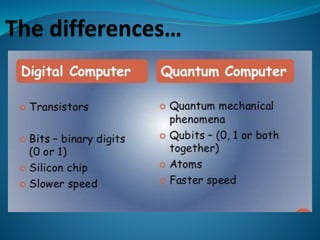
 The differences
 What is a qubit?
 Quantum properties used…
 Conclusion
Quantum computing is the area of study focused
on developing computer technology based on the
principles of quantum theory, which explains the
nature and behavior of energy and matter on the
quantum (atomic and subatomic) level.
Computers based on this theory are so smaller
and faster than digital computers.
 Calculation based on the laws of Quantum Mechanics.
 Uses Quantum Mechanical Phenomena to perform
operations on data.
 Operations done at an atomic/sub-atomic level.
 Many kinds of numerical problems like algorithms cannot
be solved using digital computers.
 Requirement of faster technology
 Requirement of smaller calculating devices
 National security require advance supercomputers
 Require advanced technology for civilian, business, trade,
environmental.
A quantum computer is a machine that performs calculations
based on the laws of quantum mechanics, which is the
behavior of particles at the sub-atomic level. A Quantum is a
smallest possible discrete unit of any physical property
Quantum Computing. Computation depends on principle of
quantum theory
In a 3-bit register of a classical computer one of the eight
numbers can be stored, but in a quantum register all eight
numbers can be stored in one register at the same time and
operated on simultaneously.
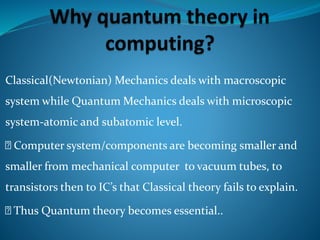
Classical(Newtonian) Mechanics deals with macroscopic
system while Quantum Mechanics deals with microscopic
system-atomic and subatomic level.
Computer system/components are becoming smaller and
smaller from mechanical computer to vacuum tubes, to
transistors then to IC’s that Classical theory fails to explain.
Thus Quantum theory becomes essential..
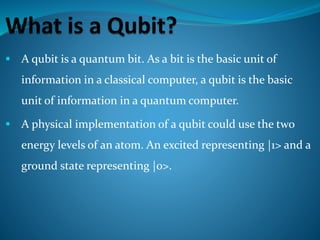
 A qubit is a quantum bit. As a bit is the basic unit of
information in a classical computer, a qubit is the basic
unit of information in a quantum computer.
 A physical implementation of a qubit could use the two
energy levels of an atom. An excited representing |1> and a
ground state representing |0>.
 The biggest problem.
 States that if a coherent (superposed) state interacts with
the environment, it falls into a classical state without
superposition.
 So quantum computer to work with superposed states, it
has to be completely isolated from the rest of the universe
(not observing the state, not measuring it..)
 Most important property in quantum information.
 States that two or more particles can be linked, and if
linked, can change properties of particle(s) changing the
linked one.
 Two particles can be linked and changed each other
without interaction.
 Quantum systems are so small.
 It is impossible to measure all properties of a Quantum
system without disturbing it.
 As a result there is no way of accurately predicting all the
properties of a particle in a Quantum System.
 Quantum computer has more to offer.
 Advantages outweighs disadvantages.
 Wide range of applications.
What is quantum computing

What is quantum computing

  • 1.
    PREPARED BY : MARIYUMKHAN 15-CAB-421 GI8037 BCA(V SEM)
  • 2.
     What isquantum computing?  Requirements of quantum computing  What is a quantum computer?  How quantum computer works?  Why quantum theory in computing?  The differences  What is a qubit?  Quantum properties used…  Conclusion
  • 3.
    Quantum computing isthe area of study focused on developing computer technology based on the principles of quantum theory, which explains the nature and behavior of energy and matter on the quantum (atomic and subatomic) level. Computers based on this theory are so smaller and faster than digital computers.
  • 4.
     Calculation basedon the laws of Quantum Mechanics.  Uses Quantum Mechanical Phenomena to perform operations on data.  Operations done at an atomic/sub-atomic level.
  • 5.
     Many kindsof numerical problems like algorithms cannot be solved using digital computers.  Requirement of faster technology  Requirement of smaller calculating devices  National security require advance supercomputers  Require advanced technology for civilian, business, trade, environmental.
  • 6.
    A quantum computeris a machine that performs calculations based on the laws of quantum mechanics, which is the behavior of particles at the sub-atomic level. A Quantum is a smallest possible discrete unit of any physical property Quantum Computing. Computation depends on principle of quantum theory
  • 7.
    In a 3-bitregister of a classical computer one of the eight numbers can be stored, but in a quantum register all eight numbers can be stored in one register at the same time and operated on simultaneously.
  • 8.
    Classical(Newtonian) Mechanics dealswith macroscopic system while Quantum Mechanics deals with microscopic system-atomic and subatomic level. Computer system/components are becoming smaller and smaller from mechanical computer to vacuum tubes, to transistors then to IC’s that Classical theory fails to explain. Thus Quantum theory becomes essential..
  • 10.
     A qubitis a quantum bit. As a bit is the basic unit of information in a classical computer, a qubit is the basic unit of information in a quantum computer.  A physical implementation of a qubit could use the two energy levels of an atom. An excited representing |1> and a ground state representing |0>.
  • 12.
     The biggestproblem.  States that if a coherent (superposed) state interacts with the environment, it falls into a classical state without superposition.  So quantum computer to work with superposed states, it has to be completely isolated from the rest of the universe (not observing the state, not measuring it..)
  • 13.
     Most importantproperty in quantum information.  States that two or more particles can be linked, and if linked, can change properties of particle(s) changing the linked one.  Two particles can be linked and changed each other without interaction.
  • 14.
     Quantum systemsare so small.  It is impossible to measure all properties of a Quantum system without disturbing it.  As a result there is no way of accurately predicting all the properties of a particle in a Quantum System.
  • 15.
     Quantum computerhas more to offer.  Advantages outweighs disadvantages.  Wide range of applications.