Quantu
m
Computi
ng
PresentedBy:
SunilAcharya
(21/533)
 CONTENT
• Introduction
• History
• Why quantum computer
• What special about quantum computer
• Applications of quantum computer
• Problems
• Advantages
• Disadvantages
• Conclusion
QUANTUM
COMPUTERS
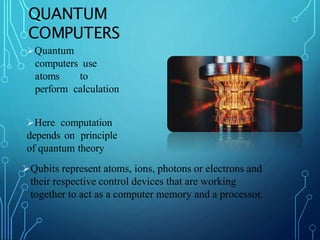
Quantum
computers use
atoms to
perform calculation
Here computation
depends on principle
of quantum theory
Qubits represent atoms, ions, photons or electrons and
their respective control devices that are working
together to act as a computer memory and a processor.
 FEATURES OF QUANTUM
COMPUTING
 Superposition
• It is what a qubit can do rather than what it is that's remarkable. A qubit places the
quantum information that it contains into a state of superposition. This refers to a
combination of all possible configurations of the qubit. "Groups of qubits in
superposition can create complex, multidimensional computational spaces.
Complex problems can be represented in new ways in these spaces.”
 Entanglement
• Entanglement is integral to quantum computing power. Pairs of qubits can be made
to become entangled. This means that the two qubits then exist in a single state. In
such a state, changing one qubit directly affects the other in a manner that's
predictable.
 Decoherence
• Decoherence occurs when the quantum behavior of qubits decays. The quantum
state can be disturbed instantly by vibrations or temperature changes. This can
cause qubits to fall out of superposition and cause errors to appear in computing.
Interference
• In an environment of entangled qubits placed into a state of superposition, there are waves
of probabilities. These are the probabilities of the outcomes of a measurement of the system.
These waves can build on each other when many of them peak at a particular outcome, or
cancel each other out when peaks and troughs interact. These are both forms of
interference.
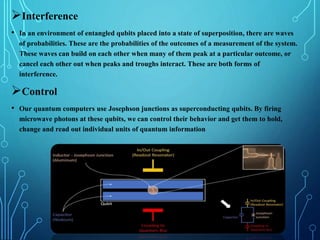
Control
• Our quantum computers use Josephson junctions as superconducting qubits. By firing
microwave photons at these qubits, we can control their behavior and get them to hold,
change and read out individual units of quantum information
 HISTORY
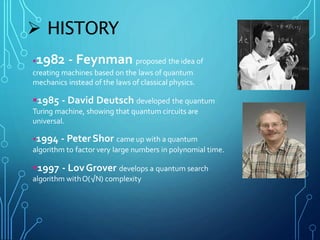
1982 - Feynman proposed the idea of
creating machines based on the laws of quantum
mechanics instead of the laws of classical physics.
1985 - David Deutsch developed the quantum
Turing machine, showing that quantum circuits are
universal.
1994 - Peter Shor came up with a quantum
algorithm to factor very large numbers in polynomial time.
1997 - LovGrover develops a quantum search
algorithm withO(√N) complexity
WHY QUANTUM
COMPUTER
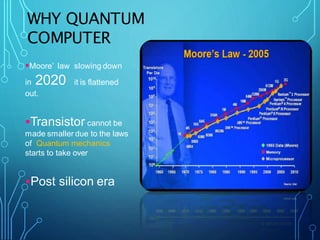
Moore’ law slowing down
it is flattened
in 2020
out.
Transistor cannot be
made smaller due to the laws
of Quantum mechanics
starts to take over
Post silicon era
QUANTUM COMPUTER VS. CLASSICAL
COMPUTER
 Quantum computers have a more basic structure than classical
computers. They have no memory or processor. All a quantum
computer uses is a set of superconducting qubits.
 Quantum computers and classical computers process information
differently. A quantum computer uses qubits to run
multidimensional quantum algorithms. Their processing power
increases exponentially as qubits are added.
 Classical computers are best for everyday tasks and have low error
rates. Quantum computers are ideal for a higher level of task, e.g.,
running simulations, analyzing data (such as for chemical or drug
trials), creating energy-efficient batteries.
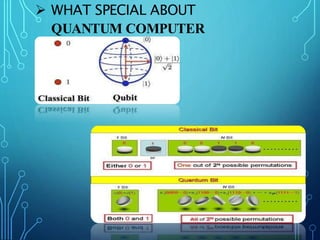
 WHAT SPECIAL ABOUT
QUANTUM COMPUTER
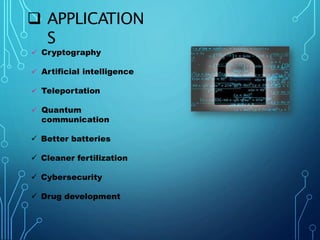
 APPLICATION
S
 Cryptography
 Artificial intelligence
 Teleportation
 Quantum
communication
 Better batteries
 Cleaner fertilization
 Cybersecurity
 Drug development
 ADVANTAGES
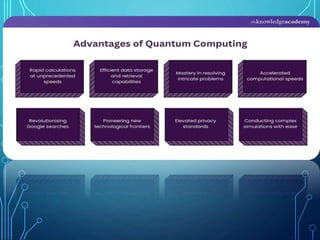
 Faster computations:-
These type of computers can perform computation at a much faster rate
than normal computers. Quantum computers have computation power
higher than supercomputers also.They can process data at 1000 times
faster than normal computers andsupercomputers. Some calculationsif
performed by a normal computer can take 1000 years is done by
quantumcomputersina few seconds.
 Best for simulation:-
Quantum computers are best for doing data simulation computing.
There are many algorithmscreated that can simulate various thingslike
weather forecasting, chemical simulationetc.
ADVANTAGES CONT.
 Medicine creation:-
These type of computers can work better in the medical field.Theycan
detect diseases and can create a formula for medicines. Different type of
diseases can be diagnosedand tested in scientific laboratoriesusing these
computers.
 Google search:-
Quantum computers are used by Google to refine searches. Now every
search onGoogle can speed up by using these computers. Most relevant
results can be populatedusing quantum computing.
 High privacy:-
These computers can make highencryption and is good at cryptography.It
is impossibleto break the security of quantum computers. RecentlyChina
has launched a satellitethat uses quantumcomputing andchina claimed
that this satellitecannotbe hacked.
 DISADVANTAGES
 Algorithm creation:-
For every type of computation,it needs to write a new algorithm.
Quantum computers cannot work as classical computers, they need
special algorithmsto perform tasks in their environment.
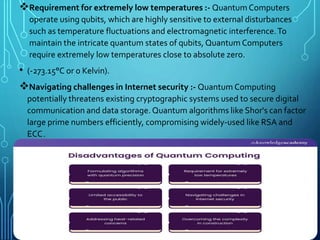
 The low temperature needed:-
As the processing in these computers is done very deeply so it needs a
temperature of negative 460 degrees F.This is the lowest temperature
of the universe and it is very difficult to maintainthat temperature.
 Not open for public:-
Due to the high range price they are not available for public use. Also,
the errors in these type of computers are high because they are still in
the development phase.Quantum computers work fine in 10 qubitsbut
after increasing qubitslike70 qubits, the accuracy is notright.
Requirement for extremely low temperatures :- Quantum Computers
operate using qubits, which are highly sensitive to external disturbances
such as temperature fluctuations and electromagnetic interference.To
maintain the intricate quantum states of qubits, Quantum Computers
require extremely low temperatures close to absolute zero.
• (-273.15°C or 0 Kelvin).
Navigating challenges in Internet security :- Quantum Computing
potentially threatens existing cryptographic systems used to secure digital
communication and data storage.Quantum algorithms like Shor's can factor
large prime numbers efficiently, compromising widely-used like RSA and
ECC.
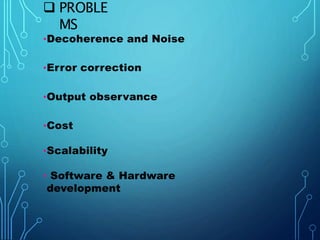
 PROBLE
MS
•Decoherence and Noise
•Error correction
•Output observance
•Cost
•Scalability
• Software & Hardware
development
QUANTUM COMPUTERS IN
DEVELOPMENT
 Google
Google is spending billions of dollars to build its quantum computer by 2029. The company opened a campus
in California called Google AI to help it meet this goal. Once developed, Google could launch a quantum
computing service via the cloud.
 IBM
BM plans to have a 1,000-qubit quantum computer in place by 2023. For now, IBM allows access to its
machines for those research organizations, universities, and laboratories that are part of its Quantum Network.
 Microsoft
Microsoft offers companies access to quantum technology via the Azure Quantum platform.
 There’s interest in quantum computing and its technology from financial services firms such as JPMorgan
Chase and Visa.
 CONCLUSION
 Quantum computing is a new technology that could
revolutionize computation. Quantum computers have the
potential to revolutionizecomputation by making certain
types of classically intractable problems solvable.
 While no quantum computer is yet sophisticated
enough to carry out calculations that a classical
computer can't, great progress is under way.
 In conclusion, exploring the Advantages and
Disadvantages of Quantum Computing unveils both
the transformative potential and the challenges
associated with this revolutionary technology. While
its benefits promise to reshape industries,
addressing its limitations will be crucial for realizing
its full potential in the digital age
 REFERENCE
 www.google.com
 www.wikipedia.org
 https://www.umsl.edu
 https://www.telecomtv.com/
 https://www.investopedia.com
THANK YOU

quantum computer -Quantum-Computing-ppt new.pptx

  • 1.
  • 2.
     CONTENT • Introduction •History • Why quantum computer • What special about quantum computer • Applications of quantum computer • Problems • Advantages • Disadvantages • Conclusion
  • 3.
    QUANTUM COMPUTERS Quantum computers use atoms to performcalculation Here computation depends on principle of quantum theory Qubits represent atoms, ions, photons or electrons and their respective control devices that are working together to act as a computer memory and a processor.
  • 4.
     FEATURES OFQUANTUM COMPUTING  Superposition • It is what a qubit can do rather than what it is that's remarkable. A qubit places the quantum information that it contains into a state of superposition. This refers to a combination of all possible configurations of the qubit. "Groups of qubits in superposition can create complex, multidimensional computational spaces. Complex problems can be represented in new ways in these spaces.”  Entanglement • Entanglement is integral to quantum computing power. Pairs of qubits can be made to become entangled. This means that the two qubits then exist in a single state. In such a state, changing one qubit directly affects the other in a manner that's predictable.  Decoherence • Decoherence occurs when the quantum behavior of qubits decays. The quantum state can be disturbed instantly by vibrations or temperature changes. This can cause qubits to fall out of superposition and cause errors to appear in computing.
  • 5.
    Interference • In anenvironment of entangled qubits placed into a state of superposition, there are waves of probabilities. These are the probabilities of the outcomes of a measurement of the system. These waves can build on each other when many of them peak at a particular outcome, or cancel each other out when peaks and troughs interact. These are both forms of interference. Control • Our quantum computers use Josephson junctions as superconducting qubits. By firing microwave photons at these qubits, we can control their behavior and get them to hold, change and read out individual units of quantum information
  • 6.
     HISTORY 1982 -Feynman proposed the idea of creating machines based on the laws of quantum mechanics instead of the laws of classical physics. 1985 - David Deutsch developed the quantum Turing machine, showing that quantum circuits are universal. 1994 - Peter Shor came up with a quantum algorithm to factor very large numbers in polynomial time. 1997 - LovGrover develops a quantum search algorithm withO(√N) complexity
  • 7.
    WHY QUANTUM COMPUTER Moore’ lawslowing down it is flattened in 2020 out. Transistor cannot be made smaller due to the laws of Quantum mechanics starts to take over Post silicon era
  • 8.
    QUANTUM COMPUTER VS.CLASSICAL COMPUTER  Quantum computers have a more basic structure than classical computers. They have no memory or processor. All a quantum computer uses is a set of superconducting qubits.  Quantum computers and classical computers process information differently. A quantum computer uses qubits to run multidimensional quantum algorithms. Their processing power increases exponentially as qubits are added.  Classical computers are best for everyday tasks and have low error rates. Quantum computers are ideal for a higher level of task, e.g., running simulations, analyzing data (such as for chemical or drug trials), creating energy-efficient batteries.
  • 9.
     WHAT SPECIALABOUT QUANTUM COMPUTER
  • 10.
     APPLICATION S  Cryptography Artificial intelligence  Teleportation  Quantum communication  Better batteries  Cleaner fertilization  Cybersecurity  Drug development
  • 11.
     ADVANTAGES  Fastercomputations:- These type of computers can perform computation at a much faster rate than normal computers. Quantum computers have computation power higher than supercomputers also.They can process data at 1000 times faster than normal computers andsupercomputers. Some calculationsif performed by a normal computer can take 1000 years is done by quantumcomputersina few seconds.  Best for simulation:- Quantum computers are best for doing data simulation computing. There are many algorithmscreated that can simulate various thingslike weather forecasting, chemical simulationetc.
  • 12.
    ADVANTAGES CONT.  Medicinecreation:- These type of computers can work better in the medical field.Theycan detect diseases and can create a formula for medicines. Different type of diseases can be diagnosedand tested in scientific laboratoriesusing these computers.  Google search:- Quantum computers are used by Google to refine searches. Now every search onGoogle can speed up by using these computers. Most relevant results can be populatedusing quantum computing.  High privacy:- These computers can make highencryption and is good at cryptography.It is impossibleto break the security of quantum computers. RecentlyChina has launched a satellitethat uses quantumcomputing andchina claimed that this satellitecannotbe hacked.
  • 14.
     DISADVANTAGES  Algorithmcreation:- For every type of computation,it needs to write a new algorithm. Quantum computers cannot work as classical computers, they need special algorithmsto perform tasks in their environment.  The low temperature needed:- As the processing in these computers is done very deeply so it needs a temperature of negative 460 degrees F.This is the lowest temperature of the universe and it is very difficult to maintainthat temperature.  Not open for public:- Due to the high range price they are not available for public use. Also, the errors in these type of computers are high because they are still in the development phase.Quantum computers work fine in 10 qubitsbut after increasing qubitslike70 qubits, the accuracy is notright.
  • 15.
    Requirement for extremelylow temperatures :- Quantum Computers operate using qubits, which are highly sensitive to external disturbances such as temperature fluctuations and electromagnetic interference.To maintain the intricate quantum states of qubits, Quantum Computers require extremely low temperatures close to absolute zero. • (-273.15°C or 0 Kelvin). Navigating challenges in Internet security :- Quantum Computing potentially threatens existing cryptographic systems used to secure digital communication and data storage.Quantum algorithms like Shor's can factor large prime numbers efficiently, compromising widely-used like RSA and ECC.
  • 16.
     PROBLE MS •Decoherence andNoise •Error correction •Output observance •Cost •Scalability • Software & Hardware development
  • 17.
    QUANTUM COMPUTERS IN DEVELOPMENT Google Google is spending billions of dollars to build its quantum computer by 2029. The company opened a campus in California called Google AI to help it meet this goal. Once developed, Google could launch a quantum computing service via the cloud.  IBM BM plans to have a 1,000-qubit quantum computer in place by 2023. For now, IBM allows access to its machines for those research organizations, universities, and laboratories that are part of its Quantum Network.  Microsoft Microsoft offers companies access to quantum technology via the Azure Quantum platform.  There’s interest in quantum computing and its technology from financial services firms such as JPMorgan Chase and Visa.
  • 18.
     CONCLUSION  Quantumcomputing is a new technology that could revolutionize computation. Quantum computers have the potential to revolutionizecomputation by making certain types of classically intractable problems solvable.  While no quantum computer is yet sophisticated enough to carry out calculations that a classical computer can't, great progress is under way.  In conclusion, exploring the Advantages and Disadvantages of Quantum Computing unveils both the transformative potential and the challenges associated with this revolutionary technology. While its benefits promise to reshape industries, addressing its limitations will be crucial for realizing its full potential in the digital age
  • 19.
     REFERENCE  www.google.com www.wikipedia.org  https://www.umsl.edu  https://www.telecomtv.com/  https://www.investopedia.com
  • 20.