QSAR- simplified
M H Ghante
Asst prof
Dept of Pharmacy
GGV, Bilaspur
What is QSAR
• A QSAR relates a numerical description of molecular structure or
properties to known biological activity
• Activity = f (molecular descriptors)
• Success of QSAR: right descriptors + right method (form of f )
• A QSAR should be
• explanatory (for structures with activity data)
• predictive (for structures without activity data)
• A QSAR can be used to explain or optimise:
• localised properties of molecules such as binding properties
• whole molecule properties such as uptake and distribution
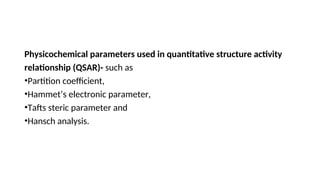
Physicochemical parameters used in quantitative structure activity
relationship (QSAR)- such as
•Partition coefficient,
•Hammet’s electronic parameter,
•Tafts steric parameter and
•Hansch analysis.
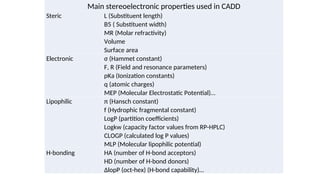
Main stereoelectronic properties used in CADD
Steric L (Substituent length)
B5 ( Substituent width)
MR (Molar refractivity)
Volume
Surface area
Electronic σ (Hammet constant)
F, R (Field and resonance parameters)
pKa (Ionization constants)
q (atomic charges)
MEP (Molecular Electrostatic Potential)…
Lipophilic π (Hansch constant)
f (Hydrophic fragmental constant)
LogP (partition coefficients)
Logkw (capacity factor values from RP-HPLC)
CLOGP (calculated log P values)
MLP (Molecular lipophilic potential)
H-bonding HA (number of H-bond acceptors)
HD (number of H-bond donors)
ΔlopP (oct-hex) (H-bond capability)…

Quantitative SAR basics for drug discovery .ppt

  • 1.
    QSAR- simplified M HGhante Asst prof Dept of Pharmacy GGV, Bilaspur
  • 2.
    What is QSAR •A QSAR relates a numerical description of molecular structure or properties to known biological activity • Activity = f (molecular descriptors) • Success of QSAR: right descriptors + right method (form of f ) • A QSAR should be • explanatory (for structures with activity data) • predictive (for structures without activity data) • A QSAR can be used to explain or optimise: • localised properties of molecules such as binding properties • whole molecule properties such as uptake and distribution
  • 3.
    Physicochemical parameters usedin quantitative structure activity relationship (QSAR)- such as •Partition coefficient, •Hammet’s electronic parameter, •Tafts steric parameter and •Hansch analysis.
  • 4.
    Main stereoelectronic propertiesused in CADD Steric L (Substituent length) B5 ( Substituent width) MR (Molar refractivity) Volume Surface area Electronic σ (Hammet constant) F, R (Field and resonance parameters) pKa (Ionization constants) q (atomic charges) MEP (Molecular Electrostatic Potential)… Lipophilic π (Hansch constant) f (Hydrophic fragmental constant) LogP (partition coefficients) Logkw (capacity factor values from RP-HPLC) CLOGP (calculated log P values) MLP (Molecular lipophilic potential) H-bonding HA (number of H-bond acceptors) HD (number of H-bond donors) ΔlopP (oct-hex) (H-bond capability)…