Anti bacterial
Antibiotics
HumanlivesVsMicroorganism
AntibioticsVsInfections
B Pharm VI sem- Medicinal Chemistry-III
Contents
• Introduction
• Classification of Antibiotics
• General structure of β-lactam antibiotics
• Structural Comparison of penicillins &
cephalosporin
• Common SAR features
• SAR of penicillins & cephalosporins
• Summary of β-lactam and subclass
Antibiotics
• Antibiosis (literally “against life”) as the biological concept of
survival of the fittest, in which one organism destroys another to
preserve itself.
• In 1942, Waksman defined “an antibiotic or antibiotic substance is
a substance produced by microorganisms, which has the capacity
of inhibiting the growth and even of destroying other
microorganisms.”
Antibiotics
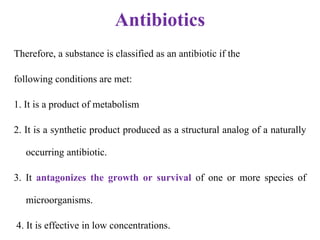
Therefore, a substance is classified as an antibiotic if the
following conditions are met:
1. It is a product of metabolism
2. It is a synthetic product produced as a structural analog of a naturally
occurring antibiotic.
3. It antagonizes the growth or survival of one or more species of
microorganisms.
4. It is effective in low concentrations.
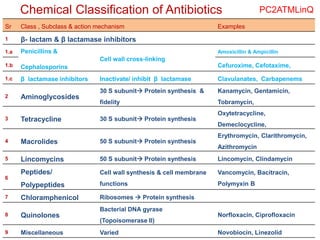
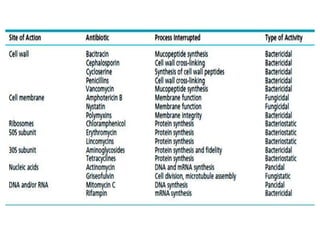
Chemical Classification of Antibiotics
Sr Class , Subclass & action mechanism Examples
1 β- lactam & β lactamase inhibitors
1.a Penicillins &
Cephalosporins
Cell wall cross-linking
Amoxicillin & Ampicillin
1.b Cefuroxime, Cefotaxime,
1.c β lactamase inhibitors Inactivate/ inhibit β lactamase Clavulanates, Carbapenems
2 Aminoglycosides
30 S subunit Protein synthesis &
fidelity
Kanamycin, Gentamicin,
Tobramycin,
3 Tetracycline 30 S subunit Protein synthesis
Oxytetracycline,
Demeclocycline,
4 Macrolides 50 S subunit Protein synthesis
Erythromycin, Clarithromycin,
Azithromycin
5 Lincomycins 50 S subunit Protein synthesis Lincomycin, Clindamycin
6
Peptides/
Polypeptides
Cell wall synthesis & cell membrane
functions
Vancomycin, Bacitracin,
Polymyxin B
7 Chloramphenicol Ribosomes  Protein synthesis
8 Quinolones
Bacterial DNA gyrase
(Topoisomerase II)
Norfloxacin, Ciprofloxacin
9 Miscellaneous Varied Novobiocin, Linezolid
PC2ATMLinQ
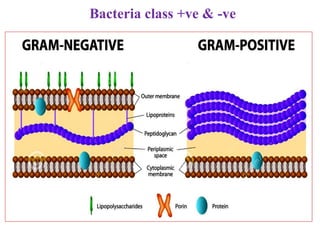
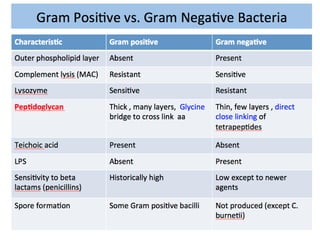
Bacteria class +ve & -ve
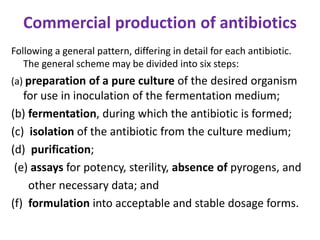
Commercial production of antibiotics
Following a general pattern, differing in detail for each antibiotic.
The general scheme may be divided into six steps:
(a) preparation of a pure culture of the desired organism
for use in inoculation of the fermentation medium;
(b) fermentation, during which the antibiotic is formed;
(c) isolation of the antibiotic from the culture medium;
(d) purification;
(e) assays for potency, sterility, absence of pyrogens, and
other necessary data; and
(f) formulation into acceptable and stable dosage forms.
β- Lactam Antibiotics
{Chemistry & SAR}
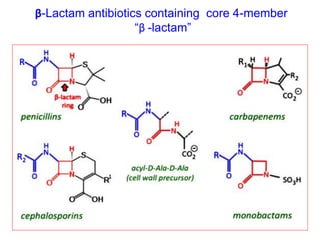
β-Lactam antibiotics containing core 4-member
“β -lactam”
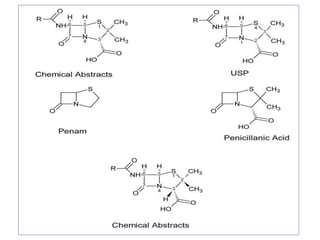
Comparison of β- lactam antibiotics
4-thia-1-azabicyclo [3.2.0] heptanes 5-thia-1-azabicyclo [4.2.0] oct-2-ene
6-carbonylaminopenicillanic acid
(6-APA)
7-acylaminocephalosporanic acid
(7-ACA)
β-Lactam Antibiotics
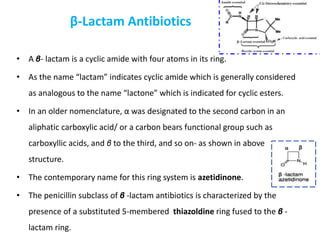
• A β- lactam is a cyclic amide with four atoms in its ring.
• As the name “lactam” indicates cyclic amide which is generally considered
as analogous to the name “lactone” which is indicated for cyclic esters.
• In an older nomenclature, α was designated to the second carbon in an
aliphatic carboxylic acid/ or a carbon bears functional group such as
carboxyllic acids, and β to the third, and so on- as shown in above
structure.
• The contemporary name for this ring system is azetidinone.
• The penicillin subclass of β -lactam antibiotics is characterized by the
presence of a substituted 5-membered thiazoldine ring fused to the β -
lactam ring.
•The Chemical Abstracts system initiates the numbering with the sulfur atom and
assigns the ring nitrogen the 4-position.
•Thus, penicillins are named as 4-thia-l-azabicyclo[3.2.0]heptanes,
•The numbering system adopted by the USP is number 1 to the nitrogen atom and
number 4 to the sulfur atom.
•The penicillin molecule contains three chiral carbon atoms (C-3, C-5, and C-6).
•The carbon atom bearing the acylamino group (C-6) has the L configuration,
whereas the carbon to which the carboxyl group is attached has the D configuration.
Thus, the acylamino and carboxyl groups are trans to each other,
•The absolute stereochemistry of the penicillins is designated as 3S:5R:6R,
Units & potency
• The procedure for assay was developed at Oxford, England, and the value
became known as the
• Oxford unit: 1 Oxford unit is defined as the smallest amount of penicillin
that will inhibit, in vitro, the growth of a strain of Staphylococcus in 50 mL
of culture medium under specified conditions.
• United States Pharmacopoeia (USP) defines unit as the antibiotic activity
of 0.6 g of penicillin G sodium reference standard.
– 1 mg of penicillin G sodium is equivalent to 1,667 units,
– 1 mg of penicillin G procaine is equivalent to 1,009 units, and 1
– mg of penicillin G potassium is equivalent to 1,530 units.
β-Lactam Antibiotics
PENICILLINS
• Benzyl penicillins
– Penicillin G
• benzylpenicillin sodium,
• Procaine benzylpenicillin,
• Benzathine penicillin
• Phenoxy-penicillins (oral penicillins)
– Penicillin V
– Propicillin
• Penicillinase resistant penicillins (anti-staphylococcal penicillins)
– Oxacillin
– Dicloxacillin
– Flucloxacillin
• Aminobenzyl penicillins
– Ampicillin
– Amoxicillin
• Ureidopenicillins (broad-spectrum penicillins)
– Mezlocillin
– Piperacillin
• ß-Lactam/ ß-lactamase inhibitors
– sulbactam & Ampicillin
– Clavulanate & Amoxicillin
– Tazobactam & Piperacillin
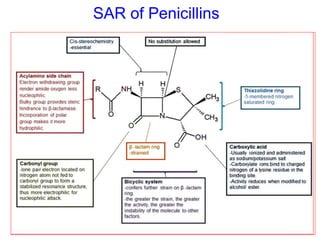
SAR of Penicillins
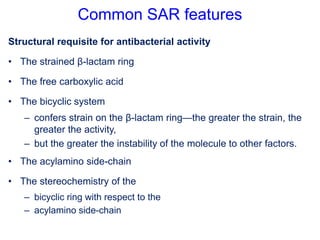
Common SAR features
Structural requisite for antibacterial activity
• The strained β-lactam ring
• The free carboxylic acid
• The bicyclic system
– confers strain on the β-lactam ring—the greater the strain, the
greater the activity,
– but the greater the instability of the molecule to other factors.
• The acylamino side-chain
• The stereochemistry of the
– bicyclic ring with respect to the
– acylamino side-chain
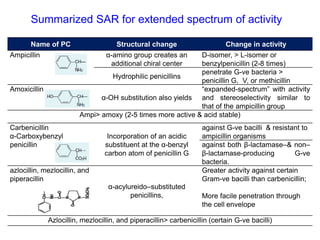
Summarized SAR for extended spectrum of activity
Name of PC Structural change Change in activity
Ampicillin α-amino group creates an
additional chiral center
D-isomer, > L-isomer or
benzylpenicillin (2-8 times)
Hydrophilic penicillins
penetrate G-ve bacteria >
penicillin G, V, or methicillin
Amoxicillin
α-OH substitution also yields
“expanded-spectrum” with activity
and stereoselectivity similar to
that of the ampicillin group
Ampi> amoxy (2-5 times more active & acid stable)
Carbenicillin
α-Carboxybenzyl
penicillin
Incorporation of an acidic
substituent at the α-benzyl
carbon atom of penicillin G
against G-ve bacilli & resistant to
ampicillin organisms
against both β-lactamase–& non–
β-lactamase-producing G-ve
bacteria.
azlocillin, mezlocillin, and
piperacillin
α-acylureido–substituted
penicillins,
Greater activity against certain
Gram-ve bacilli than carbenicillin;
More facile penetration through
the cell envelope
Azlocillin, mezlocillin, and piperacillin> carbenicillin (certain G-ve bacilli)
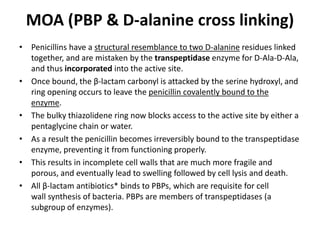
MOA (PBP & D-alanine cross linking)
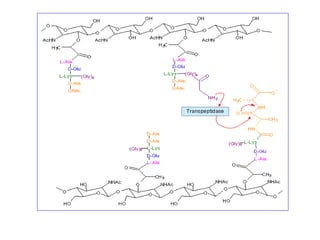
• Penicillins have a structural resemblance to two D-alanine residues linked
together, and are mistaken by the transpeptidase enzyme for D-Ala-D-Ala,
and thus incorporated into the active site.
• Once bound, the β-lactam carbonyl is attacked by the serine hydroxyl, and
ring opening occurs to leave the penicillin covalently bound to the
enzyme.
• The bulky thiazolidene ring now blocks access to the active site by either a
pentaglycine chain or water.
• As a result the penicillin becomes irreversibly bound to the transpeptidase
enzyme, preventing it from functioning properly.
• This results in incomplete cell walls that are much more fragile and
porous, and eventually lead to swelling followed by cell lysis and death.
• All β-lactam antibiotics* binds to PBPs, which are requisite for cell
wall synthesis of bacteria. PBPs are members of transpeptidases (a
subgroup of enzymes).
Different classes of PBP’s & their role in
bacterial cell wall synthesis
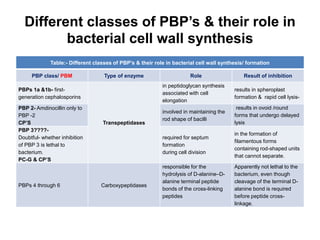
Table:- Different classes of PBP’s & their role in bacterial cell wall synthesis/ formation
PBP class/ PBM Type of enzyme Role Result of inhibition
PBPs 1a &1b- first-
generation cephalosporins
Transpeptidases
in peptidoglycan synthesis
associated with cell
elongation
results in spheroplast
formation & rapid cell lysis-
PBP 2- Amdinocillin only to
PBP -2
CP’S
involved in maintaining the
rod shape of bacilli
results in ovoid /round
forms that undergo delayed
lysis
PBP 3????-
Doubtful- whether inhibition
of PBP 3 is lethal to
bacterium.
PC-G & CP’S
required for septum
formation
during cell division
in the formation of
filamentous forms
containing rod-shaped units
that cannot separate.
PBPs 4 through 6 Carboxypeptidases
responsible for the
hydrolysis of D-alanine–D-
alanine terminal peptide
bonds of the cross-linking
peptides
Apparently not lethal to the
bacterium, even though
cleavage of the terminal D-
alanine bond is required
before peptide cross-
linkage.
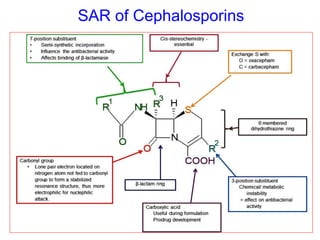
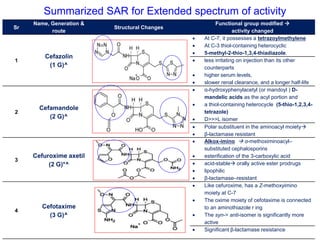
SAR of Cephalosporins
Sr
Name, Generation &
route
Structural Changes
Functional group modified 
activity changed
1
Cefazolin
(1 G)^
 At C-7, it possesses a tetrazoylmethylene
 At C-3 thiol-containing heterocyclic
 5-methyl-2-thio-1,3,4-thiadiazole.
 less irritating on injection than its other
counterparts
 higher serum levels,
 slower renal clearance, and a longer half-life
2
Cefamandole
(2 G)^
 α-hydroxyphenylacetyl (or mandoyl ) D-
mandelic acids as the acyl portion and
 a thiol-containing heterocycle (5-thio-1,2,3,4-
tetrazole)
 D>>>L isomer
 Polar substituent in the aminoacyl moiety
 β-lactamase resistant
3
Cefuroxime axetil
(2 G)*^
 Alkox-imino  α-methoximinoacyl–
substituted cephalosporins
 esterification of the 3-carboxylic acid
 acid-stable orally active ester prodrugs
 lipophilic
 β-lactamase–resistant
4
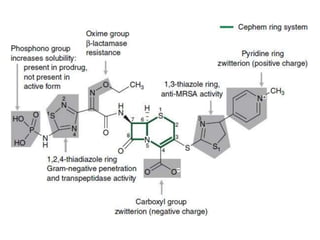
Cefotaxime
(3 G)^
 Like cefuroxime, has a Z-methoxyimino
moiety at C-7
 The oxime moiety of cefotaxime is connected
to an aminothiazole r ing
 The syn-> anti-isomer is significantly more
active
 Significant β-lactamase resistance
Summarized SAR for Extended spectrum of activity
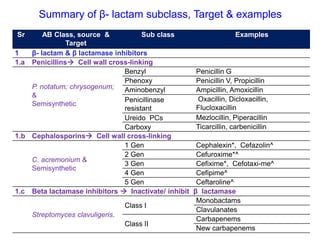
Summary of β- lactam subclass, Target & examples
Sr AB Class, source &
Target
Sub class Examples
1 β- lactam & β lactamase inhibitors
1.a Penicillins Cell wall cross-linking
P. notatum; chrysogenum;
&
Semisynthetic
Benzyl Penicillin G
Phenoxy Penicillin V, Propicillin
Aminobenzyl Ampicillin, Amoxicillin
Penicillinase
resistant
Oxacillin, Dicloxacillin,
Flucloxacillin
Ureido PCs Mezlocillin, Piperacillin
Carboxy Ticarcillin, carbenicillin
1.b Cephalosporins Cell wall cross-linking
C. acremonium &
Semisynthetic
1 Gen Cephalexin*, Cefazolin^
2 Gen Cefuroxime*^
3 Gen Cefixime*, Cefotaxi-me^
4 Gen Cefipime^
5 Gen Ceftaroline^
1.c Beta lactamase inhibitors  Inactivate/ inhibit β lactamase
Streptomyces clavuligeris.
Class I
Monobactams
Clavulanates
Class II
Carbapenems
New carbapenems
Beta lactam Antibiotics .ppt

Beta lactam Antibiotics .ppt

  • 1.
  • 2.
    Contents • Introduction • Classificationof Antibiotics • General structure of β-lactam antibiotics • Structural Comparison of penicillins & cephalosporin • Common SAR features • SAR of penicillins & cephalosporins • Summary of β-lactam and subclass
  • 3.
    Antibiotics • Antibiosis (literally“against life”) as the biological concept of survival of the fittest, in which one organism destroys another to preserve itself. • In 1942, Waksman defined “an antibiotic or antibiotic substance is a substance produced by microorganisms, which has the capacity of inhibiting the growth and even of destroying other microorganisms.”
  • 4.
    Antibiotics Therefore, a substanceis classified as an antibiotic if the following conditions are met: 1. It is a product of metabolism 2. It is a synthetic product produced as a structural analog of a naturally occurring antibiotic. 3. It antagonizes the growth or survival of one or more species of microorganisms. 4. It is effective in low concentrations.
  • 5.
    Chemical Classification ofAntibiotics Sr Class , Subclass & action mechanism Examples 1 β- lactam & β lactamase inhibitors 1.a Penicillins & Cephalosporins Cell wall cross-linking Amoxicillin & Ampicillin 1.b Cefuroxime, Cefotaxime, 1.c β lactamase inhibitors Inactivate/ inhibit β lactamase Clavulanates, Carbapenems 2 Aminoglycosides 30 S subunit Protein synthesis & fidelity Kanamycin, Gentamicin, Tobramycin, 3 Tetracycline 30 S subunit Protein synthesis Oxytetracycline, Demeclocycline, 4 Macrolides 50 S subunit Protein synthesis Erythromycin, Clarithromycin, Azithromycin 5 Lincomycins 50 S subunit Protein synthesis Lincomycin, Clindamycin 6 Peptides/ Polypeptides Cell wall synthesis & cell membrane functions Vancomycin, Bacitracin, Polymyxin B 7 Chloramphenicol Ribosomes  Protein synthesis 8 Quinolones Bacterial DNA gyrase (Topoisomerase II) Norfloxacin, Ciprofloxacin 9 Miscellaneous Varied Novobiocin, Linezolid PC2ATMLinQ
  • 8.
  • 10.
    Commercial production ofantibiotics Following a general pattern, differing in detail for each antibiotic. The general scheme may be divided into six steps: (a) preparation of a pure culture of the desired organism for use in inoculation of the fermentation medium; (b) fermentation, during which the antibiotic is formed; (c) isolation of the antibiotic from the culture medium; (d) purification; (e) assays for potency, sterility, absence of pyrogens, and other necessary data; and (f) formulation into acceptable and stable dosage forms.
  • 12.
  • 13.
    β-Lactam antibiotics containingcore 4-member “β -lactam”
  • 14.
    Comparison of β-lactam antibiotics 4-thia-1-azabicyclo [3.2.0] heptanes 5-thia-1-azabicyclo [4.2.0] oct-2-ene 6-carbonylaminopenicillanic acid (6-APA) 7-acylaminocephalosporanic acid (7-ACA)
  • 15.
    β-Lactam Antibiotics • Aβ- lactam is a cyclic amide with four atoms in its ring. • As the name “lactam” indicates cyclic amide which is generally considered as analogous to the name “lactone” which is indicated for cyclic esters. • In an older nomenclature, α was designated to the second carbon in an aliphatic carboxylic acid/ or a carbon bears functional group such as carboxyllic acids, and β to the third, and so on- as shown in above structure. • The contemporary name for this ring system is azetidinone. • The penicillin subclass of β -lactam antibiotics is characterized by the presence of a substituted 5-membered thiazoldine ring fused to the β - lactam ring.
  • 16.
    •The Chemical Abstractssystem initiates the numbering with the sulfur atom and assigns the ring nitrogen the 4-position. •Thus, penicillins are named as 4-thia-l-azabicyclo[3.2.0]heptanes, •The numbering system adopted by the USP is number 1 to the nitrogen atom and number 4 to the sulfur atom. •The penicillin molecule contains three chiral carbon atoms (C-3, C-5, and C-6). •The carbon atom bearing the acylamino group (C-6) has the L configuration, whereas the carbon to which the carboxyl group is attached has the D configuration. Thus, the acylamino and carboxyl groups are trans to each other, •The absolute stereochemistry of the penicillins is designated as 3S:5R:6R,
  • 17.
    Units & potency •The procedure for assay was developed at Oxford, England, and the value became known as the • Oxford unit: 1 Oxford unit is defined as the smallest amount of penicillin that will inhibit, in vitro, the growth of a strain of Staphylococcus in 50 mL of culture medium under specified conditions. • United States Pharmacopoeia (USP) defines unit as the antibiotic activity of 0.6 g of penicillin G sodium reference standard. – 1 mg of penicillin G sodium is equivalent to 1,667 units, – 1 mg of penicillin G procaine is equivalent to 1,009 units, and 1 – mg of penicillin G potassium is equivalent to 1,530 units.
  • 18.
    β-Lactam Antibiotics PENICILLINS • Benzylpenicillins – Penicillin G • benzylpenicillin sodium, • Procaine benzylpenicillin, • Benzathine penicillin • Phenoxy-penicillins (oral penicillins) – Penicillin V – Propicillin • Penicillinase resistant penicillins (anti-staphylococcal penicillins) – Oxacillin – Dicloxacillin – Flucloxacillin • Aminobenzyl penicillins – Ampicillin – Amoxicillin • Ureidopenicillins (broad-spectrum penicillins) – Mezlocillin – Piperacillin • ß-Lactam/ ß-lactamase inhibitors – sulbactam & Ampicillin – Clavulanate & Amoxicillin – Tazobactam & Piperacillin
  • 19.
  • 20.
    Common SAR features Structuralrequisite for antibacterial activity • The strained β-lactam ring • The free carboxylic acid • The bicyclic system – confers strain on the β-lactam ring—the greater the strain, the greater the activity, – but the greater the instability of the molecule to other factors. • The acylamino side-chain • The stereochemistry of the – bicyclic ring with respect to the – acylamino side-chain
  • 21.
    Summarized SAR forextended spectrum of activity Name of PC Structural change Change in activity Ampicillin α-amino group creates an additional chiral center D-isomer, > L-isomer or benzylpenicillin (2-8 times) Hydrophilic penicillins penetrate G-ve bacteria > penicillin G, V, or methicillin Amoxicillin α-OH substitution also yields “expanded-spectrum” with activity and stereoselectivity similar to that of the ampicillin group Ampi> amoxy (2-5 times more active & acid stable) Carbenicillin α-Carboxybenzyl penicillin Incorporation of an acidic substituent at the α-benzyl carbon atom of penicillin G against G-ve bacilli & resistant to ampicillin organisms against both β-lactamase–& non– β-lactamase-producing G-ve bacteria. azlocillin, mezlocillin, and piperacillin α-acylureido–substituted penicillins, Greater activity against certain Gram-ve bacilli than carbenicillin; More facile penetration through the cell envelope Azlocillin, mezlocillin, and piperacillin> carbenicillin (certain G-ve bacilli)
  • 22.
    MOA (PBP &D-alanine cross linking) • Penicillins have a structural resemblance to two D-alanine residues linked together, and are mistaken by the transpeptidase enzyme for D-Ala-D-Ala, and thus incorporated into the active site. • Once bound, the β-lactam carbonyl is attacked by the serine hydroxyl, and ring opening occurs to leave the penicillin covalently bound to the enzyme. • The bulky thiazolidene ring now blocks access to the active site by either a pentaglycine chain or water. • As a result the penicillin becomes irreversibly bound to the transpeptidase enzyme, preventing it from functioning properly. • This results in incomplete cell walls that are much more fragile and porous, and eventually lead to swelling followed by cell lysis and death. • All β-lactam antibiotics* binds to PBPs, which are requisite for cell wall synthesis of bacteria. PBPs are members of transpeptidases (a subgroup of enzymes).
  • 24.
    Different classes ofPBP’s & their role in bacterial cell wall synthesis Table:- Different classes of PBP’s & their role in bacterial cell wall synthesis/ formation PBP class/ PBM Type of enzyme Role Result of inhibition PBPs 1a &1b- first- generation cephalosporins Transpeptidases in peptidoglycan synthesis associated with cell elongation results in spheroplast formation & rapid cell lysis- PBP 2- Amdinocillin only to PBP -2 CP’S involved in maintaining the rod shape of bacilli results in ovoid /round forms that undergo delayed lysis PBP 3????- Doubtful- whether inhibition of PBP 3 is lethal to bacterium. PC-G & CP’S required for septum formation during cell division in the formation of filamentous forms containing rod-shaped units that cannot separate. PBPs 4 through 6 Carboxypeptidases responsible for the hydrolysis of D-alanine–D- alanine terminal peptide bonds of the cross-linking peptides Apparently not lethal to the bacterium, even though cleavage of the terminal D- alanine bond is required before peptide cross- linkage.
  • 25.
  • 27.
    Sr Name, Generation & route StructuralChanges Functional group modified  activity changed 1 Cefazolin (1 G)^  At C-7, it possesses a tetrazoylmethylene  At C-3 thiol-containing heterocyclic  5-methyl-2-thio-1,3,4-thiadiazole.  less irritating on injection than its other counterparts  higher serum levels,  slower renal clearance, and a longer half-life 2 Cefamandole (2 G)^  α-hydroxyphenylacetyl (or mandoyl ) D- mandelic acids as the acyl portion and  a thiol-containing heterocycle (5-thio-1,2,3,4- tetrazole)  D>>>L isomer  Polar substituent in the aminoacyl moiety  β-lactamase resistant 3 Cefuroxime axetil (2 G)*^  Alkox-imino  α-methoximinoacyl– substituted cephalosporins  esterification of the 3-carboxylic acid  acid-stable orally active ester prodrugs  lipophilic  β-lactamase–resistant 4 Cefotaxime (3 G)^  Like cefuroxime, has a Z-methoxyimino moiety at C-7  The oxime moiety of cefotaxime is connected to an aminothiazole r ing  The syn-> anti-isomer is significantly more active  Significant β-lactamase resistance Summarized SAR for Extended spectrum of activity
  • 28.
    Summary of β-lactam subclass, Target & examples Sr AB Class, source & Target Sub class Examples 1 β- lactam & β lactamase inhibitors 1.a Penicillins Cell wall cross-linking P. notatum; chrysogenum; & Semisynthetic Benzyl Penicillin G Phenoxy Penicillin V, Propicillin Aminobenzyl Ampicillin, Amoxicillin Penicillinase resistant Oxacillin, Dicloxacillin, Flucloxacillin Ureido PCs Mezlocillin, Piperacillin Carboxy Ticarcillin, carbenicillin 1.b Cephalosporins Cell wall cross-linking C. acremonium & Semisynthetic 1 Gen Cephalexin*, Cefazolin^ 2 Gen Cefuroxime*^ 3 Gen Cefixime*, Cefotaxi-me^ 4 Gen Cefipime^ 5 Gen Ceftaroline^ 1.c Beta lactamase inhibitors  Inactivate/ inhibit β lactamase Streptomyces clavuligeris. Class I Monobactams Clavulanates Class II Carbapenems New carbapenems