Quality 
Education 
By 
Saba Ali and Hira Saleen 
University of Punjab
Agenda : 
 Meaning of quality education 
 Definition of quality of education 
 Quality education according to UNESCO 
 Goals of Q.E 
 Purpose of Q.E 
 What we Need to improve quality education ? 
 Quality indicator 
 Factors of Quality education 
 Dimensions of quality education
 Focus of Quality education 
 Approaches to quality education 
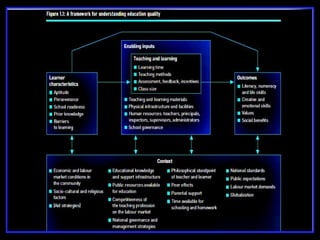
 Framework of quality education 
 Quality education in Pakistan 
 Issues and hurdles in education quality 
 Efforts of education ministry to improve E.Q 
 Goals for 2015 by policy makers. 
 Comparison of education quality of India and 
Pakistan 
 conclusion
Objectives: 
 After the completion of this topic 
students will be able to: 
 Define quality of education 
 Explain Quality education in Pakistan 
 Major issues effecting quality of 
education 
 Explain “quality education is a right for 
all”
oWhat do we mean by quality 
education? 
 Quality =effectiveness or efficiency . 
 the quality of the educational process 
experienced by students. 
 When we deal with quality education we mean: 
 a standard education must be given to all. 
 the content or syllabus must be same for all. 
 improve with the passage of time.
Definition by VVOB’s 
 A good quality education is one that 
provides all learners with capabilities they 
require to become economically productive, 
develop sustainable livelihoods, contribute 
to peaceful and democratic societies and 
enhance individual well-being.
Brief definition of quality 
education 
 Quality depend upon characteristics of: 
 learners (healthy, motivated students) 
 processes (competent teachers using active 
méthodologies ), 
 content (relevant curricula) and 
 systems (good governance and educationist).
UNESCO’s conceptualization 
of quality EDUCATION 
 The quality of education is the first 
priority of UNESCO. 
 A Ministerial Round Table 
CONFERENCE on Quality of Education, 
held in Paris in 2003. 
 UNESCO promotes access to good-quality 
education as a human right 
(Pigozzi,2004).
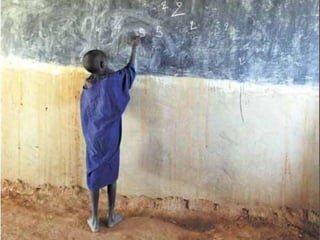
 The UN Education, Scientific and 
Cultural Organization (UNESCO) said in 
2010 that 30 percent of Pakistan’s 
population lives in a state of “extreme 
educational poverty” - receiving less than 
two years of education.
Quality Education Goals 
Academic excellence 
Improve academic standards 
Applied learning 
 Lifelong academic skills
Purpose of the Quality 
Education 
To determine the educational needs of 
students. 
To improve the quality of education 
Make education assessable to 
everyone
To create a system of quality 
education in schools, we need 
Adequate resources and budget 
Educational practices based on 
 research and discussions
Quality education based on: 
Learner characteristics 
Inputs 
Outputs 
Context
Factors at which quality of 
education depends: 
 Language factor 
 Religious factor 
 The geographical factor 
 Economic factor 
 Historical factor 
 Political factor 
 Social factor
Examples of Quality Indicators: 
 Instructional leadership 
 Teacher quality 
 Parent and community involvement 
 Effective Instructional programs 
 Orderly learning environment
Dimensions of quality education 
 Quality Learners 
 Quality Learning Environments 
 Quality Content 
 Quality Processes 
 Quality Outcomes
1.Quality learner 
 Good health and nutrition 
 Early childhood psychosocial 
development experiences. 
 Regular attendance for learning. 
 Family support for learning.
2. Quality Learning Environments 
Physical elements 
 Quality of school facilities 
 Interaction between school infrastructure 
and other quality dimensions 
 Class size 
Psychosocial elements 
 Peaceful, safe environments 
 Teachers’ behaviors that affect safety. 
 Effective school discipline policies. 
 Non-violence.
3. Quality Content 
 Student-centered, non-discriminatory, 
standards-based curriculum 
structures. 
 Uniqueness of local and national 
content. 
 Literacy. 
 Life skills 
 Challenges in reaching large numbers 
of children with quality content
4.Quality Processes: 
 educational quality centered on: 
 system inputs 
 Infrastructure 
 pupil-teacher ratios 
 curricular content 
 Teachers training
5.Quality Outcomes: 
 Quality learner outcomes are intentional, 
expected effects of the educational system. 
 These are the result after providing quality 
inputs. 
 Outcomes related to community 
participation, learner confidence and life-long 
learning. 
 Health outcomes 
 Life skills and outcomes.
 Achievement in literacy and numeracy 
 Using formative assessment to improve 
achievement outcomes
QUALITY EDUCATION FOCUS 
ON???? 
Inputs, processes and 
outcomes the leading 
to quality education.
Approaches to quality 
education: 
 Humanistic approach 
 Behaviorist approaches 
 Critical approaches 
 Adult education approaches 
 Indigenous approaches
Humanistic approach 
 According to humanistic approach: 
 Every human is unique and have equal 
rights. 
 Based on “meaning making” by acquiring 
knowledge. 
 All human need quality education 
 There must be no discrimination between 
rich and poor or male and female 
 Education for all
Behaviorist approaches 
 behaviouristic approach based on: 
 Change behaviour via specific stimuli 
 Learners are not intrinsically motivated or 
able to construct meaning for themselves. 
 Human behaviour can be predicted and 
controlled through reward and 
punishment.
Critical approach: 
 Critical approach is about; 
 education tends to reproduce the structures 
and inequalities of the society 
 According to Critical theorists: 
 education that promotes social change; 
 a curriculum and teaching methods that 
encourage critical analysis of social power 
relations and of ways in which formal 
knowledge is produced and transmitted.
Adult education approaches 
 In the adult education tradition, 
experience and critical reflection in 
learning is an important aspect of 
quality.
Indigenous approaches 
 learners have rich sources of prior 
knowledge , accumulated through a 
variety of experiences, 
 Learners should play a role in defining 
their own curriculum. 
 Learning should move beyond the 
boundaries and learn through non-formal 
education.
Framework for understanding, 
monitoring and improving 
education quality
Quality education in Pakistan 
 In Pakistan’s policies policy makers put 
great emphasize on quality education 
 The main focus of these policies on: 
“education for all’ 
 The Society for Access to Quality Education 
(SAQE) was establish in Pakistan under 
ordinance 1961 in August 2010.
Poor quality of education in 
Pakistan: 
 Over seven million primary-aged children do 
not attend school, according to a 2011 report by 
the Pakistan Education Task Force (PETF). 
 According to the 2011 Annual State of 
Education Report (ASER) compiled by the 
South Asian Forum for Education 
Development, 45 percent of grade 5 students in 
public schools can only read a grade 2-level 
story in Urdu. The number is only slightly 
better in private schools - 57 percent.
Reason of poor quality education 
 In Pakistan there are many private school 
they have their own curriculum which is 
totally different from govt.schools 
 They mostly use oxford curriculum in 
private school 
 Parents prefer private schools for their 
children. 
 In govt. schools teachers are no doubt 
experienced but they are not willing to 
teach.
Issues and hurdles in access of 
quality education: 
 Lack of resources 
 Accountability 
 Ghost schools 
 Less budget 
 Untrained teachers 
 Poverty 
 Child labour 
 extremely low level of public investment
 poor quality of management, 
monitoring, 
supervision and teaching 
 insufficient financial input,
Efforts to improve quality by 
education sector: 
 Improve curriculum 
 Change text books (according to the need of 
students) 
 Based on ideology of country, focus on ethics, 
norms, values, culture 
 Free education for 1 to 10 class. 
 Government took many steps to improve 
education quality and competition in higher 
studies by introducing schemes like solar 
systems, laptop distribution.
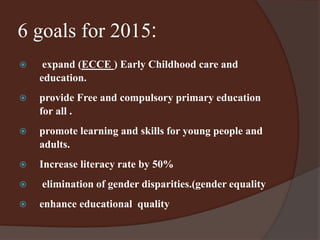
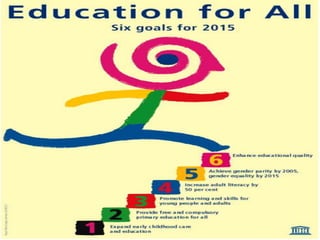
6 goals for 2015: 
 expand (ECCE ) Early Childhood care and 
education. 
 provide Free and compulsory primary education 
for all . 
 promote learning and skills for young people and 
adults. 
 Increase literacy rate by 50% 
 elimination of gender disparities.(gender equality 
 enhance educational quality
Quality education pakistan vs 
bangladesh 
 Bangladesh is also a developing country 
but from last few years they are putting 
great emphasis on quality of education, 
that is why their education system is 
improving day by day,
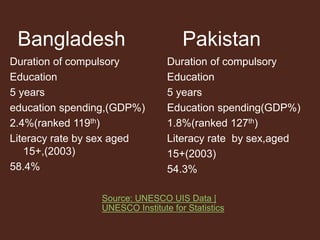
Bangladesh Pakistan 
Duration of compulsory 
Education 
5 years 
education spending,(GDP%) 
2.4%(ranked 119th) 
Literacy rate by sex aged 
Source: UNESCO UIS Data | 
UNESCO Institute for Statistics 
15+,(2003) 
58.4% 
Duration of compulsory 
Education 
5 years 
Education spending(GDP%) 
1.8%(ranked 127th) 
Literacy rate by sex,aged 
15+(2003) 
54.3%
Suggestions. 
 The quality of education includes the 
physical facilities as well as the 
 faculty, curriculum 
 The actual dynamics of teaching and 
learning. 
 The target of quality education can only 
be achieved by bringing some 
revolutionary changes to ensure better 
planning
 more funding, 
 enhanced physical facilities, 
 ongoing monitoring, 
 meaningful research, 
 good faculty, 
 faculty training, 
 Relevant 
 New Syllabuses, 
 Effective classroom dynamics
 Better educational governance. 
 involvement of all kind of human 
resource and strategic quality
Quality Education

Quality Education

  • 1.
    Quality Education By Saba Ali and Hira Saleen University of Punjab
  • 2.
    Agenda : Meaning of quality education  Definition of quality of education  Quality education according to UNESCO  Goals of Q.E  Purpose of Q.E  What we Need to improve quality education ?  Quality indicator  Factors of Quality education  Dimensions of quality education
  • 3.
     Focus ofQuality education  Approaches to quality education  Framework of quality education  Quality education in Pakistan  Issues and hurdles in education quality  Efforts of education ministry to improve E.Q  Goals for 2015 by policy makers.  Comparison of education quality of India and Pakistan  conclusion
  • 4.
    Objectives:  Afterthe completion of this topic students will be able to:  Define quality of education  Explain Quality education in Pakistan  Major issues effecting quality of education  Explain “quality education is a right for all”
  • 5.
    oWhat do wemean by quality education?  Quality =effectiveness or efficiency .  the quality of the educational process experienced by students.  When we deal with quality education we mean:  a standard education must be given to all.  the content or syllabus must be same for all.  improve with the passage of time.
  • 6.
    Definition by VVOB’s  A good quality education is one that provides all learners with capabilities they require to become economically productive, develop sustainable livelihoods, contribute to peaceful and democratic societies and enhance individual well-being.
  • 7.
    Brief definition ofquality education  Quality depend upon characteristics of:  learners (healthy, motivated students)  processes (competent teachers using active méthodologies ),  content (relevant curricula) and  systems (good governance and educationist).
  • 8.
    UNESCO’s conceptualization ofquality EDUCATION  The quality of education is the first priority of UNESCO.  A Ministerial Round Table CONFERENCE on Quality of Education, held in Paris in 2003.  UNESCO promotes access to good-quality education as a human right (Pigozzi,2004).
  • 9.
     The UNEducation, Scientific and Cultural Organization (UNESCO) said in 2010 that 30 percent of Pakistan’s population lives in a state of “extreme educational poverty” - receiving less than two years of education.
  • 11.
    Quality Education Goals Academic excellence Improve academic standards Applied learning  Lifelong academic skills
  • 12.
    Purpose of theQuality Education To determine the educational needs of students. To improve the quality of education Make education assessable to everyone
  • 13.
    To create asystem of quality education in schools, we need Adequate resources and budget Educational practices based on  research and discussions
  • 14.
    Quality education basedon: Learner characteristics Inputs Outputs Context
  • 15.
    Factors at whichquality of education depends:  Language factor  Religious factor  The geographical factor  Economic factor  Historical factor  Political factor  Social factor
  • 16.
    Examples of QualityIndicators:  Instructional leadership  Teacher quality  Parent and community involvement  Effective Instructional programs  Orderly learning environment
  • 17.
    Dimensions of qualityeducation  Quality Learners  Quality Learning Environments  Quality Content  Quality Processes  Quality Outcomes
  • 18.
    1.Quality learner Good health and nutrition  Early childhood psychosocial development experiences.  Regular attendance for learning.  Family support for learning.
  • 19.
    2. Quality LearningEnvironments Physical elements  Quality of school facilities  Interaction between school infrastructure and other quality dimensions  Class size Psychosocial elements  Peaceful, safe environments  Teachers’ behaviors that affect safety.  Effective school discipline policies.  Non-violence.
  • 20.
    3. Quality Content  Student-centered, non-discriminatory, standards-based curriculum structures.  Uniqueness of local and national content.  Literacy.  Life skills  Challenges in reaching large numbers of children with quality content
  • 21.
    4.Quality Processes: educational quality centered on:  system inputs  Infrastructure  pupil-teacher ratios  curricular content  Teachers training
  • 22.
    5.Quality Outcomes: Quality learner outcomes are intentional, expected effects of the educational system.  These are the result after providing quality inputs.  Outcomes related to community participation, learner confidence and life-long learning.  Health outcomes  Life skills and outcomes.
  • 23.
     Achievement inliteracy and numeracy  Using formative assessment to improve achievement outcomes
  • 24.
    QUALITY EDUCATION FOCUS ON???? Inputs, processes and outcomes the leading to quality education.
  • 25.
    Approaches to quality education:  Humanistic approach  Behaviorist approaches  Critical approaches  Adult education approaches  Indigenous approaches
  • 26.
    Humanistic approach According to humanistic approach:  Every human is unique and have equal rights.  Based on “meaning making” by acquiring knowledge.  All human need quality education  There must be no discrimination between rich and poor or male and female  Education for all
  • 27.
    Behaviorist approaches behaviouristic approach based on:  Change behaviour via specific stimuli  Learners are not intrinsically motivated or able to construct meaning for themselves.  Human behaviour can be predicted and controlled through reward and punishment.
  • 28.
    Critical approach: Critical approach is about;  education tends to reproduce the structures and inequalities of the society  According to Critical theorists:  education that promotes social change;  a curriculum and teaching methods that encourage critical analysis of social power relations and of ways in which formal knowledge is produced and transmitted.
  • 29.
    Adult education approaches  In the adult education tradition, experience and critical reflection in learning is an important aspect of quality.
  • 30.
    Indigenous approaches learners have rich sources of prior knowledge , accumulated through a variety of experiences,  Learners should play a role in defining their own curriculum.  Learning should move beyond the boundaries and learn through non-formal education.
  • 31.
    Framework for understanding, monitoring and improving education quality
  • 33.
    Quality education inPakistan  In Pakistan’s policies policy makers put great emphasize on quality education  The main focus of these policies on: “education for all’  The Society for Access to Quality Education (SAQE) was establish in Pakistan under ordinance 1961 in August 2010.
  • 34.
    Poor quality ofeducation in Pakistan:  Over seven million primary-aged children do not attend school, according to a 2011 report by the Pakistan Education Task Force (PETF).  According to the 2011 Annual State of Education Report (ASER) compiled by the South Asian Forum for Education Development, 45 percent of grade 5 students in public schools can only read a grade 2-level story in Urdu. The number is only slightly better in private schools - 57 percent.
  • 35.
    Reason of poorquality education  In Pakistan there are many private school they have their own curriculum which is totally different from govt.schools  They mostly use oxford curriculum in private school  Parents prefer private schools for their children.  In govt. schools teachers are no doubt experienced but they are not willing to teach.
  • 36.
    Issues and hurdlesin access of quality education:  Lack of resources  Accountability  Ghost schools  Less budget  Untrained teachers  Poverty  Child labour  extremely low level of public investment
  • 37.
     poor qualityof management, monitoring, supervision and teaching  insufficient financial input,
  • 38.
    Efforts to improvequality by education sector:  Improve curriculum  Change text books (according to the need of students)  Based on ideology of country, focus on ethics, norms, values, culture  Free education for 1 to 10 class.  Government took many steps to improve education quality and competition in higher studies by introducing schemes like solar systems, laptop distribution.
  • 39.
    6 goals for2015:  expand (ECCE ) Early Childhood care and education.  provide Free and compulsory primary education for all .  promote learning and skills for young people and adults.  Increase literacy rate by 50%  elimination of gender disparities.(gender equality  enhance educational quality
  • 41.
    Quality education pakistanvs bangladesh  Bangladesh is also a developing country but from last few years they are putting great emphasis on quality of education, that is why their education system is improving day by day,
  • 42.
    Bangladesh Pakistan Durationof compulsory Education 5 years education spending,(GDP%) 2.4%(ranked 119th) Literacy rate by sex aged Source: UNESCO UIS Data | UNESCO Institute for Statistics 15+,(2003) 58.4% Duration of compulsory Education 5 years Education spending(GDP%) 1.8%(ranked 127th) Literacy rate by sex,aged 15+(2003) 54.3%
  • 44.
    Suggestions.  Thequality of education includes the physical facilities as well as the  faculty, curriculum  The actual dynamics of teaching and learning.  The target of quality education can only be achieved by bringing some revolutionary changes to ensure better planning
  • 45.
     more funding,  enhanced physical facilities,  ongoing monitoring,  meaningful research,  good faculty,  faculty training,  Relevant  New Syllabuses,  Effective classroom dynamics
  • 46.
     Better educationalgovernance.  involvement of all kind of human resource and strategic quality