Bushra Iram
Kulsum Bano
Sidra kaneez
 Education is the third eye of man.
 Education is a better safeguard of liberty than a
standing army.
(Edward Everett)
 “Acquire knowledge from lap to grave”.
Reason of worst Education system in
Pakistan
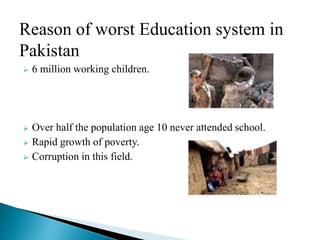
 6 million working children.
 Over half the population age 10 never attended school.
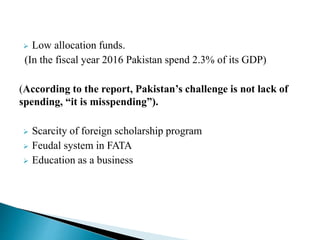
 Rapid growth of poverty.
 Corruption in this field.
 Low allocation funds.
(In the fiscal year 2016 Pakistan spend 2.3% of its GDP)
(According to the report, Pakistan’s challenge is not lack of
spending, “it is misspending”).
 Scarcity of foreign scholarship program
 Feudal system in FATA
 Education as a business
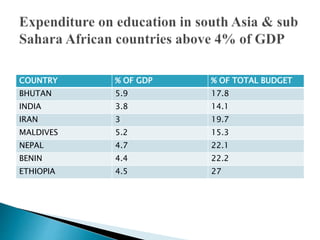
COUNTRY % OF GDP % OF TOTAL BUDGET
BHUTAN 5.9 17.8
INDIA 3.8 14.1
IRAN 3 19.7
MALDIVES 5.2 15.3
NEPAL 4.7 22.1
BENIN 4.4 22.2
ETHIOPIA 4.5 27
 Gender discrimination
(In Punjab rural areas, 44% females & 66% males. urban area 73% females
& 82% males).
(In Baluchistan rural areas,15% females & 48% males. while in urban,
44% female & 76% males).
(In KPK rural areas, % for females is 33 & males 70%. While in urban
areas, 52 % female & 77% male).
(In Sindh rural areas, 19 % female & 51 % male population. In urban
areas, 65% female & 80% male population educated).
 Low resources of technical education
 Flourishing favoritism
 Terrorist attack on educational institutions
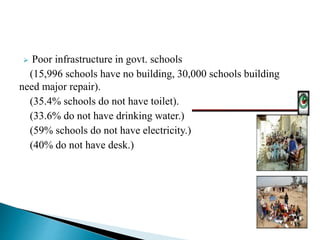
 Poor infrastructure in govt. schools
(15,996 schools have no building, 30,000 schools building
need major repair).
(35.4% schools do not have toilet).
(33.6% do not have drinking water.)
(59% schools do not have electricity.)
(40% do not have desk.)
 Pakistan is lagging 50 to 60 years behind in the field of
Education ( UN report).
 Out of 177 universities in Pakistan, none are in the rank of top
1,000 universities.
 Pakistan has the world’s weakest higher education
system while US and UK have the strongest (British QS
ranking Agency).
 5.5m children are far from primary education while
1.4m children are far from secondary education.
 Literacy Rate in Pakistan Drops by 2% in 2016-17
 According to economic survey of Pakistan 2016-17, country’s
literacy rate decline from 60% to 58%.
 Provinces Literacy Rate
 Punjab:
Female: 54%
Male: 59%
 Baluchistan :
Female:24%
Male: 56%
 KPK:
Female :36%
Male: 72%
 Sindh :
Female: 44%
Male: 67%
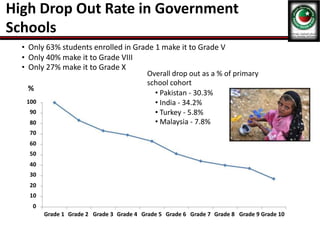
High Drop Out Rate in Government
Schools
• Only 63% students enrolled in Grade 1 make it to Grade V
• Only 40% make it to Grade VIII
• Only 27% make it to Grade X
Overall drop out as a % of primary
%
100
90
80
70
60
50
40
30
20
10
0
Grade 1 Grade 2 Grade 3 Grade 4
school cohort
• Pakistan - 30.3%
• India - 34.2%
• Turkey - 5.8%
• Malaysia - 7.8%
Grade 5 Grade 6 Grade 7 Grade 8 Grade 9 Grade 10
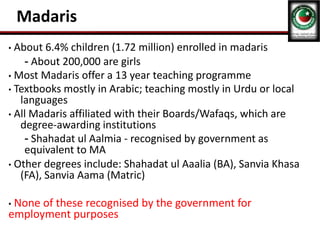
Madaris
• About 6.4% children (1.72 million) enrolled in madaris
- About 200,000 are girls
• Most Madaris offer a 13 year teaching programme
• Textbooks mostly in Arabic; teaching mostly in Urdu or local
languages
• All Madaris affiliated with their Boards/Wafaqs, which are
degree-awarding institutions
- Shahadat ul Aalmia - recognised by government as
equivalent to MA
• Other degrees include: Shahadat ul Aaalia (BA), Sanvia Khasa
(FA), Sanvia Aama (Matric)
• None of these recognised by the government for
employment purposes
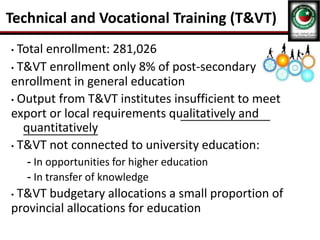
Technical and Vocational Training (T&VT)
• Total enrollment: 281,026
• T&VT enrollment only 8% of post-secondary
enrollment in general education
• Output from T&VT institutes insufficient to meet
export or local requirements qualitatively and
quantitatively
• T&VT not connected to university education:
- In opportunities for higher education
- In transfer of knowledge
• T&VT budgetary allocations a small proportion of
provincial allocations for education
NATIONAL EDUCATION
POLICY 2017
 Character Building
(Taleem (Seek, Use and Evaluate Knowledge), Tarbiyya (Social, Technical,
Moral and Ethical Training) and Tazkyya (Purification of Soul) are three
pillars of the policy).
 Promotion of early childhood education
 Enhancing Education Budget
(increase investment in education to 4% of GDP).
(40-50% budget for promotion of primary Education).
 Religious Education & reforms in deeni Madras
 Physical education, health & hygiene
 Curriculum reforms & standard setting
 Special education
(Increase participation rate of disabled children from existing 5% to
100% by 2025).
( 5% of total education budget will be allocated for Special Education).
 Provision of free elementary & secondary education
 knowledge economy through higher education
(to increase current 1.4 million students to 5 million in the next 5 years.)
 Selection, recruitment & capacity building of teachers
(To introduce Continuous Professional Development (CPD) programme).
 Language and medium of instruction
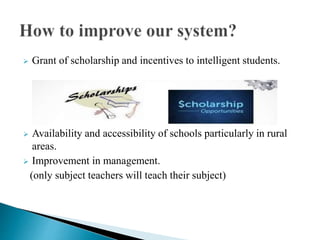
 Grant of scholarship and incentives to intelligent students.
 Availability and accessibility of schools particularly in rural
areas.
 Improvement in management.
(only subject teachers will teach their subject)
 Teachers training and knowledge.
 Equality in public and private sectors.
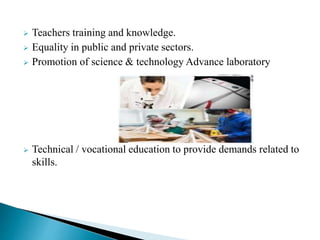
 Promotion of science & technology Advance laboratory
 Technical / vocational education to provide demands related to
skills.
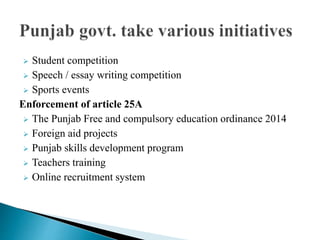
PUNJAB GOVERNMENT
 Student competition
 Speech / essay writing competition
 Sports events
Enforcement of article 25A
 The Punjab Free and compulsory education ordinance 2014
 Foreign aid projects
 Punjab skills development program
 Teachers training
 Online recruitment system
KPK GOVERNMENT
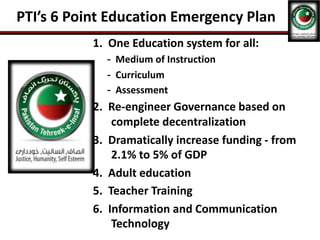
PTI’s 6 Point Education Emergency Plan
1. One Education system for all:
- Medium of Instruction
- Curriculum
- Assessment
2. Re-engineer Governance based on
complete decentralization
3. Dramatically increase funding - from
2.1% to 5% of GDP
4. Adult education
5. Teacher Training
6. Information and Communication
Technology
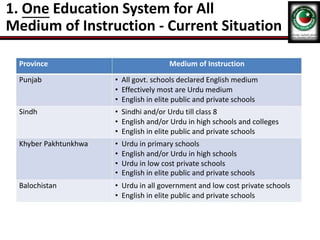
1. One Education System for All
Medium of Instruction - Current Situation
Province Medium of Instruction
Punjab • All govt. schools declared English medium
• Effectively most are Urdu medium
• English in elite public and private schools
Sindh • Sindhi and/or Urdu till class 8
• English and/or Urdu in high schools and colleges
• English in elite public and private schools
Khyber Pakhtunkhwa • Urdu in primary schools
• English and/or Urdu in high schools
• Urdu in low cost private schools
• English in elite public and private schools
Balochistan • Urdu in all government and low cost private schools
• English in elite public and private schools
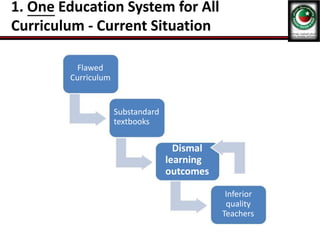
1. One Education System for All
Curriculum - Current Situation
Flawed
Curriculum
Substandard
textbooks
Dismal
learning
outcomes
Inferior
quality
Teachers
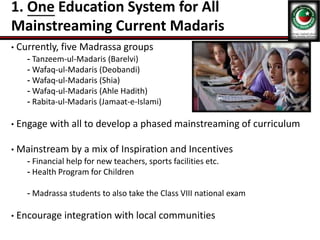
1. One Education System for All
Mainstreaming Current Madaris
• Currently, five Madrassa groups
- Tanzeem-ul-Madaris (Barelvi)
- Wafaq-ul-Madaris (Deobandi)
- Wafaq-ul-Madaris (Shia)
- Wafaq-ul-Madaris (Ahle Hadith)
- Rabita-ul-Madaris (Jamaat-e-Islami)
• Engage with all to develop a phased mainstreaming of curriculum
• Mainstream by a mix of Inspiration and Incentives
- Financial help for new teachers, sports facilities etc.
- Health Program for Children
- Madrassa students to also take the Class VIII national exam
• Encourage integration with local communities
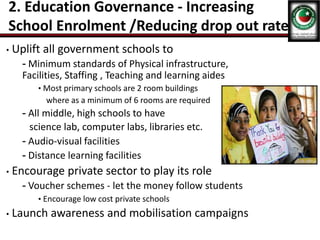
2. Education Governance - Increasing
School Enrolment /Reducing drop out rate
• Uplift all government schools to
- Minimum standards of Physical infrastructure,
Facilities, Staffing , Teaching and learning aides
• Most primary schools are 2 room buildings
where as a minimum of 6 rooms are required
- All middle, high schools to have
science lab, computer labs, libraries etc.
- Audio-visual facilities
- Distance learning facilities
• Encourage private sector to play its role
- Voucher schemes - let the money follow students
• Encourage low cost private schools
• Launch awareness and mobilisation campaigns
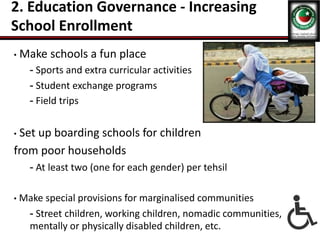
2. Education Governance - Increasing
School Enrollment
• Make schools a fun place
- Sports and extra curricular activities
- Student exchange programs
- Field trips
• Set up boarding schools for children
from poor households
- At least two (one for each gender) per tehsil
• Make special provisions for marginalised communities
- Street children, working children, nomadic communities,
mentally or physically disabled children, etc.
3. Funding
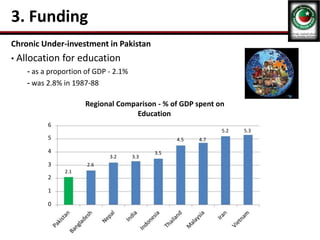
Chronic Under-investment in Pakistan
• Allocation for education
- as a proportion of GDP - 2.1%
- was 2.8% in 1987-88
Regional Comparison - % of GDP spent on
Education
6
5
4
3.2 3.3
3 2.6
2.1
2
1
0
5.2 5.3
4.5 4.7
3.5
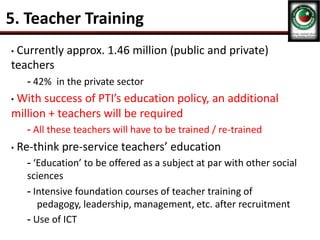
5. Teacher Training
• Currently approx. 1.46 million (public and private)
teachers
- 42% in the private sector
• With success of PTI’s education policy, an additional
million + teachers will be required
- All these teachers will have to be trained / re-trained
• Re-think pre-service teachers’ education
- ‘Education’ to be offered as a subject at par with other social
sciences
- Intensive foundation courses of teacher training of
pedagogy, leadership, management, etc. after recruitment
- Use of ICT
5. Teacher Training
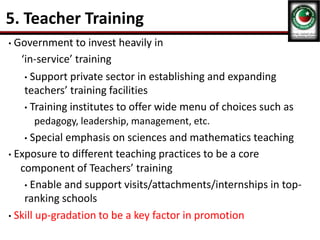
• Government to invest heavily in
‘in-service’ training
• Support private sector in establishing and expanding
teachers’ training facilities
• Training institutes to offer wide menu of choices such as
pedagogy, leadership, management, etc.
• Special emphasis on sciences and mathematics teaching
• Exposure to different teaching practices to be a core
component of Teachers’ training
• Enable and support visits/attachments/internships in top-
ranking schools
• Skill up-gradation to be a key factor in promotion
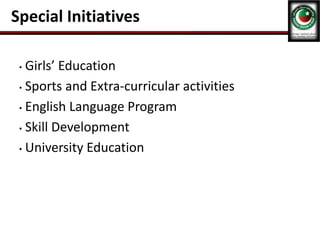
Special Initiatives
• Girls’ Education
• Sports and Extra-curricular activities
• English Language Program
• Skill Development
• University Education
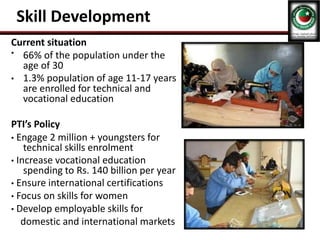
Skill Development
Current situation
• 66% of the population under the
age of 30
• 1.3% population of age 11-17 years
are enrolled for technical and
vocational education
PTI’s Policy
• Engage 2 million + youngsters for
technical skills enrolment
• Increase vocational education
spending to Rs. 140 billion per year
• Ensure international certifications
• Focus on skills for women
• Develop employable skills for
domestic and international markets
University Education - PTI’s Policy
• Make the Higher Education
Commission fully autonomous
• Make universities autonomous
by de-linking them from
government
• Make universities a hub
for research
• Increase university enrolment
by establishing new universities
and enlarging existing capacity
• Focus on university education in sciences
• Encourage collaboration with foreign universities
The End

Education system in Pakistan

  • 2.
  • 3.
     Education isthe third eye of man.  Education is a better safeguard of liberty than a standing army. (Edward Everett)  “Acquire knowledge from lap to grave”.
  • 5.
    Reason of worstEducation system in Pakistan  6 million working children.  Over half the population age 10 never attended school.  Rapid growth of poverty.  Corruption in this field.
  • 6.
     Low allocationfunds. (In the fiscal year 2016 Pakistan spend 2.3% of its GDP) (According to the report, Pakistan’s challenge is not lack of spending, “it is misspending”).  Scarcity of foreign scholarship program  Feudal system in FATA  Education as a business
  • 7.
    COUNTRY % OFGDP % OF TOTAL BUDGET BHUTAN 5.9 17.8 INDIA 3.8 14.1 IRAN 3 19.7 MALDIVES 5.2 15.3 NEPAL 4.7 22.1 BENIN 4.4 22.2 ETHIOPIA 4.5 27
  • 8.
     Gender discrimination (InPunjab rural areas, 44% females & 66% males. urban area 73% females & 82% males). (In Baluchistan rural areas,15% females & 48% males. while in urban, 44% female & 76% males). (In KPK rural areas, % for females is 33 & males 70%. While in urban areas, 52 % female & 77% male). (In Sindh rural areas, 19 % female & 51 % male population. In urban areas, 65% female & 80% male population educated).  Low resources of technical education  Flourishing favoritism  Terrorist attack on educational institutions
  • 9.
     Poor infrastructurein govt. schools (15,996 schools have no building, 30,000 schools building need major repair). (35.4% schools do not have toilet). (33.6% do not have drinking water.) (59% schools do not have electricity.) (40% do not have desk.)
  • 10.
     Pakistan islagging 50 to 60 years behind in the field of Education ( UN report).  Out of 177 universities in Pakistan, none are in the rank of top 1,000 universities.  Pakistan has the world’s weakest higher education system while US and UK have the strongest (British QS ranking Agency).  5.5m children are far from primary education while 1.4m children are far from secondary education.
  • 11.
     Literacy Ratein Pakistan Drops by 2% in 2016-17  According to economic survey of Pakistan 2016-17, country’s literacy rate decline from 60% to 58%.  Provinces Literacy Rate  Punjab: Female: 54% Male: 59%
  • 12.
     Baluchistan : Female:24% Male:56%  KPK: Female :36% Male: 72%  Sindh : Female: 44% Male: 67%
  • 13.
    High Drop OutRate in Government Schools • Only 63% students enrolled in Grade 1 make it to Grade V • Only 40% make it to Grade VIII • Only 27% make it to Grade X Overall drop out as a % of primary % 100 90 80 70 60 50 40 30 20 10 0 Grade 1 Grade 2 Grade 3 Grade 4 school cohort • Pakistan - 30.3% • India - 34.2% • Turkey - 5.8% • Malaysia - 7.8% Grade 5 Grade 6 Grade 7 Grade 8 Grade 9 Grade 10
  • 14.
    Madaris • About 6.4%children (1.72 million) enrolled in madaris - About 200,000 are girls • Most Madaris offer a 13 year teaching programme • Textbooks mostly in Arabic; teaching mostly in Urdu or local languages • All Madaris affiliated with their Boards/Wafaqs, which are degree-awarding institutions - Shahadat ul Aalmia - recognised by government as equivalent to MA • Other degrees include: Shahadat ul Aaalia (BA), Sanvia Khasa (FA), Sanvia Aama (Matric) • None of these recognised by the government for employment purposes
  • 15.
    Technical and VocationalTraining (T&VT) • Total enrollment: 281,026 • T&VT enrollment only 8% of post-secondary enrollment in general education • Output from T&VT institutes insufficient to meet export or local requirements qualitatively and quantitatively • T&VT not connected to university education: - In opportunities for higher education - In transfer of knowledge • T&VT budgetary allocations a small proportion of provincial allocations for education
  • 16.
  • 17.
     Character Building (Taleem(Seek, Use and Evaluate Knowledge), Tarbiyya (Social, Technical, Moral and Ethical Training) and Tazkyya (Purification of Soul) are three pillars of the policy).  Promotion of early childhood education  Enhancing Education Budget (increase investment in education to 4% of GDP). (40-50% budget for promotion of primary Education).  Religious Education & reforms in deeni Madras  Physical education, health & hygiene
  • 18.
     Curriculum reforms& standard setting  Special education (Increase participation rate of disabled children from existing 5% to 100% by 2025). ( 5% of total education budget will be allocated for Special Education).  Provision of free elementary & secondary education  knowledge economy through higher education (to increase current 1.4 million students to 5 million in the next 5 years.)
  • 19.
     Selection, recruitment& capacity building of teachers (To introduce Continuous Professional Development (CPD) programme).  Language and medium of instruction
  • 20.
     Grant ofscholarship and incentives to intelligent students.  Availability and accessibility of schools particularly in rural areas.  Improvement in management. (only subject teachers will teach their subject)
  • 21.
     Teachers trainingand knowledge.  Equality in public and private sectors.  Promotion of science & technology Advance laboratory  Technical / vocational education to provide demands related to skills.
  • 22.
  • 26.
     Student competition Speech / essay writing competition  Sports events Enforcement of article 25A  The Punjab Free and compulsory education ordinance 2014  Foreign aid projects  Punjab skills development program  Teachers training  Online recruitment system
  • 28.
  • 31.
    PTI’s 6 PointEducation Emergency Plan 1. One Education system for all: - Medium of Instruction - Curriculum - Assessment 2. Re-engineer Governance based on complete decentralization 3. Dramatically increase funding - from 2.1% to 5% of GDP 4. Adult education 5. Teacher Training 6. Information and Communication Technology
  • 32.
    1. One EducationSystem for All Medium of Instruction - Current Situation Province Medium of Instruction Punjab • All govt. schools declared English medium • Effectively most are Urdu medium • English in elite public and private schools Sindh • Sindhi and/or Urdu till class 8 • English and/or Urdu in high schools and colleges • English in elite public and private schools Khyber Pakhtunkhwa • Urdu in primary schools • English and/or Urdu in high schools • Urdu in low cost private schools • English in elite public and private schools Balochistan • Urdu in all government and low cost private schools • English in elite public and private schools
  • 33.
    1. One EducationSystem for All Curriculum - Current Situation Flawed Curriculum Substandard textbooks Dismal learning outcomes Inferior quality Teachers
  • 34.
    1. One EducationSystem for All Mainstreaming Current Madaris • Currently, five Madrassa groups - Tanzeem-ul-Madaris (Barelvi) - Wafaq-ul-Madaris (Deobandi) - Wafaq-ul-Madaris (Shia) - Wafaq-ul-Madaris (Ahle Hadith) - Rabita-ul-Madaris (Jamaat-e-Islami) • Engage with all to develop a phased mainstreaming of curriculum • Mainstream by a mix of Inspiration and Incentives - Financial help for new teachers, sports facilities etc. - Health Program for Children - Madrassa students to also take the Class VIII national exam • Encourage integration with local communities
  • 35.
    2. Education Governance- Increasing School Enrolment /Reducing drop out rate • Uplift all government schools to - Minimum standards of Physical infrastructure, Facilities, Staffing , Teaching and learning aides • Most primary schools are 2 room buildings where as a minimum of 6 rooms are required - All middle, high schools to have science lab, computer labs, libraries etc. - Audio-visual facilities - Distance learning facilities • Encourage private sector to play its role - Voucher schemes - let the money follow students • Encourage low cost private schools • Launch awareness and mobilisation campaigns
  • 36.
    2. Education Governance- Increasing School Enrollment • Make schools a fun place - Sports and extra curricular activities - Student exchange programs - Field trips • Set up boarding schools for children from poor households - At least two (one for each gender) per tehsil • Make special provisions for marginalised communities - Street children, working children, nomadic communities, mentally or physically disabled children, etc.
  • 37.
    3. Funding Chronic Under-investmentin Pakistan • Allocation for education - as a proportion of GDP - 2.1% - was 2.8% in 1987-88 Regional Comparison - % of GDP spent on Education 6 5 4 3.2 3.3 3 2.6 2.1 2 1 0 5.2 5.3 4.5 4.7 3.5
  • 38.
    5. Teacher Training •Currently approx. 1.46 million (public and private) teachers - 42% in the private sector • With success of PTI’s education policy, an additional million + teachers will be required - All these teachers will have to be trained / re-trained • Re-think pre-service teachers’ education - ‘Education’ to be offered as a subject at par with other social sciences - Intensive foundation courses of teacher training of pedagogy, leadership, management, etc. after recruitment - Use of ICT
  • 39.
    5. Teacher Training •Government to invest heavily in ‘in-service’ training • Support private sector in establishing and expanding teachers’ training facilities • Training institutes to offer wide menu of choices such as pedagogy, leadership, management, etc. • Special emphasis on sciences and mathematics teaching • Exposure to different teaching practices to be a core component of Teachers’ training • Enable and support visits/attachments/internships in top- ranking schools • Skill up-gradation to be a key factor in promotion
  • 40.
    Special Initiatives • Girls’Education • Sports and Extra-curricular activities • English Language Program • Skill Development • University Education
  • 42.
    Skill Development Current situation •66% of the population under the age of 30 • 1.3% population of age 11-17 years are enrolled for technical and vocational education PTI’s Policy • Engage 2 million + youngsters for technical skills enrolment • Increase vocational education spending to Rs. 140 billion per year • Ensure international certifications • Focus on skills for women • Develop employable skills for domestic and international markets
  • 43.
    University Education -PTI’s Policy • Make the Higher Education Commission fully autonomous • Make universities autonomous by de-linking them from government • Make universities a hub for research • Increase university enrolment by establishing new universities and enlarging existing capacity • Focus on university education in sciences • Encourage collaboration with foreign universities
  • 44.