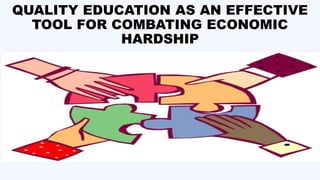
QUALITY EDUCATION AS AN EFFECTIVE
TOOL FOR COMBATING ECONOMIC
HARDSHIP
Being Education Summit
Organized by:
NASFAT EDUCATION COMMITTEE
Dated: Monday 16th Dec., 2024
Venue: NASFAT Ikorodu Branch,
Akasolori, Ikorodu, Lagos State
MEET THE FACILITATOR
RASHEED, Oluwasegun Kazeem (Ph.D)
08051700164, 07066867887
kazeemrasheed1440@gmail.com
MNAEAP, EMPM, MNIM, MTRCN, MACSN, CT, Dip. Digital Mkt., CEAF,
CME, W10FE, CMIE, FMIE, MAPROCON, AMIBRN, MCIEMA (USA)
Lead Principal Facilitator at HEED – A - DINK CONSULT
KEY WORDS
• QUALITY: Fitness for purpose
• EDUCATION: Act of liberating minds from unknown
• QUALITY EDUCATION: Education that meet the needs and
aspirations of the learners
• ECONOMIC HARDSHIP: It refers to situation where
individuals, families and communities cannot meet their
basic needs . . .
VIEWS ON EDUCATION
ANALYTICAL VIEW OF EDUCATION
Education is not limited to knowledge imparted in Schools. It is
the development of Child’s instinctive power.
PHILOSOPHICAL VIEW OF EDUCATION
Education is pleasant-sounding development of all the powers of
the human being i.e. physical, social, intellectual, aesthetic and
spiritual.
SOCIOLOGICAL VIEW OF EDUCATION
Education is a tool that helps to solve the multifarious social
problems.
VIEWS ON EDUCATION
CLASSICAL VIEW OF EDUCATION
•Socrates: “Education means bringing out the
ideas of universal validity which in the mind of
every man”
•Plato: “Education is the tool used to develop
body and soul of learners and all the perfections
which he is capable of”
•Aristotle: “Education is the creation of a sound
mind in a sound body”
VIEWS ON EDUCATION
LIBERALISTS’ VIEWS ON EDUCATION
•Spencer: “Education is complete living.”
•Froebel: “It is the process through which the child
makes the internal to be external”
EDUCATION IN THE BROADER VIEW
“Education, in the broader sense, is transmission of
life (IDEAS) by the living, to the living, through the
living and for living”. (Sajjad and Kumar 2018)
QUALITY EDUCATION
Quality education refers to an education system that
effectively equips learners with the knowledge, skills,
values and attitudes they need to live productive lives,
achieve personal and professional goals. IT IS
INCLUSIVE, EQUITABLE, AND DESIGNED TO MEET
THE DIVERSED NEEDS OF ALL LEARNERS
YARDSTICS OF QUALITY EDCATION
The simplest yardsticks to measure quality education include the
THREE DOMAINS IN EDUCATION
• COGNITIVE - Focuses on intellectual capacities
• AFFECTIVE - Focuses on attitude, emotional and values
• PSYCHOMOTOR- Focuses on physical movement
NOTE: Any form of education where learners cannot make use
of their hands is useless.
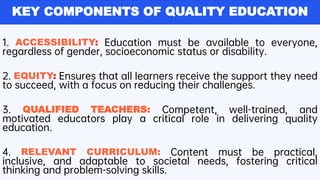
KEY COMPONENTS OF QUALITY EDUCATION
1. ACCESSIBILITY: Education must be available to everyone,
regardless of gender, socioeconomic status or disability.
2. EQUITY: Ensures that all learners receive the support they need
to succeed, with a focus on reducing their challenges.
3. QUALIFIED TEACHERS: Competent, well-trained, and
motivated educators play a critical role in delivering quality
education.
4. RELEVANT CURRICULUM: Content must be practical,
inclusive, and adaptable to societal needs, fostering critical
thinking and problem-solving skills.
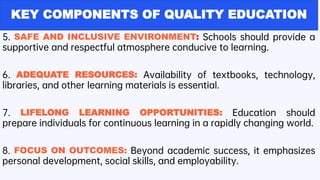
KEY COMPONENTS OF QUALITY EDUCATION
5. SAFE AND INCLUSIVE ENVIRONMENT: Schools should provide a
supportive and respectful atmosphere conducive to learning.
6. ADEQUATE RESOURCES: Availability of textbooks, technology,
libraries, and other learning materials is essential.
7. LIFELONG LEARNING OPPORTUNITIES: Education should
prepare individuals for continuous learning in a rapidly changing world.
8. FOCUS ON OUTCOMES: Beyond academic success, it emphasizes
personal development, social skills, and employability.
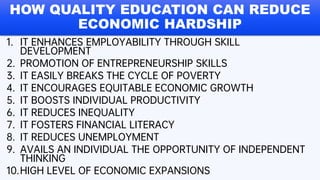
HOW QUALITY EDUCATION CAN REDUCE
ECONOMIC HARDSHIP
1. IT ENHANCES EMPLOYABILITY THROUGH SKILL
DEVELOPMENT
2. PROMOTION OF ENTREPRENEURSHIP SKILLS
3. IT EASILY BREAKS THE CYCLE OF POVERTY
4. IT ENCOURAGES EQUITABLE ECONOMIC GROWTH
5. IT BOOSTS INDIVIDUAL PRODUCTIVITY
6. IT REDUCES INEQUALITY
7. IT FOSTERS FINANCIAL LITERACY
8. IT REDUCES UNEMPLOYMENT
9. AVAILS AN INDIVIDUAL THE OPPORTUNITY OF INDEPENDENT
THINKING
10.HIGH LEVEL OF ECONOMIC EXPANSIONS
EFFECT OF POOR EDUCATION
1. LIMITED KNOWLEDGE AND SKILLS
2. LACK OF CRITICAL THINKING
3. LOW SELF-ESTEEM AND CONFIDENCE
4. LACK OF MOTIVATION
5. INCREASED RISK OF UNEMPLOYMENT
6. INDIVIDUAL REDUNDANCY
7. PERPETUATION OF POVERTY
8. LACK OF SOCIAL CONNECTIONS
9. INCREASED CRIME RATES
10.IT HINDERS PERSONAL DEVELOPMENT
11. LOWER ECONOMIC PRODUCTIVITY
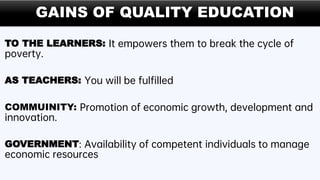
GAINS OF QUALITY EDUCATION
TO THE LEARNERS: It empowers them to break the cycle of
poverty.
AS TEACHERS: You will be fulfilled
COMMUINITY: Promotion of economic growth, development and
innovation.
GOVERNMENT: Availability of competent individuals to manage
economic resources
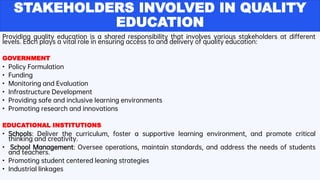
STAKEHOLDERS INVOLVED IN QUALITY
EDUCATION
Providing quality education is a shared responsibility that involves various stakeholders at different
levels. Each plays a vital role in ensuring access to and delivery of quality education:
GOVERNMENT
• Policy Formulation
• Funding
• Monitoring and Evaluation
• Infrastructure Development
• Providing safe and inclusive learning environments
• Promoting research and innovations
EDUCATIONAL INSTITUTIONS
• Schools: Deliver the curriculum, foster a supportive learning environment, and promote critical
thinking and creativity.
• School Management: Oversee operations, maintain standards, and address the needs of students
and teachers.
• Promoting student centered leaning strategies
• Industrial linkages
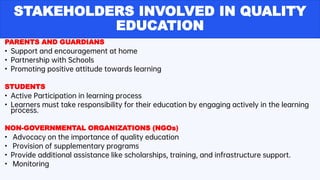
STAKEHOLDERS INVOLVED IN QUALITY
EDUCATION
PARENTS AND GUARDIANS
• Support and encouragement at home
• Partnership with Schools
• Promoting positive attitude towards learning
STUDENTS
• Active Participation in learning process
• Learners must take responsibility for their education by engaging actively in the learning
process.
NON-GOVERNMENTAL ORGANIZATIONS (NGOs)
• Advocacy on the importance of quality education
• Provision of supplementary programs
• Provide additional assistance like scholarships, training, and infrastructure support.
• Monitoring
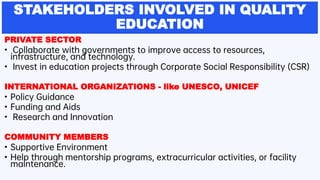
STAKEHOLDERS INVOLVED IN QUALITY
EDUCATION
PRIVATE SECTOR
• Collaborate with governments to improve access to resources,
infrastructure, and technology.
• Invest in education projects through Corporate Social Responsibility (CSR)
INTERNATIONAL ORGANIZATIONS - like UNESCO, UNICEF
• Policy Guidance
• Funding and Aids
• Research and Innovation
COMMUNITY MEMBERS
• Supportive Environment
• Help through mentorship programs, extracurricular activities, or facility
maintenance.
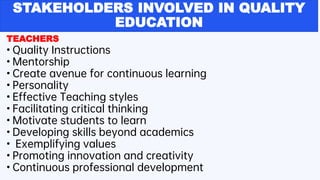
STAKEHOLDERS INVOLVED IN QUALITY
EDUCATION
TEACHERS
• Quality Instructions
• Mentorship
• Create avenue for continuous learning
• Personality
• Effective Teaching styles
• Facilitating critical thinking
• Motivate students to learn
• Developing skills beyond academics
• Exemplifying values
• Promoting innovation and creativity
• Continuous professional development
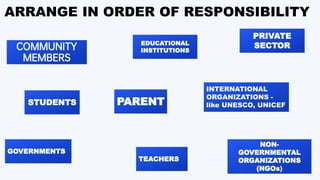
ARRANGE IN ORDER OF RESPONSIBILITY
GOVERNMENTS
EDUCATIONAL
INSTITUTIONS
TEACHERS
STUDENTS
PRIVATE
SECTOR
NON-
GOVERNMENTAL
ORGANIZATIONS
(NGOs)
INTERNATIONAL
ORGANIZATIONS -
like UNESCO, UNICEF
COMMUNITY
MEMBERS
PARENT

QUALITY EDUCATION for every educators and

  • 1.
    QUALITY EDUCATION ASAN EFFECTIVE TOOL FOR COMBATING ECONOMIC HARDSHIP
  • 2.
    Being Education Summit Organizedby: NASFAT EDUCATION COMMITTEE Dated: Monday 16th Dec., 2024 Venue: NASFAT Ikorodu Branch, Akasolori, Ikorodu, Lagos State
  • 3.
    MEET THE FACILITATOR RASHEED,Oluwasegun Kazeem (Ph.D) 08051700164, 07066867887 kazeemrasheed1440@gmail.com MNAEAP, EMPM, MNIM, MTRCN, MACSN, CT, Dip. Digital Mkt., CEAF, CME, W10FE, CMIE, FMIE, MAPROCON, AMIBRN, MCIEMA (USA) Lead Principal Facilitator at HEED – A - DINK CONSULT
  • 4.
    KEY WORDS • QUALITY:Fitness for purpose • EDUCATION: Act of liberating minds from unknown • QUALITY EDUCATION: Education that meet the needs and aspirations of the learners • ECONOMIC HARDSHIP: It refers to situation where individuals, families and communities cannot meet their basic needs . . .
  • 5.
    VIEWS ON EDUCATION ANALYTICALVIEW OF EDUCATION Education is not limited to knowledge imparted in Schools. It is the development of Child’s instinctive power. PHILOSOPHICAL VIEW OF EDUCATION Education is pleasant-sounding development of all the powers of the human being i.e. physical, social, intellectual, aesthetic and spiritual. SOCIOLOGICAL VIEW OF EDUCATION Education is a tool that helps to solve the multifarious social problems.
  • 6.
    VIEWS ON EDUCATION CLASSICALVIEW OF EDUCATION •Socrates: “Education means bringing out the ideas of universal validity which in the mind of every man” •Plato: “Education is the tool used to develop body and soul of learners and all the perfections which he is capable of” •Aristotle: “Education is the creation of a sound mind in a sound body”
  • 7.
    VIEWS ON EDUCATION LIBERALISTS’VIEWS ON EDUCATION •Spencer: “Education is complete living.” •Froebel: “It is the process through which the child makes the internal to be external” EDUCATION IN THE BROADER VIEW “Education, in the broader sense, is transmission of life (IDEAS) by the living, to the living, through the living and for living”. (Sajjad and Kumar 2018)
  • 8.
    QUALITY EDUCATION Quality educationrefers to an education system that effectively equips learners with the knowledge, skills, values and attitudes they need to live productive lives, achieve personal and professional goals. IT IS INCLUSIVE, EQUITABLE, AND DESIGNED TO MEET THE DIVERSED NEEDS OF ALL LEARNERS
  • 9.
    YARDSTICS OF QUALITYEDCATION The simplest yardsticks to measure quality education include the THREE DOMAINS IN EDUCATION • COGNITIVE - Focuses on intellectual capacities • AFFECTIVE - Focuses on attitude, emotional and values • PSYCHOMOTOR- Focuses on physical movement NOTE: Any form of education where learners cannot make use of their hands is useless.
  • 10.
    KEY COMPONENTS OFQUALITY EDUCATION 1. ACCESSIBILITY: Education must be available to everyone, regardless of gender, socioeconomic status or disability. 2. EQUITY: Ensures that all learners receive the support they need to succeed, with a focus on reducing their challenges. 3. QUALIFIED TEACHERS: Competent, well-trained, and motivated educators play a critical role in delivering quality education. 4. RELEVANT CURRICULUM: Content must be practical, inclusive, and adaptable to societal needs, fostering critical thinking and problem-solving skills.
  • 11.
    KEY COMPONENTS OFQUALITY EDUCATION 5. SAFE AND INCLUSIVE ENVIRONMENT: Schools should provide a supportive and respectful atmosphere conducive to learning. 6. ADEQUATE RESOURCES: Availability of textbooks, technology, libraries, and other learning materials is essential. 7. LIFELONG LEARNING OPPORTUNITIES: Education should prepare individuals for continuous learning in a rapidly changing world. 8. FOCUS ON OUTCOMES: Beyond academic success, it emphasizes personal development, social skills, and employability.
  • 12.
    HOW QUALITY EDUCATIONCAN REDUCE ECONOMIC HARDSHIP 1. IT ENHANCES EMPLOYABILITY THROUGH SKILL DEVELOPMENT 2. PROMOTION OF ENTREPRENEURSHIP SKILLS 3. IT EASILY BREAKS THE CYCLE OF POVERTY 4. IT ENCOURAGES EQUITABLE ECONOMIC GROWTH 5. IT BOOSTS INDIVIDUAL PRODUCTIVITY 6. IT REDUCES INEQUALITY 7. IT FOSTERS FINANCIAL LITERACY 8. IT REDUCES UNEMPLOYMENT 9. AVAILS AN INDIVIDUAL THE OPPORTUNITY OF INDEPENDENT THINKING 10.HIGH LEVEL OF ECONOMIC EXPANSIONS
  • 13.
    EFFECT OF POOREDUCATION 1. LIMITED KNOWLEDGE AND SKILLS 2. LACK OF CRITICAL THINKING 3. LOW SELF-ESTEEM AND CONFIDENCE 4. LACK OF MOTIVATION 5. INCREASED RISK OF UNEMPLOYMENT 6. INDIVIDUAL REDUNDANCY 7. PERPETUATION OF POVERTY 8. LACK OF SOCIAL CONNECTIONS 9. INCREASED CRIME RATES 10.IT HINDERS PERSONAL DEVELOPMENT 11. LOWER ECONOMIC PRODUCTIVITY
  • 14.
    GAINS OF QUALITYEDUCATION TO THE LEARNERS: It empowers them to break the cycle of poverty. AS TEACHERS: You will be fulfilled COMMUINITY: Promotion of economic growth, development and innovation. GOVERNMENT: Availability of competent individuals to manage economic resources
  • 15.
    STAKEHOLDERS INVOLVED INQUALITY EDUCATION Providing quality education is a shared responsibility that involves various stakeholders at different levels. Each plays a vital role in ensuring access to and delivery of quality education: GOVERNMENT • Policy Formulation • Funding • Monitoring and Evaluation • Infrastructure Development • Providing safe and inclusive learning environments • Promoting research and innovations EDUCATIONAL INSTITUTIONS • Schools: Deliver the curriculum, foster a supportive learning environment, and promote critical thinking and creativity. • School Management: Oversee operations, maintain standards, and address the needs of students and teachers. • Promoting student centered leaning strategies • Industrial linkages
  • 16.
    STAKEHOLDERS INVOLVED INQUALITY EDUCATION PARENTS AND GUARDIANS • Support and encouragement at home • Partnership with Schools • Promoting positive attitude towards learning STUDENTS • Active Participation in learning process • Learners must take responsibility for their education by engaging actively in the learning process. NON-GOVERNMENTAL ORGANIZATIONS (NGOs) • Advocacy on the importance of quality education • Provision of supplementary programs • Provide additional assistance like scholarships, training, and infrastructure support. • Monitoring
  • 17.
    STAKEHOLDERS INVOLVED INQUALITY EDUCATION PRIVATE SECTOR • Collaborate with governments to improve access to resources, infrastructure, and technology. • Invest in education projects through Corporate Social Responsibility (CSR) INTERNATIONAL ORGANIZATIONS - like UNESCO, UNICEF • Policy Guidance • Funding and Aids • Research and Innovation COMMUNITY MEMBERS • Supportive Environment • Help through mentorship programs, extracurricular activities, or facility maintenance.
  • 18.
    STAKEHOLDERS INVOLVED INQUALITY EDUCATION TEACHERS • Quality Instructions • Mentorship • Create avenue for continuous learning • Personality • Effective Teaching styles • Facilitating critical thinking • Motivate students to learn • Developing skills beyond academics • Exemplifying values • Promoting innovation and creativity • Continuous professional development
  • 19.
    ARRANGE IN ORDEROF RESPONSIBILITY GOVERNMENTS EDUCATIONAL INSTITUTIONS TEACHERS STUDENTS PRIVATE SECTOR NON- GOVERNMENTAL ORGANIZATIONS (NGOs) INTERNATIONAL ORGANIZATIONS - like UNESCO, UNICEF COMMUNITY MEMBERS PARENT