Total Quality Management Presented To COMASTS Institute of Information Technology
Outline Introduction Definition of Literacy & Education  Attributes of a Quality Education  Problem Statement Research Design Comparison of Education Statistics of Pakistan With other Countries  Theoretical Framework  Questionnaire,  Findings TQM Philosophy Concept of Customer & Product in Educational institutes
Developed Education Process with reference to TQM concepts Quality Management System QMS Seven Element Model for Quality Adopted Quality Management Principles Interpretation of ISO 9001:2000 For Educational Institutes. Quality Principles for Rethinking Rules Quality Principles for Rethinking Roles Quality Principles for Rethinking Responsibilities Recommendation & Conclusions
Problem Statement  “ Poor Quality of Higher education in Pakistan”   and “ Total Quality Management (TQM) as a tool to enhance the Quality of Higher education at educational institutes in Pakistan”
Objective of project To find out the Method and techniques used in different educational institutes  Find out the key reasons why educational institutes are delivering poor quality of education. To design a Quality Management System (QMS) quality management system that will improve the quality of education delivered in educational institutes
The contribution to the organization. To make a comparison of literacy rates and other findings regarding education with other countries.  To evaluate the performance of Education System of Pakistan. To evaluate the Quality of Higher Education in Pakistan. To find out the attitude of students parents and institutes towards quality of education
Scope of Research Our focus of research is all the universities of which has been working in pakistan. We have tried to collect the data of all the universities of .  There is ninety eight 98 universities and institutes in both private and public sector presently working in Pakistan, they have further gives affiliation to other parties and opened their own campuses in deferent locations of Pakistan. By implementing the recommendations given at the end of the research and by using the TQM tools in educational institutes the institutes can improve their quality and helps the government and nation to achieve their objectives and goals.
Introduction
Literacy   Literacy is more than reading and writing - it is about how we communicate in society. It is about social practices and relationships, about knowledge, language and culture.
Education “ The process of training and developing the knowledge, skill, mind, character, etc.,  especially by formal schooling”
Quality Education Characteristics Knowledge  Comprenhension  Thoughts Expansion Character
Key issues in Education Sector Problems Related to aims and Objectives Problems Related to Policy Matters Problems Related to Education System Problems Related to Facilities Main Findings from educationists
Higher Education History in Pakistan Growth of Public Universities in Pakistan University Grants Commission (UGC) 54 18-11-2003 30 2000 20 1990 15 1978 7 1968 4 1957 2 1947 No. of Universities Year
Private sector Universities Higher Education Commission Pakistan Total Up to 1995  = 10 Now in 2003     =  44 Growth Rate    = 340%
Growth of Private & Public recognized Universities Universities Guide Book 2002 HEC
World Illiteracy Rates by 2001
Education Share in National Budget  2.7 Pakistan 8. 40.0 Iran 7. 18.44 Turkey 6. 13.0 Britain 3. Federal Share; 6.7 State Share : 48 U.S.A 1. %Share in National Budget Country S.No
Comparison of TS Ratio British Universities  1:14 Australian Universities 1:15 Pakistani Universities  1:23
Variables and Theoretical framework
Variables Dependent variable   “ Quality of Higher Education” Independent Variables :   Roles   Rules Responsibilities   Moderating Variable: “ System”
Roles Role of Student Role of Parents Role of Regulatory Bodies Role of Society Role of Government Rules Students commitment to follow the rules Parents commitment to follow rules Regulatory Bodies Commitment to follow  rules Society Commitment to follow rules Government Commitment  to follow rules Responsibilities Student Responsibilities Parents Responsibilities Regulatory Bodies Responsibilities Society’s  Responsibilities Government’s  Responsibilities
Theoretical Framework Roles Rules Responsibilities Quality of Higher Education System Moderating   Variable Independent Variables Dependent Variable
Data
Data characteristics Primary Data The primary data has been collected through questionnaires, interviews and personal observations from the student, common peoples, management of universities, and officials of UGC, HEC, PNAC and employer etc. Secondary Data Secondary data has been collected from government publications, literature available at the library of UGC, National Library and others also from internet.
Data collection Methods Primary Data Observation Interviews Questionnaires
Secondary Data University Grants Commission UGC Higher Education Commission HEC Pakistan Association Of Pakistan PAP Federal Bureau of Pakistan FBP Census  A hand book of Universities  Internet.
Findings  and  Data Analysis
1.Which one do you think is the more critical problem of Poor Education 100.0 100 Total 5.0 5 others 31.0 31 Role of Regulatory Body (U.G.C/ P.E.C etc.) 11.0 11 Inequality in standards of Private & Public Universities 27.0 27 Examination System 7.0 7 Inequality in courses of different schools/universities 19.0 19 Percent Frequency
 
2.  Are you satisfied with the Role of Regulatory body for education system 100.0 100 Total 21.0 21 strongly not satisfied 22.0 22 not satisfied 41.0 41 neutral 14.0 14 satisfied 2.0 2 strongly satisfied Percent Frequency
 
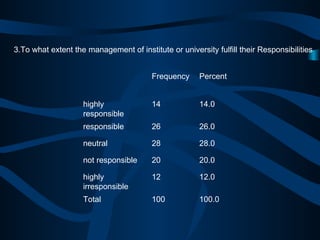
3.To what extent the management of institute or university fulfill their Responsibilities 100.0 100 Total 12.0 12 highly irresponsible 20.0 20 not responsible 28.0 28 neutral 26.0 26 responsible 14.0 14 highly responsible Percent Frequency
 
4. Does the Management follow the Rules made by regulatory body 100.0 100 Total 4.0 4 not at all 24.0 24 don’t care 27.0 27 neutral 31.0 31 some time 14.0 14 every time Percent Frequency
 
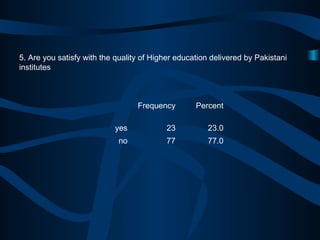
5. Are you satisfy with the quality of Higher education delivered by Pakistani institutes 77.0 77 no 23.0 23 yes Percent Frequency


7. Are you agree with the statement  "by getting ISO certification the quality improves 100.0 100 Total 9.0 9 disagree 30.0 30 neutral 44.0 44 agree 17.0 17 strongly agree Percent Frequency
 
Questionnaire,  Findings 8. What you think that by getting ISO certification the institutes and universities can  improve their education quality 100.0 100 Total 5.0 5 Strongly disagree 9.0 9 disagree 10.0 10 neutral 50.0 50 agree 26.0 26 strongly agree Percent Frequency
 
9. If you are student and planning to get admission for higher education. Will you prefer an ISO certified University? 100.0 100 Total 2.0 2 not at all 11.0 11 no 15.0 15 neutral 30.0 30 not too much 42.0 42 strongly Percent Frequency
 
Implementation of TQM
TQM Philosophy What is Quality  “ The totality of features and characteristics that satisfy needs”
Organizations, Customer and product Student  = Customer. Education   = Product   Institutes   = Organization *
Confidence Computer literacy General Knowledge Language s Latest Knowledge Character Wisdom Basic know-How Presentation skills Appearance  organizational Process Environment Technologies   Furniture Building Computers   Libraries Books Student   IN PUTS OUT PUTS Faculty   EDUCATION PROCESS
Data & Statistics Student Survey   Graduating Student Survey Alumni Survey  Employer   Survey Faculty   Survey Academic unit data & Statistics Library user survey IT User Survey New student Survey Parent Surveys International student Survey Donors Surveys University Employee Surveys HIGHER EDUCATION QMS University Reports & Benchmarks Academic Unit Reports & Benchmarks Department Reports & Benchmarks Integrated Reports Academic Domain     Campus Domain RESULTS Quality Management System For Universities
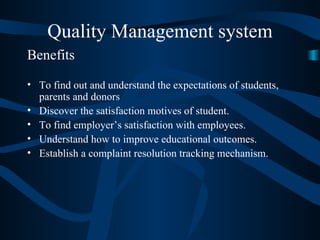
Quality Management system Benefits To find out and understand the expectations of students, parents and donors Discover the satisfaction motives of student. To find employer’s satisfaction with employees. Understand how to improve educational outcomes. Establish a complaint resolution tracking mechanism.
Adopted Seven Element Model for Quality Improvement Adopted from Ersoz, Clara Jean, M.D Philosophy + vision + strategy+Ability+ Resources + Motivation + coordination = Accomplishment No philosophy  = No follower No Vision  =Confusion  No strategy = False stars No Ability  = Nervousness No resources = Frustration  No motivation  = Anger  No Coordination = No synchronization
ISO 9001:2000  Clauses & Interpretation for Educational Institutes General Systemic Requirements   Support quality  (Management Responsibilities) Resource Requirements  Realization Requirements  Remedial Requirements
Quality Management Principles Customer Focus Leadership Involvement of people Process approach System approach to management Continual improvement Factual approach to decision making Mutually beneficial supplier relationships
Conclusions Higher education in Pakistan is in urgent need of reform. At present it is not contributing effectively to economic growth of  the country. The universities are neither geared to create new knowledge nor do their graduates study programmer which measure up to international standards.  The supply of funds to the universities is limited and there is a great potential in the universities for generating funds but real efforts are not being made to explore the possibilities for resource developments.  In addition there is improper utilization of funds available to the universities.   Inadequately equipped libraries and laboratories and a shortage of qualified teachers continue to hinder the progress of higher education towards excellence.
Conclusions I would like to recommend that the universities should get ISO registration  on the bases of  questionnaire results it is quit clear that the customer demand is ISO certified Universities, they will prefer certified Universities and the believe that by getting ISO certification the quality of education will improve Merit should be the only consideration for entry to higher education. Access to higher education, should :be based on entrance tests. For carrying  these tests a National Testing Service should be established.
It may be hard, it may be rough, what ever is the maze please do ask

Education

  • 1.
  • 2.
    Total Quality ManagementPresented To COMASTS Institute of Information Technology
  • 3.
    Outline Introduction Definitionof Literacy & Education Attributes of a Quality Education Problem Statement Research Design Comparison of Education Statistics of Pakistan With other Countries Theoretical Framework Questionnaire, Findings TQM Philosophy Concept of Customer & Product in Educational institutes
  • 4.
    Developed Education Processwith reference to TQM concepts Quality Management System QMS Seven Element Model for Quality Adopted Quality Management Principles Interpretation of ISO 9001:2000 For Educational Institutes. Quality Principles for Rethinking Rules Quality Principles for Rethinking Roles Quality Principles for Rethinking Responsibilities Recommendation & Conclusions
  • 5.
    Problem Statement “ Poor Quality of Higher education in Pakistan” and “ Total Quality Management (TQM) as a tool to enhance the Quality of Higher education at educational institutes in Pakistan”
  • 6.
    Objective of projectTo find out the Method and techniques used in different educational institutes Find out the key reasons why educational institutes are delivering poor quality of education. To design a Quality Management System (QMS) quality management system that will improve the quality of education delivered in educational institutes
  • 7.
    The contribution tothe organization. To make a comparison of literacy rates and other findings regarding education with other countries. To evaluate the performance of Education System of Pakistan. To evaluate the Quality of Higher Education in Pakistan. To find out the attitude of students parents and institutes towards quality of education
  • 8.
    Scope of ResearchOur focus of research is all the universities of which has been working in pakistan. We have tried to collect the data of all the universities of . There is ninety eight 98 universities and institutes in both private and public sector presently working in Pakistan, they have further gives affiliation to other parties and opened their own campuses in deferent locations of Pakistan. By implementing the recommendations given at the end of the research and by using the TQM tools in educational institutes the institutes can improve their quality and helps the government and nation to achieve their objectives and goals.
  • 9.
  • 10.
    Literacy Literacy is more than reading and writing - it is about how we communicate in society. It is about social practices and relationships, about knowledge, language and culture.
  • 11.
    Education “ Theprocess of training and developing the knowledge, skill, mind, character, etc., especially by formal schooling”
  • 12.
    Quality Education CharacteristicsKnowledge Comprenhension Thoughts Expansion Character
  • 13.
    Key issues inEducation Sector Problems Related to aims and Objectives Problems Related to Policy Matters Problems Related to Education System Problems Related to Facilities Main Findings from educationists
  • 14.
    Higher Education Historyin Pakistan Growth of Public Universities in Pakistan University Grants Commission (UGC) 54 18-11-2003 30 2000 20 1990 15 1978 7 1968 4 1957 2 1947 No. of Universities Year
  • 15.
    Private sector UniversitiesHigher Education Commission Pakistan Total Up to 1995 = 10 Now in 2003 = 44 Growth Rate = 340%
  • 16.
    Growth of Private& Public recognized Universities Universities Guide Book 2002 HEC
  • 17.
  • 18.
    Education Share inNational Budget 2.7 Pakistan 8. 40.0 Iran 7. 18.44 Turkey 6. 13.0 Britain 3. Federal Share; 6.7 State Share : 48 U.S.A 1. %Share in National Budget Country S.No
  • 19.
    Comparison of TSRatio British Universities 1:14 Australian Universities 1:15 Pakistani Universities 1:23
  • 20.
  • 21.
    Variables Dependent variable “ Quality of Higher Education” Independent Variables : Roles Rules Responsibilities Moderating Variable: “ System”
  • 22.
    Roles Role ofStudent Role of Parents Role of Regulatory Bodies Role of Society Role of Government Rules Students commitment to follow the rules Parents commitment to follow rules Regulatory Bodies Commitment to follow rules Society Commitment to follow rules Government Commitment to follow rules Responsibilities Student Responsibilities Parents Responsibilities Regulatory Bodies Responsibilities Society’s Responsibilities Government’s Responsibilities
  • 23.
    Theoretical Framework RolesRules Responsibilities Quality of Higher Education System Moderating Variable Independent Variables Dependent Variable
  • 24.
  • 25.
    Data characteristics PrimaryData The primary data has been collected through questionnaires, interviews and personal observations from the student, common peoples, management of universities, and officials of UGC, HEC, PNAC and employer etc. Secondary Data Secondary data has been collected from government publications, literature available at the library of UGC, National Library and others also from internet.
  • 26.
    Data collection MethodsPrimary Data Observation Interviews Questionnaires
  • 27.
    Secondary Data UniversityGrants Commission UGC Higher Education Commission HEC Pakistan Association Of Pakistan PAP Federal Bureau of Pakistan FBP Census A hand book of Universities Internet.
  • 28.
    Findings and Data Analysis
  • 29.
    1.Which one doyou think is the more critical problem of Poor Education 100.0 100 Total 5.0 5 others 31.0 31 Role of Regulatory Body (U.G.C/ P.E.C etc.) 11.0 11 Inequality in standards of Private & Public Universities 27.0 27 Examination System 7.0 7 Inequality in courses of different schools/universities 19.0 19 Percent Frequency
  • 30.
  • 31.
    2. Areyou satisfied with the Role of Regulatory body for education system 100.0 100 Total 21.0 21 strongly not satisfied 22.0 22 not satisfied 41.0 41 neutral 14.0 14 satisfied 2.0 2 strongly satisfied Percent Frequency
  • 32.
  • 33.
    3.To what extentthe management of institute or university fulfill their Responsibilities 100.0 100 Total 12.0 12 highly irresponsible 20.0 20 not responsible 28.0 28 neutral 26.0 26 responsible 14.0 14 highly responsible Percent Frequency
  • 34.
  • 35.
    4. Does theManagement follow the Rules made by regulatory body 100.0 100 Total 4.0 4 not at all 24.0 24 don’t care 27.0 27 neutral 31.0 31 some time 14.0 14 every time Percent Frequency
  • 36.
  • 37.
    5. Are yousatisfy with the quality of Higher education delivered by Pakistani institutes 77.0 77 no 23.0 23 yes Percent Frequency
  • 38.
  • 39.
  • 40.
  • 41.
    7. Are youagree with the statement "by getting ISO certification the quality improves 100.0 100 Total 9.0 9 disagree 30.0 30 neutral 44.0 44 agree 17.0 17 strongly agree Percent Frequency
  • 42.
  • 43.
    Questionnaire, Findings8. What you think that by getting ISO certification the institutes and universities can improve their education quality 100.0 100 Total 5.0 5 Strongly disagree 9.0 9 disagree 10.0 10 neutral 50.0 50 agree 26.0 26 strongly agree Percent Frequency
  • 44.
  • 45.
    9. If youare student and planning to get admission for higher education. Will you prefer an ISO certified University? 100.0 100 Total 2.0 2 not at all 11.0 11 no 15.0 15 neutral 30.0 30 not too much 42.0 42 strongly Percent Frequency
  • 46.
  • 47.
  • 48.
    TQM Philosophy Whatis Quality “ The totality of features and characteristics that satisfy needs”
  • 49.
    Organizations, Customer andproduct Student = Customer. Education = Product Institutes = Organization *
  • 50.
    Confidence Computer literacyGeneral Knowledge Language s Latest Knowledge Character Wisdom Basic know-How Presentation skills Appearance organizational Process Environment Technologies Furniture Building Computers Libraries Books Student IN PUTS OUT PUTS Faculty EDUCATION PROCESS
  • 51.
    Data & StatisticsStudent Survey Graduating Student Survey Alumni Survey Employer Survey Faculty Survey Academic unit data & Statistics Library user survey IT User Survey New student Survey Parent Surveys International student Survey Donors Surveys University Employee Surveys HIGHER EDUCATION QMS University Reports & Benchmarks Academic Unit Reports & Benchmarks Department Reports & Benchmarks Integrated Reports Academic Domain Campus Domain RESULTS Quality Management System For Universities
  • 52.
    Quality Management systemBenefits To find out and understand the expectations of students, parents and donors Discover the satisfaction motives of student. To find employer’s satisfaction with employees. Understand how to improve educational outcomes. Establish a complaint resolution tracking mechanism.
  • 53.
    Adopted Seven ElementModel for Quality Improvement Adopted from Ersoz, Clara Jean, M.D Philosophy + vision + strategy+Ability+ Resources + Motivation + coordination = Accomplishment No philosophy = No follower No Vision =Confusion No strategy = False stars No Ability = Nervousness No resources = Frustration No motivation = Anger No Coordination = No synchronization
  • 54.
    ISO 9001:2000 Clauses & Interpretation for Educational Institutes General Systemic Requirements Support quality (Management Responsibilities) Resource Requirements Realization Requirements Remedial Requirements
  • 55.
    Quality Management PrinciplesCustomer Focus Leadership Involvement of people Process approach System approach to management Continual improvement Factual approach to decision making Mutually beneficial supplier relationships
  • 56.
    Conclusions Higher educationin Pakistan is in urgent need of reform. At present it is not contributing effectively to economic growth of the country. The universities are neither geared to create new knowledge nor do their graduates study programmer which measure up to international standards. The supply of funds to the universities is limited and there is a great potential in the universities for generating funds but real efforts are not being made to explore the possibilities for resource developments. In addition there is improper utilization of funds available to the universities. Inadequately equipped libraries and laboratories and a shortage of qualified teachers continue to hinder the progress of higher education towards excellence.
  • 57.
    Conclusions I wouldlike to recommend that the universities should get ISO registration on the bases of questionnaire results it is quit clear that the customer demand is ISO certified Universities, they will prefer certified Universities and the believe that by getting ISO certification the quality of education will improve Merit should be the only consideration for entry to higher education. Access to higher education, should :be based on entrance tests. For carrying these tests a National Testing Service should be established.
  • 58.
    It may behard, it may be rough, what ever is the maze please do ask