GROUP MEMBERS NAMES
GROUP MEMBERS NAMES:
IZZA KANWAL
UMMARA MUGHAL
MEHWISH AFRAZ
SAMAN ZAHOOR
SAMRANA GULTASAB
EDUCATION
• Education is the process of facilitating learning.
• Education frequently takes place under the guidance
of educators, but learners may also educate
themselves in a process called autodidactic
learning.
• EDUCATION is
 “Preparing a person to face everyday life”
PURPOSE
Today, education raises productivity and efficiency of
individuals and produces skilled manpower.
Education is a fundamental human right and is central
to development, social progress and human freedom.
An educational system of poor quality may be one of
the most important reasons why poor countries do not
grow at a reasonable rate.
IMPORTANCE OF EDUCATION
• No nation can survive without quality or modern
education,that builds the nations and become the
cause of prosperity.
 It gives the path that leads towards bright future so
education policy should be made according to the era
time and situation.
Education System in Pakistan
 By the 18 constitutional amendment some reforms are made
for education.
 According to clause 25-A it is responsibility of state to
provide free and compulsory education to all school going
children.
 Education in Pakistan is overseen by ministry of education of
government of Pakistan.
 The education academic institution are the responsibility of
provincial government .
 Federal government is responsible for curriculum
development, recognition and some finance research.
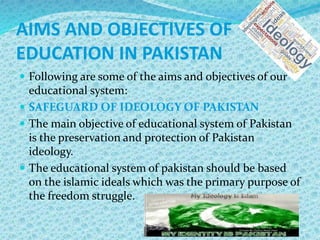
AIMS AND OBJECTIVES OF
EDUCATION IN PAKISTAN
 Following are some of the aims and objectives of our
educational system:
 SAFEGUARD OF IDEOLOGY OF PAKISTAN
 The main objective of educational system of Pakistan
is the preservation and protection of Pakistan
ideology.
 The educational system of pakistan should be based
on the islamic ideals which was the primary purpose of
the freedom struggle.
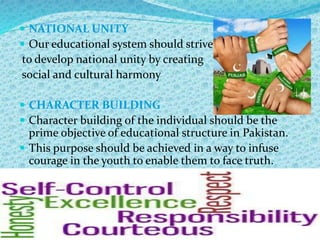
 NATIONAL UNITY
 Our educational system should strive
to develop national unity by creating
social and cultural harmony
 CHARACTER BUILDING
 Character building of the individual should be the
prime objective of educational structure in Pakistan.
 This purpose should be achieved in a way to infuse
courage in the youth to enable them to face truth.
 ERADICATION OF IGNORANCE
 As education is meant for the elimination of
illiteracy,our educational setup should attain this
target by launching a programs.
 PROMOTION OF TECHNICAL AND
PROFESSIONAL EDUCATION
 Educational structure in Pakistan should be devised
on pattern which can ensure the promotion of
scientific,technical and professional education.
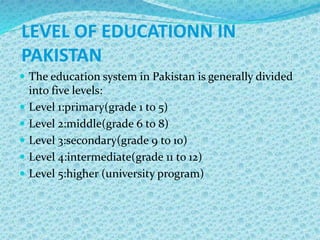
LEVEL OF EDUCATIONN IN
PAKISTAN
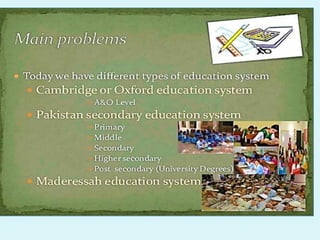
 The education system in Pakistan is generally divided
into five levels:
 Level 1:primary(grade 1 to 5)
 Level 2:middle(grade 6 to 8)
 Level 3:secondary(grade 9 to 10)
 Level 4:intermediate(grade 11 to 12)
 Level 5:higher (university program)
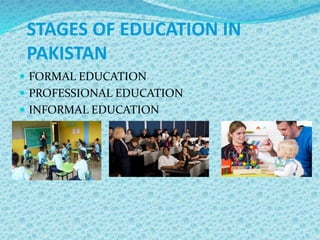
STAGES OF EDUCATION IN
PAKISTAN
 FORMAL EDUCATION
 PROFESSIONAL EDUCATION
 INFORMAL EDUCATION
Formal education:
Formal education is classroom-based, provided by trained
teachers.
Informal education:
Informal education happens outside the classroom, in after-
school programs, community-based organizations, museums,
libraries, or at home.
Professional education:
"Professional" education usually refers to education for
professional jobs, which could include law, medicine,
teaching, etc
TYPES OF FORMAL EDUCATION
 Primary Education
 Secondary Education
 Higher Education
TYPES OF INFORMAL EDUCATION
Adult Education
Madrassah Education
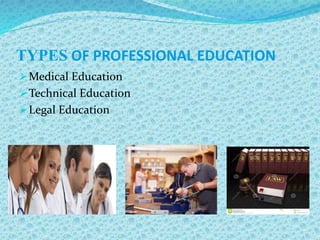
TYPES OF PROFESSIONAL EDUCATION
Medical Education
Technical Education
Legal Education
PROVINCE LITERACY RATE
Province literacy rate
 Punjab= 60.2%
 Sindh= 57.7%
 KPK= 49.9%
 Baluchistan= 48.8%
MALE AND FEMALE LITERACY
RATE
Literacy rates in Pakistan is only 58 per cent.
 MALE LITERACY RATE
 Male literacy rate in Pakistan is only 61.3 per cent.
 FEMALE LITERACY RATE
 Female literacy rate in Pakistan is only 36.8 per cent.
CAUSES OF LOW LITERACY
RATE OF FEMALES IN PAKISTAN
 Gender gap
 Poverty
 Cultural restrictions and distance
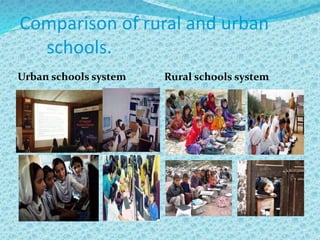
Comparison of rural and urban
schools.
Urban schools system Rural schools system
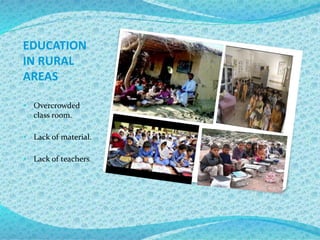
EDUCATION
IN RURAL
AREAS
• Overcrowded
class room.
• Lack of material.
• Lack of teachers.
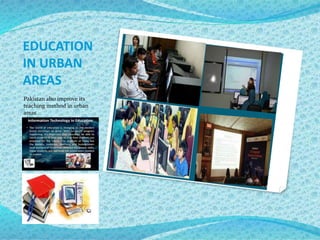
EDUCATION
IN URBAN
AREAS
Pakistan also improve its
teaching method in urban
areas
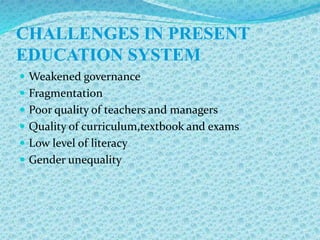
CHALLENGES IN PRESENT
EDUCATION SYSTEM
 Weakened governance
 Fragmentation
 Poor quality of teachers and managers
 Quality of curriculum,textbook and exams
 Low level of literacy
 Gender unequality
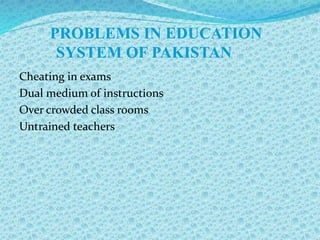
PROBLEMS IN EDUCATION
SYSTEM OF PAKISTAN
Cheating in exams
Dual medium of instructions
Over crowded class rooms
Untrained teachers
RECOMMENDATION
Career counselling:
There should be people for career counselling of children so that they could get
to know that what they have to do in future
Change the system:
Government have to take steps to end cramming system in education from
government as well as private sector and implement system of practical work
Equality and quality in syllabus:
Government should order private as well as government schools and
colleges to implement one syllabus in classes and there should be no
double standards.
Training for teachers:
Government should implement higher standards for choosing teachers to make
sure that they are teaching according to higher standards
QUESTIONS:
education system

education system

  • 3.
    GROUP MEMBERS NAMES GROUPMEMBERS NAMES: IZZA KANWAL UMMARA MUGHAL MEHWISH AFRAZ SAMAN ZAHOOR SAMRANA GULTASAB
  • 4.
    EDUCATION • Education isthe process of facilitating learning. • Education frequently takes place under the guidance of educators, but learners may also educate themselves in a process called autodidactic learning. • EDUCATION is  “Preparing a person to face everyday life”
  • 5.
    PURPOSE Today, education raisesproductivity and efficiency of individuals and produces skilled manpower. Education is a fundamental human right and is central to development, social progress and human freedom. An educational system of poor quality may be one of the most important reasons why poor countries do not grow at a reasonable rate.
  • 6.
    IMPORTANCE OF EDUCATION •No nation can survive without quality or modern education,that builds the nations and become the cause of prosperity.  It gives the path that leads towards bright future so education policy should be made according to the era time and situation.
  • 7.
    Education System inPakistan  By the 18 constitutional amendment some reforms are made for education.  According to clause 25-A it is responsibility of state to provide free and compulsory education to all school going children.  Education in Pakistan is overseen by ministry of education of government of Pakistan.  The education academic institution are the responsibility of provincial government .  Federal government is responsible for curriculum development, recognition and some finance research.
  • 8.
    AIMS AND OBJECTIVESOF EDUCATION IN PAKISTAN  Following are some of the aims and objectives of our educational system:  SAFEGUARD OF IDEOLOGY OF PAKISTAN  The main objective of educational system of Pakistan is the preservation and protection of Pakistan ideology.  The educational system of pakistan should be based on the islamic ideals which was the primary purpose of the freedom struggle.
  • 9.
     NATIONAL UNITY Our educational system should strive to develop national unity by creating social and cultural harmony  CHARACTER BUILDING  Character building of the individual should be the prime objective of educational structure in Pakistan.  This purpose should be achieved in a way to infuse courage in the youth to enable them to face truth.
  • 10.
     ERADICATION OFIGNORANCE  As education is meant for the elimination of illiteracy,our educational setup should attain this target by launching a programs.  PROMOTION OF TECHNICAL AND PROFESSIONAL EDUCATION  Educational structure in Pakistan should be devised on pattern which can ensure the promotion of scientific,technical and professional education.
  • 11.
    LEVEL OF EDUCATIONNIN PAKISTAN  The education system in Pakistan is generally divided into five levels:  Level 1:primary(grade 1 to 5)  Level 2:middle(grade 6 to 8)  Level 3:secondary(grade 9 to 10)  Level 4:intermediate(grade 11 to 12)  Level 5:higher (university program)
  • 12.
    STAGES OF EDUCATIONIN PAKISTAN  FORMAL EDUCATION  PROFESSIONAL EDUCATION  INFORMAL EDUCATION
  • 13.
    Formal education: Formal educationis classroom-based, provided by trained teachers. Informal education: Informal education happens outside the classroom, in after- school programs, community-based organizations, museums, libraries, or at home. Professional education: "Professional" education usually refers to education for professional jobs, which could include law, medicine, teaching, etc
  • 14.
    TYPES OF FORMALEDUCATION  Primary Education  Secondary Education  Higher Education TYPES OF INFORMAL EDUCATION Adult Education Madrassah Education
  • 15.
    TYPES OF PROFESSIONALEDUCATION Medical Education Technical Education Legal Education
  • 16.
    PROVINCE LITERACY RATE Provinceliteracy rate  Punjab= 60.2%  Sindh= 57.7%  KPK= 49.9%  Baluchistan= 48.8%
  • 17.
    MALE AND FEMALELITERACY RATE Literacy rates in Pakistan is only 58 per cent.  MALE LITERACY RATE  Male literacy rate in Pakistan is only 61.3 per cent.  FEMALE LITERACY RATE  Female literacy rate in Pakistan is only 36.8 per cent.
  • 18.
    CAUSES OF LOWLITERACY RATE OF FEMALES IN PAKISTAN  Gender gap  Poverty  Cultural restrictions and distance
  • 19.
    Comparison of ruraland urban schools. Urban schools system Rural schools system
  • 20.
    EDUCATION IN RURAL AREAS • Overcrowded classroom. • Lack of material. • Lack of teachers.
  • 21.
    EDUCATION IN URBAN AREAS Pakistan alsoimprove its teaching method in urban areas
  • 22.
    CHALLENGES IN PRESENT EDUCATIONSYSTEM  Weakened governance  Fragmentation  Poor quality of teachers and managers  Quality of curriculum,textbook and exams  Low level of literacy  Gender unequality
  • 24.
    PROBLEMS IN EDUCATION SYSTEMOF PAKISTAN Cheating in exams Dual medium of instructions Over crowded class rooms Untrained teachers
  • 25.
    RECOMMENDATION Career counselling: There shouldbe people for career counselling of children so that they could get to know that what they have to do in future Change the system: Government have to take steps to end cramming system in education from government as well as private sector and implement system of practical work Equality and quality in syllabus: Government should order private as well as government schools and colleges to implement one syllabus in classes and there should be no double standards. Training for teachers: Government should implement higher standards for choosing teachers to make sure that they are teaching according to higher standards
  • 26.