Quality control methods 
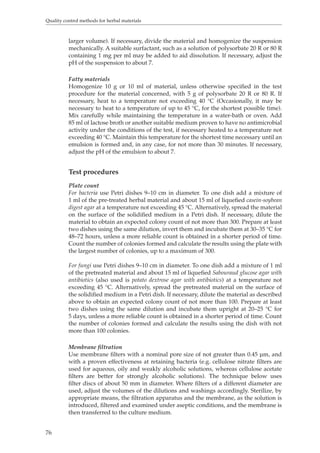
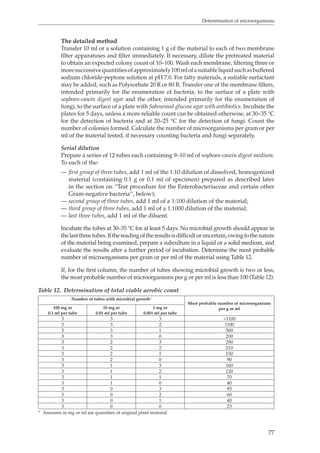
for herbal materials 
Updated edition of Quality control methods for medicinal plant materials, 1998
WHO Library Cataloguing-in-Publication Data 
Quality control methods for herbal materials. 
Updated edition of Quality control methods for medicinal plant materials, 1998 
1. Plants, Medicinal. 2. Medicine, Herbal. 3. Medicine, Traditional. 4. Quality control. 5. Manuals. I. World Health 
Organization. 
ISBN 978 92 4 150073 9 (NLM classification: QV 766) 
© World Health Organization 2011 
All rights reserved. Publications of the World Health Organization can be obtained from WHO Press, World 
Health Organization, 20 Avenue Appia, 1211 Geneva 27, Switzerland (tel.: +41 22 791 3264; fax: +41 22 791 4857; 
e-mail: bookorders@who.int). Requests for permission to reproduce or translate WHO publications – whether 
for sale or for noncommercial distribution – should be addressed to WHO Press, at the above address 
(fax: +41 22 791 4806; e-mail: permissions@who.int). 
The designations employed and the presentation of the material in this publication do not imply the expression 
of any opinion whatsoever on the part of the World Health Organization concerning the legal status of any 
country, territory, city or area or of its authorities, or concerning the delimitation of its frontiers or boundaries. 
Dotted lines on maps represent approximate border lines for which there may not yet be full agreement. 
The mention of specific companies or of certain manufacturers’ products does not imply that they are endorsed 
or recommended by the World Health Organization in preference to others of a similar nature that are not 
mentioned. Errors and omissions excepted, the names of proprietary products are distinguished by initial capital 
letters. 
All reasonable precautions have been taken by the World Health Organization to verify the information contained 
in this publication. However, the published material is being distributed without warranty of any kind, either 
expressed or implied. The responsibility for the interpretation and use of the material lies with the reader. In no 
event shall the World Health Organization be liable for damages arising from its use. 
Printed in Malta.
Contents 
Contents 
Acknowledgment ............................................................................................................v 
Preface to the first edition (1998).................................................................................vii 
Preface to the updated edition ..................................................................................... ix 
Note to the reader ........................................................................................................... xi 
1. General notices ......................................................................................................... 1 
2. Powder fineness and sieve size .............................................................................. 5 
3. General advice on sampling ................................................................................... 7 
4. Determination of foreign matter ........................................................................... 9 
5. Macroscopic and microscopic examination ........................................................11 
6. Thin-layer chromatography.................................................................................. 23 
7. Determination of ash ............................................................................................. 29 
8. Determination of extractable matter ................................................................... 31 
9. Determination of water and volatile matter...................................................... 33 
10. Determination of volatile oils .............................................................................. 37 
11. Determination of bitterness value ...................................................................... 41 
12. Determination of haemolytic activity ................................................................ 43 
13. Determination of tannins ..................................................................................... 45 
14. Determination of swelling index ........................................................................ 47 
15. Determination of foaming index ......................................................................... 49 
16. Determination of pesticide residues .................................................................. 51 
17. Determination of arsenic and toxic metals ........................................................ 67 
18. Determination of microorganisms ...................................................................... 75 
19. Determination of aflatoxins .................................................................................. 85 
iii
Quality control methods for herbal materials 
iv 
20. Radioactive contamination ................................................................................... 87 
21. Culture media and strains used for microbiological analysis ....................... 89 
22. Specifications for adsorbents for use in thin-layer chromatography ........... 93 
23. Reagents and solutions ......................................................................................... 99 
References ..................................................................................................................... 125 
Selected bibliography ................................................................................................. 127 
Glossary ........................................................................................................................ 129 
Annex WHO good practices for pharmaceutical quality control 
laboratories .................................................................................................. 135
Acknowledgements 
Acknowledgements 
The World Health Organization wishes to express its appreciation for the generous 
financial support provided by the Government of Japan for the publication of this 
document. 
WHO acknowledges its indebtedness to approximately 260 reviewers, including 
members of the organization’s Expert Advisory Panel on Traditional Medicine and 
Expert Advisory Panel on the International Pharmacopoeia and Pharmaceutical 
Preparations, WHO collaborating centres for traditional medicine, and national 
regulatory authorities in over 114 countries who provided national information, 
comments and advice on the draft texts. The preparation of this document 
benefited from technical support received from relevant professional bodies and 
nongovernmental organizations. 
WHO also wishes to thank the members of the WHO Expert Committee on 
Specifications for Pharmaceutical Preparations, which met in 2004 and 2007 and 
held consultation meetings in 2005 and 2006, for their review of, technical guidance 
on, and endorsement of the updated contents of this publication. 
The photograph on the front cover was kindly provided by Dr Yukihiro Goda, 
Head of the Division of Pharmacognosy, Phytochemistry and Narcotics, at the 
National Institute of Health Sciences, Ministry of Health, Labour and Welfare, 
Tokyo, Japan. 
v
vi
Preface to the first edition (1998) 
Plant materials are used throughout developed and developing countries as home 
remedies, over-the-counter drug products and raw materials for the pharmaceutical 
industry, and represent a substantial proportion of the global drug market. It is 
therefore essential to establish internationally recognized guidelines for assessing 
their quality. The World Health Assembly — in resolutions WHA31.33 (1978), 
WHA40.33 (1987) and WHA42.43 (1989) — has emphasized the need to ensure 
the quality of medicinal plant products by using modern control techniques and 
applying suitable standards. This manual describes a series of tests for assessing 
the quality of medicinal plant materials. The tests are designed primarily for 
use in national drug quality control laboratories in developing countries, and 
complement those described in The international pharmacopoeia,1 which provides 
quality specifications only for the few plant materials that are included in the 
WHO Model List of Essential Drugs.2 This manual does not constitute a herbal 
pharmacopoeia, but a collection of test procedures to support the development of 
national standards based on local market conditions, with due regard to existing 
national legislation and national and regional norms. Publications containing 
relevant specifications and standards, including those related to the food industry, 
are listed in the References and Bibliography. 
The test methods described here are the best methods currently available. The 
manual will be revised as needed to incorporate improvements and additional 
tests and to reflect developments in work being carried out at national and 
regional levels, including projects aimed at finding replacements for toxic 
reagents. 
In addition to the test methods, some suggestions regarding general limits for 
contaminants are included. They should be considered as a basis for establishing 
national limits. WHO is not currently able to recommend limits for contaminants 
since these are too diverse and there is a lack of consensus. For instance, the draft 
proposal for limits for some pesticides published in Pharmeuropa, 1993, 5(1): 19, is 
far more restrictive than that proposed here. 
The test procedures cannot take account of all possible impurities. Common sense 
and good pharmaceutical practice should be applied in deciding whether an 
unusual substance not detectable by the prescribed tests can be tolerated. 
1 The international pharmacopoeia, 3rd ed. Geneva, World Health Organization. Vol. 1: General methods 
of analysis, 1979. Vol. 2: Quality specifications, 1981. Vol. 3; Quality specifications, 1988. Vol. 4: Tests, 
methods, and general requirements. Quality specifications for pharmaceutical substances, excipients, and 
dosage forms, 1994. 
2 The use of essential drugs. Eighth report of the WHO Expert Committee. Geneva, World Health 
Organization, 1998 (WHO Technical Report Series, No. 882). 
vii
Quality control methods for herbal materials 
viii 
The analysis of medicinal plant materials is not restricted to those methods 
discussed or recommended here and many techniques similar to those used for the 
analysis of synthetic drugs are also frequently employed (e.g. volumetric analysis, 
gravimetric determinations, gas chromatography, column chromatography, high-performance 
liquid chromatography and spectrophotometric methods). Details of 
all these methods can be found in The international pharmacopoeia.
Preface to the updated edition 
WHO published Quality control methods for medicinal plant materials in 1998, in 
order to support WHO Member States in establishing quality standards and 
specifications for herbal materials, within the overall context of quality assurance 
and control of herbal medicines. This publication came to be regarded as one of 
the key technical documents in ensuring and controlling the quality of herbal 
medicines. 
At the end of 2007, the document WHO guidelines on assessing quality of herbal 
medicines with reference to contaminants and residues was published. These two 
publications were the result of joint activities between, among others, the teams of 
Quality and Safety: Medicines (QSM) and Traditional Medicine (TRM) within the 
WHO Cluster for Health Systems and Services. 
The majority of adverse events reported in relation to the use of herbal products 
and herbal medicines are attributable to poor quality of the product. In order to 
promote the safety of herbal medicines, WHO has committed itself to develop 
the necessary new guidelines and to update existing ones relating to the quality 
assurance and control of herbal medicines. 
The preparation of the guidelines relating to contaminants and residues gave WHO an 
opportunity to gather detailed technical information on various analytical methods 
for determining possible contaminants and residues in herbal medicines — including 
those described in 10 national and/or regional pharmacopoeias. Subsequently, WHO 
was able to compare each analytical method for specific contaminants and residues 
and could recommend methods for each of the possible contaminants and residues of 
herbal medicines. This material was identified to serve in updating the information 
and methods corresponding to sections 16–22 of Quality control methods for medicinal 
plant materials (1998). 
As the Quality control methods for medicinal plant materials was widely distributed, 
WHO considered reprinting the publication. However, in view of the above-mentioned 
opportunity given by the development of the guidelines, it was 
proposed to update the relevant sections and publish an updated edition instead 
of reprinting the existing publication. In 2004, the WHO Expert Committee on 
Specification of Pharmaceutical Preparations agreed with this proposal. 
Subsequently, draft chapters for the update were consolidated and were presented 
to the WHO Expert Committee on Specifications for Pharmaceutical Preparations 
at its consultation meetings and sessions in 2005 and 2006. At its 2007 session, the 
Expert Committee the publication of the updated edition. 
The purpose of this updated edition remains unchanged from that of the first 
edition. It is to support the development of national standards based on local 
market conditions, with due regard to existing national legislation and national 
ix 
endorsed
Quality control methods for herbal materials 
x 
and regional norms. It describes a series of tests for assessing the quality of herbal 
materials, including the determination of pesticide residues, arsenic and toxic 
heavy metals, microorganisms and aflatoxins. This new edition will also serve 
as key technical training material in capacity-building training workshops in 
herbal medicines. Compilation of the updated edition of Quality control methods for 
medicinal plant materials — now with the updated title of Quality control methods for 
herbal materials — has been undertaken thanks to continued collaboration between 
QSM and TRM. This publication is an example of the immediate response of WHO 
in the implementation of the Global strategy and plan of action on public health, 
innovation and intellectual property that was adopted by the Sixty-first World 
Health Assembly. 
As this publication was being prepared, the WHO Expert Committee on 
Specifications for Pharmaceutical Preparations adopted WHO good practices for 
pharmaceutical quality control laboratories, which were published in 2010 as Annex 1 
of the 44th report of the Committee. The scope of the good practice guidance in 
this annex includes pharmaceutical quality control laboratories handling herbal 
medicines. In order to promote these good practices and to provide general 
technical guidance in conducting the test methods described in this publication, 
Annex 1 of the Forty-fourth report of the WHO Expert Committee on specifications for 
pharmaceutical preparations is annexed to this publication for easy reference.
Note to the reader 
Note to the reader 
The test methods described in this publication are presented as examples of suitable 
methods for herbal materials. 
The analysis of herbal medicines is not restricted to those methods discussed or 
recommended here. Other techniques are available. 
When considering the choice of method, the level of detection and the herbal 
material matrix used for the testing (e.g. seeds containing oils) must be taken 
into account, and the method modified if required. The method of determination 
should be validated for the relevant matrix. 
Although selected methods are described in detail in this document, they may 
not necessarily be the most modern or state-of-the-art methods. They offer some 
options and guidance but the available technology and resources, including human 
and financial, may influence their use in particular countries. 
In the event of limitations precluding the required analytical services for herbal 
materials in a particular district(s) in a country, it is recommended that at least other 
national or regional official laboratories should be available for such purposes. 
The guidance of good practices for pharmaceutical control laboratories (see Annex 1), 
including quality assurance measures, should be followed when methods are chosen 
for all analyses. All methods chosen should be properly validated in accordance with 
these good practices. 
WHO is currently unable to recommend limits for contaminants and residues 
because they are too diverse and there is a lack of international consensus. However, 
some examples of national experience regarding general limits for contaminants 
and residues are provided in other WHO guidelines.1 
1 WHO guidelines for assessing quality of herbal medicines with reference to contaminants and residues, 
World Health Organization, Geneva, 2007. 
xi
xii
General notices 
1. General notices 
1 
General considerations 
The metric system is used throughout the text. All temperatures are expressed in 
degrees Celsius (°C). 
Tests are normally carried out at room temperature (15–25 °C, or up to 30 °C in 
some climatic zones), unless otherwise indicated. 
Any glassware used in the tests should be of suitable quality. Graduated and 
volumetric vessels should be calibrated at room temperature. 
When a water-bath is referred to in the text, a bath containing boiling water (about 
100 °C) is to be used, unless a specific water temperature is given. 
Unless otherwise specified, all solutions indicated in the tests are prepared with 
distilled or demineralized water of adequate purity. 
Reagents and solutions 
Reagents and solutions used must conform to the requirements specified in chapter 
23 on “Reagents and solutions”, and are designated as follows: reagent, R; test 
solution, TS; volumetric solution, VS. 
Precision of measurement 
Quantities and volumes 
The quantities and volumes of the materials and reagents used in the tests must be 
measured with adequate precision, which is indicated as follows: 
— a value of 20.0 means not less than 19.5 and not more than 20.5; 
— a value of 2.0 means not less than 1.95 and not more than 2.05; 
— a value of 0.20 means not less than 0.195 and not more than 0.205. 
Temperature 
Temperature measurement is indicated in a manner similar to that given for 
quantities and volumes. 
Storage conditions given in general terms refer to the following equivalent 
temperatures: 
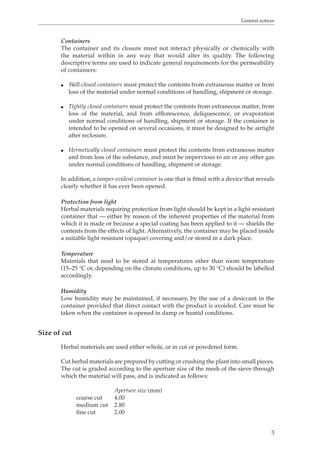
In a refrigerator 0–6 °C; 
Cold or cool 6–15 °C; 
Room temperature 15–25 °C, or up to 30 °C in some climatic zones.
Quality control methods for herbal materials 
2 
pH values 
Precision in the measurement of pH values is indicated in a manner similar to that 
for quantities and volumes. 
Calculation of results 
The results of tests and assays should be calculated to one decimal place more than 
indicated in the requirement and then rounded up or down, as follows: 
— if the last figure calculated is 5 to 9, the preceding figure is increased by 1; 
— if the last figure calculated is 4 or less, the preceding figure is left unchanged. 
Other calculations, such as in the standardization of volumetric solutions, should 
be carried out in a similar manner. 
If the material has to be dried before it can be reduced to a powder for use in a 
determination, a correction must be made to take into account the loss on drying, 
and the amount of active principle calculated with reference to the undried 
sample. 
Establishment of limits 
Reasonable limits may be established using simple statistical methods (e.g. 
control chart techniques) (1,2). Analytical results from about 20 successive 
batches are pooled together, and the grand average and “three sigma limits” (±3 
standard deviations from the grand average) are calculated. Such calculations are 
applicable when more than one individual or independent sample per batch is 
analysed (3,4). 
Solubility 
Unless otherwise specified in the test procedure for the plant material concerned, 
the approximate solubility of herbal materials should be determined at 20 °C. 
Solubility is expressed in terms of “parts”, representing the number of millilitres 
(ml) of the solvent, in which 1 g of the solid is soluble. Descriptive terms are 
sometimes used to indicate the solubility of a substance, with the following 
meanings: 
very soluble less than 1 part 
freely soluble 1–10 parts 
soluble 10–30 parts 
sparingly soluble 30–100 parts 
slightly soluble 100–1000 parts 
very slightly soluble 1000–10 000 parts 
practically insoluble more than 10 000 parts. 
Storage 
Herbal materials must be stored under specified conditions in order to avoid 
contamination and deterioration.
General notices 
Containers 
The container and its closure must not interact physically or chemically with 
the material within in any way that would alter its quality. The following 
descriptive terms are used to indicate general requirements for the permeability 
of containers: 
O Well-closed containers must protect the contents from extraneous matter or from 
loss of the material under normal conditions of handling, shipment or storage. 
O Tightly closed containers must protect the contents from extraneous matter, from 
loss of the material, and from efflorescence, deliquescence, or evaporation 
under normal conditions of handling, shipment or storage. If the container is 
intended to be opened on several occasions, it must be designed to be airtight 
after reclosure. 
O Hermetically closed containers must protect the contents from extraneous matter 
and from loss of the substance, and must be impervious to air or any other gas 
under normal conditions of handling, shipment or storage. 
In addition, a tamper-evident container is one that is fitted with a device that reveals 
clearly whether it has ever been opened. 
Protection from light 
Herbal materials requiring protection from light should be kept in a light-resistant 
container that — either by reason of the inherent properties of the material from 
which it is made or because a special coating has been applied to it — shields the 
contents from the effects of light. Alternatively, the container may be placed inside 
a suitable light-resistant (opaque) covering and/or stored in a dark place. 
Temperature 
Materials that need to be stored at temperatures other than room temperature 
(15–25 °C or, depending on the climate conditions, up to 30 °C) should be labelled 
accordingly. 
Humidity 
Low humidity may be maintained, if necessary, by the use of a desiccant in the 
container provided that direct contact with the product is avoided. Care must be 
taken when the container is opened in damp or humid conditions. 
3 
Size of cut 
Herbal materials are used either whole, or in cut or powdered form. 
Cut herbal materials are prepared by cutting or crushing the plant into small pieces. 
The cut is graded according to the aperture size of the mesh of the sieve through 
which the material will pass, and is indicated as follows: 
Aperture size (mm) 
coarse cut 4.00 
medium cut 2.80 
fine cut 2.00
Quality control methods for herbal materials 
Units of measurement 
4 
The names and symbols for units of measurement used in this manual conform 
with those used in The international pharmacopoeia (5) and those of the International 
System of units (SI), developed by the General Conference of Weights and Measures 
(CGPM) in collaboration with other international organizations (6,7).
Powder fineness and sieve size 
2. Powder fineness and sieve size 
5 
Powders 
The coarseness or fineness of a powder is classed according to the nominal aperture 
size expressed in micrometres of the mesh of the sieve through which the powder 
will pass, and is indicated as shown in Table 1. 
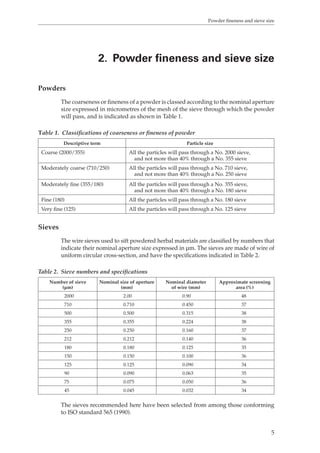
Table 1. Classifications of coarseness or fineness of powder 
Descriptive term Particle size 
Coarse (2000/355) All the particles will pass through a No. 2000 sieve, 
and not more than 40% through a No. 355 sieve 
Moderately coarse (710/250) All the particles will pass through a No. 710 sieve, 
and not more than 40% through a No. 250 sieve 
Moderately fine (355/180) All the particles will pass through a No. 355 sieve, 
and not more than 40% through a No. 180 sieve 
Fine (180) All the particles will pass through a No. 180 sieve 
Very fine (125) All the particles will pass through a No. 125 sieve 
Sieves 
The wire sieves used to sift powdered herbal materials are classified by numbers that 
indicate their nominal aperture size expressed in μm. The sieves are made of wire of 
uniform circular cross-section, and have the specifications indicated in Table 2. 
Table 2. Sieve numbers and specifications 
Number of sieve 
(μm) 
Nominal size of aperture 
(mm) 
Nominal diameter 
of wire (mm) 
Approximate screening 
area (%) 
2000 2.00 0.90 48 
710 0.710 0.450 37 
500 0.500 0.315 38 
355 0.355 0.224 38 
250 0.250 0.160 37 
212 0.212 0.140 36 
180 0.180 0.125 35 
150 0.150 0.100 36 
125 0.125 0.090 34 
90 0.090 0.063 35 
75 0.075 0.050 36 
45 0.045 0.032 34 
The sieves recommended here have been selected from among those conforming 
to ISO standard 565 (1990).
6
General advice on sampling 
3. General advice on sampling 
The reliability of any conclusions drawn from the analysis of a sample will depend 
upon how well the sample represents the whole batch. General recommendations 
for the sampling of pharmaceutical materials in connection with quality control 
are provided in the 39th report of the WHO Expert Committee on Specifications 
for Pharmaceutical Preparations (3). 
Because of the specific characteristics of herbal materials, in particular their lack 
of homogeneity, special handling procedures are required in relation to sampling. 
The following procedures should be observed when selecting and preparing an 
average sample from a batch of material. 
7 
Recommended procedures 
Sampling of material in bulk 
Inspect each container or packaging unit for conformity with pharmacopoeia 
monographs or other requirements regarding packaging and labelling. Check 
the condition of the package and note any defects that may influence the quality 
or stability of the contents (physical damage, moisture, etc.). Sample damaged 
containers individually. 
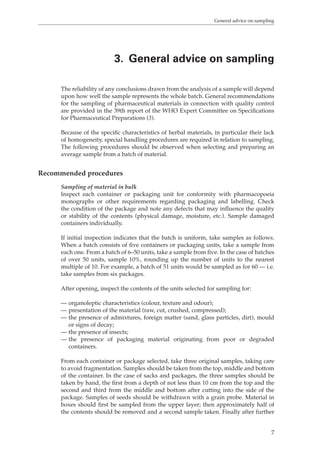
If initial inspection indicates that the batch is uniform, take samples as follows. 
When a batch consists of five containers or packaging units, take a sample from 
each one. From a batch of 6–50 units, take a sample from five. In the case of batches 
of over 50 units, sample 10%, rounding up the number of units to the nearest 
multiple of 10. For example, a batch of 51 units would be sampled as for 60 — i.e. 
take samples from six packages. 
After opening, inspect the contents of the units selected for sampling for: 
— organoleptic characteristics (colour, texture and odour); 
— presentation of the material (raw, cut, crushed, compressed); 
— the presence of admixtures, foreign matter (sand, glass particles, dirt), mould 
or signs of decay; 
— the presence of insects; 
— the presence of packaging material originating from poor or degraded 
containers. 
From each container or package selected, take three original samples, taking care 
to avoid fragmentation. Samples should be taken from the top, middle and bottom 
of the container. In the case of sacks and packages, the three samples should be 
taken by hand, the first from a depth of not less than 10 cm from the top and the 
second and third from the middle and bottom after cutting into the side of the 
package. Samples of seeds should be withdrawn with a grain probe. Material in 
boxes should first be sampled from the upper layer; then approximately half of 
the contents should be removed and a second sample taken. Finally after further
Quality control methods for herbal materials 
8 
removal of material, another sample should be taken from the bottom. Samples 
should be as uniform as possible in mass. The three original samples should then 
be combined into a pooled sample which should be mixed carefully. 
The average sample is obtained by quartering. Form the pooled sample, adequately 
mixed, into an even and square-shaped heap, and divide it diagonally into four 
equal parts. Take two diagonally opposite parts and mix carefully. Repeat the 
process as necessary until the required quantity, to within ± 10%, is obtained (100– 
200 g for flowers and up to 10 kg for certain roots). Any remaining material should 
be returned to the batch. 
Using the same quartering procedure, divide the average sample into four final 
samples, taking care that each portion is representative of the bulk material. The 
final samples are tested for the following characteristics: 
— degree of fragmentation (sieve test); 
— identity and level of impurities; 
— moisture and ash content; 
— level of active ingredients, where possible. 
A portion of each final sample should be retained to serve as reference material, 
which may also be used for re-test purposes, if necessary. 
Sampling of material in retail packages 
From each wholesale container (boxes, cartons, etc.) selected for sampling, take at 
random two consumer packages. From small batches (1–5 boxes), take 10 consumer 
packages. Prepare the pooled sample by mixing the contents of the selected consumer 
packages and proceed as described above to obtain the final sample.
Determination of foreign matter 
4. Determination of foreign matter 
Herbal materials should be entirely free from visible signs of contamination by 
moulds or insects, and other animal contamination, including animal excreta. 
No abnormal odour, discoloration, slime or signs of deterioration should be 
detected. It is seldom possible to obtain marketed plant materials that are entirely 
free from some form of innocuous foreign matter. However, no poisonous, 
dangerous or otherwise harmful foreign matter or residue should be allowed. 
During storage, products should be kept in a clean and hygienic place, so that no 
contamination occurs. Special care should be taken to avoid formation of moulds, 
since they may produce aflatoxins. 
Macroscopic examination can conveniently be employed for determining the 
presence of foreign matter in whole or cut plant materials. However, microscopy is 
indispensable for powdered materials. 
Any soil, stones, sand, dust and other foreign inorganic matter must be removed 
before herbal materials are cut or ground for testing. 
9 
Definition 
Foreign matter is material consisting of any or all of the following: 
— parts of the herbal material or materials other than those named with the limits 
specified for the herbal material concerned; 
— any organism, part or product of an organism, other than that named in the 
specification and description of the herbal material concerned; 
— mineral admixtures not adhering to the herbal materials, such as soil, stones, 
sand and dust. 
Sample size 
It is difficult to prepare a pooled sample of foreign matter since most of it adheres 
to the herbal materials which are intrinsically non-uniform. Special procedures 
requiring considerable practice are therefore necessary. The problem is especially 
difficult when the samples of unbroken crude herbal materials selected are small; 
they should be sufficiently large to be representative. 
The following quantities constitute a sample, unless otherwise specified in the test 
procedure for the herbal material concerned.
Quality control methods for herbal materials 
10 
Herbal material Sample size 
roots, rhizomes and bark 500 g 
leaves, flowers, seeds and fruit 250 g 
cut herbal materials 
50 g 
(average weight of each fragment less than 0.5 g) 
Recommended procedures 
Foreign matter in whole or cut herbal materials 
Weigh a sample of herbal material, taking the quantity indicated above unless 
otherwise specified in the test procedures for the herbal material concerned. 
Spread it in a thin layer and sort the foreign matter into groups either by visual 
inspection, using a magnifying lens (6× or 10×), or with the help of a suitable sieve, 
according to the requirements for the specific herbal material. Sift the remainder of 
the sample through a No. 250 sieve; dust is regarded as mineral admixture. Weigh 
the portions of this sorted foreign matter to within 0.05 g. Calculate the content of 
each group in grams per 100 g of air-dried sample. 
For some herbal materials where the foreign matter may closely resemble the 
material itself, it may be necessary to take a pooled sample of the herbal material 
and apply a critical test — either chemical, physical or by microscopy. The 
proportion of foreign matter is calculated from the sum of the portions that fail to 
respond to the test.
Macroscopic and microscopic examination 
5. Macroscopic and microscopic 
examination 
Herbal materials are categorized according to sensory, macroscopic and microscopic 
characteristics. An examination to determine these characteristics is the first step 
towards establishing the identity and the degree of purity of such materials, and 
should be carried out before any further tests are undertaken. Wherever possible, 
authentic specimens of the material in question and samples of pharmacopoeial 
quality should be available to serve as a reference. 
Visual inspection provides the simplest and quickest means by which to establish 
identity, purity and — possibly — quality. If a sample is found to be significantly 
different from the specifications in terms of colour, consistency, odour or taste, 
it is considered as not fulfilling the requirements. However, judgement must be 
exercised when considering odour and taste, owing to variability in assessment 
from person to person or by the same person at different times. 
Macroscopic identity of herbal materials is based on shape, size, colour, 
surface characteristics, texture, fracture characteristics and appearance of the 
cut surface. However, since these characteristics are judged subjectively and 
substitutes or adulterants may closely resemble the genuine material, it is often 
necessary to substantiate the findings by microscopy and/or physicochemical 
analysis. 
Microscopic inspection of herbal materials is indispensable for the identification of 
broken or powdered materials; the specimen may have to be treated with chemical 
reagents. An examination by microscopy alone cannot always provide complete 
identification, though when used in association with other analytical methods it 
can frequently supply invaluable supporting evidence. 
Comparison with a reference material will often reveal characteristics not described 
in the requirements which might otherwise have been attributed to foreign matter, 
rather than normal constituents. 
Any additional useful information for preparation or analysis should also be 
included in the test procedures for individual plant materials — for example the 
determination of vein-islets and the palisade ratio. 
11 
Visual examination and odour 
Wrinkled and contracted leaves, herbs or flowers should be softened and stretched 
flat (see “Preliminary treatment” below). Certain fruits and seeds may also require 
softening before dissection and observation of internal characteristics. No other 
preliminary treatment is required.
Quality control methods for herbal materials 
Recommended procedures 
12 
Size 
A graduated ruler in millimetres is adequate for the measurement of the length, 
width and thickness of crude materials. Small seeds and fruits may be measured 
by aligning 10 of them on a sheet of calibrated paper, with 1 mm spacing between 
lines, and dividing the result by 10. 
Colour 
Examine the untreated sample under diffuse daylight. If necessary, an artificial 
light source with wavelengths similar to those of daylight may be used. The colour 
of the sample should be compared with that of a reference sample. 
Surface characteristics, texture and fracture characteristics 
Examine the untreated sample. If necessary, a magnifying lens (6x to 10x) may be 
used. Wetting with water or reagents, as required, may be necessary to observe the 
characteristics of a cut surface. Touch the material to determine if it is soft or hard; 
bend and rupture it to obtain information on brittleness and the appearance of the 
fracture plane — whether it is fibrous, smooth, rough, granular, etc. 
Odour 
If the material is expected to be innocuous, place a small portion of the sample 
in the palm of the hand or in a beaker of suitable size, and slowly and repeatedly 
inhale the air over the material. If no distinct odour is perceptible, crush the sample 
between the thumb and index finger or between the palms of the hands using 
gentle pressure. If the material is known to be dangerous, crush by mechanical 
means and then pour a small quantity of boiling water onto the crushed sample in 
a beaker. First, determine the strength of the odour (none, weak, distinct, strong) 
and then the odour sensation (aromatic, fruity, musty, mouldy, rancid, etc.). A direct 
comparison of the odour with a defined substance is advisable (e.g. peppermint 
should have an odour similar to menthol, cloves should have an odour similar to 
eugenol). 
Taste 
N.B. This test should be applied only if specifically required for a given herbal 
material. 
Inspection by microscopy 
Once the material has been examined and classified according to external 
characteristics, inspection by microscopy can be carried out as the next step. 
Equipment 
The following are required: 
— a microscope equipped with lenses providing a wide range of magnification 
and a substage condenser, a graduated mechanical stage, objectives with a 
magnification of 4×, 10× and 40×, and colour filters of ground glass, blue-green; 
high eyepoint eyepieces are preferred for wearers of spectacles; 
— a lamp, either separate or incorporated into the microscope;
Macroscopic and microscopic examination 
— a set of polarizing filters; 
— a stage micrometer and an ocular micrometer to be inserted into a 6x eyepiece 
13 
and placed on the diaphragm or, preferably, a micrometer eyepiece; 
— a set of drawing attachments for the microscope; 
— a microburner (Bunsen type); 
— slides and cover-glasses of standard size; 
— a set of botanical dissecting instruments. 
Preliminary treatment 
Select a representative sample of the material. Dried parts of a plant may require 
softening before preparation for microscopy, preferably by being placed in a moist 
atmosphere or by soaking in water. For small quantities of material, place a wad of 
cotton-wool moistened with water into the bottom of a test-tube and cover with a 
piece of filter-paper. Place the material being examined on the paper, stopper the 
tube and allow it to stand overnight or until the material is soft and suitable for 
cutting. Use a desiccator for larger quantities of material, placing water into the 
lower part instead of the drying agent. 
Bark, wood and other dense and hard materials usually need to be soaked in water 
or in equal parts of water, ethanol and glycerol for a few hours or overnight until 
they are soft enough to be cut. Boiling in water for a few minutes may sometimes 
be necessary. 
Any water-soluble contents can be removed from the cells by soaking in water. 
Starch grains can be gelatinized by heating in water. In certain cases, material 
can be moistened with water for a few minutes to soften the surfaces and allow 
sections to be cut. 
Preparation of specimens 
Powdered materials 
Place 1 or 2 drops of water, glycerol/ethanol TS or chloral hydrate TS on a glass 
slide. Moisten the tip of a needle with water and dip into the powder. Transfer a 
small quantity of the material that adheres to the needle tip into the drop of fluid 
on the slide. Stir thoroughly, but carefully, and apply a cover-glass. Press lightly 
on the cover-glass with the handle of the needle, and remove excess fluid from the 
margin of the cover-glass with a strip of filter-paper. Other fluids may be used, if 
necessary, in the same manner. 
If the specimen is to be freed from air bubbles, boil carefully over a small flame of 
a microburner until the air is completely removed. Care should be taken to replace 
the fluid that evaporates so that the space beneath the cover-glass is completely 
filled with fluid at the conclusion of the operation. 
Surface tissues of leaves and flowers 
To render pieces of thin leaves transparent, boil them directly on a slide. Cut a 
piece of leaf into two portions, turn one piece upper side down and add chloral 
hydrate TS. Boil the specimen carefully over a small flame of a microburner and, as 
soon as bubbles escape, remove the slide from the flame. When the bubbles have 
ceased to appear, boil again until the fragments are transparent.
Quality control methods for herbal materials 
14 
For slightly thicker but still papery leaves, cut square pieces, about 6 mm from the 
edge of the leaf, if not otherwise specified. The pieces should be taken one-third to 
one-half of the way from the leaf-base and should include a midrib or large vein. 
In addition, cut 1 or 2 pieces from the edge including 1 or 2 indentations, where 
appropriate. For broken or cut leaves take suitable fragments as described above. 
Place the fragments in a test-tube containing chloral hydrate TS and boil for a few 
minutes until they become transparent. Transfer a fragment to a slide and cut it 
into two equal portions. Turn one piece upper side down and align the two pieces 
so that both upper and lower surfaces can be observed under the microscope. Add 
1–2 drops of chloral hydrate TS and apply a cover-glass. 
For thicker leaves, that do not become transparent enough when prepared by the 
method described above, clarify fragments by boiling with chloral hydrate TS in a 
test-tube. Transfer a fragment onto a slide, cut it into two equal portions and turn 
one portion upper side down. Scrape the surface of the two portions using a scalpel 
until only a single layer of epidermis remains. Wash the epidermis with drops of 
chloral hydrate TS or glycerol/ethanol TS to remove any residues. If possible, turn 
both parts of the epidermis upper side down, and add one of the above fluids. 
For very thick or fleshy leaves, pull off the upper and lower parts of epidermis 
by winding the softened leaf around the index finger, pressing with the thumb 
and the middle finger against the index finger and carefully incising, catching the 
incised part with forceps, and carefully bending the epidermis backwards. 
Petals and sepals of flowers may be treated in a similar manner. 
Sections 
Select representative pieces of the material being examined and cut into suitable 
lengths, one end of which is softened and smoothed. Prepare cross or transverse 
sections by cutting with a razor blade or microtome at a right angle to the 
longitudinal axis of the material. Prepare longitudinal sections by cutting in 
parallel with the longitudinal axis, either in a radial direction (radial section) or in 
a tangential direction (tangential section). 
Thick materials, such as wood, woody stems, rhizomes and roots can be cut by 
holding the softened material between the thumb and index finger, supported by 
the middle finger or by holding it in the central hole of a hand microtome. Thin 
materials such as leaves, petals and slender stems should be bound between two 
halves of a piece of elder-pith or other suitable support. If necessary, moisten the 
surface to be cut and the blade with ethanol (~375 g/l) TS. Cut the sections as 
thinly and evenly as possible. Transfer the sections with a brush moistened with 
ethanol (~150 g/l) TS to a dish containing ethanol (~150 g/l) TS. Select satisfactory 
sections for the preparation of the slides. For certain materials a sliding microtome 
may be used. 
Seeds and fruits that are very flat, or that are small and spherical, and cannot be 
held in the manner described above may be inserted into a notch cut into a small 
rubber stopper or embedded in hard paraffin (paraffin wax) as follows. Prepare a 
hard paraffin block, rectangular in shape, measuring about 7×7×15 mm, and melt 
a small hole in the centre of one end using a heated needle or thin glass rod. Press 
the material, which should be dry or softened by exposure to moisture, into this 
hole. Then prepare sections with a microtome.
Macroscopic and microscopic examination 
For the examination of mucilage, aleurone grains or spherical aggregations of 
inulin, cut the material without using water. 
15 
Clarification of microscopic particles 
The presence of certain cell contents, such as starch grains, aleurone grains, 
plastids, fats and oils, may render sections non-translucent and obscure certain 
characteristics. Reagents that dissolve some of these contents can be used in order 
to make the remaining parts stand out clearly or produce a penetrating effect. This 
renders the section more transparent and reveals details of the structures. 
If the refractive index of the clarifying agent is close to that of the cell structure, 
the material being tested becomes almost invisible; if it differs appreciably, the 
material becomes markedly evident. 
The most frequently used clarifying agents are described below (for the methods 
of preparation, see chapter 23, “Reagents and solutions”). 
Chloral hydrate TS 
On gentle heating chloral hydrate TS dissolves starch grains, aleurone grains, 
plastids, and volatile oils, and expands collapsed and delicate tissue without causing 
any undue swelling of cell walls or distortion of the tissues. It has a refractive index 
(nD 
20) of 1.44–1.48. It is the best reagent for rendering calcium oxalate clearly evident 
and is particularly useful for small crystals. However, when allowed to stand, it 
slowly dissolves calcium oxalate, owing to an increase in acidity. 
Lactochloral TS 
Lactochloral TS has a similar use to chloral hydrate TS, but is usually applied to 
sections that are difficult to clarify. It may be used cold. Before use, any air present 
in the specimen should be removed by placing in a desiccator and applying a 
vacuum. 
Lactophenol TS 
Lactophenol TS may be used cold or with heating. It has a refractive index (n20) of 
D 
1.44 and is useful for the preparation of fungi, pollen grains, most non-oily powders, 
and parasites such as mites and nematode worms. Sizes of starch grains can be 
measured accurately, but the concentric rings are usually invisible when prepared 
in this reagent. Crystals of calcium oxalate are clearly visible in lactophenol and 
shine brightly when illuminated with polarized light. This reagent dissolves 
calcium carbonate deposits with a slow effervescence, owing to the presence of 
lactic acid. 
Sodium hypochlorite TS 
Sodium hypochlorite TS is used for bleaching deeply coloured sections. Immerse 
the sections in the solution for a few minutes until sufficiently bleached, wash with 
water and prepare the mount with glycerol/ethanol TS. The bleached sections give 
a negative reaction to lignin. 
Solvents for fats and oils 
Xylene R and light petroleum R can be used to remove fats and oils from oily 
powders or sections. When necessary, immerse the material in the solvent for a 
short time, decant the liquid and wash the material with fresh solvent.
Quality control methods for herbal materials 
Histochemical detection of cell walls and contents 
16 
Reagents can be applied to a powdered sample or a section on a slide by the 
following methods: 
O Add drops of the reagent to the sample and apply a cover-glass, then irrigate 
using a strip of filter-paper as described below. 
O Place drops of the reagent on one edge of the cover-glass of a prepared specimen. 
Place a strip of filter-paper at the opposite edge of the cover-glass to remove the 
fluid under the cover-glass by suction, causing the reagent to flow over the 
specimen. 
Using the second method, the progress of the reaction may be observed under a 
microscope. Care should be taken to avoid using reagents or vapours that could 
attack the lenses or stages of the microscope. 
Cellulose cell walls 
Add 1–2 drops of iodinated zinc chloride TS and allow to stand for a few minutes; 
alternatively, add 1 drop of iodine (0.1 mol/l) VS, allow to stand for 1 minute, 
remove excess reagent with a strip of filter-paper and add 1 drop of sulfuric acid 
(~1160 g/l) TS; cellulose cell walls are stained blue to blue-violet. On the addition of 
1–2 drops of cuoxam TS, the cellulose cell walls will swell and gradually dissolve. 
Lignified cell walls 
Moisten the powder or section on a slide with a small volume of phloroglucinol 
TS and allow to stand for about 2 minutes or until almost dry. Add 1 drop of 
hydrochloric acid (~420 g/l) TS and apply a cover-glass; lignified cell walls are 
stained pink to cherry red. 
Suberized or cuticular cell walls 
Add 1–2 drops of sudan red TS and allow to stand for a few minutes or warm 
gently; suberized or cuticular cell walls are stained orange-red or red. 
Aleurone grains 
Add a few drops of iodine/ethanol TS; the aleurone grains will turn yellowish 
brown to brown. Then add a few drops of ethanolic trinitrophenol TS; the grains 
will turn yellow. Add about 1 ml of mercuric nitrate TS and allow to dissolve; the 
colour of the solution turns brick red. If the specimen is oily, render it fat-free by 
immersing and washing it in an appropriate solvent before carrying out the test. 
Calcium carbonate 
Crystals or deposits of calcium carbonate dissolve slowly with effervescence when 
acetic acid (~60 g/l) TS or hydrochloric acid (~70 g/l) TS is added. 
Calcium oxalate 
Crystals of calcium oxalate are insoluble in acetic acid (~ 60g/l) TS but dissolve in 
hydrochloric acid (~70 g/l) TS without effervescence (if applied by irrigation the 
acid should be more concentrated); they also dissolve in sulfuric acid (~350 g/l) 
TS, but needle-shaped crystals of calcium sulfate separate on standing after 
about 10 minutes. In polarized light, calcium oxalate crystals are birefringent. 
Calcium oxalate is best viewed after the sample has been clarified (e.g. with 
chloral hydrate TS).
Macroscopic and microscopic examination 
Fats, fatty oils, volatile oils and resins 
Add 1–2 drops of sudan red TS and allow to stand for a few minutes or heat gently, if 
necessary. The fatty substances are stained orange-red to red. Irrigate the preparation 
with ethanol (~750 g/l) TS and heat gently; the volatile oils and resins dissolve in 
the solvent, while fats and fatty oils (except castor oil and croton oil) remain intact. 
Hydroxyanthraquinones 
Add 1 drop of potassium hydroxide (~55 g/l) TS; cells containing 1,8-di-hydroxyanthraquinones 
17 
are stained red. 
Inulin 
Add 1 drop each of 1-naphthol TS and sulfuric acid (~1760 g/l) TS; spherical 
aggregations of crystals of inulin turn brownish red and dissolve. 
Mucilage 
Add 1 drop of Chinese ink TS to the dry sample; the mucilage shows up as 
transparent, spherically dilated fragments on a black background. Alternatively, 
add 1 drop of thionine TS to the dry sample, allow to stand for about 15 minutes, 
then wash with ethanol (~188 g/l) TS; the mucilage turns violet-red (cellulose and 
lignified cell walls are stained blue and bluish violet respectively). 
Starch 
Add a small volume of iodine (0.02 mol/l) VS; a blue or reddish blue colour is 
produced. Alternatively, add a small volume of glycerol/ethanol TS and examine 
under a microscope with polarized light; birefringence is observed giving a Maltese 
cross effect with the arms of the cross intersecting at the hilum. 
Tannin 
Add 1 drop of ferric chloride (50 g/l) TS; it turns bluish black or greenish black. 
Disintegration of tissues 
Cut the material into small pieces about 2 mm thick and 5 mm long, or into slices 
about 1 mm thick (tangential longitudinal sections are preferred for woods or 
xylem from stems). 
Use one of the following methods depending on the nature of the cell walls. For 
tissues with lignified cell walls use either method 1 or method 2. For tissues where 
lignified cells are few or occur in small groups, use method 3. 
Method 1. Nitric acid and potassium chlorate 
Place the material in a test-tube containing about 5 ml of nitric acid (~500 g/l) TS 
and heat to boiling. Add a small quantity of powdered potassium chlorate R and 
allow to react, warming gently if necessary to maintain a slight effervescence; add 
fresh quantities of powdered potassium chlorate R as needed. When the tissue 
appears to be almost completely bleached and shows a tendency to disintegrate, 
apply pressure with a glass rod to the material. If the material breaks, interrupt the 
reaction by pouring the contents of the test-tube into water. Allow the material to 
settle, decant it and wash it with fresh water until the acidity is removed. Transfer 
the material onto a slide and tease it out with a needle. Add 1 drop of glycerol/ 
ethanol TS and apply a cover-glass. The disintegrated material gives a negative 
reaction for lignin.
Quality control methods for herbal materials 
18 
Method 2. Nitric acid and chromic acid 
Place the material in a small dish and heat with nitro-chromic acid TS until the 
material breaks easily when pressure is applied with a glass rod. Wash the material 
repeatedly with water and transfer onto a slide. Tease out the material, add 1 drop 
of glycerol/ethanol TS and apply a cover-glass. The disintegrated material gives a 
negative reaction for lignin. 
This treatment can also be carried out on a slide. Place a moderately thick section of 
the material on a slide, add the reagent and allow it to stand for about 20 minutes. 
Separate the cells by applying gentle pressure, or with a sliding movement of the 
cover-glass. This process is especially useful when the disintegration of the tissues 
of a section under the microscope needs to be observed to ascertain where isolated 
cells come from. 
Method 3. Caustic alkali method 
Place the material in a test-tube containing about 5 ml of potassium hydroxide 
(~110 g/l) TS or sodium hydroxide (~80 g/l) TS, and heat on a water-bath for 
15–30 minutes until a portion breaks easily when pressure is applied with a glass 
rod. Decant the liquid and wash the softened material several times with fresh 
quantities of water. This method is particularly useful for the disintegration of 
bark, seeds, leaves and flowers, facilitating the elimination of fibres, scleroids, 
lactiferous tissues and epidermis. The disintegrated material gives a negative 
reaction for lignin. 
Measurement of specimens 
Equipment 
Use a microscope with an ocular micrometer to measure the size of small objects. 
The scales should be calibrated using a stage micrometer, consisting of a glass slide 
of usual size, upon which a scale is engraved or photographed, usually 1 or 2 mm 
long, in 0.1 and 0.01 mm divisions. The ocular micrometer consists of a small disc 
of glass, across the diameter of which a 100-line scale is engraved or photographed. 
The disc is placed into the eyepiece. 
Calibration of the ocular micrometer 
Place the ocular micrometer scale in the eyepiece of the microscope. Put the 
stage micrometer on the microscope stage and focus on the scale divisions. Both 
scales should be sharply defined in the field of view. Turn the eyepiece to place 
the scales in a parallel position and, if necessary, move the stage micrometer 
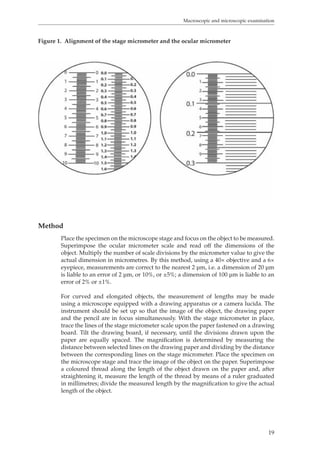
until the starting lines of both scales coincide (Figure 1). Now find another point, 
as far along the scale as possible, where two other division lines are exactly 
superimposed. Count the number of divisions on the ocular micrometer and 
the corresponding length on the stage micrometer scale, in order to determine 
the length that is equivalent to one division on the ocular micrometer scale. For 
example, if 100 divisions on the ocular micrometer scale are equal to 30 divisions 
on the stage micrometer scale, since the divisions on the stage micrometer scale 
are 0.01 mm apart, 100 ocular micrometer divisions are equivalent to 0.30 mm 
and therefore each division on the ocular micrometer scale represents 3.0 μm. 
Since the calibrations apply only for a particular lens combination, it is advisable 
to determine and record the ocular micrometer values for the most frequently 
used combinations.
Macroscopic and microscopic examination 
19 
Figure 1. Alignment of the stage micrometer and the ocular micrometer 
Method 
Place the specimen on the microscope stage and focus on the object to be measured. 
Superimpose the ocular micrometer scale and read off the dimensions of the 
object. Multiply the number of scale divisions by the micrometer value to give the 
actual dimension in micrometres. By this method, using a 40× objective and a 6× 
eyepiece, measurements are correct to the nearest 2 μm, i.e. a dimension of 20 μm 
is liable to an error of 2 μm, or 10%, or ±5%; a dimension of 100 μm is liable to an 
error of 2% or ±1%. 
For curved and elongated objects, the measurement of lengths may be made 
using a microscope equipped with a drawing apparatus or a camera lucida. The 
instrument should be set up so that the image of the object, the drawing paper 
and the pencil are in focus simultaneously. With the stage micrometer in place, 
trace the lines of the stage micrometer scale upon the paper fastened on a drawing 
board. Tilt the drawing board, if necessary, until the divisions drawn upon the 
paper are equally spaced. The magnification is determined by measuring the 
distance between selected lines on the drawing paper and dividing by the distance 
between the corresponding lines on the stage micrometer. Place the specimen on 
the microscope stage and trace the image of the object on the paper. Superimpose 
a coloured thread along the length of the object drawn on the paper and, after 
straightening it, measure the length of the thread by means of a ruler graduated 
in millimetres; divide the measured length by the magnification to give the actual 
length of the object.
Quality control methods for herbal materials 
Leaf stomata 
20 
Types of stoma 
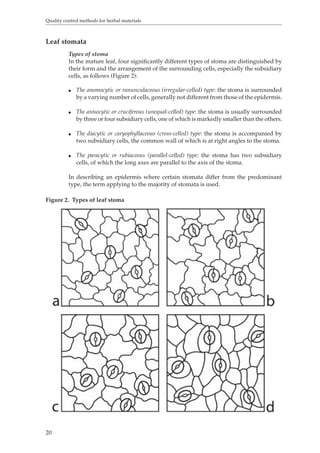
In the mature leaf, four significantly different types of stoma are distinguished by 
their form and the arrangement of the surrounding cells, especially the subsidiary 
cells, as follows (Figure 2): 
O The anomocytic or ranunculaceous (irregular-celled) type: the stoma is surrounded 
by a varying number of cells, generally not different from those of the epidermis. 
O The anisocytic or cruciferous (unequal-celled) type: the stoma is usually surrounded 
by three or four subsidiary cells, one of which is markedly smaller than the others. 
O The diacytic or caryophyllaceous (cross-celled) type: the stoma is accompanied by 
two subsidiary cells, the common wall of which is at right angles to the stoma. 
O The paracytic or rubiaceous (parallel-celled) type: the stoma has two subsidiary 
cells, of which the long axes are parallel to the axis of the stoma. 
In describing an epidermis where certain stomata differ from the predominant 
type, the term applying to the majority of stomata is used. 
Figure 2. Types of leaf stoma
Macroscopic and microscopic examination 
Determination of the stomatal index 
Place fragments of leaves, about 5×5 mm in size, in a test-tube containing about 5 ml 
of chloral hydrate TS and heat on a water-bath for about 15 minutes or until the 
fragments are transparent. Transfer a fragment to a slide and prepare it as described 
earlier, the lower epidermis uppermost, in chloral hydrate TS; place a small drop of 
glycerol/ethanol TS at one side of the cover-glass to prevent the material from drying. 
Examine under a microscope with a 40× objective and a 6× eyepiece, equipped with 
a drawing apparatus. Mark on the drawing paper a cross (x) for each epidermal cell 
and a circle (o) for each stoma. Calculate the stomatal index as follows: 
21 
stomatal index = S x 100 
E + S 
where S = the number of stomata in a given area of leaf; 
E = the number of epidermal cells (including trichomes) in the same area 
of leaf. 
For each leaf sample, no fewer than 10 determinations should be carried out and 
the average index calculated. 
Microsublimation 
Mount a small, square metal plate, about 4×4 cm in size, on a square of a suitable 
board from which a central hole, about 1 cm in diameter, has been cut. Place a metal 
ring, about 1 cm in diameter and 8 mm in height, at the centre of the metal plate 
aligned with the hole of the asbestos board. Place about 0.1–0.2 g of powdered 
material inside the ring to form an even layer, about 2 mm thick. Cover the ring 
with a clean slide. Heat gently and gradually over a small flame of a microburner. 
Change the slide if a large amount of moisture or sublimate is observed. Remove 
the slide from the ring, set it aside until the sublimate has dried and then examine 
under a microscope without adding any fluid and without a cover-glass. Prepare 
4–5 slides in this manner. 
A heating stage allows the temperature of sublimation to be recorded.
22
Thin-layer chromatography 
6. Thin-layer chromatography 
Thin-layer chromatography is particularly valuable for the qualitative determination 
of small amounts of impurities. The principles of thin-layer chromatography 
and application of the technique in pharmaceutical analysis are described in 
The international pharmacopoeia (5). As it is effective and easy to perform, and the 
equipment required is inexpensive, the technique is frequently used for evaluating 
herbal materials and their preparations. 
The following parameters should be determined on the basis of published 
pharmacopoeial monographs or established experimentally for the analysis of 
each individual herbal material: 
— type of adsorbent and method of activation (if no information on the latter can 
23 
be obtained, heat at 110 °C for 30 minutes); 
— method of preparation and concentration of the test and reference solutions; 
— volume of the solutions to be applied on the plate; 
— mobile phase and the distance of migration; 
— drying conditions (including temperature) and method of detection; 
— for the spots obtained: number and approximate position (or the Rf values if 
necessary), and fluorescence and colour. 
Two thin-layer chromatography methods are described below: the classical method 
and also the micromethod which uses different sizes of plates and hence different 
quantities of solvents. 
Classical method 
Recommended procedure 
The method outlined below assumes that chromatographic plates prepared in the 
laboratory are used; however, precoated plates, activated if necessary, may be used 
provided that they have proved suitable for the application concerned. 
A powdered specimen of pharmacopoeial quality may be used as the reference 
material. If a test for the presence of a known active principle of a herbal material is 
to be carried out, a chemical reference substance identical to that principle should be 
used. The test and reference solutions should be prepared simultaneously in exactly 
the same way. The reference solutions should be of known concentration. If the relative 
concentrations of the chemical substances in the reference solution are selected in 
accordance with the composition of a typical material, comparison of the spot size 
offers valuable additional information. The solvent system should be specified in the 
test procedure for the individual material being examined. A three-colour mixture (e.g. 
0.01% solutions in toluene of indophenol blue, sudan red G and dimethyl yellow), run 
together, permits a rapid check on the prevailing chromatographic conditions. 
If it is suspected that the materials being examined are unstable, the chamber 
in which chromatography takes place should be protected from light. In
Quality control methods for herbal materials 
24 
any case, the chromatographic chamber should always be kept out of direct 
sunlight. Otherwise, the rays of the sun may be refracted to different degrees 
owing to imperfections in the glass walls of the chamber, giving rise to areas 
of elevated temperature on the chromatographic plate and erratic flow of the 
mobile phase. 
Preparation of samples 
Prior to testing, prepare an extract of the herbal material to be examined, using a 
rapid extraction process, as follows. To 0.1–1.0 g of the powdered herbal material 
add 1–10 ml of solvent and extract either by stirring, shaking the mixture for 
3–30 minutes, or heating to boiling and allowing to cool. Remove the insoluble 
matter by centrifugation, or filter through a small funnel with filter-paper or a 
cotton plug. If necessary, evaporate the filtrate on a water-bath for just as long as 
is required to remove the solvent, then re-dissolve the residue in a small volume 
of solvent (e.g. 0.1–0.2 ml). If necessary, purify the test solution by repeating the 
extraction with solvent at a different pH, or by sublimation, distillation, or other 
appropriate method. 
Equipment 
The equipment consists of: 
— glass plates of uniform thickness throughout their entire area, 15–20 cm long, 
and wide enough to accommodate the required number of test and reference 
solutions; 
— a device for spreading a uniform layer of coating material of desired thickness 
onto the glass plates; 
— a rack to hold the prepared plates (normally 10 plates with set spacings) during 
the drying period or for transportation and storage; the rack should be small 
enough to fit in a drying oven and desiccator; 
— a chromatographic chamber of transparent material, usually glass, with a tightly 
fitting lid, of suitable size to accommodate the test plates; 
— a suitable spraying implement with a fine spray nozzle, made of a material 
resistant to the reagents to be used; 
— an ultraviolet light source emitting short (254 nm) and long (365 nm) wavelengths. 
Before use, clean the plates scrupulously by immersing in a suitable cleaning 
liquid and rinsing thoroughly until the water runs off the plates without leaving 
any visible water marks or oily spots, and then dry. The plates must be completely 
free of lint or dust when the coating material is applied. 
Method 
Preparation of the adsorbent 
Unless otherwise specified in the test procedure for the herbal material concerned, 
prepare a slurry of the coating material and water or an aqueous solution (see 
chapter 22, “Specifications for adsorbents”) and, using the spreading device, 
coat the cleaned plates with a layer about 0.25 mm thick. Dry the coated plates 
in air, heat to activate at 110 °C for 30 minutes, and then allow to cool. Inspect the 
uniformity of the coating in transmitted light and the texture in reflected light. If 
the plates are not to be used immediately, store them in a desiccator containing 
silica gel, desiccant, R. To form an edge, remove a narrow strip (2-5 mm wide) of 
the coating material from the sides of the plate.
Thin-layer chromatography 
If acid, alkaline or buffered layers are required, use diluted acid, base or salt 
mixtures instead of water for the preparation of the slurry, as specified in the test 
procedure. An aqueous solution of 5–7 g of sodium carboxymethylcellulose R 
could replace the water if the adsorbent does not already contain a binder. 
Saturation of the chromatographic chamber 
Unless otherwise specified in the test procedure, the chromatography is carried out 
in a saturated chamber. To achieve saturation, line at least half of the total area of 
the inside walls of the chamber with filter-paper, pour into the chamber a sufficient 
quantity of the mobile phase to saturate the filter-paper and form a layer about 5 mm 
deep. Close the chamber and allow to stand for at least 1 hour at room temperature. 
All operations during which the plate is exposed to the air should preferably be 
carried out at a relative humidity of 50–60%, and the plates should be handled 
with care. 
Application of the test and reference solutions 
Using a micropipette or a syringe graduated in μl, place spots of the test and 
reference solutions onto the starting line, which should be parallel to and about 
15 mm above the lower edge. The spots should be at least 15 mm from the sides of 
the plate, and at least 15 mm apart. They should be as small as possible, preferably 
not more than 4 mm in diameter; if necessary, apply the solution in portions, drying 
between applications. Mark the distance the mobile phase is intended to ascend as 
specified in the test procedure, usually 10–15 cm from the starting line. 
The results of separation can often be improved by applying the solutions to form 
a horizontal band 10-15 mm long and not more than 5 mm wide. 
Development of chromatograms 
Allow the spots to dry, place the plate — as nearly vertical as possible — into 
the chamber, ensuring that the points of application are above the surface of the 
mobile phase. Close the chamber. Develop the chromatogram at room temperature, 
unless otherwise specified in the test procedure, allowing the solvent to ascend the 
specified distance. Remove the plate, mark the position of the solvent front and 
allow the solvent to evaporate at room temperature or as specified. 
Observation and interpretation of the chromatograms 
Observe the spots produced in daylight, then under short-wave and long-wave 
ultraviolet light. Mark the centre of each spot with a needle. Measure and record 
the distance from the centre of each spot to the point of application, and indicate 
for each spot the wavelength under which it was observed. If indicated in the test 
procedure, spray the spots with the specified reagent, and observe and compare 
the spots with those of a reference material. 
If required, calculate the ratio of the distance travelled on the adsorbent by a given 
compound to that travelled by the leading edge of the solvent (the Rf value) or the 
ratio of the distances moved by a compound and a stated reference substance (the 
Rr value) as follows: 
25 
Rf = a Rr = a 
b c
Quality control methods for herbal materials 
26 
where a = the distance between the point of application and the centre of the spot 
of the material being examined; 
b = the distance between the point of application and the solvent front; 
c = the distance between the point of application and the centre of the spot 
of reference material. 
Rf values may vary with each experiment depending on the saturation conditions 
in the chromatographic chamber, the activity of the adsorbent layer, and the 
composition of the mobile phase. 
Micromethod 
The chromatograms can be developed either vertically or horizontally. Unless 
otherwise specified in the test procedure for the herbal material concerned, thin-layer 
chromatography is performed on small plates using the ascending technique. 
Ascending technique 
Equipment 
The equipment consists of: 
— precoated or specially prepared plates, not more than 100 mm long, and 100 mm 
wide, that permit development over at least 60 mm; 
— 1-μl or 2-μl micropipettes accurate to ±10% of the stated volume; 
— a chromatographic chamber with a tightly fitting lid and a flat base; the chamber 
must be of such a size to accommodate the plates and the appropriate volume 
of the mobile phase. 
Method 
Place a sufficient quantity of a previously mixed and homogeneous mobile phase 
into the chromatographic chamber to form a layer 5 mm deep (Mobile phase 
mixtures should be discarded after the development of a plate). Close the chamber 
and allow to stand at constant room temperature, protected from draughts and 
direct sunlight, for 15 minutes. 
Using a micropipette, apply spots of the solutions being examined onto the 
starting line, which should be parallel to and about 10 mm above the lower edge 
of the plate. The spots should be at least 10 mm from the sides of the plate, and 
5–10 mm apart. They should be as small as possible, preferably no more than 2 mm 
in diameter. Mark the distance the mobile phase is intended to ascend as specified 
in the test procedure for the herbal material concerned, usually 60 mm from the 
starting line. 
Allow the spots to dry, then place the plate — as nearly vertical as possible — 
into the chamber, ensuring that the points of application are above the surface 
of the mobile phase. The sides of the plate must not come into contact with the 
wall of the chamber. Close the chamber. Develop the chromatogram at room 
temperature, unless otherwise specified in the test procedure, allowing the 
solvent to ascend the specified distance. Remove the plate, mark the position of 
the solvent front and allow the solvent to evaporate at room temperature or as 
specified.
Thin-layer chromatography 
27 
Horizontal technique 
Equipment 
The equipment consists of: 
— specially made plates 50 mm long, 50 mm wide; 
— 0.5-μl or 1-μl micropipettes, accurate to ±10% of the stated volume; 
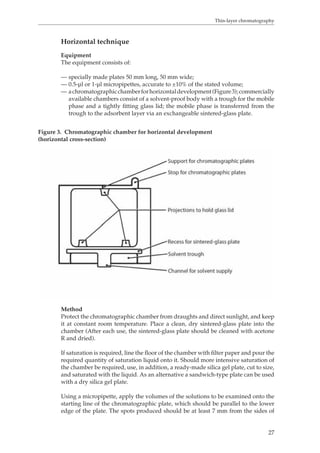
— a chromatographic chamber for horizontal development (Figure 3); commercially 
available chambers consist of a solvent-proof body with a trough for the mobile 
phase and a tightly fitting glass lid; the mobile phase is transferred from the 
trough to the adsorbent layer via an exchangeable sintered-glass plate. 
Figure 3. Chromatographic chamber for horizontal development 
(horizontal cross-section) 
Method 
Protect the chromatographic chamber from draughts and direct sunlight, and keep 
it at constant room temperature. Place a clean, dry sintered-glass plate into the 
chamber (After each use, the sintered-glass plate should be cleaned with acetone 
R and dried). 
If saturation is required, line the floor of the chamber with filter paper and pour the 
required quantity of saturation liquid onto it. Should more intensive saturation of 
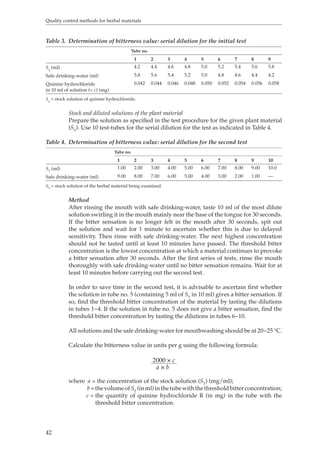
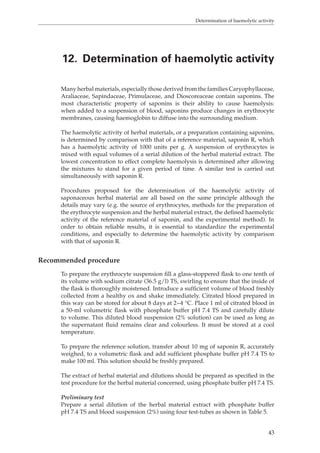
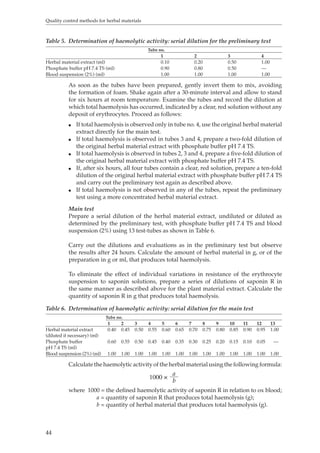
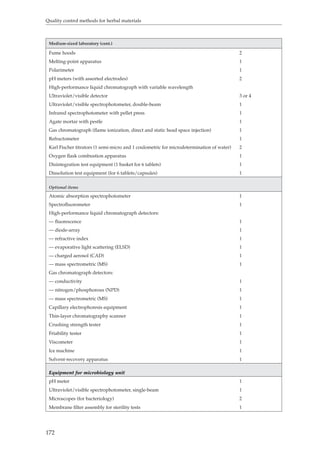
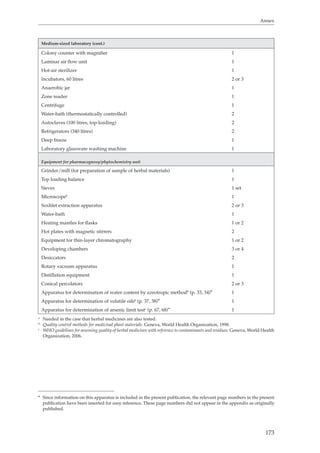
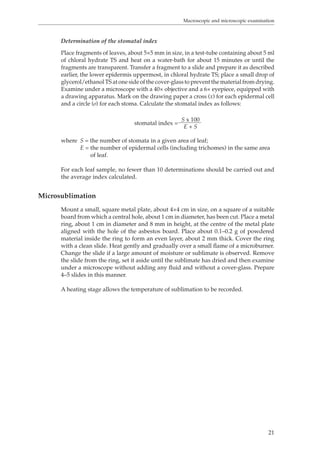
the chamber be required, use, in addition, a ready-made silica gel plate, cut to size, 
and saturated with the liquid. As an alternative a sandwich-type plate can be used 
with a dry silica gel plate. 
Using a micropipette, apply the volumes of the solutions to be examined onto the 
starting line of the chromatographic plate, which should be parallel to the lower 
edge of the plate. The spots produced should be at least 7 mm from the sides of
Quality control methods for herbal materials 
28 
the plate and not less than 5 mm apart. The spots should be as small as possible, 
preferably no more than 1 mm in diameter. Mark the distance the mobile phase 
is intended to travel as specified in the test procedure, for the herbal material 
concerned, usually 40 mm from the starting line. 
Allow the spots to dry, place the plate into the chamber with the coating downwards 
so as to be in contact with the sintered-glass plate across the whole width. The 
points of application should be about 3 mm from the edge of the sintered-glass 
plate. Close the chamber with the lid, leaving the trough for the mobile phase open. 
Using a pipette, place the required volume of previously mixed homogeneous 
mobile phase, usually 1–2 ml, into the trough and immediately close the chamber. 
Develop the chromatogram at room temperature, unless otherwise indicated in 
the test procedure, allowing the solvent to travel the specified distance. Remove 
the plate, mark the position of the solvent front and allow the solvent to evaporate 
at room temperature or as specified.
Determination of ash 
7. Determination of ash 
The ash remaining following ignition of herbal materials is determined by three 
different methods which measure total ash, acid-insoluble ash and water-soluble ash. 
The total ash method is designed to measure the total amount of material remaining 
after ignition. This includes both “physiological ash”, which is derived from 
the plant tissue itself, and “non-physiological” ash, which is the residue of the 
extraneous matter (e.g. sand and soil) adhering to the plant surface. 
Acid-insoluble ash is the residue obtained after boiling the total ash with dilute 
hydrochloric acid, and igniting the remaining insoluble matter. This measures the 
amount of silica present, especially as sand and siliceous earth. 
Water-soluble ash is the difference in weight between the total ash and the residue 
after treatment of the total ash with water. 
29 
Recommended procedure 
Total ash 
Place about 2–4 g of the ground air-dried material, accurately weighed, in a 
previously ignited and tared crucible (usually of platinum or silica). Spread the 
material in an even layer and ignite it by gradually increasing the heat to 500–600 °C 
until it is white, indicating the absence of carbon. Cool in a desiccator and weigh. 
If carbon-free ash cannot be obtained in this manner, cool the crucible and moisten 
the residue with about 2 ml of water or a saturated solution of ammonium nitrate 
R. Dry on a water-bath, then on a hot-plate and ignite to constant weight. Allow 
the residue to cool in a suitable desiccator for 30 minutes, then weigh without 
delay. Calculate the content of total ash in mg per g of air-dried material. 
Acid-insoluble ash 
To the crucible containing the total ash, add 25 ml of hydrochloric acid (~70 g/l) TS, 
cover with a watch-glass and boil gently for 5 minutes. Rinse the watch-glass with 
5 ml of hot water and add this liquid to the crucible. Collect the insoluble matter 
on an ashless filter-paper and wash with hot water until the filtrate is neutral. 
Transfer the filter-paper containing the insoluble matter to the original crucible, 
dry on a hotplate and ignite to constant weight. Allow the residue to cool in a 
suitable desiccator for 30 minutes, then weigh without delay. Calculate the content 
of acid-insoluble ash in mg per g of air-dried material. 
Water-soluble ash 
To the crucible containing the total ash, add 25 ml of water and boil for 5 minutes. 
Collect the insoluble matter in a sintered-glass crucible or on an ashless filter-paper. 
Wash with hot water and ignite in a crucible for 15 minutes at a temperature 
not exceeding 450 °C. Subtract the weight of this residue in mg from the weight 
of total ash. Calculate the content of water-soluble ash in mg per g of air-dried 
material.
30
Determination of extractable matter 
8. Determination of extractable matter 
This method determines the amount of active constituents extracted with solvents 
from a given amount of herbal material. It is employed for materials for which as 
yet no suitable chemical or biological assay exists. 
31 
Recommended procedure 
Method 1. Hot extraction 
Place about 4.0 g of coarsely powdered air-dried material, accurately weighed, 
in a glass-stoppered conical flask. Add 100 ml of water and weigh to obtain the 
total weight including the flask. Shake well and allow to stand for 1 hour. Attach a 
reflux condenser to the flask and boil gently for 1 hour; cool and weigh. Readjust 
to the original total weight with the solvent specified in the test procedure for 
the plant material concerned. Shake well and filter rapidly through a dry filter. 
Transfer 25 ml of the filtrate to a tared flat-bottomed dish and evaporate to dryness 
on a water-bath. Dry at 105 °C for 6 hours, cool in a desiccator for 30 minutes, then 
weigh without delay. Calculate the content of extractable matter in mg per g of 
air-dried material. 
Method 2. Cold maceration 
Place about 4.0 g of coarsely powdered air-dried material, accurately weighed, in 
a glass-stoppered conical flask. Macerate with 100 ml of the solvent specified for 
the plant material concerned for 6 hours, shaking frequently, then allow to stand 
for 18 hours. Filter rapidly, taking care not to lose any solvent, transfer 25 ml of the 
filtrate to a tared flat-bottomed dish and evaporate to dryness on a water-bath. Dry 
at 105 °C for 6 hours, cool in a desiccator for 30 minutes and weigh without delay. 
Calculate the content of extractable matter in mg per g of air-dried material. 
For ethanol-soluble extractable matter, use the concentration of solvent specified in 
the test procedure for the herbal material concerned; for water-soluble extractable 
matter, use water as the solvent. Use other solvents as specified in the test procedure.
32
Determination of water and volatile matter 
9. Determination of water 
and volatile matter 
An excess of water in herbal materials will encourage microbial growth, the presence 
of fungi or insects, and deterioration following hydrolysis. Limits for water content 
should therefore be set for every given herbal material. This is especially important 
for materials that absorb moisture easily or deteriorate quickly in the presence of 
water. 
The azeotropic method gives a direct measurement of the water present in the material 
being examined. When the sample is distilled together with an immiscible solvent, 
such as toluene R or xylene R, the water present in the sample is absorbed by 
the solvent. The water and the solvent are distilled together and separated in the 
receiving tube on cooling. If the solvent is anhydrous, water may remain absorbed 
in it leading to false results. It is therefore advisable to saturate the solvent with 
water before use. 
The test for loss on drying determines both water and volatile matter. Drying can 
be carried out either by heating to 100–105 °C or in a desiccator over phosphorus 
pentoxide R under atmospheric or reduced pressure at room temperature for a 
specified period of time. The desiccation method is especially useful for materials 
that melt to a sticky mass at elevated temperatures. 
33 
Recommended procedure 
Preparation of material 
Prepare a suitable quantity of the sample by cutting, granulating or shredding 
the unground or unpowdered material, so that the thickness of the parts does not 
exceed 3 mm. Seeds or fruits smaller than 3 mm should be cracked. Avoid the use 
of high-speed mills in preparing the sample, and take care that no appreciable 
amount of moisture is lost during preparation. It is important that the portion is 
large enough to be a representative sample. 
Azeotropic method (toluene distillation) 
The apparatus (Figure 4) consists of a glass flask (A) connected by a tube (D) 
to a cylindrical tube (B) fitted with a graduated receiving tube (E) and a reflux 
condenser (C). The receiving tube (E) is graduated in 0.1-ml divisions so that the 
error of readings does not exceed 0.05 ml. The preferred source of heat is an electric 
heater with a rheostat control, or an oil-bath. The upper portion of the flask and the 
connecting tube may be insulated. 
Thoroughly clean the receiving tube and the condenser of the apparatus, rinse 
with water and dry. Introduce 200 ml of toluene R and about 2 ml of water into a 
dry flask. Heat the flask to distil the liquid over a period of 2 hours, allow to cool 
for about 30 minutes and read off the volume of water to an accuracy of 0.05 ml 
(first distillation).
Quality control methods for herbal materials 
Figure 4. Apparatus used to determine water content by the azeotropic method 
(dimensions in mm) 
34
Determination of water and volatile matter 
Weigh accurately a quantity of the material expected to give about 2–3 ml of water 
and transfer to the flask (For weighing material with a paste-like character, use a 
boat of metal foil). Add a few pieces of porous porcelain and heat the flask gently 
for 15 minutes. When boiling begins, distil at a rate of 2 drops per second until 
most of the water has distilled over, then increase the rate of distillation to about 
4 drops per second. As soon as the water has been completely distilled, rinse the 
inside of the condenser tube with toluene R. Continue the distillation for 5 more 
minutes, remove the heat, allow the receiving tube to cool to room temperature 
and dislodge any droplets of water adhering to the walls of the receiving tube 
by tapping the tube. Allow the water and toluene layers to separate and read 
off the volume of water (second distillation). Calculate the content of water as a 
percentage using the formula: 
35 
100 (n1 — n) 
w 
where w = the weight in g of the material being examined; 
n = the number of ml of water obtained in the first distillation; 
= the total number of ml of water obtained in both distillations. 
n1 
Loss on drying (gravimetric determination) 
Place about 2–5 g of the prepared air-dried material, or the quantity specified 
in the test procedure for the herbal material concerned, accurately weighed, in 
a previously dried and tared flat weighing bottle. Dry the sample by one of the 
following techniques: 
— in an oven at 100-105 °C; 
— in a desiccator over phosphorus pentoxide R under atmospheric pressure or 
reduced pressure and at room temperature. 
Dry until two consecutive weighings do not differ by more than 5 mg, unless 
otherwise specified in the test procedure. Calculate the loss of weight in mg per g 
of air-dried material.
36
Determination of volatile oils 
10. Determination of volatile oils 
Volatile oils are characterized by their odour, oil-like appearance and ability to 
volatilize at room temperature. Chemically, they are usually composed of mixtures 
of, for example, monoterpenes, sesquiterpenes and their oxygenated derivatives. 
Aromatic compounds predominate in certain volatile oils. 
Because they are considered to be the “essence” of the herbal material, and are 
often biologically active, they are also known as “essential oils”. The term “volatile 
oil” is preferred because it is more specific and describes the physical properties. 
In order to determine the volume of oil, the plant material is distilled with water 
and the distillate is collected in a graduated tube. The aqueous portion separates 
automatically and is returned to the distillation flask. If the volatile oils possess a 
mass density higher than or near to that of water, or are difficult to separate from 
the aqueous phase owing to the formation of emulsions, a solvent with a low mass 
density and a suitable boiling-point may be added to the measuring tube. The 
dissolved volatile oils will then float on top of the aqueous phase. 
37 
Recommended procedure 
Carry out the determination by steam distillation. Collect the distillate in a 
graduated tube, using xylene R or the solvent specified for the herbal material 
concerned, and allow the aqueous phase to recirculate into the distillation flask. 
For all determinations read the rate of distillation from the marks engraved on the 
apparatus. 
Equipment 
A suitable apparatus is made from resistant glass with a low expansion coefficient, 
and has the following parts: 
— a round-bottomed, short-necked flask, capacity 500 or 1000 ml, the internal 
diameter of the ground-glass neck being 29 mm at the widest end; 
— a burner allowing fine control and fitted with a flue, or an electric heating device; 
— a vertical support with a horizontal ring covered with insulating material; 
— the following sections fused into one piece (Figure 5): 
O a vertical tube (AC), 210–260 mm long, with an external diameter of 13–15 mm; 
O a bent tube (CDE), CD and DE each being 145–155 mm long, and having an 
external diameter of 10 mm; 
O a bulb-condenser (FG), 145–155 mm long; 
O a tube (GH) 30–40 mm long, with a side-arm tube (HK), at an angle of 30–40°; 
O a vented ground-glass stopper (K’) and a tube (K) with an internal diameter 
of 10 mm, the wide end being of ground glass; 
O a pear-shaped bulb (J) with a volume of 3 ml; 
O a tube with a volume of 1 ml (JL), graduated over 100–110 mm in divisions 
of 0.01 ml; 
O a bulb-like swelling (L), with a volume of about 2 ml;
Quality control methods for herbal materials 
38 
O a three-way tap (M); 
O a connecting tube (BM), with an external diameter of 7–8 mm, which is fitted 
in the middle with a security tube (N); the junction (B) should be 20–25 mm 
higher than the uppermost graduation. 
Before use, clean the apparatus thoroughly by successive washings, for example 
with acetone R or a suitable detergent, then rinse with water, drain and assemble 
in a suitable place. 
Figure 5. Apparatus used to determine volatile oils (dimensions in mm)1 
1 For reasons of clarity, the 0.01-ml graduations are not shown on the tube JL.
Determination of volatile oils 
Preparation of the sample 
The preparation of the sample depends on the texture of the material and the 
location of the volatile oils. Hard and compact herbal material (e.g. bark, roots 
or rhizomes), or material containing volatile oils in the cells or small cavities 
of the tissue, should be coarsely powdered; thick leaves should be finely cut 
or lightly bruised; materials such as citrus peel are preferably crushed under 
water, as the volatile oils in large schizolysigenous cavities are easily lost 
during the process of comminution. Material consisting of thin floral parts 
or thin laminae or containing volatile oils in the epidermal glands should be 
distilled whole. 
Method 
Place the volume of distillation liquid specified in the test procedure for the herbal 
material concerned in the flask, add a few pieces of porous porcelain and join the 
condenser to the apparatus. Introduce water by tube N until it reaches level B. 
Remove stopper (K’) and introduce the appropriate volume of xylene R or the 
solvent specified for the given herbal material, using a graduated pipette and 
placing its tip at the bottom of tube K. Replace stopper, heat the liquid in the flask 
until it begins to boil and adjust the distillation rate to 2–3 ml per minute, unless 
otherwise specified in the test procedure. 
To determine the distillation rate, lower the level of water while distilling by 
means of the three-way tap until the meniscus is at the level of the lower mark (see 
Figure 6). Close the tap and simultaneously start a stopwatch. As soon as the level 
in the bulb reaches the upper mark, stop the watch and note the time taken. Open 
the tap and continue the distillation. Stop the heating after 30 minutes, turn off 
the heater, wait at least 10 minutes and then record the volume of solvent (xylene) 
collected in the graduated tube. 
39 
Figure 6. Determination of distillation rate
Quality control methods for herbal materials 
40 
Introduce the specified quantity of the herbal material being examined into the flask 
and continue the distillation as described above for the time and at the rate given 
in the test procedure. After a further 10 minutes record the volume of oil collected 
in the graduated tube and subtract the volume of solvent (xylene) previously 
noted. The difference represents the volume of volatile oils in the sample of herbal 
material taken. Calculate the oil content in ml per 100 g of herbal material.
Determination of bitterness value 
11. Determination of bitterness value 
Herbal materials that have a strong bitter taste (“bitters”) are employed 
therapeutically, mostly as appetizing agents. Their bitterness stimulates secretions 
in the gastrointestinal tract, especially of gastric juice. 
Bitter substances can be determined chemically. However, since they are mostly 
composed of two or more constituents with various degrees of bitterness, it is first 
necessary to measure total bitterness by taste. 
The bitter properties of herbal material are determined by comparing the threshold 
bitter concentration of an extract of the materials with that of a dilute solution of 
quinine hydrochloride R. The bitterness value is expressed in units equivalent to 
the bitterness of a solution containing 1 g of quinine hydrochloride R in 2000 ml. 
Safe drinking-water should be used as a vehicle for the extraction of herbal materials 
and for the mouthwash after each tasting. Taste buds dull quickly if distilled water 
is used. The hardness of water rarely has any significant influence on bitterness. 
Sensitivity to bitterness varies from person to person, and even for the same person 
it may be different at different times (because of fatigue, smoking, or after eating 

strongly flavoured food). Therefore, the same person should taste both the material 
to be tested and the quinine hydrochloride solution within a short space of time. 
The bitter sensation is not felt by the whole surface of the tongue, but is limited to 
the middle section of the upper surface of the tongue. A certain amount of training 
is required to perform this test. A person who does not appreciate a bitter sensation 
when tasting a solution of 0.058 mg of quinine hydrochloride R in 10 ml of water 
is not suitable to undertake this determination. 
The preparation of the stock solution of each individual herbal material (ST) should 
be specified in the test procedure. In each test series, unless otherwise indicated, 
the determination should start with the lowest concentration in order to retain 
sufficient sensitivity of the taste buds. 
41 
Recommended procedure 
Caution: This test should not be carried out until the identity of the herbal 
material has been confirmed. 
Preparation of solutions 
Stock and diluted quinine hydrochloride solutions 
Dissolve 0.100 g of quinine hydrochloride R in sufficient safe drinking-water to 
produce 100 ml. Further dilute 5 ml of this solution to 500 ml with safe drinking-water. 
This stock solution of quinine hydrochloride (Sq) contains 0.01 mg/ml. 
Use nine test-tubes for the serial dilution for the initial test as indicated in 
Table 3.
Quality control methods for herbal materials 
Table 3. Determination of bitterness value: serial dilution for the initial test 
42 
Tube no. 
1 2 3 4 5 6 7 8 9 
Sq (ml) 4.2 4.4 4.6 4.8 5.0 5.2 5.4 5.6 5.8 
Safe drinking-water (ml) 5.8 5.6 5.4 5.2 5.0 4.8 4.6 4.4 4.2 
Quinine hydrochloride 
in 10 ml of solution (= c) (mg) 
0.042 0.044 0.046 0.048 0.050 0.052 0.054 0.056 0.058 
Sq = stock solution of quinine hydrochloride. 
Stock and diluted solutions of the plant material 
Prepare the solution as specified in the test procedure for the given plant material 
(ST). Use 10 test-tubes for the serial dilution for the test as indicated in Table 4. 
Table 4. Determination of bitterness value: serial dilution for the second test 
Tube no. 
1 2 3 4 5 6 7 8 9 10 
ST (ml) 1.00 2.00 3.00 4.00 5.00 6.00 7.00 8.00 9.00 10.0 
Safe drinking-water (ml) 9.00 8.00 7.00 6.00 5.00 4.00 3.00 2.00 1.00 — 
ST = stock solution of the herbal material being examined. 
Method 
After rinsing the mouth with safe drinking-water, taste 10 ml of the most dilute 
solution swirling it in the mouth mainly near the base of the tongue for 30 seconds. 
If the bitter sensation is no longer felt in the mouth after 30 seconds, spit out 
the solution and wait for 1 minute to ascertain whether this is due to delayed 
sensitivity. Then rinse with safe drinking-water. The next highest concentration 
should not be tasted until at least 10 minutes have passed. The threshold bitter 
concentration is the lowest concentration at which a material continues to provoke 
a bitter sensation after 30 seconds. After the first series of tests, rinse the mouth 
thoroughly with safe drinking-water until no bitter sensation remains. Wait for at 
least 10 minutes before carrying out the second test. 
In order to save time in the second test, it is advisable to ascertain first whether 
the solution in tube no. 5 (containing 5 ml of ST in 10 ml) gives a bitter sensation. If 
so, find the threshold bitter concentration of the material by tasting the dilutions 
in tubes 1−4. If the solution in tube no. 5 does not give a bitter sensation, find the 
threshold bitter concentration by tasting the dilutions in tubes 6−10. 
All solutions and the safe drinking-water for mouthwashing should be at 20−25 °C. 
Calculate the bitterness value in units per g using the following formula: 
2000 × c 
a × b 
where a = the concentration of the stock solution (ST) (mg/ml); 
b = the volume of ST (in ml) in the tube with the threshold bitter concentration; 
c = the quantity of quinine hydrochloride R (in mg) in the tube with the 
threshold bitter concentration.
Determination of haemolytic activity 
12. Determination of haemolytic activity 
Many herbal materials, especially those derived from the families Caryophyllaceae, 
Araliaceae, Sapindaceae, Primulaceae, and Dioscoreaceae contain saponins. The 
most characteristic property of saponins is their ability to cause haemolysis: 
when added to a suspension of blood, saponins produce changes in erythrocyte 
membranes, causing haemoglobin to diffuse into the surrounding medium. 
The haemolytic activity of herbal materials, or a preparation containing saponins, 
is determined by comparison with that of a reference material, saponin R, which 
has a haemolytic activity of 1000 units per g. A suspension of erythrocytes is 
mixed with equal volumes of a serial dilution of the herbal material extract. The 
lowest concentration to effect complete haemolysis is determined after allowing 
the mixtures to stand for a given period of time. A similar test is carried out 
simultaneously with saponin R. 
Procedures proposed for the determination of the haemolytic activity of 
saponaceous herbal material are all based on the same principle although the 
details may vary (e.g. the source of erythrocytes, methods for the preparation of 
the erythrocyte suspension and the herbal material extract, the defined haemolytic 
activity of the reference material of saponin, and the experimental method). In 
order to obtain reliable results, it is essential to standardize the experimental 
conditions, and especially to determine the haemolytic activity by comparison 
with that of saponin R. 
43 
Recommended procedure 
To prepare the erythrocyte suspension fill a glass-stoppered flask to one tenth of 
its volume with sodium citrate (36.5 g/l) TS, swirling to ensure that the inside of 
the flask is thoroughly moistened. Introduce a sufficient volume of blood freshly 
collected from a healthy ox and shake immediately. Citrated blood prepared in 
this way can be stored for about 8 days at 2−4 °C. Place 1 ml of citrated blood in 
a 50-ml volumetric flask with phosphate buffer pH 7.4 TS and carefully dilute 
to volume. This diluted blood suspension (2% solution) can be used as long as 
the supernatant fluid remains clear and colourless. It must be stored at a cool 
temperature. 
To prepare the reference solution, transfer about 10 mg of saponin R, accurately 
weighed, to a volumetric flask and add sufficient phosphate buffer pH 7.4 TS to 
make 100 ml. This solution should be freshly prepared. 
The extract of herbal material and dilutions should be prepared as specified in the 
test procedure for the herbal material concerned, using phosphate buffer pH 7.4 TS. 
Preliminary test 
Prepare a serial dilution of the herbal material extract with phosphate buffer 
pH 7.4 TS and blood suspension (2%) using four test-tubes as shown in Table 5.
Quality control methods for herbal materials 
Table 5. Determination of haemolytic activity: serial dilution for the preliminary test 
44 
Tube no. 
1 2 3 4 
Herbal material extract (ml) 0.10 0.20 0.50 1.00 
Phosphate buffer pH 7.4 TS (ml) 0.90 0.80 0.50 — 
Blood suspension (2%) (ml) 1.00 1.00 1.00 1.00 
As soon as the tubes have been prepared, gently invert them to mix, avoiding 
the formation of foam. Shake again after a 30-minute interval and allow to stand 
for six hours at room temperature. Examine the tubes and record the dilution at 
which total haemolysis has occurred, indicated by a clear, red solution without any 
deposit of erythrocytes. Proceed as follows: 
O If total haemolysis is observed only in tube no. 4, use the original herbal material 
extract directly for the main test. 
O If total haemolysis is observed in tubes 3 and 4, prepare a two-fold dilution of 
the original herbal material extract with phosphate buffer pH 7.4 TS. 
O If total haemolysis is observed in tubes 2, 3 and 4, prepare a five-fold dilution of 
the original herbal material extract with phosphate buffer pH 7.4 TS. 
O If, after six hours, all four tubes contain a clear, red solution, prepare a ten-fold 
dilution of the original herbal material extract with phosphate buffer pH 7.4 TS 
and carry out the preliminary test again as described above. 
O If total haemolysis is not observed in any of the tubes, repeat the preliminary 
test using a more concentrated herbal material extract. 
Main test 
Prepare a serial dilution of the herbal material extract, undiluted or diluted as 
determined by the preliminary test, with phosphate buffer pH 7.4 TS and blood 
suspension (2%) using 13 test-tubes as shown in Table 6. 
Carry out the dilutions and evaluations as in the preliminary test but observe 
the results after 24 hours. Calculate the amount of herbal material in g, or of the 
preparation in g or ml, that produces total haemolysis. 
To eliminate the effect of individual variations in resistance of the erythrocyte 
suspension to saponin solutions, prepare a series of dilutions of saponin R in 
the same manner as described above for the plant material extract. Calculate the 
quantity of saponin R in g that produces total haemolysis. 
Table 6. Determination of haemolytic activity: serial dilution for the main test 
Tube no. 
1 2 3 4 5 6 7 8 9 10 11 12 13 
Herbal material extract 
(diluted if necessary) (ml) 
0.40 0.45 0.50 0.55 0.60 0.65 0.70 0.75 0.80 0.85 0.90 0.95 1.00 
Phosphate buffer 
pH 7.4 TS (ml) 
0.60 0.55 0.50 0.45 0.40 0.35 0.30 0.25 0.20 0.15 0.10 0.05 — 
Blood suspension (2%) (ml) 1.00 1.00 1.00 1.00 1.00 1.00 1.00 1.00 1.00 1.00 1.00 1.00 1.00 
Calculate the haemolytic activity of the herbal material using the following formula: 
1000 × ab 
where 1000 = the defined haemolytic activity of saponin R in relation to ox blood; 
a = quantity of saponin R that produces total haemolysis (g); 
b = quantity of herbal material that produces total haemolysis (g).
Determination of tannins 
13. Determination of tannins 
Tannins (or tanning substances) are substances capable of turning animal hides into 
leather by binding proteins to form water-insoluble substances that are resistant 
to proteolytic enzymes. This process, when applied to living tissue, is known as 
an “astringent” action and is the reason for the therapeutic application of tannins. 
Chemically, tannins are complex substances; they usually occur as mixtures of 
polyphenols that are difficult to separate and crystallize. They are easily oxidized 
and polymerized in solution; if this happens they lose much of their astringent 
effect and are therefore of little therapeutic value. 
45 
Recommended procedure 
To prepare the herbal material extract, introduce the quantity specified in the test 
procedure for the herbal material concerned, previously powdered to a known 
fineness and weighed accurately, into a conical flask. Add 150 ml of water and 
heat over a boiling water-bath for 30 minutes. Cool, transfer the mixture to a 250- 
ml volumetric flask and dilute to volume with water. Allow the solid material to 
settle and filter the liquid through a filter-paper, diameter 12 cm, discarding the 
first 50 ml of the filtrate. 
To determine the total amount of material that is extractable into water, evaporate 
50.0 ml of the plant material extract to dryness, dry the residue in an oven at 105 °C 
for 4 hours and weigh (T1). 
To determine the amount of herbal material not bound to hide powder that is 
extractable into water, take 80.0 ml of the herbal material extract, add 6.0 g of hide 
powder R and shake well for 60 minutes. Filter and evaporate 50.0 ml of the clear 
filtrate to dryness. Dry the residue in an oven at 105 °C and weigh (T2). 
To determine the solubility of hide powder, take 6.0 g of hide powder R, add 
80.0 ml of water and shake well for 60 minutes. Filter and evaporate 50.0 ml of the 
clear filtrate to dryness. Dry the residue in an oven at 105 °C and weigh (T0). 
Calculate the quantity of tannins as a percentage using the following formula: 
[T1–(T2 – T0)] × 500 
w 
where w = the weight of the herbal material in grams.
46
Determination of swelling index 
14. Determination of swelling index 
Many herbal materials are of specific therapeutic or pharmaceutical utility because 
of their swelling properties − especially gums and those containing an appreciable 
amount of mucilage, pectin or hemicellulose. 
The swelling index is the volume in ml taken up by the swelling of 1 g of herbal 
material under specified conditions. Its determination is based on the addition 
of water or a swelling agent as specified in the test procedure for each individual 
herbal material (either whole, cut or pulverized). Using a glass-stoppered 
measuring cylinder, the material is shaken repeatedly for 1 hour and then allowed 
to stand for a required period of time. The volume of the mixture (in ml) is then 
read. 
The mixing of whole herbal material with the swelling agent is easy to achieve, 
but cut or pulverized material requires vigorous shaking at specified intervals to 
ensure even distribution of the material in the swelling agent. 
47 
Recommended procedure 
Carry out simultaneously no fewer than three determinations for any given 
material. Introduce the specified quantity of the herbal material concerned, 
previously reduced to the required fineness and accurately weighed, into a 25-ml 
glass-stoppered measuring cylinder. The internal diameter of the cylinder should be 
about 16 mm, the length of the graduated portion about 125 mm, marked in 0.2- ml 
divisions from 0 to 25 ml in an upwards direction. Unless otherwise indicated in 
the test procedure, add 25 ml of water and shake the mixture thoroughly every 
10 minutes for 1 hour. Allow to stand for 3 hours at room temperature, or as 
specified. Measure the volume in ml occupied by the herbal material, including 
any sticky mucilage. Calculate the mean value of the individual determinations, 
related to 1 g of herbal material.
48
Determination of foaming index 
15. Determination of foaming index 
Many herbal materials contain saponins that can cause a persistent foam when 
an aqueous decoction is shaken. The foaming ability of an aqueous decoction of 
herbal materials and their extracts is measured in terms of a foaming index. 
49 
Recommended procedure 
Reduce about 1 g of the herbal material to a coarse powder (sieve size no. 1250), 
weigh accurately and transfer to a 500-ml conical flask containing 100 ml of boiling 
water. Maintain at moderate boiling for 30 minutes. Cool and filter into a 100-ml 
volumetric flask and add sufficient water through the filter to dilute to volume. 
Pour the decoction into 10 stoppered test-tubes (height 16 cm, diameter 16 mm) 
in successive portions of 1 ml, 2 ml, 3 ml, etc. up to 10 ml, and adjust the volume 
of the liquid in each tube with water to 10 ml. Stopper the tubes and shake them 
in a lengthwise motion for 15 seconds, two shakes per second. Allow to stand for 
15 minutes and measure the height of the foam. The results are assessed as follows: 
O If the height of the foam in every tube is less than 1 cm, the foaming index is 
less than 100. 
O If a height of foam of 1 cm is measured in any tube, the volume of the herbal 
material decoction in this tube (a) is used to determine the index. If this tube is 
the first or second tube in a series, prepare an intermediate dilution in a similar 
manner to obtain a more precise result. 
O If the height of the foam is more than 1 cm in every tube, the foaming index is 
over 1000. In this case repeat the determination using a new series of dilutions 
of the decoction in order to obtain a result. 
Calculate the foaming index using the following formula: 
1000 
a 
where a = the volume in ml of the decoction used for preparing the dilution in the 
tube where foaming to a height of 1 cm is observed.
Determination of pesticide residues 
16. Determination of pesticide residues 
51 
General 
Methods for the determination of pesticide residues 
Chromatography (mostly column and gas) is recommended as the principal 
method for the determination of pesticide residues. These methods may be 
coupled with mass spectrometry (MS). Samples are extracted by a standard 
procedure, impurities are removed by partition and/or adsorption, and the 
presence of a moderately broad spectrum of pesticides is measured in a single 
determination. However, these techniques are not universally applicable. 
Some pesticides are satisfactorily carried through the extraction and clean-up 
procedures, others are recovered with a poor yield, and some are lost entirely. 
Following chromatography, the separations may not always be complete, 
pesticides may decompose or metabolize, and many of the metabolic products are 
still unknown. Consequently, as a result of limitations in the analytical technique 
and incomplete knowledge of pesticide interactions with the environment, it is 
not yet possible to apply an integrated set of methods that will be satisfactory 
in all situations. 
Generally, the methodology should be adapted to the type of herbal material being 
tested, and modifications may be necessary for different samples — including 
seeds, leaves, oils, extracts and finished products — and for samples containing 
different quantities of moisture. Also, the spectrum of pesticides to be tested for is 
dependent on the specific pesticides used on the herbal material and the history of 
use of persistent pesticides in the region. 
It is therefore desirable to test herbal materials of unknown history for broad 
groups of compounds rather than for individual pesticides. Various methods 
are suitable for this purpose. Pesticides containing chlorine in the molecule, 
for example, can be detected by the measurement of total organic chlorine; 
insecticides containing phosphate can be measured by analysis for total 
organic phosphorus, whereas pesticides containing arsenic and lead can be 
detected by measurement of total arsenic or total lead, respectively. Similarly, 
the measurement of total bound carbon disulfide in a sample will provide 
information on whether residues of the dithiocarbamate family of fungicides 
are present. 
Importantly, where such general methods are employed, care must be taken to 
ensure that results are not adversely affected by contributions from certain plant 
constituents containing the targeted elements. 
If the pesticide to which the herbal material has been exposed is known or can be 
identified by suitable means, an established method for the determination of that 
particular pesticide residue should be employed.
Quality control methods for herbal materials 
52 
General aspects of analytical methodology 
The samples should be tested as quickly as possible after collection, before any 
physical or chemical changes occur. If prolonged storage is envisaged, the samples 
should preferably be stored in airtight containers under refrigeration. 
The water content of samples can also be problematic and, in some official 
pharmacopoeias, content is limited to 15% and below for the determination of 
organochlorine and pyrethroid insecticides. 
Light can cause degradation of many pesticides, and it is therefore advisable to 
protect the samples and any extracts or solutions from undue exposure to light. 
The type of container or wrapping material used should not interfere with the 
sample or affect the analytical results. 
Solvents and reagents used in the analytical method should be free from substances 
that may interfere with the reaction, alter the results or provoke degradation of the 
pesticide residue in the sample. It is usually necessary to employ specially purified 
solvents or to distil them freshly in an all-glass apparatus. Blank determinations 
with the solvents should be carried out, concentrating and testing them as specified 
in the test procedure for the herbal material concerned. 
The simplest and quickest procedure should be used to separate unwanted material 
from the sample (clean-up procedure) in order to save time when many samples 
have to be tested. 
The process of concentrating solutions should be undertaken with great care, 
especially during the evaporation of the last traces of solvent, to avoid losses of 
pesticide residues. For this reason, it is often not advisable to remove the last 
traces of solvent. Agents such as mineral oil or other oils of low volatility that may 
help to preserve the solution could be added to retard the loss of the relatively 
volatile pesticides, especially when the last traces of solvent are being evaporated. 
However, these agents, while satisfactory in colorimetric procedures, are usually 
not desirable in gas chromatographic methods. It may be necessary to evaporate 
heat-labile compounds using a rotary vacuum apparatus. 
Determination of total chlorine and phosphorus 
Most pesticides contain organically bound chlorine or phosphorus. 
Recommended procedure 
Preparation of samples 
Reduce the herbal material to a fine powder, and extract with a mixture of 
water and acetonitrile R. Most pesticides are soluble in this mixture, while most 
cellular constituents (e.g. cellulose, proteins, amino acids, starch, fats and related 
compounds) are sparingly soluble and are thus removed. A number of polar and 
moderately polar compounds may also be dissolved; it is therefore necessary to 
transfer the pesticides to light petroleum R. For pesticides containing chlorine, 
further purification is seldom required, but for those containing phosphorus, 
further purification by column chromatography may be necessary, eluting with 
mixtures of light petroleum R and ether R.
Determination of pesticide residues 
Preparation of the column 
Use Florisil R grade 60/100 PR (or equivalent), activated at 650 °C, as the support. 
If this material is obtained in bulk, transfer it immediately after opening to a 500-ml 
glass jar or bottle with a glass stopper or foil-lined, screw-top lid. Store in the dark. 
Before use, heat at not less than 130 °C, cool in a desiccator to room temperature 
and heat once again to 130 °C after 2 days. 
Prepare a Florisil column (external diameter 22 mm) which contains, after settling, 
10 cm of activated Florisil topped with about 1 cm of anhydrous sodium sulfate 
R. Pre-wet the column with 40–50 ml of light petroleum R. Place a graduated flask 
under the column to receive the eluate. 
Method 
Grind the material to allow it to pass through a sieve no. 710 or 840 and mix 
thoroughly. Place 20–50 g of the ground sample into a blender, add 350 ml 
of acetonitrile R with a water content of 35% (to 350 ml of water add sufficient 
acetonitrile R to produce 1000 ml). Blend for 5 minutes at a high speed. Filter under 
vacuum through an appropriate funnel, diameter 12 cm, fitted with filter paper, 
into a 500-ml suction flask. 
Transfer the filtrate to a 250-ml measuring cylinder and record the volume. Transfer 
the measured filtrate to a 1-litre separating funnel and carefully add 100 ml of light 
petroleum R. Shake vigorously for 1–2 minutes, add 10 ml of sodium chloride 
(400 g/l) TS and 600 ml of water. Hold the separating funnel in a horizontal position 
and mix vigorously for 30–45 seconds. Allow to separate, discard the aqueous layer 
and gently wash the solvent layer with two 100-ml portions of water. Discard the 
washings, transfer the solvent layer to a 100-ml glass-stoppered cylinder, and record 
the volume. Add about 15 g of anhydrous sodium sulfate R and shake vigorously. 
The extract must not remain in contact with this reagent for longer than 1 hour. 
Transfer the extract directly to a Florisil column; if necessary, reduce the volume 
first to 5–10 ml. Allow it to pass through the column at a rate of not more than 5 ml 
per minute. Carefully rinse the cylinder with two portions, each of 5 ml, of light 
petroleum R, transfer them to the column, rinse with further small portions of light 
petroleum R if necessary, and then elute at the same rate with 200 ml of ether/light 
petroleum TS1. Change the receiver and elute with 200 ml of ether/light petroleum 
TS2. Again change the receiver and elute with 200 ml of ether/light petroleum TS3. 
Evaporate each eluate to a suitable volume, as required, for further testing. 
O The first eluate contains chlorinated pesticides (aldrin, DDE, TDE (DDD), o,p’- 
and p,p’-DDT, HCH, heptachlor, heptachlor epoxide, lindane, methoxychlor), 
polychlorinated biphenyls (PCB), and phosphated pesticides (carbophenothion, 
ethion and fenchlorphos). 
O The second eluate contains chlorinated pesticides (dieldrin and endrin) and 
53 
phosphated pesticides (methyl parathion and parathion). 
O The third eluate contains phosphated pesticide (malathion). 
Combustion of the organic matter 
Combustion of the organic matter in oxygen is the preparatory step for the 
determination of chlorine and phosphorus. The pesticide is extracted from the 
sample and purified if necessary. The extract is concentrated, evaporated to 
dryness, transferred to a sample holder, and burned in a suitable conical flask 
flushed with oxygen. The gases produced during combustion are then absorbed
Quality control methods for herbal materials 
54 
in a suitable solution. The absorbed chlorine is determined as chloride and the 
absorbed phosphorus as orthophosphate, both using colorimetry. 
Equipment 
The combustion is carried out in a 1-litre conical flask made of borosilicate glass, 
into the stopper of which is fused one end of a piece of platinum wire about 1 mm 
in diameter. To the free end of the wire is attached a piece of platinum gauze 
measuring about 1.5 × 2 cm to provide a means of holding the sample clear of the 
absorbing liquid during combustion. 
Sample holder for chlorine-containing residues 
For a small quantity of solid material, use a sample holder made from a piece 
of halide-free filter-paper about 5 cm long and 3 cm wide; for a small volume of 
liquid, it is preferable to use a sample holder in the form of a cone made from 
cellulose acetate film. Prepare the cone as follows: 
Wearing cloth gloves and using a suitable cardboard template, cut from the film a 
circle of radius 4 cm. Manually pin the two edges together to form a cone. Seal the 
joined edges using heat to form a seam about 5 mm wide. Immerse the seam in 
acetone R to about one half of its width for 10 seconds. Remove and dry it immediately 
in a stream of hot air. Using forceps, wash the cone by dipping in a 1-litre beaker 
containing warm sodium hydroxide (~240 g/l) TS for 10 seconds at a temperature of 
about 60 °C. Rinse the cone thoroughly with water and allow to drain dry on a piece 
of aluminium foil. Place each cone in a clean funnel (diameter 65 mm). 
Sample holder for phosphorus-containing residues 
Use a piece of halide-free filter-paper about 4 cm square as the sample holder. 
Combustion of chlorine-containing residues 
Transfer an aliquot of the extract as prepared above onto the sample holder, which 
is placed in a funnel using a solvent that will not dissolve the sample holder. Allow 
the solvent to evaporate. Wearing rubber gloves, remove the sample holder and 
its dry contents from the funnel, fold it over and up to form a small packet, about 
1 cm2 in area, and secure it in the centre of the platinum gauze. Insert a narrow 
strip of filter paper, about 1 × 3 cm, as a fuse into the top of the holder, between 
the folds of the packet. Add 30 ml of water to the combustion flask. Moisten the 
neck of the flask with water. Fill the flask thoroughly with oxygen by means of a 
tube with its end just above the liquid. Ignite the free end of the paper strip and 
immediately insert the stopper. Hold the stopper firmly in place. When vigorous 
burning has begun, tilt the flask to prevent incompletely burned material from 
falling into the liquid. Immediately after combustion is completed, shake the 
flask vigorously for 10 minutes to dissolve the combustion products. Place a 
small quantity of water around the rim of the flask, and carefully withdraw the 
stopper. Rinse the stopper, platinum wire, platinum gauze and sides of the flask 
with water. Transfer the liquid and liquids used for rinsing to a 50-ml volumetric 
flask and dilute to volume with water. 
Combustion of phosphorus-containing residues 
Dip the sample holder made from filter paper into methanolic sodium hydroxide 
TS, and then suspend it in a current of heated air. Immediately transfer about 
0.2 ml of an aliquot of the extract as prepared above to the sample holder with the 
aid of 0.2-ml portions of chloroform R using a micropipette. Allow the solvent to
Determination of pesticide residues 
evaporate from the paper, fold it to form a small packet about 1 cm2 in area and 
place it in the centre of the platinum gauze. Insert a strip of filter paper, about 1 
× 3 cm, as a fuse into the top of the holder, between the folds of the packet. Add 
10 ml of sulfuric acid (~37 g/l) TS to the combustion flask and continue with the 
combustion as described above. Transfer the solution and the liquid used for 
rinsing to a 25-ml volumetric flask and dilute to volume with water. 
55 
Determination of chlorides 
Recommended procedure 
Equipment 
The determination is made with a spectrophotometer capable of measuring 
absorbance at 460 nm using absorption cells with path-lengths of 2 cm and 10 cm. 
Method 
Place 15 ml of the solution obtained after combustion in a 50-ml conical flask 
together with 1 ml of ferric ammonium sulfate (0.25 mol/l) VS and 3 ml of mercuric 
thiocyanate TS. Swirl the contents of the flask and allow to stand for 10 minutes. 
Transfer a portion of the solution to a 2-cm cell and measure the absorbance at 
460 nm using water in the reference cell. The reading should be made promptly to 
minimize absorption of chloride from the air. 
Prepare a standard solution of sodium chloride R containing 5 μg of chloride per 
ml. Transfer aliquots of this solution (0 ml, 2 ml, 4 ml, 6 ml, 8 ml and 10 ml) into 
a series of 50-ml conical flasks and dilute to 15 ml with water. Develop the colour 
and measure the absorbances as described above. Plot the absorbances against the 
chloride content of the dilutions in μg per ml and interpolate the chloride content 
of the solutions of the material tested. 
Determination of phosphates 
Recommended procedure 
The phosphomolybdate method is based on the reaction of phosphate ions 
with ammonium molybdate to form a molybdophosphate complex, which is 
subsequently reduced to form a strongly blue-coloured molybdenum complex. 
The intensity of the blue colour is measured spectrophotometrically. This method 
is applicable for the determination of any phosphates that have undergone a prior 
separation procedure. 
Naturally occurring phosphates are present in most samples, and are often not 
removed during the clean-up procedure. In order to obtain background values, 
therefore, it is necessary to proceed with the determination for all samples, even 
those with no phosphate-containing pesticides. These background values should 
be subtracted from the results obtained on testing pesticide residues. Extracts of 
most uncontaminated materials contain about 0.05–0.1 mg/kg of phosphorus. 
Therefore, no contamination with organophosphate pesticides can be assumed for 
results in this range. 
Equipment 
The determination is made with a spectrophotometer capable of measuring 
absorbance at 820 nm using an absorption cell with a path-length of 1 cm.
Quality control methods for herbal materials 
56 
Method 
Place 7 ml of the solution obtained after combustion in a calibrated 10-ml test-tube. 
Add 2.2 ml of sulfuric acid (300 g/l) TS and mix the solution well. Add 0.4 ml 
of ammonium molybdate (40 g/l) TS and swirl the mixture. Then add 0.4 ml of 
aminonaphtholsulfonic acid TS and swirl again. Heat the solution to 100 °C for 
12 minutes (± 2 minutes), cool, and transfer a portion to a 1-cm cell. Measure the 
absorbance at 820 nm using water in the reference cell. 
Prepare standard dilutions with a known content of phosphate and measure the 
absorbance as described above. Plot the absorbances against the phosphate content 
of the dilutions in μg per ml and interpolate the phosphate content of the solutions 
of the material tested. 
Qualitative and quantitative determination of organochlorine pesticides 
Recommended procedure 
Preparation of sample 
Place 20 g of powdered herbal material (sieve no. 180), accurately weighed, in 
a 500-ml beaker (tall form), mix with 98 ml of water and allow to macerate for 
at least 30 minutes. Add 200 ml of acetone R; the resulting volume of extraction 
solvent will be 295 ml. Extract for 5 minutes, while cooling, using a high-speed 
mixer. Filter the homogenized mixture through a porcelain filter (Büchner funnel, 
diameter 70 mm) fitted with a filter paper, using a slight vacuum, into a 250-ml 
graduated cylinder, allowing the process to last no longer than 1 minute, and then 
measure the volume (V) of the filtrate in ml. 
Method 
Transfer the filtrate prepared as above to a 500-ml separating funnel. Add a quantity 
of sodium chloride R equivalent in grams to one tenth of the volume of the filtrate, 
then add 100 ml of dichloromethane R. Shake vigorously for 5 minutes, allow 
the phases to separate and discard the lower (aqueous) layer. Dry the acetone-dichloromethane 
phase, transfer it to a 500-ml conical flask, add 25 g of anhydrous 
sodium sulfate R and swirl occasionally. Next, filter the solution into a 500-ml flask 
with a ground-glass stopper using a glass funnel (diameter 100 mm) containing 
purified glass-wool and anhydrous sodium sulfate R. Rinse the separating funnel, 
the conical flask and the glass funnel twice with 10 ml of ethyl acetate R. Add 5 ml 
of 2,2,4-trimethylpentane R, and concentrate the crude extract to about 2 ml in a 
rotary vacuum evaporator in a water-bath at 30–40 °C. Expel the remaining solvent 
in a gentle stream of air. 
To purify by gel chromatography, macerate 50 g of suitable beads (e.g. S-X3 bio-beads) 
in an elution mixture of cyclohexane R and ethyl acetate R (1:1) and pour 
them into a chromatographic column (length 600 mm, diameter 25 mm) adapted 
for use with a vacuum pump. Rinse the gel bed with the elution mixture under air-free 
conditions. Dissolve the extract in the flask with 5 ml of ethyl acetate R. Add 2 g 
of anhydrous sodium sulfate R, swirl gently and add 5 ml of cyclohexane R. Filter 
the completely dissolved crude extract through a rapid filter into a 10-ml test-tube 
with a ground-glass stopper and close the tube immediately. Then transfer 5 ml of 
the filtrate on to the gel column. Elute with the elution mixture at an average rate 
of 5 ml/minute. Herbal material components leave the gel column first, followed
Determination of pesticide residues 
by the active ingredients of pesticides. Fractionation must be determined for each 
column, using appropriate reference substances. 
Discard the first fraction (about 100 ml) containing the impurities. Collect the 
organochlorine pesticides appearing in the next eluate (about 70 ml) in a flask with 
a ground-glass stopper. Add l0 ml of 2,2,4-trimethylpentane R and concentrate 
the solution to about 5 ml in a rotary vacuum evaporator and a water-bath at 30– 
40 °C. Pipette another 5 ml of 2,2,4-trimethylpentane R into the flask and carefully 
evaporate the solution to about 1 ml (do not allow to become completely dry). 
Calculate the amount of plant material, in grams, in the purified extract using the 
following formula: 
57 
V 590 × sample weight in g 
where V = volume of filtrate. 
To purify further, transfer 1 g of previously deactivated silica gel for column 
chromatography (70-230 mesh) containing 1.5% water, to a chromatographic column 
(length 25 cm, internal diameter 7 mm). Put 10 mm of anhydrous sodium sulfate R 
on top of the content of the column and cover with purified glass wool. Before use, 
rinse the column with 5 ml of hexane R. Allow the solvent to reach the surface of 
the column filling, then transfer quantitatively, by means of a pipette, the purified 
extract obtained by gel chromatography from the flask to the prepared silica gel 
column and rinse with 1 ml of hexane R. Set the flask aside for subsequent elutions. 
Using a 10-ml volumetric flask as the receiver, elute any residues of polychlorinated 
biphenyls from the column with 10 ml of hexane R (eluate 0). Add 2 ml of an 
elution mixture composed of toluene R/hexane R (35:65) to the flask and swirl. 
Quantitatively transfer the solution to the column. Using another 10-ml volumetric 
flask as the receiver, elute the majority of the organochlorine pesticides from the 
silica gel column using 6 ml of the same elution mixture. Dilute the contents of the 
flasks to volume with the elution mixture (eluate 1). 
Rinse the flask with 2 ml of toluene R and transfer it quantitatively to the column. 
Collect the eluate in a third 10-ml volumetric flask. Add 8 ml of toluene R to the 
flask, swirl and transfer the solution to the silica gel column; elute the remaining 
organochlorine pesticides using the same receiver. Dilute the contents of the flask 
to volume with toluene R (eluate 2). 
Evaluate the test solutions by capillary gas chromatography using an electron capture 
detector (ECD). Confirm the findings obtained for the main column (first separation 
system) with a second capillary column of different polarity (second separation system). 
Determination by gas chromatography 
A capillary gas chromatograph with an ECD is used for the measurement. Helium 
R is used as the carrier gas and a mixture of argon R and methane R (95:5) as an 
auxiliary gas for the detection. 
First separation system 
Use a vitreous silica column, 30 m long with an internal diameter of 0.25 mm, 
packed with a chemically bound phase of 5% phenyl, 95% methyl-polysiloxane. 
Use the following temperature programme:
Quality control methods for herbal materials 
58 
— heat at 60 °C for 0.5 minutes; 
— increase the temperature at a rate of 30 °C per minute to 160 °C and maintain 
this temperature for 2 minutes; 
— increase the temperature at a rate of 2 °C per minute to 250 °C and maintain this 
temperature for 5 minutes. 
Use a “split/split-free” injector to inject the sample solution and maintain 
the injection port at a temperature of 240 °C. Inject a volume of 1 μl at a rate of 
30 seconds (“split-free”). The detector temperature should be 300 °C. 
Second separation system 
Use a vitreous silica column, 15 m long with an internal diameter of 0.25 mm, 
packed with a chemically bound phase of 7% cyanopropyl, 7% phenyl, 86% 
methyl-polysiloxane. Use the following temperature programme: 
— heat at 60 °C for 12 seconds; 
— increase the temperature at a rate of 30 °C per minute to 180 °C and maintain 
this temperature for 1 minute; 
— increase the temperature at a rate of 2 °C per minute to 250 °C and maintain this 
temperature for 5 minutes. 
Use an on-column injector to inject a volume of 1 μl of the sample solution. The 
detector temperature should be 300 °C. 
Use the “external standard” method for the qualitative and quantitative evaluation 
of the organochlorine pesticides in the test solutions with reference solutions 
of the following pesticides: α-, β-, γ- and δ-hexachlorocyclohexane (HCH); 
hexachlorobenzene; quintozene; aldrin; dieldrin; endrin; α- and β-endosulfan; 
endosulfan sulfate; heptachlor, heptachlorepoxide; camphechlor; TDE, DDE and 
DDT (both o,p’- and p,p’-isomers); methoxychlor. 
Measure the peak height of the pesticides obtained in the chromatograms and 
calculate the concentration of the residues in mg/kg using the following formula: 
ht × 10 
× 
wr 
w hr 
where ht = peak height obtained for the test solution in mm; 
w = quantity of sample in the purified extract (g); 
wr= quantity of pesticide in ng in the reference solution injected; 
hr = peak height obtained for the reference solution in mm. 
Analysis of esters of organophosphorus compounds 
Although most organophosphorus compounds undergo rapid decomposition, 
Member States may elect to test for them because of their harmful nature if present 
in significant concentrations. Testing may be more relevant in the case of herbal 
medicines used at high concentrations and frequency. 
The extraction and the clean-up procedures can be performed as described above, 
but the detection requires a phosphorus flame ionization detector (P-FID).
Determination of pesticide residues 
59 
Determination of specific pesticide residues in herbal material 
General recommendations 
For the total determination, mix thoroughly 1 kg of herbal material. 
In order to obtain reliable chromatographic results, do one or more of the following: 
— repeat the separation using another column; 
— use a different separation system; 
— use a different detector system; 
— apply a coupling technique; 
— prepare a derivative; 
— perform chromatography with a mixture of the sample and a reference substance; 
— change the sample preparation; 
— use a fractionated elution during the column-chromatography clean-up 
procedure of the herbal extract and test every fraction by chromatography; 
— compare the distribution coefficient of the material with that of a reference 
substance. 
Prior to the quantitative determination of the material to be tested, check whether 
there is a linear relationship between the values obtained for the reference substance 
and its concentration over the range 0.1–2 times the standard concentration. 
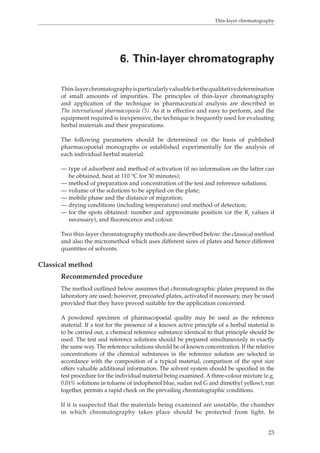
Otherwise, prepare another concentration range or evaluate the results using 
a reference curve. Use any suitable mechanical or manual technique for the 
chromatographic determination. 
Store the reference solutions protected from light to prevent decomposition. Use 
glass vessels closed with glass stoppers and keep them in a container saturated with 
the solvent employed to avoid any increase in concentration due to evaporation. 
Check the loss by evaporation by interim weighing of the vessels. 
Rate of recovery 
The rate of recovery (R) is the percentage of the reference material originally added 
to the herbal material that is determined using the method described below. 
Determination of desmetryn, prometryn and simazine residues 
Recommended procedure 
Preparation of the herbal material extract 
Place 10 g of powdered herbal material in a 500-ml conical flask and add 125 ml of 
chloroform R.1 Shake the mixture for 60 minutes and filter under reduced pressure 
through a filter paper (medium grade) into a round-bottomed flask. Wash the 
residue with 3 successive volumes each of 25 ml of chloroform R. 
1 In future development of this method, replacement of chloroform by other appropriate solvents is 
recommended.
Quality control methods for herbal materials 
60 
Method 
Concentrate the combined filtrates to a volume of 3–5 ml using a rotary vacuum 
evaporator and a water-bath at 40 °C. Transfer the extract to a chromatographic column 
as prepared below, rinsing the round-bottomed flask twice with 5 ml of chloroform R. 
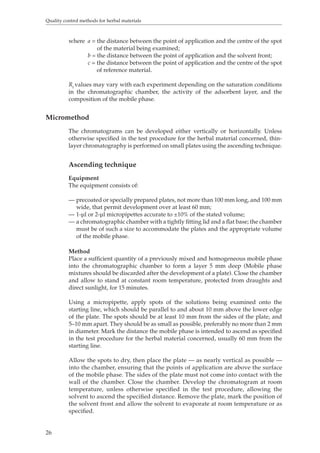
Preparation of chromatographic column 
Use a glass tube (internal diameter 20–22 mm) with a restricted orifice and protected 
with a sintered-glass plate (e.g. P10 or P16, glass filter G4; or P40, glass filter G3). 
Fill the column with chloroform R, and then pour purified aluminium oxide R into 
it to form a 100-mm thick layer. The support material should remain covered with 
chloroform R. After transferring the extract and the rinsing liquids to the column, 
elute with 150 ml of chloroform R at a rate of 1–2 drops per second, collecting the 
eluate in a round-bottomed flask. The first purifying process is completed when no 
further eluate drips from the column. 
Evaporate the eluate to dryness using a rotary vacuum evaporator and a water-bath 
at 40 °C. To the residue add 10 ml of light petroleum R and transfer the 
mixture to a chromatographic column containing a layer of purified aluminium 
oxide R, 50 mm thick, in light petroleum R. Elute the mixture with 90 ml of light 
petroleum R, using this to rinse the round-bottomed flask, at a rate of 1–2 drops 
per second. Discard the eluate. Dissolve any remaining residue, which has not 
dissolved in light petroleum R in 10 ml of a mixture composed of 60 volumes of 
chloroform R, and 40 volumes of light petroleum R and transfer the solution to 
the column. Rinse the round-bottomed flask twice more with 10 ml of the solvent 
mixture. Transfer the liquid used for rinsing to the column. Elute with 120 ml of 
the same solvent mixture, at a rate of 1–2 drops per second and collect the eluate 
in a round-bottomed flask. The second purifying process is completed when no 
further eluate drips from the column. 
Evaporate the eluate to dryness using a rotary vacuum evaporator and a water-bath 
at 40 °C. To prepare a purified extract for the determination by gas chromatography, 
dissolve the residue in sufficient acetone R to produce a volume of 10 ml. If an 
especially purified extract is required, proceed as described below. 
To the residue add 10 ml of light petroleum R and 10 ml of dimethyl sulfoxide 
R. Shake the mixture and transfer it to a separating funnel. Extract the dimethyl 
sulfoxide layer twice with 10 ml of light petroleum R. Discard the petroleum ether 
extract. Then add 100 ml of water to the dimethyl sulfoxide layer and extract 3 
times, each with 20 ml of chloroform R. Extract the combined chloroform extracts 
twice with 20 ml of water and evaporate them to dryness using a rotary vacuum 
evaporator and a water-bath at 40 °C. Transfer the residue together with a mixture 
of 10 ml of light petroleum R and 10 ml of hydrochloric acid (1 mol/l) VS to a 
separating funnel and extract the mixture first with 10 ml and then with 5 ml of 
hydrochloric acid (1 mol/l) VS. Discard the petroleum ether layer and adjust the 
pH of the combined aqueous solutions to a value between 7 and 8 using sodium 
hydroxide (1 mol/l) VS. Extract the solution 3 times, each with 20 ml of chloroform 
R. Dry the combined chloroform extracts with anhydrous sodium sulfate R 
and filter into a round-bottomed flask, rinsing the funnel 3 times with 10.0-ml 
portions of chloroform R. Evaporate the filtrate to dryness using a rotary vacuum 
evaporator and a water-bath at 40 °C. Dissolve the residue in sufficient acetone R 
to produce 10 ml of especially purified extract to be used for the determination by 
gas chromatography.
Determination of pesticide residues 
61 
Use the extracts as indicated in Table 7 for the following herbal materials. 
Table 7. Extract to be used for specific herbal materials 
No. Material No. Material 
1 Flores Calendulae 10 Fructus Foeniculi 
2 Flores Chamomillae 11 Herba Millefolii 
3 Folia Melissae 12 Herba Plantaginis lanceolatae 
4 Folia Menthae piperitae 13 Radix Althaeae 
5 Folia Salviae 14 Radix Angelicae 
6 Folia Thymi 15 Radix Levistici 
7 Fructus Carvi 16 Radix Petroselini 
8 Fructus Coriandri 17 Radix Valerianae 
9 Fructus Cynobasti 
For materials no. 1 and 2, use an especially purified extract (see above); for materials 
no. 3–17, use a purified extract (see above). 
Determination of the rate of recovery 
Prepare five individual samples using each of the following procedures: 
1. To prepare solution S2, first dissolve separately 0.04 g of each of the reference 
substances, desmetryn R, prometryn R and simazine R, in sufficient acetone 
R to produce 100 ml. Then place 5 ml of each solution in a 100-ml volumetric 
flask and dilute the mixture to volume with acetone R (S2). Place 10 g of 
powdered plant material in a 500-ml conical flask and add 1 ml of solution 
S2. Shake this mixture mechanically for 60 minutes; if necessary, repeat the 
operation manually and then proceed as described under “Preparation of 
the herbal material extract” (see p. 59). Use either the purified or especially 
purified extract for the determination by gas chromatography, as specified in 
the test procedure for the herbal material concerned. 
2. Treat 10 g of powdered herbal material as described under “Preparation of 
the herbal material extract” (see p. 59). Use either the purified extract or the 
especially purified extract for the determination by gas chromatography, as 
specified in the test procedure for each individual herbal material. 
Calculate the rate of recovery (R) as a percentage using the following formula: 
2(a-b) 
c 
where a = average quantity in mg/kg of the 5 residues obtained using procedure 1; 
b = average quantity in mg/kg of the 5 residues obtained using procedure 2; 
c = quantity of reference substances in mg contained in solution S2 during 
procedure 1. 
The rate should be within the range 70–120%. It is specific for each material. 
Determination by gas chromatography 
Perform the determination as described in The international pharmacopoeia (5).
Quality control methods for herbal materials 
62 
Equipment 
The equipment consists of: 
— a glass column 1.2 m long, internal diameter 2 mm; 
— a suitable stationary liquid phase; 
— a suitable diatomaceous support. 
Use nitrogen R as the carrier gas with a flow rate of 30 ml/min. The sample injection 
block should be maintained at 230 °C, the column at 190 °C and the detector, which 
should be nitrogen-selective, at 300 °C. In addition: 
— volume of sample solution to be injected: 2.0 μl; 
— separation characteristics: h ≤ 1.2 × 10⁻³ for desmetryn R; RS ≥1.2 for prometryn 
R and simazine R; 
— relative standard deviation (precision of chromatographic system): sr. 0.05 for 
desmetryn R, prometryn R and simazine R. 
Method 
Chromatogram T. To determine the separation characteristics, inject solution S2 (for 
the preparation of solution S2 see “Determination of the rate of recovery” above). 
Chromatograms A1–A5. To determine the relative standard deviation inject solution 
S2 and repeat the determination 5 times. 
Chromatogram S2. Inject 1 ml of solution S2 for the determination of the rate of 
recovery. Dilute 1 ml of solution S2 to 10 ml with acetone R and inject it for the 
chromatographic determination. The peaks on the chromatogram occur in the 
following sequence: prometryn, simazine, desmetryn. 
Chromatogram P2. Inject the purified extract or the especially purified extract. 
Determine using an external standard: a = 0.0005. To convert the values obtained 
to percentage by weight, multiply the concentration in mg/kg by 104. 
The total maximum permissible amount of residues due to desmetryn, prometryn 
and simazine is 2 mg/kg of herbal material. 
Determination of specific organochlorine, organophosphorus 
and pyrethroid insecticide residues 
Recommended procedure 
Depending on the substance being examined, it may be necessary to modify, 
sometimes extensively, the procedure described below. In any case, it may 
be necessary to use, in addition, another column with a different polarity or 
another detection method (e.g. mass spectrometry) or a different method (e.g. 
immunochemical method) to confirm the results obtained. 
This procedure is valid only for the analysis of samples of herbal materials 
containing less than 15% water. Samples with a higher content of water may 
be dried, provided it has been shown that the drying procedure does not 
significantly affect the pesticide content.
Determination of pesticide residues 
Preparation of sample 
Extraction 
To 10 g of the substance being examined, coarsely powdered, add 100 ml of acetone 
R and allow to stand for 20 min. Add 1 ml of a solution containing 1.8 μg/ml 
of carbophenothion R in toluene R. Homogenize using a high-speed blender for 
3 min. Filter and wash the filter cake with two quantities, each of 25 ml, of acetone 
R. Combine the filtrate and the washings and heat using a rotary evaporator 
at a temperature not exceeding 40 °C until the solvent has almost completely 
evaporated. To the residue add a few millilitres of toluene R and heat again until 
the acetone is completely removed. Dissolve the residue in 8 ml of toluene R. Filter 
through a membrane filter (45 μm), rinse the flask and the filter with toluene R and 
dilute to 10.0 ml with the same solvent (solution A). 
Purification 
Organochlorine, organophosphorus and pyrethroid insecticides 
Examine by size-exclusion chromatography. The chromatographic procedure may 
be carried out using: 
— a stainless steel column 0.30 m long and 7.8 mm in internal diameter packed 
63 
with styrene-divinylbenzene copolymer R (5 μm); 
— as mobile phase toluene R at a flow rate of 1 ml/min. 
Performance of the column. Inject 100 μl of a solution containing 0.5 g/l of methyl red 
R and 0.5 g/l of oracet blue 2R in toluene R and proceed with the chromatography. 
The column is not suitable unless the colour of the eluate changes from orange to 
blue at an elution volume of about 10.3 ml. If necessary calibrate the column using 
a solution containing, in toluene R, at a suitable concentration, the insecticide to be 
analysed with the lowest molecular mass (for example, dichlorvos) and that with 
the highest molecular mass (for example, deltamethrin). Determine which fraction 
of the eluate contains both insecticides. 
Purification of the test solution. Inject a suitable volume of solution A (100 μl to 
500 μl) and proceed with the chromatography. Collect the fraction as determined 
above (solution B). Organophosphorus insecticides are usually eluted between 
8.8 ml and 10.9 ml. Organochlorine and pyrethroid insecticides are usually eluted 
between 8.5 ml and 10.3 ml. 
Organochlorine and pyrethroid insecticides 
In a chromatography column, 0.10 m long and 5 mm in internal diameter, introduce 
a piece of defatted cotton and 0.5 g of silica gel treated as follows: heat silica gel 
for chromatography R in an oven at 150 °C for at least 4 h. Allow to cool and add 
dropwise a quantity of water R corresponding to 1.5% of the mass of silica gel used; 
shake vigorously until agglomerates have disappeared and continue shaking for 
2 h using a mechanical shaker. Condition the column using 1.5 ml of hexane R. 
Prepacked columns containing about 0.5 g of a suitable silica gel may also be used 
provided they have been validated beforehand. 
Concentrate solution B in a current of helium for chromatography R or oxygen-free 
nitrogen R almost to dryness and dilute to a suitable volume with toluene 
R (200 μl to 1 ml according to the volume injected in the preparation of solution 
B). Transfer quantitatively on to the column and proceed with the chromatography 
using 1.8 ml of toluene R as the mobile phase. Collect the eluate (solution C).
Quality control methods for herbal materials 
64 
Quantitative analysis 
Organophosphorus insecticides 
Examine by gas chromatography, using carbophenothion R as internal standard. It 
may be necessary to use a second internal standard to identify possible interference 
with the peak corresponding to carbophenothion. 
Test solution. Concentrate solution B in a current of helium for chromatography R 
almost to dryness and dilute to 100 μl with toluene R. 
Reference solution. Prepare at least 3 solutions in toluene R containing the insecticides 
to be determined and carbophenothion at concentrations suitable for plotting a 
calibration curve. 
The chromatographic procedure may be carried out using: 
— a fused-silica column 30 m long and 0.32 mm in internal diameter, the internal 
wall of which is covered with a layer 0.25 μm thick of poly(dimethyl)siloxane R; 
— hydrogen for chromatography R as the carrier gas (other gases such as helium 
for chromatography R or nitrogen for chromatography R may also be used 
provided the chromatography is suitably validated); 
— a phosphorus-nitrogen flame-ionization detector or an atomic emission 
spectrometry detector, 
maintaining the temperature of the column at 80 °C for 1 minute, then raising 
it at a rate of 30 °C/minute to 150 °C, maintaining it at 150 °C for 3 min, then 
raising the temperature at a rate of 4 °C/minute to 280 °C and maintaining at this 
temperature for 1 minute, and maintaining the temperature of the injector port at 
250 °C and that of the detector at 275 °C. Inject the chosen volume of each solution. 
When the chromatograms are recorded in the prescribed conditions, the relative 
retention times are approximately those listed in Table 8. Calculate the content of 
each insecticide from the peak areas and the concentrations of the solutions. 
Table 8. Relative retention times of organophosphorus insecticides 
Substances Relative retention times Substances Relative retention times 
dichlorvos 0.20 parathion 0.69 
fonofos 0.50 chlorpyrifos 0.70 
diazinon 0.52 methidathion 0.78 
parathion-methyl 0.59 ethion 0.96 
chlorpyrifos-methyl 0.60 carbophenothion 1.00 
pirimiphos-methyl 0.66 azinphos-methyl 1.17 
malathion 0.67 phosalon 1.18 
Note: The relative retention times are very close. If it is necessary to distinguish 
between two relative retention times that are very close, further development of a 
suitable method will be required. 
Organochlorine and pyrethroid insecticides 
Examine by gas chromatography, using carbophenothion as the internal standard. It 
may be necessary to use a second internal standard to identify possible interference 
with the peak corresponding to carbophenothion.
Determination of pesticide residues 
Test solution. Concentrate solution C in a current of helium for chromatography R 
or oxygen-free nitrogen R almost to dryness and dilute to 500 μl with toluene R. 
Reference solution. Prepare at least three solutions in toluene R containing the 
insecticides to be determined and carbophenothion at concentrations suitable for 
plotting a calibration curve. 
65 
The chromatographic procedure may be carried out using: 
— a fused silica column 30 m long and 0.32 mm in internal diameter the internal 
wall of which is covered with a 0.25 μm thick layer of poly (dimethyl) (diphenyl) 
siloxane R; 
— hydrogen for chromatography R as the carrier gas (other gases such as helium 
for chromatography R or nitrogen for chromatography R may also be used, 
provided the chromatography is suitably validated); 
— an electron-capture detector; 
— a device allowing direct cold on-column injection, 
maintaining the temperature of the column at 80 °C for 1 minute, then raising it 
at a rate of 30 °C/minute to 150 °C, maintaining it at 150 °C for 3 minutes, then 
raising the temperature at a rate of 4 °C/minute to 280 °C and maintaining at 
this temperature for 1 minute, and maintaining the temperature of the injector 
port at 250 °C and that of the detector at 275 °C. Inject the chosen volume of each 
solution. When the chromatograms are recorded in the prescribed conditions, 
the relative retention times are approximately those listed in Table 9. Calculate 
the content of each insecticide from the peak areas and the concentrations of the 
solutions. 
Table 9. Relative retention times of organochlorine and pyrethroid insecticides 
Substances Relative retention times Substances Relative retention times 
α- hexachlorocyclohexane 0.44 p,p’-DDE 0.87 
hexachlorobenzene 0.45 o,p’-DDD 0.89 
β- hexachlorocyclohexane 0.49 endrin 0.91 
lindane 0 49 β-endosulfan 0.92 
δ- hexachlorocyclohexane 0.54 o,p’-DDT 0.95 
ε- hexachlorocyclohexane 0.56 carbophenothion 1.00 
heptachlor 0.61 p,p’- DDT 1.02 
aldrin 0.68 cis-permethrin 1.29 
cis-heptachlor-epoxide 0.76 trans-permethrin 1.31 
o,p’-DDE 0.81 cypermethrina 1.40 
α-endosulfan 0.82 fenvaleratea 1.47 and 1.49 
dieldrin 0.87 deltamethrin 1.54 
a The substance shows several peaks.
66
Determination of arsenic and toxic metals 
17. Determination of arsenic 
and toxic metals 
67 
Limit tests 
Limit test for arsenic 
Arsenic is abundant in nature and its presence in herbal materials should be no 
different to its wide occurrence in foods. A popular test method relies on the 
digestion of the herbal material matrix followed by subjection of the digestate to a 
comparative colorimetric test in a special apparatus. 
The test method described below uses colorimetry and does not use toxic mercuric 
bromide paper. The method uses N-N-diethylmethyldithiocarbamate in pyridine 
and it reacts with hydrogen arsenide to afford a red–purple complex. The limit is 
expressed in terms of arsenic (III) trioxide (As2O3). 
Equipment 
Use the apparatus illustrated in Figure 7. 
Figure 7. Apparatus for arsenic limit test 
A, generator bottle (capacity up to the shoulder: approximately 70 ml); B, exit tube; C, glass tube (inside 
diameter: 5.6 mm, the tip of the part to be inserted in the absorber tube D is drawn out to 1 mm in diameter); 
D, absorber tube (inside diameter: 10 mm); E, small perforation; F, glass wool (about 0.2 g); G, mark at 5 ml; 
H and J, rubber stopper.
Quality control methods for herbal materials 
68 
Place glass wool F in the exit tube B up to about 30 mm in height, moisten the glass 
wool uniformly with a mixture of an equal volume of lead (II) acetate TS and water, 
and apply gentle suction to the lower end to remove the excess mixture. Insert the 
tube vertically into the centre of the rubber stopper H, and attach the tube to the 
generator bottle A so that the small perforation E in the lower end of B extends 
slightly below the stopper. At the upper end of B, attach the rubber stopper J to 
hold the tube C vertically. Make the lower end of the exit tube of C level with that 
of the rubber stopper J. 
Preparation of the test solution 
Unless otherwise specified, proceed as follows. 
Examples for ginseng, powdered ginseng and red ginseng 
Prepare the test solution with 1.0 g of pulverized ginseng (or red ginseng) according 
to the method described below, and perform the test using the apparatus described 
above. 
Method 
Weigh the amount of the sample as directed in the monograph, and place it in a 
crucible of platinum, quartz or porcelain. Add 10 ml of a solution of magnesium 
nitrate hexahydrate in ethanol (95) (1 in 10), burn the ethanol, heat gradually, 

and ignite to incinerate. If carbonized material still remains after this procedure, 
moisten with a small quantity of nitric acid and ignite again to incinerate in the 
same manner. After cooling, add 3 ml of hydrochloric acid, heat in a water bath to 
dissolve the residue, and designate it as the test solution. 
Standard solutions 
Absorbing solution for hydrogen arsenide. Dissolve 0.50 g of silver N,N-diethyl-dithiocarbamate 
in pyridine to make 100 ml. Preserve this solution in a glass-stoppered 
bottle protected from light, in a cold place. 
Standard arsenic stock solution. Weigh accurately 0.100 g of finely powdered arsenic 
(III) trioxide standard reagent dried at 105 °C for 4 hours, and add 5 ml of sodium 
hydroxide solution (1 in 5) to dissolve. Add dilute sulfuric acid to neutralize, add 
a further 10 ml of dilute sulfuric acid, and add freshly boiled and cooled water to 
make exactly 1000 ml. 
Standard arsenic solution. Pipette 10 ml of standard arsenic stock solution, add 10 ml 
of dilute sulfuric acid, and add freshly boiled and cooled water to make exactly 
1000 ml. Each ml of the solution contains 1 μg of arsenic (III) trioxide (As2O3). 
Prepare standard arsenic solution just before use and preserve in a glass-stoppered 
bottle. 
Procedure 
Unless otherwise specified, proceed using the above-mentioned apparatus. Carry 
out the preparation of the standard colour at the same time. 
Place the test solution in the generator bottle A and, if necessary, wash down the 
solution in the bottle with a small quantity of water. Add 1 drop of methyl orange 
TS, and after neutralizing with ammonia TS, ammonia solution (NH4OH), or 
diluted hydrochloric acid, add 5 ml of diluted hydrochloric acid (1 in 2) add 5 ml 
of potassium iodide TS, and allow to stand for 2–3 minutes. Add 5 ml of acidic
Determination of arsenic and toxic metals 
tin (II) chloride TS, and allow to stand for 10 minutes. Then add water to make 
40 ml, add 2 g of zinc for arsenic analysis, and immediately connect the rubber 
stopper H fitted with B and C with the generator bottle A. Transfer 5 ml of the 
absorbing solution for hydrogen arsenide to the absorber tube D, insert the tip 
of C to the bottom of the absorber tube D, then immerse the generator bottle A 
up to the shoulder in water maintained at 25 °C, and allow to stand for 1 hour. 
Disconnect the absorber tube, add pyridine to make 5 ml, if necessary, and observe 
the colour of the absorbing solution: the colour produced is not more intense than 
the standard colour. 
Preparation of standard colour. Measure accurately 2 ml of Standard Arsenic Solution 
into the generator bottle A. Add 5 ml of diluted hydrochloric acid (1 in 2) and 5 ml 
of potassium iodide TS, and allow to stand for 2–3 minutes. Add 5 ml of acidic 
tin (II) chloride TS, allow to stand at room temperature for 10 minutes, and then 
proceed as directed above. The colour produced corresponds to 2 μg of arsenic (III) 
trioxide (As2O3) and is used as the standard. 
Notes: Apparatus, reagents and test solutions used in the test should contain little 
or no arsenic. If necessary, perform a blank determination. 
69 
Details of the reagents and solutions are given in chapter 23. 
Limit test for cadmium and lead 
Equipment 
The equipment comprises a digestion vessel, consisting of a vitreous silica crucible 
(DIN 12904), “tall form”, height 62 mm, diameter 50 mm, capacity 75 ml, with a 
vitreous silica cover. 
The materials used are: 
— digestion mixture: 2 parts by weight of nitric acid (~1000 g/l) TS and 1 part by 
weight of perchloric acid (~1170 g/l) TS; 
— reference materials: olive leaves (Olea europaea)1 and hay powder.2 
Clean scrupulously with nitric acid (~1000 g/l) TS the digestion vessel and all 
other equipment to be used for the determination. Rinse thoroughly several times 
with water and dry at 120 °C. 
Preparation of the sample 
For the wet digestion method in an open system, place 200–250 mg of air-dried 
herbal material, accurately weighed, finely cut and homogeneously mixed, into 
a cleaned silica crucible. Add 1.0 ml of the digestion mixture, cover the crucible 
without exerting pressure and place it in an oven with a controlled temperature 
and time regulator (computer-controlled, if available). 
1 BCR reference material CRM No. 62 Community Bureau of Reference, obtainable from BCR, 
Directorate-General XII, Commission of the European Communities, 200 rue de la Loi, B-1049 
Brussels, Belgium. 
2 Obtainable from IAEA/V-10, International Atomic Energy Agency, Analytical Quality Control 
Services, Laboratory Geibersdorf, PO Box 100, A-Vienna, Austria.
Quality control methods for herbal materials 
70 
Heat slowly to 100 °C and maintain at this temperature for up to 3 hours; then heat 
to 120 °C and maintain at this temperature for 2 hours. Raise the temperature very 
slowly to 240 °C, avoiding losses due to possible violent reactions, especially in 
the temperature range of 160–200 °C, and maintain at this temperature for 4 hours. 
Dissolve the remaining dry inorganic residue in 2.5 ml of nitric acid (~1000 g/l) TS 
and use for the determination of heavy metals. 
Every sample should be tested in parallel with a blank. 
Method 
The contents of lead and cadmium may be determined by inverse voltammetry or 
by atomic absorption spectrophotometry. 
Limit test for total toxic metals as lead 
In this method, the heavy metals are the metallic inclusions that are darkened with 
sodium sulfide TS in acidic solution; their quantity is expressed in terms of the 
quantity of lead (Pb). 
Preparation of sample solution and blank solution 
Test solution. Place an amount of the sample, as directed in the monograph, in 
a quartz or porcelain crucible, cover loosely with a lid, and carbonize by gentle 
ignition. After cooling, add 2 ml of nitric acid and 5 drops of sulfuric acid, heat 
cautiously until white fumes are evolved, and incinerate by ignition between 
500 °C and 600 °C. Cool, add 2 ml of hydrochloric acid, evaporate to dryness in 
a water-bath, moisten the residue with 3 drops of hydrochloric acid, add 10 ml of 
hot water, and warm for 2 minutes. Then add 1 drop of phenolphthalein TS, add 
ammonia TS drop by drop until the solution develops a pale red colour, add 2 ml 
of dilute acetic acid, filter, if necessary, and wash with 10 ml of water. Transfer the 
filtrate and washings to a Nessler tube, and add water to make 50 ml. Designate 
this as the test solution. 
Control solution. Evaporate a mixture of 2 ml of nitric acid, 5 drops of sulfuric 
acid, and 2 ml of hydrochloric acid on a water-bath, further evaporate to dryness 
on a sand-bath, and moisten the residue with 3 drops of hydrochloric acid. 
Hereinafter, proceed as directed above for the test solution, and then add the 
volume of standard lead solution as directed in the monograph and sufficient 
water to make 50 ml. 
Procedure 
Add 1 drop of sodium sulfide TS both to the test solution and to the control solution, 
mix thoroughly, and allow to stand for 5 minutes. Then compare the colours of the 
two solutions by viewing the tubes downwards or transversely against a white 
background. The test solution has no more colour than the control solution. 
Limit test for total toxic metals as lead in extracts 
Test solution. Ignite 0.3 g of extracts to ash, warm with 3 ml of dilute hydrochloric 
acid, and filter. Wash the residue with two 5 ml portions of water. Neutralize the 
combined filtrate and washings by adding ammonia TS, filter, if necessary, and 
add 2 ml of dilute acetic acid and water to make 50 ml. Perform the heavy metals 
limit test using this solution as the test solution.
Determination of arsenic and toxic metals 
Control solution. Proceed with 3 ml of dilute hydrochloric acid in the same manner 
as directed above for the preparation of the test solution, and add 3 ml of standard 
lead solution 1 ppm, and water to make 50 ml. 
Procedure 
Add 1 drop of sodium sulfide TS to both the test solution and to the control solution, 
mix thoroughly, and allow to stand for 5 minutes. Then compare the colours of the 
two solutions by viewing the tubes downwards or transversely against a white 
background. The test solution has no more colour than the control solution. 
71 
Determination of specific toxic metals 
Atomic absorption spectrometry (AA) is used for the determination of the amount 
or concentration of specific heavy metals. AA uses the phenomenon that atoms 
in the ground state absorb light of a specific wavelength, characteristic of the 
particular atom, when the light passes through an atomic vapour layer of the 
element to be determined. 
Caution must be exercised when using the recommended closed high-pressure 
digestion vessels and microwave laboratory equipment, and the operators 
should be fully familiar with the safety and operating instructions given by the 
manufacturer. 
Procedure 
Equipment 
Usually the apparatus consists of a light source, a sample atomizer, a spectroscope, 
a photometer and a recording system, together with the following: 
O A digestion flask: a polytetrafluoroethylene flask with a volume of about 120 ml, 
fitted with an airtight closure, a valve to adjust the pressure inside the container 
and a polytetrafluoroethylene tube to allow release of gas. A good example is 
the Digestion Vessel Assembly P/N ZZ 1000. 
O A system for making flasks airtight, using the same torsional force. One example is 
the CEM Capping station calibration. 
O A microwave oven, with a magnetron frequency of 2450 MHz, with a selectable 
output from 0 to 630 ± 70 W in 1% increments, a programmable digital computer, 
a polytetrafluoroethylene-coated microwave cavity with a variable speed 
exhaust fan, a rotating turntable drive system and exhaust tubing to vent fumes. 
O An atomic absorption spectrometer, equipped with an appropriate lamp for each 
element as source of radiation and a deuterium lamp as background corrector; 
the system is fitted with a sample atomiser of which there are three types (the 
flame type, the electrochemical type and the cold-vapour type). 
O A graphite furnace (electrochemical type) is used as an atomization device 
for cadmium, copper, iron, lead, nickel and zinc. One example is the Vapour 
Generation Accessory. 
An automated continuous-flow hydride vapour generation system is used for 
arsenic and mercury.1 
1 The Vapour Generation Accessory is suitable.
Quality control methods for herbal materials 
72 
Method 
Clean all the glassware and laboratory equipment with a 10 g/l solution of nitric 
acid R in water, carbon-dioxide free R before use. 
Test solution. In a digestion flask, place the prescribed quantity of the substance 
to be examined (about 0.5 g of powdered drug or 0.5 g of fatty oil). Add 3 ml of 
nitric acid R, 1 ml hydrogen peroxide R and 1 ml of hydrochloric acid R. Seal the 
flask so that it is airtight. Place the digestion flasks in the microwave oven. Carry 
out the digestion in 3 steps according to the following procedure, for 7 flasks 
each containing the test solution: 80% power for 15 minutes; 100% power for 
5 minutes; then 80% power for 20 minutes. At the end of the cycle allow the 
flasks to cool in air and to each add 4 ml of sulfuric acid R. Repeat the digestion 
programme. After cooling in air, open each digestion flask and introduce the 
clear, colourless solution obtained into a 50-ml volumetric flask. Rinse each 
digestion flask with 2 quantities, each of 15 ml, of water R and collect the rinsings 
in the volumetric flask. Add 1 ml of 10 g/l solution of magnesium nitrate R and 
1 ml of 100 g/l solution of ammonium dihydrogen phosphate R and dilute to 
50 ml with water R. 
Blank solution. Mix 3 ml of nitric acid R, 1 ml hydrogen peroxide R (30%) and 1 ml 
of hydrochloric acid R in a digestion flask. Carry out the digestion in the same 
manner as for the test solution. 
Detection of cadmium, copper, iron, lead, nickel and zinc 
Measure the content of cadmium (Cd), copper (Cu), iron (Fe), lead (Pb), nickel (Ni) 
and zinc (Zn) by the standard additions method using reference solutions of each 
heavy metal. Suitable instrumental parameters are listed in Table 10. 
The absorbance value of the compensation liquid (blank solution) is subtracted from 
the value obtained with the test solution. 
Table 10. Instrumental parameters for heavy metals 
Cd Cu Fe Ni Pb Zn 
Wavelength nm 228.8 324.8 248.3 232 283.5 213.9 
Slit width nm 0.5 0.5 0.2 0.2 0.5 0.5 
Hollow-cathode lamp current mA 6 7 5 10 5 7 
Ignition temperature °C 800 800 800 800 800 800 
Atomization temperature °C 1800 2300 2300 2500 2200 2000 
Background corrector on on on on on on 
Nitrogen flow Litre/min 3 3 3 3 3 3
Determination of arsenic and toxic metals 
Detection of arsenic and mercury 
Measure the content of arsenic (As) and mercury (Hg) in comparison with reference 
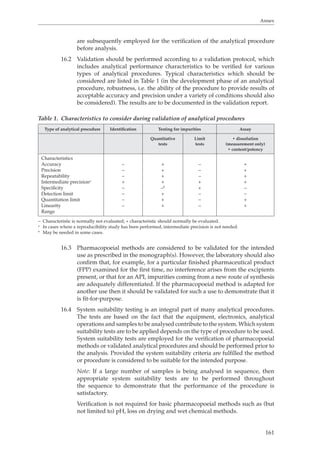
solutions containing these elements at a known concentration by direct calibration 
using an automated continuous-flow hydride vapour generation system. 
The absorbance value of the compensation liquid (blank solution) is automatically 
subtracted from the value obtained with the test solution. 
Arsenic 
Sample solution. To 19 ml of the test solution or of the blank solution as described 
above, add 1 ml of a 200 g/l solution of potassium iodide R. Allow the test solution 
to stand at room temperature for about 50 min or at 70 °C for about 4 minutes. 
73 
Acid reagent. Heavy metal-free hydrochloric acid R. 
Reducing reagent. A 6 g/l solution of sodium tetrahydroborate R in a 5 g/l solution 
of sodium hydroxide R. 
The instrumental parameters in Table 11 may be used. 
Mercury 
Sample solution. Test solution or blank solution, as described above. 
Acid reagent. A 515 g/l solution of heavy metal-free hydrochloric acid R. 
Reducing reagent. A 10 g/l solution of stannous chloride R or sodium tetrahydroborate 
in dilute hydrochloric acid R. 
The instrumental parameters in Table 11 may be used. 
Table 11. Instrumental parameters for determination of arsenic and mercury 
As Hg 
Wavelength nm 193.7 253.7 
Slit width nm 0.2 0.5 
Hollow-cathode lamp current mA 10 4 
Acid reagent flow rate ml/minute 1.0 1.0 
Reducing reagent flow rate ml/minute 1.0 1.0 
Sample solution flow rate ml/minute 7.0 7.0 
Absorption cell Quartz (heated) Quartz (unheated) 
Background corrector on on 
Nitrogen flow rate litre/minute 0.1 0.1 
Heating 800 °C 100 °C
74
Determination of microorganisms 
18. Determination of microorganisms 
75 
Total viable aerobic count 
The total viable aerobic count (TVC) of the herbal material being examined is 
determined, as specified in the test procedure below, using one of the following 
methods: membrane-filtration, plate count or serial dilution. Aerobic bacteria and 
fungi (moulds and yeasts) are determined by the TVC. 
Usually a maximum permitted level is set for certain products, but when the TVC 
exceeds this level then it is unnecessary to proceed with determination of specific 
organisms; the material should be rejected without being subjected to further 
testing. 
Pretreatment of the test herbal material 
Depending on the nature of the crude herbal material, grind, dissolve, dilute, 
suspend or emulsify it using a suitable method and eliminate any antimicrobial 
properties by dilution, neutralization or filtration. Either phosphate buffer pH 7.2; 
buffered sodium chloride-peptone solution, pH 7.0; or fluid medium, used for the 
test, is used to suspend or dilute the test specimen. 
Some materials have special requirements, which have to be met for acceptable 
pretreatment to be performed. Some examples are as follows: 
Materials containing tannins, antimicrobial substances 
Some herbal preparations present difficulties in determining levels of microbes 
(e.g. those containing high contents of tannins or essential oils). When test 
specimens have antimicrobial activity or contain antimicrobial substances, any 
such antimicrobial properties are removed as mentioned above. For the test, use a 
mixture of several portions selected at random from the bulk or from the contents 
of a sufficient number of containers. If the test specimens are diluted with fluid 
medium, the test should be performed quickly. 
Water-soluble materials 
Dissolve or dilute 10 g or 10 ml of plant material, unless otherwise specified in 
the test procedure for the material concerned, in lactose broth or another suitable 
medium proven to have no antimicrobial activity under the conditions of the test. 
Adjust the volume to 100 ml with the same medium (Note that some materials may 
require the use of larger volumes). If necessary, adjust the pH of the suspension to 
about 7. 
Non-fatty materials insoluble in water 
Suspend 10 g or 10 ml of the herbal material, unless otherwise specified in the test 
procedure for the material concerned, in lactose broth or another suitable medium 
proven to have no antimicrobial activity under the conditions of the test; dilute to 
100 ml with the same medium (Note that some materials may require the use of a
Quality control methods for herbal materials 
76 
larger volume). If necessary, divide the material and homogenize the suspension 
mechanically. A suitable surfactant, such as a solution of polysorbate 20 R or 80 R 
containing 1 mg per ml may be added to aid dissolution. If necessary, adjust the 
pH of the suspension to about 7. 
Fatty materials 
Homogenize 10 g or 10 ml of material, unless otherwise specified in the test 
procedure for the material concerned, with 5 g of polysorbate 20 R or 80 R. If 
necessary, heat to a temperature not exceeding 40 °C (Occasionally, it may be 
necessary to heat to a temperature of up to 45 °C, for the shortest possible time). 
Mix carefully while maintaining the temperature in a water-bath or oven. Add 
85 ml of lactose broth or another suitable medium proven to have no antimicrobial 
activity under the conditions of the test, if necessary heated to a temperature not 
exceeding 40 °C. Maintain this temperature for the shortest time necessary until an 
emulsion is formed and, in any case, for not more than 30 minutes. If necessary, 
adjust the pH of the emulsion to about 7. 
Test procedures 
Plate count 
For bacteria use Petri dishes 9–10 cm in diameter. To one dish add a mixture of 
1 ml of the pre-treated herbal material and about 15 ml of liquefied casein-soybean 
digest agar at a temperature not exceeding 45 °C. Alternatively, spread the material 
on the surface of the solidified medium in a Petri dish. If necessary, dilute the 
material to obtain an expected colony count of not more than 300. Prepare at least 
two dishes using the same dilution, invert them and incubate them at 30–35 °C for 
48–72 hours, unless a more reliable count is obtained in a shorter period of time. 
Count the number of colonies formed and calculate the results using the plate with 
the largest number of colonies, up to a maximum of 300. 
For fungi use Petri dishes 9–10 cm in diameter. To one dish add a mixture of 1 ml 
of the pretreated material and about 15 ml of liquefied Sabouraud glucose agar with 
antibiotics (also used is potato dextrose agar with antibiotics) at a temperature not 
exceeding 45 °C. Alternatively, spread the pretreated material on the surface of 
the solidified medium in a Petri dish. If necessary, dilute the material as described 
above to obtain an expected colony count of not more than 100. Prepare at least 
two dishes using the same dilution and incubate them upright at 20–25 °C for 
5 days, unless a more reliable count is obtained in a shorter period of time. Count 
the number of colonies formed and calculate the results using the dish with not 
more than 100 colonies. 
Membrane filtration 
Use membrane filters with a nominal pore size of not greater than 0.45 μm, and 
with a proven effectiveness at retaining bacteria (e.g. cellulose nitrate filters are 
used for aqueous, oily and weakly alcoholic solutions, whereas cellulose acetate 
filters are better for strongly alcoholic solutions). The technique below uses 
filter discs of about 50 mm in diameter. Where filters of a different diameter are 
used, adjust the volumes of the dilutions and washings accordingly. Sterilize, by 
appropriate means, the filtration apparatus and the membrane, as the solution is 
introduced, filtered and examined under aseptic conditions, and the membrane is 
then transferred to the culture medium.
Determination of microorganisms 
The detailed method 
Transfer 10 ml or a solution containing 1 g of the material to each of two membrane 
filter apparatuses and filter immediately. If necessary, dilute the pretreated material 
to obtain an expected colony count of 10–100. Wash each membrane, filtering three or 
more successive quantities of approximately 100 ml of a suitable liquid such as buffered 
sodium chloride-peptone solution at pH 7.0. For fatty materials, a suitable surfactant 
may be added, such as Polysorbate 20 R or 80 R. Transfer one of the membrane filters, 
intended primarily for the enumeration of bacteria, to the surface of a plate with 
soybean-casein digest agar and the other, intended primarily for the enumeration of 
fungi, to the surface of a plate with Sabouraud glucose agar with antibiotics. Incubate the 
plates for 5 days, unless a more reliable count can be obtained otherwise, at 30–35 °C 
for the detection of bacteria and at 20–25 °C for the detection of fungi. Count the 
number of colonies formed. Calculate the number of microorganisms per gram or per 
ml of the material tested, if necessary counting bacteria and fungi separately. 
Serial dilution 
Prepare a series of 12 tubes each containing 9–10 ml of soybean-casein digest medium. 
To each of the: 
— first group of three tubes, add 1 ml of the 1:10 dilution of dissolved, homogenized 
material (containing 0.1 g or 0.1 ml of specimen) prepared as described later 
in the section on “Test procedure for the Enterobacteriaceae and certain other 
Gram-negative bacteria”, below); 
— second group of three tubes, add 1 ml of a 1:100 dilution of the material; 
— third group of three tubes, add 1 ml of a 1:1000 dilution of the material; 
— last three tubes, add 1 ml of the diluent. 
Incubate the tubes at 30–35 °C for at least 5 days. No microbial growth should appear in 
the last three tubes. If the reading of the results is difficult or uncertain, owing to the nature 
of the material being examined, prepare a subculture in a liquid or a solid medium, and 
evaluate the results after a further period of incubation. Determine the most probable 
number of microorganisms per gram or per ml of the material using Table 12. 
If, for the first column, the number of tubes showing microbial growth is two or less, 
the most probable number of microorganisms per g or per ml is less than 100 (Table 12). 
77 
Table 12. Determination of total viable aerobic count 
Number of tubes with microbial growtha 
Most probable number of microorganisms 
100 mg or per g or ml 
0.1 ml per tube 
10 mg or 
0.01 ml per tube 
1 mg or 
0.001 ml per tube 
3 3 3 1100 
3 3 2 1100 
3 3 1 500 
3 3 0 200 
3 2 3 290 
3 2 2 210 
3 2 1 150 
3 2 0 90 
3 1 3 160 
3 1 2 120 
3 1 1 70 
3 1 0 40 
3 0 3 95 
3 0 2 60 
3 0 1 40 
3 0 0 23 
a Amounts in mg or ml are quantities of original plant material.
Quality control methods for herbal materials 
78 
Effectiveness of the culture medium, confirmation of antimicrobial 
substances and validity of the counting method 
The following strains are normally used (see also chapter 21): 
Staphylococcus aureus NCIMB 8625 (ATCC 6538-P, CIP 53.156) or NCIMB 9518 
(ATCC 6538, CIP 4.83, IFO 13276) 
Bacillus subtilis NCIMB 8054 (ATCC 6633, CIP 52.62, IFO 3134) 
Escherichia coli NCIMB 8545 (ATCC 8739, CIP 53.126, IFO 3972) 
Candida albicans ATCC 2091 (CIP 1180.79, IFO 1393) or ATCC 10 231 
(NCPF 3179, CIP 48.72, IFO 1594) 
Clostridia botulinum ATCC 19297 (NCTC 7272) 
Clostridium perfringens ATCC 13124 (NCTC 8239) 
Clostridium tetani ATCC e19406 (NCTC 279) 
Allow the test strains to grow separately in tubes containing soybean-casein digest 
medium at 30–35 °C for 18–24 hours for aerobic bacteria and between 20–25 °C for 
Candida albicans, for 48 hours (Antibiotics are often added to the culture medium 
to attain a particular selectivity). 
Dilute portions of each of the cultures using buffered sodium chloride-peptone 
solution, pH 7.0 or phosphate buffer, pH 7.2 to prepare test suspensions containing 
50–200 viable colony forming units (cfu) (microorganisms) per ml. Growth-promoting 
qualities are tested by inoculating 1 ml of each microorganism into each 
medium. The test media are satisfactory if clear evidence of growth appears in 
all the inoculated media after incubation at the indicated temperature for 5 days. 
When a count of test organisms with a test specimen is less than one fifth of that 
without the test specimen, any such effect must be eliminated by dilution, filtration, 
neutralization or inactivation. 
To confirm the sterility of the medium and of the diluent and the aseptic performance 
of the test, follow the TVC method using sterile buffered sodium chloride-peptone 
solution, pH 7.0, or phosphate buffer, pH 7.2, as a control. There should be no 
growth of microorganisms. 
To validate the method, a count for the test organism should be obtained differing 
by not more than a factor of 10 from the calculated value for the inoculum. 
Tests for specific microorganisms 
Microbial tests should be applied to starting plant materials, intermediate and 
finished products where necessary. Enterobacteria and certain other Gram-negative 
bacteria Escherichia coli, Salmonella and Staphylococcus aureus are included as target 
strains of the test. 
The conditions of the tests for microbial contamination are designed to 
minimize accidental contamination of the materials being examined and the 
precautions taken must not adversely affect any microorganisms that could be 
revealed.
Determination of microorganisms 
Pretreatment of the material being examined 
Refer to the sampling and preparation of the test solution in TVC (see ”Test 
procedures” above), including the elimination of any antimicrobial substances 
which may be present. 
Test procedure for the Enterobacteriaceae and certain other 
Gram-negative bacteria 
Detection of bacteria 
Homogenize the pretreated material appropriately and incubate at 30–37 °C for 
a length of time sufficient for revivification of the bacteria, but not sufficient for 
multiplication of the organisms (usually 2–5 hours). Shake the container, transfer 
aliquots equivalent to 1 g or 1 ml of the homogenized material to 100 ml of 
Enterobacteriaceae enrichment broth Mossel and incubate at 35–37 °C for 18–48 hours. 
Prepare a subculture on a plate with violet-red bile agar with glucose and lactose. 
Incubate at 35–37 °C for 18–48 hours. The material passes the test if no growth of 
colonies of Gram-negative bacteria is detected on the plate. 
Quantitative evaluation 
Inoculate a suitable amount of Enterobacteriaceae enrichment broth Mossel with 
quantities of homogenized material prepared as described in the above section on 
“Detection of bacteria”, appropriately diluted as necessary, to contain 1 g, 0.1 g and 
10 μg, or 1 ml, 0.1 ml and 10 μl, of the material being examined. Incubate at 35–37 °C 
for 24–48 hours. Prepare a subculture of each of the cultures on a plate with violet-red 
bile agar with glucose and lactose in order to obtain selective isolation. Incubate at 
35–37 °C for 18–24 hours. The growth of well-developed colonies, generally red or 
reddish in colour, of Gram-negative bacteria constitutes a positive result. Note the 
smallest quantity of material that gives a positive result. Determine the probable 
number of bacteria using Table 13. 
Table 13. Determination of Enterobacteriaceae and certain other Gram-negative bacteria 
79 
Result for each quantity or volume Probable number of bacteria 
per g of material 
1.0 g or 1.0 ml 0.1 g or 0.1 ml 0.01 g or 0.01 ml 
+ + + More than 102 
+ + – Less than 102 but more than 10 
+ – – Less than 10 but more than 1 
– – – Less than 1 
Escherichia coli 
Transfer a quantity of the homogenized material in lactose broth, prepared and 
incubated as described above, and containing 1 g or 1 ml of the material being 
examined, to 100 ml of MacConkey broth and incubate at 43–45 °C for 18–24 hours. 
Prepare a subculture on a plate with MacConkey agar and incubate at 43–45 °C for 
18–24 hours. Growth of red, generally non-mucoid colonies of Gram-negative rods, 
sometimes surrounded by a reddish zone of precipitation, indicates the possible 
presence of E. coli. This may be confirmed by the formation of indole at 43.5–44.5 °C 
or by other biochemical reactions. The material passes the test if no such colonies 
are detected or if the confirmatory biochemical reactions are negative.
Quality control methods for herbal materials 
80 
Salmonella spp. 
Incubate the solution, suspension or emulsion of the pretreated material prepared 
as described above at 35–37 °C for 5–24 hours, as appropriate for enrichment. 
Primary test 
Transfer 10 ml of the enrichment culture to 100 ml of tetrathionate bile brilliant green 
broth and incubate at 42–43 °C for 18–24 hours. Prepare subcultures on at least two 
of the following three agar media: deoxycholate citrate agar; xylose, lysine, deoxycholate 
agar; and brilliant green agar. Incubate at 35–37 °C for 24–48 hours. Carry out the 
secondary test if any colonies are produced that conform to the description given 
in Table 14. 
Secondary test 
Prepare a subculture of any colonies showing the characteristics described in 
Table 14 on the surface of triple sugar iron agar using the deep inoculation technique. 
This is done by first inoculating the inclined surface of the culture medium, 
followed by a stab culture with the same inoculating needle and then, incubating 
at 35–37 °C for 18–24 hours. The test is positive for the presence of Salmonella spp. if 
a change of colour from red to yellow is observed in the deep culture (but not in the 
surface culture), usually with the formation of gas with or without production of 
hydrogen sulfide in the agar. Confirmation is obtained by appropriate biochemical 
and serological tests. 
The material being examined passes the test if cultures of the type described do 
not appear in the primary test, or if the confirmatory biochemical and serological 
tests are negative. 
Table 14. Description of Salmonella colonies appearing on different culture media 
Medium Description of colony 
Deoxycholate citrate agar Well-developed, colourless 
Xylose, lysine, deoxycholate agar Well-developed, red, with or without black centres 
Brilliant green agar Small, transparent and colourless, or opaque, pink or white 
(frequently surrounded by a pink to red zone) 
Pseudomonas aeruginosa 
Pretreat the material being examined as described under “Pretreatment of the test 
herbal material”, above, but using buffered sodium chloride-peptone solution, pH 
7.0, or another suitable medium shown not to have antimicrobial activity under 
the conditions of the test, in place of lactose broth. Inoculate 100 ml of soybean-casein 
digest medium with a quantity of the solution, suspension or emulsion thus 
obtained containing 1 g or 1 ml of the material being examined. Mix and incubate 
at 35–37 °C for 24–48 hours. Prepare a subculture on a plate of cetrimide agar and 
incubate at 35–37 °C for 24–48 hours. If no growth of microorganisms is detected, 
the material passes the test. If growth of colonies of Gram-negative rods occurs, 
usually with a greenish fluorescence, apply an oxidase test and test the growth in 
soybean-casein digest medium at 42 °C. The following method may be used. Place 
2 or 3 drops of a freshly prepared 0.01 g/ml solution of N,N,N’,N’-tetramethyl-p- 
phenylenediamine dihydrochloride R on a filter paper and apply a smear of 
the suspected colony; the test is positive if a purple colour is produced within 
5–10 seconds. The material passes the test if cultures of the type described do not 
appear or if the confirmatory biochemical test is negative.
Determination of microorganisms 
Staphylococcus aureus 
Prepare an enrichment culture as described for Pseudomonas aeruginosa. Prepare a 
subculture on a suitable medium such as Baird-Parker agar. Incubate at 35–37 °C 
for 24–48 hours. The material passes the test if no growth of microorganisms is 
detected. Black colonies of Gram-positive cocci often surrounded by clear zones 
may indicate the presence of Staphylococcus aureus. For catalase-positive cocci, 
confirmation may be obtained, for example, by coagulase and deoxyribonuclease 
tests. The material passes the test if cultures of the type described do not appear or 
if the confirmatory biochemical test is negative. 
Clostridium spp. 
Add 10 g (10 ml) of the herbal materials, preparation or product to be examined 
to two suitable vessels, each containing 100 ml of cooked-meat medium, heated 
just prior to use, to 100 °C for a few minutes and cooled to 37 °C. To distinguish 
between sporing and non-sporing organisms, immediately seal one vessel with a 
layer of sterile paraffin or agar, heat the other vessel at 65 °C for 30 minutes, and 
then similarly seal. 
Incubate both vessels at 35–37 °C and examine every 24 hours for up to 4 days. 
Growth of sporing organisms occurs in the vessel which was heated after 
inoculation. 
If no growth occurs in either of the vessels, the sample passes the test for absence 
of Clostridia and other anaerobic bacteria. 
If sporing anaerobic organisms (Table 15) are found, inoculate the cultures, each in 
duplicate, on one half of the surface of plates containing 5% defibrinated sheep blood 
agar medium. Incubate at 37 °C for 48 hours, one plate anaerobically and the other 
aerobically, to check that the organisms will not grow under aerobic conditions. 
81 
Table 15. Characteristics of Clostridium species on cooked-meat medium 
Clostridium botulinum Clostridium perfringens Clostridium tetani 
No digestion of meat; 
much gas, white sediment 
meat turns pink colour 
No digestion of meat; 
burnt organic smell 
After 24 and 48 hours examine the appearance of the colonies together with the type 
and extent of haemolysis, and also examine microscopically for spore formation 
using Gram stain or spore stain techniques. Match the result with the description 
in Table 16, for further identification of specified clostridia. 
Table 16. Characteristics of Clostridium species on 5% defibrinated sheep blood agar 
medium 
Clostridium botulinum Clostridium perfringens Clostridium tetani 
Colonies Irregular, translucent 
with a granular surface 
and indefinite fimbriated 
spreading edge 
Large, circular, convex, 
semitranslucent, smooth 
with an entire edge 
Transparent with long 
feathery spreading 
projections 
Haemolysis + Double zone + 
Spores Oval, central, subterminal 
distended bacilli 
Absent Spherical and terminal 
(drum stick)
Quality control methods for herbal materials 
82 
Shigella 
The method described below is adapted from the WHO guidelines for the control 
of epidemics due to Shigella dysenteriae type 1. 
Direct inoculation of agar plates 
Use 2 or 3 loopfuls of the herbal materials, preparations or products to be tested. 
Incubate plates at 35–37 °C for 18–24 hours. 
Inoculate a general purpose plating medium of low selectivity and one of moderate 
or high selectivity. MacConkey agar is recommended as a medium of low selectivity. 
MacConkey agar with 1 mcg/ml of potassium tellurite has been reported to be 
particularly useful for S. dysenteriae type 1 (Sd1). Use a small inoculum. Incubate 
at 35–37 °C for 18–24 hours. 
Xylose-lysine-desoxycholate (XLD) agar is recommended as a medium of moderate or 
high selectivity for isolation of Shigella. Desoxycholate citrate agar (DCA) is a suitable 
alternative. 
Note: Do not use salmonella–shigella (SS) agar, as it often inhibits growth of Sd1. 
Each new batch of medium should be controlled for quality before routine use by 
inoculating it with known reference strains and observing their growth and colony 
characteristics. 
Identification of colonies on plating media 
Colonies suspicious for Shigella will appear as follows: 
— MacConkey agar: convex, colourless, 2–3 mm; 
— XLD agar: red, smooth, 1–2 mm; 
— DCA agar: colourless, translucent, 2–3 mm. 
Identify well-separated colonies of typical appearance to be transferred from each 
of the plating media for further testing by making a mark on the bottom of the 
Petri dish. 
Whenever possible a person experienced in the identification of Shigella should 
train laboratory workers who are unfamiliar with its identification. 
Inoculation of Kligler iron agar 
Pick three characteristic colonies from the plating media and inoculate into Kligler 
iron agar (KIA) as follows: stab the butt and then streak the slant with a zigzag 
configuration. Pay attention to proper labelling of the tubes. If screw-cap KIA tubes 
are used, make sure that the caps are loose. Incubate overnight. On the following 
morning, examine the reactions in the KIA tubes. Tubes suspicious for Shigella will 
have an acid (yellow) butt and an alkaline (red) slant. They will not produce gas 
(no bubbles or cracks in the agar) and will not produce hydrogen sulfide (no black 
along the stab line). 
Triple sugar iron agar (TSI) can also be used for the identification of Shigella. It will 
give the same reactions as KIA.
Determination of microorganisms 
Validation of the tests for specific microorganisms 
If necessary, grow separately the test strains listed in Table 17 on the culture media 
indicated, at 30–35 °C for 18–24 hours. Dilute portions of each of the cultures using 
buffered sodium chloride-peptone solution pH 7.0 so that the test suspensions 
contain about 103 microorganisms per ml. Mix equal volumes of each suspension 
and use 0.4 ml (approximately 102 microorganisms of each strain) as an inoculum in 
tests for Escherichia coli, Salmonella spp., Pseudomonas aeruginosa and Staphylococcus 
aureus, in the presence of the material being examined, if necessary. The test method 
should give a positive result for the respective strain of microorganism. 
Table 17. Validation of tests for detection of specific microorganisms in the herbal sample 
Microorganism Strain numbera Medium 
Escherichia coli e.g. NCIMB 8545 
83 
(ATCC 8739, CIP 53.126, IFO 3972) 
lactose broth 
Pseudomonas aeruginosa e.g. NCIMB 8626 
(ATCC 9027, CIP 82.118) 
soybean-casein digest 
medium 
Salmonella typhimurium No strain number is recommended. Species not 
pathogenic for humans, such as Salmonella abony 
(NCTC 6017, CIP 80.39), may be used 
lactose broth 
Clostridium botulinum e.g. ATCC 19297 (NCTC 7272) cooked-meat medium 
Clostridium perfringens e.g. ATCC 13124 (NCTC 8239) cooked-meat medium 
Clostridium tetani e.g. ATCC e19406 (NCTC 279) cooked-meat medium 
Staphylococcus aureus e.g. NCIMB 8625 
(ATCC 6538 P, CIP 53.156) or NCIMB 9518 
(ATCC 6538, CIP 4.83, IFO 13276) 
soybean-casein digest 
medium 
a See chapter 21. 
For other microorganisms see overview under ”Effectiveness of the culture 
medium, confirmation of antimicrobial substances and validity of the counting 
method” (see p. 78).
84
Determination of aflatoxins 
19. Determination of aflatoxins 
Whenever testing for aflatoxins is required, this should be done after using a 
suitable clean-up procedure during which great care should be taken not to 
expose any personnel or the working or general environment to these dangerous 
and toxic substances. Thus Member States should adapt their good practices for 
pharmaceutical control laboratories and good manufacturing practices (GMP) 
accordingly. Only products that have a history of aflatoxin contamination need 
to be tested. 
85 
Tests for aflatoxins 
These tests are designed to detect the possible presence of aflatoxins B1, B2, G1 and 
G2, which are highly toxic contaminants in any material of plant origin. 
Recommended procedure 
The method described below does not require the use of toxic solvents, such as 
chloroform and dichloromethane. It uses a multifunctional column, which contains 
lipophilic and charged active sites, and high-performance liquid chromatography 
(HPLC) using fluorescence detection to determine aflatoxins B1, B2, G1 and G2. The 
advantages of employing a multifunctional column are: 
— high total recoveries of aflatoxins B1, B2, G1 and G2 (more than 85%); 
— the column can be kept (stocked) at room temperature and for a fairly long time 
prior to use. 
Standard solutions of aflatoxin B1, B2, G1 and G2 (2.5 ng/ml) 
Stock standard solution. Weigh exactly 1.0 mg each of crystalline material of aflatoxins 
B1, B2, G1 and G2 and dissolve in 50 ml of toluene-acetonitrile (9:1) solution by 
shaking vigorously in a glass flask to obtain a standard stock solution (20 μg/ml). 
This standard solution should be kept in a tightly sealed container, covered with 
aluminium foil, and kept in a refrigerator at 4 °C in the dark. 
Working standard solution. 0.5 ml of stock standard solution is added to toluene-acetonitrile 
(9:1) solution to give 200 ml (working standard solution (50 ng/ml). 
Standard solution. Take 1.0 ml of working standard solution and add to toluene-acetonitrile 
(9:1) solution to give 20 ml (final standard solution (2.5 ng/ml). 
Standard solution for liquid chromatography analysis. Transfer 0.25 ml of the final 
standard solution (as described above) into a glass centrifuge tube and evaporate 
to dryness at 40 °C or by using a nitrogen air stream. To derivatize1 aflatoxins B1 and 
G1 (precolumn derivatization), add 0.1 ml of trifluoroacetic acid (TFA) solution to 
the residue in the tube, tightly seal the tube and shake vigorously. Allow the tube to 
1 BCR reference material CRM No. 62 Community Bureau of Reference, obtainable from BCR, 
Directorate-General X11, Commission of the European Communities, 200 rue de la Loi, B-1049 
Brussels, Belgium.
Quality control methods for herbal materials 
86 
stand at room temperature for 15 min in the dark. Add 0.4 ml of acetonitrile:water 
(1:9) solution to the tube. A 20-μl portion of the sample solution in the tube is 
subjected to liquid chromatography analysis. 
Preparation of sample 
Grind the herbal material for testing to a uniform consistency using a coffee mill, 
and extract a 50-g test sample with 400 ml of acetonitrile-water (9:1) by shaking 
vigorously in a glass flask fitted with a stopper for 30 minutes or by using a 
mechanical blender for 5 minutes. Filter the solution through a filter paper 
or centrifuge. Transfer a 5-ml portion of the filtrate, or the top clean layer, to a 
multifunctional column (such as a MultiSep #228 cartridge column (Romer Labs) 
or an Autoprep MF-A [Showa-denko]) and pass through at a flow rate of 1 ml/ 
minute. The aflatoxins present in a sample are passed through the column as the 
first eluate. Obtain the first 1-ml of the eluate as the test solution. 
Evaporate 0.5 ml of the test solution in a glass centrifuge tube to dryness at 40 °C 
or by using a nitrogen air stream to remove solvent. 
To derivatize aflatoxins B1 and G1 (precolumn derivatization), add 0.1 ml of 
trifluoroacetic acid (TFA) solution to the residue in the tube, tightly seal the tube 
and shake vigorously. Allow the tube to stand at room temperature for 15 minutes 
in the dark. Add 0.4 ml of acetonitrile-water (1:9) solution to the tube. Subject a 
20-μl portion of the sample solution in the tube to liquid chromatography analysis. 
Method 
Liquid chromatography conditions 
The mobile phase is acetonitrile-methanol-water (1:3:6).1 De-gas the mobile phase by 
sonication. Connect an octadecyl-silica gel (ODS) column (4.6 mm inner diameter (ID) 
× 250 mm, 3–5 μm), such as Inertsil ODS-3 (4.6 mm ID × 250 mm, 3 μm) as the liquid 
chromatography column. Maintain the column at 40 °C with a flow rate of 1 ml/ 
minute. The aflatoxin and its derivatives are detected at the excitation and emission 
wavelengths of 365 nm and 450 nm, respectively. The injection volume is 20 μl. 
If an impurity peak overlaps the peaks corresponding to aflatoxins, the alternative 
liquid chromatography conditions, described below, are recommended. 
Alternative liquid chromatography conditions 
The mobile phase is methanol-water (3:7). De-gas the mobile phase by sonication. 
Connect a fluorocarbonated column, such as Wako-pack Fluofix 120E (4.6 mm ID × 
250 mm, 5 μm) as the liquid chromatography column. Maintain the column at 40 °C 
with a flow rate of 1 ml/minute. The aflatoxin and its derivatives are detected at 
the excitation and emission wavelengths of 365 nm and 450 nm, respectively. The 
injection volume is 20 μl. 
Interpretation of the results 
Compare the retention time of peak area or peak heights of the aflatoxin under 
study in the chromatograms. If they are bigger or higher than those obtained in a 
standard solution of the aflatoxin under investigation, it should be regarded as a 
positive result for the presence of aflatoxin in the sample solution. 
1 If the sample solution contains a lot of impurity, the column should be washed by acetonitrile for 
5–10 min and reconditioned with the mobile phase for 10 min before the next analysis.
Radioactive contamination 
20. Radioactive contamination 
Following a severe nuclear accident, the environment may be contaminated with 
airborne radioactive materials. These may deposit on the leaves of medicinal 
plants. Their activity concentration and the type of radioactive contamination can 
be measured by the radiation monitoring laboratories of most of the WHO Member 
States. The activity concentration of radioisotopes in herbs should be assessed by 
the competent national radiohygiene laboratories taking into account the relevant 
recommendations of international organizations, such as Codex Alimentarius, 
the International Atomic Energy Agency (IAEA), the Food and Agriculture 
Organization of the United Nations (FAO) and WHO. 
Since radionuclides from accidental discharges vary with the type of facility 
involved, a generalized method of measurement is not yet available. However, 
should such contamination be a concern, suspect samples can be analysed by 
a competent laboratory. Details of laboratory techniques are available from the 
IAEA.1 
1 International Atomic Energy Agency (IAEA), Analytical Quality Control Services, Laboratory 
Seibersdorf, PO Box 100, Vienna, Austria. 
87
88
Culture media and strains used for microbiological analysis 
21. Culture media and strains used 
for microbiological analysis 
89 
Culture media 
The following media are satisfactory, but other media may be used if they have 
similar nutritive and selective properties for the microorganisms to be tested. See 
chapter 23 for the list of reagents and solutions. 
Baird–Parker agar 
Procedure. Dissolve 10 g of pancreatic digest of casein R, 5 g of beef extract R, 1g 
of water-soluble yeast extract R, 5 g of lithium chloride R, 20 g of agar R, 12 g of 
glycine R and 10 g of sodium pyruvate R in sufficient water to produce 950 ml. 
Heat to boiling for 1 minute, shaking frequently and adjust the pH to 6.6–7.0 using 
sodium hydroxide (0.5 mol/l) VS. Sterilize in an autoclave at 121 °C for 15 minutes, 
cool to 45–50 °C and add 10 ml of a sterile 0.01 g/ml solution of potassium tellurite 
R and 50 ml of egg-yolk emulsion. 
Brilliant green agar 
Procedure. Dissolve 10 g of dried peptone R (meat and casein), 3 g of water-soluble 
yeast extract R, 5 g of sodium chloride R, 10 g of lactose R, 10 g of sucrose 
R, 20 g of agar R, 0.08 g of phenol red R and 12.5 mg of brilliant green R in 
sufficient water to produce 1000 ml. Heat to boiling for 1 minute. Using sodium 
hydroxide (0.05 mol/l) VS, adjust the pH to 6.7–7.1. Immediately before use, 
sterilize in an autoclave at 121 °C for 15 minutes, cool to 50 °C and pour into 
Petri dishes. 
Buffered sodium chloride–peptone solution pH 7.0 
Procedure. Dissolve 3.56 g of potassium dihydrogen phosphate R, 7.23 g of 
disodium hydrogen phosphate R, 4.30 g of sodium chloride R and 1 g of dried 
peptone R (meat and casein) in sufficient water to produce 1000 ml. Polysorbate 
20 R or polysorbate 80 R may be added, 0.001–0.01 g/ml. Sterilize in an autoclave 
at 121 °C for 15 minutes. 
Casein–soybean digest agar 
Procedure. Dissolve 15 g of pancreatic digest of casein R, 3 g of papaic digest of 
soybean meal R, 5 g of sodium chloride R and 15 g of agar R in sufficient water 
to produce 1000 ml. Using sodium hydroxide (0.05 mol/l) VS, adjust the pH to 
7.1–7.5. Sterilize in an autoclave at 121 °C for 15 minutes. 
Cetrimide agar 
Procedure. Dissolve 20 g of pancreatic digest of gelatin R, 1.4 g of magnesium 
chloride R, 10 g of potassium sulfate R, 0.3 g of cetrimide R, 13.6 g of agar R and 
10 ml of glycerol R in sufficient water to produce 1000 ml. Heat to boiling for 
1 minute with shaking. Using sodium hydroxide (0.05 mol/l) VS, adjust the pH to 
7.0–7.4. Sterilize in an autoclave at 121 °C for 15 minutes.
Quality control methods for herbal materials 
90 
Cooked-meat medium 
Procedure 
Part I: Mix 454.0 g of ground beef heart (fat free) with 1000 ml of water (use 
purified water) and add 25 ml of 1 M sodium hydroxide. Heat to boiling and 
simmer for 20 minutes with frequent stirring. Cool and check the pH, which 
should be about 7.2; adjust it if necessary. Filter through several layers of gauze; 
squeeze out the excess liquid. Spread the meat particles to partially dry and place 
in suitable vessels. 
Part II: Filter the fluid obtained from part I through three pieces of coarse filter 
paper to clarify. Then filter through one piece of finer filter paper (Whatman No. 1 
or equivalent is suitable). Dissolve the following ingredients in the filtrate: peptic 
digest of animal tissues (20.0 g), dextrose monohydrate (2.0 g), and sodium chloride 
(5.0 g). Adjust the volume to 1000 ml with water (use purified water). Add the fluid 
to the vessels, using about four to five parts of the fluid to one part of the meat. pH 
after sterilization: 7.2 +/- 0.1. 
Defibrinated sheep blood agar medium (five per cent) (blood agar medium) 
Procedure. Heat casein-soybean digest agar medium and cool to 45–50 °C in a 
water-bath. Add sufficient amount of defibrinated sheep blood to make 5 per cent 
and mix. 
Deoxycholate citrate agar 
Procedure. Dissolve 10 g of beef extract R, 10 g of dried peptone R (meat), 10 g 
of lactose R, 20 g of sodium citrate R, 1 g of iron (III) citrate R, 5 g of sodium 
deoxycholate, 13.5 g of agar R and 20 mg of neutral red R in sufficient water to 
produce 1000 ml. Heat gently to boiling for 1 minute, cool to 50 °C and adjust the 
pH to 7.1–7.5 using sodium hydroxide (0.05 mol/l) VS. Pour into Petri dishes. Do 
not heat in an autoclave. 
Enterobacteriaceae enrichment broth (Mossel) 
Procedure. Dissolve 10 g of pancreatic digest of gelatin R, 5 g of glucose hydrate 
R, 20 g of dehydrated ox bile R, 2 g of potassium dihydrogen phosphate R, 8 g of 
disodium hydrogen phosphate R and 15 mg of brilliant green R in sufficient water 
to produce 1000 ml. Heat to boiling for 30 minutes and cool immediately. Using 
sodium hydroxide (0.05 mol/l) VS adjust the pH to 7.0–7.4. 
Kligler’s iron agar (KIA) 
Procedure. Dissolve the agar in the meat infusion broth, or alternatively in 
meat extract broth, by heating in a boiling water-bath or in steam at 100° C. 
Bring the molten nutrient agar to 80 °C in a water-bath. Add and dissolve the 
lactose, peptone, proteose peptone, NaCl, glucose, ferrous sulfate, and sodium 
thiosulfate and mix well. Adjust the pH to 7.4. Add 6 ml of 0.5% solution of 
phenol red and mix well. Distribute in screw-cap tubes (15 × 150 or 16 × 160 mm) 
in 5–6 ml amounts and sterilize by autoclaving at 121 °C for 15 minutes. Allow 
the medium to cool and set with a slant of 2.5 cm and a butt 2.5 cm deep. Record 
batch number and date on the label and then store at room temperature not 
exceeding 25 °C. 
An additional 10 g of peptone, 3 g of beef extract, 3 g of yeast extract, and one litre 
of distilled water may be used in place of meat infusion broth.
Culture media and strains used for microbiological analysis 
Lactose broth 
Procedure. Dissolve 3 g of beef extract R, 5 g of pancreatic digest of gelatin R and 
5 g of lactose R in sufficient water to produce 1000 ml. Using sodium hydroxide 
(0.0 5 mol/l) VS adjust the pH to 6.7–7.1. Sterilize in an autoclave at 121 °C for 
15 minutes. 
MacConkey agar 
Procedure. Dissolve 17 g of pancreatic digest of gelatin R, 3 g of dried peptone R 
(meat and casein), 10 g of lactose R, 5 g of sodium chloride R, 1.5 g of bile salts R, 
13.5 g of agar R, 30 mg of neutral red R and 1 mg of crystal violet R in sufficient 
water to produce 1000 ml. Using sodium hydroxide (0.05 mol/l) VS, adjust the pH 
to 6.9–7.3. Heat to boiling for 1 minute with constant shaking then sterilize in an 
autoclave at 121 °C for 15 minutes. 
MacConkey broth 
Procedure. Dissolve 20 g of pancreatic digest of gelatin R, 10 g of lactose R, 5 g 
of dehydrated ox bile R and 10 mg of bromocresol purple R in sufficient water 
to produce 1000 ml. Using sodium hydroxide (0.05 mol/l) VS, adjust the pH to 
7.1–7.5. Sterilize in an autoclave at 121 °C for 15 minutes. 
Sabouraud glucose agar with antibiotics 
Procedure. Dissolve 10 g of dried peptone R (meat and casein), 40 g of glucose 
hydrate R and 15 g of agar R in sufficient water to produce 1000 ml. Using acetic 
acid (~60 g/l) TS, adjust the pH to 5.4–5.8. Sterilize in an autoclave at 121 °C for 
15 minutes. Immediately before use, add sterile solutions of 0.10 g of benzylpenicillin 
sodium R and 0.1 g of tetracycline R per litre of medium or, alternatively, before 
sterilization add 0.05 g of chloramphenicol R per litre of medium. 
Soybean-casein-digest medium 
Procedure. Dissolve 17 g of pancreatic digest of casein R, 3 g of papaic digest 
of soybean meal R, 5 g of sodium chloride R, 2.5 g of dipotassium hydrogen 
phosphate R and 2.5 g of glucose hydrate R in sufficient water to produce 1000 ml. 
Using sodium hydroxide (0.05 mol/l) VS, adjust the pH to 7.1–7.5. Sterilize in an 
autoclave at 121 °C for 15 minutes. 
Tetrathionate bile brilliant green broth 
Procedure. Dissolve 8.6 g of dried peptone R, 8 g of dehydrated ox bile R, 6.4 g of 
sodium chloride R, 20 g of calcium carbonate RI, 20 g of potassium tetrathionate R 
and 0.07 g of brilliant green R in sufficient water to produce 1000 ml. Using sodium 
hydroxide (0.05 mol/l) VS, adjust the pH to 6.8–7.2. Heat just to boiling; do not 
reheat. 
Triple sugar iron agar 
Procedure. Dissolve 3 g of beef extract R, 3 g of water-soluble yeast extract, 20 g 
of dried peptone R (casein and beef), 5 g of sodium chloride R, 10 g of lactose R, 
10 g of sucrose R, 1 g of glucose hydrate R, 0.3 g of brown ammonium iron(III) 
citrate R, 0.3 g of sodium thiosulfate R, 25 mg of phenol red R and 12 g of agar R 
in sufficient water to produce 1000 ml. Heat to boiling for 1 minute with shaking. 
Using sodium hydroxide (0.05 mol/l) VS, adjust the pH to 7.2–7.6. Distribute in 
tubes and sterilize in an autoclave at 121 °C for 15 minutes. Allow to set in an 
inclined position covered with a butt. 
91
Quality control methods for herbal materials 
92 
Violet-red bile agar with glucose and lactose 
Procedure. Dissolve 3.0 g of water-soluble yeast extract R, 7.0 g of pancreatic digest 
of gelatin R, 1.5 g of bile salts R, 10.0 g of lactose R, 5.0 g of sodium chloride R, 10.0 g 
of glucose hydrate R, 15.0 g of agar R, 30 mg of neutral red R and 2.0 mg of crystal 
violet R in sufficient water to produce 1000 ml. Heat to boiling and adjust the pH 
to 7.2–7.6 using sodium hydroxide (0.05 mol/l) VS. Do not heat in an autoclave. 
Xylose, lysine, deoxycholate agar 
Procedure. Dissolve 3.5 g of xylose R, 5 g of L-lysine R, 7.5 g of lactose R, 7.5 g of 
sucrose R, 5 g of sodium chloride R, 3 g of water-soluble yeast extract R, 0.08 g of 
phenol red R, 13.5 g of agar R, 2.5 g of sodium deoxycholate R, 6.8 g of sodium 
thiosulfate R and 0.8 g of brown ammonium iron(III) citrate R in sufficient water 
to produce 1000 ml. Using sodium hydroxide (0.05 mol/l) VS, adjust the pH to 
7.2–7.6. Heat just to boiling, cool to 50 °C and pour into Petri dishes. Do not heat 
in an autoclave. 
Strains of microorganisms 
The microorganism strains referred to throughout the text are suitable, but others 
may be used if they have similar properties. The designations of the strains and the 
addresses from which they may be obtained are listed in Table 18. 
Table 18. Addresses for obtaining strains of microorganism 
Designation Address 
ATCC American Type Culture Collection, 12301 Park Lawn Drive, Rockville, MD 20852, 
USA 
CIP Collection de l’Institut Pasteur, Service de la Collection Nationale de Cultures de 
Microorganismes (CNCM), 25 rue du Docteur Roux, F 75015 Paris, France 
IFO Institute for Fermentation, Osaka (IFO) microorganism strains, The Culture 
Collection Division, The NITE Biological Resource Center (NBRC), Department 
of Biotechnology, National Institute of Technology and Evaluation (NITE), 2-5-8, 
Kazusa-kamatari, Kisarazu City, Chiba 292-0818, Japan 
NCIMB National Collection of Industrial and Marine Bacteria, 23 St Machar Drive, Aberdeen 
AB24 3RY, Scotland 
NCPF National Collection of Pathogenic Fungi, PHLS Mycology Reference Laboratory, 
Public Health Laboratory, Kingsdown, Bristol BS2 8EL, England 
NCTC National Collection of Type Cultures, Central Public Health Laboratory, 
61 Colindale Avenue, London NW9 5HT, England
Specifications for adsorbents for use in thin-layer chromatography 
22. Specifications for adsorbents 
for use in thin-layer chromatography 
Cellulose 
Description. A fine, white, homogeneous powder with an average particle size of 
less than 30 μm. 
Preparation. Suspend 15 g in 100 ml of water and homogenize for 60 seconds in 
an electric mixer. Carefully coat cleaned plates with a layer 0.25 mm thick using a 
spreading device. Allow the coated plates to dry in air. 
Separating power. Apply separately to the adsorbent layer 10 μl of 0.25 mg/ml 
solutions containing respectively brilliant black BN R, amaranth SR, fast yellow 
AB R and tropaeolin O R in a mixture of equal volumes of methanol R and water. 
Develop the plate using a mixture of 50 volumes of 1-propanol R, 10 volumes of 
ethyl acetate R and 40 volumes of water over a distance of 10 cm. The chromatogram 
shows four clearly separated spots. 
Cellulose, microcrystalline 
Description. A fine, white, homogeneous powder with an average particle size of 
less than 30 μm. 
Preparation. Suspend 25 g in 90 ml of water and homogenize for 60 seconds in an 
electric mixer. Carefully coat cleaned plates with a layer 0.25 mm thick using a 
spreading device. Allow the coated plates to dry in air. 
Separating power. Apply separately to the adsorbent layer 10 μl of 0.25 mg/ml 
solutions containing respectively brilliant black BN R, amaranth S R, fast yellow 
R and tropaeolin O R in a mixture of equal volumes of methanol R and water. 
Develop the plate using a mixture of 50 volumes of 1-propanol R, 10 volumes of 
ethyl acetate R and 40 volumes of water over a distance of 10 cm. The chromatogram 
shows four clearly separated spots. 
Cellulose F254 
Description. A fine, white, homogeneous powder with an average particle size of less 
than 30 μm containing a fluorescent indicator with an optimal intensity at 254 nm. 
Preparation. Suspend 25 g in 100 ml of water and homogenize for 60 seconds using 
an electric mixer. Carefully coat cleaned plates with a layer 0.25 mm thick using a 
spreading device. Allow the coated plates to dry in air. 
Separating power. Apply separately to the adsorbent layer 10 μl of 0.25 mg/ml 
solutions containing respectively brilliant black BN R, amaranth S R, fast yellow 
R and tropaeolin O R in a mixture of equal volumes of methanol R and water. 
Develop the plate using a mixture of 50 volumes of 1-propanol R, 10 volumes of 
93
Quality control methods for herbal materials 
94 
ethyl acetate R and 40 volumes of water over a distance of 10 cm. The chromatogram 
shows four clearly separated spots. 
Fluorescence. Prepare a 1.0 mg/ml solution of benzoic acid R in a mixture of 
9 volumes of 2-propanol R and 1 volume of formic acid (~1080g/l) TS. Apply to the 
adsorbent layer at 10 points of application, increasing the quantities of the solution 
from 1 μl to 10 μl. Develop the chromatogram using a mixture of 9 volumes of 
2-propanol R and 1 volume of formic acid (~1080g/l) TS. Allow the solvents to 
evaporate and examine the chromatogram in ultraviolet light at 254 nm. The 
benzoic acid appears as dark spots on a fluorescent background in the upper third 
of the chromatogram for amounts of 2 μg and more. 
Kieselguhr G 
Description. A fine, greyish white powder with an average particle size of between 
10 and 40 μm containing about 150 g of calcium sulfate, hemihydrate per kg 
(The grey colour becomes more pronounced when the powder is triturated with 
water). 
Content of calcium sulfate. Place about 0.25 g, accurately weighed, in a flask with 
a ground-glass stopper, add 3 ml of hydrochloric acid (~70 g/l) TS and 100 ml of 
water and shake vigorously for 30 minutes. Filter through a sintered-glass filter 
and wash the residue. Using the combined filtrate and washings, carry out the 
assay for calcium by complexometry (5). Each ml of disodium edetate (0.05 mol/l) 
VS is equivalent to 7.26 mg of CaSO4, 1/2H2O (Mr 145.1). 
pH. Shake 1 g with 10 ml of carbon-dioxide-free water R for 5 minutes. Measure the 
pH potentiometrically (5) ; pH should be between 7 and 8. 
Preparation. Suspend 30 g in 60 ml of sodium acetate (1.6g/l) TS, shaking vigorously 
for 30 seconds. Carefully coat cleaned plates with a layer 0.25 mm thick using a 
spreading device. Allow the coated plates to dry in air. 
Separating power. Apply separately to the adsorbent layer 5 μl of 0.10 mg/ml 
solutions containing respectively lactose R, sucrose R, glucose R, D-fructose R 
and D-galactose R in pyridine R. Develop the plate using a mixture of 65 volumes 
of ethyl acetate R, 23 volumes of 2-propanol R and 12 volumes of water. After 
removing the plate from the chromatographic chamber, dry it in an oven at 105- 
110 °C and allow to cool. Spray the plate with about 10 ml of anisaldehyde TS 
and heat to 100-105 °C for 5–10 minutes. The chromatogram shows five clearly 
separated spots without tailing. 
Kieselguhr GF254 
Description. A fine, greyish white powder with an average particle size of between 
10 and 40 μm containing about 150 g of calcium sulfate, hemihydrate per kg and a 
fluorescent indicator with an optimal intensity at 254 nm (The grey colour becomes 
more pronounced when the powder is triturated with water). 
Content of calcium sulfate. Place about 0.25 g, accurately weighed, in a flask with 
a ground-glass stopper, add 3 ml of hydrochloric acid (~70g/l) TS and 100 ml of 
water and shake vigorously for 30 minutes. Filter through a sintered-glass filter 
and wash the residue. Using the combined filtrate and washings, carry out the
Specifications for adsorbents for use in thin-layer chromatography 
assay for calcium by complexometry (5). Each ml of disodium edetate (0.05 mol/l) 
VS is equivalent to 7.26 mg of CaSO4, 1/2H2O (Mr 145.1). 
pH. Shake 1 g with 10 ml of carbon-dioxide-free water R for 5 minutes. Measure the 
pH potentiometrically (5); pH is between 7 and 8. 
Preparation. Suspend 30 g in 60 ml of sodium acetate (1.6 g/l) TS shaking vigorously 
for 30 seconds. Carefully coat cleaned plates with a layer 0.25 mm thick using a 
spreading device. Allow the coated plates to dry in air. 
Separating power. Apply separately to the adsorbent layer 5 μl of 0.10 mg/ml 
solutions containing respectively lactose R, sucrose R, glucose R, D-fructose R 
and D-galactose R in pyridine R. Develop the plate using a mixture of 65 volumes 
of ethyl acetate R, 23 volumes of 2-propanol R and 12 volumes of water. After 
removing the plate from the chromatographic chamber, dry it in an oven at 105– 
110 °C and allow to cool. Spray the plate with about 10 ml of anisaldehyde TS 
and heat to 100–105 °C for 5–10 minutes. The chromatogram shows five clearly 
separated spots without tailing. 
Fluorescence. Prepare a 1.0 mg/ml solution of benzoic acid R in a mixture of 
9 volumes of 2-propanol R and 1 volume of formic acid (~1080g/l) TS. Apply to the 
adsorbent layer at 10 points of application, increasing the quantities of the solution 
from 1 μl to 10 μl. Develop the chromatogram using a mixture of 9 volumes of 
2-propanol R and 1 volume of formic acid R. Allow the solvents to evaporate and 
examine the chromatogram in ultraviolet light at 254 nm. The benzoic acid appears 
as dark spots on a fluorescent background in the upper third of the chromatogram 
for amounts of 2 μg and more. 
Kieselguhr H 
Description. A fine, greyish white powder with an average particle size of between 
10 and 40 μm (The grey colour becomes more pronounced when the powder is 
triturated with water). 
pH. Shake 1 g with 10 ml of carbon-dioxide-free water R for 5 minutes. Measure the 
pH potentiometrically (5); pH is between 6.4 and 8.0. 
Preparation. Suspend 30 g in 60 ml of sodium acetate (1.6 g/l) TS, shaking vigorously 
for 30 seconds. Carefully coat cleaned plates with a layer 0.25 mm thick using a 
spreading device. Allow the coated plates to dry in air. 
Separating power. Apply separately to the adsorbent layer 5 μl of 0.10 mg/ml 
solutions containing respectively lactose R, sucrose R, glucose R, D-fructose R 
and D-galactose R in pyridine R. Develop the plate using a mixture of 65 volumes 
of ethyl acetate R, 23 volumes of 2-propanol R and 12 volumes of water. After 
removing the plate from the chromatographic chamber, dry it in an oven at 105– 
110 °C and allow to cool. Spray the plate with about 10 ml of anisaldehyde TS 
and heat to 100–105 °C for 5–10 minutes. The chromatogram shows five clearly 
separated spots without tailing. 
Silica gel G 
Description. A fine, white, homogeneous powder with an average particle size of 
between 10 and 40 μm containing about 130 g of calcium sulfate, hemihydrate per kg. 
95
Quality control methods for herbal materials 
96 
Content of calcium sulfate. Place about 0.25 g, accurately weighed, in a flask with 
a ground-glass stopper, add 3 ml of hydrochloric acid (~70g/l) TS and 100 ml of 
water and shake vigorously for 30 minutes. Filter through a sintered-glass filter 
and wash the residue. Using the combined filtrate and washings, carry out the 
assay for calcium by complexometry (5). Each ml of disodium edetate (0.05 mol/l) 
VS is equivalent to 7.26 mg of CaSO4, 1/2H2O (MW 145.1). 
pH. Shake 1 g with 10 ml of carbon-dioxide-free water R for 5 minutes. Measure the 
pH potentiometrically (5); pH is about 7. 
Preparation. Suspend 30 g in 60 ml of water, shaking vigorously for 30 seconds. 
Carefully coat the cleaned plates with a layer 0.25 mm thick using a spreading 
device. Allow the coated plates to dry in air. 
Separating power. Apply separately to the adsorbent layer 10 μl of 0.10 mg/ml 
solutions containing respectively indophenol blue R, sudan red G R and dimethyl 
yellow R in toluene R. Develop the plate with the same solvent over a distance 
of 10 cm. The chromatogram shows three clearly separated spots, the spot of 
indophenol blue near the points of application, that of dimethyl yellow in the 
middle of the chromatogram, and that of sudan red G between the two. 
Silica gel GF254 
Description. A fine, white, homogeneous powder with an average particle size of 
between 10 and 40 μm containing about 130 g of calcium sulfate, hemihydrate per 
kg and about 150 g of a fluorescent indicator per kg with an optimal intensity at 
254 nm. 
Content of calcium sulfate. Place about 0.25 g, accurately weighed, in a flask with 
a ground-glass stopper, add 3 ml of hydrochloric acid (~70g/l) TS and 100 ml of 
water and shake vigorously for 30 minutes. Filter through a sintered-glass filter 
and wash the residue. Using the combined filtrate and washings, carry out the 
assay for calcium by complexometry (5). Each ml of disodium edetate (0.05 mol/l) 
VS is equivalent to 7.26 mg of CaSO4, 1/2H2O (Mr 145.1). 
pH. Shake 1 g with 10 ml of carbon-dioxide-free water R for 5 minutes. Measure the 
pH potentiometrically (5); pH is about 7. 
Preparation. Suspend 30 g in 60 ml of water, shaking vigorously for 30 seconds. 
Carefully coat the cleaned plates with a layer 0.25 mm thick using a spreading 
device. Allow the coated plates to dry in air. 
Separating power. Apply separately to the adsorbent layer 10 μl of 0.10 mg/ml 
solutions containing respectively indophenol blue R, sudan red G R and dimethyl 
yellow R in toluene R. Develop the plate with the same solvent over a distance 
of 10 cm. The chromatogram shows three clearly separated spots, the spot of 
indophenol blue near the point of application, that of dimethyl yellow in the 
middle of the chromatogram, and that of sudan red G between the two. 
Fluorescence. Prepare a 1.0 mg/ml solution of benzoic acid R in a mixture of 
9 volumes of 2-propanol R and 1 volume of formic acid (~1080g/l) TS. Apply to the 
adsorbent layer at 10 points of application, increasing the quantities of the solution 
from 1 μl to 10 μl. Develop the chromatogram using a mixture of 9 volumes of
Specifications for adsorbents for use in thin-layer chromatography 
2-propanol R and 1 volume of formic acid (~1080g/l) TS. Allow the solvents to 
evaporate and examine the chromatogram in ultraviolet light at 254 nm. The 
benzoic acid appears as dark spots on a fluorescent background in the upper third 
of the chromatogram for amounts of 2 μg and more. 
Silica gel H 
Description. A fine, white, homogeneous powder with an average particle size of 
between 10 and 40 μm. 
pH. Shake 1 g with 10 ml of carbon-dioxide-free water R for 5 minutes. Measure the 
pH potentiometrically (5); pH is about 7. 
Preparation. Suspend 30 g in 60 ml of water, shaking vigorously for 30 seconds. 
Carefully coat the cleaned plates with a layer 0.25 mm thick using a spreading 
device. Allow the coated plates to dry in air. 
Separating power. Apply separately to the adsorbent layer 10 μl of 0.10 mg/ml 
solutions containing respectively indophenol blue R, sudan red G R and dimethyl 
yellow R in toluene R. Develop the plate with the same solvent over a distance 
of 10 cm. The chromatogram shows three clearly separated spots, the spot of 
indophenol blue near the point of application, that of dimethyl yellow in the 
middle of the chromatogram, and that of sudan red G between the two. 
Silica gel HF254 
Description. A fine, white, homogeneous powder with an average particle size of 
between 10 and 40 μm containing about 150 g of a fluorescent indicator per kg with 
an optimal intensity at 254 nm. 
pH. Shake 1 g with 10 ml of carbon-dioxide-free water R for 5 minutes. Measure the 
pH potentiometrically (5); pH is about 7. 
Preparation. Suspend 30 g in 60 ml of water, shaking vigorously for 30 seconds. 
Carefully coat the cleaned plates with a layer 0.25 mm thick using a spreading 
device. Allow the coated plates to dry in air. 
Separating power. Apply separately to the adsorbent layer 10 μl of 0.10 mg/ml 
solutions containing respectively indophenol blue R, sudan red G R and dimethyl 
yellow R in toluene R. Develop the plate with the same solvent over a distance 
of 10 cm. The chromatogram shows three clearly separated spots, the spot of 
indophenol blue near the point of application, that of dimethyl yellow in the 
middle of the chromatogram, and that of sudan red G between the two. 
Fluorescence. Prepare a 1.0 mg/ml solution of benzoic acid R in a mixture of 
9 volumes of 2-propanol R and 1 volume of formic acid (~1080g/l) TS. Apply to the 
adsorbent layer at 10 points of application, increasing the quantities of the solution 
from 1 μl to 10 μl. Develop the chromatogram using a mixture of 9 volumes of 
2-propanol R and 1 volume of formic acid (~1080g/l) TS. Allow the solvents to 
evaporate and examine the chromatogram in ultraviolet light at 254 nm. The 
benzoic acid appears as dark spots on a fluorescent background in the upper third 
of the chromatogram for amounts of 2 μg and more. 
97
Quality control methods for herbal materials 
98 
Silica gel, HF254, silanized 
Description. A fine, white, homogeneous powder which, after shaking with water, 
floats on the surface because of its water-repellent properties. It contains about 
150 g of a fluorescent indicator per kg with an optimal intensity at 254 nm. 
Preparation. Suspend 30 g with 60 ml of a mixture of 2 volumes of water and 1 
volume of methanol R shaking vigorously for 2 minutes. Carefully coat the cleaned 
plates with a layer 0.25 mm thick using a spreading device. Allow the coated plates 
to dry in air, then dry for 30 minutes in an oven at 100-105 °C. 
Separating power. Prepare a mixture containing 0.1 g of each of methyl laurate R, 
methyl myristate R, methyl palmitate R and methyl stearate R. Then add 40 ml of a 
0.3 g/ml decanted solution of potassium hydroxide R in ethanol (~710g/l) TS and 
heat under reflux on a water-bath for 1 hour. Cool, add 100 ml of water, acidify with 
hydrochloric acid (~70g/l) TS and extract with three 1-ml volumes of chloroform 
R. Dry the combined chloroform extracts over anhydrous sodium sulfate R, 
filter and evaporate to dryness. Dissolve the residue in 50 ml of chloroform R. 
Apply separately to the adsorbent layer, three 10-μl portions of this solution and 
develop the chromatogram in a mixture of 65 volumes of dioxan R, 25 volumes of 
water and 10 volumes of glacial acetic acid R. After removing the plate from the 
chromatographic chamber, heat it in an oven at 120 °C for 30 minutes. Allow to 
cool, spray with a solution containing 35 mg of phosphomolybdic acid R per ml of 
2-propanol R and heat at 50 °C until the spots become visible. Expose the plate to 
ammonia vapour until the adsorbent turns white. The chromatogram shows four 
clearly separated spots. 
Fluorescence. Prepare a 1.0 mg/ml solution of benzoic acid R in a mixture of 
9 volumes of 2-propanol R and 1 volume of formic acid (~1080g/l) TS. Apply to the 
adsorbent layer at 10 points of application, increasing the quantities of the solution 
from 1 μl to 10 μl. Develop the chromatogram using a mixture of 9 volumes of 
2-propanol R and 1 volume of formic acid (~1080 g/l) TS. Allow the solvents 
to evaporate and examine the chromatogram in ultraviolet light at 254 nm. The 
benzoic acid appears as dark spots on a fluorescent background in the upper third 
of the chromatogram for amounts of 2 μg and more.
Reagents and solutions 
23. Reagents and solutions 
The reagents, test solutions and volumetric solutions mentioned in this publication 
are described below. Reagents are denoted by the abbreviation R, test solutions 
by the abbreviation TS, and volumetric solutions by the abbreviations VS. 
The concentration of the reagent solutions is expressed in g/l, that is, grams of 
anhydrous substance per litre of water or solvent, as indicated. Where no solvent is 
indicated, demineralized water should be used. The procedures for the preparation 
of test solutions that require special attention are given in detail. The designation 
of d denotes the relative density d20 
20:, i.e. measured in air at 20 °C in relation to 
99 
water at 20 °C. Colour index (CI) numbers are provided for stains. 
Acetic acid, glacial, R. C2H4O2; d ~1.048. 
A suitable commercially available reagent. 
Acetic acid (~300 g/l) TS. A solution of glacial acetic acid R containing about 300 g 
of C2H4O2 per litre (approximately 5 mol/l); d ~ 1.037. 
Acetic acid (~60 g/l) TS. Acetic acid (~300 g/l) TS, diluted to contain about 60 g of 
C2H4O2 per litre (approximately 1 mol/l); d ~ 1.008. 
Acetic acid, dilute. 
Dilute 6 g of glacial acetic acid with water to make 100 ml (1 mol/l). 
Acetone R. C3H6O. 
A suitable commercially available reagent. 
Acetonitrile R. Methyl cyanide, C2H3N. 
Description. A clear, colourless liquid. 
Miscibility. Freely soluble with water. 
A suitable commercially available reagent. 
Acidic tin (II) chloride TS. 
Dissolve 8 g of tin (II) chloride dihydrate in 500 ml of hydrochloric acid. Preserve 
in glass-stoppered bottles. Use within 3 months. 
Aflatoxin mixture TS. 
Procedure. Prepare a mixed working standard in a mixture of 98 volumes of 
chloroform R and 2 volumes of acetonitrile R, containing 0.5 μg of each of 
aflatoxins B1 and G1 per ml, and 0.1 μg of each of aflatoxins B2 and G2 per ml. 
Note. Aflatoxins are highly toxic and should be handled with care. National legal 
requirements should be followed. 
Suitable commercially available working standards. 
Agar R. 
A suitable commercially available reagent.
Quality control methods for herbal materials 
100 
Aluminium chloride R. AlC13.6H2O. 
A suitable commercially available reagent. 
Aluminium oxide, purified, R. Al2O3. 
A suitable commercially available reagent for column chromatography. 
Amaranth S R. C.I. 16185; acid red 27; C20H11N2Na3O10S3. 
Description. A deep brown or deep reddish brown, fine powder. 
A suitable commercially available reagent. 
1,2,4-Aminonaphtholsulfonic acid R. C10H9NO4S. 
Description. A white to slightly brownish pink powder. 
Solubility. Sparingly soluble in water. 
Aminonaphtholsulfonic acid TS. 
Procedure. Add 0.25 g of 1,2,4-aminonaphtholsulfonic acid R to 100 ml of freshly 
prepared sodium metabisulfite (150 g/l) TS with mechanical stirring. After 
stirring for 15 minutes, add 0.5 g of anhydrous sodium sulfite R. After stirring 
for an additional 5 minutes, filter the mixture. 
Storage. Keep in a brown bottle. 
Note. This reagent should be prepared freshly every week. 
Ammonia solution. NH4OH (R or TS) 
Ammonia water. A suitable commercially available reagent: specific gravity: about 
0.90; density: 0.908 g/ml; content: 28–30%. 
Ammonia TS. 
To 400 ml of ammonia solution add water to make 1000 ml (10%). 
Ammonia (~260g/l) TS. d~0.894. 
A suitable commercially available reagent. 
Ammonia (~100 g/l) TS. Ammonia (~260 g/l) TS, diluted to contain about 100 g of 
NH3 per litre (approximately 6 mol/l); d 0.956. 
Ammonium dihydrogen phosphate R. (NH4)H2PO4. 
Monobasic ammonium phosphate. A white, crystalline powder or colourless 
crystals, freely soluble in water. 
Ammonium iron(III) citrate, brown, R. Ferric ammonium citrate, brown; soluble 
ferric citrate. 
Contains about 9% of NH3, 16.5–18.5% of Fe, and about 65% of hydrated citric acid. 
Description. Reddish brown granules, garnet-red transparent scales, or brownish 
yellow powder; odourless or slight odour of NH3. Very deliquescent. 
Solubility. Very soluble in water; practically insoluble in ethanol (~750 g/l) TS. 
Storage. Store in a well closed container, protected from light. 
A suitable commercially available reagent. 
Ammonium molybdate R. (NH4)6Mo7O24.4H2O. 
A suitable commercially available reagent. 
Ammonium molybdate (40 g/l) TS. A solution of ammonium molybdate R 
containing about 40 g of (NH4)6Mo7O24.4H2O per litre.
Reagents and solutions 
Ammonium nitrate R. NH4NO3. 
A suitable commercially available reagent. 
Ammonium oxalate R. C2H8N2O4.H2O. 
A suitable commercially available reagent. 
Ammonium oxalate (25 g/l) TS. A solution of ammonium oxalate R containing 
about 27 g of C2H8N2O4 per litre. 
Ammonium thiocyanate R. CH4N2S. 
A suitable commercially available reagent. 
Ammonium thiocyanate (75 g/l) TS. 
A solution of ammonium thiocyanate R containing about 75 g of CH4N2S per litre 
(approximately 1 mol/l). 
Anisaldehyde R. 4-Methoxybenzaldehyde; C8H8O2. 
Description. A colourless to pale yellow, oily liquid with an aromatic odour. 
Boiling point. About 248°C. 
Mass density (ρ20). About 1.125 kg/l. 
A suitable commercially available reagent. 
Anisaldehyde TS. 
Procedure. Mix in the following order: 0.5 ml of anisaldehyde R, 10 ml of glacial 
acetic acid R, 85 ml of methanol R and 5 ml of sulfuric acid (~1760 g/l) TS. 
Argon R. Ar. 
Contains not less than 999.95 ml of Ar per litre. 
A suitable commercially available reagent. 
Argon-methane R. 
A suitable commercially available reagent. 
Arsenic, dilute, AsTS. 
One millilitre contains 10 μg of arsenic. 
Procedure. Dilute 1 ml of strong arsenic AsTS with sufficient water to produce 100 ml. 
Note. Dilute arsenic AsTS must be freshly prepared. 
Arsenic, strong, AsTS. 
Procedure. Dissolve 0.132 g of arsenic trioxide R in 6 ml of sodium hydroxide (~80 g/l) 
TS, by gentle heating. Dilute the cooled solution with 20 ml of water, and add 50 ml 
of hydrochloric acid (~250 g/l) TS and sufficient water to produce 100 ml. 
Arsenic trioxide R. As2O3. 
A suitable commercially available reagent. 
Beads for gel chromatography. 
A suitable commercially available material for gel chromatography. 
Beef extract R. A residue from beef broth obtained by extracting fresh, sound, lean 
beef by cooking with water and evaporating the resulting broth at a low temperature, 
usually under reduced pressure until a thick pasty residue is obtained. 
A suitable commercially available reagent. 
101
Quality control methods for herbal materials 
102 
Benzoic acid R. C7H6O2. Contains not less than 99.8% of C7H6O2. 
Description. Colourless, light, feathery crystals or a white, microcrystalline powder; 
characteristic, faint odour. 
Solubility. Slightly soluble in water; freely soluble in ethanol (~750 g/l) TS, ether R, 
and chloroform R. 
Methanol-insoluble substances. Dissolve 20 g in 200 ml of methanol R and digest 
under complete reflux for 30 minutes. Filter through a tared filtering crucible, 
wash thoroughly with methanol R, and dry at 105°C; leaves a residue of not more 
than 1.0 mg. 
Assay. Dissolve about 0.5 g, accurately weighed, in 15 ml of ethanol (~750 g/l) 
TS, previously neutralized to phenol red/ethanol TS, add 20 ml of water and 
titrate with sodium hydroxide (0.1 mol/l) VS, using phenol red/ethanol TS 
as indicator. Repeat the operation without the substance being examined and 
make any necessary correction. Each ml of sodium hydroxide (0.1 mol/l) VS is 
equivalent to 12.21 mg of C7H6O2. 
Benzylpenicillin sodium R. C16H17N2NaO4S. 
Quality conforms to the monograph in The international pharmacopoeia (5). 
Bile salts R. 
Description. A concentrate of beef bile, the principal constituent of which is sodium 
desoxycholate, determined as cholic acid. 
Solubility. Soluble in water and in ethanol (~750 g/l) TS. 
Acidity. pH of a 0.02 g/ml solution 5.8–6.2. 
A suitable commercially available reagent. 
Brilliant black BN R. C.I. 28440; C28H17N5Na4O14S4. 
Description. A bluish violet or greyish black powder or fine crystals. 
Solubility. Freely soluble in water, practically insoluble in ethanol (~750 g/l) TS, 
acetone R, chloroform R and ether R. 
A suitable commercially available reagent. 
Brilliant green R. Malachite green G; basic green 1; C.I. 42040; C27H34N2O4S. 
Description. Small, glistening golden crystals. 
Solubility. Soluble in water and ethanol (~750 g/l) TS. 
A suitable commercially available reagent. 
Bromine R. Br2. 
A suitable commercially available reagent. 
Bromine AsTS. 
Procedure. Dissolve 30 g of potassium bromide R in 40 ml of water, add 30 g 
of bromine R and dilute with sufficient water to produce 100 ml. The solution 
complies with the following test. Evaporate 10 ml nearly to dryness on a water-bath, 
add 50 ml of water, 10 ml of hydrochloric acid (~250 g/l) AsTS, and sufficient 
stannous chloride AsTS to reduce the remaining bromine, and apply the general 
test for arsenic. The colour of the stain produced is not more intense than that 
produced from a 1-ml standard stain, showing that the amount of arsenic does 
not exceed 1 μg/ml. 
Bromocresol purple R. C21H16Br2O5S. 
A suitable commercially available reagent.
Reagents and solutions 
103 
Calcium carbonate R1. CaCO3. 
A suitable commercially available reagent. 
Calcium carbonate R2. Calcium carbonate R1 of suitable quality to serve as a 
primary standard for the standardization of disodium edetate solutions. 
A suitable commercially available reagent. 
Calcon R. Monosodium salt of 2-hydroxy-1-[(2-hydroxy-1-naphthyl)azo] 
naphthalene-4-sulfonic acid; C.I. Mordant Black 17, C.I. 15705, Eriochrome Blue 
Black R, Solochrome Dark Blue; C20H13NaO5S. 
A suitable commercially available reagent. 
Calcon carboxylic acid R. 2-Hydroxy-1-(2-hydroxy-4-sulfo-1-naphthylazo)-3- 
naphthoic acid; C21H14N2O7S,3H2O. 
Description. A dark-brown powder with a violet tint. 
Solubility. Practically insoluble in water; slightly soluble in methanol R and in 
ethanol (~750 g/l) TS; freely soluble in solutions of alkali hydroxides. 
A suitable commercially available reagent. 
Calcon carboxylic acid indicator mixture R. 
Procedure. Mix 0.1 g of calcon carboxylic acid R with 10 g of anhydrous sodium 
sulfate R. 
Calcon indicator mixture R. 
Procedure. Mix 0.1 g of calcon R with 10g of anhydrous sodium sulfate R. 
Carbophenothion. CHClOPS. O,O-Diethyl S-[[(4-chlorophenyl)thio] methyl]- 
111623phosphorodithionate. 
Yellowish liquid, practically insoluble in water, miscible with organic solvents. d25: 
4 
about 1.27. 
A suitable commercially available reagent. 
Cetrimide R. Contains not less than 96.0% and not more than 101.0% of 
alkyltrimethylammonium bromide, calculated as C17H38BrN with reference to 
the dried substance. 
Description. A white or almost white, voluminous, free-flowing powder; slight 
characteristic odour. 
Solubility. Soluble in two parts of water; freely soluble in ethanol (~750 g/l) TS. 
A suitable commercially available reagent. 
Chinese ink TS. Indian ink. 
A suitable commercially available reagent. 
Note. Before use, dilute 1 ml of black Chinese ink TS with 2 ml of water; if necessary, 
further dilute up to 1:10. It must be freshly prepared. 
Chloral hydrate R. C2H3Cl3O2. 
Description. Colourless, hygroscopic crystals with a sharp odour. 
Melting temperature. About 55°C. 
A suitable commercially available reagent. 
Chloral hydrate TS. 
Procedure. Dissolve 50 g of chloral hydrate R in 20 ml of water.
Quality control methods for herbal materials 
104 
Chloramphenicol R. C11H12Cl2N2O5. Quality conforms to the monograph in The 
international pharmacopoeia (5). 
Chloroform R. CHCl3. 
A suitable commercially available reagent. 
Chromic acid TS. 
Procedure. Dissolve 84 g of chromium trioxide R in 700 ml of water and add slowly, 
with stirring, 400 ml of sulfuric acid (~1760 g/l) TS. 
Chromium trioxide R. CrO3. 
A suitable commercially available reagent. 
Copper (II) sulfate R. CuSO4,5H2O. 
A suitable commercially available reagent. 
Crystal violet R. C25H30ClN3. 
A suitable commercially available reagent. 
Cuoxam TS. Tetramine copper dihydroxide, Schweizer’s reagent. 
Procedure. Dissolve 10 g of copper(II) sulfate R in 100 ml of water, and add sufficient 
sodium hydroxide (~240 g/l) TS until alkaline. Filter the precipitate and wash 
with cold water, previously made sulfate-free. To the moist copper hydroxide add, 
while stirring, ammonia (~100 g/l) TS until dissolved. 
Note. Cuoxam TS must be freshly prepared. 
Cyclohexane R. C6H12. 
A suitable commercially available reagent. 
Desmetryn R. C9H17N5S. 2-methylmercapto-4-methylamino-6-isopropylamino-S-triazine. 
A commercially available reagent suitable for use as a reference material. 
Dichloromethane R. Methylene chloride, CH2Cl2. 
Description. A clear colourless, mobile liquid. 
Miscibility. Freely miscible with ethanol (~750 g/l) TS and ether R. 
Boiling range. Not less than 95% distils between 39 and 41 °C. 
Residue on evaporation. After evaporation on a water-bath and drying at 105 °C, 
leaves not more than 0.5 mg/ml. 
A suitable commercially available reagent. 
Dimethyl sulfoxide R. C2H6OS. 
Description. A colourless liquid; odourless or with a slight unpleasant odour. 
Mass density (ρ20). 1.10 kg/l. 
A suitable commercially available reagent. 
Dimethyl yellow R. C.I. 11020; 4-dimethylaminoazobenzene; C14H15N3. 
Caution. Dimethyl yellow R is carcinogenic. 
Description. Produces a red colour in moderately acidic alcoholic solutions and 
yellow colour in weakly acidic and alkaline solutions. 
Homogeneity. Carry out the method for thin-layer chromatography, using silica gel 
G as the coating substance and dichloromethane R as the mobile phase. Apply
Reagents and solutions 
10 μl of a 0.1 mg/ml solution in dichloromethane R. After removing the plate from 
the chromatographic chamber allow it to dry in air. Only one spot appears on the 
chromatogram. 
A suitable commercially available reagent. 
Dioxan R. 1,4-Dioxane, C4H8O2. 
Caution. It is dangerous to determine the boiling range or the residue on evaporation 
before ensuring that the reagent complies with the test for peroxides, described 
below. 
Description. A clear, colourless liquid. 
Miscibility. Miscible with water, ethanol (~750 g/l) TS and ether R. 
Boiling range. Not less than 95% distils between 101 and 105°C. 
Melting temperature. Solidifies when cooled in ice and does not completely remelt 
at temperatures below 10°C. 
Residue on evaporation. Evaporate on a water-bath and dry to constant weight at 
105°C; leaves a residue of not more than 0.1 mg/ml. 
Mass density (ρ20). About 1.031 kg/l. 
Water. Determined by the Karl Fischer method, not more than 5.0 mg/ml. 
Peroxides. Add 5 ml to a mixture of 1 g of potassium iodide R dissolved in 10 ml of 
water, 5 ml of hydrochloric acid (~70 g/l) TS, and 2 ml of starch TS, and mix; not 
more than a faint blue or brown colour is produced. 
A suitable commercially available reagent. 
105 
Dipotassium hydrogen phosphate R. K2HPO4. 
A suitable commercially available reagent. 
Disodium edetate R. C10H14N2Na2O8.2H2O. 
A suitable commercially available reagent. 
Disodium edetate (0.05 mol/l) VS. Disodium edetate R, dissolved in water to 
contain 16.81 g of C10H14N2Na2O8 in 1000 ml. 
Method of standardization. Ascertain the exact concentration by an appropriate 
method. The following method is suitable: transfer about 200 mg of calcium 
carbonate R2, accurately weighed, to a 400-ml beaker, add 10 ml of water, and 
swirl to form a slurry. Cover the beaker with a watch glass, and introduce 2 ml 
of hydrochloric acid (~70 g/l) TS from a pipette inserted between the lip of the 
beaker and the edge of the watch glass. Swirl the contents of the beaker to dissolve 
the calcium carbonate. Wash down the sides of the beaker, the outer surface of the 
pipette, and the watch glass with water, and dilute with water to about 100 ml. 
While stirring the solution, preferably with a magnetic stirrer, add about 30 ml of 
the disodium edetate solution from a 50-ml burette. Add 10 ml of sodium hydroxide 
(~80 g/l) TS and 0.3 g of calcon indicator mixture R or of calcon carboxylic acid 
indicator mixture R and continue the titration with the disodium edetate solution 
to a blue end-point. Each 5.005 mg of calcium carbonate is equivalent to 1 ml of 
disodium edetate (0.05 mol/l) VS. 
Disodium hydrogen phosphate R. Na2HPO4.12H2O. 
A suitable commercially available reagent. 
Ethanol R. 
A suitable commercially available reagent.
Quality control methods for herbal materials 
106 
Ethanol (~750 g/l) TS. 
A suitable commercially available reagent. 
Ethanol (~710g/l) TS. A solution of about 950 ml of ethanol (~750 g/l) TS diluted 
with water to 1000 ml. 
Ethanol (~375 g/l) TS. A solution of about 525 ml of ethanol (~750 g/l) TS diluted 
with water to 1000 ml. 
Ethanol (~188 g/l) TS. A solution of about 260 ml of ethanol (~750 g/l) TS diluted 
with water to 1000 ml. 
Ethanol (~150g/l) TS. A solution of about 210 ml of ethanol (~750 g/l) TS diluted 
with water to 1000 ml. 
Ether R. C4H10O. 
A suitable commercially available reagent. 
Ether/light petroleum TS1. 
Procedure. Dilute 60 ml of ether R with sufficient distilled light petroleum R to 
produce 1000 ml. 
Ether/light petroleum TS2. 
Procedure. Dilute 150 ml of ether R with sufficient distilled light petroleum R to 
produce 1000 ml. 
Ether/light petroleum TS3. 
Procedure. Dilute 500 ml of ether R with sufficient distilled light petroleum R to 
produce 1000 ml. 
Ethyl acetate R. C 4H8O2. 
A suitable commercially available reagent. 
Fast yellow R. C.I. 13015; E105; C12H9N3Na2O6S2. 
Description. An orange-yellow to red powder. 
Solubility. Freely soluble in water; slightly soluble in ethanol (~750 g/l) TS; 
practically insoluble in ether R and chloroform R. 
A suitable commercially available reagent. 
Ferric ammonium sulfate R. FeH4NO8S2.12H2O. 
This reagent should be free of chlorides. 
A suitable commercially available reagent. 
Ferric ammonium sulfate (0.25 mol/l) VS. Ferric ammonium sulfate R, dissolved 
in nitric acid (~750 g/l) TS to contain 120.5 g of FeH4NO8S2.12H2O in 1000 ml. 
Procedure. Dissolve 120.5 g of ferric ammonium sulfate R in a sufficient quantity of 
nitric acid (~750 g/l) TS to produce 1000 ml. The reagent should be free of chlorides. 
Ferric chloride R. FeCl3,6H2O. 
A suitable commercially available reagent. 
Ferric chloride (50g/l) TS. 
Procedure. Dissolve 5 g of ferric chloride R in 100 ml of water.
Reagents and solutions 
107 
Ferrous sulfate. FeSO4.7 H2O 
A suitable commercially available reagent. 
Florisil R. 
A suitable commercially available material for column chromatography. 
Formic acid (~1080 g/l) TS. CH2O2; d ~ 1.2. 
A suitable commercially available reagent. 
D-Fructose R. C6H12O6. 
Description. A white, crystalline powder. 
Melting point. About 103°C with decomposition. 
Specific optical rotation. Use a 0.10 g/ml solution in water containing 0.05 ml of 
ammonia (~100 g/l) TS; [α]D20 °C = about -92°. 
A suitable commercially available reagent. 
D-Galactose R. C6H12O6. 
Description. A white, crystalline powder. 
Melting point. About 164°C. 
Specific optical rotation. Use a 0.10 g/ml solution in water; [α]D20 °C = about +80°. 
A suitable commercially available reagent. 
Glucose R. Dextrose; C6H12O6. Quality conforms to the monograph in The 
international pharmacopoeia (5). 
Glucose hydrate R. Monohydrate of α-D’glucopyranose, CHO.HO. Contains 
61262not less than 99.0% and not more than 101.5% of CHO, calculated with reference 
6126to the dried substance. 
Description. Colourless crystals or a white crystalline or granular powder; odourless. 
Solubility. Soluble in about 1 part of water and in about 60 parts of ethanol (~750 g/l) 
TS; more soluble in boiling water and in boiling ethanol (~750 g/l) TS. 
Acidity. Dissolve 5 g in 50 ml of carbon-dioxide-free water R. Neutralization 
requires not more than 0.5 ml of carbonate-free sodium hydroxide (0.02 mol/l) VS, 
phenolphthalein/ethanol TS being used as indicator. 
Specific optical rotation. Dissolve 100 mg, previously dried to constant weight, in 1 
ml of water, and add a few drops of ammonia (~100 g/l) TS; [α]20 °C 
= + 52 to + 53°. 
DSoluble starch or sulfites. Dissolve 1 g in 10 ml of water and add 1 drop of iodine TS; 
the liquid is coloured yellow. 
Loss on drying. Dry to constant weight at 105 °C; loses not less than 80 mg/g and 
not more than 100 mg/g. 
Sulfated ash. Not more than 1.0 mg/g. 
Assay. Dissolve about 0.1 g, accurately weighed, in 50 ml of water, add 30 ml of 
iodine (0.1 mol/l) VS and 10 ml of sodium carbonate (50 g/l) TS, and allow to stand 
for 20 minutes. Add 15 ml of hydrochloric acid (~70 g/l) TS and titrate the excess 
of iodine with sodium thiosulfate (0.1 mol/l) VS, using starch TS as indicator. 
Perform a blank determination and make any necessary corrections. Each ml of 
iodine (0.1 mol/l) VS is equivalent to 9.008 mg of C6H12O6. 
Glycerol R. Propane- 1,2,3-triol with small amounts of water, C3H8O3. Contains not 
less than 970 g/kg of C3H8O3. 
Description. A clear, almost colourless, syrupy and hygroscopic liquid; odourless.
Quality control methods for herbal materials 
108 
Miscibility. Miscible with water and ethanol (~750 g/l) TS; practically immiscible 
with ether R and chloroform R. 
Mass density (ρ). Not less than 1.256 kg/l. 
20Refractive index (n20 
). Not less than 1.469. 
D 
Acrolein and other reducing substances. Mix 1 ml with 1 ml of ammonia (~100 g/l) TS 
and heat in a water-bath at 60 °C for 5 minutes; the liquid is not coloured yellow. 
Remove from the water-bath and add 3 drops of silver nitrate (40 g/l) TS; the 
liquid does not become coloured within 5 minutes. 
Sulfated ash. Not more than 0.5 mg/ml. 
A suitable commercially available reagent. 
Glycerol-ethanol TS. 
Procedure. Mix equal volumes of glycerol R, water and ethanol (~750 g/l) TS. 
Glycine R. Aminoacetic acid, C2H5NO2. 
A suitable commercially available reagent. 
Helium R. He. Contains not less than 999.95 ml of He per litre. 
A suitable commercially available reagent. 
Helium for chromatography. He. 
Contains not less than 99.995 per cent V/V of He. 
A suitable commercially available reagent. 
Hexane. C6H14. 
A colourless, flammable liquid, practically insoluble in water, miscible with ethanol 
and with ether. 
d20 20 : 0.659 to 0.663. 
nD 
20: 1.375 to 1.376 
Distillation range. Not less than 95 per cent distils between 67 °C and 69 °C. 
A suitable commercially available reagent. 
Hexane R. n-Hexane, CH. 
614Description. A colourless, mobile, highly inflammable liquid. 
Boiling range. Distils completely over a range of 1 °C between 67.5 and 69.5 °C. 
Mass density (ρ). 0.658–0.659 kg/l. 
20Refractive index (n20 
). 1.374–1.375. 
D 
A suitable commercially available reagent. 
Hide powder R. 
A suitable commercially available reference material. 
Hydrochloric acid R. HCl 
A suitable commercially available reagent. 
Hydrochloric acid (1 mol/l) VS. Hydrochloric acid (~250 g/l) TS, diluted with 
water to contain 36.47 g of HCl in 1000 ml. 
Method of standardization. Ascertain the exact concentration of the 1 mol/l solution 
in the following manner. Dissolve about 1.5 g, accurately weighed, of anhydrous 
sodium carbonate R (previously dried at 270 °C for 1 hour) in 50 ml of water and 
titrate with the hydrochloric acid solution, using methyl orange/ethanol TS as
Reagents and solutions 
indicator. Each 52.99 mg of anhydrous sodium carbonate R is equivalent to 1 ml of 
hydrochloric acid (1 mol/l) VS. 
109 
Hydrochloric acid (~420 g/l) TS. d ~1.18. 
A suitable commercially available reagent. 
Hydrochloric acid (~ 250 g/l) AsTS. Hydrochloric acid (~250 g/l) TS that complies 
with the following tests A and B. 
A. Dilute 10 ml with sufficient water to produce 50 ml, add 5 ml of ammonium 
thiocyanate (75 g/l) TS and stir immediately; no colour is produced. 
B. To 50 ml add 0.2 ml of bromine AsTS, evaporate on a water-bath until reduced 
to 16 ml, adding more bromine AsTS if necessary to ensure that an excess, as 
indicated by the colour, is present throughout the evaporation. Add 50 ml of 
water and 5 drops of stannous chloride AsTS and apply the general test for 
arsenic. The colour of the stain produced is not more intense than that produced 
from a 0.2-ml standard stain, showing that the amount of arsenic does not exceed 
0.05 μg/ml. 
Hydrochloric acid (~ 250 g/l) TS. A solution of hydrochloric acid (~420 g/l) TS in 
water, containing approximately 250 g of HCl per litre; d ~1.12. 
Hydrochloric acid (~ 250 g/l), stannated, AsTS. 
Procedure. Dilute 1 ml of stannous chloride AsTS with sufficient hydrochloric acid 
(~250 g/l) AsTS to produce 100 ml. 
Hydrochloric acid (~ 70 g/l) TS. 
Procedure. Dilute 260 ml of hydrochloric acid (~250 g/l) TS with sufficient water to 
produce 1000 ml (approximately 2 mol/l); d ~1.035. 
Hydrochloric acid, dilute, R 
Dilute 23.6 ml of hydrochloric acid with water to make 100 ml (10%). 
Hydrogen for chromatography. H2. 
Contains not less than 99.95 per cent V/V of H2. 
A suitable commercially available reagent. 
Indian ink see Chinese ink TS. 
Indophenol blue R. C.I. 49700; C18H26N2O. 
Description. A violet-black powder. 
Solubility. Practically insoluble in water; soluble in chloroform R. 
Homogeneity. Carry out the method for thin-layer chromatography, using silica gel 
G as the coating substance and dichloromethane R as the mobile phase. Apply 
10 μl of a 0.1 mg/ml solution in dichloromethane R and develop. After removing 
the plate from the chromatographic chamber allow it to dry in air. Only one spot 
appears on the chromatogram. 
A suitable commercially available reagent. 
Iodine R. I2. 
A suitable commercially available reagent.
Quality control methods for herbal materials 
110 
Iodine TS. 
Procedure. Dissolve 2.6 g of iodine R and 3 g of potassium iodide R in sufficient 
water to produce 100 ml (approximately 0.1 mol/l). 
Iodine (0.1 mol/l) VS. Iodine R and potassium iodide R, dissolved in water to 
contain 25.38 g of I2 and 36.0 g of KI in 1000 ml. 
Method of standardization. Ascertain the exact concentration of the 0.1 mol/l solution 
by titrating 25.0 ml with sodium thiosulfate (0.1 mol/l) VS, using starch TS as 
indicator. 
Iodine (0.02 mol/l) VS. Iodine R and potassium iodide R, dissolved in water to 
contain 5.076 g of I2 and 7.2 g of KI in 1000 ml. 
Method of standardization. Ascertain the exact concentration of the solution following 
the method described under iodine (0.1 mol/l) VS. 
Iodine/ethanol TS. 
Procedure. Dissolve 10 g of iodine R in sufficient ethanol (~750 g/l) TS to produce 1000 ml. 
Iron(III) citrate R. Ferric citrate, C6H5FeO7.H2O. 
A suitable commercially available reagent. 
Lactic acid R. C3H6O3. Quality conforms to the monograph in The international 
pharmacopoeia (5). 
Lactochloral TS. 
Procedure. Dissolve 50 g of chloral hydrate R in 50 g of lactic acid R by gentle heating. 
Lactophenol TS. 
Procedure. To a mixture of 20 g of lactic acid R and 40 g of glycerol R dissolved in 
20 ml of water, add 20 g of phenol R and mix. 
Lactose R. C12H22O11. 
A suitable commercially available reagent. 
Lead acetate R. C4H6O4Pb.3H2O. 
A suitable commercially available reagent. 
Lead acetate (80 g/l) TS. A solution of lead acetate R in freshly boiled water 
containing about 80 g/l of C4H6O4Pb (approximately 0.25 mol/l). 
Lead(II) acetate TS. 
To 9.5 g of lead(II) acetate trihydrate add freshly boiled and cooled water to make 
100 ml. Preserve in tightly stoppered bottles (0.25 mol/l). 
Lithium chloride R. LiCl. 
Description. White, deliquescent crystals or granules. 
Solubility. Freely soluble in water; soluble in acetone R and ethanol (~ 750 g/l) TS. 
Storage. Store in a tightly closed container. 
A suitable commercially available reagent. 
L-Lysine R. C6H14N2O2. 
Description. Crystalline needles or hexagonal plates.
Reagents and solutions 
Solubility. Soluble in water; very slightly soluble in ethanol (~750 g/l) TS; insoluble 
in ether R. 
Melting point. About 213 °C with decomposition. 
Specific optical rotation. Dissolve 0.2 g in 10 ml of hydrochloric acid (~250 g/l) TS; 
[α]D20 °C 
111 
= about +21.5 °. 
A suitable commercially available reagent. 
Magnesium chloride R. MgCl2.6H2O. 
A suitable commercially available reagent. 
Magnesium nitrate R. Mg(NO3)2 
See Magnesium nitrate hexahydrate. 
Magnesium nitrate hexahydrate R. Mg(NO3)2.6H2O 
A suitable commercially available reagent. 
Mercuric bromide R. HgBr2. 
A suitable commercially available reagent. 
Mercuric bromide AsTS. 
Procedure. Dissolve 5 g of mercuric bromide R in sufficient ethanol (~ 750 g/l) TS 
to produce 100 ml. 
Mercuric bromide paper AsR. 
Procedure. Use smooth, white filter-paper weighing 65–120 g/m2. The thickness 
of the paper in mm should be approximately equal numerically to the weight 
expressed as above, divided by 400. Soak pieces of filter-paper, not less than 
25 mm in width, in mercuric bromide AsTS, decant the superfluous liquid, 
suspend the paper over a non-metallic thread and allow it to dry, protected from 
light. 
Storage. Store the mercuric bromide paper AsR in stoppered bottles in the dark. 
Note. Paper that has been exposed to sunlight or to vapours of ammonia must not 
be used as it produces only a pale stain or no stain at all. 
Mercuric nitrate TS. Millon’s reagent; nitric acid solution of mercury. 
Procedure. Dissolve 1 ml of mercury R in 9 ml of fuming nitric acid R, keeping the 
mixture well cooled during the reaction. When the reaction is complete, dilute the 
solution with an equal volume of water. It should be protected from light and used 
within two months of preparation. 
Mercuric thiocyanate R. C2HgN2S2. 
A suitable commercially available reagent. 
Mercuric thiocyanate TS. A saturated solution of mercuric thiocyanate R in ethanol 
(~ 750 g/l) TS. 
Mercury R. Hg. 
A suitable commercially available reagent. 
Methane R. CH4. 
A suitable commercially available reagent.
Quality control methods for herbal materials 
112 
Methanol R. CH4O. 
A suitable commercially available reagent. 
Methyl laurate R. C13H26O2. 
Description. A colourless or pale yellow liquid. 
Mass density (ρ20). About 0.87 kg/l. 
A suitable commercially available reagent. 
Methyl myristate R. C15H30O2. 
Description. A colourless or slightly yellow liquid. 
Mass density (ρ20). About 0.87 kg/l. 
A suitable commercially available reagent. 
Methyl orange R. Sodium salt of 4’-dimethylaminoazobenzene-4-sulfonic acid, 
C14H14N3NaO3S. 
A suitable commercially available reagent. 
Methyl orange TS. 
Dissolve 0.1 g of methyl orange in 100 ml of water, and filter if necessary. 
Methyl orange/ethanol TS. 
Procedure. Dissolve 0.04 g of methyl orange R in sufficient ethanol (~ 150 g/l) TS to 
produce 100 ml. 
Methyl palmitate R. Methyl hexadecanoate; C17H34O2. 
Description. A colourless, waxy solid. 
Freezing point. About 27°C. 
Mass density (ρ20). About 0.86 kg/l. 
A suitable commercially available reagent. 
Methyl red. C.I. 13020. 2-(4-Dimethylamino-phenylazo)benzoic acid. C15H15N3O2. 
A dark-red powder or violet crystals, practically insoluble in water, soluble in 
alcohol. 
A suitable commercially available reagent. 
Methyl stearate R. C19H38O2. 
Description. A white or pale yellow, crystalline mass. 
Melting point. About 38°C. 
A suitable commercially available reagent. 
1-Naphthol R. C10H8O. 
Description. Colourless crystals or a white, crystalline powder; odour, characteristic. 
Solubility. Soluble in 5 parts of ethanol (~750 g/l) TS (may form a slightly opalescent, 
colourless or almost colourless solution). 
Melting range. 93-96°C. 
Sulfated ash. Not more than 0.5 mg/g. 
A suitable commercially available reagent. 
1-Naphthol TS. 
Procedure. Dissolve 20 g of 1-naphthol R in 100 ml of ethanol (~750 g/l) TS. Protect 
from light and use within a few days of preparation.
Reagents and solutions 
113 
Neutral red R. C.I. 50040; C.I. Basic red; C15H17ClN4. 
A suitable commercially available reagent. 
Nitric acid, fuming, R. HNO3. 
A suitable commercially available reagent. 
Nitric acid (~ 1000 g/l) TS. d ~ 1.41. 
A suitable commercially available reagent. 
Nitric acid (~ 750 g/l) TS. 
Procedure. Dilute 750 ml of nitric acid (~1000 g/l) TS with sufficient water to 
produce 1000 ml (approximately 12 mol/l). 
Nitric acid (~500 g/l) TS. 
Procedure. Dilute 500 ml of nitric acid (~1000 g/l) TS with sufficient water to 
produce 1000 ml (approximately 8 mol/l). 
Nitric acid (~225 g/l) TS. 
Procedure. Dilute 225 ml of nitric acid (~1000 g/l) TS with sufficient water to 
produce 1000 ml (approximately 3.5 mol/l). 
Nitric acid R. HNO3 (concentration: 69–70%, density: about 1.42 g/ml) 
A suitable commercially available reagent. 
Nitro-chromic acid TS. 
Procedure. Mix equal volumes of nitric acid (~225 g/l) TS and chromic acid TS. 
Nitrogen. N2. 
Nitrogen, washed and dried. 
A suitable commercially available reagent. 
Nitrogen for chromatography. 
Contains not less than 99.95 per cent V/V of N2. 
A suitable commercially available reagent. 
Nitrogen, oxygen-free. 
Nitrogen R which has been freed from oxygen by passing it through alkaline 
pyrogallol solution R. 
Nitrogen R. N2. 
A suitable commercially available reagent. 
Oracet blue 2R. CI 61110. 1-amino-4-(phenylamino)anthracene-9,10-dione. 
C20H14N2O2. mp: about 194 °C. 
A suitable commercially available reagent. 
Ox bile, dehydrated, R. Dehydrated, purified fresh bile. 
A suitable commercially available reagent. 
Pancreatic digest of casein R. 
A suitable commercially available reagent.
Quality control methods for herbal materials 
114 
Pancreatic digest of gelatin R. 
A suitable commercially available reagent. 
Papaic digest of soybean meal R. 
A suitable commercially available reagent. 
Paraffin, liquid, R. 
A suitable commercially available reagent. 
Peptone, dried, R. A variety of peptones are available from casein, meat, beef or a 
mixture of these. 
A suitable commercially available reagent. 
Perchloric acid (~ 1170 g/l) TS. d ~ 1.67. 
A suitable commercially available reagent. 
Petroleum, light, R. 
A suitable commercially available reagent. 
Phenol R. C6H6O 
Description. Colourless, or at most faintly pink, cohering or separate acicular 
crystals, or crystalline masses; characteristic odour. Corrosive, and blanches the 
skin and mucous membranes. 
Solubility. Soluble in about 15 parts of water and in about 100 parts of liquid 
paraffin R; freely soluble in ethanol (~750 g/l) TS, ether R and chloroform R. 
Completeness of solution. 1.0 g dissolves completely in 15 ml of water at 15°C. 
Congealing temperature. Not below 40.5°C. 
Residue on evaporation. Evaporate on a water-bath and dry to constant weight at 
105°C; leaves not more than 0.5 mg/g of residue. 
A suitable commercially available reagent. 
Phenolphthalein R. C20H14O4. 
A suitable commercially available reagent. 
Phenolphthalein TS. 
Dissolve 1 g of phenolphthalein in 100 ml of ethanol R. 
Phenolphthalein/ethanol TS. 
Procedure. Dissolve 1.0 g of phenolphthalein R in sufficient ethanol (~ 750 g/l) TS 
to produce 100 ml. 
Phenol red R. Phenolsulfonphthalein, C19HI4O5S. 
A suitable commercially available reagent. 
Phenol red/ethanol TS. 
Procedure. Dissolve 0.05 g of phenol red R in a mixture of 2.85 ml of sodium 
hydroxide (0.05 mol/l) VS and 5 ml of ethanol (~710 g/l) TS. Warm the solution 
slightly and after cooling dilute with sufficient ethanol (~150 g/l) TS to produce 
250 ml. 
Phloroglucinol R. Benzene-1,3,5-triol dihydrate; C6H6O3,2H2O. 
Description. White or pale cream crystals.
Reagents and solutions 
115 
Melting point. About 220°C. 
A suitable commercially available reagent. 
Phloroglucinol TS. 
Procedure. Dissolve 1 g of phloroglucinol R in 100 ml of ethanol (~750 g/l) TS. 
Phosphate buffer, pH 7.4, TS. 
Procedure. Dissolve 6.8 g of potassium dihydrogen phosphate R in 250 ml of water 
and add 393.4 ml of sodium hydroxide (0.1 mol/l) VS. 
Phosphate buffer solution, pH 7.2. 
Mix 50 ml of 0.2 mol/l potassium dihydrogen phosphate TS for buffer solution 
and 34.7 ml of 0.2 mol/l sodium hydroxide VS, and add water to make 200 ml. 
Phosphomolybdic acid R. H3PO4,12MoO3,24H2O. 
A suitable commercially available reagent. 
Phosphorus pentoxide R. P2O5. 
A suitable commercially available reagent. 
Poly(dimethyl)(diphenyl)siloxane. 
Contains 95 per cent of methyl groups and 5 per cent of phenyl groups. DB-5, SE52. 
Stationary phase for gas chromatography. 
A suitable commercially available material for column chromatography. 
Poly(dimethyl)siloxane. 
Silicone gum rubber (methyl). Organosilicon polymer with the appearance of a 
semi-liquid, colourless gum. 
A suitable commercially available material for column chromatography. 
Polysorbate 20 R. Quality conforms to the monograph in The international 
pharmacopoeia (5). 
Polysorbate 80 R. Quality conforms to the monograph in The international 
pharmacopoeia (5). 
Potassium bromide R. KBr. 
A suitable commercially available reagent. 
Potassium chlorate R. KClO3. 
A suitable commercially available reagent. 
Potassium dichromate R. K2Cr2O7. 
A suitable commercially available reagent. 
Potassium dichromate (0.0167 mol/l) VS. Potassium dichromate R, dissolved in 
water to contain 4.904 g of K2Cr2O7 in 1000 ml. 
Method of standardization. Ascertain the exact concentration of the 0.0167 mol/l 
solution in the following manner: Place 25.0 ml of the potassium dichromate 
solution into a glass-stoppered flask. Add 2 g of potassium iodide R, dilute with 
200 ml of water, add 5 ml of hydrochloric acid (~420 g/l) TS, allow to stand for 
10 minutes in a dark place, and titrate the liberated iodine with sodium thiosulfate
Quality control methods for herbal materials 
116 
(0.1 mol/l) VS, adding 3 ml of starch TS as the end-point is approached. Correct 
for a blank determined using the same quantities of the same reagents. 
Potassium dihydrogen phosphate R. KH2PO4. 
A suitable commercially available reagent. 
Potassium dihydrogen phosphate TS (0.2 mol/l) 
Dissolve 27.22 g of potassium dihydrogen phosphate in water to make 1000 ml. 
Potassium hydrogen phthalate R. C8H5KO4. 
A suitable commercially available reagent. 
Potassium hydroxide. KOH 
A suitable commercially available reagent. 
Potassium hydroxide R. KOH. 
A suitable commercially available reagent. 
Potassium hydroxide (~110 g/l) TS. A solution of potassium hydroxide R 
containing about 112 g of KOH per litre (approximately 2 mol/l). 
Potassium hydroxide (~55 g/l) TS. A solution of potassium hydroxide R containing 
about 56 g of KOH per litre (approximately 1 mol/l). 
Potassium iodide R. KI. 
A suitable commercially available reagent. 
Potassium iodide TS. 
Dissolve 16.5 g of potassium iodide in water to make 100 ml. Preserve in light-resistant 
containers. Prepare before use (1 mol/l). 
Potassium iodide AsR. 
Potassium iodide R that complies with the following test: Dissolve 10 g of potassium 
iodide R in 25 ml of hydrochloric acid (~ 250 g/l) as TS and 35 ml of water, add 2 
drops of stannous chloride AsTS and apply the general test for arsenic; no visible 
stain is produced. 
Potassium iodide (80 g/l) TS. A solution of potassium iodide R containing about 
83 g of KI per litre (approximately 0.5 mol/l). 
Potassium sulfate R. K2SO4. 
A suitable commercially available reagent. 
Potassium tellurite R. K2TeO3 (approx.) 
A suitable commercially available reagent. 
Potassium tetrathionate R. K2S4O6. 
A suitable commercially available reagent. 
Prometryn R. C10H19N5S. 
A commercially available reagent suitable for use as a reference material.
Reagents and solutions 
1-Propanol R. n-Propanol; propan-1-ol, C3H8O. 
Description. A clear, colourless liquid. 
Miscibility. Miscible with water and ethanol (~750 g/l) TS. 
Boiling range. Not less than 95% distils between 95 and 98°C. 
Mass density (ρ20). About 0.803 kg/l. 
Residue on evaporation. Evaporate on a water-bath and dry to constant weight at 
105°C; leaves a residue of not more than 0.1 mg/g. 
A suitable commercially available reagent. 
117 
2-Propanol R. Isopropyl alcohol; C3H8O. 
A suitable commercially available reagent. 
Propylene glycol R. Propane diol, C3H8O2. 
A suitable commercially available reagent. 
Pyridine R. C5H5N. 
A suitable commercially available reagent. 
Pyrogallol R. C6H6O3. Benzene-1,2,3-triol. 
White crystals, becoming brownish on exposure to air and light, very soluble in 
water, in alcohol and in ether, slightly soluble in carbon disulfide. On exposure to 
air, aqueous solutions, and more rapidly alkaline solutions, become brown owing 
to the absorption of oxygen. 
mp: about 131 °C. 
Store protected from light. 
A suitable commercially available reagent. 
Pyrogallol solution, alkaline. 
Dissolve 0.5 g pyrogallol R in 2 ml of carbon dioxide-free water R. Dissolve 12 g 
of potassium hydroxide R in 8 ml of carbon dioxide-free water R. Mix the two 
solutions immediately before use. 
Quinine hydrochloride R. C20H24N2O2,HCl,2H2O. Quality of substance conforms 
to the monograph in The international pharmacopoeia (5). 
Saponin R. 
A suitable commercially available reference material. 
Silica gel G 
Description. A fine, white, homogeneous powder with an average particle size 
of between 10 and 44 μm containing about 130 g of calcium sulfate, hemihydrate 
per kg. 
Content of calcium sulfate. Place about 0.25 g, accurately weighed, in a flask with a 
ground-glass stopper, add 3 ml of hydrochloric acid (~ 70 g/l) TS and 100 ml of 
water and shake vigorously for 30 minutes. Filter through a sintered-glass filter 
and wash the residue. Using the combined filtrate and washings, carry out the 
assay for calcium by complexometry (5). Each ml of disodium edetate (0.05 mol/l) 
VS is equivalent to 7.26 mg of CaSO4.1/2H2O (MW 145.1). 
pH. Shake 1 g with 10 ml of carbon-dioxide-free water R for 5 minutes. Measure the 
pH potentiometrically (5); pH is about 7.
Quality control methods for herbal materials 
118 
Preparation. Suspend 30 g in 60 ml of water, shaking vigorously for 30 seconds. 
Carefully coat the cleaned plates with a layer 0.25 mm thick using a spreading 
device. Allow the coated plates to dry in air. 
Separating power. Apply separately to the adsorbent layer 10 μl of 0.10 mg/ml 
solutions containing respectively indophenol blue R, Sudan red G R and dimethyl 
yellow R in toluene R. Develop the plate with the same solvent over a distance 
of 10 cm. The chromatogram shows three clearly separated spots, the spot of 
indophenol blue near the points of application, that of dimethyl yellow in the 
middle of the chromatogram, and that of Sudan red G between the two. 
Silica gel R. 
A suitable commercially available material for column chromatography. 
Silica gel, desiccant, R. 
Description. An amorphous, partly hydrated SiO2, occurring in glassy granules of 
varying sizes. It is frequently coated with a substance that changes colour when the 
capacity to absorb water is exhausted. Such coloured products may be regenerated 
(i.e., may regain their capacity to absorb water) by heating at 110°C until the gel 
assumes the original colour. 
Loss on drying. Ignite 2 g, accurately weighed, at 950±50°C to constant weight; the 
loss is not more than 60 mg/g. 
Water absorption. Place about 10g in a tared weighing-bottle, and weigh. Then place 
the bottle, with the cover removed, for 24 hours in a closed container in which 
80% relative humidity is maintained by being in equilibrium with sulfuric acid 
having a relative density of 1.19. Weigh again; the increase in weight is not less 
than 310 mg/g. 
A suitable commercially available reagent. 
Silver nitrate R. AgNO3. 
A suitable commercially available reagent. 
Silver nitrate (40 g/l) TS. A solution of silver nitrate R containing about 42.5 g of 
AgNO3 per litre (approximately 0.25 mol/l). 
Simazine R. C7H12CIN5. 
A commercially available reagent suitable for use as a reference material. 
Soda lime R. 
A suitable commercially available reagent. 
Sodium acetate R. C2H3NaO2,3H2O. 
A suitable commercially available reagent. 
Sodium acetate (1.6g/l) TS. A solution of sodium acetate R containing about 1.64 g 
of C2H3NaO2 per litre (0.02 mol/l). 
Sodium carbonate R. Na2CO3,10H2O. 
A suitable commercially available reagent. 
Sodium carbonate, anhydrous, R. Na2CO3. 
A suitable commercially available reagent.
Reagents and solutions 
Sodium carbonate (50 g/l) TS. A solution of sodium carbonate R containing about 
50 g of Na2CO3 per litre (approximately 0.5 mol/l). 
Sodium chloride R. NaCl. 
A suitable commercially available reagent. 
Sodium chloride (400 g/l) TS. A solution of sodium chloride R containing about 
400 g of NaCl per litre. 
Sodium chloride (100g/l) TS. A solution of sodium chloride R containing about 
100 g of NaCl per litre. 
Sodium citrate R. C6H5Na3O7.2H2O. 
Quality of substance conforms to the monograph in The international pharmacopoeia (5). 
Sodium citrate (36.5 g/l) TS. A solution of sodium citrate R containing about 36.5 g 
of C6H5Na3O7 per litre. 
Sodium deoxycholate R. C23H39NaO4. Containing not less than 90% of C23H39NaO4. 
A suitable commercially available reagent. 
119 
Sodium hydroxide R. NaOH. 
A suitable commercially available reagent. 
Sodium hydroxide (~ 240 g/l) TS. A solution of sodium hydroxide R containing 
about 240 g of NaOH per litre of carbon-dioxide-free water R. 
Sodium hydroxide (~80g/l) TS. A solution of sodium hydroxide R containing 
about 80 g of NaOH per litre (approximately 2 mol/l). 
Sodium hydroxide (1 M). 
Dissolve 162 g of sodium hydroxide in 150 ml of carbon dioxide-free water R, cool 
the solution to room temperature and filter through hardened filter paper. Dilute 
54.5 ml of the clear filtrate with carbon dioxide-free water R to 1000 ml. 
Standardization. weigh accurately about 5 g of potassium hydrogen phthalate, 
previously crushed lightly and dried at 120 °C for 2 hours, and dissolve in 75 ml 
of carbon dioxide-free water R. Add 0.1 ml of phenolphthalein TS, and titrate with 
the sodium hydroxide solution to the production of a permanent pink colour. Each 
204.2 mg of potassium hydrogen phthalate is equivalent to 1 ml of 0.1 M sodium 
hydroxide VS. 
Storage. Solutions of alkali hydroxides absorb carbon dioxide when exposed to 
air. They should therefore be stored in bottles with suitable non-glass, well-fitting 
stoppers, provided with a tube filled with the soda lime. 
Note. Prepare solutions at lower concentrations (e.g., 0.1 M, 0.01 M) by quantitatively 
diluting accurately measured volumes of the 1 M solution with sufficient carbon 
dioxide-free water R to yield the desired concentration. 
Restandardize the solution frequently. 
Sodium hydroxide (1 mol/l) VS. Sodium hydroxide R dissolved in water to 
produce a solution containing 40.01 g of NaOH in 1000 ml. 
Method of standardization. Ascertain the exact concentration of the 1 mol/l solution 
in the following manner: dry about 5 g of potassium hydrogen phthalate R at 105 °C
Quality control methods for herbal materials 
120 
for 3 hours and weigh accurately. If the potassium hydrogen phthalate is in the 
form of large crystals, they should be crushed before drying. Dissolve in 75 ml of 
carbon-dioxide-free water R and titrate with the sodium hydroxide solution, using 
phenolphthalein/ethanol TS as indicator. Each 0.2042 g of potassium hydrogen 
phthalate is equivalent to 1 ml of sodium hydroxide (1 mol/l) VS. Standard 
solutions of sodium hydroxide should be restandardized frequently. 
Storage. Solutions of alkali hydroxides absorb carbon dioxide when exposed to air. 
They should therefore be stored in bottles with suitable non-glass, tightly-fitting 
stoppers, provided with a tube filled with soda lime R. 
Sodium hydroxide (0.5 mol/l) VS. Sodium hydroxide R dissolved in water to 
produce a solution containing 20.00 g of NaOH in 1000 ml. 
Method of standardization. Ascertain the exact concentration of the solution following 
the method described under sodium hydroxide (1 mol/l) VS. 
Sodium hydroxide (0.1 mol/l) VS. Sodium hydroxide R dissolved in water to 
produce a solution containing 4.001 g of NaOH in 1000 ml. 
Method of standardization. Ascertain the exact concentration of the solution following 
the method described under sodium hydroxide (1 mol/l) VS. 
Sodium hydroxide (0.05 mol/l) VS. Sodium hydroxide R, dissolved in water to 
produce a solution containing 2.000 g of NaOH in 1000 ml. 
Method of standardization. Ascertain the exact concentration of the solution following 
the method described under sodium hydroxide (1 mol/l) VS. 
Sodium hydroxide (0.02 mol/l), carbonate-free, VS. Sodium hydroxide R, dissolved 
in water to produce a solution containing 0.8001 g of NaOH in 1000 ml. 
Method of standardization. Ascertain the exact concentration of the solution following 
the method described under sodium hydroxide (1 mol/l) VS. 
Sodium hydroxide, methanolic TS. 
Procedure. Dissolve 2.5 g of sodium hydroxide R in 10 ml of carbon-dioxide-free 
water R. Add 1 ml of propylene glycol R and dilute to 100 ml with methanol R. 
Sodium hypochlorite TS. Containing 100-140 g of available chlorine per litre. 
Description. A yellowish liquid; odour of chlorine. A suitable commercially 
available reagent. 
Sodium metabisulfite R. Na2O5S2. 
A suitable commercially available reagent. 
Sodium metabisulfite (150 g/l) TS. 
A solution of sodium metabisulfite R containing about 150 g of Na2O5S2 per litre. 
Sodium pyruvate R. C3H3NaO2. 
Description. An almost white to white powder or a crystalline powder. 
Solubility. Soluble in water. 
A suitable commercially available reagent. 
Sodium sulfate, anhydrous, R. Na2SO3. 
A suitable commercially available reagent.
Reagents and solutions 
Sodium sulfide TS. Na2S 
Dissolve 5 g of sodium sulfide ennaehydrate in a mixture of 10 ml of water and 
30 ml of glycerin. Or dissolve 5 g of sodium hydroxide in a mixture of 30 ml of 
water and 90 ml of glycerin, saturate half the volume of this solution with hydrogen 
sulfide, while cooling, and mix with the remaining half. Preserve in well-filled, 
light-resistant bottles. Use within 3 months. 
121 
Sodium sulfide ennaehydrate R. Na2S,9H2O 
A suitable commercially available reagent. 
Sodium sulfite, anhydrous, R. Na2SO3 
A suitable commercially available reagent. 
Sodium tetrahydroborate R. NaBH4. 
Hygroscopic crystals, freely soluble in water, soluble in ethanol. 
Sodium thiosulfate R. Na2S2O3,5H2O. 
A suitable commercially available reagent. 
Sodium thiosulfate (0.1 mol/l) VS. Sodium thiosulfate R, dissolved in water to 
produce a solution containing 15.82 g of Na2S2O3 in 1000 ml. 
Method of standardization. Ascertain the exact concentration of the 0.1 mol/l solution 
in the following manner: transfer 30.0 ml of potassium dichromate (0.0167 mol/l) 
VS to a glass-stoppered flask and dilute with 50 ml of water. Add 2 g of potassium 
iodide R and 5 ml of hydrochloric acid (~250 g/l) TS, stopper and allow to stand 
for 10 minutes. Dilute with 100 ml of water and titrate the liberated iodine with 
the sodium thiosulfate solution, using starch TS as indicator. Sodium thiosulfate 
solutions should be restandardized frequently. 
Stannous chloride R. SnCl2,2H2O. 
A suitable commercially available reagent. 
Stannous chloride TS. 
Procedure. Dissolve 330 g of stannous chloride R in 100 ml of hydrochloric acid 
(~250 g/l) TS and sufficient water to produce 1000 ml. 
Stannous chloride AsTS. 
Procedure. Prepare from stannous chloride TS by adding an equal volume of 
hydrochloric acid (~250 g/l) TS, boiling down to the original volume, and filtering 
through a fine-grained filter-paper. 
Test for arsenic. To 10 ml add 6 ml of water and 10 ml of hydrochloric acid (~250 g/l) 
AsTS, and distil 16 ml. To the distillate add 50 ml of water and 2 drops of stannous 
chloride AsTS and apply the general test for arsenic. The colour of the stain 
produced is not more intense than that produced from a 1-ml standard stain, 
showing that the amount of arsenic does not exceed 1 μg/ml. 
Starch R. 
A suitable commercially available reagent. 
Starch, soluble, R. 
A suitable commercially available reagent.
Quality control methods for herbal materials 
122 
Starch TS. 
Procedure. Mix 0.5 g of starch R or of soluble starch R with 5 ml of water, and add 
this solution, with constant stirring, to sufficient water to produce about 100 ml; 
boil for a few minutes, cool, and filter. 
Note. Starch TS should be freshly prepared. 
Styrene-divinylbenzene copolymer. 
Porous, rigid, cross-linked polymer beads. Several grades are available with 
different sizes of beads. The size range of the beads is specified after the name of 
the reagent in the tests where it is used. 
A suitable commercially available material. 
Sucrose R. C12H22O11. 
A suitable commercially available reagent. 
Sudan red G R. 1-(4-Phenylazophenylazo)-2-naphthol; sudan III; solvent red 23; 
C.I. 26100; C22H16N4O. 
Description. A reddish brown powder. 
Solubility. Practically insoluble in water; soluble in chloroform R. 
A suitable commercially available reagent. 
Sudan red TS. 
Procedure. Dissolve 0.5 g of sudan red G R in 100 ml of glacial acetic acid R. 
Sulfuric acid R. H2SO4 
A suitable commercially available reagent. 
Sulfuric acid (~1760 g/l) TS. d ~ 1.84. 
A suitable commercially available reagent. 
Sulfuric acid (~1160 g/l) TS. 
Procedure. Add 660 ml of sulfuric acid (~1760 g/l) TS to sufficient water to produce 
1000 ml. 
Sulfuric acid (~350 g/l) TS. 
Procedure. Add 200 ml of sulfuric acid (~1760 g/l) TS to sufficient water to produce 
1000 ml. 
Sulfuric acid (~300 g/l) TS. 
Procedure. Add 171 ml of sulfuric acid (~ 1760 g/l) TS to sufficient water to produce 
1000 ml (approximately 3 mol/l). 
Sulfuric acid (~ 37 g/l) TS. 
Procedure. Add 21.5 ml of sulfuric acid (~ 1760 g/l) TS to sufficient water to produce 
1000 ml (approximately 0.375 mol/l). 
Tetracycline R. C22H24N2O8. 
A suitable commercially available reagent. 
N,N,N’,N’-Tetramethyl-p-phenylenediamine dihydrochloride R. C10H16N2, 2HCl. 
Description. Whitish grey crystals. 
A suitable commercially available reagent.
Reagents and solutions 
123 
Thionine R. C.I. 52000; C12H10ClN3S. 
Description. Blackish green glistening crystals. 
Solubility. Freely soluble in hot water. 
A suitable commercially available reagent. 
Thionine TS. 
Procedure. Dissolve 0.2 g of thionine R in 100 ml of ethanol (~188 g/l) TS. 
Toluene R. C7H8. Methylbenzene. 
A clear, colourless, flammable liquid, very slightly soluble in water, miscible with 
alcohol. d20 
20: 0.865 to 0.870. 
bp: about 110 °C. 
A suitable commercially available reagent. 
Trifluoroacetic acid (TFA). CF3COOH. 
A suitable commercially available reagent. 
2,2,4-Trimethylpentane R. C8H18. 
A suitable commercially available reagent. 
Trinitrophenol R. C6H3N3O7. 
A suitable commercially available reagent. 
Trinitrophenol, ethanolic, TS. 
Procedure. Dissolve 1 g of trinitrophenol R in 100 ml of ethanol (~750 g/l) TS. 
Tropaeolin O R. C.I. 14270; E103: resorcin yellow; chrysoin S; sulpho orange; acid 
orange 6; C12H9N2NaO5S. 
Description. Produces a yellow colour in moderately alkaline solutions and an 
orange colour in strongly alkaline solutions (pH range 11.0-12.7). 
A suitable commercially available reagent. 
Water, carbon-dioxide-free, R. Water that has been boiled vigorously for a few 
minutes and protected from the atmosphere during cooling and storage. 
Xylene R. C8H10. 
A suitable commercially available reagent. 
D-Xylose R. C5H10O5. 
Description. A white, crystalline powder. 
Specific optical rotation. Dissolve 1 g in 10 ml of water; [α]D20 °C = about +20°. 
A suitable commercially available reagent. 
Yeast extract, water-soluble, R. 
A suitable commercially available reagent. 
Zinc R. Zn; granulate, powder, or dust. 
A suitable commercially available reagent. 
Zinc, AsR, granulated. Granulated zinc R that complies with the following tests:
Quality control methods for herbal materials 
124 
Limit of arsenic. Add 10 ml of stannated hydrochloric acid (~ 250 g/l) AsTS to 50 ml 
of water, and apply the general test for arsenic; use 10 g of granulated zinc R and 
allow the reaction to continue for 1 hour; no visible stain is produced. 
Test for sensitivity. Repeat the test for arsenic with the addition of 0.1 ml of dilute 
arsenic AsTS; a faint, but distinct yellow stain is produced. 
Zinc acetate R. C4H6O4Zn,2H2O. 
A suitable commercially available reagent. 
Zinc acetate/aluminium chloride TS. 
Procedure. Dissolve 200 g of zinc acetate R and 5 g of aluminium chloride R in 
sufficient water to produce 1000 ml. 
Zinc chloride R. ZnCl2. 
A suitable commercially available reagent. 
Zinc chloride, iodinated, TS. 
Procedure. Dissolve 40 g of zinc chloride R and 13 g of potassium iodide R in 21 ml 
of water. Add 1 g of iodine R and shake for 15 minutes. Filter if necessary. 
Storage. Store protected from light.
References 
References 
1. Quality control methods. In: Remington: the science and practice of pharmacy, 19th 
125 
ed. Easton, PA, MACK, 1995:118–119. 
2. Lachman L et al. Quality control charts. In: The theory and practice of industrial 
pharmacy. Philadelphia, Lea  Febiger, 1986:817–824. 
3. WHO guidelines for sampling of pharmaceutical products and related materials. 
In: WHO Expert Committee on Specifications for Pharmaceutical Preparations. 
Thirty-ninth report. Geneva, World Health Organization, 2005 (WHO Technical 
Report Series, No. 929) Annex 4. 
4. WHO guidelines for Good Manufacturing Practices (GMP) for herbal medicines. 
Geneva, World Health Organization, 2007. 
5. The international pharmacopoeia, 4th ed. Vol. 1 and Vol. 2. Geneva, World Health 
Organization, 2006; First supplement, 2008. 
6. Lowe DA. Guide to international recommendations on names and symbols for 
quantities and on units of measurement. Geneva, World Health Organization, 
1975. 
7. The SI for the health professions. Geneva, World Health Organization, 1977.
126
Selected bibliography 
127 
National and regional pharmacopoeias 
European Pharmacopoeia, 5th ed. Strasbourg. European Directorate for the Quality 
of Medicines, Council of Europe, 2004. 
Farmacopea Argentina, Vol. 1, 7th ed. Buenos Aires, Ministry of Health, 2003. 
The Japanese pharmacopoeia, 14th ed. (English ed.). Tokyo, Ministry of Health, Labour 
and Welfare, 2001. 
The Korean Pharmacopoeia, 8th ed. (English ed.). Seoul, Korea Food and Drug 
Administration, 2002. 
Pharmacopoeia of the People’s Republic of China. Vol. I (English ed.). Beijing, Chemical 
Industry Press, 2005. 
Pharmacopoeia of the People’s Republic of China. Vol. 2 (English ed.). Beijing, Chemical 
Industry Press, 2005. 
Thai herbal pharmacopoeia, Vol. 1. Bangkok, Department of Medical Sciences, 
Ministry of Public Health, 1998. 
Thai herbal pharmacopoeia, Vol. 2. Bangkok, Department of Medical Sciences, 
Ministry of Public Health, 2000. 
Thai pharmacopoeia, Vol. 1. Bangkok, Department of Medical Sciences, Ministry of 
Public Health, 1987. 
The United States pharmacopeia 28 and the National Formulary 23. Rockville, MD, The 
United States Pharmacopeia Convention, Inc., 2004. 
Other publications 
WHO guidelines on Good Agricultural and Collection Practices (GACP) for Medicinal 
Plants, Geneva, World Health Organization, 2003 
WHO guidelines on safety monitoring of herbal medicines in pharmacovigilance systems, 
Geneva, World Health Organization, 2004 
WHO guidelines for assessing quality of herbal medicines with reference to contaminants 
and residues, Geneva, World Health Organization, 2007. 
WHO monographs on selected medicinal plants, Volume 1. Geneva, World Health 
Organization, 1999
Quality control methods for herbal materials 
128 
WHO monographs on selected medicinal plants, Volume 2. Geneva, World Health 
Organization, 2002 
WHO monographs on selected medicinal plants, Volume 3. Geneva, World Health 
Organization, 2007 
WHO monographs on selected medicinal plants, Volume 4. Geneva, World Health 
Organization, 2009 
WHO monographs on selected medicinal plants commonly used in the Newly Independent 
States (NIS), Geneva, World Health Organization, 2010
Glossary 
Glossary 
The terms that are relevant for the reader of this document are described for 
reference. These are extracted from the WHO guidelines for assessing quality of herbal 
medicines with reference to contaminants and residues.1 
The number in parentheses following a term refer to the number of the publications 
given in the reference list; sometimes it was necessary to adapt the definitions so 
that they would apply properly to herbal medicines. Where references are given, 
they identify the source documents from which terms have been abstracted or 
derived. 
129 
Terms relating to herbal medicines 
The terms and their definitions have been selected and adopted from other WHO 
documents and guidelines that are widely used by WHO Member States. Definitions 
of the terms may differ from those adopted in regulations and/or in common 
usage in some Member States. However, one of the purposes of these definitions is 
to provide consistency in terminology with other relevant WHO documents in this 
field, such as the WHO General guidelines for methodologies on research and evaluation 
of traditional medicine (1) and WHO Good manufacturing practices (2,3). It should also 
be noted that these definitions have been developed to meet the demand for the 
establishment of standard, internationally acceptable definitions to be used in the 
evaluation and research of herbal medicines (1). 
Herbs (1) 
Herbs include crude plant material such as leaves, flowers, fruit, seeds, stems, 
wood, bark, roots, rhizomes or other plant parts, which may be entire, fragmented 
or powdered. 
Herbal materials (1) 
Herbal materials are either whole plants or parts of medicinal plants in the crude 
state. They include herbs, fresh juices, gums, fixed oils, essential oils, resins and 
dry powders of herbs. In some countries, these materials may be processed by 
various local procedures, such as steaming, roasting, or stir baking with honey, 
alcoholic beverages or other materials.2 
Herbal preparations (1) 
Herbal preparations are the basis for finished herbal products and may include 
comminuted or powdered herbal materials, or extracts, tinctures and fatty oils, 
expressed juices and processed exudates of herbal materials. They are produced 
with the aid of extraction, distillation, expression, fractionation, purification, 
concentration, fermentation or other physical or biological processes. They also 
1 WHO guidelines for assessing quality of herbal medicines with reference to contaminants and residues. 
Geneva, World Health Organization, 2007. 
2 The wording of this definition has been modified from the original.
Quality control methods for herbal materials 
130 
include preparations made by steeping or heating herbal materials in alcoholic 
beverages and/or honey, or in other materials. 
Finished herbal products or herbal medicinal products (1) 
These terms refer to products containing as active substances exclusively herbal 
drugs or herbal drug preparations. They may consist of herbal preparations made 
from one or more herbs. If more than one herb is used, the term “mixed herbal 
product” may also be used. They may contain excipients in addition to the active 
ingredients. In some countries herbal medicines may contain, by tradition, natural 
organic or inorganic active ingredients, which are not of plant origin (e.g. animal 
materials and mineral materials). Generally however, finished products or mixed 
products to which chemically defined active substances have been added, including 
synthetic compounds and/or isolated constituents from herbal materials, are not 
considered to be herbal. 
Medicinal plant materials (see Herbal materials) 
Medicinal plant (3) 
A plant, either growing wild or cultivated, used for its medicinal purposes. 
Terms relating to contaminants and residues in herbal materials 
In general the following terms and their explanations as they relate to contaminants 
and residues in herbal medicines have been adopted verbatim or where necessary 
adapted from the definitions for pesticide residues in foods, developed by the 
Codex Alimentarius Commission (4) and the Joint FAO/WHO Meeting on 
Pesticide Residues. Thus when Member States consider the terms relevant to 
their individual needs, these documents should be consulted. The reason for this 
suggestion is that in future the Joint FAO/WHO Meetings on Pesticide Residues 
(JMPR) will probably continue as the group mandated to evaluate the safety of 
pesticides and the Joint FAO/WHO Expert Committee on Food Additives (JECFA) 
for contaminants in herbal medicines and in foods. 
The definitions contained in this glossary were originally quoted from various 
documents listed above; however, they were modified at the WHO Consultation 
on Contaminants and Residues to adapt them to the scope of this publication.1 
In general when countries are setting standards for their herbal medicines they 
should take into account the differences in dosages, quantities and frequency of 
use, and methods of preparation of herbal medicines relative to those of foods. 
Contamination (2) 
The undesired introduction of impurities of a chemical or microbiological nature, 
or of foreign matter, into or onto a starting material, intermediate product or 
finished herbal product during production, sampling, packaging or repackaging, 
storage or transport. 
1 WHO guidelines for assessing quality of herbal medicines with reference to contaminants and residues. 
Geneva, World Health Organization, 2007.
Glossary 
Cross-contamination (2) 
The contamination of a starting material, intermediate product or finished product 
with another starting material or product during production. 
131 
Foreign matter (see Section 4) 
Material consisting of any or all of the following: 
— parts of the herbal material or materials other than those named with the limits 
specified for the herbal material concerned; 
— any organism, part or product of an organism, other than that named in the 
specification and description of the herbalmaterial concerned; 
— mineral admixtures such as soil, stones, sand, and dust; and glass, metal and 
plastics or any other extraneous materials. These may be loose or adhering to 
these herbal materials. 
Acceptable daily intake (ADI) of a chemical (4) 
The estimated maximum amount of an agent, expressed on a body mass basis, 
to which an individual in a (sub)population may be exposed daily over his or 
her lifetime without appreciable health risk. ADIs are normally determined for 
substances that are deliberately added (to foods) or are residues that are present as 
a result of approved uses of the agent. 
A daily intake, which, during an entire lifetime, appears to be without appreciable 
risk to the health of the consumer, on the basis of all the known facts at the time 
of the evaluation of the chemical by the Joint FAO/WHO Meeting on Pesticide 
Residues. It is expressed in milligrams of the chemical per kilogram of body 
weight.1 
Acceptable residue level (ARL) (4) 
The ARL is given in mg of pesticide per kg of medicinal plant material and can be 
calculated from the maximum “acceptable daily intake” (ADI) of the pesticide for 
humans, as recommended by FAO and WHO, and the mean daily intake (MDI) of 
the medicinal plant material. 
Acute reference dose (ARD) (4) 
The acute reference dose of a chemical is an estimate of the amount of a substance, 
normally expressed on a body-weight basis, that can be ingested in a period of 
24 hours or less without appreciable health risk to the consumer on the basis of all 
known facts at the time of the evaluation. 
ARD is the amount of pesticide to which a person is exposed, usually, at one day’s 
regimen of herbal medicines and which results in acute effects on the human body. 
ARD estimations include a safety factor to ensure that the elderly, infants, children 
and those whose systems are under stress because of illness, are protected. 
Extraneous maximum residue limit (EMRL) (4) 
A pesticide residue or a contaminant arising from environmental sources (including 
former agricultural uses) other than the use of a pesticide or contaminant substance 
1 For additional information on ADIs relative to pesticide residues refer to the Report of the 1975 
Joint FAO/WHO Meeting on Pesticide Residues, FAO Plant Production and Protection Series No. 
1 or WHO Technical Report Series No. 592.
Quality control methods for herbal materials 
132 
directly or indirectly on the herbal medicine. The concentration is expressed in 
milligrams of pesticide residue or contaminant per kilogram of the herbal medicine. 
Maximum residue limit (MRL) (4) 
The MRL is the maximum concentration of a pesticide residue (expressed as mg/ 
kg) recommended by the Codex Alimentarius Commission to be legally permitted 
(in food commodities and animal feeds). MRLs are based on good agricultural 
practices (GAP) data established for foods, and foods derived from commodities 
that comply with the respective MRLs are intended to be toxicologically acceptable. 
Such MRL values might be used by analogy for herbal medicines. 
MRLs which are primarily intended to apply in international trade are derived 
from estimations made by the Joint FAO/WHO Meeting on Pesticide Residues 
(JMPR) following: 
O Toxicological assessment of the pesticide and its residue and review of residue 
data from supervised trials and supervised uses including those reflecting 
national food agricultural practices. Data from supervised trials conducted at 
the highest nationally recommended, authorized or registered uses are usually 
included in the review. 
O Consideration of the various dietary residue estimates and determinations both 
at the national and international levels in comparison with the ADI, should 
indicate that herbal medicines complying with MRLs proposed by the Codex 
Alimentarius Commission are safe for human consumption. 
O In order to accommodate variations in national pest control requirements, Codex 
MRLs take into account the higher levels shown to arise in such supervised trials, 
which are considered to represent effective pest control practices. For herbal 
medicines, the levels recommended by the Codex Alimentarius Commission to 
be legally permitted in food commodities or in animal feeds could be applicable 
to herbal materials/preparations. Generally MRLs would be based on GAP 
data and are intended to be toxicologically acceptable. 
GAP includes the nationally authorized safe uses of pesticides under actual 
conditions necessary for effective and reliable pest control. It encompasses a range 
of levels of pesticide applications up to the highest authorized use, applied in a 
manner which leaves a residue that is the smallest amount practicable. Authorized 
safe uses are determined at the national level and include nationally registered 
or recommended uses, which take into account public and occupational health 
and environmental safety considerations. GAP applies at all stages of production, 
storage, transport, distribution and processing of herbal medicines. 
Permitted daily exposure 
The term “permitted daily exposure” (PDE) is defined in the ICH guidelines as 
a pharmaceutically acceptable intake of residual solvents to avoid confusion of 
differing ADIs for the same substance (5). 
Pesticide 
For the purpose of this publication, pesticides are defined as any substance intended 
for preventing, destroying, attracting, repelling, or controlling any pest — including 
unwanted species of plants or animals — during production, storage, transport, 
distribution and processing. The term includes substances intended for use as a
Glossary 
plant-growth regulator, defoliant, desiccant, fruit thinning agent, or sprouting 
inhibitor and substances applied to crops either before or after harvest to protect 
the commodity from deterioration during storage and transport. The term normally 
excludes fertilizers and plant nutrients. 
Pesticide residue (4) 
A pesticide residue is any specified substance in food, agricultural commodities or 
animal feed resulting from the use of a pesticide. The term includes any derivatives 
of a pesticide, such as conversion products, metabolites, reaction products and 
impurities considered to be of toxicological significance. 
Persistent organic pollutants (POPs) 
Persistent organic pollutants (POPs) are chemical substances that persist in the 
environment, bioaccumulate through the food web and pose a risk of causing 
adverse effects to human health and the environment. With the evidence of long-range 
transport of these substances to regions where they have never been used or 
produced and the consequent threats they pose to the environment of the whole 
globe, the international community has, on several occasions, called for urgent 
global action to reduce and eliminate releases of these chemicals.1 
Tolerable intake (TI) — general definition 
Tolerable intake is defined as an estimate of the intake of a substance over a lifetime 
that is considered to be without appreciable health risk (6). 
TI of a contaminant 
In the context of this publication, the TI is defined as the estimated 
amount of a contaminant, expressed on a body mass basis, to which each 
individual in a (sub)population may be exposed over a specified period 
without appreciable risk. The term “tolerable” is used for agents that are 
not deliberately added, such as contaminants. 
TI of pesticide as a contaminant in herbal products 
The estimated amount of pesticide consumed as a contaminant in herbal 
products, together with other sources over a period of time, ranging from 
daily to lifetime, without causing harm to humans. 
Residual solvents 
These are residues of organic solvents that are used or produced in the manufacture 
of and processing of herbal preparations/products. Solvents are classified by the 
ICH (CPMP/ICH 283/95) according to their potential risk into: 
133 
— class 1 (solvents to be avoided such as benzene); 
— class 2 (limited toxic potential such as methanol or hexane); 
— class 3 (low toxic potential such as ethanol). 
1 United Nations Environment Programme (http://www.chem.unep.ch/pops/default.html).
Quality control methods for herbal materials 
134 
References to the glossary 
1. General guidelines for methodologies on research and evaluation of traditional 
medicine. Geneva, World Health Organization, 2000 (Document WHO/EDM/ 
TRM/2000.1). 
2. Good manufacturing practices for pharmaceutical products: main principles. In: WHO 
guidelines for Good Manufacturing Practices (GMP) for herbal medicines. Geneva, 
World Health Organization, 2007. 
3. Good manufacturing practices: updated supplementary guidelines for manufacture of 
herbal medicines. In: WHO guidelines for Good Manufacturing Practices (GMP) for 
herbal medicines. Geneva, World Health Organization, 2007. 
4. Pesticide residues in food — methods of analysis and sampling. Codex Alimentarius. 
Vol. 2A, Part 1, 2nd ed. Rome, Joint FAO/WHO Food Standards Programme, 
2000. 
5. International Conference on Harmonisation of Technical Requirements for 
Registration of Pharmaceuticals for Human Use. ICH Harmonized Tripartite 
Guideline, Impurities: Guidelines for Residual Solvents (Q3C (R3)) (http://www. 
ich.org/cache/compo/363-272-1.html#Q3C). 
6. International Programme on Chemical Safety. Assessing human health risks of 
chemicals: derivation of guidance values for health-based exposure limits. Geneva, World 
Health Organization, 1994. (Environmental Health Criteria 170.) (See: http:// 
www.inchem.org/documents/ehc/ehc/ehc170.htm#SectionNumber:2.2).
Annex 
Annex 
WHO good practices for pharmaceutical 
quality control laboratories1 
8 
135 
Contents 
General considerations ......................................................................................136 
Glossary ...............................................................................................................13 
Part One. Management and infrastructure .....................................................143 
1. Organization and management ...............................................................143 
2. Quality management system ....................................................................144 
3. Control of documentation .........................................................................146 
4. Records ........................................................................................................146 
5. Data-processing equipment ......................................................................147 
6. Personnel .....................................................................................................148 
7. Premises .......................................................................................................149 
8. Equipment, instruments and other devices ...........................................150 
9. Contracts......................................................................................................151 
Part Two. Materials, equipment, instruments and other devices ................151 
10. Reagents ......................................................................................................151 
11. Reference substances and reference materials .......................................153 
12. Calibration, verification of performance and qualification 
of equipment, instruments and other devices .......................................155 
13. Traceability ..................................................................................................156 
Part Three. Working procedures ......................................................................156 
14. Incoming samples ......................................................................................156 
15. Analytical worksheet .................................................................................159 
16. Validation of analytical procedures .........................................................160 
17. Testing ..........................................................................................................162 
18. Evaluation of test results ...........................................................................162 
19. Certificate of analysis.................................................................................164 
20. Retained samples .......................................................................................165 
Part Four. Safety .................................................................................................165 
21. General rules ...............................................................................................165 
References ............................................................................................................166 
Appendix 
Equipment for a first-stage and medium-sized pharmaceutical 
quality control laboratory .................................................................................169 
1 Reproduced in its entirety from WHO Expert Committee on Specifications for Pharmaceutical 
Preparations. Forty-fourth report. Geneva, World Health Organization, 2010 (WHO Technical Report 
Series, No. 957), Annex 1.
Quality control methods for herbal materials 
General considerations 
136 
The WHO Expert Committee on Specifications for Pharmaceutical Products 
adopted in 1999 the guidelines entitled WHO Good practices for national 
pharmaceutical control laboratories, which were published as Annex 3 of the 
WHO Technical Report Series, No. 902, 2002. As the other guidelines related to 
laboratory quality assurance have been updated and subsequent inspections for 
the compliance with the guidelines on good practices for national pharmaceutical 
control laboratories indicated that some sections were in need of improvement 
and clarification, it was considered necessary to prepare a revised text. 
These guidelines provide advice on the quality management system within 
which the analysis of active pharmaceutical ingredients (APIs), excipients and 
pharmaceutical products should be performed to demonstrate that reliable results 
are obtained. 
Compliance with the recommendations provided in these guidelines will help 
promote international harmonization of laboratory practices and will facilitate 
cooperation among laboratories and mutual recognition of results. 
Special attention should be given to ensure the correct and efficient functioning 
of the laboratory. Planning and future budgets should ensure that the necessary 
resources are available inter alia for the maintenance of the laboratory, as well as 
for an appropriate infrastructure and energy supply. Means and procedures should 
be in place (in case of possible supply problems) to ensure that the laboratory can 
continue its activities. 
These guidelines are applicable to any pharmaceutical quality control laboratory, 
be it national, commercial or nongovernmental. However, they do not include 
guidance for those laboratories involved in the testing of biological products, 
e.g. vaccines and blood products. Separate guidance for such laboratories is 
available. 
These guidelines are consistent with the requirements of the WHO guidelines for 
good manufacturing practices (1) and with the requirements of the International 
Standard ISO/IEC 17025:2005 (2), and provide detailed guidance for laboratories 
performing quality control of medicines. The guidance specific to microbiology 
laboratories can be found in the draft working document WHO guideline on good 
practices for pharmaceutical microbiology laboratories (reference QAS/09.297). 
The good practice outlined below is to be considered as a general guide and it 
may be adapted to meet individual needs provided that an equivalent level of 
quality assurance is achieved. The notes given provide clarification of the text or 
examples; they do not contain requirements which should be fulfilled to comply 
with these guidelines. 
Pharmaceutical quality control testing is usually a matter of repetitive testing 
of samples of APIs or of a limited number of pharmaceutical products, whereas 
national quality control laboratories have to be able to deal with a much wider 
range of pharmaceutical substances and products and, therefore, have to 
apply a wider variety of test methods. Specific recommendations for national 
pharmaceutical quality control laboratories are addressed in the following text.
Annex 
Particular consideration is given to countries with limited resources wishing 
to establish a governmental pharmaceutical quality control laboratory, having 
recently done so, or which are planning to modernize an existing laboratory. 
Quality control laboratories may perform some or all quality control activities, e.g. 
sampling, testing of APIs, excipients, packaging materials and/or pharmaceutical 
products, stability testing, testing against specifications and investigative testing. 
137 
For the quality of a medicine sample to be correctly assessed: 
O The submission of a sample of an API, excipient or pharmaceutical product or 
a suspected counterfeit material to the laboratory, selected in accordance with 
national requirements, should be accompanied by a statement of the reason 
why the analysis has been requested. 
O The analysis should be correctly planned and meticulously executed. 
O The results should be competently evaluated to determine whether the sample 
complies with the specifications or other relevant criteria. 
National pharmaceutical quality control laboratories 
The government, normally through the national medicines regulatory authority 
(NMRA), may establish and maintain a pharmaceutical quality control laboratory 
to carry out the required tests and assays to verify that APIs, excipients and 
pharmaceutical products meet the prescribed specifications. Large countries may 
require several pharmaceutical quality control laboratories which conform to 
national legislation, and appropriate arrangements should, therefore, be in place 
to monitor their compliance with a quality management system. Throughout the 
process of marketing authorization and postmarketing surveillance, the laboratory 
or laboratories work closely with the NMRA. 
A national pharmaceutical quality control laboratory provides effective support 
for an NMRA acting together with its inspection services. The analytical results 
obtained should accurately describe the properties of the samples assessed, 
permitting correct conclusions to be drawn about the quality of the samples of 
medicines analysed, and also serving as an adequate basis for any subsequent 
administrative regulations and legal action. 
National pharmaceutical quality control laboratories usually encompass essentially 
two types of activity: 
— compliance testing of APIs, pharmaceutical excipients and pharmaceutical 
products employing “official” methods including pharmacopoeial methods, 
validated analytical procedures provided by the manufacturer and approved 
by the relevant government authority for marketing authorization or validated 
analytical procedures developed by the laboratory; and 
— investigative testing of suspicious, illegal, counterfeit substances or products, 
submitted for examination by medicine inspectors, customs or police. 
To ensure patient safety, the role of the national pharmaceutical quality control 
laboratory should be defined in the general pharmaceutical legislation of the 
country in such a way that the results provided by it can, if necessary, lead to 
enforcement of the law and legal action.
Quality control methods for herbal materials 
Glossary 
138 
The definitions given below apply to the terms as used in these guidelines. They 
may have different meanings in other contexts. 
acceptance criterion for an analytical result 
Predefined and documented indicators by which a result is considered to be within 
the limit(s) or to exceed the limit(s) indicated in the specification. 
accuracy 
The degree of agreement of test results with the true value or the closeness of the 
results obtained by the procedure to the true value (1). 
Note: It is normally established on samples of the material to be examined that 
have been prepared to quantitative accuracy. Accuracy should be established 
across the specified range of the analytical procedure. It is generally acceptable 
to use a “spiked” placebo which contains a known quantity or concentration of a 
reference substance. 
active pharmaceutical ingredient (API) 
Any substance or mixture of substances intended to be used in the manufacture of a 
pharmaceutical dosage form and that, when so used, becomes an active ingredient 
of that pharmaceutical dosage form. Such substances are intended to furnish 
pharmacological activity or other direct effect in the diagnosis, cure, mitigation, 
treatment, or prevention of disease or to affect the structure and function of the 
body (1). 
analytical test report 
An analytical test report usually includes a description of the test procedure(s) 
employed, results of the analysis, discussion and conclusions and/or 
recommendations for one or more samples submitted for testing (see Part three, 
sections 18.7–18.11). 
analytical worksheet 
A printed form, an analytical workbook or electronic means (e-records) for 
recording information about the sample, as well as reagents and solvents used, test 
procedure applied, calculations made, results and any other relevant information 
or comments (see Part three, section 15). 
batch (or lot) 
A defined quantity of starting material, packaging material or product processed in 
a single process or series of processes so that it is expected to be homogeneous. It 
may sometimes be necessary to divide a batch into a number of sub-batches which 
are later brought together to form a final homogeneous batch. In the case of terminal 
sterilization the batch size is determined by the capacity of the autoclave. In continuous 
manufacture the batch should correspond to a defined fraction of the production, 
characterized by its intended homogeneity. The batch size can be defined either as a 
fixed quantity or as the amount produced in a fixed time interval (1). 
batch number (or lot number) 
A distinctive combination of numbers and/or letters which uniquely identifies a 
batch on the labels, its batch records and corresponding certificates of analysis (1).
Annex 
calibration 
The set of operations that establish, under specified conditions, the relationship 
between values indicated by an instrument or system for measuring (especially 
weighing), recording and controlling, or the values represented by a material 
measure, and the corresponding known values of a reference standard. Limits for 
acceptance of the results of measuring should be established (1). 
certificate of analysis 
The list of test procedures applied to a particular sample with the results obtained 
and the acceptance criteria applied. It indicates whether or not the sample complies 
with the specification (3). 
certified reference material 
Reference material, characterized by a metrologically valid procedure for one or 
more specified properties, accompanied by a certificate that provides the value of 
the specified property, its associated uncertainty and a statement of metrological 
traceability (4). 
compliance testing 
Analysis of active pharmaceutical ingredients (APIs), pharmaceutical excipients, 
packaging material or pharmaceutical products according to the requirements 
of a pharmacopoeial monograph or a specification in an approved marketing 
authorization. 
control sample 
A sample used for testing the continued accuracy and precision of the procedure. 
It should have a matrix similar to that of the samples to be analysed. It has an 
assigned value with its associated uncertainty. 
design qualification (DQ) 
Documented collection of activities that define the functional and operational 
specifications of the instrument and criteria for selection of the vendor, based on 
the intended purpose of the instrument. 
Note: Selection and purchase of a new instrument should follow a conscious 
decision process, based on the needs of the technical management. When designing 
a new laboratory facility, the design specification and the requirements for services 
should be agreed between the management team and the agreed suppliers and 
documented. 
good manufacturing practice(s) (GMP) 
That part of quality assurance which ensures that pharmaceutical products are 
consistently produced and controlled to the quality standards appropriate to their 
intended use and as required by the marketing authorization (1). 
installation qualification (IQ) 
The performance of tests to ensure that the analytical equipment used in a laboratory 
is correctly installed and operates in accordance with established specifications. 
management review 
A formal, documented review of the key performance indicators of a quality 
management system performed by top management. 
139
Quality control methods for herbal materials 
140 
manufacturer 
A company that carries out operations such as production, packaging, testing, 
repackaging, labelling and/or relabelling of pharmaceuticals (1). 
marketing authorization (product licence, registration certificate) 
A legal document issued by the competent medicines regulatory authority that 
authorizes the marketing or free distribution of a pharmaceutical product in the 
respective country after evaluation for safety, efficacy and quality. In terms of 
quality it establishes inter alia the detailed composition and formulation of the 
pharmaceutical product and the quality requirements for the product and its 
ingredients. It also includes details of packaging, labelling, storage conditions, 
shelf-life and approved conditions of use. 
measurement uncertainty 
Non-negative parameter characterizing the dispersion of quantity values being 
attributed to a measurand (analyte), based on the information used (4). 
metrological traceability 
Property of a measurement result whereby the result can be related to a reference 
through a documented, unbroken chain of calibrations, each contributing to the 
measurement uncertainty (4). 
operational qualification (OQ) 
Documented verification that the analytical equipment performs as intended over 
all anticipated operating ranges. 
out-of-specification (OOS) result 
All test results that fall outside the specifications or acceptance criteria established 
in product dossiers, drug master files, pharmacopoeias or by the manufacturer (5). 
performance qualification (PQ) 
Documented verification that the analytical equipment operates consistently 
and gives reproducibility within the defined specifications and parameters for 
prolonged periods. 
pharmaceutical excipient 
A substance, other than the active pharmaceutical ingredient (API), which has 
been appropriately evaluated for safety and is included in a medicines delivery 
system to: 
— aid in the processing of the medicines delivery system during its manufacture; 
— protect, support or enhance stability, bioavailability or patient acceptability; 
— assist in pharmaceutical product identification; or 
— enhance any other attribute of the overall safety and effectiveness of the 
medicine during its storage or use (6, 7). 
pharmaceutical product 
Any material or product intended for human or veterinary use, presented in its 
finished dosage form or as a starting material for use in such a dosage form, which 
is subject to control by pharmaceutical legislation in the exporting state and/or the 
importing state (1).
Annex 
precision 
The degree of agreement among individual results when the procedure is applied 
repeatedly to multiple samplings of a homogeneous sample. Precision, usually 
expressed as relative standard deviation, may be considered at three levels: 
repeatability (precision under the same operating conditions over a short period 
of time), intermediate precision (within laboratory variations — different days, 
different analysts or different equipment) and reproducibility (precision between 
laboratories). 
primary reference substance (or standard) 
A substance that is widely acknowledged to possess the appropriate qualities 
within a specified context, and whose assigned content is accepted without 
requiring comparison with another chemical substance (8). 
Note: Pharmacopoeial chemical reference substances are considered to be primary 
reference substances. In the absence of a pharmacopoeial reference substance, a 
manufacturer should establish a primary reference substance. 
qualification of equipment 
Action of proving and documenting that any analytical equipment complies with 
the required specifications and performs suitably for its intended purpose (see Part 
two, section 12). 
quality control 
All measures taken, including the setting of specifications, sampling, testing 
and analytical clearance, to ensure that raw materials, intermediates, packaging 
materials and finished pharmaceutical products conform with established 
specifications for identity, strength, purity and other characteristics. 
quality management system 
An appropriate infrastructure, encompassing the organizational structure, 
procedures, processes and resources, and systematic actions necessary to ensure 
adequate confidence that a product or service will satisfy given requirements for 
quality (see Part one, section 2). 
quality manager 
A member of staff who has a defined responsibility and authority for ensuring that the 
management system related to quality is implemented and followed at all times (see 
Part one, section 1.3(j)). 
quality manual 
A handbook that describes the various elements of the quality management system 
for assuring the quality of the test results generated by a laboratory (see Part one, 
sections 2.1–2.2). 
quality unit(s) 
An organizational unit, independent of production, which fulfils both quality 
assurance and quality control responsibilities. This can be in the form of separate 
quality assurance and quality control or a single individual or group, depending 
on the size and structure of the organization. 
141
Quality control methods for herbal materials 
142 
reference material 
Material sufficiently homogeneous and stable with respect to one or more 
specified properties, which has been established to be fit for its intended use in a 
measurement process (4). 
reference substance (or standard) 
An authenticated, uniform material that is intended for use in specified chemical and 
physical tests, in which its properties are compared with those of the product under 
examination, and which possesses a degree of purity adequate for its intended use (8). 
secondary reference substance (or standard) 
A substance whose characteristics are assigned and/or calibrated by comparison 
with a primary reference substance. The extent of characterization and testing of a 
secondary reference substance may be less than for a primary reference substance (8). 
Note: Often referred to as an “in-house” working standard. 
signature (signed) 
Record of the individual who performed a particular action or review. The record 
can be initials, full handwritten signature, personal seal or authenticated and 
secure electronic signature. 
specification 
A list of detailed requirements (acceptance criteria for the prescribed test 
procedures) with which the substance or pharmaceutical product has to conform 
to ensure suitable quality. 
standard operating procedure (SOP) 
An authorized written procedure giving instructions for performing operations 
both general and specific. 
standard uncertainty 
Uncertainty of the result of a measurement expressed as a standard deviation (4, 9, 10). 
system suitability test 
A test which is performed to ensure that the analytical procedure fulfils the 
acceptance criteria which had been established during the validation of the 
procedure. This test is performed before starting the analytical procedure and is to 
be repeated regularly, as appropriate, throughout the analytical run to ensure that 
the system’s performance is acceptable at the time of the test. 
validation of an analytical procedure 
The documented process by which an analytical procedure (or method) is 
demonstrated to be suitable for its intended use. 
verification of an analytical procedure 
Process by which a pharmacopoeial method or validated analytical procedure is 
demonstrated to be suitable for the analysis to be performed. 
verification of performance 
Test procedure regularly applied to a system (e.g. liquid chromatographic system) 
to demonstrate consistency of response.
Annex 
143 
Part One. Management and infrastructure 
1. Organization and management 
1.1 The laboratory, or the organization of which it is part, should be an entity 
that is legally authorized to function and can be held legally responsible. 
1.2 The laboratory should be organized and operate so as to meet the 
requirements laid down in these guidelines. 
1.3 The laboratory should: 
(a) have managerial and technical personnel with the authority and 
resources needed to carry out their duties and to identify the occurrence 
of departures from the quality management system or the procedures 
for performing tests and/or calibrations, validation and verification, 
and to initiate actions to prevent or minimize such departures; 
(b) have arrangements to ensure that its management and personnel are not 
subject to commercial, political, financial and other pressures or conflicts 
of interest that may adversely affect the quality of their work; 
(c) have a policy and procedure in place to ensure confidentiality of 
— information contained in marketing authorizations, 
— transfer of results or reports, 
— and to protect data in archives (paper and electronic); 
(d) define, with the aid of organizational charts, the organization and 
management structure of the laboratory, its place in any parent 
organization (such as the ministry or the NMRA in the case of a national 
pharmaceutical quality control laboratory), and the relationships 
between management, technical operations, support services and the 
quality management system; 
(e) specify the responsibility, authority and interrelationships of all 
personnel who manage, perform or verify work which affects the quality 
of the tests and/or calibrations, validations and verifications; 
(f) ensure the precise allocation of responsibilities, particularly in the 
designation of specific units for particular types of medicines; 
(g) nominate trained substitutes/deputies for key management and 
specialized scientific personnel; 
(h) provide adequate supervision of staff, including trainees, by persons 
familiar with the test and/or calibration, validation and verification 
methods and procedures, as well as their purpose and the assessment of 
the results; 
(i) have management which has overall responsibility for the technical 
operations and the provision of resources needed to ensure the required 
quality of laboratory operations; 
(j) designate a member of staff as quality manager who, irrespective of 
other duties he/she may have, will ensure compliance with the quality 
management system. The nominated quality manager should have 
direct access to the highest level of management at which decisions are 
taken on laboratory policies or resources; 
(k) ensure adequate information flow between staff at all levels. Staff are to 
be made aware of the relevance and importance of their activities; 
(l) ensure the traceability of the sample from receipt, throughout the stages 
of testing, to the completion of the analytical test report;
Quality control methods for herbal materials 
144 
(m) maintain an up-to-date collection of all specifications and related 
documents (paper or electronic) used in the laboratory; and 
(n) have appropriate safety procedures (see Part four). 
1.4 The laboratory should maintain a registry with the following functions: 
(a) receiving, distributing and supervising the consignment of the samples 
to the specific units; and 
(b) keeping records on all incoming samples and accompanying documents. 
1.5 In a large laboratory, it is necessary to guarantee communication and 
coordination between the staff involved in the testing of the same sample in 
different units. 
2. Quality management system 
2.1 The laboratory or organization management should establish, implement 
and maintain a quality management system appropriate to the scope of its 
activities, including the type, range and volume of testing and/or calibration, 
validation and verification activities it undertakes. The laboratory management 
should ensure that its policies, systems, programmes, procedures and 
instructions are described to the extent necessary to enable the laboratory 
to assure the quality of the test results that it generates. The documentation 
used in this quality management system should be communicated, available 
to, and understood and implemented by, the appropriate personnel. The 
elements of this system should be documented, e.g. in a quality manual, for 
the organization as a whole and/or for a laboratory within the organization. 
Note: Quality control laboratories of a manufacturer may have this 
information in other documents than a quality manual. 
2.2 The quality manual should contain as a minimum: 
(a) a quality policy statement, including at least the following: 
(i) a statement of the laboratory management’s intentions with respect 
to the standard of service it will provide, 
(ii) a commitment to establishing, implementing and maintaining an 
effective quality management system, 
(iii) the laboratory management’s commitment to good professional 
practice and quality of testing, calibration, validation and 
verification, 
(iv) the laboratory management’s commitment to compliance with the 
content of these guidelines, 
(v) a requirement that all personnel concerned with testing and 
calibration activities within the laboratory familiarize themselves 
with the documentation concerning quality and the implementation 
of the policies and procedures in their work; 
(b) the structure of the laboratory (organizational chart); 
(c) the operational and functional activities pertaining to quality, so that the 
extent and the limits of the responsibilities are clearly defined; 
(d) outline of the structure of documentation used in the laboratory quality 
management system; 
(e) the general internal quality management procedures; 
(f) references to specific procedures for each test;
Annex 
(g) information on the appropriate qualifications, experience and 
145 
competencies that personnel are required to possess; 
(h) information on initial and in-service training of staff; 
(i) a policy for internal and external audit; 
(j) a policy for implementing and verifying corrective and preventive actions; 
(k) a policy for dealing with complaints; 
(l) a policy for performing management reviews of the quality management 
system; 
(m) a policy for selecting, establishing and approving analytical procedures; 
(n) a policy for handling of OOS results; 
(o) a policy for the employment of appropriate reference substances and 
reference materials; 
(p) a policy for participation in appropriate proficiency testing schemes and 
collaborative trials and the evaluation of the performance (applicable to 
national pharmaceutical quality control laboratories, but may be applied 
by other laboratories); and 
(q) a policy to select service providers and suppliers. 
2.3 The laboratory should establish, implement and maintain authorized written 
SOPs including, but not limited to, administrative and technical operations, 
such as: 
(a) personnel matters, including qualifications, training, clothing and 
hygiene; 
(b) the change control; 
(c) internal audit; 
(d) dealing with complaints; 
(e) implementation and verification of corrective and preventive actions; 
(f) the purchase and receipt of consignments of materials (e.g. samples, 
reagents); 
(g) the procurement, preparation and control of reference substances and 
reference materials (8); 
(h) the internal labelling, quarantine and storage of materials; 
(i) the qualification of equipment (11); 
(j) the calibration of equipment; 
(k) preventive maintenance and verification of instruments and equipment; 
(l) sampling, if performed by the laboratory, and visual inspection; 
(m) the testing of samples with descriptions of the methods and equipment 
used; 
(n) atypical and OOS results; 
(o) validation of analytical procedures; 
(p) cleaning of laboratory facilities, including bench tops, equipment, work 
stations, clean rooms (aseptic suites) and glassware; 
(q) monitoring of environmental conditions, e.g. temperature and humidity; 
(r) monitoring storage conditions; 
(s) disposal of reagents and solvent samples; and 
(t) safety measures. 
2.4 The activities of the laboratory should be systematically and periodically 
audited (internally and, where appropriate, by external audits or 
inspections) to verify compliance with the requirements of the quality 
management system and to apply corrective and preventive actions, 
if necessary. The audits should be carried out by trained and qualified 
personnel, who are independent of the activity to be audited. The quality
Quality control methods for herbal materials 
146 
manager is responsible for planning and organizing internal audits 
addressing all elements of the quality management system. Such audits 
should be recorded, together with details of any corrective and preventive 
action taken. 
2.5 Management review of quality issues should be regularly undertaken (at 
least annually), including: 
(a) reports on internal and external audits or inspections and any follow-up 
required to correct any deficiencies; 
(b) the outcome of investigations carried out as a result of complaints 
received, doubtful (atypical) or aberrant results reported in collaborative 
trials and/or proficiency tests; and 
(c) corrective actions applied and preventive actions introduced as a result 
of these investigations. 
3. Control of documentation 
3.1 Documentation is an essential part of the quality management system. The 
laboratory should establish and maintain procedures to control and review all 
documents (both internally generated and from external sources) that form part 
of the quality documentation. A master list identifying the current version status 
and distribution of documents should be established and readily available. 
3.2 The procedures should ensure that: 
(a) each document, whether a technical or a quality document, has a unique 
identifier, version number and date of implementation; 
(b) appropriate, authorized SOPs are available at the relevant locations, e.g. 
near instruments; 
(c) documents are kept up to date and reviewed as required; 
(d) any invalid document is removed and replaced with the authorized, 
revised document with immediate effect; 
(e) a revised document includes references to the previous document; 
(f) old, invalid documents are retained in the archives to ensure traceability 
of the evolution of the procedures; any copies are destroyed; 
(g) all relevant staff are trained for the new and revised SOPs; and 
(h) quality documentation, including records, is retained for a minimum of 
five years. 
3.3 A system of change control should be in place to inform staff of new and 
revised procedures. The system should ensure that: 
(a) revised documents are prepared by the initiator, or a person who 
performs the same function, reviewed and approved at the same level 
as the original document and subsequently released by the quality 
manager (quality unit); and 
(b) staff acknowledge by a signature that they are aware of applicable 
changes and their date of implementation. 
4. Records 
4.1 The laboratory should establish and maintain procedures for the 
identification, collection, indexing, retrieval, storage, maintenance and 
disposal of and access to all quality and technical/scientific records.
Annex 
4.2 All original observations, including calculations and derived data, 
calibration, validation and verification records and final results, should 
be retained on record for an appropriate period of time in accordance 
with national regulations and, if applicable, contractual arrangements, 
whichever is longer. The records should include the data recorded in 
the analytical worksheet by the technician or analyst on consecutively 
numbered pages with references to the appendices containing the relevant 
recordings, e.g. chromatograms and spectra. 
The records for each test should contain sufficient information to permit the 
tests to be repeated and/or the results to be recalculated, if necessary. The 
records should include the identity of the personnel involved in the sampling, 
preparation and testing of the samples. The records of samples to be used 
in legal proceedings should be kept according to the legal requirements 
applicable to them. 
Note: The generally accepted retention period of shelf-life plus one year for 
a pharmaceutical product on the market and 15 years for an investigational 
product is recommended, unless national regulations are more stringent or 
contractual arrangements do not require otherwise. 
4.3 All quality and technical/scientific records (including analytical test reports, 
certificates of analysis and analytical worksheets) should be legible, readily 
retrievable, stored and retained within facilities that provide a suitable 
environment that will prevent modification, damage or deterioration and/ 
or loss. The conditions under which all original records are stored should be 
such as to ensure their security and confidentiality and access to them should 
be restricted to authorized personnel. Electronic storage and signatures 
may also be employed but with restricted access and in conformance with 
requirements for electronic records (12–16). 
4.4 Quality management records should include reports from internal (and 
external if performed) audits and management reviews, as well as records 
of all complaints and their investigations, including records of possible 
corrective and preventive actions. 
147 
5. Data-processing equipment 
5.1 Detailed recommendations are provided in Appendix 5 to Annex 4 of the 
Fortieth report of the WHO Expert Committee on Specifications for Pharmaceutical 
Preparations: Supplementary guidelines in good manufacturing practice: 
validation. Validation of computerized systems (12). 
5.2 For computers, automated tests or calibration equipment, and the collection, 
processing, recording, reporting, storage or retrieval of test and/or calibration 
data, the laboratory should ensure that: 
(a) computer software developed by the user is documented in sufficient 
detail and appropriately validated or verified as being suitable for use; 
(b) procedures are established and implemented for protecting the integrity of 
data. Such procedures should include, but are not limited to, measures to 
ensure the integrity and confidentiality of data entry or collection and the 
storage, transmission and processing of data. In particular, electronic data 
should be protected from unauthorized access and an audit trail of any 
amendments should be maintained;
Quality control methods for herbal materials 
148 
(c) computers and automated equipment are maintained so as to function 
properly and are provided with the environmental and operating 
conditions necessary to ensure the integrity of test and calibration data; 
(d) procedures are established and implemented for making, documenting 
and controlling changes to information stored in computerized systems; 
and 
(e) electronic data should be backed up at appropriate regular intervals 
according to a documented procedure. Backed-up data should be 
retrievable and stored in such a manner as to prevent data loss. 
Note: For further guidance on validation of data-processing equipment, refer 
to documents published by the International Society for Pharmaceutical 
Engineering (13, 14), US Food and Drug Administration (15), European 
Commission (16) and the Official Medicines Control Laboratories Network 
of the Council of Europe (17). 
6. Personnel 
6.1 The laboratory should have sufficient personnel with the necessary 
education, training, technical knowledge and experience for their assigned 
functions. 
6.2 The technical management should ensure the competence of all personnel 
operating specific equipment, instruments or other devices, who are 
performing tests and/or calibrations, validations or verifications. Their duties 
also involve the evaluation of results as well as signing analytical test reports 
and certificates of analysis (see Part three, sections 18.7–18.11 and 19). 
6.3 Staff undergoing training should be appropriately supervised and should be 
assessed on completion of the training. Personnel performing specific tasks 
should be appropriately qualified in terms of their education, training and 
experience, as required. 
6.4 The laboratory personnel should be permanently employed or under 
contract. The laboratory should ensure that additional technical and key 
support personnel who are under contract are supervised and sufficiently 
competent and that their work is in accordance with the quality management 
system. 
6.5 The laboratory should maintain current job descriptions for all personnel 
involved in tests and/or calibrations, validations and verifications. The 
laboratory should also maintain records of all technical personnel, describing 
their qualifications, training and experience. 
6.6 The laboratory should have the following managerial and technical 
personnel: 
(a) a head of laboratory (supervisor), who should have qualifications 
appropriate to the position, with extensive experience in medicines 
analysis and laboratory management in a pharmaceutical quality control 
laboratory in the regulatory sector or in industry. The head of laboratory 
is responsible for the content of certificates of analysis and analytical 
testing reports. This person is also responsible for ensuring that: 
(i) all key members of the laboratory staff have the requisite competence 
for the required functions and their grades reflect their responsibilities,
Annex 
(ii) the adequacy of existing staffing, management and training 
149 
procedures is reviewed periodically, 
(iii) the technical management is adequately supervised; 
(b) the technical management who ensure that: 
(i) procedures for performing calibration, verification and (re-) 
qualification of instruments, monitoring of environmental and 
storage conditions are in place and are conducted as required, 
(ii) regular in-service training programmes to update and extend the 
skills of both professionals and technicians are arranged, 
(iii) the safekeeping of any materials subject to poison regulation or to 
the controls applied to narcotic and psychotropic substances (see 
Part one, section 7.12) kept in the workplace is under the supervision 
of an authorized person, 
(iv) national pharmaceutical quality control laboratories regularly 
participate in suitable proficiency testing schemes and collaborative 
trials to assess analytical procedures or reference substances; 
(c) analysts, who should normally be graduates in pharmacy, analytical 
chemistry, microbiology or other relevant subjects, with the requisite 
knowledge, skills and ability to adequately perform the tasks assigned 
to them by management and to supervise technical staff; 
(d) technical staff, who should hold diplomas in their subjects awarded by 
technical or vocational schools; and 
(e) a quality manager (see Part one, section 1.3(j)). 
7. Premises 
7.1 The laboratory facilities are to be of a suitable size, construction and location. 
These facilities are to be designed to suit the functions and operations to be 
conducted in them. Rest and refreshment rooms should be separate from 
laboratory areas. Changing areas and toilets should be easily accessible and 
appropriate for the number of users. 
7.2 The laboratory facilities should have adequate safety equipment located 
appropriately and measures should be in place to ensure good housekeeping. 
Each laboratory should be equipped with adequate instruments and 
equipment, including work benches, work stations and fume hoods. 
7.3 The environmental conditions, including lighting, energy sources, 
temperature, humidity and air pressure, are to be appropriate to the 
functions and operations to be performed. The laboratory should ensure that 
the environmental conditions are monitored, controlled and documented 
and do not invalidate the results or adversely affect the quality of the 
measurements. 
7.4 Special precautions should be taken and, if necessary, there should be a 
separate and dedicated unit or equipment (e.g. isolator, laminar flow work 
bench) to handle, weigh and manipulate highly toxic substances, including 
genotoxic substances. Procedures should be in place to avoid exposure and 
contamination. 
7.5 Archive facilities should be provided to ensure the secure storage and 
retrieval of all documents. The design and condition of the archives should 
be such as to protect the contents from deterioration. Access to the archives 
should be restricted to designated personnel.
Quality control methods for herbal materials 
150 
7.6 Procedures should be in place for the safe removal of types of waste including 
toxic waste (chemical and biological), reagents, samples, solvents and air 
filters. 
7.7 Microbiological testing, if performed, should be contained in an appropriately 
designed and constructed laboratory unit. For further guidance see the 
draft working document WHO guideline on good practices for pharmaceutical 
microbiology laboratories (reference QAS/09.297). 
7.8 If in vivo biological testing (e.g. rabbit pyrogen test) is included in the scope 
of the laboratory activities then the animal houses should be isolated from 
the other laboratory areas with a separate entrance and air-conditioning 
system. The relevant guidance and regulations are to be applied (18). 
Laboratory storage facilities 
7.9 The storage facilities should be well organized for the correct storage of 
samples, reagents and equipment. 
7.10 Separate storage facilities should be maintained for the secure storage of 
samples, retained samples (see Part three, section 20), reagents and laboratory 
accessories (see Part two, sections 10.13– 10.14), reference substances and 
reference materials (see Part two, section 11). Storage facilities should be 
equipped to store material, if necessary, under refrigeration (2–8°C) and 
frozen (-20°C) and securely locked. All specified storage conditions should 
be controlled, monitored and records maintained. Access should be restricted 
to designated personnel. 
7.11 Appropriate safety procedures should be drawn up and rigorously 
implemented wherever toxic or flammable reagents are stored or used. The 
laboratory should provide separate rooms or areas for storing flammable 
substances, fuming and concentrated acids and bases, volatile amines and 
other reagents, such as hydrochloric acid, nitric acid, ammonia and bromine. 
Self-igniting materials, such as metallic sodium and potassium, should also 
be stored separately. Small stocks of acids, bases and solvents may be kept 
in the laboratory store but the main stocks of these items should preferably 
be retained in a store separate from the laboratory building. 
7.12 Reagents subject to poison regulations or to the controls applied to narcotic 
and psychotropic substances should be clearly marked as required by national 
legislation. They should be kept separately from other reagents in locked 
cabinets. A designated responsible member of staff should maintain a register 
of these substances. The head of each unit should accept personal responsibility 
for the safekeeping of any of these reagents kept in the workplace. 
7.13 Gases also should be stored in a dedicated store, if possible isolated from 
the main building. Wherever possible gas bottles in the laboratory are to 
be avoided and distribution from an external gas store is preferred. If gas 
bottles are present in the laboratory they should be safely secured. 
Note: Consideration should be given to the installation of gas generators. 
8. Equipment, instruments and other devices 
8.1 Equipment, instruments and other devices should be designed, constructed, 
adapted, located, calibrated, qualified, verified and maintained as required
Annex 
by the operations to be carried out in the local environment. The user should 
purchase the equipment from an agent capable of providing full technical 
support and maintenance when necessary. 
8.2 The laboratory should have the required test equipment, instruments and 
other devices for the correct performance of the tests and/or calibrations, 
validations and verifications (including the preparation of samples and the 
processing and analysis of test and/or calibration data). 
8.3 Equipment, instruments and other devices, including those used for 
sampling, should meet the laboratory’s requirements and comply with the 
relevant standard specifications, as well as being verified, qualified and/or 
calibrated regularly (see Part two, section 12). 
151 
9. Contracts 
Purchasing services and supplies 
9.1 The laboratory should have a procedure for the selection and purchasing of 
services and supplies it uses that affect the quality of testing. 
9.2 The laboratory should evaluate suppliers of critical consumables, supplies 
and services which affect quality of testing, maintain records of these 
evaluations and list approved suppliers, which have been demonstrated to 
be of a suitable quality with respect to the requirements of the laboratory. 
Subcontracting of testing 
9.3 When a laboratory subcontracts work, which may include specific testing, it 
is to be done with organizations approved for the type of activity required. 
The laboratory is responsible for periodically assessing the competence of a 
contracted organization. 
9.4 When a laboratory performs testing for a customer and subcontracts part of 
the testing, it should advise the customer of the arrangement in writing and, 
if appropriate, gain his or her approval. 
9.5 There should be a written contract which clearly establishes the duties and 
responsibilities of each party, defines the contracted work and any technical 
arrangements made in connection with it. The contract should permit the 
laboratory to audit the facilities and competencies of the contracted organization 
and ensure the access of the laboratory to records and retained samples. 
9.6 The contracted organization should not pass to a third party any work 
entrusted to it under contract without the laboratory’s prior evaluation and 
approval of the arrangements. 
9.7 The laboratory should maintain a register of all subcontractors that it uses 
and a record of the assessment of the competence of subcontractors. 
9.8 The laboratory takes the responsibility for all results reported, including 
those furnished by the subcontracting organization. 
Part Two. Materials, equipment, instruments and other devices 
10. Reagents 
10.1 All reagents and chemicals, including solvents and materials used in tests 
and assays, should be of appropriate quality.
Quality control methods for herbal materials 
152 
10.2 Reagents should be purchased from reputable, approved suppliers and 
should be accompanied by the certificate of analysis, and the material safety 
data sheet, if required. 
10.3 In the preparation of reagent solutions in the laboratory: 
(a) responsibility for this task should be clearly specified in the job 
description of the person assigned to carry it out; and 
(b) prescribed procedures should be used which are in accordance with 
published pharmacopoeial or other standards where available. Records 
should be kept of the preparation and standardization of volumetric 
solutions. 
10.4 The labels of all reagents should clearly specify: 
(a) content; 
(b) manufacturer; 
(c) date received and date of opening of the container; 
(d) concentration, if applicable; 
(e) storage conditions; and 
(f) expiry date or retest date, as justified. 
10.5 The labels of reagent solutions prepared in the laboratory should clearly 
specify: 
(a) name; 
(b) date of preparation and initials of technician or analyst; 
(c) expiry date or retest date, as justified; and 
(d) concentration, if applicable. 
10.6 The labels for volumetric solutions prepared in the laboratory should clearly 
specify: 
(a) name; 
(b) molarity (or concentration); 
(c) date of preparation and initials of technician/analyst; 
(d) date of standardization and initials of technician/analyst; and 
(e) standardization factor. 
Note: The laboratory should ensure that the volumetric solution is suitable 
for use at the time of use. 
10.7 In the transportation and subdivision of reagents: 
(a) whenever possible they should be transported in the original containers; 
and 
(b) when subdivision is necessary, clean containers should be used and 
appropriately labelled. 
Visual inspection 
10.8 All reagent containers should be visually inspected to ensure that the seals 
are intact, both when they are delivered to the store and when they are 
distributed to the units. 
10.9 Reagents that appear to have been tampered with should be rejected; 
however, this requirement may exceptionally be waived if the identity and 
purity of the reagent concerned can be confirmed by testing.
Annex 
Water 
10.10 Water should be considered as a reagent. The appropriate grade for a specific 
test should be used as described in the pharmacopoeias or in an approved test 
when available. 
10.11 Precautions should be taken to avoid contamination during its supply, 
153 
storage and distribution. 
10.12 The quality of the water should be verified regularly to ensure that the 
various grades of water meet the appropriate specifications. 
Storage 
10.13 Stocks of reagents should be maintained in a store under the appropriate 
storage conditions (ambient temperature, under refrigeration or frozen). The 
store should contain a supply of clean bottles, vials, spoons, funnels and 
labels, as required, for dispensing reagents from larger to smaller containers. 
Special equipment may be needed for the transfer of larger volumes of 
corrosive liquids. 
10.14 The person in charge of the store is responsible for looking after the storage 
facilities and their inventory and for noting the expiry date of chemicals and 
reagents. Training may be needed in handling chemicals safely and with the 
necessary care. 
11. Reference substances and reference materials 
11.1 Reference substances (primary reference substances or secondary reference 
substances (8)) are used for the testing of a sample. 
Note: Pharmacopoeial reference substances should be employed when 
available and appropriate for the analysis. When a pharmacopoeia reference 
substance has not been established then the manufacturer should use its 
own reference substance. 
11.2 Reference materials may be necessary for the calibration and/or qualification 
of equipment, instruments or other devices. 
Registration and labelling 
11.3 An identification number should be assigned to all reference substances, 
except for pharmacopoeial reference substances. 
11.4 A new identification number should be assigned to each new batch. 
11.5 This number should be marked on each vial of the reference substance. 
11.6 The identification number should be quoted on the analytical worksheet 
every time the reference substance is used (see Part three, section 15.5). In 
the case of pharmacopoeial reference substances the batch number and/or 
the batch validity statement should be attached to the worksheet. 
11.7 The register for all reference substances and reference materials should be 
maintained and contain the following information: 
(a) the identification number of the substance or material; 
(b) a precise description of the substance or material;
Quality control methods for herbal materials 
154 
(c) the source; 
(d) the date of receipt; 
(e) the batch designation or other identification code; 
(f) the intended use of the substance or material (e.g. as an infrared 
reference substance or as an impurity reference substance for thin-layer 
chromatography); 
(g) the location of storage in the laboratory, and any special storage 
conditions; 
(h) any further necessary information (e.g. the results of visual inspections); 
(i) expiry date or retest date; 
(j) certificate (batch validity statement) of a pharmacopoeial reference 
substance and a certified reference material which indicates its use, the 
assigned content, if applicable, and its status (validity); and 
(k) in the case of secondary reference substances prepared and supplied by 
the manufacturer, the certificate of analysis. 
11.8 A person should be nominated to be responsible for reference substances 
and reference materials. 
11.9 If a national pharmaceutical quality control laboratory is required to establish 
reference substances for use by other institutions, a separate reference 
substances unit should be established. 
11.10 In addition a file should be kept in which all information on the properties 
of each reference substance is entered including the safety data sheets. 
11.11 For reference substances prepared in the laboratory, the file should include 
the results of all tests and verifications used to establish the reference 
substances and expiry date or retest date; these should be signed by the 
responsible analyst. 
Retesting (monitoring) 
11.12 All reference substances prepared in the laboratory or supplied externally 
should be retested at regular intervals to ensure that deterioration has not 
occurred. The interval for retesting depends on a number of factors, including 
stability of the substance, storage conditions employed, type of container and 
extent of use (how often the container is opened and closed). More detailed 
information on the handling, storage and retesting of reference substances 
is given in the WHO General guidelines for the establishment, maintenance and 
distribution of chemical reference substances (8). 
11.13 The results of these tests should be recorded and signed by the responsible 
analyst. 
11.14 In the case that the result of retesting of a reference substance is noncompliant, 
a retrospective check of tests performed using this reference substance since 
its previous examination should be carried out. For evaluation of outcomes 
of retrospective checks and consideration of possible corrective actions, risk 
analysis should be applied. 
11.15 Pharmacopoeial reference substances are regularly retested and the validity 
(current status) of these reference substances is available from the issuing 
pharmacopoeia by various means, e.g. web sites or catalogues. Retesting by 
the laboratory is not necessary, provided the reference substances are stored 
in accordance with the storage conditions indicated.
Annex 
155 
12. Calibration, verification of performance and qualification 
of equipment, instruments and other devices 
12.1 Each item of equipment, instrument or other device used for testing, 
verification and/or calibration should, when practicable, be uniquely 
identified. 
12.2 All equipment, instruments and other devices (e.g. volumetric glassware 
and automatic dispensers) requiring calibration should be labelled, coded or 
otherwise identified to indicate the status of calibration and the date when 
recalibration is due. 
12.3 Laboratory equipment should undergo design qualification, installation 
qualification, operation qualification and performance qualification (for 
definitions of these terms see the Glossary) (11). Depending on the function 
and operation of the instrument, the design qualification of a commercially 
available standard instrument may be omitted as the installation qualification, 
operational qualification and performance qualification may be considered 
to be a sufficient indicator of its suitable design. 
12.4 As applicable, the performance of equipment should be verified at 
appropriate intervals according to a plan established by the laboratory. 
12.5 Measuring equipment should be regularly calibrated according to a plan 
established by the laboratory (11). 
12.6 Specific procedures should be established for each type of measuring 
equipment, taking into account the type of equipment, the extent of use and 
supplier’s recommendations. For example: 
— pH meters are verified with standard certified buffer solutions before use; 
— balances are to be checked daily using internal calibration and regularly 
using suitable test weights, and requalification should be performed 
annually using certified reference weights. 
12.7 Only authorized personnel should operate equipment, instruments and 
devices. Up-to-date SOPs on the use, maintenance, verification, qualification 
and calibration of equipment, instruments and devices (including any relevant 
manuals provided by the manufacturer) should be readily available for use by 
the appropriate laboratory personnel together with a schedule of the dates on 
which verification and/or calibration is due. 
12.8 Records should be kept of each item of equipment, instrument or other 
device used to perform testing, verification and/or calibration. The records 
should include at least the following: 
(a) the identity of the equipment, instrument or other device; 
(b) the manufacturer’s name and the equipment model, serial number or 
other unique identification; 
(c) the qualification, verification and/or calibration required; 
(d) the current location, where appropriate; 
(e) the equipment manufacturer’s instructions, if available, or an indication of 
their location; 
(f) the dates, results and copies of reports, verifications and certificates of 
all calibrations, adjustments, acceptance criteria and the due date of the 
next qualification, verification and/or calibration;
Quality control methods for herbal materials 
156 
(g) the maintenance carried out to date and the maintenance plan; and 
(h) a history of any damage, malfunction, modification or repair. 
It is also recommended that records should be kept and additional 
observations made of the time for which the equipment, instruments or 
devices were used. 
12.9 Procedures should include instructions for the safe handling, transport and 
storage of measuring equipment. On reinstallation, requalification of the 
equipment is required to ensure that it functions properly. 
12.10 Maintenance procedures should be established, e.g. regular servicing should 
be performed by a team of maintenance specialists, whether internal or 
external, followed by verification of performance. 
12.11 Equipment, instruments and other devices, either subjected to overloading 
or mishandling, giving suspect results, shown to be defective or outside 
specified limits, should be taken out of service and clearly labelled or 
marked. Wherever possible they should not be used until they have been 
repaired and requalified. 
12.12 When the equipment, instruments and other devices are outside the direct 
control of the laboratory for a certain period or have undergone major repair, 
the laboratory should requalify the equipment to ensure its suitability for 
use. 
Note: For further guidance on calibration, verification of performance and 
qualification of equipment refer to: 
O Procedures for verifying and calibrating refractometers, thermometers used in 
determinations of melting temperatures and potentiometers for pH determinations 
and methods for verifying the reliability of scales for ultraviolet and infrared 
spectrophotometers and spectrofluorometers in The International Pharmacopoeia (19); 
O Specific guidelines for qualification of equipment elaborated by the European 
Network of Official Medicines Control Laboratories (OMCL) (20); and 
O General chapter of the US Pharmacopeia on Analytical instrument qualification (21). 
13. Traceability 
13.1 The result of an analysis should be traceable, when appropriate, ultimately 
to a primary reference substance. 
13.2 All calibrations or qualification of instruments should be traceable to certified 
reference materials and to SI units (metrological traceability). 
Part Three. Working procedures 
14. Incoming samples 
Sections 14.1–14.3 are applicable to national pharmaceutical quality control 
laboratories. 
14.1 Samples received by a laboratory may be for compliance testing or for 
investigative testing. Samples for compliance testing include routine samples 
for control, samples suspected of not complying with the specifications or 
samples submitted in connection with a marketing authorization process.
Annex 
Close collaboration with the providers of the samples is important. In 
particular it is important that the sample is large enough to enable, if required, 
a number of replicate tests to be carried out (see Part three, section 14.3) and 
for part of the sample to be retained (see Part three, section 20). 
14.2 Samples for investigative testing may be submitted by various sources 
including customs, police and medicines inspectors. These samples comprise 
suspicious, illegal or counterfeit substances or products. Usually, the primary 
objective of investigative testing is to identify the substance or the ingredient 
in the product and, if sufficient substance or product is available, to estimate 
the purity or content. Well-documented screening procedures should be in 
place as well as confirmatory analytical procedures to positively identify the 
substance or the ingredient(s). If an estimation of the content of an identified 
ingredient is required then an appropriate quantitative analytical procedure 
should be applied. The value obtained should be reported with an indication 
of the uncertainty of measurement if required (see Part three, section 18.10). 
14.3 It is common for a sample to be taken and divided into three approximately 
157 
equal portions for submission to the laboratory: 
— one for immediate testing; 
— the second for confirmation of testing if required; and 
— the third for retention in case of dispute. 
14.4 If the laboratory is responsible for sampling of substances, materials or 
products for subsequent testing then it should have a sampling plan and 
an internal procedure for sampling available to all analysts and technicians 
working in the laboratory. Samples should be representative of the batches 
of material from which they are taken and sampling should be carried out so 
as to avoid contamination and other adverse effects on quality, or mix-up of 
or by the material being sampled. All the relevant data related to sampling 
should be recorded. 
Note: Guidelines for sampling of pharmaceutical products and related 
materials were adopted by the WHO Expert Committee on Specifications 
for Pharmaceutical Preparations at its thirty-ninth meeting (22). 
Test request 
14.5 A standard test request form should be filled out and should accompany 
each sample submitted to the laboratory. In the case of a pharmaceutical 
manufacturer’s laboratory the requirements may be given in the master 
production instructions. 
14.6 The test request form should provide or leave space for the following 
information: 
(a) the name of the institution or inspector that supplied the sample; 
(b) the source of the material; 
(c) a full description of the medicine, including its composition, international 
nonproprietary name (INN) (if available) and brand name(s); 
(d) dosage form and concentration or strength, the manufacturer, the batch 
number (if available) and the marketing authorization number; 
(e) the size of the sample; 
(f) the reason for requesting the analysis; 
(g) the date on which the sample was collected;
Quality control methods for herbal materials 
158 
(h) the size of the consignment from which it was taken, when appropriate; 
(i) the expiry date (for pharmaceutical products) or retest date (for APIs 
and pharmaceutical excipients); 
(j) the specification to be used for testing; 
(k) a record of any further comments (e.g. discrepancies found or associated 
hazard); and 
(l) the required storage conditions. 
14.7 The laboratory should review the test request to ensure that: 
(a) the requirements are adequately defined and the laboratory has the 
capability and resources to meet them; and 
(b) the appropriate tests and/or methods are selected and are capable of 
meeting customers’ requirements. 
Any issue should be resolved with the originator of the request for analysis 
before testing starts and a record of the review should be kept. 
Registration and labelling 
14.8 All newly delivered samples and accompanying documents (e.g. the test 
request) should be assigned a registration number. Separate registration 
numbers should be assigned to requests referring to two or more medicines, 
different dosage forms, or different batches of the same medicine or different 
sources of the same batch. If applicable, a unique registration number 
should also be assigned to any incoming retained sample (see Part three, 
section 20). 
14.9 A label bearing the registration number should be affixed to each container 
of the sample. Care should be taken to avoid obscuring any other markings 
or inscriptions. 
14.10 A register should be kept, which may be a record book, a card file or data-processing 
equipment, in which the following information is recorded: 
(a) the registration number of the sample; 
(b) the date of receipt; and 
(c) the specific unit to which the sample was forwarded. 
Visual inspection of the submitted sample 
14.11 The sample received should be visually inspected by laboratory staff to 
ensure that the labelling conforms with the information contained in the test 
request. The findings should be recorded, dated and signed. If discrepancies 
are found, or if the sample is obviously damaged, this fact should be recorded 
without delay on the test request form. Any queries should be immediately 
referred back to the provider of the sample. 
Storage 
14.12 The sample prior to testing, the retained sample (see Part three, section 
20) and any portions of the sample remaining after performance of all 
the required tests should be stored safely, taking into account the storage 
conditions (22, 23) specified for the sample. 
Forwarding to testing 
14.13 The specific unit to which the sample is sent for testing is determined by the 
person responsible.
Annex 
14.14 The examination of a sample should not be started before the relevant test 
159 
request has been received. 
14.15 The sample should be properly stored until all relevant documentation has 
been received. 
14.16 A request for analysis may be accepted verbally only in emergencies. All 
details should immediately be placed on record pending the receipt of 
written confirmation. 
14.17 Unless a computerized system is used, copies or duplicates of all 
documentation should accompany each numbered sample when sent to the 
specific unit. 
14.18 Testing should be performed as described under Part three, section 17. 
15. Analytical worksheet 
15.1 The analytical worksheet is an internal document to be used by the 
analyst for recording information about the sample, the test procedure, 
calculations and the results of testing. It is to be complemented by the raw 
data obtained in the analysis. 
Purpose 
15.2 The analytical worksheet contains documentary evidence either: 
— to confirm that the sample being examined is in accordance with the 
requirements; or 
— to support an OOS result (see Part three, sections 18.1–18.3). 
Use 
15.3 A separate analytical worksheet should usually be used for each numbered 
sample or group of samples. 
15.4 Analytical worksheets from different units relating to the same sample 
should be assembled together. 
Content 
15.5 The analytical worksheet should provide the following information: 
(a) the registration number of the sample (see Part three, section 14.9); 
(b) page numbering, including the total number of pages (and including 
annexes); 
(c) the date of the test request; 
(d) the date on which the analysis was started and completed; 
(e) the name and signature of the analyst; 
(f) a description of the sample received; 
(g) references to the specifications and a full description of test methods by 
which the sample was tested, including the limits; 
(h) the identification of the test equipment used (see Part two, section 12.1); 
(i) the identification number of any reference substance used (see Part two, 
section 11.5); 
(j) if applicable, the results of the system suitability test; 
(k) the identification of reagents and solvents employed; 
(l) the results obtained;
Quality control methods for herbal materials 
160 
(m) the interpretation of the results and the final conclusions (whether or not 
the sample was found to comply with the specifications), approved and 
signed by the supervisor; and 
(n) any further comments, for example, for internal information (see Part 
three, section 17.1), or detailed notes on the specifications selected and 
the methods of assessment used (see Part three, section 15.9), or any 
deviation from the prescribed procedure, which should be approved and 
reported, or whether and when portions of the sample were forwarded 
to other units for special tests and the date on which the results were 
received. 
15.6 All values obtained from each test, including blank results, should 
immediately be entered on the analytical worksheet and all graphical data, 
whether obtained from recording instruments or plotted by hand, should be 
attached or be traceable to an electronic record file or document where the 
data are available. 
15.7 The completed analytical worksheet should be signed by the responsible 
analyst(s), verified and approved and signed by the supervisor. 
15.8 When a mistake is made in an analytical worksheet or when data or text 
need to be amended, the old information should be deleted by putting a 
single line through it (it should not be erased or made illegible) and the 
new information added alongside. All such alterations should be signed 
by the person making the correction and the date of the change inserted. 
The reason for the change should also be given on the worksheet (suitable 
procedures should be in place for amending electronic worksheets). 
Selection of the specifications to be used 
15.9 The specification necessary to assess the sample may be that given in the 
test request or master production instructions. If no precise instruction is 
given, the specification in the officially recognized national pharmacopoeia 
may be used or, failing this, the manufacturer’s officially approved or other 
nationally recognized specification. If no suitable method is available: 
(a) the specification contained in the marketing authorization or product 
licence may be requested from the marketing authorization holder or 
manufacturer and verified by the laboratory; or 
(b) the requirements may be set by the laboratory itself on the basis of 
published information and any procedure employed is to be validated 
by the testing laboratory (see Part three, section 16). 
15.10 For official specifications the current version of the relevant pharmacopoeia 
should be available. 
Filing 
15.11 The analytical worksheet should be kept safely together with any attachments, 
including calculations and recordings of instrumental analyses. 
16. Validation of analytical procedures 
16.1 All analytical procedures employed for testing should be suitable for the 
intended use. This is demonstrated by validation (24). Validation also 
serves to establish acceptance criteria for system suitability tests which
Annex 
are subsequently employed for the verification of the analytical procedure 
before analysis. 
16.2 Validation should be performed according to a validation protocol, which 
includes analytical performance characteristics to be verified for various 
types of analytical procedures. Typical characteristics which should be 
considered are listed in Table 1 (in the development phase of an analytical 
procedure, robustness, i.e. the ability of the procedure to provide results of 
acceptable accuracy and precision under a variety of conditions should also 
be considered). The results are to be documented in the validation report. 
161 
Table 1. Characteristics to consider during validation of analytical procedures 
Type of analytical procedure Identification Testing for impurities Assay 
Quantitative 
tests 
Limit 
tests 
• dissolution 
(measurement only) 
• content/potency 
Characteristics 
Accuracy 
Precision 
Repeatability 
Intermediate precisiona 
Specificity 
Detection limit 
Quantitation limit 
Linearity 
Range 
– 
– 
– 
+ 
– 
– 
– 
– 
+ 
+ 
+ 
+ 
–b 
+ 
+ 
+ 
– 
– 
– 
+ 
+ 
– 
– 
– 
+ 
+ 
+ 
+ 
– 
– 
+ 
+ 
– Characteristic is normally not evaluated; + characteristic should normally be evaluated. 
a In cases where a reproducibility study has been performed, intermediate precision is not needed. 
b May be needed in some cases. 
16.3 Pharmacopoeial methods are considered to be validated for the intended 
use as prescribed in the monograph(s). However, the laboratory should also 
confirm that, for example, for a particular finished pharmaceutical product 
(FPP) examined for the first time, no interference arises from the excipients 
present, or that for an API, impurities coming from a new route of synthesis 
are adequately differentiated. If the pharmacopoeial method is adapted for 
another use then it should be validated for such a use to demonstrate that it 
is fit-for-purpose. 
16.4 System suitability testing is an integral part of many analytical procedures. 
The tests are based on the fact that the equipment, electronics, analytical 
operations and samples to be analysed contribute to the system. Which system 
suitability tests are to be applied depends on the type of procedure to be used. 
System suitability tests are employed for the verification of pharmacopoeial 
methods or validated analytical procedures and should be performed prior to 
the analysis. Provided the system suitability criteria are fulfilled the method 
or procedure is considered to be suitable for the intended purpose. 
Note: If a large number of samples is being analysed in sequence, then 
appropriate system suitability tests are to be performed throughout 
the sequence to demonstrate that the performance of the procedure is 
satisfactory. 
Verification is not required for basic pharmacopoeial methods such as (but 
not limited to) pH, loss on drying and wet chemical methods.
Quality control methods for herbal materials 
162 
16.5 A major change to the analytical procedure, or in the composition of the 
product tested, or in the synthesis of the API, will require revalidation of the 
analytical procedure. 
Note: Further guidance on validation of analytical procedures is available in 
the following: 
O Guideline elaborated by the International Conference on Harmonisation of 
Technical Requirements for Registration of Pharmaceuticals for Human Use 
(ICH) (25); 
O Guideline elaborated by the European Network of Official Medicines Control 
Laboratories (OMCL) (26); 
O General chapters of the US Pharmacopeia on Validation of compendial procedures 
and on Verification of compendial procedures (27). 
17. Testing 
17.1 The sample should be tested in accordance with the work plan of the 
laboratory after completion of the preliminary procedures. If this is not 
feasible the reasons should be noted, e.g. in the analytical worksheet (see Part 
three, section 15), and the sample should be stored in a special place which is 
kept locked (see Part three, section 14.12). 
17.2 Specific tests required may need to be carried out by another unit or by a 
specialized external laboratory (see Part one, section 9). The responsible 
person should prepare the request and arrange for the transfer of the required 
number of units (bottles, vials or tablets) from the sample. Each of these 
units should bear the correct registration number. When the analytical test 
report contains results of tests performed by subcontractors, these results 
should be identified as such. 
17.3 Detailed guidance on official pharmacopoeial requirements is usually 
given in the general notices and specific monographs of the pharmacopoeia 
concerned. Test procedures should be described in detail and should provide 
sufficient information to allow properly trained analysts to perform the 
analysis in a reliable manner. Where system suitability criteria are defined in 
the method they should be fulfilled. Any deviation from the test procedure 
should be approved and documented. 
18. Evaluation of test results 
18.1 Test results should be reviewed and, where appropriate, evaluated statistically 
after completion of all the tests to determine whether they are mutually 
consistent and if they meet the specifications used. The evaluation should 
take into consideration the results of all the tests (all test data). Whenever 
doubtful (atypical) results are obtained they should be investigated. The 
complete testing procedure needs to be checked according to the internal 
quality management system (see also Part one, section 2). 
18.2 When a doubtful result (suspected OOS result) has been identified, a review 
of the different procedures applied during the testing process is to be 
undertaken by the supervisor with the analyst or technician before retesting 
is permitted. The following steps should be followed:
Annex 
(a) confirm with the analyst or technician that the appropriate procedure(s) 
163 
was (were) applied and followed correctly; 
(b) examine the raw data to identify possible discrepancies; 
(c) check all calculations; 
(d) check that the equipment used was qualified and calibrated, and that 
system suitability tests were performed and were acceptable; 
(e) ensure that the appropriate reagents, solvents and reference substances 
were used; 
(f) confirm that the correct glassware was used; and 
(g) ensure that original sample preparations are not discarded until the 
investigation is complete. 
18.3 The identification of an error which caused an aberrant result will invalidate 
the result and a retest of the sample will be necessary. Doubtful results can 
be rejected only if they are clearly due to an identified error. Sometimes the 
outcome of the investigation is inconclusive — no obvious cause can be 
identified — in which case a confirmatory determination is to be performed 
by another analyst who should be at least as experienced and competent 
in the analytical procedure as the original analyst. A similar value would 
indicate an OOS result. However, further confirmation using another 
validated method, if available, may be advised. 
18.4 An SOP should be in place for the conduct of an investigation of an OOS 
test result. The SOP should give clear guidance on the number of retests 
allowed (based on sound statistical principles). All investigations and their 
conclusions should be recorded. In the event of an error, any corrective 
action taken and any preventive measure introduced should be recorded 
and implemented. 
18.5 All individual results (all test data) with acceptance criteria should be 
reported. 
18.6 All conclusions should be entered on the analytical worksheet (see Part 
three, section 15) by the analyst and signed by the supervisor. 
Note: Further guidance on evaluation and reporting of test results is available 
in the following: 
O Guideline elaborated by the US Food and Drug Administration (5); 
O Guideline elaborated by the European Network of Official Medicines Control 
Laboratories (OMCL) (28). 
Analytical test report 
18.7 The analytical test report is a compilation of the results and states the 
conclusions of the examination of a sample. It should be: 
(a) issued by the laboratory; and 
(b) based on the analytical worksheet (see Part three, section 15). 
18.8 Any amendments to the original analytical test report will require the issue 
of a new corrected document. 
18.9 Pharmacopoeial content limits are set taking into account the uncertainty 
of measurement, and the production capability and acceptance criteria for 
an analytical result should be predefined. Under presently applicable rules 
neither the pharmacopoeias nor the NMRAs require the value found to be
Quality control methods for herbal materials 
164 
expressed with its associated expanded uncertainty for compliance testing. 
However, when reporting the results of investigative testing, although the 
primary objective is to identify a substance in the sample, a determination 
of its concentration may be also requested, in which case the estimated 
uncertainty should also be given. 
18.10 Measurement uncertainty can be estimated in a number of ways, e.g.: 
(a) by preparing an uncertainty budget for each uncertainty component 
identified in an analytical procedure (bottom-up approach); 
(b) from validation data and control charts (29); and 
(c) from the data obtained from proficiency tests or collaborative trials (top-down 
approach). 
Note: Further guidance can be found in various guidelines (9, 10, 30, 31, 32). 
Content of the analytical test report 
18.11 The analytical test report should provide the following information: 
(a) the laboratory registration number of the sample; 
(b) the laboratory test report number; 
(c) the name and address of the laboratory testing the sample; 
(d) the name and address of the originator of the request for analysis; 
(e) the name, description and batch number of the sample, where 
appropriate; 
(f) an introduction giving the background to and the purpose of the 
investigation; 
(g) a reference to the specifications used for testing the sample or a detailed 
description of the procedures employed (sample for investigative testing), 
including the limits; 
(h) the results of all the tests performed or the numerical results with the 
standard deviation of all the tests performed (if applicable); 
(i) a discussion of the results obtained; 
(j) a conclusion as to whether or not the sample(s) was (were) found 
to be within the limits of the specifications used, or for a sample for 
investigative testing, the substance(s) or ingredient(s) identified; 
(k) the date on which the test(s) was (were) completed; 
(l) the signature of the head of the laboratory or authorized person; 
(m) the name and address of the original manufacturer and, if applicable, 
those of the repacker and/or trader; 
(n) whether or not the sample(s) complies (comply) with the requirements; 
(o) the date on which the sample was received; 
(p) the expiry date or retest date, if applicable; and 
(q) a statement indicating that the analytical test report, or any portion 
thereof, cannot be reproduced without the authorization of the 
laboratory. 
19. Certificate of analysis 
19.1 A certificate of analysis is prepared for each batch of a substance or product 
and usually contains the following information: 
(a) the registration number of the sample; 
(b) date of receipt;
Annex 
(c) the name and address of the laboratory testing the sample; 
(d) the name and address of the originator of the request for analysis; 
(e) the name, description and batch number of the sample where appropriate; 
(f) the name and address of the original manufacturer and, if applicable, 
165 
those of the repacker and/or trader; 
(g) the reference to the specification used for testing the sample; 
(h) the results of all tests performed (mean and standard deviation, if 
applicable) with the prescribed limits; 
(i) a conclusion as to whether or not the sample was found to be within the 
limits of the specification; 
(j) expiry date or retest date if applicable; 
(k) date on which the test(s) was (were) completed; and 
(l) the signature of the head of laboratory or other authorized person. 
Note: The Guideline on model certificate of analysis was adopted by the WHO 
Expert Committee on Specifications for Pharmaceutical Preparations at its 
thirty-sixth meeting (3). 
20. Retained samples 
20.1 Samples should be retained as required by the legislation or by the originator 
of the request for analysis. There should be a sufficient amount of retained 
sample to allow at least two re-analyses. The retained sample should be kept 
in its final pack. 
Part Four. Safety 
21. General rules 
21.1 General and specific safety instructions reflecting identified risk, should 
be made available to each staff member and supplemented regularly as 
appropriate (e.g. with written material, poster displays, audiovisual material 
and occasional seminars). 
21.2 General rules for safe working in accordance with national regulations and 
SOPs normally include the following requirements: 
(a) safety data sheets should be available to staff before testing is carried 
out; 
(b) smoking, eating and drinking in the laboratory should be prohibited; 
(c) staff should be familiar with the use of fire-fighting equipment, including 
fire extinguishers, fire blankets and gas masks; 
(d) staff should wear laboratory coats or other protective clothing, including 
eye protection; 
(e) special care should be taken, as appropriate, in handling, for example, 
highly potent, infectious or volatile substances; 
(f) highly toxic and/or genotoxic samples should be handled in a specially 
designed facility to avoid the risk of contamination; 
(g) all containers of chemicals should be fully labelled and include 
prominent warnings (e.g. “poison”, “flammable”, “radioactive”) 
whenever appropriate; 
(h) adequate insulation and spark-proofing should be provided for electrical 
wiring and equipment, including refrigerators;
Quality control methods for herbal materials 
166 
(i) rules on safe handling of cylinders of compressed gases should 
be observed and staff should be familiar with the relevant colour 
identification codes; 
(j) staff should be aware of the need to avoid working alone in the laboratory; 
and 
(k) first-aid materials should be provided and staff instructed in first-aid 
techniques, emergency care and the use of antidotes. 
21.3 Protective clothing should be available, including eye protection, masks and 
gloves. Safety showers should be installed. Rubber suction bulbs should 
be used on manual pipettes and siphons. Staff should be instructed in the 
safe handling of glassware, corrosive reagents and solvents and particularly 
in the use of safety containers or baskets to avoid spillage from containers. 
Warnings, precautions and instructions should be given for work with violent, 
uncontrollable or dangerous reactions when handling specific reagents (e.g. 
mixing water and acids, or acetone–chloroform and ammonia), flammable 
products, oxidizing or radioactive agents and especially biologicals such 
as infectious agents. Peroxide-free solvents should be used. Staff should be 
aware of methods for the safe disposal of unwanted corrosive or dangerous 
products by neutralization or deactivation and of the need for safe and 
complete disposal of mercury and its salts. 
21.4 Poisonous or hazardous products should be singled out and labeled 
appropriately, but it should not be taken for granted that all other chemicals 
and biologicals are safe. Unnecessary contact with reagents, especially 
solvents and their vapours, should be avoided. The use of known carcinogens 
and mutagens as reagents should be limited or totally excluded if required 
by national regulations. Replacement of toxic solvents and reagents by 
less toxic materials or reduction of their use should always be the aim, 
particularly when new techniques are developed. 
References 
1. Quality assurance of pharmaceuticals. A compendium of guidelines and related 
materials. Vol. 2, 2nd updated edition. Good manufacturing practices and inspection. 
Geneva, World Health Organization, 2007. 
2. International Organization for Standardization. General requirements for the 
competence of testing and calibration laboratories. ISO/IEC 17025:2005. 
3. Model certificate of analysis. In: WHO Expert Committee on Specifications 
for Pharmaceutical Preparations. Thirty-sixth report. Geneva, World Health 
Organization, 2002, Annex 10 (WHO Technical Report Series, No. 902). 
4. International vocabulary of metrology — Basic and general concepts and associated 
terms. VIM 3rd ed., Joint Committee for Guides in Metrology (JCGM) 200:2008 
(http://www.bipm.org/utils/common/documents/jcgm/JCGM_200_2008. 
pdf). 
5. Guidance for industry — Investigating out-of-specification test results for 
pharmaceutical production. US Food and Drug Administration, Center for 
Drug Evaluation and Research (CDER), October 2006 (http://www.fda. 
gov/downloads/Drugs/GuidanceComplianceRegulatoryInformation/ 
Guidances/UCM070287.pdf). 
6. Guidelines for inspection of drug distribution channels. In: WHO Expert 
Committee on Specifications for Pharmaceutical Preparations. Thirty-fifth report.
Annex 
Geneva, World Health Organization, 1999, Annex 6 (WHO Technical Report 
Series, No. 885). 
7. Good manufacturing practices: supplementary guidelines for the manufacture 
of pharmaceutical excipients. In: WHO Expert Committee on Specifications 
for Pharmaceutical Preparations. Thirty-fifth report. Geneva, World Health 
Organization, 1999, Annex 5 (WHO Technical Report Series, No. 885). 
8. General guidelines for the establishment, maintenance and distribution of 
chemical reference substances. In: WHO Expert Committee on Specifications 
for Pharmaceutical Preparations. Forty-first report. Geneva, World Health 
Organization, 2007, Annex 3 (WHO Technical Report Series, No. 943). 
9. International Organization for Standardization. Guidance for the use of 
repeatability, reproducibility and trueness estimates in measurement uncertainty 
estimation. 2004 (ISO Guide 21748). 
10. International Organization for Standardization/International Electrotechnical 
Commission. Uncertainty of measurement — Part 3: Guide to the expression of 
uncertainty in measurement (GUM:1995) 2008 (ISO/IEC Guide 98-3). 
11. Supplementary guidelines in good manufacturing practice: validation. 
Qualification of systems and equipment. In: WHO Expert Committee on Specifications 
for Pharmaceutical Preparations. Fortieth report. Geneva, World Health Organization, 
2006, Annex 4, Appendix 6 (WHO Technical Report Series, No. 937). 
12. Supplementary guidelines in good manufacturing practice: validation. Validation 
of computerized systems. In: WHO Expert Committee on Specifications for 
Pharmaceutical Preparations. Fortieth report. Geneva, World Health Organization, 
2006, Annex 4, Appendix 5 (WHO Technical Report Series, No. 937). 
13. Good automated manufacturing practice (GAMP) Good Practice Guides: Validation 
of laboratory computerized systems. International Society for Pharmaceutical 
Engineering (ISPE), 2005. 
14. Good automated manufacturing practice (GAMP) Good Practice Guides: Electronic 
data archiving. International Society for Pharmaceutical Engineering (ISPE),2007. 
15. Title 21 Code of Federal Regulations (21 CFR Part 11): Electronic records; electronic 
signatures. US Food and Drug Administration. The current status of 21 CFR 
Part 11 Guidance is located under Regulations and Guidance at: http://www. 
fda.gov/cder/gmp/index.htm — see background: http://www.fda.gov/ 
OHRMS/DOCKETS/98fr/03-4312.pdf. 
16. Computerised systems. In: The rules governing medicinal products in the European 
Union. Vol. 4. Good manufacturing practice (GMP) guidelines. Annex 11 (http:// 
ec.europa.eu/health/files/eudralex/vol-4/pdfs-en/anx11_en.pdf). 
17. Official Medicines Control Laboratories Network of the Council of Europe, 
Quality Assurance Documents: PA/PH/OMCL (08) 69 3R — Validation of 
computerised systems — core document (http://www.edqm.eu/medias/fichiers/ 
Validation_of_Computerised_Systems_Core_Document.pdf) and its annexes: 
– PA/PH/OMCL (08) 87 2R — Annex 1: Validation of computerized calculation 
systems: example of validation of in-house software (http://www.edqm. 
eu/medias/fichiers/NEW_Annex_1_Validation_of_computerised_ 
calculation.pdf) 
– PA/PH/OMCL (08) 88 R — Annex 2: Validation of Databases 
(DB),Laboratory Information Management Systems (LIMS) and Electronic 
Laboratory Notebooks (ELN) (http://www.edqm.eu/site/NEW_ 
Annex_2_ Validation_of_Databases_DB_Laboratory_pdf-en-8392-2.html), 
– PA/PH/OMCL (08) 89 R — Annex 3: Validation of computers as part of 
test equipment (http://www.edqm.eu/site/NEW_Annex_3_Validation_ 
of_computers_as_part_of_tespdf-en-8393-2.html). 
167
Quality control methods for herbal materials 
168 
18. Guidelines for good laboratory practice and guidelines for the testing of chemicals. 
Organisation for Economic Co-operation and Development(OECD), 
Environment Directorate, Chemical Safety. (http://www.oecd.org/ document 
/63/0,3343,en_2649_34381_2346175_1_1_1_1,00.html). 
19. The International Pharmacopoeia, Fourth Edition (including First Supplement). 
Vol. 2. Methods of analysis. Geneva, World Health Organization, 2008 (http:// 
www.who.int/phint). 
20. Official Medicines Control Laboratories Network of the Council of Europe, 
Quality Assurance Documents: 
– PA/PH/OMCL (08) 73 — Qualification of equipment (http://www.edqm. 
eu/medias/fichiers/NEW_Qualification_of_Equipment_core_document. 
pdf), 
– PA/PH/OMCL (07) 17 DEF –Annex 1: Qualification of HPLC equipment 
(http://www.edqm.eu/medias/fichiers/Annex_1_Qualification_of_ 
HPLC_Equipment.pdf), 
– PA/PH/OMCL (06) 86 DEF — Annex 2: Qualification of GC Equipment 
(http://www.edqm.eu/medias/fichiers/Annex_2_Qualification_of_GC_ 
equipment.pdf), 
– PA/PH/OMCL (07) 11 DEF CORR — Annex 3: Qualification of UV-visible 
spectrophotometers (http://www.edqm.eu/medias/fichiers/Annex_3_ 
Qualification_of_UV_Visible_spectrophotometers.pdf), 
– PA/PH/OMCL (07) 12 DEF CORR - Annex 4: Qualification of IR 
spectrophotometers (http://www.edqm.eu/medias/fichiers/Annex_4_ 
Qualification_of_IR_spectrophotometers.pdf), 
– PA/PH/OMCL (07) 108 3R — Annex 5: Qualification of automatic titrators 
(http://www.edqm.eu/medias/fichiers/NEW_Annex_5_Qualification_ 
of_Automatic_Titrators.pdf). 
21. US Pharmacopeia, 32nd ed. General chapters: 1058 Analytical instrument 
qualification. Rockville, MD, 2009. 
22. WHO guidelines for sampling of pharmaceutical products and related materials. 
In: WHO Expert Committee on Specifications for Pharmaceutical Preparations. 
Thirty-ninth report. Geneva, World Health Organization, 2005, Annex 4 (WHO 
Technical Report Series, No. 929). 
23. Stability testing of active pharmaceutical ingredients and finished 
pharmaceutical products. In: WHO Expert Committee on Specifications 
for Pharmaceutical Preparations. Forty-third report. Geneva, World Health 
Organization, 2009, Annex 2 (WHO Technical Report Series, No. 953). 
24. Supplementary guidelines in good manufacturing practice: validation. 
Analytical method validation. In: WHO Expert Committee on Specifications for 
Pharmaceutical Preparations. Fortieth report. Geneva, World Health Organization, 
2006, Annex 4, Appendix 4 (WHO Technical Report Series, No. 937). 
25. Guideline of the International Conference on Harmonisation of Technical 
Requirements for Registration of Pharmaceuticals for Human Use (ICH) 
Q2(R1): Validation of analytical procedures: text and methodology (http:// 
www.ich.org/LOB/media/MEDIA417.pdf). 
26. Official Medicines Control Laboratories Network of the Council of Europe, 
Quality Assurance Documents: PA/PH/OMCL (05) 47 DEF — Validation of 
analytical procedures (http://www.edqm.eu/medias/fichiers/Validation_of_ 
Analytical_Procedures.pdf). 
27. The US Pharmacopeia, 32nd ed. General chapters: 1225 Validation of compendial 
procedures and 1226 Verification of compendial procedures. Rockville, MD, 
2009.
Annex 
28. Official Medicines Control Laboratories Network of the Council of Europe, 
Quality Assurance Documents: PA/PH/OMCL (07) 28 DEF CORR — 
Evaluation and reporting of results (http://www.edqm.eu/medias/fichiers/ 
Evaluation_Reporting_of_Results.pdf). 
29. Shewhart control charts. International Organization for Standardization, 1991 
169 
(ISO 8258). 
30. Official Medicines Control Laboratories Network of the Council of Europe, 
Quality Assurance Documents: 
– PA/PH/OMCL (05) 49 DEF CORR — Uncertainty of measurement — Part 
1: General OMCL policy for implementation of measurement uncertainty in 
compliance testing (http://www.edqm.eu/medias/fichiers/Uncertainty_ 
of_Measurements_Part_I_Compliance_testing.pdf), 
– PA/PH/OMCL (07) 106 DEF — Uncertainty of measurement — Part 2: 
OMCL policy on the estimation and application of uncertainty in analytical 
measurement (http://www.edqm.eu/medias/fichiers/Uncertainty_of_ 
Measurements_Part_II_Other_than_compliance_testing.pdf). 
31. EURACHEM/Cooperation on International Traceability in Analytical 
Chemistry (CITAC) Guides. Quantifying uncertainty in analytical measurement, 
2nd ed, EURACHEM/CITAC, 2000. 
32. EURACHEM/ Cooperation on International Traceability in Analytical 
Chemistry (CITAC) Guides. Use of uncertainty information in compliance assessment, 
EURACHEM/CITAC, 2007 (http://www.measurementuncertainty.org/). 
Appendix 
Equipment for a first-stage and medium-sized 
pharmaceutical quality control laboratory 
A list of equipment considered by the Committee to be adequate either for a first-stage 
or medium-sized pharmaceutical quality control laboratory is given in the 
table. In the case of a medium-sized laboratory, specific sections are devoted to 
a microbiology unit and pharmacognosy/phytochemistry unit. For a first-stage 
laboratory testing herbal medicines, the additional equipment recommended is 
specified in the table. 
This list does not represent any requirements which should be fulfilled to comply with 
these guidelines. NMRAs or laboratories wishing to perform pharmaceutical analyses 
may consider the following list in the establishment or upgrading of their testing 
facilities. For budgetary reasons it is necessary, besides the cost of equipment, to take 
into consideration the cost of reference materials, reagents, solvents, glassware, other 
laboratory commodities and personnel. Experience has shown that for sustainability, 
a laboratory should allow a margin of 10–15% per year of the purchasing expenditure 
on equipment to cover the cost of maintenance.
Quality control methods for herbal materials 
Table. Equipment for a first-stage and medium-sized pharmaceutical quality control 
laboratory 
First-stage laboratory 
Equipment and major instruments Quantity 
Top-loading balance 1 
Analytical balance (5 digits) 1 or 2 
Melting-point apparatus 1 
pH meter (with assorted electrodes) 1 
Microscope 1 
Polarimeter 1 
High-performance liquid chromatograph with ultraviolet detector 2 
Ultraviolet/visible spectrophotometer 1 
Infrared spectrophotometer with pellet press 1 
Karl Fischer titrator (semi-micro determination of water) 1 
Agate mortar with pestle 1 
Equipment for thin-layer chromatography 1 
Thin-layer chromatography spotter 1 
Developing chambers 6 + 1a 
Atomizers 6 
Ultraviolet viewing lamp 1 
Disintegration test equipment (1 basket for 6 tablets) 1 
Dissolution apparatus 1 
Soxhlet extraction apparatus (60 ml) 3 + 1a 
Micrometer callipers 1 
Pycnometers 2 
Burettes/pipettes (10 ml and 25 ml/1, 2, 5, 10, 20, 25, 50 ml) 3 of each 
Desiccator 1 + 1a 
Centrifuge (table-top model, 4-place swing rotor) 1 
Water-bath (20 litres) 1 
Hot plates with magnetic stirrers 3 
Vacuum pump (rotary, oil) 1 
Drying oven (60 litres) 1 
Vacuum oven (17 litres) 1 
Muffle furnace 1 
Refrigerator (explosion-proof) 1 
Water distilling apparatus (8 litres/hour) 1 
Water deionizer (10 litres/hour) 1 
Dehumidifier (where needed) 1 
Fume hood 1 
Optional items 
Analytical microbalance 1 
Flame photometer (including air compressor) 1 
170
First-stage laboratory (cont.) 
Refractometer 1 
Viscometer 1 
Vortex mixer 1 
Shaker (wrist-action) 1 
Pipette rinser 1 
Constant temperature water-bath 1 
Ultrasonic cleaner (5 litres) 1 
Medium-sized laboratory 
Equipment and major instruments Quantity 
Top-loading balance 1 or 2 
Analytical balance (5 digits) 2 
Analytical microbalance 1 
Microscope 1 or 2 
Equipment for thin-layer chromatography 1 
Thin-layer chromatography multispotter 1 
Developing chambers 6 
Atomizers 6 
Ultraviolet viewing lamp 1 
Potentiometric titrimeter 1 
Micro-Kjeldahl equipment (including fume flasks) 1 
Soxhlet extraction apparatus (60 ml) 3 
Pycnometers 2 
Burettes/pipettes (10 ml and 25 ml/1, 2, 5, 10, 20, 25, 50 ml) 6 of each 
Micrometer callipers 1 
Heating mantles for flasks (assorted sizes: 50, 200 and 2000 ml) 6 
Sieves (assorted sizes) 1 set 
Centrifuge (floor model) 1 
Shaker (wrist-action) 1 
Vortex mixers 2 
Water-bath (electrical, 20 litres) 2 or 3 
Hot plates with magnetic stirrers 3 or 4 
Vacuum pump (rotary, oil) 2 
Vacuum rotary evaporator 1 
Drying oven (60 litres) 2 or 3 
Muffle furnace (23 litres) 1 
Vacuum oven (17 litres) 1 
Desiccators 2 
Refrigerator (explosion-proof) 2 
Freezer 1 
Ultrasonic cleaners (5 litres) 2 
Laboratory glassware washing machine 1 
Water distilling apparatus (8 litres/hour) 1 
Water deionizing equipment (10 litres/hour) 1 
Annex 
171
Quality control methods for herbal materials 
Medium-sized laboratory (cont.) 
Fume hoods 2 
Melting-point apparatus 1 
Polarimeter 1 
pH meters (with assorted electrodes) 2 
High-performance liquid chromatograph with variable wavelength 
Ultraviolet/visible detector 3 or 4 
Ultraviolet/visible spectrophotometer, double-beam 1 
Infrared spectrophotometer with pellet press 1 
Agate mortar with pestle 1 
Gas chromatograph (flame ionization, direct and static head space injection) 1 
Refractometer 1 
Karl Fischer titrators (1 semi-micro and 1 coulometric for microdetermination of water) 2 
Oxygen flask combustion apparatus 1 
Disintegration test equipment (1 basket for 6 tablets) 1 
Dissolution test equipment (for 6 tablets/capsules) 1 
Optional items 
Atomic absorption spectrophotometer 1 
Spectrofluorometer 1 
High-performance liquid chromatograph detectors: 
— fluorescence 1 
— diode-array 1 
— refractive index 1 
— evaporative light scattering (ELSD) 1 
— charged aerosol (CAD) 1 
— mass spectrometric (MS) 1 
Gas chromatograph detectors: 
— conductivity 1 
— nitrogen/phosphorous (NPD) 1 
— mass spectrometric (MS) 1 
Capillary electrophoresis equipment 1 
Thin-layer chromatography scanner 1 
Crushing strength tester 1 
Friability tester 1 
Viscometer 1 
Ice machine 1 
Solvent-recovery apparatus 1 
Equipment for microbiology unit 
pH meter 1 
Ultraviolet/visible spectrophotometer, single-beam 1 
Microscopes (for bacteriology) 2 
Membrane filter assembly for sterility tests 1 
172
Annex 
173 
Medium-sized laboratory (cont.) 
Colony counter with magnifier 1 
Laminar air flow unit 1 
Hot-air sterilizer 1 
Incubators, 60 litres 2 or 3 
Anaerobic jar 1 
Zone reader 1 
Centrifuge 1 
Water-bath (thermostatically controlled) 2 
Autoclaves (100 litres, top-loading) 2 
Refrigerators (340 litres) 2 
Deep freeze 1 
Laboratory glassware washing machine 1 
Equipment for pharmacognosy/phytochemistry unit 
Grinder/mill (for preparation of sample of herbal materials) 1 
Top loading balance 1 
Sieves 1 set 
Microscopeb 1 
Soxhlet extraction apparatus 2 or 3 
Water-bath 1 
Heating mantles for flasks 1 or 2 
Hot plates with magnetic stirrers 2 
Equipment for thin-layer chromatography 1 or 2 
Developing chambers 3 or 4 
Desiccators 2 
Rotary vacuum apparatus 1 
Distillation equipment 1 
Conical percolators 2 or 3 
Apparatus for determination of water content by azeotropic methodb (p. 33, 34)* 1 
Apparatus for determination of volatile oilsb (p. 37, 38)* 1 
Apparatus for determination of arsenic limit testc (p. 67, 68)* 1 
a Needed in the case that herbal medicines are also tested. 
b Quality control methods for medicinal plant materials. Geneva, World Health Organization, 1998. 
c WHO guidelines for assessing quality of herbal medicines with reference to contaminants and residues. Geneva, World Health 
Organization, 2006. 
* Since information on this apparatus is included in the present publication, the relevant page numbers in the present 
publication have been inserted for easy reference. These page numbers did not appear in the appendix as originally 
published.
Quality control methods  of herbal materials

Quality control methods of herbal materials

  • 2.
    Quality control methods for herbal materials Updated edition of Quality control methods for medicinal plant materials, 1998
  • 3.
    WHO Library Cataloguing-in-PublicationData Quality control methods for herbal materials. Updated edition of Quality control methods for medicinal plant materials, 1998 1. Plants, Medicinal. 2. Medicine, Herbal. 3. Medicine, Traditional. 4. Quality control. 5. Manuals. I. World Health Organization. ISBN 978 92 4 150073 9 (NLM classification: QV 766) © World Health Organization 2011 All rights reserved. Publications of the World Health Organization can be obtained from WHO Press, World Health Organization, 20 Avenue Appia, 1211 Geneva 27, Switzerland (tel.: +41 22 791 3264; fax: +41 22 791 4857; e-mail: bookorders@who.int). Requests for permission to reproduce or translate WHO publications – whether for sale or for noncommercial distribution – should be addressed to WHO Press, at the above address (fax: +41 22 791 4806; e-mail: permissions@who.int). The designations employed and the presentation of the material in this publication do not imply the expression of any opinion whatsoever on the part of the World Health Organization concerning the legal status of any country, territory, city or area or of its authorities, or concerning the delimitation of its frontiers or boundaries. Dotted lines on maps represent approximate border lines for which there may not yet be full agreement. The mention of specific companies or of certain manufacturers’ products does not imply that they are endorsed or recommended by the World Health Organization in preference to others of a similar nature that are not mentioned. Errors and omissions excepted, the names of proprietary products are distinguished by initial capital letters. All reasonable precautions have been taken by the World Health Organization to verify the information contained in this publication. However, the published material is being distributed without warranty of any kind, either expressed or implied. The responsibility for the interpretation and use of the material lies with the reader. In no event shall the World Health Organization be liable for damages arising from its use. Printed in Malta.
  • 4.
    Contents Contents Acknowledgment............................................................................................................v Preface to the first edition (1998).................................................................................vii Preface to the updated edition ..................................................................................... ix Note to the reader ........................................................................................................... xi 1. General notices ......................................................................................................... 1 2. Powder fineness and sieve size .............................................................................. 5 3. General advice on sampling ................................................................................... 7 4. Determination of foreign matter ........................................................................... 9 5. Macroscopic and microscopic examination ........................................................11 6. Thin-layer chromatography.................................................................................. 23 7. Determination of ash ............................................................................................. 29 8. Determination of extractable matter ................................................................... 31 9. Determination of water and volatile matter...................................................... 33 10. Determination of volatile oils .............................................................................. 37 11. Determination of bitterness value ...................................................................... 41 12. Determination of haemolytic activity ................................................................ 43 13. Determination of tannins ..................................................................................... 45 14. Determination of swelling index ........................................................................ 47 15. Determination of foaming index ......................................................................... 49 16. Determination of pesticide residues .................................................................. 51 17. Determination of arsenic and toxic metals ........................................................ 67 18. Determination of microorganisms ...................................................................... 75 19. Determination of aflatoxins .................................................................................. 85 iii
  • 5.
    Quality control methodsfor herbal materials iv 20. Radioactive contamination ................................................................................... 87 21. Culture media and strains used for microbiological analysis ....................... 89 22. Specifications for adsorbents for use in thin-layer chromatography ........... 93 23. Reagents and solutions ......................................................................................... 99 References ..................................................................................................................... 125 Selected bibliography ................................................................................................. 127 Glossary ........................................................................................................................ 129 Annex WHO good practices for pharmaceutical quality control laboratories .................................................................................................. 135
  • 6.
    Acknowledgements Acknowledgements TheWorld Health Organization wishes to express its appreciation for the generous financial support provided by the Government of Japan for the publication of this document. WHO acknowledges its indebtedness to approximately 260 reviewers, including members of the organization’s Expert Advisory Panel on Traditional Medicine and Expert Advisory Panel on the International Pharmacopoeia and Pharmaceutical Preparations, WHO collaborating centres for traditional medicine, and national regulatory authorities in over 114 countries who provided national information, comments and advice on the draft texts. The preparation of this document benefited from technical support received from relevant professional bodies and nongovernmental organizations. WHO also wishes to thank the members of the WHO Expert Committee on Specifications for Pharmaceutical Preparations, which met in 2004 and 2007 and held consultation meetings in 2005 and 2006, for their review of, technical guidance on, and endorsement of the updated contents of this publication. The photograph on the front cover was kindly provided by Dr Yukihiro Goda, Head of the Division of Pharmacognosy, Phytochemistry and Narcotics, at the National Institute of Health Sciences, Ministry of Health, Labour and Welfare, Tokyo, Japan. v
  • 7.
  • 8.
    Preface to thefirst edition (1998) Preface to the first edition (1998) Plant materials are used throughout developed and developing countries as home remedies, over-the-counter drug products and raw materials for the pharmaceutical industry, and represent a substantial proportion of the global drug market. It is therefore essential to establish internationally recognized guidelines for assessing their quality. The World Health Assembly — in resolutions WHA31.33 (1978), WHA40.33 (1987) and WHA42.43 (1989) — has emphasized the need to ensure the quality of medicinal plant products by using modern control techniques and applying suitable standards. This manual describes a series of tests for assessing the quality of medicinal plant materials. The tests are designed primarily for use in national drug quality control laboratories in developing countries, and complement those described in The international pharmacopoeia,1 which provides quality specifications only for the few plant materials that are included in the WHO Model List of Essential Drugs.2 This manual does not constitute a herbal pharmacopoeia, but a collection of test procedures to support the development of national standards based on local market conditions, with due regard to existing national legislation and national and regional norms. Publications containing relevant specifications and standards, including those related to the food industry, are listed in the References and Bibliography. The test methods described here are the best methods currently available. The manual will be revised as needed to incorporate improvements and additional tests and to reflect developments in work being carried out at national and regional levels, including projects aimed at finding replacements for toxic reagents. In addition to the test methods, some suggestions regarding general limits for contaminants are included. They should be considered as a basis for establishing national limits. WHO is not currently able to recommend limits for contaminants since these are too diverse and there is a lack of consensus. For instance, the draft proposal for limits for some pesticides published in Pharmeuropa, 1993, 5(1): 19, is far more restrictive than that proposed here. The test procedures cannot take account of all possible impurities. Common sense and good pharmaceutical practice should be applied in deciding whether an unusual substance not detectable by the prescribed tests can be tolerated. 1 The international pharmacopoeia, 3rd ed. Geneva, World Health Organization. Vol. 1: General methods of analysis, 1979. Vol. 2: Quality specifications, 1981. Vol. 3; Quality specifications, 1988. Vol. 4: Tests, methods, and general requirements. Quality specifications for pharmaceutical substances, excipients, and dosage forms, 1994. 2 The use of essential drugs. Eighth report of the WHO Expert Committee. Geneva, World Health Organization, 1998 (WHO Technical Report Series, No. 882). vii
  • 9.
    Quality control methodsfor herbal materials viii The analysis of medicinal plant materials is not restricted to those methods discussed or recommended here and many techniques similar to those used for the analysis of synthetic drugs are also frequently employed (e.g. volumetric analysis, gravimetric determinations, gas chromatography, column chromatography, high-performance liquid chromatography and spectrophotometric methods). Details of all these methods can be found in The international pharmacopoeia.
  • 10.
    Preface to theupdated edition Preface to the updated edition WHO published Quality control methods for medicinal plant materials in 1998, in order to support WHO Member States in establishing quality standards and specifications for herbal materials, within the overall context of quality assurance and control of herbal medicines. This publication came to be regarded as one of the key technical documents in ensuring and controlling the quality of herbal medicines. At the end of 2007, the document WHO guidelines on assessing quality of herbal medicines with reference to contaminants and residues was published. These two publications were the result of joint activities between, among others, the teams of Quality and Safety: Medicines (QSM) and Traditional Medicine (TRM) within the WHO Cluster for Health Systems and Services. The majority of adverse events reported in relation to the use of herbal products and herbal medicines are attributable to poor quality of the product. In order to promote the safety of herbal medicines, WHO has committed itself to develop the necessary new guidelines and to update existing ones relating to the quality assurance and control of herbal medicines. The preparation of the guidelines relating to contaminants and residues gave WHO an opportunity to gather detailed technical information on various analytical methods for determining possible contaminants and residues in herbal medicines — including those described in 10 national and/or regional pharmacopoeias. Subsequently, WHO was able to compare each analytical method for specific contaminants and residues and could recommend methods for each of the possible contaminants and residues of herbal medicines. This material was identified to serve in updating the information and methods corresponding to sections 16–22 of Quality control methods for medicinal plant materials (1998). As the Quality control methods for medicinal plant materials was widely distributed, WHO considered reprinting the publication. However, in view of the above-mentioned opportunity given by the development of the guidelines, it was proposed to update the relevant sections and publish an updated edition instead of reprinting the existing publication. In 2004, the WHO Expert Committee on Specification of Pharmaceutical Preparations agreed with this proposal. Subsequently, draft chapters for the update were consolidated and were presented to the WHO Expert Committee on Specifications for Pharmaceutical Preparations at its consultation meetings and sessions in 2005 and 2006. At its 2007 session, the Expert Committee the publication of the updated edition. The purpose of this updated edition remains unchanged from that of the first edition. It is to support the development of national standards based on local market conditions, with due regard to existing national legislation and national ix endorsed
  • 11.
    Quality control methodsfor herbal materials x and regional norms. It describes a series of tests for assessing the quality of herbal materials, including the determination of pesticide residues, arsenic and toxic heavy metals, microorganisms and aflatoxins. This new edition will also serve as key technical training material in capacity-building training workshops in herbal medicines. Compilation of the updated edition of Quality control methods for medicinal plant materials — now with the updated title of Quality control methods for herbal materials — has been undertaken thanks to continued collaboration between QSM and TRM. This publication is an example of the immediate response of WHO in the implementation of the Global strategy and plan of action on public health, innovation and intellectual property that was adopted by the Sixty-first World Health Assembly. As this publication was being prepared, the WHO Expert Committee on Specifications for Pharmaceutical Preparations adopted WHO good practices for pharmaceutical quality control laboratories, which were published in 2010 as Annex 1 of the 44th report of the Committee. The scope of the good practice guidance in this annex includes pharmaceutical quality control laboratories handling herbal medicines. In order to promote these good practices and to provide general technical guidance in conducting the test methods described in this publication, Annex 1 of the Forty-fourth report of the WHO Expert Committee on specifications for pharmaceutical preparations is annexed to this publication for easy reference.
  • 12.
    Note to thereader Note to the reader The test methods described in this publication are presented as examples of suitable methods for herbal materials. The analysis of herbal medicines is not restricted to those methods discussed or recommended here. Other techniques are available. When considering the choice of method, the level of detection and the herbal material matrix used for the testing (e.g. seeds containing oils) must be taken into account, and the method modified if required. The method of determination should be validated for the relevant matrix. Although selected methods are described in detail in this document, they may not necessarily be the most modern or state-of-the-art methods. They offer some options and guidance but the available technology and resources, including human and financial, may influence their use in particular countries. In the event of limitations precluding the required analytical services for herbal materials in a particular district(s) in a country, it is recommended that at least other national or regional official laboratories should be available for such purposes. The guidance of good practices for pharmaceutical control laboratories (see Annex 1), including quality assurance measures, should be followed when methods are chosen for all analyses. All methods chosen should be properly validated in accordance with these good practices. WHO is currently unable to recommend limits for contaminants and residues because they are too diverse and there is a lack of international consensus. However, some examples of national experience regarding general limits for contaminants and residues are provided in other WHO guidelines.1 1 WHO guidelines for assessing quality of herbal medicines with reference to contaminants and residues, World Health Organization, Geneva, 2007. xi
  • 13.
  • 14.
    General notices 1.General notices 1 General considerations The metric system is used throughout the text. All temperatures are expressed in degrees Celsius (°C). Tests are normally carried out at room temperature (15–25 °C, or up to 30 °C in some climatic zones), unless otherwise indicated. Any glassware used in the tests should be of suitable quality. Graduated and volumetric vessels should be calibrated at room temperature. When a water-bath is referred to in the text, a bath containing boiling water (about 100 °C) is to be used, unless a specific water temperature is given. Unless otherwise specified, all solutions indicated in the tests are prepared with distilled or demineralized water of adequate purity. Reagents and solutions Reagents and solutions used must conform to the requirements specified in chapter 23 on “Reagents and solutions”, and are designated as follows: reagent, R; test solution, TS; volumetric solution, VS. Precision of measurement Quantities and volumes The quantities and volumes of the materials and reagents used in the tests must be measured with adequate precision, which is indicated as follows: — a value of 20.0 means not less than 19.5 and not more than 20.5; — a value of 2.0 means not less than 1.95 and not more than 2.05; — a value of 0.20 means not less than 0.195 and not more than 0.205. Temperature Temperature measurement is indicated in a manner similar to that given for quantities and volumes. Storage conditions given in general terms refer to the following equivalent temperatures: In a refrigerator 0–6 °C; Cold or cool 6–15 °C; Room temperature 15–25 °C, or up to 30 °C in some climatic zones.
  • 15.
    Quality control methodsfor herbal materials 2 pH values Precision in the measurement of pH values is indicated in a manner similar to that for quantities and volumes. Calculation of results The results of tests and assays should be calculated to one decimal place more than indicated in the requirement and then rounded up or down, as follows: — if the last figure calculated is 5 to 9, the preceding figure is increased by 1; — if the last figure calculated is 4 or less, the preceding figure is left unchanged. Other calculations, such as in the standardization of volumetric solutions, should be carried out in a similar manner. If the material has to be dried before it can be reduced to a powder for use in a determination, a correction must be made to take into account the loss on drying, and the amount of active principle calculated with reference to the undried sample. Establishment of limits Reasonable limits may be established using simple statistical methods (e.g. control chart techniques) (1,2). Analytical results from about 20 successive batches are pooled together, and the grand average and “three sigma limits” (±3 standard deviations from the grand average) are calculated. Such calculations are applicable when more than one individual or independent sample per batch is analysed (3,4). Solubility Unless otherwise specified in the test procedure for the plant material concerned, the approximate solubility of herbal materials should be determined at 20 °C. Solubility is expressed in terms of “parts”, representing the number of millilitres (ml) of the solvent, in which 1 g of the solid is soluble. Descriptive terms are sometimes used to indicate the solubility of a substance, with the following meanings: very soluble less than 1 part freely soluble 1–10 parts soluble 10–30 parts sparingly soluble 30–100 parts slightly soluble 100–1000 parts very slightly soluble 1000–10 000 parts practically insoluble more than 10 000 parts. Storage Herbal materials must be stored under specified conditions in order to avoid contamination and deterioration.
  • 16.
    General notices Containers The container and its closure must not interact physically or chemically with the material within in any way that would alter its quality. The following descriptive terms are used to indicate general requirements for the permeability of containers: O Well-closed containers must protect the contents from extraneous matter or from loss of the material under normal conditions of handling, shipment or storage. O Tightly closed containers must protect the contents from extraneous matter, from loss of the material, and from efflorescence, deliquescence, or evaporation under normal conditions of handling, shipment or storage. If the container is intended to be opened on several occasions, it must be designed to be airtight after reclosure. O Hermetically closed containers must protect the contents from extraneous matter and from loss of the substance, and must be impervious to air or any other gas under normal conditions of handling, shipment or storage. In addition, a tamper-evident container is one that is fitted with a device that reveals clearly whether it has ever been opened. Protection from light Herbal materials requiring protection from light should be kept in a light-resistant container that — either by reason of the inherent properties of the material from which it is made or because a special coating has been applied to it — shields the contents from the effects of light. Alternatively, the container may be placed inside a suitable light-resistant (opaque) covering and/or stored in a dark place. Temperature Materials that need to be stored at temperatures other than room temperature (15–25 °C or, depending on the climate conditions, up to 30 °C) should be labelled accordingly. Humidity Low humidity may be maintained, if necessary, by the use of a desiccant in the container provided that direct contact with the product is avoided. Care must be taken when the container is opened in damp or humid conditions. 3 Size of cut Herbal materials are used either whole, or in cut or powdered form. Cut herbal materials are prepared by cutting or crushing the plant into small pieces. The cut is graded according to the aperture size of the mesh of the sieve through which the material will pass, and is indicated as follows: Aperture size (mm) coarse cut 4.00 medium cut 2.80 fine cut 2.00
  • 17.
    Quality control methodsfor herbal materials Units of measurement 4 The names and symbols for units of measurement used in this manual conform with those used in The international pharmacopoeia (5) and those of the International System of units (SI), developed by the General Conference of Weights and Measures (CGPM) in collaboration with other international organizations (6,7).
  • 18.
    Powder fineness andsieve size 2. Powder fineness and sieve size 5 Powders The coarseness or fineness of a powder is classed according to the nominal aperture size expressed in micrometres of the mesh of the sieve through which the powder will pass, and is indicated as shown in Table 1. Table 1. Classifications of coarseness or fineness of powder Descriptive term Particle size Coarse (2000/355) All the particles will pass through a No. 2000 sieve, and not more than 40% through a No. 355 sieve Moderately coarse (710/250) All the particles will pass through a No. 710 sieve, and not more than 40% through a No. 250 sieve Moderately fine (355/180) All the particles will pass through a No. 355 sieve, and not more than 40% through a No. 180 sieve Fine (180) All the particles will pass through a No. 180 sieve Very fine (125) All the particles will pass through a No. 125 sieve Sieves The wire sieves used to sift powdered herbal materials are classified by numbers that indicate their nominal aperture size expressed in μm. The sieves are made of wire of uniform circular cross-section, and have the specifications indicated in Table 2. Table 2. Sieve numbers and specifications Number of sieve (μm) Nominal size of aperture (mm) Nominal diameter of wire (mm) Approximate screening area (%) 2000 2.00 0.90 48 710 0.710 0.450 37 500 0.500 0.315 38 355 0.355 0.224 38 250 0.250 0.160 37 212 0.212 0.140 36 180 0.180 0.125 35 150 0.150 0.100 36 125 0.125 0.090 34 90 0.090 0.063 35 75 0.075 0.050 36 45 0.045 0.032 34 The sieves recommended here have been selected from among those conforming to ISO standard 565 (1990).
  • 19.
  • 20.
    General advice onsampling 3. General advice on sampling The reliability of any conclusions drawn from the analysis of a sample will depend upon how well the sample represents the whole batch. General recommendations for the sampling of pharmaceutical materials in connection with quality control are provided in the 39th report of the WHO Expert Committee on Specifications for Pharmaceutical Preparations (3). Because of the specific characteristics of herbal materials, in particular their lack of homogeneity, special handling procedures are required in relation to sampling. The following procedures should be observed when selecting and preparing an average sample from a batch of material. 7 Recommended procedures Sampling of material in bulk Inspect each container or packaging unit for conformity with pharmacopoeia monographs or other requirements regarding packaging and labelling. Check the condition of the package and note any defects that may influence the quality or stability of the contents (physical damage, moisture, etc.). Sample damaged containers individually. If initial inspection indicates that the batch is uniform, take samples as follows. When a batch consists of five containers or packaging units, take a sample from each one. From a batch of 6–50 units, take a sample from five. In the case of batches of over 50 units, sample 10%, rounding up the number of units to the nearest multiple of 10. For example, a batch of 51 units would be sampled as for 60 — i.e. take samples from six packages. After opening, inspect the contents of the units selected for sampling for: — organoleptic characteristics (colour, texture and odour); — presentation of the material (raw, cut, crushed, compressed); — the presence of admixtures, foreign matter (sand, glass particles, dirt), mould or signs of decay; — the presence of insects; — the presence of packaging material originating from poor or degraded containers. From each container or package selected, take three original samples, taking care to avoid fragmentation. Samples should be taken from the top, middle and bottom of the container. In the case of sacks and packages, the three samples should be taken by hand, the first from a depth of not less than 10 cm from the top and the second and third from the middle and bottom after cutting into the side of the package. Samples of seeds should be withdrawn with a grain probe. Material in boxes should first be sampled from the upper layer; then approximately half of the contents should be removed and a second sample taken. Finally after further
  • 21.
    Quality control methodsfor herbal materials 8 removal of material, another sample should be taken from the bottom. Samples should be as uniform as possible in mass. The three original samples should then be combined into a pooled sample which should be mixed carefully. The average sample is obtained by quartering. Form the pooled sample, adequately mixed, into an even and square-shaped heap, and divide it diagonally into four equal parts. Take two diagonally opposite parts and mix carefully. Repeat the process as necessary until the required quantity, to within ± 10%, is obtained (100– 200 g for flowers and up to 10 kg for certain roots). Any remaining material should be returned to the batch. Using the same quartering procedure, divide the average sample into four final samples, taking care that each portion is representative of the bulk material. The final samples are tested for the following characteristics: — degree of fragmentation (sieve test); — identity and level of impurities; — moisture and ash content; — level of active ingredients, where possible. A portion of each final sample should be retained to serve as reference material, which may also be used for re-test purposes, if necessary. Sampling of material in retail packages From each wholesale container (boxes, cartons, etc.) selected for sampling, take at random two consumer packages. From small batches (1–5 boxes), take 10 consumer packages. Prepare the pooled sample by mixing the contents of the selected consumer packages and proceed as described above to obtain the final sample.
  • 22.
    Determination of foreignmatter 4. Determination of foreign matter Herbal materials should be entirely free from visible signs of contamination by moulds or insects, and other animal contamination, including animal excreta. No abnormal odour, discoloration, slime or signs of deterioration should be detected. It is seldom possible to obtain marketed plant materials that are entirely free from some form of innocuous foreign matter. However, no poisonous, dangerous or otherwise harmful foreign matter or residue should be allowed. During storage, products should be kept in a clean and hygienic place, so that no contamination occurs. Special care should be taken to avoid formation of moulds, since they may produce aflatoxins. Macroscopic examination can conveniently be employed for determining the presence of foreign matter in whole or cut plant materials. However, microscopy is indispensable for powdered materials. Any soil, stones, sand, dust and other foreign inorganic matter must be removed before herbal materials are cut or ground for testing. 9 Definition Foreign matter is material consisting of any or all of the following: — parts of the herbal material or materials other than those named with the limits specified for the herbal material concerned; — any organism, part or product of an organism, other than that named in the specification and description of the herbal material concerned; — mineral admixtures not adhering to the herbal materials, such as soil, stones, sand and dust. Sample size It is difficult to prepare a pooled sample of foreign matter since most of it adheres to the herbal materials which are intrinsically non-uniform. Special procedures requiring considerable practice are therefore necessary. The problem is especially difficult when the samples of unbroken crude herbal materials selected are small; they should be sufficiently large to be representative. The following quantities constitute a sample, unless otherwise specified in the test procedure for the herbal material concerned.
  • 23.
    Quality control methodsfor herbal materials 10 Herbal material Sample size roots, rhizomes and bark 500 g leaves, flowers, seeds and fruit 250 g cut herbal materials 50 g (average weight of each fragment less than 0.5 g) Recommended procedures Foreign matter in whole or cut herbal materials Weigh a sample of herbal material, taking the quantity indicated above unless otherwise specified in the test procedures for the herbal material concerned. Spread it in a thin layer and sort the foreign matter into groups either by visual inspection, using a magnifying lens (6× or 10×), or with the help of a suitable sieve, according to the requirements for the specific herbal material. Sift the remainder of the sample through a No. 250 sieve; dust is regarded as mineral admixture. Weigh the portions of this sorted foreign matter to within 0.05 g. Calculate the content of each group in grams per 100 g of air-dried sample. For some herbal materials where the foreign matter may closely resemble the material itself, it may be necessary to take a pooled sample of the herbal material and apply a critical test — either chemical, physical or by microscopy. The proportion of foreign matter is calculated from the sum of the portions that fail to respond to the test.
  • 24.
    Macroscopic and microscopicexamination 5. Macroscopic and microscopic examination Herbal materials are categorized according to sensory, macroscopic and microscopic characteristics. An examination to determine these characteristics is the first step towards establishing the identity and the degree of purity of such materials, and should be carried out before any further tests are undertaken. Wherever possible, authentic specimens of the material in question and samples of pharmacopoeial quality should be available to serve as a reference. Visual inspection provides the simplest and quickest means by which to establish identity, purity and — possibly — quality. If a sample is found to be significantly different from the specifications in terms of colour, consistency, odour or taste, it is considered as not fulfilling the requirements. However, judgement must be exercised when considering odour and taste, owing to variability in assessment from person to person or by the same person at different times. Macroscopic identity of herbal materials is based on shape, size, colour, surface characteristics, texture, fracture characteristics and appearance of the cut surface. However, since these characteristics are judged subjectively and substitutes or adulterants may closely resemble the genuine material, it is often necessary to substantiate the findings by microscopy and/or physicochemical analysis. Microscopic inspection of herbal materials is indispensable for the identification of broken or powdered materials; the specimen may have to be treated with chemical reagents. An examination by microscopy alone cannot always provide complete identification, though when used in association with other analytical methods it can frequently supply invaluable supporting evidence. Comparison with a reference material will often reveal characteristics not described in the requirements which might otherwise have been attributed to foreign matter, rather than normal constituents. Any additional useful information for preparation or analysis should also be included in the test procedures for individual plant materials — for example the determination of vein-islets and the palisade ratio. 11 Visual examination and odour Wrinkled and contracted leaves, herbs or flowers should be softened and stretched flat (see “Preliminary treatment” below). Certain fruits and seeds may also require softening before dissection and observation of internal characteristics. No other preliminary treatment is required.
  • 25.
    Quality control methodsfor herbal materials Recommended procedures 12 Size A graduated ruler in millimetres is adequate for the measurement of the length, width and thickness of crude materials. Small seeds and fruits may be measured by aligning 10 of them on a sheet of calibrated paper, with 1 mm spacing between lines, and dividing the result by 10. Colour Examine the untreated sample under diffuse daylight. If necessary, an artificial light source with wavelengths similar to those of daylight may be used. The colour of the sample should be compared with that of a reference sample. Surface characteristics, texture and fracture characteristics Examine the untreated sample. If necessary, a magnifying lens (6x to 10x) may be used. Wetting with water or reagents, as required, may be necessary to observe the characteristics of a cut surface. Touch the material to determine if it is soft or hard; bend and rupture it to obtain information on brittleness and the appearance of the fracture plane — whether it is fibrous, smooth, rough, granular, etc. Odour If the material is expected to be innocuous, place a small portion of the sample in the palm of the hand or in a beaker of suitable size, and slowly and repeatedly inhale the air over the material. If no distinct odour is perceptible, crush the sample between the thumb and index finger or between the palms of the hands using gentle pressure. If the material is known to be dangerous, crush by mechanical means and then pour a small quantity of boiling water onto the crushed sample in a beaker. First, determine the strength of the odour (none, weak, distinct, strong) and then the odour sensation (aromatic, fruity, musty, mouldy, rancid, etc.). A direct comparison of the odour with a defined substance is advisable (e.g. peppermint should have an odour similar to menthol, cloves should have an odour similar to eugenol). Taste N.B. This test should be applied only if specifically required for a given herbal material. Inspection by microscopy Once the material has been examined and classified according to external characteristics, inspection by microscopy can be carried out as the next step. Equipment The following are required: — a microscope equipped with lenses providing a wide range of magnification and a substage condenser, a graduated mechanical stage, objectives with a magnification of 4×, 10× and 40×, and colour filters of ground glass, blue-green; high eyepoint eyepieces are preferred for wearers of spectacles; — a lamp, either separate or incorporated into the microscope;
  • 26.
    Macroscopic and microscopicexamination — a set of polarizing filters; — a stage micrometer and an ocular micrometer to be inserted into a 6x eyepiece 13 and placed on the diaphragm or, preferably, a micrometer eyepiece; — a set of drawing attachments for the microscope; — a microburner (Bunsen type); — slides and cover-glasses of standard size; — a set of botanical dissecting instruments. Preliminary treatment Select a representative sample of the material. Dried parts of a plant may require softening before preparation for microscopy, preferably by being placed in a moist atmosphere or by soaking in water. For small quantities of material, place a wad of cotton-wool moistened with water into the bottom of a test-tube and cover with a piece of filter-paper. Place the material being examined on the paper, stopper the tube and allow it to stand overnight or until the material is soft and suitable for cutting. Use a desiccator for larger quantities of material, placing water into the lower part instead of the drying agent. Bark, wood and other dense and hard materials usually need to be soaked in water or in equal parts of water, ethanol and glycerol for a few hours or overnight until they are soft enough to be cut. Boiling in water for a few minutes may sometimes be necessary. Any water-soluble contents can be removed from the cells by soaking in water. Starch grains can be gelatinized by heating in water. In certain cases, material can be moistened with water for a few minutes to soften the surfaces and allow sections to be cut. Preparation of specimens Powdered materials Place 1 or 2 drops of water, glycerol/ethanol TS or chloral hydrate TS on a glass slide. Moisten the tip of a needle with water and dip into the powder. Transfer a small quantity of the material that adheres to the needle tip into the drop of fluid on the slide. Stir thoroughly, but carefully, and apply a cover-glass. Press lightly on the cover-glass with the handle of the needle, and remove excess fluid from the margin of the cover-glass with a strip of filter-paper. Other fluids may be used, if necessary, in the same manner. If the specimen is to be freed from air bubbles, boil carefully over a small flame of a microburner until the air is completely removed. Care should be taken to replace the fluid that evaporates so that the space beneath the cover-glass is completely filled with fluid at the conclusion of the operation. Surface tissues of leaves and flowers To render pieces of thin leaves transparent, boil them directly on a slide. Cut a piece of leaf into two portions, turn one piece upper side down and add chloral hydrate TS. Boil the specimen carefully over a small flame of a microburner and, as soon as bubbles escape, remove the slide from the flame. When the bubbles have ceased to appear, boil again until the fragments are transparent.
  • 27.
    Quality control methodsfor herbal materials 14 For slightly thicker but still papery leaves, cut square pieces, about 6 mm from the edge of the leaf, if not otherwise specified. The pieces should be taken one-third to one-half of the way from the leaf-base and should include a midrib or large vein. In addition, cut 1 or 2 pieces from the edge including 1 or 2 indentations, where appropriate. For broken or cut leaves take suitable fragments as described above. Place the fragments in a test-tube containing chloral hydrate TS and boil for a few minutes until they become transparent. Transfer a fragment to a slide and cut it into two equal portions. Turn one piece upper side down and align the two pieces so that both upper and lower surfaces can be observed under the microscope. Add 1–2 drops of chloral hydrate TS and apply a cover-glass. For thicker leaves, that do not become transparent enough when prepared by the method described above, clarify fragments by boiling with chloral hydrate TS in a test-tube. Transfer a fragment onto a slide, cut it into two equal portions and turn one portion upper side down. Scrape the surface of the two portions using a scalpel until only a single layer of epidermis remains. Wash the epidermis with drops of chloral hydrate TS or glycerol/ethanol TS to remove any residues. If possible, turn both parts of the epidermis upper side down, and add one of the above fluids. For very thick or fleshy leaves, pull off the upper and lower parts of epidermis by winding the softened leaf around the index finger, pressing with the thumb and the middle finger against the index finger and carefully incising, catching the incised part with forceps, and carefully bending the epidermis backwards. Petals and sepals of flowers may be treated in a similar manner. Sections Select representative pieces of the material being examined and cut into suitable lengths, one end of which is softened and smoothed. Prepare cross or transverse sections by cutting with a razor blade or microtome at a right angle to the longitudinal axis of the material. Prepare longitudinal sections by cutting in parallel with the longitudinal axis, either in a radial direction (radial section) or in a tangential direction (tangential section). Thick materials, such as wood, woody stems, rhizomes and roots can be cut by holding the softened material between the thumb and index finger, supported by the middle finger or by holding it in the central hole of a hand microtome. Thin materials such as leaves, petals and slender stems should be bound between two halves of a piece of elder-pith or other suitable support. If necessary, moisten the surface to be cut and the blade with ethanol (~375 g/l) TS. Cut the sections as thinly and evenly as possible. Transfer the sections with a brush moistened with ethanol (~150 g/l) TS to a dish containing ethanol (~150 g/l) TS. Select satisfactory sections for the preparation of the slides. For certain materials a sliding microtome may be used. Seeds and fruits that are very flat, or that are small and spherical, and cannot be held in the manner described above may be inserted into a notch cut into a small rubber stopper or embedded in hard paraffin (paraffin wax) as follows. Prepare a hard paraffin block, rectangular in shape, measuring about 7×7×15 mm, and melt a small hole in the centre of one end using a heated needle or thin glass rod. Press the material, which should be dry or softened by exposure to moisture, into this hole. Then prepare sections with a microtome.
  • 28.
    Macroscopic and microscopicexamination For the examination of mucilage, aleurone grains or spherical aggregations of inulin, cut the material without using water. 15 Clarification of microscopic particles The presence of certain cell contents, such as starch grains, aleurone grains, plastids, fats and oils, may render sections non-translucent and obscure certain characteristics. Reagents that dissolve some of these contents can be used in order to make the remaining parts stand out clearly or produce a penetrating effect. This renders the section more transparent and reveals details of the structures. If the refractive index of the clarifying agent is close to that of the cell structure, the material being tested becomes almost invisible; if it differs appreciably, the material becomes markedly evident. The most frequently used clarifying agents are described below (for the methods of preparation, see chapter 23, “Reagents and solutions”). Chloral hydrate TS On gentle heating chloral hydrate TS dissolves starch grains, aleurone grains, plastids, and volatile oils, and expands collapsed and delicate tissue without causing any undue swelling of cell walls or distortion of the tissues. It has a refractive index (nD 20) of 1.44–1.48. It is the best reagent for rendering calcium oxalate clearly evident and is particularly useful for small crystals. However, when allowed to stand, it slowly dissolves calcium oxalate, owing to an increase in acidity. Lactochloral TS Lactochloral TS has a similar use to chloral hydrate TS, but is usually applied to sections that are difficult to clarify. It may be used cold. Before use, any air present in the specimen should be removed by placing in a desiccator and applying a vacuum. Lactophenol TS Lactophenol TS may be used cold or with heating. It has a refractive index (n20) of D 1.44 and is useful for the preparation of fungi, pollen grains, most non-oily powders, and parasites such as mites and nematode worms. Sizes of starch grains can be measured accurately, but the concentric rings are usually invisible when prepared in this reagent. Crystals of calcium oxalate are clearly visible in lactophenol and shine brightly when illuminated with polarized light. This reagent dissolves calcium carbonate deposits with a slow effervescence, owing to the presence of lactic acid. Sodium hypochlorite TS Sodium hypochlorite TS is used for bleaching deeply coloured sections. Immerse the sections in the solution for a few minutes until sufficiently bleached, wash with water and prepare the mount with glycerol/ethanol TS. The bleached sections give a negative reaction to lignin. Solvents for fats and oils Xylene R and light petroleum R can be used to remove fats and oils from oily powders or sections. When necessary, immerse the material in the solvent for a short time, decant the liquid and wash the material with fresh solvent.
  • 29.
    Quality control methodsfor herbal materials Histochemical detection of cell walls and contents 16 Reagents can be applied to a powdered sample or a section on a slide by the following methods: O Add drops of the reagent to the sample and apply a cover-glass, then irrigate using a strip of filter-paper as described below. O Place drops of the reagent on one edge of the cover-glass of a prepared specimen. Place a strip of filter-paper at the opposite edge of the cover-glass to remove the fluid under the cover-glass by suction, causing the reagent to flow over the specimen. Using the second method, the progress of the reaction may be observed under a microscope. Care should be taken to avoid using reagents or vapours that could attack the lenses or stages of the microscope. Cellulose cell walls Add 1–2 drops of iodinated zinc chloride TS and allow to stand for a few minutes; alternatively, add 1 drop of iodine (0.1 mol/l) VS, allow to stand for 1 minute, remove excess reagent with a strip of filter-paper and add 1 drop of sulfuric acid (~1160 g/l) TS; cellulose cell walls are stained blue to blue-violet. On the addition of 1–2 drops of cuoxam TS, the cellulose cell walls will swell and gradually dissolve. Lignified cell walls Moisten the powder or section on a slide with a small volume of phloroglucinol TS and allow to stand for about 2 minutes or until almost dry. Add 1 drop of hydrochloric acid (~420 g/l) TS and apply a cover-glass; lignified cell walls are stained pink to cherry red. Suberized or cuticular cell walls Add 1–2 drops of sudan red TS and allow to stand for a few minutes or warm gently; suberized or cuticular cell walls are stained orange-red or red. Aleurone grains Add a few drops of iodine/ethanol TS; the aleurone grains will turn yellowish brown to brown. Then add a few drops of ethanolic trinitrophenol TS; the grains will turn yellow. Add about 1 ml of mercuric nitrate TS and allow to dissolve; the colour of the solution turns brick red. If the specimen is oily, render it fat-free by immersing and washing it in an appropriate solvent before carrying out the test. Calcium carbonate Crystals or deposits of calcium carbonate dissolve slowly with effervescence when acetic acid (~60 g/l) TS or hydrochloric acid (~70 g/l) TS is added. Calcium oxalate Crystals of calcium oxalate are insoluble in acetic acid (~ 60g/l) TS but dissolve in hydrochloric acid (~70 g/l) TS without effervescence (if applied by irrigation the acid should be more concentrated); they also dissolve in sulfuric acid (~350 g/l) TS, but needle-shaped crystals of calcium sulfate separate on standing after about 10 minutes. In polarized light, calcium oxalate crystals are birefringent. Calcium oxalate is best viewed after the sample has been clarified (e.g. with chloral hydrate TS).
  • 30.
    Macroscopic and microscopicexamination Fats, fatty oils, volatile oils and resins Add 1–2 drops of sudan red TS and allow to stand for a few minutes or heat gently, if necessary. The fatty substances are stained orange-red to red. Irrigate the preparation with ethanol (~750 g/l) TS and heat gently; the volatile oils and resins dissolve in the solvent, while fats and fatty oils (except castor oil and croton oil) remain intact. Hydroxyanthraquinones Add 1 drop of potassium hydroxide (~55 g/l) TS; cells containing 1,8-di-hydroxyanthraquinones 17 are stained red. Inulin Add 1 drop each of 1-naphthol TS and sulfuric acid (~1760 g/l) TS; spherical aggregations of crystals of inulin turn brownish red and dissolve. Mucilage Add 1 drop of Chinese ink TS to the dry sample; the mucilage shows up as transparent, spherically dilated fragments on a black background. Alternatively, add 1 drop of thionine TS to the dry sample, allow to stand for about 15 minutes, then wash with ethanol (~188 g/l) TS; the mucilage turns violet-red (cellulose and lignified cell walls are stained blue and bluish violet respectively). Starch Add a small volume of iodine (0.02 mol/l) VS; a blue or reddish blue colour is produced. Alternatively, add a small volume of glycerol/ethanol TS and examine under a microscope with polarized light; birefringence is observed giving a Maltese cross effect with the arms of the cross intersecting at the hilum. Tannin Add 1 drop of ferric chloride (50 g/l) TS; it turns bluish black or greenish black. Disintegration of tissues Cut the material into small pieces about 2 mm thick and 5 mm long, or into slices about 1 mm thick (tangential longitudinal sections are preferred for woods or xylem from stems). Use one of the following methods depending on the nature of the cell walls. For tissues with lignified cell walls use either method 1 or method 2. For tissues where lignified cells are few or occur in small groups, use method 3. Method 1. Nitric acid and potassium chlorate Place the material in a test-tube containing about 5 ml of nitric acid (~500 g/l) TS and heat to boiling. Add a small quantity of powdered potassium chlorate R and allow to react, warming gently if necessary to maintain a slight effervescence; add fresh quantities of powdered potassium chlorate R as needed. When the tissue appears to be almost completely bleached and shows a tendency to disintegrate, apply pressure with a glass rod to the material. If the material breaks, interrupt the reaction by pouring the contents of the test-tube into water. Allow the material to settle, decant it and wash it with fresh water until the acidity is removed. Transfer the material onto a slide and tease it out with a needle. Add 1 drop of glycerol/ ethanol TS and apply a cover-glass. The disintegrated material gives a negative reaction for lignin.
  • 31.
    Quality control methodsfor herbal materials 18 Method 2. Nitric acid and chromic acid Place the material in a small dish and heat with nitro-chromic acid TS until the material breaks easily when pressure is applied with a glass rod. Wash the material repeatedly with water and transfer onto a slide. Tease out the material, add 1 drop of glycerol/ethanol TS and apply a cover-glass. The disintegrated material gives a negative reaction for lignin. This treatment can also be carried out on a slide. Place a moderately thick section of the material on a slide, add the reagent and allow it to stand for about 20 minutes. Separate the cells by applying gentle pressure, or with a sliding movement of the cover-glass. This process is especially useful when the disintegration of the tissues of a section under the microscope needs to be observed to ascertain where isolated cells come from. Method 3. Caustic alkali method Place the material in a test-tube containing about 5 ml of potassium hydroxide (~110 g/l) TS or sodium hydroxide (~80 g/l) TS, and heat on a water-bath for 15–30 minutes until a portion breaks easily when pressure is applied with a glass rod. Decant the liquid and wash the softened material several times with fresh quantities of water. This method is particularly useful for the disintegration of bark, seeds, leaves and flowers, facilitating the elimination of fibres, scleroids, lactiferous tissues and epidermis. The disintegrated material gives a negative reaction for lignin. Measurement of specimens Equipment Use a microscope with an ocular micrometer to measure the size of small objects. The scales should be calibrated using a stage micrometer, consisting of a glass slide of usual size, upon which a scale is engraved or photographed, usually 1 or 2 mm long, in 0.1 and 0.01 mm divisions. The ocular micrometer consists of a small disc of glass, across the diameter of which a 100-line scale is engraved or photographed. The disc is placed into the eyepiece. Calibration of the ocular micrometer Place the ocular micrometer scale in the eyepiece of the microscope. Put the stage micrometer on the microscope stage and focus on the scale divisions. Both scales should be sharply defined in the field of view. Turn the eyepiece to place the scales in a parallel position and, if necessary, move the stage micrometer until the starting lines of both scales coincide (Figure 1). Now find another point, as far along the scale as possible, where two other division lines are exactly superimposed. Count the number of divisions on the ocular micrometer and the corresponding length on the stage micrometer scale, in order to determine the length that is equivalent to one division on the ocular micrometer scale. For example, if 100 divisions on the ocular micrometer scale are equal to 30 divisions on the stage micrometer scale, since the divisions on the stage micrometer scale are 0.01 mm apart, 100 ocular micrometer divisions are equivalent to 0.30 mm and therefore each division on the ocular micrometer scale represents 3.0 μm. Since the calibrations apply only for a particular lens combination, it is advisable to determine and record the ocular micrometer values for the most frequently used combinations.
  • 32.
    Macroscopic and microscopicexamination 19 Figure 1. Alignment of the stage micrometer and the ocular micrometer Method Place the specimen on the microscope stage and focus on the object to be measured. Superimpose the ocular micrometer scale and read off the dimensions of the object. Multiply the number of scale divisions by the micrometer value to give the actual dimension in micrometres. By this method, using a 40× objective and a 6× eyepiece, measurements are correct to the nearest 2 μm, i.e. a dimension of 20 μm is liable to an error of 2 μm, or 10%, or ±5%; a dimension of 100 μm is liable to an error of 2% or ±1%. For curved and elongated objects, the measurement of lengths may be made using a microscope equipped with a drawing apparatus or a camera lucida. The instrument should be set up so that the image of the object, the drawing paper and the pencil are in focus simultaneously. With the stage micrometer in place, trace the lines of the stage micrometer scale upon the paper fastened on a drawing board. Tilt the drawing board, if necessary, until the divisions drawn upon the paper are equally spaced. The magnification is determined by measuring the distance between selected lines on the drawing paper and dividing by the distance between the corresponding lines on the stage micrometer. Place the specimen on the microscope stage and trace the image of the object on the paper. Superimpose a coloured thread along the length of the object drawn on the paper and, after straightening it, measure the length of the thread by means of a ruler graduated in millimetres; divide the measured length by the magnification to give the actual length of the object.
  • 33.
    Quality control methodsfor herbal materials Leaf stomata 20 Types of stoma In the mature leaf, four significantly different types of stoma are distinguished by their form and the arrangement of the surrounding cells, especially the subsidiary cells, as follows (Figure 2): O The anomocytic or ranunculaceous (irregular-celled) type: the stoma is surrounded by a varying number of cells, generally not different from those of the epidermis. O The anisocytic or cruciferous (unequal-celled) type: the stoma is usually surrounded by three or four subsidiary cells, one of which is markedly smaller than the others. O The diacytic or caryophyllaceous (cross-celled) type: the stoma is accompanied by two subsidiary cells, the common wall of which is at right angles to the stoma. O The paracytic or rubiaceous (parallel-celled) type: the stoma has two subsidiary cells, of which the long axes are parallel to the axis of the stoma. In describing an epidermis where certain stomata differ from the predominant type, the term applying to the majority of stomata is used. Figure 2. Types of leaf stoma
  • 34.
    Macroscopic and microscopicexamination Determination of the stomatal index Place fragments of leaves, about 5×5 mm in size, in a test-tube containing about 5 ml of chloral hydrate TS and heat on a water-bath for about 15 minutes or until the fragments are transparent. Transfer a fragment to a slide and prepare it as described earlier, the lower epidermis uppermost, in chloral hydrate TS; place a small drop of glycerol/ethanol TS at one side of the cover-glass to prevent the material from drying. Examine under a microscope with a 40× objective and a 6× eyepiece, equipped with a drawing apparatus. Mark on the drawing paper a cross (x) for each epidermal cell and a circle (o) for each stoma. Calculate the stomatal index as follows: 21 stomatal index = S x 100 E + S where S = the number of stomata in a given area of leaf; E = the number of epidermal cells (including trichomes) in the same area of leaf. For each leaf sample, no fewer than 10 determinations should be carried out and the average index calculated. Microsublimation Mount a small, square metal plate, about 4×4 cm in size, on a square of a suitable board from which a central hole, about 1 cm in diameter, has been cut. Place a metal ring, about 1 cm in diameter and 8 mm in height, at the centre of the metal plate aligned with the hole of the asbestos board. Place about 0.1–0.2 g of powdered material inside the ring to form an even layer, about 2 mm thick. Cover the ring with a clean slide. Heat gently and gradually over a small flame of a microburner. Change the slide if a large amount of moisture or sublimate is observed. Remove the slide from the ring, set it aside until the sublimate has dried and then examine under a microscope without adding any fluid and without a cover-glass. Prepare 4–5 slides in this manner. A heating stage allows the temperature of sublimation to be recorded.
  • 35.
  • 36.
    Thin-layer chromatography 6.Thin-layer chromatography Thin-layer chromatography is particularly valuable for the qualitative determination of small amounts of impurities. The principles of thin-layer chromatography and application of the technique in pharmaceutical analysis are described in The international pharmacopoeia (5). As it is effective and easy to perform, and the equipment required is inexpensive, the technique is frequently used for evaluating herbal materials and their preparations. The following parameters should be determined on the basis of published pharmacopoeial monographs or established experimentally for the analysis of each individual herbal material: — type of adsorbent and method of activation (if no information on the latter can 23 be obtained, heat at 110 °C for 30 minutes); — method of preparation and concentration of the test and reference solutions; — volume of the solutions to be applied on the plate; — mobile phase and the distance of migration; — drying conditions (including temperature) and method of detection; — for the spots obtained: number and approximate position (or the Rf values if necessary), and fluorescence and colour. Two thin-layer chromatography methods are described below: the classical method and also the micromethod which uses different sizes of plates and hence different quantities of solvents. Classical method Recommended procedure The method outlined below assumes that chromatographic plates prepared in the laboratory are used; however, precoated plates, activated if necessary, may be used provided that they have proved suitable for the application concerned. A powdered specimen of pharmacopoeial quality may be used as the reference material. If a test for the presence of a known active principle of a herbal material is to be carried out, a chemical reference substance identical to that principle should be used. The test and reference solutions should be prepared simultaneously in exactly the same way. The reference solutions should be of known concentration. If the relative concentrations of the chemical substances in the reference solution are selected in accordance with the composition of a typical material, comparison of the spot size offers valuable additional information. The solvent system should be specified in the test procedure for the individual material being examined. A three-colour mixture (e.g. 0.01% solutions in toluene of indophenol blue, sudan red G and dimethyl yellow), run together, permits a rapid check on the prevailing chromatographic conditions. If it is suspected that the materials being examined are unstable, the chamber in which chromatography takes place should be protected from light. In
  • 37.
    Quality control methodsfor herbal materials 24 any case, the chromatographic chamber should always be kept out of direct sunlight. Otherwise, the rays of the sun may be refracted to different degrees owing to imperfections in the glass walls of the chamber, giving rise to areas of elevated temperature on the chromatographic plate and erratic flow of the mobile phase. Preparation of samples Prior to testing, prepare an extract of the herbal material to be examined, using a rapid extraction process, as follows. To 0.1–1.0 g of the powdered herbal material add 1–10 ml of solvent and extract either by stirring, shaking the mixture for 3–30 minutes, or heating to boiling and allowing to cool. Remove the insoluble matter by centrifugation, or filter through a small funnel with filter-paper or a cotton plug. If necessary, evaporate the filtrate on a water-bath for just as long as is required to remove the solvent, then re-dissolve the residue in a small volume of solvent (e.g. 0.1–0.2 ml). If necessary, purify the test solution by repeating the extraction with solvent at a different pH, or by sublimation, distillation, or other appropriate method. Equipment The equipment consists of: — glass plates of uniform thickness throughout their entire area, 15–20 cm long, and wide enough to accommodate the required number of test and reference solutions; — a device for spreading a uniform layer of coating material of desired thickness onto the glass plates; — a rack to hold the prepared plates (normally 10 plates with set spacings) during the drying period or for transportation and storage; the rack should be small enough to fit in a drying oven and desiccator; — a chromatographic chamber of transparent material, usually glass, with a tightly fitting lid, of suitable size to accommodate the test plates; — a suitable spraying implement with a fine spray nozzle, made of a material resistant to the reagents to be used; — an ultraviolet light source emitting short (254 nm) and long (365 nm) wavelengths. Before use, clean the plates scrupulously by immersing in a suitable cleaning liquid and rinsing thoroughly until the water runs off the plates without leaving any visible water marks or oily spots, and then dry. The plates must be completely free of lint or dust when the coating material is applied. Method Preparation of the adsorbent Unless otherwise specified in the test procedure for the herbal material concerned, prepare a slurry of the coating material and water or an aqueous solution (see chapter 22, “Specifications for adsorbents”) and, using the spreading device, coat the cleaned plates with a layer about 0.25 mm thick. Dry the coated plates in air, heat to activate at 110 °C for 30 minutes, and then allow to cool. Inspect the uniformity of the coating in transmitted light and the texture in reflected light. If the plates are not to be used immediately, store them in a desiccator containing silica gel, desiccant, R. To form an edge, remove a narrow strip (2-5 mm wide) of the coating material from the sides of the plate.
  • 38.
    Thin-layer chromatography Ifacid, alkaline or buffered layers are required, use diluted acid, base or salt mixtures instead of water for the preparation of the slurry, as specified in the test procedure. An aqueous solution of 5–7 g of sodium carboxymethylcellulose R could replace the water if the adsorbent does not already contain a binder. Saturation of the chromatographic chamber Unless otherwise specified in the test procedure, the chromatography is carried out in a saturated chamber. To achieve saturation, line at least half of the total area of the inside walls of the chamber with filter-paper, pour into the chamber a sufficient quantity of the mobile phase to saturate the filter-paper and form a layer about 5 mm deep. Close the chamber and allow to stand for at least 1 hour at room temperature. All operations during which the plate is exposed to the air should preferably be carried out at a relative humidity of 50–60%, and the plates should be handled with care. Application of the test and reference solutions Using a micropipette or a syringe graduated in μl, place spots of the test and reference solutions onto the starting line, which should be parallel to and about 15 mm above the lower edge. The spots should be at least 15 mm from the sides of the plate, and at least 15 mm apart. They should be as small as possible, preferably not more than 4 mm in diameter; if necessary, apply the solution in portions, drying between applications. Mark the distance the mobile phase is intended to ascend as specified in the test procedure, usually 10–15 cm from the starting line. The results of separation can often be improved by applying the solutions to form a horizontal band 10-15 mm long and not more than 5 mm wide. Development of chromatograms Allow the spots to dry, place the plate — as nearly vertical as possible — into the chamber, ensuring that the points of application are above the surface of the mobile phase. Close the chamber. Develop the chromatogram at room temperature, unless otherwise specified in the test procedure, allowing the solvent to ascend the specified distance. Remove the plate, mark the position of the solvent front and allow the solvent to evaporate at room temperature or as specified. Observation and interpretation of the chromatograms Observe the spots produced in daylight, then under short-wave and long-wave ultraviolet light. Mark the centre of each spot with a needle. Measure and record the distance from the centre of each spot to the point of application, and indicate for each spot the wavelength under which it was observed. If indicated in the test procedure, spray the spots with the specified reagent, and observe and compare the spots with those of a reference material. If required, calculate the ratio of the distance travelled on the adsorbent by a given compound to that travelled by the leading edge of the solvent (the Rf value) or the ratio of the distances moved by a compound and a stated reference substance (the Rr value) as follows: 25 Rf = a Rr = a b c
  • 39.
    Quality control methodsfor herbal materials 26 where a = the distance between the point of application and the centre of the spot of the material being examined; b = the distance between the point of application and the solvent front; c = the distance between the point of application and the centre of the spot of reference material. Rf values may vary with each experiment depending on the saturation conditions in the chromatographic chamber, the activity of the adsorbent layer, and the composition of the mobile phase. Micromethod The chromatograms can be developed either vertically or horizontally. Unless otherwise specified in the test procedure for the herbal material concerned, thin-layer chromatography is performed on small plates using the ascending technique. Ascending technique Equipment The equipment consists of: — precoated or specially prepared plates, not more than 100 mm long, and 100 mm wide, that permit development over at least 60 mm; — 1-μl or 2-μl micropipettes accurate to ±10% of the stated volume; — a chromatographic chamber with a tightly fitting lid and a flat base; the chamber must be of such a size to accommodate the plates and the appropriate volume of the mobile phase. Method Place a sufficient quantity of a previously mixed and homogeneous mobile phase into the chromatographic chamber to form a layer 5 mm deep (Mobile phase mixtures should be discarded after the development of a plate). Close the chamber and allow to stand at constant room temperature, protected from draughts and direct sunlight, for 15 minutes. Using a micropipette, apply spots of the solutions being examined onto the starting line, which should be parallel to and about 10 mm above the lower edge of the plate. The spots should be at least 10 mm from the sides of the plate, and 5–10 mm apart. They should be as small as possible, preferably no more than 2 mm in diameter. Mark the distance the mobile phase is intended to ascend as specified in the test procedure for the herbal material concerned, usually 60 mm from the starting line. Allow the spots to dry, then place the plate — as nearly vertical as possible — into the chamber, ensuring that the points of application are above the surface of the mobile phase. The sides of the plate must not come into contact with the wall of the chamber. Close the chamber. Develop the chromatogram at room temperature, unless otherwise specified in the test procedure, allowing the solvent to ascend the specified distance. Remove the plate, mark the position of the solvent front and allow the solvent to evaporate at room temperature or as specified.
  • 40.
    Thin-layer chromatography 27 Horizontal technique Equipment The equipment consists of: — specially made plates 50 mm long, 50 mm wide; — 0.5-μl or 1-μl micropipettes, accurate to ±10% of the stated volume; — a chromatographic chamber for horizontal development (Figure 3); commercially available chambers consist of a solvent-proof body with a trough for the mobile phase and a tightly fitting glass lid; the mobile phase is transferred from the trough to the adsorbent layer via an exchangeable sintered-glass plate. Figure 3. Chromatographic chamber for horizontal development (horizontal cross-section) Method Protect the chromatographic chamber from draughts and direct sunlight, and keep it at constant room temperature. Place a clean, dry sintered-glass plate into the chamber (After each use, the sintered-glass plate should be cleaned with acetone R and dried). If saturation is required, line the floor of the chamber with filter paper and pour the required quantity of saturation liquid onto it. Should more intensive saturation of the chamber be required, use, in addition, a ready-made silica gel plate, cut to size, and saturated with the liquid. As an alternative a sandwich-type plate can be used with a dry silica gel plate. Using a micropipette, apply the volumes of the solutions to be examined onto the starting line of the chromatographic plate, which should be parallel to the lower edge of the plate. The spots produced should be at least 7 mm from the sides of
  • 41.
    Quality control methodsfor herbal materials 28 the plate and not less than 5 mm apart. The spots should be as small as possible, preferably no more than 1 mm in diameter. Mark the distance the mobile phase is intended to travel as specified in the test procedure, for the herbal material concerned, usually 40 mm from the starting line. Allow the spots to dry, place the plate into the chamber with the coating downwards so as to be in contact with the sintered-glass plate across the whole width. The points of application should be about 3 mm from the edge of the sintered-glass plate. Close the chamber with the lid, leaving the trough for the mobile phase open. Using a pipette, place the required volume of previously mixed homogeneous mobile phase, usually 1–2 ml, into the trough and immediately close the chamber. Develop the chromatogram at room temperature, unless otherwise indicated in the test procedure, allowing the solvent to travel the specified distance. Remove the plate, mark the position of the solvent front and allow the solvent to evaporate at room temperature or as specified.
  • 42.
    Determination of ash 7. Determination of ash The ash remaining following ignition of herbal materials is determined by three different methods which measure total ash, acid-insoluble ash and water-soluble ash. The total ash method is designed to measure the total amount of material remaining after ignition. This includes both “physiological ash”, which is derived from the plant tissue itself, and “non-physiological” ash, which is the residue of the extraneous matter (e.g. sand and soil) adhering to the plant surface. Acid-insoluble ash is the residue obtained after boiling the total ash with dilute hydrochloric acid, and igniting the remaining insoluble matter. This measures the amount of silica present, especially as sand and siliceous earth. Water-soluble ash is the difference in weight between the total ash and the residue after treatment of the total ash with water. 29 Recommended procedure Total ash Place about 2–4 g of the ground air-dried material, accurately weighed, in a previously ignited and tared crucible (usually of platinum or silica). Spread the material in an even layer and ignite it by gradually increasing the heat to 500–600 °C until it is white, indicating the absence of carbon. Cool in a desiccator and weigh. If carbon-free ash cannot be obtained in this manner, cool the crucible and moisten the residue with about 2 ml of water or a saturated solution of ammonium nitrate R. Dry on a water-bath, then on a hot-plate and ignite to constant weight. Allow the residue to cool in a suitable desiccator for 30 minutes, then weigh without delay. Calculate the content of total ash in mg per g of air-dried material. Acid-insoluble ash To the crucible containing the total ash, add 25 ml of hydrochloric acid (~70 g/l) TS, cover with a watch-glass and boil gently for 5 minutes. Rinse the watch-glass with 5 ml of hot water and add this liquid to the crucible. Collect the insoluble matter on an ashless filter-paper and wash with hot water until the filtrate is neutral. Transfer the filter-paper containing the insoluble matter to the original crucible, dry on a hotplate and ignite to constant weight. Allow the residue to cool in a suitable desiccator for 30 minutes, then weigh without delay. Calculate the content of acid-insoluble ash in mg per g of air-dried material. Water-soluble ash To the crucible containing the total ash, add 25 ml of water and boil for 5 minutes. Collect the insoluble matter in a sintered-glass crucible or on an ashless filter-paper. Wash with hot water and ignite in a crucible for 15 minutes at a temperature not exceeding 450 °C. Subtract the weight of this residue in mg from the weight of total ash. Calculate the content of water-soluble ash in mg per g of air-dried material.
  • 43.
  • 44.
    Determination of extractablematter 8. Determination of extractable matter This method determines the amount of active constituents extracted with solvents from a given amount of herbal material. It is employed for materials for which as yet no suitable chemical or biological assay exists. 31 Recommended procedure Method 1. Hot extraction Place about 4.0 g of coarsely powdered air-dried material, accurately weighed, in a glass-stoppered conical flask. Add 100 ml of water and weigh to obtain the total weight including the flask. Shake well and allow to stand for 1 hour. Attach a reflux condenser to the flask and boil gently for 1 hour; cool and weigh. Readjust to the original total weight with the solvent specified in the test procedure for the plant material concerned. Shake well and filter rapidly through a dry filter. Transfer 25 ml of the filtrate to a tared flat-bottomed dish and evaporate to dryness on a water-bath. Dry at 105 °C for 6 hours, cool in a desiccator for 30 minutes, then weigh without delay. Calculate the content of extractable matter in mg per g of air-dried material. Method 2. Cold maceration Place about 4.0 g of coarsely powdered air-dried material, accurately weighed, in a glass-stoppered conical flask. Macerate with 100 ml of the solvent specified for the plant material concerned for 6 hours, shaking frequently, then allow to stand for 18 hours. Filter rapidly, taking care not to lose any solvent, transfer 25 ml of the filtrate to a tared flat-bottomed dish and evaporate to dryness on a water-bath. Dry at 105 °C for 6 hours, cool in a desiccator for 30 minutes and weigh without delay. Calculate the content of extractable matter in mg per g of air-dried material. For ethanol-soluble extractable matter, use the concentration of solvent specified in the test procedure for the herbal material concerned; for water-soluble extractable matter, use water as the solvent. Use other solvents as specified in the test procedure.
  • 45.
  • 46.
    Determination of waterand volatile matter 9. Determination of water and volatile matter An excess of water in herbal materials will encourage microbial growth, the presence of fungi or insects, and deterioration following hydrolysis. Limits for water content should therefore be set for every given herbal material. This is especially important for materials that absorb moisture easily or deteriorate quickly in the presence of water. The azeotropic method gives a direct measurement of the water present in the material being examined. When the sample is distilled together with an immiscible solvent, such as toluene R or xylene R, the water present in the sample is absorbed by the solvent. The water and the solvent are distilled together and separated in the receiving tube on cooling. If the solvent is anhydrous, water may remain absorbed in it leading to false results. It is therefore advisable to saturate the solvent with water before use. The test for loss on drying determines both water and volatile matter. Drying can be carried out either by heating to 100–105 °C or in a desiccator over phosphorus pentoxide R under atmospheric or reduced pressure at room temperature for a specified period of time. The desiccation method is especially useful for materials that melt to a sticky mass at elevated temperatures. 33 Recommended procedure Preparation of material Prepare a suitable quantity of the sample by cutting, granulating or shredding the unground or unpowdered material, so that the thickness of the parts does not exceed 3 mm. Seeds or fruits smaller than 3 mm should be cracked. Avoid the use of high-speed mills in preparing the sample, and take care that no appreciable amount of moisture is lost during preparation. It is important that the portion is large enough to be a representative sample. Azeotropic method (toluene distillation) The apparatus (Figure 4) consists of a glass flask (A) connected by a tube (D) to a cylindrical tube (B) fitted with a graduated receiving tube (E) and a reflux condenser (C). The receiving tube (E) is graduated in 0.1-ml divisions so that the error of readings does not exceed 0.05 ml. The preferred source of heat is an electric heater with a rheostat control, or an oil-bath. The upper portion of the flask and the connecting tube may be insulated. Thoroughly clean the receiving tube and the condenser of the apparatus, rinse with water and dry. Introduce 200 ml of toluene R and about 2 ml of water into a dry flask. Heat the flask to distil the liquid over a period of 2 hours, allow to cool for about 30 minutes and read off the volume of water to an accuracy of 0.05 ml (first distillation).
  • 47.
    Quality control methodsfor herbal materials Figure 4. Apparatus used to determine water content by the azeotropic method (dimensions in mm) 34
  • 48.
    Determination of waterand volatile matter Weigh accurately a quantity of the material expected to give about 2–3 ml of water and transfer to the flask (For weighing material with a paste-like character, use a boat of metal foil). Add a few pieces of porous porcelain and heat the flask gently for 15 minutes. When boiling begins, distil at a rate of 2 drops per second until most of the water has distilled over, then increase the rate of distillation to about 4 drops per second. As soon as the water has been completely distilled, rinse the inside of the condenser tube with toluene R. Continue the distillation for 5 more minutes, remove the heat, allow the receiving tube to cool to room temperature and dislodge any droplets of water adhering to the walls of the receiving tube by tapping the tube. Allow the water and toluene layers to separate and read off the volume of water (second distillation). Calculate the content of water as a percentage using the formula: 35 100 (n1 — n) w where w = the weight in g of the material being examined; n = the number of ml of water obtained in the first distillation; = the total number of ml of water obtained in both distillations. n1 Loss on drying (gravimetric determination) Place about 2–5 g of the prepared air-dried material, or the quantity specified in the test procedure for the herbal material concerned, accurately weighed, in a previously dried and tared flat weighing bottle. Dry the sample by one of the following techniques: — in an oven at 100-105 °C; — in a desiccator over phosphorus pentoxide R under atmospheric pressure or reduced pressure and at room temperature. Dry until two consecutive weighings do not differ by more than 5 mg, unless otherwise specified in the test procedure. Calculate the loss of weight in mg per g of air-dried material.
  • 49.
  • 50.
    Determination of volatileoils 10. Determination of volatile oils Volatile oils are characterized by their odour, oil-like appearance and ability to volatilize at room temperature. Chemically, they are usually composed of mixtures of, for example, monoterpenes, sesquiterpenes and their oxygenated derivatives. Aromatic compounds predominate in certain volatile oils. Because they are considered to be the “essence” of the herbal material, and are often biologically active, they are also known as “essential oils”. The term “volatile oil” is preferred because it is more specific and describes the physical properties. In order to determine the volume of oil, the plant material is distilled with water and the distillate is collected in a graduated tube. The aqueous portion separates automatically and is returned to the distillation flask. If the volatile oils possess a mass density higher than or near to that of water, or are difficult to separate from the aqueous phase owing to the formation of emulsions, a solvent with a low mass density and a suitable boiling-point may be added to the measuring tube. The dissolved volatile oils will then float on top of the aqueous phase. 37 Recommended procedure Carry out the determination by steam distillation. Collect the distillate in a graduated tube, using xylene R or the solvent specified for the herbal material concerned, and allow the aqueous phase to recirculate into the distillation flask. For all determinations read the rate of distillation from the marks engraved on the apparatus. Equipment A suitable apparatus is made from resistant glass with a low expansion coefficient, and has the following parts: — a round-bottomed, short-necked flask, capacity 500 or 1000 ml, the internal diameter of the ground-glass neck being 29 mm at the widest end; — a burner allowing fine control and fitted with a flue, or an electric heating device; — a vertical support with a horizontal ring covered with insulating material; — the following sections fused into one piece (Figure 5): O a vertical tube (AC), 210–260 mm long, with an external diameter of 13–15 mm; O a bent tube (CDE), CD and DE each being 145–155 mm long, and having an external diameter of 10 mm; O a bulb-condenser (FG), 145–155 mm long; O a tube (GH) 30–40 mm long, with a side-arm tube (HK), at an angle of 30–40°; O a vented ground-glass stopper (K’) and a tube (K) with an internal diameter of 10 mm, the wide end being of ground glass; O a pear-shaped bulb (J) with a volume of 3 ml; O a tube with a volume of 1 ml (JL), graduated over 100–110 mm in divisions of 0.01 ml; O a bulb-like swelling (L), with a volume of about 2 ml;
  • 51.
    Quality control methodsfor herbal materials 38 O a three-way tap (M); O a connecting tube (BM), with an external diameter of 7–8 mm, which is fitted in the middle with a security tube (N); the junction (B) should be 20–25 mm higher than the uppermost graduation. Before use, clean the apparatus thoroughly by successive washings, for example with acetone R or a suitable detergent, then rinse with water, drain and assemble in a suitable place. Figure 5. Apparatus used to determine volatile oils (dimensions in mm)1 1 For reasons of clarity, the 0.01-ml graduations are not shown on the tube JL.
  • 52.
    Determination of volatileoils Preparation of the sample The preparation of the sample depends on the texture of the material and the location of the volatile oils. Hard and compact herbal material (e.g. bark, roots or rhizomes), or material containing volatile oils in the cells or small cavities of the tissue, should be coarsely powdered; thick leaves should be finely cut or lightly bruised; materials such as citrus peel are preferably crushed under water, as the volatile oils in large schizolysigenous cavities are easily lost during the process of comminution. Material consisting of thin floral parts or thin laminae or containing volatile oils in the epidermal glands should be distilled whole. Method Place the volume of distillation liquid specified in the test procedure for the herbal material concerned in the flask, add a few pieces of porous porcelain and join the condenser to the apparatus. Introduce water by tube N until it reaches level B. Remove stopper (K’) and introduce the appropriate volume of xylene R or the solvent specified for the given herbal material, using a graduated pipette and placing its tip at the bottom of tube K. Replace stopper, heat the liquid in the flask until it begins to boil and adjust the distillation rate to 2–3 ml per minute, unless otherwise specified in the test procedure. To determine the distillation rate, lower the level of water while distilling by means of the three-way tap until the meniscus is at the level of the lower mark (see Figure 6). Close the tap and simultaneously start a stopwatch. As soon as the level in the bulb reaches the upper mark, stop the watch and note the time taken. Open the tap and continue the distillation. Stop the heating after 30 minutes, turn off the heater, wait at least 10 minutes and then record the volume of solvent (xylene) collected in the graduated tube. 39 Figure 6. Determination of distillation rate
  • 53.
    Quality control methodsfor herbal materials 40 Introduce the specified quantity of the herbal material being examined into the flask and continue the distillation as described above for the time and at the rate given in the test procedure. After a further 10 minutes record the volume of oil collected in the graduated tube and subtract the volume of solvent (xylene) previously noted. The difference represents the volume of volatile oils in the sample of herbal material taken. Calculate the oil content in ml per 100 g of herbal material.
  • 54.
    Determination of bitternessvalue 11. Determination of bitterness value Herbal materials that have a strong bitter taste (“bitters”) are employed therapeutically, mostly as appetizing agents. Their bitterness stimulates secretions in the gastrointestinal tract, especially of gastric juice. Bitter substances can be determined chemically. However, since they are mostly composed of two or more constituents with various degrees of bitterness, it is first necessary to measure total bitterness by taste. The bitter properties of herbal material are determined by comparing the threshold bitter concentration of an extract of the materials with that of a dilute solution of quinine hydrochloride R. The bitterness value is expressed in units equivalent to the bitterness of a solution containing 1 g of quinine hydrochloride R in 2000 ml. Safe drinking-water should be used as a vehicle for the extraction of herbal materials and for the mouthwash after each tasting. Taste buds dull quickly if distilled water is used. The hardness of water rarely has any significant influence on bitterness. Sensitivity to bitterness varies from person to person, and even for the same person it may be different at different times (because of fatigue, smoking, or after eating strongly flavoured food). Therefore, the same person should taste both the material to be tested and the quinine hydrochloride solution within a short space of time. The bitter sensation is not felt by the whole surface of the tongue, but is limited to the middle section of the upper surface of the tongue. A certain amount of training is required to perform this test. A person who does not appreciate a bitter sensation when tasting a solution of 0.058 mg of quinine hydrochloride R in 10 ml of water is not suitable to undertake this determination. The preparation of the stock solution of each individual herbal material (ST) should be specified in the test procedure. In each test series, unless otherwise indicated, the determination should start with the lowest concentration in order to retain sufficient sensitivity of the taste buds. 41 Recommended procedure Caution: This test should not be carried out until the identity of the herbal material has been confirmed. Preparation of solutions Stock and diluted quinine hydrochloride solutions Dissolve 0.100 g of quinine hydrochloride R in sufficient safe drinking-water to produce 100 ml. Further dilute 5 ml of this solution to 500 ml with safe drinking-water. This stock solution of quinine hydrochloride (Sq) contains 0.01 mg/ml. Use nine test-tubes for the serial dilution for the initial test as indicated in Table 3.
  • 55.
    Quality control methodsfor herbal materials Table 3. Determination of bitterness value: serial dilution for the initial test 42 Tube no. 1 2 3 4 5 6 7 8 9 Sq (ml) 4.2 4.4 4.6 4.8 5.0 5.2 5.4 5.6 5.8 Safe drinking-water (ml) 5.8 5.6 5.4 5.2 5.0 4.8 4.6 4.4 4.2 Quinine hydrochloride in 10 ml of solution (= c) (mg) 0.042 0.044 0.046 0.048 0.050 0.052 0.054 0.056 0.058 Sq = stock solution of quinine hydrochloride. Stock and diluted solutions of the plant material Prepare the solution as specified in the test procedure for the given plant material (ST). Use 10 test-tubes for the serial dilution for the test as indicated in Table 4. Table 4. Determination of bitterness value: serial dilution for the second test Tube no. 1 2 3 4 5 6 7 8 9 10 ST (ml) 1.00 2.00 3.00 4.00 5.00 6.00 7.00 8.00 9.00 10.0 Safe drinking-water (ml) 9.00 8.00 7.00 6.00 5.00 4.00 3.00 2.00 1.00 — ST = stock solution of the herbal material being examined. Method After rinsing the mouth with safe drinking-water, taste 10 ml of the most dilute solution swirling it in the mouth mainly near the base of the tongue for 30 seconds. If the bitter sensation is no longer felt in the mouth after 30 seconds, spit out the solution and wait for 1 minute to ascertain whether this is due to delayed sensitivity. Then rinse with safe drinking-water. The next highest concentration should not be tasted until at least 10 minutes have passed. The threshold bitter concentration is the lowest concentration at which a material continues to provoke a bitter sensation after 30 seconds. After the first series of tests, rinse the mouth thoroughly with safe drinking-water until no bitter sensation remains. Wait for at least 10 minutes before carrying out the second test. In order to save time in the second test, it is advisable to ascertain first whether the solution in tube no. 5 (containing 5 ml of ST in 10 ml) gives a bitter sensation. If so, find the threshold bitter concentration of the material by tasting the dilutions in tubes 1−4. If the solution in tube no. 5 does not give a bitter sensation, find the threshold bitter concentration by tasting the dilutions in tubes 6−10. All solutions and the safe drinking-water for mouthwashing should be at 20−25 °C. Calculate the bitterness value in units per g using the following formula: 2000 × c a × b where a = the concentration of the stock solution (ST) (mg/ml); b = the volume of ST (in ml) in the tube with the threshold bitter concentration; c = the quantity of quinine hydrochloride R (in mg) in the tube with the threshold bitter concentration.
  • 56.
    Determination of haemolyticactivity 12. Determination of haemolytic activity Many herbal materials, especially those derived from the families Caryophyllaceae, Araliaceae, Sapindaceae, Primulaceae, and Dioscoreaceae contain saponins. The most characteristic property of saponins is their ability to cause haemolysis: when added to a suspension of blood, saponins produce changes in erythrocyte membranes, causing haemoglobin to diffuse into the surrounding medium. The haemolytic activity of herbal materials, or a preparation containing saponins, is determined by comparison with that of a reference material, saponin R, which has a haemolytic activity of 1000 units per g. A suspension of erythrocytes is mixed with equal volumes of a serial dilution of the herbal material extract. The lowest concentration to effect complete haemolysis is determined after allowing the mixtures to stand for a given period of time. A similar test is carried out simultaneously with saponin R. Procedures proposed for the determination of the haemolytic activity of saponaceous herbal material are all based on the same principle although the details may vary (e.g. the source of erythrocytes, methods for the preparation of the erythrocyte suspension and the herbal material extract, the defined haemolytic activity of the reference material of saponin, and the experimental method). In order to obtain reliable results, it is essential to standardize the experimental conditions, and especially to determine the haemolytic activity by comparison with that of saponin R. 43 Recommended procedure To prepare the erythrocyte suspension fill a glass-stoppered flask to one tenth of its volume with sodium citrate (36.5 g/l) TS, swirling to ensure that the inside of the flask is thoroughly moistened. Introduce a sufficient volume of blood freshly collected from a healthy ox and shake immediately. Citrated blood prepared in this way can be stored for about 8 days at 2−4 °C. Place 1 ml of citrated blood in a 50-ml volumetric flask with phosphate buffer pH 7.4 TS and carefully dilute to volume. This diluted blood suspension (2% solution) can be used as long as the supernatant fluid remains clear and colourless. It must be stored at a cool temperature. To prepare the reference solution, transfer about 10 mg of saponin R, accurately weighed, to a volumetric flask and add sufficient phosphate buffer pH 7.4 TS to make 100 ml. This solution should be freshly prepared. The extract of herbal material and dilutions should be prepared as specified in the test procedure for the herbal material concerned, using phosphate buffer pH 7.4 TS. Preliminary test Prepare a serial dilution of the herbal material extract with phosphate buffer pH 7.4 TS and blood suspension (2%) using four test-tubes as shown in Table 5.
  • 57.
    Quality control methodsfor herbal materials Table 5. Determination of haemolytic activity: serial dilution for the preliminary test 44 Tube no. 1 2 3 4 Herbal material extract (ml) 0.10 0.20 0.50 1.00 Phosphate buffer pH 7.4 TS (ml) 0.90 0.80 0.50 — Blood suspension (2%) (ml) 1.00 1.00 1.00 1.00 As soon as the tubes have been prepared, gently invert them to mix, avoiding the formation of foam. Shake again after a 30-minute interval and allow to stand for six hours at room temperature. Examine the tubes and record the dilution at which total haemolysis has occurred, indicated by a clear, red solution without any deposit of erythrocytes. Proceed as follows: O If total haemolysis is observed only in tube no. 4, use the original herbal material extract directly for the main test. O If total haemolysis is observed in tubes 3 and 4, prepare a two-fold dilution of the original herbal material extract with phosphate buffer pH 7.4 TS. O If total haemolysis is observed in tubes 2, 3 and 4, prepare a five-fold dilution of the original herbal material extract with phosphate buffer pH 7.4 TS. O If, after six hours, all four tubes contain a clear, red solution, prepare a ten-fold dilution of the original herbal material extract with phosphate buffer pH 7.4 TS and carry out the preliminary test again as described above. O If total haemolysis is not observed in any of the tubes, repeat the preliminary test using a more concentrated herbal material extract. Main test Prepare a serial dilution of the herbal material extract, undiluted or diluted as determined by the preliminary test, with phosphate buffer pH 7.4 TS and blood suspension (2%) using 13 test-tubes as shown in Table 6. Carry out the dilutions and evaluations as in the preliminary test but observe the results after 24 hours. Calculate the amount of herbal material in g, or of the preparation in g or ml, that produces total haemolysis. To eliminate the effect of individual variations in resistance of the erythrocyte suspension to saponin solutions, prepare a series of dilutions of saponin R in the same manner as described above for the plant material extract. Calculate the quantity of saponin R in g that produces total haemolysis. Table 6. Determination of haemolytic activity: serial dilution for the main test Tube no. 1 2 3 4 5 6 7 8 9 10 11 12 13 Herbal material extract (diluted if necessary) (ml) 0.40 0.45 0.50 0.55 0.60 0.65 0.70 0.75 0.80 0.85 0.90 0.95 1.00 Phosphate buffer pH 7.4 TS (ml) 0.60 0.55 0.50 0.45 0.40 0.35 0.30 0.25 0.20 0.15 0.10 0.05 — Blood suspension (2%) (ml) 1.00 1.00 1.00 1.00 1.00 1.00 1.00 1.00 1.00 1.00 1.00 1.00 1.00 Calculate the haemolytic activity of the herbal material using the following formula: 1000 × ab where 1000 = the defined haemolytic activity of saponin R in relation to ox blood; a = quantity of saponin R that produces total haemolysis (g); b = quantity of herbal material that produces total haemolysis (g).
  • 58.
    Determination of tannins 13. Determination of tannins Tannins (or tanning substances) are substances capable of turning animal hides into leather by binding proteins to form water-insoluble substances that are resistant to proteolytic enzymes. This process, when applied to living tissue, is known as an “astringent” action and is the reason for the therapeutic application of tannins. Chemically, tannins are complex substances; they usually occur as mixtures of polyphenols that are difficult to separate and crystallize. They are easily oxidized and polymerized in solution; if this happens they lose much of their astringent effect and are therefore of little therapeutic value. 45 Recommended procedure To prepare the herbal material extract, introduce the quantity specified in the test procedure for the herbal material concerned, previously powdered to a known fineness and weighed accurately, into a conical flask. Add 150 ml of water and heat over a boiling water-bath for 30 minutes. Cool, transfer the mixture to a 250- ml volumetric flask and dilute to volume with water. Allow the solid material to settle and filter the liquid through a filter-paper, diameter 12 cm, discarding the first 50 ml of the filtrate. To determine the total amount of material that is extractable into water, evaporate 50.0 ml of the plant material extract to dryness, dry the residue in an oven at 105 °C for 4 hours and weigh (T1). To determine the amount of herbal material not bound to hide powder that is extractable into water, take 80.0 ml of the herbal material extract, add 6.0 g of hide powder R and shake well for 60 minutes. Filter and evaporate 50.0 ml of the clear filtrate to dryness. Dry the residue in an oven at 105 °C and weigh (T2). To determine the solubility of hide powder, take 6.0 g of hide powder R, add 80.0 ml of water and shake well for 60 minutes. Filter and evaporate 50.0 ml of the clear filtrate to dryness. Dry the residue in an oven at 105 °C and weigh (T0). Calculate the quantity of tannins as a percentage using the following formula: [T1–(T2 – T0)] × 500 w where w = the weight of the herbal material in grams.
  • 59.
  • 60.
    Determination of swellingindex 14. Determination of swelling index Many herbal materials are of specific therapeutic or pharmaceutical utility because of their swelling properties − especially gums and those containing an appreciable amount of mucilage, pectin or hemicellulose. The swelling index is the volume in ml taken up by the swelling of 1 g of herbal material under specified conditions. Its determination is based on the addition of water or a swelling agent as specified in the test procedure for each individual herbal material (either whole, cut or pulverized). Using a glass-stoppered measuring cylinder, the material is shaken repeatedly for 1 hour and then allowed to stand for a required period of time. The volume of the mixture (in ml) is then read. The mixing of whole herbal material with the swelling agent is easy to achieve, but cut or pulverized material requires vigorous shaking at specified intervals to ensure even distribution of the material in the swelling agent. 47 Recommended procedure Carry out simultaneously no fewer than three determinations for any given material. Introduce the specified quantity of the herbal material concerned, previously reduced to the required fineness and accurately weighed, into a 25-ml glass-stoppered measuring cylinder. The internal diameter of the cylinder should be about 16 mm, the length of the graduated portion about 125 mm, marked in 0.2- ml divisions from 0 to 25 ml in an upwards direction. Unless otherwise indicated in the test procedure, add 25 ml of water and shake the mixture thoroughly every 10 minutes for 1 hour. Allow to stand for 3 hours at room temperature, or as specified. Measure the volume in ml occupied by the herbal material, including any sticky mucilage. Calculate the mean value of the individual determinations, related to 1 g of herbal material.
  • 61.
  • 62.
    Determination of foamingindex 15. Determination of foaming index Many herbal materials contain saponins that can cause a persistent foam when an aqueous decoction is shaken. The foaming ability of an aqueous decoction of herbal materials and their extracts is measured in terms of a foaming index. 49 Recommended procedure Reduce about 1 g of the herbal material to a coarse powder (sieve size no. 1250), weigh accurately and transfer to a 500-ml conical flask containing 100 ml of boiling water. Maintain at moderate boiling for 30 minutes. Cool and filter into a 100-ml volumetric flask and add sufficient water through the filter to dilute to volume. Pour the decoction into 10 stoppered test-tubes (height 16 cm, diameter 16 mm) in successive portions of 1 ml, 2 ml, 3 ml, etc. up to 10 ml, and adjust the volume of the liquid in each tube with water to 10 ml. Stopper the tubes and shake them in a lengthwise motion for 15 seconds, two shakes per second. Allow to stand for 15 minutes and measure the height of the foam. The results are assessed as follows: O If the height of the foam in every tube is less than 1 cm, the foaming index is less than 100. O If a height of foam of 1 cm is measured in any tube, the volume of the herbal material decoction in this tube (a) is used to determine the index. If this tube is the first or second tube in a series, prepare an intermediate dilution in a similar manner to obtain a more precise result. O If the height of the foam is more than 1 cm in every tube, the foaming index is over 1000. In this case repeat the determination using a new series of dilutions of the decoction in order to obtain a result. Calculate the foaming index using the following formula: 1000 a where a = the volume in ml of the decoction used for preparing the dilution in the tube where foaming to a height of 1 cm is observed.
  • 64.
    Determination of pesticideresidues 16. Determination of pesticide residues 51 General Methods for the determination of pesticide residues Chromatography (mostly column and gas) is recommended as the principal method for the determination of pesticide residues. These methods may be coupled with mass spectrometry (MS). Samples are extracted by a standard procedure, impurities are removed by partition and/or adsorption, and the presence of a moderately broad spectrum of pesticides is measured in a single determination. However, these techniques are not universally applicable. Some pesticides are satisfactorily carried through the extraction and clean-up procedures, others are recovered with a poor yield, and some are lost entirely. Following chromatography, the separations may not always be complete, pesticides may decompose or metabolize, and many of the metabolic products are still unknown. Consequently, as a result of limitations in the analytical technique and incomplete knowledge of pesticide interactions with the environment, it is not yet possible to apply an integrated set of methods that will be satisfactory in all situations. Generally, the methodology should be adapted to the type of herbal material being tested, and modifications may be necessary for different samples — including seeds, leaves, oils, extracts and finished products — and for samples containing different quantities of moisture. Also, the spectrum of pesticides to be tested for is dependent on the specific pesticides used on the herbal material and the history of use of persistent pesticides in the region. It is therefore desirable to test herbal materials of unknown history for broad groups of compounds rather than for individual pesticides. Various methods are suitable for this purpose. Pesticides containing chlorine in the molecule, for example, can be detected by the measurement of total organic chlorine; insecticides containing phosphate can be measured by analysis for total organic phosphorus, whereas pesticides containing arsenic and lead can be detected by measurement of total arsenic or total lead, respectively. Similarly, the measurement of total bound carbon disulfide in a sample will provide information on whether residues of the dithiocarbamate family of fungicides are present. Importantly, where such general methods are employed, care must be taken to ensure that results are not adversely affected by contributions from certain plant constituents containing the targeted elements. If the pesticide to which the herbal material has been exposed is known or can be identified by suitable means, an established method for the determination of that particular pesticide residue should be employed.
  • 65.
    Quality control methodsfor herbal materials 52 General aspects of analytical methodology The samples should be tested as quickly as possible after collection, before any physical or chemical changes occur. If prolonged storage is envisaged, the samples should preferably be stored in airtight containers under refrigeration. The water content of samples can also be problematic and, in some official pharmacopoeias, content is limited to 15% and below for the determination of organochlorine and pyrethroid insecticides. Light can cause degradation of many pesticides, and it is therefore advisable to protect the samples and any extracts or solutions from undue exposure to light. The type of container or wrapping material used should not interfere with the sample or affect the analytical results. Solvents and reagents used in the analytical method should be free from substances that may interfere with the reaction, alter the results or provoke degradation of the pesticide residue in the sample. It is usually necessary to employ specially purified solvents or to distil them freshly in an all-glass apparatus. Blank determinations with the solvents should be carried out, concentrating and testing them as specified in the test procedure for the herbal material concerned. The simplest and quickest procedure should be used to separate unwanted material from the sample (clean-up procedure) in order to save time when many samples have to be tested. The process of concentrating solutions should be undertaken with great care, especially during the evaporation of the last traces of solvent, to avoid losses of pesticide residues. For this reason, it is often not advisable to remove the last traces of solvent. Agents such as mineral oil or other oils of low volatility that may help to preserve the solution could be added to retard the loss of the relatively volatile pesticides, especially when the last traces of solvent are being evaporated. However, these agents, while satisfactory in colorimetric procedures, are usually not desirable in gas chromatographic methods. It may be necessary to evaporate heat-labile compounds using a rotary vacuum apparatus. Determination of total chlorine and phosphorus Most pesticides contain organically bound chlorine or phosphorus. Recommended procedure Preparation of samples Reduce the herbal material to a fine powder, and extract with a mixture of water and acetonitrile R. Most pesticides are soluble in this mixture, while most cellular constituents (e.g. cellulose, proteins, amino acids, starch, fats and related compounds) are sparingly soluble and are thus removed. A number of polar and moderately polar compounds may also be dissolved; it is therefore necessary to transfer the pesticides to light petroleum R. For pesticides containing chlorine, further purification is seldom required, but for those containing phosphorus, further purification by column chromatography may be necessary, eluting with mixtures of light petroleum R and ether R.
  • 66.
    Determination of pesticideresidues Preparation of the column Use Florisil R grade 60/100 PR (or equivalent), activated at 650 °C, as the support. If this material is obtained in bulk, transfer it immediately after opening to a 500-ml glass jar or bottle with a glass stopper or foil-lined, screw-top lid. Store in the dark. Before use, heat at not less than 130 °C, cool in a desiccator to room temperature and heat once again to 130 °C after 2 days. Prepare a Florisil column (external diameter 22 mm) which contains, after settling, 10 cm of activated Florisil topped with about 1 cm of anhydrous sodium sulfate R. Pre-wet the column with 40–50 ml of light petroleum R. Place a graduated flask under the column to receive the eluate. Method Grind the material to allow it to pass through a sieve no. 710 or 840 and mix thoroughly. Place 20–50 g of the ground sample into a blender, add 350 ml of acetonitrile R with a water content of 35% (to 350 ml of water add sufficient acetonitrile R to produce 1000 ml). Blend for 5 minutes at a high speed. Filter under vacuum through an appropriate funnel, diameter 12 cm, fitted with filter paper, into a 500-ml suction flask. Transfer the filtrate to a 250-ml measuring cylinder and record the volume. Transfer the measured filtrate to a 1-litre separating funnel and carefully add 100 ml of light petroleum R. Shake vigorously for 1–2 minutes, add 10 ml of sodium chloride (400 g/l) TS and 600 ml of water. Hold the separating funnel in a horizontal position and mix vigorously for 30–45 seconds. Allow to separate, discard the aqueous layer and gently wash the solvent layer with two 100-ml portions of water. Discard the washings, transfer the solvent layer to a 100-ml glass-stoppered cylinder, and record the volume. Add about 15 g of anhydrous sodium sulfate R and shake vigorously. The extract must not remain in contact with this reagent for longer than 1 hour. Transfer the extract directly to a Florisil column; if necessary, reduce the volume first to 5–10 ml. Allow it to pass through the column at a rate of not more than 5 ml per minute. Carefully rinse the cylinder with two portions, each of 5 ml, of light petroleum R, transfer them to the column, rinse with further small portions of light petroleum R if necessary, and then elute at the same rate with 200 ml of ether/light petroleum TS1. Change the receiver and elute with 200 ml of ether/light petroleum TS2. Again change the receiver and elute with 200 ml of ether/light petroleum TS3. Evaporate each eluate to a suitable volume, as required, for further testing. O The first eluate contains chlorinated pesticides (aldrin, DDE, TDE (DDD), o,p’- and p,p’-DDT, HCH, heptachlor, heptachlor epoxide, lindane, methoxychlor), polychlorinated biphenyls (PCB), and phosphated pesticides (carbophenothion, ethion and fenchlorphos). O The second eluate contains chlorinated pesticides (dieldrin and endrin) and 53 phosphated pesticides (methyl parathion and parathion). O The third eluate contains phosphated pesticide (malathion). Combustion of the organic matter Combustion of the organic matter in oxygen is the preparatory step for the determination of chlorine and phosphorus. The pesticide is extracted from the sample and purified if necessary. The extract is concentrated, evaporated to dryness, transferred to a sample holder, and burned in a suitable conical flask flushed with oxygen. The gases produced during combustion are then absorbed
  • 67.
    Quality control methodsfor herbal materials 54 in a suitable solution. The absorbed chlorine is determined as chloride and the absorbed phosphorus as orthophosphate, both using colorimetry. Equipment The combustion is carried out in a 1-litre conical flask made of borosilicate glass, into the stopper of which is fused one end of a piece of platinum wire about 1 mm in diameter. To the free end of the wire is attached a piece of platinum gauze measuring about 1.5 × 2 cm to provide a means of holding the sample clear of the absorbing liquid during combustion. Sample holder for chlorine-containing residues For a small quantity of solid material, use a sample holder made from a piece of halide-free filter-paper about 5 cm long and 3 cm wide; for a small volume of liquid, it is preferable to use a sample holder in the form of a cone made from cellulose acetate film. Prepare the cone as follows: Wearing cloth gloves and using a suitable cardboard template, cut from the film a circle of radius 4 cm. Manually pin the two edges together to form a cone. Seal the joined edges using heat to form a seam about 5 mm wide. Immerse the seam in acetone R to about one half of its width for 10 seconds. Remove and dry it immediately in a stream of hot air. Using forceps, wash the cone by dipping in a 1-litre beaker containing warm sodium hydroxide (~240 g/l) TS for 10 seconds at a temperature of about 60 °C. Rinse the cone thoroughly with water and allow to drain dry on a piece of aluminium foil. Place each cone in a clean funnel (diameter 65 mm). Sample holder for phosphorus-containing residues Use a piece of halide-free filter-paper about 4 cm square as the sample holder. Combustion of chlorine-containing residues Transfer an aliquot of the extract as prepared above onto the sample holder, which is placed in a funnel using a solvent that will not dissolve the sample holder. Allow the solvent to evaporate. Wearing rubber gloves, remove the sample holder and its dry contents from the funnel, fold it over and up to form a small packet, about 1 cm2 in area, and secure it in the centre of the platinum gauze. Insert a narrow strip of filter paper, about 1 × 3 cm, as a fuse into the top of the holder, between the folds of the packet. Add 30 ml of water to the combustion flask. Moisten the neck of the flask with water. Fill the flask thoroughly with oxygen by means of a tube with its end just above the liquid. Ignite the free end of the paper strip and immediately insert the stopper. Hold the stopper firmly in place. When vigorous burning has begun, tilt the flask to prevent incompletely burned material from falling into the liquid. Immediately after combustion is completed, shake the flask vigorously for 10 minutes to dissolve the combustion products. Place a small quantity of water around the rim of the flask, and carefully withdraw the stopper. Rinse the stopper, platinum wire, platinum gauze and sides of the flask with water. Transfer the liquid and liquids used for rinsing to a 50-ml volumetric flask and dilute to volume with water. Combustion of phosphorus-containing residues Dip the sample holder made from filter paper into methanolic sodium hydroxide TS, and then suspend it in a current of heated air. Immediately transfer about 0.2 ml of an aliquot of the extract as prepared above to the sample holder with the aid of 0.2-ml portions of chloroform R using a micropipette. Allow the solvent to
  • 68.
    Determination of pesticideresidues evaporate from the paper, fold it to form a small packet about 1 cm2 in area and place it in the centre of the platinum gauze. Insert a strip of filter paper, about 1 × 3 cm, as a fuse into the top of the holder, between the folds of the packet. Add 10 ml of sulfuric acid (~37 g/l) TS to the combustion flask and continue with the combustion as described above. Transfer the solution and the liquid used for rinsing to a 25-ml volumetric flask and dilute to volume with water. 55 Determination of chlorides Recommended procedure Equipment The determination is made with a spectrophotometer capable of measuring absorbance at 460 nm using absorption cells with path-lengths of 2 cm and 10 cm. Method Place 15 ml of the solution obtained after combustion in a 50-ml conical flask together with 1 ml of ferric ammonium sulfate (0.25 mol/l) VS and 3 ml of mercuric thiocyanate TS. Swirl the contents of the flask and allow to stand for 10 minutes. Transfer a portion of the solution to a 2-cm cell and measure the absorbance at 460 nm using water in the reference cell. The reading should be made promptly to minimize absorption of chloride from the air. Prepare a standard solution of sodium chloride R containing 5 μg of chloride per ml. Transfer aliquots of this solution (0 ml, 2 ml, 4 ml, 6 ml, 8 ml and 10 ml) into a series of 50-ml conical flasks and dilute to 15 ml with water. Develop the colour and measure the absorbances as described above. Plot the absorbances against the chloride content of the dilutions in μg per ml and interpolate the chloride content of the solutions of the material tested. Determination of phosphates Recommended procedure The phosphomolybdate method is based on the reaction of phosphate ions with ammonium molybdate to form a molybdophosphate complex, which is subsequently reduced to form a strongly blue-coloured molybdenum complex. The intensity of the blue colour is measured spectrophotometrically. This method is applicable for the determination of any phosphates that have undergone a prior separation procedure. Naturally occurring phosphates are present in most samples, and are often not removed during the clean-up procedure. In order to obtain background values, therefore, it is necessary to proceed with the determination for all samples, even those with no phosphate-containing pesticides. These background values should be subtracted from the results obtained on testing pesticide residues. Extracts of most uncontaminated materials contain about 0.05–0.1 mg/kg of phosphorus. Therefore, no contamination with organophosphate pesticides can be assumed for results in this range. Equipment The determination is made with a spectrophotometer capable of measuring absorbance at 820 nm using an absorption cell with a path-length of 1 cm.
  • 69.
    Quality control methodsfor herbal materials 56 Method Place 7 ml of the solution obtained after combustion in a calibrated 10-ml test-tube. Add 2.2 ml of sulfuric acid (300 g/l) TS and mix the solution well. Add 0.4 ml of ammonium molybdate (40 g/l) TS and swirl the mixture. Then add 0.4 ml of aminonaphtholsulfonic acid TS and swirl again. Heat the solution to 100 °C for 12 minutes (± 2 minutes), cool, and transfer a portion to a 1-cm cell. Measure the absorbance at 820 nm using water in the reference cell. Prepare standard dilutions with a known content of phosphate and measure the absorbance as described above. Plot the absorbances against the phosphate content of the dilutions in μg per ml and interpolate the phosphate content of the solutions of the material tested. Qualitative and quantitative determination of organochlorine pesticides Recommended procedure Preparation of sample Place 20 g of powdered herbal material (sieve no. 180), accurately weighed, in a 500-ml beaker (tall form), mix with 98 ml of water and allow to macerate for at least 30 minutes. Add 200 ml of acetone R; the resulting volume of extraction solvent will be 295 ml. Extract for 5 minutes, while cooling, using a high-speed mixer. Filter the homogenized mixture through a porcelain filter (Büchner funnel, diameter 70 mm) fitted with a filter paper, using a slight vacuum, into a 250-ml graduated cylinder, allowing the process to last no longer than 1 minute, and then measure the volume (V) of the filtrate in ml. Method Transfer the filtrate prepared as above to a 500-ml separating funnel. Add a quantity of sodium chloride R equivalent in grams to one tenth of the volume of the filtrate, then add 100 ml of dichloromethane R. Shake vigorously for 5 minutes, allow the phases to separate and discard the lower (aqueous) layer. Dry the acetone-dichloromethane phase, transfer it to a 500-ml conical flask, add 25 g of anhydrous sodium sulfate R and swirl occasionally. Next, filter the solution into a 500-ml flask with a ground-glass stopper using a glass funnel (diameter 100 mm) containing purified glass-wool and anhydrous sodium sulfate R. Rinse the separating funnel, the conical flask and the glass funnel twice with 10 ml of ethyl acetate R. Add 5 ml of 2,2,4-trimethylpentane R, and concentrate the crude extract to about 2 ml in a rotary vacuum evaporator in a water-bath at 30–40 °C. Expel the remaining solvent in a gentle stream of air. To purify by gel chromatography, macerate 50 g of suitable beads (e.g. S-X3 bio-beads) in an elution mixture of cyclohexane R and ethyl acetate R (1:1) and pour them into a chromatographic column (length 600 mm, diameter 25 mm) adapted for use with a vacuum pump. Rinse the gel bed with the elution mixture under air-free conditions. Dissolve the extract in the flask with 5 ml of ethyl acetate R. Add 2 g of anhydrous sodium sulfate R, swirl gently and add 5 ml of cyclohexane R. Filter the completely dissolved crude extract through a rapid filter into a 10-ml test-tube with a ground-glass stopper and close the tube immediately. Then transfer 5 ml of the filtrate on to the gel column. Elute with the elution mixture at an average rate of 5 ml/minute. Herbal material components leave the gel column first, followed
  • 70.
    Determination of pesticideresidues by the active ingredients of pesticides. Fractionation must be determined for each column, using appropriate reference substances. Discard the first fraction (about 100 ml) containing the impurities. Collect the organochlorine pesticides appearing in the next eluate (about 70 ml) in a flask with a ground-glass stopper. Add l0 ml of 2,2,4-trimethylpentane R and concentrate the solution to about 5 ml in a rotary vacuum evaporator and a water-bath at 30– 40 °C. Pipette another 5 ml of 2,2,4-trimethylpentane R into the flask and carefully evaporate the solution to about 1 ml (do not allow to become completely dry). Calculate the amount of plant material, in grams, in the purified extract using the following formula: 57 V 590 × sample weight in g where V = volume of filtrate. To purify further, transfer 1 g of previously deactivated silica gel for column chromatography (70-230 mesh) containing 1.5% water, to a chromatographic column (length 25 cm, internal diameter 7 mm). Put 10 mm of anhydrous sodium sulfate R on top of the content of the column and cover with purified glass wool. Before use, rinse the column with 5 ml of hexane R. Allow the solvent to reach the surface of the column filling, then transfer quantitatively, by means of a pipette, the purified extract obtained by gel chromatography from the flask to the prepared silica gel column and rinse with 1 ml of hexane R. Set the flask aside for subsequent elutions. Using a 10-ml volumetric flask as the receiver, elute any residues of polychlorinated biphenyls from the column with 10 ml of hexane R (eluate 0). Add 2 ml of an elution mixture composed of toluene R/hexane R (35:65) to the flask and swirl. Quantitatively transfer the solution to the column. Using another 10-ml volumetric flask as the receiver, elute the majority of the organochlorine pesticides from the silica gel column using 6 ml of the same elution mixture. Dilute the contents of the flasks to volume with the elution mixture (eluate 1). Rinse the flask with 2 ml of toluene R and transfer it quantitatively to the column. Collect the eluate in a third 10-ml volumetric flask. Add 8 ml of toluene R to the flask, swirl and transfer the solution to the silica gel column; elute the remaining organochlorine pesticides using the same receiver. Dilute the contents of the flask to volume with toluene R (eluate 2). Evaluate the test solutions by capillary gas chromatography using an electron capture detector (ECD). Confirm the findings obtained for the main column (first separation system) with a second capillary column of different polarity (second separation system). Determination by gas chromatography A capillary gas chromatograph with an ECD is used for the measurement. Helium R is used as the carrier gas and a mixture of argon R and methane R (95:5) as an auxiliary gas for the detection. First separation system Use a vitreous silica column, 30 m long with an internal diameter of 0.25 mm, packed with a chemically bound phase of 5% phenyl, 95% methyl-polysiloxane. Use the following temperature programme:
  • 71.
    Quality control methodsfor herbal materials 58 — heat at 60 °C for 0.5 minutes; — increase the temperature at a rate of 30 °C per minute to 160 °C and maintain this temperature for 2 minutes; — increase the temperature at a rate of 2 °C per minute to 250 °C and maintain this temperature for 5 minutes. Use a “split/split-free” injector to inject the sample solution and maintain the injection port at a temperature of 240 °C. Inject a volume of 1 μl at a rate of 30 seconds (“split-free”). The detector temperature should be 300 °C. Second separation system Use a vitreous silica column, 15 m long with an internal diameter of 0.25 mm, packed with a chemically bound phase of 7% cyanopropyl, 7% phenyl, 86% methyl-polysiloxane. Use the following temperature programme: — heat at 60 °C for 12 seconds; — increase the temperature at a rate of 30 °C per minute to 180 °C and maintain this temperature for 1 minute; — increase the temperature at a rate of 2 °C per minute to 250 °C and maintain this temperature for 5 minutes. Use an on-column injector to inject a volume of 1 μl of the sample solution. The detector temperature should be 300 °C. Use the “external standard” method for the qualitative and quantitative evaluation of the organochlorine pesticides in the test solutions with reference solutions of the following pesticides: α-, β-, γ- and δ-hexachlorocyclohexane (HCH); hexachlorobenzene; quintozene; aldrin; dieldrin; endrin; α- and β-endosulfan; endosulfan sulfate; heptachlor, heptachlorepoxide; camphechlor; TDE, DDE and DDT (both o,p’- and p,p’-isomers); methoxychlor. Measure the peak height of the pesticides obtained in the chromatograms and calculate the concentration of the residues in mg/kg using the following formula: ht × 10 × wr w hr where ht = peak height obtained for the test solution in mm; w = quantity of sample in the purified extract (g); wr= quantity of pesticide in ng in the reference solution injected; hr = peak height obtained for the reference solution in mm. Analysis of esters of organophosphorus compounds Although most organophosphorus compounds undergo rapid decomposition, Member States may elect to test for them because of their harmful nature if present in significant concentrations. Testing may be more relevant in the case of herbal medicines used at high concentrations and frequency. The extraction and the clean-up procedures can be performed as described above, but the detection requires a phosphorus flame ionization detector (P-FID).
  • 72.
    Determination of pesticideresidues 59 Determination of specific pesticide residues in herbal material General recommendations For the total determination, mix thoroughly 1 kg of herbal material. In order to obtain reliable chromatographic results, do one or more of the following: — repeat the separation using another column; — use a different separation system; — use a different detector system; — apply a coupling technique; — prepare a derivative; — perform chromatography with a mixture of the sample and a reference substance; — change the sample preparation; — use a fractionated elution during the column-chromatography clean-up procedure of the herbal extract and test every fraction by chromatography; — compare the distribution coefficient of the material with that of a reference substance. Prior to the quantitative determination of the material to be tested, check whether there is a linear relationship between the values obtained for the reference substance and its concentration over the range 0.1–2 times the standard concentration. Otherwise, prepare another concentration range or evaluate the results using a reference curve. Use any suitable mechanical or manual technique for the chromatographic determination. Store the reference solutions protected from light to prevent decomposition. Use glass vessels closed with glass stoppers and keep them in a container saturated with the solvent employed to avoid any increase in concentration due to evaporation. Check the loss by evaporation by interim weighing of the vessels. Rate of recovery The rate of recovery (R) is the percentage of the reference material originally added to the herbal material that is determined using the method described below. Determination of desmetryn, prometryn and simazine residues Recommended procedure Preparation of the herbal material extract Place 10 g of powdered herbal material in a 500-ml conical flask and add 125 ml of chloroform R.1 Shake the mixture for 60 minutes and filter under reduced pressure through a filter paper (medium grade) into a round-bottomed flask. Wash the residue with 3 successive volumes each of 25 ml of chloroform R. 1 In future development of this method, replacement of chloroform by other appropriate solvents is recommended.
  • 73.
    Quality control methodsfor herbal materials 60 Method Concentrate the combined filtrates to a volume of 3–5 ml using a rotary vacuum evaporator and a water-bath at 40 °C. Transfer the extract to a chromatographic column as prepared below, rinsing the round-bottomed flask twice with 5 ml of chloroform R. Preparation of chromatographic column Use a glass tube (internal diameter 20–22 mm) with a restricted orifice and protected with a sintered-glass plate (e.g. P10 or P16, glass filter G4; or P40, glass filter G3). Fill the column with chloroform R, and then pour purified aluminium oxide R into it to form a 100-mm thick layer. The support material should remain covered with chloroform R. After transferring the extract and the rinsing liquids to the column, elute with 150 ml of chloroform R at a rate of 1–2 drops per second, collecting the eluate in a round-bottomed flask. The first purifying process is completed when no further eluate drips from the column. Evaporate the eluate to dryness using a rotary vacuum evaporator and a water-bath at 40 °C. To the residue add 10 ml of light petroleum R and transfer the mixture to a chromatographic column containing a layer of purified aluminium oxide R, 50 mm thick, in light petroleum R. Elute the mixture with 90 ml of light petroleum R, using this to rinse the round-bottomed flask, at a rate of 1–2 drops per second. Discard the eluate. Dissolve any remaining residue, which has not dissolved in light petroleum R in 10 ml of a mixture composed of 60 volumes of chloroform R, and 40 volumes of light petroleum R and transfer the solution to the column. Rinse the round-bottomed flask twice more with 10 ml of the solvent mixture. Transfer the liquid used for rinsing to the column. Elute with 120 ml of the same solvent mixture, at a rate of 1–2 drops per second and collect the eluate in a round-bottomed flask. The second purifying process is completed when no further eluate drips from the column. Evaporate the eluate to dryness using a rotary vacuum evaporator and a water-bath at 40 °C. To prepare a purified extract for the determination by gas chromatography, dissolve the residue in sufficient acetone R to produce a volume of 10 ml. If an especially purified extract is required, proceed as described below. To the residue add 10 ml of light petroleum R and 10 ml of dimethyl sulfoxide R. Shake the mixture and transfer it to a separating funnel. Extract the dimethyl sulfoxide layer twice with 10 ml of light petroleum R. Discard the petroleum ether extract. Then add 100 ml of water to the dimethyl sulfoxide layer and extract 3 times, each with 20 ml of chloroform R. Extract the combined chloroform extracts twice with 20 ml of water and evaporate them to dryness using a rotary vacuum evaporator and a water-bath at 40 °C. Transfer the residue together with a mixture of 10 ml of light petroleum R and 10 ml of hydrochloric acid (1 mol/l) VS to a separating funnel and extract the mixture first with 10 ml and then with 5 ml of hydrochloric acid (1 mol/l) VS. Discard the petroleum ether layer and adjust the pH of the combined aqueous solutions to a value between 7 and 8 using sodium hydroxide (1 mol/l) VS. Extract the solution 3 times, each with 20 ml of chloroform R. Dry the combined chloroform extracts with anhydrous sodium sulfate R and filter into a round-bottomed flask, rinsing the funnel 3 times with 10.0-ml portions of chloroform R. Evaporate the filtrate to dryness using a rotary vacuum evaporator and a water-bath at 40 °C. Dissolve the residue in sufficient acetone R to produce 10 ml of especially purified extract to be used for the determination by gas chromatography.
  • 74.
    Determination of pesticideresidues 61 Use the extracts as indicated in Table 7 for the following herbal materials. Table 7. Extract to be used for specific herbal materials No. Material No. Material 1 Flores Calendulae 10 Fructus Foeniculi 2 Flores Chamomillae 11 Herba Millefolii 3 Folia Melissae 12 Herba Plantaginis lanceolatae 4 Folia Menthae piperitae 13 Radix Althaeae 5 Folia Salviae 14 Radix Angelicae 6 Folia Thymi 15 Radix Levistici 7 Fructus Carvi 16 Radix Petroselini 8 Fructus Coriandri 17 Radix Valerianae 9 Fructus Cynobasti For materials no. 1 and 2, use an especially purified extract (see above); for materials no. 3–17, use a purified extract (see above). Determination of the rate of recovery Prepare five individual samples using each of the following procedures: 1. To prepare solution S2, first dissolve separately 0.04 g of each of the reference substances, desmetryn R, prometryn R and simazine R, in sufficient acetone R to produce 100 ml. Then place 5 ml of each solution in a 100-ml volumetric flask and dilute the mixture to volume with acetone R (S2). Place 10 g of powdered plant material in a 500-ml conical flask and add 1 ml of solution S2. Shake this mixture mechanically for 60 minutes; if necessary, repeat the operation manually and then proceed as described under “Preparation of the herbal material extract” (see p. 59). Use either the purified or especially purified extract for the determination by gas chromatography, as specified in the test procedure for the herbal material concerned. 2. Treat 10 g of powdered herbal material as described under “Preparation of the herbal material extract” (see p. 59). Use either the purified extract or the especially purified extract for the determination by gas chromatography, as specified in the test procedure for each individual herbal material. Calculate the rate of recovery (R) as a percentage using the following formula: 2(a-b) c where a = average quantity in mg/kg of the 5 residues obtained using procedure 1; b = average quantity in mg/kg of the 5 residues obtained using procedure 2; c = quantity of reference substances in mg contained in solution S2 during procedure 1. The rate should be within the range 70–120%. It is specific for each material. Determination by gas chromatography Perform the determination as described in The international pharmacopoeia (5).
  • 75.
    Quality control methodsfor herbal materials 62 Equipment The equipment consists of: — a glass column 1.2 m long, internal diameter 2 mm; — a suitable stationary liquid phase; — a suitable diatomaceous support. Use nitrogen R as the carrier gas with a flow rate of 30 ml/min. The sample injection block should be maintained at 230 °C, the column at 190 °C and the detector, which should be nitrogen-selective, at 300 °C. In addition: — volume of sample solution to be injected: 2.0 μl; — separation characteristics: h ≤ 1.2 × 10⁻³ for desmetryn R; RS ≥1.2 for prometryn R and simazine R; — relative standard deviation (precision of chromatographic system): sr. 0.05 for desmetryn R, prometryn R and simazine R. Method Chromatogram T. To determine the separation characteristics, inject solution S2 (for the preparation of solution S2 see “Determination of the rate of recovery” above). Chromatograms A1–A5. To determine the relative standard deviation inject solution S2 and repeat the determination 5 times. Chromatogram S2. Inject 1 ml of solution S2 for the determination of the rate of recovery. Dilute 1 ml of solution S2 to 10 ml with acetone R and inject it for the chromatographic determination. The peaks on the chromatogram occur in the following sequence: prometryn, simazine, desmetryn. Chromatogram P2. Inject the purified extract or the especially purified extract. Determine using an external standard: a = 0.0005. To convert the values obtained to percentage by weight, multiply the concentration in mg/kg by 104. The total maximum permissible amount of residues due to desmetryn, prometryn and simazine is 2 mg/kg of herbal material. Determination of specific organochlorine, organophosphorus and pyrethroid insecticide residues Recommended procedure Depending on the substance being examined, it may be necessary to modify, sometimes extensively, the procedure described below. In any case, it may be necessary to use, in addition, another column with a different polarity or another detection method (e.g. mass spectrometry) or a different method (e.g. immunochemical method) to confirm the results obtained. This procedure is valid only for the analysis of samples of herbal materials containing less than 15% water. Samples with a higher content of water may be dried, provided it has been shown that the drying procedure does not significantly affect the pesticide content.
  • 76.
    Determination of pesticideresidues Preparation of sample Extraction To 10 g of the substance being examined, coarsely powdered, add 100 ml of acetone R and allow to stand for 20 min. Add 1 ml of a solution containing 1.8 μg/ml of carbophenothion R in toluene R. Homogenize using a high-speed blender for 3 min. Filter and wash the filter cake with two quantities, each of 25 ml, of acetone R. Combine the filtrate and the washings and heat using a rotary evaporator at a temperature not exceeding 40 °C until the solvent has almost completely evaporated. To the residue add a few millilitres of toluene R and heat again until the acetone is completely removed. Dissolve the residue in 8 ml of toluene R. Filter through a membrane filter (45 μm), rinse the flask and the filter with toluene R and dilute to 10.0 ml with the same solvent (solution A). Purification Organochlorine, organophosphorus and pyrethroid insecticides Examine by size-exclusion chromatography. The chromatographic procedure may be carried out using: — a stainless steel column 0.30 m long and 7.8 mm in internal diameter packed 63 with styrene-divinylbenzene copolymer R (5 μm); — as mobile phase toluene R at a flow rate of 1 ml/min. Performance of the column. Inject 100 μl of a solution containing 0.5 g/l of methyl red R and 0.5 g/l of oracet blue 2R in toluene R and proceed with the chromatography. The column is not suitable unless the colour of the eluate changes from orange to blue at an elution volume of about 10.3 ml. If necessary calibrate the column using a solution containing, in toluene R, at a suitable concentration, the insecticide to be analysed with the lowest molecular mass (for example, dichlorvos) and that with the highest molecular mass (for example, deltamethrin). Determine which fraction of the eluate contains both insecticides. Purification of the test solution. Inject a suitable volume of solution A (100 μl to 500 μl) and proceed with the chromatography. Collect the fraction as determined above (solution B). Organophosphorus insecticides are usually eluted between 8.8 ml and 10.9 ml. Organochlorine and pyrethroid insecticides are usually eluted between 8.5 ml and 10.3 ml. Organochlorine and pyrethroid insecticides In a chromatography column, 0.10 m long and 5 mm in internal diameter, introduce a piece of defatted cotton and 0.5 g of silica gel treated as follows: heat silica gel for chromatography R in an oven at 150 °C for at least 4 h. Allow to cool and add dropwise a quantity of water R corresponding to 1.5% of the mass of silica gel used; shake vigorously until agglomerates have disappeared and continue shaking for 2 h using a mechanical shaker. Condition the column using 1.5 ml of hexane R. Prepacked columns containing about 0.5 g of a suitable silica gel may also be used provided they have been validated beforehand. Concentrate solution B in a current of helium for chromatography R or oxygen-free nitrogen R almost to dryness and dilute to a suitable volume with toluene R (200 μl to 1 ml according to the volume injected in the preparation of solution B). Transfer quantitatively on to the column and proceed with the chromatography using 1.8 ml of toluene R as the mobile phase. Collect the eluate (solution C).
  • 77.
    Quality control methodsfor herbal materials 64 Quantitative analysis Organophosphorus insecticides Examine by gas chromatography, using carbophenothion R as internal standard. It may be necessary to use a second internal standard to identify possible interference with the peak corresponding to carbophenothion. Test solution. Concentrate solution B in a current of helium for chromatography R almost to dryness and dilute to 100 μl with toluene R. Reference solution. Prepare at least 3 solutions in toluene R containing the insecticides to be determined and carbophenothion at concentrations suitable for plotting a calibration curve. The chromatographic procedure may be carried out using: — a fused-silica column 30 m long and 0.32 mm in internal diameter, the internal wall of which is covered with a layer 0.25 μm thick of poly(dimethyl)siloxane R; — hydrogen for chromatography R as the carrier gas (other gases such as helium for chromatography R or nitrogen for chromatography R may also be used provided the chromatography is suitably validated); — a phosphorus-nitrogen flame-ionization detector or an atomic emission spectrometry detector, maintaining the temperature of the column at 80 °C for 1 minute, then raising it at a rate of 30 °C/minute to 150 °C, maintaining it at 150 °C for 3 min, then raising the temperature at a rate of 4 °C/minute to 280 °C and maintaining at this temperature for 1 minute, and maintaining the temperature of the injector port at 250 °C and that of the detector at 275 °C. Inject the chosen volume of each solution. When the chromatograms are recorded in the prescribed conditions, the relative retention times are approximately those listed in Table 8. Calculate the content of each insecticide from the peak areas and the concentrations of the solutions. Table 8. Relative retention times of organophosphorus insecticides Substances Relative retention times Substances Relative retention times dichlorvos 0.20 parathion 0.69 fonofos 0.50 chlorpyrifos 0.70 diazinon 0.52 methidathion 0.78 parathion-methyl 0.59 ethion 0.96 chlorpyrifos-methyl 0.60 carbophenothion 1.00 pirimiphos-methyl 0.66 azinphos-methyl 1.17 malathion 0.67 phosalon 1.18 Note: The relative retention times are very close. If it is necessary to distinguish between two relative retention times that are very close, further development of a suitable method will be required. Organochlorine and pyrethroid insecticides Examine by gas chromatography, using carbophenothion as the internal standard. It may be necessary to use a second internal standard to identify possible interference with the peak corresponding to carbophenothion.
  • 78.
    Determination of pesticideresidues Test solution. Concentrate solution C in a current of helium for chromatography R or oxygen-free nitrogen R almost to dryness and dilute to 500 μl with toluene R. Reference solution. Prepare at least three solutions in toluene R containing the insecticides to be determined and carbophenothion at concentrations suitable for plotting a calibration curve. 65 The chromatographic procedure may be carried out using: — a fused silica column 30 m long and 0.32 mm in internal diameter the internal wall of which is covered with a 0.25 μm thick layer of poly (dimethyl) (diphenyl) siloxane R; — hydrogen for chromatography R as the carrier gas (other gases such as helium for chromatography R or nitrogen for chromatography R may also be used, provided the chromatography is suitably validated); — an electron-capture detector; — a device allowing direct cold on-column injection, maintaining the temperature of the column at 80 °C for 1 minute, then raising it at a rate of 30 °C/minute to 150 °C, maintaining it at 150 °C for 3 minutes, then raising the temperature at a rate of 4 °C/minute to 280 °C and maintaining at this temperature for 1 minute, and maintaining the temperature of the injector port at 250 °C and that of the detector at 275 °C. Inject the chosen volume of each solution. When the chromatograms are recorded in the prescribed conditions, the relative retention times are approximately those listed in Table 9. Calculate the content of each insecticide from the peak areas and the concentrations of the solutions. Table 9. Relative retention times of organochlorine and pyrethroid insecticides Substances Relative retention times Substances Relative retention times α- hexachlorocyclohexane 0.44 p,p’-DDE 0.87 hexachlorobenzene 0.45 o,p’-DDD 0.89 β- hexachlorocyclohexane 0.49 endrin 0.91 lindane 0 49 β-endosulfan 0.92 δ- hexachlorocyclohexane 0.54 o,p’-DDT 0.95 ε- hexachlorocyclohexane 0.56 carbophenothion 1.00 heptachlor 0.61 p,p’- DDT 1.02 aldrin 0.68 cis-permethrin 1.29 cis-heptachlor-epoxide 0.76 trans-permethrin 1.31 o,p’-DDE 0.81 cypermethrina 1.40 α-endosulfan 0.82 fenvaleratea 1.47 and 1.49 dieldrin 0.87 deltamethrin 1.54 a The substance shows several peaks.
  • 79.
  • 80.
    Determination of arsenicand toxic metals 17. Determination of arsenic and toxic metals 67 Limit tests Limit test for arsenic Arsenic is abundant in nature and its presence in herbal materials should be no different to its wide occurrence in foods. A popular test method relies on the digestion of the herbal material matrix followed by subjection of the digestate to a comparative colorimetric test in a special apparatus. The test method described below uses colorimetry and does not use toxic mercuric bromide paper. The method uses N-N-diethylmethyldithiocarbamate in pyridine and it reacts with hydrogen arsenide to afford a red–purple complex. The limit is expressed in terms of arsenic (III) trioxide (As2O3). Equipment Use the apparatus illustrated in Figure 7. Figure 7. Apparatus for arsenic limit test A, generator bottle (capacity up to the shoulder: approximately 70 ml); B, exit tube; C, glass tube (inside diameter: 5.6 mm, the tip of the part to be inserted in the absorber tube D is drawn out to 1 mm in diameter); D, absorber tube (inside diameter: 10 mm); E, small perforation; F, glass wool (about 0.2 g); G, mark at 5 ml; H and J, rubber stopper.
  • 81.
    Quality control methodsfor herbal materials 68 Place glass wool F in the exit tube B up to about 30 mm in height, moisten the glass wool uniformly with a mixture of an equal volume of lead (II) acetate TS and water, and apply gentle suction to the lower end to remove the excess mixture. Insert the tube vertically into the centre of the rubber stopper H, and attach the tube to the generator bottle A so that the small perforation E in the lower end of B extends slightly below the stopper. At the upper end of B, attach the rubber stopper J to hold the tube C vertically. Make the lower end of the exit tube of C level with that of the rubber stopper J. Preparation of the test solution Unless otherwise specified, proceed as follows. Examples for ginseng, powdered ginseng and red ginseng Prepare the test solution with 1.0 g of pulverized ginseng (or red ginseng) according to the method described below, and perform the test using the apparatus described above. Method Weigh the amount of the sample as directed in the monograph, and place it in a crucible of platinum, quartz or porcelain. Add 10 ml of a solution of magnesium nitrate hexahydrate in ethanol (95) (1 in 10), burn the ethanol, heat gradually, and ignite to incinerate. If carbonized material still remains after this procedure, moisten with a small quantity of nitric acid and ignite again to incinerate in the same manner. After cooling, add 3 ml of hydrochloric acid, heat in a water bath to dissolve the residue, and designate it as the test solution. Standard solutions Absorbing solution for hydrogen arsenide. Dissolve 0.50 g of silver N,N-diethyl-dithiocarbamate in pyridine to make 100 ml. Preserve this solution in a glass-stoppered bottle protected from light, in a cold place. Standard arsenic stock solution. Weigh accurately 0.100 g of finely powdered arsenic (III) trioxide standard reagent dried at 105 °C for 4 hours, and add 5 ml of sodium hydroxide solution (1 in 5) to dissolve. Add dilute sulfuric acid to neutralize, add a further 10 ml of dilute sulfuric acid, and add freshly boiled and cooled water to make exactly 1000 ml. Standard arsenic solution. Pipette 10 ml of standard arsenic stock solution, add 10 ml of dilute sulfuric acid, and add freshly boiled and cooled water to make exactly 1000 ml. Each ml of the solution contains 1 μg of arsenic (III) trioxide (As2O3). Prepare standard arsenic solution just before use and preserve in a glass-stoppered bottle. Procedure Unless otherwise specified, proceed using the above-mentioned apparatus. Carry out the preparation of the standard colour at the same time. Place the test solution in the generator bottle A and, if necessary, wash down the solution in the bottle with a small quantity of water. Add 1 drop of methyl orange TS, and after neutralizing with ammonia TS, ammonia solution (NH4OH), or diluted hydrochloric acid, add 5 ml of diluted hydrochloric acid (1 in 2) add 5 ml of potassium iodide TS, and allow to stand for 2–3 minutes. Add 5 ml of acidic
  • 82.
    Determination of arsenicand toxic metals tin (II) chloride TS, and allow to stand for 10 minutes. Then add water to make 40 ml, add 2 g of zinc for arsenic analysis, and immediately connect the rubber stopper H fitted with B and C with the generator bottle A. Transfer 5 ml of the absorbing solution for hydrogen arsenide to the absorber tube D, insert the tip of C to the bottom of the absorber tube D, then immerse the generator bottle A up to the shoulder in water maintained at 25 °C, and allow to stand for 1 hour. Disconnect the absorber tube, add pyridine to make 5 ml, if necessary, and observe the colour of the absorbing solution: the colour produced is not more intense than the standard colour. Preparation of standard colour. Measure accurately 2 ml of Standard Arsenic Solution into the generator bottle A. Add 5 ml of diluted hydrochloric acid (1 in 2) and 5 ml of potassium iodide TS, and allow to stand for 2–3 minutes. Add 5 ml of acidic tin (II) chloride TS, allow to stand at room temperature for 10 minutes, and then proceed as directed above. The colour produced corresponds to 2 μg of arsenic (III) trioxide (As2O3) and is used as the standard. Notes: Apparatus, reagents and test solutions used in the test should contain little or no arsenic. If necessary, perform a blank determination. 69 Details of the reagents and solutions are given in chapter 23. Limit test for cadmium and lead Equipment The equipment comprises a digestion vessel, consisting of a vitreous silica crucible (DIN 12904), “tall form”, height 62 mm, diameter 50 mm, capacity 75 ml, with a vitreous silica cover. The materials used are: — digestion mixture: 2 parts by weight of nitric acid (~1000 g/l) TS and 1 part by weight of perchloric acid (~1170 g/l) TS; — reference materials: olive leaves (Olea europaea)1 and hay powder.2 Clean scrupulously with nitric acid (~1000 g/l) TS the digestion vessel and all other equipment to be used for the determination. Rinse thoroughly several times with water and dry at 120 °C. Preparation of the sample For the wet digestion method in an open system, place 200–250 mg of air-dried herbal material, accurately weighed, finely cut and homogeneously mixed, into a cleaned silica crucible. Add 1.0 ml of the digestion mixture, cover the crucible without exerting pressure and place it in an oven with a controlled temperature and time regulator (computer-controlled, if available). 1 BCR reference material CRM No. 62 Community Bureau of Reference, obtainable from BCR, Directorate-General XII, Commission of the European Communities, 200 rue de la Loi, B-1049 Brussels, Belgium. 2 Obtainable from IAEA/V-10, International Atomic Energy Agency, Analytical Quality Control Services, Laboratory Geibersdorf, PO Box 100, A-Vienna, Austria.
  • 83.
    Quality control methodsfor herbal materials 70 Heat slowly to 100 °C and maintain at this temperature for up to 3 hours; then heat to 120 °C and maintain at this temperature for 2 hours. Raise the temperature very slowly to 240 °C, avoiding losses due to possible violent reactions, especially in the temperature range of 160–200 °C, and maintain at this temperature for 4 hours. Dissolve the remaining dry inorganic residue in 2.5 ml of nitric acid (~1000 g/l) TS and use for the determination of heavy metals. Every sample should be tested in parallel with a blank. Method The contents of lead and cadmium may be determined by inverse voltammetry or by atomic absorption spectrophotometry. Limit test for total toxic metals as lead In this method, the heavy metals are the metallic inclusions that are darkened with sodium sulfide TS in acidic solution; their quantity is expressed in terms of the quantity of lead (Pb). Preparation of sample solution and blank solution Test solution. Place an amount of the sample, as directed in the monograph, in a quartz or porcelain crucible, cover loosely with a lid, and carbonize by gentle ignition. After cooling, add 2 ml of nitric acid and 5 drops of sulfuric acid, heat cautiously until white fumes are evolved, and incinerate by ignition between 500 °C and 600 °C. Cool, add 2 ml of hydrochloric acid, evaporate to dryness in a water-bath, moisten the residue with 3 drops of hydrochloric acid, add 10 ml of hot water, and warm for 2 minutes. Then add 1 drop of phenolphthalein TS, add ammonia TS drop by drop until the solution develops a pale red colour, add 2 ml of dilute acetic acid, filter, if necessary, and wash with 10 ml of water. Transfer the filtrate and washings to a Nessler tube, and add water to make 50 ml. Designate this as the test solution. Control solution. Evaporate a mixture of 2 ml of nitric acid, 5 drops of sulfuric acid, and 2 ml of hydrochloric acid on a water-bath, further evaporate to dryness on a sand-bath, and moisten the residue with 3 drops of hydrochloric acid. Hereinafter, proceed as directed above for the test solution, and then add the volume of standard lead solution as directed in the monograph and sufficient water to make 50 ml. Procedure Add 1 drop of sodium sulfide TS both to the test solution and to the control solution, mix thoroughly, and allow to stand for 5 minutes. Then compare the colours of the two solutions by viewing the tubes downwards or transversely against a white background. The test solution has no more colour than the control solution. Limit test for total toxic metals as lead in extracts Test solution. Ignite 0.3 g of extracts to ash, warm with 3 ml of dilute hydrochloric acid, and filter. Wash the residue with two 5 ml portions of water. Neutralize the combined filtrate and washings by adding ammonia TS, filter, if necessary, and add 2 ml of dilute acetic acid and water to make 50 ml. Perform the heavy metals limit test using this solution as the test solution.
  • 84.
    Determination of arsenicand toxic metals Control solution. Proceed with 3 ml of dilute hydrochloric acid in the same manner as directed above for the preparation of the test solution, and add 3 ml of standard lead solution 1 ppm, and water to make 50 ml. Procedure Add 1 drop of sodium sulfide TS to both the test solution and to the control solution, mix thoroughly, and allow to stand for 5 minutes. Then compare the colours of the two solutions by viewing the tubes downwards or transversely against a white background. The test solution has no more colour than the control solution. 71 Determination of specific toxic metals Atomic absorption spectrometry (AA) is used for the determination of the amount or concentration of specific heavy metals. AA uses the phenomenon that atoms in the ground state absorb light of a specific wavelength, characteristic of the particular atom, when the light passes through an atomic vapour layer of the element to be determined. Caution must be exercised when using the recommended closed high-pressure digestion vessels and microwave laboratory equipment, and the operators should be fully familiar with the safety and operating instructions given by the manufacturer. Procedure Equipment Usually the apparatus consists of a light source, a sample atomizer, a spectroscope, a photometer and a recording system, together with the following: O A digestion flask: a polytetrafluoroethylene flask with a volume of about 120 ml, fitted with an airtight closure, a valve to adjust the pressure inside the container and a polytetrafluoroethylene tube to allow release of gas. A good example is the Digestion Vessel Assembly P/N ZZ 1000. O A system for making flasks airtight, using the same torsional force. One example is the CEM Capping station calibration. O A microwave oven, with a magnetron frequency of 2450 MHz, with a selectable output from 0 to 630 ± 70 W in 1% increments, a programmable digital computer, a polytetrafluoroethylene-coated microwave cavity with a variable speed exhaust fan, a rotating turntable drive system and exhaust tubing to vent fumes. O An atomic absorption spectrometer, equipped with an appropriate lamp for each element as source of radiation and a deuterium lamp as background corrector; the system is fitted with a sample atomiser of which there are three types (the flame type, the electrochemical type and the cold-vapour type). O A graphite furnace (electrochemical type) is used as an atomization device for cadmium, copper, iron, lead, nickel and zinc. One example is the Vapour Generation Accessory. An automated continuous-flow hydride vapour generation system is used for arsenic and mercury.1 1 The Vapour Generation Accessory is suitable.
  • 85.
    Quality control methodsfor herbal materials 72 Method Clean all the glassware and laboratory equipment with a 10 g/l solution of nitric acid R in water, carbon-dioxide free R before use. Test solution. In a digestion flask, place the prescribed quantity of the substance to be examined (about 0.5 g of powdered drug or 0.5 g of fatty oil). Add 3 ml of nitric acid R, 1 ml hydrogen peroxide R and 1 ml of hydrochloric acid R. Seal the flask so that it is airtight. Place the digestion flasks in the microwave oven. Carry out the digestion in 3 steps according to the following procedure, for 7 flasks each containing the test solution: 80% power for 15 minutes; 100% power for 5 minutes; then 80% power for 20 minutes. At the end of the cycle allow the flasks to cool in air and to each add 4 ml of sulfuric acid R. Repeat the digestion programme. After cooling in air, open each digestion flask and introduce the clear, colourless solution obtained into a 50-ml volumetric flask. Rinse each digestion flask with 2 quantities, each of 15 ml, of water R and collect the rinsings in the volumetric flask. Add 1 ml of 10 g/l solution of magnesium nitrate R and 1 ml of 100 g/l solution of ammonium dihydrogen phosphate R and dilute to 50 ml with water R. Blank solution. Mix 3 ml of nitric acid R, 1 ml hydrogen peroxide R (30%) and 1 ml of hydrochloric acid R in a digestion flask. Carry out the digestion in the same manner as for the test solution. Detection of cadmium, copper, iron, lead, nickel and zinc Measure the content of cadmium (Cd), copper (Cu), iron (Fe), lead (Pb), nickel (Ni) and zinc (Zn) by the standard additions method using reference solutions of each heavy metal. Suitable instrumental parameters are listed in Table 10. The absorbance value of the compensation liquid (blank solution) is subtracted from the value obtained with the test solution. Table 10. Instrumental parameters for heavy metals Cd Cu Fe Ni Pb Zn Wavelength nm 228.8 324.8 248.3 232 283.5 213.9 Slit width nm 0.5 0.5 0.2 0.2 0.5 0.5 Hollow-cathode lamp current mA 6 7 5 10 5 7 Ignition temperature °C 800 800 800 800 800 800 Atomization temperature °C 1800 2300 2300 2500 2200 2000 Background corrector on on on on on on Nitrogen flow Litre/min 3 3 3 3 3 3
  • 86.
    Determination of arsenicand toxic metals Detection of arsenic and mercury Measure the content of arsenic (As) and mercury (Hg) in comparison with reference solutions containing these elements at a known concentration by direct calibration using an automated continuous-flow hydride vapour generation system. The absorbance value of the compensation liquid (blank solution) is automatically subtracted from the value obtained with the test solution. Arsenic Sample solution. To 19 ml of the test solution or of the blank solution as described above, add 1 ml of a 200 g/l solution of potassium iodide R. Allow the test solution to stand at room temperature for about 50 min or at 70 °C for about 4 minutes. 73 Acid reagent. Heavy metal-free hydrochloric acid R. Reducing reagent. A 6 g/l solution of sodium tetrahydroborate R in a 5 g/l solution of sodium hydroxide R. The instrumental parameters in Table 11 may be used. Mercury Sample solution. Test solution or blank solution, as described above. Acid reagent. A 515 g/l solution of heavy metal-free hydrochloric acid R. Reducing reagent. A 10 g/l solution of stannous chloride R or sodium tetrahydroborate in dilute hydrochloric acid R. The instrumental parameters in Table 11 may be used. Table 11. Instrumental parameters for determination of arsenic and mercury As Hg Wavelength nm 193.7 253.7 Slit width nm 0.2 0.5 Hollow-cathode lamp current mA 10 4 Acid reagent flow rate ml/minute 1.0 1.0 Reducing reagent flow rate ml/minute 1.0 1.0 Sample solution flow rate ml/minute 7.0 7.0 Absorption cell Quartz (heated) Quartz (unheated) Background corrector on on Nitrogen flow rate litre/minute 0.1 0.1 Heating 800 °C 100 °C
  • 87.
  • 88.
    Determination of microorganisms 18. Determination of microorganisms 75 Total viable aerobic count The total viable aerobic count (TVC) of the herbal material being examined is determined, as specified in the test procedure below, using one of the following methods: membrane-filtration, plate count or serial dilution. Aerobic bacteria and fungi (moulds and yeasts) are determined by the TVC. Usually a maximum permitted level is set for certain products, but when the TVC exceeds this level then it is unnecessary to proceed with determination of specific organisms; the material should be rejected without being subjected to further testing. Pretreatment of the test herbal material Depending on the nature of the crude herbal material, grind, dissolve, dilute, suspend or emulsify it using a suitable method and eliminate any antimicrobial properties by dilution, neutralization or filtration. Either phosphate buffer pH 7.2; buffered sodium chloride-peptone solution, pH 7.0; or fluid medium, used for the test, is used to suspend or dilute the test specimen. Some materials have special requirements, which have to be met for acceptable pretreatment to be performed. Some examples are as follows: Materials containing tannins, antimicrobial substances Some herbal preparations present difficulties in determining levels of microbes (e.g. those containing high contents of tannins or essential oils). When test specimens have antimicrobial activity or contain antimicrobial substances, any such antimicrobial properties are removed as mentioned above. For the test, use a mixture of several portions selected at random from the bulk or from the contents of a sufficient number of containers. If the test specimens are diluted with fluid medium, the test should be performed quickly. Water-soluble materials Dissolve or dilute 10 g or 10 ml of plant material, unless otherwise specified in the test procedure for the material concerned, in lactose broth or another suitable medium proven to have no antimicrobial activity under the conditions of the test. Adjust the volume to 100 ml with the same medium (Note that some materials may require the use of larger volumes). If necessary, adjust the pH of the suspension to about 7. Non-fatty materials insoluble in water Suspend 10 g or 10 ml of the herbal material, unless otherwise specified in the test procedure for the material concerned, in lactose broth or another suitable medium proven to have no antimicrobial activity under the conditions of the test; dilute to 100 ml with the same medium (Note that some materials may require the use of a
  • 89.
    Quality control methodsfor herbal materials 76 larger volume). If necessary, divide the material and homogenize the suspension mechanically. A suitable surfactant, such as a solution of polysorbate 20 R or 80 R containing 1 mg per ml may be added to aid dissolution. If necessary, adjust the pH of the suspension to about 7. Fatty materials Homogenize 10 g or 10 ml of material, unless otherwise specified in the test procedure for the material concerned, with 5 g of polysorbate 20 R or 80 R. If necessary, heat to a temperature not exceeding 40 °C (Occasionally, it may be necessary to heat to a temperature of up to 45 °C, for the shortest possible time). Mix carefully while maintaining the temperature in a water-bath or oven. Add 85 ml of lactose broth or another suitable medium proven to have no antimicrobial activity under the conditions of the test, if necessary heated to a temperature not exceeding 40 °C. Maintain this temperature for the shortest time necessary until an emulsion is formed and, in any case, for not more than 30 minutes. If necessary, adjust the pH of the emulsion to about 7. Test procedures Plate count For bacteria use Petri dishes 9–10 cm in diameter. To one dish add a mixture of 1 ml of the pre-treated herbal material and about 15 ml of liquefied casein-soybean digest agar at a temperature not exceeding 45 °C. Alternatively, spread the material on the surface of the solidified medium in a Petri dish. If necessary, dilute the material to obtain an expected colony count of not more than 300. Prepare at least two dishes using the same dilution, invert them and incubate them at 30–35 °C for 48–72 hours, unless a more reliable count is obtained in a shorter period of time. Count the number of colonies formed and calculate the results using the plate with the largest number of colonies, up to a maximum of 300. For fungi use Petri dishes 9–10 cm in diameter. To one dish add a mixture of 1 ml of the pretreated material and about 15 ml of liquefied Sabouraud glucose agar with antibiotics (also used is potato dextrose agar with antibiotics) at a temperature not exceeding 45 °C. Alternatively, spread the pretreated material on the surface of the solidified medium in a Petri dish. If necessary, dilute the material as described above to obtain an expected colony count of not more than 100. Prepare at least two dishes using the same dilution and incubate them upright at 20–25 °C for 5 days, unless a more reliable count is obtained in a shorter period of time. Count the number of colonies formed and calculate the results using the dish with not more than 100 colonies. Membrane filtration Use membrane filters with a nominal pore size of not greater than 0.45 μm, and with a proven effectiveness at retaining bacteria (e.g. cellulose nitrate filters are used for aqueous, oily and weakly alcoholic solutions, whereas cellulose acetate filters are better for strongly alcoholic solutions). The technique below uses filter discs of about 50 mm in diameter. Where filters of a different diameter are used, adjust the volumes of the dilutions and washings accordingly. Sterilize, by appropriate means, the filtration apparatus and the membrane, as the solution is introduced, filtered and examined under aseptic conditions, and the membrane is then transferred to the culture medium.
  • 90.
    Determination of microorganisms The detailed method Transfer 10 ml or a solution containing 1 g of the material to each of two membrane filter apparatuses and filter immediately. If necessary, dilute the pretreated material to obtain an expected colony count of 10–100. Wash each membrane, filtering three or more successive quantities of approximately 100 ml of a suitable liquid such as buffered sodium chloride-peptone solution at pH 7.0. For fatty materials, a suitable surfactant may be added, such as Polysorbate 20 R or 80 R. Transfer one of the membrane filters, intended primarily for the enumeration of bacteria, to the surface of a plate with soybean-casein digest agar and the other, intended primarily for the enumeration of fungi, to the surface of a plate with Sabouraud glucose agar with antibiotics. Incubate the plates for 5 days, unless a more reliable count can be obtained otherwise, at 30–35 °C for the detection of bacteria and at 20–25 °C for the detection of fungi. Count the number of colonies formed. Calculate the number of microorganisms per gram or per ml of the material tested, if necessary counting bacteria and fungi separately. Serial dilution Prepare a series of 12 tubes each containing 9–10 ml of soybean-casein digest medium. To each of the: — first group of three tubes, add 1 ml of the 1:10 dilution of dissolved, homogenized material (containing 0.1 g or 0.1 ml of specimen) prepared as described later in the section on “Test procedure for the Enterobacteriaceae and certain other Gram-negative bacteria”, below); — second group of three tubes, add 1 ml of a 1:100 dilution of the material; — third group of three tubes, add 1 ml of a 1:1000 dilution of the material; — last three tubes, add 1 ml of the diluent. Incubate the tubes at 30–35 °C for at least 5 days. No microbial growth should appear in the last three tubes. If the reading of the results is difficult or uncertain, owing to the nature of the material being examined, prepare a subculture in a liquid or a solid medium, and evaluate the results after a further period of incubation. Determine the most probable number of microorganisms per gram or per ml of the material using Table 12. If, for the first column, the number of tubes showing microbial growth is two or less, the most probable number of microorganisms per g or per ml is less than 100 (Table 12). 77 Table 12. Determination of total viable aerobic count Number of tubes with microbial growtha Most probable number of microorganisms 100 mg or per g or ml 0.1 ml per tube 10 mg or 0.01 ml per tube 1 mg or 0.001 ml per tube 3 3 3 1100 3 3 2 1100 3 3 1 500 3 3 0 200 3 2 3 290 3 2 2 210 3 2 1 150 3 2 0 90 3 1 3 160 3 1 2 120 3 1 1 70 3 1 0 40 3 0 3 95 3 0 2 60 3 0 1 40 3 0 0 23 a Amounts in mg or ml are quantities of original plant material.
  • 91.
    Quality control methodsfor herbal materials 78 Effectiveness of the culture medium, confirmation of antimicrobial substances and validity of the counting method The following strains are normally used (see also chapter 21): Staphylococcus aureus NCIMB 8625 (ATCC 6538-P, CIP 53.156) or NCIMB 9518 (ATCC 6538, CIP 4.83, IFO 13276) Bacillus subtilis NCIMB 8054 (ATCC 6633, CIP 52.62, IFO 3134) Escherichia coli NCIMB 8545 (ATCC 8739, CIP 53.126, IFO 3972) Candida albicans ATCC 2091 (CIP 1180.79, IFO 1393) or ATCC 10 231 (NCPF 3179, CIP 48.72, IFO 1594) Clostridia botulinum ATCC 19297 (NCTC 7272) Clostridium perfringens ATCC 13124 (NCTC 8239) Clostridium tetani ATCC e19406 (NCTC 279) Allow the test strains to grow separately in tubes containing soybean-casein digest medium at 30–35 °C for 18–24 hours for aerobic bacteria and between 20–25 °C for Candida albicans, for 48 hours (Antibiotics are often added to the culture medium to attain a particular selectivity). Dilute portions of each of the cultures using buffered sodium chloride-peptone solution, pH 7.0 or phosphate buffer, pH 7.2 to prepare test suspensions containing 50–200 viable colony forming units (cfu) (microorganisms) per ml. Growth-promoting qualities are tested by inoculating 1 ml of each microorganism into each medium. The test media are satisfactory if clear evidence of growth appears in all the inoculated media after incubation at the indicated temperature for 5 days. When a count of test organisms with a test specimen is less than one fifth of that without the test specimen, any such effect must be eliminated by dilution, filtration, neutralization or inactivation. To confirm the sterility of the medium and of the diluent and the aseptic performance of the test, follow the TVC method using sterile buffered sodium chloride-peptone solution, pH 7.0, or phosphate buffer, pH 7.2, as a control. There should be no growth of microorganisms. To validate the method, a count for the test organism should be obtained differing by not more than a factor of 10 from the calculated value for the inoculum. Tests for specific microorganisms Microbial tests should be applied to starting plant materials, intermediate and finished products where necessary. Enterobacteria and certain other Gram-negative bacteria Escherichia coli, Salmonella and Staphylococcus aureus are included as target strains of the test. The conditions of the tests for microbial contamination are designed to minimize accidental contamination of the materials being examined and the precautions taken must not adversely affect any microorganisms that could be revealed.
  • 92.
    Determination of microorganisms Pretreatment of the material being examined Refer to the sampling and preparation of the test solution in TVC (see ”Test procedures” above), including the elimination of any antimicrobial substances which may be present. Test procedure for the Enterobacteriaceae and certain other Gram-negative bacteria Detection of bacteria Homogenize the pretreated material appropriately and incubate at 30–37 °C for a length of time sufficient for revivification of the bacteria, but not sufficient for multiplication of the organisms (usually 2–5 hours). Shake the container, transfer aliquots equivalent to 1 g or 1 ml of the homogenized material to 100 ml of Enterobacteriaceae enrichment broth Mossel and incubate at 35–37 °C for 18–48 hours. Prepare a subculture on a plate with violet-red bile agar with glucose and lactose. Incubate at 35–37 °C for 18–48 hours. The material passes the test if no growth of colonies of Gram-negative bacteria is detected on the plate. Quantitative evaluation Inoculate a suitable amount of Enterobacteriaceae enrichment broth Mossel with quantities of homogenized material prepared as described in the above section on “Detection of bacteria”, appropriately diluted as necessary, to contain 1 g, 0.1 g and 10 μg, or 1 ml, 0.1 ml and 10 μl, of the material being examined. Incubate at 35–37 °C for 24–48 hours. Prepare a subculture of each of the cultures on a plate with violet-red bile agar with glucose and lactose in order to obtain selective isolation. Incubate at 35–37 °C for 18–24 hours. The growth of well-developed colonies, generally red or reddish in colour, of Gram-negative bacteria constitutes a positive result. Note the smallest quantity of material that gives a positive result. Determine the probable number of bacteria using Table 13. Table 13. Determination of Enterobacteriaceae and certain other Gram-negative bacteria 79 Result for each quantity or volume Probable number of bacteria per g of material 1.0 g or 1.0 ml 0.1 g or 0.1 ml 0.01 g or 0.01 ml + + + More than 102 + + – Less than 102 but more than 10 + – – Less than 10 but more than 1 – – – Less than 1 Escherichia coli Transfer a quantity of the homogenized material in lactose broth, prepared and incubated as described above, and containing 1 g or 1 ml of the material being examined, to 100 ml of MacConkey broth and incubate at 43–45 °C for 18–24 hours. Prepare a subculture on a plate with MacConkey agar and incubate at 43–45 °C for 18–24 hours. Growth of red, generally non-mucoid colonies of Gram-negative rods, sometimes surrounded by a reddish zone of precipitation, indicates the possible presence of E. coli. This may be confirmed by the formation of indole at 43.5–44.5 °C or by other biochemical reactions. The material passes the test if no such colonies are detected or if the confirmatory biochemical reactions are negative.
  • 93.
    Quality control methodsfor herbal materials 80 Salmonella spp. Incubate the solution, suspension or emulsion of the pretreated material prepared as described above at 35–37 °C for 5–24 hours, as appropriate for enrichment. Primary test Transfer 10 ml of the enrichment culture to 100 ml of tetrathionate bile brilliant green broth and incubate at 42–43 °C for 18–24 hours. Prepare subcultures on at least two of the following three agar media: deoxycholate citrate agar; xylose, lysine, deoxycholate agar; and brilliant green agar. Incubate at 35–37 °C for 24–48 hours. Carry out the secondary test if any colonies are produced that conform to the description given in Table 14. Secondary test Prepare a subculture of any colonies showing the characteristics described in Table 14 on the surface of triple sugar iron agar using the deep inoculation technique. This is done by first inoculating the inclined surface of the culture medium, followed by a stab culture with the same inoculating needle and then, incubating at 35–37 °C for 18–24 hours. The test is positive for the presence of Salmonella spp. if a change of colour from red to yellow is observed in the deep culture (but not in the surface culture), usually with the formation of gas with or without production of hydrogen sulfide in the agar. Confirmation is obtained by appropriate biochemical and serological tests. The material being examined passes the test if cultures of the type described do not appear in the primary test, or if the confirmatory biochemical and serological tests are negative. Table 14. Description of Salmonella colonies appearing on different culture media Medium Description of colony Deoxycholate citrate agar Well-developed, colourless Xylose, lysine, deoxycholate agar Well-developed, red, with or without black centres Brilliant green agar Small, transparent and colourless, or opaque, pink or white (frequently surrounded by a pink to red zone) Pseudomonas aeruginosa Pretreat the material being examined as described under “Pretreatment of the test herbal material”, above, but using buffered sodium chloride-peptone solution, pH 7.0, or another suitable medium shown not to have antimicrobial activity under the conditions of the test, in place of lactose broth. Inoculate 100 ml of soybean-casein digest medium with a quantity of the solution, suspension or emulsion thus obtained containing 1 g or 1 ml of the material being examined. Mix and incubate at 35–37 °C for 24–48 hours. Prepare a subculture on a plate of cetrimide agar and incubate at 35–37 °C for 24–48 hours. If no growth of microorganisms is detected, the material passes the test. If growth of colonies of Gram-negative rods occurs, usually with a greenish fluorescence, apply an oxidase test and test the growth in soybean-casein digest medium at 42 °C. The following method may be used. Place 2 or 3 drops of a freshly prepared 0.01 g/ml solution of N,N,N’,N’-tetramethyl-p- phenylenediamine dihydrochloride R on a filter paper and apply a smear of the suspected colony; the test is positive if a purple colour is produced within 5–10 seconds. The material passes the test if cultures of the type described do not appear or if the confirmatory biochemical test is negative.
  • 94.
    Determination of microorganisms Staphylococcus aureus Prepare an enrichment culture as described for Pseudomonas aeruginosa. Prepare a subculture on a suitable medium such as Baird-Parker agar. Incubate at 35–37 °C for 24–48 hours. The material passes the test if no growth of microorganisms is detected. Black colonies of Gram-positive cocci often surrounded by clear zones may indicate the presence of Staphylococcus aureus. For catalase-positive cocci, confirmation may be obtained, for example, by coagulase and deoxyribonuclease tests. The material passes the test if cultures of the type described do not appear or if the confirmatory biochemical test is negative. Clostridium spp. Add 10 g (10 ml) of the herbal materials, preparation or product to be examined to two suitable vessels, each containing 100 ml of cooked-meat medium, heated just prior to use, to 100 °C for a few minutes and cooled to 37 °C. To distinguish between sporing and non-sporing organisms, immediately seal one vessel with a layer of sterile paraffin or agar, heat the other vessel at 65 °C for 30 minutes, and then similarly seal. Incubate both vessels at 35–37 °C and examine every 24 hours for up to 4 days. Growth of sporing organisms occurs in the vessel which was heated after inoculation. If no growth occurs in either of the vessels, the sample passes the test for absence of Clostridia and other anaerobic bacteria. If sporing anaerobic organisms (Table 15) are found, inoculate the cultures, each in duplicate, on one half of the surface of plates containing 5% defibrinated sheep blood agar medium. Incubate at 37 °C for 48 hours, one plate anaerobically and the other aerobically, to check that the organisms will not grow under aerobic conditions. 81 Table 15. Characteristics of Clostridium species on cooked-meat medium Clostridium botulinum Clostridium perfringens Clostridium tetani No digestion of meat; No digestion of meat; much gas, white sediment meat turns pink colour No digestion of meat; burnt organic smell After 24 and 48 hours examine the appearance of the colonies together with the type and extent of haemolysis, and also examine microscopically for spore formation using Gram stain or spore stain techniques. Match the result with the description in Table 16, for further identification of specified clostridia. Table 16. Characteristics of Clostridium species on 5% defibrinated sheep blood agar medium Clostridium botulinum Clostridium perfringens Clostridium tetani Colonies Irregular, translucent with a granular surface and indefinite fimbriated spreading edge Large, circular, convex, semitranslucent, smooth with an entire edge Transparent with long feathery spreading projections Haemolysis + Double zone + Spores Oval, central, subterminal distended bacilli Absent Spherical and terminal (drum stick)
  • 95.
    Quality control methodsfor herbal materials 82 Shigella The method described below is adapted from the WHO guidelines for the control of epidemics due to Shigella dysenteriae type 1. Direct inoculation of agar plates Use 2 or 3 loopfuls of the herbal materials, preparations or products to be tested. Incubate plates at 35–37 °C for 18–24 hours. Inoculate a general purpose plating medium of low selectivity and one of moderate or high selectivity. MacConkey agar is recommended as a medium of low selectivity. MacConkey agar with 1 mcg/ml of potassium tellurite has been reported to be particularly useful for S. dysenteriae type 1 (Sd1). Use a small inoculum. Incubate at 35–37 °C for 18–24 hours. Xylose-lysine-desoxycholate (XLD) agar is recommended as a medium of moderate or high selectivity for isolation of Shigella. Desoxycholate citrate agar (DCA) is a suitable alternative. Note: Do not use salmonella–shigella (SS) agar, as it often inhibits growth of Sd1. Each new batch of medium should be controlled for quality before routine use by inoculating it with known reference strains and observing their growth and colony characteristics. Identification of colonies on plating media Colonies suspicious for Shigella will appear as follows: — MacConkey agar: convex, colourless, 2–3 mm; — XLD agar: red, smooth, 1–2 mm; — DCA agar: colourless, translucent, 2–3 mm. Identify well-separated colonies of typical appearance to be transferred from each of the plating media for further testing by making a mark on the bottom of the Petri dish. Whenever possible a person experienced in the identification of Shigella should train laboratory workers who are unfamiliar with its identification. Inoculation of Kligler iron agar Pick three characteristic colonies from the plating media and inoculate into Kligler iron agar (KIA) as follows: stab the butt and then streak the slant with a zigzag configuration. Pay attention to proper labelling of the tubes. If screw-cap KIA tubes are used, make sure that the caps are loose. Incubate overnight. On the following morning, examine the reactions in the KIA tubes. Tubes suspicious for Shigella will have an acid (yellow) butt and an alkaline (red) slant. They will not produce gas (no bubbles or cracks in the agar) and will not produce hydrogen sulfide (no black along the stab line). Triple sugar iron agar (TSI) can also be used for the identification of Shigella. It will give the same reactions as KIA.
  • 96.
    Determination of microorganisms Validation of the tests for specific microorganisms If necessary, grow separately the test strains listed in Table 17 on the culture media indicated, at 30–35 °C for 18–24 hours. Dilute portions of each of the cultures using buffered sodium chloride-peptone solution pH 7.0 so that the test suspensions contain about 103 microorganisms per ml. Mix equal volumes of each suspension and use 0.4 ml (approximately 102 microorganisms of each strain) as an inoculum in tests for Escherichia coli, Salmonella spp., Pseudomonas aeruginosa and Staphylococcus aureus, in the presence of the material being examined, if necessary. The test method should give a positive result for the respective strain of microorganism. Table 17. Validation of tests for detection of specific microorganisms in the herbal sample Microorganism Strain numbera Medium Escherichia coli e.g. NCIMB 8545 83 (ATCC 8739, CIP 53.126, IFO 3972) lactose broth Pseudomonas aeruginosa e.g. NCIMB 8626 (ATCC 9027, CIP 82.118) soybean-casein digest medium Salmonella typhimurium No strain number is recommended. Species not pathogenic for humans, such as Salmonella abony (NCTC 6017, CIP 80.39), may be used lactose broth Clostridium botulinum e.g. ATCC 19297 (NCTC 7272) cooked-meat medium Clostridium perfringens e.g. ATCC 13124 (NCTC 8239) cooked-meat medium Clostridium tetani e.g. ATCC e19406 (NCTC 279) cooked-meat medium Staphylococcus aureus e.g. NCIMB 8625 (ATCC 6538 P, CIP 53.156) or NCIMB 9518 (ATCC 6538, CIP 4.83, IFO 13276) soybean-casein digest medium a See chapter 21. For other microorganisms see overview under ”Effectiveness of the culture medium, confirmation of antimicrobial substances and validity of the counting method” (see p. 78).
  • 97.
  • 98.
    Determination of aflatoxins 19. Determination of aflatoxins Whenever testing for aflatoxins is required, this should be done after using a suitable clean-up procedure during which great care should be taken not to expose any personnel or the working or general environment to these dangerous and toxic substances. Thus Member States should adapt their good practices for pharmaceutical control laboratories and good manufacturing practices (GMP) accordingly. Only products that have a history of aflatoxin contamination need to be tested. 85 Tests for aflatoxins These tests are designed to detect the possible presence of aflatoxins B1, B2, G1 and G2, which are highly toxic contaminants in any material of plant origin. Recommended procedure The method described below does not require the use of toxic solvents, such as chloroform and dichloromethane. It uses a multifunctional column, which contains lipophilic and charged active sites, and high-performance liquid chromatography (HPLC) using fluorescence detection to determine aflatoxins B1, B2, G1 and G2. The advantages of employing a multifunctional column are: — high total recoveries of aflatoxins B1, B2, G1 and G2 (more than 85%); — the column can be kept (stocked) at room temperature and for a fairly long time prior to use. Standard solutions of aflatoxin B1, B2, G1 and G2 (2.5 ng/ml) Stock standard solution. Weigh exactly 1.0 mg each of crystalline material of aflatoxins B1, B2, G1 and G2 and dissolve in 50 ml of toluene-acetonitrile (9:1) solution by shaking vigorously in a glass flask to obtain a standard stock solution (20 μg/ml). This standard solution should be kept in a tightly sealed container, covered with aluminium foil, and kept in a refrigerator at 4 °C in the dark. Working standard solution. 0.5 ml of stock standard solution is added to toluene-acetonitrile (9:1) solution to give 200 ml (working standard solution (50 ng/ml). Standard solution. Take 1.0 ml of working standard solution and add to toluene-acetonitrile (9:1) solution to give 20 ml (final standard solution (2.5 ng/ml). Standard solution for liquid chromatography analysis. Transfer 0.25 ml of the final standard solution (as described above) into a glass centrifuge tube and evaporate to dryness at 40 °C or by using a nitrogen air stream. To derivatize1 aflatoxins B1 and G1 (precolumn derivatization), add 0.1 ml of trifluoroacetic acid (TFA) solution to the residue in the tube, tightly seal the tube and shake vigorously. Allow the tube to 1 BCR reference material CRM No. 62 Community Bureau of Reference, obtainable from BCR, Directorate-General X11, Commission of the European Communities, 200 rue de la Loi, B-1049 Brussels, Belgium.
  • 99.
    Quality control methodsfor herbal materials 86 stand at room temperature for 15 min in the dark. Add 0.4 ml of acetonitrile:water (1:9) solution to the tube. A 20-μl portion of the sample solution in the tube is subjected to liquid chromatography analysis. Preparation of sample Grind the herbal material for testing to a uniform consistency using a coffee mill, and extract a 50-g test sample with 400 ml of acetonitrile-water (9:1) by shaking vigorously in a glass flask fitted with a stopper for 30 minutes or by using a mechanical blender for 5 minutes. Filter the solution through a filter paper or centrifuge. Transfer a 5-ml portion of the filtrate, or the top clean layer, to a multifunctional column (such as a MultiSep #228 cartridge column (Romer Labs) or an Autoprep MF-A [Showa-denko]) and pass through at a flow rate of 1 ml/ minute. The aflatoxins present in a sample are passed through the column as the first eluate. Obtain the first 1-ml of the eluate as the test solution. Evaporate 0.5 ml of the test solution in a glass centrifuge tube to dryness at 40 °C or by using a nitrogen air stream to remove solvent. To derivatize aflatoxins B1 and G1 (precolumn derivatization), add 0.1 ml of trifluoroacetic acid (TFA) solution to the residue in the tube, tightly seal the tube and shake vigorously. Allow the tube to stand at room temperature for 15 minutes in the dark. Add 0.4 ml of acetonitrile-water (1:9) solution to the tube. Subject a 20-μl portion of the sample solution in the tube to liquid chromatography analysis. Method Liquid chromatography conditions The mobile phase is acetonitrile-methanol-water (1:3:6).1 De-gas the mobile phase by sonication. Connect an octadecyl-silica gel (ODS) column (4.6 mm inner diameter (ID) × 250 mm, 3–5 μm), such as Inertsil ODS-3 (4.6 mm ID × 250 mm, 3 μm) as the liquid chromatography column. Maintain the column at 40 °C with a flow rate of 1 ml/ minute. The aflatoxin and its derivatives are detected at the excitation and emission wavelengths of 365 nm and 450 nm, respectively. The injection volume is 20 μl. If an impurity peak overlaps the peaks corresponding to aflatoxins, the alternative liquid chromatography conditions, described below, are recommended. Alternative liquid chromatography conditions The mobile phase is methanol-water (3:7). De-gas the mobile phase by sonication. Connect a fluorocarbonated column, such as Wako-pack Fluofix 120E (4.6 mm ID × 250 mm, 5 μm) as the liquid chromatography column. Maintain the column at 40 °C with a flow rate of 1 ml/minute. The aflatoxin and its derivatives are detected at the excitation and emission wavelengths of 365 nm and 450 nm, respectively. The injection volume is 20 μl. Interpretation of the results Compare the retention time of peak area or peak heights of the aflatoxin under study in the chromatograms. If they are bigger or higher than those obtained in a standard solution of the aflatoxin under investigation, it should be regarded as a positive result for the presence of aflatoxin in the sample solution. 1 If the sample solution contains a lot of impurity, the column should be washed by acetonitrile for 5–10 min and reconditioned with the mobile phase for 10 min before the next analysis.
  • 100.
    Radioactive contamination 20.Radioactive contamination Following a severe nuclear accident, the environment may be contaminated with airborne radioactive materials. These may deposit on the leaves of medicinal plants. Their activity concentration and the type of radioactive contamination can be measured by the radiation monitoring laboratories of most of the WHO Member States. The activity concentration of radioisotopes in herbs should be assessed by the competent national radiohygiene laboratories taking into account the relevant recommendations of international organizations, such as Codex Alimentarius, the International Atomic Energy Agency (IAEA), the Food and Agriculture Organization of the United Nations (FAO) and WHO. Since radionuclides from accidental discharges vary with the type of facility involved, a generalized method of measurement is not yet available. However, should such contamination be a concern, suspect samples can be analysed by a competent laboratory. Details of laboratory techniques are available from the IAEA.1 1 International Atomic Energy Agency (IAEA), Analytical Quality Control Services, Laboratory Seibersdorf, PO Box 100, Vienna, Austria. 87
  • 101.
  • 102.
    Culture media andstrains used for microbiological analysis 21. Culture media and strains used for microbiological analysis 89 Culture media The following media are satisfactory, but other media may be used if they have similar nutritive and selective properties for the microorganisms to be tested. See chapter 23 for the list of reagents and solutions. Baird–Parker agar Procedure. Dissolve 10 g of pancreatic digest of casein R, 5 g of beef extract R, 1g of water-soluble yeast extract R, 5 g of lithium chloride R, 20 g of agar R, 12 g of glycine R and 10 g of sodium pyruvate R in sufficient water to produce 950 ml. Heat to boiling for 1 minute, shaking frequently and adjust the pH to 6.6–7.0 using sodium hydroxide (0.5 mol/l) VS. Sterilize in an autoclave at 121 °C for 15 minutes, cool to 45–50 °C and add 10 ml of a sterile 0.01 g/ml solution of potassium tellurite R and 50 ml of egg-yolk emulsion. Brilliant green agar Procedure. Dissolve 10 g of dried peptone R (meat and casein), 3 g of water-soluble yeast extract R, 5 g of sodium chloride R, 10 g of lactose R, 10 g of sucrose R, 20 g of agar R, 0.08 g of phenol red R and 12.5 mg of brilliant green R in sufficient water to produce 1000 ml. Heat to boiling for 1 minute. Using sodium hydroxide (0.05 mol/l) VS, adjust the pH to 6.7–7.1. Immediately before use, sterilize in an autoclave at 121 °C for 15 minutes, cool to 50 °C and pour into Petri dishes. Buffered sodium chloride–peptone solution pH 7.0 Procedure. Dissolve 3.56 g of potassium dihydrogen phosphate R, 7.23 g of disodium hydrogen phosphate R, 4.30 g of sodium chloride R and 1 g of dried peptone R (meat and casein) in sufficient water to produce 1000 ml. Polysorbate 20 R or polysorbate 80 R may be added, 0.001–0.01 g/ml. Sterilize in an autoclave at 121 °C for 15 minutes. Casein–soybean digest agar Procedure. Dissolve 15 g of pancreatic digest of casein R, 3 g of papaic digest of soybean meal R, 5 g of sodium chloride R and 15 g of agar R in sufficient water to produce 1000 ml. Using sodium hydroxide (0.05 mol/l) VS, adjust the pH to 7.1–7.5. Sterilize in an autoclave at 121 °C for 15 minutes. Cetrimide agar Procedure. Dissolve 20 g of pancreatic digest of gelatin R, 1.4 g of magnesium chloride R, 10 g of potassium sulfate R, 0.3 g of cetrimide R, 13.6 g of agar R and 10 ml of glycerol R in sufficient water to produce 1000 ml. Heat to boiling for 1 minute with shaking. Using sodium hydroxide (0.05 mol/l) VS, adjust the pH to 7.0–7.4. Sterilize in an autoclave at 121 °C for 15 minutes.
  • 103.
    Quality control methodsfor herbal materials 90 Cooked-meat medium Procedure Part I: Mix 454.0 g of ground beef heart (fat free) with 1000 ml of water (use purified water) and add 25 ml of 1 M sodium hydroxide. Heat to boiling and simmer for 20 minutes with frequent stirring. Cool and check the pH, which should be about 7.2; adjust it if necessary. Filter through several layers of gauze; squeeze out the excess liquid. Spread the meat particles to partially dry and place in suitable vessels. Part II: Filter the fluid obtained from part I through three pieces of coarse filter paper to clarify. Then filter through one piece of finer filter paper (Whatman No. 1 or equivalent is suitable). Dissolve the following ingredients in the filtrate: peptic digest of animal tissues (20.0 g), dextrose monohydrate (2.0 g), and sodium chloride (5.0 g). Adjust the volume to 1000 ml with water (use purified water). Add the fluid to the vessels, using about four to five parts of the fluid to one part of the meat. pH after sterilization: 7.2 +/- 0.1. Defibrinated sheep blood agar medium (five per cent) (blood agar medium) Procedure. Heat casein-soybean digest agar medium and cool to 45–50 °C in a water-bath. Add sufficient amount of defibrinated sheep blood to make 5 per cent and mix. Deoxycholate citrate agar Procedure. Dissolve 10 g of beef extract R, 10 g of dried peptone R (meat), 10 g of lactose R, 20 g of sodium citrate R, 1 g of iron (III) citrate R, 5 g of sodium deoxycholate, 13.5 g of agar R and 20 mg of neutral red R in sufficient water to produce 1000 ml. Heat gently to boiling for 1 minute, cool to 50 °C and adjust the pH to 7.1–7.5 using sodium hydroxide (0.05 mol/l) VS. Pour into Petri dishes. Do not heat in an autoclave. Enterobacteriaceae enrichment broth (Mossel) Procedure. Dissolve 10 g of pancreatic digest of gelatin R, 5 g of glucose hydrate R, 20 g of dehydrated ox bile R, 2 g of potassium dihydrogen phosphate R, 8 g of disodium hydrogen phosphate R and 15 mg of brilliant green R in sufficient water to produce 1000 ml. Heat to boiling for 30 minutes and cool immediately. Using sodium hydroxide (0.05 mol/l) VS adjust the pH to 7.0–7.4. Kligler’s iron agar (KIA) Procedure. Dissolve the agar in the meat infusion broth, or alternatively in meat extract broth, by heating in a boiling water-bath or in steam at 100° C. Bring the molten nutrient agar to 80 °C in a water-bath. Add and dissolve the lactose, peptone, proteose peptone, NaCl, glucose, ferrous sulfate, and sodium thiosulfate and mix well. Adjust the pH to 7.4. Add 6 ml of 0.5% solution of phenol red and mix well. Distribute in screw-cap tubes (15 × 150 or 16 × 160 mm) in 5–6 ml amounts and sterilize by autoclaving at 121 °C for 15 minutes. Allow the medium to cool and set with a slant of 2.5 cm and a butt 2.5 cm deep. Record batch number and date on the label and then store at room temperature not exceeding 25 °C. An additional 10 g of peptone, 3 g of beef extract, 3 g of yeast extract, and one litre of distilled water may be used in place of meat infusion broth.
  • 104.
    Culture media andstrains used for microbiological analysis Lactose broth Procedure. Dissolve 3 g of beef extract R, 5 g of pancreatic digest of gelatin R and 5 g of lactose R in sufficient water to produce 1000 ml. Using sodium hydroxide (0.0 5 mol/l) VS adjust the pH to 6.7–7.1. Sterilize in an autoclave at 121 °C for 15 minutes. MacConkey agar Procedure. Dissolve 17 g of pancreatic digest of gelatin R, 3 g of dried peptone R (meat and casein), 10 g of lactose R, 5 g of sodium chloride R, 1.5 g of bile salts R, 13.5 g of agar R, 30 mg of neutral red R and 1 mg of crystal violet R in sufficient water to produce 1000 ml. Using sodium hydroxide (0.05 mol/l) VS, adjust the pH to 6.9–7.3. Heat to boiling for 1 minute with constant shaking then sterilize in an autoclave at 121 °C for 15 minutes. MacConkey broth Procedure. Dissolve 20 g of pancreatic digest of gelatin R, 10 g of lactose R, 5 g of dehydrated ox bile R and 10 mg of bromocresol purple R in sufficient water to produce 1000 ml. Using sodium hydroxide (0.05 mol/l) VS, adjust the pH to 7.1–7.5. Sterilize in an autoclave at 121 °C for 15 minutes. Sabouraud glucose agar with antibiotics Procedure. Dissolve 10 g of dried peptone R (meat and casein), 40 g of glucose hydrate R and 15 g of agar R in sufficient water to produce 1000 ml. Using acetic acid (~60 g/l) TS, adjust the pH to 5.4–5.8. Sterilize in an autoclave at 121 °C for 15 minutes. Immediately before use, add sterile solutions of 0.10 g of benzylpenicillin sodium R and 0.1 g of tetracycline R per litre of medium or, alternatively, before sterilization add 0.05 g of chloramphenicol R per litre of medium. Soybean-casein-digest medium Procedure. Dissolve 17 g of pancreatic digest of casein R, 3 g of papaic digest of soybean meal R, 5 g of sodium chloride R, 2.5 g of dipotassium hydrogen phosphate R and 2.5 g of glucose hydrate R in sufficient water to produce 1000 ml. Using sodium hydroxide (0.05 mol/l) VS, adjust the pH to 7.1–7.5. Sterilize in an autoclave at 121 °C for 15 minutes. Tetrathionate bile brilliant green broth Procedure. Dissolve 8.6 g of dried peptone R, 8 g of dehydrated ox bile R, 6.4 g of sodium chloride R, 20 g of calcium carbonate RI, 20 g of potassium tetrathionate R and 0.07 g of brilliant green R in sufficient water to produce 1000 ml. Using sodium hydroxide (0.05 mol/l) VS, adjust the pH to 6.8–7.2. Heat just to boiling; do not reheat. Triple sugar iron agar Procedure. Dissolve 3 g of beef extract R, 3 g of water-soluble yeast extract, 20 g of dried peptone R (casein and beef), 5 g of sodium chloride R, 10 g of lactose R, 10 g of sucrose R, 1 g of glucose hydrate R, 0.3 g of brown ammonium iron(III) citrate R, 0.3 g of sodium thiosulfate R, 25 mg of phenol red R and 12 g of agar R in sufficient water to produce 1000 ml. Heat to boiling for 1 minute with shaking. Using sodium hydroxide (0.05 mol/l) VS, adjust the pH to 7.2–7.6. Distribute in tubes and sterilize in an autoclave at 121 °C for 15 minutes. Allow to set in an inclined position covered with a butt. 91
  • 105.
    Quality control methodsfor herbal materials 92 Violet-red bile agar with glucose and lactose Procedure. Dissolve 3.0 g of water-soluble yeast extract R, 7.0 g of pancreatic digest of gelatin R, 1.5 g of bile salts R, 10.0 g of lactose R, 5.0 g of sodium chloride R, 10.0 g of glucose hydrate R, 15.0 g of agar R, 30 mg of neutral red R and 2.0 mg of crystal violet R in sufficient water to produce 1000 ml. Heat to boiling and adjust the pH to 7.2–7.6 using sodium hydroxide (0.05 mol/l) VS. Do not heat in an autoclave. Xylose, lysine, deoxycholate agar Procedure. Dissolve 3.5 g of xylose R, 5 g of L-lysine R, 7.5 g of lactose R, 7.5 g of sucrose R, 5 g of sodium chloride R, 3 g of water-soluble yeast extract R, 0.08 g of phenol red R, 13.5 g of agar R, 2.5 g of sodium deoxycholate R, 6.8 g of sodium thiosulfate R and 0.8 g of brown ammonium iron(III) citrate R in sufficient water to produce 1000 ml. Using sodium hydroxide (0.05 mol/l) VS, adjust the pH to 7.2–7.6. Heat just to boiling, cool to 50 °C and pour into Petri dishes. Do not heat in an autoclave. Strains of microorganisms The microorganism strains referred to throughout the text are suitable, but others may be used if they have similar properties. The designations of the strains and the addresses from which they may be obtained are listed in Table 18. Table 18. Addresses for obtaining strains of microorganism Designation Address ATCC American Type Culture Collection, 12301 Park Lawn Drive, Rockville, MD 20852, USA CIP Collection de l’Institut Pasteur, Service de la Collection Nationale de Cultures de Microorganismes (CNCM), 25 rue du Docteur Roux, F 75015 Paris, France IFO Institute for Fermentation, Osaka (IFO) microorganism strains, The Culture Collection Division, The NITE Biological Resource Center (NBRC), Department of Biotechnology, National Institute of Technology and Evaluation (NITE), 2-5-8, Kazusa-kamatari, Kisarazu City, Chiba 292-0818, Japan NCIMB National Collection of Industrial and Marine Bacteria, 23 St Machar Drive, Aberdeen AB24 3RY, Scotland NCPF National Collection of Pathogenic Fungi, PHLS Mycology Reference Laboratory, Public Health Laboratory, Kingsdown, Bristol BS2 8EL, England NCTC National Collection of Type Cultures, Central Public Health Laboratory, 61 Colindale Avenue, London NW9 5HT, England
  • 106.
    Specifications for adsorbentsfor use in thin-layer chromatography 22. Specifications for adsorbents for use in thin-layer chromatography Cellulose Description. A fine, white, homogeneous powder with an average particle size of less than 30 μm. Preparation. Suspend 15 g in 100 ml of water and homogenize for 60 seconds in an electric mixer. Carefully coat cleaned plates with a layer 0.25 mm thick using a spreading device. Allow the coated plates to dry in air. Separating power. Apply separately to the adsorbent layer 10 μl of 0.25 mg/ml solutions containing respectively brilliant black BN R, amaranth SR, fast yellow AB R and tropaeolin O R in a mixture of equal volumes of methanol R and water. Develop the plate using a mixture of 50 volumes of 1-propanol R, 10 volumes of ethyl acetate R and 40 volumes of water over a distance of 10 cm. The chromatogram shows four clearly separated spots. Cellulose, microcrystalline Description. A fine, white, homogeneous powder with an average particle size of less than 30 μm. Preparation. Suspend 25 g in 90 ml of water and homogenize for 60 seconds in an electric mixer. Carefully coat cleaned plates with a layer 0.25 mm thick using a spreading device. Allow the coated plates to dry in air. Separating power. Apply separately to the adsorbent layer 10 μl of 0.25 mg/ml solutions containing respectively brilliant black BN R, amaranth S R, fast yellow R and tropaeolin O R in a mixture of equal volumes of methanol R and water. Develop the plate using a mixture of 50 volumes of 1-propanol R, 10 volumes of ethyl acetate R and 40 volumes of water over a distance of 10 cm. The chromatogram shows four clearly separated spots. Cellulose F254 Description. A fine, white, homogeneous powder with an average particle size of less than 30 μm containing a fluorescent indicator with an optimal intensity at 254 nm. Preparation. Suspend 25 g in 100 ml of water and homogenize for 60 seconds using an electric mixer. Carefully coat cleaned plates with a layer 0.25 mm thick using a spreading device. Allow the coated plates to dry in air. Separating power. Apply separately to the adsorbent layer 10 μl of 0.25 mg/ml solutions containing respectively brilliant black BN R, amaranth S R, fast yellow R and tropaeolin O R in a mixture of equal volumes of methanol R and water. Develop the plate using a mixture of 50 volumes of 1-propanol R, 10 volumes of 93
  • 107.
    Quality control methodsfor herbal materials 94 ethyl acetate R and 40 volumes of water over a distance of 10 cm. The chromatogram shows four clearly separated spots. Fluorescence. Prepare a 1.0 mg/ml solution of benzoic acid R in a mixture of 9 volumes of 2-propanol R and 1 volume of formic acid (~1080g/l) TS. Apply to the adsorbent layer at 10 points of application, increasing the quantities of the solution from 1 μl to 10 μl. Develop the chromatogram using a mixture of 9 volumes of 2-propanol R and 1 volume of formic acid (~1080g/l) TS. Allow the solvents to evaporate and examine the chromatogram in ultraviolet light at 254 nm. The benzoic acid appears as dark spots on a fluorescent background in the upper third of the chromatogram for amounts of 2 μg and more. Kieselguhr G Description. A fine, greyish white powder with an average particle size of between 10 and 40 μm containing about 150 g of calcium sulfate, hemihydrate per kg (The grey colour becomes more pronounced when the powder is triturated with water). Content of calcium sulfate. Place about 0.25 g, accurately weighed, in a flask with a ground-glass stopper, add 3 ml of hydrochloric acid (~70 g/l) TS and 100 ml of water and shake vigorously for 30 minutes. Filter through a sintered-glass filter and wash the residue. Using the combined filtrate and washings, carry out the assay for calcium by complexometry (5). Each ml of disodium edetate (0.05 mol/l) VS is equivalent to 7.26 mg of CaSO4, 1/2H2O (Mr 145.1). pH. Shake 1 g with 10 ml of carbon-dioxide-free water R for 5 minutes. Measure the pH potentiometrically (5) ; pH should be between 7 and 8. Preparation. Suspend 30 g in 60 ml of sodium acetate (1.6g/l) TS, shaking vigorously for 30 seconds. Carefully coat cleaned plates with a layer 0.25 mm thick using a spreading device. Allow the coated plates to dry in air. Separating power. Apply separately to the adsorbent layer 5 μl of 0.10 mg/ml solutions containing respectively lactose R, sucrose R, glucose R, D-fructose R and D-galactose R in pyridine R. Develop the plate using a mixture of 65 volumes of ethyl acetate R, 23 volumes of 2-propanol R and 12 volumes of water. After removing the plate from the chromatographic chamber, dry it in an oven at 105- 110 °C and allow to cool. Spray the plate with about 10 ml of anisaldehyde TS and heat to 100-105 °C for 5–10 minutes. The chromatogram shows five clearly separated spots without tailing. Kieselguhr GF254 Description. A fine, greyish white powder with an average particle size of between 10 and 40 μm containing about 150 g of calcium sulfate, hemihydrate per kg and a fluorescent indicator with an optimal intensity at 254 nm (The grey colour becomes more pronounced when the powder is triturated with water). Content of calcium sulfate. Place about 0.25 g, accurately weighed, in a flask with a ground-glass stopper, add 3 ml of hydrochloric acid (~70g/l) TS and 100 ml of water and shake vigorously for 30 minutes. Filter through a sintered-glass filter and wash the residue. Using the combined filtrate and washings, carry out the
  • 108.
    Specifications for adsorbentsfor use in thin-layer chromatography assay for calcium by complexometry (5). Each ml of disodium edetate (0.05 mol/l) VS is equivalent to 7.26 mg of CaSO4, 1/2H2O (Mr 145.1). pH. Shake 1 g with 10 ml of carbon-dioxide-free water R for 5 minutes. Measure the pH potentiometrically (5); pH is between 7 and 8. Preparation. Suspend 30 g in 60 ml of sodium acetate (1.6 g/l) TS shaking vigorously for 30 seconds. Carefully coat cleaned plates with a layer 0.25 mm thick using a spreading device. Allow the coated plates to dry in air. Separating power. Apply separately to the adsorbent layer 5 μl of 0.10 mg/ml solutions containing respectively lactose R, sucrose R, glucose R, D-fructose R and D-galactose R in pyridine R. Develop the plate using a mixture of 65 volumes of ethyl acetate R, 23 volumes of 2-propanol R and 12 volumes of water. After removing the plate from the chromatographic chamber, dry it in an oven at 105– 110 °C and allow to cool. Spray the plate with about 10 ml of anisaldehyde TS and heat to 100–105 °C for 5–10 minutes. The chromatogram shows five clearly separated spots without tailing. Fluorescence. Prepare a 1.0 mg/ml solution of benzoic acid R in a mixture of 9 volumes of 2-propanol R and 1 volume of formic acid (~1080g/l) TS. Apply to the adsorbent layer at 10 points of application, increasing the quantities of the solution from 1 μl to 10 μl. Develop the chromatogram using a mixture of 9 volumes of 2-propanol R and 1 volume of formic acid R. Allow the solvents to evaporate and examine the chromatogram in ultraviolet light at 254 nm. The benzoic acid appears as dark spots on a fluorescent background in the upper third of the chromatogram for amounts of 2 μg and more. Kieselguhr H Description. A fine, greyish white powder with an average particle size of between 10 and 40 μm (The grey colour becomes more pronounced when the powder is triturated with water). pH. Shake 1 g with 10 ml of carbon-dioxide-free water R for 5 minutes. Measure the pH potentiometrically (5); pH is between 6.4 and 8.0. Preparation. Suspend 30 g in 60 ml of sodium acetate (1.6 g/l) TS, shaking vigorously for 30 seconds. Carefully coat cleaned plates with a layer 0.25 mm thick using a spreading device. Allow the coated plates to dry in air. Separating power. Apply separately to the adsorbent layer 5 μl of 0.10 mg/ml solutions containing respectively lactose R, sucrose R, glucose R, D-fructose R and D-galactose R in pyridine R. Develop the plate using a mixture of 65 volumes of ethyl acetate R, 23 volumes of 2-propanol R and 12 volumes of water. After removing the plate from the chromatographic chamber, dry it in an oven at 105– 110 °C and allow to cool. Spray the plate with about 10 ml of anisaldehyde TS and heat to 100–105 °C for 5–10 minutes. The chromatogram shows five clearly separated spots without tailing. Silica gel G Description. A fine, white, homogeneous powder with an average particle size of between 10 and 40 μm containing about 130 g of calcium sulfate, hemihydrate per kg. 95
  • 109.
    Quality control methodsfor herbal materials 96 Content of calcium sulfate. Place about 0.25 g, accurately weighed, in a flask with a ground-glass stopper, add 3 ml of hydrochloric acid (~70g/l) TS and 100 ml of water and shake vigorously for 30 minutes. Filter through a sintered-glass filter and wash the residue. Using the combined filtrate and washings, carry out the assay for calcium by complexometry (5). Each ml of disodium edetate (0.05 mol/l) VS is equivalent to 7.26 mg of CaSO4, 1/2H2O (MW 145.1). pH. Shake 1 g with 10 ml of carbon-dioxide-free water R for 5 minutes. Measure the pH potentiometrically (5); pH is about 7. Preparation. Suspend 30 g in 60 ml of water, shaking vigorously for 30 seconds. Carefully coat the cleaned plates with a layer 0.25 mm thick using a spreading device. Allow the coated plates to dry in air. Separating power. Apply separately to the adsorbent layer 10 μl of 0.10 mg/ml solutions containing respectively indophenol blue R, sudan red G R and dimethyl yellow R in toluene R. Develop the plate with the same solvent over a distance of 10 cm. The chromatogram shows three clearly separated spots, the spot of indophenol blue near the points of application, that of dimethyl yellow in the middle of the chromatogram, and that of sudan red G between the two. Silica gel GF254 Description. A fine, white, homogeneous powder with an average particle size of between 10 and 40 μm containing about 130 g of calcium sulfate, hemihydrate per kg and about 150 g of a fluorescent indicator per kg with an optimal intensity at 254 nm. Content of calcium sulfate. Place about 0.25 g, accurately weighed, in a flask with a ground-glass stopper, add 3 ml of hydrochloric acid (~70g/l) TS and 100 ml of water and shake vigorously for 30 minutes. Filter through a sintered-glass filter and wash the residue. Using the combined filtrate and washings, carry out the assay for calcium by complexometry (5). Each ml of disodium edetate (0.05 mol/l) VS is equivalent to 7.26 mg of CaSO4, 1/2H2O (Mr 145.1). pH. Shake 1 g with 10 ml of carbon-dioxide-free water R for 5 minutes. Measure the pH potentiometrically (5); pH is about 7. Preparation. Suspend 30 g in 60 ml of water, shaking vigorously for 30 seconds. Carefully coat the cleaned plates with a layer 0.25 mm thick using a spreading device. Allow the coated plates to dry in air. Separating power. Apply separately to the adsorbent layer 10 μl of 0.10 mg/ml solutions containing respectively indophenol blue R, sudan red G R and dimethyl yellow R in toluene R. Develop the plate with the same solvent over a distance of 10 cm. The chromatogram shows three clearly separated spots, the spot of indophenol blue near the point of application, that of dimethyl yellow in the middle of the chromatogram, and that of sudan red G between the two. Fluorescence. Prepare a 1.0 mg/ml solution of benzoic acid R in a mixture of 9 volumes of 2-propanol R and 1 volume of formic acid (~1080g/l) TS. Apply to the adsorbent layer at 10 points of application, increasing the quantities of the solution from 1 μl to 10 μl. Develop the chromatogram using a mixture of 9 volumes of
  • 110.
    Specifications for adsorbentsfor use in thin-layer chromatography 2-propanol R and 1 volume of formic acid (~1080g/l) TS. Allow the solvents to evaporate and examine the chromatogram in ultraviolet light at 254 nm. The benzoic acid appears as dark spots on a fluorescent background in the upper third of the chromatogram for amounts of 2 μg and more. Silica gel H Description. A fine, white, homogeneous powder with an average particle size of between 10 and 40 μm. pH. Shake 1 g with 10 ml of carbon-dioxide-free water R for 5 minutes. Measure the pH potentiometrically (5); pH is about 7. Preparation. Suspend 30 g in 60 ml of water, shaking vigorously for 30 seconds. Carefully coat the cleaned plates with a layer 0.25 mm thick using a spreading device. Allow the coated plates to dry in air. Separating power. Apply separately to the adsorbent layer 10 μl of 0.10 mg/ml solutions containing respectively indophenol blue R, sudan red G R and dimethyl yellow R in toluene R. Develop the plate with the same solvent over a distance of 10 cm. The chromatogram shows three clearly separated spots, the spot of indophenol blue near the point of application, that of dimethyl yellow in the middle of the chromatogram, and that of sudan red G between the two. Silica gel HF254 Description. A fine, white, homogeneous powder with an average particle size of between 10 and 40 μm containing about 150 g of a fluorescent indicator per kg with an optimal intensity at 254 nm. pH. Shake 1 g with 10 ml of carbon-dioxide-free water R for 5 minutes. Measure the pH potentiometrically (5); pH is about 7. Preparation. Suspend 30 g in 60 ml of water, shaking vigorously for 30 seconds. Carefully coat the cleaned plates with a layer 0.25 mm thick using a spreading device. Allow the coated plates to dry in air. Separating power. Apply separately to the adsorbent layer 10 μl of 0.10 mg/ml solutions containing respectively indophenol blue R, sudan red G R and dimethyl yellow R in toluene R. Develop the plate with the same solvent over a distance of 10 cm. The chromatogram shows three clearly separated spots, the spot of indophenol blue near the point of application, that of dimethyl yellow in the middle of the chromatogram, and that of sudan red G between the two. Fluorescence. Prepare a 1.0 mg/ml solution of benzoic acid R in a mixture of 9 volumes of 2-propanol R and 1 volume of formic acid (~1080g/l) TS. Apply to the adsorbent layer at 10 points of application, increasing the quantities of the solution from 1 μl to 10 μl. Develop the chromatogram using a mixture of 9 volumes of 2-propanol R and 1 volume of formic acid (~1080g/l) TS. Allow the solvents to evaporate and examine the chromatogram in ultraviolet light at 254 nm. The benzoic acid appears as dark spots on a fluorescent background in the upper third of the chromatogram for amounts of 2 μg and more. 97
  • 111.
    Quality control methodsfor herbal materials 98 Silica gel, HF254, silanized Description. A fine, white, homogeneous powder which, after shaking with water, floats on the surface because of its water-repellent properties. It contains about 150 g of a fluorescent indicator per kg with an optimal intensity at 254 nm. Preparation. Suspend 30 g with 60 ml of a mixture of 2 volumes of water and 1 volume of methanol R shaking vigorously for 2 minutes. Carefully coat the cleaned plates with a layer 0.25 mm thick using a spreading device. Allow the coated plates to dry in air, then dry for 30 minutes in an oven at 100-105 °C. Separating power. Prepare a mixture containing 0.1 g of each of methyl laurate R, methyl myristate R, methyl palmitate R and methyl stearate R. Then add 40 ml of a 0.3 g/ml decanted solution of potassium hydroxide R in ethanol (~710g/l) TS and heat under reflux on a water-bath for 1 hour. Cool, add 100 ml of water, acidify with hydrochloric acid (~70g/l) TS and extract with three 1-ml volumes of chloroform R. Dry the combined chloroform extracts over anhydrous sodium sulfate R, filter and evaporate to dryness. Dissolve the residue in 50 ml of chloroform R. Apply separately to the adsorbent layer, three 10-μl portions of this solution and develop the chromatogram in a mixture of 65 volumes of dioxan R, 25 volumes of water and 10 volumes of glacial acetic acid R. After removing the plate from the chromatographic chamber, heat it in an oven at 120 °C for 30 minutes. Allow to cool, spray with a solution containing 35 mg of phosphomolybdic acid R per ml of 2-propanol R and heat at 50 °C until the spots become visible. Expose the plate to ammonia vapour until the adsorbent turns white. The chromatogram shows four clearly separated spots. Fluorescence. Prepare a 1.0 mg/ml solution of benzoic acid R in a mixture of 9 volumes of 2-propanol R and 1 volume of formic acid (~1080g/l) TS. Apply to the adsorbent layer at 10 points of application, increasing the quantities of the solution from 1 μl to 10 μl. Develop the chromatogram using a mixture of 9 volumes of 2-propanol R and 1 volume of formic acid (~1080 g/l) TS. Allow the solvents to evaporate and examine the chromatogram in ultraviolet light at 254 nm. The benzoic acid appears as dark spots on a fluorescent background in the upper third of the chromatogram for amounts of 2 μg and more.
  • 112.
    Reagents and solutions 23. Reagents and solutions The reagents, test solutions and volumetric solutions mentioned in this publication are described below. Reagents are denoted by the abbreviation R, test solutions by the abbreviation TS, and volumetric solutions by the abbreviations VS. The concentration of the reagent solutions is expressed in g/l, that is, grams of anhydrous substance per litre of water or solvent, as indicated. Where no solvent is indicated, demineralized water should be used. The procedures for the preparation of test solutions that require special attention are given in detail. The designation of d denotes the relative density d20 20:, i.e. measured in air at 20 °C in relation to 99 water at 20 °C. Colour index (CI) numbers are provided for stains. Acetic acid, glacial, R. C2H4O2; d ~1.048. A suitable commercially available reagent. Acetic acid (~300 g/l) TS. A solution of glacial acetic acid R containing about 300 g of C2H4O2 per litre (approximately 5 mol/l); d ~ 1.037. Acetic acid (~60 g/l) TS. Acetic acid (~300 g/l) TS, diluted to contain about 60 g of C2H4O2 per litre (approximately 1 mol/l); d ~ 1.008. Acetic acid, dilute. Dilute 6 g of glacial acetic acid with water to make 100 ml (1 mol/l). Acetone R. C3H6O. A suitable commercially available reagent. Acetonitrile R. Methyl cyanide, C2H3N. Description. A clear, colourless liquid. Miscibility. Freely soluble with water. A suitable commercially available reagent. Acidic tin (II) chloride TS. Dissolve 8 g of tin (II) chloride dihydrate in 500 ml of hydrochloric acid. Preserve in glass-stoppered bottles. Use within 3 months. Aflatoxin mixture TS. Procedure. Prepare a mixed working standard in a mixture of 98 volumes of chloroform R and 2 volumes of acetonitrile R, containing 0.5 μg of each of aflatoxins B1 and G1 per ml, and 0.1 μg of each of aflatoxins B2 and G2 per ml. Note. Aflatoxins are highly toxic and should be handled with care. National legal requirements should be followed. Suitable commercially available working standards. Agar R. A suitable commercially available reagent.
  • 113.
    Quality control methodsfor herbal materials 100 Aluminium chloride R. AlC13.6H2O. A suitable commercially available reagent. Aluminium oxide, purified, R. Al2O3. A suitable commercially available reagent for column chromatography. Amaranth S R. C.I. 16185; acid red 27; C20H11N2Na3O10S3. Description. A deep brown or deep reddish brown, fine powder. A suitable commercially available reagent. 1,2,4-Aminonaphtholsulfonic acid R. C10H9NO4S. Description. A white to slightly brownish pink powder. Solubility. Sparingly soluble in water. Aminonaphtholsulfonic acid TS. Procedure. Add 0.25 g of 1,2,4-aminonaphtholsulfonic acid R to 100 ml of freshly prepared sodium metabisulfite (150 g/l) TS with mechanical stirring. After stirring for 15 minutes, add 0.5 g of anhydrous sodium sulfite R. After stirring for an additional 5 minutes, filter the mixture. Storage. Keep in a brown bottle. Note. This reagent should be prepared freshly every week. Ammonia solution. NH4OH (R or TS) Ammonia water. A suitable commercially available reagent: specific gravity: about 0.90; density: 0.908 g/ml; content: 28–30%. Ammonia TS. To 400 ml of ammonia solution add water to make 1000 ml (10%). Ammonia (~260g/l) TS. d~0.894. A suitable commercially available reagent. Ammonia (~100 g/l) TS. Ammonia (~260 g/l) TS, diluted to contain about 100 g of NH3 per litre (approximately 6 mol/l); d 0.956. Ammonium dihydrogen phosphate R. (NH4)H2PO4. Monobasic ammonium phosphate. A white, crystalline powder or colourless crystals, freely soluble in water. Ammonium iron(III) citrate, brown, R. Ferric ammonium citrate, brown; soluble ferric citrate. Contains about 9% of NH3, 16.5–18.5% of Fe, and about 65% of hydrated citric acid. Description. Reddish brown granules, garnet-red transparent scales, or brownish yellow powder; odourless or slight odour of NH3. Very deliquescent. Solubility. Very soluble in water; practically insoluble in ethanol (~750 g/l) TS. Storage. Store in a well closed container, protected from light. A suitable commercially available reagent. Ammonium molybdate R. (NH4)6Mo7O24.4H2O. A suitable commercially available reagent. Ammonium molybdate (40 g/l) TS. A solution of ammonium molybdate R containing about 40 g of (NH4)6Mo7O24.4H2O per litre.
  • 114.
    Reagents and solutions Ammonium nitrate R. NH4NO3. A suitable commercially available reagent. Ammonium oxalate R. C2H8N2O4.H2O. A suitable commercially available reagent. Ammonium oxalate (25 g/l) TS. A solution of ammonium oxalate R containing about 27 g of C2H8N2O4 per litre. Ammonium thiocyanate R. CH4N2S. A suitable commercially available reagent. Ammonium thiocyanate (75 g/l) TS. A solution of ammonium thiocyanate R containing about 75 g of CH4N2S per litre (approximately 1 mol/l). Anisaldehyde R. 4-Methoxybenzaldehyde; C8H8O2. Description. A colourless to pale yellow, oily liquid with an aromatic odour. Boiling point. About 248°C. Mass density (ρ20). About 1.125 kg/l. A suitable commercially available reagent. Anisaldehyde TS. Procedure. Mix in the following order: 0.5 ml of anisaldehyde R, 10 ml of glacial acetic acid R, 85 ml of methanol R and 5 ml of sulfuric acid (~1760 g/l) TS. Argon R. Ar. Contains not less than 999.95 ml of Ar per litre. A suitable commercially available reagent. Argon-methane R. A suitable commercially available reagent. Arsenic, dilute, AsTS. One millilitre contains 10 μg of arsenic. Procedure. Dilute 1 ml of strong arsenic AsTS with sufficient water to produce 100 ml. Note. Dilute arsenic AsTS must be freshly prepared. Arsenic, strong, AsTS. Procedure. Dissolve 0.132 g of arsenic trioxide R in 6 ml of sodium hydroxide (~80 g/l) TS, by gentle heating. Dilute the cooled solution with 20 ml of water, and add 50 ml of hydrochloric acid (~250 g/l) TS and sufficient water to produce 100 ml. Arsenic trioxide R. As2O3. A suitable commercially available reagent. Beads for gel chromatography. A suitable commercially available material for gel chromatography. Beef extract R. A residue from beef broth obtained by extracting fresh, sound, lean beef by cooking with water and evaporating the resulting broth at a low temperature, usually under reduced pressure until a thick pasty residue is obtained. A suitable commercially available reagent. 101
  • 115.
    Quality control methodsfor herbal materials 102 Benzoic acid R. C7H6O2. Contains not less than 99.8% of C7H6O2. Description. Colourless, light, feathery crystals or a white, microcrystalline powder; characteristic, faint odour. Solubility. Slightly soluble in water; freely soluble in ethanol (~750 g/l) TS, ether R, and chloroform R. Methanol-insoluble substances. Dissolve 20 g in 200 ml of methanol R and digest under complete reflux for 30 minutes. Filter through a tared filtering crucible, wash thoroughly with methanol R, and dry at 105°C; leaves a residue of not more than 1.0 mg. Assay. Dissolve about 0.5 g, accurately weighed, in 15 ml of ethanol (~750 g/l) TS, previously neutralized to phenol red/ethanol TS, add 20 ml of water and titrate with sodium hydroxide (0.1 mol/l) VS, using phenol red/ethanol TS as indicator. Repeat the operation without the substance being examined and make any necessary correction. Each ml of sodium hydroxide (0.1 mol/l) VS is equivalent to 12.21 mg of C7H6O2. Benzylpenicillin sodium R. C16H17N2NaO4S. Quality conforms to the monograph in The international pharmacopoeia (5). Bile salts R. Description. A concentrate of beef bile, the principal constituent of which is sodium desoxycholate, determined as cholic acid. Solubility. Soluble in water and in ethanol (~750 g/l) TS. Acidity. pH of a 0.02 g/ml solution 5.8–6.2. A suitable commercially available reagent. Brilliant black BN R. C.I. 28440; C28H17N5Na4O14S4. Description. A bluish violet or greyish black powder or fine crystals. Solubility. Freely soluble in water, practically insoluble in ethanol (~750 g/l) TS, acetone R, chloroform R and ether R. A suitable commercially available reagent. Brilliant green R. Malachite green G; basic green 1; C.I. 42040; C27H34N2O4S. Description. Small, glistening golden crystals. Solubility. Soluble in water and ethanol (~750 g/l) TS. A suitable commercially available reagent. Bromine R. Br2. A suitable commercially available reagent. Bromine AsTS. Procedure. Dissolve 30 g of potassium bromide R in 40 ml of water, add 30 g of bromine R and dilute with sufficient water to produce 100 ml. The solution complies with the following test. Evaporate 10 ml nearly to dryness on a water-bath, add 50 ml of water, 10 ml of hydrochloric acid (~250 g/l) AsTS, and sufficient stannous chloride AsTS to reduce the remaining bromine, and apply the general test for arsenic. The colour of the stain produced is not more intense than that produced from a 1-ml standard stain, showing that the amount of arsenic does not exceed 1 μg/ml. Bromocresol purple R. C21H16Br2O5S. A suitable commercially available reagent.
  • 116.
    Reagents and solutions 103 Calcium carbonate R1. CaCO3. A suitable commercially available reagent. Calcium carbonate R2. Calcium carbonate R1 of suitable quality to serve as a primary standard for the standardization of disodium edetate solutions. A suitable commercially available reagent. Calcon R. Monosodium salt of 2-hydroxy-1-[(2-hydroxy-1-naphthyl)azo] naphthalene-4-sulfonic acid; C.I. Mordant Black 17, C.I. 15705, Eriochrome Blue Black R, Solochrome Dark Blue; C20H13NaO5S. A suitable commercially available reagent. Calcon carboxylic acid R. 2-Hydroxy-1-(2-hydroxy-4-sulfo-1-naphthylazo)-3- naphthoic acid; C21H14N2O7S,3H2O. Description. A dark-brown powder with a violet tint. Solubility. Practically insoluble in water; slightly soluble in methanol R and in ethanol (~750 g/l) TS; freely soluble in solutions of alkali hydroxides. A suitable commercially available reagent. Calcon carboxylic acid indicator mixture R. Procedure. Mix 0.1 g of calcon carboxylic acid R with 10 g of anhydrous sodium sulfate R. Calcon indicator mixture R. Procedure. Mix 0.1 g of calcon R with 10g of anhydrous sodium sulfate R. Carbophenothion. CHClOPS. O,O-Diethyl S-[[(4-chlorophenyl)thio] methyl]- 111623phosphorodithionate. Yellowish liquid, practically insoluble in water, miscible with organic solvents. d25: 4 about 1.27. A suitable commercially available reagent. Cetrimide R. Contains not less than 96.0% and not more than 101.0% of alkyltrimethylammonium bromide, calculated as C17H38BrN with reference to the dried substance. Description. A white or almost white, voluminous, free-flowing powder; slight characteristic odour. Solubility. Soluble in two parts of water; freely soluble in ethanol (~750 g/l) TS. A suitable commercially available reagent. Chinese ink TS. Indian ink. A suitable commercially available reagent. Note. Before use, dilute 1 ml of black Chinese ink TS with 2 ml of water; if necessary, further dilute up to 1:10. It must be freshly prepared. Chloral hydrate R. C2H3Cl3O2. Description. Colourless, hygroscopic crystals with a sharp odour. Melting temperature. About 55°C. A suitable commercially available reagent. Chloral hydrate TS. Procedure. Dissolve 50 g of chloral hydrate R in 20 ml of water.
  • 117.
    Quality control methodsfor herbal materials 104 Chloramphenicol R. C11H12Cl2N2O5. Quality conforms to the monograph in The international pharmacopoeia (5). Chloroform R. CHCl3. A suitable commercially available reagent. Chromic acid TS. Procedure. Dissolve 84 g of chromium trioxide R in 700 ml of water and add slowly, with stirring, 400 ml of sulfuric acid (~1760 g/l) TS. Chromium trioxide R. CrO3. A suitable commercially available reagent. Copper (II) sulfate R. CuSO4,5H2O. A suitable commercially available reagent. Crystal violet R. C25H30ClN3. A suitable commercially available reagent. Cuoxam TS. Tetramine copper dihydroxide, Schweizer’s reagent. Procedure. Dissolve 10 g of copper(II) sulfate R in 100 ml of water, and add sufficient sodium hydroxide (~240 g/l) TS until alkaline. Filter the precipitate and wash with cold water, previously made sulfate-free. To the moist copper hydroxide add, while stirring, ammonia (~100 g/l) TS until dissolved. Note. Cuoxam TS must be freshly prepared. Cyclohexane R. C6H12. A suitable commercially available reagent. Desmetryn R. C9H17N5S. 2-methylmercapto-4-methylamino-6-isopropylamino-S-triazine. A commercially available reagent suitable for use as a reference material. Dichloromethane R. Methylene chloride, CH2Cl2. Description. A clear colourless, mobile liquid. Miscibility. Freely miscible with ethanol (~750 g/l) TS and ether R. Boiling range. Not less than 95% distils between 39 and 41 °C. Residue on evaporation. After evaporation on a water-bath and drying at 105 °C, leaves not more than 0.5 mg/ml. A suitable commercially available reagent. Dimethyl sulfoxide R. C2H6OS. Description. A colourless liquid; odourless or with a slight unpleasant odour. Mass density (ρ20). 1.10 kg/l. A suitable commercially available reagent. Dimethyl yellow R. C.I. 11020; 4-dimethylaminoazobenzene; C14H15N3. Caution. Dimethyl yellow R is carcinogenic. Description. Produces a red colour in moderately acidic alcoholic solutions and yellow colour in weakly acidic and alkaline solutions. Homogeneity. Carry out the method for thin-layer chromatography, using silica gel G as the coating substance and dichloromethane R as the mobile phase. Apply
  • 118.
    Reagents and solutions 10 μl of a 0.1 mg/ml solution in dichloromethane R. After removing the plate from the chromatographic chamber allow it to dry in air. Only one spot appears on the chromatogram. A suitable commercially available reagent. Dioxan R. 1,4-Dioxane, C4H8O2. Caution. It is dangerous to determine the boiling range or the residue on evaporation before ensuring that the reagent complies with the test for peroxides, described below. Description. A clear, colourless liquid. Miscibility. Miscible with water, ethanol (~750 g/l) TS and ether R. Boiling range. Not less than 95% distils between 101 and 105°C. Melting temperature. Solidifies when cooled in ice and does not completely remelt at temperatures below 10°C. Residue on evaporation. Evaporate on a water-bath and dry to constant weight at 105°C; leaves a residue of not more than 0.1 mg/ml. Mass density (ρ20). About 1.031 kg/l. Water. Determined by the Karl Fischer method, not more than 5.0 mg/ml. Peroxides. Add 5 ml to a mixture of 1 g of potassium iodide R dissolved in 10 ml of water, 5 ml of hydrochloric acid (~70 g/l) TS, and 2 ml of starch TS, and mix; not more than a faint blue or brown colour is produced. A suitable commercially available reagent. 105 Dipotassium hydrogen phosphate R. K2HPO4. A suitable commercially available reagent. Disodium edetate R. C10H14N2Na2O8.2H2O. A suitable commercially available reagent. Disodium edetate (0.05 mol/l) VS. Disodium edetate R, dissolved in water to contain 16.81 g of C10H14N2Na2O8 in 1000 ml. Method of standardization. Ascertain the exact concentration by an appropriate method. The following method is suitable: transfer about 200 mg of calcium carbonate R2, accurately weighed, to a 400-ml beaker, add 10 ml of water, and swirl to form a slurry. Cover the beaker with a watch glass, and introduce 2 ml of hydrochloric acid (~70 g/l) TS from a pipette inserted between the lip of the beaker and the edge of the watch glass. Swirl the contents of the beaker to dissolve the calcium carbonate. Wash down the sides of the beaker, the outer surface of the pipette, and the watch glass with water, and dilute with water to about 100 ml. While stirring the solution, preferably with a magnetic stirrer, add about 30 ml of the disodium edetate solution from a 50-ml burette. Add 10 ml of sodium hydroxide (~80 g/l) TS and 0.3 g of calcon indicator mixture R or of calcon carboxylic acid indicator mixture R and continue the titration with the disodium edetate solution to a blue end-point. Each 5.005 mg of calcium carbonate is equivalent to 1 ml of disodium edetate (0.05 mol/l) VS. Disodium hydrogen phosphate R. Na2HPO4.12H2O. A suitable commercially available reagent. Ethanol R. A suitable commercially available reagent.
  • 119.
    Quality control methodsfor herbal materials 106 Ethanol (~750 g/l) TS. A suitable commercially available reagent. Ethanol (~710g/l) TS. A solution of about 950 ml of ethanol (~750 g/l) TS diluted with water to 1000 ml. Ethanol (~375 g/l) TS. A solution of about 525 ml of ethanol (~750 g/l) TS diluted with water to 1000 ml. Ethanol (~188 g/l) TS. A solution of about 260 ml of ethanol (~750 g/l) TS diluted with water to 1000 ml. Ethanol (~150g/l) TS. A solution of about 210 ml of ethanol (~750 g/l) TS diluted with water to 1000 ml. Ether R. C4H10O. A suitable commercially available reagent. Ether/light petroleum TS1. Procedure. Dilute 60 ml of ether R with sufficient distilled light petroleum R to produce 1000 ml. Ether/light petroleum TS2. Procedure. Dilute 150 ml of ether R with sufficient distilled light petroleum R to produce 1000 ml. Ether/light petroleum TS3. Procedure. Dilute 500 ml of ether R with sufficient distilled light petroleum R to produce 1000 ml. Ethyl acetate R. C 4H8O2. A suitable commercially available reagent. Fast yellow R. C.I. 13015; E105; C12H9N3Na2O6S2. Description. An orange-yellow to red powder. Solubility. Freely soluble in water; slightly soluble in ethanol (~750 g/l) TS; practically insoluble in ether R and chloroform R. A suitable commercially available reagent. Ferric ammonium sulfate R. FeH4NO8S2.12H2O. This reagent should be free of chlorides. A suitable commercially available reagent. Ferric ammonium sulfate (0.25 mol/l) VS. Ferric ammonium sulfate R, dissolved in nitric acid (~750 g/l) TS to contain 120.5 g of FeH4NO8S2.12H2O in 1000 ml. Procedure. Dissolve 120.5 g of ferric ammonium sulfate R in a sufficient quantity of nitric acid (~750 g/l) TS to produce 1000 ml. The reagent should be free of chlorides. Ferric chloride R. FeCl3,6H2O. A suitable commercially available reagent. Ferric chloride (50g/l) TS. Procedure. Dissolve 5 g of ferric chloride R in 100 ml of water.
  • 120.
    Reagents and solutions 107 Ferrous sulfate. FeSO4.7 H2O A suitable commercially available reagent. Florisil R. A suitable commercially available material for column chromatography. Formic acid (~1080 g/l) TS. CH2O2; d ~ 1.2. A suitable commercially available reagent. D-Fructose R. C6H12O6. Description. A white, crystalline powder. Melting point. About 103°C with decomposition. Specific optical rotation. Use a 0.10 g/ml solution in water containing 0.05 ml of ammonia (~100 g/l) TS; [α]D20 °C = about -92°. A suitable commercially available reagent. D-Galactose R. C6H12O6. Description. A white, crystalline powder. Melting point. About 164°C. Specific optical rotation. Use a 0.10 g/ml solution in water; [α]D20 °C = about +80°. A suitable commercially available reagent. Glucose R. Dextrose; C6H12O6. Quality conforms to the monograph in The international pharmacopoeia (5). Glucose hydrate R. Monohydrate of α-D’glucopyranose, CHO.HO. Contains 61262not less than 99.0% and not more than 101.5% of CHO, calculated with reference 6126to the dried substance. Description. Colourless crystals or a white crystalline or granular powder; odourless. Solubility. Soluble in about 1 part of water and in about 60 parts of ethanol (~750 g/l) TS; more soluble in boiling water and in boiling ethanol (~750 g/l) TS. Acidity. Dissolve 5 g in 50 ml of carbon-dioxide-free water R. Neutralization requires not more than 0.5 ml of carbonate-free sodium hydroxide (0.02 mol/l) VS, phenolphthalein/ethanol TS being used as indicator. Specific optical rotation. Dissolve 100 mg, previously dried to constant weight, in 1 ml of water, and add a few drops of ammonia (~100 g/l) TS; [α]20 °C = + 52 to + 53°. DSoluble starch or sulfites. Dissolve 1 g in 10 ml of water and add 1 drop of iodine TS; the liquid is coloured yellow. Loss on drying. Dry to constant weight at 105 °C; loses not less than 80 mg/g and not more than 100 mg/g. Sulfated ash. Not more than 1.0 mg/g. Assay. Dissolve about 0.1 g, accurately weighed, in 50 ml of water, add 30 ml of iodine (0.1 mol/l) VS and 10 ml of sodium carbonate (50 g/l) TS, and allow to stand for 20 minutes. Add 15 ml of hydrochloric acid (~70 g/l) TS and titrate the excess of iodine with sodium thiosulfate (0.1 mol/l) VS, using starch TS as indicator. Perform a blank determination and make any necessary corrections. Each ml of iodine (0.1 mol/l) VS is equivalent to 9.008 mg of C6H12O6. Glycerol R. Propane- 1,2,3-triol with small amounts of water, C3H8O3. Contains not less than 970 g/kg of C3H8O3. Description. A clear, almost colourless, syrupy and hygroscopic liquid; odourless.
  • 121.
    Quality control methodsfor herbal materials 108 Miscibility. Miscible with water and ethanol (~750 g/l) TS; practically immiscible with ether R and chloroform R. Mass density (ρ). Not less than 1.256 kg/l. 20Refractive index (n20 ). Not less than 1.469. D Acrolein and other reducing substances. Mix 1 ml with 1 ml of ammonia (~100 g/l) TS and heat in a water-bath at 60 °C for 5 minutes; the liquid is not coloured yellow. Remove from the water-bath and add 3 drops of silver nitrate (40 g/l) TS; the liquid does not become coloured within 5 minutes. Sulfated ash. Not more than 0.5 mg/ml. A suitable commercially available reagent. Glycerol-ethanol TS. Procedure. Mix equal volumes of glycerol R, water and ethanol (~750 g/l) TS. Glycine R. Aminoacetic acid, C2H5NO2. A suitable commercially available reagent. Helium R. He. Contains not less than 999.95 ml of He per litre. A suitable commercially available reagent. Helium for chromatography. He. Contains not less than 99.995 per cent V/V of He. A suitable commercially available reagent. Hexane. C6H14. A colourless, flammable liquid, practically insoluble in water, miscible with ethanol and with ether. d20 20 : 0.659 to 0.663. nD 20: 1.375 to 1.376 Distillation range. Not less than 95 per cent distils between 67 °C and 69 °C. A suitable commercially available reagent. Hexane R. n-Hexane, CH. 614Description. A colourless, mobile, highly inflammable liquid. Boiling range. Distils completely over a range of 1 °C between 67.5 and 69.5 °C. Mass density (ρ). 0.658–0.659 kg/l. 20Refractive index (n20 ). 1.374–1.375. D A suitable commercially available reagent. Hide powder R. A suitable commercially available reference material. Hydrochloric acid R. HCl A suitable commercially available reagent. Hydrochloric acid (1 mol/l) VS. Hydrochloric acid (~250 g/l) TS, diluted with water to contain 36.47 g of HCl in 1000 ml. Method of standardization. Ascertain the exact concentration of the 1 mol/l solution in the following manner. Dissolve about 1.5 g, accurately weighed, of anhydrous sodium carbonate R (previously dried at 270 °C for 1 hour) in 50 ml of water and titrate with the hydrochloric acid solution, using methyl orange/ethanol TS as
  • 122.
    Reagents and solutions indicator. Each 52.99 mg of anhydrous sodium carbonate R is equivalent to 1 ml of hydrochloric acid (1 mol/l) VS. 109 Hydrochloric acid (~420 g/l) TS. d ~1.18. A suitable commercially available reagent. Hydrochloric acid (~ 250 g/l) AsTS. Hydrochloric acid (~250 g/l) TS that complies with the following tests A and B. A. Dilute 10 ml with sufficient water to produce 50 ml, add 5 ml of ammonium thiocyanate (75 g/l) TS and stir immediately; no colour is produced. B. To 50 ml add 0.2 ml of bromine AsTS, evaporate on a water-bath until reduced to 16 ml, adding more bromine AsTS if necessary to ensure that an excess, as indicated by the colour, is present throughout the evaporation. Add 50 ml of water and 5 drops of stannous chloride AsTS and apply the general test for arsenic. The colour of the stain produced is not more intense than that produced from a 0.2-ml standard stain, showing that the amount of arsenic does not exceed 0.05 μg/ml. Hydrochloric acid (~ 250 g/l) TS. A solution of hydrochloric acid (~420 g/l) TS in water, containing approximately 250 g of HCl per litre; d ~1.12. Hydrochloric acid (~ 250 g/l), stannated, AsTS. Procedure. Dilute 1 ml of stannous chloride AsTS with sufficient hydrochloric acid (~250 g/l) AsTS to produce 100 ml. Hydrochloric acid (~ 70 g/l) TS. Procedure. Dilute 260 ml of hydrochloric acid (~250 g/l) TS with sufficient water to produce 1000 ml (approximately 2 mol/l); d ~1.035. Hydrochloric acid, dilute, R Dilute 23.6 ml of hydrochloric acid with water to make 100 ml (10%). Hydrogen for chromatography. H2. Contains not less than 99.95 per cent V/V of H2. A suitable commercially available reagent. Indian ink see Chinese ink TS. Indophenol blue R. C.I. 49700; C18H26N2O. Description. A violet-black powder. Solubility. Practically insoluble in water; soluble in chloroform R. Homogeneity. Carry out the method for thin-layer chromatography, using silica gel G as the coating substance and dichloromethane R as the mobile phase. Apply 10 μl of a 0.1 mg/ml solution in dichloromethane R and develop. After removing the plate from the chromatographic chamber allow it to dry in air. Only one spot appears on the chromatogram. A suitable commercially available reagent. Iodine R. I2. A suitable commercially available reagent.
  • 123.
    Quality control methodsfor herbal materials 110 Iodine TS. Procedure. Dissolve 2.6 g of iodine R and 3 g of potassium iodide R in sufficient water to produce 100 ml (approximately 0.1 mol/l). Iodine (0.1 mol/l) VS. Iodine R and potassium iodide R, dissolved in water to contain 25.38 g of I2 and 36.0 g of KI in 1000 ml. Method of standardization. Ascertain the exact concentration of the 0.1 mol/l solution by titrating 25.0 ml with sodium thiosulfate (0.1 mol/l) VS, using starch TS as indicator. Iodine (0.02 mol/l) VS. Iodine R and potassium iodide R, dissolved in water to contain 5.076 g of I2 and 7.2 g of KI in 1000 ml. Method of standardization. Ascertain the exact concentration of the solution following the method described under iodine (0.1 mol/l) VS. Iodine/ethanol TS. Procedure. Dissolve 10 g of iodine R in sufficient ethanol (~750 g/l) TS to produce 1000 ml. Iron(III) citrate R. Ferric citrate, C6H5FeO7.H2O. A suitable commercially available reagent. Lactic acid R. C3H6O3. Quality conforms to the monograph in The international pharmacopoeia (5). Lactochloral TS. Procedure. Dissolve 50 g of chloral hydrate R in 50 g of lactic acid R by gentle heating. Lactophenol TS. Procedure. To a mixture of 20 g of lactic acid R and 40 g of glycerol R dissolved in 20 ml of water, add 20 g of phenol R and mix. Lactose R. C12H22O11. A suitable commercially available reagent. Lead acetate R. C4H6O4Pb.3H2O. A suitable commercially available reagent. Lead acetate (80 g/l) TS. A solution of lead acetate R in freshly boiled water containing about 80 g/l of C4H6O4Pb (approximately 0.25 mol/l). Lead(II) acetate TS. To 9.5 g of lead(II) acetate trihydrate add freshly boiled and cooled water to make 100 ml. Preserve in tightly stoppered bottles (0.25 mol/l). Lithium chloride R. LiCl. Description. White, deliquescent crystals or granules. Solubility. Freely soluble in water; soluble in acetone R and ethanol (~ 750 g/l) TS. Storage. Store in a tightly closed container. A suitable commercially available reagent. L-Lysine R. C6H14N2O2. Description. Crystalline needles or hexagonal plates.
  • 124.
    Reagents and solutions Solubility. Soluble in water; very slightly soluble in ethanol (~750 g/l) TS; insoluble in ether R. Melting point. About 213 °C with decomposition. Specific optical rotation. Dissolve 0.2 g in 10 ml of hydrochloric acid (~250 g/l) TS; [α]D20 °C 111 = about +21.5 °. A suitable commercially available reagent. Magnesium chloride R. MgCl2.6H2O. A suitable commercially available reagent. Magnesium nitrate R. Mg(NO3)2 See Magnesium nitrate hexahydrate. Magnesium nitrate hexahydrate R. Mg(NO3)2.6H2O A suitable commercially available reagent. Mercuric bromide R. HgBr2. A suitable commercially available reagent. Mercuric bromide AsTS. Procedure. Dissolve 5 g of mercuric bromide R in sufficient ethanol (~ 750 g/l) TS to produce 100 ml. Mercuric bromide paper AsR. Procedure. Use smooth, white filter-paper weighing 65–120 g/m2. The thickness of the paper in mm should be approximately equal numerically to the weight expressed as above, divided by 400. Soak pieces of filter-paper, not less than 25 mm in width, in mercuric bromide AsTS, decant the superfluous liquid, suspend the paper over a non-metallic thread and allow it to dry, protected from light. Storage. Store the mercuric bromide paper AsR in stoppered bottles in the dark. Note. Paper that has been exposed to sunlight or to vapours of ammonia must not be used as it produces only a pale stain or no stain at all. Mercuric nitrate TS. Millon’s reagent; nitric acid solution of mercury. Procedure. Dissolve 1 ml of mercury R in 9 ml of fuming nitric acid R, keeping the mixture well cooled during the reaction. When the reaction is complete, dilute the solution with an equal volume of water. It should be protected from light and used within two months of preparation. Mercuric thiocyanate R. C2HgN2S2. A suitable commercially available reagent. Mercuric thiocyanate TS. A saturated solution of mercuric thiocyanate R in ethanol (~ 750 g/l) TS. Mercury R. Hg. A suitable commercially available reagent. Methane R. CH4. A suitable commercially available reagent.
  • 125.
    Quality control methodsfor herbal materials 112 Methanol R. CH4O. A suitable commercially available reagent. Methyl laurate R. C13H26O2. Description. A colourless or pale yellow liquid. Mass density (ρ20). About 0.87 kg/l. A suitable commercially available reagent. Methyl myristate R. C15H30O2. Description. A colourless or slightly yellow liquid. Mass density (ρ20). About 0.87 kg/l. A suitable commercially available reagent. Methyl orange R. Sodium salt of 4’-dimethylaminoazobenzene-4-sulfonic acid, C14H14N3NaO3S. A suitable commercially available reagent. Methyl orange TS. Dissolve 0.1 g of methyl orange in 100 ml of water, and filter if necessary. Methyl orange/ethanol TS. Procedure. Dissolve 0.04 g of methyl orange R in sufficient ethanol (~ 150 g/l) TS to produce 100 ml. Methyl palmitate R. Methyl hexadecanoate; C17H34O2. Description. A colourless, waxy solid. Freezing point. About 27°C. Mass density (ρ20). About 0.86 kg/l. A suitable commercially available reagent. Methyl red. C.I. 13020. 2-(4-Dimethylamino-phenylazo)benzoic acid. C15H15N3O2. A dark-red powder or violet crystals, practically insoluble in water, soluble in alcohol. A suitable commercially available reagent. Methyl stearate R. C19H38O2. Description. A white or pale yellow, crystalline mass. Melting point. About 38°C. A suitable commercially available reagent. 1-Naphthol R. C10H8O. Description. Colourless crystals or a white, crystalline powder; odour, characteristic. Solubility. Soluble in 5 parts of ethanol (~750 g/l) TS (may form a slightly opalescent, colourless or almost colourless solution). Melting range. 93-96°C. Sulfated ash. Not more than 0.5 mg/g. A suitable commercially available reagent. 1-Naphthol TS. Procedure. Dissolve 20 g of 1-naphthol R in 100 ml of ethanol (~750 g/l) TS. Protect from light and use within a few days of preparation.
  • 126.
    Reagents and solutions 113 Neutral red R. C.I. 50040; C.I. Basic red; C15H17ClN4. A suitable commercially available reagent. Nitric acid, fuming, R. HNO3. A suitable commercially available reagent. Nitric acid (~ 1000 g/l) TS. d ~ 1.41. A suitable commercially available reagent. Nitric acid (~ 750 g/l) TS. Procedure. Dilute 750 ml of nitric acid (~1000 g/l) TS with sufficient water to produce 1000 ml (approximately 12 mol/l). Nitric acid (~500 g/l) TS. Procedure. Dilute 500 ml of nitric acid (~1000 g/l) TS with sufficient water to produce 1000 ml (approximately 8 mol/l). Nitric acid (~225 g/l) TS. Procedure. Dilute 225 ml of nitric acid (~1000 g/l) TS with sufficient water to produce 1000 ml (approximately 3.5 mol/l). Nitric acid R. HNO3 (concentration: 69–70%, density: about 1.42 g/ml) A suitable commercially available reagent. Nitro-chromic acid TS. Procedure. Mix equal volumes of nitric acid (~225 g/l) TS and chromic acid TS. Nitrogen. N2. Nitrogen, washed and dried. A suitable commercially available reagent. Nitrogen for chromatography. Contains not less than 99.95 per cent V/V of N2. A suitable commercially available reagent. Nitrogen, oxygen-free. Nitrogen R which has been freed from oxygen by passing it through alkaline pyrogallol solution R. Nitrogen R. N2. A suitable commercially available reagent. Oracet blue 2R. CI 61110. 1-amino-4-(phenylamino)anthracene-9,10-dione. C20H14N2O2. mp: about 194 °C. A suitable commercially available reagent. Ox bile, dehydrated, R. Dehydrated, purified fresh bile. A suitable commercially available reagent. Pancreatic digest of casein R. A suitable commercially available reagent.
  • 127.
    Quality control methodsfor herbal materials 114 Pancreatic digest of gelatin R. A suitable commercially available reagent. Papaic digest of soybean meal R. A suitable commercially available reagent. Paraffin, liquid, R. A suitable commercially available reagent. Peptone, dried, R. A variety of peptones are available from casein, meat, beef or a mixture of these. A suitable commercially available reagent. Perchloric acid (~ 1170 g/l) TS. d ~ 1.67. A suitable commercially available reagent. Petroleum, light, R. A suitable commercially available reagent. Phenol R. C6H6O Description. Colourless, or at most faintly pink, cohering or separate acicular crystals, or crystalline masses; characteristic odour. Corrosive, and blanches the skin and mucous membranes. Solubility. Soluble in about 15 parts of water and in about 100 parts of liquid paraffin R; freely soluble in ethanol (~750 g/l) TS, ether R and chloroform R. Completeness of solution. 1.0 g dissolves completely in 15 ml of water at 15°C. Congealing temperature. Not below 40.5°C. Residue on evaporation. Evaporate on a water-bath and dry to constant weight at 105°C; leaves not more than 0.5 mg/g of residue. A suitable commercially available reagent. Phenolphthalein R. C20H14O4. A suitable commercially available reagent. Phenolphthalein TS. Dissolve 1 g of phenolphthalein in 100 ml of ethanol R. Phenolphthalein/ethanol TS. Procedure. Dissolve 1.0 g of phenolphthalein R in sufficient ethanol (~ 750 g/l) TS to produce 100 ml. Phenol red R. Phenolsulfonphthalein, C19HI4O5S. A suitable commercially available reagent. Phenol red/ethanol TS. Procedure. Dissolve 0.05 g of phenol red R in a mixture of 2.85 ml of sodium hydroxide (0.05 mol/l) VS and 5 ml of ethanol (~710 g/l) TS. Warm the solution slightly and after cooling dilute with sufficient ethanol (~150 g/l) TS to produce 250 ml. Phloroglucinol R. Benzene-1,3,5-triol dihydrate; C6H6O3,2H2O. Description. White or pale cream crystals.
  • 128.
    Reagents and solutions 115 Melting point. About 220°C. A suitable commercially available reagent. Phloroglucinol TS. Procedure. Dissolve 1 g of phloroglucinol R in 100 ml of ethanol (~750 g/l) TS. Phosphate buffer, pH 7.4, TS. Procedure. Dissolve 6.8 g of potassium dihydrogen phosphate R in 250 ml of water and add 393.4 ml of sodium hydroxide (0.1 mol/l) VS. Phosphate buffer solution, pH 7.2. Mix 50 ml of 0.2 mol/l potassium dihydrogen phosphate TS for buffer solution and 34.7 ml of 0.2 mol/l sodium hydroxide VS, and add water to make 200 ml. Phosphomolybdic acid R. H3PO4,12MoO3,24H2O. A suitable commercially available reagent. Phosphorus pentoxide R. P2O5. A suitable commercially available reagent. Poly(dimethyl)(diphenyl)siloxane. Contains 95 per cent of methyl groups and 5 per cent of phenyl groups. DB-5, SE52. Stationary phase for gas chromatography. A suitable commercially available material for column chromatography. Poly(dimethyl)siloxane. Silicone gum rubber (methyl). Organosilicon polymer with the appearance of a semi-liquid, colourless gum. A suitable commercially available material for column chromatography. Polysorbate 20 R. Quality conforms to the monograph in The international pharmacopoeia (5). Polysorbate 80 R. Quality conforms to the monograph in The international pharmacopoeia (5). Potassium bromide R. KBr. A suitable commercially available reagent. Potassium chlorate R. KClO3. A suitable commercially available reagent. Potassium dichromate R. K2Cr2O7. A suitable commercially available reagent. Potassium dichromate (0.0167 mol/l) VS. Potassium dichromate R, dissolved in water to contain 4.904 g of K2Cr2O7 in 1000 ml. Method of standardization. Ascertain the exact concentration of the 0.0167 mol/l solution in the following manner: Place 25.0 ml of the potassium dichromate solution into a glass-stoppered flask. Add 2 g of potassium iodide R, dilute with 200 ml of water, add 5 ml of hydrochloric acid (~420 g/l) TS, allow to stand for 10 minutes in a dark place, and titrate the liberated iodine with sodium thiosulfate
  • 129.
    Quality control methodsfor herbal materials 116 (0.1 mol/l) VS, adding 3 ml of starch TS as the end-point is approached. Correct for a blank determined using the same quantities of the same reagents. Potassium dihydrogen phosphate R. KH2PO4. A suitable commercially available reagent. Potassium dihydrogen phosphate TS (0.2 mol/l) Dissolve 27.22 g of potassium dihydrogen phosphate in water to make 1000 ml. Potassium hydrogen phthalate R. C8H5KO4. A suitable commercially available reagent. Potassium hydroxide. KOH A suitable commercially available reagent. Potassium hydroxide R. KOH. A suitable commercially available reagent. Potassium hydroxide (~110 g/l) TS. A solution of potassium hydroxide R containing about 112 g of KOH per litre (approximately 2 mol/l). Potassium hydroxide (~55 g/l) TS. A solution of potassium hydroxide R containing about 56 g of KOH per litre (approximately 1 mol/l). Potassium iodide R. KI. A suitable commercially available reagent. Potassium iodide TS. Dissolve 16.5 g of potassium iodide in water to make 100 ml. Preserve in light-resistant containers. Prepare before use (1 mol/l). Potassium iodide AsR. Potassium iodide R that complies with the following test: Dissolve 10 g of potassium iodide R in 25 ml of hydrochloric acid (~ 250 g/l) as TS and 35 ml of water, add 2 drops of stannous chloride AsTS and apply the general test for arsenic; no visible stain is produced. Potassium iodide (80 g/l) TS. A solution of potassium iodide R containing about 83 g of KI per litre (approximately 0.5 mol/l). Potassium sulfate R. K2SO4. A suitable commercially available reagent. Potassium tellurite R. K2TeO3 (approx.) A suitable commercially available reagent. Potassium tetrathionate R. K2S4O6. A suitable commercially available reagent. Prometryn R. C10H19N5S. A commercially available reagent suitable for use as a reference material.
  • 130.
    Reagents and solutions 1-Propanol R. n-Propanol; propan-1-ol, C3H8O. Description. A clear, colourless liquid. Miscibility. Miscible with water and ethanol (~750 g/l) TS. Boiling range. Not less than 95% distils between 95 and 98°C. Mass density (ρ20). About 0.803 kg/l. Residue on evaporation. Evaporate on a water-bath and dry to constant weight at 105°C; leaves a residue of not more than 0.1 mg/g. A suitable commercially available reagent. 117 2-Propanol R. Isopropyl alcohol; C3H8O. A suitable commercially available reagent. Propylene glycol R. Propane diol, C3H8O2. A suitable commercially available reagent. Pyridine R. C5H5N. A suitable commercially available reagent. Pyrogallol R. C6H6O3. Benzene-1,2,3-triol. White crystals, becoming brownish on exposure to air and light, very soluble in water, in alcohol and in ether, slightly soluble in carbon disulfide. On exposure to air, aqueous solutions, and more rapidly alkaline solutions, become brown owing to the absorption of oxygen. mp: about 131 °C. Store protected from light. A suitable commercially available reagent. Pyrogallol solution, alkaline. Dissolve 0.5 g pyrogallol R in 2 ml of carbon dioxide-free water R. Dissolve 12 g of potassium hydroxide R in 8 ml of carbon dioxide-free water R. Mix the two solutions immediately before use. Quinine hydrochloride R. C20H24N2O2,HCl,2H2O. Quality of substance conforms to the monograph in The international pharmacopoeia (5). Saponin R. A suitable commercially available reference material. Silica gel G Description. A fine, white, homogeneous powder with an average particle size of between 10 and 44 μm containing about 130 g of calcium sulfate, hemihydrate per kg. Content of calcium sulfate. Place about 0.25 g, accurately weighed, in a flask with a ground-glass stopper, add 3 ml of hydrochloric acid (~ 70 g/l) TS and 100 ml of water and shake vigorously for 30 minutes. Filter through a sintered-glass filter and wash the residue. Using the combined filtrate and washings, carry out the assay for calcium by complexometry (5). Each ml of disodium edetate (0.05 mol/l) VS is equivalent to 7.26 mg of CaSO4.1/2H2O (MW 145.1). pH. Shake 1 g with 10 ml of carbon-dioxide-free water R for 5 minutes. Measure the pH potentiometrically (5); pH is about 7.
  • 131.
    Quality control methodsfor herbal materials 118 Preparation. Suspend 30 g in 60 ml of water, shaking vigorously for 30 seconds. Carefully coat the cleaned plates with a layer 0.25 mm thick using a spreading device. Allow the coated plates to dry in air. Separating power. Apply separately to the adsorbent layer 10 μl of 0.10 mg/ml solutions containing respectively indophenol blue R, Sudan red G R and dimethyl yellow R in toluene R. Develop the plate with the same solvent over a distance of 10 cm. The chromatogram shows three clearly separated spots, the spot of indophenol blue near the points of application, that of dimethyl yellow in the middle of the chromatogram, and that of Sudan red G between the two. Silica gel R. A suitable commercially available material for column chromatography. Silica gel, desiccant, R. Description. An amorphous, partly hydrated SiO2, occurring in glassy granules of varying sizes. It is frequently coated with a substance that changes colour when the capacity to absorb water is exhausted. Such coloured products may be regenerated (i.e., may regain their capacity to absorb water) by heating at 110°C until the gel assumes the original colour. Loss on drying. Ignite 2 g, accurately weighed, at 950±50°C to constant weight; the loss is not more than 60 mg/g. Water absorption. Place about 10g in a tared weighing-bottle, and weigh. Then place the bottle, with the cover removed, for 24 hours in a closed container in which 80% relative humidity is maintained by being in equilibrium with sulfuric acid having a relative density of 1.19. Weigh again; the increase in weight is not less than 310 mg/g. A suitable commercially available reagent. Silver nitrate R. AgNO3. A suitable commercially available reagent. Silver nitrate (40 g/l) TS. A solution of silver nitrate R containing about 42.5 g of AgNO3 per litre (approximately 0.25 mol/l). Simazine R. C7H12CIN5. A commercially available reagent suitable for use as a reference material. Soda lime R. A suitable commercially available reagent. Sodium acetate R. C2H3NaO2,3H2O. A suitable commercially available reagent. Sodium acetate (1.6g/l) TS. A solution of sodium acetate R containing about 1.64 g of C2H3NaO2 per litre (0.02 mol/l). Sodium carbonate R. Na2CO3,10H2O. A suitable commercially available reagent. Sodium carbonate, anhydrous, R. Na2CO3. A suitable commercially available reagent.
  • 132.
    Reagents and solutions Sodium carbonate (50 g/l) TS. A solution of sodium carbonate R containing about 50 g of Na2CO3 per litre (approximately 0.5 mol/l). Sodium chloride R. NaCl. A suitable commercially available reagent. Sodium chloride (400 g/l) TS. A solution of sodium chloride R containing about 400 g of NaCl per litre. Sodium chloride (100g/l) TS. A solution of sodium chloride R containing about 100 g of NaCl per litre. Sodium citrate R. C6H5Na3O7.2H2O. Quality of substance conforms to the monograph in The international pharmacopoeia (5). Sodium citrate (36.5 g/l) TS. A solution of sodium citrate R containing about 36.5 g of C6H5Na3O7 per litre. Sodium deoxycholate R. C23H39NaO4. Containing not less than 90% of C23H39NaO4. A suitable commercially available reagent. 119 Sodium hydroxide R. NaOH. A suitable commercially available reagent. Sodium hydroxide (~ 240 g/l) TS. A solution of sodium hydroxide R containing about 240 g of NaOH per litre of carbon-dioxide-free water R. Sodium hydroxide (~80g/l) TS. A solution of sodium hydroxide R containing about 80 g of NaOH per litre (approximately 2 mol/l). Sodium hydroxide (1 M). Dissolve 162 g of sodium hydroxide in 150 ml of carbon dioxide-free water R, cool the solution to room temperature and filter through hardened filter paper. Dilute 54.5 ml of the clear filtrate with carbon dioxide-free water R to 1000 ml. Standardization. weigh accurately about 5 g of potassium hydrogen phthalate, previously crushed lightly and dried at 120 °C for 2 hours, and dissolve in 75 ml of carbon dioxide-free water R. Add 0.1 ml of phenolphthalein TS, and titrate with the sodium hydroxide solution to the production of a permanent pink colour. Each 204.2 mg of potassium hydrogen phthalate is equivalent to 1 ml of 0.1 M sodium hydroxide VS. Storage. Solutions of alkali hydroxides absorb carbon dioxide when exposed to air. They should therefore be stored in bottles with suitable non-glass, well-fitting stoppers, provided with a tube filled with the soda lime. Note. Prepare solutions at lower concentrations (e.g., 0.1 M, 0.01 M) by quantitatively diluting accurately measured volumes of the 1 M solution with sufficient carbon dioxide-free water R to yield the desired concentration. Restandardize the solution frequently. Sodium hydroxide (1 mol/l) VS. Sodium hydroxide R dissolved in water to produce a solution containing 40.01 g of NaOH in 1000 ml. Method of standardization. Ascertain the exact concentration of the 1 mol/l solution in the following manner: dry about 5 g of potassium hydrogen phthalate R at 105 °C
  • 133.
    Quality control methodsfor herbal materials 120 for 3 hours and weigh accurately. If the potassium hydrogen phthalate is in the form of large crystals, they should be crushed before drying. Dissolve in 75 ml of carbon-dioxide-free water R and titrate with the sodium hydroxide solution, using phenolphthalein/ethanol TS as indicator. Each 0.2042 g of potassium hydrogen phthalate is equivalent to 1 ml of sodium hydroxide (1 mol/l) VS. Standard solutions of sodium hydroxide should be restandardized frequently. Storage. Solutions of alkali hydroxides absorb carbon dioxide when exposed to air. They should therefore be stored in bottles with suitable non-glass, tightly-fitting stoppers, provided with a tube filled with soda lime R. Sodium hydroxide (0.5 mol/l) VS. Sodium hydroxide R dissolved in water to produce a solution containing 20.00 g of NaOH in 1000 ml. Method of standardization. Ascertain the exact concentration of the solution following the method described under sodium hydroxide (1 mol/l) VS. Sodium hydroxide (0.1 mol/l) VS. Sodium hydroxide R dissolved in water to produce a solution containing 4.001 g of NaOH in 1000 ml. Method of standardization. Ascertain the exact concentration of the solution following the method described under sodium hydroxide (1 mol/l) VS. Sodium hydroxide (0.05 mol/l) VS. Sodium hydroxide R, dissolved in water to produce a solution containing 2.000 g of NaOH in 1000 ml. Method of standardization. Ascertain the exact concentration of the solution following the method described under sodium hydroxide (1 mol/l) VS. Sodium hydroxide (0.02 mol/l), carbonate-free, VS. Sodium hydroxide R, dissolved in water to produce a solution containing 0.8001 g of NaOH in 1000 ml. Method of standardization. Ascertain the exact concentration of the solution following the method described under sodium hydroxide (1 mol/l) VS. Sodium hydroxide, methanolic TS. Procedure. Dissolve 2.5 g of sodium hydroxide R in 10 ml of carbon-dioxide-free water R. Add 1 ml of propylene glycol R and dilute to 100 ml with methanol R. Sodium hypochlorite TS. Containing 100-140 g of available chlorine per litre. Description. A yellowish liquid; odour of chlorine. A suitable commercially available reagent. Sodium metabisulfite R. Na2O5S2. A suitable commercially available reagent. Sodium metabisulfite (150 g/l) TS. A solution of sodium metabisulfite R containing about 150 g of Na2O5S2 per litre. Sodium pyruvate R. C3H3NaO2. Description. An almost white to white powder or a crystalline powder. Solubility. Soluble in water. A suitable commercially available reagent. Sodium sulfate, anhydrous, R. Na2SO3. A suitable commercially available reagent.
  • 134.
    Reagents and solutions Sodium sulfide TS. Na2S Dissolve 5 g of sodium sulfide ennaehydrate in a mixture of 10 ml of water and 30 ml of glycerin. Or dissolve 5 g of sodium hydroxide in a mixture of 30 ml of water and 90 ml of glycerin, saturate half the volume of this solution with hydrogen sulfide, while cooling, and mix with the remaining half. Preserve in well-filled, light-resistant bottles. Use within 3 months. 121 Sodium sulfide ennaehydrate R. Na2S,9H2O A suitable commercially available reagent. Sodium sulfite, anhydrous, R. Na2SO3 A suitable commercially available reagent. Sodium tetrahydroborate R. NaBH4. Hygroscopic crystals, freely soluble in water, soluble in ethanol. Sodium thiosulfate R. Na2S2O3,5H2O. A suitable commercially available reagent. Sodium thiosulfate (0.1 mol/l) VS. Sodium thiosulfate R, dissolved in water to produce a solution containing 15.82 g of Na2S2O3 in 1000 ml. Method of standardization. Ascertain the exact concentration of the 0.1 mol/l solution in the following manner: transfer 30.0 ml of potassium dichromate (0.0167 mol/l) VS to a glass-stoppered flask and dilute with 50 ml of water. Add 2 g of potassium iodide R and 5 ml of hydrochloric acid (~250 g/l) TS, stopper and allow to stand for 10 minutes. Dilute with 100 ml of water and titrate the liberated iodine with the sodium thiosulfate solution, using starch TS as indicator. Sodium thiosulfate solutions should be restandardized frequently. Stannous chloride R. SnCl2,2H2O. A suitable commercially available reagent. Stannous chloride TS. Procedure. Dissolve 330 g of stannous chloride R in 100 ml of hydrochloric acid (~250 g/l) TS and sufficient water to produce 1000 ml. Stannous chloride AsTS. Procedure. Prepare from stannous chloride TS by adding an equal volume of hydrochloric acid (~250 g/l) TS, boiling down to the original volume, and filtering through a fine-grained filter-paper. Test for arsenic. To 10 ml add 6 ml of water and 10 ml of hydrochloric acid (~250 g/l) AsTS, and distil 16 ml. To the distillate add 50 ml of water and 2 drops of stannous chloride AsTS and apply the general test for arsenic. The colour of the stain produced is not more intense than that produced from a 1-ml standard stain, showing that the amount of arsenic does not exceed 1 μg/ml. Starch R. A suitable commercially available reagent. Starch, soluble, R. A suitable commercially available reagent.
  • 135.
    Quality control methodsfor herbal materials 122 Starch TS. Procedure. Mix 0.5 g of starch R or of soluble starch R with 5 ml of water, and add this solution, with constant stirring, to sufficient water to produce about 100 ml; boil for a few minutes, cool, and filter. Note. Starch TS should be freshly prepared. Styrene-divinylbenzene copolymer. Porous, rigid, cross-linked polymer beads. Several grades are available with different sizes of beads. The size range of the beads is specified after the name of the reagent in the tests where it is used. A suitable commercially available material. Sucrose R. C12H22O11. A suitable commercially available reagent. Sudan red G R. 1-(4-Phenylazophenylazo)-2-naphthol; sudan III; solvent red 23; C.I. 26100; C22H16N4O. Description. A reddish brown powder. Solubility. Practically insoluble in water; soluble in chloroform R. A suitable commercially available reagent. Sudan red TS. Procedure. Dissolve 0.5 g of sudan red G R in 100 ml of glacial acetic acid R. Sulfuric acid R. H2SO4 A suitable commercially available reagent. Sulfuric acid (~1760 g/l) TS. d ~ 1.84. A suitable commercially available reagent. Sulfuric acid (~1160 g/l) TS. Procedure. Add 660 ml of sulfuric acid (~1760 g/l) TS to sufficient water to produce 1000 ml. Sulfuric acid (~350 g/l) TS. Procedure. Add 200 ml of sulfuric acid (~1760 g/l) TS to sufficient water to produce 1000 ml. Sulfuric acid (~300 g/l) TS. Procedure. Add 171 ml of sulfuric acid (~ 1760 g/l) TS to sufficient water to produce 1000 ml (approximately 3 mol/l). Sulfuric acid (~ 37 g/l) TS. Procedure. Add 21.5 ml of sulfuric acid (~ 1760 g/l) TS to sufficient water to produce 1000 ml (approximately 0.375 mol/l). Tetracycline R. C22H24N2O8. A suitable commercially available reagent. N,N,N’,N’-Tetramethyl-p-phenylenediamine dihydrochloride R. C10H16N2, 2HCl. Description. Whitish grey crystals. A suitable commercially available reagent.
  • 136.
    Reagents and solutions 123 Thionine R. C.I. 52000; C12H10ClN3S. Description. Blackish green glistening crystals. Solubility. Freely soluble in hot water. A suitable commercially available reagent. Thionine TS. Procedure. Dissolve 0.2 g of thionine R in 100 ml of ethanol (~188 g/l) TS. Toluene R. C7H8. Methylbenzene. A clear, colourless, flammable liquid, very slightly soluble in water, miscible with alcohol. d20 20: 0.865 to 0.870. bp: about 110 °C. A suitable commercially available reagent. Trifluoroacetic acid (TFA). CF3COOH. A suitable commercially available reagent. 2,2,4-Trimethylpentane R. C8H18. A suitable commercially available reagent. Trinitrophenol R. C6H3N3O7. A suitable commercially available reagent. Trinitrophenol, ethanolic, TS. Procedure. Dissolve 1 g of trinitrophenol R in 100 ml of ethanol (~750 g/l) TS. Tropaeolin O R. C.I. 14270; E103: resorcin yellow; chrysoin S; sulpho orange; acid orange 6; C12H9N2NaO5S. Description. Produces a yellow colour in moderately alkaline solutions and an orange colour in strongly alkaline solutions (pH range 11.0-12.7). A suitable commercially available reagent. Water, carbon-dioxide-free, R. Water that has been boiled vigorously for a few minutes and protected from the atmosphere during cooling and storage. Xylene R. C8H10. A suitable commercially available reagent. D-Xylose R. C5H10O5. Description. A white, crystalline powder. Specific optical rotation. Dissolve 1 g in 10 ml of water; [α]D20 °C = about +20°. A suitable commercially available reagent. Yeast extract, water-soluble, R. A suitable commercially available reagent. Zinc R. Zn; granulate, powder, or dust. A suitable commercially available reagent. Zinc, AsR, granulated. Granulated zinc R that complies with the following tests:
  • 137.
    Quality control methodsfor herbal materials 124 Limit of arsenic. Add 10 ml of stannated hydrochloric acid (~ 250 g/l) AsTS to 50 ml of water, and apply the general test for arsenic; use 10 g of granulated zinc R and allow the reaction to continue for 1 hour; no visible stain is produced. Test for sensitivity. Repeat the test for arsenic with the addition of 0.1 ml of dilute arsenic AsTS; a faint, but distinct yellow stain is produced. Zinc acetate R. C4H6O4Zn,2H2O. A suitable commercially available reagent. Zinc acetate/aluminium chloride TS. Procedure. Dissolve 200 g of zinc acetate R and 5 g of aluminium chloride R in sufficient water to produce 1000 ml. Zinc chloride R. ZnCl2. A suitable commercially available reagent. Zinc chloride, iodinated, TS. Procedure. Dissolve 40 g of zinc chloride R and 13 g of potassium iodide R in 21 ml of water. Add 1 g of iodine R and shake for 15 minutes. Filter if necessary. Storage. Store protected from light.
  • 138.
    References References 1.Quality control methods. In: Remington: the science and practice of pharmacy, 19th 125 ed. Easton, PA, MACK, 1995:118–119. 2. Lachman L et al. Quality control charts. In: The theory and practice of industrial pharmacy. Philadelphia, Lea Febiger, 1986:817–824. 3. WHO guidelines for sampling of pharmaceutical products and related materials. In: WHO Expert Committee on Specifications for Pharmaceutical Preparations. Thirty-ninth report. Geneva, World Health Organization, 2005 (WHO Technical Report Series, No. 929) Annex 4. 4. WHO guidelines for Good Manufacturing Practices (GMP) for herbal medicines. Geneva, World Health Organization, 2007. 5. The international pharmacopoeia, 4th ed. Vol. 1 and Vol. 2. Geneva, World Health Organization, 2006; First supplement, 2008. 6. Lowe DA. Guide to international recommendations on names and symbols for quantities and on units of measurement. Geneva, World Health Organization, 1975. 7. The SI for the health professions. Geneva, World Health Organization, 1977.
  • 139.
  • 140.
    Selected bibliography Selectedbibliography 127 National and regional pharmacopoeias European Pharmacopoeia, 5th ed. Strasbourg. European Directorate for the Quality of Medicines, Council of Europe, 2004. Farmacopea Argentina, Vol. 1, 7th ed. Buenos Aires, Ministry of Health, 2003. The Japanese pharmacopoeia, 14th ed. (English ed.). Tokyo, Ministry of Health, Labour and Welfare, 2001. The Korean Pharmacopoeia, 8th ed. (English ed.). Seoul, Korea Food and Drug Administration, 2002. Pharmacopoeia of the People’s Republic of China. Vol. I (English ed.). Beijing, Chemical Industry Press, 2005. Pharmacopoeia of the People’s Republic of China. Vol. 2 (English ed.). Beijing, Chemical Industry Press, 2005. Thai herbal pharmacopoeia, Vol. 1. Bangkok, Department of Medical Sciences, Ministry of Public Health, 1998. Thai herbal pharmacopoeia, Vol. 2. Bangkok, Department of Medical Sciences, Ministry of Public Health, 2000. Thai pharmacopoeia, Vol. 1. Bangkok, Department of Medical Sciences, Ministry of Public Health, 1987. The United States pharmacopeia 28 and the National Formulary 23. Rockville, MD, The United States Pharmacopeia Convention, Inc., 2004. Other publications WHO guidelines on Good Agricultural and Collection Practices (GACP) for Medicinal Plants, Geneva, World Health Organization, 2003 WHO guidelines on safety monitoring of herbal medicines in pharmacovigilance systems, Geneva, World Health Organization, 2004 WHO guidelines for assessing quality of herbal medicines with reference to contaminants and residues, Geneva, World Health Organization, 2007. WHO monographs on selected medicinal plants, Volume 1. Geneva, World Health Organization, 1999
  • 141.
    Quality control methodsfor herbal materials 128 WHO monographs on selected medicinal plants, Volume 2. Geneva, World Health Organization, 2002 WHO monographs on selected medicinal plants, Volume 3. Geneva, World Health Organization, 2007 WHO monographs on selected medicinal plants, Volume 4. Geneva, World Health Organization, 2009 WHO monographs on selected medicinal plants commonly used in the Newly Independent States (NIS), Geneva, World Health Organization, 2010
  • 142.
    Glossary Glossary Theterms that are relevant for the reader of this document are described for reference. These are extracted from the WHO guidelines for assessing quality of herbal medicines with reference to contaminants and residues.1 The number in parentheses following a term refer to the number of the publications given in the reference list; sometimes it was necessary to adapt the definitions so that they would apply properly to herbal medicines. Where references are given, they identify the source documents from which terms have been abstracted or derived. 129 Terms relating to herbal medicines The terms and their definitions have been selected and adopted from other WHO documents and guidelines that are widely used by WHO Member States. Definitions of the terms may differ from those adopted in regulations and/or in common usage in some Member States. However, one of the purposes of these definitions is to provide consistency in terminology with other relevant WHO documents in this field, such as the WHO General guidelines for methodologies on research and evaluation of traditional medicine (1) and WHO Good manufacturing practices (2,3). It should also be noted that these definitions have been developed to meet the demand for the establishment of standard, internationally acceptable definitions to be used in the evaluation and research of herbal medicines (1). Herbs (1) Herbs include crude plant material such as leaves, flowers, fruit, seeds, stems, wood, bark, roots, rhizomes or other plant parts, which may be entire, fragmented or powdered. Herbal materials (1) Herbal materials are either whole plants or parts of medicinal plants in the crude state. They include herbs, fresh juices, gums, fixed oils, essential oils, resins and dry powders of herbs. In some countries, these materials may be processed by various local procedures, such as steaming, roasting, or stir baking with honey, alcoholic beverages or other materials.2 Herbal preparations (1) Herbal preparations are the basis for finished herbal products and may include comminuted or powdered herbal materials, or extracts, tinctures and fatty oils, expressed juices and processed exudates of herbal materials. They are produced with the aid of extraction, distillation, expression, fractionation, purification, concentration, fermentation or other physical or biological processes. They also 1 WHO guidelines for assessing quality of herbal medicines with reference to contaminants and residues. Geneva, World Health Organization, 2007. 2 The wording of this definition has been modified from the original.
  • 143.
    Quality control methodsfor herbal materials 130 include preparations made by steeping or heating herbal materials in alcoholic beverages and/or honey, or in other materials. Finished herbal products or herbal medicinal products (1) These terms refer to products containing as active substances exclusively herbal drugs or herbal drug preparations. They may consist of herbal preparations made from one or more herbs. If more than one herb is used, the term “mixed herbal product” may also be used. They may contain excipients in addition to the active ingredients. In some countries herbal medicines may contain, by tradition, natural organic or inorganic active ingredients, which are not of plant origin (e.g. animal materials and mineral materials). Generally however, finished products or mixed products to which chemically defined active substances have been added, including synthetic compounds and/or isolated constituents from herbal materials, are not considered to be herbal. Medicinal plant materials (see Herbal materials) Medicinal plant (3) A plant, either growing wild or cultivated, used for its medicinal purposes. Terms relating to contaminants and residues in herbal materials In general the following terms and their explanations as they relate to contaminants and residues in herbal medicines have been adopted verbatim or where necessary adapted from the definitions for pesticide residues in foods, developed by the Codex Alimentarius Commission (4) and the Joint FAO/WHO Meeting on Pesticide Residues. Thus when Member States consider the terms relevant to their individual needs, these documents should be consulted. The reason for this suggestion is that in future the Joint FAO/WHO Meetings on Pesticide Residues (JMPR) will probably continue as the group mandated to evaluate the safety of pesticides and the Joint FAO/WHO Expert Committee on Food Additives (JECFA) for contaminants in herbal medicines and in foods. The definitions contained in this glossary were originally quoted from various documents listed above; however, they were modified at the WHO Consultation on Contaminants and Residues to adapt them to the scope of this publication.1 In general when countries are setting standards for their herbal medicines they should take into account the differences in dosages, quantities and frequency of use, and methods of preparation of herbal medicines relative to those of foods. Contamination (2) The undesired introduction of impurities of a chemical or microbiological nature, or of foreign matter, into or onto a starting material, intermediate product or finished herbal product during production, sampling, packaging or repackaging, storage or transport. 1 WHO guidelines for assessing quality of herbal medicines with reference to contaminants and residues. Geneva, World Health Organization, 2007.
  • 144.
    Glossary Cross-contamination (2) The contamination of a starting material, intermediate product or finished product with another starting material or product during production. 131 Foreign matter (see Section 4) Material consisting of any or all of the following: — parts of the herbal material or materials other than those named with the limits specified for the herbal material concerned; — any organism, part or product of an organism, other than that named in the specification and description of the herbalmaterial concerned; — mineral admixtures such as soil, stones, sand, and dust; and glass, metal and plastics or any other extraneous materials. These may be loose or adhering to these herbal materials. Acceptable daily intake (ADI) of a chemical (4) The estimated maximum amount of an agent, expressed on a body mass basis, to which an individual in a (sub)population may be exposed daily over his or her lifetime without appreciable health risk. ADIs are normally determined for substances that are deliberately added (to foods) or are residues that are present as a result of approved uses of the agent. A daily intake, which, during an entire lifetime, appears to be without appreciable risk to the health of the consumer, on the basis of all the known facts at the time of the evaluation of the chemical by the Joint FAO/WHO Meeting on Pesticide Residues. It is expressed in milligrams of the chemical per kilogram of body weight.1 Acceptable residue level (ARL) (4) The ARL is given in mg of pesticide per kg of medicinal plant material and can be calculated from the maximum “acceptable daily intake” (ADI) of the pesticide for humans, as recommended by FAO and WHO, and the mean daily intake (MDI) of the medicinal plant material. Acute reference dose (ARD) (4) The acute reference dose of a chemical is an estimate of the amount of a substance, normally expressed on a body-weight basis, that can be ingested in a period of 24 hours or less without appreciable health risk to the consumer on the basis of all known facts at the time of the evaluation. ARD is the amount of pesticide to which a person is exposed, usually, at one day’s regimen of herbal medicines and which results in acute effects on the human body. ARD estimations include a safety factor to ensure that the elderly, infants, children and those whose systems are under stress because of illness, are protected. Extraneous maximum residue limit (EMRL) (4) A pesticide residue or a contaminant arising from environmental sources (including former agricultural uses) other than the use of a pesticide or contaminant substance 1 For additional information on ADIs relative to pesticide residues refer to the Report of the 1975 Joint FAO/WHO Meeting on Pesticide Residues, FAO Plant Production and Protection Series No. 1 or WHO Technical Report Series No. 592.
  • 145.
    Quality control methodsfor herbal materials 132 directly or indirectly on the herbal medicine. The concentration is expressed in milligrams of pesticide residue or contaminant per kilogram of the herbal medicine. Maximum residue limit (MRL) (4) The MRL is the maximum concentration of a pesticide residue (expressed as mg/ kg) recommended by the Codex Alimentarius Commission to be legally permitted (in food commodities and animal feeds). MRLs are based on good agricultural practices (GAP) data established for foods, and foods derived from commodities that comply with the respective MRLs are intended to be toxicologically acceptable. Such MRL values might be used by analogy for herbal medicines. MRLs which are primarily intended to apply in international trade are derived from estimations made by the Joint FAO/WHO Meeting on Pesticide Residues (JMPR) following: O Toxicological assessment of the pesticide and its residue and review of residue data from supervised trials and supervised uses including those reflecting national food agricultural practices. Data from supervised trials conducted at the highest nationally recommended, authorized or registered uses are usually included in the review. O Consideration of the various dietary residue estimates and determinations both at the national and international levels in comparison with the ADI, should indicate that herbal medicines complying with MRLs proposed by the Codex Alimentarius Commission are safe for human consumption. O In order to accommodate variations in national pest control requirements, Codex MRLs take into account the higher levels shown to arise in such supervised trials, which are considered to represent effective pest control practices. For herbal medicines, the levels recommended by the Codex Alimentarius Commission to be legally permitted in food commodities or in animal feeds could be applicable to herbal materials/preparations. Generally MRLs would be based on GAP data and are intended to be toxicologically acceptable. GAP includes the nationally authorized safe uses of pesticides under actual conditions necessary for effective and reliable pest control. It encompasses a range of levels of pesticide applications up to the highest authorized use, applied in a manner which leaves a residue that is the smallest amount practicable. Authorized safe uses are determined at the national level and include nationally registered or recommended uses, which take into account public and occupational health and environmental safety considerations. GAP applies at all stages of production, storage, transport, distribution and processing of herbal medicines. Permitted daily exposure The term “permitted daily exposure” (PDE) is defined in the ICH guidelines as a pharmaceutically acceptable intake of residual solvents to avoid confusion of differing ADIs for the same substance (5). Pesticide For the purpose of this publication, pesticides are defined as any substance intended for preventing, destroying, attracting, repelling, or controlling any pest — including unwanted species of plants or animals — during production, storage, transport, distribution and processing. The term includes substances intended for use as a
  • 146.
    Glossary plant-growth regulator,defoliant, desiccant, fruit thinning agent, or sprouting inhibitor and substances applied to crops either before or after harvest to protect the commodity from deterioration during storage and transport. The term normally excludes fertilizers and plant nutrients. Pesticide residue (4) A pesticide residue is any specified substance in food, agricultural commodities or animal feed resulting from the use of a pesticide. The term includes any derivatives of a pesticide, such as conversion products, metabolites, reaction products and impurities considered to be of toxicological significance. Persistent organic pollutants (POPs) Persistent organic pollutants (POPs) are chemical substances that persist in the environment, bioaccumulate through the food web and pose a risk of causing adverse effects to human health and the environment. With the evidence of long-range transport of these substances to regions where they have never been used or produced and the consequent threats they pose to the environment of the whole globe, the international community has, on several occasions, called for urgent global action to reduce and eliminate releases of these chemicals.1 Tolerable intake (TI) — general definition Tolerable intake is defined as an estimate of the intake of a substance over a lifetime that is considered to be without appreciable health risk (6). TI of a contaminant In the context of this publication, the TI is defined as the estimated amount of a contaminant, expressed on a body mass basis, to which each individual in a (sub)population may be exposed over a specified period without appreciable risk. The term “tolerable” is used for agents that are not deliberately added, such as contaminants. TI of pesticide as a contaminant in herbal products The estimated amount of pesticide consumed as a contaminant in herbal products, together with other sources over a period of time, ranging from daily to lifetime, without causing harm to humans. Residual solvents These are residues of organic solvents that are used or produced in the manufacture of and processing of herbal preparations/products. Solvents are classified by the ICH (CPMP/ICH 283/95) according to their potential risk into: 133 — class 1 (solvents to be avoided such as benzene); — class 2 (limited toxic potential such as methanol or hexane); — class 3 (low toxic potential such as ethanol). 1 United Nations Environment Programme (http://www.chem.unep.ch/pops/default.html).
  • 147.
    Quality control methodsfor herbal materials 134 References to the glossary 1. General guidelines for methodologies on research and evaluation of traditional medicine. Geneva, World Health Organization, 2000 (Document WHO/EDM/ TRM/2000.1). 2. Good manufacturing practices for pharmaceutical products: main principles. In: WHO guidelines for Good Manufacturing Practices (GMP) for herbal medicines. Geneva, World Health Organization, 2007. 3. Good manufacturing practices: updated supplementary guidelines for manufacture of herbal medicines. In: WHO guidelines for Good Manufacturing Practices (GMP) for herbal medicines. Geneva, World Health Organization, 2007. 4. Pesticide residues in food — methods of analysis and sampling. Codex Alimentarius. Vol. 2A, Part 1, 2nd ed. Rome, Joint FAO/WHO Food Standards Programme, 2000. 5. International Conference on Harmonisation of Technical Requirements for Registration of Pharmaceuticals for Human Use. ICH Harmonized Tripartite Guideline, Impurities: Guidelines for Residual Solvents (Q3C (R3)) (http://www. ich.org/cache/compo/363-272-1.html#Q3C). 6. International Programme on Chemical Safety. Assessing human health risks of chemicals: derivation of guidance values for health-based exposure limits. Geneva, World Health Organization, 1994. (Environmental Health Criteria 170.) (See: http:// www.inchem.org/documents/ehc/ehc/ehc170.htm#SectionNumber:2.2).
  • 148.
    Annex Annex WHOgood practices for pharmaceutical quality control laboratories1 8 135 Contents General considerations ......................................................................................136 Glossary ...............................................................................................................13 Part One. Management and infrastructure .....................................................143 1. Organization and management ...............................................................143 2. Quality management system ....................................................................144 3. Control of documentation .........................................................................146 4. Records ........................................................................................................146 5. Data-processing equipment ......................................................................147 6. Personnel .....................................................................................................148 7. Premises .......................................................................................................149 8. Equipment, instruments and other devices ...........................................150 9. Contracts......................................................................................................151 Part Two. Materials, equipment, instruments and other devices ................151 10. Reagents ......................................................................................................151 11. Reference substances and reference materials .......................................153 12. Calibration, verification of performance and qualification of equipment, instruments and other devices .......................................155 13. Traceability ..................................................................................................156 Part Three. Working procedures ......................................................................156 14. Incoming samples ......................................................................................156 15. Analytical worksheet .................................................................................159 16. Validation of analytical procedures .........................................................160 17. Testing ..........................................................................................................162 18. Evaluation of test results ...........................................................................162 19. Certificate of analysis.................................................................................164 20. Retained samples .......................................................................................165 Part Four. Safety .................................................................................................165 21. General rules ...............................................................................................165 References ............................................................................................................166 Appendix Equipment for a first-stage and medium-sized pharmaceutical quality control laboratory .................................................................................169 1 Reproduced in its entirety from WHO Expert Committee on Specifications for Pharmaceutical Preparations. Forty-fourth report. Geneva, World Health Organization, 2010 (WHO Technical Report Series, No. 957), Annex 1.
  • 149.
    Quality control methodsfor herbal materials General considerations 136 The WHO Expert Committee on Specifications for Pharmaceutical Products adopted in 1999 the guidelines entitled WHO Good practices for national pharmaceutical control laboratories, which were published as Annex 3 of the WHO Technical Report Series, No. 902, 2002. As the other guidelines related to laboratory quality assurance have been updated and subsequent inspections for the compliance with the guidelines on good practices for national pharmaceutical control laboratories indicated that some sections were in need of improvement and clarification, it was considered necessary to prepare a revised text. These guidelines provide advice on the quality management system within which the analysis of active pharmaceutical ingredients (APIs), excipients and pharmaceutical products should be performed to demonstrate that reliable results are obtained. Compliance with the recommendations provided in these guidelines will help promote international harmonization of laboratory practices and will facilitate cooperation among laboratories and mutual recognition of results. Special attention should be given to ensure the correct and efficient functioning of the laboratory. Planning and future budgets should ensure that the necessary resources are available inter alia for the maintenance of the laboratory, as well as for an appropriate infrastructure and energy supply. Means and procedures should be in place (in case of possible supply problems) to ensure that the laboratory can continue its activities. These guidelines are applicable to any pharmaceutical quality control laboratory, be it national, commercial or nongovernmental. However, they do not include guidance for those laboratories involved in the testing of biological products, e.g. vaccines and blood products. Separate guidance for such laboratories is available. These guidelines are consistent with the requirements of the WHO guidelines for good manufacturing practices (1) and with the requirements of the International Standard ISO/IEC 17025:2005 (2), and provide detailed guidance for laboratories performing quality control of medicines. The guidance specific to microbiology laboratories can be found in the draft working document WHO guideline on good practices for pharmaceutical microbiology laboratories (reference QAS/09.297). The good practice outlined below is to be considered as a general guide and it may be adapted to meet individual needs provided that an equivalent level of quality assurance is achieved. The notes given provide clarification of the text or examples; they do not contain requirements which should be fulfilled to comply with these guidelines. Pharmaceutical quality control testing is usually a matter of repetitive testing of samples of APIs or of a limited number of pharmaceutical products, whereas national quality control laboratories have to be able to deal with a much wider range of pharmaceutical substances and products and, therefore, have to apply a wider variety of test methods. Specific recommendations for national pharmaceutical quality control laboratories are addressed in the following text.
  • 150.
    Annex Particular considerationis given to countries with limited resources wishing to establish a governmental pharmaceutical quality control laboratory, having recently done so, or which are planning to modernize an existing laboratory. Quality control laboratories may perform some or all quality control activities, e.g. sampling, testing of APIs, excipients, packaging materials and/or pharmaceutical products, stability testing, testing against specifications and investigative testing. 137 For the quality of a medicine sample to be correctly assessed: O The submission of a sample of an API, excipient or pharmaceutical product or a suspected counterfeit material to the laboratory, selected in accordance with national requirements, should be accompanied by a statement of the reason why the analysis has been requested. O The analysis should be correctly planned and meticulously executed. O The results should be competently evaluated to determine whether the sample complies with the specifications or other relevant criteria. National pharmaceutical quality control laboratories The government, normally through the national medicines regulatory authority (NMRA), may establish and maintain a pharmaceutical quality control laboratory to carry out the required tests and assays to verify that APIs, excipients and pharmaceutical products meet the prescribed specifications. Large countries may require several pharmaceutical quality control laboratories which conform to national legislation, and appropriate arrangements should, therefore, be in place to monitor their compliance with a quality management system. Throughout the process of marketing authorization and postmarketing surveillance, the laboratory or laboratories work closely with the NMRA. A national pharmaceutical quality control laboratory provides effective support for an NMRA acting together with its inspection services. The analytical results obtained should accurately describe the properties of the samples assessed, permitting correct conclusions to be drawn about the quality of the samples of medicines analysed, and also serving as an adequate basis for any subsequent administrative regulations and legal action. National pharmaceutical quality control laboratories usually encompass essentially two types of activity: — compliance testing of APIs, pharmaceutical excipients and pharmaceutical products employing “official” methods including pharmacopoeial methods, validated analytical procedures provided by the manufacturer and approved by the relevant government authority for marketing authorization or validated analytical procedures developed by the laboratory; and — investigative testing of suspicious, illegal, counterfeit substances or products, submitted for examination by medicine inspectors, customs or police. To ensure patient safety, the role of the national pharmaceutical quality control laboratory should be defined in the general pharmaceutical legislation of the country in such a way that the results provided by it can, if necessary, lead to enforcement of the law and legal action.
  • 151.
    Quality control methodsfor herbal materials Glossary 138 The definitions given below apply to the terms as used in these guidelines. They may have different meanings in other contexts. acceptance criterion for an analytical result Predefined and documented indicators by which a result is considered to be within the limit(s) or to exceed the limit(s) indicated in the specification. accuracy The degree of agreement of test results with the true value or the closeness of the results obtained by the procedure to the true value (1). Note: It is normally established on samples of the material to be examined that have been prepared to quantitative accuracy. Accuracy should be established across the specified range of the analytical procedure. It is generally acceptable to use a “spiked” placebo which contains a known quantity or concentration of a reference substance. active pharmaceutical ingredient (API) Any substance or mixture of substances intended to be used in the manufacture of a pharmaceutical dosage form and that, when so used, becomes an active ingredient of that pharmaceutical dosage form. Such substances are intended to furnish pharmacological activity or other direct effect in the diagnosis, cure, mitigation, treatment, or prevention of disease or to affect the structure and function of the body (1). analytical test report An analytical test report usually includes a description of the test procedure(s) employed, results of the analysis, discussion and conclusions and/or recommendations for one or more samples submitted for testing (see Part three, sections 18.7–18.11). analytical worksheet A printed form, an analytical workbook or electronic means (e-records) for recording information about the sample, as well as reagents and solvents used, test procedure applied, calculations made, results and any other relevant information or comments (see Part three, section 15). batch (or lot) A defined quantity of starting material, packaging material or product processed in a single process or series of processes so that it is expected to be homogeneous. It may sometimes be necessary to divide a batch into a number of sub-batches which are later brought together to form a final homogeneous batch. In the case of terminal sterilization the batch size is determined by the capacity of the autoclave. In continuous manufacture the batch should correspond to a defined fraction of the production, characterized by its intended homogeneity. The batch size can be defined either as a fixed quantity or as the amount produced in a fixed time interval (1). batch number (or lot number) A distinctive combination of numbers and/or letters which uniquely identifies a batch on the labels, its batch records and corresponding certificates of analysis (1).
  • 152.
    Annex calibration Theset of operations that establish, under specified conditions, the relationship between values indicated by an instrument or system for measuring (especially weighing), recording and controlling, or the values represented by a material measure, and the corresponding known values of a reference standard. Limits for acceptance of the results of measuring should be established (1). certificate of analysis The list of test procedures applied to a particular sample with the results obtained and the acceptance criteria applied. It indicates whether or not the sample complies with the specification (3). certified reference material Reference material, characterized by a metrologically valid procedure for one or more specified properties, accompanied by a certificate that provides the value of the specified property, its associated uncertainty and a statement of metrological traceability (4). compliance testing Analysis of active pharmaceutical ingredients (APIs), pharmaceutical excipients, packaging material or pharmaceutical products according to the requirements of a pharmacopoeial monograph or a specification in an approved marketing authorization. control sample A sample used for testing the continued accuracy and precision of the procedure. It should have a matrix similar to that of the samples to be analysed. It has an assigned value with its associated uncertainty. design qualification (DQ) Documented collection of activities that define the functional and operational specifications of the instrument and criteria for selection of the vendor, based on the intended purpose of the instrument. Note: Selection and purchase of a new instrument should follow a conscious decision process, based on the needs of the technical management. When designing a new laboratory facility, the design specification and the requirements for services should be agreed between the management team and the agreed suppliers and documented. good manufacturing practice(s) (GMP) That part of quality assurance which ensures that pharmaceutical products are consistently produced and controlled to the quality standards appropriate to their intended use and as required by the marketing authorization (1). installation qualification (IQ) The performance of tests to ensure that the analytical equipment used in a laboratory is correctly installed and operates in accordance with established specifications. management review A formal, documented review of the key performance indicators of a quality management system performed by top management. 139
  • 153.
    Quality control methodsfor herbal materials 140 manufacturer A company that carries out operations such as production, packaging, testing, repackaging, labelling and/or relabelling of pharmaceuticals (1). marketing authorization (product licence, registration certificate) A legal document issued by the competent medicines regulatory authority that authorizes the marketing or free distribution of a pharmaceutical product in the respective country after evaluation for safety, efficacy and quality. In terms of quality it establishes inter alia the detailed composition and formulation of the pharmaceutical product and the quality requirements for the product and its ingredients. It also includes details of packaging, labelling, storage conditions, shelf-life and approved conditions of use. measurement uncertainty Non-negative parameter characterizing the dispersion of quantity values being attributed to a measurand (analyte), based on the information used (4). metrological traceability Property of a measurement result whereby the result can be related to a reference through a documented, unbroken chain of calibrations, each contributing to the measurement uncertainty (4). operational qualification (OQ) Documented verification that the analytical equipment performs as intended over all anticipated operating ranges. out-of-specification (OOS) result All test results that fall outside the specifications or acceptance criteria established in product dossiers, drug master files, pharmacopoeias or by the manufacturer (5). performance qualification (PQ) Documented verification that the analytical equipment operates consistently and gives reproducibility within the defined specifications and parameters for prolonged periods. pharmaceutical excipient A substance, other than the active pharmaceutical ingredient (API), which has been appropriately evaluated for safety and is included in a medicines delivery system to: — aid in the processing of the medicines delivery system during its manufacture; — protect, support or enhance stability, bioavailability or patient acceptability; — assist in pharmaceutical product identification; or — enhance any other attribute of the overall safety and effectiveness of the medicine during its storage or use (6, 7). pharmaceutical product Any material or product intended for human or veterinary use, presented in its finished dosage form or as a starting material for use in such a dosage form, which is subject to control by pharmaceutical legislation in the exporting state and/or the importing state (1).
  • 154.
    Annex precision Thedegree of agreement among individual results when the procedure is applied repeatedly to multiple samplings of a homogeneous sample. Precision, usually expressed as relative standard deviation, may be considered at three levels: repeatability (precision under the same operating conditions over a short period of time), intermediate precision (within laboratory variations — different days, different analysts or different equipment) and reproducibility (precision between laboratories). primary reference substance (or standard) A substance that is widely acknowledged to possess the appropriate qualities within a specified context, and whose assigned content is accepted without requiring comparison with another chemical substance (8). Note: Pharmacopoeial chemical reference substances are considered to be primary reference substances. In the absence of a pharmacopoeial reference substance, a manufacturer should establish a primary reference substance. qualification of equipment Action of proving and documenting that any analytical equipment complies with the required specifications and performs suitably for its intended purpose (see Part two, section 12). quality control All measures taken, including the setting of specifications, sampling, testing and analytical clearance, to ensure that raw materials, intermediates, packaging materials and finished pharmaceutical products conform with established specifications for identity, strength, purity and other characteristics. quality management system An appropriate infrastructure, encompassing the organizational structure, procedures, processes and resources, and systematic actions necessary to ensure adequate confidence that a product or service will satisfy given requirements for quality (see Part one, section 2). quality manager A member of staff who has a defined responsibility and authority for ensuring that the management system related to quality is implemented and followed at all times (see Part one, section 1.3(j)). quality manual A handbook that describes the various elements of the quality management system for assuring the quality of the test results generated by a laboratory (see Part one, sections 2.1–2.2). quality unit(s) An organizational unit, independent of production, which fulfils both quality assurance and quality control responsibilities. This can be in the form of separate quality assurance and quality control or a single individual or group, depending on the size and structure of the organization. 141
  • 155.
    Quality control methodsfor herbal materials 142 reference material Material sufficiently homogeneous and stable with respect to one or more specified properties, which has been established to be fit for its intended use in a measurement process (4). reference substance (or standard) An authenticated, uniform material that is intended for use in specified chemical and physical tests, in which its properties are compared with those of the product under examination, and which possesses a degree of purity adequate for its intended use (8). secondary reference substance (or standard) A substance whose characteristics are assigned and/or calibrated by comparison with a primary reference substance. The extent of characterization and testing of a secondary reference substance may be less than for a primary reference substance (8). Note: Often referred to as an “in-house” working standard. signature (signed) Record of the individual who performed a particular action or review. The record can be initials, full handwritten signature, personal seal or authenticated and secure electronic signature. specification A list of detailed requirements (acceptance criteria for the prescribed test procedures) with which the substance or pharmaceutical product has to conform to ensure suitable quality. standard operating procedure (SOP) An authorized written procedure giving instructions for performing operations both general and specific. standard uncertainty Uncertainty of the result of a measurement expressed as a standard deviation (4, 9, 10). system suitability test A test which is performed to ensure that the analytical procedure fulfils the acceptance criteria which had been established during the validation of the procedure. This test is performed before starting the analytical procedure and is to be repeated regularly, as appropriate, throughout the analytical run to ensure that the system’s performance is acceptable at the time of the test. validation of an analytical procedure The documented process by which an analytical procedure (or method) is demonstrated to be suitable for its intended use. verification of an analytical procedure Process by which a pharmacopoeial method or validated analytical procedure is demonstrated to be suitable for the analysis to be performed. verification of performance Test procedure regularly applied to a system (e.g. liquid chromatographic system) to demonstrate consistency of response.
  • 156.
    Annex 143 PartOne. Management and infrastructure 1. Organization and management 1.1 The laboratory, or the organization of which it is part, should be an entity that is legally authorized to function and can be held legally responsible. 1.2 The laboratory should be organized and operate so as to meet the requirements laid down in these guidelines. 1.3 The laboratory should: (a) have managerial and technical personnel with the authority and resources needed to carry out their duties and to identify the occurrence of departures from the quality management system or the procedures for performing tests and/or calibrations, validation and verification, and to initiate actions to prevent or minimize such departures; (b) have arrangements to ensure that its management and personnel are not subject to commercial, political, financial and other pressures or conflicts of interest that may adversely affect the quality of their work; (c) have a policy and procedure in place to ensure confidentiality of — information contained in marketing authorizations, — transfer of results or reports, — and to protect data in archives (paper and electronic); (d) define, with the aid of organizational charts, the organization and management structure of the laboratory, its place in any parent organization (such as the ministry or the NMRA in the case of a national pharmaceutical quality control laboratory), and the relationships between management, technical operations, support services and the quality management system; (e) specify the responsibility, authority and interrelationships of all personnel who manage, perform or verify work which affects the quality of the tests and/or calibrations, validations and verifications; (f) ensure the precise allocation of responsibilities, particularly in the designation of specific units for particular types of medicines; (g) nominate trained substitutes/deputies for key management and specialized scientific personnel; (h) provide adequate supervision of staff, including trainees, by persons familiar with the test and/or calibration, validation and verification methods and procedures, as well as their purpose and the assessment of the results; (i) have management which has overall responsibility for the technical operations and the provision of resources needed to ensure the required quality of laboratory operations; (j) designate a member of staff as quality manager who, irrespective of other duties he/she may have, will ensure compliance with the quality management system. The nominated quality manager should have direct access to the highest level of management at which decisions are taken on laboratory policies or resources; (k) ensure adequate information flow between staff at all levels. Staff are to be made aware of the relevance and importance of their activities; (l) ensure the traceability of the sample from receipt, throughout the stages of testing, to the completion of the analytical test report;
  • 157.
    Quality control methodsfor herbal materials 144 (m) maintain an up-to-date collection of all specifications and related documents (paper or electronic) used in the laboratory; and (n) have appropriate safety procedures (see Part four). 1.4 The laboratory should maintain a registry with the following functions: (a) receiving, distributing and supervising the consignment of the samples to the specific units; and (b) keeping records on all incoming samples and accompanying documents. 1.5 In a large laboratory, it is necessary to guarantee communication and coordination between the staff involved in the testing of the same sample in different units. 2. Quality management system 2.1 The laboratory or organization management should establish, implement and maintain a quality management system appropriate to the scope of its activities, including the type, range and volume of testing and/or calibration, validation and verification activities it undertakes. The laboratory management should ensure that its policies, systems, programmes, procedures and instructions are described to the extent necessary to enable the laboratory to assure the quality of the test results that it generates. The documentation used in this quality management system should be communicated, available to, and understood and implemented by, the appropriate personnel. The elements of this system should be documented, e.g. in a quality manual, for the organization as a whole and/or for a laboratory within the organization. Note: Quality control laboratories of a manufacturer may have this information in other documents than a quality manual. 2.2 The quality manual should contain as a minimum: (a) a quality policy statement, including at least the following: (i) a statement of the laboratory management’s intentions with respect to the standard of service it will provide, (ii) a commitment to establishing, implementing and maintaining an effective quality management system, (iii) the laboratory management’s commitment to good professional practice and quality of testing, calibration, validation and verification, (iv) the laboratory management’s commitment to compliance with the content of these guidelines, (v) a requirement that all personnel concerned with testing and calibration activities within the laboratory familiarize themselves with the documentation concerning quality and the implementation of the policies and procedures in their work; (b) the structure of the laboratory (organizational chart); (c) the operational and functional activities pertaining to quality, so that the extent and the limits of the responsibilities are clearly defined; (d) outline of the structure of documentation used in the laboratory quality management system; (e) the general internal quality management procedures; (f) references to specific procedures for each test;
  • 158.
    Annex (g) informationon the appropriate qualifications, experience and 145 competencies that personnel are required to possess; (h) information on initial and in-service training of staff; (i) a policy for internal and external audit; (j) a policy for implementing and verifying corrective and preventive actions; (k) a policy for dealing with complaints; (l) a policy for performing management reviews of the quality management system; (m) a policy for selecting, establishing and approving analytical procedures; (n) a policy for handling of OOS results; (o) a policy for the employment of appropriate reference substances and reference materials; (p) a policy for participation in appropriate proficiency testing schemes and collaborative trials and the evaluation of the performance (applicable to national pharmaceutical quality control laboratories, but may be applied by other laboratories); and (q) a policy to select service providers and suppliers. 2.3 The laboratory should establish, implement and maintain authorized written SOPs including, but not limited to, administrative and technical operations, such as: (a) personnel matters, including qualifications, training, clothing and hygiene; (b) the change control; (c) internal audit; (d) dealing with complaints; (e) implementation and verification of corrective and preventive actions; (f) the purchase and receipt of consignments of materials (e.g. samples, reagents); (g) the procurement, preparation and control of reference substances and reference materials (8); (h) the internal labelling, quarantine and storage of materials; (i) the qualification of equipment (11); (j) the calibration of equipment; (k) preventive maintenance and verification of instruments and equipment; (l) sampling, if performed by the laboratory, and visual inspection; (m) the testing of samples with descriptions of the methods and equipment used; (n) atypical and OOS results; (o) validation of analytical procedures; (p) cleaning of laboratory facilities, including bench tops, equipment, work stations, clean rooms (aseptic suites) and glassware; (q) monitoring of environmental conditions, e.g. temperature and humidity; (r) monitoring storage conditions; (s) disposal of reagents and solvent samples; and (t) safety measures. 2.4 The activities of the laboratory should be systematically and periodically audited (internally and, where appropriate, by external audits or inspections) to verify compliance with the requirements of the quality management system and to apply corrective and preventive actions, if necessary. The audits should be carried out by trained and qualified personnel, who are independent of the activity to be audited. The quality
  • 159.
    Quality control methodsfor herbal materials 146 manager is responsible for planning and organizing internal audits addressing all elements of the quality management system. Such audits should be recorded, together with details of any corrective and preventive action taken. 2.5 Management review of quality issues should be regularly undertaken (at least annually), including: (a) reports on internal and external audits or inspections and any follow-up required to correct any deficiencies; (b) the outcome of investigations carried out as a result of complaints received, doubtful (atypical) or aberrant results reported in collaborative trials and/or proficiency tests; and (c) corrective actions applied and preventive actions introduced as a result of these investigations. 3. Control of documentation 3.1 Documentation is an essential part of the quality management system. The laboratory should establish and maintain procedures to control and review all documents (both internally generated and from external sources) that form part of the quality documentation. A master list identifying the current version status and distribution of documents should be established and readily available. 3.2 The procedures should ensure that: (a) each document, whether a technical or a quality document, has a unique identifier, version number and date of implementation; (b) appropriate, authorized SOPs are available at the relevant locations, e.g. near instruments; (c) documents are kept up to date and reviewed as required; (d) any invalid document is removed and replaced with the authorized, revised document with immediate effect; (e) a revised document includes references to the previous document; (f) old, invalid documents are retained in the archives to ensure traceability of the evolution of the procedures; any copies are destroyed; (g) all relevant staff are trained for the new and revised SOPs; and (h) quality documentation, including records, is retained for a minimum of five years. 3.3 A system of change control should be in place to inform staff of new and revised procedures. The system should ensure that: (a) revised documents are prepared by the initiator, or a person who performs the same function, reviewed and approved at the same level as the original document and subsequently released by the quality manager (quality unit); and (b) staff acknowledge by a signature that they are aware of applicable changes and their date of implementation. 4. Records 4.1 The laboratory should establish and maintain procedures for the identification, collection, indexing, retrieval, storage, maintenance and disposal of and access to all quality and technical/scientific records.
  • 160.
    Annex 4.2 Alloriginal observations, including calculations and derived data, calibration, validation and verification records and final results, should be retained on record for an appropriate period of time in accordance with national regulations and, if applicable, contractual arrangements, whichever is longer. The records should include the data recorded in the analytical worksheet by the technician or analyst on consecutively numbered pages with references to the appendices containing the relevant recordings, e.g. chromatograms and spectra. The records for each test should contain sufficient information to permit the tests to be repeated and/or the results to be recalculated, if necessary. The records should include the identity of the personnel involved in the sampling, preparation and testing of the samples. The records of samples to be used in legal proceedings should be kept according to the legal requirements applicable to them. Note: The generally accepted retention period of shelf-life plus one year for a pharmaceutical product on the market and 15 years for an investigational product is recommended, unless national regulations are more stringent or contractual arrangements do not require otherwise. 4.3 All quality and technical/scientific records (including analytical test reports, certificates of analysis and analytical worksheets) should be legible, readily retrievable, stored and retained within facilities that provide a suitable environment that will prevent modification, damage or deterioration and/ or loss. The conditions under which all original records are stored should be such as to ensure their security and confidentiality and access to them should be restricted to authorized personnel. Electronic storage and signatures may also be employed but with restricted access and in conformance with requirements for electronic records (12–16). 4.4 Quality management records should include reports from internal (and external if performed) audits and management reviews, as well as records of all complaints and their investigations, including records of possible corrective and preventive actions. 147 5. Data-processing equipment 5.1 Detailed recommendations are provided in Appendix 5 to Annex 4 of the Fortieth report of the WHO Expert Committee on Specifications for Pharmaceutical Preparations: Supplementary guidelines in good manufacturing practice: validation. Validation of computerized systems (12). 5.2 For computers, automated tests or calibration equipment, and the collection, processing, recording, reporting, storage or retrieval of test and/or calibration data, the laboratory should ensure that: (a) computer software developed by the user is documented in sufficient detail and appropriately validated or verified as being suitable for use; (b) procedures are established and implemented for protecting the integrity of data. Such procedures should include, but are not limited to, measures to ensure the integrity and confidentiality of data entry or collection and the storage, transmission and processing of data. In particular, electronic data should be protected from unauthorized access and an audit trail of any amendments should be maintained;
  • 161.
    Quality control methodsfor herbal materials 148 (c) computers and automated equipment are maintained so as to function properly and are provided with the environmental and operating conditions necessary to ensure the integrity of test and calibration data; (d) procedures are established and implemented for making, documenting and controlling changes to information stored in computerized systems; and (e) electronic data should be backed up at appropriate regular intervals according to a documented procedure. Backed-up data should be retrievable and stored in such a manner as to prevent data loss. Note: For further guidance on validation of data-processing equipment, refer to documents published by the International Society for Pharmaceutical Engineering (13, 14), US Food and Drug Administration (15), European Commission (16) and the Official Medicines Control Laboratories Network of the Council of Europe (17). 6. Personnel 6.1 The laboratory should have sufficient personnel with the necessary education, training, technical knowledge and experience for their assigned functions. 6.2 The technical management should ensure the competence of all personnel operating specific equipment, instruments or other devices, who are performing tests and/or calibrations, validations or verifications. Their duties also involve the evaluation of results as well as signing analytical test reports and certificates of analysis (see Part three, sections 18.7–18.11 and 19). 6.3 Staff undergoing training should be appropriately supervised and should be assessed on completion of the training. Personnel performing specific tasks should be appropriately qualified in terms of their education, training and experience, as required. 6.4 The laboratory personnel should be permanently employed or under contract. The laboratory should ensure that additional technical and key support personnel who are under contract are supervised and sufficiently competent and that their work is in accordance with the quality management system. 6.5 The laboratory should maintain current job descriptions for all personnel involved in tests and/or calibrations, validations and verifications. The laboratory should also maintain records of all technical personnel, describing their qualifications, training and experience. 6.6 The laboratory should have the following managerial and technical personnel: (a) a head of laboratory (supervisor), who should have qualifications appropriate to the position, with extensive experience in medicines analysis and laboratory management in a pharmaceutical quality control laboratory in the regulatory sector or in industry. The head of laboratory is responsible for the content of certificates of analysis and analytical testing reports. This person is also responsible for ensuring that: (i) all key members of the laboratory staff have the requisite competence for the required functions and their grades reflect their responsibilities,
  • 162.
    Annex (ii) theadequacy of existing staffing, management and training 149 procedures is reviewed periodically, (iii) the technical management is adequately supervised; (b) the technical management who ensure that: (i) procedures for performing calibration, verification and (re-) qualification of instruments, monitoring of environmental and storage conditions are in place and are conducted as required, (ii) regular in-service training programmes to update and extend the skills of both professionals and technicians are arranged, (iii) the safekeeping of any materials subject to poison regulation or to the controls applied to narcotic and psychotropic substances (see Part one, section 7.12) kept in the workplace is under the supervision of an authorized person, (iv) national pharmaceutical quality control laboratories regularly participate in suitable proficiency testing schemes and collaborative trials to assess analytical procedures or reference substances; (c) analysts, who should normally be graduates in pharmacy, analytical chemistry, microbiology or other relevant subjects, with the requisite knowledge, skills and ability to adequately perform the tasks assigned to them by management and to supervise technical staff; (d) technical staff, who should hold diplomas in their subjects awarded by technical or vocational schools; and (e) a quality manager (see Part one, section 1.3(j)). 7. Premises 7.1 The laboratory facilities are to be of a suitable size, construction and location. These facilities are to be designed to suit the functions and operations to be conducted in them. Rest and refreshment rooms should be separate from laboratory areas. Changing areas and toilets should be easily accessible and appropriate for the number of users. 7.2 The laboratory facilities should have adequate safety equipment located appropriately and measures should be in place to ensure good housekeeping. Each laboratory should be equipped with adequate instruments and equipment, including work benches, work stations and fume hoods. 7.3 The environmental conditions, including lighting, energy sources, temperature, humidity and air pressure, are to be appropriate to the functions and operations to be performed. The laboratory should ensure that the environmental conditions are monitored, controlled and documented and do not invalidate the results or adversely affect the quality of the measurements. 7.4 Special precautions should be taken and, if necessary, there should be a separate and dedicated unit or equipment (e.g. isolator, laminar flow work bench) to handle, weigh and manipulate highly toxic substances, including genotoxic substances. Procedures should be in place to avoid exposure and contamination. 7.5 Archive facilities should be provided to ensure the secure storage and retrieval of all documents. The design and condition of the archives should be such as to protect the contents from deterioration. Access to the archives should be restricted to designated personnel.
  • 163.
    Quality control methodsfor herbal materials 150 7.6 Procedures should be in place for the safe removal of types of waste including toxic waste (chemical and biological), reagents, samples, solvents and air filters. 7.7 Microbiological testing, if performed, should be contained in an appropriately designed and constructed laboratory unit. For further guidance see the draft working document WHO guideline on good practices for pharmaceutical microbiology laboratories (reference QAS/09.297). 7.8 If in vivo biological testing (e.g. rabbit pyrogen test) is included in the scope of the laboratory activities then the animal houses should be isolated from the other laboratory areas with a separate entrance and air-conditioning system. The relevant guidance and regulations are to be applied (18). Laboratory storage facilities 7.9 The storage facilities should be well organized for the correct storage of samples, reagents and equipment. 7.10 Separate storage facilities should be maintained for the secure storage of samples, retained samples (see Part three, section 20), reagents and laboratory accessories (see Part two, sections 10.13– 10.14), reference substances and reference materials (see Part two, section 11). Storage facilities should be equipped to store material, if necessary, under refrigeration (2–8°C) and frozen (-20°C) and securely locked. All specified storage conditions should be controlled, monitored and records maintained. Access should be restricted to designated personnel. 7.11 Appropriate safety procedures should be drawn up and rigorously implemented wherever toxic or flammable reagents are stored or used. The laboratory should provide separate rooms or areas for storing flammable substances, fuming and concentrated acids and bases, volatile amines and other reagents, such as hydrochloric acid, nitric acid, ammonia and bromine. Self-igniting materials, such as metallic sodium and potassium, should also be stored separately. Small stocks of acids, bases and solvents may be kept in the laboratory store but the main stocks of these items should preferably be retained in a store separate from the laboratory building. 7.12 Reagents subject to poison regulations or to the controls applied to narcotic and psychotropic substances should be clearly marked as required by national legislation. They should be kept separately from other reagents in locked cabinets. A designated responsible member of staff should maintain a register of these substances. The head of each unit should accept personal responsibility for the safekeeping of any of these reagents kept in the workplace. 7.13 Gases also should be stored in a dedicated store, if possible isolated from the main building. Wherever possible gas bottles in the laboratory are to be avoided and distribution from an external gas store is preferred. If gas bottles are present in the laboratory they should be safely secured. Note: Consideration should be given to the installation of gas generators. 8. Equipment, instruments and other devices 8.1 Equipment, instruments and other devices should be designed, constructed, adapted, located, calibrated, qualified, verified and maintained as required
  • 164.
    Annex by theoperations to be carried out in the local environment. The user should purchase the equipment from an agent capable of providing full technical support and maintenance when necessary. 8.2 The laboratory should have the required test equipment, instruments and other devices for the correct performance of the tests and/or calibrations, validations and verifications (including the preparation of samples and the processing and analysis of test and/or calibration data). 8.3 Equipment, instruments and other devices, including those used for sampling, should meet the laboratory’s requirements and comply with the relevant standard specifications, as well as being verified, qualified and/or calibrated regularly (see Part two, section 12). 151 9. Contracts Purchasing services and supplies 9.1 The laboratory should have a procedure for the selection and purchasing of services and supplies it uses that affect the quality of testing. 9.2 The laboratory should evaluate suppliers of critical consumables, supplies and services which affect quality of testing, maintain records of these evaluations and list approved suppliers, which have been demonstrated to be of a suitable quality with respect to the requirements of the laboratory. Subcontracting of testing 9.3 When a laboratory subcontracts work, which may include specific testing, it is to be done with organizations approved for the type of activity required. The laboratory is responsible for periodically assessing the competence of a contracted organization. 9.4 When a laboratory performs testing for a customer and subcontracts part of the testing, it should advise the customer of the arrangement in writing and, if appropriate, gain his or her approval. 9.5 There should be a written contract which clearly establishes the duties and responsibilities of each party, defines the contracted work and any technical arrangements made in connection with it. The contract should permit the laboratory to audit the facilities and competencies of the contracted organization and ensure the access of the laboratory to records and retained samples. 9.6 The contracted organization should not pass to a third party any work entrusted to it under contract without the laboratory’s prior evaluation and approval of the arrangements. 9.7 The laboratory should maintain a register of all subcontractors that it uses and a record of the assessment of the competence of subcontractors. 9.8 The laboratory takes the responsibility for all results reported, including those furnished by the subcontracting organization. Part Two. Materials, equipment, instruments and other devices 10. Reagents 10.1 All reagents and chemicals, including solvents and materials used in tests and assays, should be of appropriate quality.
  • 165.
    Quality control methodsfor herbal materials 152 10.2 Reagents should be purchased from reputable, approved suppliers and should be accompanied by the certificate of analysis, and the material safety data sheet, if required. 10.3 In the preparation of reagent solutions in the laboratory: (a) responsibility for this task should be clearly specified in the job description of the person assigned to carry it out; and (b) prescribed procedures should be used which are in accordance with published pharmacopoeial or other standards where available. Records should be kept of the preparation and standardization of volumetric solutions. 10.4 The labels of all reagents should clearly specify: (a) content; (b) manufacturer; (c) date received and date of opening of the container; (d) concentration, if applicable; (e) storage conditions; and (f) expiry date or retest date, as justified. 10.5 The labels of reagent solutions prepared in the laboratory should clearly specify: (a) name; (b) date of preparation and initials of technician or analyst; (c) expiry date or retest date, as justified; and (d) concentration, if applicable. 10.6 The labels for volumetric solutions prepared in the laboratory should clearly specify: (a) name; (b) molarity (or concentration); (c) date of preparation and initials of technician/analyst; (d) date of standardization and initials of technician/analyst; and (e) standardization factor. Note: The laboratory should ensure that the volumetric solution is suitable for use at the time of use. 10.7 In the transportation and subdivision of reagents: (a) whenever possible they should be transported in the original containers; and (b) when subdivision is necessary, clean containers should be used and appropriately labelled. Visual inspection 10.8 All reagent containers should be visually inspected to ensure that the seals are intact, both when they are delivered to the store and when they are distributed to the units. 10.9 Reagents that appear to have been tampered with should be rejected; however, this requirement may exceptionally be waived if the identity and purity of the reagent concerned can be confirmed by testing.
  • 166.
    Annex Water 10.10Water should be considered as a reagent. The appropriate grade for a specific test should be used as described in the pharmacopoeias or in an approved test when available. 10.11 Precautions should be taken to avoid contamination during its supply, 153 storage and distribution. 10.12 The quality of the water should be verified regularly to ensure that the various grades of water meet the appropriate specifications. Storage 10.13 Stocks of reagents should be maintained in a store under the appropriate storage conditions (ambient temperature, under refrigeration or frozen). The store should contain a supply of clean bottles, vials, spoons, funnels and labels, as required, for dispensing reagents from larger to smaller containers. Special equipment may be needed for the transfer of larger volumes of corrosive liquids. 10.14 The person in charge of the store is responsible for looking after the storage facilities and their inventory and for noting the expiry date of chemicals and reagents. Training may be needed in handling chemicals safely and with the necessary care. 11. Reference substances and reference materials 11.1 Reference substances (primary reference substances or secondary reference substances (8)) are used for the testing of a sample. Note: Pharmacopoeial reference substances should be employed when available and appropriate for the analysis. When a pharmacopoeia reference substance has not been established then the manufacturer should use its own reference substance. 11.2 Reference materials may be necessary for the calibration and/or qualification of equipment, instruments or other devices. Registration and labelling 11.3 An identification number should be assigned to all reference substances, except for pharmacopoeial reference substances. 11.4 A new identification number should be assigned to each new batch. 11.5 This number should be marked on each vial of the reference substance. 11.6 The identification number should be quoted on the analytical worksheet every time the reference substance is used (see Part three, section 15.5). In the case of pharmacopoeial reference substances the batch number and/or the batch validity statement should be attached to the worksheet. 11.7 The register for all reference substances and reference materials should be maintained and contain the following information: (a) the identification number of the substance or material; (b) a precise description of the substance or material;
  • 167.
    Quality control methodsfor herbal materials 154 (c) the source; (d) the date of receipt; (e) the batch designation or other identification code; (f) the intended use of the substance or material (e.g. as an infrared reference substance or as an impurity reference substance for thin-layer chromatography); (g) the location of storage in the laboratory, and any special storage conditions; (h) any further necessary information (e.g. the results of visual inspections); (i) expiry date or retest date; (j) certificate (batch validity statement) of a pharmacopoeial reference substance and a certified reference material which indicates its use, the assigned content, if applicable, and its status (validity); and (k) in the case of secondary reference substances prepared and supplied by the manufacturer, the certificate of analysis. 11.8 A person should be nominated to be responsible for reference substances and reference materials. 11.9 If a national pharmaceutical quality control laboratory is required to establish reference substances for use by other institutions, a separate reference substances unit should be established. 11.10 In addition a file should be kept in which all information on the properties of each reference substance is entered including the safety data sheets. 11.11 For reference substances prepared in the laboratory, the file should include the results of all tests and verifications used to establish the reference substances and expiry date or retest date; these should be signed by the responsible analyst. Retesting (monitoring) 11.12 All reference substances prepared in the laboratory or supplied externally should be retested at regular intervals to ensure that deterioration has not occurred. The interval for retesting depends on a number of factors, including stability of the substance, storage conditions employed, type of container and extent of use (how often the container is opened and closed). More detailed information on the handling, storage and retesting of reference substances is given in the WHO General guidelines for the establishment, maintenance and distribution of chemical reference substances (8). 11.13 The results of these tests should be recorded and signed by the responsible analyst. 11.14 In the case that the result of retesting of a reference substance is noncompliant, a retrospective check of tests performed using this reference substance since its previous examination should be carried out. For evaluation of outcomes of retrospective checks and consideration of possible corrective actions, risk analysis should be applied. 11.15 Pharmacopoeial reference substances are regularly retested and the validity (current status) of these reference substances is available from the issuing pharmacopoeia by various means, e.g. web sites or catalogues. Retesting by the laboratory is not necessary, provided the reference substances are stored in accordance with the storage conditions indicated.
  • 168.
    Annex 155 12.Calibration, verification of performance and qualification of equipment, instruments and other devices 12.1 Each item of equipment, instrument or other device used for testing, verification and/or calibration should, when practicable, be uniquely identified. 12.2 All equipment, instruments and other devices (e.g. volumetric glassware and automatic dispensers) requiring calibration should be labelled, coded or otherwise identified to indicate the status of calibration and the date when recalibration is due. 12.3 Laboratory equipment should undergo design qualification, installation qualification, operation qualification and performance qualification (for definitions of these terms see the Glossary) (11). Depending on the function and operation of the instrument, the design qualification of a commercially available standard instrument may be omitted as the installation qualification, operational qualification and performance qualification may be considered to be a sufficient indicator of its suitable design. 12.4 As applicable, the performance of equipment should be verified at appropriate intervals according to a plan established by the laboratory. 12.5 Measuring equipment should be regularly calibrated according to a plan established by the laboratory (11). 12.6 Specific procedures should be established for each type of measuring equipment, taking into account the type of equipment, the extent of use and supplier’s recommendations. For example: — pH meters are verified with standard certified buffer solutions before use; — balances are to be checked daily using internal calibration and regularly using suitable test weights, and requalification should be performed annually using certified reference weights. 12.7 Only authorized personnel should operate equipment, instruments and devices. Up-to-date SOPs on the use, maintenance, verification, qualification and calibration of equipment, instruments and devices (including any relevant manuals provided by the manufacturer) should be readily available for use by the appropriate laboratory personnel together with a schedule of the dates on which verification and/or calibration is due. 12.8 Records should be kept of each item of equipment, instrument or other device used to perform testing, verification and/or calibration. The records should include at least the following: (a) the identity of the equipment, instrument or other device; (b) the manufacturer’s name and the equipment model, serial number or other unique identification; (c) the qualification, verification and/or calibration required; (d) the current location, where appropriate; (e) the equipment manufacturer’s instructions, if available, or an indication of their location; (f) the dates, results and copies of reports, verifications and certificates of all calibrations, adjustments, acceptance criteria and the due date of the next qualification, verification and/or calibration;
  • 169.
    Quality control methodsfor herbal materials 156 (g) the maintenance carried out to date and the maintenance plan; and (h) a history of any damage, malfunction, modification or repair. It is also recommended that records should be kept and additional observations made of the time for which the equipment, instruments or devices were used. 12.9 Procedures should include instructions for the safe handling, transport and storage of measuring equipment. On reinstallation, requalification of the equipment is required to ensure that it functions properly. 12.10 Maintenance procedures should be established, e.g. regular servicing should be performed by a team of maintenance specialists, whether internal or external, followed by verification of performance. 12.11 Equipment, instruments and other devices, either subjected to overloading or mishandling, giving suspect results, shown to be defective or outside specified limits, should be taken out of service and clearly labelled or marked. Wherever possible they should not be used until they have been repaired and requalified. 12.12 When the equipment, instruments and other devices are outside the direct control of the laboratory for a certain period or have undergone major repair, the laboratory should requalify the equipment to ensure its suitability for use. Note: For further guidance on calibration, verification of performance and qualification of equipment refer to: O Procedures for verifying and calibrating refractometers, thermometers used in determinations of melting temperatures and potentiometers for pH determinations and methods for verifying the reliability of scales for ultraviolet and infrared spectrophotometers and spectrofluorometers in The International Pharmacopoeia (19); O Specific guidelines for qualification of equipment elaborated by the European Network of Official Medicines Control Laboratories (OMCL) (20); and O General chapter of the US Pharmacopeia on Analytical instrument qualification (21). 13. Traceability 13.1 The result of an analysis should be traceable, when appropriate, ultimately to a primary reference substance. 13.2 All calibrations or qualification of instruments should be traceable to certified reference materials and to SI units (metrological traceability). Part Three. Working procedures 14. Incoming samples Sections 14.1–14.3 are applicable to national pharmaceutical quality control laboratories. 14.1 Samples received by a laboratory may be for compliance testing or for investigative testing. Samples for compliance testing include routine samples for control, samples suspected of not complying with the specifications or samples submitted in connection with a marketing authorization process.
  • 170.
    Annex Close collaborationwith the providers of the samples is important. In particular it is important that the sample is large enough to enable, if required, a number of replicate tests to be carried out (see Part three, section 14.3) and for part of the sample to be retained (see Part three, section 20). 14.2 Samples for investigative testing may be submitted by various sources including customs, police and medicines inspectors. These samples comprise suspicious, illegal or counterfeit substances or products. Usually, the primary objective of investigative testing is to identify the substance or the ingredient in the product and, if sufficient substance or product is available, to estimate the purity or content. Well-documented screening procedures should be in place as well as confirmatory analytical procedures to positively identify the substance or the ingredient(s). If an estimation of the content of an identified ingredient is required then an appropriate quantitative analytical procedure should be applied. The value obtained should be reported with an indication of the uncertainty of measurement if required (see Part three, section 18.10). 14.3 It is common for a sample to be taken and divided into three approximately 157 equal portions for submission to the laboratory: — one for immediate testing; — the second for confirmation of testing if required; and — the third for retention in case of dispute. 14.4 If the laboratory is responsible for sampling of substances, materials or products for subsequent testing then it should have a sampling plan and an internal procedure for sampling available to all analysts and technicians working in the laboratory. Samples should be representative of the batches of material from which they are taken and sampling should be carried out so as to avoid contamination and other adverse effects on quality, or mix-up of or by the material being sampled. All the relevant data related to sampling should be recorded. Note: Guidelines for sampling of pharmaceutical products and related materials were adopted by the WHO Expert Committee on Specifications for Pharmaceutical Preparations at its thirty-ninth meeting (22). Test request 14.5 A standard test request form should be filled out and should accompany each sample submitted to the laboratory. In the case of a pharmaceutical manufacturer’s laboratory the requirements may be given in the master production instructions. 14.6 The test request form should provide or leave space for the following information: (a) the name of the institution or inspector that supplied the sample; (b) the source of the material; (c) a full description of the medicine, including its composition, international nonproprietary name (INN) (if available) and brand name(s); (d) dosage form and concentration or strength, the manufacturer, the batch number (if available) and the marketing authorization number; (e) the size of the sample; (f) the reason for requesting the analysis; (g) the date on which the sample was collected;
  • 171.
    Quality control methodsfor herbal materials 158 (h) the size of the consignment from which it was taken, when appropriate; (i) the expiry date (for pharmaceutical products) or retest date (for APIs and pharmaceutical excipients); (j) the specification to be used for testing; (k) a record of any further comments (e.g. discrepancies found or associated hazard); and (l) the required storage conditions. 14.7 The laboratory should review the test request to ensure that: (a) the requirements are adequately defined and the laboratory has the capability and resources to meet them; and (b) the appropriate tests and/or methods are selected and are capable of meeting customers’ requirements. Any issue should be resolved with the originator of the request for analysis before testing starts and a record of the review should be kept. Registration and labelling 14.8 All newly delivered samples and accompanying documents (e.g. the test request) should be assigned a registration number. Separate registration numbers should be assigned to requests referring to two or more medicines, different dosage forms, or different batches of the same medicine or different sources of the same batch. If applicable, a unique registration number should also be assigned to any incoming retained sample (see Part three, section 20). 14.9 A label bearing the registration number should be affixed to each container of the sample. Care should be taken to avoid obscuring any other markings or inscriptions. 14.10 A register should be kept, which may be a record book, a card file or data-processing equipment, in which the following information is recorded: (a) the registration number of the sample; (b) the date of receipt; and (c) the specific unit to which the sample was forwarded. Visual inspection of the submitted sample 14.11 The sample received should be visually inspected by laboratory staff to ensure that the labelling conforms with the information contained in the test request. The findings should be recorded, dated and signed. If discrepancies are found, or if the sample is obviously damaged, this fact should be recorded without delay on the test request form. Any queries should be immediately referred back to the provider of the sample. Storage 14.12 The sample prior to testing, the retained sample (see Part three, section 20) and any portions of the sample remaining after performance of all the required tests should be stored safely, taking into account the storage conditions (22, 23) specified for the sample. Forwarding to testing 14.13 The specific unit to which the sample is sent for testing is determined by the person responsible.
  • 172.
    Annex 14.14 Theexamination of a sample should not be started before the relevant test 159 request has been received. 14.15 The sample should be properly stored until all relevant documentation has been received. 14.16 A request for analysis may be accepted verbally only in emergencies. All details should immediately be placed on record pending the receipt of written confirmation. 14.17 Unless a computerized system is used, copies or duplicates of all documentation should accompany each numbered sample when sent to the specific unit. 14.18 Testing should be performed as described under Part three, section 17. 15. Analytical worksheet 15.1 The analytical worksheet is an internal document to be used by the analyst for recording information about the sample, the test procedure, calculations and the results of testing. It is to be complemented by the raw data obtained in the analysis. Purpose 15.2 The analytical worksheet contains documentary evidence either: — to confirm that the sample being examined is in accordance with the requirements; or — to support an OOS result (see Part three, sections 18.1–18.3). Use 15.3 A separate analytical worksheet should usually be used for each numbered sample or group of samples. 15.4 Analytical worksheets from different units relating to the same sample should be assembled together. Content 15.5 The analytical worksheet should provide the following information: (a) the registration number of the sample (see Part three, section 14.9); (b) page numbering, including the total number of pages (and including annexes); (c) the date of the test request; (d) the date on which the analysis was started and completed; (e) the name and signature of the analyst; (f) a description of the sample received; (g) references to the specifications and a full description of test methods by which the sample was tested, including the limits; (h) the identification of the test equipment used (see Part two, section 12.1); (i) the identification number of any reference substance used (see Part two, section 11.5); (j) if applicable, the results of the system suitability test; (k) the identification of reagents and solvents employed; (l) the results obtained;
  • 173.
    Quality control methodsfor herbal materials 160 (m) the interpretation of the results and the final conclusions (whether or not the sample was found to comply with the specifications), approved and signed by the supervisor; and (n) any further comments, for example, for internal information (see Part three, section 17.1), or detailed notes on the specifications selected and the methods of assessment used (see Part three, section 15.9), or any deviation from the prescribed procedure, which should be approved and reported, or whether and when portions of the sample were forwarded to other units for special tests and the date on which the results were received. 15.6 All values obtained from each test, including blank results, should immediately be entered on the analytical worksheet and all graphical data, whether obtained from recording instruments or plotted by hand, should be attached or be traceable to an electronic record file or document where the data are available. 15.7 The completed analytical worksheet should be signed by the responsible analyst(s), verified and approved and signed by the supervisor. 15.8 When a mistake is made in an analytical worksheet or when data or text need to be amended, the old information should be deleted by putting a single line through it (it should not be erased or made illegible) and the new information added alongside. All such alterations should be signed by the person making the correction and the date of the change inserted. The reason for the change should also be given on the worksheet (suitable procedures should be in place for amending electronic worksheets). Selection of the specifications to be used 15.9 The specification necessary to assess the sample may be that given in the test request or master production instructions. If no precise instruction is given, the specification in the officially recognized national pharmacopoeia may be used or, failing this, the manufacturer’s officially approved or other nationally recognized specification. If no suitable method is available: (a) the specification contained in the marketing authorization or product licence may be requested from the marketing authorization holder or manufacturer and verified by the laboratory; or (b) the requirements may be set by the laboratory itself on the basis of published information and any procedure employed is to be validated by the testing laboratory (see Part three, section 16). 15.10 For official specifications the current version of the relevant pharmacopoeia should be available. Filing 15.11 The analytical worksheet should be kept safely together with any attachments, including calculations and recordings of instrumental analyses. 16. Validation of analytical procedures 16.1 All analytical procedures employed for testing should be suitable for the intended use. This is demonstrated by validation (24). Validation also serves to establish acceptance criteria for system suitability tests which
  • 174.
    Annex are subsequentlyemployed for the verification of the analytical procedure before analysis. 16.2 Validation should be performed according to a validation protocol, which includes analytical performance characteristics to be verified for various types of analytical procedures. Typical characteristics which should be considered are listed in Table 1 (in the development phase of an analytical procedure, robustness, i.e. the ability of the procedure to provide results of acceptable accuracy and precision under a variety of conditions should also be considered). The results are to be documented in the validation report. 161 Table 1. Characteristics to consider during validation of analytical procedures Type of analytical procedure Identification Testing for impurities Assay Quantitative tests Limit tests • dissolution (measurement only) • content/potency Characteristics Accuracy Precision Repeatability Intermediate precisiona Specificity Detection limit Quantitation limit Linearity Range – – – + – – – – + + + + –b + + + – – – + + – – – + + + + – – + + – Characteristic is normally not evaluated; + characteristic should normally be evaluated. a In cases where a reproducibility study has been performed, intermediate precision is not needed. b May be needed in some cases. 16.3 Pharmacopoeial methods are considered to be validated for the intended use as prescribed in the monograph(s). However, the laboratory should also confirm that, for example, for a particular finished pharmaceutical product (FPP) examined for the first time, no interference arises from the excipients present, or that for an API, impurities coming from a new route of synthesis are adequately differentiated. If the pharmacopoeial method is adapted for another use then it should be validated for such a use to demonstrate that it is fit-for-purpose. 16.4 System suitability testing is an integral part of many analytical procedures. The tests are based on the fact that the equipment, electronics, analytical operations and samples to be analysed contribute to the system. Which system suitability tests are to be applied depends on the type of procedure to be used. System suitability tests are employed for the verification of pharmacopoeial methods or validated analytical procedures and should be performed prior to the analysis. Provided the system suitability criteria are fulfilled the method or procedure is considered to be suitable for the intended purpose. Note: If a large number of samples is being analysed in sequence, then appropriate system suitability tests are to be performed throughout the sequence to demonstrate that the performance of the procedure is satisfactory. Verification is not required for basic pharmacopoeial methods such as (but not limited to) pH, loss on drying and wet chemical methods.
  • 175.
    Quality control methodsfor herbal materials 162 16.5 A major change to the analytical procedure, or in the composition of the product tested, or in the synthesis of the API, will require revalidation of the analytical procedure. Note: Further guidance on validation of analytical procedures is available in the following: O Guideline elaborated by the International Conference on Harmonisation of Technical Requirements for Registration of Pharmaceuticals for Human Use (ICH) (25); O Guideline elaborated by the European Network of Official Medicines Control Laboratories (OMCL) (26); O General chapters of the US Pharmacopeia on Validation of compendial procedures and on Verification of compendial procedures (27). 17. Testing 17.1 The sample should be tested in accordance with the work plan of the laboratory after completion of the preliminary procedures. If this is not feasible the reasons should be noted, e.g. in the analytical worksheet (see Part three, section 15), and the sample should be stored in a special place which is kept locked (see Part three, section 14.12). 17.2 Specific tests required may need to be carried out by another unit or by a specialized external laboratory (see Part one, section 9). The responsible person should prepare the request and arrange for the transfer of the required number of units (bottles, vials or tablets) from the sample. Each of these units should bear the correct registration number. When the analytical test report contains results of tests performed by subcontractors, these results should be identified as such. 17.3 Detailed guidance on official pharmacopoeial requirements is usually given in the general notices and specific monographs of the pharmacopoeia concerned. Test procedures should be described in detail and should provide sufficient information to allow properly trained analysts to perform the analysis in a reliable manner. Where system suitability criteria are defined in the method they should be fulfilled. Any deviation from the test procedure should be approved and documented. 18. Evaluation of test results 18.1 Test results should be reviewed and, where appropriate, evaluated statistically after completion of all the tests to determine whether they are mutually consistent and if they meet the specifications used. The evaluation should take into consideration the results of all the tests (all test data). Whenever doubtful (atypical) results are obtained they should be investigated. The complete testing procedure needs to be checked according to the internal quality management system (see also Part one, section 2). 18.2 When a doubtful result (suspected OOS result) has been identified, a review of the different procedures applied during the testing process is to be undertaken by the supervisor with the analyst or technician before retesting is permitted. The following steps should be followed:
  • 176.
    Annex (a) confirmwith the analyst or technician that the appropriate procedure(s) 163 was (were) applied and followed correctly; (b) examine the raw data to identify possible discrepancies; (c) check all calculations; (d) check that the equipment used was qualified and calibrated, and that system suitability tests were performed and were acceptable; (e) ensure that the appropriate reagents, solvents and reference substances were used; (f) confirm that the correct glassware was used; and (g) ensure that original sample preparations are not discarded until the investigation is complete. 18.3 The identification of an error which caused an aberrant result will invalidate the result and a retest of the sample will be necessary. Doubtful results can be rejected only if they are clearly due to an identified error. Sometimes the outcome of the investigation is inconclusive — no obvious cause can be identified — in which case a confirmatory determination is to be performed by another analyst who should be at least as experienced and competent in the analytical procedure as the original analyst. A similar value would indicate an OOS result. However, further confirmation using another validated method, if available, may be advised. 18.4 An SOP should be in place for the conduct of an investigation of an OOS test result. The SOP should give clear guidance on the number of retests allowed (based on sound statistical principles). All investigations and their conclusions should be recorded. In the event of an error, any corrective action taken and any preventive measure introduced should be recorded and implemented. 18.5 All individual results (all test data) with acceptance criteria should be reported. 18.6 All conclusions should be entered on the analytical worksheet (see Part three, section 15) by the analyst and signed by the supervisor. Note: Further guidance on evaluation and reporting of test results is available in the following: O Guideline elaborated by the US Food and Drug Administration (5); O Guideline elaborated by the European Network of Official Medicines Control Laboratories (OMCL) (28). Analytical test report 18.7 The analytical test report is a compilation of the results and states the conclusions of the examination of a sample. It should be: (a) issued by the laboratory; and (b) based on the analytical worksheet (see Part three, section 15). 18.8 Any amendments to the original analytical test report will require the issue of a new corrected document. 18.9 Pharmacopoeial content limits are set taking into account the uncertainty of measurement, and the production capability and acceptance criteria for an analytical result should be predefined. Under presently applicable rules neither the pharmacopoeias nor the NMRAs require the value found to be
  • 177.
    Quality control methodsfor herbal materials 164 expressed with its associated expanded uncertainty for compliance testing. However, when reporting the results of investigative testing, although the primary objective is to identify a substance in the sample, a determination of its concentration may be also requested, in which case the estimated uncertainty should also be given. 18.10 Measurement uncertainty can be estimated in a number of ways, e.g.: (a) by preparing an uncertainty budget for each uncertainty component identified in an analytical procedure (bottom-up approach); (b) from validation data and control charts (29); and (c) from the data obtained from proficiency tests or collaborative trials (top-down approach). Note: Further guidance can be found in various guidelines (9, 10, 30, 31, 32). Content of the analytical test report 18.11 The analytical test report should provide the following information: (a) the laboratory registration number of the sample; (b) the laboratory test report number; (c) the name and address of the laboratory testing the sample; (d) the name and address of the originator of the request for analysis; (e) the name, description and batch number of the sample, where appropriate; (f) an introduction giving the background to and the purpose of the investigation; (g) a reference to the specifications used for testing the sample or a detailed description of the procedures employed (sample for investigative testing), including the limits; (h) the results of all the tests performed or the numerical results with the standard deviation of all the tests performed (if applicable); (i) a discussion of the results obtained; (j) a conclusion as to whether or not the sample(s) was (were) found to be within the limits of the specifications used, or for a sample for investigative testing, the substance(s) or ingredient(s) identified; (k) the date on which the test(s) was (were) completed; (l) the signature of the head of the laboratory or authorized person; (m) the name and address of the original manufacturer and, if applicable, those of the repacker and/or trader; (n) whether or not the sample(s) complies (comply) with the requirements; (o) the date on which the sample was received; (p) the expiry date or retest date, if applicable; and (q) a statement indicating that the analytical test report, or any portion thereof, cannot be reproduced without the authorization of the laboratory. 19. Certificate of analysis 19.1 A certificate of analysis is prepared for each batch of a substance or product and usually contains the following information: (a) the registration number of the sample; (b) date of receipt;
  • 178.
    Annex (c) thename and address of the laboratory testing the sample; (d) the name and address of the originator of the request for analysis; (e) the name, description and batch number of the sample where appropriate; (f) the name and address of the original manufacturer and, if applicable, 165 those of the repacker and/or trader; (g) the reference to the specification used for testing the sample; (h) the results of all tests performed (mean and standard deviation, if applicable) with the prescribed limits; (i) a conclusion as to whether or not the sample was found to be within the limits of the specification; (j) expiry date or retest date if applicable; (k) date on which the test(s) was (were) completed; and (l) the signature of the head of laboratory or other authorized person. Note: The Guideline on model certificate of analysis was adopted by the WHO Expert Committee on Specifications for Pharmaceutical Preparations at its thirty-sixth meeting (3). 20. Retained samples 20.1 Samples should be retained as required by the legislation or by the originator of the request for analysis. There should be a sufficient amount of retained sample to allow at least two re-analyses. The retained sample should be kept in its final pack. Part Four. Safety 21. General rules 21.1 General and specific safety instructions reflecting identified risk, should be made available to each staff member and supplemented regularly as appropriate (e.g. with written material, poster displays, audiovisual material and occasional seminars). 21.2 General rules for safe working in accordance with national regulations and SOPs normally include the following requirements: (a) safety data sheets should be available to staff before testing is carried out; (b) smoking, eating and drinking in the laboratory should be prohibited; (c) staff should be familiar with the use of fire-fighting equipment, including fire extinguishers, fire blankets and gas masks; (d) staff should wear laboratory coats or other protective clothing, including eye protection; (e) special care should be taken, as appropriate, in handling, for example, highly potent, infectious or volatile substances; (f) highly toxic and/or genotoxic samples should be handled in a specially designed facility to avoid the risk of contamination; (g) all containers of chemicals should be fully labelled and include prominent warnings (e.g. “poison”, “flammable”, “radioactive”) whenever appropriate; (h) adequate insulation and spark-proofing should be provided for electrical wiring and equipment, including refrigerators;
  • 179.
    Quality control methodsfor herbal materials 166 (i) rules on safe handling of cylinders of compressed gases should be observed and staff should be familiar with the relevant colour identification codes; (j) staff should be aware of the need to avoid working alone in the laboratory; and (k) first-aid materials should be provided and staff instructed in first-aid techniques, emergency care and the use of antidotes. 21.3 Protective clothing should be available, including eye protection, masks and gloves. Safety showers should be installed. Rubber suction bulbs should be used on manual pipettes and siphons. Staff should be instructed in the safe handling of glassware, corrosive reagents and solvents and particularly in the use of safety containers or baskets to avoid spillage from containers. Warnings, precautions and instructions should be given for work with violent, uncontrollable or dangerous reactions when handling specific reagents (e.g. mixing water and acids, or acetone–chloroform and ammonia), flammable products, oxidizing or radioactive agents and especially biologicals such as infectious agents. Peroxide-free solvents should be used. Staff should be aware of methods for the safe disposal of unwanted corrosive or dangerous products by neutralization or deactivation and of the need for safe and complete disposal of mercury and its salts. 21.4 Poisonous or hazardous products should be singled out and labeled appropriately, but it should not be taken for granted that all other chemicals and biologicals are safe. Unnecessary contact with reagents, especially solvents and their vapours, should be avoided. The use of known carcinogens and mutagens as reagents should be limited or totally excluded if required by national regulations. Replacement of toxic solvents and reagents by less toxic materials or reduction of their use should always be the aim, particularly when new techniques are developed. References 1. Quality assurance of pharmaceuticals. A compendium of guidelines and related materials. Vol. 2, 2nd updated edition. Good manufacturing practices and inspection. Geneva, World Health Organization, 2007. 2. International Organization for Standardization. General requirements for the competence of testing and calibration laboratories. ISO/IEC 17025:2005. 3. Model certificate of analysis. In: WHO Expert Committee on Specifications for Pharmaceutical Preparations. Thirty-sixth report. Geneva, World Health Organization, 2002, Annex 10 (WHO Technical Report Series, No. 902). 4. International vocabulary of metrology — Basic and general concepts and associated terms. VIM 3rd ed., Joint Committee for Guides in Metrology (JCGM) 200:2008 (http://www.bipm.org/utils/common/documents/jcgm/JCGM_200_2008. pdf). 5. Guidance for industry — Investigating out-of-specification test results for pharmaceutical production. US Food and Drug Administration, Center for Drug Evaluation and Research (CDER), October 2006 (http://www.fda. gov/downloads/Drugs/GuidanceComplianceRegulatoryInformation/ Guidances/UCM070287.pdf). 6. Guidelines for inspection of drug distribution channels. In: WHO Expert Committee on Specifications for Pharmaceutical Preparations. Thirty-fifth report.
  • 180.
    Annex Geneva, WorldHealth Organization, 1999, Annex 6 (WHO Technical Report Series, No. 885). 7. Good manufacturing practices: supplementary guidelines for the manufacture of pharmaceutical excipients. In: WHO Expert Committee on Specifications for Pharmaceutical Preparations. Thirty-fifth report. Geneva, World Health Organization, 1999, Annex 5 (WHO Technical Report Series, No. 885). 8. General guidelines for the establishment, maintenance and distribution of chemical reference substances. In: WHO Expert Committee on Specifications for Pharmaceutical Preparations. Forty-first report. Geneva, World Health Organization, 2007, Annex 3 (WHO Technical Report Series, No. 943). 9. International Organization for Standardization. Guidance for the use of repeatability, reproducibility and trueness estimates in measurement uncertainty estimation. 2004 (ISO Guide 21748). 10. International Organization for Standardization/International Electrotechnical Commission. Uncertainty of measurement — Part 3: Guide to the expression of uncertainty in measurement (GUM:1995) 2008 (ISO/IEC Guide 98-3). 11. Supplementary guidelines in good manufacturing practice: validation. Qualification of systems and equipment. In: WHO Expert Committee on Specifications for Pharmaceutical Preparations. Fortieth report. Geneva, World Health Organization, 2006, Annex 4, Appendix 6 (WHO Technical Report Series, No. 937). 12. Supplementary guidelines in good manufacturing practice: validation. Validation of computerized systems. In: WHO Expert Committee on Specifications for Pharmaceutical Preparations. Fortieth report. Geneva, World Health Organization, 2006, Annex 4, Appendix 5 (WHO Technical Report Series, No. 937). 13. Good automated manufacturing practice (GAMP) Good Practice Guides: Validation of laboratory computerized systems. International Society for Pharmaceutical Engineering (ISPE), 2005. 14. Good automated manufacturing practice (GAMP) Good Practice Guides: Electronic data archiving. International Society for Pharmaceutical Engineering (ISPE),2007. 15. Title 21 Code of Federal Regulations (21 CFR Part 11): Electronic records; electronic signatures. US Food and Drug Administration. The current status of 21 CFR Part 11 Guidance is located under Regulations and Guidance at: http://www. fda.gov/cder/gmp/index.htm — see background: http://www.fda.gov/ OHRMS/DOCKETS/98fr/03-4312.pdf. 16. Computerised systems. In: The rules governing medicinal products in the European Union. Vol. 4. Good manufacturing practice (GMP) guidelines. Annex 11 (http:// ec.europa.eu/health/files/eudralex/vol-4/pdfs-en/anx11_en.pdf). 17. Official Medicines Control Laboratories Network of the Council of Europe, Quality Assurance Documents: PA/PH/OMCL (08) 69 3R — Validation of computerised systems — core document (http://www.edqm.eu/medias/fichiers/ Validation_of_Computerised_Systems_Core_Document.pdf) and its annexes: – PA/PH/OMCL (08) 87 2R — Annex 1: Validation of computerized calculation systems: example of validation of in-house software (http://www.edqm. eu/medias/fichiers/NEW_Annex_1_Validation_of_computerised_ calculation.pdf) – PA/PH/OMCL (08) 88 R — Annex 2: Validation of Databases (DB),Laboratory Information Management Systems (LIMS) and Electronic Laboratory Notebooks (ELN) (http://www.edqm.eu/site/NEW_ Annex_2_ Validation_of_Databases_DB_Laboratory_pdf-en-8392-2.html), – PA/PH/OMCL (08) 89 R — Annex 3: Validation of computers as part of test equipment (http://www.edqm.eu/site/NEW_Annex_3_Validation_ of_computers_as_part_of_tespdf-en-8393-2.html). 167
  • 181.
    Quality control methodsfor herbal materials 168 18. Guidelines for good laboratory practice and guidelines for the testing of chemicals. Organisation for Economic Co-operation and Development(OECD), Environment Directorate, Chemical Safety. (http://www.oecd.org/ document /63/0,3343,en_2649_34381_2346175_1_1_1_1,00.html). 19. The International Pharmacopoeia, Fourth Edition (including First Supplement). Vol. 2. Methods of analysis. Geneva, World Health Organization, 2008 (http:// www.who.int/phint). 20. Official Medicines Control Laboratories Network of the Council of Europe, Quality Assurance Documents: – PA/PH/OMCL (08) 73 — Qualification of equipment (http://www.edqm. eu/medias/fichiers/NEW_Qualification_of_Equipment_core_document. pdf), – PA/PH/OMCL (07) 17 DEF –Annex 1: Qualification of HPLC equipment (http://www.edqm.eu/medias/fichiers/Annex_1_Qualification_of_ HPLC_Equipment.pdf), – PA/PH/OMCL (06) 86 DEF — Annex 2: Qualification of GC Equipment (http://www.edqm.eu/medias/fichiers/Annex_2_Qualification_of_GC_ equipment.pdf), – PA/PH/OMCL (07) 11 DEF CORR — Annex 3: Qualification of UV-visible spectrophotometers (http://www.edqm.eu/medias/fichiers/Annex_3_ Qualification_of_UV_Visible_spectrophotometers.pdf), – PA/PH/OMCL (07) 12 DEF CORR - Annex 4: Qualification of IR spectrophotometers (http://www.edqm.eu/medias/fichiers/Annex_4_ Qualification_of_IR_spectrophotometers.pdf), – PA/PH/OMCL (07) 108 3R — Annex 5: Qualification of automatic titrators (http://www.edqm.eu/medias/fichiers/NEW_Annex_5_Qualification_ of_Automatic_Titrators.pdf). 21. US Pharmacopeia, 32nd ed. General chapters: 1058 Analytical instrument qualification. Rockville, MD, 2009. 22. WHO guidelines for sampling of pharmaceutical products and related materials. In: WHO Expert Committee on Specifications for Pharmaceutical Preparations. Thirty-ninth report. Geneva, World Health Organization, 2005, Annex 4 (WHO Technical Report Series, No. 929). 23. Stability testing of active pharmaceutical ingredients and finished pharmaceutical products. In: WHO Expert Committee on Specifications for Pharmaceutical Preparations. Forty-third report. Geneva, World Health Organization, 2009, Annex 2 (WHO Technical Report Series, No. 953). 24. Supplementary guidelines in good manufacturing practice: validation. Analytical method validation. In: WHO Expert Committee on Specifications for Pharmaceutical Preparations. Fortieth report. Geneva, World Health Organization, 2006, Annex 4, Appendix 4 (WHO Technical Report Series, No. 937). 25. Guideline of the International Conference on Harmonisation of Technical Requirements for Registration of Pharmaceuticals for Human Use (ICH) Q2(R1): Validation of analytical procedures: text and methodology (http:// www.ich.org/LOB/media/MEDIA417.pdf). 26. Official Medicines Control Laboratories Network of the Council of Europe, Quality Assurance Documents: PA/PH/OMCL (05) 47 DEF — Validation of analytical procedures (http://www.edqm.eu/medias/fichiers/Validation_of_ Analytical_Procedures.pdf). 27. The US Pharmacopeia, 32nd ed. General chapters: 1225 Validation of compendial procedures and 1226 Verification of compendial procedures. Rockville, MD, 2009.
  • 182.
    Annex 28. OfficialMedicines Control Laboratories Network of the Council of Europe, Quality Assurance Documents: PA/PH/OMCL (07) 28 DEF CORR — Evaluation and reporting of results (http://www.edqm.eu/medias/fichiers/ Evaluation_Reporting_of_Results.pdf). 29. Shewhart control charts. International Organization for Standardization, 1991 169 (ISO 8258). 30. Official Medicines Control Laboratories Network of the Council of Europe, Quality Assurance Documents: – PA/PH/OMCL (05) 49 DEF CORR — Uncertainty of measurement — Part 1: General OMCL policy for implementation of measurement uncertainty in compliance testing (http://www.edqm.eu/medias/fichiers/Uncertainty_ of_Measurements_Part_I_Compliance_testing.pdf), – PA/PH/OMCL (07) 106 DEF — Uncertainty of measurement — Part 2: OMCL policy on the estimation and application of uncertainty in analytical measurement (http://www.edqm.eu/medias/fichiers/Uncertainty_of_ Measurements_Part_II_Other_than_compliance_testing.pdf). 31. EURACHEM/Cooperation on International Traceability in Analytical Chemistry (CITAC) Guides. Quantifying uncertainty in analytical measurement, 2nd ed, EURACHEM/CITAC, 2000. 32. EURACHEM/ Cooperation on International Traceability in Analytical Chemistry (CITAC) Guides. Use of uncertainty information in compliance assessment, EURACHEM/CITAC, 2007 (http://www.measurementuncertainty.org/). Appendix Equipment for a first-stage and medium-sized pharmaceutical quality control laboratory A list of equipment considered by the Committee to be adequate either for a first-stage or medium-sized pharmaceutical quality control laboratory is given in the table. In the case of a medium-sized laboratory, specific sections are devoted to a microbiology unit and pharmacognosy/phytochemistry unit. For a first-stage laboratory testing herbal medicines, the additional equipment recommended is specified in the table. This list does not represent any requirements which should be fulfilled to comply with these guidelines. NMRAs or laboratories wishing to perform pharmaceutical analyses may consider the following list in the establishment or upgrading of their testing facilities. For budgetary reasons it is necessary, besides the cost of equipment, to take into consideration the cost of reference materials, reagents, solvents, glassware, other laboratory commodities and personnel. Experience has shown that for sustainability, a laboratory should allow a margin of 10–15% per year of the purchasing expenditure on equipment to cover the cost of maintenance.
  • 183.
    Quality control methodsfor herbal materials Table. Equipment for a first-stage and medium-sized pharmaceutical quality control laboratory First-stage laboratory Equipment and major instruments Quantity Top-loading balance 1 Analytical balance (5 digits) 1 or 2 Melting-point apparatus 1 pH meter (with assorted electrodes) 1 Microscope 1 Polarimeter 1 High-performance liquid chromatograph with ultraviolet detector 2 Ultraviolet/visible spectrophotometer 1 Infrared spectrophotometer with pellet press 1 Karl Fischer titrator (semi-micro determination of water) 1 Agate mortar with pestle 1 Equipment for thin-layer chromatography 1 Thin-layer chromatography spotter 1 Developing chambers 6 + 1a Atomizers 6 Ultraviolet viewing lamp 1 Disintegration test equipment (1 basket for 6 tablets) 1 Dissolution apparatus 1 Soxhlet extraction apparatus (60 ml) 3 + 1a Micrometer callipers 1 Pycnometers 2 Burettes/pipettes (10 ml and 25 ml/1, 2, 5, 10, 20, 25, 50 ml) 3 of each Desiccator 1 + 1a Centrifuge (table-top model, 4-place swing rotor) 1 Water-bath (20 litres) 1 Hot plates with magnetic stirrers 3 Vacuum pump (rotary, oil) 1 Drying oven (60 litres) 1 Vacuum oven (17 litres) 1 Muffle furnace 1 Refrigerator (explosion-proof) 1 Water distilling apparatus (8 litres/hour) 1 Water deionizer (10 litres/hour) 1 Dehumidifier (where needed) 1 Fume hood 1 Optional items Analytical microbalance 1 Flame photometer (including air compressor) 1 170
  • 184.
    First-stage laboratory (cont.) Refractometer 1 Viscometer 1 Vortex mixer 1 Shaker (wrist-action) 1 Pipette rinser 1 Constant temperature water-bath 1 Ultrasonic cleaner (5 litres) 1 Medium-sized laboratory Equipment and major instruments Quantity Top-loading balance 1 or 2 Analytical balance (5 digits) 2 Analytical microbalance 1 Microscope 1 or 2 Equipment for thin-layer chromatography 1 Thin-layer chromatography multispotter 1 Developing chambers 6 Atomizers 6 Ultraviolet viewing lamp 1 Potentiometric titrimeter 1 Micro-Kjeldahl equipment (including fume flasks) 1 Soxhlet extraction apparatus (60 ml) 3 Pycnometers 2 Burettes/pipettes (10 ml and 25 ml/1, 2, 5, 10, 20, 25, 50 ml) 6 of each Micrometer callipers 1 Heating mantles for flasks (assorted sizes: 50, 200 and 2000 ml) 6 Sieves (assorted sizes) 1 set Centrifuge (floor model) 1 Shaker (wrist-action) 1 Vortex mixers 2 Water-bath (electrical, 20 litres) 2 or 3 Hot plates with magnetic stirrers 3 or 4 Vacuum pump (rotary, oil) 2 Vacuum rotary evaporator 1 Drying oven (60 litres) 2 or 3 Muffle furnace (23 litres) 1 Vacuum oven (17 litres) 1 Desiccators 2 Refrigerator (explosion-proof) 2 Freezer 1 Ultrasonic cleaners (5 litres) 2 Laboratory glassware washing machine 1 Water distilling apparatus (8 litres/hour) 1 Water deionizing equipment (10 litres/hour) 1 Annex 171
  • 185.
    Quality control methodsfor herbal materials Medium-sized laboratory (cont.) Fume hoods 2 Melting-point apparatus 1 Polarimeter 1 pH meters (with assorted electrodes) 2 High-performance liquid chromatograph with variable wavelength Ultraviolet/visible detector 3 or 4 Ultraviolet/visible spectrophotometer, double-beam 1 Infrared spectrophotometer with pellet press 1 Agate mortar with pestle 1 Gas chromatograph (flame ionization, direct and static head space injection) 1 Refractometer 1 Karl Fischer titrators (1 semi-micro and 1 coulometric for microdetermination of water) 2 Oxygen flask combustion apparatus 1 Disintegration test equipment (1 basket for 6 tablets) 1 Dissolution test equipment (for 6 tablets/capsules) 1 Optional items Atomic absorption spectrophotometer 1 Spectrofluorometer 1 High-performance liquid chromatograph detectors: — fluorescence 1 — diode-array 1 — refractive index 1 — evaporative light scattering (ELSD) 1 — charged aerosol (CAD) 1 — mass spectrometric (MS) 1 Gas chromatograph detectors: — conductivity 1 — nitrogen/phosphorous (NPD) 1 — mass spectrometric (MS) 1 Capillary electrophoresis equipment 1 Thin-layer chromatography scanner 1 Crushing strength tester 1 Friability tester 1 Viscometer 1 Ice machine 1 Solvent-recovery apparatus 1 Equipment for microbiology unit pH meter 1 Ultraviolet/visible spectrophotometer, single-beam 1 Microscopes (for bacteriology) 2 Membrane filter assembly for sterility tests 1 172
  • 186.
    Annex 173 Medium-sizedlaboratory (cont.) Colony counter with magnifier 1 Laminar air flow unit 1 Hot-air sterilizer 1 Incubators, 60 litres 2 or 3 Anaerobic jar 1 Zone reader 1 Centrifuge 1 Water-bath (thermostatically controlled) 2 Autoclaves (100 litres, top-loading) 2 Refrigerators (340 litres) 2 Deep freeze 1 Laboratory glassware washing machine 1 Equipment for pharmacognosy/phytochemistry unit Grinder/mill (for preparation of sample of herbal materials) 1 Top loading balance 1 Sieves 1 set Microscopeb 1 Soxhlet extraction apparatus 2 or 3 Water-bath 1 Heating mantles for flasks 1 or 2 Hot plates with magnetic stirrers 2 Equipment for thin-layer chromatography 1 or 2 Developing chambers 3 or 4 Desiccators 2 Rotary vacuum apparatus 1 Distillation equipment 1 Conical percolators 2 or 3 Apparatus for determination of water content by azeotropic methodb (p. 33, 34)* 1 Apparatus for determination of volatile oilsb (p. 37, 38)* 1 Apparatus for determination of arsenic limit testc (p. 67, 68)* 1 a Needed in the case that herbal medicines are also tested. b Quality control methods for medicinal plant materials. Geneva, World Health Organization, 1998. c WHO guidelines for assessing quality of herbal medicines with reference to contaminants and residues. Geneva, World Health Organization, 2006. * Since information on this apparatus is included in the present publication, the relevant page numbers in the present publication have been inserted for easy reference. These page numbers did not appear in the appendix as originally published.