1
Audit
• Presented By-Atharva Rajesh Gandhi
• First year M Pharmacy
• Subject: Documentation and Regulatory Writing
• Department Of Drug Regulatory Affairs
• Guided By- Dr. Lokesh Premchand Kothari
(M.Pharm, Ph.D.)
SHRI NEMINATH JAIN BRAHMACHARYASHRAM
SHRIMAN SURESHDADA JAIN COLLEGE OF PHARMACY
NEMINAGAR CHANDWAD DIST. NASHIK
Audit
Definition-
•Auditing is definedas the on-site verification activity, such as
inspection or examination, of a process or quality system, to
ensure compliance to requirements
•According to ISO defines as the “A systemic, independent, and
documented process for gathering audit evidence and objectively
assessing them to ascertain the extent to which the verification
criteria are met.”
•According to Internal Audit Standard Board(ICAB), “Auditing is
an impartial review of financial information of any organization,
whether profit-oriented or not, and irrespective of its size or legal
form, when such an investigation is conducted with a view to
offering an opinion thereon.”
3
4.
4
Goals Of anAudit
Goals
Ensuring
Accuracy
compliance
Risk
identification
Transparency
and
accountability
Fraud
detection
Performance
evaluation
5.
5
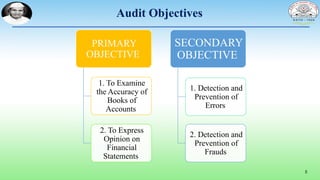
Audit Objectives
PRIMARY
OBJECTIVE
1. ToExamine
the Accuracy of
Books of
Accounts
2. To Express
Opinion on
Financial
Statements
SECONDARY
OBJECTIVE
1. Detection and
Prevention of
Errors
2. Detection and
Prevention of
Frauds
6.
6
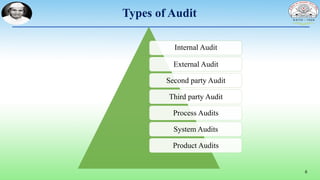
Types of Audit
InternalAudit
External Audit
Second party Audit
Third party Audit
Process Audits
System Audits
Product Audits
7.
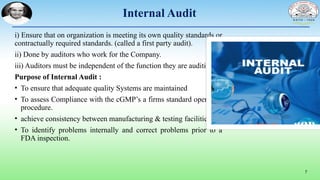
Internal Audit
i) Ensurethat on organization is meeting its own quality standards or
contractually required standards. (called a first party audit).
ii) Done by auditors who work for the Company.
iii) Auditors must be independent of the function they are auditing.
Purpose of Internal Audit :
• To ensure that adequate quality Systems are maintained
• To assess Compliance with the cGMP’s a firms standard operating
procedure.
• achieve consistency between manufacturing & testing facilities.
• To identify problems internally and correct problems prior to a
FDA inspection.
7
8.
8
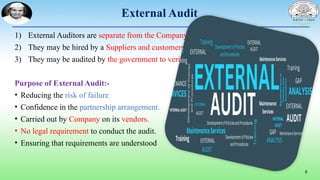
External Audit
1) ExternalAuditors are separate from the Company
2) They may be hired by a Suppliers and customers
3) They may be audited by the government to verify.
Purpose of External Audit:-
• Reducing the risk of failure
• Confidence in the partnership arrangement.
• Carried out by Company on its vendors.
• No legal requirement to conduct the audit.
• Ensuring that requirements are understood
9.
9
• Second PartyAudits:
External audits done by a Company that has a Contract with the audited
firm is known as second party Audit.
• Third party Audits:
External quality audits done by an organization that has no contract with
the Company it is auditing is called a third party Audit.
• Process Audits :-
A process audits verifies that a documented process meets quality
standards. This process could be a manufacturing process or service process.
10.
10
• Products Audits:-
A product quality audit verifies that a physical products meets design
Specification's and other quality measurements.
• System Audits:
It is a review of how quality standards are measured and met by the
Company. It verifies the procedures used to measure the quality of the
product, how detects are recorded, and how the compony ensures that
failed product is not passed.
11.
11
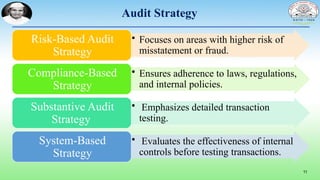
Audit Strategy
• Focuseson areas with higher risk of
misstatement or fraud.
Risk-Based Audit
Strategy
• Ensures adherence to laws, regulations,
and internal policies.
Compliance-Based
Strategy
• Emphasizes detailed transaction
testing.
Substantive Audit
Strategy
• Evaluates the effectiveness of internal
controls before testing transactions.
System-Based
Strategy
12.
12
TYPES OF AUDITSTRATEGY
1. Internal audit strategy
2. External audit strategy
• INTERNAL AUDIT STRATEGY:
Internal audits analyze a company's Internal control, including its corporate governance and accounting systems.
They support timely and accurate financial reporting and guarantee compliance to rules and laws.
• EXTERNAL AUDIT STRATEGY
The analysis of a public or private company's policies and processes is the main goal of external audits.
Private corporations are not required by law to conduct an annual external audit, although they frequently do so to boost their
reputation, identify irregularities, and guard against fraud.
While public firms that sell shares on the open market are required by law to do an annual external audit.
Types of External Audit:
1. Finance audit
2. Compliance audit
13.
13
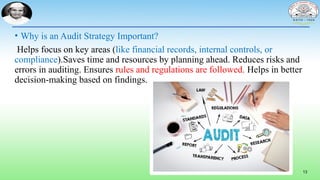
• Why isan Audit Strategy Important?
Helps focus on key areas (like financial records, internal controls, or
compliance).Saves time and resources by planning ahead. Reduces risks and
errors in auditing. Ensures rules and regulations are followed. Helps in better
decision-making based on findings.