Complaints and Evaluation of
complaints.
Payel Pramanick
Asst. Professor
Dept. of Quality Assurance
ABMRCP
Sub: QA 6th Sem. B.Pharm
 DEFINATION OF COMPLAINT:
 “Complaint is defined as statement that is something wrong or not good
enough, which shows customer dissatisfactionabout the companyand the
product”.
 Example: Complaint about packagingmaterials, Concerning about
the productetc.
 NEED FOR COMPLAINT HANDLING SYSTEM
 Itgives the company an opportunity to improve the quality of theproduct
 It is helpful to maintaincGMP
 It maintains committed relationship betweenthe customer andcompany
 It is the regulatoryobligation
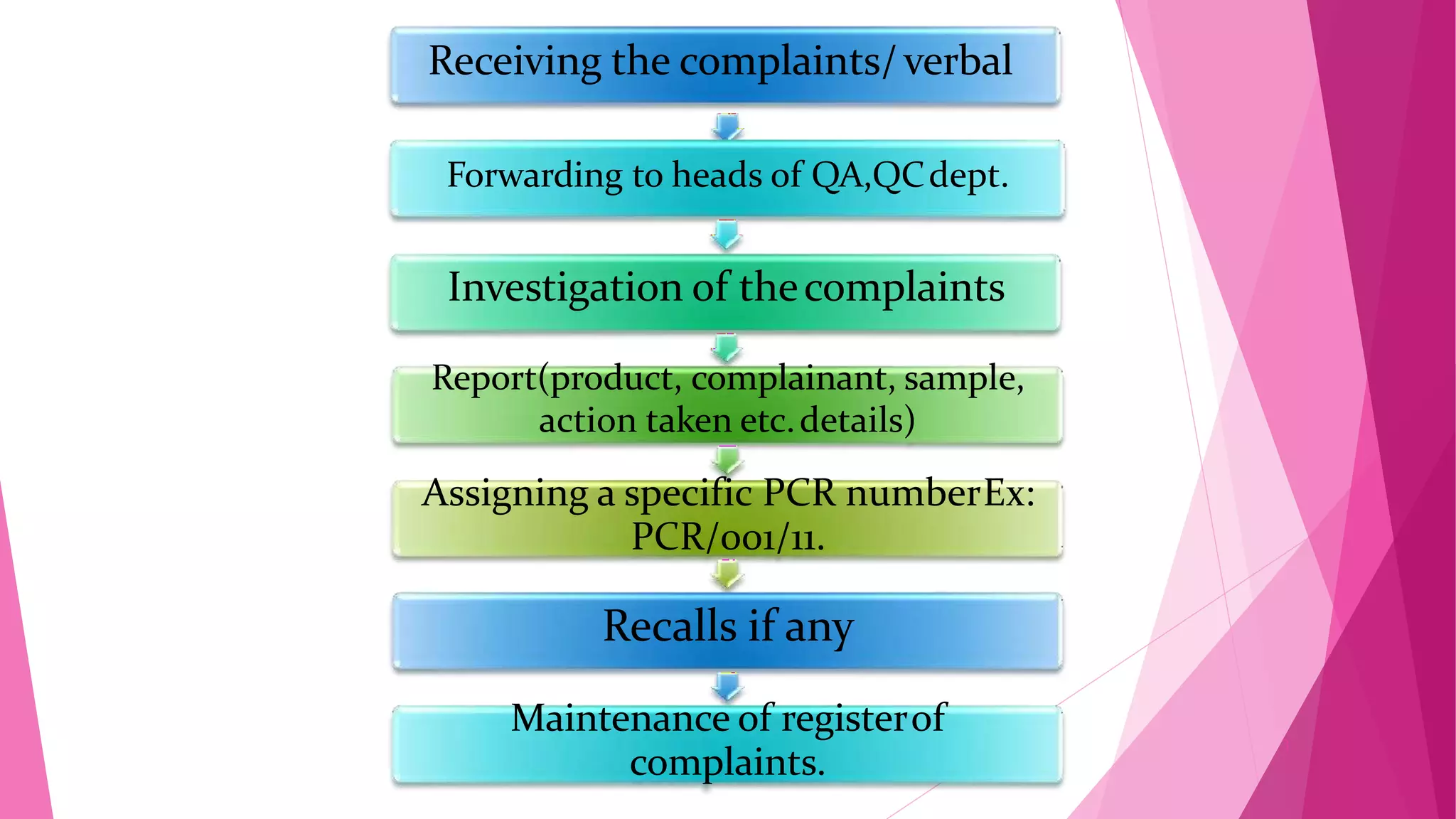
Receiving the complaints/verbal
3
Forwarding to heads of QA,QCdept.
Investigation of thecomplaints
Report(product, complainant, sample,
action taken etc.details)
Assigning a specific PCR numberEx:
PCR/001/11.
Recalls if any
Maintenance of registerof
complaints.
SOP on complaint handling
4
• OBJECTIVE: Tolay outthe procedure for investigation
and reporting the marketcomplaints.
• RESPONSIBILITY: The quality assurance manager along
with manager of the complaint related department.
• PROCEDURE:
• Complaints shall be classified in followingcategories to
facilitateinvestigation:
• Product quality complaints (nontherapeutic).
• Packaging complaints (shortages and packagingerror).
• Medical complaints (therapeuticproblems).
Time period for investigation after receipt of
complaints:
• Product quality complaints – within 5 days.
• Packaging and quality complaints – within 10 days.
• Medical complaint – within 3days.
• Complaint records shall be maintained at least one year
after expiration date ofmedicines.
• Complaint records shall be reviewed and a monthly
summary shall be prepared for themanagement.
5
PRODUCT NAME COMPLAINT CATEGORY
Batch no. Mfg.date expirydate Packaging/
medical.
product quality/
Name / address
complainant:
of the
Complaint reported through:
Complainant sample enclosed:
yes / no
Quality of sampleenclosed:
Investigation report
Total quantity involved
PCR received by
On:
Investigation doneby:
Action taken Conclusion:
Confirmed/notconfirmed
PCR no:
PCR approved by:
recommended corrective
actions
6
Product complaint data sheet Should contain
the following:
7
• Serial number assigned to thecomplaints.
• Exact nature of thecomplaints.
• Name of thecomplainants.
• Address of the complainants.
• Date of complaintreceived.
• If verbal, name of the person whoreceived the
complaint.
• Name of the product, strength and batchnumber of the
product.
• Reference to analytical recordnumber.
 Quantity involved in thecomplaint.
 Size of sample obtained from thecomplainant.
 Evaluation of complaint by QCdepartment.
 Materials and records used to performevaluation.
 Other possible effected materials, productsand results of their
investigation.
 Name and signature of the investigator(s)and date.
 Action taken by thecompany.
 Copy of reply sent tocomplainant.
8
Steps in handling of complaints:
9
• The proposed handling system is in compliance with
the GMP Guidelines of EU, USA and Brazil and is
presented in four steps:
• Receiving complaints.
• Technical investigation.
• Corrective actions/feedback to
Customers.
• Monthly reports/trend analysis.
The investigation form mustinclude:
• Information about thecomplainant:
• Name
• Address
• phone no.
• E mail
• Information about the drugproduct
• Product name
• Lot no
• MFG & Exp date
• Amount of the product with the problem.
• Detailed description of thecomplaint. 10
Technical investigation
11
• Upon receipt of the investigation form, the QAunit is
able to start theinvestigation.
It is divided into twophases:
• Documentation based investigation.
• Laboratory analysis.
Documentation based investigation:
• The primary documentation to be reviewed consists
of:
✓ Complaint files: This is constituted to check how many
other complaints of the same nature had occurred to a
specific lot and how they were handled.
✓ Batch records must be verified in order to see if there
were any non-conformance during the production.
Laboratory analysis phase
It consists of requesting the Quality Control(QC) laboratory to
analyze.
• Complaint samples.
• Control ( retained) samples.
• Complaint samples are the customer sample.
• Retained samples – the reserve samples representative of
the lot manufactured (which were kept under appropriate
conditions of temperature, humidity and light so that the
drug product was notaffected).
• The company elects a person in the QA unit to be in charge of
technical investigation of each complaint, e.g. a Complaint
Officer.
20
There are three possible conclusions, asfollows:
• Confirmed complaints.
• Non confirmed complaints.
• Counterfeit/ tamper suspicion.
CONFIRMED COMPLAINTS:
• When both complaint and control samples showed out-
of-specification (OOS) results or when only the
complaint sample showed OOS results, it is clearly a
single unexplained failing product
• Example:
a single unexplained failure may be when one tablet is
missing in the intact blister strip in the complaint sample, but
no deviation was found in the retained samples or during the
in-process controls and finalQC analysis recorded in the batch
record.
13
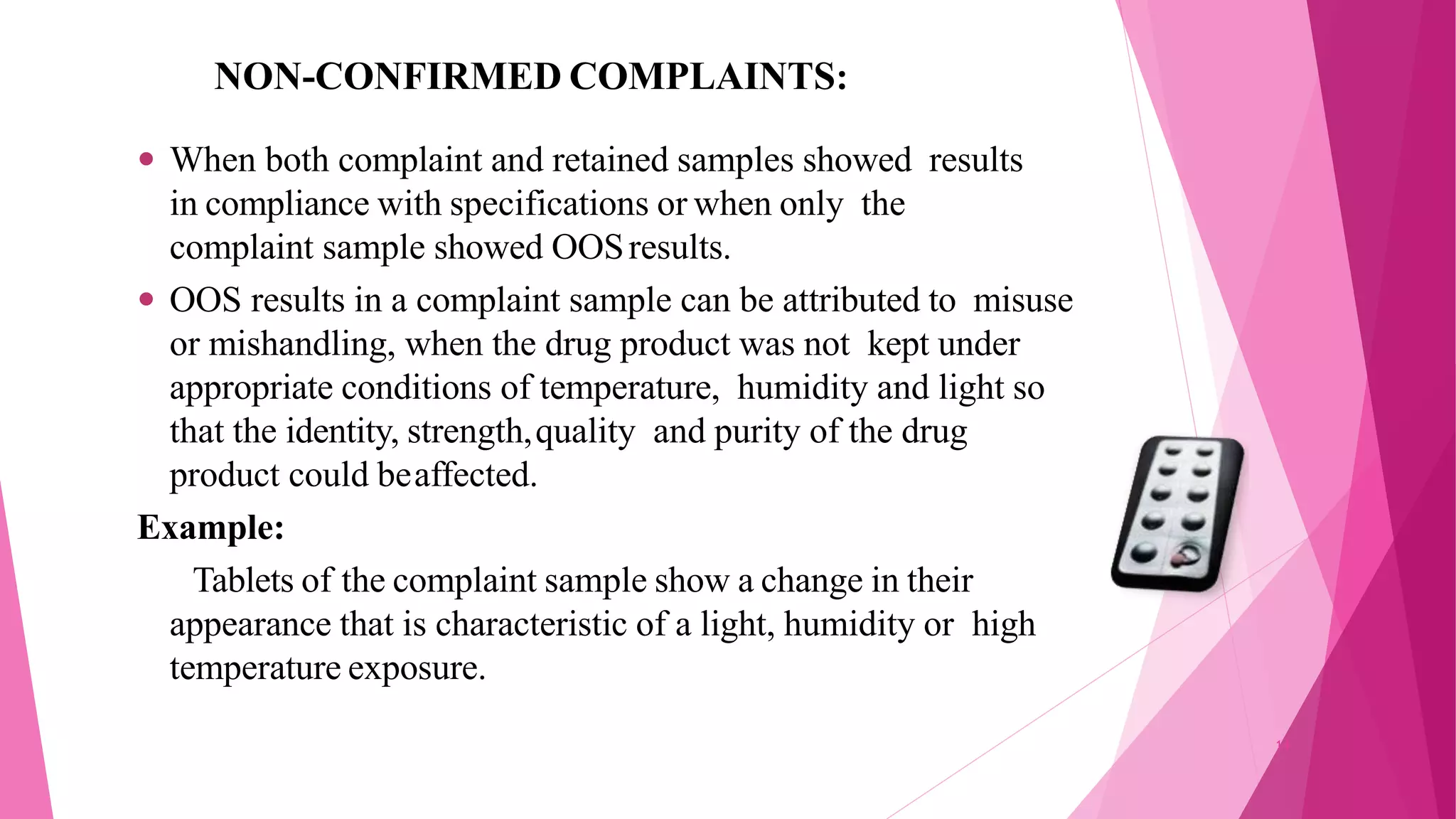
NON-CONFIRMED COMPLAINTS:
14
 When both complaint and retained samples showed results
in compliance with specifications or when only the
complaint sample showed OOSresults.
 OOS results in a complaint sample can be attributed to misuse
or mishandling, when the drug product was not kept under
appropriate conditions of temperature, humidity and light so
that the identity, strength,quality and purity of the drug
product could beaffected.
Example:
Tablets of the complaint sample show a change in their
appearance that is characteristic of a light, humidity or high
temperature exposure.
COUNTERFEIT / TAMPER SUSPICION:
• When the retained sample is within the specification but the
complaint sample is clearly OOS with no reason for that, such
as a counterfeit or tampered drug product.
• Example:
when packaging material is different from the original; an
example of tampering is when the color of the drug product is
completely different from the original or when any foreign
substance was added to theproduct.
• 15
✓The Complaint Officer must also check if the complaint
represents a serious and unexpected adverse drug
experience.
✓The Complaint Officer and the QA Manager must sign off
the investigation form once the investigation is
completed.
✓30 days is a reasonable time to conclude an
investigation.
✓Complaint files should be retained for at least 1 year
after the expiry date of the lot.
16
CORRECTIVE ACTIONS AND FEEDBACK
TO CUSTOMERS
17
• For all confirmed complaints, corrective actions must be
implemented. These actions can range from a simple and quick
training to some employees to a formal Corrective Action and
Preventive Action (CAPA) handling.
• The criteria for choosing appropriate action depends on the nature of
the complaint.
• If a CAPA is opened, a multidisciplinary team consisting of
representatives of QA, QC, Regulatory Affairs and Production
Management must beestablished.
• Concerning non-confirmed complaints originating from misuse or
inadequate handling of the drug product. The customer should receive
a written response together with scientific information on the correct
use and handling.
• As feedback to the customer, the company must write a
response letter to the complainant to explain the
investigation approach taken, the results obtained and
any implications, in case the quality problem was
confirmed.
• The customer should be sent a free replacement product
together with the response letter, since the customer
returned the product (the ‘complaint sample’) to the
company for analysis and a quality problem was found.
18
MONTHLY REPORTS AND TREND
ANALYSIS
19
• Monthly reports should be elaborated in order to evaluate the
amount and the nature of the complaints received and to
perform a trend analysis of these complaints.
The monthly reports must answer the following questions:
• How many complaints did the company receive in the
period?
• How many wereconfirmed?
• How many were non-confirmed or werecounterfeit/tamper
suspicion?
• Graphic methods of displaying data are important adjuncts to
data analysis andpresentation.
• The report must be readily available mainly during GMP
inspections.
Documentation final product complaint report
 Nature of thecomplaint--------------------------
 Date :
 Complaint:
 Originator of the complaint & title----------------------------
 Distribution contact person & title----------------------------
 Method of notification----------------------------
 Name :
20
P.O#
 Phone No.
 Date shipped-------------Invoice#-------
 Product name:-----------------
Control no:----------
• Total quantityshipped
• Reason for complaint returnrequest--------------------------
• Complaint: Product :
• Evaluation of complaints:
• 1.Physical characteristics-------------------------
2.Sign of deterioration
3.Other observation
• Quality control Findings:
• Returned sample
2.Returned sample reassay---------------
• 3. initial data
21
 Quality control comments & suggestions-------------------
--------------------------------------------------------------------
--------------------------------------------------------------------
-------------------------------------------------------------
• Quality control Date
• Complaint:
• Product :
• Packaging/Labeling/Inserts
Evaluation----------------------------------------------------------------
----------------------------------------------------------------
• Remarks
22
Resultant actiontaken:
1.Method,Date of customer notification& authorized
action
2.Comments
3.Completion date for action taken
4.Quality assuranceevaluation
23
Customer complaint record book
24
Repor
t no.
Date
receive
d
Produ
ct
name
Receiv
ed by
Produ
ct lot
no.
Date
investi
gation
started
Date
investi
gation
ended
Complaints

Complaints

  • 1.
    Complaints and Evaluationof complaints. Payel Pramanick Asst. Professor Dept. of Quality Assurance ABMRCP Sub: QA 6th Sem. B.Pharm
  • 2.
     DEFINATION OFCOMPLAINT:  “Complaint is defined as statement that is something wrong or not good enough, which shows customer dissatisfactionabout the companyand the product”.  Example: Complaint about packagingmaterials, Concerning about the productetc.  NEED FOR COMPLAINT HANDLING SYSTEM  Itgives the company an opportunity to improve the quality of theproduct  It is helpful to maintaincGMP  It maintains committed relationship betweenthe customer andcompany  It is the regulatoryobligation
  • 3.
    Receiving the complaints/verbal 3 Forwardingto heads of QA,QCdept. Investigation of thecomplaints Report(product, complainant, sample, action taken etc.details) Assigning a specific PCR numberEx: PCR/001/11. Recalls if any Maintenance of registerof complaints.
  • 4.
    SOP on complainthandling 4 • OBJECTIVE: Tolay outthe procedure for investigation and reporting the marketcomplaints. • RESPONSIBILITY: The quality assurance manager along with manager of the complaint related department. • PROCEDURE: • Complaints shall be classified in followingcategories to facilitateinvestigation: • Product quality complaints (nontherapeutic). • Packaging complaints (shortages and packagingerror). • Medical complaints (therapeuticproblems).
  • 5.
    Time period forinvestigation after receipt of complaints: • Product quality complaints – within 5 days. • Packaging and quality complaints – within 10 days. • Medical complaint – within 3days. • Complaint records shall be maintained at least one year after expiration date ofmedicines. • Complaint records shall be reviewed and a monthly summary shall be prepared for themanagement. 5
  • 6.
    PRODUCT NAME COMPLAINTCATEGORY Batch no. Mfg.date expirydate Packaging/ medical. product quality/ Name / address complainant: of the Complaint reported through: Complainant sample enclosed: yes / no Quality of sampleenclosed: Investigation report Total quantity involved PCR received by On: Investigation doneby: Action taken Conclusion: Confirmed/notconfirmed PCR no: PCR approved by: recommended corrective actions 6
  • 7.
    Product complaint datasheet Should contain the following: 7 • Serial number assigned to thecomplaints. • Exact nature of thecomplaints. • Name of thecomplainants. • Address of the complainants. • Date of complaintreceived. • If verbal, name of the person whoreceived the complaint. • Name of the product, strength and batchnumber of the product. • Reference to analytical recordnumber.
  • 8.
     Quantity involvedin thecomplaint.  Size of sample obtained from thecomplainant.  Evaluation of complaint by QCdepartment.  Materials and records used to performevaluation.  Other possible effected materials, productsand results of their investigation.  Name and signature of the investigator(s)and date.  Action taken by thecompany.  Copy of reply sent tocomplainant. 8
  • 9.
    Steps in handlingof complaints: 9 • The proposed handling system is in compliance with the GMP Guidelines of EU, USA and Brazil and is presented in four steps: • Receiving complaints. • Technical investigation. • Corrective actions/feedback to Customers. • Monthly reports/trend analysis.
  • 10.
    The investigation formmustinclude: • Information about thecomplainant: • Name • Address • phone no. • E mail • Information about the drugproduct • Product name • Lot no • MFG & Exp date • Amount of the product with the problem. • Detailed description of thecomplaint. 10
  • 11.
    Technical investigation 11 • Uponreceipt of the investigation form, the QAunit is able to start theinvestigation. It is divided into twophases: • Documentation based investigation. • Laboratory analysis. Documentation based investigation: • The primary documentation to be reviewed consists of: ✓ Complaint files: This is constituted to check how many other complaints of the same nature had occurred to a specific lot and how they were handled. ✓ Batch records must be verified in order to see if there were any non-conformance during the production.
  • 12.
    Laboratory analysis phase Itconsists of requesting the Quality Control(QC) laboratory to analyze. • Complaint samples. • Control ( retained) samples. • Complaint samples are the customer sample. • Retained samples – the reserve samples representative of the lot manufactured (which were kept under appropriate conditions of temperature, humidity and light so that the drug product was notaffected). • The company elects a person in the QA unit to be in charge of technical investigation of each complaint, e.g. a Complaint Officer. 20
  • 13.
    There are threepossible conclusions, asfollows: • Confirmed complaints. • Non confirmed complaints. • Counterfeit/ tamper suspicion. CONFIRMED COMPLAINTS: • When both complaint and control samples showed out- of-specification (OOS) results or when only the complaint sample showed OOS results, it is clearly a single unexplained failing product • Example: a single unexplained failure may be when one tablet is missing in the intact blister strip in the complaint sample, but no deviation was found in the retained samples or during the in-process controls and finalQC analysis recorded in the batch record. 13
  • 14.
    NON-CONFIRMED COMPLAINTS: 14  Whenboth complaint and retained samples showed results in compliance with specifications or when only the complaint sample showed OOSresults.  OOS results in a complaint sample can be attributed to misuse or mishandling, when the drug product was not kept under appropriate conditions of temperature, humidity and light so that the identity, strength,quality and purity of the drug product could beaffected. Example: Tablets of the complaint sample show a change in their appearance that is characteristic of a light, humidity or high temperature exposure.
  • 15.
    COUNTERFEIT / TAMPERSUSPICION: • When the retained sample is within the specification but the complaint sample is clearly OOS with no reason for that, such as a counterfeit or tampered drug product. • Example: when packaging material is different from the original; an example of tampering is when the color of the drug product is completely different from the original or when any foreign substance was added to theproduct. • 15
  • 16.
    ✓The Complaint Officermust also check if the complaint represents a serious and unexpected adverse drug experience. ✓The Complaint Officer and the QA Manager must sign off the investigation form once the investigation is completed. ✓30 days is a reasonable time to conclude an investigation. ✓Complaint files should be retained for at least 1 year after the expiry date of the lot. 16
  • 17.
    CORRECTIVE ACTIONS ANDFEEDBACK TO CUSTOMERS 17 • For all confirmed complaints, corrective actions must be implemented. These actions can range from a simple and quick training to some employees to a formal Corrective Action and Preventive Action (CAPA) handling. • The criteria for choosing appropriate action depends on the nature of the complaint. • If a CAPA is opened, a multidisciplinary team consisting of representatives of QA, QC, Regulatory Affairs and Production Management must beestablished. • Concerning non-confirmed complaints originating from misuse or inadequate handling of the drug product. The customer should receive a written response together with scientific information on the correct use and handling.
  • 18.
    • As feedbackto the customer, the company must write a response letter to the complainant to explain the investigation approach taken, the results obtained and any implications, in case the quality problem was confirmed. • The customer should be sent a free replacement product together with the response letter, since the customer returned the product (the ‘complaint sample’) to the company for analysis and a quality problem was found. 18
  • 19.
    MONTHLY REPORTS ANDTREND ANALYSIS 19 • Monthly reports should be elaborated in order to evaluate the amount and the nature of the complaints received and to perform a trend analysis of these complaints. The monthly reports must answer the following questions: • How many complaints did the company receive in the period? • How many wereconfirmed? • How many were non-confirmed or werecounterfeit/tamper suspicion? • Graphic methods of displaying data are important adjuncts to data analysis andpresentation. • The report must be readily available mainly during GMP inspections.
  • 20.
    Documentation final productcomplaint report  Nature of thecomplaint--------------------------  Date :  Complaint:  Originator of the complaint & title----------------------------  Distribution contact person & title----------------------------  Method of notification----------------------------  Name : 20 P.O#  Phone No.  Date shipped-------------Invoice#-------  Product name:----------------- Control no:----------
  • 21.
    • Total quantityshipped •Reason for complaint returnrequest-------------------------- • Complaint: Product : • Evaluation of complaints: • 1.Physical characteristics------------------------- 2.Sign of deterioration 3.Other observation • Quality control Findings: • Returned sample 2.Returned sample reassay--------------- • 3. initial data 21
  • 22.
     Quality controlcomments & suggestions------------------- -------------------------------------------------------------------- -------------------------------------------------------------------- ------------------------------------------------------------- • Quality control Date • Complaint: • Product : • Packaging/Labeling/Inserts Evaluation---------------------------------------------------------------- ---------------------------------------------------------------- • Remarks 22
  • 23.
    Resultant actiontaken: 1.Method,Date ofcustomer notification& authorized action 2.Comments 3.Completion date for action taken 4.Quality assuranceevaluation 23
  • 24.
    Customer complaint recordbook 24 Repor t no. Date receive d Produ ct name Receiv ed by Produ ct lot no. Date investi gation started Date investi gation ended