QUALITATIVE ERRORS IN HPLC
 Poor separation power.
 Some special substances from the samples can
  be adsorbed strongly in and on the stationary
 QUALITATIVE ERROR SOURCES IN HPLC:
  phase.
 Selectivity changes of the stationary phase can
  also result from highly sorptive impurities in the
  mobile phase.
 Many mobile phases are oxygen / light sensitive
  which let grow the concentration of unwanted
  mobile phase impurities.
CONT…


   The column temperature

   Strong believe in the identification power
    of spectrographical HPLC detectors

   The total numbers of chemical substances
    qualified for a chromatographic analysis is
    very much larger in HPLC.
MINIMUM OF REASONS WHICH
SHOULD ANIMATE USING ERROR
CONTROL TECHNIQUES IN
QUALITATIVE HPLC

   Check the separation power of the
    chromatographic equipment.
   Use of two columns either parallel or in series
    under conditions of a physical and chemical
    selectivity optimization
   Planar chromatography in connection with HPLC
ABT - CONCEPT


   The ABT concept uses retention time and
    peak width values of homologues separated
    isocratically.

   A=a= constant value as column/capillary
    quality number.
    B = b0=peak width value
    T=tm=dead time/residence time
CONDITION FOR ABT CONCEPT
 At least four homologues are used.
 The time and peak width data must be taken
  very precise and the isocratic conditions
  must remain constant during the complete
  run time. As no peak overloading is
  acceptable - which falsifies peak width and
  retention time data.
 The homologue sample is diluted in a solvent
  eluting later than the homologues.
 From this run the retention time and peak
  width data allow to calculate most accurate
  and helpful control values. They describe the
  quality of a column/capillary and the overall
  qualification of the complete analytical
  system.
 The series of runs start at a quite high
  separation speed, which then is lowered
  stepwise to a quite low speed. This produces
  very fast and finally quite slow
  chromatograms.
 Analyzing all control data over the speed axis
  we find the best possible separation capacity
  at the most economical chromatogram
  speed.
   The best possible stationary and mobile phases at
    a well selected separation temperature are taken.
   In HPLC this may be a selection of four
    consecutive members for homologues from the
    series of methyl- to C18 esters of di nitro benzoic
    acids .
   ABT data are in easy reach using proper
    software, but they can also be found by
    pencil, liner and paper.
   In HPLC the homologue numbers have
    independent of the taken ester homologues the
    index or homologue numbers 100, 200, 300 and
    400.
ABT CALCULATES THE FOLLOWING
BASIC VALUES
     The dead time (tm) or the residence time
   Knowing the tm value all non adjusted retention
    time values “tms” can be changed into the
    adjusted net retention time values “ts”.
   “ts” is the individual residence time in the
    stationary phase.
   Knowing “ts” values we can calculate in isocratic
    HPLC the important value “k”.
   “k = ts / tm” or k = (tms - tm) / tm.
CONT…

   Using k as chromatography unit we can build a
    chromatography scale in k - units.
   The chromatographic process - but not yet the
    separation - starts at k = -1.
   Any substance or mixture which is insoluble or not
    sorbing on and in in the stationary phase leaves
    the instrument at k = 0, also known as “blind time
    area”.
   virtual k-value k = unlimited, for substances which
    are irreversibly adsorb or chemisorb in or on the
    stationary phase or any solid wall within the
    instrument.
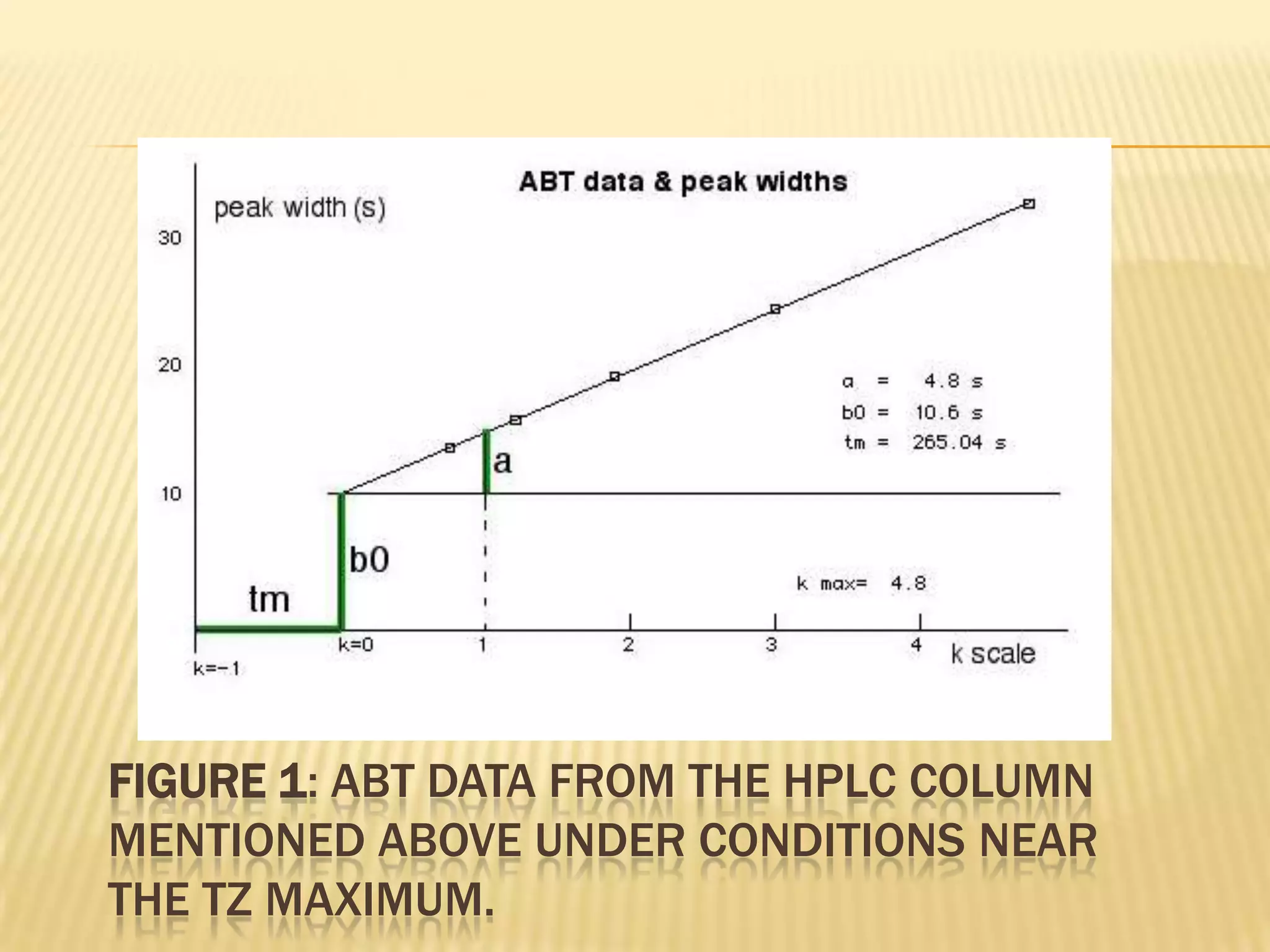
    The peak width value “b0”
    b0 is found by a simple mathematical procedure in
     extrapolating a linear increase of peak width data
     over tm-time units.
    bo is depend on sampling process, all mechanical
     connection parts and their dead volumes, with the
     mobile phase volume, with the volume of connection
     tubes and the phase flow speed.
    b0 is acting completely against separation.
    peak width value adds to all correct peak width
     values of all substances in isocratic HPLC.
   Because of the strictly linear growth ABT calculates
    the function peak width = a * k + b0.
   All three ABT data: “a”, “b0”, “tm” in seconds
    change drastically with the mobile phase flow
    speed “U”.
    U= tm / L (sec/mm)
    L= length of the column/capillary (mm).

   To avoid any trouble caused by not eluted
    substances with too long retention times every
    HPLC instrument must have “backflush”
    installations.
PRACTICAL APPLICATION
OF “A”, “B0”, “TM”:
   Any not adjusted retention time value tms can be
    transferred into k-values.
   The peak width b05 of any peak with known tms
    value can be pre calculated:
    b05 (at tms) = b0 + a * (tms - tm) / tm = b0 + a * k.

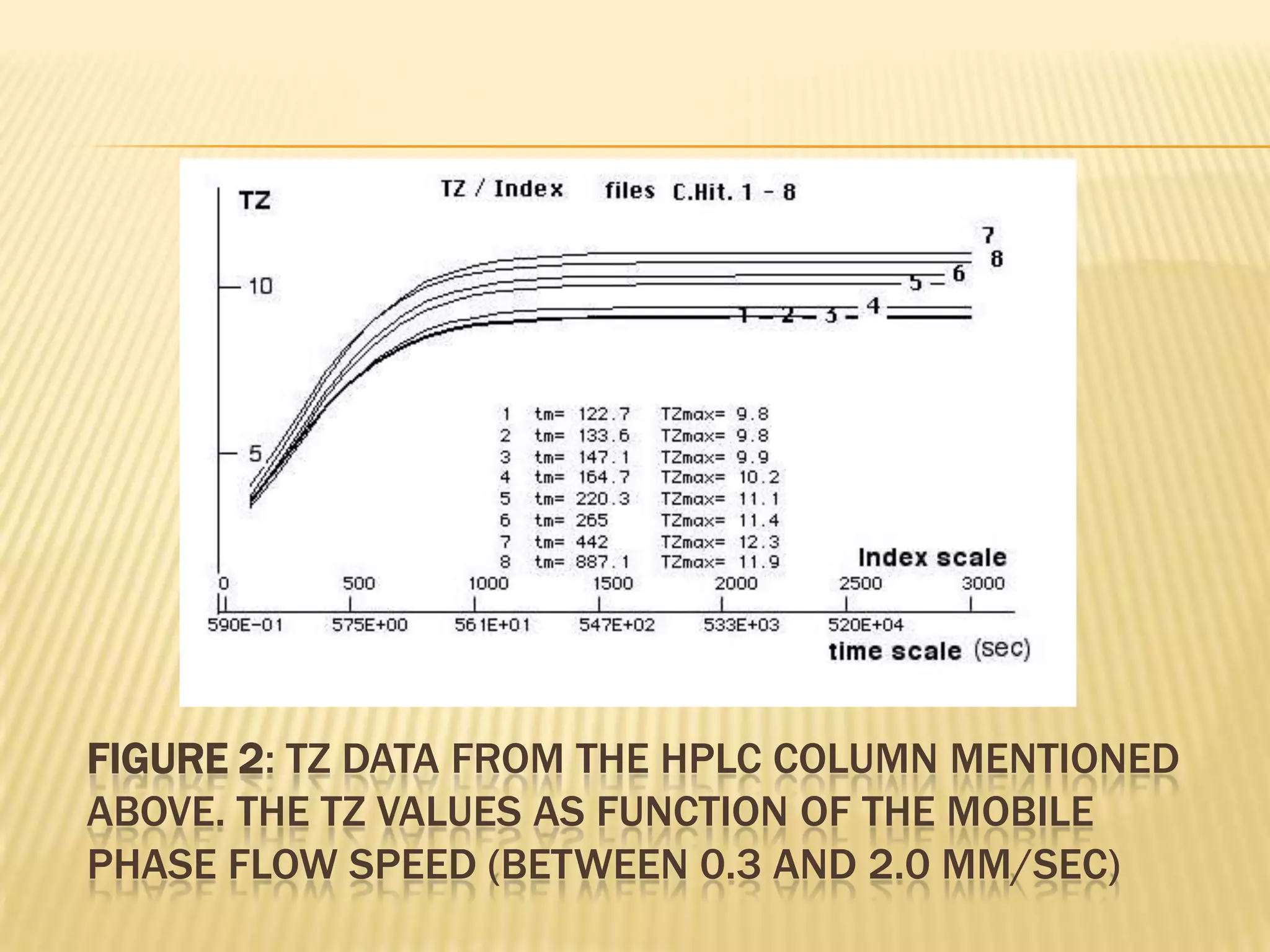
   The Trennzahl for any time region can be pre
    calculated, see figure 2:
    TZ = [tms homol.(N) - tms homol.(N-1)] / [b05
    homol.(N) + b05 homol.(N-1)] + 1

   The peak capacity “PC”
   The ABT theory works with the theoretical
    plate height “h” or “HETP” respective the
    theoretical plate number n to describe the
    separation capacity of a column packing or
    the separation power or packing quality of the
    column as such.

   n = 5.545 * (tms / b05)2 = 5.545 * ((ts + tm) /
    (b0 + a*(ts / tm))2

   HETP = L / n [mm]
THE FORMULA FOR N AND HETP ABOVE
HAS THE FOLLOWING PROBLEM


 The factor “5.545” is correct only for
  symmetrical GAUSS shaped peaks. Those
  do not exist in practice.
 n and HETP are substance dependent.

 Separation exists only if there is more than
  one substance in a sample.
HPLC ABT- AND TZ-VALUES


 Isocratic runs with
 a 250 mm long HPLC column of 3 mm inner
  diameter,
 stationary phase Eurosphere 100 / C18,
 mobile phase methanol / water 85 /15 v/v,
 room temperature,
 inlet pressure ranges at 8 levels from 255 bar
  (fastest flow speed) to 39 bar (longest
  analysis time).
FIGURE 1: ABT DATA FROM THE HPLC COLUMN
MENTIONED ABOVE UNDER CONDITIONS NEAR
THE TZ MAXIMUM.
FIGURE 2: TZ DATA FROM THE HPLC COLUMN MENTIONED
ABOVE. THE TZ VALUES AS FUNCTION OF THE MOBILE
PHASE FLOW SPEED (BETWEEN 0.3 AND 2.0 MM/SEC)
Qualitative errors in hplc (1)

Qualitative errors in hplc (1)

  • 1.
  • 2.
     Poor separationpower.  Some special substances from the samples can be adsorbed strongly in and on the stationary QUALITATIVE ERROR SOURCES IN HPLC: phase.  Selectivity changes of the stationary phase can also result from highly sorptive impurities in the mobile phase.  Many mobile phases are oxygen / light sensitive which let grow the concentration of unwanted mobile phase impurities.
  • 3.
    CONT…  The column temperature  Strong believe in the identification power of spectrographical HPLC detectors  The total numbers of chemical substances qualified for a chromatographic analysis is very much larger in HPLC.
  • 4.
    MINIMUM OF REASONSWHICH SHOULD ANIMATE USING ERROR CONTROL TECHNIQUES IN QUALITATIVE HPLC  Check the separation power of the chromatographic equipment.  Use of two columns either parallel or in series under conditions of a physical and chemical selectivity optimization  Planar chromatography in connection with HPLC
  • 5.
    ABT - CONCEPT  The ABT concept uses retention time and peak width values of homologues separated isocratically.  A=a= constant value as column/capillary quality number. B = b0=peak width value T=tm=dead time/residence time
  • 6.
    CONDITION FOR ABTCONCEPT  At least four homologues are used.  The time and peak width data must be taken very precise and the isocratic conditions must remain constant during the complete run time. As no peak overloading is acceptable - which falsifies peak width and retention time data.  The homologue sample is diluted in a solvent eluting later than the homologues.
  • 7.
     From thisrun the retention time and peak width data allow to calculate most accurate and helpful control values. They describe the quality of a column/capillary and the overall qualification of the complete analytical system.  The series of runs start at a quite high separation speed, which then is lowered stepwise to a quite low speed. This produces very fast and finally quite slow chromatograms.  Analyzing all control data over the speed axis we find the best possible separation capacity at the most economical chromatogram speed.
  • 8.
    The best possible stationary and mobile phases at a well selected separation temperature are taken.  In HPLC this may be a selection of four consecutive members for homologues from the series of methyl- to C18 esters of di nitro benzoic acids .  ABT data are in easy reach using proper software, but they can also be found by pencil, liner and paper.  In HPLC the homologue numbers have independent of the taken ester homologues the index or homologue numbers 100, 200, 300 and 400.
  • 9.
    ABT CALCULATES THEFOLLOWING BASIC VALUES  The dead time (tm) or the residence time  Knowing the tm value all non adjusted retention time values “tms” can be changed into the adjusted net retention time values “ts”.  “ts” is the individual residence time in the stationary phase.  Knowing “ts” values we can calculate in isocratic HPLC the important value “k”.  “k = ts / tm” or k = (tms - tm) / tm.
  • 10.
    CONT…  Using k as chromatography unit we can build a chromatography scale in k - units.  The chromatographic process - but not yet the separation - starts at k = -1.  Any substance or mixture which is insoluble or not sorbing on and in in the stationary phase leaves the instrument at k = 0, also known as “blind time area”.  virtual k-value k = unlimited, for substances which are irreversibly adsorb or chemisorb in or on the stationary phase or any solid wall within the instrument.
  • 11.
    The peak width value “b0”  b0 is found by a simple mathematical procedure in extrapolating a linear increase of peak width data over tm-time units.  bo is depend on sampling process, all mechanical connection parts and their dead volumes, with the mobile phase volume, with the volume of connection tubes and the phase flow speed.  b0 is acting completely against separation.  peak width value adds to all correct peak width values of all substances in isocratic HPLC.  Because of the strictly linear growth ABT calculates the function peak width = a * k + b0.
  • 12.
    All three ABT data: “a”, “b0”, “tm” in seconds change drastically with the mobile phase flow speed “U”. U= tm / L (sec/mm) L= length of the column/capillary (mm).  To avoid any trouble caused by not eluted substances with too long retention times every HPLC instrument must have “backflush” installations.
  • 13.
    PRACTICAL APPLICATION OF “A”,“B0”, “TM”:  Any not adjusted retention time value tms can be transferred into k-values.  The peak width b05 of any peak with known tms value can be pre calculated: b05 (at tms) = b0 + a * (tms - tm) / tm = b0 + a * k.  The Trennzahl for any time region can be pre calculated, see figure 2: TZ = [tms homol.(N) - tms homol.(N-1)] / [b05 homol.(N) + b05 homol.(N-1)] + 1  The peak capacity “PC”
  • 14.
    The ABT theory works with the theoretical plate height “h” or “HETP” respective the theoretical plate number n to describe the separation capacity of a column packing or the separation power or packing quality of the column as such.  n = 5.545 * (tms / b05)2 = 5.545 * ((ts + tm) / (b0 + a*(ts / tm))2  HETP = L / n [mm]
  • 15.
    THE FORMULA FORN AND HETP ABOVE HAS THE FOLLOWING PROBLEM  The factor “5.545” is correct only for symmetrical GAUSS shaped peaks. Those do not exist in practice.  n and HETP are substance dependent.  Separation exists only if there is more than one substance in a sample.
  • 16.
    HPLC ABT- ANDTZ-VALUES  Isocratic runs with  a 250 mm long HPLC column of 3 mm inner diameter,  stationary phase Eurosphere 100 / C18,  mobile phase methanol / water 85 /15 v/v,  room temperature,  inlet pressure ranges at 8 levels from 255 bar (fastest flow speed) to 39 bar (longest analysis time).
  • 17.
    FIGURE 1: ABTDATA FROM THE HPLC COLUMN MENTIONED ABOVE UNDER CONDITIONS NEAR THE TZ MAXIMUM.
  • 18.
    FIGURE 2: TZDATA FROM THE HPLC COLUMN MENTIONED ABOVE. THE TZ VALUES AS FUNCTION OF THE MOBILE PHASE FLOW SPEED (BETWEEN 0.3 AND 2.0 MM/SEC)