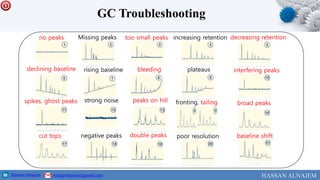
GC Troubleshooting
no peaks Missing peaks too small peaks increasing retention decreasing retention
declining baseline interfering peaksrising baseline bleeding plateaus
spikes, ghost peaks broad peaksstrong noise peaks on hill fronting, tailing
cut tops baseline shiftnegative peaks double peaks poor resolution
HASSAN ALNAJEMHassan-Alnajem Alnajemhassan@gmail.com
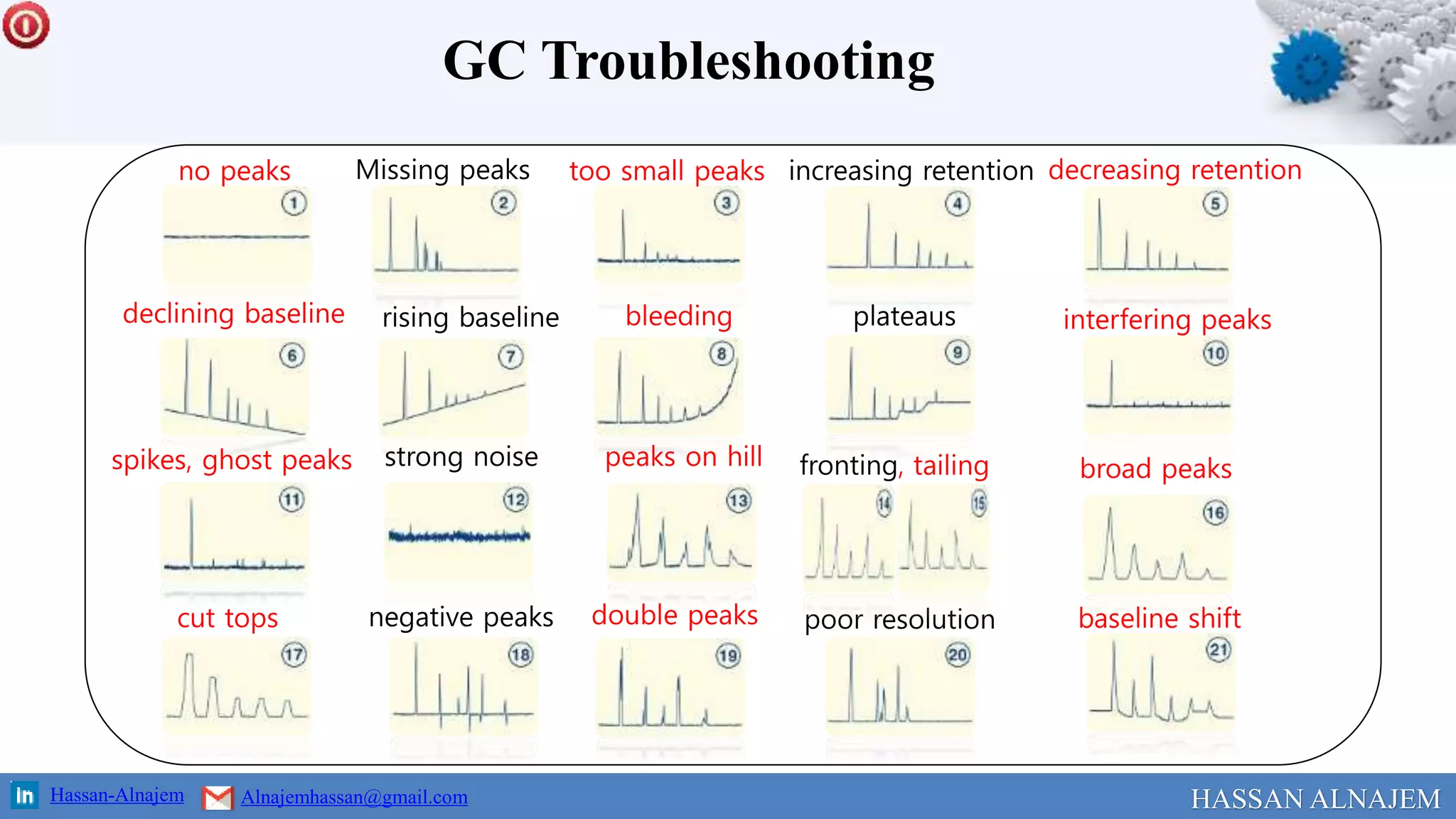
Possible causes Suggested remedy
1. error in the detector power supply / electronics. 1. check detector/electronic power supply and cables.
2. no FID flame. 2. check FID; reignite it.
3. syringe defective / clogged. 3. use a different syringe or clean it.
4. temperature too low for the analytes, oven heating faulty. 4. check temperature program, oven temperature.
5. detector / software / computer hardware failure. 5. check integrator, cables; restart computer.
6. no gas flow. 6. check gas tubes, valves, seals; test gas flow; shorten front of
GC column, change injection septum.
7. column connection leaks. 7. use new ferrules.
8. broken GC column. 8. if breakage is at the beginning or at the end, remove the sh
ort piece; breakage in the middle can be mended with a glass c
onnector; for multiple breakages: replace column.
Hassan-Alnajem
No peaks
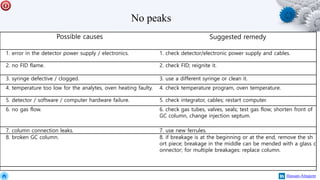
Possible causes Suggested remedy
1. syringe defective / clogged. 1. use a different syringe or clean it.
2. sample too diluted. 2. increase injection volume; concentrate sample.
3. sample concentration too high. 3. decrease injection volume; dilute sample.
4. column connection leaks, column not properly installed 4. check column installation; search for leaks; replace ferrules.
5. perforated injection septum. 5. replace septum.
6. injector temperature too low. 6. check temperature program; increase injector temperature.
7. sample decomposes in the injector. 7. check temperature program; reduce injector temperature; repla
ce liner; check capillary ends.
8. column oven too hot. 8. check temperature program, oven temperature (external therm
ometer); decrease temperature.
9. incorrect flow rate. 9. measure flow, control and adjust it if necessary.
10. column absorbs or decomposes analytes. 10. check capillary ends; check intact deactivation using the test
mixture; for poor results shorten both column ends by about 10 c
m; or replace column; if column test does not show any defects: a
) use a column with thicker film
b) use phase with better deactivation
c) use column with special selectivity
Hassan-Alnajem
Missing peaks
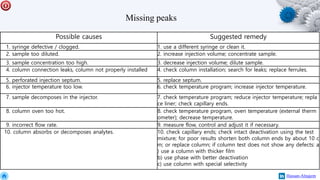
Possible causes Suggested remedy
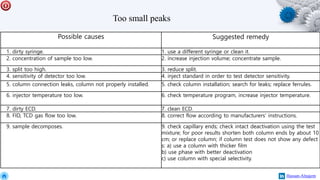
1. dirty syringe. 1. use a different syringe or clean it.
2. concentration of sample too low. 2. increase injection volume; concentrate sample.
3. split too high. 3. reduce split.
4. sensitivity of detector too low. 4. inject standard in order to test detector sensitivity.
5. column connection leaks, column not properly installed. 5. check column installation; search for leaks; replace ferrules.
6. injector temperature too low. 6. check temperature program, increase injector temperature.
7. dirty ECD. 7. clean ECD.
8. FID, TCD gas flow too low. 8. correct flow according to manufacturers’ instructions.
9. sample decomposes. 9. check capillary ends; check intact deactivation using the test
mixture; for poor results shorten both column ends by about 10
cm; or replace column; if column test does not show any defect
s: a) use a column with thicker film
b) use phase with better deactivation
c) use column with special selectivity.
Hassan-Alnajem
Too small peaks
Possible causes Suggested remedy
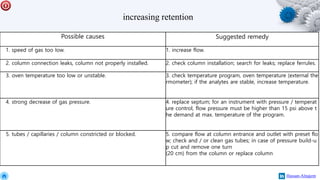
1. speed of gas too low. 1. increase flow.
2. column connection leaks, column not properly installed. 2. check column installation; search for leaks; replace ferrules.
3. oven temperature too low or unstable. 3. check temperature program, oven temperature (external the
rmometer); if the analytes are stable, increase temperature.
4. strong decrease of gas pressure. 4. replace septum; for an instrument with pressure / temperat
ure control, flow pressure must be higher than 15 psi above t
he demand at max. temperature of the program.
5. tubes / capillaries / column constricted or blocked. 5. compare flow at column entrance and outlet with preset flo
w; check and / or clean gas tubes; in case of pressure build-u
p cut and remove one turn
(20 cm) from the column or replace column
Hassan-Alnajem
increasing retention
Possible causes Suggested remedy
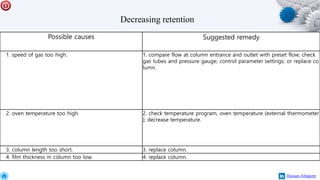
1. speed of gas too high. 1. compare flow at column entrance and outlet with preset flow; check
gas tubes and pressure gauge; control parameter settings; or replace co
lumn.
2. oven temperature too high. 2. check temperature program, oven temperature (external thermometer
); decrease temperature.
3. column length too short. 3. replace column.
4. film thickness in column too low. 4. replace column.
Hassan-Alnajem
Decreasing retention
Possible causes Suggested remedy
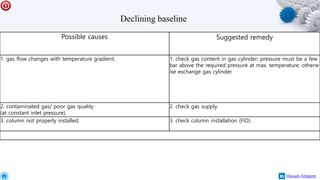
1. gas flow changes with temperature gradient. 1. check gas content in gas cylinder; pressure must be a few
bar above the required pressure at max. temperature; otherw
ise exchange gas cylinder.
2. contaminated gas/ poor gas quality
(at constant inlet pressure).
2. check gas supply.
3. column not properly installed. 3. check column installation (FID).
Hassan-Alnajem
Declining baseline
Possible causes Suggested remedy
1. leak at column entrance or injection septum. 1. check column installation; search for leaks; replace ferrules.
2. injector contaminated. 2. make a run at lower injector temperature; if the baseline improves, replace
liner, use low bleed or high temperature septa.
3. column contaminated. 3. cut two turns from column entrance; rinse column with solvent (only chem
ically bonded phases); otherwise replace column or use guard column.
4. detector contaminated. 4. clean detector.
5. increase of temperature too fast. 5. decrease temperature gradient and end temperature.
6. poor gas quality. 6. use gas grades recommended for GC; for longer supply lines from gas sou
rce to GC use gas purification cartridges directly connected to the GC.
Hassan-Alnajem
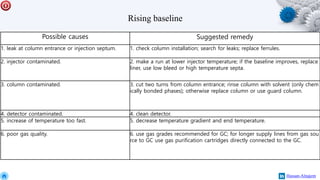
Rising baseline
Possible causes Suggested remedy
1. decomposition of the stationary phase. 1. check for leaks; matrix check for compatibility with the colu
mn.
2. column contaminated. 2. cut two turns from column entrance; rinse column with solv
ent (only chemically bonded phases); otherwise replace colum
n or use guard column.
3. increase of temperature too fast / end temperature too high. 3. decrease temperature gradient and end temperature.
4. column not properly conditioned. 4. condition column according to manufacturers’ instructions (
while column is not connected to the detector).
5. detector contaminated. 5. clean detector according to manufacturers’ instructions.
6. poor gas quality. 6. use gas grades recommended for GC; for longer supply line
s from gas source to GC use gas purification cartridges directly
connected to the GC.
Hassan-Alnajem
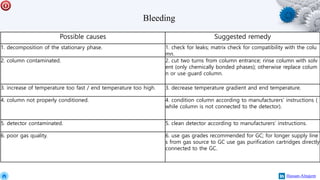
Bleeding
Possible causes Suggested remedy
1. steps in temperature program too drastic. 1. avoid very short and strong heating periods.
Hassan-Alnajem
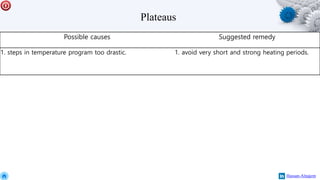
Plateaus
Possible causes Suggested remedy
1. poor gas quality. 1. use gas grades recommended for GC; for longer supply lines f
rom gas source to GC use gas purification cartridges directly con
nected to the GC.
2. FID: dust or contaminants in the detector. 2. clean detector; if particles are visible in the column or column
ends are not cut precisely (frayed edges), cut two turns from the
column entrance.
3. electronic defect, damaged cable or detector. 3. replace cable, contact your GC manufacturer.
4. bleeding of silicon septa. 4. replace injection septum, use low bleed or high temperature s
epta
Hassan-Alnajem
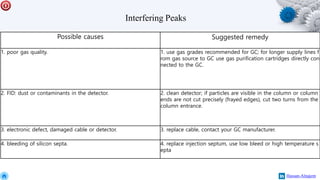
Interfering Peaks
Possible causes Suggested remedy
1. contamination from vials / septa or sample preparation. 1. control SPE and / or autosampler vials; use low bleed or high temp
erature septa.
2. derivatization not quantitative. 2. check derivatization protocol; use more reactive derivatization reag
ents.
3. dirty syringe. 3. use a different syringe or clean it.
4. sample decomposes. 4. check temperature program, oven temperature (external thermomet
er); if analytes are not temperature-stable, reduce injector temperatur
e; replace liner.
5. column absorbs or decomposes analytes. 5. check capillary ends; check intact deactivation using the test mixtur
e; for poor results shorten both column ends by about 10 cm; or repl
ace column; if column test does not show any defects:
a) use a column with thicker film
b) use phase with better deactivation
c) use column with special selectivity.
6. sample volume too high, double injection. 6. reduce sample volume or add a blank run after a high volume injec
tion.
7. poor gas quality. 7. use gas grades recommended for GC; for longer supply lines from
gas source to GC use gas purification cartridges directly connected to
the GC.
Hassan-Alnajem
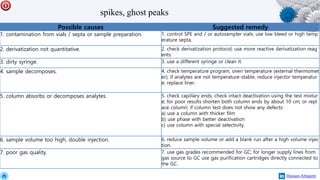
spikes, ghost peaks
Possible causes Suggested remedy
1. leak at column entrance or injection septum. 1. check column installation; search for leaks; replace ferrules.
2. bleeding of septum / injector contaminated. 2. make a run with lower injector temperature; if the baseline improves
, replace liner, use low bleed or high temperature septa.
3. septum particles in column entrance. 3. cut 1 turn from column entrance; replace injection septum.
4. column contaminated. 4. cut two turns from column entrance; rinse column with solvent (only
chemically bonded phases); otherwise replace column or use guard col
umn.
5. column not properly conditioned. 5. condition column according to manufacturers’ instructions (while col
umn is not connected to the detector).
6. hardware defect. 6. check temperature program, oven temperature (external thermomet
er); contact your GC manufacturer.
7. detector contaminated (electronics). 7. clean detector according to manufacturers’ instructions; check electr
onics.
8. increase of temperature too fast. 8. decrease temperature gradient and end temperature.
9. poor gas quality. 9. use gas grades recommended for GC; for longer supply lines from g
as source to GC use gas purification cartridges directly connected to t
he GC.
Hassan-Alnajem
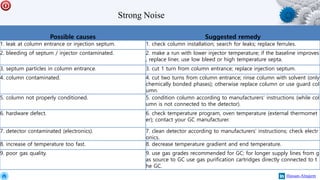
Strong Noise
Possible causes Suggested remedy
1. column not properly installed. 1. check capillary ends; check tight and correct fit in injector and detector.
2. temperature of injection too low. 2. check injector temperature; if analytes are stable, increase temperature.
3. solvent not compatible with GC phase. 3. change solvent.
4. splitter defect. 4. measure flow and adjust splitter.
5. poorly deactivated column, film thickness too low. 5. check capillary ends; check intact deactivation using the test mixture; for poor
results shorten both column ends by about 10 cm; or replace column.
Hassan-Alnajem
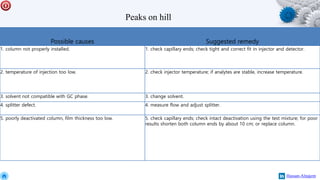
Peaks on hill
Possible causes Suggested remedy
1. column overload. 1. decrease injection volume; dilute sample.
2. sample vaporizes too slowly, not evenly or condenses. 2. increase injector temperature (consider max. tem
perature limits of the column).
3. analytes coelute. 3. change temperature program or use column with
different selectivity.
4. sample decomposes. 4. check temperature program, oven temperature (e
xternal thermometer); if analytes are not temperatu
re-stable, reduce injector temperature; replace liner.
5. column absorbs or decomposes analytes. 5. check capillary ends; check intact deactivation usi
ng the test mixture; for poor results shorten both c
olumn ends by about 10 cm; or replace column; if c
olumn test does not show any defects: a) use a col
umn with thicker film
b) use phase with better deactivation
c) use column with special selectivity.
Hassan-Alnajem
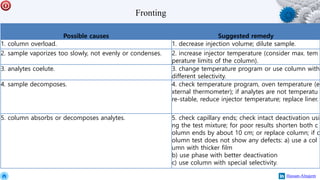
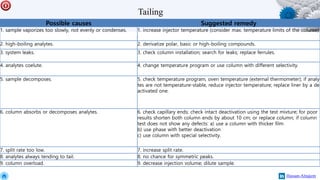
Fronting
Possible causes Suggested remedy
1. sample vaporizes too slowly, not evenly or condenses. 1. increase injector temperature (consider max. temperature limits of the column)
.
2. high-boiling analytes. 2. derivatize polar, basic or high-boiling compounds.
3. system leaks. 3. check column installation; search for leaks; replace ferrules.
4. analytes coelute. 4. change temperature program or use column with different selectivity.
5. sample decomposes. 5. check temperature program, oven temperature (external thermometer); if analy
tes are not temperature-stable, reduce injector temperature; replace liner by a de
activated one.
6. column absorbs or decomposes analytes. 6. check capillary ends; check intact deactivation using the test mixture; for poor
results shorten both column ends by about 10 cm; or replace column; if column
test does not show any defects: a) use a column with thicker film
b) use phase with better deactivation
c) use column with special selectivity.
7. split rate too low. 7. increase split rate.
8. analytes always tending to tail. 8. no chance for symmetric peaks.
9. column overload. 9. decrease injection volume; dilute sample.
Hassan-Alnajem
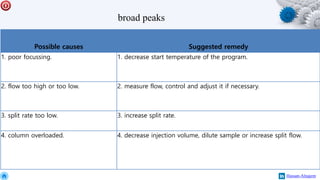
Tailing
Possible causes Suggested remedy
1. poor focussing. 1. decrease start temperature of the program.
2. flow too high or too low. 2. measure flow, control and adjust it if necessary.
3. split rate too low. 3. increase split rate.
4. column overloaded. 4. decrease injection volume, dilute sample or increase split flow.
Hassan-Alnajem
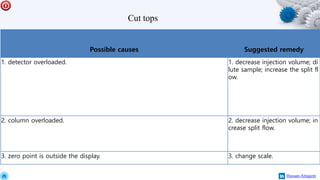
broad peaks
Possible causes Suggested remedy
1. detector overloaded. 1. decrease injection volume; di
lute sample; increase the split fl
ow.
2. column overloaded. 2. decrease injection volume; in
crease split flow.
3. zero point is outside the display. 3. change scale.
Hassan-Alnajem
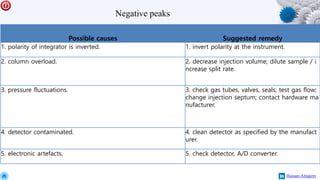
Cut tops
Possible causes Suggested remedy
1. polarity of integrator is inverted. 1. invert polarity at the instrument.
2. column overload. 2. decrease injection volume; dilute sample / i
ncrease split rate.
3. pressure fluctuations. 3. check gas tubes, valves, seals; test gas flow;
change injection septum; contact hardware ma
nufacturer.
4. detector contaminated. 4. clean detector as specified by the manufact
urer.
5. electronic artefacts. 5. check detector, A/D converter.
Hassan-Alnajem
Negative peaks
Possible causes Suggested remedy
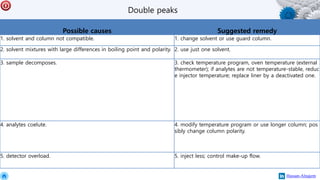
1. solvent and column not compatible. 1. change solvent or use guard column.
2. solvent mixtures with large differences in boiling point and polarity. 2. use just one solvent.
3. sample decomposes. 3. check temperature program, oven temperature (external
thermometer); if analytes are not temperature-stable, reduc
e injector temperature; replace liner by a deactivated one.
4. analytes coelute. 4. modify temperature program or use longer column; pos
sibly change column polarity.
5. detector overload. 5. inject less; control make-up flow.
Hassan-Alnajem
Double peaks
Possible causes Suggested remedy
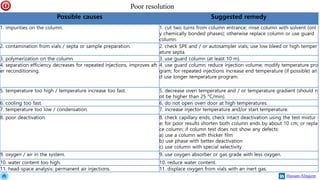
1. impurities on the column. 1. cut two turns from column entrance; rinse column with solvent (onl
y chemically bonded phases); otherwise replace column or use guard
column.
2. contamination from vials / septa or sample preparation. 2. check SPE and / or autosampler vials; use low bleed or high temper
ature septa.
3. polymerization on the column. 3. use guard column (at least 10 m).
4. separation efficiency decreases for repeated injections, improves aft
er reconditioning.
4. use guard column; reduce injection volume; modify temperature pro
gram; for repeated injections increase end temperature (if possible) an
d use longer temperature program.
5. temperature too high / temperature increase too fast. 5. decrease oven temperature and / or temperature gradient (should n
ot be higher than 25 °C/min).
6. cooling too fast. 6. do not open oven door at high temperatures.
7. temperature too low / condensation. 7. increase injector temperature and/or start temperature.
8. poor deactivation. 8. check capillary ends; check intact deactivation using the test mixtur
e; for poor results shorten both column ends by about 10 cm; or repla
ce column; if column test does not show any defects:
a) use a column with thicker film
b) use phase with better deactivation
c) use column with special selectivity.
9. oxygen / air in the system. 9. use oxygen absorber or gas grade with less oxygen.
10. water content too high. 10. reduce water content.
11. head-space analysis: permanent air injections. 11. displace oxygen from vials with an inert gas.
Hassan-Alnajem
Poor resolution
Possible causes Suggested remedy
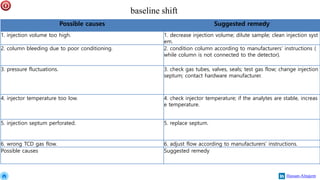
1. injection volume too high. 1. decrease injection volume; dilute sample; clean injection syst
em.
2. column bleeding due to poor conditioning. 2. condition column according to manufacturers’ instructions (
while column is not connected to the detector).
3. pressure fluctuations. 3. check gas tubes, valves, seals; test gas flow; change injection
septum; contact hardware manufacturer.
4. injector temperature too low. 4. check injector temperature; if the analytes are stable, increas
e temperature.
5. injection septum perforated. 5. replace septum.
6. wrong TCD gas flow. 6. adjust flow according to manufacturers’ instructions.
Possible causes Suggested remedy
Hassan-Alnajem
baseline shift

Gc troubleshooting

  • 1.
    GC Troubleshooting no peaksMissing peaks too small peaks increasing retention decreasing retention declining baseline interfering peaksrising baseline bleeding plateaus spikes, ghost peaks broad peaksstrong noise peaks on hill fronting, tailing cut tops baseline shiftnegative peaks double peaks poor resolution HASSAN ALNAJEMHassan-Alnajem Alnajemhassan@gmail.com
  • 2.
    Possible causes Suggestedremedy 1. error in the detector power supply / electronics. 1. check detector/electronic power supply and cables. 2. no FID flame. 2. check FID; reignite it. 3. syringe defective / clogged. 3. use a different syringe or clean it. 4. temperature too low for the analytes, oven heating faulty. 4. check temperature program, oven temperature. 5. detector / software / computer hardware failure. 5. check integrator, cables; restart computer. 6. no gas flow. 6. check gas tubes, valves, seals; test gas flow; shorten front of GC column, change injection septum. 7. column connection leaks. 7. use new ferrules. 8. broken GC column. 8. if breakage is at the beginning or at the end, remove the sh ort piece; breakage in the middle can be mended with a glass c onnector; for multiple breakages: replace column. Hassan-Alnajem No peaks
  • 3.
    Possible causes Suggestedremedy 1. syringe defective / clogged. 1. use a different syringe or clean it. 2. sample too diluted. 2. increase injection volume; concentrate sample. 3. sample concentration too high. 3. decrease injection volume; dilute sample. 4. column connection leaks, column not properly installed 4. check column installation; search for leaks; replace ferrules. 5. perforated injection septum. 5. replace septum. 6. injector temperature too low. 6. check temperature program; increase injector temperature. 7. sample decomposes in the injector. 7. check temperature program; reduce injector temperature; repla ce liner; check capillary ends. 8. column oven too hot. 8. check temperature program, oven temperature (external therm ometer); decrease temperature. 9. incorrect flow rate. 9. measure flow, control and adjust it if necessary. 10. column absorbs or decomposes analytes. 10. check capillary ends; check intact deactivation using the test mixture; for poor results shorten both column ends by about 10 c m; or replace column; if column test does not show any defects: a ) use a column with thicker film b) use phase with better deactivation c) use column with special selectivity Hassan-Alnajem Missing peaks
  • 4.
    Possible causes Suggestedremedy 1. dirty syringe. 1. use a different syringe or clean it. 2. concentration of sample too low. 2. increase injection volume; concentrate sample. 3. split too high. 3. reduce split. 4. sensitivity of detector too low. 4. inject standard in order to test detector sensitivity. 5. column connection leaks, column not properly installed. 5. check column installation; search for leaks; replace ferrules. 6. injector temperature too low. 6. check temperature program, increase injector temperature. 7. dirty ECD. 7. clean ECD. 8. FID, TCD gas flow too low. 8. correct flow according to manufacturers’ instructions. 9. sample decomposes. 9. check capillary ends; check intact deactivation using the test mixture; for poor results shorten both column ends by about 10 cm; or replace column; if column test does not show any defect s: a) use a column with thicker film b) use phase with better deactivation c) use column with special selectivity. Hassan-Alnajem Too small peaks
  • 5.
    Possible causes Suggestedremedy 1. speed of gas too low. 1. increase flow. 2. column connection leaks, column not properly installed. 2. check column installation; search for leaks; replace ferrules. 3. oven temperature too low or unstable. 3. check temperature program, oven temperature (external the rmometer); if the analytes are stable, increase temperature. 4. strong decrease of gas pressure. 4. replace septum; for an instrument with pressure / temperat ure control, flow pressure must be higher than 15 psi above t he demand at max. temperature of the program. 5. tubes / capillaries / column constricted or blocked. 5. compare flow at column entrance and outlet with preset flo w; check and / or clean gas tubes; in case of pressure build-u p cut and remove one turn (20 cm) from the column or replace column Hassan-Alnajem increasing retention
  • 6.
    Possible causes Suggestedremedy 1. speed of gas too high. 1. compare flow at column entrance and outlet with preset flow; check gas tubes and pressure gauge; control parameter settings; or replace co lumn. 2. oven temperature too high. 2. check temperature program, oven temperature (external thermometer ); decrease temperature. 3. column length too short. 3. replace column. 4. film thickness in column too low. 4. replace column. Hassan-Alnajem Decreasing retention
  • 7.
    Possible causes Suggestedremedy 1. gas flow changes with temperature gradient. 1. check gas content in gas cylinder; pressure must be a few bar above the required pressure at max. temperature; otherw ise exchange gas cylinder. 2. contaminated gas/ poor gas quality (at constant inlet pressure). 2. check gas supply. 3. column not properly installed. 3. check column installation (FID). Hassan-Alnajem Declining baseline
  • 8.
    Possible causes Suggestedremedy 1. leak at column entrance or injection septum. 1. check column installation; search for leaks; replace ferrules. 2. injector contaminated. 2. make a run at lower injector temperature; if the baseline improves, replace liner, use low bleed or high temperature septa. 3. column contaminated. 3. cut two turns from column entrance; rinse column with solvent (only chem ically bonded phases); otherwise replace column or use guard column. 4. detector contaminated. 4. clean detector. 5. increase of temperature too fast. 5. decrease temperature gradient and end temperature. 6. poor gas quality. 6. use gas grades recommended for GC; for longer supply lines from gas sou rce to GC use gas purification cartridges directly connected to the GC. Hassan-Alnajem Rising baseline
  • 9.
    Possible causes Suggestedremedy 1. decomposition of the stationary phase. 1. check for leaks; matrix check for compatibility with the colu mn. 2. column contaminated. 2. cut two turns from column entrance; rinse column with solv ent (only chemically bonded phases); otherwise replace colum n or use guard column. 3. increase of temperature too fast / end temperature too high. 3. decrease temperature gradient and end temperature. 4. column not properly conditioned. 4. condition column according to manufacturers’ instructions ( while column is not connected to the detector). 5. detector contaminated. 5. clean detector according to manufacturers’ instructions. 6. poor gas quality. 6. use gas grades recommended for GC; for longer supply line s from gas source to GC use gas purification cartridges directly connected to the GC. Hassan-Alnajem Bleeding
  • 10.
    Possible causes Suggestedremedy 1. steps in temperature program too drastic. 1. avoid very short and strong heating periods. Hassan-Alnajem Plateaus
  • 11.
    Possible causes Suggestedremedy 1. poor gas quality. 1. use gas grades recommended for GC; for longer supply lines f rom gas source to GC use gas purification cartridges directly con nected to the GC. 2. FID: dust or contaminants in the detector. 2. clean detector; if particles are visible in the column or column ends are not cut precisely (frayed edges), cut two turns from the column entrance. 3. electronic defect, damaged cable or detector. 3. replace cable, contact your GC manufacturer. 4. bleeding of silicon septa. 4. replace injection septum, use low bleed or high temperature s epta Hassan-Alnajem Interfering Peaks
  • 12.
    Possible causes Suggestedremedy 1. contamination from vials / septa or sample preparation. 1. control SPE and / or autosampler vials; use low bleed or high temp erature septa. 2. derivatization not quantitative. 2. check derivatization protocol; use more reactive derivatization reag ents. 3. dirty syringe. 3. use a different syringe or clean it. 4. sample decomposes. 4. check temperature program, oven temperature (external thermomet er); if analytes are not temperature-stable, reduce injector temperatur e; replace liner. 5. column absorbs or decomposes analytes. 5. check capillary ends; check intact deactivation using the test mixtur e; for poor results shorten both column ends by about 10 cm; or repl ace column; if column test does not show any defects: a) use a column with thicker film b) use phase with better deactivation c) use column with special selectivity. 6. sample volume too high, double injection. 6. reduce sample volume or add a blank run after a high volume injec tion. 7. poor gas quality. 7. use gas grades recommended for GC; for longer supply lines from gas source to GC use gas purification cartridges directly connected to the GC. Hassan-Alnajem spikes, ghost peaks
  • 13.
    Possible causes Suggestedremedy 1. leak at column entrance or injection septum. 1. check column installation; search for leaks; replace ferrules. 2. bleeding of septum / injector contaminated. 2. make a run with lower injector temperature; if the baseline improves , replace liner, use low bleed or high temperature septa. 3. septum particles in column entrance. 3. cut 1 turn from column entrance; replace injection septum. 4. column contaminated. 4. cut two turns from column entrance; rinse column with solvent (only chemically bonded phases); otherwise replace column or use guard col umn. 5. column not properly conditioned. 5. condition column according to manufacturers’ instructions (while col umn is not connected to the detector). 6. hardware defect. 6. check temperature program, oven temperature (external thermomet er); contact your GC manufacturer. 7. detector contaminated (electronics). 7. clean detector according to manufacturers’ instructions; check electr onics. 8. increase of temperature too fast. 8. decrease temperature gradient and end temperature. 9. poor gas quality. 9. use gas grades recommended for GC; for longer supply lines from g as source to GC use gas purification cartridges directly connected to t he GC. Hassan-Alnajem Strong Noise
  • 14.
    Possible causes Suggestedremedy 1. column not properly installed. 1. check capillary ends; check tight and correct fit in injector and detector. 2. temperature of injection too low. 2. check injector temperature; if analytes are stable, increase temperature. 3. solvent not compatible with GC phase. 3. change solvent. 4. splitter defect. 4. measure flow and adjust splitter. 5. poorly deactivated column, film thickness too low. 5. check capillary ends; check intact deactivation using the test mixture; for poor results shorten both column ends by about 10 cm; or replace column. Hassan-Alnajem Peaks on hill
  • 15.
    Possible causes Suggestedremedy 1. column overload. 1. decrease injection volume; dilute sample. 2. sample vaporizes too slowly, not evenly or condenses. 2. increase injector temperature (consider max. tem perature limits of the column). 3. analytes coelute. 3. change temperature program or use column with different selectivity. 4. sample decomposes. 4. check temperature program, oven temperature (e xternal thermometer); if analytes are not temperatu re-stable, reduce injector temperature; replace liner. 5. column absorbs or decomposes analytes. 5. check capillary ends; check intact deactivation usi ng the test mixture; for poor results shorten both c olumn ends by about 10 cm; or replace column; if c olumn test does not show any defects: a) use a col umn with thicker film b) use phase with better deactivation c) use column with special selectivity. Hassan-Alnajem Fronting
  • 16.
    Possible causes Suggestedremedy 1. sample vaporizes too slowly, not evenly or condenses. 1. increase injector temperature (consider max. temperature limits of the column) . 2. high-boiling analytes. 2. derivatize polar, basic or high-boiling compounds. 3. system leaks. 3. check column installation; search for leaks; replace ferrules. 4. analytes coelute. 4. change temperature program or use column with different selectivity. 5. sample decomposes. 5. check temperature program, oven temperature (external thermometer); if analy tes are not temperature-stable, reduce injector temperature; replace liner by a de activated one. 6. column absorbs or decomposes analytes. 6. check capillary ends; check intact deactivation using the test mixture; for poor results shorten both column ends by about 10 cm; or replace column; if column test does not show any defects: a) use a column with thicker film b) use phase with better deactivation c) use column with special selectivity. 7. split rate too low. 7. increase split rate. 8. analytes always tending to tail. 8. no chance for symmetric peaks. 9. column overload. 9. decrease injection volume; dilute sample. Hassan-Alnajem Tailing
  • 17.
    Possible causes Suggestedremedy 1. poor focussing. 1. decrease start temperature of the program. 2. flow too high or too low. 2. measure flow, control and adjust it if necessary. 3. split rate too low. 3. increase split rate. 4. column overloaded. 4. decrease injection volume, dilute sample or increase split flow. Hassan-Alnajem broad peaks
  • 18.
    Possible causes Suggestedremedy 1. detector overloaded. 1. decrease injection volume; di lute sample; increase the split fl ow. 2. column overloaded. 2. decrease injection volume; in crease split flow. 3. zero point is outside the display. 3. change scale. Hassan-Alnajem Cut tops
  • 19.
    Possible causes Suggestedremedy 1. polarity of integrator is inverted. 1. invert polarity at the instrument. 2. column overload. 2. decrease injection volume; dilute sample / i ncrease split rate. 3. pressure fluctuations. 3. check gas tubes, valves, seals; test gas flow; change injection septum; contact hardware ma nufacturer. 4. detector contaminated. 4. clean detector as specified by the manufact urer. 5. electronic artefacts. 5. check detector, A/D converter. Hassan-Alnajem Negative peaks
  • 20.
    Possible causes Suggestedremedy 1. solvent and column not compatible. 1. change solvent or use guard column. 2. solvent mixtures with large differences in boiling point and polarity. 2. use just one solvent. 3. sample decomposes. 3. check temperature program, oven temperature (external thermometer); if analytes are not temperature-stable, reduc e injector temperature; replace liner by a deactivated one. 4. analytes coelute. 4. modify temperature program or use longer column; pos sibly change column polarity. 5. detector overload. 5. inject less; control make-up flow. Hassan-Alnajem Double peaks
  • 21.
    Possible causes Suggestedremedy 1. impurities on the column. 1. cut two turns from column entrance; rinse column with solvent (onl y chemically bonded phases); otherwise replace column or use guard column. 2. contamination from vials / septa or sample preparation. 2. check SPE and / or autosampler vials; use low bleed or high temper ature septa. 3. polymerization on the column. 3. use guard column (at least 10 m). 4. separation efficiency decreases for repeated injections, improves aft er reconditioning. 4. use guard column; reduce injection volume; modify temperature pro gram; for repeated injections increase end temperature (if possible) an d use longer temperature program. 5. temperature too high / temperature increase too fast. 5. decrease oven temperature and / or temperature gradient (should n ot be higher than 25 °C/min). 6. cooling too fast. 6. do not open oven door at high temperatures. 7. temperature too low / condensation. 7. increase injector temperature and/or start temperature. 8. poor deactivation. 8. check capillary ends; check intact deactivation using the test mixtur e; for poor results shorten both column ends by about 10 cm; or repla ce column; if column test does not show any defects: a) use a column with thicker film b) use phase with better deactivation c) use column with special selectivity. 9. oxygen / air in the system. 9. use oxygen absorber or gas grade with less oxygen. 10. water content too high. 10. reduce water content. 11. head-space analysis: permanent air injections. 11. displace oxygen from vials with an inert gas. Hassan-Alnajem Poor resolution
  • 22.
    Possible causes Suggestedremedy 1. injection volume too high. 1. decrease injection volume; dilute sample; clean injection syst em. 2. column bleeding due to poor conditioning. 2. condition column according to manufacturers’ instructions ( while column is not connected to the detector). 3. pressure fluctuations. 3. check gas tubes, valves, seals; test gas flow; change injection septum; contact hardware manufacturer. 4. injector temperature too low. 4. check injector temperature; if the analytes are stable, increas e temperature. 5. injection septum perforated. 5. replace septum. 6. wrong TCD gas flow. 6. adjust flow according to manufacturers’ instructions. Possible causes Suggested remedy Hassan-Alnajem baseline shift