P R E PA R E D B Y: E S B
MODULE NO.1
ARBT 5
PRECAST AND CAST IN PLACE
INTRODUCTION
Nowadays, the construction industry is growing more and
more with new technics. Various researches and
development programs are held by researcher and
national association to find economic and time-saving
technics for construction. Precast concrete is one of them.
Precast concrete is the new construction technic that
makes construction speedy and economical on the large
construction projects.
PRECAST & CAST-IN-SITU
Precast & cast-in-situ concrete are the product produced by
casting concrete in a mould or formwork cured to get the
strength of RCC elements.
The precast concrete is transported to the construction site,
lifted and positioned at the predetermined place.
The cast-in-situ concrete is a standard concrete which is
poured into the specific formwork on the site and cured to
get the strength of RCC elements.
1. DEFINITION
Precast Concrete
According to ‘Precast Concrete Institute, U.S.A’ (Published in: Designing
with Precast and Prestressed Concrete), precast concrete is cast into a
specific shape at a location other than building site like factories. The
concrete is placed into a form, typically wood or steel, and is cured. These
components are then transported to the construction site for erection into
place. Precast concrete can be plant-cast or site-cast.
Cast-in-situ Concrete
According to ‘Edward Allen and Joseph Iano’ (Author of Fundamental of
Building Construction Materials & Methods), cast-in-situ concrete is cast into
forms on the building site. It offers unlimited possibilities to the designer for any
shape formation with a limitless selection of surface textures
02. CASTING
Precast Concrete
1. In the precast concrete, elements are manufactured in a controlled
casting environment and hence it is easier to control mix, placement and
curing.
2. Elements can be cast in advance and held until the hour you need
them, thereby saves time.
3. Weather condition has no effect on casting work.
Cast-in-situ Concrete
1. In the cast-in-situ concrete, column, slab etc. elements are casted on site in the
open environment and hence it is difficult to control mix, placement and curing.
2. Elements cannot be casted in advance.
3. Weather condition can delay the casting work.
03. QUALITY CONTROL
Precast Concrete
Quality can be controlled and maintained easily.
Cast-in-situ Concrete
Quality control and maintenance is difficult.
04. COST
• Precast Concrete
• Precast concrete is cheaper form of construction if large
structures are to be constructed.
• Maintenance cost of precast concrete structure is higher.
• Cast-in-situ Concrete
• In situ concrete is cheaper form of construction for small
structures.
• Maintenance cost of cast-in-situ concrete structure is less
compared to the precast concrete structure.
05. REQUIREMENT OF WORKER & MACHINERY
Precast Concrete
• Less labours are required.
• Skilled labours are required at construction site.
• Skilled and technical contractor is required for construction of the
precast concrete structure.
• Precast concrete requires heavy machinery and cranes for handling
i.e. lifting and installation of heavy elements
• Cast-in-situ Concrete
• More labours are required.
• Skilled labours are required at construction site.
• Local contractors can also build the structure.
• Cast-in-situ concrete does not require such handling equipment.
06. STRENGTH
• Precast Concrete
• Precast concrete construction is quick as it can be installed immediately
and there is no waiting for it to gain strength.
• Increase in strength can be achieved by accelerated curing.
• On site strength test is not required.
• High strength concrete can be used because it is in controlled condition.
• Cast-in-situ Concrete
• In situ concrete construction is slow as gaining of strength requires
time.
• Increase in strength at situ by accelerated curing is a difficult task.
• On site strength test is required.
• It will difficult to use high strength concrete as it depends on site
condition and resources available.
07. TIME OF CONSTRUCTION
Precast Concrete
• Total construction time is less as compared to cast-in-
situ.
• Speedy construction is possible.
Cast-in-situ Concrete
• Total construction time is more as compared to precast.
• Speed is less as elements are casted at site.
08. TECHNICAL POINTS
Precast Concrete
• Large number of joints in structural system.
• Less resistant to Earthquake and wind forces not recommended where
seismic loads are dominant.
• In precast concrete construction, details at the joint become very critical
and needs careful attention.
• The elements have to be designed for handling stress or loads during
handling, which may or may not increase steel.
• Elements of varying lengths and shape can be developed.
• Precast concrete does not offer a monolithic architectural character.
Cast-in-situ Concrete
• Less number of joints present in structural system.
• More resistant to earthquake and wind forces.
• Elements cannot be casted in advance.
• Elements are not to be designed for any such loads or
stress.
• There is constraint in length and shape of element.
• In situ concrete offers a monolithic architectural
character.
09. SURFACE FINISHING
• Precast Concrete
• According to ‘Bulletin of American Concrete Institute‘
(1993), precast concrete gives smooth interior finish hence
they need minimum preparation before paint, wallpaper etc.
or the other wall coverings can be applied directly.
• Cast-in-situ Concrete
• In the cast-in-situ concrete construction, you have to
do plaster for the smooth finish and also requires pre-
preparation for a paint like wall putty etc.
10. POINTS TO BE TAKEN CARE OF
Precast Concrete
• One has to meticulous during work with precast concrete
because the precast unit can be damaged during
transportation and handling.
Cast-in-situ Concrete
• In the cast-in-situ concrete construction, be careful about
following points:
01. During the concreting process like mixing,
transportation, placing, finishing etc.
02. Curing of concrete for certain time etc.
11. CONCLUSION
• In the final note, precast & cast-in-situ concrete both
are the easy construction technics. Both methods have
their advances such as precast concrete construction
gives cost benefits on a large project, quality assurance
due to control casting condition, reduces the high
supervision of concreting process like mixing, placing
etc. at the construction site. On the other side, cast-in-
situ concrete is the conventional method for concreting, it
is very and largely used for construction, and any local
contractor can adopt this method.
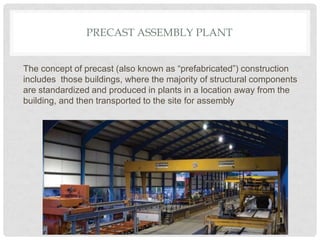
PRECAST ASSEMBLY PLANT
The concept of precast (also known as “prefabricated”) construction
includes those buildings, where the majority of structural components
are standardized and produced in plants in a location away from the
building, and then transported to the site for assembly
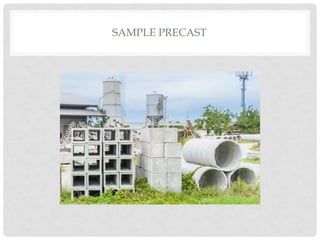
SAMPLE PRECAST
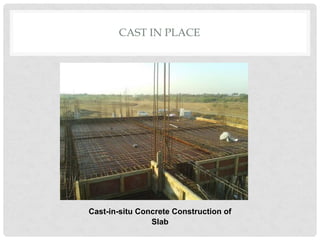
CAST IN PLACE
Cast-in-situ Concrete Construction of
Slab
12. TYPES OF PRECAST SYSTEMS
TYPES OF PRECAST SYSTEMS
Depending on the load-bearing structure, precast systems
can be divided into the following categories: Large-panel
systems
Frame systems
Slab-column systems with walls
Mixed systems
12.1 LARGE PANEL SYSTEMS
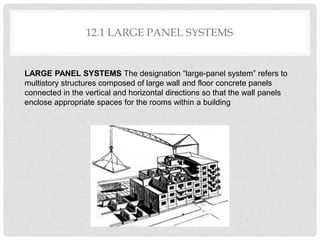
LARGE PANEL SYSTEMS The designation “large-panel system” refers to
multistory structures composed of large wall and floor concrete panels
connected in the vertical and horizontal directions so that the wall panels
enclose appropriate spaces for the rooms within a building
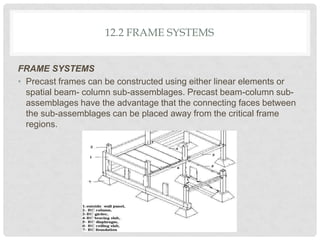
12.2 FRAME SYSTEMS
FRAME SYSTEMS
• Precast frames can be constructed using either linear elements or
spatial beam- column sub-assemblages. Precast beam-column sub-
assemblages have the advantage that the connecting faces between
the sub-assemblages can be placed away from the critical frame
regions.
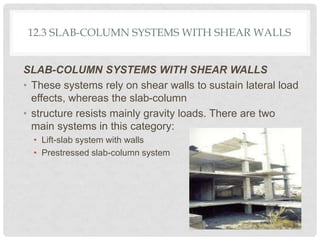
12.3 SLAB-COLUMN SYSTEMS WITH SHEAR WALLS
SLAB-COLUMN SYSTEMS WITH SHEAR WALLS
• These systems rely on shear walls to sustain lateral load
effects, whereas the slab-column
• structure resists mainly gravity loads. There are two
main systems in this category:
• Lift-slab system with walls
• Prestressed slab-column system
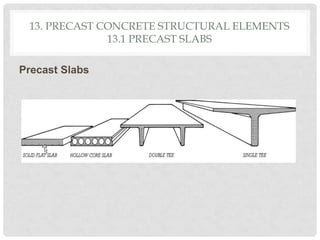
13. PRECAST CONCRETE STRUCTURAL ELEMENTS
13.1 PRECAST SLABS
Precast Slabs
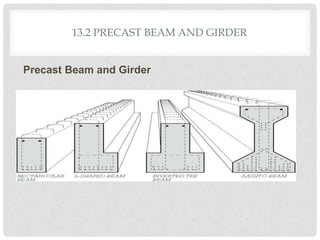
13.2 PRECAST BEAM AND GIRDER
Precast Beam and Girder
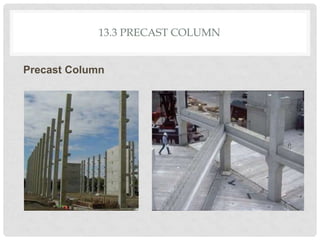
13.3 PRECAST COLUMN
Precast Column
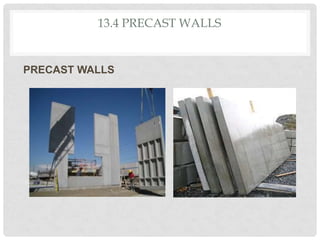
13.4 PRECAST WALLS
PRECAST WALLS
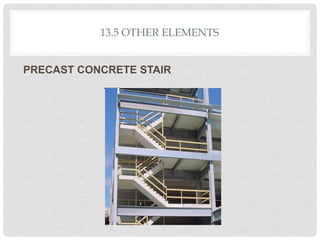
13.5 OTHER ELEMENTS
PRECAST CONCRETE STAIR
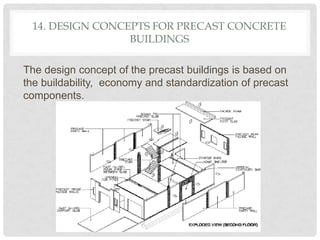
14. DESIGN CONCEPTS FOR PRECAST CONCRETE
BUILDINGS
The design concept of the precast buildings is based on
the buildability, economy and standardization of precast
components.

02_Precast-and-Cast-in-Place.ppt

  • 1.
    P R EPA R E D B Y: E S B MODULE NO.1 ARBT 5 PRECAST AND CAST IN PLACE
  • 2.
    INTRODUCTION Nowadays, the constructionindustry is growing more and more with new technics. Various researches and development programs are held by researcher and national association to find economic and time-saving technics for construction. Precast concrete is one of them. Precast concrete is the new construction technic that makes construction speedy and economical on the large construction projects.
  • 3.
    PRECAST & CAST-IN-SITU Precast& cast-in-situ concrete are the product produced by casting concrete in a mould or formwork cured to get the strength of RCC elements. The precast concrete is transported to the construction site, lifted and positioned at the predetermined place. The cast-in-situ concrete is a standard concrete which is poured into the specific formwork on the site and cured to get the strength of RCC elements.
  • 4.
    1. DEFINITION Precast Concrete Accordingto ‘Precast Concrete Institute, U.S.A’ (Published in: Designing with Precast and Prestressed Concrete), precast concrete is cast into a specific shape at a location other than building site like factories. The concrete is placed into a form, typically wood or steel, and is cured. These components are then transported to the construction site for erection into place. Precast concrete can be plant-cast or site-cast. Cast-in-situ Concrete According to ‘Edward Allen and Joseph Iano’ (Author of Fundamental of Building Construction Materials & Methods), cast-in-situ concrete is cast into forms on the building site. It offers unlimited possibilities to the designer for any shape formation with a limitless selection of surface textures
  • 5.
    02. CASTING Precast Concrete 1.In the precast concrete, elements are manufactured in a controlled casting environment and hence it is easier to control mix, placement and curing. 2. Elements can be cast in advance and held until the hour you need them, thereby saves time. 3. Weather condition has no effect on casting work. Cast-in-situ Concrete 1. In the cast-in-situ concrete, column, slab etc. elements are casted on site in the open environment and hence it is difficult to control mix, placement and curing. 2. Elements cannot be casted in advance. 3. Weather condition can delay the casting work.
  • 6.
    03. QUALITY CONTROL PrecastConcrete Quality can be controlled and maintained easily. Cast-in-situ Concrete Quality control and maintenance is difficult.
  • 7.
    04. COST • PrecastConcrete • Precast concrete is cheaper form of construction if large structures are to be constructed. • Maintenance cost of precast concrete structure is higher. • Cast-in-situ Concrete • In situ concrete is cheaper form of construction for small structures. • Maintenance cost of cast-in-situ concrete structure is less compared to the precast concrete structure.
  • 8.
    05. REQUIREMENT OFWORKER & MACHINERY Precast Concrete • Less labours are required. • Skilled labours are required at construction site. • Skilled and technical contractor is required for construction of the precast concrete structure. • Precast concrete requires heavy machinery and cranes for handling i.e. lifting and installation of heavy elements • Cast-in-situ Concrete • More labours are required. • Skilled labours are required at construction site. • Local contractors can also build the structure. • Cast-in-situ concrete does not require such handling equipment.
  • 9.
    06. STRENGTH • PrecastConcrete • Precast concrete construction is quick as it can be installed immediately and there is no waiting for it to gain strength. • Increase in strength can be achieved by accelerated curing. • On site strength test is not required. • High strength concrete can be used because it is in controlled condition. • Cast-in-situ Concrete • In situ concrete construction is slow as gaining of strength requires time. • Increase in strength at situ by accelerated curing is a difficult task. • On site strength test is required. • It will difficult to use high strength concrete as it depends on site condition and resources available.
  • 10.
    07. TIME OFCONSTRUCTION Precast Concrete • Total construction time is less as compared to cast-in- situ. • Speedy construction is possible. Cast-in-situ Concrete • Total construction time is more as compared to precast. • Speed is less as elements are casted at site.
  • 11.
    08. TECHNICAL POINTS PrecastConcrete • Large number of joints in structural system. • Less resistant to Earthquake and wind forces not recommended where seismic loads are dominant. • In precast concrete construction, details at the joint become very critical and needs careful attention. • The elements have to be designed for handling stress or loads during handling, which may or may not increase steel. • Elements of varying lengths and shape can be developed. • Precast concrete does not offer a monolithic architectural character.
  • 12.
    Cast-in-situ Concrete • Lessnumber of joints present in structural system. • More resistant to earthquake and wind forces. • Elements cannot be casted in advance. • Elements are not to be designed for any such loads or stress. • There is constraint in length and shape of element. • In situ concrete offers a monolithic architectural character.
  • 13.
    09. SURFACE FINISHING •Precast Concrete • According to ‘Bulletin of American Concrete Institute‘ (1993), precast concrete gives smooth interior finish hence they need minimum preparation before paint, wallpaper etc. or the other wall coverings can be applied directly. • Cast-in-situ Concrete • In the cast-in-situ concrete construction, you have to do plaster for the smooth finish and also requires pre- preparation for a paint like wall putty etc.
  • 14.
    10. POINTS TOBE TAKEN CARE OF Precast Concrete • One has to meticulous during work with precast concrete because the precast unit can be damaged during transportation and handling. Cast-in-situ Concrete • In the cast-in-situ concrete construction, be careful about following points: 01. During the concreting process like mixing, transportation, placing, finishing etc. 02. Curing of concrete for certain time etc.
  • 15.
    11. CONCLUSION • Inthe final note, precast & cast-in-situ concrete both are the easy construction technics. Both methods have their advances such as precast concrete construction gives cost benefits on a large project, quality assurance due to control casting condition, reduces the high supervision of concreting process like mixing, placing etc. at the construction site. On the other side, cast-in- situ concrete is the conventional method for concreting, it is very and largely used for construction, and any local contractor can adopt this method.
  • 16.
    PRECAST ASSEMBLY PLANT Theconcept of precast (also known as “prefabricated”) construction includes those buildings, where the majority of structural components are standardized and produced in plants in a location away from the building, and then transported to the site for assembly
  • 17.
  • 18.
    CAST IN PLACE Cast-in-situConcrete Construction of Slab
  • 19.
    12. TYPES OFPRECAST SYSTEMS TYPES OF PRECAST SYSTEMS Depending on the load-bearing structure, precast systems can be divided into the following categories: Large-panel systems Frame systems Slab-column systems with walls Mixed systems
  • 20.
    12.1 LARGE PANELSYSTEMS LARGE PANEL SYSTEMS The designation “large-panel system” refers to multistory structures composed of large wall and floor concrete panels connected in the vertical and horizontal directions so that the wall panels enclose appropriate spaces for the rooms within a building
  • 21.
    12.2 FRAME SYSTEMS FRAMESYSTEMS • Precast frames can be constructed using either linear elements or spatial beam- column sub-assemblages. Precast beam-column sub- assemblages have the advantage that the connecting faces between the sub-assemblages can be placed away from the critical frame regions.
  • 22.
    12.3 SLAB-COLUMN SYSTEMSWITH SHEAR WALLS SLAB-COLUMN SYSTEMS WITH SHEAR WALLS • These systems rely on shear walls to sustain lateral load effects, whereas the slab-column • structure resists mainly gravity loads. There are two main systems in this category: • Lift-slab system with walls • Prestressed slab-column system
  • 23.
    13. PRECAST CONCRETESTRUCTURAL ELEMENTS 13.1 PRECAST SLABS Precast Slabs
  • 24.
    13.2 PRECAST BEAMAND GIRDER Precast Beam and Girder
  • 25.
  • 26.
  • 27.
  • 28.
    14. DESIGN CONCEPTSFOR PRECAST CONCRETE BUILDINGS The design concept of the precast buildings is based on the buildability, economy and standardization of precast components.