By Shubham Arora (GET-Civil)
Supertech Limited, 4270
Principles-Manufacturing Industry
 Anyone starts a business for earning profits, & in fast paced 20th century,
for profits, one needs to survive in the competition & there is only “survival
of the fittest”.
 Manufacturing needs 5 more ‘Ms’, henceforth I have figured out 5
necessary principles/vertical which can be continuously improvised to
meet specific customer requirements:
 Marketing ( To grow & at least to generate fixed costs)
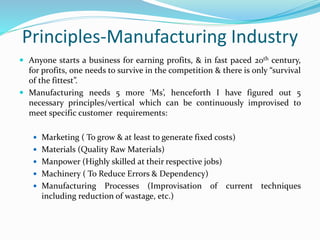
 Materials (Quality Raw Materials)
 Manpower (Highly skilled at their respective jobs)
 Machinery ( To Reduce Errors & Dependency)
 Manufacturing Processes (Improvisation of current techniques
including reduction of wastage, etc.)
Precasting- A Manufacturing Unit
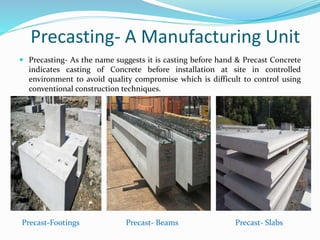
 Precasting- As the name suggests it is casting before hand & Precast Concrete
indicates casting of Concrete before installation at site in controlled
environment to avoid quality compromise which is difficult to control using
conventional construction techniques.
Precast-Footings Precast- Beams Precast- Slabs
Precast Concrete as Finished Good!
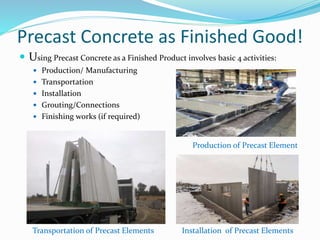
 Using Precast Concrete as a Finished Product involves basic 4 activities:
 Production/ Manufacturing
 Transportation
 Installation
 Grouting/Connections
 Finishing works (if required)
Production of Precast Element
Transportation of Precast Elements Installation of Precast Elements
Manufacturing of Precast Elements
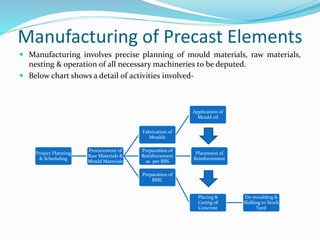
 Manufacturing involves precise planning of mould materials, raw materials,
nesting & operation of all necessary machineries to be deputed.
 Below chart shows a detail of activities involved-
Project Planning
& Scheduling
Procurement of
Raw Materials &
Mould Materials
Fabrication of
Moulds
Application of
Mould oil
Preparation of
Reinforcement
as per BBS
Placement of
Reinforcement
Preparation of
RMC
Placing &
Curing of
Concrete
De-moulding &
Shifting to Stock
Yard
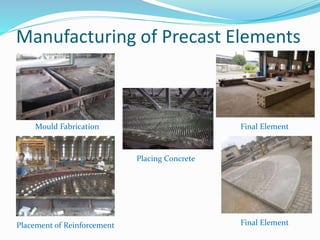
Manufacturing of Precast Elements
Mould Fabrication
Placement of Reinforcement
Placing Concrete
Final Element
Final Element
Transportation of Precast Elements
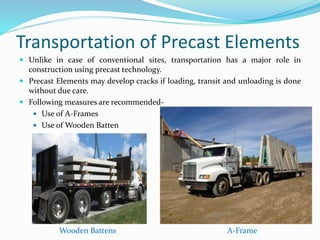
 Unlike in case of conventional sites, transportation has a major role in
construction using precast technology.
 Precast Elements may develop cracks if loading, transit and unloading is done
without due care.
 Following measures are recommended-
 Use of A-Frames
 Use of Wooden Batten
A-FrameWooden Battens
Installation of Precast Elements
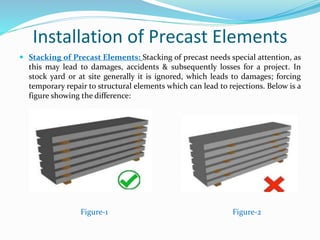
 Stacking of Precast Elements: Stacking of precast needs special attention, as
this may lead to damages, accidents & subsequently losses for a project. In
stock yard or at site generally it is ignored, which leads to damages; forcing
temporary repair to structural elements which can lead to rejections. Below is a
figure showing the difference:
Figure-1 Figure-2
Installation of Precast Elements
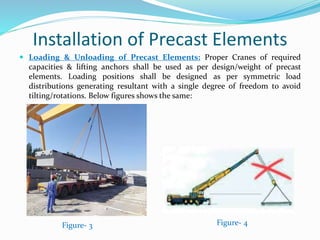
 Loading & Unloading of Precast Elements: Proper Cranes of required
capacities & lifting anchors shall be used as per design/weight of precast
elements. Loading positions shall be designed as per symmetric load
distributions generating resultant with a single degree of freedom to avoid
tilting/rotations. Below figures shows the same:
Figure- 3 Figure- 4
Installation of Precast Elements
 Erection of Precast Elements: This needs a detail planning & coordination
with each personnel on site. Below mentioned are steps that could improve
efficiency and reduce contingencies during installation of precast elements.
 Positioning of Crane: Crane Radius, Crane Installation point, Access to installation
are the various factors which could help in deciding the position of crane.
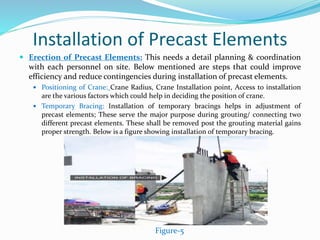
 Temporary Bracing: Installation of temporary bracings helps in adjustment of
precast elements; These serve the major purpose during grouting/ connecting two
different precast elements. These shall be removed post the grouting material gains
proper strength. Below is a figure showing installation of temporary bracing.
Figure-5
Installation of Precast Elements
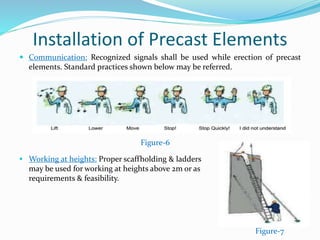
 Communication: Recognized signals shall be used while erection of precast
elements. Standard practices shown below may be referred.
 Working at heights: Proper scaffholding & ladders
may be used for working at heights above 2m or as per site
requirements & feasibility.
Figure-6
Figure-7
Installation of Precast Elements
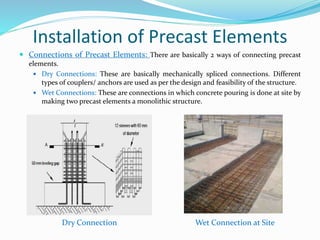
 Connections of Precast Elements: There are basically 2 ways of connecting precast
elements.
 Dry Connections: These are basically mechanically spliced connections. Different
types of couplers/ anchors are used as per the design and feasibility of the structure.
 Wet Connections: These are connections in which concrete pouring is done at site by
making two precast elements a monolithic structure.
Dry Connection Wet Connection at Site
Installation of Precast Elements
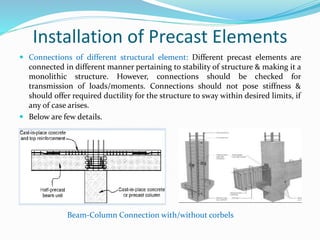
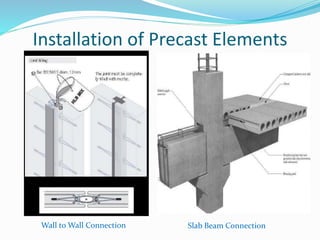
 Connections of different structural element: Different precast elements are
connected in different manner pertaining to stability of structure & making it a
monolithic structure. However, connections should be checked for
transmission of loads/moments. Connections should not pose stiffness &
should offer required ductility for the structure to sway within desired limits, if
any of case arises.
 Below are few details.
Beam-Column Connection with/without corbels
Installation of Precast Elements
Wall to Wall Connection Slab Beam Connection
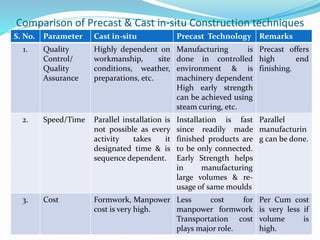
Comparison of Precast & Cast in-situ Construction techniques
S. No. Parameter Cast in-situ Precast Technology Remarks
1. Quality
Control/
Quality
Assurance
Highly dependent on
workmanship, site
conditions, weather,
preparations, etc.
Manufacturing is
done in controlled
environment & is
machinery dependent
High early strength
can be achieved using
steam curing, etc.
Precast offers
high end
finishing.
2. Speed/Time Parallel installation is
not possible as every
activity takes it
designated time & is
sequence dependent.
Installation is fast
since readily made
finished products are
to be only connected.
Early Strength helps
in manufacturing
large volumes & re-
usage of same moulds
Parallel
manufacturin
g can be done.
3. Cost Formwork, Manpower
cost is very high.
Less cost for
manpower formwork
Transportation cost
plays major role.
Per Cum cost
is very less if
volume is
high.
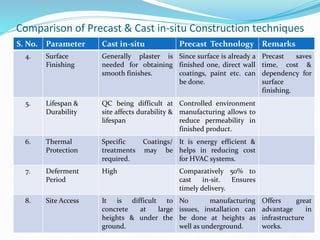
Comparison of Precast & Cast in-situ Construction techniques
S. No. Parameter Cast in-situ Precast Technology Remarks
4. Surface
Finishing
Generally plaster is
needed for obtaining
smooth finishes.
Since surface is already a
finished one, direct wall
coatings, paint etc. can
be done.
Precast saves
time, cost &
dependency for
surface
finishing.
5. Lifespan &
Durability
QC being difficult at
site affects durability &
lifespan
Controlled environment
manufacturing allows to
reduce permeability in
finished product.
6. Thermal
Protection
Specific Coatings/
treatments may be
required.
It is energy efficient &
helps in reducing cost
for HVAC systems.
7. Deferment
Period
High Comparatively 50% to
cast in-sit. Ensures
timely delivery.
8. Site Access It is difficult to
concrete at large
heights & under the
ground.
No manufacturing
issues, installation can
be done at heights as
well as underground.
Offers great
advantage in
infrastructure
works.
Disadvantage of using Precast Tech.
 High Initial Investment: Initial set up of machinery requires high investment,
therefore, it is not recommended for small-scale works.
 Transportation Issue: Transportation costs around 15-20% in case of precast
construction which is almost double. Also, access to most of the sites needs to
be rechecked & may involve high cost for logistic works.
 Handling Difficulties: Specific precautions, tools & practices are required.
Improper stacking & mishandling can lead to unnecessary cost & time delays.
 Complex Connections: Precise manufacturing with no tolerance is targeted to
avoid any problems during connection of different precast elements. However,
broken edges during mishandling may pose major problems.
 Modification: It is difficult to make modifications post installation in
comparison to cast in-situ. Hence requires strong planning in design &
manufacturing both.
 Camber issue: In case of pre-stressed precast wall panels, slabs, etc. camber can
be observed. Hence, screeding may be required in some cases which increases
the cost.
Dry Casting- Way Ahead in Precast
 In order to cater the large demand, dry casting was used as a prominent option
in which w/c ratio is reduced which resulted in increase of density of concrete
and allowed the usage of formwork for a very short time. In some industries
both dry & wet casting are done depending upon the type of element. Below is
a short detail on their comparison.
S. No. Parameter Wet Casting Dry Casting Remarks
1. Cost More Costly Less Costly
2. Slump High Slump Zero Slump
3. Speed/
Productivity
Formwork
cannot be
removed for
min. of 04 hrs
Formwork can be
removed shortly.
4. w/c Ratio More Up to 10% reduction in
comparison to wet cast
5. Aggregates Nominal size
can be used.
Up to max. 10mm are
recommended.
Applications of Dry Casting
 Following precast elements are prepared using dry casting technique in precast
industry.
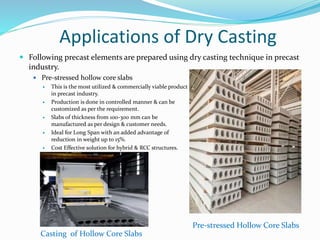
 Pre-stressed hollow core slabs
 This is the most utilized & commercially viable product
in precast industry.
 Production is done in controlled manner & can be
customized as per the requirement.
 Slabs of thickness from 100-300 mm can be
manufactured as per design & customer needs.
 Ideal for Long Span with an added advantage of
reduction in weight up to 15%.
 Cost Effective solution for hybrid & RCC structures.
Pre-stressed Hollow Core Slabs
Casting of Hollow Core Slabs
Applications of Dry Casting
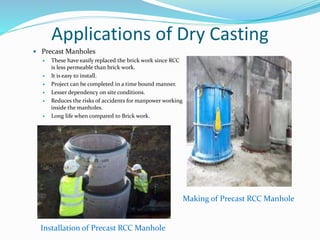
 Precast Manholes
 These have easily replaced the brick work since RCC
is less permeable than brick work.
 It is easy to install.
 Project can be completed in a time bound manner.
 Lesser dependency on site conditions.
 Reduces the risks of accidents for manpower working
inside the manholes.
 Long life when compared to Brick work.
Installation of Precast RCC Manhole
Making of Precast RCC Manhole
Applications of Dry Casting
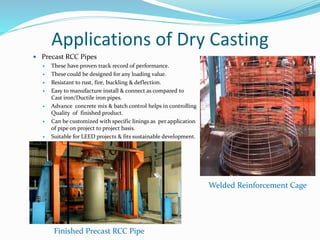
 Precast RCC Pipes
 These have proven track record of performance.
 These could be designed for any loading value.
 Resistant to rust, fire, buckling & deflection.
 Easy to manufacture install & connect as compared to
Cast iron/Ductile iron pipes.
 Advance concrete mix & batch control helps in controlling
Quality of finished product.
 Can be customized with specific linings as per application
of pipe on project to project basis.
 Suitable for LEED projects & fits sustainable development.
Welded Reinforcement Cage
Finished Precast RCC Pipe
Applications of Dry Casting
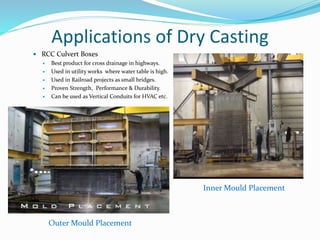
 RCC Culvert Boxes
 Best product for cross drainage in highways.
 Used in utility works where water table is high.
 Used in Railroad projects as small bridges.
 Proven Strength, Performance & Durability.
 Can be used as Vertical Conduits for HVAC etc.
Inner Mould Placement
Outer Mould Placement
Challenges for Precast Industry
 Improper Grouting/joint filling has been a major challenge and also
improvised techniques for the same are quite expensive.
 Inadequate bracing/ improper dowel lengths also result in weakening of
connections due to moments do not get transferred.
 Pin holes are generally found as a manufacturing defect which may be result of
improper vibrations or mixing of concrete.
 Elements of thickness less than 100mm pose a challenge developing cracks
during transportation & handling.
 Elements of width greater than 2400mm are also difficult to transportation
subjecting to availability of vehicle & road conditions for the site route.
 Projects in which elements are not repetitive & un-symmetrical can be
uneconomical with this technology.
 Advance Integration for piping & wiring is needed & also it is difficult to
modify the details at a later stage.
 Proper waterproofing solutions are necessary to avoid leakages through
junctions.
Supertech- My First Workplace
You can reach me on Linkedin for Any Questions!!!
Happy Learning!!!

Construction using Precast technology

  • 1.
    By Shubham Arora(GET-Civil) Supertech Limited, 4270
  • 2.
    Principles-Manufacturing Industry  Anyonestarts a business for earning profits, & in fast paced 20th century, for profits, one needs to survive in the competition & there is only “survival of the fittest”.  Manufacturing needs 5 more ‘Ms’, henceforth I have figured out 5 necessary principles/vertical which can be continuously improvised to meet specific customer requirements:  Marketing ( To grow & at least to generate fixed costs)  Materials (Quality Raw Materials)  Manpower (Highly skilled at their respective jobs)  Machinery ( To Reduce Errors & Dependency)  Manufacturing Processes (Improvisation of current techniques including reduction of wastage, etc.)
  • 3.
    Precasting- A ManufacturingUnit  Precasting- As the name suggests it is casting before hand & Precast Concrete indicates casting of Concrete before installation at site in controlled environment to avoid quality compromise which is difficult to control using conventional construction techniques. Precast-Footings Precast- Beams Precast- Slabs
  • 4.
    Precast Concrete asFinished Good!  Using Precast Concrete as a Finished Product involves basic 4 activities:  Production/ Manufacturing  Transportation  Installation  Grouting/Connections  Finishing works (if required) Production of Precast Element Transportation of Precast Elements Installation of Precast Elements
  • 5.
    Manufacturing of PrecastElements  Manufacturing involves precise planning of mould materials, raw materials, nesting & operation of all necessary machineries to be deputed.  Below chart shows a detail of activities involved- Project Planning & Scheduling Procurement of Raw Materials & Mould Materials Fabrication of Moulds Application of Mould oil Preparation of Reinforcement as per BBS Placement of Reinforcement Preparation of RMC Placing & Curing of Concrete De-moulding & Shifting to Stock Yard
  • 6.
    Manufacturing of PrecastElements Mould Fabrication Placement of Reinforcement Placing Concrete Final Element Final Element
  • 7.
    Transportation of PrecastElements  Unlike in case of conventional sites, transportation has a major role in construction using precast technology.  Precast Elements may develop cracks if loading, transit and unloading is done without due care.  Following measures are recommended-  Use of A-Frames  Use of Wooden Batten A-FrameWooden Battens
  • 8.
    Installation of PrecastElements  Stacking of Precast Elements: Stacking of precast needs special attention, as this may lead to damages, accidents & subsequently losses for a project. In stock yard or at site generally it is ignored, which leads to damages; forcing temporary repair to structural elements which can lead to rejections. Below is a figure showing the difference: Figure-1 Figure-2
  • 9.
    Installation of PrecastElements  Loading & Unloading of Precast Elements: Proper Cranes of required capacities & lifting anchors shall be used as per design/weight of precast elements. Loading positions shall be designed as per symmetric load distributions generating resultant with a single degree of freedom to avoid tilting/rotations. Below figures shows the same: Figure- 3 Figure- 4
  • 10.
    Installation of PrecastElements  Erection of Precast Elements: This needs a detail planning & coordination with each personnel on site. Below mentioned are steps that could improve efficiency and reduce contingencies during installation of precast elements.  Positioning of Crane: Crane Radius, Crane Installation point, Access to installation are the various factors which could help in deciding the position of crane.  Temporary Bracing: Installation of temporary bracings helps in adjustment of precast elements; These serve the major purpose during grouting/ connecting two different precast elements. These shall be removed post the grouting material gains proper strength. Below is a figure showing installation of temporary bracing. Figure-5
  • 11.
    Installation of PrecastElements  Communication: Recognized signals shall be used while erection of precast elements. Standard practices shown below may be referred.  Working at heights: Proper scaffholding & ladders may be used for working at heights above 2m or as per site requirements & feasibility. Figure-6 Figure-7
  • 12.
    Installation of PrecastElements  Connections of Precast Elements: There are basically 2 ways of connecting precast elements.  Dry Connections: These are basically mechanically spliced connections. Different types of couplers/ anchors are used as per the design and feasibility of the structure.  Wet Connections: These are connections in which concrete pouring is done at site by making two precast elements a monolithic structure. Dry Connection Wet Connection at Site
  • 13.
    Installation of PrecastElements  Connections of different structural element: Different precast elements are connected in different manner pertaining to stability of structure & making it a monolithic structure. However, connections should be checked for transmission of loads/moments. Connections should not pose stiffness & should offer required ductility for the structure to sway within desired limits, if any of case arises.  Below are few details. Beam-Column Connection with/without corbels
  • 14.
    Installation of PrecastElements Wall to Wall Connection Slab Beam Connection
  • 15.
    Comparison of Precast& Cast in-situ Construction techniques S. No. Parameter Cast in-situ Precast Technology Remarks 1. Quality Control/ Quality Assurance Highly dependent on workmanship, site conditions, weather, preparations, etc. Manufacturing is done in controlled environment & is machinery dependent High early strength can be achieved using steam curing, etc. Precast offers high end finishing. 2. Speed/Time Parallel installation is not possible as every activity takes it designated time & is sequence dependent. Installation is fast since readily made finished products are to be only connected. Early Strength helps in manufacturing large volumes & re- usage of same moulds Parallel manufacturin g can be done. 3. Cost Formwork, Manpower cost is very high. Less cost for manpower formwork Transportation cost plays major role. Per Cum cost is very less if volume is high.
  • 16.
    Comparison of Precast& Cast in-situ Construction techniques S. No. Parameter Cast in-situ Precast Technology Remarks 4. Surface Finishing Generally plaster is needed for obtaining smooth finishes. Since surface is already a finished one, direct wall coatings, paint etc. can be done. Precast saves time, cost & dependency for surface finishing. 5. Lifespan & Durability QC being difficult at site affects durability & lifespan Controlled environment manufacturing allows to reduce permeability in finished product. 6. Thermal Protection Specific Coatings/ treatments may be required. It is energy efficient & helps in reducing cost for HVAC systems. 7. Deferment Period High Comparatively 50% to cast in-sit. Ensures timely delivery. 8. Site Access It is difficult to concrete at large heights & under the ground. No manufacturing issues, installation can be done at heights as well as underground. Offers great advantage in infrastructure works.
  • 17.
    Disadvantage of usingPrecast Tech.  High Initial Investment: Initial set up of machinery requires high investment, therefore, it is not recommended for small-scale works.  Transportation Issue: Transportation costs around 15-20% in case of precast construction which is almost double. Also, access to most of the sites needs to be rechecked & may involve high cost for logistic works.  Handling Difficulties: Specific precautions, tools & practices are required. Improper stacking & mishandling can lead to unnecessary cost & time delays.  Complex Connections: Precise manufacturing with no tolerance is targeted to avoid any problems during connection of different precast elements. However, broken edges during mishandling may pose major problems.  Modification: It is difficult to make modifications post installation in comparison to cast in-situ. Hence requires strong planning in design & manufacturing both.  Camber issue: In case of pre-stressed precast wall panels, slabs, etc. camber can be observed. Hence, screeding may be required in some cases which increases the cost.
  • 18.
    Dry Casting- WayAhead in Precast  In order to cater the large demand, dry casting was used as a prominent option in which w/c ratio is reduced which resulted in increase of density of concrete and allowed the usage of formwork for a very short time. In some industries both dry & wet casting are done depending upon the type of element. Below is a short detail on their comparison. S. No. Parameter Wet Casting Dry Casting Remarks 1. Cost More Costly Less Costly 2. Slump High Slump Zero Slump 3. Speed/ Productivity Formwork cannot be removed for min. of 04 hrs Formwork can be removed shortly. 4. w/c Ratio More Up to 10% reduction in comparison to wet cast 5. Aggregates Nominal size can be used. Up to max. 10mm are recommended.
  • 19.
    Applications of DryCasting  Following precast elements are prepared using dry casting technique in precast industry.  Pre-stressed hollow core slabs  This is the most utilized & commercially viable product in precast industry.  Production is done in controlled manner & can be customized as per the requirement.  Slabs of thickness from 100-300 mm can be manufactured as per design & customer needs.  Ideal for Long Span with an added advantage of reduction in weight up to 15%.  Cost Effective solution for hybrid & RCC structures. Pre-stressed Hollow Core Slabs Casting of Hollow Core Slabs
  • 20.
    Applications of DryCasting  Precast Manholes  These have easily replaced the brick work since RCC is less permeable than brick work.  It is easy to install.  Project can be completed in a time bound manner.  Lesser dependency on site conditions.  Reduces the risks of accidents for manpower working inside the manholes.  Long life when compared to Brick work. Installation of Precast RCC Manhole Making of Precast RCC Manhole
  • 21.
    Applications of DryCasting  Precast RCC Pipes  These have proven track record of performance.  These could be designed for any loading value.  Resistant to rust, fire, buckling & deflection.  Easy to manufacture install & connect as compared to Cast iron/Ductile iron pipes.  Advance concrete mix & batch control helps in controlling Quality of finished product.  Can be customized with specific linings as per application of pipe on project to project basis.  Suitable for LEED projects & fits sustainable development. Welded Reinforcement Cage Finished Precast RCC Pipe
  • 22.
    Applications of DryCasting  RCC Culvert Boxes  Best product for cross drainage in highways.  Used in utility works where water table is high.  Used in Railroad projects as small bridges.  Proven Strength, Performance & Durability.  Can be used as Vertical Conduits for HVAC etc. Inner Mould Placement Outer Mould Placement
  • 23.
    Challenges for PrecastIndustry  Improper Grouting/joint filling has been a major challenge and also improvised techniques for the same are quite expensive.  Inadequate bracing/ improper dowel lengths also result in weakening of connections due to moments do not get transferred.  Pin holes are generally found as a manufacturing defect which may be result of improper vibrations or mixing of concrete.  Elements of thickness less than 100mm pose a challenge developing cracks during transportation & handling.  Elements of width greater than 2400mm are also difficult to transportation subjecting to availability of vehicle & road conditions for the site route.  Projects in which elements are not repetitive & un-symmetrical can be uneconomical with this technology.  Advance Integration for piping & wiring is needed & also it is difficult to modify the details at a later stage.  Proper waterproofing solutions are necessary to avoid leakages through junctions.
  • 24.
  • 25.
    You can reachme on Linkedin for Any Questions!!! Happy Learning!!!