Webinar:  QA Three Best Practices March 11, 2009 3:30 PM – 5:00 PM
Jorge Luis Boria Sr. VP International Process Improvement Liveware Inc. [email_address] Michael Milutis Director of Marketing Computer Aid, Inc. (CAI) [email_address]
About  Presenter’s Firm LIVEWARE is a business consultant company in the field of Software Engineering. Since its creation in 1983 it has specialized in the dissemination, application and development of Software Engineering, particularly the concepts of Total Quality and the strategic value of Information Systems. In the past five years it developed a tight relationship with the Software Engineering Institute and is currently the sponsor of five lead appraisers, two certified high maturity lead appraisers, and two CMMI instructors.
CAI  is a global IT outsourcing firm currently managing active engagements with over 100 Fortune 1,000 companies and government agencies around the world.  CAI  is a leader in IT Best Practices for legacy support and new development application management.  CAI’s  focus is directed toward practical implementations that track and measure the right activities in software activity management  CAI  consistently promises and delivers double digit productivity in its outsourcing and consulting engagements.  CAI  makes all of this possible through the use of: Standard processes Management by metrics SLA compliance management Detailed cost, resource, and time tracking Capacity management  Standard estimation A unique, metrics based methodology along with a proprietary, real time data repository and management system  (TRACER®).   About Computer Aid, Inc. (CAI)
The Project Management Institute’s ISSIG group has accredited this webinar with PDUs Stay tuned! Your PDU code will be displayed at the conclusion of this webinar. PDU CREDITS  FOR THIS WEBINAR
NOW AVAILABLE!  ONLINE WEBINAR RECORDINGS  ANYTIME ACCESS! WWW. ITMPI.ORG / LIBRARY
Quality Assurance Role Provide teams and management with visibility into the process being used and into the products being built through: reviewing and auditing work products and team activities to verify compliance with procedures and to standards continues in next slide
Quality Assurance Role supplying teams and management with feedback on reviews and audits assisting in the definition of plans, standards, and procedures addressing non-compliance issues through vigilance and escalation from previous slide
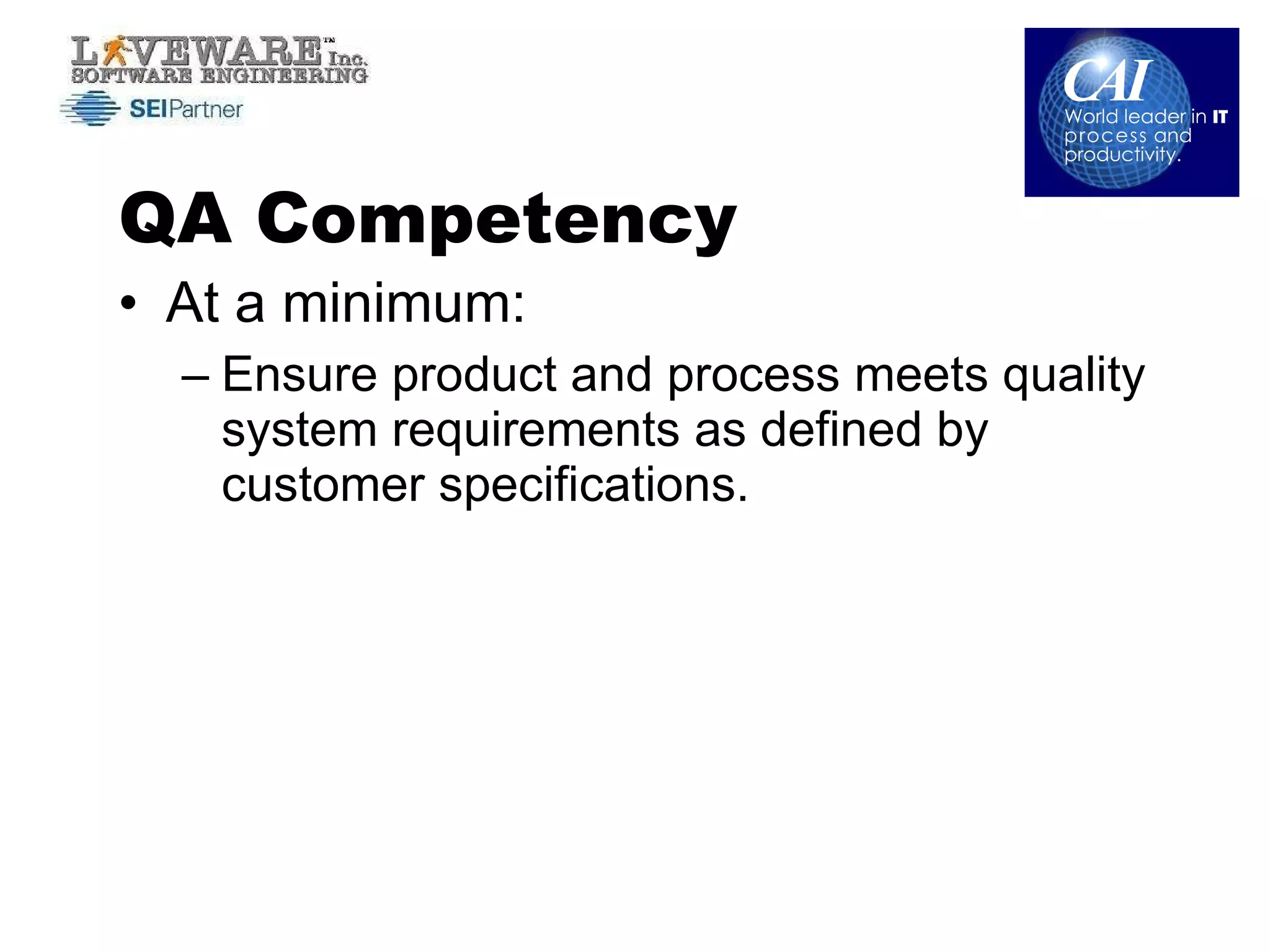
QA vs Testing Structural Verification Integration and System Functional Verification Validation  (User Acceptance) Component Functional Verification Non-functional Verification TESTING VALIDATE VERIFY BUILD Coding Requirements High Level Design Component Design Specification QA
QA Competency At a minimum: Ensure product and process meets quality system requirements as defined by customer specifications.
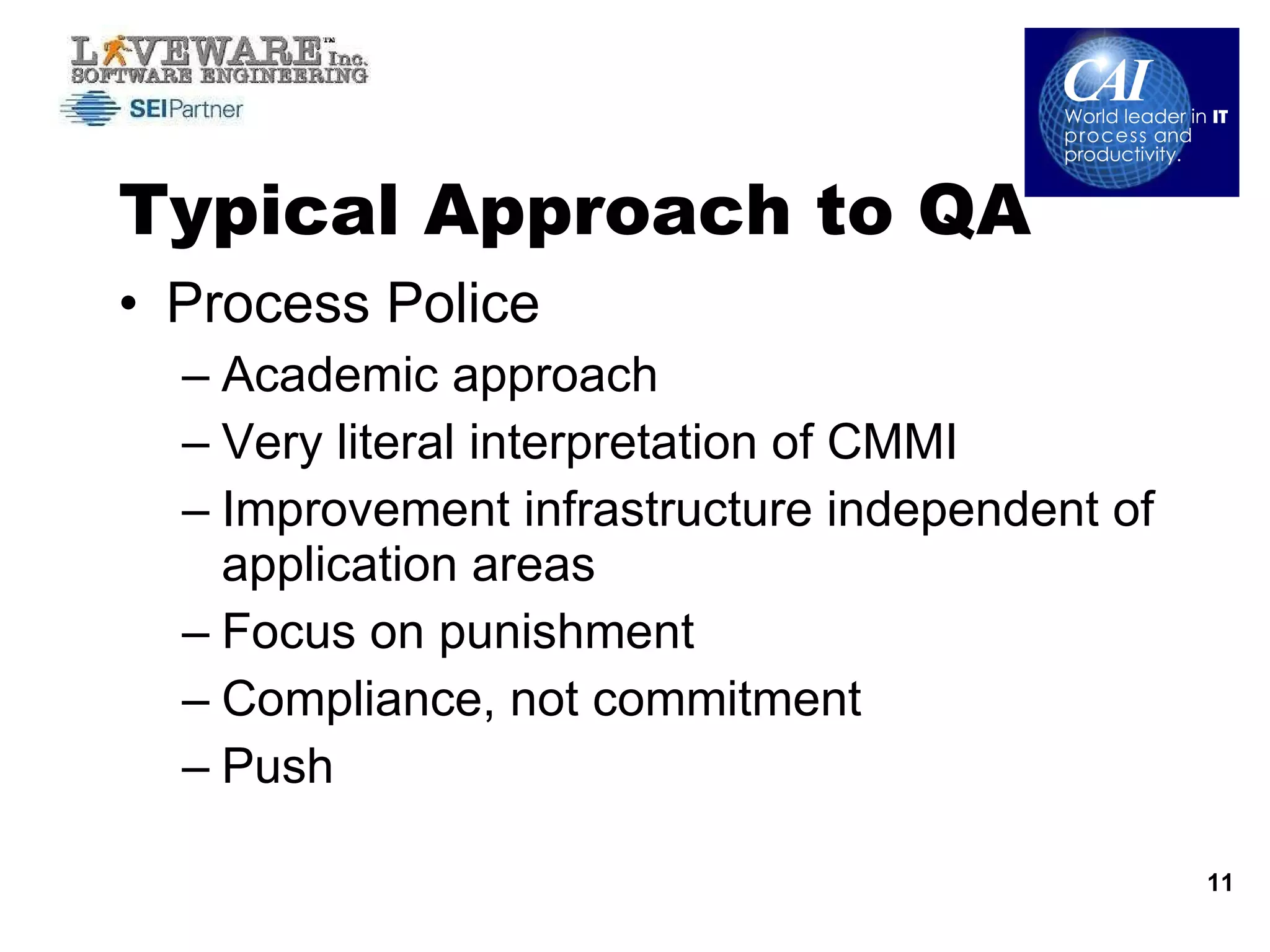
Typical Approach to QA Process Police Academic approach Very literal interpretation of CMMI Improvement infrastructure independent of application areas Focus on punishment Compliance, not commitment Push
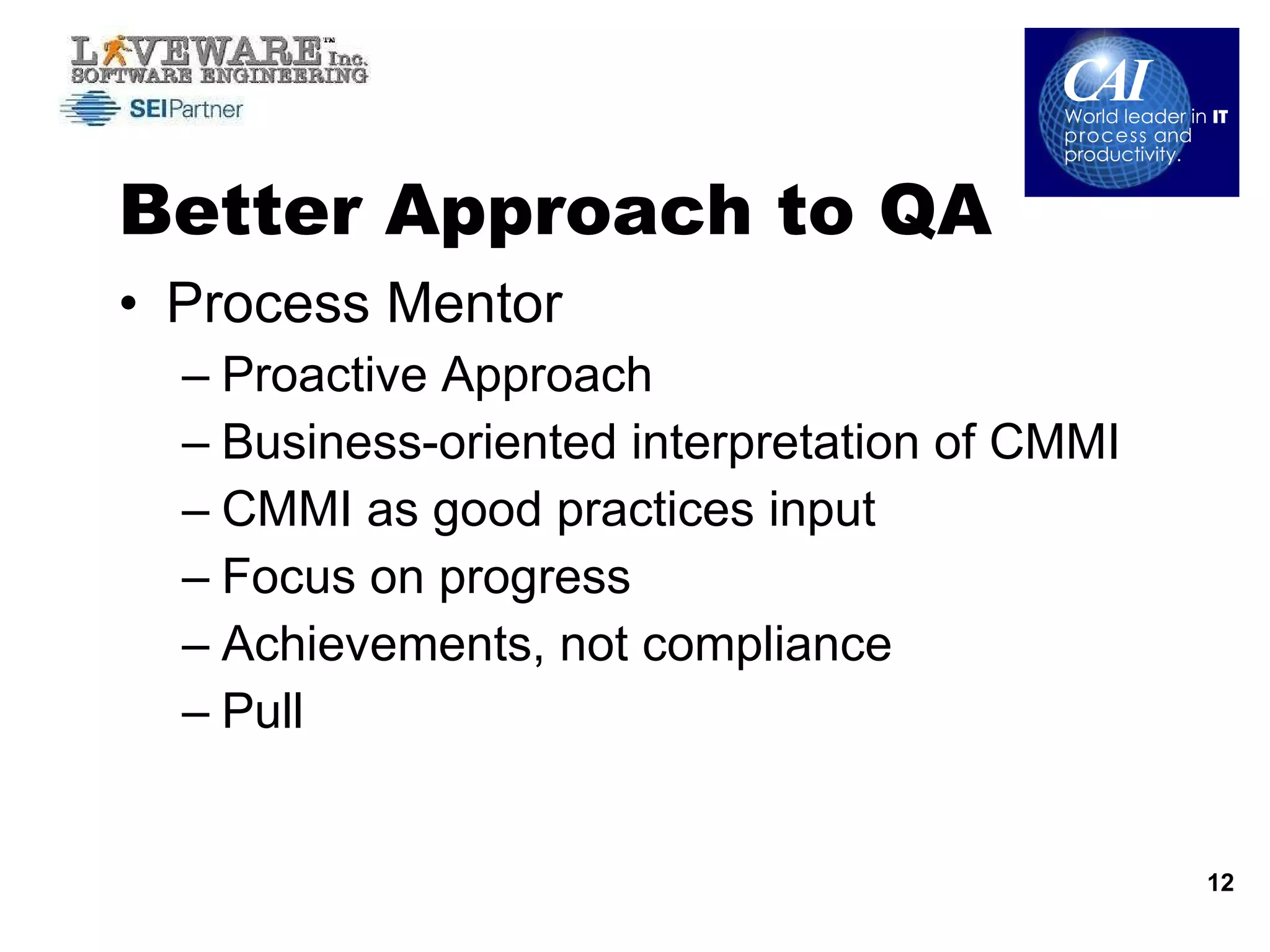
Better Approach to QA Process Mentor Proactive Approach Business-oriented interpretation of CMMI CMMI as good practices input Focus on progress Achievements, not compliance Pull
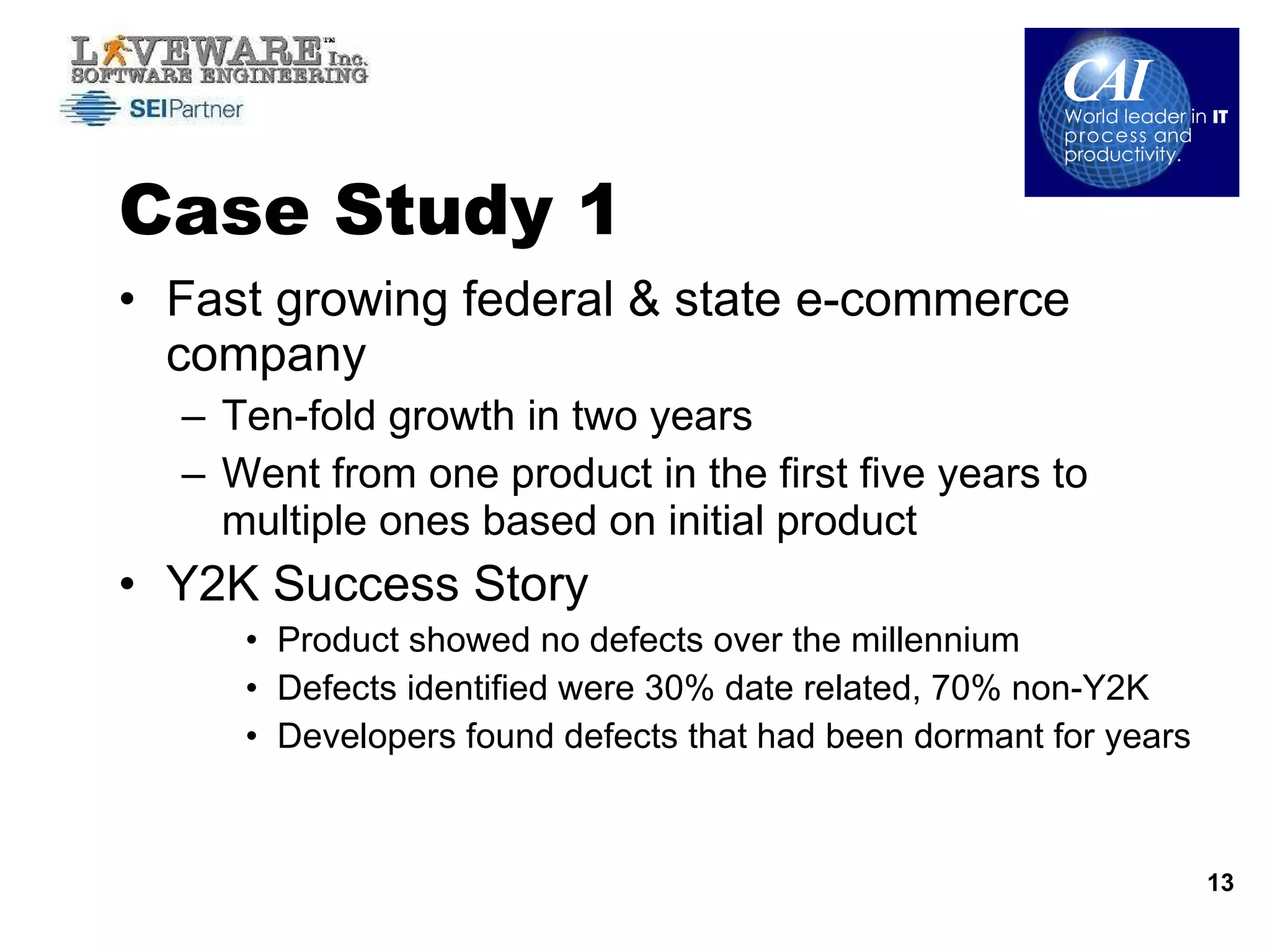
Case Study 1  Fast growing federal & state e-commerce company Ten-fold growth in two years Went from one product in the first five years to multiple ones based on initial product Y2K Success Story Product showed no defects over the millennium  Defects identified were 30% date related, 70% non-Y2K Developers found defects that had been dormant for years
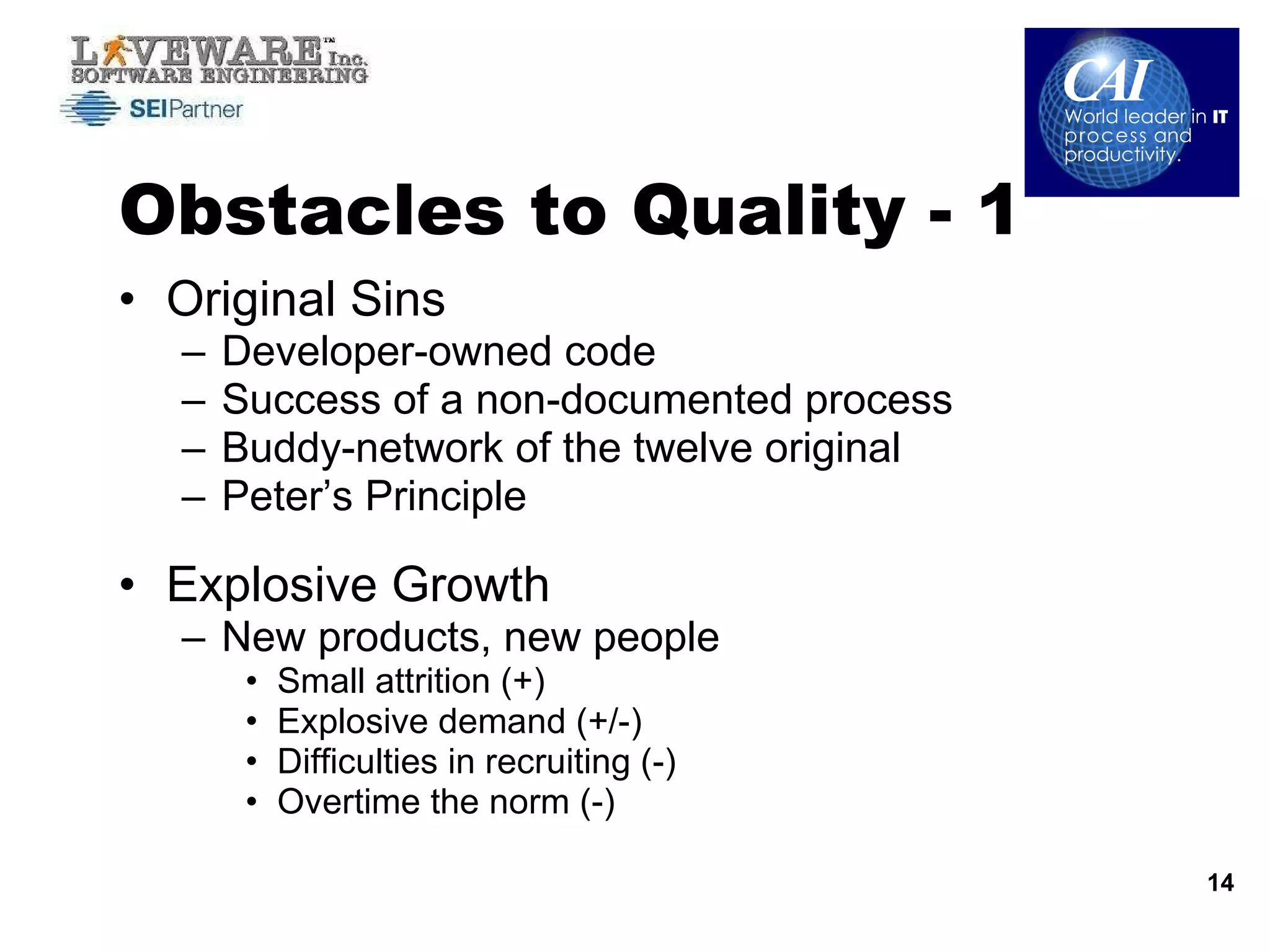
Obstacles to Quality - 1 Original Sins Developer-owned code Success of a non-documented process Buddy-network of the twelve original Peter’s Principle  Explosive Growth New products, new people Small attrition (+) Explosive demand (+/-) Difficulties in recruiting (-) Overtime the norm (-)
Obstacles to Quality - 2 Matrix Organization Project management vs. Project Administration Flexible yet chaotic team composition Project leadership power struggles Readiness for change highly challenged by volatility of all project components Requires strong discipline to succeed
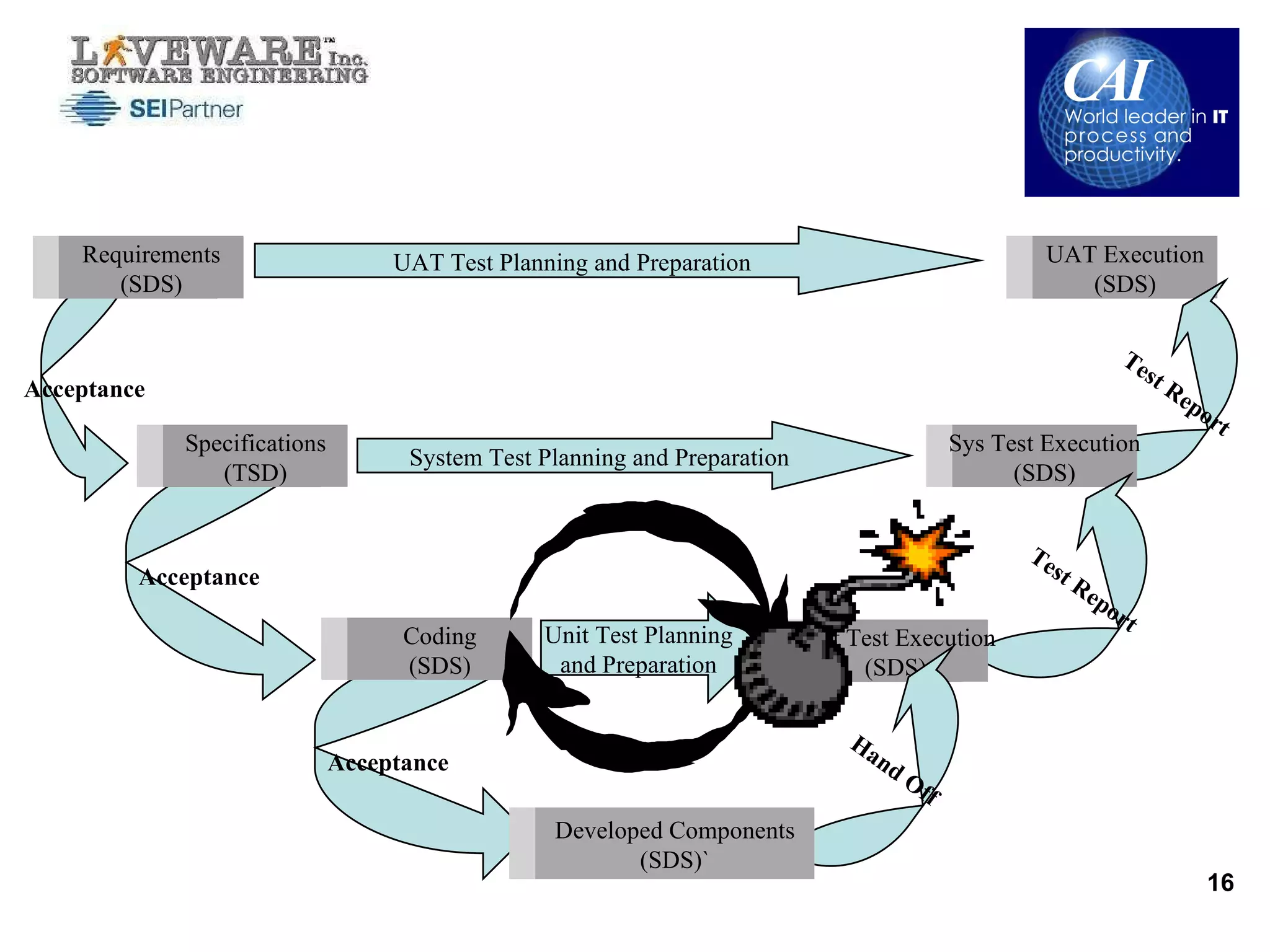
Context - 3 UAT Execution (SDS) Test Report Sys Test Execution (SDS) Test Report Acceptance UAT Test Planning and Preparation System Test Planning and Preparation Unit Test Planning and Preparation Acceptance Requirements (SDS) Acceptance Specifications (TSD) Coding (SDS) Unit Test Execution (SDS) Hand Off Developed Components (SDS)`
First Process Change Shared test cases across testing, analysis and development teams Immediate payback with early detection  Shorter integration phase New process required new skills SQA to help developers through the processes Requirements revealed as problem Pushback!
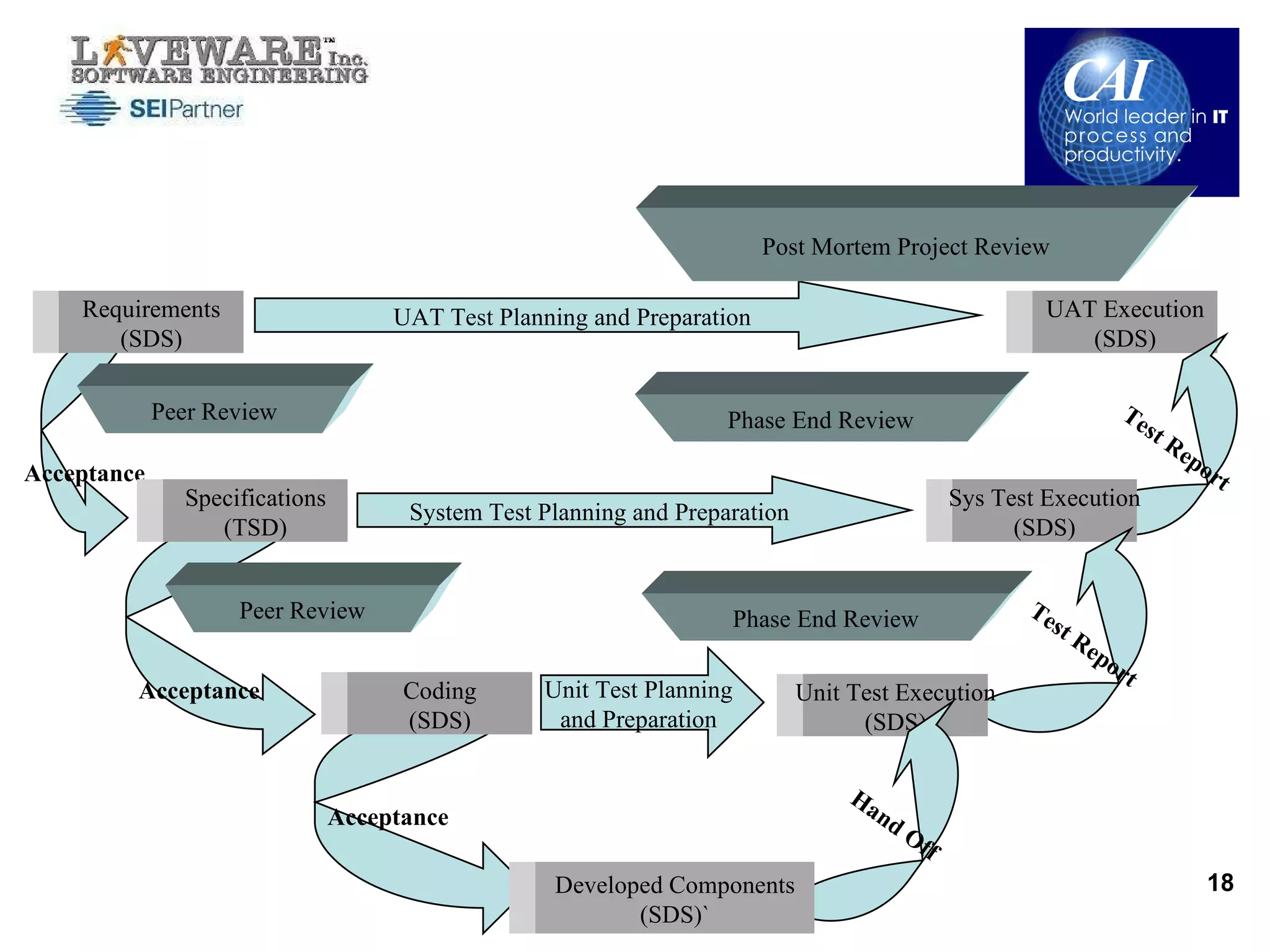
Context - 3 UAT Execution (SDS) Test Report Sys Test Execution (SDS) Test Report Acceptance UAT Test Planning and Preparation System Test Planning and Preparation Unit Test Planning and Preparation Acceptance Requirements (SDS) Acceptance Specifications (TSD) Coding (SDS) Unit Test Execution (SDS) Hand Off Developed Components (SDS)` Phase End Review Phase End Review Post Mortem Project Review Peer Review Peer Review
Progress Attained Requirements problems fixed Peer reviewed and agreed upon by testers and developers alike Baselined, accessible to all and put under change control and as root of the traceability matrix (under testers control) QA now seen as supporting projects  Waiving unnecessary procedures  No longer “process police”
And Compliance? Testing (SQC) as the enforcers  (at each transition) Process a consequence of their need to do good work Validated by  past  success in Y2K and  need to use process deliverables Handovers became smooth
The Good News Quality counts went up  Number of builds between freeze and release reduced by 50% Test preparation time vs. execution time changed from 20%-80% to 70%-30% Moving 50% of the total effort out of the project’s critical path Defects caught by developers increased an order of magnitude Developers pushing involvement of testers early in review of requirements and design specifications
Success Factors – 1 QA engineers (proactive support) had process ownership could talk the talk and walk the walk perceived as rescuing the project from itself Testing engineers (compliance control) technical authority from Y2K good reasons to demand process commitment responsibility over the traceability matrix perceived as process-focused, not witch-hunters
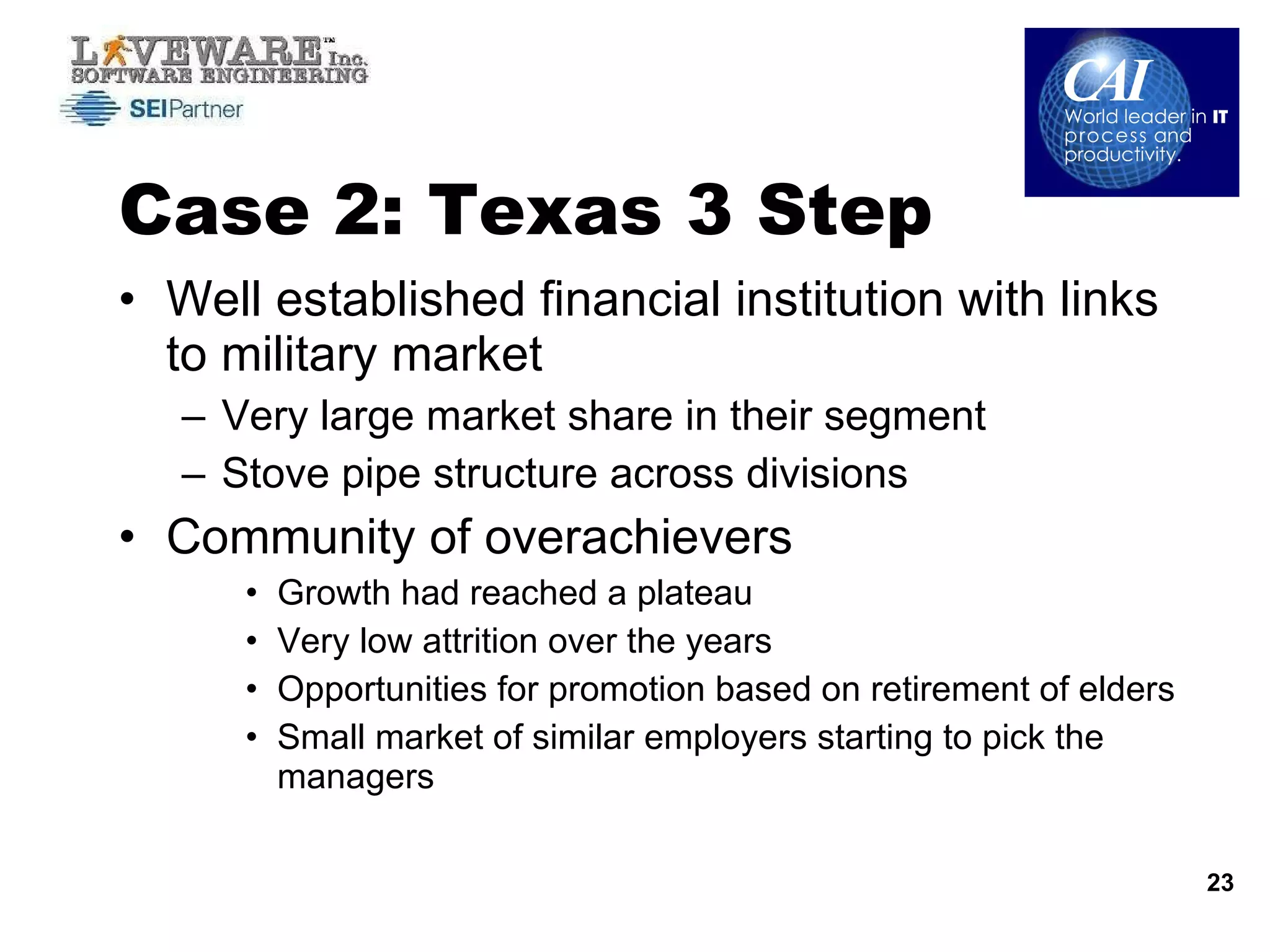
Case 2: Texas 3 Step Well established financial institution with links to military market Very large market share in their segment Stove pipe structure across divisions  Community of overachievers Growth had reached a plateau  Very low attrition over the years Opportunities for promotion based on retirement of elders Small market of similar employers starting to pick the managers
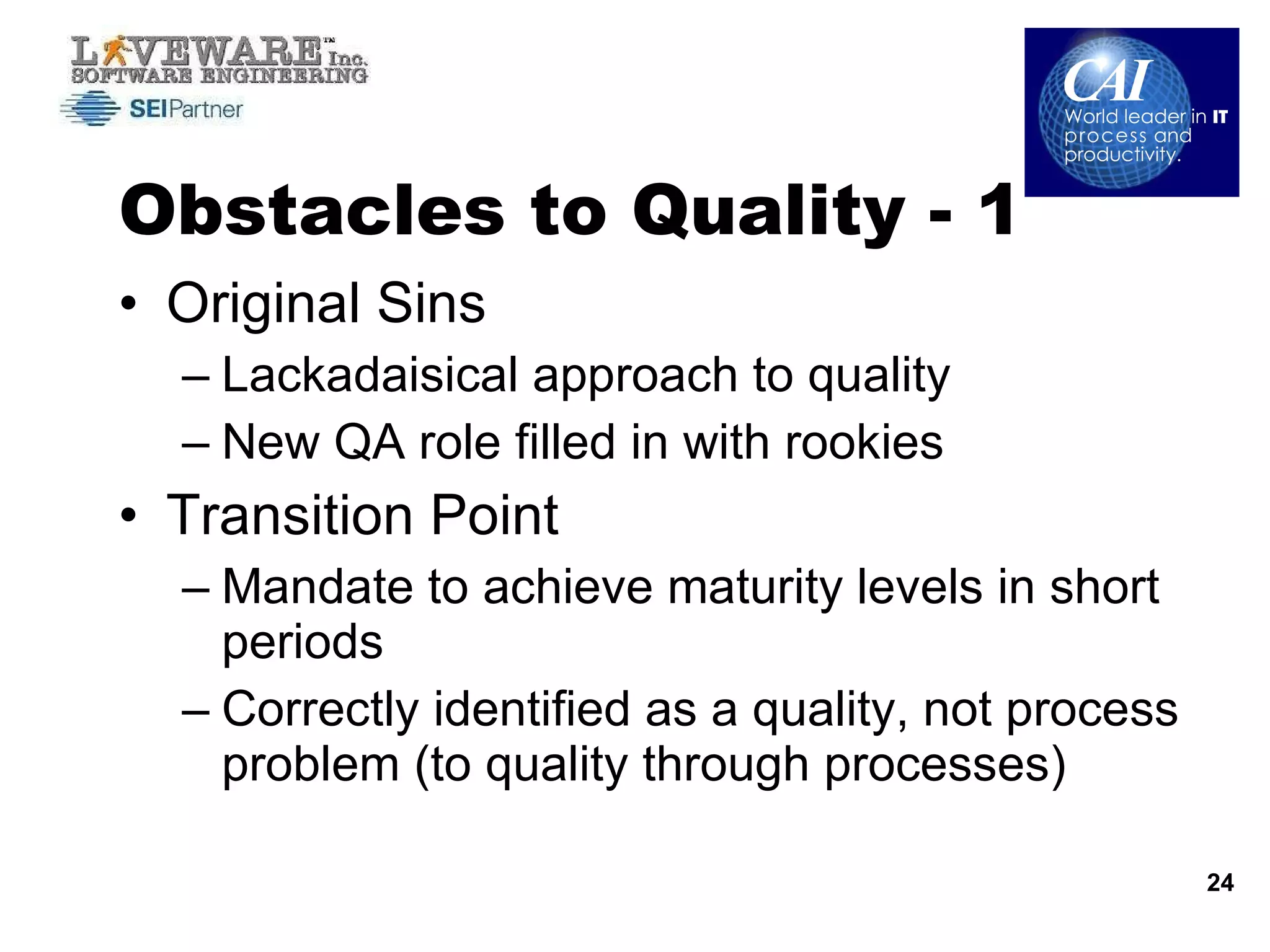
Obstacles to Quality - 1 Original Sins Lackadaisical approach to quality New QA role filled in with rookies Transition Point Mandate to achieve maturity levels in short periods  Correctly identified as a quality, not process problem (to quality through processes)
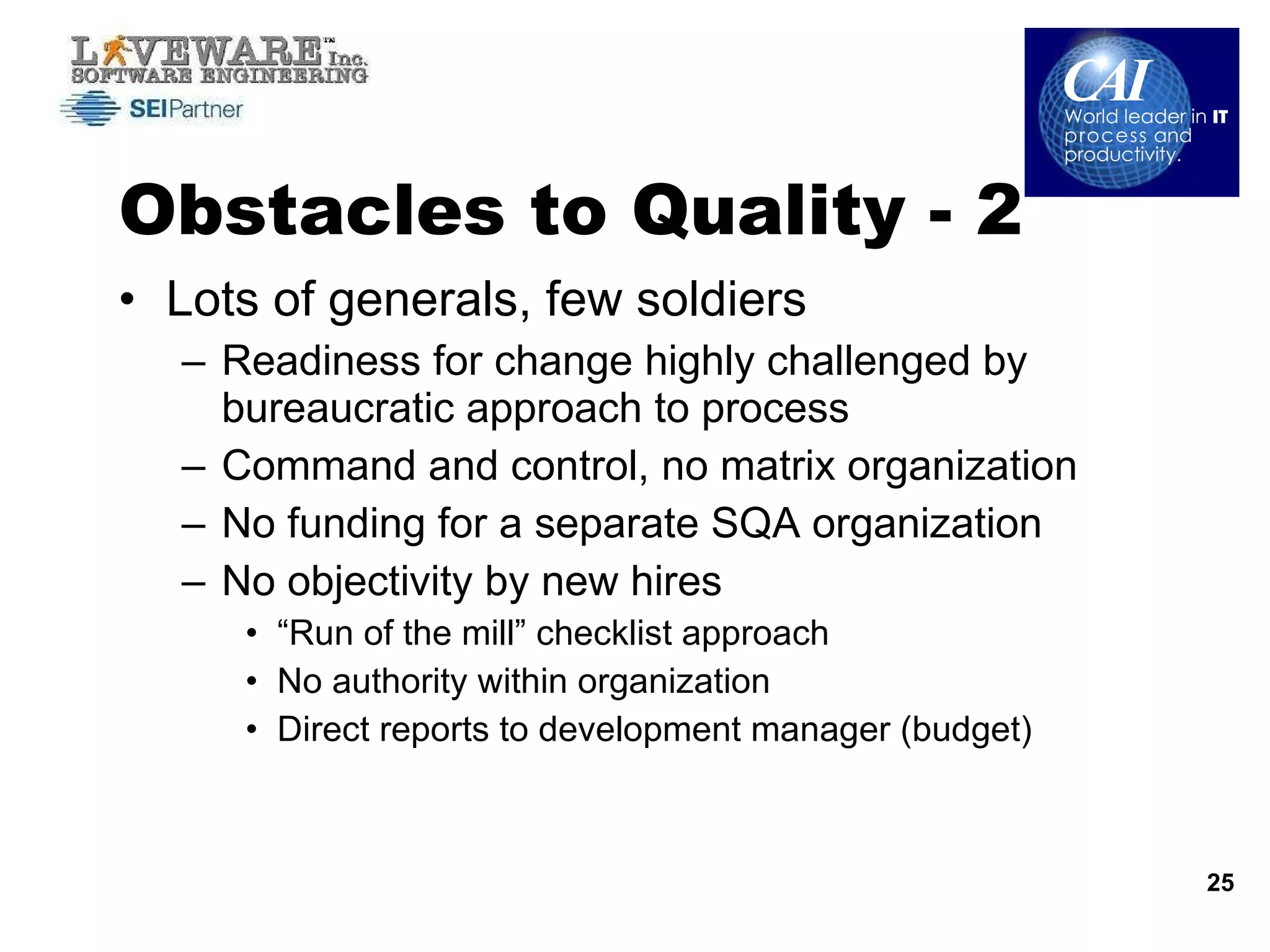
Obstacles to Quality - 2 Lots of generals, few soldiers Readiness for change highly challenged by bureaucratic approach to process Command and control, no matrix organization No funding for a separate SQA organization No objectivity by new hires “ Run of the mill” checklist approach No authority within organization Direct reports to development manager (budget)
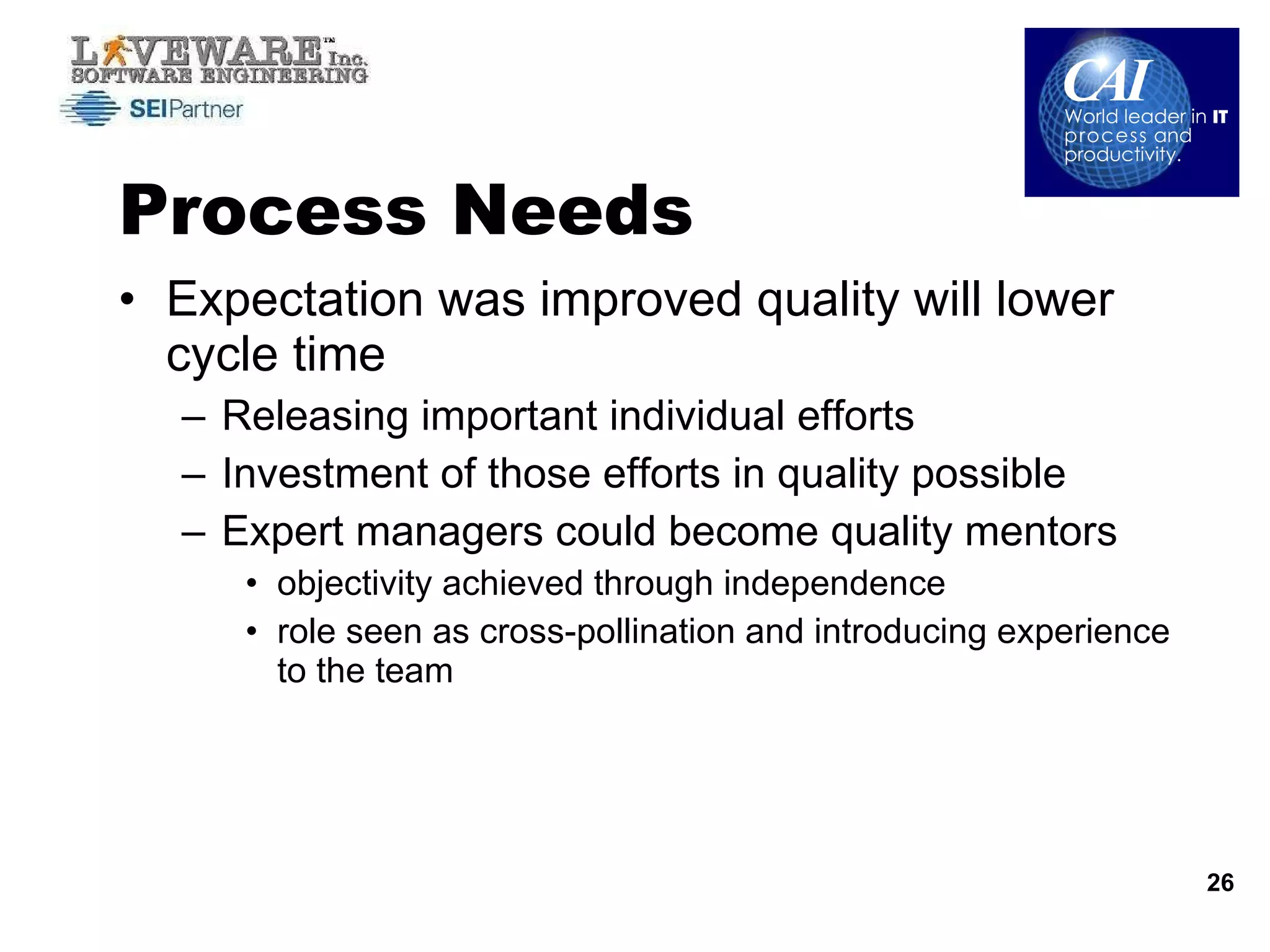
Process Needs Expectation was improved quality will lower cycle time Releasing important individual efforts Investment of those efforts in quality possible Expert managers could become quality mentors objectivity achieved through independence role seen as cross-pollination and introducing experience to the team
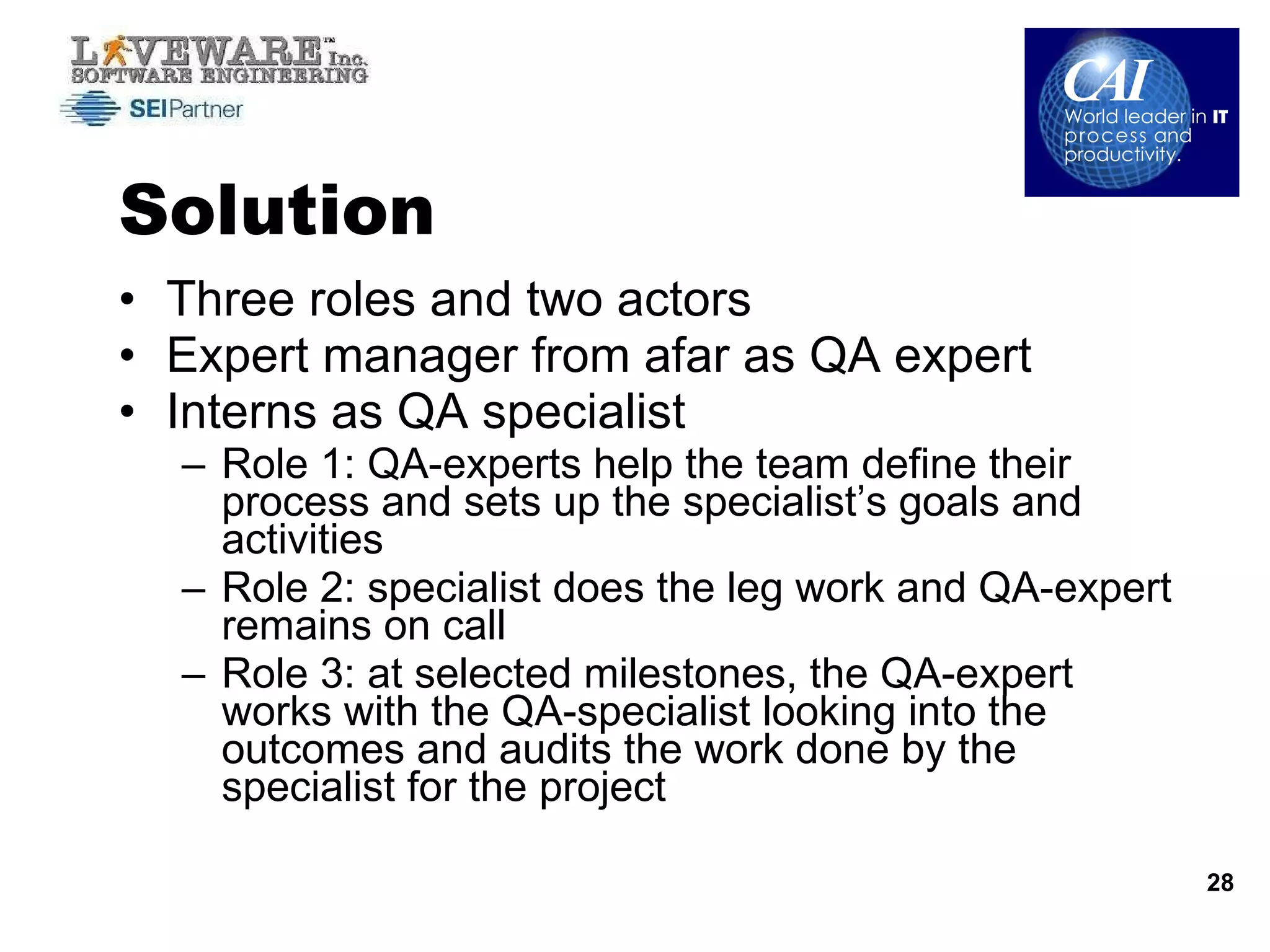
New Obstacle Expert manager too expensive to perform menial tasks Filling in checklist Supporting template use Doing the paperwork
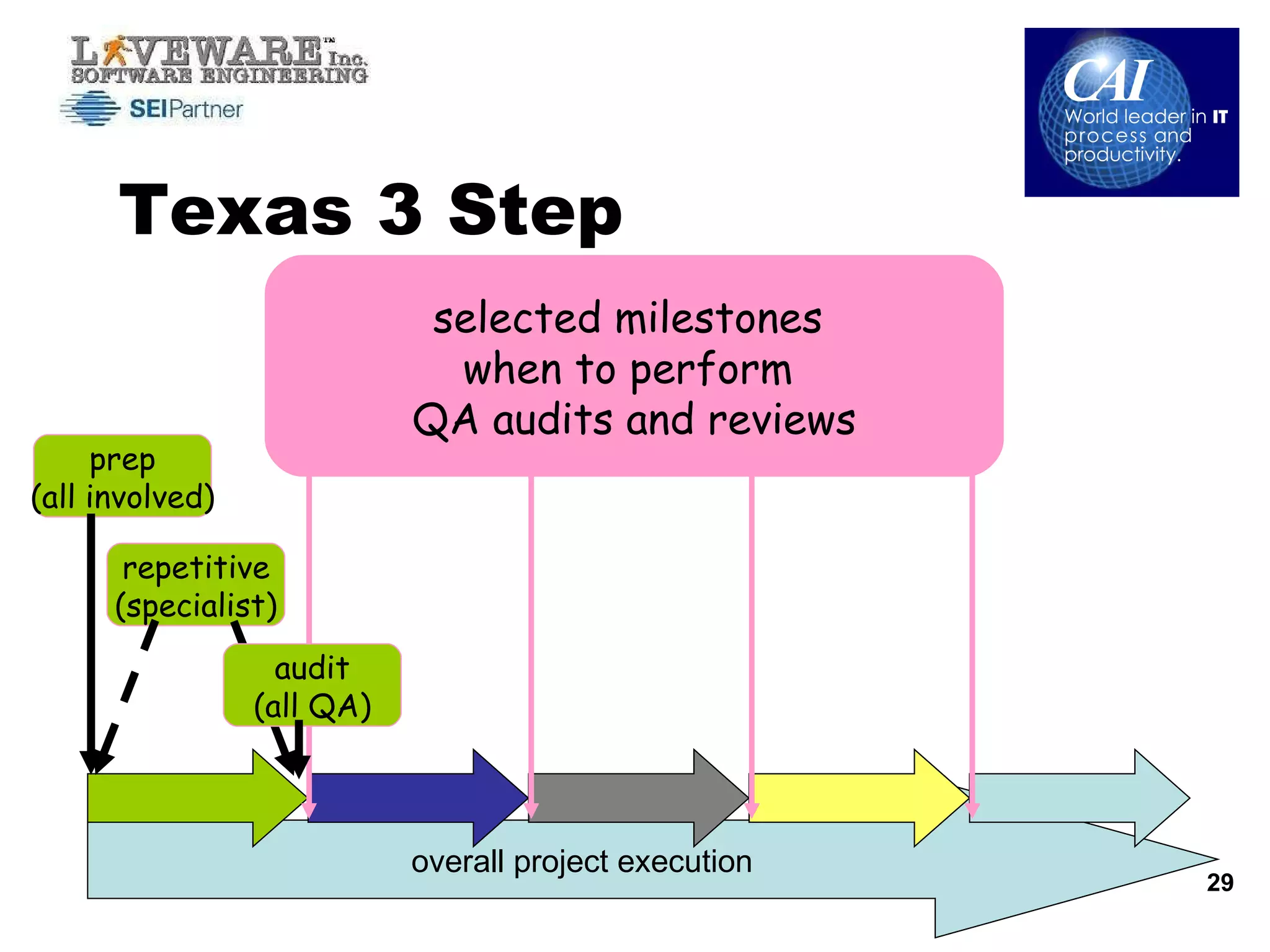
Solution Three roles and two actors  Expert manager from afar as QA expert Interns as QA specialist Role 1: QA-experts help the team define their process and sets up the specialist’s goals and activities Role 2: specialist does the leg work and QA-expert remains on call Role 3: at selected milestones, the QA-expert works with the QA-specialist looking into the outcomes and audits the work done by the specialist for the project
Texas 3 Step overall project execution selected milestones  when to perform  QA audits and reviews prep (all involved) repetitive (specialist) audit (all QA)
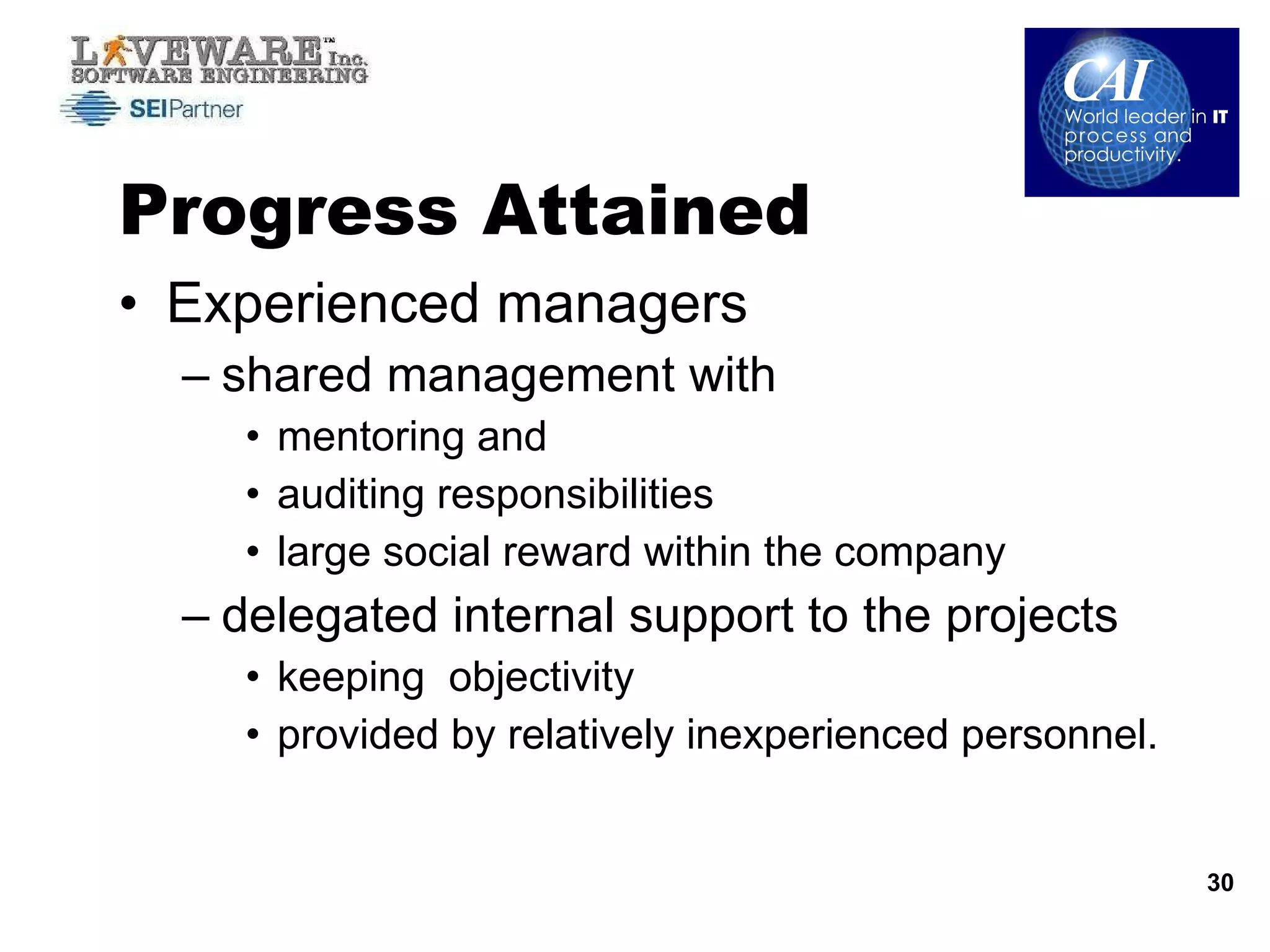
Progress Attained Experienced managers  shared management with  mentoring and  auditing responsibilities  large social reward within the company delegated internal support to the projects keeping  objectivity provided by relatively inexperienced personnel.
The Good News Steep learning curve  100% process compliance in six months  Significantly shortened delivery dates (no hard data)
Success Factors – 2 Experienced Managers  authority from experience and reputation perceived as process focused, not witch-hunters knowledge on how to make things happen faster and better Internal QA resources  artifact responsibility talked the talk and walked the walk perceived as helping the project doing productive work
Case 3: Another Division Well established financial institution with links to military market Very large market share in their segment Stove pipe structure across divisions  Community of overachievers Growth had reached a plateau  Very low attrition over the years Opportunities for promotion based on retirement of elders Small market of similar employers starting to pick the managers  Same Old Story
Obstacles to Quality - 1 Original Sins Lackadaisical approach to quality New QA role filled in with rookies Transition Point Mandate to achieve maturity levels in short periods  Correctly identified as a quality, not process problem (to quality through processes) Same Old Story
Obstacles to Quality - 2 Lots of generals, few soldiers Readiness for change highly challenged by bureaucratic approach to process Command and control, no matrix organization No funding for a separate SQA organization No objectivity by new hires “ Run of the mill” checklist approach No authority within organization Direct reports to development manager (budget) Same Old Story
Process Change Expectation was improved quality will lower cycle time Releasing important individual efforts Investment of those efforts in quality possible Expert managers could become quality mentors objectivity achieved through independence role seen as cross-pollination and introducing experience to the team Same Old Story
New Approach Expert managers seen as stopped in their tracks by lack of open positions neighboring companies picking their up and coming managers opportunity for a new parallel track money not the problem lack of open positions IS the problem
Solution New QA function  Using experienced senior managers with responsibility over  mentoring  auditing the work of up-and coming first line managers making “ it” happen Line managers promoted to QA Up and coming getting the jobs
Progress Attained Experienced managers  shared management with  mentoring and  auditing responsibilities  large social reward within the company delegated internal support to the projects keeping  objectivity provided by relatively inexperienced personnel.
The Good News New role well positioned by CEO  Perceived as promotion in a clogged career ladder New QA group found it very easy to coordinate work  Their advice was very sound  the organization quickly closed ranks behind them organization was first one in the company to reach Maturity Level 2 achieved in only six months.
Success Factors – 3  Experienced Senior Managers  authority from experience and reputation perceived as process focused, not witch-hunters knowledge to make things happen faster and better “been there, done that” process responsibility at Level 2 could talk the talk and walk the walk perceived as helping the project do productive work
Common CSF – 1  Use of Experienced Personnel  had authority from experience and reputation were perceived as process focused, not witch-hunters had the knowledge to make things happen faster and better
Common CSF – 2  Focus on progress help the projects to help the process improvement program avoid the “Gotcha!” attitude make thinks happen, treat project members as adults
Questions? Your PDU CODE: S010-ITMPI09015
CAI Sponsors  The IT Metrics & Productivity Institute: Clearinghouse repository of best practices:  WWW.ITMPI.ORG   Weekly educational newsletter:  WWW.ITMPI.ORG  / SUBSCRIBE Weekly webinars hosted by industry leaders:  WWW.ITMPI.ORG  / WEBINARS ACCESS WEBINAR RECORDINGS ANYTIME AT  WWW.ITMPI.ORG  / LIBRARY
Software Best Practices Conferences Around the World WWW.ITMPI.ORG  / EVENTS   Mar. 10 Orlando, FL Mar. 31 Albany, NY Apr. 9 Baton Rouge, LA Apr. 28 Tallahassee, FL Apr. 30 Detroit, MI May 14 Tampa, FL May 19 Philadelphia, PA June 2  Hartford, CT 2009 Dates and Locations June 9 Houston, TX June 11 New York, NY Sep. 15 Toronto, ON Sep. 22 Chicago, IL Sep. 29 New York, NY Oct. 6 Baltimore, MD Oct. 20 Philadelphia, PA Nov. 10 Princeton, NJ Nov. 17 Ft. Lauderdale, FL
Jorge Luis Boria Sr. VP International Process Improvement Liveware Inc. [email_address] Michael Milutis Director of Marketing Computer Aid, Inc. (CAI) [email_address]

Qa 3 best practices

  • 1.
    Webinar: QAThree Best Practices March 11, 2009 3:30 PM – 5:00 PM
  • 2.
    Jorge Luis BoriaSr. VP International Process Improvement Liveware Inc. [email_address] Michael Milutis Director of Marketing Computer Aid, Inc. (CAI) [email_address]
  • 3.
    About Presenter’sFirm LIVEWARE is a business consultant company in the field of Software Engineering. Since its creation in 1983 it has specialized in the dissemination, application and development of Software Engineering, particularly the concepts of Total Quality and the strategic value of Information Systems. In the past five years it developed a tight relationship with the Software Engineering Institute and is currently the sponsor of five lead appraisers, two certified high maturity lead appraisers, and two CMMI instructors.
  • 4.
    CAI isa global IT outsourcing firm currently managing active engagements with over 100 Fortune 1,000 companies and government agencies around the world. CAI is a leader in IT Best Practices for legacy support and new development application management. CAI’s focus is directed toward practical implementations that track and measure the right activities in software activity management CAI consistently promises and delivers double digit productivity in its outsourcing and consulting engagements. CAI makes all of this possible through the use of: Standard processes Management by metrics SLA compliance management Detailed cost, resource, and time tracking Capacity management Standard estimation A unique, metrics based methodology along with a proprietary, real time data repository and management system (TRACER®). About Computer Aid, Inc. (CAI)
  • 5.
    The Project ManagementInstitute’s ISSIG group has accredited this webinar with PDUs Stay tuned! Your PDU code will be displayed at the conclusion of this webinar. PDU CREDITS FOR THIS WEBINAR
  • 6.
    NOW AVAILABLE! ONLINE WEBINAR RECORDINGS ANYTIME ACCESS! WWW. ITMPI.ORG / LIBRARY
  • 7.
    Quality Assurance RoleProvide teams and management with visibility into the process being used and into the products being built through: reviewing and auditing work products and team activities to verify compliance with procedures and to standards continues in next slide
  • 8.
    Quality Assurance Rolesupplying teams and management with feedback on reviews and audits assisting in the definition of plans, standards, and procedures addressing non-compliance issues through vigilance and escalation from previous slide
  • 9.
    QA vs TestingStructural Verification Integration and System Functional Verification Validation (User Acceptance) Component Functional Verification Non-functional Verification TESTING VALIDATE VERIFY BUILD Coding Requirements High Level Design Component Design Specification QA
  • 10.
    QA Competency Ata minimum: Ensure product and process meets quality system requirements as defined by customer specifications.
  • 11.
    Typical Approach toQA Process Police Academic approach Very literal interpretation of CMMI Improvement infrastructure independent of application areas Focus on punishment Compliance, not commitment Push
  • 12.
    Better Approach toQA Process Mentor Proactive Approach Business-oriented interpretation of CMMI CMMI as good practices input Focus on progress Achievements, not compliance Pull
  • 13.
    Case Study 1 Fast growing federal & state e-commerce company Ten-fold growth in two years Went from one product in the first five years to multiple ones based on initial product Y2K Success Story Product showed no defects over the millennium Defects identified were 30% date related, 70% non-Y2K Developers found defects that had been dormant for years
  • 14.
    Obstacles to Quality- 1 Original Sins Developer-owned code Success of a non-documented process Buddy-network of the twelve original Peter’s Principle Explosive Growth New products, new people Small attrition (+) Explosive demand (+/-) Difficulties in recruiting (-) Overtime the norm (-)
  • 15.
    Obstacles to Quality- 2 Matrix Organization Project management vs. Project Administration Flexible yet chaotic team composition Project leadership power struggles Readiness for change highly challenged by volatility of all project components Requires strong discipline to succeed
  • 16.
    Context - 3UAT Execution (SDS) Test Report Sys Test Execution (SDS) Test Report Acceptance UAT Test Planning and Preparation System Test Planning and Preparation Unit Test Planning and Preparation Acceptance Requirements (SDS) Acceptance Specifications (TSD) Coding (SDS) Unit Test Execution (SDS) Hand Off Developed Components (SDS)`
  • 17.
    First Process ChangeShared test cases across testing, analysis and development teams Immediate payback with early detection Shorter integration phase New process required new skills SQA to help developers through the processes Requirements revealed as problem Pushback!
  • 18.
    Context - 3UAT Execution (SDS) Test Report Sys Test Execution (SDS) Test Report Acceptance UAT Test Planning and Preparation System Test Planning and Preparation Unit Test Planning and Preparation Acceptance Requirements (SDS) Acceptance Specifications (TSD) Coding (SDS) Unit Test Execution (SDS) Hand Off Developed Components (SDS)` Phase End Review Phase End Review Post Mortem Project Review Peer Review Peer Review
  • 19.
    Progress Attained Requirementsproblems fixed Peer reviewed and agreed upon by testers and developers alike Baselined, accessible to all and put under change control and as root of the traceability matrix (under testers control) QA now seen as supporting projects Waiving unnecessary procedures No longer “process police”
  • 20.
    And Compliance? Testing(SQC) as the enforcers (at each transition) Process a consequence of their need to do good work Validated by past success in Y2K and need to use process deliverables Handovers became smooth
  • 21.
    The Good NewsQuality counts went up Number of builds between freeze and release reduced by 50% Test preparation time vs. execution time changed from 20%-80% to 70%-30% Moving 50% of the total effort out of the project’s critical path Defects caught by developers increased an order of magnitude Developers pushing involvement of testers early in review of requirements and design specifications
  • 22.
    Success Factors –1 QA engineers (proactive support) had process ownership could talk the talk and walk the walk perceived as rescuing the project from itself Testing engineers (compliance control) technical authority from Y2K good reasons to demand process commitment responsibility over the traceability matrix perceived as process-focused, not witch-hunters
  • 23.
    Case 2: Texas3 Step Well established financial institution with links to military market Very large market share in their segment Stove pipe structure across divisions Community of overachievers Growth had reached a plateau Very low attrition over the years Opportunities for promotion based on retirement of elders Small market of similar employers starting to pick the managers
  • 24.
    Obstacles to Quality- 1 Original Sins Lackadaisical approach to quality New QA role filled in with rookies Transition Point Mandate to achieve maturity levels in short periods Correctly identified as a quality, not process problem (to quality through processes)
  • 25.
    Obstacles to Quality- 2 Lots of generals, few soldiers Readiness for change highly challenged by bureaucratic approach to process Command and control, no matrix organization No funding for a separate SQA organization No objectivity by new hires “ Run of the mill” checklist approach No authority within organization Direct reports to development manager (budget)
  • 26.
    Process Needs Expectationwas improved quality will lower cycle time Releasing important individual efforts Investment of those efforts in quality possible Expert managers could become quality mentors objectivity achieved through independence role seen as cross-pollination and introducing experience to the team
  • 27.
    New Obstacle Expertmanager too expensive to perform menial tasks Filling in checklist Supporting template use Doing the paperwork
  • 28.
    Solution Three rolesand two actors Expert manager from afar as QA expert Interns as QA specialist Role 1: QA-experts help the team define their process and sets up the specialist’s goals and activities Role 2: specialist does the leg work and QA-expert remains on call Role 3: at selected milestones, the QA-expert works with the QA-specialist looking into the outcomes and audits the work done by the specialist for the project
  • 29.
    Texas 3 Stepoverall project execution selected milestones when to perform QA audits and reviews prep (all involved) repetitive (specialist) audit (all QA)
  • 30.
    Progress Attained Experiencedmanagers shared management with mentoring and auditing responsibilities large social reward within the company delegated internal support to the projects keeping objectivity provided by relatively inexperienced personnel.
  • 31.
    The Good NewsSteep learning curve 100% process compliance in six months Significantly shortened delivery dates (no hard data)
  • 32.
    Success Factors –2 Experienced Managers authority from experience and reputation perceived as process focused, not witch-hunters knowledge on how to make things happen faster and better Internal QA resources artifact responsibility talked the talk and walked the walk perceived as helping the project doing productive work
  • 33.
    Case 3: AnotherDivision Well established financial institution with links to military market Very large market share in their segment Stove pipe structure across divisions Community of overachievers Growth had reached a plateau Very low attrition over the years Opportunities for promotion based on retirement of elders Small market of similar employers starting to pick the managers Same Old Story
  • 34.
    Obstacles to Quality- 1 Original Sins Lackadaisical approach to quality New QA role filled in with rookies Transition Point Mandate to achieve maturity levels in short periods Correctly identified as a quality, not process problem (to quality through processes) Same Old Story
  • 35.
    Obstacles to Quality- 2 Lots of generals, few soldiers Readiness for change highly challenged by bureaucratic approach to process Command and control, no matrix organization No funding for a separate SQA organization No objectivity by new hires “ Run of the mill” checklist approach No authority within organization Direct reports to development manager (budget) Same Old Story
  • 36.
    Process Change Expectationwas improved quality will lower cycle time Releasing important individual efforts Investment of those efforts in quality possible Expert managers could become quality mentors objectivity achieved through independence role seen as cross-pollination and introducing experience to the team Same Old Story
  • 37.
    New Approach Expertmanagers seen as stopped in their tracks by lack of open positions neighboring companies picking their up and coming managers opportunity for a new parallel track money not the problem lack of open positions IS the problem
  • 38.
    Solution New QAfunction Using experienced senior managers with responsibility over mentoring auditing the work of up-and coming first line managers making “ it” happen Line managers promoted to QA Up and coming getting the jobs
  • 39.
    Progress Attained Experiencedmanagers shared management with mentoring and auditing responsibilities large social reward within the company delegated internal support to the projects keeping objectivity provided by relatively inexperienced personnel.
  • 40.
    The Good NewsNew role well positioned by CEO Perceived as promotion in a clogged career ladder New QA group found it very easy to coordinate work Their advice was very sound the organization quickly closed ranks behind them organization was first one in the company to reach Maturity Level 2 achieved in only six months.
  • 41.
    Success Factors –3 Experienced Senior Managers authority from experience and reputation perceived as process focused, not witch-hunters knowledge to make things happen faster and better “been there, done that” process responsibility at Level 2 could talk the talk and walk the walk perceived as helping the project do productive work
  • 42.
    Common CSF –1 Use of Experienced Personnel had authority from experience and reputation were perceived as process focused, not witch-hunters had the knowledge to make things happen faster and better
  • 43.
    Common CSF –2 Focus on progress help the projects to help the process improvement program avoid the “Gotcha!” attitude make thinks happen, treat project members as adults
  • 44.
    Questions? Your PDUCODE: S010-ITMPI09015
  • 45.
    CAI Sponsors The IT Metrics & Productivity Institute: Clearinghouse repository of best practices: WWW.ITMPI.ORG Weekly educational newsletter: WWW.ITMPI.ORG / SUBSCRIBE Weekly webinars hosted by industry leaders: WWW.ITMPI.ORG / WEBINARS ACCESS WEBINAR RECORDINGS ANYTIME AT WWW.ITMPI.ORG / LIBRARY
  • 46.
    Software Best PracticesConferences Around the World WWW.ITMPI.ORG / EVENTS Mar. 10 Orlando, FL Mar. 31 Albany, NY Apr. 9 Baton Rouge, LA Apr. 28 Tallahassee, FL Apr. 30 Detroit, MI May 14 Tampa, FL May 19 Philadelphia, PA June 2 Hartford, CT 2009 Dates and Locations June 9 Houston, TX June 11 New York, NY Sep. 15 Toronto, ON Sep. 22 Chicago, IL Sep. 29 New York, NY Oct. 6 Baltimore, MD Oct. 20 Philadelphia, PA Nov. 10 Princeton, NJ Nov. 17 Ft. Lauderdale, FL
  • 47.
    Jorge Luis BoriaSr. VP International Process Improvement Liveware Inc. [email_address] Michael Milutis Director of Marketing Computer Aid, Inc. (CAI) [email_address]

Editor's Notes

  • #2 The purpose of this webinar is to discuss issues that impact the effectiveness of IT organizations. Our discussion will be limited to IT Service Delivery (problem resolution, consultation requests, enhancements and projects). We will not be addressing Infrastructure or Operations Management issues.
  • #11 Entry-Level Critical Work Functions Ensure materials, processes and final product meet quality specifications. Support and maintain quality systems. Comply with local, federal and company health, safety and environmental regulations. Identify unsafe conditions and take corrective actions. Entry-Level Technical Content Areas Quality Assurance Meeting Customer Needs Lean Manufacturing Quality Management Systems and Tools Industry Standards Improving Quality Introduction to Statistical Process Control Sampling and Charting Problem Solving Tools Inspecting for Quality Inspecting Raw/Incoming Materials Inspecting In-Process Product Inspecting Final Products Continuous Improvement Business Process Reengineering Systems Analysis Data Analysis Performance improvement strategies Technician-Level Critical Work Functions Monitor production for product and process quality Employ audits and inspections to maintain the quality and continuous improvement process Correct the product and process to meet quality standards Suggest and/or implement continuous improvement actions Technician-Level Technical Content Areas Probability and Statistics Data Analysis and Presentation Presentation Skills Query-Based Intermediate Computer Skills Facilitation Skills Business Case Statistical Process Control Methods Factor Analysis Capability Analysis- Inspection/Test/Validation Reliability Analysis Acceptance Sampling Quality Assurance Audits ISO 9000 Audit Procedures Corrective and Preventive Actions Eliminating Non-Conformities Verification and Documentation Documentation Creation Benchmarking and Best Practice
  • #12 Fix what hasn’t been working: Academic approach: Literal Interpretation: Infrastructure: Management Visibility: Process Changes: Fragmented Improvements: Build on things that Do work: Project management process: Significant effort in this area over the last 5 years. L2 discipline evident in recent mini-assessments.
  • #13 Fix what hasn’t been working: Academic approach: Literal Interpretation: Infrastructure: Management Visibility: Process Changes: Fragmented Improvements: Build on things that Do work: Project management process: Significant effort in this area over the last 5 years. L2 discipline evident in recent mini-assessments.