OVERVIEW OF TEST
PROCESS IMPROVEMENT
FRAMEWORKS
Nikita Knysh, Ciklum, February 21, 2012
Speaker
 Nikita Knysh, 31 y.o.
 E-comonic, Ciklum
 11 years in IT, 5 years in software test
 ISTQB Certified Test Manager
Agenda
 The way of improvement
 Why use process frameworks
 TMM
 TPI
 CTP
 STEP
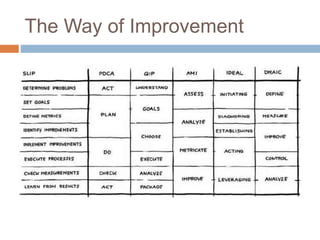
The Way of Improvement
Why Use Process Frameworks
 Get aware of industry practices
 See where we are, measure process maturity
 Compare to others
 Suggest improvements, set goals
 Evaluate improvement
Test Maturity Model (TMM)
 Complements CMM
 Establish basics first, then grow
 Staged
 Need to achieve previous level to claim for next
 Once a level is achieved, no further improvement
needed in it
 Binary
 You either fulfill or not. A stage cannot be 50%
fulfilled
Test Maturity Model (TMM)
 The five maturity levels
 Initial
 Defined
 Integrated
 Managed and measured
 Optimized
 Documentation-intensive.
 Suitable for contractual test, in regulated
industries, where auditable process is required.
Test Process Improvement
(TPI)
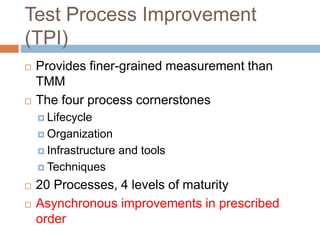
 Provides finer-grained measurement than
TMM
 The four process cornerstones
 Lifecycle
 Organization
 Infrastructure and tools
 Techniques
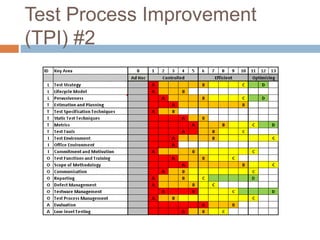
 20 Processes, 4 levels of maturity
 Asynchronous improvements in prescribed
order
Test Process Improvement
(TPI) #2
Test Process Improvement
(TPI) #3
 Allows to establish the process and start add
value quickly, then improve steadily and
incrementally
 Suitable for startups or introducing QA function
to existing companies
Critical Testing Processes
(CTP)
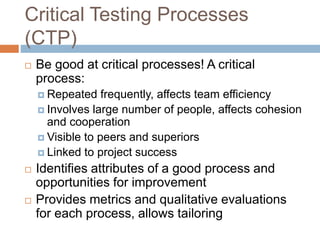
 Be good at critical processes! A critical
process:
 Repeated frequently, affects team efficiency
 Involves large number of people, affects cohesion
and cooperation
 Visible to peers and superiors
 Linked to project success
 Identifies attributes of a good process and
opportunities for improvement
 Provides metrics and qualitative evaluations
for each process, allows tailoring
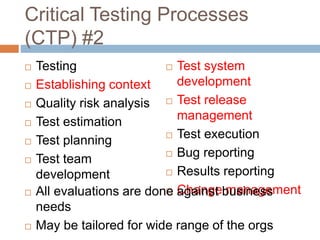
Critical Testing Processes
(CTP) #2
 Testing
 Establishing context
 Quality risk analysis
 Test estimation
 Test planning
 Test team
development
 Test system
development
 Test release
management
 Test execution
 Bug reporting
 Results reporting
 Change management All evaluations are done against business
needs
 May be tailored for wide range of the orgs
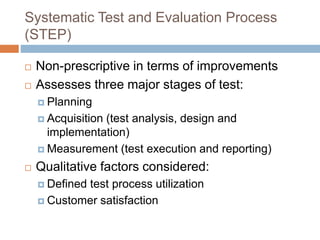
Systematic Test and Evaluation Process
(STEP)
 Non-prescriptive in terms of improvements
 Assesses three major stages of test:
 Planning
 Acquisition (test analysis, design and
implementation)
 Measurement (test execution and reporting)
 Qualitative factors considered:
 Defined test process utilization
 Customer satisfaction
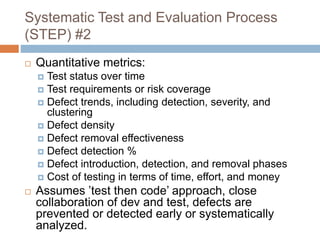
Systematic Test and Evaluation Process
(STEP) #2
 Quantitative metrics:
 Test status over time
 Test requirements or risk coverage
 Defect trends, including detection, severity, and
clustering
 Defect density
 Defect removal effectiveness
 Defect detection %
 Defect introduction, detection, and removal phases
 Cost of testing in terms of time, effort, and money
 Assumes ’test then code’ approach, close
collaboration of dev and test, defects are
prevented or detected early or systematically
analyzed.
Some Other Frameworks
 Test Organization Maturity (TOM)
 Test Improvement Model (TIM)
 Software Quality Rank (SQR)
 TMap
Thank you!
 Questions

Overview of test process improvement frameworks

  • 1.
    OVERVIEW OF TEST PROCESSIMPROVEMENT FRAMEWORKS Nikita Knysh, Ciklum, February 21, 2012
  • 2.
    Speaker  Nikita Knysh,31 y.o.  E-comonic, Ciklum  11 years in IT, 5 years in software test  ISTQB Certified Test Manager
  • 3.
    Agenda  The wayof improvement  Why use process frameworks  TMM  TPI  CTP  STEP
  • 4.
    The Way ofImprovement
  • 5.
    Why Use ProcessFrameworks  Get aware of industry practices  See where we are, measure process maturity  Compare to others  Suggest improvements, set goals  Evaluate improvement
  • 6.
    Test Maturity Model(TMM)  Complements CMM  Establish basics first, then grow  Staged  Need to achieve previous level to claim for next  Once a level is achieved, no further improvement needed in it  Binary  You either fulfill or not. A stage cannot be 50% fulfilled
  • 7.
    Test Maturity Model(TMM)  The five maturity levels  Initial  Defined  Integrated  Managed and measured  Optimized  Documentation-intensive.  Suitable for contractual test, in regulated industries, where auditable process is required.
  • 8.
    Test Process Improvement (TPI) Provides finer-grained measurement than TMM  The four process cornerstones  Lifecycle  Organization  Infrastructure and tools  Techniques  20 Processes, 4 levels of maturity  Asynchronous improvements in prescribed order
  • 9.
  • 10.
    Test Process Improvement (TPI)#3  Allows to establish the process and start add value quickly, then improve steadily and incrementally  Suitable for startups or introducing QA function to existing companies
  • 11.
    Critical Testing Processes (CTP) Be good at critical processes! A critical process:  Repeated frequently, affects team efficiency  Involves large number of people, affects cohesion and cooperation  Visible to peers and superiors  Linked to project success  Identifies attributes of a good process and opportunities for improvement  Provides metrics and qualitative evaluations for each process, allows tailoring
  • 12.
    Critical Testing Processes (CTP)#2  Testing  Establishing context  Quality risk analysis  Test estimation  Test planning  Test team development  Test system development  Test release management  Test execution  Bug reporting  Results reporting  Change management All evaluations are done against business needs  May be tailored for wide range of the orgs
  • 13.
    Systematic Test andEvaluation Process (STEP)  Non-prescriptive in terms of improvements  Assesses three major stages of test:  Planning  Acquisition (test analysis, design and implementation)  Measurement (test execution and reporting)  Qualitative factors considered:  Defined test process utilization  Customer satisfaction
  • 14.
    Systematic Test andEvaluation Process (STEP) #2  Quantitative metrics:  Test status over time  Test requirements or risk coverage  Defect trends, including detection, severity, and clustering  Defect density  Defect removal effectiveness  Defect detection %  Defect introduction, detection, and removal phases  Cost of testing in terms of time, effort, and money  Assumes ’test then code’ approach, close collaboration of dev and test, defects are prevented or detected early or systematically analyzed.
  • 15.
    Some Other Frameworks Test Organization Maturity (TOM)  Test Improvement Model (TIM)  Software Quality Rank (SQR)  TMap
  • 16.

Editor's Notes

  • #6 - A framework is a set of practices and measurements
  • #13 Establishing context: study documents, talking to project stakeholders, fitting in organization and its operation Test system development: identify specific tests to address critical quality risks, designing and implementing test cases, data, scripts, environments, documenting tests and test coverage Test release management: delivery of a known set of components for testing, hand-off prom the project team to test team, balance need for quick feedback against need for testing progress (each release should be better than the previous) Change management: balancing risks and costs of change / bugfix with benefits and opportunities, select the right changes in the right order, balance schedule/budget/features/quality.