PROCESS IMPROVEMENT 
TOPIC 9 
1
Process improvement 
Understanding existing processes. 
Introducing process changes to achieve organisational 
objectives which are usually focused on quality 
improvement, cost reduction and schedule acceleration. 
Most process improvement work so far has focused on 
defect reduction. This reflects the increasing attention 
paid by industry to quality. 
However, other process attributes can be the focus of 
improvement 
2
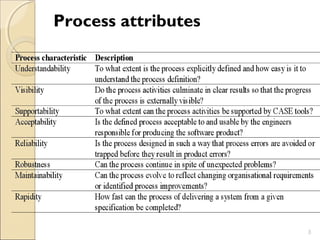
Process attributes 
3
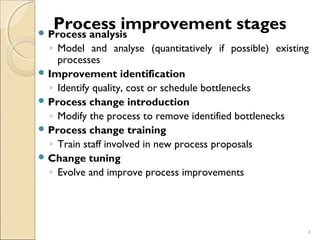
Process improvement stages Process analysis 
◦ Model and analyse (quantitatively if possible) existing 
processes 
Improvement identification 
◦ Identify quality, cost or schedule bottlenecks 
Process change introduction 
◦ Modify the process to remove identified bottlenecks 
Process change training 
◦ Train staff involved in new process proposals 
Change tuning 
◦ Evolve and improve process improvements 
4
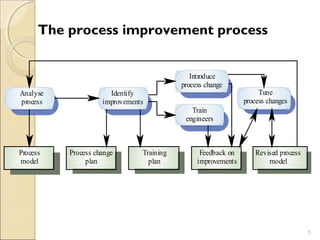
The process improvement process 
5 
Process 
model 
Process change 
plan 
Training 
plan 
Feedback on 
improvements 
Revised process 
model 
Analyse 
process 
Identify 
improvements 
Tune 
process changes 
Introduce 
process change 
Train 
engineers
Process and product quality 
Process quality and product quality are closely related. 
A good process is usually required to produce a good 
product. 
For manufactured goods, process is the 
principal quality determinant. 
For design-based activity, other factors are also involved 
especially the capabilities of the designers 
6
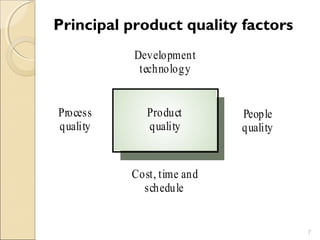
Principal product quality factors 
7 
Development 
technology 
Product 
quality 
Cost, time and 
schedule 
Process 
quality 
People 
quality
Quality factors 
For large projects with ‘average’ capabilities, the 
development process determines product quality. 
For small projects, the capabilities of the developers is the 
main determinant. 
The development technology is particularly significant for 
small projects. 
In all cases, if an unrealistic schedule is imposed then 
product quality will suffer. 
8
Process analysis and modelling 
Process analysis 
◦ The study of existing processes to understand the 
relationships between parts of the process and to 
compare them with other processes 
Process modelling 
◦ The documentation of a process which records the 
tasks, the roles and the entities used. 
◦ Process models may be presented from different 
perspectives. 
9
Process analysis and modelling 
Study an existing process to understand its 
activities. 
Produce an abstract model of the process. You should 
normally represent this graphically. Several different views 
(e.g. activities, deliverables, etc.) may be required. 
Analyse the model to discover process 
problems. Involves discussing activities with stakeholders. 
10
Process analysis techniques 
Published process models and process 
standards 
◦ It is always best to start process analysis with an 
existing model. People then may extend and change 
this. 
Questionnaires and interviews 
◦ Must be carefully designed. Participants may tell you 
what they think you want to hear 
Ethnographic analysis 
◦ Involves assimilating process knowledge by observation 
11
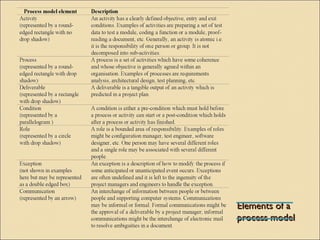
EElleemmeennttss ooff aa 
pprroocceessss mmooddeell
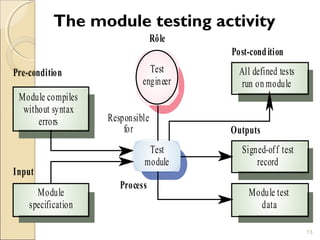
The module testing activity 
13 
Test 
module 
Signed-of f test 
record 
Module test 
data 
Module compiles 
without syntax 
errors 
Module 
specification 
All defined tests 
run on module 
Test 
engineer 
Pre-condition 
Input 
Process 
Rôle 
Post-cond ition 
Outputs 
Responsible 
for
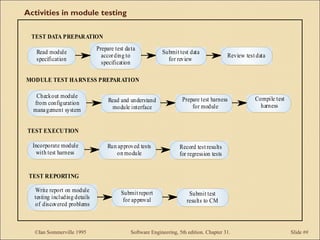
Activities in module testing 
Prepare test da ta 
accor ding to 
specification 
Read module 
specification 
Submit test data 
for review 
Review test data 
TEST DATA PREPARATION 
Read and understand 
module interface 
Checkout module 
from configuration 
mana gement system 
Prepare test harness 
for module 
Compile test 
harness 
MODULE TEST HARNESS PREPARATION 
Incorporate module 
with test harness 
Run approved tests 
on module 
Record test results 
for regression tests 
TEST EXECUTION 
Write report on module 
testing including details 
of discovered problems 
Submit report 
for approval 
Submit test 
results to CM 
TEST REPORTING 
©Ian Sommerville 1995 Software Engineering, 5th edition. Chapter 31. Slide ##
Process exceptions 
Software processes are complex and process models 
cannot effectively represent how to handle exceptions. 
◦ Several key people becoming ill just before a critical review. 
◦ A complete failure of a communication processor so that no e-mail 
is available for several days. 
◦ Organisational reorganisation. 
◦ A need to respond to an unanticipated request for new proposals. 
Under these circumstances, the model is suspended and 
managers use their initiative to deal with the exception. 
15
Process measurement 
Wherever possible, quantitative process data 
should be collected 
◦ However, where organisations do not have clearly 
defined process standards this is very difficult as you 
don’t know what to measure. A process may have to be 
defined before any measurement is possible 
Process measurements should be used to 
assess process improvements 
◦ But this does not mean that measurements should drive 
the improvements. The improvement driver should be 
the organizational objectives 
16
Classes of process measurement 
Time taken for process activities to be 
completed 
◦ E.g. Calendar time or effort to complete an activity or 
process 
Resources required for processes or activities 
◦ E.g. Total effort in person-days 
Number of occurrences of a particular event 
◦ E.g. Number of defects discovered 
17
Goal-Question-Metric Paradigm 
Goals 
◦ What is the organisation trying to achieve? The 
objective of process improvement is to satisfy these 
goals 
Questions 
◦ Questions about areas of uncertainty related to the 
goals. You need process knowledge to derive these 
Metrics 
◦ Measurements to be collected to answer the questions 
18
The Software Engineering Institute 
US Defense Dept. funded institute associated with 
Carnegie Mellon 
Mission is to promote software technology 
transfer particularly to defense contractors 
Maturity model proposed in mid-1980s, refined in early 
1990s. 
Work has been very influential in process 
improvement 
19
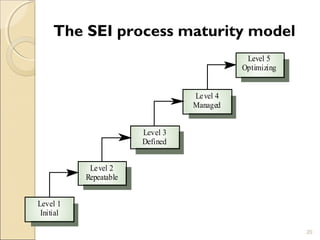
The SEI process maturity model 
20 
Level 3 
Defined 
Level 2 
Repeatable 
Level 1 
Initial 
Level 4 
Managed 
Level 5 
Optimizing
Maturity model levels 
Initial 
◦ Essentially uncontrolled 
Repeatable 
◦ Product management procedures defined and used 
Defined 
◦ Process management procedures and strategies defined 
and used 
Managed 
◦ Quality management strategies defined and used 
Optimising 
◦ Process improvement strategies defined and used 
21
CAPABILITY MATURITY 
MODEL (CMM) 
CMM is a strategy for improving the software process, 
irrespective of the actual life cycle model used. 
Software Engineering Institute (SEI) of Carnegie-Mellon 
University developed CMM in 1986. 
CMM is used to judge the maturity of the software 
processes of an organization and to identify the key 
practices that are required to increase the maturity of 
these processes. 
22
Different levels of CMM 
1) Initial (maturity level 1)- 
 At this, the lowest level, there are essentially no sound 
software engineering management practices in place in 
the organization. Instead everything is done on adhoc 
basis. In maturity level 1 organization, the software 
process is unpredictable. 
2) Repeatable (maturity level 2)- 
 At this level, policies for managing a software project and 
procedures to implement those policies are established. 
Planning and managing new projects is based on 
experience with similar projects. 
 An objective in achieving level 2 is to institutionalize 
effective management processes for software projects, 
which allow organizations to repeat successful practices, 
developed on other projects. 
 The software process capability at level 4 organizations 
can be summarized as disciplined. 
23
Cont’ed 
3) Defined (maturity level 3)- 
At this level, the standard process for developing and 
maintaining software across the organization is 
documented, including both software engineering and 
management processes. Processes established at level 3 
are used to help the software managers and technical staff 
to perform more effectively. The 
software process capability at level 4 organizations can be 
summarized as standard and constituent. 
24
Cont’ed 
4) Managed (maturity level 4)- 
At this level, the organization sets quantitative quality 
goals for both software products and processes. 
Productivity and quality are measured for important 
software process activities across all projects as part of an 
organizational measurement program. 
The software process capability at level 4 
organizations can be summarized as “predictable”. 
25
Cont’ed 
5) Optimizing (maturity level 5)- 
At this level, the entire organization is focused on 
continuous process improvement. The organizations have 
the means to identify weaknesses and strengthen the 
process proactively, with the goal of preventing the 
occurrence of defects. 
The software process capability at level 4 organizations can 
be summarized as continuously improving. 
26
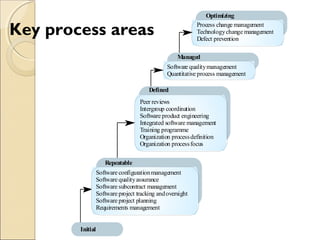
Key process areas Process changemanagement 
Technologychangemanagement 
Defect prevention 
Software qualitymanagement 
Quantitative process management 
Peer reviews 
Intergroup coordination 
Software product engineering 
Integrated softwaremanagement 
Training programme 
Organization processdefinition 
Organization process focus 
Software configurationmanagement 
Software qualityassurance 
Software subcontract management 
Software project tracking andoversight 
Software project planning 
Requirements management 
Initial 
Repeatable 
Defined 
Managed 
Optimizing
Key process areas 
Key process areas of CMM are: 
1.Requirements management which establishes a 
common relationship between the customer and 
developer. 
2. Software project planning where reasonable plans for 
managing the software project are established. 
3. Software project tracing and oversight which 
establishes adequate visibility into actual progress to help 
management track deviations from plans. 
4. Software subcontract management for selecting 
efficient subcontractors and managing them. 
5. Software quality assurance which provides visibility 
into the software process and product. 
6. Software configuration management which 
establishes and maintains the integrity of the products 
throughout the life cycle. 
28
SEI model problems 
It focuses on project management rather than 
product development. 
It ignores the use of technologies such as rapid 
prototyping. 
It does not incorporate risk analysis as a key 
process area. 
It does not define its domain of applicability. 
29
The CMM and ISO 9000 
There is a clear correlation between the key processes 
in the CMM and the quality management processes in 
ISO 9000. 
The CMM is more detailed and prescriptive and 
includes a framework for improvement. 
Organisations rated as level 2 in the CMM are likely to 
be ISO 9000 compliant. 
30
Capability assessment 
An important role of the SEI is to use the CMM to assess 
the capabilities of contractors bidding for US government 
defence contracts. 
The model is intended to represent organisational 
capability not the practices used in particular projects. 
Within the same organisation, there are often wide 
variations in processes used 
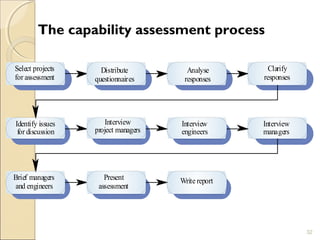
Capability assessment is questionnaire-based. 
31
The capability assessment process 
32 
Select projects 
for assessment 
Distribute 
questionnaires 
Analyse 
responses 
Clarify 
responses 
Identify issues 
for discussion 
Interview 
project managers 
Interview 
engineers 
Interview 
managers 
Brief managers 
and engineers 
Present 
assessment 
Write report
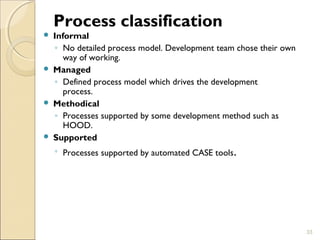
Process classification 
 Informal 
◦ No detailed process model. Development team chose their own 
way of working. 
 Managed 
◦ Defined process model which drives the development 
process. 
 Methodical 
◦ Processes supported by some development method such as 
HOOD. 
 Supported 
◦ Processes supported by automated CASE tools. 
33
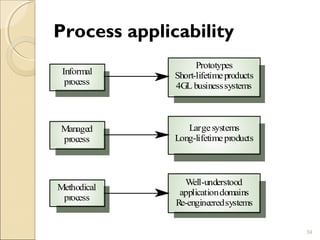
Process applicability 
34 
Prototypes 
Short-lifetime products 
4GL businesssystems 
Informal 
process 
Large systems 
Long-lifetime products 
Managed 
process 
Well-understood 
applicationdomains 
Re-engineeredsystems 
Methodical 
process
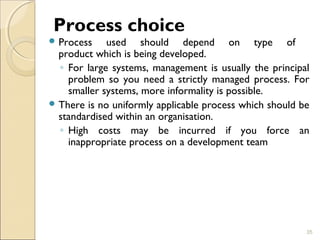
Process choice 
Process used should depend on type of 
product which is being developed. 
◦ For large systems, management is usually the principal 
problem so you need a strictly managed process. For 
smaller systems, more informality is possible. 
There is no uniformly applicable process which should be 
standardised within an organisation. 
◦ High costs may be incurred if you force an 
inappropriate process on a development team 
35
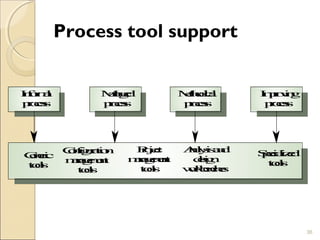
Process tool support 
36 
Informal 
process 
Managed 
process 
Methodical 
process 
Improving 
process 
Specialized 
tools 
Analysisand 
design 
workbenches 
Project 
management 
tools 
Configuration 
management 
tools 
Generic 
tools
Key points 
Process improvement involves process analysis, 
standardisation, measurement and change. 
Process models include descriptions of tasks, activities, 
roles, exceptions, communications, deliverables and 
other processes. 
Measurement should be used to answer specific 
questions about the software process used. 
The three types of process metrics which can be 
collected are time metrics, resource utilisation metrics 
and event metrics. 
37
Key points 
The SEI model classifies software processes as initial, 
repeatable, defined, managed and optimising. It identifies 
key processes which should be used at each of these 
levels. 
The SEI model is appropriate for large systems developed 
by large teams of engineers. It cannot be applied without 
modification in other situations. 
Processes can be classified as informal, managed, 
methodical and improving. This classification can be used 
to identify process tool support. 
38

9.process improvement chapter 9

  • 1.
  • 2.
    Process improvement Understandingexisting processes. Introducing process changes to achieve organisational objectives which are usually focused on quality improvement, cost reduction and schedule acceleration. Most process improvement work so far has focused on defect reduction. This reflects the increasing attention paid by industry to quality. However, other process attributes can be the focus of improvement 2
  • 3.
  • 4.
    Process improvement stagesProcess analysis ◦ Model and analyse (quantitatively if possible) existing processes Improvement identification ◦ Identify quality, cost or schedule bottlenecks Process change introduction ◦ Modify the process to remove identified bottlenecks Process change training ◦ Train staff involved in new process proposals Change tuning ◦ Evolve and improve process improvements 4
  • 5.
    The process improvementprocess 5 Process model Process change plan Training plan Feedback on improvements Revised process model Analyse process Identify improvements Tune process changes Introduce process change Train engineers
  • 6.
    Process and productquality Process quality and product quality are closely related. A good process is usually required to produce a good product. For manufactured goods, process is the principal quality determinant. For design-based activity, other factors are also involved especially the capabilities of the designers 6
  • 7.
    Principal product qualityfactors 7 Development technology Product quality Cost, time and schedule Process quality People quality
  • 8.
    Quality factors Forlarge projects with ‘average’ capabilities, the development process determines product quality. For small projects, the capabilities of the developers is the main determinant. The development technology is particularly significant for small projects. In all cases, if an unrealistic schedule is imposed then product quality will suffer. 8
  • 9.
    Process analysis andmodelling Process analysis ◦ The study of existing processes to understand the relationships between parts of the process and to compare them with other processes Process modelling ◦ The documentation of a process which records the tasks, the roles and the entities used. ◦ Process models may be presented from different perspectives. 9
  • 10.
    Process analysis andmodelling Study an existing process to understand its activities. Produce an abstract model of the process. You should normally represent this graphically. Several different views (e.g. activities, deliverables, etc.) may be required. Analyse the model to discover process problems. Involves discussing activities with stakeholders. 10
  • 11.
    Process analysis techniques Published process models and process standards ◦ It is always best to start process analysis with an existing model. People then may extend and change this. Questionnaires and interviews ◦ Must be carefully designed. Participants may tell you what they think you want to hear Ethnographic analysis ◦ Involves assimilating process knowledge by observation 11
  • 12.
    EElleemmeennttss ooff aa pprroocceessss mmooddeell
  • 13.
    The module testingactivity 13 Test module Signed-of f test record Module test data Module compiles without syntax errors Module specification All defined tests run on module Test engineer Pre-condition Input Process Rôle Post-cond ition Outputs Responsible for
  • 14.
    Activities in moduletesting Prepare test da ta accor ding to specification Read module specification Submit test data for review Review test data TEST DATA PREPARATION Read and understand module interface Checkout module from configuration mana gement system Prepare test harness for module Compile test harness MODULE TEST HARNESS PREPARATION Incorporate module with test harness Run approved tests on module Record test results for regression tests TEST EXECUTION Write report on module testing including details of discovered problems Submit report for approval Submit test results to CM TEST REPORTING ©Ian Sommerville 1995 Software Engineering, 5th edition. Chapter 31. Slide ##
  • 15.
    Process exceptions Softwareprocesses are complex and process models cannot effectively represent how to handle exceptions. ◦ Several key people becoming ill just before a critical review. ◦ A complete failure of a communication processor so that no e-mail is available for several days. ◦ Organisational reorganisation. ◦ A need to respond to an unanticipated request for new proposals. Under these circumstances, the model is suspended and managers use their initiative to deal with the exception. 15
  • 16.
    Process measurement Whereverpossible, quantitative process data should be collected ◦ However, where organisations do not have clearly defined process standards this is very difficult as you don’t know what to measure. A process may have to be defined before any measurement is possible Process measurements should be used to assess process improvements ◦ But this does not mean that measurements should drive the improvements. The improvement driver should be the organizational objectives 16
  • 17.
    Classes of processmeasurement Time taken for process activities to be completed ◦ E.g. Calendar time or effort to complete an activity or process Resources required for processes or activities ◦ E.g. Total effort in person-days Number of occurrences of a particular event ◦ E.g. Number of defects discovered 17
  • 18.
    Goal-Question-Metric Paradigm Goals ◦ What is the organisation trying to achieve? The objective of process improvement is to satisfy these goals Questions ◦ Questions about areas of uncertainty related to the goals. You need process knowledge to derive these Metrics ◦ Measurements to be collected to answer the questions 18
  • 19.
    The Software EngineeringInstitute US Defense Dept. funded institute associated with Carnegie Mellon Mission is to promote software technology transfer particularly to defense contractors Maturity model proposed in mid-1980s, refined in early 1990s. Work has been very influential in process improvement 19
  • 20.
    The SEI processmaturity model 20 Level 3 Defined Level 2 Repeatable Level 1 Initial Level 4 Managed Level 5 Optimizing
  • 21.
    Maturity model levels Initial ◦ Essentially uncontrolled Repeatable ◦ Product management procedures defined and used Defined ◦ Process management procedures and strategies defined and used Managed ◦ Quality management strategies defined and used Optimising ◦ Process improvement strategies defined and used 21
  • 22.
    CAPABILITY MATURITY MODEL(CMM) CMM is a strategy for improving the software process, irrespective of the actual life cycle model used. Software Engineering Institute (SEI) of Carnegie-Mellon University developed CMM in 1986. CMM is used to judge the maturity of the software processes of an organization and to identify the key practices that are required to increase the maturity of these processes. 22
  • 23.
    Different levels ofCMM 1) Initial (maturity level 1)-  At this, the lowest level, there are essentially no sound software engineering management practices in place in the organization. Instead everything is done on adhoc basis. In maturity level 1 organization, the software process is unpredictable. 2) Repeatable (maturity level 2)-  At this level, policies for managing a software project and procedures to implement those policies are established. Planning and managing new projects is based on experience with similar projects.  An objective in achieving level 2 is to institutionalize effective management processes for software projects, which allow organizations to repeat successful practices, developed on other projects.  The software process capability at level 4 organizations can be summarized as disciplined. 23
  • 24.
    Cont’ed 3) Defined(maturity level 3)- At this level, the standard process for developing and maintaining software across the organization is documented, including both software engineering and management processes. Processes established at level 3 are used to help the software managers and technical staff to perform more effectively. The software process capability at level 4 organizations can be summarized as standard and constituent. 24
  • 25.
    Cont’ed 4) Managed(maturity level 4)- At this level, the organization sets quantitative quality goals for both software products and processes. Productivity and quality are measured for important software process activities across all projects as part of an organizational measurement program. The software process capability at level 4 organizations can be summarized as “predictable”. 25
  • 26.
    Cont’ed 5) Optimizing(maturity level 5)- At this level, the entire organization is focused on continuous process improvement. The organizations have the means to identify weaknesses and strengthen the process proactively, with the goal of preventing the occurrence of defects. The software process capability at level 4 organizations can be summarized as continuously improving. 26
  • 27.
    Key process areasProcess changemanagement Technologychangemanagement Defect prevention Software qualitymanagement Quantitative process management Peer reviews Intergroup coordination Software product engineering Integrated softwaremanagement Training programme Organization processdefinition Organization process focus Software configurationmanagement Software qualityassurance Software subcontract management Software project tracking andoversight Software project planning Requirements management Initial Repeatable Defined Managed Optimizing
  • 28.
    Key process areas Key process areas of CMM are: 1.Requirements management which establishes a common relationship between the customer and developer. 2. Software project planning where reasonable plans for managing the software project are established. 3. Software project tracing and oversight which establishes adequate visibility into actual progress to help management track deviations from plans. 4. Software subcontract management for selecting efficient subcontractors and managing them. 5. Software quality assurance which provides visibility into the software process and product. 6. Software configuration management which establishes and maintains the integrity of the products throughout the life cycle. 28
  • 29.
    SEI model problems It focuses on project management rather than product development. It ignores the use of technologies such as rapid prototyping. It does not incorporate risk analysis as a key process area. It does not define its domain of applicability. 29
  • 30.
    The CMM andISO 9000 There is a clear correlation between the key processes in the CMM and the quality management processes in ISO 9000. The CMM is more detailed and prescriptive and includes a framework for improvement. Organisations rated as level 2 in the CMM are likely to be ISO 9000 compliant. 30
  • 31.
    Capability assessment Animportant role of the SEI is to use the CMM to assess the capabilities of contractors bidding for US government defence contracts. The model is intended to represent organisational capability not the practices used in particular projects. Within the same organisation, there are often wide variations in processes used Capability assessment is questionnaire-based. 31
  • 32.
    The capability assessmentprocess 32 Select projects for assessment Distribute questionnaires Analyse responses Clarify responses Identify issues for discussion Interview project managers Interview engineers Interview managers Brief managers and engineers Present assessment Write report
  • 33.
    Process classification Informal ◦ No detailed process model. Development team chose their own way of working.  Managed ◦ Defined process model which drives the development process.  Methodical ◦ Processes supported by some development method such as HOOD.  Supported ◦ Processes supported by automated CASE tools. 33
  • 34.
    Process applicability 34 Prototypes Short-lifetime products 4GL businesssystems Informal process Large systems Long-lifetime products Managed process Well-understood applicationdomains Re-engineeredsystems Methodical process
  • 35.
    Process choice Processused should depend on type of product which is being developed. ◦ For large systems, management is usually the principal problem so you need a strictly managed process. For smaller systems, more informality is possible. There is no uniformly applicable process which should be standardised within an organisation. ◦ High costs may be incurred if you force an inappropriate process on a development team 35
  • 36.
    Process tool support 36 Informal process Managed process Methodical process Improving process Specialized tools Analysisand design workbenches Project management tools Configuration management tools Generic tools
  • 37.
    Key points Processimprovement involves process analysis, standardisation, measurement and change. Process models include descriptions of tasks, activities, roles, exceptions, communications, deliverables and other processes. Measurement should be used to answer specific questions about the software process used. The three types of process metrics which can be collected are time metrics, resource utilisation metrics and event metrics. 37
  • 38.
    Key points TheSEI model classifies software processes as initial, repeatable, defined, managed and optimising. It identifies key processes which should be used at each of these levels. The SEI model is appropriate for large systems developed by large teams of engineers. It cannot be applied without modification in other situations. Processes can be classified as informal, managed, methodical and improving. This classification can be used to identify process tool support. 38