Kittitouch Suteeca
Ref. Panit Watcharawitch, PhD (cantab)
Standard CMMI Appraisal Method for
Process Improvement (SCAMPI)
 SCAMPI is designed to provide benchmark quality
ratings relative to Capability Maturity Model®
Integration (CMMISM) models. It is applicable to a wide
range of appraisal usage modes, including both internal
process improvement and external capability
determinations. SCAMPI satisfies all of the Appraisal
Requirements for CMMI (ARC) requirements for a Class
A appraisal method and supports the conduct of
ISO/IEC 15504 assessments.
 SCAMPI Appraisal System (SAS)
 Method Definition Document (MDD)
 Appraisal Requirements for CMMI (ARC)
 Appraisal Team Member (ATM)
 Appraisal Disclosure Statement (ADS)
2
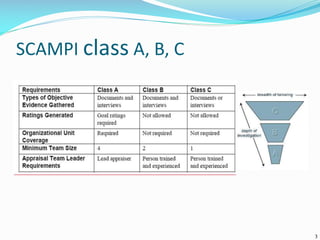
SCAMPI class A, B, C
3
Objective SCAMPI class A
 Understand the current implemented process.
 Identify process weakness (and strengths) in the
organization unit.
 Determine degree of satisfaction of CMMI process area
goal investigated.
 Assign rating ,if request by appraisal sponsor.
4
Rating process attributes
 Process attribute rating values: The ordinal rating scale
defined below shall be used to express the levels of
achievement of the process attributes.
 N Not achieved: There is little or no evidence of
achievement of the defined attribute in the assessed
process.
 P Partially achieved: There is some evidence of an approach
to, and some achievement of, the defined attribute in the
assessed process. Some aspects of achievement of the
attribute may be unpredictable.
5
Rating process attributes
 L Largely achieved: There is evidence of a systematic
approach to, and significant achievement of, the defined
attribute in the assessed process. Some weakness related
to this attribute may exist in the assessed process.
 F Fully achieved: There is evidence of a complete and
systematic approach to, and full achievement of, the
defined attribute in the assessed process. No significant
weaknesses related to this attribute exist in the assessed
process.
6
Rating process attributes
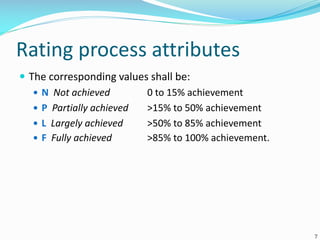
 The corresponding values shall be:
 N Not achieved 0 to 15% achievement
 P Partially achieved >15% to 50% achievement
 L Largely achieved >50% to 85% achievement
 F Fully achieved >85% to 100% achievement.
7
Example: CMMI ML2 Appraisal of RUP
8
Reference: http://www.ibm.com/developerworks/rational/library/dec05/grundmann/
Requirement management (REQM)
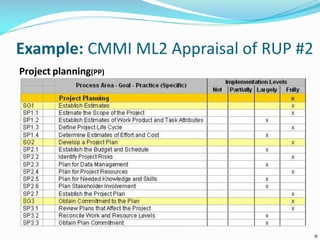
Example: CMMI ML2 Appraisal of RUP #2
9
Project planning(PP)
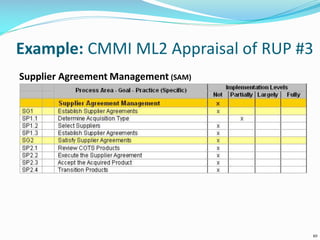
Example: CMMI ML2 Appraisal of RUP #3
10
Supplier Agreement Management (SAM)
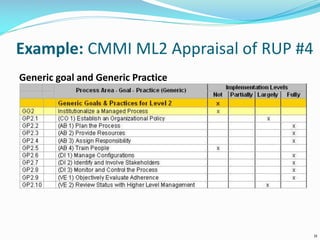
Example: CMMI ML2 Appraisal of RUP #4
11
Generic goal and Generic Practice
Example: CMMI ML2 Appraisal
12
0.00%
20.00%
40.00%
60.00%
80.00%
100.00%
120.00%
REQM
PP
PMC
SAM
MA
PPQA
CM
PAs
SPI with CMMI Project Summary Chart
Maturity Level 2
% Complete of each
PAs
% Actual Complete of
PAs
Example: CMMI ML2 Appraisal
13
0.00%
5.00%
10.00%
15.00%
20.00%
25.00%
REQM
PP
PMC
SAM
MA
PPQA
CMPAs
SPI with CMMI Project Summary Chart
Maturity Level 2
% PAs in Project
(Estimation)
% Complete of PAs in
Project
Example: CMMI ML2 Appraisal
14
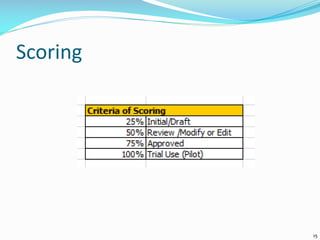
Scoring
15
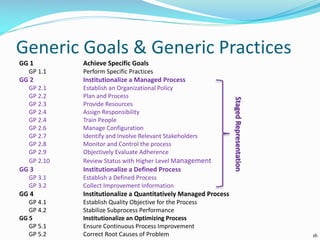
Generic Goals & Generic Practices
GG 1 Achieve Specific Goals
GP 1.1 Perform Specific Practices
GG 2 Institutionalize a Managed Process
GP 2.1 Establish an Organizational Policy
GP 2.2 Plan and Process
GP 2.3 Provide Resources
GP 2.4 Assign Responsibility
GP 2.4 Train People
GP 2.6 Manage Configuration
GP 2.7 Identify and Involve Relevant Stakeholders
GP 2.8 Monitor and Control the process
GP 2.9 Objectively Evaluate Adherence
GP 2.10 Review Status with Higher Level Management
GG 3 Institutionalize a Defined Process
GP 3.1 Establish a Defined Process
GP 3.2 Collect Improvement Information
GG 4 Institutionalize a Quantitatively Managed Process
GP 4.1 Establish Quality Objective for the Process
GP 4.2 Stabilize Subprocess Performance
GG 5 Institutionalize an Optimizing Process
GP 5.1 Ensure Continuous Process Improvement
GP 5.2 Correct Root Causes of Problem StagedRepresentation 16
Appraisal keys
 Appraisal Considerations
 Direct Artifact
 Indirect Artifact
17
Example:REQM ML2
 15 Key practices
 5 Specific Practices
 10 Generic Practices
 SP 1.1-1 Obtain an Understanding of Requirements
 Develop an understanding with the requirements providers
on the meaning of the requirements
 Appraisal Considerations
 Consider existence of requirements at multiple levels (e.g.,
product and product component requirements.).
18
Example:REQM ML2
 Direct Artifact
 Allocated Requirements Document
 Allocated Requirements Database
 Review Report of Requirements
 Commitments from affected groups on allocated
requirements
 Defined criteria for evaluation and acceptance of
requirements
19
Example:REQM ML2
 Indirect Artifact
 Evidence of early (before committing to develop the
corresponding software) system requirement allocated to
software review (e.g. meeting minutes, reports…)
 A list or characterization of requirements providers
authorized to provide direction
20
Example of ML2 and ML3
 Available in SPI. site.
21

Ch 12(spi)cm mi scampi

  • 1.
    Kittitouch Suteeca Ref. PanitWatcharawitch, PhD (cantab)
  • 2.
    Standard CMMI AppraisalMethod for Process Improvement (SCAMPI)  SCAMPI is designed to provide benchmark quality ratings relative to Capability Maturity Model® Integration (CMMISM) models. It is applicable to a wide range of appraisal usage modes, including both internal process improvement and external capability determinations. SCAMPI satisfies all of the Appraisal Requirements for CMMI (ARC) requirements for a Class A appraisal method and supports the conduct of ISO/IEC 15504 assessments.  SCAMPI Appraisal System (SAS)  Method Definition Document (MDD)  Appraisal Requirements for CMMI (ARC)  Appraisal Team Member (ATM)  Appraisal Disclosure Statement (ADS) 2
  • 3.
  • 4.
    Objective SCAMPI classA  Understand the current implemented process.  Identify process weakness (and strengths) in the organization unit.  Determine degree of satisfaction of CMMI process area goal investigated.  Assign rating ,if request by appraisal sponsor. 4
  • 5.
    Rating process attributes Process attribute rating values: The ordinal rating scale defined below shall be used to express the levels of achievement of the process attributes.  N Not achieved: There is little or no evidence of achievement of the defined attribute in the assessed process.  P Partially achieved: There is some evidence of an approach to, and some achievement of, the defined attribute in the assessed process. Some aspects of achievement of the attribute may be unpredictable. 5
  • 6.
    Rating process attributes L Largely achieved: There is evidence of a systematic approach to, and significant achievement of, the defined attribute in the assessed process. Some weakness related to this attribute may exist in the assessed process.  F Fully achieved: There is evidence of a complete and systematic approach to, and full achievement of, the defined attribute in the assessed process. No significant weaknesses related to this attribute exist in the assessed process. 6
  • 7.
    Rating process attributes The corresponding values shall be:  N Not achieved 0 to 15% achievement  P Partially achieved >15% to 50% achievement  L Largely achieved >50% to 85% achievement  F Fully achieved >85% to 100% achievement. 7
  • 8.
    Example: CMMI ML2Appraisal of RUP 8 Reference: http://www.ibm.com/developerworks/rational/library/dec05/grundmann/ Requirement management (REQM)
  • 9.
    Example: CMMI ML2Appraisal of RUP #2 9 Project planning(PP)
  • 10.
    Example: CMMI ML2Appraisal of RUP #3 10 Supplier Agreement Management (SAM)
  • 11.
    Example: CMMI ML2Appraisal of RUP #4 11 Generic goal and Generic Practice
  • 12.
    Example: CMMI ML2Appraisal 12 0.00% 20.00% 40.00% 60.00% 80.00% 100.00% 120.00% REQM PP PMC SAM MA PPQA CM PAs SPI with CMMI Project Summary Chart Maturity Level 2 % Complete of each PAs % Actual Complete of PAs
  • 13.
    Example: CMMI ML2Appraisal 13 0.00% 5.00% 10.00% 15.00% 20.00% 25.00% REQM PP PMC SAM MA PPQA CMPAs SPI with CMMI Project Summary Chart Maturity Level 2 % PAs in Project (Estimation) % Complete of PAs in Project
  • 14.
    Example: CMMI ML2Appraisal 14
  • 15.
  • 16.
    Generic Goals &Generic Practices GG 1 Achieve Specific Goals GP 1.1 Perform Specific Practices GG 2 Institutionalize a Managed Process GP 2.1 Establish an Organizational Policy GP 2.2 Plan and Process GP 2.3 Provide Resources GP 2.4 Assign Responsibility GP 2.4 Train People GP 2.6 Manage Configuration GP 2.7 Identify and Involve Relevant Stakeholders GP 2.8 Monitor and Control the process GP 2.9 Objectively Evaluate Adherence GP 2.10 Review Status with Higher Level Management GG 3 Institutionalize a Defined Process GP 3.1 Establish a Defined Process GP 3.2 Collect Improvement Information GG 4 Institutionalize a Quantitatively Managed Process GP 4.1 Establish Quality Objective for the Process GP 4.2 Stabilize Subprocess Performance GG 5 Institutionalize an Optimizing Process GP 5.1 Ensure Continuous Process Improvement GP 5.2 Correct Root Causes of Problem StagedRepresentation 16
  • 17.
    Appraisal keys  AppraisalConsiderations  Direct Artifact  Indirect Artifact 17
  • 18.
    Example:REQM ML2  15Key practices  5 Specific Practices  10 Generic Practices  SP 1.1-1 Obtain an Understanding of Requirements  Develop an understanding with the requirements providers on the meaning of the requirements  Appraisal Considerations  Consider existence of requirements at multiple levels (e.g., product and product component requirements.). 18
  • 19.
    Example:REQM ML2  DirectArtifact  Allocated Requirements Document  Allocated Requirements Database  Review Report of Requirements  Commitments from affected groups on allocated requirements  Defined criteria for evaluation and acceptance of requirements 19
  • 20.
    Example:REQM ML2  IndirectArtifact  Evidence of early (before committing to develop the corresponding software) system requirement allocated to software review (e.g. meeting minutes, reports…)  A list or characterization of requirements providers authorized to provide direction 20
  • 21.
    Example of ML2and ML3  Available in SPI. site. 21