USING
INFORMATIVE WRITING
TECHNIQUES
English Grade 10
3RD Quarter – LESSON 3
By: SIR JOSH
You are expected to have:
1. Identified the structure
and features of informative
writing.
2. Written an informative
text.
Most Essential
Learning
Competency
(MELC):
• Use a variety of
informative,
persuasive, and
argumentative
writing
techniques.
• Writing is the most complex among the four
macro skills in communication. It takes years
and a lot of practice to master this skill.
Common Essay Writings:
• Persuasive Essay
• Argumentative Essay
LESSON
RECAP:
Read the text
carefully:
Face-to-face learning is an instructional
method where course content and
learning material are taught in person to
a group of students. This allows for a live
interaction between a learner and an
instructor. It is the most traditional type
of learning instruction. Learners benefit
from a greater level of interaction with
their fellow students as well. In face-to-
face learning, students are held
accountable for their progress at the
class’s specific meeting date and time.
Face-to-face learning ensures a better
understanding and recollection of lesson
content and gives class members a
chance to bond with one another.
Read the text
carefully:
Face-to-face learning is essentially a
teacher-centered method of
education and tends to vary widely
among cultures. Many modern
education systems have largely
shifted away from
traditional face-to-face forms of
educational instruction, in favor of
individual students’
needs.
PROCESS QUESTIONS:
PROCESS QUESTIONS:
PROCESS QUESTIONS:
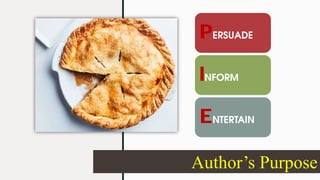
Author’s Purpose
PERSUADE
INFORM
ENTERTAIN
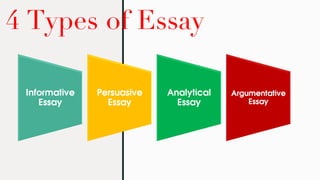
4 Types of Essay
Informative
Essay
Persuasive
Essay
Analytical
Essay
Argumentative
Essay
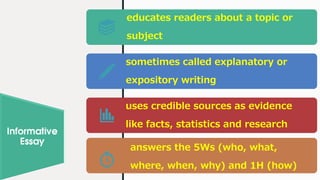
Informative
Essay
educates readers about a topic or
subject
sometimes called explanatory or
expository writing
uses credible sources as evidence
like facts, statistics and research
answers the 5Ws (who, what,
where, when, why) and 1H (how)
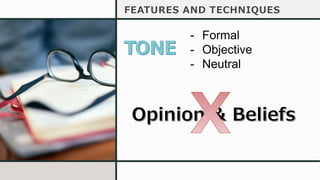
FEATURES AND TECHNIQUES
- Formal
- Objective
- Neutral
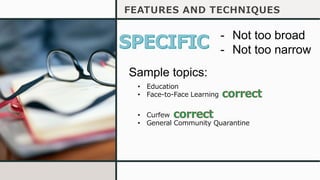
FEATURES AND TECHNIQUES
- Not too broad
- Not too narrow
Sample topics:
• Education
• Face-to-Face Learning
• Curfew
• General Community Quarantine
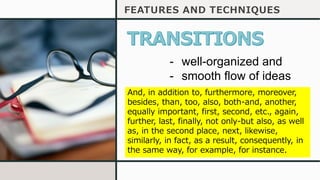
FEATURES AND TECHNIQUES
- well-organized and
- smooth flow of ideas
And, in addition to, furthermore, moreover,
besides, than, too, also, both-and, another,
equally important, first, second, etc., again,
further, last, finally, not only-but also, as well
as, in the second place, next, likewise,
similarly, in fact, as a result, consequently, in
the same way, for example, for instance.
Structure of
Informative
Text
• Introduction
• Body
• Conclusion
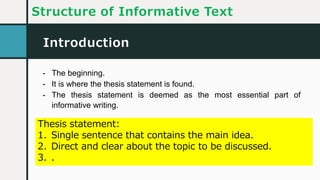
Introduction
Structure of Informative Text
- The beginning.
- It is where the thesis statement is found.
- The thesis statement is deemed as the most essential part of
informative writing.
Thesis statement:
1. Single sentence that contains the main idea.
2. Direct and clear about the topic to be discussed.
3. .
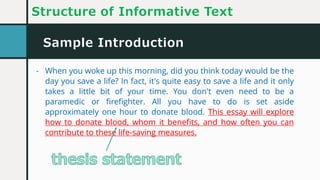
Sample Introduction
Structure of Informative Text
- When you woke up this morning, did you think today would be the
day you save a life? In fact, it's quite easy to save a life and it only
takes a little bit of your time. You don't even need to be a
paramedic or firefighter. All you have to do is set aside
approximately one hour to donate blood. This essay will explore
how to donate blood, whom it benefits, and how often you can
contribute to these life-saving measures.
- When you woke up this morning, did you think today would be the
day you save a life? In fact, it's quite easy to save a life and it only
takes a little bit of your time. You don't even need to be a
paramedic or firefighter. All you have to do is set aside
approximately one hour to donate blood. This essay will explore
how to donate blood, whom it benefits, and how often you can
contribute to these life-saving measures.
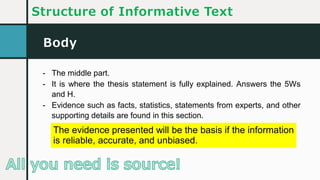
Body
Structure of Informative Text
- The middle part.
- It is where the thesis statement is fully explained. Answers the 5Ws
and H.
- Evidence such as facts, statistics, statements from experts, and other
supporting details are found in this section.
The evidence presented will be the basis if the information
is reliable, accurate, and unbiased.
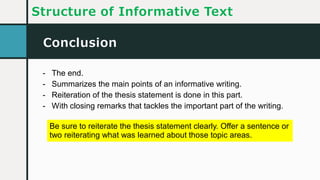
Conclusion
Structure of Informative Text
- The end.
- Summarizes the main points of an informative writing.
- Reiteration of the thesis statement is done in this part.
- With closing remarks that tackles the important part of the writing.
Be sure to reiterate the thesis statement clearly. Offer a sentence or
two reiterating what was learned about those topic areas.
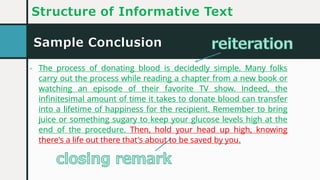
Sample Conclusion
Structure of Informative Text
- The process of donating blood is decidedly simple. Many folks
carry out the process while reading a chapter from a new book or
watching an episode of their favorite TV show. Indeed, the
infinitesimal amount of time it takes to donate blood can transfer
into a lifetime of happiness for the recipient. Remember to bring
juice or something sugary to keep your glucose levels high at the
end of the procedure. Then, hold your head up high, knowing
there's a life out there that's about to be saved by you.
- The process of donating blood is decidedly simple. Many folks
carry out the process while reading a chapter from a new book or
watching an episode of their favorite TV show. Indeed, the
infinitesimal amount of time it takes to donate blood can transfer
into a lifetime of happiness for the recipient. Remember to bring
juice or something sugary to keep your glucose levels high at the
end of the procedure. Then, hold your head up high, knowing
there's a life out there that's about to be saved by you.
Selection No.1:
Animal testing has benefited human health.
People do not contract polio anymore
because of a vaccine tested on animals.
Advances in antibiotics, insulin, and other
drugs have been made possible through
research done on animals. Animal testing
should continue to benefit medical research.
• DIF
Selection No.1:
The introduction clearly explains the topic,
however, at the last part of the paragraph,
the author had expressed his opinion on
the use of animal testing. Informative
writing should be fact-based and not a
biased information.
What have you learned?
• The purpose of informative writing is to educate its readers on a certain topic or
subject.
• Informative writing is a fact-based information and answers the 5Ws and 1H.
• The features and techniques of informative writing are the following:
• the tone must be formal, objective and neutral
• its topic must be specific and clearly explained and supported with evidences
• uses transitional words for organized and smooth flow of ideas
• Informative has 3 structures namely introduction, body and conclusion.
• Introduction contains the thesis statement.
• Body explains and supports the thesis statements by providing facts from
credible sources.
• Conclusion summarizes the whole writings, reiterate the thesis statement
and gives a closing remarks that will engage the readers more on the topic.

Q3-Informative-Writing-Copy Only 2.pdf

  • 1.
    USING INFORMATIVE WRITING TECHNIQUES English Grade10 3RD Quarter – LESSON 3 By: SIR JOSH
  • 2.
    You are expectedto have: 1. Identified the structure and features of informative writing. 2. Written an informative text. Most Essential Learning Competency (MELC): • Use a variety of informative, persuasive, and argumentative writing techniques.
  • 3.
    • Writing isthe most complex among the four macro skills in communication. It takes years and a lot of practice to master this skill. Common Essay Writings: • Persuasive Essay • Argumentative Essay LESSON RECAP:
  • 4.
    Read the text carefully: Face-to-facelearning is an instructional method where course content and learning material are taught in person to a group of students. This allows for a live interaction between a learner and an instructor. It is the most traditional type of learning instruction. Learners benefit from a greater level of interaction with their fellow students as well. In face-to- face learning, students are held accountable for their progress at the class’s specific meeting date and time. Face-to-face learning ensures a better understanding and recollection of lesson content and gives class members a chance to bond with one another.
  • 5.
    Read the text carefully: Face-to-facelearning is essentially a teacher-centered method of education and tends to vary widely among cultures. Many modern education systems have largely shifted away from traditional face-to-face forms of educational instruction, in favor of individual students’ needs.
  • 6.
  • 7.
  • 8.
  • 9.
  • 10.
    4 Types ofEssay Informative Essay Persuasive Essay Analytical Essay Argumentative Essay
  • 11.
    Informative Essay educates readers abouta topic or subject sometimes called explanatory or expository writing uses credible sources as evidence like facts, statistics and research answers the 5Ws (who, what, where, when, why) and 1H (how)
  • 12.
    FEATURES AND TECHNIQUES -Formal - Objective - Neutral
  • 13.
    FEATURES AND TECHNIQUES -Not too broad - Not too narrow Sample topics: • Education • Face-to-Face Learning • Curfew • General Community Quarantine
  • 14.
    FEATURES AND TECHNIQUES -well-organized and - smooth flow of ideas And, in addition to, furthermore, moreover, besides, than, too, also, both-and, another, equally important, first, second, etc., again, further, last, finally, not only-but also, as well as, in the second place, next, likewise, similarly, in fact, as a result, consequently, in the same way, for example, for instance.
  • 15.
  • 16.
    Introduction Structure of InformativeText - The beginning. - It is where the thesis statement is found. - The thesis statement is deemed as the most essential part of informative writing. Thesis statement: 1. Single sentence that contains the main idea. 2. Direct and clear about the topic to be discussed. 3. .
  • 17.
    Sample Introduction Structure ofInformative Text - When you woke up this morning, did you think today would be the day you save a life? In fact, it's quite easy to save a life and it only takes a little bit of your time. You don't even need to be a paramedic or firefighter. All you have to do is set aside approximately one hour to donate blood. This essay will explore how to donate blood, whom it benefits, and how often you can contribute to these life-saving measures. - When you woke up this morning, did you think today would be the day you save a life? In fact, it's quite easy to save a life and it only takes a little bit of your time. You don't even need to be a paramedic or firefighter. All you have to do is set aside approximately one hour to donate blood. This essay will explore how to donate blood, whom it benefits, and how often you can contribute to these life-saving measures.
  • 18.
    Body Structure of InformativeText - The middle part. - It is where the thesis statement is fully explained. Answers the 5Ws and H. - Evidence such as facts, statistics, statements from experts, and other supporting details are found in this section. The evidence presented will be the basis if the information is reliable, accurate, and unbiased.
  • 19.
    Conclusion Structure of InformativeText - The end. - Summarizes the main points of an informative writing. - Reiteration of the thesis statement is done in this part. - With closing remarks that tackles the important part of the writing. Be sure to reiterate the thesis statement clearly. Offer a sentence or two reiterating what was learned about those topic areas.
  • 20.
    Sample Conclusion Structure ofInformative Text - The process of donating blood is decidedly simple. Many folks carry out the process while reading a chapter from a new book or watching an episode of their favorite TV show. Indeed, the infinitesimal amount of time it takes to donate blood can transfer into a lifetime of happiness for the recipient. Remember to bring juice or something sugary to keep your glucose levels high at the end of the procedure. Then, hold your head up high, knowing there's a life out there that's about to be saved by you. - The process of donating blood is decidedly simple. Many folks carry out the process while reading a chapter from a new book or watching an episode of their favorite TV show. Indeed, the infinitesimal amount of time it takes to donate blood can transfer into a lifetime of happiness for the recipient. Remember to bring juice or something sugary to keep your glucose levels high at the end of the procedure. Then, hold your head up high, knowing there's a life out there that's about to be saved by you.
  • 21.
    Selection No.1: Animal testinghas benefited human health. People do not contract polio anymore because of a vaccine tested on animals. Advances in antibiotics, insulin, and other drugs have been made possible through research done on animals. Animal testing should continue to benefit medical research.
  • 22.
    • DIF Selection No.1: Theintroduction clearly explains the topic, however, at the last part of the paragraph, the author had expressed his opinion on the use of animal testing. Informative writing should be fact-based and not a biased information.
  • 23.
    What have youlearned? • The purpose of informative writing is to educate its readers on a certain topic or subject. • Informative writing is a fact-based information and answers the 5Ws and 1H. • The features and techniques of informative writing are the following: • the tone must be formal, objective and neutral • its topic must be specific and clearly explained and supported with evidences • uses transitional words for organized and smooth flow of ideas • Informative has 3 structures namely introduction, body and conclusion. • Introduction contains the thesis statement. • Body explains and supports the thesis statements by providing facts from credible sources. • Conclusion summarizes the whole writings, reiterate the thesis statement and gives a closing remarks that will engage the readers more on the topic.