Informative Writing
Techniques
An Informative text is a non-fiction
writing that provides information,
description, and definition of a certain
topic or idea. Its purpose is to inform,
describe, or define an idea or topic
with the use of information.
It contains the 5W’s (What, Where,
When, Who, and Why) and 1H (How) of
the topic. It aims to address the
questions a reader has in mind. They
are mostly found in encyclopedias,
newspapers, magazines, and
textbooks.
An informative text, just like an
argumentative text, consists of three
parts, introduction, body, and
conclusion.
The Writing Process entails three phases:
1.The Pre- Writing (Before);
2.While Writing (During); and
3.The Post-Writing Phase (After)
The Pre-Writing phase includes the
things you need to do “before” the
writing itself. It is the phase where you
are going to:
a. Determine the topic
b. Narrow your topic
c. Make an outline
d. Gather data
2. The Writing phase is where you are
going to start writing your draft. Make
use of your map, which is your outline,
and the information that you have
gathered.
Tips: Just write and write and write. Let
the flow of words pass for you to
convey what you want to.
3. The Post- Writing is the phase where
you can edit and revise your draft. To
edit is to correct errors committed in the
draft, such as grammar, punctuation,
and other technicalities.
Here are some tips to help improve your
paper:
1. The title should be catchy.
2. Be factual. Informing others with fake
news is punishable by law and is foul in
informative text writing.
3. Be a reader. Reading is a prerequisite
of writing.
4. Be objective. Avoid biases by
focusing on your purpose—to
inform.
5. Write to express, not to impress.
Informative text writing calls for a
truthful and factual expression.
Impressing others is not a
consideration in this type of
writing.
Directions: Read each statement
carefully and write the answer on the
space provided before the number.
1. It is the phase of writing where you are
going to determine the topic of your
paper.
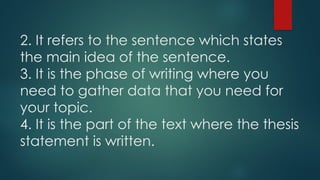
2. It refers to the sentence which states
the main idea of the sentence.
3. It is the phase of writing where you
need to gather data that you need for
your topic.
4. It is the part of the text where the thesis
statement is written.
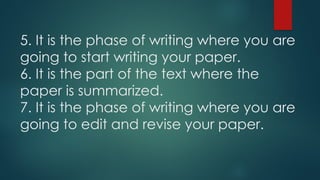
5. It is the phase of writing where you are
going to start writing your paper.
6. It is the part of the text where the
paper is summarized.
7. It is the phase of writing where you are
going to edit and revise your paper.
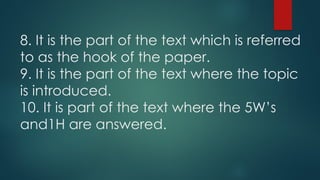
8. It is the part of the text which is referred
to as the hook of the paper.
9. It is the part of the text where the topic
is introduced.
10. It is part of the text where the 5W’s
and1H are answered.
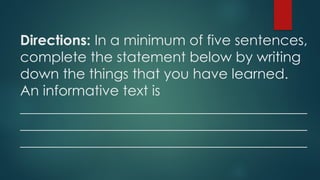
Directions: In a minimum of five sentences,
complete the statement below by writing
down the things that you have learned.
An informative text is
_________________________________________
_________________________________________
_________________________________________

Informative Writing TechniquesJHDGSHSG.pptx

  • 1.
  • 2.
    An Informative textis a non-fiction writing that provides information, description, and definition of a certain topic or idea. Its purpose is to inform, describe, or define an idea or topic with the use of information.
  • 3.
    It contains the5W’s (What, Where, When, Who, and Why) and 1H (How) of the topic. It aims to address the questions a reader has in mind. They are mostly found in encyclopedias, newspapers, magazines, and textbooks.
  • 4.
    An informative text,just like an argumentative text, consists of three parts, introduction, body, and conclusion.
  • 5.
    The Writing Processentails three phases: 1.The Pre- Writing (Before); 2.While Writing (During); and 3.The Post-Writing Phase (After)
  • 6.
    The Pre-Writing phaseincludes the things you need to do “before” the writing itself. It is the phase where you are going to: a. Determine the topic b. Narrow your topic c. Make an outline d. Gather data
  • 7.
    2. The Writingphase is where you are going to start writing your draft. Make use of your map, which is your outline, and the information that you have gathered.
  • 8.
    Tips: Just writeand write and write. Let the flow of words pass for you to convey what you want to.
  • 9.
    3. The Post-Writing is the phase where you can edit and revise your draft. To edit is to correct errors committed in the draft, such as grammar, punctuation, and other technicalities.
  • 10.
    Here are sometips to help improve your paper: 1. The title should be catchy. 2. Be factual. Informing others with fake news is punishable by law and is foul in informative text writing. 3. Be a reader. Reading is a prerequisite of writing.
  • 11.
    4. Be objective.Avoid biases by focusing on your purpose—to inform. 5. Write to express, not to impress. Informative text writing calls for a truthful and factual expression. Impressing others is not a consideration in this type of writing.
  • 12.
    Directions: Read eachstatement carefully and write the answer on the space provided before the number. 1. It is the phase of writing where you are going to determine the topic of your paper.
  • 13.
    2. It refersto the sentence which states the main idea of the sentence. 3. It is the phase of writing where you need to gather data that you need for your topic. 4. It is the part of the text where the thesis statement is written.
  • 14.
    5. It isthe phase of writing where you are going to start writing your paper. 6. It is the part of the text where the paper is summarized. 7. It is the phase of writing where you are going to edit and revise your paper.
  • 15.
    8. It isthe part of the text which is referred to as the hook of the paper. 9. It is the part of the text where the topic is introduced. 10. It is part of the text where the 5W’s and1H are answered.
  • 16.
    Directions: In aminimum of five sentences, complete the statement below by writing down the things that you have learned. An informative text is _________________________________________ _________________________________________ _________________________________________