English Quarter 3
EnglishQuarter 3
Module 2A Using
Module 2A Using
Informative
Informative
Writing
Writing
Techniques
Techniques
2.
Using Informative Writing
UsingInformative Writing
Techniques
Techniques
Writing is the most complex of the four macro skills in
communication. It takes years and a lot of practice to
master this skill. However, since writing is part of life, you
need to hone your writing skills to prepare you for academic
and professional demands.
In the previous modules, argumentative writing was already
discussed. Where the writer needs to take a stand on a
certain issue, the writer’s stand must be supported with
evidence. The same is true with informative writing, which
we encounter daily from reading instructions, writing a
grocery list, and reading books and announcements among
other things.
3.
Informative writing explainsa specific
topic. The information included in
informative texts is grounded on facts.
Informative or informational texts may
follow a number of structures like
description, sequence, cause and effect,
problem-solution, and comparison and
contrast.
4.
•
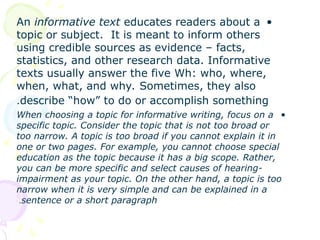
An informative texteducates readers about a
topic or subject. It is meant to inform others
using credible sources as evidence – facts,
statistics, and other research data. Informative
texts usually answer the five Wh: who, where,
when, what, and why. Sometimes, they also
describe “how” to do or accomplish something
.
•
When choosing a topic for informative writing, focus on a
specific topic. Consider the topic that is not too broad or
too narrow. A topic is too broad if you cannot explain it in
one or two pages. For example, you cannot choose special
education as the topic because it has a big scope. Rather,
you can be more specific and select causes of hearing-
impairment as your topic. On the other hand, a topic is too
narrow when it is very simple and can be explained in a
sentence or a short paragraph
.
5.
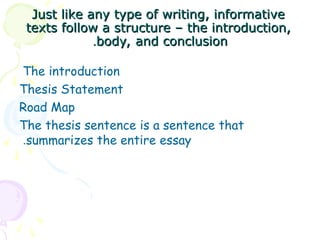
Just like anytype of writing, informative
Just like any type of writing, informative
texts follow a structure – the introduction,
texts follow a structure – the introduction,
body, and conclusion
body, and conclusion
.
.
The introduction
Thesis Statement
Road Map
The thesis sentence is a sentence that
summarizes the entire essay
.
6.
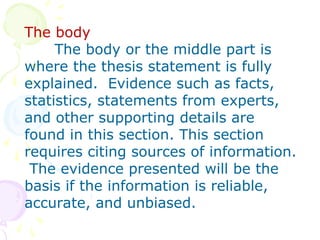
The body
The bodyor the middle part is
where the thesis statement is fully
explained. Evidence such as facts,
statistics, statements from experts,
and other supporting details are
found in this section. This section
requires citing sources of information.
The evidence presented will be the
basis if the information is reliable,
accurate, and unbiased.
7.
.
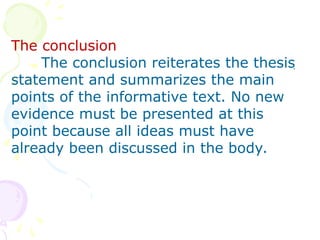
The conclusion
The conclusionreiterates the thesis
statement and summarizes the main
points of the informative text. No new
evidence must be presented at this
point because all ideas must have
already been discussed in the body.
8.
Tone, clarity (beingclear) and transition words
Aside from the structure, other features and
techniques of informative writing need to be considered.
First is tone or attitude of the author toward the topic. The
attitude of the author toward the topic should always be
formal, objective, and neutral. As mentioned above,
informative writing is fact-based - biased information is
unacceptable. The writer’s opinion and beliefs do not have a
place in informative writing. Second, always be specific.
Provide clear answers to the five Ws and one H of the topic
you are writing about. Employ language that is clear,
formal, and unbiased. Also, do not forget to use transitional
words (discussed in previous modules) for organized and
smooth flow of ideas. In doing so, readers can get a better
understanding of the information they read.
9.
Informative essays varyin length, but all good
informative pieces are a product of an application
of several writing techniques. Below are some of
the best tips/techniques to help you write an
excellent informative text.
1.Open with an attention grabber and conclude
with a summary of the main points of the essay.
2. Use appropriate transitional words to ensure the
logical flow of ideas.
3.Observe formal tone.
4.Utilize proper language and applicable vocabulary
to the topic. Similarly, avoid biased language.
5.Make use of formatting, nonlinear texts such as
flowcharts, graphs, graphic organizers, and digital
texts with hyperlinks when needed.
10.
How to Emailyour Teachers
The new normal has limited
face-to-face interactions, which is
why people shifted to sending emails
and chats to transact business. This
also has become the set-up even in
the educational setting; teachers,
learners, and parents communicate
with one another through chat or
email.
11.
However, while thismedium is more
efficient, this could disrupt the
communication process especially if the
message is not clearly and coherently. The
learner may not be aware that emails and
chats are also formal correspondence and
ends up sending friendly and informal
messages to his teachers. The result? Seen-
zoned messages, without reply. To avoid
miscommunication, follow these email tips,
rules, and examples outlined by educator
Katie Azevedo.
12.
First, enter asubject line (for
email). This tells the receiver if the
message is important, urgent, work-
related and whatnot. Secondly, use a
proper greeting or salutation just like
you do in business letters. Next,
introduce yourself by stating your
name and your class or section. This
is necessary since teachers have
hundreds of students to attend to.
13.
After these preliminaries
stateyour concern, preferably
by starting with an overview
sentence. Keep it short and
simple, and remind yourself to
use appropriate language;
jokes, sarcasm, and emojis are
not necessary. Lastly, thank
your teacher and close out the
email or chat. Remember not to
demand an immediate reply.
14.
These tips andrules send a
message that you only mean
business; hence you are likely to
get the answers you are seeking.
This is not just a school-skill; this
will be applicable even when you
will be applying for a job or when
you are emailing or sending
chats to your boss.