Remember Me!
Types of Speech
according to
purpose
“Informative or
Expository Essay”
Transfer Goal:
 The students in the long term and on their own will be able to design
and perform effective controlled and uncontrolled oral communication
activities based on context and expose themselves to an array of
communication situations where speaking and listening, responding
skills that may create a persuasive, credible and effective
communication can be honed to appreciate and exhibit viability to
work in a variety of careers and develop a strong self-presentation
skill utilizing both the verbal and non-verbal factors to enhance their
life of faith to the Almighty, excellence in whatever endeavor and
service to others and to God.
Essential Understanding:
The student will understand that
communication is an integral part
of human existence. It contributes
enormously to the success of
being human.
Essential Questions:
The students will keep considering…
1. Why do I need to be able to express myself
effectively through communication skills?
2. Why is communication important
nowadays?
Informative or
Expository Essay
Is a type of non-fiction
that tells a reader facts
about a topic.
Informative Writing
----- is to give the reader ,detailed and
proper information about a topic.
 May come in many forms: Essays,
newspaper, textbooks, and scholarly
journals
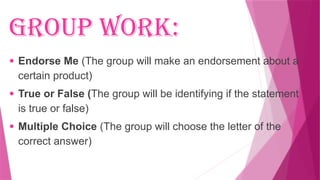
Group Work:
● Endorse Me (The group will make an endorsement about a
certain product)
● True or False (The group will be identifying if the statement
is true or false)
● Multiple Choice (The group will choose the letter of the
correct answer)
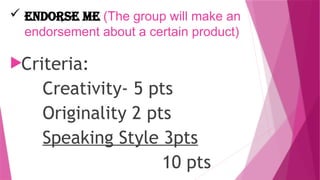
 Endorse Me (The group will make an
endorsement about a certain product)
Criteria:
Creativity- 5 pts
Originality 2 pts
Speaking Style 3pts
10 pts
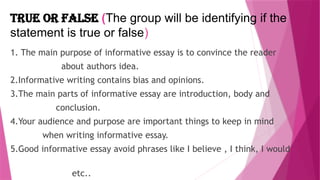
True or False (The group will be identifying if the
statement is true or false)
1. The main purpose of informative essay is to convince the reader
about authors idea.
2.Informative writing contains bias and opinions.
3.The main parts of informative essay are introduction, body and
conclusion.
4.Your audience and purpose are important things to keep in mind
when writing informative essay.
5.Good informative essay avoid phrases like I believe , I think, I would
etc..
 Multiple Choice (The group will identify
what is being described by each statement )
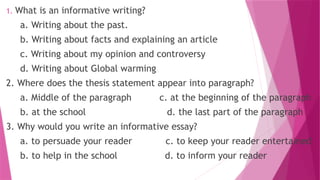
1. What is an informative writing?
a. Writing about the past.
b. Writing about facts and explaining an article
c. Writing about my opinion and controversy
d. Writing about Global warming
2. Where does the thesis statement appear into paragraph?
a. Middle of the paragraph c. at the beginning of the paragraph
b. at the school d. the last part of the paragraph
3. Why would you write an informative essay?
a. to persuade your reader c. to keep your reader entertained
b. to help in the school d. to inform your reader
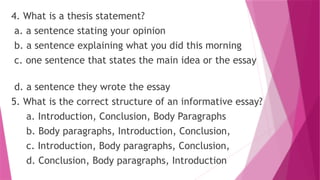
4. What is a thesis statement?
a. a sentence stating your opinion
b. a sentence explaining what you did this morning
c. one sentence that states the main idea or the essay
d. a sentence they wrote the essay
5. What is the correct structure of an informative essay?
a. Introduction, Conclusion, Body Paragraphs
b. Body paragraphs, Introduction, Conclusion,
c. Introduction, Body paragraphs, Conclusion,
d. Conclusion, Body paragraphs, Introduction
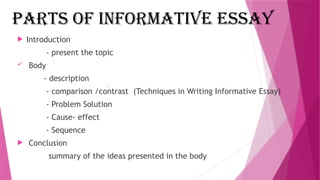
Parts of Informative Essay
 Introduction
- present the topic
 Body
- description
- comparison /contrast (Techniques in Writing Informative Essay)
- Problem Solution
- Cause- effect
- Sequence
 Conclusion
summary of the ideas presented in the body
Faith/Biblical Reflection:
“But blessed are your eyes, for
they see, and your ears, for
they hear”
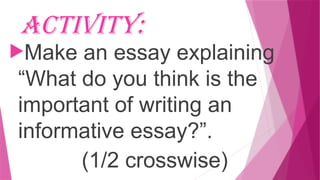
Activity:
Make an essay explaining
“What do you think is the
important of writing an
informative essay?”.
(1/2 crosswise)
PURPOSIVE ASSIGNMENT
1. Based on your own
understanding what are the
characteristics of an
informative essay?
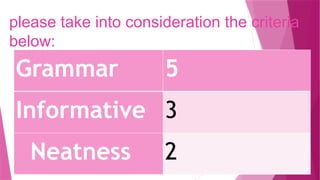
please take into consideration the criteria
below:
Grammar 5
Informative 3
Neatness 2
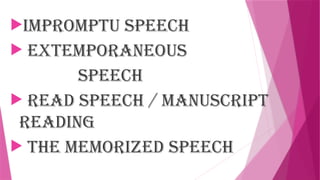
Methods of Speaking
Impromptu Speech
 Extemporaneous
Speech
 Read Speech / Manuscript
Reading
 The Memorized Speech
Impromptu Speech

- impromptu speaking you may be guided
by the nature of the occasion . As it is
speaking with very little preparation, you
might find yourself being asked to react
to a certain issue or to a preceding talk or
simply to participate in commemorating
an event.
Delivered with almost no
prior preparation at all.
Extemporaneous Speech

the extemporaneous speech is prepared in
advance but delivered spontaneously.
Extempore means growing “ out of time” or
coming at the time of delivery.
How to practice effectively
A. Read through your outline once or twice to get
ideas in mind.
B. Stand up and face your imaginary audience
squarely.
C. Time of speech.
D. Deliver the speech all the way without stopping.
E. Go through the practice repeatedly.
i. Learn to stand and move inn front of
the audience.
ii. Learn to use your voice effectively.
iii. Consider transitions and diction.
iv. Consider the image you project to the
audience.
Read speech/manuscript
reading
Speaking in the manuscript involves writing out the speech in full
and then reading it aloud. In the manuscript, speech the wording
should be planned very carefully as it should be appropriate for a
solemn and historic occasion with a big audience. This kind of
delivery, however, lacks naturalness and spontaneity and may even
result from a tendency to write a speech without any audience
adaptation. Besides, it includes a mechanical and monotonous
tone. It might not facilitate eye contact and conversational
delivery style.
1. The manuscript should be typewritten, highlighted in
larger font, readable even if you are quite away from the
script.
2. For words you have difficulty in pronouncing, use phonetic
spelling, accent marks or IPA symbols to help you in your
pronunciation or even consult Mr. Webster.
3. Make marking the will help you determine pauses, places
of special emphasis, or places where to go to slow down
or speed up.
4. double-check that there will, in fact, be a lectern or
speaker’s stand upon which the manuscript can be placed.

Types of Speech PowerPoint Presentations

  • 1.
  • 6.
    Types of Speech accordingto purpose “Informative or Expository Essay”
  • 7.
    Transfer Goal:  Thestudents in the long term and on their own will be able to design and perform effective controlled and uncontrolled oral communication activities based on context and expose themselves to an array of communication situations where speaking and listening, responding skills that may create a persuasive, credible and effective communication can be honed to appreciate and exhibit viability to work in a variety of careers and develop a strong self-presentation skill utilizing both the verbal and non-verbal factors to enhance their life of faith to the Almighty, excellence in whatever endeavor and service to others and to God.
  • 8.
    Essential Understanding: The studentwill understand that communication is an integral part of human existence. It contributes enormously to the success of being human.
  • 9.
    Essential Questions: The studentswill keep considering… 1. Why do I need to be able to express myself effectively through communication skills? 2. Why is communication important nowadays?
  • 10.
    Informative or Expository Essay Isa type of non-fiction that tells a reader facts about a topic.
  • 11.
    Informative Writing ----- isto give the reader ,detailed and proper information about a topic.  May come in many forms: Essays, newspaper, textbooks, and scholarly journals
  • 12.
    Group Work: ● EndorseMe (The group will make an endorsement about a certain product) ● True or False (The group will be identifying if the statement is true or false) ● Multiple Choice (The group will choose the letter of the correct answer)
  • 13.
     Endorse Me(The group will make an endorsement about a certain product) Criteria: Creativity- 5 pts Originality 2 pts Speaking Style 3pts 10 pts
  • 14.
    True or False(The group will be identifying if the statement is true or false) 1. The main purpose of informative essay is to convince the reader about authors idea. 2.Informative writing contains bias and opinions. 3.The main parts of informative essay are introduction, body and conclusion. 4.Your audience and purpose are important things to keep in mind when writing informative essay. 5.Good informative essay avoid phrases like I believe , I think, I would etc..
  • 15.
     Multiple Choice(The group will identify what is being described by each statement )
  • 16.
    1. What isan informative writing? a. Writing about the past. b. Writing about facts and explaining an article c. Writing about my opinion and controversy d. Writing about Global warming 2. Where does the thesis statement appear into paragraph? a. Middle of the paragraph c. at the beginning of the paragraph b. at the school d. the last part of the paragraph 3. Why would you write an informative essay? a. to persuade your reader c. to keep your reader entertained b. to help in the school d. to inform your reader
  • 17.
    4. What isa thesis statement? a. a sentence stating your opinion b. a sentence explaining what you did this morning c. one sentence that states the main idea or the essay d. a sentence they wrote the essay 5. What is the correct structure of an informative essay? a. Introduction, Conclusion, Body Paragraphs b. Body paragraphs, Introduction, Conclusion, c. Introduction, Body paragraphs, Conclusion, d. Conclusion, Body paragraphs, Introduction
  • 19.
    Parts of InformativeEssay  Introduction - present the topic  Body - description - comparison /contrast (Techniques in Writing Informative Essay) - Problem Solution - Cause- effect - Sequence  Conclusion summary of the ideas presented in the body
  • 20.
    Faith/Biblical Reflection: “But blessedare your eyes, for they see, and your ears, for they hear”
  • 21.
    Activity: Make an essayexplaining “What do you think is the important of writing an informative essay?”. (1/2 crosswise)
  • 22.
    PURPOSIVE ASSIGNMENT 1. Basedon your own understanding what are the characteristics of an informative essay?
  • 23.
    please take intoconsideration the criteria below: Grammar 5 Informative 3 Neatness 2
  • 24.
  • 25.
    Impromptu Speech  Extemporaneous Speech Read Speech / Manuscript Reading  The Memorized Speech
  • 26.
    Impromptu Speech  - impromptuspeaking you may be guided by the nature of the occasion . As it is speaking with very little preparation, you might find yourself being asked to react to a certain issue or to a preceding talk or simply to participate in commemorating an event.
  • 27.
    Delivered with almostno prior preparation at all.
  • 28.
    Extemporaneous Speech  the extemporaneousspeech is prepared in advance but delivered spontaneously. Extempore means growing “ out of time” or coming at the time of delivery.
  • 29.
    How to practiceeffectively A. Read through your outline once or twice to get ideas in mind. B. Stand up and face your imaginary audience squarely. C. Time of speech. D. Deliver the speech all the way without stopping.
  • 30.
    E. Go throughthe practice repeatedly. i. Learn to stand and move inn front of the audience. ii. Learn to use your voice effectively. iii. Consider transitions and diction. iv. Consider the image you project to the audience.
  • 31.
    Read speech/manuscript reading Speaking inthe manuscript involves writing out the speech in full and then reading it aloud. In the manuscript, speech the wording should be planned very carefully as it should be appropriate for a solemn and historic occasion with a big audience. This kind of delivery, however, lacks naturalness and spontaneity and may even result from a tendency to write a speech without any audience adaptation. Besides, it includes a mechanical and monotonous tone. It might not facilitate eye contact and conversational delivery style.
  • 32.
    1. The manuscriptshould be typewritten, highlighted in larger font, readable even if you are quite away from the script. 2. For words you have difficulty in pronouncing, use phonetic spelling, accent marks or IPA symbols to help you in your pronunciation or even consult Mr. Webster. 3. Make marking the will help you determine pauses, places of special emphasis, or places where to go to slow down or speed up. 4. double-check that there will, in fact, be a lectern or speaker’s stand upon which the manuscript can be placed.