REVIEW
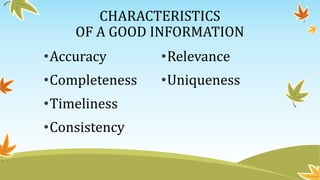
CHARACTERISTICS
OF A GOOD INFORMATION
•Accuracy
•Completeness
•Timeliness
•Consistency
•Relevance
•Uniqueness
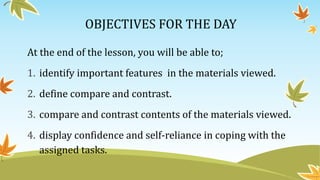
OBJECTIVES FOR THE DAY
At the end of the lesson, you will be able to;
1. identify important features in the materials viewed.
2. define compare and contrast.
3. compare and contrast contents of the materials viewed.
4. display confidence and self-reliance in coping with the
assigned tasks.
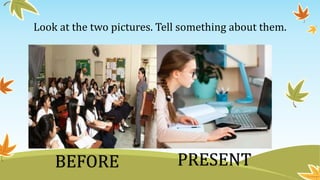
Look at the two pictures. Tell something about them.
BEFORE PRESENT
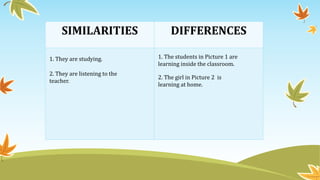
SIMILARITIES DIFFERENCES
1. They are studying.
2. They are listening to the
teacher.
1. The students in Picture 1 are
learning inside the classroom.
2. The girl in Picture 2 is
learning at home.
COMPARE AND
CONTRAST
Prepared by: Teacher Kate
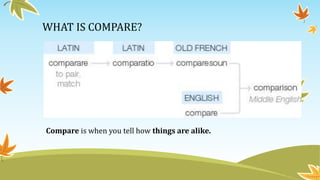
WHAT IS COMPARE?
Compare is when you tell how things are alike.
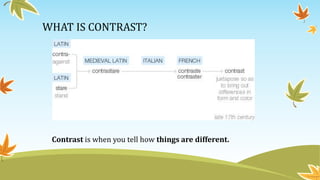
WHAT IS CONTRAST?
Contrast is when you tell how things are different.
When comparing and contrasting, we usually use
tables or diagrams. One famous example of a
diagram used in compare and contrast is the
Venn Diagram.
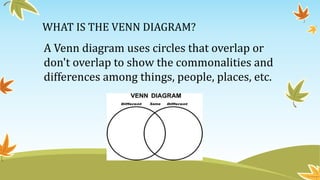
WHAT IS THE VENN DIAGRAM?
A Venn diagram uses circles that overlap or
don't overlap to show the commonalities and
differences among things, people, places, etc.
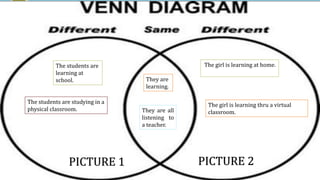
They are
learning.
They are all
listening to
a teacher.
The students are
learning at
school.
The girl is learning at home.
The students are studying in a
physical classroom.
The girl is learning thru a virtual
classroom.
PICTURE 1 PICTURE 2
At this point, we are going to learn more about
comparing and contrasting the content of
materials that we use when studying.
As a learner, you are used to accomplishing
homework and research works given to you by
your teachers, and because you want to fully
understand these learning activities, you work on
finding more information from various sources
or materials.
The gathered details from various sources
support your answers and maximize your
understanding of the lesson.
Yes, there are lots of answers in the internet, BUT
as a responsible learner, you must be aware as to
where to find the right information and how to
assess various materials or sources. The
relevance and credibility of the sources of
information you use must also be considered.
One method of making sure that you get quality
and right information is to COMPARE AND
CONTRAST the materials that you have found
online!
Comparing and contrasting information will
allow you to choose the best answers for your
learning activities.
THE THINGS WE SHOULD NOTE WHEN WE
COMPARE AND CONTRAST INFORMATION
1.Study the material carefully.
2.Make sure that the information given is correct.
(Accuracy)
3.Tell whether the content is complete.
(Completeness)
4.Tell whether the data is up-to-date and accurate.
(Timeliness)
5. Take note of the story or technique used to
present the information. (Consistency)
6. Determine if it is related to what you are looking
for. (Relevance)
7. Note whether the information is as unique as
possible. (Uniqueness)
EXAMPLE
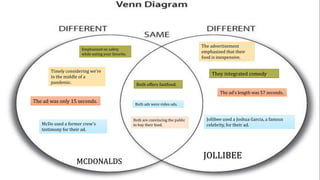
MCDONALDS
JOLLIBEE
Both offers fastfood.
Both ads were video ads.
Emphasized on safety
while eating your favorite.
Timely considering we’re
in the middle of a
pandemic.
Both are convincing the public
to buy their food.
The advertisement
emphasized that their
food is inexpensive.
They integrated comedy.
The ad was only 15 seconds.
The ad’s length was 57 seconds.
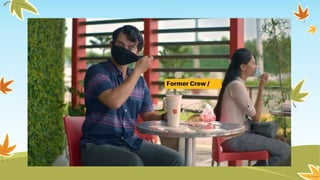
McDo used a former crew’s
testimony for their ad.
Jollibee used a Joshua Garcia, a famous
celebrity, for their ad.
COMMUNITY
QUARANTINE
COMMUNITY QUARANTINE
The government has announced another
extension of Enhanced Community Quarantine
(ECQ). However, some regions, particularly
those with a low risk of COVID-19 cases will be
under General Community Quarantine (GCQ).
To understand further, let's explore the
differences between ECQ AND GCQ.
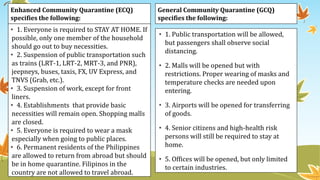
Enhanced Community Quarantine (ECQ)
specifies the following:
• 1. Everyone is required to STAY AT HOME. If
possible, only one member of the household
should go out to buy necessities.
• 2. Suspension of public transportation such
as trains (LRT-1, LRT-2, MRT-3, and PNR),
jeepneys, buses, taxis, FX, UV Express, and
TNVS (Grab, etc.).
• 3. Suspension of work, except for front
liners.
• 4. Establishments that provide basic
necessities will remain open. Shopping malls
are closed.
• 5. Everyone is required to wear a mask
especially when going to public places.
• 6. Permanent residents of the Philippines
are allowed to return from abroad but should
be in home quarantine. Filipinos in the
country are not allowed to travel abroad.
General Community Quarantine (GCQ)
specifies the following:
• 1. Public transportation will be allowed,
but passengers shall observe social
distancing.
• 2. Malls will be opened but with
restrictions. Proper wearing of masks and
temperature checks are needed upon
entering.
• 3. Airports will be opened for transferring
of goods.
• 4. Senior citizens and high-health risk
persons will still be required to stay at
home.
• 5. Offices will be opened, but only limited
to certain industries.
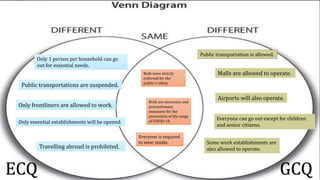
ECQ GCQ
Both were strictly
enforced for the
public’s safety.
Both are necessary and
precautionary
measures for the
prevention of the surge
of COVID-19.
Only 1 person per household can go
out for essential needs.
Public transportations are suspended.
Only frontliners are allowed to work.
Only essential establishments will be opened.
Everyone is required
to wear masks.
Travelling abroad is prohibited.
Public transportation is allowed.
Malls are allowed to operate.
Airports will also operate.
Everyone can go out except for children
and senior citizens.
Some work establishments are
also allowed to operate.
QUIZ TIME!
1. What is the poem all about?
2. What were the activities missed
by the author before times?
3. Do you feel the same as what
the author felt in the poem? If
yes, how? If no, how?
4. Are there similarities and
differences on how people live and
enjoy life in the poem? What are
they?
ASSIGNMENT
Research about the different sources of materialS, specifically the
print sources and the web sources. Make a Venn diagram to compare
and contrast the two. (20 pts.)
CRITERIA FOR ASSIGNMENT:
CONTENT: 50%
TIMELINESS: 20%
RELEVANCE: 30%
TOTAL : 100%
THANK YOU FOR
LISTENING! 

COMPARE AND CONTRAST.pptx

  • 2.
  • 3.
    CHARACTERISTICS OF A GOODINFORMATION •Accuracy •Completeness •Timeliness •Consistency •Relevance •Uniqueness
  • 4.
    OBJECTIVES FOR THEDAY At the end of the lesson, you will be able to; 1. identify important features in the materials viewed. 2. define compare and contrast. 3. compare and contrast contents of the materials viewed. 4. display confidence and self-reliance in coping with the assigned tasks.
  • 5.
    Look at thetwo pictures. Tell something about them. BEFORE PRESENT
  • 6.
    SIMILARITIES DIFFERENCES 1. Theyare studying. 2. They are listening to the teacher. 1. The students in Picture 1 are learning inside the classroom. 2. The girl in Picture 2 is learning at home.
  • 7.
  • 8.
    WHAT IS COMPARE? Compareis when you tell how things are alike.
  • 9.
    WHAT IS CONTRAST? Contrastis when you tell how things are different.
  • 10.
    When comparing andcontrasting, we usually use tables or diagrams. One famous example of a diagram used in compare and contrast is the Venn Diagram.
  • 11.
    WHAT IS THEVENN DIAGRAM? A Venn diagram uses circles that overlap or don't overlap to show the commonalities and differences among things, people, places, etc.
  • 12.
    They are learning. They areall listening to a teacher. The students are learning at school. The girl is learning at home. The students are studying in a physical classroom. The girl is learning thru a virtual classroom. PICTURE 1 PICTURE 2
  • 13.
    At this point,we are going to learn more about comparing and contrasting the content of materials that we use when studying. As a learner, you are used to accomplishing homework and research works given to you by your teachers, and because you want to fully understand these learning activities, you work on finding more information from various sources or materials.
  • 14.
    The gathered detailsfrom various sources support your answers and maximize your understanding of the lesson. Yes, there are lots of answers in the internet, BUT as a responsible learner, you must be aware as to where to find the right information and how to assess various materials or sources. The relevance and credibility of the sources of information you use must also be considered.
  • 15.
    One method ofmaking sure that you get quality and right information is to COMPARE AND CONTRAST the materials that you have found online! Comparing and contrasting information will allow you to choose the best answers for your learning activities.
  • 16.
    THE THINGS WESHOULD NOTE WHEN WE COMPARE AND CONTRAST INFORMATION 1.Study the material carefully. 2.Make sure that the information given is correct. (Accuracy) 3.Tell whether the content is complete. (Completeness) 4.Tell whether the data is up-to-date and accurate. (Timeliness)
  • 17.
    5. Take noteof the story or technique used to present the information. (Consistency) 6. Determine if it is related to what you are looking for. (Relevance) 7. Note whether the information is as unique as possible. (Uniqueness)
  • 18.
  • 21.
    MCDONALDS JOLLIBEE Both offers fastfood. Bothads were video ads. Emphasized on safety while eating your favorite. Timely considering we’re in the middle of a pandemic. Both are convincing the public to buy their food. The advertisement emphasized that their food is inexpensive. They integrated comedy. The ad was only 15 seconds. The ad’s length was 57 seconds. McDo used a former crew’s testimony for their ad. Jollibee used a Joshua Garcia, a famous celebrity, for their ad.
  • 22.
  • 23.
    COMMUNITY QUARANTINE The governmenthas announced another extension of Enhanced Community Quarantine (ECQ). However, some regions, particularly those with a low risk of COVID-19 cases will be under General Community Quarantine (GCQ). To understand further, let's explore the differences between ECQ AND GCQ.
  • 24.
    Enhanced Community Quarantine(ECQ) specifies the following: • 1. Everyone is required to STAY AT HOME. If possible, only one member of the household should go out to buy necessities. • 2. Suspension of public transportation such as trains (LRT-1, LRT-2, MRT-3, and PNR), jeepneys, buses, taxis, FX, UV Express, and TNVS (Grab, etc.). • 3. Suspension of work, except for front liners. • 4. Establishments that provide basic necessities will remain open. Shopping malls are closed. • 5. Everyone is required to wear a mask especially when going to public places. • 6. Permanent residents of the Philippines are allowed to return from abroad but should be in home quarantine. Filipinos in the country are not allowed to travel abroad. General Community Quarantine (GCQ) specifies the following: • 1. Public transportation will be allowed, but passengers shall observe social distancing. • 2. Malls will be opened but with restrictions. Proper wearing of masks and temperature checks are needed upon entering. • 3. Airports will be opened for transferring of goods. • 4. Senior citizens and high-health risk persons will still be required to stay at home. • 5. Offices will be opened, but only limited to certain industries.
  • 25.
    ECQ GCQ Both werestrictly enforced for the public’s safety. Both are necessary and precautionary measures for the prevention of the surge of COVID-19. Only 1 person per household can go out for essential needs. Public transportations are suspended. Only frontliners are allowed to work. Only essential establishments will be opened. Everyone is required to wear masks. Travelling abroad is prohibited. Public transportation is allowed. Malls are allowed to operate. Airports will also operate. Everyone can go out except for children and senior citizens. Some work establishments are also allowed to operate.
  • 26.
  • 27.
    1. What isthe poem all about?
  • 28.
    2. What werethe activities missed by the author before times?
  • 29.
    3. Do youfeel the same as what the author felt in the poem? If yes, how? If no, how?
  • 30.
    4. Are theresimilarities and differences on how people live and enjoy life in the poem? What are they?
  • 31.
    ASSIGNMENT Research about thedifferent sources of materialS, specifically the print sources and the web sources. Make a Venn diagram to compare and contrast the two. (20 pts.) CRITERIA FOR ASSIGNMENT: CONTENT: 50% TIMELINESS: 20% RELEVANCE: 30% TOTAL : 100%
  • 32.