Using Informative
Writing Techniques
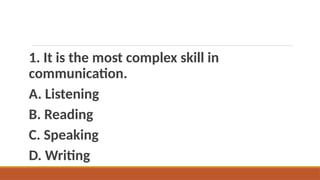
1. It is the most complex skill in
communication.
A. Listening
B. Reading
C. Speaking
D. Writing
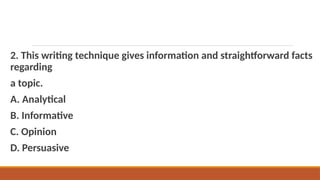
2. This writing technique gives information and straightforward facts
regarding
a topic.
A. Analytical
B. Informative
C. Opinion
D. Persuasive
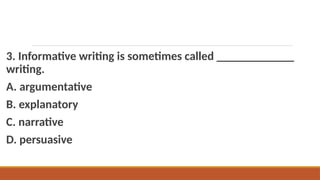
3. Informative writing is sometimes called _____________
writing.
A. argumentative
B. explanatory
C. narrative
D. persuasive
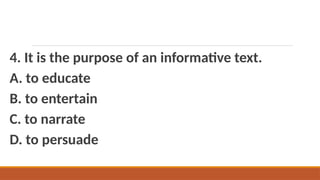
4. It is the purpose of an informative text.
A. to educate
B. to entertain
C. to narrate
D. to persuade
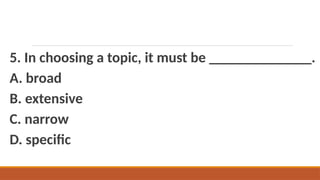
5. In choosing a topic, it must be ______________.
A. broad
B. extensive
C. narrow
D. specific
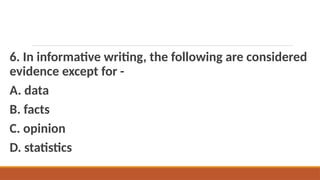
6. In informative writing, the following are considered
evidence except for -
A. data
B. facts
C. opinion
D. statistics
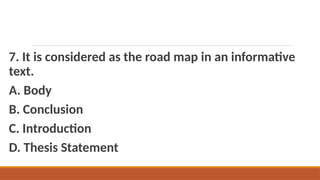
7. It is considered as the road map in an informative
text.
A. Body
B. Conclusion
C. Introduction
D. Thesis Statement
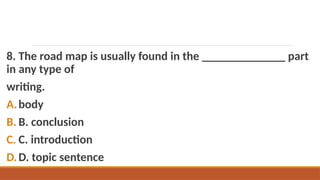
8. The road map is usually found in the ______________ part
in any type of
writing.
A.body
B. B. conclusion
C. C. introduction
D.D. topic sentence
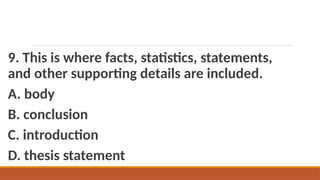
9. This is where facts, statistics, statements,
and other supporting details are included.
A. body
B. conclusion
C. introduction
D. thesis statement
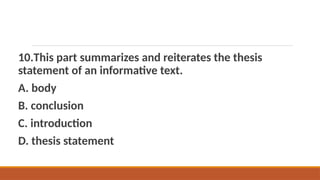
10.This part summarizes and reiterates the thesis
statement of an informative text.
A. body
B. conclusion
C. introduction
D. thesis statement
Writing is the most complex of the four macro
skills in communication. It takes years and a
lot of practice to master this skill. However,
since writing is part of life, you need to hone
your writing skills to prepare you for academic
and professional demands.
Informative writing explains a specific topic. The information included in informative
texts is grounded on facts. Informative or informational texts may follow a number
of structures like description, sequence, cause and effect, problem-solution, and
comparison and cont
In the previous modules, argumentative writing was
already discussed. Where the writer needs to take a
stand on a certain issue, the writer’s stand must be
supported with evidence. The same is true with
informative writing, which we encounter daily from
reading instructions, writing a grocery list, and reading
books and announcements among other things.
An informative text educates readers about a topic
or subject. It is meant to inform others using
credible sources as evidence – facts, statistics, and
other research data. Informative texts usually
answer the five Ws: who, where, when, what, and
why. Sometimes, they also describe “how” to do or
accomplish something.
When choosing a topic for informative writing, focus on a specific
topic.
Consider the topic that is not too broad or too narrow. A topic is
too broad if you cannot explain it in one or two pages. For
example, you cannot choose special education as the topic
because it has a big scope. Rather, you can be more specific and
select causes of hearing-impairment as your topic. On the other
hand, a topic is too narrow when it is very simple and can be
explained in a sentence or a short paragraph.
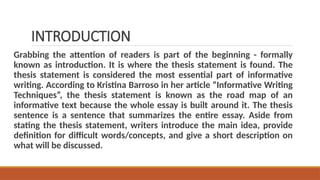
INTRODUCTION
Grabbing the attention of readers is part of the beginning - formally
known as introduction. It is where the thesis statement is found. The
thesis statement is considered the most essential part of informative
writing. According to Kristina Barroso in her article “Informative Writing
Techniques”, the thesis statement is known as the road map of an
informative text because the whole essay is built around it. The thesis
sentence is a sentence that summarizes the entire essay. Aside from
stating the thesis statement, writers introduce the main idea, provide
definition for difficult words/concepts, and give a short description on
what will be discussed.
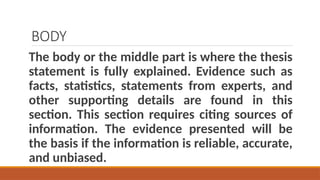
BODY
The body or the middle part is where the thesis
statement is fully explained. Evidence such as
facts, statistics, statements from experts, and
other supporting details are found in this
section. This section requires citing sources of
information. The evidence presented will be
the basis if the information is reliable, accurate,
and unbiased.
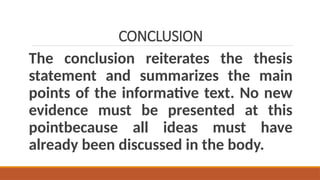
CONCLUSION
The conclusion reiterates the thesis
statement and summarizes the main
points of the informative text. No new
evidence must be presented at this
pointbecause all ideas must have
already been discussed in the body.
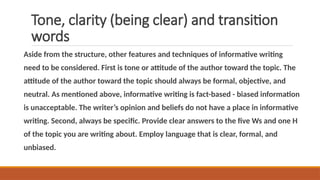
Tone, clarity (being clear) and transition
words
Aside from the structure, other features and techniques of informative writing
need to be considered. First is tone or attitude of the author toward the topic. The
attitude of the author toward the topic should always be formal, objective, and
neutral. As mentioned above, informative writing is fact-based - biased information
is unacceptable. The writer’s opinion and beliefs do not have a place in informative
writing. Second, always be specific. Provide clear answers to the five Ws and one H
of the topic you are writing about. Employ language that is clear, formal, and
unbiased.
Informative essays vary in length, but all good informative pieces are a product
of an application of several writing techniques. Below are some of the best
tips/techniques to help you write an excellent informative text.
1. Open with an attention grabber and conclude with a summary of the main
points of the essay.
2. Use appropriate transitional words to ensure the logical flow of ideas.
3. Observe formal tone.
4. Utilize proper language and applicable vocabulary to the topic. Similarly, avoid
biased language.
5. Make use of formatting, nonlinear texts such as flowcharts, graphs, graphic
organizers, and digital texts with hyperlinks when needed.
This essay is probably way shorter than most informative essays, but does it
comply to the prescribed structure and conventions in informative writing? Does it
comply to the guidelines and techniques?
It started with a relatable scenario and ended with a repeat of the thesis
statement.
It utilized transitional words such as ‘however, first, second, next, after,
lastly.’
The tone is generally formal, but it becomes conversational in parts where
the essay shifts to a second person point of view.
The language used is simple and appropriate for the target audience –
students.
There aren’t any graphics or visuals, but they are not really necessary
considering the length of the essay and the topic. However, in online
platforms, this essay could be presented in a bullet list with and with other
nonlinear texts.
Informative writing plays a vital role not only in
the academic world but also in the real world. It
is a skill so essential that it can affect your
grades and future job opportunities. Becoming
an effective writer is not easy, but it pays to be
one.

Using Informative Writing Techniques.pptx

  • 1.
  • 2.
    1. It isthe most complex skill in communication. A. Listening B. Reading C. Speaking D. Writing
  • 3.
    2. This writingtechnique gives information and straightforward facts regarding a topic. A. Analytical B. Informative C. Opinion D. Persuasive
  • 4.
    3. Informative writingis sometimes called _____________ writing. A. argumentative B. explanatory C. narrative D. persuasive
  • 5.
    4. It isthe purpose of an informative text. A. to educate B. to entertain C. to narrate D. to persuade
  • 6.
    5. In choosinga topic, it must be ______________. A. broad B. extensive C. narrow D. specific
  • 7.
    6. In informativewriting, the following are considered evidence except for - A. data B. facts C. opinion D. statistics
  • 8.
    7. It isconsidered as the road map in an informative text. A. Body B. Conclusion C. Introduction D. Thesis Statement
  • 9.
    8. The roadmap is usually found in the ______________ part in any type of writing. A.body B. B. conclusion C. C. introduction D.D. topic sentence
  • 10.
    9. This iswhere facts, statistics, statements, and other supporting details are included. A. body B. conclusion C. introduction D. thesis statement
  • 11.
    10.This part summarizesand reiterates the thesis statement of an informative text. A. body B. conclusion C. introduction D. thesis statement
  • 12.
    Writing is themost complex of the four macro skills in communication. It takes years and a lot of practice to master this skill. However, since writing is part of life, you need to hone your writing skills to prepare you for academic and professional demands.
  • 13.
    Informative writing explainsa specific topic. The information included in informative texts is grounded on facts. Informative or informational texts may follow a number of structures like description, sequence, cause and effect, problem-solution, and comparison and cont
  • 14.
    In the previousmodules, argumentative writing was already discussed. Where the writer needs to take a stand on a certain issue, the writer’s stand must be supported with evidence. The same is true with informative writing, which we encounter daily from reading instructions, writing a grocery list, and reading books and announcements among other things.
  • 15.
    An informative texteducates readers about a topic or subject. It is meant to inform others using credible sources as evidence – facts, statistics, and other research data. Informative texts usually answer the five Ws: who, where, when, what, and why. Sometimes, they also describe “how” to do or accomplish something.
  • 16.
    When choosing atopic for informative writing, focus on a specific topic. Consider the topic that is not too broad or too narrow. A topic is too broad if you cannot explain it in one or two pages. For example, you cannot choose special education as the topic because it has a big scope. Rather, you can be more specific and select causes of hearing-impairment as your topic. On the other hand, a topic is too narrow when it is very simple and can be explained in a sentence or a short paragraph.
  • 17.
    INTRODUCTION Grabbing the attentionof readers is part of the beginning - formally known as introduction. It is where the thesis statement is found. The thesis statement is considered the most essential part of informative writing. According to Kristina Barroso in her article “Informative Writing Techniques”, the thesis statement is known as the road map of an informative text because the whole essay is built around it. The thesis sentence is a sentence that summarizes the entire essay. Aside from stating the thesis statement, writers introduce the main idea, provide definition for difficult words/concepts, and give a short description on what will be discussed.
  • 18.
    BODY The body orthe middle part is where the thesis statement is fully explained. Evidence such as facts, statistics, statements from experts, and other supporting details are found in this section. This section requires citing sources of information. The evidence presented will be the basis if the information is reliable, accurate, and unbiased.
  • 19.
    CONCLUSION The conclusion reiteratesthe thesis statement and summarizes the main points of the informative text. No new evidence must be presented at this pointbecause all ideas must have already been discussed in the body.
  • 20.
    Tone, clarity (beingclear) and transition words Aside from the structure, other features and techniques of informative writing need to be considered. First is tone or attitude of the author toward the topic. The attitude of the author toward the topic should always be formal, objective, and neutral. As mentioned above, informative writing is fact-based - biased information is unacceptable. The writer’s opinion and beliefs do not have a place in informative writing. Second, always be specific. Provide clear answers to the five Ws and one H of the topic you are writing about. Employ language that is clear, formal, and unbiased.
  • 21.
    Informative essays varyin length, but all good informative pieces are a product of an application of several writing techniques. Below are some of the best tips/techniques to help you write an excellent informative text. 1. Open with an attention grabber and conclude with a summary of the main points of the essay. 2. Use appropriate transitional words to ensure the logical flow of ideas. 3. Observe formal tone. 4. Utilize proper language and applicable vocabulary to the topic. Similarly, avoid biased language. 5. Make use of formatting, nonlinear texts such as flowcharts, graphs, graphic organizers, and digital texts with hyperlinks when needed.
  • 22.
    This essay isprobably way shorter than most informative essays, but does it comply to the prescribed structure and conventions in informative writing? Does it comply to the guidelines and techniques? It started with a relatable scenario and ended with a repeat of the thesis statement. It utilized transitional words such as ‘however, first, second, next, after, lastly.’ The tone is generally formal, but it becomes conversational in parts where the essay shifts to a second person point of view. The language used is simple and appropriate for the target audience – students. There aren’t any graphics or visuals, but they are not really necessary considering the length of the essay and the topic. However, in online platforms, this essay could be presented in a bullet list with and with other nonlinear texts.
  • 23.
    Informative writing playsa vital role not only in the academic world but also in the real world. It is a skill so essential that it can affect your grades and future job opportunities. Becoming an effective writer is not easy, but it pays to be one.