UNIVERSIDAD PEDAGÓGICA EXPERIMENTAL LIBERTADORINSTITUTO PEDAGÓGICO DE CARACASDEPARTAMENTO DE IDIOMAS MODERNOSCÁTEDRA DE LINGÜÍSTICAEVALUACIÓN DE ILETESTING AND TEST CONSTRUCTIONProfa. Rosynella CardozoProf. Jonathan Magdalena
TESTING
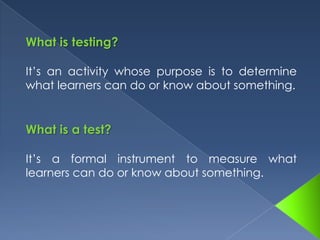
What is testing?It’s an activity whose purpose is to determine what learners can do or know about something.What is a test?It’s a formal instrument to measure what learners can do or know about something. 
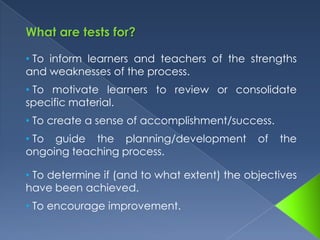
What are tests for? To inform learners and teachers of the strengths and weaknesses of the process.
 To motivate learners to review or consolidate specific material.
 To create a sense of accomplishment/success.
 To guide the planning/development of the ongoing teaching process.
 To determine if (and to what extent) the objectives have been achieved.
 To encourage improvement. TEST TYPES
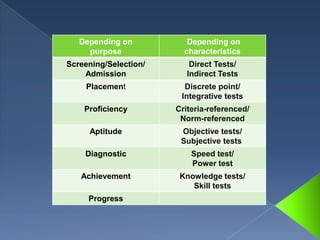
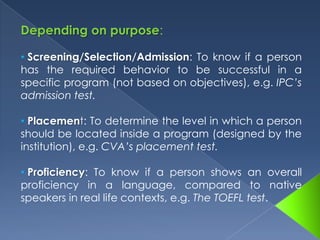
Depending on purpose: Screening/Selection/Admission: To know if a person has the required behavior to be successful in a specific program (not based on objectives), e.g. IPC’s admission test.
Placement: To determine the level in which a person should be located inside a program (designed by the institution), e.g. CVA’s placement test.
Proficiency: To know if a person shows an overall proficiency in a language, compared to native speakers in real life contexts, e.g. The TOEFL test. 
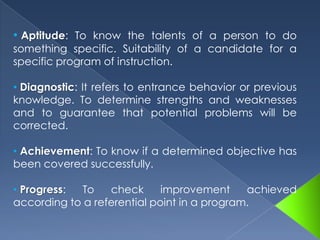
 Aptitude: To know the talents of a person to do something specific. Suitability of a candidate for a specific program of instruction.
Diagnostic: It refers to entrance behavior or previous knowledge. To determine strengths and weaknesses and to guarantee that potential problems will be corrected.
Achievement: To know if a determined objective has been covered successfully.
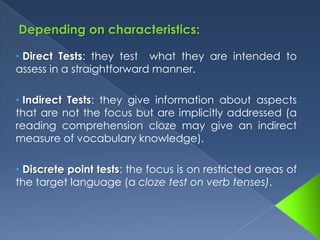
Progress: To check improvement achieved according to a referential point in a program. Depending on characteristics: Direct Tests: they test  what they are intended to assess in a straightforward manner.
Indirect Tests: they give information about aspects that are not the focus but are implicitly addressed (a reading comprehension cloze may give an indirect measure of vocabulary knowledge).
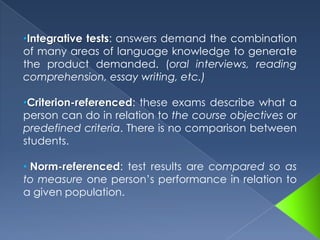
Discrete point tests: the focus is on restricted areas of the target language (a cloze test on verb tenses). Integrative tests: answers demand the combination of many areas of language knowledge to generate the product demanded. (oral interviews, reading comprehension, essay writing, etc.)  
Criterion-referenced: these exams describe what a person can do in relation to the course objectives or  predefined criteria. There is no comparison between students.
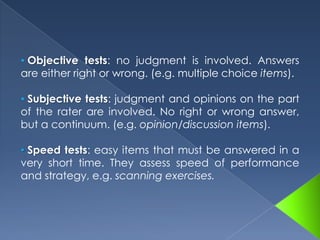
Norm-referenced: test results are compared so as to measure one person’s performance in relation to a given population. Objective tests: no judgment is involved. Answers are either right or wrong. (e.g. multiple choiceitems).
Subjective tests: judgment and opinions on the part of the rater are involved. No right or wrong answer, but a continuum. (e.g. opinion/discussion items). 

Testing and test constructions

  • 1.
    UNIVERSIDAD PEDAGÓGICA EXPERIMENTALLIBERTADORINSTITUTO PEDAGÓGICO DE CARACASDEPARTAMENTO DE IDIOMAS MODERNOSCÁTEDRA DE LINGÜÍSTICAEVALUACIÓN DE ILETESTING AND TEST CONSTRUCTIONProfa. Rosynella CardozoProf. Jonathan Magdalena
  • 2.
  • 3.
    What is testing?It’san activity whose purpose is to determine what learners can do or know about something.What is a test?It’s a formal instrument to measure what learners can do or know about something. 
  • 4.
    What are testsfor? To inform learners and teachers of the strengths and weaknesses of the process.
  • 5.
    To motivatelearners to review or consolidate specific material.
  • 6.
    To createa sense of accomplishment/success.
  • 7.
    To guidethe planning/development of the ongoing teaching process.
  • 8.
    To determineif (and to what extent) the objectives have been achieved.
  • 9.
    To encourageimprovement. TEST TYPES
  • 11.
    Depending on purpose: Screening/Selection/Admission:To know if a person has the required behavior to be successful in a specific program (not based on objectives), e.g. IPC’s admission test.
  • 12.
    Placement: To determinethe level in which a person should be located inside a program (designed by the institution), e.g. CVA’s placement test.
  • 13.
    Proficiency: To knowif a person shows an overall proficiency in a language, compared to native speakers in real life contexts, e.g. The TOEFL test. 
  • 14.
     Aptitude: To knowthe talents of a person to do something specific. Suitability of a candidate for a specific program of instruction.
  • 15.
    Diagnostic: It refersto entrance behavior or previous knowledge. To determine strengths and weaknesses and to guarantee that potential problems will be corrected.
  • 16.
    Achievement: To knowif a determined objective has been covered successfully.
  • 17.
    Progress: To checkimprovement achieved according to a referential point in a program. Depending on characteristics: Direct Tests: they test what they are intended to assess in a straightforward manner.
  • 18.
    Indirect Tests: theygive information about aspects that are not the focus but are implicitly addressed (a reading comprehension cloze may give an indirect measure of vocabulary knowledge).
  • 19.
    Discrete point tests:the focus is on restricted areas of the target language (a cloze test on verb tenses). Integrative tests: answers demand the combination of many areas of language knowledge to generate the product demanded. (oral interviews, reading comprehension, essay writing, etc.)  
  • 20.
    Criterion-referenced: these examsdescribe what a person can do in relation to the course objectives or predefined criteria. There is no comparison between students.
  • 21.
    Norm-referenced: test resultsare compared so as to measure one person’s performance in relation to a given population. Objective tests: no judgment is involved. Answers are either right or wrong. (e.g. multiple choiceitems).
  • 22.
    Subjective tests: judgmentand opinions on the part of the rater are involved. No right or wrong answer, but a continuum. (e.g. opinion/discussion items).