Sample Question Paper – 2 Pg 1 of 5
Sample Question Paper 2016
Science
Class – X (SA – II)
Time allowed: 03 Hours Maximum Marks: 90
General Instructions:
(i) The question paper comprises two sections, A and B. You are to attempt both the sections.
(ii) All questions are compulsory.
(iii) There is no choice in any of the question.
(iv) All questions of Section-A and B are to be attempted separately.
(v) Question numbers 1 to 3 in Section - A are one mark question. They are to be answered in one
word or in one sentence.
(vi) Question numbers 4 to 6 in Section - A are two marks questions. These are to be answered in 30
words each.
(vii) Question numbers 7 to 18 in Section - A are three marks questions. These are to be answered in
about 50 words each.
(viii) Question numbers 19 to 24 in Section-A are 5 marks questions. These are to be answered in 70
words each.
(ix) Question numbers 25 to 33 in Section- B are multiple choice questions based on practical skills.
Each question is a one mark question. You are to select one most appropriate response out of
the four provided to you.
(x) Question numbers 34 to 36 in Section B are two marks questions based on practical skills.
These are to be answered in brief.
SECTION – A
1 Name the process of converting vegetable oil to vegetable ghee. 1
2 Give reason for the statement- Since the ovary releases one egg every month, the
uterus also prepares itself every month by making its lining thick and spongy.
1
3 Name the component of white light that has the greatest wavelength. 1
4 Which natural resource are the „biodiversity hot spots‟? Suggest what happens
when there is a loss of biodiversity?
2
5 Write the name and molecular formula of an organic compound having its name
suffixed with „–ol‟ and having two carbon atoms in the molecule. With the help
of a balanced equation indicate what happens when its heated with excess of
conc. H2SO4.
½ + ½ +1
6 A cube of edge 6 cm is placed over a printed page. At what distance from the top
surface of cube will the letters appear when seen from above?
Refractive index of glass is 1.5
2
7 What is meant by isomers? “We can not have isomers of the first three members
of alkane series” give reason to justify this statement.
Draw the structures of two isomers of pentane, C5H12
1+1+1
8 i) Name the following:
Sample Question Paper – 2 Pg 2 of 5
a) Third member of aldehyde series
b) Second member of carboxylic series
ii) Write the IUPAC name of the following:
a)
3
3 3
3
|
|
CH
CH C CH
CH
 
b)
1
1
½
½
9 Four elements A, B, C and D have atomic numbers 12, 13, 14 and 15
respectively.
Answer the following questions giving reasons -
i) What is the number of valence electrons and valency of D?
ii) Which of them will have largest atomic radii?
iii) Which of these elements will form the most basic oxide?
1+1+1
10 Differentiate between combustion and oxidation reactions of ethanol. 3
11 In a germinating seed, which parts are known as future shoot and future root?
Mention the function of cotyledon.
3
12 What is placenta? Write any two major functions of placenta. 3
13 „Different species use different strategies to determine sex of a newborn
individual. It can be environmental cues or genetically determined‟. Explain the
statement by giving example for each strategy.
3
14 A 2 cm high object is placed at a distance of 32 cm from a concave mirror. The
image is real, inverted and 3 cm in size. Find the focal length of the mirror and
the position where the image is formed?
3
15 A child while playing with his father‟s spectacles burnt a hole in a piece of paper
by focusing a small image of the sun on it.
(i) What defect of vision his father is suffering from?
(ii) Write two causes for this defect?
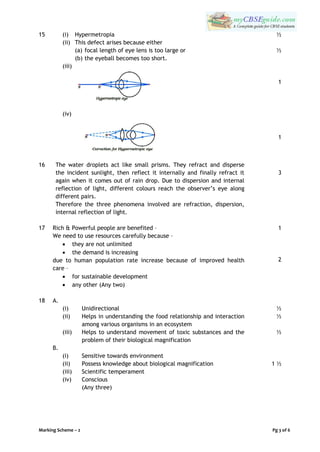
(iii) Draw a ray diagram to show image formation by the defective eye?
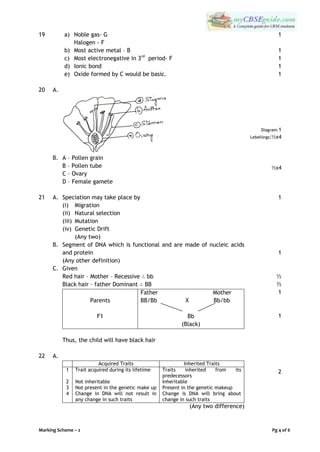
(iv) Draw a ray diagram showing corrected eye using proper lens.
3
16 Explain the formation of rainbow in the sky with the help of a diagram. List the
three phenomena involved in proper sequence.
3
17 Which types of people are benefited from the development of different
resources? Why do we need to use the resources carefully?
3
18 Write any three characteristics of a food chain. Dharmesh always treated the
chemical effluent before disposing it in the water body. Mention any three moral
values possessed by Dharmesh.
3
19 In the following table. Six elements A, B, C, D, E and F of the modern periodic
table with atomic numbers 3 to 18 are given:
1+1+1+1+1
Sample Question Paper – 2 Pg 3 of 5
3 4 5 6 7 8 9 10
A E G
11 12 13 14 15 16 17 18
B C D F
a) Which of these is i) Noble gas ii) halogen
b) Which of these is the most active metal in 3rd
period?
c) Identify the most electronegative element in the third period.
d) In the compound between B and F what type of bond will be formed?
e) What would be the nature of oxide formed by C?
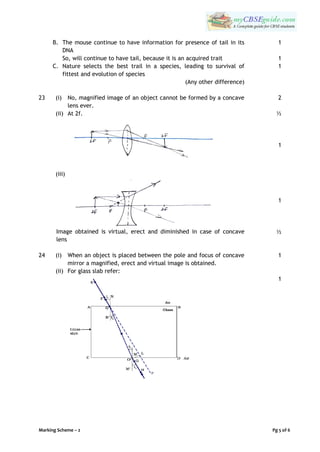
20 A. Draw a longitudinal section of a flower and label the following parts –
a) Part that develops into a fruit
b) Part that produces pollen grain
c) Part that transfers male gametes
d) Part that is sticky to trap
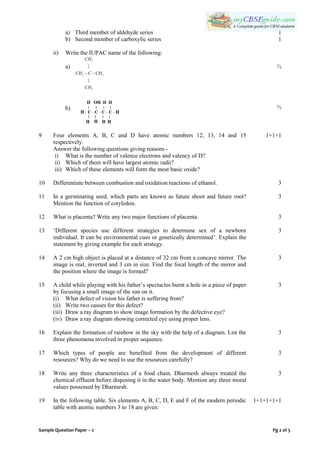
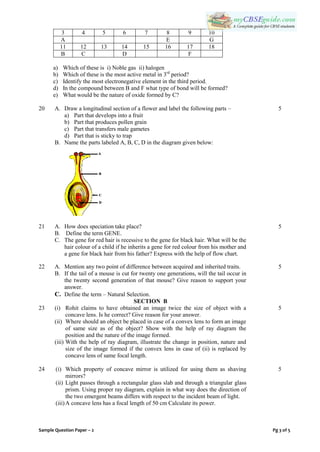
B. Name the parts labeled A, B, C, D in the diagram given below:
5
21 A. How does speciation take place?
B. Define the term GENE.
C. The gene for red hair is recessive to the gene for black hair. What will be the
hair colour of a child if he inherits a gene for red colour from his mother and
a gene for black hair from his father? Express with the help of flow chart.
5
22 A. Mention any two point of difference between acquired and inherited traits.
B. If the tail of a mouse is cut for twenty one generations, will the tail occur in
the twenty second generation of that mouse? Give reason to support your
answer.
C. Define the term – Natural Selection.
5
SECTION B
23 (i) Rohit claims to have obtained an image twice the size of object with a
concave lens. Is he correct? Give reason for your answer.
(ii) Where should an object be placed in case of a convex lens to form an image
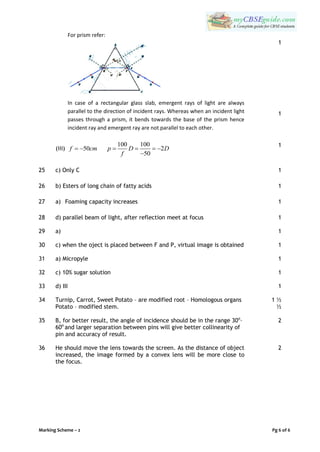
of same size as of the object? Show with the help of ray diagram the
position and the nature of the image formed.
(iii) With the help of ray diagram, illustrate the change in position, nature and
size of the image formed if the convex lens in case of (ii) is replaced by
concave lens of same focal length.
5
24 (i) Which property of concave mirror is utilized for using them as shaving
mirrors?
(ii) Light passes through a rectangular glass slab and through a triangular glass
prism. Using proper ray diagram, explain in what way does the direction of
the two emergent beams differs with respect to the incident beam of light.
(iii)A concave lens has a focal length of 50 cm Calculate its power.
5
Sample Question Paper – 2 Pg 4 of 5
25 A student is given equal amount of three samples A, B and C of water with
temporary hardness. He keeps the three samples at different temperatures. A at
room temperature, B at 50o
C and C at 80o
C.
Which sample will give maximum amount of lather with soap solution?
a) A
b) Both B and C
c) Only C
d) Both A and B
1
26 Soaps are formed by alkaline hydrolysis of
a) Carboxylic acids
b) Esters of long chain fatty acids
c) Esters of small chain
d) Inorganic acids
1
27 On addition of Na2CO3 to hard water
a) the foaming capacity increases
b) the foaming capacity decreases
c) the foaming capacity increases then decreases
d) the foaming capacity decreases then increases
1
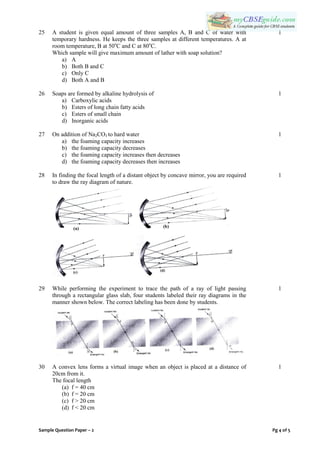
28 In finding the focal length of a distant object by concave mirror, you are required
to draw the ray diagram of nature.
1
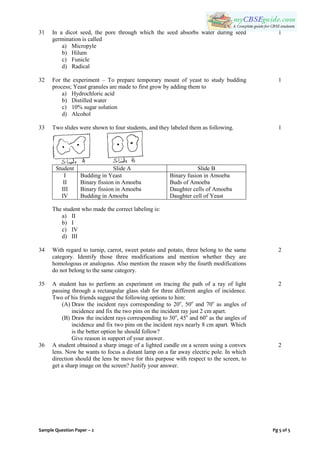
29 While performing the experiment to trace the path of a ray of light passing
through a rectangular glass slab, four students labeled their ray diagrams in the
manner shown below. The correct labeling has been done by students.
1
30 A convex lens forms a virtual image when an object is placed at a distance of
20cm from it.
The focal length
(a) f = 40 cm
(b) f = 20 cm
(c) f > 20 cm
(d) f < 20 cm
1
Sample Question Paper – 2 Pg 5 of 5
31 In a dicot seed, the pore through which the seed absorbs water during seed
germination is called
a) Micropyle
b) Hilum
c) Funicle
d) Radical
1
32 For the experiment – To prepare temporary mount of yeast to study budding
process; Yeast granules are made to first grow by adding them to
a) Hydrochloric acid
b) Distilled water
c) 10% sugar solution
d) Alcohol
1
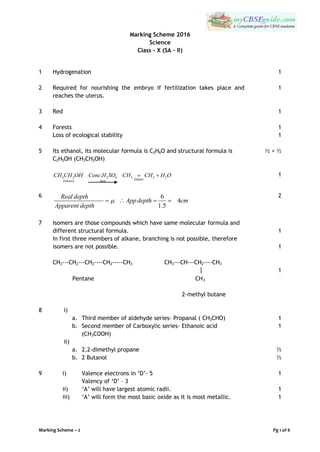
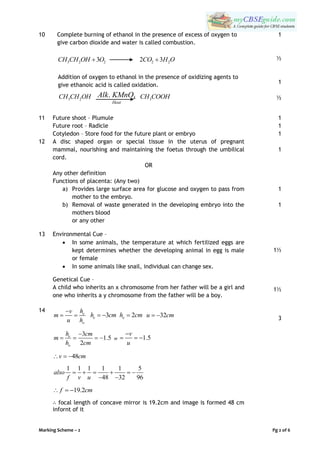
33 Two slides were shown to four students, and they labeled them as following.
Student Slide A Slide B
I
II
III
IV
Budding in Yeast
Binary fission in Amoeba
Budding in Amoeba
Binary fusion in Amoeba
Buds of Amoeba
Daughter cells of Amoeba
Daughter cell of Yeast
The student who made the correct labeling is:
a) II
b) I
c) IV
d) III
1
34 With regard to turnip, carrot, sweet potato and potato, three belong to the same
category. Identify those three modifications and mention whether they are
homologous or analogous. Also mention the reason why the fourth modifications
do not belong to the same category.
2
35 A student has to perform an experiment on tracing the path of a ray of light
passing through a rectangular glass slab for three different angles of incidence.
Two of his friends suggest the following options to him:
(A) Draw the incident rays corresponding to 20o
, 50o
and 70o
as angles of
incidence and fix the two pins on the incident ray just 2 cm apart.
(B) Draw the incident rays corresponding to 30o
, 45o
and 60o
as the angles of
incidence and fix two pins on the incident rays nearly 8 cm apart. Which
is the better option he should follow?
Give reason in support of your answer.
2
36 A student obtained a sharp image of a lighted candle on a screen using a convex
lens. Now he wants to focus a distant lamp on a far away electric pole. In which
direction should the lens be move for this purpose with respect to the screen, to
get a sharp image on the screen? Justify your answer.
2
Marking Scheme – 2 Pg 1 of 6
Marking Scheme 2016
Science
Class – X (SA – II)
1 Hydrogenation 1
2 Required for nourishing the embryo if fertilization takes place and
reaches the uterus.
1
3 Red 1
4 Forests
Loss of ecological stability
1
1
5 Its ethanol, its molecular formula is C2H6O and structural formula is
C2H5OH (CH3CH2OH)
3 2
Ethanol
CH CH OH 2 4.
heat
Conc H SO 2 2 2
Ethane
CH CH H O 
½ + ½
1
6 Real depth
Apparent depth

6
4
1.5
Appdepth cm  
2
7 Isomers are those compounds which have same molecular formula and
different structural formula.
In first three members of alkane, branching is not possible, therefore
isomers are not possible.
CH3---CH2---CH2----CH2-----CH3 CH3---CH---CH2----CH3

Pentane CH3
2-methyl butane
1
1
1
8 i)
a. Third member of aldehyde series- Propanal ( CH3CHO)
b. Second member of Carboxylic series- Ethanoic acid
(CH3COOH)
ii)
a. 2,2-dimethyl propane
b. 2 Butanol
1
1
½
½
9 i) Valence electrons in ‘D’- 5
Valency of ‘D’ – 3
ii) ‘A’ will have largest atomic radii.
iii) ‘A’ will form the most basic oxide as it is most metallic.
1
1
1
Marking Scheme – 2 Pg 2 of 6
10 Complete burning of ethanol in the presence of excess of oxygen to
give carbon dioxide and water is called combustion.
3 2 23CH CH OH O 222 3CO H O
Addition of oxygen to ethanol in the presence of oxidizing agents to
give ethanoic acid is called oxidation.
3 2CH CH OH 4.
Heat
Alk KMnO 3CH COOH
1
½
1
½
11 Future shoot – Plumule
Future root – Radicle
Cotyledon – Store food for the future plant or embryo
1
1
1
12 A disc shaped organ or special tissue in the uterus of pregnant
mammal, nourishing and maintaining the foetus through the umbilical
cord.
OR
Any other definition
Functions of placenta: (Any two)
a) Provides large surface area for glucose and oxygen to pass from
mother to the embryo.
b) Removal of waste generated in the developing embryo into the
mothers blood
or any other
1
1
1
13 Environmental Cue –
 In some animals, the temperature at which fertilized eggs are
kept determines whether the developing animal in egg is male
or female
 In some animals like snail, individual can change sex.
Genetical Cue –
A child who inherits an x chromosome from her father will be a girl and
one who inherits a y chromosome from the father will be a boy.
1½
1½
14 e
o
hv
m
u h

  3eh cm  2oh cm 32u cm 
3
1.5
2
e
o
h cm
m
h cm

    or 1.5
v
u

  
48v cm  
1 1 1 1 1 5
48 32 96
also
f v u
     
 
19.2f cm  
∴ focal length of concave mirror is 19.2cm and image is formed 48 cm
infornt of it
3
Marking Scheme – 2 Pg 3 of 6
15 (i) Hypermetropia
(ii) This defect arises because either
(a) focal length of eye lens is too large or
(b) the eyeball becomes too short.
(iii)
(iv)
½
½
1
1
16 The water droplets act like small prisms. They refract and disperse
the incident sunlight, then reflect it internally and finally refract it
again when it comes out of rain drop. Due to dispersion and internal
reflection of light, different colours reach the observer’s eye along
different pairs.
Therefore the three phenomena involved are refraction, dispersion,
internal reflection of light.
3
17 Rich & Powerful people are benefited –
We need to use resources carefully because –
 they are not unlimited
 the demand is increasing
due to human population rate increase because of improved health
care –
 for sustainable development
 any other (Any two)
1
2
18 A.
(i) Unidirectional
(ii) Helps in understanding the food relationship and interaction
among various organisms in an ecosystem
(iii) Helps to understand movement of toxic substances and the
problem of their biological magnification
B.
(i) Sensitive towards environment
(ii) Possess knowledge about biological magnification
(iii) Scientific temperament
(iv) Conscious
(Any three)
½
½
½
1 ½
Marking Scheme – 2 Pg 4 of 6
19 a) Noble gas- G
Halogen - F
b) Most active metal – B
c) Most electronegative in 3rd
period- F
d) Ionic bond
e) Oxide formed by C would be basic.
1
1
1
1
1
20 A.
B. A – Pollen grain
B – Pollen tube
C – Ovary
D – Female gamete
Diagram:1
Lebellings:½x4
½x4
21 A. Speciation may take place by
(i) Migration
(ii) Natural selection
(iii) Mutation
(iv) Genetic Drift
(Any two)
B. Segment of DNA which is functional and are made of nucleic acids
and protein
(Any other definition)
C. Given
Red hair – Mother – Recessive ∴ bb
Black hair – father Dominant ∴ BB
Parents
F1
Father Mother
BB/Bb X Bb/bb
Bb
(Black)
Thus, the child will have black hair
1
1
½
½
1
1
22 A.
Acquired Traits Inherited Traits
1 Trait acquired during its lifetime Traits inherited from its
predecessors
2 Not inheritable Inheritable
3 Not present in the genetic make up Present in the genetic makeup
4 Change in DNA will not result in
any change in such traits
Change is DNA will bring about
change in such traits
(Any two difference)
2
Marking Scheme – 2 Pg 5 of 6
B. The mouse continue to have information for presence of tail in its
DNA
So, will continue to have tail, because it is an acquired trait
C. Nature selects the best trail in a species, leading to survival of
fittest and evolution of species
(Any other difference)
1
1
1
23 (i) No, magnified image of an object cannot be formed by a concave
lens ever.
(ii) At 2f.
(iii)
Image obtained is virtual, erect and diminished in case of concave
lens
2
½
1
1
½
24 (i) When an object is placed between the pole and focus of concave
mirror a magnified, erect and virtual image is obtained.
(ii) For glass slab refer:
1
1
Marking Scheme – 2 Pg 6 of 6
For prism refer:
In case of a rectangular glass slab, emergent rays of light are always
parallel to the direction of incident rays. Whereas when an incident light
passes through a prism, it bends towards the base of the prism hence
incident ray and emergent ray are not parallel to each other.
(iii)
100 100
50 2
50
f cm p D D
f
     

1
1
1
25 c) Only C 1
26 b) Esters of long chain of fatty acids 1
27 a) Foaming capacity increases 1
28 d) parallel beam of light, after reflection meet at focus 1
29 a) 1
30 c) when the oject is placed between F and P, virtual image is obtained 1
31 a) Micropyle 1
32 c) 10% sugar solution 1
33 d) III 1
34 Turnip, Carrot, Sweet Potato – are modified root – Homologous organs
Potato – modified stem.
1 ½
½
35 B, for better result, the angle of incidence should be in the range 30o
–
60o
and larger separation between pins will give better collinearity of
pin and accuracy of result.
2
36 He should move the lens towards the screen. As the distance of object
increased, the image formed by a convex lens will be more close to
the focus.
2
Material downloaded from http://myCBSEguide.com and http://onlineteachers.co.in
CBSE Sample Paper-04
SUMMATIVE ASSESSMENT –II
SCIENCE (Theory)
Class – X
Time allowed: 3 hours Maximum Marks: 90
General Instructions:
a) All questions are compulsory.
b) The question paper comprises of two sections, A and B. You are to attempt both the sections.
c) Questions 1 to 3 in section A are one mark questions. These are to be answered in one word
or in one sentence.
d) Questions 4 to 6 in section A are two marks questions. These are to be answered in about 30
words each.
e) Questions 7 to 18 in section A are three marks questions. These are to be answered in about
50 words each.
f) Questions 19 to 24 in section A are five marks questions. These are to be answered in about
70 words each.
g) Questions 25 to 27 in section B are 2 marks questions and Questions 28 to 36 are multiple
choice questions based on practical skills. Each question of multiple choice questions is a one
mark question. You are to select one most appropriate response out of the four provided to
you.
Section A
1. Write a food chain in a forest ecosystem.
2. Name the product formed beside soap that is obtained during saponification process.
3. Are the laws of reflection applicable to plane surfaces also valid for curved surfaces?
4. In what S.I. unit is power of lenses rated? A convex lens has a focal length of 50 cm, Calculate
its power.
5. What discrepancies were there in Mendeleev’s Periodic Table?
6. Name one organ analogous to the wing of the bird. Why are they both analogous? Can you
include the wing of bat also with them under the same category? Give reason.
7. An object of size ' 'l cm is placed in front of a (i) convex mirror and (ii) concave mirror. With a
neat ray-diagram, explain how an erect image is formed.
8. (i) Is the speed of light a constant?
(ii) Which colour has the greatest speed in the visible region?
(iii) Is it possible to combine the seven colours in the spectrum to form white?
9. Sheeba studies in grade 9 and is a secretary of school’s club. As per practice in the school, all
members of science club assemble in Physics lab in last two periods on every Friday.
Sheeba also extends help to her mother in kitchen. One day she observed that the apparent
random wavering or flickering of objects seen through a turbulent stream of hot air rising
Material downloaded from http://myCBSEguide.com and http://onlineteachers.co.in
above the fire in the kitchen. She discussed about this with her friends and decided to raise the
question in school’s science club meeting.
Read the given passage and answer the following questions:
(a) Explain the reason behind the observation.
(b) Name the similar phenomenon on a larger scale. Also, draw the ray diagram.
(c) What values are shown by Sheeba?
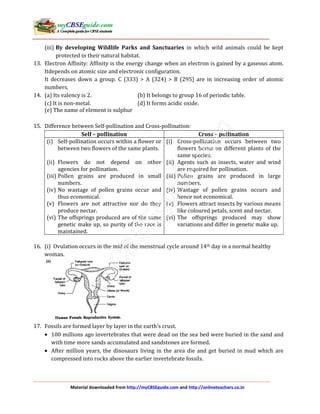
10. Draw a neat labelled diagram of human eye.
11. “Vegetarian food habits can sustain a larger number of people.” Justify the statement in terms
of food chain.
12. List any three measures of the projection of wildlife.
13. What is electron affinity? The electron affinity values of three elements A, B and C of a group
are 324, 295 and 333 kJ mol-1. Arrange these in increasing order of their atomic numbers.
14. The atomic number of an element is 16. Predict its:
(a) valency (b) group number (c) whether it is a metal of non-metal
(d) nature of the oxide formed (e) name of the element.
15. Differentiate between ‘Self pollination’ and ‘Cross pollination’. Describe double fertilization in
plants.
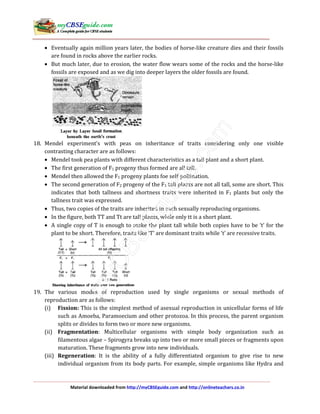
16. (i) When does ovulation occur during the menstrual cycle in a normal healthy female?
(ii) Draw a labelled diagram to show the reproductive system of a human female.
17. How are fossils formed?
18. Explain Mendel’s experiment with peas on inheritance of traits considering only one visible
contrasting character.
19. Discuss in brief the various modes of reproduction used by single organisms.
Or
Explain with example how characteristics of a population changes over the years for the
following situations:
(a) To gain survival advantage.
(b) Due to accidental survival.
(c) Temporary change of characteristics.
20. A square wire of side 3.0 cm is placed 25 cm away from a concave mirror of focal length 10 cm.
What is the area enclosed by the image of the wire? The centre of the wire is on the axis of the
mirror, with its two sides normal to the axis.
Or
A small candle 2.5 cm in size is placed 27 cm in front of a concave mirror of radius of curvature
0.36 m. At what distance from the mirror should a screen be placed in order to receive a sharp
image? Describe the nature and size of the image. If the candle is moved to the mirror, how
would the screen have to be moved?
21. Draw a labelled diagram which shows th refraction of light through a triangular glass prism.
Mark the:
(i) Angle of deviation (ii) Angle of emergence (iii) Angle of prism
Material downloaded from http://myCBSEguide.com and http://onlineteachers.co.in
Or
Give some points of similarities and dissimilarities between a camera and a human eye.
22. Give five differences between diamond and graphite.
Or
(a) A compound X is formed by the reaction of carboxylic acid having the molecular formula
C2H4O2 and alcohol (Y) in the presence of conc. H2SO4. The same carboxylic acid is obtained
by the oxidation of alcohol (Y). Name the compounds X and Y. Give the chemical equation
for the reaction.
23. (a) Which hydrocarbons burn with
(i) non-sooty blue flame (ii) sooty yellow flame
(b) What happens when methane reacts with chlorine?
(c) What is rectified spirit?
(d) Why does soap not work in hard water?
(e) What is glacial acid?
Or
(a) What is hydrogenation? Give one reaction. What is its industrial application?
(b) What is esterification?
24. Describe the human female reproductive system with the help of a labelled diagram.
Or
Describe the process of fertilization in the human female.
Section B
25. (i) Which of the following reagents gives brisk effervescene with ethanoic acid and why?
(a) Calcium hydroxide (b) Sodium chloride
(c) Sodium bicarbonate (d) Ammonium chloride
(ii) Write the chemical equation.
26. (i) Which is the correct diagram showing an Amoeba undergoing binary fission?
(ii) Justify your answer.
27. Who among the following uses a concave mirror and why?
(a) Automobile rider (b) Shopkeeper (c) Dentist (d) All of these
28. The functional group present in acetic acid:
(a) Carboxylic (b) Alcohol (c) Aldehyde (d) Ketone
29. The physical state of pure acetic acid is:
Material downloaded from http://myCBSEguide.com and http://onlineteachers.co.in
(a) Solid (b) Liquid (c) Aq. Solution (d) Gaseous state
30. The figure given below shows:
(a) Amoeba undergoing binary fission (b) Yeast undergoing binary fission
(c) Yeast undergoing budding (d) Amoeba undergoing budding
31. Meosis, Mitosis and Amitosis are the types of:
(a) Cell division (b) Cytokinesis (c) Karyokinesis (d) All of these
32. How many times the process of budding continuous in the yeast:
(a) 2-3 times (b) 3-4 times (c) 50-70 times (d) 100-500 times
33. The outgrowth of hydra is termed as:
(a) Bulb (b) Bud (c) Daughter hydra (d) Tentacles
34. The light from a distant object on passing through the convex lens ( f − focal length):
(a) converges at focus ( ).f (b) Appears to diverge from focus.
(c) Converges at 2 .f (d) Appears to diverge from 2 .f
35. When red, blue and green light coming parallel to principal axis fall on a convex lens, they will
converge on the axis at:
(a) One point (b) Two points (c) Three points (d) Always at one point
36. The correct formula to calculate the percentage of water absorbed by raisins is:
(a) 2 1
1
100
W W
W
−
= (b) 1 2
2
100
W W
W
−
= (c) 1
2 1
100
W
W W
=
−
(d) 2
2 1
100
W
W W
=
−
Material downloaded from http://myCBSEguide.com and http://onlineteachers.co.in
CBSE Sample Paper-04
SUMMATIVE ASSESSMENT –II
SCIENCE (Theory)
Class – X
Time allowed: 3 hours Maximum Marks: 90
(Solutions)
SECTION-A
1. Grass → Deer → Lion
(producers) (herbivore) (carnivore)
2. Glycerol.
3. Yes, the same laws of reflection are valid for both plane and curved surfaces.
4. The S.I. unit of power is dioptre.
If f = 50 cm =
1
2
m, then P =
1
f
= 2 D
5. (a) It was based on increasing order of atomic weight and vertical similarly in properties, but
vertical similarity of properties was given preference over increasing order. Consequently
some elements with higher atomic weight were placed before the elements with lower
atomic weight.
(b) Isotopes were not given separate place in the periodic table although they had different
atomic masses.
(c) Certain elements with similar properties were placed in separate groups whereas some
elements having dissimilar properties were placed in same groups.
6. The wings of insects are analogous to the wing of the bird. They both are analogous because
they perform the same function, but are not similar in structural plan and development origin.
Yes, the wings of birds are analogous to wings of bats. Bat wings consist of flaps of skin
stretched between the bones of the fingers and arms. Bird wings consist of feathers extending
all along the arm. They both have separate evolutionary origins, but are superficially similar
because they evolved to serve the same function. Analogies are the result of convergent
evolution.
Note (just for knowledge, not for examination purpose): Though bird and bat wings are
analogous as wings, but as forelimbs they are homologous. Birds and bats did not inherit wings
from a common ancestor with wings, but they did inherit forelimbs from a common ancestor
with forelimbs.
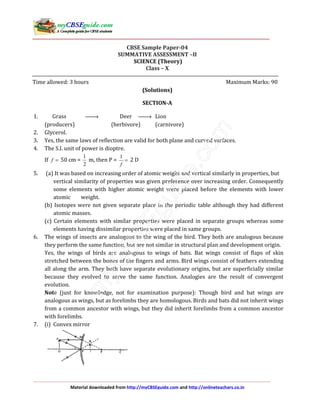
7. (i) Convex mirror
Material downloaded from http://myCBSEguide.com and http://onlineteachers.co.in
(ii) Concave mirror
8. (i) Yes, speed of light is constant in free space.
(ii) In free space all colours will travel with same speed.
(iii) Yes, by keeping a prism inverted after a prism to split the white light, it is possible to re-
unite the colours to form white light.
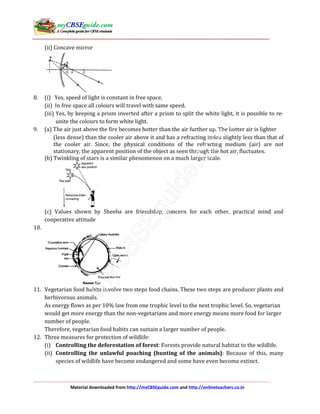
9. (a) The air just above the fire becomes hotter than the air further up. The hotter air is lighter
(less dense) than the cooler air above it and has a refracting index slightly less than that of
the cooler air. Since, the physical conditions of the refracting medium (air) are not
stationary, the apparent position of the object as seen through the hot air, fluctuates.
(b) Twinkling of stars is a similar phenomenon on a much larger scale.
(c) Values shown by Sheeba are friendship, concern for each other, practical mind and
cooperative attitude
10.
11. Vegetarian food habits involve two steps food chains. These two steps are producer plants and
herbivorous animals.
As energy flows as per 10% law from one trophic level to the next trophic level. So, vegetarian
would get more energy than the non-vegetarians and more energy means more food for larger
number of people.
Therefore, vegetarian food habits can sustain a larger number of people.
12. Three measures for protection of wildlife:
(i) Controlling the deforestation of forest: Forests provide natural habitat to the wildlife.
(ii) Controlling the unlawful poaching (hunting of the animals): Because of this, many
species of wildlife have become endangered and some have even become extinct.
Material downloaded from http://myCBSEguide.com and http://onlineteachers.co.in
(iii) By developing Wildlife Parks and Sanctuaries in which wild animals could be kept
protected in their natural habitat.
13. Electron Affinity: Affinity is the energy change when an electron is gained by a gaseous atom.
Itdepends on atomic size and electronic configuration.
It decreases down a group. C (333) > A (324) > B (295) are in increasing order of atomic
numbers.
14. (a) Its valency is 2. (b) It belongs to group 16 of periodic table.
(c) It is non-metal. (d) It forms acidic oxide.
(e) The name of element is sulphur
15. Difference between Self-pollination and Cross-pollination:
Self – pollination Cross – pollination
(i) Self-pollination occurs within a flower or
between two flowers of the same plants.
(ii) Flowers do not depend on other
agencies for pollination.
(iii) Pollen grains are produced in small
numbers.
(iv) No wastage of pollen grains occur and
thus economical.
(v) Flowers are not attractive nor do they
produce nectar.
(vi) The offsprings produced are of the same
genetic make up, so purity of the race is
maintained.
(i) Cross-pollination occurs between two
flowers borne on different plants of the
same species.
(ii) Agents such as insects, water and wind
are required for pollination.
(iii) Pollen grains are produced in large
numbers.
(iv) Wastage of pollen grains occurs and
hence not economical.
(v) Flowers attract insects by various means
like coloured petals, scent and nectar.
(vi) The offsprings produced may show
variations and differ in genetic make up.
16. (i) Ovulation occurs in the mid of the menstrual cycle around 14th day in a normal healthy
woman.
17. Fossils are formed layer by layer in the earth’s crust.
• 100 millions ago invertebrates that were dead on the sea bed were buried in the sand and
with time more sands accumulated and sandstones are formed.
• After million years, the dinosaurs living in the area die and get buried in mud which are
compressed into rocks above the earlier invertebrate fossils.
Material downloaded from http://myCBSEguide.com and http://onlineteachers.co.in
• Eventually again million years later, the bodies of horse-like creature dies and their fossils
are found in rocks above the earlier rocks.
• But much later, due to erosion, the water flow wears some of the rocks and the horse-like
fossils are exposed and as we dig into deeper layers the older fossils are found.
18. Mendel experiment’s with peas on inheritance of traits considering only one visible
contrasting character are as follows:
• Mendel took pea plants with different characteristics as a tall plant and a short plant.
• The first generation of F1 progeny thus formed are all tall.
• Mendel then allowed the F1 progeny plants foe self-pollination.
• The second generation of F2 progeny of the F1 tall plants are not all tall, some are short. This
indicates that both tallness and shortness traits were inherited in F1 plants but only the
tallness trait was expressed.
• Thus, two copies of the traits are inherited in each sexually reproducing organisms.
• In the figure, both TT and Tt are tall plants, while only tt is a short plant.
• A single copy of T is enough to make the plant tall while both copies have to be ‘t’ for the
plant to be short. Therefore, traits like ‘T’ are dominant traits while ‘t’ are recessive traits.
19. The various modes of reproduction used by single organisms or sexual methods of
reproduction are as follows:
(i) Fission: This is the simplest method of asexual reproduction in unicellular forms of life
such as Amoeba, Paramoecium and other protozoa. In this process, the parent organism
splits or divides to form two or more new organisms.
(ii) Fragmentation: Multicellular organisms with simple body organization such as
filamentous algae – Spirogyra breaks up into two or more small pieces or fragments upon
maturation. These fragments grow into new individuals.
(iii) Regeneration: It is the ability of a fully differentiated organism to give rise to new
individual organism from its body parts. For example, simple organisms like Hydra and
Material downloaded from http://myCBSEguide.com and http://onlineteachers.co.in
Planaria can be cut into any number of pieces and each piece grows into a complete
organism.
(iv) Budding: In budding, a small part of a body of the parent grows out as a ‘bud’ which then
detaches and becomes a new organism.
(v) Vegetative Propagation: In vegetative propagation, new plants are obtained from the
parts of the old plants like stems, roots and leaves without the help of any reproductive
organ. There are two ways of vegetative propagation: (i) Natural vegetative propagation
and (ii) Artificial vegetative propagation.
(vi) Spore formation: When a slice of a bread is kept in moist dark place for a few days,
spores of Rhizopus present in air settle on the bread to form new fungus plant of
Rhizopus.
Or
The characteristics of a population changes over the years for the following situations:
For example: 12 red beetles live in a green leafy bush grows by sexual reproduction and
generate variation.
(a) Situation to gain survival advantage:
• Crows eat these beetles, leaving only fewer beetles available for reproduction.
• Due to colour variation during reproduction, only one green beetle evolves and
therefore, all its progeny beetles become green.
• Crows cannot see green coloured beetles on green leaves and hence cannot eat them,
resulting more green beetles than red ones in the beetle population.
(b) Situation due to accidental survival:
• Due to colour variation during reproduction, a blue colour beetle appears and all its
progeny beetles become blue.
• Crows can see red and blue beetles and therefore, eat them.
• Initially there are less number of blue beetles and more of red beetles.
• Then an elephant stumps on the bushes and kills most of the beetles. By chance, few
beetles that survived were mostly blue.
• Thus the blue beetle population slowly expands.
• There is no survival advantage on this variation and provides diversity without
adaptation.
(c) Situation of temporary change of characteristics:
• As the beetle population begins to expand, the bushes suffer from a disease and amount
of leaf available for beetles have reduced.
• Thus the beetles are poorly nourished and the average weight of an adult beetle has
decreased.
• After few years, the plant disease is eliminated and enough food is available for the
beetles. Thus the beetles have come back to its normal size and weight.
• This change in not inherited over generation.
Material downloaded from http://myCBSEguide.com and http://onlineteachers.co.in
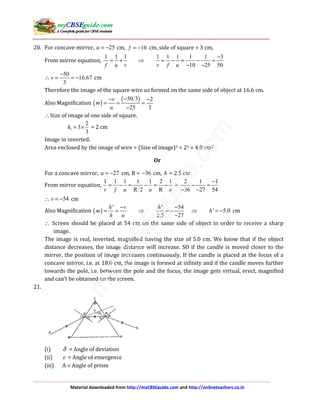
20. For concave mirror, 25u = − cm, 10f = − cm, side of square = 3 cm,
From mirror equation,
1 1 1
f u v
= + ⇒
1 1 1 1 1 3
10 25 50v f u
−
= − = − =
− −
∴
50
16.67
3
v
−
= = − cm
Therefore the image of the square wire us formed on the same side of object at 16.6 cm.
Also Magnification ( )
( )50 3 2
25 3
v
m
u
−− −
= = =
−
∴Size of image of one side of square.
1
2
3
3
h = × = 2 cm
Image in inverted.
Area enclosed by the image of wire = (Size of image)2 = 22 = 4.0 cm2
Or
For a concave mirror, 27u = − cm, R = 36− cm, h = 2.5 cm
From mirror equation,
1 1 1 1 1 2 1
R 2 Rv f u u u
= − = − = − =
2 1 1
36 27 54
−
− =
− −
∴ 54v = − cm
Also Magnification ( )
'h v
m
h u
−
= = ⇒
' 54
2.5 27
h −
= −
−
⇒ ' 5.0h = − cm
∴ Screen should be placed at 54 cm on the same side of object in order to receive a sharp
image.
The image is real, inverted, magnified having the size of 5.0 cm. We know that if the object
distance decreases, the image distance will increase. SO if the candle is moved closer to the
mirror, the position of image increases continuously. If the candle is placed at the focus of a
concave mirror, i.e. at 18.0 cm, the image is formed at infinity and if the candle moves further
towards the pole, i.e. between the pole and the focus, the image gets virtual, erect, magnified
and can’t be obtained on the screen.
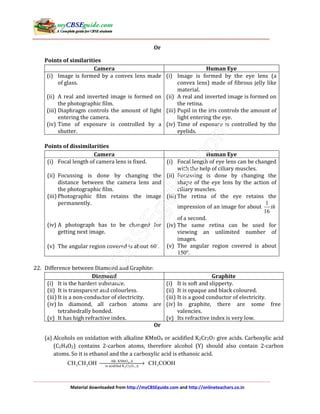
21.
(i) δ = Angle of deviation
(ii) e = Angle of emergence
(iii) A = Angle of prism
Material downloaded from http://myCBSEguide.com and http://onlineteachers.co.in
Or
Points of similarities
Camera Human Eye
(i) Image is formed by a convex lens made
of glass.
(ii) A real and inverted image is formed on
the photographic film.
(iii) Diaphragm controls the amount of light
entering the camera.
(iv) Time of exposure is controlled by a
shutter.
(i) Image is formed by the eye lens (a
convex lens) made of fibrous jelly like
material.
(ii) A real and inverted image is formed on
the retina.
(iii) Pupil in the iris controls the amount of
light entering the eye.
(iv) Time of exposure is controlled by the
eyelids.
Points of dissimilarities
Camera Human Eye
(i) Focal length of camera lens is fixed.
(ii) Focussing is done by changing the
distance between the camera lens and
the photographic film.
(iii) Photographic film retains the image
permanently.
(iv) A photograph has to be changed for
getting next image.
(v) The angular region covered is about 60 .
(i) Focal length of eye lens can be changed
with the help of ciliary muscles.
(ii) Focussing is done by changing the
shape of the eye lens by the action of
ciliary muscles.
(iii) The retina of the eye retains the
impression of an image for about
1
16
th
of a second.
(iv) The same retina can be used for
viewing an unlimited number of
images.
(v) The angular region covered is about
150 .°
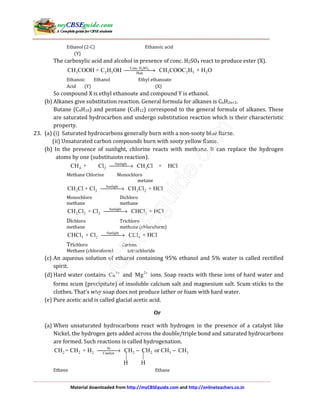
22. Difference between Diamond and Graphite:
Diamond Graphite
(i) It is the hardest substance.
(ii) It is transparent and colourless.
(iii) It is a non-conductor of electricity.
(iv) In diamond, all carbon atoms are
tetrahedrally bonded.
(v) It has high refractive index.
(i) It is soft and slipperty.
(ii) It is opaque and black coloured.
(iii) It is a good conductor of electricity.
(iv) In graphite, there are some free
valencies.
(v) Its refractive index is very low.
Or
(a) Alcohols on oxidation with alkaline KMnO4 or acidified K2Cr2O7 give acids. Carboxylic acid
(C2H4O2) contains 2-carbon atoms, therefore alcohol (Y) should also contain 2-carbon
atoms. So it is ethanol and the a carboxylic acid is ethanoic acid.
4
2 2 7
Alk. KMnO ,
3 2 3or acidified K Cr O ,
CH CH OH CH COOH∆
∆
→
Material downloaded from http://myCBSEguide.com and http://onlineteachers.co.in
Ethanol (2-C) Ethanoic acid
(Y)
The carboxylic acid and alcohol in presence of conc. H2SO4 react to produce ester (X).
2 4Conc. H SO
3 2 5 3 2 5 2Heat
CH COOH + C H OH CH COOC H + H O→
Ethanoic Ethanol Ethyl ethanoate
Acid (Y) (X)
So compound X is ethyl ethanoate and compound Y is ethanol.
(b) Alkanes give substitution reaction. General formula for alkanes is CnH2n+2.
Butane (C4H10) and pentane (C5H12) correspond to the general formula of alkanes. These
are saturated hydrocarbon and undergo substitution reaction which is their characteristic
property.
23. (a) (i) Saturated hydrocarbons generally burn with a non-sooty blue flame.
(ii) Unsaturated carbon compounds burn with sooty yellow flame.
(b) In the presence of sunlight, chlorine reacts with methane. It can replace the hydrogen
atoms by one (substituiotn reaction).
Sunlight
4 2 3CH + Cl CH Cl + HCl→
Methane Chlorine Monochloro
metane
Sunlight
3 2 2 2CH Cl + Cl CH Cl + HCl→
Monochloro Dichloro
methane methane
Sunlight
2 2 2 3CH Cl + Cl CHCl + HCl→
Dichloro Trichloro
methane methane (chloroform)
Sunlight
3 2 4CHCl + Cl CCl + HCl→
Trichloro Carbon
Methane (chloroform) tetrachloride
(c) An aqueous solution of ethanol containing 95% ethanol and 5% water is called rectified
spirit.
(d) Hard water contains 2
Ca +
and 2
Mg +
ions. Soap reacts with these ions of hard water and
forms scum (precipitate) of insoluble calcium salt and magnesium salt. Scum sticks to the
clothes. That’s why soap does not produce lather or foam with hard water.
(e) Pure acetic acid is called glacial acetic acid.
Or
(a) When unsaturated hydrocarbons react with hydrogen in the presence of a catalyst like
Nickel, the hydrogen gets added across the double/triple bond and saturated hydrocarbons
are formed. Such reactions is called hydrogenation.
Ni
2 2 2 2 2 3 3Catalyst
CH = CH + H CH CH or CH CH
H H
→ − −
Ethene Ethane
Material downloaded from http://myCBSEguide.com and http://onlineteachers.co.in
(Unsaturated) (Saturated)
Industrial Use: It is used in the preparation of vanaspati ghee from vegetable oil.
Vegetable oil + H2
Ni
473 K
→ Vanaspati ghrr
(b) When carboxylic acid reacts with alcohol in presence of conc. H2SO4, ester is formed. This is
called esterification.
Carboxylic acid + Alcohol 2 4Conc. H SO
→ Ester + water
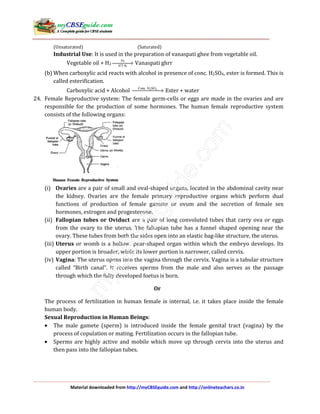
24. Female Reproductive system: The female germ-cells or eggs are made in the ovaries and are
responsible for the production of some hormones. The human female reproductive system
consists of the following organs:
(i) Ovaries are a pair of small and oval-shaped organs, located in the abdominal cavity near
the kidney. Ovaries are the female primary reproductive organs which perform dual
functions of production of female gamete or ovum and the secretion of female sex
hormones, estrogen and progesterone.
(ii) Fallopian tubes or Oviduct are a pair of long convoluted tubes that carry ova or eggs
from the ovary to the uterus. The fallopian tube has a funnel shaped opening near the
ovary. These tubes from both the sides open into an elastic bag-like structure, the uterus.
(iii) Uterus or womb is a hollow, pear-shaped organ within which the embryo develops. Its
upper portion is broader, while its lower portion is narrower, called cervix.
(iv) Vagina: The uterus opens into the vagina through the cervix. Vagina is a tabular structure
called “Birth canal”. It receives sperms from the male and also serves as the passage
through which the fully developed foetus is born.
Or
The process of fertilization in human female is internal, i.e. it takes place inside the female
human body.
Sexual Reproduction in Human Beings:
• The male gamete (sperm) is introduced inside the female genital tract (vagina) by the
process of copulation or mating. Fertilization occurs in the fallopian tube.
• Sperms are highly active and mobile which move up through cervix into the uterus and
then pass into the fallopian tubes.
Material downloaded from http://myCBSEguide.com and http://onlineteachers.co.in
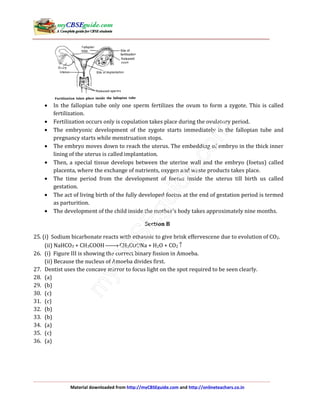
• In the fallopian tube only one sperm fertilizes the ovum to form a zygote. This is called
fertilization.
• Fertilization occurs only is copulation takes place during the ovulatory period.
• The embryonic development of the zygote starts immediately in the fallopian tube and
pregnancy starts while menstruation stops.
• The embryo moves down to reach the uterus. The embedding of embryo in the thick inner
lining of the uterus is called implantation.
• Then, a special tissue develops between the uterine wall and the embryo (foetus) called
placenta, where the exchange of nutrients, oxygen and waste products takes place.
• The time period from the development of foetus inside the uterus till birth us called
gestation.
• The act of living birth of the fully developed foetus at the end of gestation period is termed
as parturition.
• The development of the child inside the mother’s body takes approximately nine months.
Section B
25. (i) Sodium bicarbonate reacts with ethanoic to give brisk effervescene due to evolution of CO2.
(ii) NaHCO3 + CH3COOH → CH3COONa + H2O + CO2 ↑
26. (i) Figure III is showing the correct binary fission in Amoeba.
(ii) Because the nucleus of Amoeba divides first.
27. Dentist uses the concave mirror to focus light on the spot required to be seen clearly.
28. (a)
29. (b)
30. (c)
31. (c)
32. (b)
33. (b)
34. (a)
35. (c)
36. (a)

Cbse paper solved

  • 1.
    Sample Question Paper– 2 Pg 1 of 5 Sample Question Paper 2016 Science Class – X (SA – II) Time allowed: 03 Hours Maximum Marks: 90 General Instructions: (i) The question paper comprises two sections, A and B. You are to attempt both the sections. (ii) All questions are compulsory. (iii) There is no choice in any of the question. (iv) All questions of Section-A and B are to be attempted separately. (v) Question numbers 1 to 3 in Section - A are one mark question. They are to be answered in one word or in one sentence. (vi) Question numbers 4 to 6 in Section - A are two marks questions. These are to be answered in 30 words each. (vii) Question numbers 7 to 18 in Section - A are three marks questions. These are to be answered in about 50 words each. (viii) Question numbers 19 to 24 in Section-A are 5 marks questions. These are to be answered in 70 words each. (ix) Question numbers 25 to 33 in Section- B are multiple choice questions based on practical skills. Each question is a one mark question. You are to select one most appropriate response out of the four provided to you. (x) Question numbers 34 to 36 in Section B are two marks questions based on practical skills. These are to be answered in brief. SECTION – A 1 Name the process of converting vegetable oil to vegetable ghee. 1 2 Give reason for the statement- Since the ovary releases one egg every month, the uterus also prepares itself every month by making its lining thick and spongy. 1 3 Name the component of white light that has the greatest wavelength. 1 4 Which natural resource are the „biodiversity hot spots‟? Suggest what happens when there is a loss of biodiversity? 2 5 Write the name and molecular formula of an organic compound having its name suffixed with „–ol‟ and having two carbon atoms in the molecule. With the help of a balanced equation indicate what happens when its heated with excess of conc. H2SO4. ½ + ½ +1 6 A cube of edge 6 cm is placed over a printed page. At what distance from the top surface of cube will the letters appear when seen from above? Refractive index of glass is 1.5 2 7 What is meant by isomers? “We can not have isomers of the first three members of alkane series” give reason to justify this statement. Draw the structures of two isomers of pentane, C5H12 1+1+1 8 i) Name the following:
  • 2.
    Sample Question Paper– 2 Pg 2 of 5 a) Third member of aldehyde series b) Second member of carboxylic series ii) Write the IUPAC name of the following: a) 3 3 3 3 | | CH CH C CH CH   b) 1 1 ½ ½ 9 Four elements A, B, C and D have atomic numbers 12, 13, 14 and 15 respectively. Answer the following questions giving reasons - i) What is the number of valence electrons and valency of D? ii) Which of them will have largest atomic radii? iii) Which of these elements will form the most basic oxide? 1+1+1 10 Differentiate between combustion and oxidation reactions of ethanol. 3 11 In a germinating seed, which parts are known as future shoot and future root? Mention the function of cotyledon. 3 12 What is placenta? Write any two major functions of placenta. 3 13 „Different species use different strategies to determine sex of a newborn individual. It can be environmental cues or genetically determined‟. Explain the statement by giving example for each strategy. 3 14 A 2 cm high object is placed at a distance of 32 cm from a concave mirror. The image is real, inverted and 3 cm in size. Find the focal length of the mirror and the position where the image is formed? 3 15 A child while playing with his father‟s spectacles burnt a hole in a piece of paper by focusing a small image of the sun on it. (i) What defect of vision his father is suffering from? (ii) Write two causes for this defect? (iii) Draw a ray diagram to show image formation by the defective eye? (iv) Draw a ray diagram showing corrected eye using proper lens. 3 16 Explain the formation of rainbow in the sky with the help of a diagram. List the three phenomena involved in proper sequence. 3 17 Which types of people are benefited from the development of different resources? Why do we need to use the resources carefully? 3 18 Write any three characteristics of a food chain. Dharmesh always treated the chemical effluent before disposing it in the water body. Mention any three moral values possessed by Dharmesh. 3 19 In the following table. Six elements A, B, C, D, E and F of the modern periodic table with atomic numbers 3 to 18 are given: 1+1+1+1+1
  • 3.
    Sample Question Paper– 2 Pg 3 of 5 3 4 5 6 7 8 9 10 A E G 11 12 13 14 15 16 17 18 B C D F a) Which of these is i) Noble gas ii) halogen b) Which of these is the most active metal in 3rd period? c) Identify the most electronegative element in the third period. d) In the compound between B and F what type of bond will be formed? e) What would be the nature of oxide formed by C? 20 A. Draw a longitudinal section of a flower and label the following parts – a) Part that develops into a fruit b) Part that produces pollen grain c) Part that transfers male gametes d) Part that is sticky to trap B. Name the parts labeled A, B, C, D in the diagram given below: 5 21 A. How does speciation take place? B. Define the term GENE. C. The gene for red hair is recessive to the gene for black hair. What will be the hair colour of a child if he inherits a gene for red colour from his mother and a gene for black hair from his father? Express with the help of flow chart. 5 22 A. Mention any two point of difference between acquired and inherited traits. B. If the tail of a mouse is cut for twenty one generations, will the tail occur in the twenty second generation of that mouse? Give reason to support your answer. C. Define the term – Natural Selection. 5 SECTION B 23 (i) Rohit claims to have obtained an image twice the size of object with a concave lens. Is he correct? Give reason for your answer. (ii) Where should an object be placed in case of a convex lens to form an image of same size as of the object? Show with the help of ray diagram the position and the nature of the image formed. (iii) With the help of ray diagram, illustrate the change in position, nature and size of the image formed if the convex lens in case of (ii) is replaced by concave lens of same focal length. 5 24 (i) Which property of concave mirror is utilized for using them as shaving mirrors? (ii) Light passes through a rectangular glass slab and through a triangular glass prism. Using proper ray diagram, explain in what way does the direction of the two emergent beams differs with respect to the incident beam of light. (iii)A concave lens has a focal length of 50 cm Calculate its power. 5
  • 4.
    Sample Question Paper– 2 Pg 4 of 5 25 A student is given equal amount of three samples A, B and C of water with temporary hardness. He keeps the three samples at different temperatures. A at room temperature, B at 50o C and C at 80o C. Which sample will give maximum amount of lather with soap solution? a) A b) Both B and C c) Only C d) Both A and B 1 26 Soaps are formed by alkaline hydrolysis of a) Carboxylic acids b) Esters of long chain fatty acids c) Esters of small chain d) Inorganic acids 1 27 On addition of Na2CO3 to hard water a) the foaming capacity increases b) the foaming capacity decreases c) the foaming capacity increases then decreases d) the foaming capacity decreases then increases 1 28 In finding the focal length of a distant object by concave mirror, you are required to draw the ray diagram of nature. 1 29 While performing the experiment to trace the path of a ray of light passing through a rectangular glass slab, four students labeled their ray diagrams in the manner shown below. The correct labeling has been done by students. 1 30 A convex lens forms a virtual image when an object is placed at a distance of 20cm from it. The focal length (a) f = 40 cm (b) f = 20 cm (c) f > 20 cm (d) f < 20 cm 1
  • 5.
    Sample Question Paper– 2 Pg 5 of 5 31 In a dicot seed, the pore through which the seed absorbs water during seed germination is called a) Micropyle b) Hilum c) Funicle d) Radical 1 32 For the experiment – To prepare temporary mount of yeast to study budding process; Yeast granules are made to first grow by adding them to a) Hydrochloric acid b) Distilled water c) 10% sugar solution d) Alcohol 1 33 Two slides were shown to four students, and they labeled them as following. Student Slide A Slide B I II III IV Budding in Yeast Binary fission in Amoeba Binary fission in Amoeba Budding in Amoeba Binary fusion in Amoeba Buds of Amoeba Daughter cells of Amoeba Daughter cell of Yeast The student who made the correct labeling is: a) II b) I c) IV d) III 1 34 With regard to turnip, carrot, sweet potato and potato, three belong to the same category. Identify those three modifications and mention whether they are homologous or analogous. Also mention the reason why the fourth modifications do not belong to the same category. 2 35 A student has to perform an experiment on tracing the path of a ray of light passing through a rectangular glass slab for three different angles of incidence. Two of his friends suggest the following options to him: (A) Draw the incident rays corresponding to 20o , 50o and 70o as angles of incidence and fix the two pins on the incident ray just 2 cm apart. (B) Draw the incident rays corresponding to 30o , 45o and 60o as the angles of incidence and fix two pins on the incident rays nearly 8 cm apart. Which is the better option he should follow? Give reason in support of your answer. 2 36 A student obtained a sharp image of a lighted candle on a screen using a convex lens. Now he wants to focus a distant lamp on a far away electric pole. In which direction should the lens be move for this purpose with respect to the screen, to get a sharp image on the screen? Justify your answer. 2
  • 6.
    Marking Scheme –2 Pg 1 of 6 Marking Scheme 2016 Science Class – X (SA – II) 1 Hydrogenation 1 2 Required for nourishing the embryo if fertilization takes place and reaches the uterus. 1 3 Red 1 4 Forests Loss of ecological stability 1 1 5 Its ethanol, its molecular formula is C2H6O and structural formula is C2H5OH (CH3CH2OH) 3 2 Ethanol CH CH OH 2 4. heat Conc H SO 2 2 2 Ethane CH CH H O  ½ + ½ 1 6 Real depth Apparent depth  6 4 1.5 Appdepth cm   2 7 Isomers are those compounds which have same molecular formula and different structural formula. In first three members of alkane, branching is not possible, therefore isomers are not possible. CH3---CH2---CH2----CH2-----CH3 CH3---CH---CH2----CH3  Pentane CH3 2-methyl butane 1 1 1 8 i) a. Third member of aldehyde series- Propanal ( CH3CHO) b. Second member of Carboxylic series- Ethanoic acid (CH3COOH) ii) a. 2,2-dimethyl propane b. 2 Butanol 1 1 ½ ½ 9 i) Valence electrons in ‘D’- 5 Valency of ‘D’ – 3 ii) ‘A’ will have largest atomic radii. iii) ‘A’ will form the most basic oxide as it is most metallic. 1 1 1
  • 7.
    Marking Scheme –2 Pg 2 of 6 10 Complete burning of ethanol in the presence of excess of oxygen to give carbon dioxide and water is called combustion. 3 2 23CH CH OH O 222 3CO H O Addition of oxygen to ethanol in the presence of oxidizing agents to give ethanoic acid is called oxidation. 3 2CH CH OH 4. Heat Alk KMnO 3CH COOH 1 ½ 1 ½ 11 Future shoot – Plumule Future root – Radicle Cotyledon – Store food for the future plant or embryo 1 1 1 12 A disc shaped organ or special tissue in the uterus of pregnant mammal, nourishing and maintaining the foetus through the umbilical cord. OR Any other definition Functions of placenta: (Any two) a) Provides large surface area for glucose and oxygen to pass from mother to the embryo. b) Removal of waste generated in the developing embryo into the mothers blood or any other 1 1 1 13 Environmental Cue –  In some animals, the temperature at which fertilized eggs are kept determines whether the developing animal in egg is male or female  In some animals like snail, individual can change sex. Genetical Cue – A child who inherits an x chromosome from her father will be a girl and one who inherits a y chromosome from the father will be a boy. 1½ 1½ 14 e o hv m u h    3eh cm  2oh cm 32u cm  3 1.5 2 e o h cm m h cm      or 1.5 v u     48v cm   1 1 1 1 1 5 48 32 96 also f v u         19.2f cm   ∴ focal length of concave mirror is 19.2cm and image is formed 48 cm infornt of it 3
  • 8.
    Marking Scheme –2 Pg 3 of 6 15 (i) Hypermetropia (ii) This defect arises because either (a) focal length of eye lens is too large or (b) the eyeball becomes too short. (iii) (iv) ½ ½ 1 1 16 The water droplets act like small prisms. They refract and disperse the incident sunlight, then reflect it internally and finally refract it again when it comes out of rain drop. Due to dispersion and internal reflection of light, different colours reach the observer’s eye along different pairs. Therefore the three phenomena involved are refraction, dispersion, internal reflection of light. 3 17 Rich & Powerful people are benefited – We need to use resources carefully because –  they are not unlimited  the demand is increasing due to human population rate increase because of improved health care –  for sustainable development  any other (Any two) 1 2 18 A. (i) Unidirectional (ii) Helps in understanding the food relationship and interaction among various organisms in an ecosystem (iii) Helps to understand movement of toxic substances and the problem of their biological magnification B. (i) Sensitive towards environment (ii) Possess knowledge about biological magnification (iii) Scientific temperament (iv) Conscious (Any three) ½ ½ ½ 1 ½
  • 9.
    Marking Scheme –2 Pg 4 of 6 19 a) Noble gas- G Halogen - F b) Most active metal – B c) Most electronegative in 3rd period- F d) Ionic bond e) Oxide formed by C would be basic. 1 1 1 1 1 20 A. B. A – Pollen grain B – Pollen tube C – Ovary D – Female gamete Diagram:1 Lebellings:½x4 ½x4 21 A. Speciation may take place by (i) Migration (ii) Natural selection (iii) Mutation (iv) Genetic Drift (Any two) B. Segment of DNA which is functional and are made of nucleic acids and protein (Any other definition) C. Given Red hair – Mother – Recessive ∴ bb Black hair – father Dominant ∴ BB Parents F1 Father Mother BB/Bb X Bb/bb Bb (Black) Thus, the child will have black hair 1 1 ½ ½ 1 1 22 A. Acquired Traits Inherited Traits 1 Trait acquired during its lifetime Traits inherited from its predecessors 2 Not inheritable Inheritable 3 Not present in the genetic make up Present in the genetic makeup 4 Change in DNA will not result in any change in such traits Change is DNA will bring about change in such traits (Any two difference) 2
  • 10.
    Marking Scheme –2 Pg 5 of 6 B. The mouse continue to have information for presence of tail in its DNA So, will continue to have tail, because it is an acquired trait C. Nature selects the best trail in a species, leading to survival of fittest and evolution of species (Any other difference) 1 1 1 23 (i) No, magnified image of an object cannot be formed by a concave lens ever. (ii) At 2f. (iii) Image obtained is virtual, erect and diminished in case of concave lens 2 ½ 1 1 ½ 24 (i) When an object is placed between the pole and focus of concave mirror a magnified, erect and virtual image is obtained. (ii) For glass slab refer: 1 1
  • 11.
    Marking Scheme –2 Pg 6 of 6 For prism refer: In case of a rectangular glass slab, emergent rays of light are always parallel to the direction of incident rays. Whereas when an incident light passes through a prism, it bends towards the base of the prism hence incident ray and emergent ray are not parallel to each other. (iii) 100 100 50 2 50 f cm p D D f        1 1 1 25 c) Only C 1 26 b) Esters of long chain of fatty acids 1 27 a) Foaming capacity increases 1 28 d) parallel beam of light, after reflection meet at focus 1 29 a) 1 30 c) when the oject is placed between F and P, virtual image is obtained 1 31 a) Micropyle 1 32 c) 10% sugar solution 1 33 d) III 1 34 Turnip, Carrot, Sweet Potato – are modified root – Homologous organs Potato – modified stem. 1 ½ ½ 35 B, for better result, the angle of incidence should be in the range 30o – 60o and larger separation between pins will give better collinearity of pin and accuracy of result. 2 36 He should move the lens towards the screen. As the distance of object increased, the image formed by a convex lens will be more close to the focus. 2
  • 12.
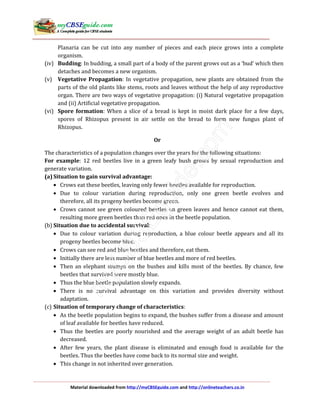
    Material downloaded fromhttp://myCBSEguide.com and http://onlineteachers.co.in CBSE Sample Paper-04 SUMMATIVE ASSESSMENT –II SCIENCE (Theory) Class – X Time allowed: 3 hours Maximum Marks: 90 General Instructions: a) All questions are compulsory. b) The question paper comprises of two sections, A and B. You are to attempt both the sections. c) Questions 1 to 3 in section A are one mark questions. These are to be answered in one word or in one sentence. d) Questions 4 to 6 in section A are two marks questions. These are to be answered in about 30 words each. e) Questions 7 to 18 in section A are three marks questions. These are to be answered in about 50 words each. f) Questions 19 to 24 in section A are five marks questions. These are to be answered in about 70 words each. g) Questions 25 to 27 in section B are 2 marks questions and Questions 28 to 36 are multiple choice questions based on practical skills. Each question of multiple choice questions is a one mark question. You are to select one most appropriate response out of the four provided to you. Section A 1. Write a food chain in a forest ecosystem. 2. Name the product formed beside soap that is obtained during saponification process. 3. Are the laws of reflection applicable to plane surfaces also valid for curved surfaces? 4. In what S.I. unit is power of lenses rated? A convex lens has a focal length of 50 cm, Calculate its power. 5. What discrepancies were there in Mendeleev’s Periodic Table? 6. Name one organ analogous to the wing of the bird. Why are they both analogous? Can you include the wing of bat also with them under the same category? Give reason. 7. An object of size ' 'l cm is placed in front of a (i) convex mirror and (ii) concave mirror. With a neat ray-diagram, explain how an erect image is formed. 8. (i) Is the speed of light a constant? (ii) Which colour has the greatest speed in the visible region? (iii) Is it possible to combine the seven colours in the spectrum to form white? 9. Sheeba studies in grade 9 and is a secretary of school’s club. As per practice in the school, all members of science club assemble in Physics lab in last two periods on every Friday. Sheeba also extends help to her mother in kitchen. One day she observed that the apparent random wavering or flickering of objects seen through a turbulent stream of hot air rising
  • 13.
    Material downloaded fromhttp://myCBSEguide.com and http://onlineteachers.co.in above the fire in the kitchen. She discussed about this with her friends and decided to raise the question in school’s science club meeting. Read the given passage and answer the following questions: (a) Explain the reason behind the observation. (b) Name the similar phenomenon on a larger scale. Also, draw the ray diagram. (c) What values are shown by Sheeba? 10. Draw a neat labelled diagram of human eye. 11. “Vegetarian food habits can sustain a larger number of people.” Justify the statement in terms of food chain. 12. List any three measures of the projection of wildlife. 13. What is electron affinity? The electron affinity values of three elements A, B and C of a group are 324, 295 and 333 kJ mol-1. Arrange these in increasing order of their atomic numbers. 14. The atomic number of an element is 16. Predict its: (a) valency (b) group number (c) whether it is a metal of non-metal (d) nature of the oxide formed (e) name of the element. 15. Differentiate between ‘Self pollination’ and ‘Cross pollination’. Describe double fertilization in plants. 16. (i) When does ovulation occur during the menstrual cycle in a normal healthy female? (ii) Draw a labelled diagram to show the reproductive system of a human female. 17. How are fossils formed? 18. Explain Mendel’s experiment with peas on inheritance of traits considering only one visible contrasting character. 19. Discuss in brief the various modes of reproduction used by single organisms. Or Explain with example how characteristics of a population changes over the years for the following situations: (a) To gain survival advantage. (b) Due to accidental survival. (c) Temporary change of characteristics. 20. A square wire of side 3.0 cm is placed 25 cm away from a concave mirror of focal length 10 cm. What is the area enclosed by the image of the wire? The centre of the wire is on the axis of the mirror, with its two sides normal to the axis. Or A small candle 2.5 cm in size is placed 27 cm in front of a concave mirror of radius of curvature 0.36 m. At what distance from the mirror should a screen be placed in order to receive a sharp image? Describe the nature and size of the image. If the candle is moved to the mirror, how would the screen have to be moved? 21. Draw a labelled diagram which shows th refraction of light through a triangular glass prism. Mark the: (i) Angle of deviation (ii) Angle of emergence (iii) Angle of prism
  • 14.
    Material downloaded fromhttp://myCBSEguide.com and http://onlineteachers.co.in Or Give some points of similarities and dissimilarities between a camera and a human eye. 22. Give five differences between diamond and graphite. Or (a) A compound X is formed by the reaction of carboxylic acid having the molecular formula C2H4O2 and alcohol (Y) in the presence of conc. H2SO4. The same carboxylic acid is obtained by the oxidation of alcohol (Y). Name the compounds X and Y. Give the chemical equation for the reaction. 23. (a) Which hydrocarbons burn with (i) non-sooty blue flame (ii) sooty yellow flame (b) What happens when methane reacts with chlorine? (c) What is rectified spirit? (d) Why does soap not work in hard water? (e) What is glacial acid? Or (a) What is hydrogenation? Give one reaction. What is its industrial application? (b) What is esterification? 24. Describe the human female reproductive system with the help of a labelled diagram. Or Describe the process of fertilization in the human female. Section B 25. (i) Which of the following reagents gives brisk effervescene with ethanoic acid and why? (a) Calcium hydroxide (b) Sodium chloride (c) Sodium bicarbonate (d) Ammonium chloride (ii) Write the chemical equation. 26. (i) Which is the correct diagram showing an Amoeba undergoing binary fission? (ii) Justify your answer. 27. Who among the following uses a concave mirror and why? (a) Automobile rider (b) Shopkeeper (c) Dentist (d) All of these 28. The functional group present in acetic acid: (a) Carboxylic (b) Alcohol (c) Aldehyde (d) Ketone 29. The physical state of pure acetic acid is:
  • 15.
    Material downloaded fromhttp://myCBSEguide.com and http://onlineteachers.co.in (a) Solid (b) Liquid (c) Aq. Solution (d) Gaseous state 30. The figure given below shows: (a) Amoeba undergoing binary fission (b) Yeast undergoing binary fission (c) Yeast undergoing budding (d) Amoeba undergoing budding 31. Meosis, Mitosis and Amitosis are the types of: (a) Cell division (b) Cytokinesis (c) Karyokinesis (d) All of these 32. How many times the process of budding continuous in the yeast: (a) 2-3 times (b) 3-4 times (c) 50-70 times (d) 100-500 times 33. The outgrowth of hydra is termed as: (a) Bulb (b) Bud (c) Daughter hydra (d) Tentacles 34. The light from a distant object on passing through the convex lens ( f − focal length): (a) converges at focus ( ).f (b) Appears to diverge from focus. (c) Converges at 2 .f (d) Appears to diverge from 2 .f 35. When red, blue and green light coming parallel to principal axis fall on a convex lens, they will converge on the axis at: (a) One point (b) Two points (c) Three points (d) Always at one point 36. The correct formula to calculate the percentage of water absorbed by raisins is: (a) 2 1 1 100 W W W − = (b) 1 2 2 100 W W W − = (c) 1 2 1 100 W W W = − (d) 2 2 1 100 W W W = −
  • 16.
    Material downloaded fromhttp://myCBSEguide.com and http://onlineteachers.co.in CBSE Sample Paper-04 SUMMATIVE ASSESSMENT –II SCIENCE (Theory) Class – X Time allowed: 3 hours Maximum Marks: 90 (Solutions) SECTION-A 1. Grass → Deer → Lion (producers) (herbivore) (carnivore) 2. Glycerol. 3. Yes, the same laws of reflection are valid for both plane and curved surfaces. 4. The S.I. unit of power is dioptre. If f = 50 cm = 1 2 m, then P = 1 f = 2 D 5. (a) It was based on increasing order of atomic weight and vertical similarly in properties, but vertical similarity of properties was given preference over increasing order. Consequently some elements with higher atomic weight were placed before the elements with lower atomic weight. (b) Isotopes were not given separate place in the periodic table although they had different atomic masses. (c) Certain elements with similar properties were placed in separate groups whereas some elements having dissimilar properties were placed in same groups. 6. The wings of insects are analogous to the wing of the bird. They both are analogous because they perform the same function, but are not similar in structural plan and development origin. Yes, the wings of birds are analogous to wings of bats. Bat wings consist of flaps of skin stretched between the bones of the fingers and arms. Bird wings consist of feathers extending all along the arm. They both have separate evolutionary origins, but are superficially similar because they evolved to serve the same function. Analogies are the result of convergent evolution. Note (just for knowledge, not for examination purpose): Though bird and bat wings are analogous as wings, but as forelimbs they are homologous. Birds and bats did not inherit wings from a common ancestor with wings, but they did inherit forelimbs from a common ancestor with forelimbs. 7. (i) Convex mirror
  • 17.
    Material downloaded fromhttp://myCBSEguide.com and http://onlineteachers.co.in (ii) Concave mirror 8. (i) Yes, speed of light is constant in free space. (ii) In free space all colours will travel with same speed. (iii) Yes, by keeping a prism inverted after a prism to split the white light, it is possible to re- unite the colours to form white light. 9. (a) The air just above the fire becomes hotter than the air further up. The hotter air is lighter (less dense) than the cooler air above it and has a refracting index slightly less than that of the cooler air. Since, the physical conditions of the refracting medium (air) are not stationary, the apparent position of the object as seen through the hot air, fluctuates. (b) Twinkling of stars is a similar phenomenon on a much larger scale. (c) Values shown by Sheeba are friendship, concern for each other, practical mind and cooperative attitude 10. 11. Vegetarian food habits involve two steps food chains. These two steps are producer plants and herbivorous animals. As energy flows as per 10% law from one trophic level to the next trophic level. So, vegetarian would get more energy than the non-vegetarians and more energy means more food for larger number of people. Therefore, vegetarian food habits can sustain a larger number of people. 12. Three measures for protection of wildlife: (i) Controlling the deforestation of forest: Forests provide natural habitat to the wildlife. (ii) Controlling the unlawful poaching (hunting of the animals): Because of this, many species of wildlife have become endangered and some have even become extinct.
  • 18.
    Material downloaded fromhttp://myCBSEguide.com and http://onlineteachers.co.in (iii) By developing Wildlife Parks and Sanctuaries in which wild animals could be kept protected in their natural habitat. 13. Electron Affinity: Affinity is the energy change when an electron is gained by a gaseous atom. Itdepends on atomic size and electronic configuration. It decreases down a group. C (333) > A (324) > B (295) are in increasing order of atomic numbers. 14. (a) Its valency is 2. (b) It belongs to group 16 of periodic table. (c) It is non-metal. (d) It forms acidic oxide. (e) The name of element is sulphur 15. Difference between Self-pollination and Cross-pollination: Self – pollination Cross – pollination (i) Self-pollination occurs within a flower or between two flowers of the same plants. (ii) Flowers do not depend on other agencies for pollination. (iii) Pollen grains are produced in small numbers. (iv) No wastage of pollen grains occur and thus economical. (v) Flowers are not attractive nor do they produce nectar. (vi) The offsprings produced are of the same genetic make up, so purity of the race is maintained. (i) Cross-pollination occurs between two flowers borne on different plants of the same species. (ii) Agents such as insects, water and wind are required for pollination. (iii) Pollen grains are produced in large numbers. (iv) Wastage of pollen grains occurs and hence not economical. (v) Flowers attract insects by various means like coloured petals, scent and nectar. (vi) The offsprings produced may show variations and differ in genetic make up. 16. (i) Ovulation occurs in the mid of the menstrual cycle around 14th day in a normal healthy woman. 17. Fossils are formed layer by layer in the earth’s crust. • 100 millions ago invertebrates that were dead on the sea bed were buried in the sand and with time more sands accumulated and sandstones are formed. • After million years, the dinosaurs living in the area die and get buried in mud which are compressed into rocks above the earlier invertebrate fossils.
  • 19.
    Material downloaded fromhttp://myCBSEguide.com and http://onlineteachers.co.in • Eventually again million years later, the bodies of horse-like creature dies and their fossils are found in rocks above the earlier rocks. • But much later, due to erosion, the water flow wears some of the rocks and the horse-like fossils are exposed and as we dig into deeper layers the older fossils are found. 18. Mendel experiment’s with peas on inheritance of traits considering only one visible contrasting character are as follows: • Mendel took pea plants with different characteristics as a tall plant and a short plant. • The first generation of F1 progeny thus formed are all tall. • Mendel then allowed the F1 progeny plants foe self-pollination. • The second generation of F2 progeny of the F1 tall plants are not all tall, some are short. This indicates that both tallness and shortness traits were inherited in F1 plants but only the tallness trait was expressed. • Thus, two copies of the traits are inherited in each sexually reproducing organisms. • In the figure, both TT and Tt are tall plants, while only tt is a short plant. • A single copy of T is enough to make the plant tall while both copies have to be ‘t’ for the plant to be short. Therefore, traits like ‘T’ are dominant traits while ‘t’ are recessive traits. 19. The various modes of reproduction used by single organisms or sexual methods of reproduction are as follows: (i) Fission: This is the simplest method of asexual reproduction in unicellular forms of life such as Amoeba, Paramoecium and other protozoa. In this process, the parent organism splits or divides to form two or more new organisms. (ii) Fragmentation: Multicellular organisms with simple body organization such as filamentous algae – Spirogyra breaks up into two or more small pieces or fragments upon maturation. These fragments grow into new individuals. (iii) Regeneration: It is the ability of a fully differentiated organism to give rise to new individual organism from its body parts. For example, simple organisms like Hydra and
  • 20.
    Material downloaded fromhttp://myCBSEguide.com and http://onlineteachers.co.in Planaria can be cut into any number of pieces and each piece grows into a complete organism. (iv) Budding: In budding, a small part of a body of the parent grows out as a ‘bud’ which then detaches and becomes a new organism. (v) Vegetative Propagation: In vegetative propagation, new plants are obtained from the parts of the old plants like stems, roots and leaves without the help of any reproductive organ. There are two ways of vegetative propagation: (i) Natural vegetative propagation and (ii) Artificial vegetative propagation. (vi) Spore formation: When a slice of a bread is kept in moist dark place for a few days, spores of Rhizopus present in air settle on the bread to form new fungus plant of Rhizopus. Or The characteristics of a population changes over the years for the following situations: For example: 12 red beetles live in a green leafy bush grows by sexual reproduction and generate variation. (a) Situation to gain survival advantage: • Crows eat these beetles, leaving only fewer beetles available for reproduction. • Due to colour variation during reproduction, only one green beetle evolves and therefore, all its progeny beetles become green. • Crows cannot see green coloured beetles on green leaves and hence cannot eat them, resulting more green beetles than red ones in the beetle population. (b) Situation due to accidental survival: • Due to colour variation during reproduction, a blue colour beetle appears and all its progeny beetles become blue. • Crows can see red and blue beetles and therefore, eat them. • Initially there are less number of blue beetles and more of red beetles. • Then an elephant stumps on the bushes and kills most of the beetles. By chance, few beetles that survived were mostly blue. • Thus the blue beetle population slowly expands. • There is no survival advantage on this variation and provides diversity without adaptation. (c) Situation of temporary change of characteristics: • As the beetle population begins to expand, the bushes suffer from a disease and amount of leaf available for beetles have reduced. • Thus the beetles are poorly nourished and the average weight of an adult beetle has decreased. • After few years, the plant disease is eliminated and enough food is available for the beetles. Thus the beetles have come back to its normal size and weight. • This change in not inherited over generation.
  • 21.
    Material downloaded fromhttp://myCBSEguide.com and http://onlineteachers.co.in 20. For concave mirror, 25u = − cm, 10f = − cm, side of square = 3 cm, From mirror equation, 1 1 1 f u v = + ⇒ 1 1 1 1 1 3 10 25 50v f u − = − = − = − − ∴ 50 16.67 3 v − = = − cm Therefore the image of the square wire us formed on the same side of object at 16.6 cm. Also Magnification ( ) ( )50 3 2 25 3 v m u −− − = = = − ∴Size of image of one side of square. 1 2 3 3 h = × = 2 cm Image in inverted. Area enclosed by the image of wire = (Size of image)2 = 22 = 4.0 cm2 Or For a concave mirror, 27u = − cm, R = 36− cm, h = 2.5 cm From mirror equation, 1 1 1 1 1 2 1 R 2 Rv f u u u = − = − = − = 2 1 1 36 27 54 − − = − − ∴ 54v = − cm Also Magnification ( ) 'h v m h u − = = ⇒ ' 54 2.5 27 h − = − − ⇒ ' 5.0h = − cm ∴ Screen should be placed at 54 cm on the same side of object in order to receive a sharp image. The image is real, inverted, magnified having the size of 5.0 cm. We know that if the object distance decreases, the image distance will increase. SO if the candle is moved closer to the mirror, the position of image increases continuously. If the candle is placed at the focus of a concave mirror, i.e. at 18.0 cm, the image is formed at infinity and if the candle moves further towards the pole, i.e. between the pole and the focus, the image gets virtual, erect, magnified and can’t be obtained on the screen. 21. (i) δ = Angle of deviation (ii) e = Angle of emergence (iii) A = Angle of prism
  • 22.
    Material downloaded fromhttp://myCBSEguide.com and http://onlineteachers.co.in Or Points of similarities Camera Human Eye (i) Image is formed by a convex lens made of glass. (ii) A real and inverted image is formed on the photographic film. (iii) Diaphragm controls the amount of light entering the camera. (iv) Time of exposure is controlled by a shutter. (i) Image is formed by the eye lens (a convex lens) made of fibrous jelly like material. (ii) A real and inverted image is formed on the retina. (iii) Pupil in the iris controls the amount of light entering the eye. (iv) Time of exposure is controlled by the eyelids. Points of dissimilarities Camera Human Eye (i) Focal length of camera lens is fixed. (ii) Focussing is done by changing the distance between the camera lens and the photographic film. (iii) Photographic film retains the image permanently. (iv) A photograph has to be changed for getting next image. (v) The angular region covered is about 60 . (i) Focal length of eye lens can be changed with the help of ciliary muscles. (ii) Focussing is done by changing the shape of the eye lens by the action of ciliary muscles. (iii) The retina of the eye retains the impression of an image for about 1 16 th of a second. (iv) The same retina can be used for viewing an unlimited number of images. (v) The angular region covered is about 150 .° 22. Difference between Diamond and Graphite: Diamond Graphite (i) It is the hardest substance. (ii) It is transparent and colourless. (iii) It is a non-conductor of electricity. (iv) In diamond, all carbon atoms are tetrahedrally bonded. (v) It has high refractive index. (i) It is soft and slipperty. (ii) It is opaque and black coloured. (iii) It is a good conductor of electricity. (iv) In graphite, there are some free valencies. (v) Its refractive index is very low. Or (a) Alcohols on oxidation with alkaline KMnO4 or acidified K2Cr2O7 give acids. Carboxylic acid (C2H4O2) contains 2-carbon atoms, therefore alcohol (Y) should also contain 2-carbon atoms. So it is ethanol and the a carboxylic acid is ethanoic acid. 4 2 2 7 Alk. KMnO , 3 2 3or acidified K Cr O , CH CH OH CH COOH∆ ∆ →
  • 23.
    Material downloaded fromhttp://myCBSEguide.com and http://onlineteachers.co.in Ethanol (2-C) Ethanoic acid (Y) The carboxylic acid and alcohol in presence of conc. H2SO4 react to produce ester (X). 2 4Conc. H SO 3 2 5 3 2 5 2Heat CH COOH + C H OH CH COOC H + H O→ Ethanoic Ethanol Ethyl ethanoate Acid (Y) (X) So compound X is ethyl ethanoate and compound Y is ethanol. (b) Alkanes give substitution reaction. General formula for alkanes is CnH2n+2. Butane (C4H10) and pentane (C5H12) correspond to the general formula of alkanes. These are saturated hydrocarbon and undergo substitution reaction which is their characteristic property. 23. (a) (i) Saturated hydrocarbons generally burn with a non-sooty blue flame. (ii) Unsaturated carbon compounds burn with sooty yellow flame. (b) In the presence of sunlight, chlorine reacts with methane. It can replace the hydrogen atoms by one (substituiotn reaction). Sunlight 4 2 3CH + Cl CH Cl + HCl→ Methane Chlorine Monochloro metane Sunlight 3 2 2 2CH Cl + Cl CH Cl + HCl→ Monochloro Dichloro methane methane Sunlight 2 2 2 3CH Cl + Cl CHCl + HCl→ Dichloro Trichloro methane methane (chloroform) Sunlight 3 2 4CHCl + Cl CCl + HCl→ Trichloro Carbon Methane (chloroform) tetrachloride (c) An aqueous solution of ethanol containing 95% ethanol and 5% water is called rectified spirit. (d) Hard water contains 2 Ca + and 2 Mg + ions. Soap reacts with these ions of hard water and forms scum (precipitate) of insoluble calcium salt and magnesium salt. Scum sticks to the clothes. That’s why soap does not produce lather or foam with hard water. (e) Pure acetic acid is called glacial acetic acid. Or (a) When unsaturated hydrocarbons react with hydrogen in the presence of a catalyst like Nickel, the hydrogen gets added across the double/triple bond and saturated hydrocarbons are formed. Such reactions is called hydrogenation. Ni 2 2 2 2 2 3 3Catalyst CH = CH + H CH CH or CH CH H H → − − Ethene Ethane
  • 24.
    Material downloaded fromhttp://myCBSEguide.com and http://onlineteachers.co.in (Unsaturated) (Saturated) Industrial Use: It is used in the preparation of vanaspati ghee from vegetable oil. Vegetable oil + H2 Ni 473 K → Vanaspati ghrr (b) When carboxylic acid reacts with alcohol in presence of conc. H2SO4, ester is formed. This is called esterification. Carboxylic acid + Alcohol 2 4Conc. H SO → Ester + water 24. Female Reproductive system: The female germ-cells or eggs are made in the ovaries and are responsible for the production of some hormones. The human female reproductive system consists of the following organs: (i) Ovaries are a pair of small and oval-shaped organs, located in the abdominal cavity near the kidney. Ovaries are the female primary reproductive organs which perform dual functions of production of female gamete or ovum and the secretion of female sex hormones, estrogen and progesterone. (ii) Fallopian tubes or Oviduct are a pair of long convoluted tubes that carry ova or eggs from the ovary to the uterus. The fallopian tube has a funnel shaped opening near the ovary. These tubes from both the sides open into an elastic bag-like structure, the uterus. (iii) Uterus or womb is a hollow, pear-shaped organ within which the embryo develops. Its upper portion is broader, while its lower portion is narrower, called cervix. (iv) Vagina: The uterus opens into the vagina through the cervix. Vagina is a tabular structure called “Birth canal”. It receives sperms from the male and also serves as the passage through which the fully developed foetus is born. Or The process of fertilization in human female is internal, i.e. it takes place inside the female human body. Sexual Reproduction in Human Beings: • The male gamete (sperm) is introduced inside the female genital tract (vagina) by the process of copulation or mating. Fertilization occurs in the fallopian tube. • Sperms are highly active and mobile which move up through cervix into the uterus and then pass into the fallopian tubes.
  • 25.
    Material downloaded fromhttp://myCBSEguide.com and http://onlineteachers.co.in • In the fallopian tube only one sperm fertilizes the ovum to form a zygote. This is called fertilization. • Fertilization occurs only is copulation takes place during the ovulatory period. • The embryonic development of the zygote starts immediately in the fallopian tube and pregnancy starts while menstruation stops. • The embryo moves down to reach the uterus. The embedding of embryo in the thick inner lining of the uterus is called implantation. • Then, a special tissue develops between the uterine wall and the embryo (foetus) called placenta, where the exchange of nutrients, oxygen and waste products takes place. • The time period from the development of foetus inside the uterus till birth us called gestation. • The act of living birth of the fully developed foetus at the end of gestation period is termed as parturition. • The development of the child inside the mother’s body takes approximately nine months. Section B 25. (i) Sodium bicarbonate reacts with ethanoic to give brisk effervescene due to evolution of CO2. (ii) NaHCO3 + CH3COOH → CH3COONa + H2O + CO2 ↑ 26. (i) Figure III is showing the correct binary fission in Amoeba. (ii) Because the nucleus of Amoeba divides first. 27. Dentist uses the concave mirror to focus light on the spot required to be seen clearly. 28. (a) 29. (b) 30. (c) 31. (c) 32. (b) 33. (b) 34. (a) 35. (c) 36. (a)