URBAN MANAGEMENT POLICIES 
AND PRACTICE IN NEPAL 
Bhagawan Aryal 
Local Development Officer 
Office of District Development 
Committee,Pyuthan 
Nepal
PRESENTATION OUTLINE 
 Nepal at Glance 
 Urban Policies and Legislations 
 Three Year plan of Government of Nepal 
 Institutional Arrangement 
 Existing Scenario/Facts and Figure 
 Urbanization Trend 
 City Profile 
 Challenges 
 Future Prospects
NEPAL AT GLANCE 
Total Area : 1,47,181 sq. Km 
(0.03% of the world and 0.30% of Asia) 
Total Population: 26.5 Million 
Number of Household: 5.66 Million 
Population growth rate: 1.35% 
 Population Density: 180 per sq. km 
 Urban population Density: 985 per sq.km 
 Sex Ratio : 94.41 (Males per 
hundred females) 
 Urban Population: 25%, 
 Rural Population: 75%
POLITICAL SYSTEM 
 Before 1990s :- Panchayat Regime Led by King 
 After 1990s (Peoples Movement 1st):- Multi 
Party Democracy with constitutional Monarchy 
 After 2006 (People's Movement 2nd):- Nepal 
became Federal Democratic Republic
ECONOMIC INDICATORS 
 Population Below Poverty Line : 25.16% 
 Urban Poverty : 10% (Increased 
8% to 10%) 
 Annual Economic Growth Rate: 5.2%
POLICIES AND LEGISLATION 
 Local Self Governance Act 1999 
 Solid Waste Management Act. 
 Town Development Act. 
 Urban Development Policies. 
 Housing Policies
THREE YEAR PLAN 
Objectives 
To develop safe, clean and prosperous cities with 
adequate infrastructure. 
Strategies 
 Encourage private-sector investment in the 
basic social and physical infrastructures of big 
cities and towns, and 
 Formulate proper programmes for developing 
the urban infrastructure needed for the planned 
development of villages which are emerging as 
towns as well as for towns which are growing into 
municipalities.
OPERATING POLICIES 
Programmes operated by public-private 
partnerships will be run to develop and advance 
basic urban services. 
Programmes to renovate and preserve important 
historical, religious, cultural and touristic sites 
lying in major urban areas will be initiated. 
 Planned cities and settlements will be developed 
in the vicinity of both major highways, including 
the Mid-Hills Highway, and other roads which are 
important from the perspective of economic 
development.
...OPERATING POLICIES 
Basic urban services will be gradually 
developed and expanded in emerging towns, 
And One c i t y wi l l be selec ted for 
development as a model planned city with all 
the necessary infrastructure. 
 Sus tainable and s y s temat i c urban 
d e v e l o pme n t p l a n s a n d s e t t l eme n t 
development programmes will be executed.
...OPERATING POLICIES 
 The infrastructure of regional megacities 
and selected small towns will be developed in 
an integrated fashion. 
 Model projects wi l l be f ramed and 
implemented to make the r i ver s of 
Kathmandu Valley clean and green
INSTITUTIONAL 
ARRANGEMENTS 
 National Planning Commission 
 Apex body of Planning chair by Prime Minister 
 Sectoral Coordination 
 Ministry of Federal Affairs and Local 
Development 
 Formulation of Urban policies and Plan 
 Working as Focal Ministry of Municipality 
 Assist and Technical Support to Municipality for 
formulation of local level urban planning
… INSTITUTIONAL 
ARRANGEMENTS 
 Ministry of Urban Development 
 Town Development Fund 
 Solid Waste Management Board 
 Kathmandu Valley Development Authority 
 Office of District Development Committee 
 Municipalities 
 Town Development Committee
EXISTING SCENARIO/FACTS 
AND FIGURE 
Total Population: 2,64,94,504 
No. of City Government : 130 
Urban Population: 67,71,995 
Current Urban Population: 25.56 % 
Total Population growth rate : 1.35% 
Urban Population Growth rate : 3.38% 
Urban Poverty Rate : 15.5%
RESPONSIBILITIES OF 
MUNICIPALITIES(CITY 
GOVERNMENT) 
Revenue Collection 
Physical Development 
Solid Waste Management 
Envi ronmental issues and Hygiene and 
Sanitation 
Judicial Authority
RESPONSIBILITIES OF 
MUNICIPALITIES(CITY 
GOVERNMENT) 
Education and Sports 
Cultural Development 
Urban Transportation 
Health Service 
Social Welfare 
Industry and Tourism
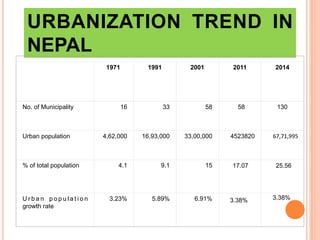
URBANIZATION TREND IN 
NEPAL 
1971 1991 2001 2011 2014 
No. of Municipality 16 33 58 
Urban population 4,62,000 16,93,000 33,00,000 4523820 
% of total population 4.1 9.1 15 
Ur b a n p o p u l a t i o n 
growth rate 
17.07 
3.23% 5.89% 6.91% 3.38% 
130 
25.56 
58 
67,71,995 
3.38%
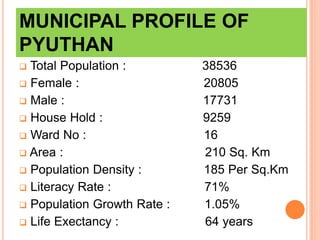
MUNICIPAL PROFILE OF 
PYUTHAN 
 Total Population : 38536 
 Female : 20805 
 Male : 17731 
 House Hold : 9259 
 Ward No : 16 
 Area : 210 Sq. Km 
 Population Density : 185 Per Sq.Km 
 Literacy Rate : 71% 
 Population Growth Rate : 1.05% 
 Life Exectancy : 64 years
...MUNICIPAL PROFILE OF 
PYUTHAN 
 Human Development Index : 0.426 
 Malnutrition : 42.5% (under 5yr) 
 House hold with Safe drinking water : 78% 
 Solid Waste Collected : 6 Ton Daily
URBAN ISSUES AND 
CHALLENGES 
Local election not held since 2002 which is 
hindering the representation of political parties, 
disadvantaged groups and women in the decision 
making. 
Internal revenue base becoming very weak, and 
revenue rate cant be revised in the absence of 
peoples rep in the spirit of no taxation without 
representation
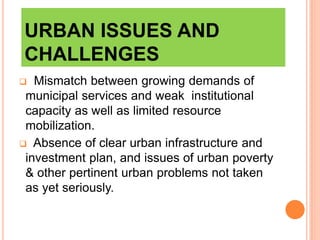
URBAN ISSUES AND 
CHALLENGES 
 Mismatch between growing demands of 
municipal services and weak institutional 
capacity as well as limited resource 
mobilization. 
 Absence of clear urban infrastructure and 
investment plan, and issues of urban poverty 
& other pertinent urban problems not taken 
as yet seriously.
...URBAN ISSUES AND 
CHALLENGES 
 Growing dependency of municipalities on central 
government for block grants due to fulfill so many 
demands of the tax payers and inadequate 
mobilization of resources. 
 Double responsibilities to EOs to work as Mayor as 
well as administrator, and their frequent transfer 
from one city to another and even other ministries. 
 Institutional development of 72 new municipalities 
are even more challenging to enable them to deliver 
minimum urban utility services to the people
...URBAN ISSUES AND 
CHALLENGES 
Decreasing employment opportunities due 
to low level of urban investment and local 
economic development programs or 
activities. 
A decade long internal conflict, unstable 
government and lingering transition affected 
the overall development process and 
economic growth in the country.
OPPORTUNITIES 
New constitution likely to guaranty constitutional 
provision of Municipalities as a third tier of govt., 
and State Restructuring Committee will define the 
share of resources and coordination mechanism 
with state govt. 
The political parties and government have shown 
their commitment to hold local election very soon 
to end the vacuum of peoples representation at 
the local level.
...OPPORTUNITIES 
 MoFALD & National Planning Commission 
gradually giving importance to growing 
urban challenges. 
 72 new municipalities will contribute to 
increase GDP by mobilizing their resources. 
 National Urban Development Strategy & 
Urban Poverty Policy being drafted by the 
government can address the needs of the 
urban poor and other burning urban issues.
...OPPORTUNITIES 
Formula based grant allocation system 
(MCPM) will increase competitiveness among 
municipalities and increase their performance
WAY FORWARD 
Completion of Landfill site Construction. 
Preparation of Master plan& Land use plan. 
Community composting system being started. 
Increasing awareness regarding environmental 
issues.
...WAY FORWARD 
Increase cooperation among public, private 
and community level. 
Proper enforcement of law. 
Capacitate the Human Resource.
LUMBINI BIRTH PLACE OF LORD 
BUDDHA
LOLORRDD B BUUDDDDHHAA
MT. EVEREST, NEPAL
TILICHO LAKE, NEPAL (4919M)
RARA LAKE, NEPAL
THANK YOU 
Comments and Suggestions are Welcome

[Urban Management Program City Paper : Kathmandu, Nepal]

  • 1.
    URBAN MANAGEMENT POLICIES AND PRACTICE IN NEPAL Bhagawan Aryal Local Development Officer Office of District Development Committee,Pyuthan Nepal
  • 3.
    PRESENTATION OUTLINE Nepal at Glance  Urban Policies and Legislations  Three Year plan of Government of Nepal  Institutional Arrangement  Existing Scenario/Facts and Figure  Urbanization Trend  City Profile  Challenges  Future Prospects
  • 4.
    NEPAL AT GLANCE Total Area : 1,47,181 sq. Km (0.03% of the world and 0.30% of Asia) Total Population: 26.5 Million Number of Household: 5.66 Million Population growth rate: 1.35%  Population Density: 180 per sq. km  Urban population Density: 985 per sq.km  Sex Ratio : 94.41 (Males per hundred females)  Urban Population: 25%,  Rural Population: 75%
  • 5.
    POLITICAL SYSTEM Before 1990s :- Panchayat Regime Led by King  After 1990s (Peoples Movement 1st):- Multi Party Democracy with constitutional Monarchy  After 2006 (People's Movement 2nd):- Nepal became Federal Democratic Republic
  • 6.
    ECONOMIC INDICATORS Population Below Poverty Line : 25.16%  Urban Poverty : 10% (Increased 8% to 10%)  Annual Economic Growth Rate: 5.2%
  • 7.
    POLICIES AND LEGISLATION  Local Self Governance Act 1999  Solid Waste Management Act.  Town Development Act.  Urban Development Policies.  Housing Policies
  • 8.
    THREE YEAR PLAN Objectives To develop safe, clean and prosperous cities with adequate infrastructure. Strategies  Encourage private-sector investment in the basic social and physical infrastructures of big cities and towns, and  Formulate proper programmes for developing the urban infrastructure needed for the planned development of villages which are emerging as towns as well as for towns which are growing into municipalities.
  • 9.
    OPERATING POLICIES Programmesoperated by public-private partnerships will be run to develop and advance basic urban services. Programmes to renovate and preserve important historical, religious, cultural and touristic sites lying in major urban areas will be initiated.  Planned cities and settlements will be developed in the vicinity of both major highways, including the Mid-Hills Highway, and other roads which are important from the perspective of economic development.
  • 10.
    ...OPERATING POLICIES Basicurban services will be gradually developed and expanded in emerging towns, And One c i t y wi l l be selec ted for development as a model planned city with all the necessary infrastructure.  Sus tainable and s y s temat i c urban d e v e l o pme n t p l a n s a n d s e t t l eme n t development programmes will be executed.
  • 11.
    ...OPERATING POLICIES The infrastructure of regional megacities and selected small towns will be developed in an integrated fashion.  Model projects wi l l be f ramed and implemented to make the r i ver s of Kathmandu Valley clean and green
  • 12.
    INSTITUTIONAL ARRANGEMENTS National Planning Commission  Apex body of Planning chair by Prime Minister  Sectoral Coordination  Ministry of Federal Affairs and Local Development  Formulation of Urban policies and Plan  Working as Focal Ministry of Municipality  Assist and Technical Support to Municipality for formulation of local level urban planning
  • 13.
    … INSTITUTIONAL ARRANGEMENTS  Ministry of Urban Development  Town Development Fund  Solid Waste Management Board  Kathmandu Valley Development Authority  Office of District Development Committee  Municipalities  Town Development Committee
  • 14.
    EXISTING SCENARIO/FACTS ANDFIGURE Total Population: 2,64,94,504 No. of City Government : 130 Urban Population: 67,71,995 Current Urban Population: 25.56 % Total Population growth rate : 1.35% Urban Population Growth rate : 3.38% Urban Poverty Rate : 15.5%
  • 15.
    RESPONSIBILITIES OF MUNICIPALITIES(CITY GOVERNMENT) Revenue Collection Physical Development Solid Waste Management Envi ronmental issues and Hygiene and Sanitation Judicial Authority
  • 16.
    RESPONSIBILITIES OF MUNICIPALITIES(CITY GOVERNMENT) Education and Sports Cultural Development Urban Transportation Health Service Social Welfare Industry and Tourism
  • 17.
    URBANIZATION TREND IN NEPAL 1971 1991 2001 2011 2014 No. of Municipality 16 33 58 Urban population 4,62,000 16,93,000 33,00,000 4523820 % of total population 4.1 9.1 15 Ur b a n p o p u l a t i o n growth rate 17.07 3.23% 5.89% 6.91% 3.38% 130 25.56 58 67,71,995 3.38%
  • 18.
    MUNICIPAL PROFILE OF PYUTHAN  Total Population : 38536  Female : 20805  Male : 17731  House Hold : 9259  Ward No : 16  Area : 210 Sq. Km  Population Density : 185 Per Sq.Km  Literacy Rate : 71%  Population Growth Rate : 1.05%  Life Exectancy : 64 years
  • 19.
    ...MUNICIPAL PROFILE OF PYUTHAN  Human Development Index : 0.426  Malnutrition : 42.5% (under 5yr)  House hold with Safe drinking water : 78%  Solid Waste Collected : 6 Ton Daily
  • 20.
    URBAN ISSUES AND CHALLENGES Local election not held since 2002 which is hindering the representation of political parties, disadvantaged groups and women in the decision making. Internal revenue base becoming very weak, and revenue rate cant be revised in the absence of peoples rep in the spirit of no taxation without representation
  • 21.
    URBAN ISSUES AND CHALLENGES  Mismatch between growing demands of municipal services and weak institutional capacity as well as limited resource mobilization.  Absence of clear urban infrastructure and investment plan, and issues of urban poverty & other pertinent urban problems not taken as yet seriously.
  • 22.
    ...URBAN ISSUES AND CHALLENGES  Growing dependency of municipalities on central government for block grants due to fulfill so many demands of the tax payers and inadequate mobilization of resources.  Double responsibilities to EOs to work as Mayor as well as administrator, and their frequent transfer from one city to another and even other ministries.  Institutional development of 72 new municipalities are even more challenging to enable them to deliver minimum urban utility services to the people
  • 23.
    ...URBAN ISSUES AND CHALLENGES Decreasing employment opportunities due to low level of urban investment and local economic development programs or activities. A decade long internal conflict, unstable government and lingering transition affected the overall development process and economic growth in the country.
  • 24.
    OPPORTUNITIES New constitutionlikely to guaranty constitutional provision of Municipalities as a third tier of govt., and State Restructuring Committee will define the share of resources and coordination mechanism with state govt. The political parties and government have shown their commitment to hold local election very soon to end the vacuum of peoples representation at the local level.
  • 25.
    ...OPPORTUNITIES  MoFALD& National Planning Commission gradually giving importance to growing urban challenges.  72 new municipalities will contribute to increase GDP by mobilizing their resources.  National Urban Development Strategy & Urban Poverty Policy being drafted by the government can address the needs of the urban poor and other burning urban issues.
  • 26.
    ...OPPORTUNITIES Formula basedgrant allocation system (MCPM) will increase competitiveness among municipalities and increase their performance
  • 27.
    WAY FORWARD Completionof Landfill site Construction. Preparation of Master plan& Land use plan. Community composting system being started. Increasing awareness regarding environmental issues.
  • 28.
    ...WAY FORWARD Increasecooperation among public, private and community level. Proper enforcement of law. Capacitate the Human Resource.
  • 29.
    LUMBINI BIRTH PLACEOF LORD BUDDHA
  • 30.
  • 31.
  • 32.
  • 33.
  • 34.
    THANK YOU Commentsand Suggestions are Welcome