Regional Planning
in Nepal: Prospects
and Challenges
Ashish Dangal
Master‘s Student Infrastructure Planning
University of Stuttgart
3 February, 2021
Important Disclaimer
New Political Map of Nepal endorsed on May 20, 2020
Previously Used Political Map of Nepal
On May 20, 2020, the Government of Nepal endorsed a new Political Map of Nepal with
a segment of territory added in the upper left corner.
The old Political Map in this presentation is used for demonstration purposes only due to
lack of availability of Geodata pertaining to the new Political Map.
Location and Key Indicators
Data Source: data.worldbank.org, Wikipedia
* Rank in the World in descending order
1. The Context of Nepal
Key Metrics of Nepal
Metrics/Indicators Nepal
Population (in Mio.) 28.6 (2019) (49th)*
Area (in sq. km) 147,516(93rd)*
Nominal Gross Domestic
Production(GDP)
$30.6 Billion (2019) (101st)*
Major Sources of National
Income
Foreign
Remittance(26.9%of
GDP in 2019), Tourism
(7.9% of GDP in 2017),
Carpets and Textiles
Per Capita Income $1,090 (2019) (159th)*
Human Development Index
(HDI)
0.579 (147th)*
An overview of the Nepalese Economy
Imports (2018) Exports (2018)
$10.1 Billion $723 Million
Data Source: 2020 CIA WORLD FACTBOOK, www.oec.world
1. The Context of Nepal
Data Source: 2020 CIA WORLD FACTBOOK, www.oec.world
Geography and Topography: Small, but Diverse.
1. The Context of Nepal
Settlement Patterns
Typical Settlement in Rural Mountain Region
Typical Settlement and Agriculture in Rural Hill Region
Typical Settlement and Agriculture in Rural Terai Region
1. The Context of Nepal
Typical Urban Settlement-Kathmandu
Demographic Trend
1. The Context of Nepal
• At 16.8 Million active population, currently
the 37th largest workforce in the world
• Ageing Society in 2028
(Data Source:DEMOGRAPHIC CHANGES OF NEPAL: Trends and
Policy Implications , NPC, 2017)
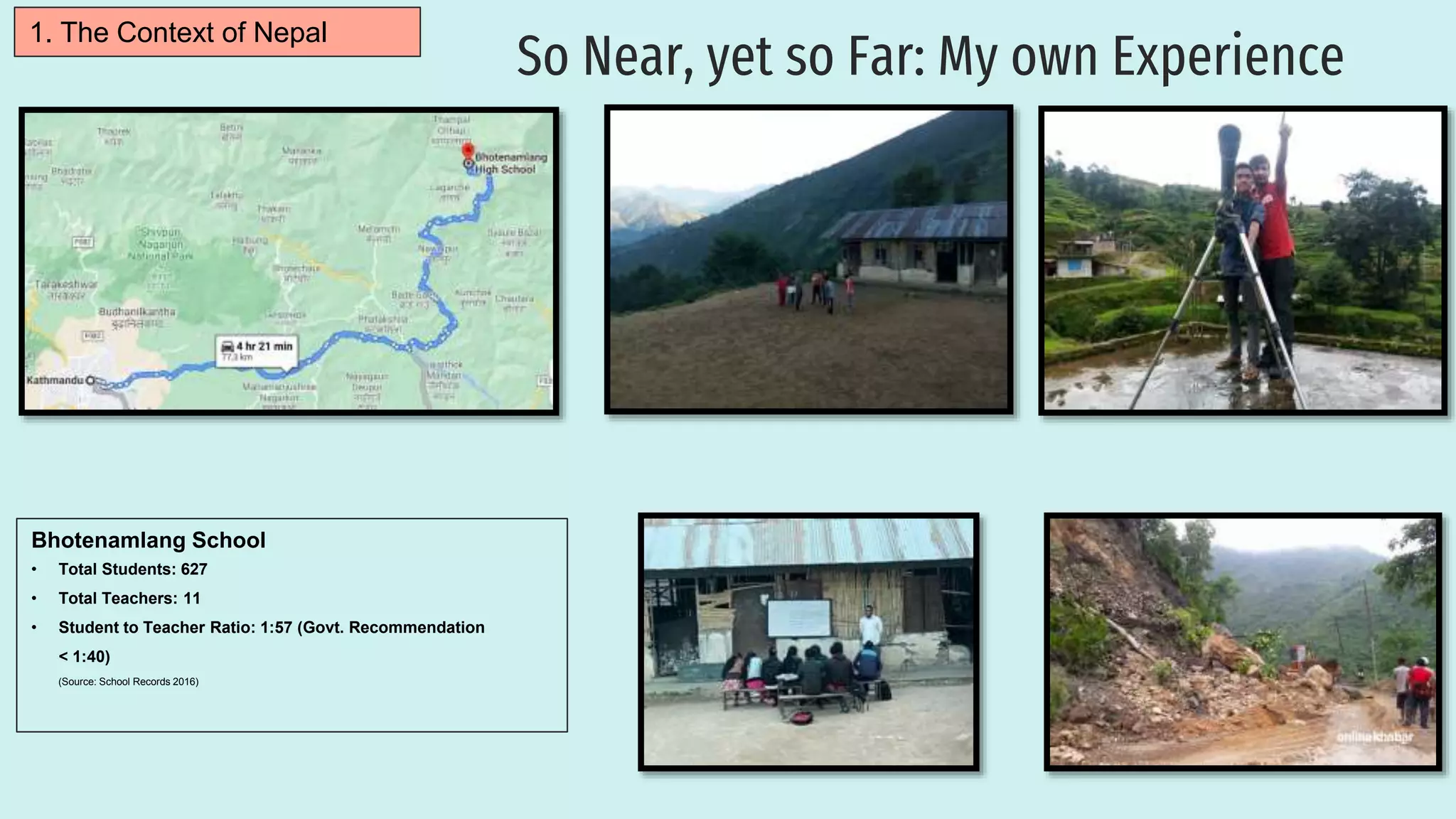
So Near, yet so Far: My own Experience
Bhotenamlang School
• Total Students: 627
• Total Teachers: 11
• Student to Teacher Ratio: 1:57 (Govt. Recommendation
< 1:40)
(Source: School Records 2016)
1. The Context of Nepal
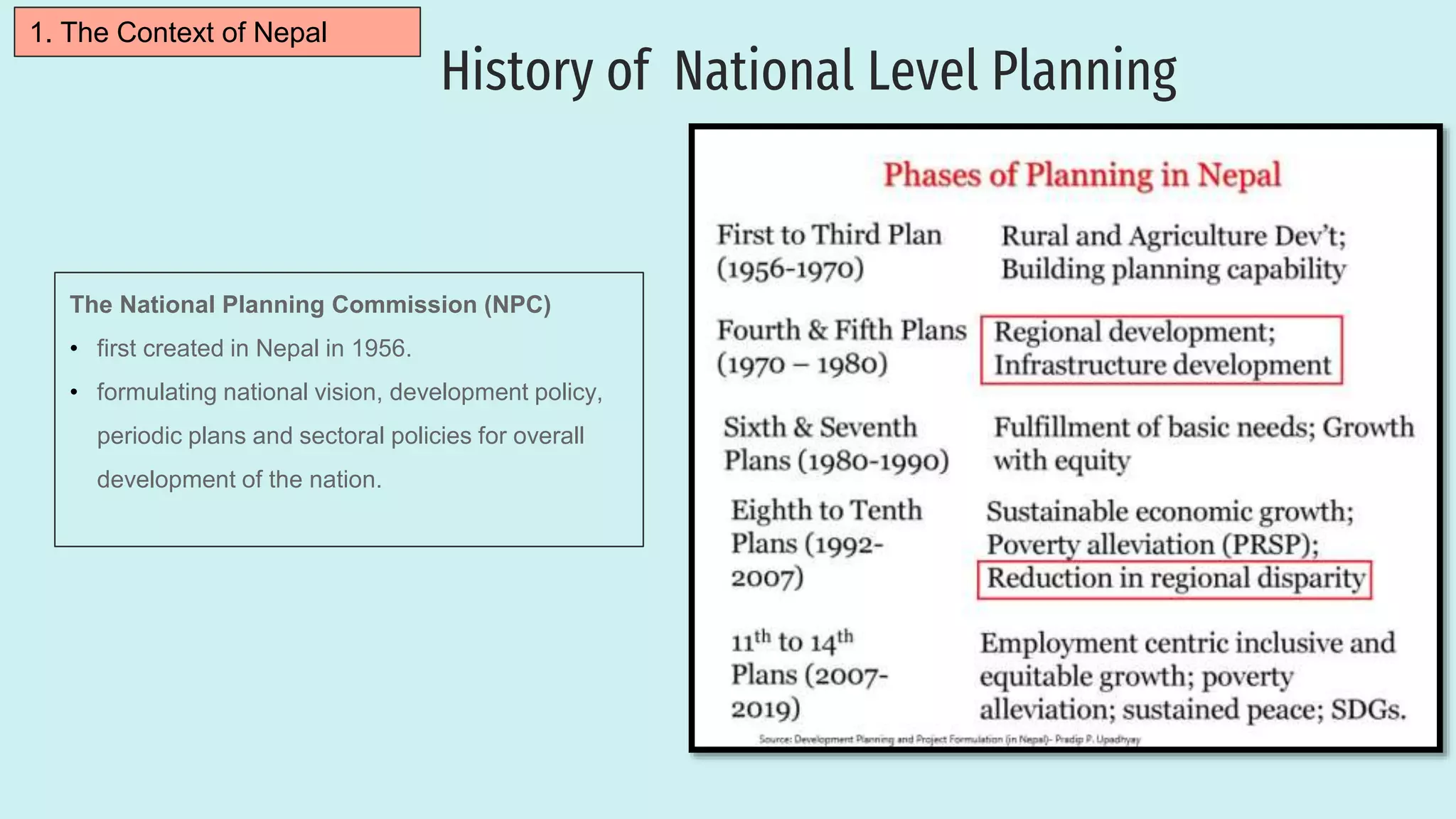
History of National Level Planning
The National Planning Commission (NPC)
• first created in Nepal in 1956.
• formulating national vision, development policy,
periodic plans and sectoral policies for overall
development of the nation.
1. The Context of Nepal
After 2015
Administrative Divisions : Past and Present
Until 2015
Decentralization has been the major running target of the administration
divisions.
1. The Context of Nepal
Present Planning Hierarchy
1. The Context of Nepal
Status of Regional Development
2. Present Status of Development
Strategic Transportation Network
Nepal Road Network
• Strategic Roads Network
a) Highways
b) Feeder Roads
• Local Road Network
a) District Roads
b) Urban Roads
2. Present Status of Development
• 60% of the road network is
concentrated in the Terai region
• 50% of the population of the
hilly region still need to walk 2
hours to reach an SRN road.
• 2 district headquarters still not
connected to the SRN
Source: Sector Assessment (Summary): Road
Transport, ADB, 2015
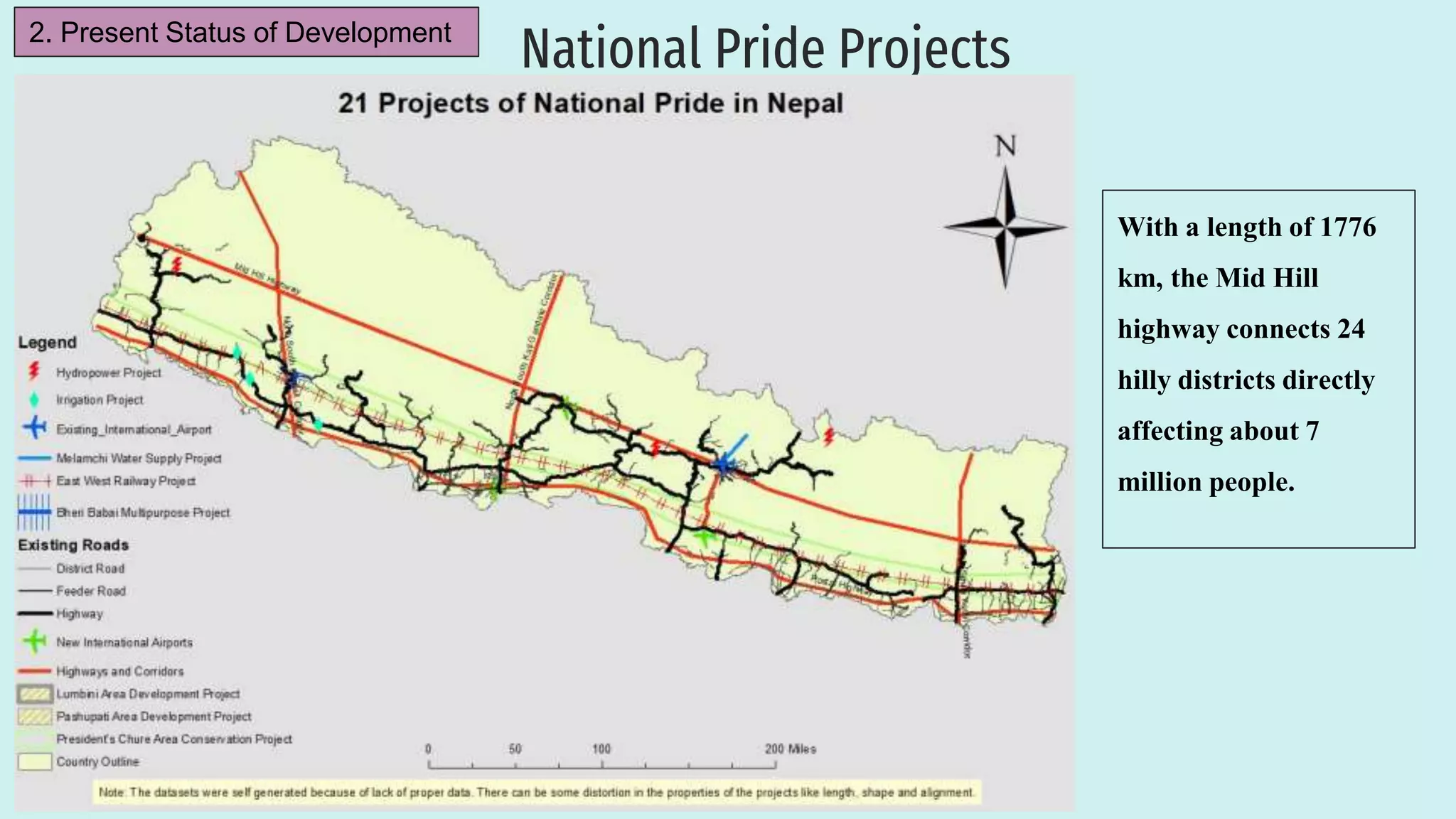
National Pride Projects
2. Present Status of Development
With a length of 1776
km, the Mid Hill
highway connects 24
hilly districts directly
affecting about 7
million people.
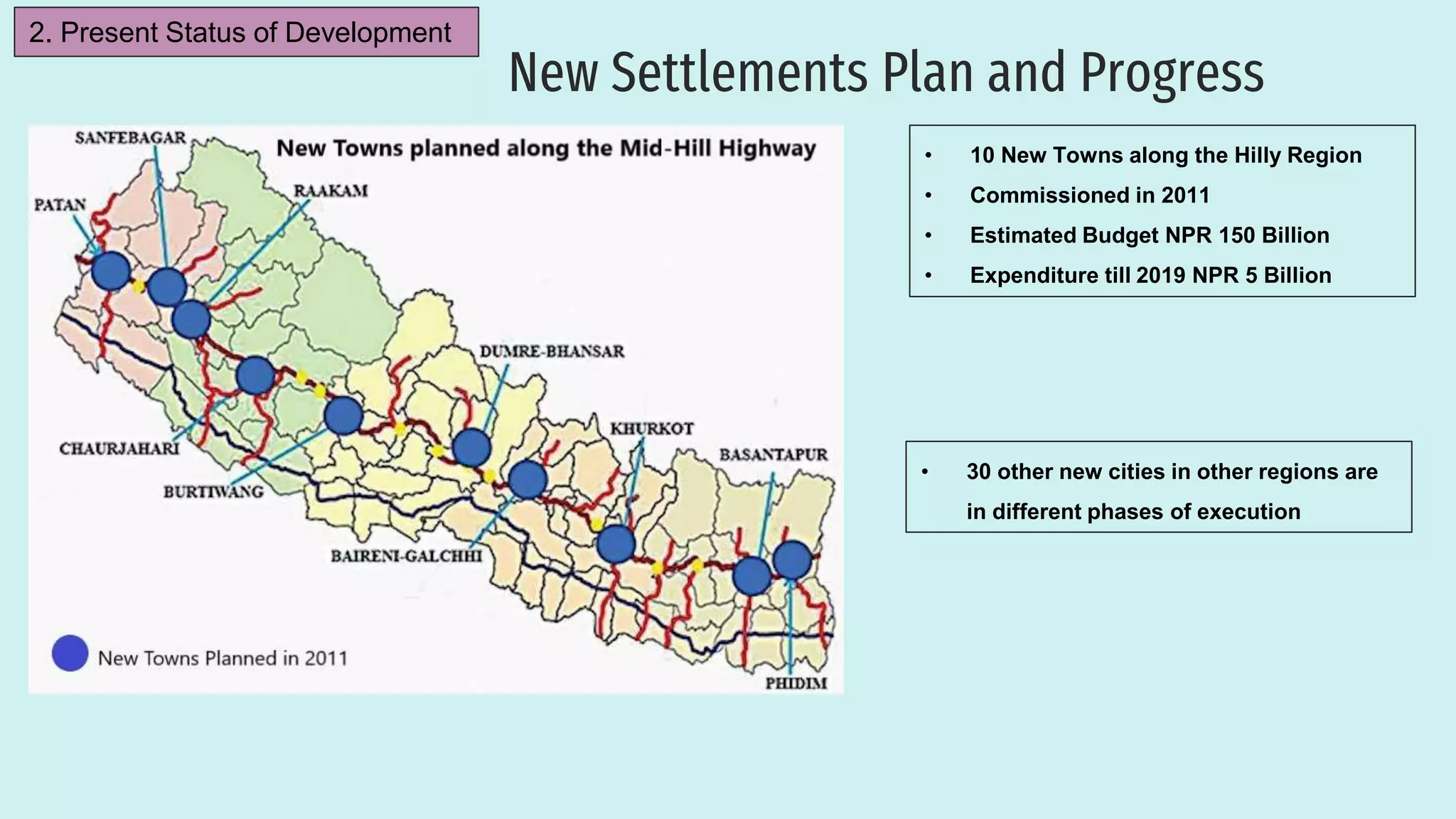
New Settlements Plan and Progress
• 30 other new cities in other regions are
in different phases of execution
• 10 New Towns along the Hilly Region
• Commissioned in 2011
• Estimated Budget NPR 150 Billion
• Expenditure till 2019 NPR 5 Billion
2. Present Status of Development
Water Resources Management
Irrigation
• 81% of irrigable land is irrigated
• Only 35% of irrigated land has year-round irrigation
facility
Water Supply
• 86% of the Population has access to Water Supply
Power Supply
• Nepal has economical Hydropower potential of
about 42,000 MW
• As of 2017, Nepal has been able to generate 501
MW
• Peak demand in Winter, 2016 was1198 MW
501 MW- met internally
468 MW- imported from India
268 MW- Load Management
(Data Source: Nepal’s Water Resources and its Development Strategy, Pradhan, 2018)
2. Present Status of Development
Internal Migration
3. Challenges and Opportunities
• Internal Migration is the largest contributor to urban growth (MOUD,2015)
• 40 new cities are planned keeping in view this trend of internal migration
Urbanization
3. Challenges and Opportunities
Land use change in Kathmandu 1989-2016
Challenges of Urbanization in Nepal
• Lack of Planning and large and growing infrastructure deficits (Managing
Nepal‘s Urban Transition, World Bank, 2013)
• Problems of drinking water, sanitation, air pollution, squatter settlements
(Challenges of Inclusive Urbanization in the Face of Political Transition in Nepal, Mugambwa &
Katusiimeh,2018)
Opportunities
• New towns and cities
Level of Urbanization
Kathmandu 96.97%
Pokhara 79.52%
Rest of the Hill Region 18.28%
Inner Terai Valley 41.97%
Rest of Terai 38.94%
Source: National Urban Development Strategy, 2017
Challenges: Lack of Proper Planning and
Implementation Tools
• Planning guidelines not contextualized
• No Centralized GIS database of infrastructure projects
• No evidence based planning of medium and small scale projects
• Data not easily accessible
My Experience in Hetauda
2 Ministries commissioned the same Project
• Ministry of Physical Infrastructure Development, Province 3
• Ministry of Forest, Environment and Industries, Province 3
3. Challenges and Opportunities
Challenges: Lack of Effective Monitoring and
Implementation
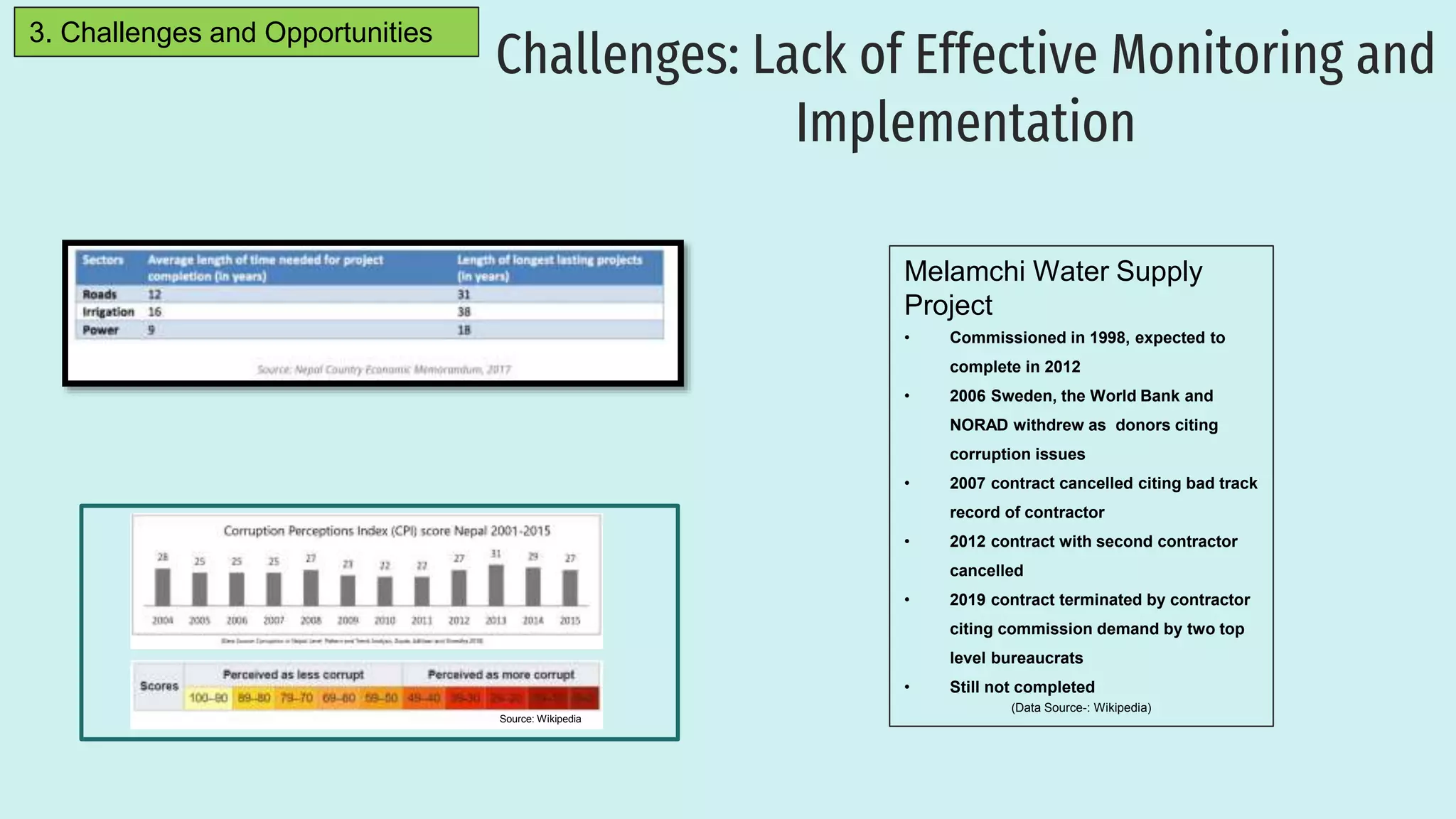
Source: Wikipedia
Melamchi Water Supply
Project
• Commissioned in 1998, expected to
complete in 2012
• 2006 Sweden, the World Bank and
NORAD withdrew as donors citing
corruption issues
• 2007 contract cancelled citing bad track
record of contractor
• 2012 contract with second contractor
cancelled
• 2019 contract terminated by contractor
citing commission demand by two top
level bureaucrats
• Still not completed
(Data Source-: Wikipedia)
3. Challenges and Opportunities
Challenges: Natural Hazards and Climate Change
Nepal‘s Rank in Global Risk
Assessment Studies
Climate Risk- 4th (Global Climate Risk Index)
Earthquake Risk- 11th (Global Risk for Earthquake Occurence
and Impact)
Flood Risk- 30th (UNDP / BCPR, 2004)
Total Natural Hazard related deaths- 23rd
3. Challenges and Opportunities
Opportunities: Climate change and Disaster Risk Management Plan
3. Challenges and Opportunities
Disaster Relief and Response
1997-2002
Disaster Management
2003-2007
Climate Change Adaptation
2008-2010
Localised CCA and DRR
2011
Figure: Timeline of CCA and DRR Policy Development Nepal
Source: London School of Economics and Political Science, 2019
• Climate Change and Disaster Risk are aggravating
the Regional Disparity in Nepal inducing Poverty and
Migration and destruction of built Infrastructures.
• Initially DRR and CCA were addressed separately.
But now a new Framework is being practiced by
integrating DRR and CCA.
• The German Agency GIZ has helped prepare a
guidebook for Preparation of Local Disaster and
Climate Resilience Plan for the Local Governments
• All Local Governments have either prepared or are
preparing contextual LDCRP
Challenges:- Haphazard „Development“ Projects
3. Challenges and Opportunities
Opportunities: Ropeway Development
• Ropeways are better alternative than roads in disaster-prone hilly areas -Nepal Country
Report, World Bank , 1976
• Ropeways are relatively viable as compared to roads- Cheaper to build, operate and
maintain, negligible harm to the environment, less pollution, less noise, less space
requirement, less construction work, less slope destabilization, less risk of triggering
landslides, less risk of floodings, no major bridges required, powered by electricity- a
resource abundant in Nepal
Manakamana Cable Car, Kurintar Chandragiri Cable car, Kathmandu
3. Challenges and Opportunities
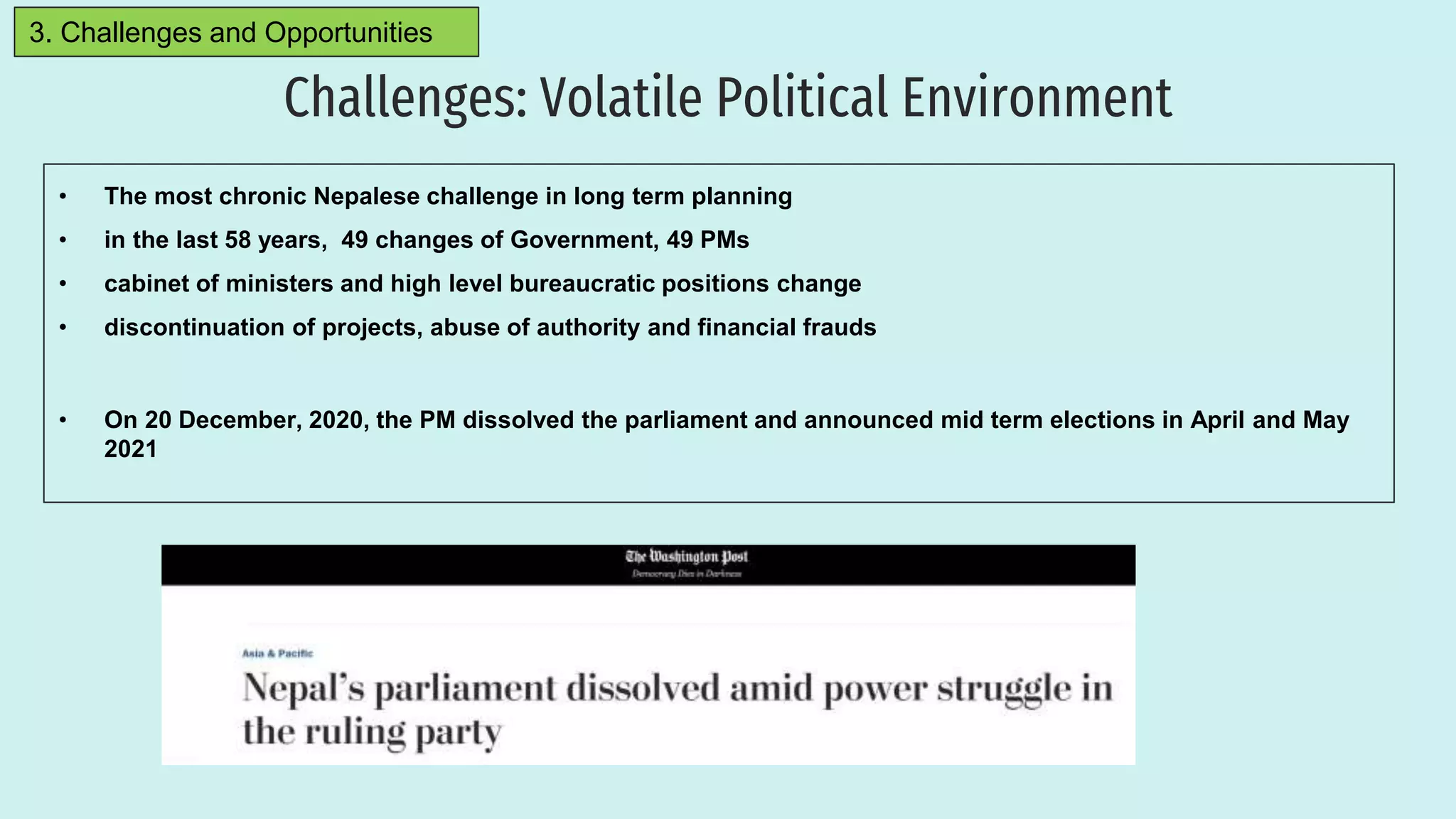
Challenges: Volatile Political Environment
• The most chronic Nepalese challenge in long term planning
• in the last 58 years, 49 changes of Government, 49 PMs
• cabinet of ministers and high level bureaucratic positions change
• discontinuation of projects, abuse of authority and financial frauds
• On 20 December, 2020, the PM dissolved the parliament and announced mid term elections in April and May
2021
3. Challenges and Opportunities
Image Source: MS Powerpoint Online Library
Thank You.

Regional Planning in Nepal: Prospects and Challenges

  • 1.
    Regional Planning in Nepal:Prospects and Challenges Ashish Dangal Master‘s Student Infrastructure Planning University of Stuttgart 3 February, 2021
  • 2.
    Important Disclaimer New PoliticalMap of Nepal endorsed on May 20, 2020 Previously Used Political Map of Nepal On May 20, 2020, the Government of Nepal endorsed a new Political Map of Nepal with a segment of territory added in the upper left corner. The old Political Map in this presentation is used for demonstration purposes only due to lack of availability of Geodata pertaining to the new Political Map.
  • 3.
    Location and KeyIndicators Data Source: data.worldbank.org, Wikipedia * Rank in the World in descending order 1. The Context of Nepal Key Metrics of Nepal Metrics/Indicators Nepal Population (in Mio.) 28.6 (2019) (49th)* Area (in sq. km) 147,516(93rd)* Nominal Gross Domestic Production(GDP) $30.6 Billion (2019) (101st)* Major Sources of National Income Foreign Remittance(26.9%of GDP in 2019), Tourism (7.9% of GDP in 2017), Carpets and Textiles Per Capita Income $1,090 (2019) (159th)* Human Development Index (HDI) 0.579 (147th)*
  • 4.
    An overview ofthe Nepalese Economy Imports (2018) Exports (2018) $10.1 Billion $723 Million Data Source: 2020 CIA WORLD FACTBOOK, www.oec.world 1. The Context of Nepal Data Source: 2020 CIA WORLD FACTBOOK, www.oec.world Data Source: 2020 CIA WORLD FACTBOOK, www.oec.world
  • 5.
    Geography and Topography:Small, but Diverse. 1. The Context of Nepal
  • 6.
    Settlement Patterns Typical Settlementin Rural Mountain Region Typical Settlement and Agriculture in Rural Hill Region Typical Settlement and Agriculture in Rural Terai Region 1. The Context of Nepal Typical Urban Settlement-Kathmandu
  • 7.
    Demographic Trend 1. TheContext of Nepal • At 16.8 Million active population, currently the 37th largest workforce in the world • Ageing Society in 2028 (Data Source:DEMOGRAPHIC CHANGES OF NEPAL: Trends and Policy Implications , NPC, 2017)
  • 8.
    So Near, yetso Far: My own Experience Bhotenamlang School • Total Students: 627 • Total Teachers: 11 • Student to Teacher Ratio: 1:57 (Govt. Recommendation < 1:40) (Source: School Records 2016) 1. The Context of Nepal
  • 9.
    History of NationalLevel Planning The National Planning Commission (NPC) • first created in Nepal in 1956. • formulating national vision, development policy, periodic plans and sectoral policies for overall development of the nation. 1. The Context of Nepal
  • 10.
    After 2015 Administrative Divisions: Past and Present Until 2015 Decentralization has been the major running target of the administration divisions. 1. The Context of Nepal
  • 11.
    Present Planning Hierarchy 1.The Context of Nepal
  • 12.
    Status of RegionalDevelopment 2. Present Status of Development
  • 13.
    Strategic Transportation Network NepalRoad Network • Strategic Roads Network a) Highways b) Feeder Roads • Local Road Network a) District Roads b) Urban Roads 2. Present Status of Development • 60% of the road network is concentrated in the Terai region • 50% of the population of the hilly region still need to walk 2 hours to reach an SRN road. • 2 district headquarters still not connected to the SRN Source: Sector Assessment (Summary): Road Transport, ADB, 2015
  • 14.
    National Pride Projects 2.Present Status of Development With a length of 1776 km, the Mid Hill highway connects 24 hilly districts directly affecting about 7 million people.
  • 15.
    New Settlements Planand Progress • 30 other new cities in other regions are in different phases of execution • 10 New Towns along the Hilly Region • Commissioned in 2011 • Estimated Budget NPR 150 Billion • Expenditure till 2019 NPR 5 Billion 2. Present Status of Development
  • 16.
    Water Resources Management Irrigation •81% of irrigable land is irrigated • Only 35% of irrigated land has year-round irrigation facility Water Supply • 86% of the Population has access to Water Supply Power Supply • Nepal has economical Hydropower potential of about 42,000 MW • As of 2017, Nepal has been able to generate 501 MW • Peak demand in Winter, 2016 was1198 MW 501 MW- met internally 468 MW- imported from India 268 MW- Load Management (Data Source: Nepal’s Water Resources and its Development Strategy, Pradhan, 2018) 2. Present Status of Development
  • 17.
    Internal Migration 3. Challengesand Opportunities • Internal Migration is the largest contributor to urban growth (MOUD,2015) • 40 new cities are planned keeping in view this trend of internal migration
  • 18.
    Urbanization 3. Challenges andOpportunities Land use change in Kathmandu 1989-2016 Challenges of Urbanization in Nepal • Lack of Planning and large and growing infrastructure deficits (Managing Nepal‘s Urban Transition, World Bank, 2013) • Problems of drinking water, sanitation, air pollution, squatter settlements (Challenges of Inclusive Urbanization in the Face of Political Transition in Nepal, Mugambwa & Katusiimeh,2018) Opportunities • New towns and cities Level of Urbanization Kathmandu 96.97% Pokhara 79.52% Rest of the Hill Region 18.28% Inner Terai Valley 41.97% Rest of Terai 38.94% Source: National Urban Development Strategy, 2017
  • 19.
    Challenges: Lack ofProper Planning and Implementation Tools • Planning guidelines not contextualized • No Centralized GIS database of infrastructure projects • No evidence based planning of medium and small scale projects • Data not easily accessible My Experience in Hetauda 2 Ministries commissioned the same Project • Ministry of Physical Infrastructure Development, Province 3 • Ministry of Forest, Environment and Industries, Province 3 3. Challenges and Opportunities
  • 20.
    Challenges: Lack ofEffective Monitoring and Implementation Source: Wikipedia Melamchi Water Supply Project • Commissioned in 1998, expected to complete in 2012 • 2006 Sweden, the World Bank and NORAD withdrew as donors citing corruption issues • 2007 contract cancelled citing bad track record of contractor • 2012 contract with second contractor cancelled • 2019 contract terminated by contractor citing commission demand by two top level bureaucrats • Still not completed (Data Source-: Wikipedia) 3. Challenges and Opportunities
  • 21.
    Challenges: Natural Hazardsand Climate Change Nepal‘s Rank in Global Risk Assessment Studies Climate Risk- 4th (Global Climate Risk Index) Earthquake Risk- 11th (Global Risk for Earthquake Occurence and Impact) Flood Risk- 30th (UNDP / BCPR, 2004) Total Natural Hazard related deaths- 23rd 3. Challenges and Opportunities
  • 22.
    Opportunities: Climate changeand Disaster Risk Management Plan 3. Challenges and Opportunities Disaster Relief and Response 1997-2002 Disaster Management 2003-2007 Climate Change Adaptation 2008-2010 Localised CCA and DRR 2011 Figure: Timeline of CCA and DRR Policy Development Nepal Source: London School of Economics and Political Science, 2019 • Climate Change and Disaster Risk are aggravating the Regional Disparity in Nepal inducing Poverty and Migration and destruction of built Infrastructures. • Initially DRR and CCA were addressed separately. But now a new Framework is being practiced by integrating DRR and CCA. • The German Agency GIZ has helped prepare a guidebook for Preparation of Local Disaster and Climate Resilience Plan for the Local Governments • All Local Governments have either prepared or are preparing contextual LDCRP
  • 23.
    Challenges:- Haphazard „Development“Projects 3. Challenges and Opportunities
  • 24.
    Opportunities: Ropeway Development •Ropeways are better alternative than roads in disaster-prone hilly areas -Nepal Country Report, World Bank , 1976 • Ropeways are relatively viable as compared to roads- Cheaper to build, operate and maintain, negligible harm to the environment, less pollution, less noise, less space requirement, less construction work, less slope destabilization, less risk of triggering landslides, less risk of floodings, no major bridges required, powered by electricity- a resource abundant in Nepal Manakamana Cable Car, Kurintar Chandragiri Cable car, Kathmandu 3. Challenges and Opportunities
  • 25.
    Challenges: Volatile PoliticalEnvironment • The most chronic Nepalese challenge in long term planning • in the last 58 years, 49 changes of Government, 49 PMs • cabinet of ministers and high level bureaucratic positions change • discontinuation of projects, abuse of authority and financial frauds • On 20 December, 2020, the PM dissolved the parliament and announced mid term elections in April and May 2021 3. Challenges and Opportunities
  • 26.
    Image Source: MSPowerpoint Online Library Thank You.

Editor's Notes

  • #4 Population density 196/km2, density rank 71
  • #8 Median age 24.6
  • #14 Classification of road system. Explain the points.
  • #25 roads in hilly areas where construction and maintainance costs of roads tend to be very high The government has not shown much interest in Ropeways development Private investors have invested in some Ropeway sytems to connect people to otherwise remote religious places.