Intensive care unit
1 Ahmed Ahmed Sa3ed
Table of Contents
History......................................................................................................................................................................... 2
Specialities................................................................................................................................................................... 4
Equipment and systems................................................................................................................................................. 5
Oxygen Cylinder with Stand .................................................................................................................................................... 5
Pulse Oxi meter with probe ..................................................................................................................................................... 5
ECG – Monitor with Leads...................................................................................................................................................... 6
ECG– Machine withLeads ....................................................................................................................................................... 6
SuctionApparatus................................................................................................................................................................. 6
BP Apparatus ..................................................................................................................................................................... 6
Glucometer..................................................................................................................................................................... 6
. Ambubag..................................................................................................................................................................... 7
Nebulizer ....................................................................................................................................................................... 7
Quality of care.............................................................................................................................................................. 8
Operational logistics ..................................................................................................................................................... 8
Remote collaboration systems ....................................................................................................................................... 8
2 Ahmed Ahmed Sa3ed
Intensive care unit
An intensive care unit (ICU), also known as an intensive therapy
unit or intensive treatment unit (ITU) or critical care unit (CCU), is
a special department of a hospital or health care facility that provides
intensive treatment medicine.
Intensive care units cater to patients with severe and life-threatening
illnesses and injuries, which require constant, close monitoring and
support from specialist equipment and medications in order to ensure
normal bodily functions. They are staffed by highly trained doctors and
nurses who specialise in caring for critically ill patients. ICUs are also
distinguished from normal hospital wards by a higher staff-to-patient
ratio and access to advanced medical resources and equipment that is
not routinely available elsewhere. Common conditions that are treated
within ICUs include acute (or adult) respiratory distress syndrome
(ARDS), trauma, multiple organ failure and sepsis.[1]
Patients may be transferred directly to an intensive care unit from an
emergency department if required, or from a ward if they rapidly
deteriorate, or immediately after surgery if the surgery is very invasive
and the patient is at high risk of complications.[2]
Intensive care unit
ICU patients often requiremechanical
ventilation if they have lost the ability to
breathe normall
History
In 1854, Florence Nightingale left for a Crimean War, where triage, used to separate seriously wounded
soldiers from the less-seriously wounded, was observed. Until recently, it was reported that Nightingale
reduced mortality from 40% to 2% on the battlefield. Although this was not the case, her experiences during
the war formed the foundation for her later discovery of the importance of sanitary conditions in hospitals, a
critical component of intensive care. In 1950, anesthesiologist Peter Safar established the concept of "Advanced
Support of Life", keeping patients sedated and ventilated in an intensive care environment. Safar is considered
to be the first practitioner of intensive care medicine as a speciality. In response to a polio epidemic (where
3 Ahmed Ahmed Sa3ed
many patients required constant ventilation and surveillance), Bjørn Aage Ibsen established the first intensive
care unit in Copenhagen in 1953.[3][4][5] The first application of this idea in the United States was in 1955 by
Dr. William Mosenthal, a surgeon at the Dartmouth-Hitchcock Medical Center.[6] In the 1960s, the importance
of cardiac arrhythmias as a source of morbidity and mortality in myocardial infarctions (heart attacks) was
recognized. This led to the routine use of cardiac monitoring in ICUs, especially after heart attacks.[7]
4 Ahmed Ahmed Sa3ed
Specialities
Hospitals may have ICUs that cater to a specific medical speciality or
patient, such as those listed below:
Neonatal intensive care unit (NICU). This specialty unit cares for
neonatal patients who have not left the hospital after birth.
Common conditions cared for include prematurity and associated
complications, congenital disorders such as Congenital
diaphragmatic hernia, or complications resulting from the
birthing process.
Pediatric intensive care unit (PICU). Pediatric patients are treated
in this intensive care unit for life-threatening medical problems
such as asthma, influenza, diabetic ketoacidosis, or traumatic
brain injury. Surgical cases may also be transferred to the PICU
postoperatively if the patient has a potential for rapid
deterioration and requires more frequent monitoring, such as in
spinal fusions or surgeries involving the airway such as removal
of the tonsils or adenoids. Some facilities also have specialized
pediatric cardiac intensive care units, where patients with
congenital heart disease are cared for. These units also typically
handle cardiac transplantation and postop care of cardiac
catheterization patients if those services are offered at the
hospital.
Psychiatric intensive care unit (PICU). Patients who may
voluntarily harm themselves are delivered here so they can be
monitored more vigorously. Patient rooms are locked, preventing
escaping.
Coronary care unit (CCU): Also known as Cardiac Intensive
Care Unit (CICU) or Cardiovascular Intensive Care Unit
(CVICU), this ICU caters to patients specifically with congenital
heart defects or life-threatening acute conditions such as cardiac
arrest.
Neurological intensive care unit (NeuroICU). Patients here are
treated for aneurysms, brain tumors, stroke, rattlesnake bites and
post surgical patients who have undergone various neurological
surgeries and require hourly neurological exams. Many nurses
who work within these units have neurological intensive care
certifications. Once the patients are more stable and off the
ventilator, they are transferred to a neurological care unit.
Trauma intensive care unit (Trauma ICU). These are found only
in hospitals certified in Trauma and have a dedicated Trauma
Emergency Department equipped with a team of surgeons,
nurses, respiratory therapists, and radiological staff.
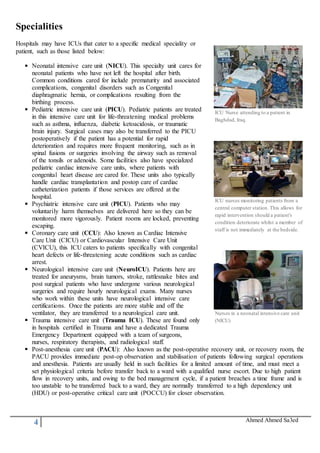
ICU Nurse attending to a patient in
Baghdad, Iraq.
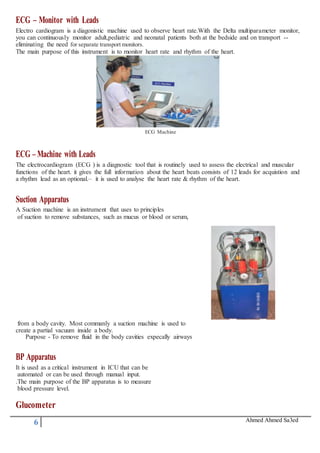
ICU nurses monitoring patients from a
central computer station. This allows for
rapid intervention should a patient's
condition deteriorate whilst a member of
staff is not immediately at the bedside.
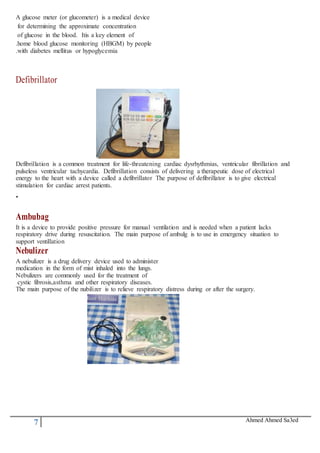
Nurses in a neonatal intensive care unit
(NICU)
Post-anesthesia care unit (PACU): Also known as the post-operative recovery unit, or recovery room, the
PACU provides immediate post-op observation and stabilisation of patients following surgical operations
and anesthesia. Patients are usually held in such facilities for a limited amount of time, and must meet a
set physiological criteria before transfer back to a ward with a qualified nurse escort. Due to high patient
flow in recovery units, and owing to the bed management cycle, if a patient breaches a time frame and is
too unstable to be transferred back to a ward, they are normally transferred to a high dependency unit
(HDU) or post-operative critical care unit (POCCU) for closer observation.
5 Ahmed Ahmed Sa3ed
High dependency unit (HDU): In the United Kingdom and elsewhere (known as step down unit or
progressive care unit in North America), most acute hospitals have a transitional high dependency unit
(HDU) for patients who require close observation, treatment and nursing care that cannot be provided on
a general ward, but whose care is not at a critical enough level to warrant an ICU bed. These units are
also called step-down, progressive and intensive recovery units and are utilised until a patient's condition
stabilizes enough to qualify them for discharge to a general ward.[8]
Surgical Intensive Care Unit (SICU): A specialized service in larger hospitals that provides inpatient care
for critically ill patients on surgical services. As opposed to other ICUs, the care is managed by surgeons
trained in critical-care.
Out of Hospital ICU
Mobile Intensive Care Unit (MICU)
A specialized ambulance with the staff and equipment to provide on-scene Advanced Life Support resuscitation
and intensive care during transport. In the Anglo American model of pre-hospital care MICUs are generally
paramedic crewed. In the Franco German model MICU crews are usually a specialist nurse and doctor. Some
systems use a mix of the two models.
Equipment and systems
Common equipment in an ICU includes mechanical ventilators to assist breathing through an endotracheal tube
or a tracheostomy tube; cardiac monitors including those with telemetry; external pacemakers; defibrillators;
dialysis equipment for renal problems; equipment for the constant monitoring of bodily functions; a web of
intravenous lines, feeding tubes, nasogastric tubes, suction pumps, drains, and catheters; and a wide array of
drugs to treat the primary condition(s) of hospitalization. Medically induced comas, analgesics, and induced
sedation are common ICU tools needed and used to reduce pain and prevent secondary infections.
Equipment Used inIntensive Care UnitAn intensve care unit is a special department in a healthcare facility that provides intensive care to critically ill
patients. An ICU consists of various equipment necessary to support life in patients. Following are a few of
these:
Oxygen Cylinder with Stand
Oygen cylinder is a instrument used to supply oygen to the patient during a surgery or after
surgery where patient suffers from inadequete oxygen supply
.The oxygen is stored in this cylinder.
Pulse Oxi meter with probe
A pulse oximeter may be a separate monitor or a part
of larger heart and lung monitor.
It uses a probe with a red light and a sensor to measure oxygen levels.
Purpose - To monitor pulse and oxygen saturation level.
Pulse Oxi meter
6 Ahmed Ahmed Sa3ed
ECG – Monitor with Leads
Electro cardiogram is a diagonistic machine used to observe heart rate.With the Delta multiparameter monitor,
you can continuously monitor adult,pediatric and neonatal patients both at the bedside and on transport --
eliminating the need for separate transport monitors.
The main purpose of this instrument is to monitor heart rate and rhythm of the heart.
ECG Machine
ECG –Machine with Leads
The electrocardiogram (ECG ) is a diagnostic tool that is routinely used to assess the electrical and muscular
functions of the heart. it gives the full information about the heart beats consists of 12 leads for acquistion and
a rhythm lead as an optional.– it is used to analyse the heart rate & rhythm of the heart.
Suction Apparatus
A Suction machine is an instrument that uses to principles
of suction to remove substances, such as mucus or blood or serum,
from a body cavity. Most commanly a suction machine is used to
create a partial vacuum inside a body.
Purpose - To remove fluid in the body cavities expecally airways
BP Apparatus
It is used as a critical instrument in ICU that can be
automated or can be used through manual input.
.The main purpose of the BP apparatus is to measure
blood pressure level.
Glucometer
7 Ahmed Ahmed Sa3ed
A glucose meter (or glucometer) is a medical device
for determining the approximate concentration
of glucose in the blood. Itis a key element of
.home blood glucose monitoring (HBGM) by people
.with diabetes mellitus or hypoglycemia
Defibrillator
Defibrillation is a common treatment for life-threatening cardiac dysrhythmias, ventricular fibrillation and
pulseless ventricular tachycardia. Defibrillation consists of delivering a therapeutic dose of electrical
energy to the heart with a device called a defibrillator The purpose of defibrillator is to give electrical
stimulation for cardiac arrest patients.
.
Ambubag
It is a device to provide positive pressure for manual ventilation and is needed when a patient lacks
respiratory drive during resuscitation. The main purpose of ambulg is to use in emergency situation to
support ventillation
Nebulizer
A nebulizer is a drug delivery device used to administer
medication in the form of mist inhaled into the lungs.
Nebulizers are commonly used for the treatment of
cystic fibrosis,asthma and other respiratory diseases.
The main purpose of the nubilizer is to relieve respiratory distress during or after the surgery.
8 Ahmed Ahmed Sa3ed
Quality of care
The available data suggests a relation between ICU volume and quality of care for mechanically ventilated
patients.[9] After adjustment for severity of illnesses, demographic variables, and characteristics of different
ICUs (including staffing by intensivists), higher ICU staffing was significantly associated with lower ICU and
hospital mortality rates. A ratio of 2 patients to 1 nurse is recommended for a medical ICU, which contrasts to
the ratio of 4:1 or 5:1 typically seen on medical floors. This varies from country to country, though; e.g., in
Australia and the United Kingdom most ICUs are staffed on a 2:1 basis (for high-dependency patients who
require closer monitoring or more intensive treatment than a hospital ward can offer) or on a 1:1 basis for
patients requiring very intensive support and monitoring; for example, a patient on a mechanical ventilator with
associated anaesthetics or sedation such as propofol, midazolam and use of strong analgesics such as morphine,
fentanyl and/or remifentanil.
In the ICU, international guidelines recommend that every patient gets checked for delirium every day (usually
twice or more a day) using a validated clinical tool. The two most widely used are the Confusion Assessment
Method for the ICU (CAM-ICU) and the Intensive Care Delirium Screening Checklist (ICDSC). There are
translations of these tools in over 20 languages and they are used globally in many thousands of ICUs.[10]
Operational logistics
In the United States, up to 20% of hospital beds can be labelled as intensive-care beds; in the United Kingdom,
intensive care usually will comprise only up to 2% of total beds. This high disparity is attributed to admission
of patients in the UK only when considered the most severely ill.[11]
Intensive care is an expensive healthcare service. A recent study conducted in the United States found, hospital
stays that involved In the United Kingdom, the average cost of funding an intensive care unit is:
£838 per bed per day for a neonatal intensive care unit
£1,702 per bed per day for a pediatric intensive care unit
£1,328 per bed per day for an adult intensive care unit
ICU services were 2.5 times more costly than other hospital stays
Remote collaboration systems
Some hospitals have installed teleconferencing systems that allow doctors and nurses at a central facility (either
in the same building, at a central location serving several local hospitals, or in rural locations another more
urban facility) to collaborate with on-site staff and speak with patients (a form of telemedicine). This is
variously called an eICU, virtual ICU, or tele-ICU. Remote staff typically have access to vital signs from live
monitoring equipment, and to electronic health records so they can get a broader view of a patient's medical
history. Often bedside and remote staff have met in person and may rotate responsibilities. Such systems allow
hospitals to double-check that correct procedures are being followed for the patients most vulnerable to
mistakes, and to use access expertise remotely to keep patients that would otherwise have to be transferred to a
larger facility, and have demonstrated a significant decrease in mortality.[14][15][16][17]
9 Ahmed Ahmed Sa3ed

Intensive care unit (icu)

  • 1.
  • 2.
    1 Ahmed AhmedSa3ed Table of Contents History......................................................................................................................................................................... 2 Specialities................................................................................................................................................................... 4 Equipment and systems................................................................................................................................................. 5 Oxygen Cylinder with Stand .................................................................................................................................................... 5 Pulse Oxi meter with probe ..................................................................................................................................................... 5 ECG – Monitor with Leads...................................................................................................................................................... 6 ECG– Machine withLeads ....................................................................................................................................................... 6 SuctionApparatus................................................................................................................................................................. 6 BP Apparatus ..................................................................................................................................................................... 6 Glucometer..................................................................................................................................................................... 6 . Ambubag..................................................................................................................................................................... 7 Nebulizer ....................................................................................................................................................................... 7 Quality of care.............................................................................................................................................................. 8 Operational logistics ..................................................................................................................................................... 8 Remote collaboration systems ....................................................................................................................................... 8
  • 3.
    2 Ahmed AhmedSa3ed Intensive care unit An intensive care unit (ICU), also known as an intensive therapy unit or intensive treatment unit (ITU) or critical care unit (CCU), is a special department of a hospital or health care facility that provides intensive treatment medicine. Intensive care units cater to patients with severe and life-threatening illnesses and injuries, which require constant, close monitoring and support from specialist equipment and medications in order to ensure normal bodily functions. They are staffed by highly trained doctors and nurses who specialise in caring for critically ill patients. ICUs are also distinguished from normal hospital wards by a higher staff-to-patient ratio and access to advanced medical resources and equipment that is not routinely available elsewhere. Common conditions that are treated within ICUs include acute (or adult) respiratory distress syndrome (ARDS), trauma, multiple organ failure and sepsis.[1] Patients may be transferred directly to an intensive care unit from an emergency department if required, or from a ward if they rapidly deteriorate, or immediately after surgery if the surgery is very invasive and the patient is at high risk of complications.[2] Intensive care unit ICU patients often requiremechanical ventilation if they have lost the ability to breathe normall History In 1854, Florence Nightingale left for a Crimean War, where triage, used to separate seriously wounded soldiers from the less-seriously wounded, was observed. Until recently, it was reported that Nightingale reduced mortality from 40% to 2% on the battlefield. Although this was not the case, her experiences during the war formed the foundation for her later discovery of the importance of sanitary conditions in hospitals, a critical component of intensive care. In 1950, anesthesiologist Peter Safar established the concept of "Advanced Support of Life", keeping patients sedated and ventilated in an intensive care environment. Safar is considered to be the first practitioner of intensive care medicine as a speciality. In response to a polio epidemic (where
  • 4.
    3 Ahmed AhmedSa3ed many patients required constant ventilation and surveillance), Bjørn Aage Ibsen established the first intensive care unit in Copenhagen in 1953.[3][4][5] The first application of this idea in the United States was in 1955 by Dr. William Mosenthal, a surgeon at the Dartmouth-Hitchcock Medical Center.[6] In the 1960s, the importance of cardiac arrhythmias as a source of morbidity and mortality in myocardial infarctions (heart attacks) was recognized. This led to the routine use of cardiac monitoring in ICUs, especially after heart attacks.[7]
  • 5.
    4 Ahmed AhmedSa3ed Specialities Hospitals may have ICUs that cater to a specific medical speciality or patient, such as those listed below: Neonatal intensive care unit (NICU). This specialty unit cares for neonatal patients who have not left the hospital after birth. Common conditions cared for include prematurity and associated complications, congenital disorders such as Congenital diaphragmatic hernia, or complications resulting from the birthing process. Pediatric intensive care unit (PICU). Pediatric patients are treated in this intensive care unit for life-threatening medical problems such as asthma, influenza, diabetic ketoacidosis, or traumatic brain injury. Surgical cases may also be transferred to the PICU postoperatively if the patient has a potential for rapid deterioration and requires more frequent monitoring, such as in spinal fusions or surgeries involving the airway such as removal of the tonsils or adenoids. Some facilities also have specialized pediatric cardiac intensive care units, where patients with congenital heart disease are cared for. These units also typically handle cardiac transplantation and postop care of cardiac catheterization patients if those services are offered at the hospital. Psychiatric intensive care unit (PICU). Patients who may voluntarily harm themselves are delivered here so they can be monitored more vigorously. Patient rooms are locked, preventing escaping. Coronary care unit (CCU): Also known as Cardiac Intensive Care Unit (CICU) or Cardiovascular Intensive Care Unit (CVICU), this ICU caters to patients specifically with congenital heart defects or life-threatening acute conditions such as cardiac arrest. Neurological intensive care unit (NeuroICU). Patients here are treated for aneurysms, brain tumors, stroke, rattlesnake bites and post surgical patients who have undergone various neurological surgeries and require hourly neurological exams. Many nurses who work within these units have neurological intensive care certifications. Once the patients are more stable and off the ventilator, they are transferred to a neurological care unit. Trauma intensive care unit (Trauma ICU). These are found only in hospitals certified in Trauma and have a dedicated Trauma Emergency Department equipped with a team of surgeons, nurses, respiratory therapists, and radiological staff. ICU Nurse attending to a patient in Baghdad, Iraq. ICU nurses monitoring patients from a central computer station. This allows for rapid intervention should a patient's condition deteriorate whilst a member of staff is not immediately at the bedside. Nurses in a neonatal intensive care unit (NICU) Post-anesthesia care unit (PACU): Also known as the post-operative recovery unit, or recovery room, the PACU provides immediate post-op observation and stabilisation of patients following surgical operations and anesthesia. Patients are usually held in such facilities for a limited amount of time, and must meet a set physiological criteria before transfer back to a ward with a qualified nurse escort. Due to high patient flow in recovery units, and owing to the bed management cycle, if a patient breaches a time frame and is too unstable to be transferred back to a ward, they are normally transferred to a high dependency unit (HDU) or post-operative critical care unit (POCCU) for closer observation.
  • 6.
    5 Ahmed AhmedSa3ed High dependency unit (HDU): In the United Kingdom and elsewhere (known as step down unit or progressive care unit in North America), most acute hospitals have a transitional high dependency unit (HDU) for patients who require close observation, treatment and nursing care that cannot be provided on a general ward, but whose care is not at a critical enough level to warrant an ICU bed. These units are also called step-down, progressive and intensive recovery units and are utilised until a patient's condition stabilizes enough to qualify them for discharge to a general ward.[8] Surgical Intensive Care Unit (SICU): A specialized service in larger hospitals that provides inpatient care for critically ill patients on surgical services. As opposed to other ICUs, the care is managed by surgeons trained in critical-care. Out of Hospital ICU Mobile Intensive Care Unit (MICU) A specialized ambulance with the staff and equipment to provide on-scene Advanced Life Support resuscitation and intensive care during transport. In the Anglo American model of pre-hospital care MICUs are generally paramedic crewed. In the Franco German model MICU crews are usually a specialist nurse and doctor. Some systems use a mix of the two models. Equipment and systems Common equipment in an ICU includes mechanical ventilators to assist breathing through an endotracheal tube or a tracheostomy tube; cardiac monitors including those with telemetry; external pacemakers; defibrillators; dialysis equipment for renal problems; equipment for the constant monitoring of bodily functions; a web of intravenous lines, feeding tubes, nasogastric tubes, suction pumps, drains, and catheters; and a wide array of drugs to treat the primary condition(s) of hospitalization. Medically induced comas, analgesics, and induced sedation are common ICU tools needed and used to reduce pain and prevent secondary infections. Equipment Used inIntensive Care UnitAn intensve care unit is a special department in a healthcare facility that provides intensive care to critically ill patients. An ICU consists of various equipment necessary to support life in patients. Following are a few of these: Oxygen Cylinder with Stand Oygen cylinder is a instrument used to supply oygen to the patient during a surgery or after surgery where patient suffers from inadequete oxygen supply .The oxygen is stored in this cylinder. Pulse Oxi meter with probe A pulse oximeter may be a separate monitor or a part of larger heart and lung monitor. It uses a probe with a red light and a sensor to measure oxygen levels. Purpose - To monitor pulse and oxygen saturation level. Pulse Oxi meter
  • 7.
    6 Ahmed AhmedSa3ed ECG – Monitor with Leads Electro cardiogram is a diagonistic machine used to observe heart rate.With the Delta multiparameter monitor, you can continuously monitor adult,pediatric and neonatal patients both at the bedside and on transport -- eliminating the need for separate transport monitors. The main purpose of this instrument is to monitor heart rate and rhythm of the heart. ECG Machine ECG –Machine with Leads The electrocardiogram (ECG ) is a diagnostic tool that is routinely used to assess the electrical and muscular functions of the heart. it gives the full information about the heart beats consists of 12 leads for acquistion and a rhythm lead as an optional.– it is used to analyse the heart rate & rhythm of the heart. Suction Apparatus A Suction machine is an instrument that uses to principles of suction to remove substances, such as mucus or blood or serum, from a body cavity. Most commanly a suction machine is used to create a partial vacuum inside a body. Purpose - To remove fluid in the body cavities expecally airways BP Apparatus It is used as a critical instrument in ICU that can be automated or can be used through manual input. .The main purpose of the BP apparatus is to measure blood pressure level. Glucometer
  • 8.
    7 Ahmed AhmedSa3ed A glucose meter (or glucometer) is a medical device for determining the approximate concentration of glucose in the blood. Itis a key element of .home blood glucose monitoring (HBGM) by people .with diabetes mellitus or hypoglycemia Defibrillator Defibrillation is a common treatment for life-threatening cardiac dysrhythmias, ventricular fibrillation and pulseless ventricular tachycardia. Defibrillation consists of delivering a therapeutic dose of electrical energy to the heart with a device called a defibrillator The purpose of defibrillator is to give electrical stimulation for cardiac arrest patients. . Ambubag It is a device to provide positive pressure for manual ventilation and is needed when a patient lacks respiratory drive during resuscitation. The main purpose of ambulg is to use in emergency situation to support ventillation Nebulizer A nebulizer is a drug delivery device used to administer medication in the form of mist inhaled into the lungs. Nebulizers are commonly used for the treatment of cystic fibrosis,asthma and other respiratory diseases. The main purpose of the nubilizer is to relieve respiratory distress during or after the surgery.
  • 9.
    8 Ahmed AhmedSa3ed Quality of care The available data suggests a relation between ICU volume and quality of care for mechanically ventilated patients.[9] After adjustment for severity of illnesses, demographic variables, and characteristics of different ICUs (including staffing by intensivists), higher ICU staffing was significantly associated with lower ICU and hospital mortality rates. A ratio of 2 patients to 1 nurse is recommended for a medical ICU, which contrasts to the ratio of 4:1 or 5:1 typically seen on medical floors. This varies from country to country, though; e.g., in Australia and the United Kingdom most ICUs are staffed on a 2:1 basis (for high-dependency patients who require closer monitoring or more intensive treatment than a hospital ward can offer) or on a 1:1 basis for patients requiring very intensive support and monitoring; for example, a patient on a mechanical ventilator with associated anaesthetics or sedation such as propofol, midazolam and use of strong analgesics such as morphine, fentanyl and/or remifentanil. In the ICU, international guidelines recommend that every patient gets checked for delirium every day (usually twice or more a day) using a validated clinical tool. The two most widely used are the Confusion Assessment Method for the ICU (CAM-ICU) and the Intensive Care Delirium Screening Checklist (ICDSC). There are translations of these tools in over 20 languages and they are used globally in many thousands of ICUs.[10] Operational logistics In the United States, up to 20% of hospital beds can be labelled as intensive-care beds; in the United Kingdom, intensive care usually will comprise only up to 2% of total beds. This high disparity is attributed to admission of patients in the UK only when considered the most severely ill.[11] Intensive care is an expensive healthcare service. A recent study conducted in the United States found, hospital stays that involved In the United Kingdom, the average cost of funding an intensive care unit is: £838 per bed per day for a neonatal intensive care unit £1,702 per bed per day for a pediatric intensive care unit £1,328 per bed per day for an adult intensive care unit ICU services were 2.5 times more costly than other hospital stays Remote collaboration systems Some hospitals have installed teleconferencing systems that allow doctors and nurses at a central facility (either in the same building, at a central location serving several local hospitals, or in rural locations another more urban facility) to collaborate with on-site staff and speak with patients (a form of telemedicine). This is variously called an eICU, virtual ICU, or tele-ICU. Remote staff typically have access to vital signs from live monitoring equipment, and to electronic health records so they can get a broader view of a patient's medical history. Often bedside and remote staff have met in person and may rotate responsibilities. Such systems allow hospitals to double-check that correct procedures are being followed for the patients most vulnerable to mistakes, and to use access expertise remotely to keep patients that would otherwise have to be transferred to a larger facility, and have demonstrated a significant decrease in mortality.[14][15][16][17]
  • 10.